



Abstract
This article presents a brief review of the conductor’s role towards the group, since the initial definitions provided by S.H. Foulkes and E.J. Anthony (1957 [1984]). Meanwhile E.L. Cortesão (1967; 1979; 1988; 1989 [2008]; 1991) tackled the initial conceptualizations of matrix and group processes, believing they were not sufficiently developed to explain the technique or any other meta-theory in group analysis. So he developed a complementary point of view, the concept of ‘pattern’, which would embrace all the phenomena related to the matrix and simultaneously be more aware of the conductor’s presence and influence through his personal and general characteristics, his specific postures and his attitudes when he holds and sustains the group process within the matrix. He proposed this concept of pattern as a kind of imprint brought by the conductor into the group’s matrix, which conveys and sustains the matrix when he promotes and develops a group-analytic process.
The Conductor Facing the Group and Matrix
The conductor plays a very specific and important role in relation to the group. The nature, functions and objectives of this role are specific and very different in terms of task, involvement, expectations and objectives, from any role played by any other group member. He is the one who creates the initial conditions for the group’s existence when he proceeds with a candidate selection process among his patients. He manages the setting when he decides the place and timetable for the encounters. He introduces some fundamental rules and emphasizes the physical and psychological boundaries of the group structure, which are necessary for a proper evolution of this human experience. Furthermore, he has goals when he proposes tasks to all group members: they must be willing to understand, deal and interact with each other’s internal feelings.
His main activity is to produce interventions and interpretations with specific intentions: while holding the framework and boundaries in order to maintain the group experience, through the conductor’s interventions and interpretations he can obstruct or move forward the group process, taking into account all the verbal and non-verbal interactions that occur among group members. He tries to link the process to the content so that emotions, feelings, thoughts and other unconscious material become more conscious in each member and also for the group as a whole.
The group experience is intended to be a light and creative situation for all participants, while the conductor guides and conveys this therapeutic process, dealing with all obstacles and resistance that emerge from anyone of the group.
Finally, the conductor must have a clear and grounded theory and technique supported by his own personality, personal group analysis training, up-to-date scientific information and his own life experiences and wisdom.
Beyond all these technical aspects, the conductor must be fully committed with his personality and persona into the group process. This is the essence of the conductor’s role.
How Can We Envision the Conductor’s Role?
We can envision this role starting with S.H. Foulkes’ point of view, which some authors, such as Allan Horne (1992), Morris Nitsun (2009) and Sylvia Hutchinson (2009) believe to be somewhat ambivalent. They remind us that Foulkes’ conceptualization was very much influenced by his personal and political standings against any form of authoritarian leadership (Nazi–fascism) and his belief about anyone’s self-empowerment facing the power of any group or the whole nation. Allan Horne considered that: S.H. Foulkes adopts an ambiguous position concerning the conductor’s struggle with the power issue in his relations with the group, for instance pontificating on how to be spontaneous without taking over or how to be non-directive without abdicating control. He seems not to take into account the importance of authority and parental figures of the power. (1992: 196)
Sylvia Hutchinson (2009) refers to S.H. Foulkes’ published articles, where he has two differentiated and significant positions regarding authority: (i) the executive authority position or dynamic ‘active administrator’ when the conductor defines and maintains the setting, the rules and the boundaries; and (ii) the position of an ‘expert’ in human behaviour and group dynamics, becoming a ‘container and analyst/translator of communications’ (Hutchinson, 2009: 356) with a ‘posture and presence similar or equivalent to a psychoanalyst’ (Foulkes, 1948 [1983]).
When S.H. Foulkes mentions the therapist’s style, he adopts a position that is a balance between a quite passive attitude with little or no intervention with the group dynamics to an active attitude making efforts to allow the progressive emancipation of the group. When he discusses how the presence of the group therapist should influence the group process, his opinion was that group therapists should fade away and transfer all their interactions into the group’s initiative. These positions are illustrated by countless statements, such as: ‘the therapist shouldn’t take an active posture’ (Foulkes, 1964: 66), or ‘the conductor, on the other hand, is the instrument of the group. He can be said to be the first servant of the group’ (Foulkes, 1948 [1983]: 139); or even ‘The conductor wants to use the group as an instrument for therapy’ (Foulkes, 1948 [1983]: 135).
Complementary Perspectives over Leadership Issues within the Group
Looking for complementary perspectives over leadership issues within the group, the author has found a few reflections, positions and references in some published articles, which he now summarizes and reflects on.
First, C. Garland and colleagues (1984) wrote: ‘The nature of the interventions refers to the kind of activity or awareness the conductor appears to be seeking to promote in the group, and also to the way he or she goes about it’ (Garland et al., 1984: 140). These authors emphasize a facilitator role, which they have categorized into two categories: an open facilitation and a guided facilitation. An open facilitation consists of any conductor’s communication about what is occurring in the group process, from a simple ‘uh um’ or ‘um’, to a little push, to a shot in the dark, when ‘he is still ignorant as are the other non-speaking members’ (Garland et al., 1984: 141) which can open or push forward the group process. A guided facilitation occurs when the conductor At times the conductor working in an analytic setting may be aware of the latent meaning in the process of the group, but not wish to present this awareness directly to the group. Instead, he may choose to make a facilitator remark, which opens a particular door, through which the group may make its own way to the latent meaning. (Garland et al., 1984: 141)
Terence Lear published an article entitled: The Inspiring Role of the Conductor (Lear, 1985) where he draws our attention to two aspects: (i) ‘The conductor’s interventions should be creative because they can inspire the group to become also creative’; and (ii) ‘Another associated idea is the advantage for the conductor to have a theory of a developmental kind, which would be syntonic to an inspiring role’ (Lear, 1985: 151).
Later on, Allan Horne in his article Control and Leadership in Group Psychotherapy (Horne, 1992) reflects on possible conscious intentions by the conductor ‘to control’ the group process, when he faces unconscious forces that run under the sub-grouping phenomena, group resistance as a whole or even at a personal level with the group members. There are three types of control problems: (i) ‘the over-control/abdication dilemma’; (ii) ‘the approach to other sources of power in the group’; (iii) ‘the possible transmission of unconscious forces through the conductor’ (Horne, 1992). Allan Horne suggests that the appropriate approach is for the conductor to accept the struggle with the dilemmas of control and abdication, which are ultimately irresolvable, to foster the leadership capacities of the other members of the group, and to see himself not only as the midwife at the group’s labour of translating unconscious into conscious, but also, for better or worse, as swept up in their unconscious fantasy-life of the group.
Morris Nitsun in his book The Anti-Group (1996) argues that a lack of leadership will create division and fragmentation in the group, allowing the emergence of anti-group processes, as he reminds us, through the following quotations: ‘In this instance, the group needs active, not passive leadership. The conductor’s authority and leadership skill then is vital to the survival of the group’ (Nitsun, 2009: 328), or ‘Although the aim is to empower the group, there are many instances when the group requires an authority figure—times of crisis and difficult decision making, times of group impasse or conflict which require leadership and times when there is a genuine need for dependence, through heightened vulnerability or illness, or emotional fragmentation in the group’ (Nitsun, 2009: 328).
The same author, in his next book The Group as an Object of Desire (Nitsun, 2006), provides deep and extended reflections over the relationship between the therapist and the group, in terms of desire and sexual drives and how the therapist can mediate them to the group members. He also mentions how certain conductor’s characteristics, in terms of seductiveness, ability to seduce, and eroticism, can open or close the group process. He emphasizes the importance of group analyst’s person and presence which can be understood: ‘In all three main dimensions—dependence, rebellion/revolt and erotic desire—the conductor is himself a key player and constantly interacts with the group in the expression and negotiation of authority’ (Nitsun, 2009: 343).
Meanwhile in another important article published in Group Analysis: Authority and Revolt: The Challenges of Group Leadership (Nitsun, 2009), the same author mentions his difficulties in understanding and accepting Foulkes’ position on the conductor’s role, because of its complex and contradictory formulation. He believes a lack of leadership will create division and fragmentation in the group, leading to the emergence of anti-group processes, already mentioned in his book The Anti-Group (1996), where he wrote: ‘In this instance, the group needs active, not passive leadership. The conductor’s authority and leadership skill then is vital to the survival of the group’ (Nitsun, 2009: 328); or Although the aim is to empower the group, there are many instances when the group requires an authority figure—times of crisis and difficult decision making, times of group impasse or conflict which require leadership and times when there is a genuine need for dependence, through heightened vulnerability or illness, or emotional fragmentation in the group. (Nitsun, 2009: 329)
When Sylvia Hutchinson replies to Morris Nitsun’s Lecture (Nitsun, 2009), she emphasizes that Foulkes was ‘I think, a revolutionary in the analytic world in focusing attention on the potential destructive power of those in authority rather than those in a dependent relation to authority’ (Hutchinson, 2009: 355); and He recognized and emphasized the power invested in the group and in one of his later articles (Foulkes, 1971) wrote of the power of suggestion and the strong tendency of groups to conform and submit to the conscious and unconscious opinion of its leaders. He stressed the importance of a group analyst counter-acting this tendency and helping free the group from this automatic tendency to compliance and conformity. (Hutchinson, 2009: 355)
Eduard Klain (2009) considers that a group analyst should behave as ‘a kind of amplifier’ who receives meanings and emotive contents from the communications and works on them through his emotional participation.
Göran Ahlin (2010) writes about cultural differences between conductor styles in group psychotherapy ‘focusing on the issue of passive versus active conductor approaches in different schools of group psychotherapy, taking into account the surrounding socio-cultural circumstances’ (Ahlin, 2010: 185). He believes the therapist’s interventions are heavily inspired/influenced by his ‘personal therapeutic style’ (Ahlin, 2010: 187) and depend on the conceptual framework of his therapy school, own experience and maturity (Ahlin, 2010: 187). The functions of the intervention can be studied under two continuous dimensions: a horizontal one, which attempts to strike a balance between an insight-enhancing function and a containing function (Bion’s concept) and a vertical one, which seeks a balance between a controlling function and a catalytic one. This last concept comes from the field of chemistry ‘as a metaphor for the therapist just by being present enhances interpersonal therapeutic processes to develop and unfold’ (Ahlin, 2010: 187).
Very recently Rocco A. Pisani (2012) presented us with an original view about the group analyst being a ‘creative acting person’, like a conductor of an orchestra, in a democratic style whereby in each session ‘the theme is always new and un-repeatable. Each session is a piece of “music” without a score’ (Pisani, 2012), and his ‘art’ is expressed through his personality and ‘charisma’ based on his personal talent, intuitive capacity and inventiveness, improvisation and animation; in a word, his creativity within a scientific framework. He found several similarities and some differences concerning the relationship between the orchestra/maestro and the group/conductor:
‘The orchestral conductor is the composer’s interpreter while the group analytic conductor is the interpreter of the text (content of the communications created by the group)’ (Pisani, 2012);
The group conductor like an orchestral conductor that ‘does not write the “music” but interprets it constantly, mainly in his head’ (Pisani, 2012);
‘The conductor organizes the structure, directs the process and makes a contribution, at crucial time, to the creation of the content . . . He is the organizer, keeper, guarantor, animator and guardian of the process of free-floating communication’ (Pisani, 2012);
‘Constantly he integrates in his head various levels of the communication process: reality, transference, projective, primordial’ (Pisani, 2012);
‘He triggers and sustains the free-floating dialogue. He triggers and sustains the analysis and translation of the unconscious meaning of the communications’ (Pisani, 2012);
The conductor directs as someone on an equal footing with the other members of the group: ‘He is a primus inter pares’ (Pisani, 2012);
The group analyst should act as a guide with authority: ‘The conductor plays an active part in the analysis of the communications and the creation of content’ (Pisani, 2012).
Finally, Peter Zelaskowski (1993) explores the conductor’s role in relation to external and internal boundary management, ‘during the import phase by looking at goal and task definition, contract-setting . . .’ and during the ‘processing phase’ when he manages the psychological boundaries within the group (Zelaskowski, 1993).
Although these assessments about the conductor’s role are quite pertinent, they are simultaneously quite specific and partial with regard to its characteristics and dimensions.
The Concept of Pattern: What Is It About?
In my opinion, the most extended and deep conceptualization about this subject, it was proposed by Eduardo Luís Cortesão at the Workshop about Research in Group Analysis, in London, between January 1966 and November 1967. Where the first contributions from S.H. Foulkes (1948 [1983]); 1964; 1967) and S.H. Foulkes and E.J. Anthony (1957 [2014]) were discussed with an emphasis on their conceptualization of group matrix and network. During these discussions, E.L. Cortesão realized that their conceptualization of matrix ‘was not sufficient to explain a theory of the technique or any meta-theory in group-analysis’ (Ferreira, 2005: 71) (translated by the author). He subsequently developed a complementary point of view which would embrace all the phenomena related to the matrix’s existence and also be more aware of the group analyst’s presence and influence through his personal and general characteristics; his postures and attitudes when he holds and sustains the group process within the matrix or when he exercises his interpretative function and even when he sets certain objectives to achieve with the group, for example: ‘how a group member solves his own transference neurosis, or how the individualization of their own selves occurs through mental labour and working-through’ (Cortesão, 1989 [2008]: 118) (translated by the author).
E.L. Cortesão stated that a group analyst should have ‘expertise in group processes’ and a ‘conveyor’s capacity’ which are dependent on his theoretical and technical training and scientific knowledge. He should be a ‘conveyor’ or a ‘transmitter’, as a catalyser and not as a ‘leader’ ‘with whom someone can identify, not a “pattern” for adaptation or conformism’ (Cortesão, 1989 [2008]: 119) (translated by the author).
This concept of pattern would include all the characteristics, competences and skills the group analyst uses when he deals with the group matrix. The pattern is unique and conveyed by each group analyst (Cortesão, 1967; 1979; 1988; 1989 [2008]; 1991) and (Pines, 1994).
The level of achievement of the analytic work depends on the conductor’s personal and general characteristics, which can be modified to a greater or lesser degree by his own personal analysis in a group process, his theoretical and practical training and his supervision.
Meanwhile, S.H. Foulkes considered this conceptualization unacceptable because it proposes ‘a kind of “imprint” brought by the group analyst to the group matrix’ (Foulkes, 1967: 34) and gives too much emphasis to the conductor’s role, diminishing the importance of the group and the emergence of the matrix.
At the First European Symposium of Group Analysis held in Lisbon, in 1970, E.L. Cortesão (1971) clarified that Foulkes’ position did not translate his idea: ‘because it does not deal with the imprint which the therapist makes, but rather the imprint he conveys’ (Cortesão, 1971: 119) (translated by the author). The nature of group analyst’s role refers to being a ‘conveyor’, a transmitter, a catalyser, and not a ‘leader’ with whom someone can identify, not a ‘pattern’ for adaptation or conformism. E.L. Cortesão believed ‘the group analyst should not offer himself as a protector or a model, nor should he run the group in an active or didactic way’ (Cortesão 1989 [2008]: 119) (Translated by the author).
It seems that this disagreement emerged from E.L. Cortesão trying to look more deeply into the influence and consequences of the presence of one or more conductors. This occurs, nowadays, more often with new applications of the group analytic model of intervention, for example, with multi-familial interventions. The other conceptualization differences between Cortesão and Foulkes, lay in Cortesão’s views about the existence of communication and transference levels between each group member at individual level among themselves or with the conductor and also how intrapsychic and interpersonal representations interplay between each individual’s internal matrix and the group matrix. To understand more about these points of view, we should read Maria Rita Mendes Leal’s work and her published articles in English and also in French (Leal, 1968; 1969; 1982; 1983; 1997) because E.L. Cortesão’s extended pattern’s conceptualization was presented in his book—published only in Portuguese language under the title: Grupanálise—Teoria e Técnica (Cortesão, 1989 [2008]) over the three pattern’s main dimensions: nature, functions and purposes.
The Group Analytic Pattern
About Its Nature
The pattern is related to the personal characteristics of the conductor, as a person with his own personality and character, internalized representations of his family and socio-cultural matrixes, as he strives for a successful and fruitful personal analysis in a group process and how he has internalized and identified himself with his own group analyst.
It is also related to his capacities and abilities to establish empathic authentic, true and honest relationships, how he is able to be in a group and how much he enjoys it. These last characteristics are related to the so-called therapist’s style.
About Its Functions
The pattern’s functions are related to: a) The proposal and implementation of the rules, selection and therapeutic contract; b) All procedures of the group analyst including his verbal and non-verbal communications, interventions, interpretations and other analytical procedures c) ‘The promotion of the “truth” and emotional insight’ (Cortesão, 1988).
About Its Purposes
The fundamental purposes of the conductor are expressed by induction and maintenance of the group process within the matrix by eliciting rational and emotional insights and interventions that may lead to modification in each Self.
Other fundamental purposes are the developmental and differentiated restructuring of each function of one’s Self order to enable psychological autonomy and natural, coherent interdependence (Cortesão, 1988).
Later on, Isaura Neto and Ana Sofia Nava (2004) updated E.L. Cortesão’s original diagram with more integrated group analytic and psycho-analytic information, over what they named the ‘pattern dimensions’.
From his last formulations about the pattern, E.L. Cortesão wrote: ‘The group analytic pattern consisted of the kind of specific attitudes that the group analyst transmits and sustains in the group-analytic matrix, which have an interpretative function that feeds and develops the group analytic process’ (Cortesão, 1989 [2008]: 127).
After him, other Portuguese group analysts made some significant contributions and clarifications, namely: Maria Etelvina Brito (1989) has compared ‘the transmission of pattern as exercising of parental functions during the child development process’ and the ‘pattern’s integration towards the group’ as equivalent to an acquisition of the object prevalent within the group matrix.
Isaura Manso Neto (1999b) has spoken about integration of the pattern as ‘the result of identification with the group analyst’s group analytic function’.
Guilherme Ferreira (2002) reminds us about group members having certain feelings towards the therapist as a powerful and parental figure, who originates and makes the laws and rules, when the ‘working contract’ has been setting during initial phases of the group process. Meanwhile the group emerges as a pre-Oedipus, omnipotent mother with whom they establish a fusion type relationship and at these initial moments the group as a whole remains in a non-differentiated situation for a while, as if undergoing ‘coitus interruptus’ (Ferreira, 2002: 25). Simultaneously, the group analyst becomes like a parental figure.
The Group Analytic Pattern.

(Cortesão, 1980; 1988; 1989 [2008]).
The Pattern Dimensions.
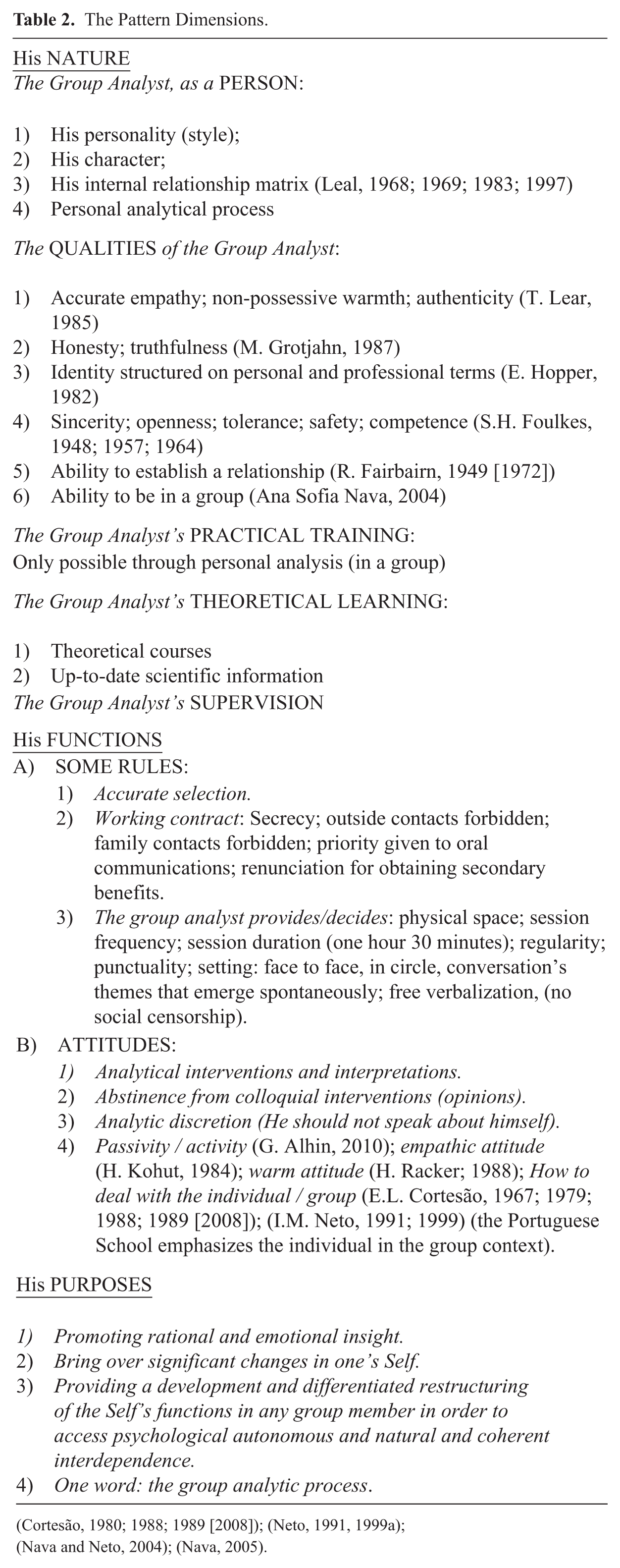
(Cortesão, 1980; 1988; 1989 [2008]); (Neto, 1991, 1999a);
César V. Dinis (2002; 2005) transmits strong ideas about the importance of the group analyst’s person and presence, considering the relationship between the group members and the group analyst a clearly asymmetric one, where the group analyst has ‘responsibility to look after the group to prevent it mimicking a self-help group. As such, he must be vigilant to ensure authenticity, and attentive to avoid alliances of convenience, defensive collusions and reactive character formation’ (Dinis, 2005: 13) (translation by the author).
Isaura Neto (1999a) emphasizes different kinds of pattern in different moments from the group dynamics: (i) ‘When a group analyst has to deal with himself and with the group’; (ii) ‘When he became a transference figure as the result of a neurotic movement by one or more group members within the context and dynamics of the matrix’; (iii) ‘When questions are raised in the “here-and-now” as regards the group dynamics’ (Neto, 1999a).
Final Remarks
The majority of Portuguese authors think there is a clear presence and influence in these pattern related phenomena during group dynamics, such that in a gradual way one will see the integration of ‘an exogenous pattern—conveyed by the group analyst, and an endogenous pattern—elaboration of the endogenous pattern by the matrix’ (Ancona, 1989 [1992]) and ‘this process is gradual and harmonious, so that eventually the two patterns interpenetrate and empower one another’ (Nava, 2005). This will create the specific functioning characteristics for each group’s dynamic.
The pattern correlates with the matrix and group process gradually and it can no longer be considered as belonging to the group analyst, since the group will spontaneously integrate and take possession of it.
As a possible conclusion, we can state that this conceptualization of pattern is an attempt to cover almost every aspect of the conductor/group analyst’s role including what kind of person he is himself; what he represents to each group member; how he works with the group; his influence towards the group dynamics and how these factors are influenced by his own quest for truth, wisdom and the emotional balance of each group member’s Self and to foster better interdependent functioning among the group members.