



Abstract
This contribution is about the Reflective Citizens Koinonia community intervention, with a specific focus on its moving matrix and transmissibility. Starting from the history of this method and its architecture, attention will be brought to the specific features, properties and values that make the matrix move and attune to local contexts. In order to give the reader an idea of the dynamic and emergent themes of RC workshops, some finger food from Chieri (Italy) Reflective Citizens Koinonia (RC Koinonia) first three workshops is presented to the reader, from the foundation without trauma to the first workshop held during pandemic in 2020.
Introduction
Thanks Regine for inviting me to enter in a dialogue with your presentation, in particular I resonate with the challenge to move the geometry of the circle from the clinical set-setting to the community. I will focus on one of the community interventions you mention in your lecture, namely reflective citizens, koinonia and a method of working with groups of citizens. In times when foundation matrices move faster as a consequence of anthropic activities and actions, RC Koinonia provides a space of developmental, positive social-psychic retreat (Mojovic, 2015) to halt, slow down, think, dialogue and dream as a community in search of new thoughts and directions. Little can the known when facing the unknowns of our times.
I will try to convey a taste of Reflective Citizens Koinonia, starting with its:
History
Regine reminded us that group analysis has its roots in difficult times, and so it is for RC Koinonia, since its cradle is in Serbia in the aftermath of the 1990’s Balkan War. It was developed by Marina Mojovic and Jelica Sataric in an attempt to take care of the wounded, damaged, disrupted social matrix after 10 years of bloody conflict. It is currently widespread in several countries of the former Yugoslavia.
To describe what it is about I will use the very same words that citizens read on the last review of Chieri RC Koinonia flyer, since the text was eventually adapted to our social and cultural context, so as to reach out to as many citizens as possible.
RC Koinonia is a space open to diversity where we can as citizens and participants learn and practice the art of LISTENING, DIALOGUE and THINK together about issues related to contemporary social and climate changes that are taking place in the present and will impact the future of our communities, locally and globally. We have a responsibility as citizens to think about the present in order to build the future together without relying on communication based on slogans and propaganda.
In other words, a place to tackle the issues of citizenship, as Pat de Maré (1996) would put it.
Architecture—the outcome of over 20 years of experience and careful thinking
RC Koinonia is the outcome of a careful and competent meeting and articulation of sibling methodological and theoretical approaches, namely: social dreaming, group analysis, group relations, listening posts, operative groups, therapeutic community. In this confluence each group device feeds the following one in a smooth flow from the SD matrix to the RC Large Group shifting into the small leaderless groups and back to the RC Large Group. Starting with dreams and talking to dreams lowers exposure to anxiety, and yet provides access to an intimacy between people who do not know each other and structures a safe enough space. Quoting citizens from RC Chieri: ‘Starting an experience with dreams creates a common ground’ and ‘. . . a space free of judgement: I can’t be judged for my dreams’, namely two essential conditions for the flourishing of the art of dialogue and listening, as well as for voicing different points of view.
RC method is built on blocks of events since it triggers a process which benefits from continuity; continuity means to hold and take part in RC workshops twice or three times a year, as well as the possibility of spreading this experience to other communities, towns, regions, resulting in the building of a RC network.
RC Moving matrix and its peculiar features/properties
This is the RC matrix potential for spreading and rooting in different communities, which recalls how strawberries spread out their thin roots and multiply in a green carpet, white blossom and producing red fruit.
At present, the RC is widespread in many countries of the former Yugoslavia where new branches spring out every year, in Italy in Chieri and Padua, in Greece in Thessaloniki, in the United Kingdom and in the USA in Dallas. In addition, on 25 April 2020, in the midst of the pandemic, the International Reflective Citizens (IRC) was born, currently in its sixth workshop. The IRC is a space where professionals—citizens from six continents come together in a rich, engaging, confronting, debate on citizenship issues in different latitudes.
What fuels the RC Koinonia matrix in its moving and rooting are its core values and the properties of its fabric. RC core values are embedded in the Serbian word zajednicarenje: gratuity, generosity, solidarity, cooperation, spending time together. Every workshop is free of charge; when a new branch is founded RC activists bring the ‘natural starter’, the matrix: participating in the first couple of workshops—Marina, Zaven and Sanja travelled to Chieri to bring the Serbian matrix—and the new branch was delivered without foundation trauma. Gratuity because the host is investing time and competence in founding and caring for a RC branch without income; gratuity because participation is free of charge, the condition that makes RC accessible to citizens, regardless of their economic situation.
And about the properties of the RC moving matrix:
Transmissibility by any interested and motivated citizen, no need to be a professional of the psychological field—when Chieri Branch was founded Marina and I were the only group analysts in the staff—my friend Lorenzo is a sports entrepreneur, Maria an illustrator and Gaia a medical student. A new branch can be founded by only one motivated citizen, trained through experience and following the method, since the method makes it move.
Flexibility is needed and therefore the capacity to tune in to local reality.
Plasticity needs to be present, since it can be compared to clay, namely a solid material than can be modelled to adapt to the emerging needs of the local community. I refer to the different formats and applications: travelling RC Koinonia, Cultural Shelter and RC, RC workshops on a chosen theme (i.e. the one held in Dallas about racial issues and racism, RC for Climate and RC for Health in Novi Sad), spirituality RC workshop, Walking RC, RC in Organizations, RC addressed to special populations of citizens such as children, adolescents, children and parents, etc.
Finger food from Chieri RC
To offer a taste of RC, I will try to give some hints about the process and emergent themes of the first three workshops held in Chieri (Bascialla and Mulasso, 2021).
During the first RC workshop (9 March 2019) 70 citizens grappled with the meaning and aim of the RC experience, as if to better understand what was the purpose of that space and which shape it could take. The dreams contained suggestions: it is possible to lose one’s usual lens and try on other people’s glasses so to change our way of looking at the world; I can meet the other and mirror myself in him/her, a common humanity; a space where mending and repairing is possible—a dream about a torn necklace and the effort to look for the scattered beads; citizenship as the antithesis of becoming robots, the former requiring to reach out to the other. Also questioning the possibility to shift from reflection to action taking on responsibility, and the issue of time, namely whether the RC time is ‘cronos’, a quantitative sequence of events in time, or ‘kairos’, a qualitative time in between, where something special happens.
Of course in this first workshop sewage, fear, conflictual fractals surfaced, but they were not picked up from the matrix, so the RC baby was born in Agape.
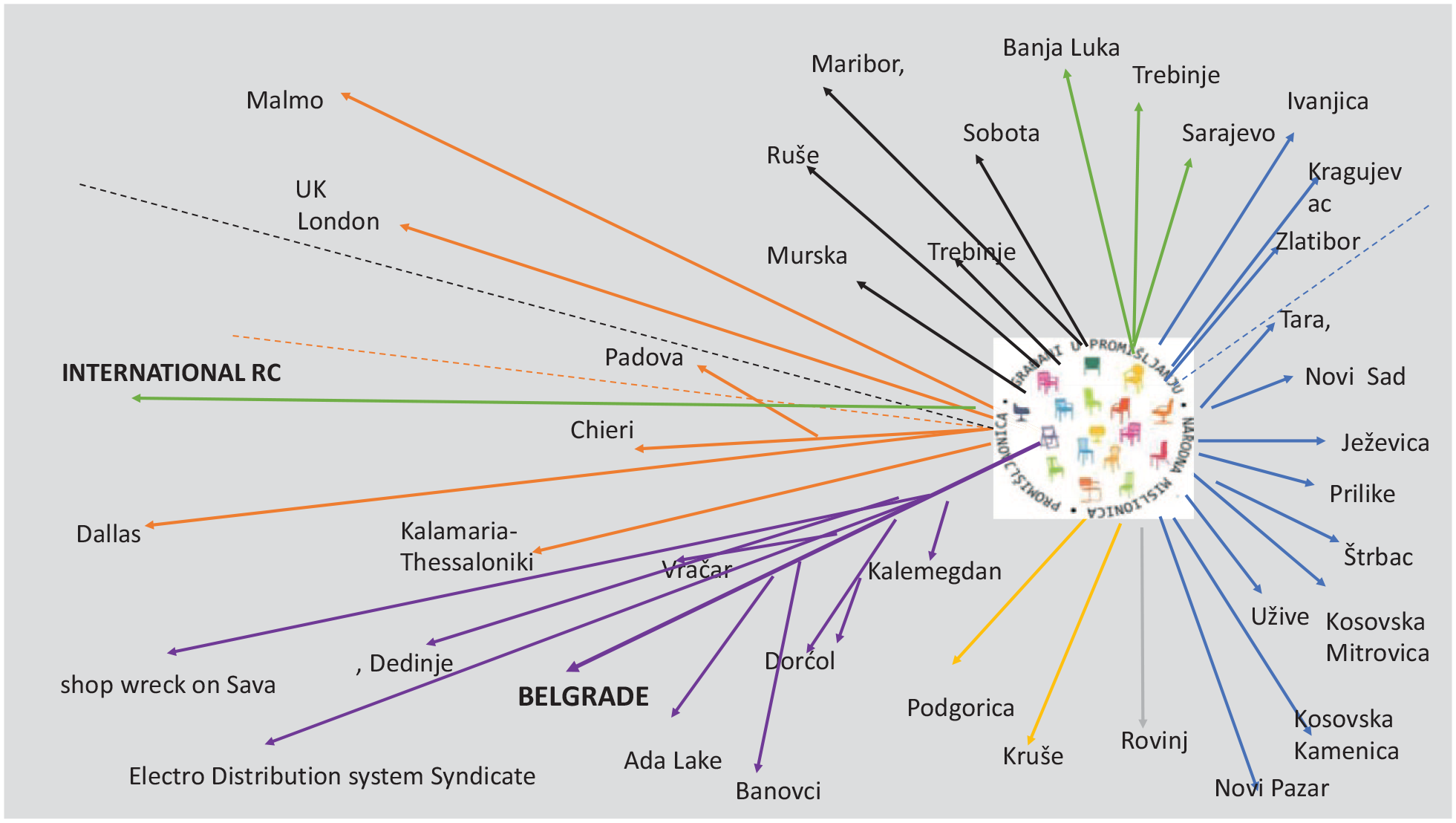
Web of spreading of RC network
The second RC workshop (14 September 2019) contained 70 citizens and two subgroup meetings: the experienced and the novice. There was a very fast rhythm, both in the matrix and in the large groups, as well as in the small groups. One of the main themes dealt with was intergenerational confrontation, since there were many young adults among the participants. Dreams talked about youth and children given responsibilities that they could not cope with yet; being the wrong person in the wrong place; handling power without the appropriate tools to do it; polarizations about the use of technology; intergenerational differences; the presence of water in different shapes evoking the image of the youth—not like wanderers anymore—but rather as sailors looking for their way towards the horizon which is the same for everybody; a need for connection with nature and community.
Due to the Covid19 pandemic we had to wait until September 2020 to hold the third workshop, with fewer citizens (30) and in the open air and social distancing. The huge empty space created by the Large Groups’ chairs’ arrangement was a representation of what we had been going through and still were, such as social distancing and empty cities/spaces. Meanwhile it was so touching to be physically present for the first time since the pandemic burst into the world. In the SDM dreams rushed one after the other, generating a galloping rhythm as if they had been waiting for a long time to be told. Apocalyptic dreams about the end of the world suddenly evolved into more hopeful narratives. If I were to give a title to this workshop it would be: ‘where will we go and where are we heading to?’
Since then two more workshops were held in June and October 2021, and Chieri RC matrix is in evolution:
The matrix is now moving from its first cradle on the hill top, a safe open space in the outskirts of the town, to the Youth Centre ArKa in town, hosted in a venue run by the youth cultural association Hygge. A networking process with local associations has started!
Quoting Humberto Maturana (2019), whose thought seems to be embodied by RC Koinonia (he developed the biology of love and founded the matristic academy in Santiago del Chile): If we do not reflect on the foundations of our opinions, ideas, beliefs, we turn towards fundamentalism.
Thank you for listening.
