



Abstract
The essentials of therapeutic practice in group analysis are summarised through three basic principles. The conductor is responsible for fostering a climate that allows each of a group’s members to find their own voice; bear witness to the voices of others; and come out of the shadows together through the group’s discourse.
These principles are built on the author’s earlier writing about the speech, silence, and the language of the group which can make a home amongst strangers. They are framed in the ordinary language of daily experience and the parallel idiom of musicology to address the most primary of musical instruments—the voice.
They incorporate of a range of other terms and concepts that bring our attention to core complexities at the heart of many peoples’ deepest sources of disquiet arising out of unresolved intergenerational trauma. The group’s work is akin to a mourning process set in motion for hitherto unacknowledged grief. Disturbance can move about unpredictably. Our challenge is to locate and translate hidden, buried or displaced injury into the everyday language of human suffering where seeds can be sown for resolution.
This multi-modal presentation is illustrated with clinical vignettes from groups at work and with collage and paintings. It opens with a Paul McCartney song, ‘Blackbird’ (1968), whose music and lyrics give historical significance to the struggle for human rights. Its closing vignettes explore ‘tools for conviviality’ with images of lost and found brotherhood and a spontaneous online ceremony of eating together in China. The paintings of Morris Nitsun bring us to an ultimate agency for change generated by small groups—the shifting mood-scape of their dynamic life. One image conveys the tragedy and desolation of the pandemic, and another offers the natural world’s consolation in beauty.
Keywords
Introduction
This keynote opens with the voice of Paul McCartney giving flight to the bird with the broken wing (Blackbird, 1968). He expresses a new generation’s aspirations for change—one I am proud to be a part of. Sixty years ago, and more, we thought we could change the world. The voices of the Beatles, and others like them, took us part of the way. Bob Dylan marked ‘the times they are a changing’ and 60 years ago to the week, Martin Luther King who spoke to us from a dream, told us that though ‘the arc of the moral universe is long . . . it bends toward justice’. Group analytic training began during the Second World War and then in its London context in the 1960s. The optimism of the time—a brief window—entered our field and led many to think that groups might carry the day.
This optimism is sustained by the heartening growth of training institutes for group therapy in many parts of the world. The work of this Society has spread and our attendance at this Symposium is inspiring. EGATIN now has membership from some 40 training institutes from Eastern and Western Europe and beyond. Germany alone has 17 training centres with new developments beyond Europe’s boundaries including China, India, Indonesia, Israel, Japan, Rwanda, Russia, Singapore and South Africa. It is a special honour—and a daunting challenge—to bring you my own perspective on our work with groups—and to be doing so in a part of the world that has suffered from so much violence.
I trust you will appreciate my sensitivity to matters of violence when you learn that my unusual name: Schlapobersky, is only unusual because almost all our large family carrying this name perished in in the Lithuanian Holocaust in 1941. In the circle of our immediate family alone, there are some 40 civilian murders, and the killing fields lie all around us. Some are as far as Lithuania and others lie just a few hundred kilometres away from Belgrade. New fields of death are being sown with the invasion of Ukraine. We are all neighbours to the dead. If we are to remain hopeful, we must face the challenge of not falling into their silence. We honour them in how we attend to the living, how we protect our endangered planet, now on fire, and how we safeguard the future (Schlapobersky, 2017).
Our founders emerged from the ravages of the Second World War with humanitarian principles that inform group analysis and have helped to shape the programme of this Symposium. I wish to honour the organizers for bringing us to Belgrade where much reparative work has been under way for some time. We are here to learn from you and from one another and to see how we can make our own different contributions. This is our first face to face meeting since the pandemic. I extend my thanks to the Society for inviting me and special thanks to Linde Wotton, the Society’s Scientific Secretary, who has carried the work from Berlin 2017 to Barcelona 2021 and now to Belgrade. I also extend my sincere thanks to Tija Despotovic and the Local Organizing Committee, which you chair so ably, Tija, and to Carla Penna, today’s respondent—thank you for your response Carla, and for so much that goes beyond it.
Primary principles
This presentation offers three principles for therapeutic practice:
The first is the responsibility we carry to foster a climate that allows each of a group’s members to find their own voice. Some find it hard to express or even discover personal or authentic voices of their own and the group becomes an arena for this shared struggle.
The second involves the bearing of witness to the voices of others. The conductor may need to speak as a witness in the group and set the groundwork for people to bear witness to one another’s voices. Some group members can discover the opposite as we become aware of their inability, resistance or reluctance to honour this principle toward one or several others. Instead, they look away from, disavow or demean the person or the story of one or some of the others in the group. This which then becomes the ‘location of disturbance’ —a term pioneered by Foulkes which is now widely used— and a topic for analysis and exploration (Schlapobersky, 2016: 440–458).
The third is in the dynamics of collective engagement that create a new emergent—the group-as-a-whole—that can allow its members to come out of the shadows together and find themselves anew. Like the other two principles, this can also emerge in a mix of light and shade. Here too it can fall to the conductor to foster curiosity about the analytic enterprise, especially when the going gets tough. The conductor leads in the spirit of enquiry from relational, through reflective to reparative experience in the group. The group-as-a-whole is only entirely ‘in the light’ at rare moments of transcendence or transformation when it comes to its ‘home key’, as Linde Wotton puts it. Its process is lived out in the passing light and shadow of free-floating discussion which can be charged with dissonance and conflict. The group can be fraught with tension and frustration at one point, or in one sub-group, and eased to the point of resolution in another. These fluctuations between states of dissonance and harmony can sometimes be profound and often take us by surprise.

Three dynamic principles in group psychotherapy.
These three principles are framed in the ordinary language of daily experience and in the parallel idiom of musicology as we are, of course, talking about the first and most primary of musical instruments: the voice. Wotton describes how ‘human communication rests on our innate musicality . . . only by aligning ourselves alongside another—through being in time and in tune . . . (can we) make sense of what Mead calls the conversation of gesture and response . . .’ (Wotton, 2012). The simplicity of the formulation should not be mistaken for anything superficial. Our engagement is with the hurt, the injured, the lost and the displaced: people whose lives are spent in toxic bonds. In charting our course, we bring into focus the subjects of unknown and un-mourned grief, problematics that lie at the heart of intergenerational trauma that groups can help to identify and resolve. These three principles were first set out in this integrated form in a paper I published in Netherlands in Leerboek Groeppsychotherapie (Verhagen and ter Haar, 2022).

The language of the group.
The scope of group analysis
These open, general principles allow the systematic incorporation of a whole range of other terms and concepts in group analysis and beyond, which you can track as we go, together with their authors. In the cases I bring to your attention, the core complex that lies at the heart of many peoples’ deepest sources of disquiet can arises out of unresolved intergenerational trauma. The group’s work is often akin to a mourning process that the group sets in motion for hitherto unacknowledged grief. Disturbance can move about in unpredictable ways and our challenge is to locate and translate hidden, buried or displaced injury into the everyday language of human suffering where we can sow the seeds for resolution.

Three dimensions of psychotherapy.
In my Foulkes Lecture (2015), I described group therapy as a process of making a home amongst strangers (Schlapobersky, 2015). These ‘stranger groups’ sharpen our focus on how, through free floating discussion, aliens can become allies in intermediate territory of the group. The intimate conversations that can make a group therapeutic, replicate the kind of exchange that happens between people at a dinner table or round the hearth. Group therapy borrows from normative groups but behind the simplicity of ordinary conversation, attention is shifted from what is troublesome in the world—reported on in people’s homes or offices—to what is troublesome about the world within the room and the person in the group. Resolutions may be found as the hidden but active group at work is revealed inside each one (Pines 1996). Troubled members of a group are found internally ‘occupied’. Therapy bears fruit as each one’s internal, troubled group gets played out amongst the others. The group’s resources, its narrative, drama and analysis, move the experience from the telling of stories to interactions of the moment, and then to reflection and reparation. In the progression from relational through reflective experience to reparation, we rely on movement in the group’s language, from monologue through dialogue to discourse. The three principles introduced today are not necessarily sequential in the same developmental way. They can arise simultaneously and work on synchronous terms.
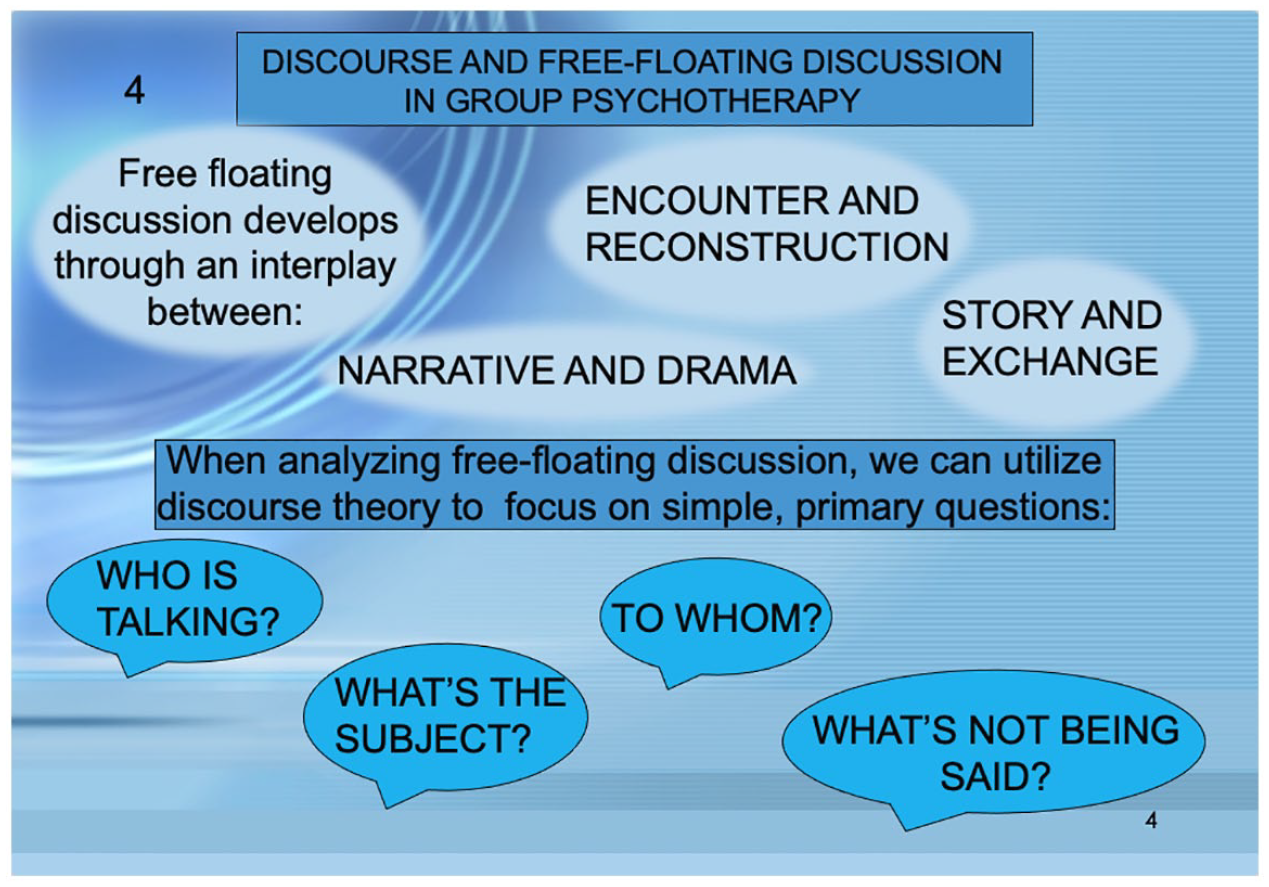
Discourse and free-floating discussion in psychotherapy.
Each of these three principles are illustrated with one vignette drawn from my own practice. There are then two concluding vignettes, also drawn from my practice, that emphasize those moments when the three principles work together to bring the group as-a-whole to life and they take the work beyond our European therapy rooms. One summarises events in a human rights agency in London in the 1980s in a group for refugees and survivors of trauma from countries in which torture is endemic. The other is a vignette from an online therapy group in China that captures a moment when the group ‘turns’ into a crucible for change.
The ‘magic circle’ of the group can open its members to their own and to one another’s lost voices, as James Anthony puts it (Anthony, 1978). There may be a history that is unidentified or unidentifiable, arising out of known, unknown or un-mourned grief. These lost places in peoples’ lives may be places of loss or places that never existed in the first place. So, the empty and vacuous states underlying predicaments of many different kinds might be defensive or they might arise out of unformed experience in the past. We are dealing with trauma in the first case and with deprivation in the second. Some who populate our groups struggle with both and we rely on the emptiness of the circle to find and locate the emptiness among or within our members. What happens next, the how, why and what of the unfolding process, is the core of this paper.
Subjects like ‘troubled’, ‘emptiness’, ‘home’ and ‘homeless’ are selected as key figurations that colour the process. We owe the term ‘figuration’ to Foulkes and Anthony who drew it from the sociologist Norbert Elias (Foulkes and Anthony, 1984). Figurations capture moments in which subjects or topics in a group gain significance through thematic content interwoven with the process dynamics of those who generate it. Home is not only a theme or subject. It colours relations amongst those who express it. As people in a group construct the picture of a home that was once safe but is now lost, they can generate a sense of safety or one of loss. They can come to inhabit the very subject of our theme—safety or grief—through a process of enactment or recreation. Some remember home as the sanctuary of childhood whilst others—people who could not wait to get away—remember precarious attachments in homes of injury, abuse or entrapment that left them in chronically insecure states of different kinds. Others remember home as a location that was both loved and resented, leaving a confusing residue of ambivalence in its wake, later found underlying, other difficulties. For some, home references are lost in an unremembered world. For others home itself was missing as the family lived as itinerants. Some can only find home outside the group on returning to loved ones in the evenings; for others home has yet to be found anywhere. Some find themselves at home in the group—the only safe place they have known—whilst others find it a source of anxiety, persecution or confusion. In a group’s associations we can find an emerging theme or subject that has bearing on the dynamics of its process. In the triangle between the past—there and then—the present—here and now—and the present world outside the group, process dynamics recreate the originating subject under discussion.
The three principles are illustrated with collages by our colleague Eve-Marie Kimmerling—presented here with her permission. They capture the startling poetry with which the unconscious or primordial can erupt into the visual field of the present. She will later present her collages in her own workshops here at the Symposium. Here they are called on to capture the startle-effect of the unexpected and improbable in the paradoxical nature of interpersonal life.
The material in the vignettes has been authorized and anonymized in accordance with the ethical requirements of the Institute of Group Analysis and International Psychoanalytic Association. All who might recognize themselves have been consulted and some have helped to shape the content of what I will now be sharing so I thank and honour them now.
Finding a voice, bearing witness, coming out of the shadows: Three vignettes
Vignette 1: Finding a voice
Two members of a small group, a man and woman who have been with us for some time, recount detail of early parental betrayal. Though cared for physically, they were embroiled in emotional injuries for which they had neither words nor recognition. The man says to the woman, ‘I think you were abandoned before you knew it’ and, when she protests, he replies, ‘I look at you, casting about, going from place to place and person to person—you look just so lost. I look at you and I see myself’, and tears come to her eyes. His mirror opens her heart. By finding voices for these histories, these two have gained new degrees of autonomy and well-being in a reparative dialogue.
The dialogue becomes discourse when joined by a third participant, a newcomer amongst us, Michael. Unexpectedly he draws attention to himself—something he rarely does—to tell us he is having a panic attack in the room. He cannot bear to hear what the other two have to say about their childhoods. He has no memory of his own but is filled with alarm as he listens to theirs. His own agitation and upset fill the room. It must have been terrible, people say, because the room is just full of his distress, and he cannot remember anything. Someone else comments that it is his agitation that speaks. We know that in his early teenage years his mother sent him to live with relatives in the UK to get him away from conflict with his alcoholic father in their Australian home. Now he gives us other glimpses of early hurt and injury. His body carries the panic that cannot be registered in words. We see him speak with his body’s voice. He is embarrassed by his loss of control, but people encourage him to talk to us about what he is feeling in the moment. In addition to the role of holding and containment, my own contribution is a concluding observation that day, that the hurt in the room tells us about what he simply cannot remember: the feelings of a troubled little boy.
Commentary
The psychotherapist’s quest is to penetrate the heart of stone that holds the secrets of inner injury, and to do this we need to find form in its silence. We sit through what Fairbairn calls ‘the return of bad objects’ (Fairbairn, 1986), the disturbing consequences arising out of hidden and now recently felt sorrow to which our groups give voice. The holding environment contains this man’s disturbance, giving a context to his agitation, meaning to his hidden history and a new sense of the possible in this encounter with a lost past. He does not have a voice made up of words. It is his body that does the speaking, and it speaks to the group of a deep-seated fear that has always been present and the group, over time, helps him put it into words. We begin to find answers to the question he poses: Will he always be haunted by his lost childhood? We get close to his most profound fears by attending to what he does not say. The worry is not revealed by what he says but by what he cannot say. We work ‘between the notes’, as Linde Wotton puts it in the first of her own original publications (Wotton, 2012).

Kimmerling: Explorers of deep time; exhausting all possibilities; a golden moment; sublime resonance.

Explorers of deep time.
Human suffering—including serious early deprivation, the adult or childhood experience of grave adversity, trauma or abuse, illness or disability—creates its own areas of silence. These are the shadows of hidden injury where numbness, the sense of betrayal or the permanent sense of living in a state of exile from the self and society, can remain deeply concealed. The earlier and the more serious the injury, the greater can be the level of encapsulation or disassociation. Our task in psychotherapy is to gain access to these hidden areas of silent affliction, allowing people to find their own voices and freeing up the voices of others.
Vignette 2: Bearing witness
Juliette was working out her notice after some seven years in a twice-weekly group. She had a successful career and was finally settled with a partner. She had lived through a childhood of conflict between her parents, their painful divorce and finally her mother’s severe mental illness. She ran away at 17 when the mother became dangerously psychotic and left the country to join a father she hardly knew in Hong Kong. Living abroad, she did well at university, established herself as a business consultant and found love with a new man. They returned to the UK and were in the process of setting up home together. She had still to overcome many adversities and the group gave her a context in which to gather and find herself—it became an auxiliary ego.
She knew that her earlier failed marriages arose out of a personal history still alive inside her which she now brought into the group. During her early years with us we appreciated her insights but found her brittle and defensive. If we came too close to her core conflicts we found anger, repudiation and withdrawal. People gave her the adjective ‘stony’ and described her as ‘hard as flint’. Despite the increasingly open account of early injury, we hardly ever saw her tears. She left the group a few times and returned after some sessions or indeed, on one occasion, after months away. These were the patterns of conflict associated with her current partner and previous husbands—splitting associated with the encapsulation of early injury. People recognized that what she did with us in the group was a mirror to the pattern described with her partner. Another member who was once a boy scout described her communication as a kind of semaphore made up of only two signals. She gave people only two options—one flag for ‘love me’ and the other for ‘fuck off!’. Whoever could not give her the first got the second—you give me unconditional love, or I will give you rejection. This was her mother’s story, and we helped her change this into one of her own. The splitting that governed attraction and rejection had ruinous consequences for her previous love relationships, but here, slowly, the holding power of the group and its members allowed integration of different psychic pressures. Some years later, soon after the death of another woman’s father at a time when people were in tears about lost parents, she gave notice of departure.
Vignette 2: continued
Juliette was grieving about her forthcoming departure during a period of mourning, but she showed no appropriate emotions. People had seen her through a great deal and knew her intimately. She had become an affectionate, available and emotional woman and gained a resilience that was to see her through unforeseen crises still to come. Much of the defensive encapsulation was resolved, and so was some of the splitting. On leaving she had no words or explanation in response to others’ concerned enquiries and we lived with the weight of her sorrow during a long silence. Close to the leaving date she began to weep unexpectedly but could say nothing about her tears and we had to leave her to cry. Eventually she found words to put an end to a silence she had never known that she was living with. Without warning she said, ‘You people are crying for what you’ve lost’. This was true. Three of them were crying over parental loss. Juliette said, ‘You’re crying for what you’ve lost. I’m crying for what I never had. This is different’. We all knew what she meant—this was her region of the unspeakable. She went on to say, ‘It makes losing you all now feel very dangerous. You’re the only family I’ve had where love has been safe’.
Juliet looked at me in an intense way that seemed to take me in with great meaning that was sustained through her concluding sessions. This remained part of our continuing relationship as need arose later in her life when she came to see me occasionally 1 .

Kimmerling: Becoming invisible, opening new apertures, a tender heart, recalibration.

Kimmerling: Becoming invisible.
Commentary
These areas of unspeakable injury belonged to Juliette’s early years, leaving her set apart and marked by difference. Only by denying the fear, shame and madness of her history did she feel she could lead a normal life. Now she made a poignant observation on leaving, sharing its prime contribution to her life. She had discovered, she said, that it was never too late to have a happy childhood. The phrase remains alive in the group 25 years on, despite its rotating membership. The unspeakable silence was about an aspect of her history for which, until she found the word, she did not realize she did not understand.
No one could have given Juliet these words until she found them for herself. It was the same in Michael’s case. The encapsulated injuries required denial to create the illusion of normality, but the price paid was hardness and splitting that undid any options for living through the ambiguities and uncertainties of ordinary family life. What Michael and Juliet each found in their different groups was that by remembering the past, penetrating the core of its injuries and the heart of stone—and then coming to terms with their radically different histories—they could finally leave the past behind. Previously, the earlier silence of a dissociated history had ruinous consequences for what they most hoped for—a happy family life. This was replaced as they made new sets of terms with their own histories and learnt to ‘play’ with their own and with other people’s experience. They acquired a sense of peace that allowed those they were closest to, finally, to know them on very different terms.
Barwick describes how ‘the witnessing process—“observation and self-observation in a social setting”—is a crucial therapeutic group activity facilitating the revision of both ego and superego boundaries’ (Barwick, 2004). He quotes the emphasis given by Foulkes in his ‘model of three’, ‘the simplest elementary model for the understanding of interpersonal relationships’, where engagement between any two people is witnessed by a third. The narrative detail given in Vignette 2 describes the developmental impact of bearing witness—of witnessing and being witnessed—at the core of the model. This process rests on what he calls witness credibility in which the foundations of self, allow individuation through ‘the gradual patterning of difference’.
. . . The witness must not only witness but speak. If the silent witness cannot be encouraged to speak in a group, the therapist must. It is only the process of an ever-evolving dialogue between witnesses that transforms what otherwise might be stoic resignation in the face of further ‘desolation’, into the promise of real change. (Barwick, 2004: 126)
In her recent Foulkes Lecture, Miriam Berger (Berger, 2023) anchors the witnessing process in the horizontal axis of group life, supported by her discussant, Joanna Skowronska (Skowronska, 2023). ‘Facts matter’, she writes, ‘just as the obliteration of facts matters . . . the absence of witnessing expressed through nonrecognition, denial or silence, becomes a fact in its own right’, calling for attention. She calls on the writing of Ashuach and Berman (2022) who direct us to adopt a concerted look . . . into the cyclic nature embedded in human sociality . . . Horizontality offers us a perspective which opens up an ever-growing awareness of the lived, interactive processes which unfold among members of the group (that) unravel the relational consequences of their past traumatic experiences and enable them to become active participants in each other’s healing. (Berger, 2023: 447)
Vignette 3: Coming out of the shadows
In a small group, our recurrent figurations are all about mothers—a familiar and recurrent topic. Some have had endearing mothers, others speak only of bad mothers whilst others have complex and ambivalent relationships. Whenever the subject of mothers comes up, Zofia—a relative newcomer—‘leaves the room’ and seems to just disappear. Her withdrawal is radical and immediate. Zofia herself—though she has explained how little mothering she had, many times over—cannot see herself through others’ appreciation. We are just getting to know her, but she does not seem to know herself. One day she comes in to tell us of her deep embarrassment at the opera. She was with a friend at a performance of Puccini’s Madame Butterfly and, as the story unfolds, the Japanese mother of a little boy named ‘Trouble’, is depicted waiting for the father of her son to return from America. The son is played in the story by a marionette—a puppet. The distracted mother looking out to sea has no eyes for her child and, at a point, the marionette looks up at his mother with his little head set to one side in a wordless gesture of desperate and imploring need. Zofia tells us about this and shows us how he looked up at his mother and she opens her mouth as the marionette did on the stage. She breaks down in a wave of tears as she does so. This happened at the opera. She sees her history in the marionette and cries her heart out in the group. She is comforted over a long period as tears wrack her body. When she can finally speak, she tells us what happened in the opera when she had to rush out for a time and missed part of what followed.
Commentary
This is what must have happened in Zofia’s childhood so many times over but there is no flight now. She goes through what Kurt Goldstein, writing about a different population, called a ‘catastrophic reaction’—a breakdown of the familiar leading to the disorganization of established defences and a prolonged period of acute vulnerability (Goldstein 1939/2000). Here it becomes a cathartic rather than a traumatic state, followed by new and healthier adjustments. Zofia’s own history in London and her parents’ histories in Poland become new, dominant figurations in the group for some time, running parallel with the similar stories of others. In the months that follow, we discover how her history was lost in the shadows. Together with others making similar journeys, we recognize that she is now coming into the light with a voice of her own. As people come out of the shadows together, the group furnishes an arena that bears witness to the lost, the hidden and the unrecognized.

Kimmerling: Dreamweavers, shapeshifteres, divine threads, transformed.

Kimmerling: Objects of desire.
The intermediate territory of the group: A lost past made visible
The principles are three facets of a prism that allows access to indivisible core experience at the heart of the group. Working together they allow the return of the repressed. A man struggling to find his voice is seen and witnessed in this struggle and, with others’ help, emerges from the shadows of his own history. A woman without access to her history repeats it through dramatic enactments that work like a brass rubbing to bring into relief the complex texture of her injuries and lacunae so that the hole at the centre of her life is what she can eventually grieve for, and her tears are elicited by the group’s empty space. And the defensive structures of another woman whose avoidant dissociation of anything to do with mothers is finally undone by a night at the opera during a period in therapy when she is held in compassion for the first time. In the gesture of a marionette that captures what the poet Sylvia Plath called ‘the O-gape of complete despair’, she discovers her yearning for maternal care and, joining the group through her tears, she turns longing into belonging (Plath 1981).
They live with the hidden inflections of time-bound injury that carry the legacy of intergenerational trauma. The events of the Second World War have marked and blighted their lives, two and three generations on. Michael’s grandparents were, respectively, sole survivors of Jewish families in Hungary who perished in the Holocaust. They met in a displaced person’s camp in 1945 and became part of a large contingent of survivors brought to Australia. His parents who raised him there could not give him a home. Juliette’s mother, together with Julia’s grandparents, suffered a direct hit on their underground bomb shelter in London during the Blitz. Whilst many others perished, they survived in the shadows of massive psychic trauma and, like so many forms of complex PTSD, Juliette’s mother could be tipped into psychotic states by any passing events. Zofia’s parents—Polish refugees who settled in London after the War—also carried their histories into her upbringing. Her mother was a young nurse in the national uprising against the Nazi occupation of Warsaw in 1944 and had lived in a permanent state of shock since then. She carried an utterly blank absence of emotion into her adult life and into the life of her daughter.
They are a sub-set within the much larger group of people we see in groups troubled by what Friedman describes so accurately as primary relational disorders (Friedman, 2013, 2018). Galit Atlas describes their emotional inheritance in a new book of this title (Atlas, 2022). The relational disorders of their parents and grandparents leave these child survivors living in the haunted homes of their forbears’ histories with few outward signs of any ghosts.

The group’s intermediate territory.
Resonance is the ‘organizer’ of the group’s elementary dynamics—mirroring, exchange, amplification, valency and condenser—and as the substrate of a group’s life, these dynamics work through free floating discussion to configure its process and content (Schlapobersky, 2016: 247–277). We see resonance turned into pictures in the paintings that illustrate this keynote. I have called on the scenic understanding of the group as theatre, following Beck, O’Beney, and Mallet, where enactments, positioning and witnessing, arising out of the more elementary dynamics, give meaning to its figurations (Beck, 2006; Mallett, 2015; O‘Beney, 2022).
The magic circle and its four domains
James Anthony introduced what he called ‘the group under the couch’ as early as 1978. He described how the analytic situation that appeared visibly so bare was in fact haunted by groups from the primary family organisation onward . . . the air was clamorous with the voices, supporting and persecuting, of friends, relatives and enemies who made up the social orbit of the patient . . . The group-analytic therapist incarnates the ‘group under the couch’, settles them down in a circle of chairs, transforms each of them into a patient and not a projection and joins the circle himself . . . in a face-to-face encounter. There is no concealment, no diplomatic immunity . . . (Anthony, 1978)

Barbeito: Images of the day, images of first reflection and the current domain of the group.
This diagram describes the ‘magic circle, with its multiple layers of communication’. It is set out here to give a pictorial sense of the group as a whole working in its four domains—the current, transference, projective and primordial (The four domains of a group: Schlapobersky, 2016: Figure 13.2). The paintings of Daniel Barbieto, a contemporary artist in Uruguay, help to illustrate the domains. I have arranged them in a progression from faces of the day in the current domain to faces and feelings of the night in the projective and primordial. Objects of the accessible mind capture the images of the transpersonal and proceed to those of the unconscious (Barbeito, D: https://www.dbarbeito.com).

Barbeito: Fantasy and daydreams — the transference domain of the group.
People’s passage through the group is captured in a series of Barbeito’s paintings Depictions begin at the level of first reflection—eyes, visage, demeanour and facial deportment—all portrayed as we might see them and indeed ourselves, in a group, a mirror, a portrait or a photograph. This is the current level of the group in which Michael, Juliet and Zofia are people with names, histories, problems and preoccupations.
This is the world within, the domain of ‘whole objects’. You can see the woman’s face and then see her romantic dream going out to a man on a balcony with the moon in the sky above and, perhaps, her dream, perhaps of a future—there is a herd of cows and perhaps a home or a church? Can you see longing in her face? Or anticipation? This illustration of one woman and her fantasies could reveal that the man on the balcony is really her father in the past but no, more likely it is the partner she hopes for in the future. Is this memory or desire? The transference is charged with projective disappointments and dreams for the future.

Barbeito: Mental content set outside the mind — the projective domain of the group.
Here we see the picture of another woman’s face with all her mental content externalized—there is a pink elephant, a cow, two forms of transport—a car and an aeroplane—the sun in one place and the moon with a star in another, a rooster or parrot between a tree and a face, two significant others, a scorpion or a sea-creature, a church dome and a television set. What a world, just like you and me! Consider what Anthony had to say about the world clamouring for attention under the couch in analysis! Now, all of it is in the group and what a world it makes!

Barbeito: The archaic or primordial domain.
This picture takes us to what we might construe as someone’s part objects. There are so many weird creatures of the mind swimming like protozoa in a single, directional flow. And what creatures they are! What is her unconscious made of? And what was it that launched them in this direction? Where do these projections come from and where do they go? So much for the world within, so much for its projections and so much for the landscape of archaic experience.

Barbeito: The world between.
The last in the Barbeito series describes what happens when we place a person in a group or consider them in a couple. A man and a woman stand at the foundation or current level standing back-to-back on a hill. Each is speaking into the ear of a different face. The two faces are set at angles to one another and, from the open crown of these two heads, we have a flow of little people moving in both directions. Can we construe this as intimacy? Is it a pictorial form of fusion in the unconscious life of a couple with the transpersonal flow of unconscious life experience? We might imagine this is exactly what is happening through the merger of conscious and unconscious experience in the life of a group.
Conclusion: The sonorous self
Beneath the current domain, the transference, projective and archaic are in constant tension with words from one person—expressing themselves at one level—attaching themselves to another one or set of members who are at that moment caught up in something that might belong to an entirely different domain. The wordscape and the landscape are in constant movement, sometimes in tension or opposition, and at other times, in synchrony. In the model we work to, we are committed to staying with free floating discussion and, for this to work well, the conductor’s primary challenge is to read the silences, translate the tears, decode the injurious interchange and find a new key that can turn a potential cacophony into something resonant and meaningful. In the last vignette you will find a person’s hands reaching out from an online group to offer sunflower seeds to a fellow group member thousands of miles away.
Vignette 4: My brother, what have they done to you?
One ‘turning point’ is drawn from a group meeting in a London centre established for survivors of organized violence in the 1980s. This account comes from the opening meeting of one of our first such groups. Much of the span of my own work belongs in the 35 years between this group and the concluding vignette describing a current Chinese group.
A group of eight men sit in a circle with two therapists for the first meeting of what will be a two-year group programme of some 70 sessions. They come from countries in which torture is endemic and have all been profoundly injured. None of them know each other but they all know one or other of the two therapists. Some are from the Horn of Africa and include a Christian Ethiopian and Muslim Somali. From Black Africa there is a Congolese and a man named Jonas, a Rwandan Tutsi who survived the genocide, both of whom were raised as Christians. The other four include two Iraqis who are Sunni Muslims and two Iranians who are Shi’ite, one of whom is Mustafa. Their religion, nationality and the ethnicity of their origins are given to stress their differences. What they have in common is prior experience of traumatic loss and violence. They are all refugees. We are meeting in a clinic established to provide such services for this population. All the group’s members have already had extended periods of rehabilitation followed by preparatory psychotherapy with either one of the two co-therapists.
We struggle through introductions that falter and halt. People refer all their questions to one or other of the therapists, from whom they expect answers. The two therapists are occasional and cordial participants, but we consistently refer back to the group. Then there is silence, followed by limited narrative sequences in people’s fragmented stories of origin and arrival as refugees. We are as enabling as possible, but the edge to people’s anxieties is inhibiting. All new groups begin this way with a form of serial monologue.
One of the men, Mustafa from Iran, asks where the toilet is. He is directed by one of the therapists, and everyone sees him gather his crutches from beneath his chair and limp across the group room to the door. He was already seated when the other members arrived so—until now—only the therapists knew how handicapped he was. We watch his every move in a kind of charged silence that remains unbroken whilst he is out. A few minutes later the door opens and watched by everyone, he struggles across the room back to his seat and stumbles into his chair perspiring from the effort. Finally, he replaces his crutches beneath his chair.
Jonas is a black man from Rwanda. He has extensive, visible scarring to his face and neck and speaks with a commanding French accent. He looks at Mustafa across the room and, leaning towards him, says, ‘My brother, what did they do to you?’ There is a long pause and then, with the reply, the room fills with relief and a real exchange emerges. Mustafa speaks in broken, faltering English about how soldiers at home broke his back with their rifle butts and boots and how lucky he is to be alive. He goes on to tell us of how his family saved him, how he escaped from Iran with his wife and about the baby they are expecting. This relational moment moves us from monologue to dialogue and the dialogue between these two leads to a non-directed and random exchange across the group in the conversational exchange that discourse is comprised of which informs us that the group is coming to life. It will falter, fall back and confound itself many times over in the coming months of therapy. This first relational moment begins in the voices of two people coming out of the shadows. We all became witnesses, and in the act of bearing witness, group therapy begins 2 .
Vignette 5: A ceremony of eating together in China
This slow open group meeting online with mental health professionals in China, began a new year of therapy with several vacancies filled by new members.
We had been doing work of value together but now found ourselves struggling with tension between the new-comers and old-timers which became our new and challenging focus—the ‘locus of disturbance’. The original members drew together in new-found alliances that made life all the harder for the newcomers. By contrast, the new members had a fragmentary presence that left them feeling even more isolated. The spirit of the original members was lifted by a vitalizing story from one of them. She had a new kite that she took delight in flying whilst on holiday at the sea. It lifted, she told us, and it lifted her spirits. She said she felt as if she was a child again and was now flying high. There was such buoyancy in her delivery that it prompted laughter that only the original members could celebrate but it brought us to a grinding halt as the newcomers expressed distress about exclusion.
We were rescued when one of the other originals named each of the newcomers and said to them that she had a jar of sunflower seeds on her desk beside the computer and wanted to offer them her seeds. During an earlier stage in our first year of therapy she had been very vulnerable but was now gaining confidence, composure and authority in her personal life—thanks to the group—and she brought us her developing strength. With this gift to the group the new round of ensuing laughter touched us all. We could not see the seeds—they were out of view—but we felt her generosity. One of the new members was missing, however, and when he returned to re-join us at the next session, his downcast disposition stood in contrast to the warm engagement of the other newcomers. He was puzzled by the shift of alignment. People explained that he had missed a valuable session and named the person who had given sunflower seeds to the group— ‘she fed us all’, they said. He turned to her—in the zoom room which involves no turn at all but as I remember it now, months later, there was a definite ‘turn’—and he asked, don’t you have any more sunflower seeds for me, even just a few?
She dipped her hand into her pot of sunflower seeds—invisible beside the computer—and held them out to him so her hand became visible on the screen. ‘Here you are’, she said, ‘There’s plenty more for you here’. He put his own hand forward, so it too became visible on the screen and the connection between their hands was profound. His appreciation was very moving at the time, and she later reported feeling proud of herself on being able to reach him through generosity. Though he remained an uncomfortable and hesitant participant in the group for some time, it marked a turning point for both of them, and for the group as a whole.
Commentary
The discussion that ensued when this vignette was shared with the group—to secure authorization for its disclosure here—took us several steps forward in the development of group cohesion. The two people involved in the act of giving and receiving were most deeply moved but they were all intrigued and honoured to know that our group experience, now anonymized, would be found valuable by others. My colleagues in China—the group members and interpreter—wanted this audience to know that in China the seeds are not shelled before they are served. The shelling goes together with eating to provide people with ‘tools for conviviality’, a ‘ceremony of eating’ (Illich, 2001). So, they join us here today and will be pleased to hear from us when we reconnect.
How and when does a group ‘turn’? T.S. Eliot says we live at the still point of the turning world. Time can sometimes stand still at points when key moments seem to last forever. Time compression can lead to time dilation and bring people together from the four points of the compass on new and enduring terms.
All three of the principles given in outline come back to speaking and listening. In ‘The Sonorous Self’, Malcolm Pines gives us a developmental line for listening in four stages, beginning with the capacity to hear—the primordial gift of nature. Stages two and three take us through socialization and reflective listening that includes concepts of reversibility—the I in the other and the other in me which can lead to a sense of reciprocity, rightness and justice. In the fourth stage we go beyond the mature adult and, in returning to the child’s ability to hear, we can let go of auditory discrimination to listen for the harmony that lies behind disharmony—the sonorous equivalent of sublime moments in a group like the one above, when toxic bonds become healing relationships and the light comes through. These are the landscapes and moodscapes of transcendence described by Pines as the fourth stage of hearing in this account of the sonorous self. (Pines, 2024: Collected Papers). Murray Cox refers to this as ‘the pull of the primordial’ (Cox and Theilgaard, 1987).
Morris Nitsun’s Empty city: A tribute
To end with we have paintings by Morris Nitsun (Nitsun, 2022) whose work I take this opportunity to celebrate, honouring his creativity as both an artist and a group analyst, and mourning his death. The first portrays pandemic and The Empty City—it conveys how metropolitan centres of the world were laid waste by the pandemic. It works so effectively not only through its pictorial portrayal but also by the way it captures and identifies mood-scape. In the last analysis, we have the ultimate agency for change generated by the small group in the shifting mood-scape of its dynamic life, seen here in an image that conveys something desolate, tragic and forbidding. It lies beyond, behind and underneath the words that make up our spoken language. This is a different kind of language but each of us is intimately familiar with it in our dreams and pre-verbal experience as infants. The last of Nitsun’s images here is a consoling image of beauty and transcendence that that comes from an easier time in the painter’s life.

Nitsun: The Empty City.

Nitsun: Boats at Formentor.
Moodscapes can bring experience of ultimate regression, but they can also provide progression in which, thanks to our inborn aesthetics, time can speak to us without the numbers of a clock. This not ticking time. It is not numerate and at moments of archaic experience when strangers become brothers and people separated by vast physical distance can eat sunflower seeds together, time can be elongated or compressed. It happens to us during what Foulkes called the condenser, when time stands still, and a group can turn on the axles of its members’ resolving experience.
Footnotes
Acknowledgements
To Daniel Barbeito for his permission to include five of his paintings as illustrations in the presentation.
To Robi Friedman for guidance in the final drafting of the presentation
To Uri Levin for his originating contribution in the construction of the three primary principles, ‘finding a voice, bearing witness and coming out of the shadows’, first published in Verhagen P and ter Haar A (eds) (2022) Leerboek Groepspsychotherapi
To Eve-Marie Kimmerling for her permission to include three illustrative collages in the presentation
To Mohan Dudley of Hodge Jones and Allen, Executor of the Estate of the late Morris Nitsun, for permission to display two of Morris Nitsun’s paintings in the presentation
To Carla Penna for guidance in the final drafting of the presentation
To Leo Sherbersky for the final design of the Powerpoint diagrams
To Verhagen P for permission to incorporate my chapter originally published in Verhagen P and ter Haar A (eds) (2022) Leerboek Groepspsychotherapi, pp. 179–191, ‘Finding a voice, bearing witness and coming out of the shadows’, in this revised and extended form
To Linde Wotton for guidance in the final drafting of the presentation

Notes
John teaches internationally conducting courses or workshops in Australia, Denmark, India, Romania, Israel, South Africa, Sweden, Switzerland and USA. Currently he provides teaching and psychotherapy in China; a consultative service to the Board of the Association of Psychoanalysts and Psychotherapists, Ukraine; and consultation to the German Society for Group Analysis and Group Psychotherapy (D3G), in the forthcoming conference: The Past In The Present: The German-Jewish Legacy of Group Analysis.
Publications include:
Robin Skynner’s Collected Papers: Vol 1: Group Analysis and Family Therapy (ed.) (Routledge, 1989); Vol 2: Institutes And How To Survive Them: The Theory and Practice of Mental Health Consultation (ed.) (Routledge, 1990).
From Psychoanalysis to Group Analysis: Further Papers of Malcolm Pines (ed.) (Routledge, 2024).
From The Couch To The Circle: Group Analytic Psychotherapy In Practice (Routledge, 2016) and When They Came For Me: The Hidden Diary Of An Apartheid Prisoner (Berghahn Books, 2021).