



Abstract
Resume
This paper offers a methodical review of the scientific literature of the last decade that concerns itself with online services offering supportive advocacy for anorexia nervosa and bulimia nervosa (‘pro-ana’ and ‘pro-mia’). The main question is whether these studies reproduce the traditional divide in the study of eating disorders, between clinical and social science perspectives, with limited mutual exchanges. Having first identified a specific body of literature, the authors investigate its content, methods and approaches, and analyse the network of cross-citations the components generate and share. On this basis, the authors argue that the scientific literature touching on pro-ana websites can be regarded as a single transdisciplinary body of knowledge. What’s more, they show that the literature on computer-mediated sociabilities centred on eating disorders displays different structural characteristics with respect to the traditional, non-Web-related research on eating disorders. In the latter, the social sciences have usually provided a critical counterpoint to the development of a health sciences mainstream. In the case of Web-related research, however, the social sciences have taken the lead role in defining the field, with the health sciences following suit.
During the last decade, a growing body of scientific literature has mirrored the rise of public attention and media focus on online services that adopt positive attitudes towards anorexia nervosa and bulimia nervosa (‘pro-ana’ and ‘pro-mia’ in Web parlance). The militant stance of the authors of many of these Web contents and the possibility that their opinions might appeal to a wider audience of ‘wannarexics’ – people with disordered eating attitudes, but not clinically diagnosable as Eating Disorder (ED) sufferers – represent a challenge for health practitioners and policymakers. In media narratives, the authors of these sites even describe their condition as a ‘choice’. 1 While allegedly glorifying eating disorders as a lifestyle, pro-ana and pro-mia individuals frequently offer fellow sufferers distinctive forms of online support, sometimes conducive to treatment-seeking, sometimes actively resisting it.
The constant efforts of pro-ED blogs, social media, and discussion forums to escape censorship and to develop distinctive codes, jargon and online forms of interaction make it increasingly difficult to estimate their actual spread and effects (and ironically contribute to the constant migration and proliferation of these communities). The deceptive and often concealed nature of pro-ana websites hinders reliable webometric analyses, even at an exploratory level. Figures extrapolated from easily accessible online tools such as Google Trends – apart from pointing to the term ‘pro-ana’ as being the most popular and all-encompassing designation for all pro-ED online contents – displays a clear upsurge in the news between 2004 and 2007, whereas the media focus seems to settle down at the end of the decade. 2
If anything, these preliminary considerations point to the inadequacies of the empirical basis for research in this area. But they also define a great need for scientific studies of pro-ED online conducts in problematizing and critically assessing the militant stance of so many of these websites. This topic has the direct advantage of being relevant both to the sociology of medicine and to Media Studies. Whether or not we accept the assumption that digital technologies have a role in shifting EDs from diseases to lifestyle choices, it is important to assess the place of the social sciences in a context of changing epistemic equilibria in the wake of a distinguishable anorectic and bulimic online public space.
Thus, the present methodical literature review also aims to contribute to the sociology of science. Through emergent coding of topics and analysis of a network of citations within a corpus of studies of pro-ED online contents over the last 10 years, it became possible for us to conduct a review to uncover cross-disciplinary relationships and connectedness between research fields and orientations, as well as to delineate time trends and perspectives. By comparing pre-existing epistemic trends with those that emerge from the study of pro-ED websites, our work also advances the hypothesis of a gap in continuity between studies of the offline and the online manifestations of eating disorders. Our research question is, then, whether a more compact and interrelated research field is emerging, and to what extent this enables further progress to be made in today’s understanding of these disorders.
Background
The traditional, non-Web-related scientific literature on EDs is characterized by a clear distinction between disciplines and approaches. In the period between 1970 and 2000, historical differentials can be detected from year to year in which fields as diverse as psychiatry, neurology, physiology, nutrition, epidemiology, genetics, and the social sciences and humanities have – respectively – addressed ED-related issues. The ‘starting-blocks effect’ that characterizes this situation points towards a progressive acknowledgement of the complexity and multifaceted nature of the phenomenon.
Nevertheless, dialogue between specialists belonging to different fields has been rare and limited to criticism (notably of normative and clinical approaches by gender studies) or to pleas for more multidisciplinary research programs (for instance, nutrition and anthropology trying to establish collaborations with psychology and psychiatry). Comprehensive studies that simultaneously take into account environmental, biological and behavioural factors are virtually non-existent, since each research area continues to apply its own particular modus operandi to the field.
Psychiatry and clinical psychology must be regarded as the reference disciplines that, for historical and institutional reasons, have shaped the knowledge base on EDs. Their nosographic categories – progressively expanded from anorexia nervosa to include bulimia (1980), eating disorders not otherwise specified or EDNOS (1994), and more recently binge eating, as described in the different editions of the Diagnostic and Statistical Manual of Mental Disorders (DSM) – invite interpretations and further research from within the field (Russell, 1979; Walsh, 2009; Zimmerman et al., 2008). In addition, a growing literature studies personality traits and their prevalence among ED sufferers (Cassin & von Ranson, 2005; Lilenfeld et al., 2006).
Other disciplines such as physiology and nutrition draw attention to biological processes (including neurological and endocrinological factors) that are associated with EDs or that trigger them. Their focus on micronutrient deficiencies, alterations in blood composition, hormonal balances, or even neurobiological vulnerabilities – although recognized as relevant (Kaye, 2008; Reiter & Graves, 2010) – does not eliminate the need for these investigations to justify their legitimacy in ED scholarship (Cockfield & Philpot, 2009).
As recent studies have taken into account possible genetic risk factors at the individual level (Bulik et al., 2007; Hinney et al., 2004), other research areas, such as epigenetic and epidemiology studies, have explored the environmental and social dimensions of these disorders. The purpose is to estimate prevalence and incidence among different populations, in some cases with attention to social factors that might contribute to the disorders (Hoek & van Hoeken, 2003; Hoek, 2006).
Over time, increasing attempts by the social sciences and humanities to take into account mass media discourse and the socio-economical determinants of identity and interaction have complemented medical approaches. Interpreting illness as a socially constructed category, socio-historical and political approaches have, since the late 1970s, attempted investigations into the relationship between socio-economic status and eating disorders, thereby challenging long-established misconceptions of these pathologies as concerning social elites in the main (Gard & Freeman, 1996; Gibbons, 2001). Others have emphasized differentials in reputation, social prestige and interpersonal connectivity of subjects with anorexia and bulimia (Allen, 2008). Evidence suggesting that bulimic behaviours can also be correlated with lower income and parents’ education (Goeree et al., 2009) further supports the need to weigh clinical aspects against a complex array of social dimensions. Indeed, the characterization of EDs as ‘culture-bound syndromes’ (Lee, 1996) had already been established via the discovery of cases of disordered eating behaviours in past ages (Hepworth, 1999). ED sufferers find themselves at the very centre of a political tension, as highlighted by Orbach (1986) and more recently by Darmon (2003) who – adopting Becker’s classic micro-relativistic stance on deviance (1963) – interprets anorexia nervosa as a personal and social ‘career’.
The sometimes sharp opposition between normative approaches to anorexia and bulimia nervosa (traditionally conveyed by biomedical sciences and clinical psychology) and antagonistic visions of EDs interpreted as forms of criticism of dominant socio-cultural models (Bell, 1985; Brumberg, 1988; Raimbault & Eliacheff, 1989; Turner, 1984) mirrors the extent to which cacophonic scientific trends still limit our understanding of these conditions in the wider frame of human eating behaviours (Fischler, 2001).
This admittedly sketchy mapping of the non-Web-related scientific production outlines a generalized disciplinary fragmentation: different science and research areas have continued working independently. Existing meta-analyses and literature reviews concentrate on specific populations or subtopics and are limited by the boundaries of their discipline. Computer-mediated communication adds new dimensions to the array of social factors that need to be taken into account to understand anorexic and bulimic behaviours. It also brings about the need to assess the validity of pre-existing theoretical frameworks. If competing research threads have characterized the studies of eating disorders before the Web, one has to question their validity in the light of the more fundamental question of whether pro-ana online behaviours should be distinct from their ‘real-life’ counterparts or rather assimilated to them.
Methodology
To study the literature on pro-ED online communities, a wide-ranging cross-disciplinary search was carried out among the main online databases, publishing platforms and digital archives for health sciences, psychology, social sciences and humanities: ScienceDirect, Medline, PsycInfo, Science Citation Index Expanded (SCI-EXPANDED), Social Sciences Citation Index (SSCI), Arts & Humanities Citation Index (A&HCI), JStor, Muse, Ingenta Connect, GoogleScholar. The following keywords have been used: pro-ana; anore* bulimi* + internet + online + web; pro-eating disorders; thinspiration. 3
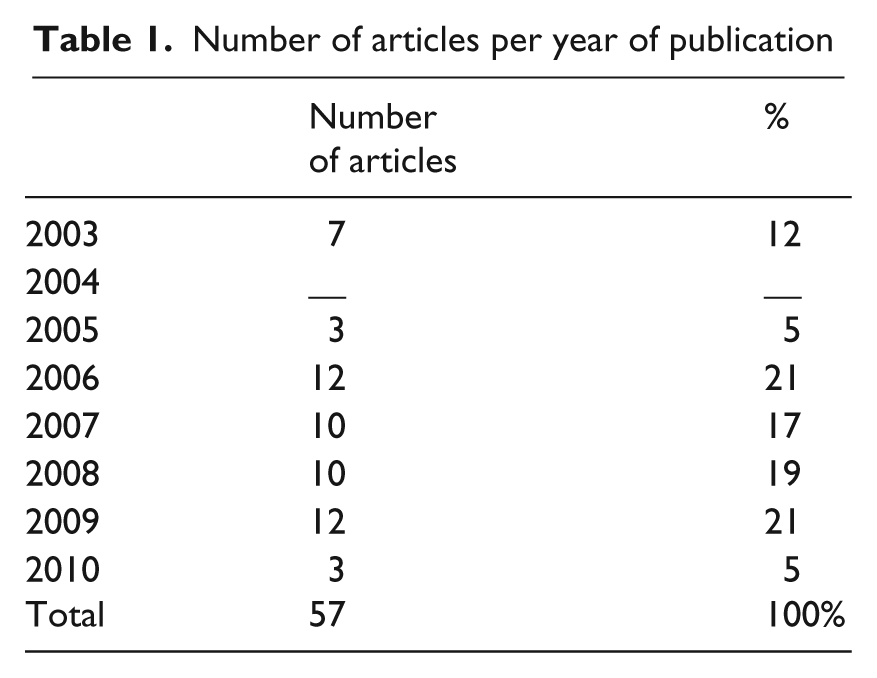
The inclusion criteria were: publication date (January 2000 to August 2010); non-redundancy; relevance; focus on anorexia as primary pathology (i.e. not as a consequence of other disorders). An initial selection of 42 articles was completed through bibliographic ‘snowballing’ – thus bringing the total number of publications to 57. 4 The language is primarily English, though a small number of French, Spanish, Portuguese, Italian and German publications also feature. From a chronological point of view, relevant publications fall within the period 2003–2010 (see Table 1): with just a few articles having been published in the first half of the decade (characteristically peaking in 2003), a momentum has built, leading to a more steady average of 11 articles per year in 2006–2009.
Number of articles per year of publication
A system of category codes was developed by Casilli and Araya through an iterative reading of the articles, isolating units of analysis and identifying threads. The units were then coded according to dominant themes and arranged into two parallel non-hierarchical, mutually exclusive inventories by Tubaro and Casilli. Discrepancies in coding were discussed and settled by consensus.
All the authors contributed to the building of a citation network. From the bibliographic reference lists of each article, citations of other articles included in this body of literature have been extracted and organized into a relational database (see below).
Results
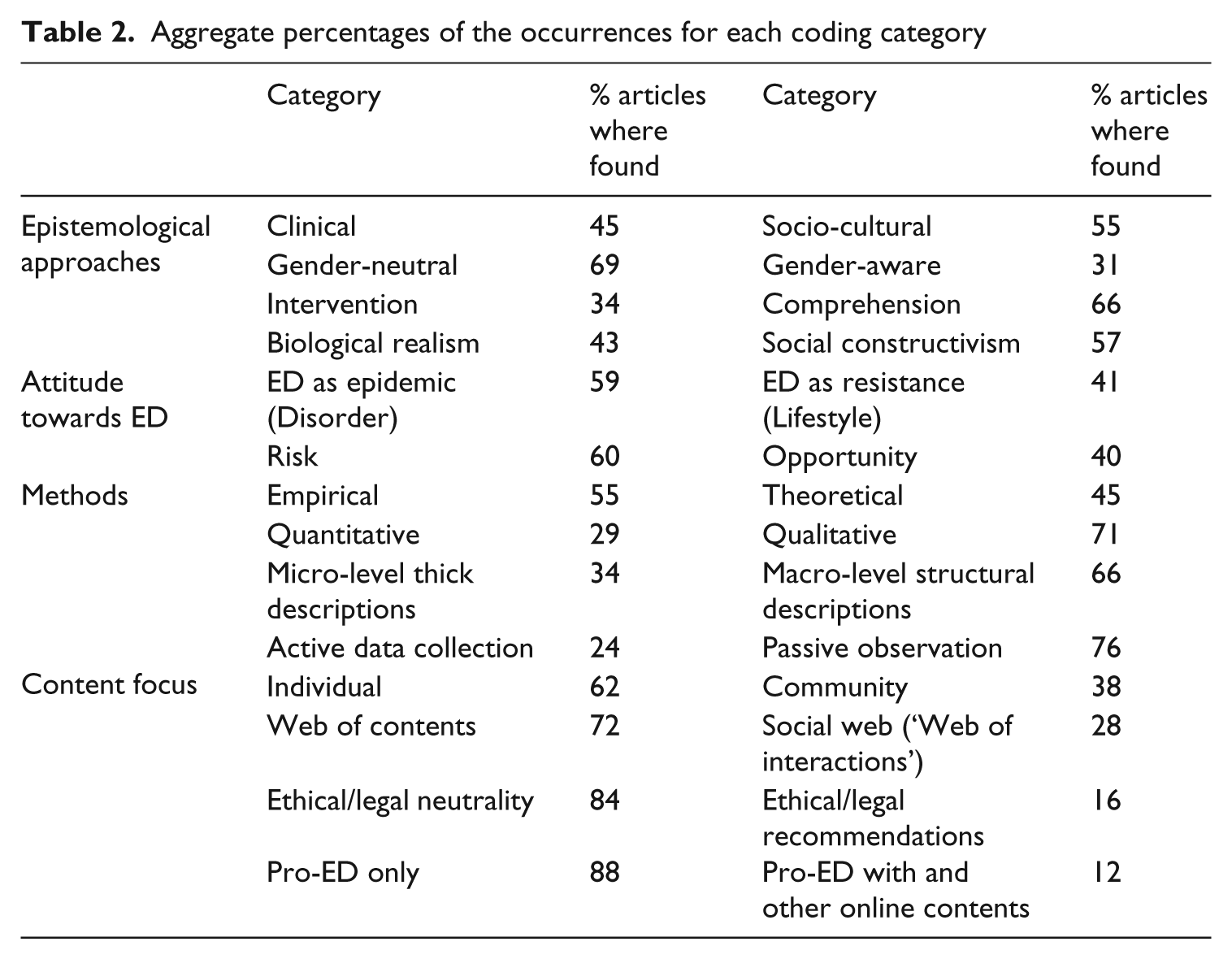
Fourteen mutually exclusive coding categories, developed to describe the articles of the corpus, were divided into four groups, as described below and summarized later in Table 2.
Aggregate percentages of the occurrences for each coding category
Epistemological approaches
The categories of the first group cover overall approaches to the online pro-ana and pro-mia phenomenon.
1 Clinical/Socio-cultural
We observe a continuity with the non-Web-related literature inasmuch as the research fields already featured had a tradition of studying eating disorders, with the same dividing line between clinical (health sciences, psychiatry and clinical psychology) and socio-cultural approaches (social psychology, communication and media studies, cultural studies and sociology). The very boundaries of health sciences are manifestly redefined by the absence of significant research fields with a record of having investigated anorexia nervosa and bulimia nervosa in a non-Web-based context: in fact genetics, neurobiology and endocrinology are virtually absent. While early analyses of pro-ED websites (Da Cunha Recuero, 2005; Dias, 2003; Ferreday, 2003; Fox, Ward & O’Rourke, 2005; Martin, 2005; Pollack, 2003; Regan Shade, 2003) were primarily socio-cultural, the second half of the decade has seen a rise in the share of health sciences contributions. Before 2005, clinical studies were indeed present with a mere three short papers (Andrist, 2003; Chesley et al., 2003; Davies & Lipsey, 2003), and only after that date were the first strong results produced, with the contributions of, among others, Bardone-Cone & Cass (2006), Lyons, Mehl & Pennebaker (2006), Norris et al. (2006) and Wilson et al. (2006). (We return to this point later.)
2 Gender-neutral
Among the articles adopting a socio-cultural approach, some pursue the feminist and post-structuralist tradition of presenting eating disorders as a gender-aware critical stance against biomedical power. This view has a more radical flavour in earlier articles (Dias, 2003; Ferreday, 2003; Pollack, 2003) and appears nuanced in recent ones, as emphasis has gradually shifted to a more multifaceted representation of the phenomenon, taking into account both biological and cultural factors (Mulveen & Hepworth, 2006; Overbeke, 2008; Ward, 2007).
3 Intervention/Comprehension
Articles also differ in the two core objectives they pursue: therapeutic intervention, assuming that knowledge of online pro-anorectic behaviours can help manage or re-orient them; and comprehension, fostering a deeper insight into the phenomenon. It is to be noted that clinical studies (as defined above) are not always interventionist (see e.g. Abbate-Daga et al., 2006; Borzekowski et al., 2010; Lipczynska, 2007).
4 Biological realism
The distinction between realistic visions, highlighting the biological grounds of EDs online, and social constructivist approaches, with a focus on culture, partially coincides with the clinical/non-clinical divide. The former are concerned primarily with physical and psychological effects, and see the Internet as a medium that may sustain, or even spread, eating disorders. The latter consider pro-ED websites to be a strategy of alternative embodiment (Ward, 2007) collectively constructed by pro-ana individuals established as a movement (Hammersley & Treseder, 2007; Gavin, Rodman & Poyer, 2008).
Attitude towards ED
The second group of categories sorts articles according to the stance they take in the public debate surrounding pro-ED websites.
5 Disease/Lifestyle
A highly controversial issue is whether to interpret anorexia as a disease or as a lifestyle. Positions range between two extremes: an epidemiological perspective, which sees websites as factors stimulating the spread of the disease and searches for ways to control it; and an approach insisting on elements of choice and a display of pride rather than shame. Some of the papers interpret eating disorders as culture-bound syndromes, arising in postcolonial situations and in relation to new media (Daniels, 2009; Lelwica, Hoglund & McNallie, 2009). Following the theoretical framework established by Hall & Jefferson (1976) and Hebdige (1979), pro-ana and pro-mia subcultures might be engaged in a series of rituals aimed at resisting the cultural hegemony represented by the biomedical establishment. The possible interpretation of anorexia as a lifestyle is recognized not only by social science literature, but also by some nutrition and clinical psychology studies. For instance Csipke & Horne (2007) discuss whether lifestyle necessarily presupposes choice or is merely a habit that pervades all daily activities.
6 Risk/Opportunity
A related distinction is made between articles that view pro-ED websites as risk factors and those that highlight the opportunities they provide in support of members. Gender and media studies have frequently adopted the latter view, although they also appreciate the possible health risks involved (e.g. Mulveen & Hepworth, 2006). The health science literature initially pointed to the potentially harmful effects of pro-ED websites viewership (Bardone-Cone & Cass, 2006, 2007), but then recognized nuances: for instance active online participation, rather than passive lurking, can mitigate damages and even be beneficial (Csipke & Horne, 2007).
Subdividing by methods used
Articles can also be divided into different categories according to the method used.
7 Theoretical/Empirical
A first distinction, cutting across all the scientific disciplines involved, is made between theoretical (e.g. Groulez, 2006; Pollack, 2003; Tierney, 2006, 2008) and empirical studies (e.g. Bardone-Cone & Cass, 2006, 2007; Csipke & Horne, 2007; Custers & van den Bulck, 2009; Fox, Ward & O’Rourke, 2005; Mulveen & Hepworth, 2006). The former include meta-analyses and literature reviews (Mulè & Sideli, 2009; Overbeke, 2008).
8 Quantitative/Qualitative
Another distinction can be drawn between quantitative and qualitative research, in respect of both methods and data. Most theoretical reflections are qualitative in nature, while empirical studies are split almost evenly between the two categories. Beyond basic statistics, quantitative analyses sometimes use experiments (Bardone-Cone & Cass, 2006, 2007; Martijn et al., 2009) and small-scale surveys (e.g. Peebles et al., 2008); qualitative studies adopt phenomenological approaches (Mulveen & Hepworth, 2006), online ethnography (Brotsky & Giles, 2007), and grounded theory (Norris et al., 2006; Williams & Reid, 2007).
9 Micro/Macro
A closely related differentiation is drawn between a micro approach, which seeks to render a thick description of motivations, actions and behaviours at the individual level (as in ethnography), and a macro approach, with focus on social structures at the group or system level (Andrist, 2003; Eichenberg & Brähler, 2007; Ward, 2007).
10 Passive and active data collection
Among empirical studies, the vast majority employ some form of content analysis or passive observation of websites considered as ‘naturally occurring discourse’ (e.g. Davies & Lipsey, 2003; Giles, 2006; Williams & Reid, 2007), sometimes with the help of search engines (Abbate Daga et al., 2006). Very few actively collect their own data through health questionnaires, interviews or experiments, typically with small samples or in pilot studies (Bardone-Cone & Cass, 2006, 2007; Csipke & Horne, 2007; Custers & van den Bulck, 2009; Peebles et al., 2008). This presumably mirrors the technical and ethical concerns that arise in studies of sensitive issues in a largely under-age, vulnerable and hidden population.
Content focus
The final set of categories classifies articles according to differences in their objectives and focus.
11 Individual/Community
While most research studies the motivations, behaviours and health state of individuals, few explore the actual role of websites in community-building – or rather in establishing a measurable ‘sense of virtual community’, as suggested by Blanchard (2007) and Ellonen, Kosonen & Henttonen (2007). Tierney (2006), for example, maintains that these websites encourage a sense of belonging amongst members, which might explain their popularity and the reasons why individuals use them. In the last few years, an interpretation of pro-ana websites in terms of interactions, networks and social capital has also surfaced (Alkmin Reis, 2008; Tierney, 2008), accompanied by the idea that personal interactions on- and offline may affect each other (Ransom et al., 2010).
12 Contents/Interactions
Most articles describe a Web of contents and focus primarily on viewership, but some have recently acknowledged the more active role of individuals in the so-called Web of interactions – sometimes referred to as Web 2.0 – in which they participate in content creation, exchange with others, and engage in real-life social networking (Alkmin Reis, 2008; Frampton, 2008; Tierney, 2008).
13 Ethical/Legal ramifications
Another set of issues that is sometimes, but not constantly, found in this literature is the need to deal with the legal or ethical ramifications of pro-ED website participation, such as censorship and freedom of expression (Regan Shade, 2003), or websites’ accountability (Martin, 2005).
14 ED-only/ED-plus content
Finally, we distinguish between articles that deal only with pro-ED websites (the majority in our corpus) and the few that analyse this question in conjunction with related topics such as other media (Derenne & Beresin, 2006) or other ‘extreme’ online contents (Bell, 2007; Daniels, 2009).
Discussion
The categories listed in the preceding section provide a description of the topics and orientations adopted in the literature. In this section we problematize these results by looking at actual trends over time and at reciprocal balances between categories.
Aggregate occurrences
At first sight, the aggregate percentage of the coding categories’ occurrences (Table 2), although uninformative about the mutual interconnections of these categories, helps us advance some hypotheses.
Table 2 reproduces, in the proportion of articles found, the traditional divide between health sciences and social sciences/humanities. More precisely, clinical articles are about 42% of the corpus, and socio/cultural ones are 58% (considered as an equivalent, given the limited number of publications analysed). The options Disorder/Lifestyle, Realism/Constructivism, Risk/Opportunity, Empirical/Theoretical show comparable proportions. This suggests that on an aggregate level all these categories point to the same split between social and health sciences in dealing with pro-ana.
For other categories, however, one of the mutually exclusive options is clearly dominant. For instance, the split between quantitative (29%) and qualitative (71%) mirrors that between active (24%) and passive (76%). This may depend on the difficulties entailed in administering health questionnaires and in collecting reliable metrics, which would explain why a majority of the studies examined prefer passive immersion as a method and tend to work on qualitative data, performing smaller exploratory studies.
Evolution of topics and approaches
In light of these similarities in ratios, one might wonder whether some of these categories might be consolidated. Yet, the evolution of the categories presented throughout the decade reveals other aspects, thus corroborating our detailed initial categorization. Figure 1 presents time trends for the groups of categories. It represents the percentage of articles falling into the second mutually exclusive option of each coding category – the first can be obtained by difference.

Evolution of the four groups of categories in the period 2000–2010.
Clearly, no distinguishable trend emerges for any of the categories. Some fluctuations are visible but are likely to be due to idiosyncratic factors (publication timing, differences in journal policies, and article size) and it is advisable not to overemphasize their relevance. Moreover, there is no detectable pattern for the category central to our analysis – health science vs. social science – whether it is considered separately or in comparison to others. This suggests that analyses of the pro-ana phenomenon are multifaceted, and help us appreciate the complexity of the interplay of topics within this body of literature. No strong correlations or other forms of statistical dependence have been detected, which calls for caution in any attempt at consolidating categories – each remains meaningful in itself, independently of the others.
Intra-corpus citation network
In order to synthesize and to draw a clearer picture, one option is to consider each article as an entity interrelated with the others. Figure 2 is a visualization of the citation network in which each node corresponds to an article in our corpus, and there is a connection from one node to another if the former cites the latter. The size of nodes is proportional to the number of citations received (indegree); and health citations (designated by unfilled squares) are differentiated from social science citations (designated by filled squares).

Intra-corpus citation network between articles in health science (designated by unfilled squares) and social science (designated by filled squares).
The first ostensible feature of the network is its density, with one main large component and few isolates (mostly non-English articles). This indicates that, despite disciplinary gaps, authors are aware of one another’s work and position themselves within an existing body of knowledge on the topic of online pro-ED. Remarkably, the split between health sciences and social sciences is less pronounced, to the extent that much-cited articles are of both types and are interconnected.
Decade-long evolution of intra-corpus citations
Once again, it is important to look at the evolution over time of our body of literature, taking into account its relational dimension. Figure 3 represents the same network but sorts and groups articles by date of publication. The figure can be read clockwise, starting with the older articles in the upper-left corner and the most recent in the lower-left.
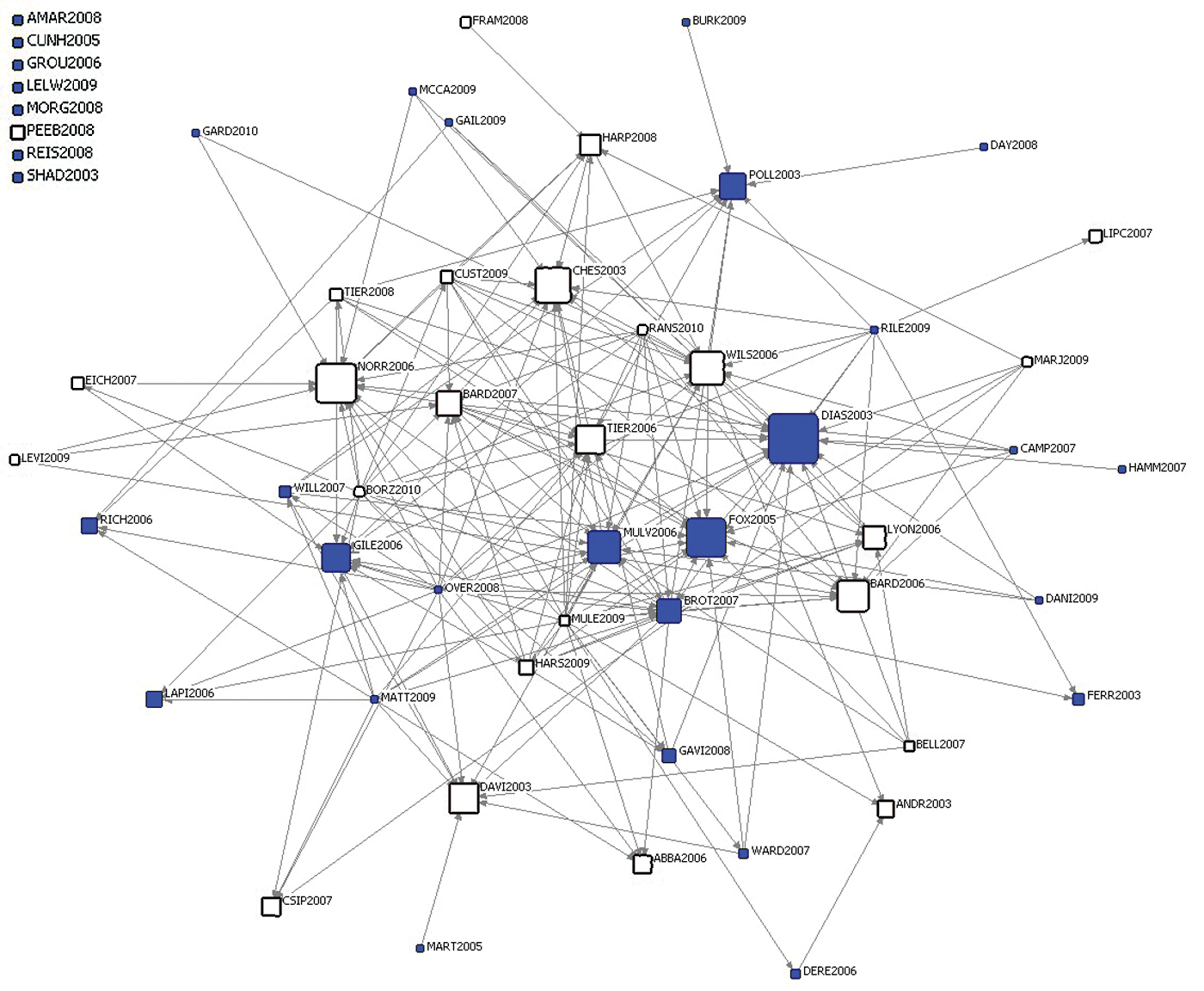
Network of intra-corpus citations highlighting the development of the body of literature over the decade 2000–2010. Health science nodes are designated by unfilled squares, and social science nodes by filled squares.
Figure 3 shows that the much-cited articles are concentrated in the first half of the decade – particularly in 2003 and 2006 (with only one in 2005). This is partly a structural effect, due to the fact that – citations being necessarily established from more recent to less recent articles – some connections are impossible to make. Among the citations that are possible, however, the fact that 2003–2006 articles are more cited cannot merely be regarded as a probabilistic effect, but should be seen as indicative of why their design, method or results are still considered relevant. Uninterrupted citations connote the recognition of these authors as authorities in this emerging field and suggest that our densely knit network is actually built over time on their contributions.
To appreciate this cumulative effect, it is also important to distinguish the relevant categories that apply to these earlier articles. In comparing all most-cited authors, we discover that in the years 2003–2006 the social sciences and humanities articles have the highest indegrees. This means that their role as landmark contributions is recognized by both health and social sciences epistemological orientations. This result implies that the constitution of this field of research is mainly independent of the evolution of scientific production touching on offline EDs. In the latter (as highlighted in our introduction), social sciences approaches stem from dominant health science ones. Conversely, in the field of online ED studies, social science initiated the field in the early 2000s, with health sciences simply catching up after a short time-lag. The rise in the number of health science-oriented studies in the second half of the decade (as mentioned above) clearly does not dismiss the social-sciences approaches, whose legitimacy is expressed by the unflagging pace of intra-network citations. This is particularly true for gender studies investigations: if we cross the categories Health/Social with Gender/Neutral, we notice that the top indegrees are on the side of gender studies articles, with the highest indegree by far in the entire network being that of Dias (2003). This is all the more striking if we look back at Table 2 where, on an aggregate level, gender-aware articles were a mere one-third of the entire corpus.
Conclusions
This review has addressed the question whether the 2000–2010 scientific literature touching on pro-ED websites can be regarded as a single body of knowledge. This literature’s network of intra-corpus citations allows us to establish that it constitutes a common field of transdisciplinary contributions to the same topic. Analysis of how this network has evolved over time brings to light authors’ definitions of a common ground.
Joint analysis of the interpretative categories and the evolution of the citation network also answers the other fundamental question of whether there is continuity between the traditional, non-Web-related literature on EDs and the literature on computer-mediated sociabilities centred on EDs. It is clear that these two bodies of literature must be considered as displaying different structural characteristics: in the former, the social sciences counterpoint the development of a health sciences mainstream dominated by psychiatry; in the latter, instead, they play a major role in defining the field, while the health sciences by and large follow suit.
Despite the currently limited number of publications online that are pro-ED, it is important to provide perspectives along which the field can extend. The first is a plea for even more transdisciplinarity. Because social and health sciences have so far progressed in tandem, it is conceivable to create joint research projects, given the commonalities in accumulated knowledge and methods.
This would also help override a remarkable limitation of the field so far, namely that the majority of existing research consists of pilot studies or descriptive pieces. It is time to call for more extensive and thorough studies, using high-quality datasets, harvested online or collected while observing the actual behaviour of Internet users. The current move towards open and community online health data, despite major privacy concerns (Pagliari, Detmer & Singleton, 2007; Steinbrook, 2008), contributes to creating expectations of possibly crossing personal online communication data with biomedically relevant information (medical records, neuroimaging, genetic testing results, etc.). This might, in the foreseeable future, allow for the inclusion of life sciences such as genetics, neuroscience and molecular biology within the research field of online pro-ED usages.
This new afflux of digitized data will, in our opinion, provide a basis for more accurate webometric estimations – which, as stated at the beginning of this article, can still prove to be problematical. Assessing the actual size and topology of this pro-ana and -mia ‘invisible Web’ would help illuminate the extent to which present-day censorship campaigns against websites promoting eating disorders might be appropriate or counterproductive, as may already be the case where repression of pro-ED web communities triggers radicalization and proliferation of back-up pages, messages and contents.
As more data is likely to become available in the foreseeable future, the sound knowledge base represented by the scientific literature featured in our review will indeed facilitate a better understanding of the pro-ED web as an indicator of wider cultural and social phenomena.
Footnotes
Acknowledgements
The authors would like to thank Claude Fischler for his useful advice and bibliographic guidance; and Annika K Martin, Elifsu Sabuncu, Antoine Blanchard and Barbara B Neves for their help in recovering bibliographical material. This article forms part of the ongoing research project ‘Ana-Mia Sociability: an online/offline social networks approach to eating disorders’, supported by the French Agence Nationale pour la Recherche, ANR (grant number ANR-09-ALIA-001). It is a literature review, for which no ethical approval was required. However, the overall research project of which it forms a part has received the approval of the ethical review board of the EHESS, Paris.