




Abstract
Where is food ‘good to think’? This comparative study describes the mental foodscapes of Swedish and French people by asking them to say where, in time and space, they would go to in order to eat well. Both the Swedish and French respondents say they would avoid the US and fast-food establishments in order to eat well, but while the French in general point inward, toward the countryside of their region a couple of decades ago, the Swedes, in their choices, want to go far away, to the Mediterranean region, South-east Asia or an abstract wilderness. The article argues that the reason for these differences is that consumers in these two countries use different dominant rationalities to judge the food of different places – a nutritional rationality in Sweden and a rationality of origin in France – and it proceeds to identify the politico-historical roots of these rationalities. Finally, it argues that while each rationality makes a certain set of food and place qualities cognizable and judgeable, others, such as exotic foods in France and conviviality in Sweden, are left non-cognizable and difficult to judge.
The act of eating is not about physical incorporation alone, but involves the mental activity of choosing what to incorporate into our bodies or not. Food has to be ‘bonne à penser’, as Lévi-Strauss (1962: 128) once put it. Focus consequently falls on the representations of food and eating that people use to define what food is ‘good to think’. In this article I’m specifically interested in collective representations of foods from different places – what I’ve elsewhere conceptualized as mental foodscapes (Bildtgård, 2009) – and how people in France and Sweden use them to think about their eating. With inspiration from Lévi-Strauss , I ask: Where is food good to think in France and Sweden?
Representations of foods from different places are everywhere: in stores, restaurants, commercials, the media, etc. An important reason for this is that food and place market one another. Food is used by countries and cities to create positive images that will attract tourism and business: consider for example how VisitSweden.com , which markets Sweden to international tourists, regularly publishes articles on Swedish restaurants, renowned Swedish chefs and local specialities. France even has a national council – Le Conseil Supérieur de l’Oenotourisme (CSO) – whose sole purpose is to promote wine tourism. In the same way, place is used by producers, restaurants and others to market their products to consumers at home (Cook & Crang, 1996). Restaurateurs may use themes such as the traditional hospitality and splendour of Victorian England or the cool ambiance of a contemporary metropolitan service culture to attract customers (Cuthill, 2007). Producers may use representations of genuine country life or wild nature to give a sense of tradition or purity to their products. Certain foreign foods can be used to symbolize authenticity, tradition and the comfort of home and family (Bell & Hollows, 2007). Such representations create new identities for food items whose identities have been lost along the food chain. Cook and Crang (1996) label this process a double commodity fetishization: In a first step of fetishization the conditions of production are hidden by the long series of complex transformations that the product undergoes in the food chain. In a second step, a new identity is created by the various actors at the end of that chain. This also involves consumers, who may use these identities or stories for different personal purposes.
For consumers, representations of food and place are important because they lend meaning to the act of eating and help them manage their bodies and identities through the choices they make. Exotic foods might help the consumer express cultural competence (Bourdieu, 1984; Germann Moltz, 2007; Johnston & Baumann, 2007). Local foods might instill a sense of comfort and belonging. Certain regional diets might help the consumer manage his or her health. This opens up an interesting question: to what uses do consumers put representations of foods from different places in their food choices? Or: if indeed we are where we eat, as Bell and Valentine (1997) put it, then where would we ideally eat and what should that place ideally help us be? What place-bound qualities does the consumer want to incorporate with his or her food? What is perceived as desirable and less desirable in the food of different places?
The act of determining the desirability of the food from a certain place presupposes some kind of judgement basis against which the qualities of a certain place and its food can be judged. Here I have conceptualized such bases as rationalities of food and place, following Foucault’s discussion of the role of rationalities in the government of conduct (Dean, 1994; Foucault, 1991). In Foucault’s argument, rationalities are expressed and legitimized through systems of knowledge and expertise, such as medicine and medical doctors, and govern action indirectly, by drawing out lines and demarcating fields of desirable and sensible conduct. They inform the individual about what the desirable goals are for different activities and how they should go about reaching those goals. Thus a rationality for eating will point out ways of going about eating well, and define what the desirable outcome of eating well is (and the negative effects of not eating well). An interesting question then, is: What dominant rationalities govern where food is good to think in Sweden and in France? And which choices are rendered undesirable or even unimaginable by these rationalities?
According to Foucault, government is to a large extent about the power to define which rationality is relevant for different kinds of activities, to define which knowledge best expresses this rationality and which is to be considered the proper expertise. This is determined in a historical struggle between interests. A final question for this article is therefore: What are the historical roots of the rationalities that govern where food is good to think from a Swedish and French perspective?
Method
This study is based on two open-ended questions that have been posed to people in both France and Sweden: ‘If you were able to travel freely in space and time, where would you go in order to eat well?’, and ‘Where, at any rate, would you not go in order to eat well?’
These questions were posed to Swedish and French respondents using two different methodologies: surveys and focus groups. The original French survey material was collected as part of an international survey (OCHA 1; referred to as FS below) which was carried out in France, Italy, Switzerland, Germany, the UK and the US in 2001 (for information about the survey, see Fischler & Masson, 2007). In 2005 I repeated the survey in Sweden (referred to as SS below). The survey data includes 176 French responses to both questions, and 92 and 90 Swedish responses to the first and second questions respectively. Both samples are boosted with regard to medical staff and teachers, who are thought likely to be acquainted with the ideas of nutritional science and thus less likely to hold culturally specific ideas about what it means to eat well. Thus, any differences found between the two countries are more likely to be cultural differences.
In order to increase the understanding generated by the survey material, both questions were also posed to focus groups in the two countries. Eight focus groups were conducted in Sweden (referred to as SF below) and seven in France (referred to as FF below), including a total of 25 people in each country. Groups were put together in order to ensure a variation of respondents. In both countries respondents were recruited to groups that were respectively composed of cultural workers, academics, nursing staff, qualified and unqualified workers (in France it proved too difficult to compose a group of qualified workers). Also, three groups were created that included people with a direct interest in food-related questions: chefs, farmers and dieticians. Since culture is the central analytic dimension, care was taken to include only people born in each country (two exceptions were disregarded in the final analysis).
In a first step the data was classified with regard to the places chosen by the respondents. Places that were described in a similar manner and are geographically close were merged into greater entities (i.e. Italy, Spain, Greece and Morocco are classified as the Mediterranean region). These places were then ranked on the basis of how often they were chosen by the respondents. A line was drawn between recurrent place choices and odder choices at a point where the drop-off was significant (in the data from each country such a point was easily determinable). This practice yielded a handful of dominant place choices, as well as non-choices, in each country. The motives for going to these places were further analysed to determine what the respondents found desirable (or undesirable) about the eating that they offered and for what reasons. The result of this analysis was the identification of two dominant national rationalities of food that seem to govern where people want to go to eat well: in Sweden a nutritional rationality, and in France a rationality of origin.
The French section of the survey data used in this study (FS above) has been used in a very interesting study by Shields (2007). Shields adds the case of the US, and it would have been interesting to compare her findings with my Swedish data. However, both the aim and the use of the data are quite different in the two studies, which makes any meaningful comparison difficult. Shields’ study focuses on how national identities in France and the US are reflected in the imaginary choice to stay ‘here and now’ to eat well. This study focuses on the rationalities that underpin people’s choices no matter where they want to go in order to eat well. However, the reader who is interested in the subject of this article should definitely have a look at Shields’ article as well.
Where French and Swedish people do not want to go to eat well
The Swedish and the French respondents are in close agreement about where they would not go in order to eat well. The most unpopular choice in the French data is ‘a fast-food restaurant’, followed very closely by the US. The US clearly tops the list for the Swedish respondents, followed by ‘a fast-food restaurant’ as their second (non)choice. In reality the difference between these two choices is very small. For both the Swedish and the French respondents the US is the home and birthplace of fast food and fast-food establishments, and fast food is also the reason for not wanting to go to the US to eat well.
From the motives given by the French and Swedish respondents it is clear that the US and fast-food establishments are seen as representing problematic aspects of modern eating, aspects of eating from which the respondents want to distance themselves. However, the way fast food is represented reveals some important differences between the rationalities used by the French and Swedish respondents to problematize what it means to eat well. Even if both the French and the Swedish respondents clearly distance themselves from an American style of eating manifested in fast food and fast-food restaurants, they do so for slightly different reasons.
The Swedish respondents generally apply a nutritional argument to qualify their choices of where they would not go to eat well. For the Swedish respondents fast food poses a problem mainly because it is perceived as nutritionally unbalanced and consequently unhealthy. The food served in fast-food restaurants and in the US is portrayed as too fat, too sweet and full of chemical additives, which makes it bad for health and, importantly, fattening. This representation is repeatedly qualified with the observation that Americans tend to be fat: [I wouldn’t go to] the US. It’s the sacred homeland of fast-food establishments. Coca cola, strips, hamburgers, doughnuts. Fat foods: unhealthy and greasy. (SS) [I wouldn’t go to] the US today, where 60% of the population is overweight. It’s a junk-food culture. (SS)
However, the Swedish respondents do not seem to blame the American consumer for his or her food choices, but rather the food culture. They paint an image of an environment uniformly dominated by fast food, to the extent that consumer choice is paradoxically limited by the fact that nothing healthy is on offer: [I wouldn’t go to] the US. I’d be brainwashed by the commercials and all the fast-food outlets and follow the crowd according to the motto: ‘Twenty million flies can’t be wrong – eat shit.’ (SS)
The French tend to agree with the representation of fast food put forward by the Swedes, but they add a couple of nuances that make the representation typically French. The French answers repeatedly problematize the anonymity of fast foods. They are particularly worried about the way that fast foods are produced, making it impossible to relate to the producer and the context of production and thus, in the long run, with oneself. In other words, they touch on the existential question, originally formulated by Fischler (1988: 282): ‘If we don’t know what we eat, how can we know what we are?’ Even if negative health effects figure as an aspect of this idea, it is only one consequence of a deeper ontological problem.
For example, the French respondents focus on the fact that fast foods are typically industrially pre-produced foods. The consequence is that the consumer does not know what he or she is eating – the meat in a hamburger can come from thousands of different cows around the world and may contain hormones and chemical additives. The food is anonymous, and it is impossible to know anything about its quality. To add to the problem, fast foods are standardized. All products in a certain category are identical; there is nothing that expresses the identity of the product or the producer. It always tastes the same, no matter which outlet of the fast-food chain you go to or who prepares the meal (in fact, as Ritzer, 2000, notes, variation is intentionally suppressed in the fast-food restaurant). It is impossible to connect with the place of production, the practices of production or the producer through the food: its taste, smell, texture or colour. As a consequence the food is in the best case boring and in the worst case destabilizing for personal identity. A parallel can be drawn to Fischler’s (1980) argument that modern eating is characterized by an anxiety-generating normlessness. This observation seems to hold true for the French respondents.
[I wouldn’t go to McDonalds]. The last and only time I’ve been there I found it tasteless, undefinable. If I had closed my eyes I would not have been able to say what I had in my mouth. (FS) I wouldn’t go to a McDo because everything tastes the same. It’s impossible to have the taste modified. The sauce for example is manufactured globally and you can’t have any regional dishes. The cooking is programmed in advanced by a computer – you can’t choose to have your steak rare or ‘à point’ … thus you can’t affect the taste. (FS)
The French typically add that Americans do not know HOW to eat. They note that Americans ‘eat anything, anytime and any way’ (FS): at any time of the day, in front of the TV, alone, super-sized portions. The French are appalled by what they perceive as unorganized and de-structured meal habits.
The worst of all is the US of our time because they do not know how to eat; they don’t eat regularly, they eat too much meat, fat, sugar and salt. … (FS) [North] America. I don’t like their ‘cuisine’. They never eat around a table. The meals are unbalanced. It’s always take-away to eat in front of the TV or in the street. (FS)
In conclusion, while the French and the Swedish respondents tend to agree on where they would not go in order to eat well, their motives reveal an important difference in regard to what is perceived as the main problem. While the rationality used by the Swedes to think about what it means to eat well tends to make them focus on issues of health and problematize places that are perceived to have little in the way of healthy food, the rationality used by the French makes them focus on issues of identity and problematize places where the food lacks a clear identity or threatens the identity of the consumer. I return to this observation below.
Where the French want to go
If the French and Swedish respondents agreed about where they did not want to go to eat well, they couldn’t be less in agreement about where they wanted to go. Where the French almost unanimously look to their own country to eat well, a majority of the Swedes say they would like to go far from present-day Sweden to do so.
The most striking thing about the French respondents’ answers to the question of where they want to go to eat well is the extent to which they choose a place in France, most often a specific region in France, with its own local produce and specialities. For some of the respondents these choices apparently reflect a wish to discover their country through the specialities of each region. Some regions – such as Alsace, Provence, Aquitaine and Lyon – do indeed seem to have a special attraction for the respondents, with particular cuisines and specialities that are commonly known and appreciated around the country. However, it is clear that most of the respondents simply want to stay where they are. The choice of a specific region is simply shorthand for ‘chez moi’ (‘at home’). In this context ‘chez moi’ is used in a wider sense than the respondents’ actual house or apartment, it designates the region or even local community where they live (the Swedes only ever use ‘at home’ in the sense of their own house/apartment). The arguments for wanting to stay in a certain region tend to be the same no matter which the actual region is: It is a place where you can find everything you need. It is a place where the local specialities are particularly good, where you can find fresher products than elsewhere and where production is more natural than anywhere else.
Where I live in Bourgogne, because I think that we are quite spoiled when it comes to food, it’s varied and fresh. We have Cassis, wine, lots of vegetables, since it is an agricultural region. (FS) I’d stay at home because I’m lucky enough to live in a region (Bretagne) where there’s plenty of everything: Good meat, fish, vegetables. (FS)
These respondents clearly have a strong sense of pride in local food production and its products. But the wish to stay where you are goes deeper than simple pride in the local. For many of the respondents ‘chez moi’ is a place where they know and have a close personal and biographical relation to the food: to local specialities and products that they have eaten since they were young; to traditional practices of production that they have learned about or even have personal experience of; and to the local producers, who are neighbours, relatives, members of the local community or region. Furthermore, at home they can produce their own food (and many respondents claim they do), or get products from relatives and friends they know personally. And they can prepare their food themselves, according to their own habits and tastes, using products they have chosen themselves, from selected sources. ‘Chez moi’ is thus a place where people have a direct relationship to the production and preparation of their food, according to local traditions and practices, and where they consequently feel they know and trust their food.
I’d stay where I am, at home in Bordeaux, because I don’t like the unknown very much. I want to know what I eat. You don’t know what you’re eating elsewhere so I prefer to prepare my own food where I am. (FS) I’d go eat in France at home in Pas de Calais because I know what I prepare and with what products. I prefer to cook my own food because then I know what I eat. I know that I’ve produced the ingredients myself. (FS)
Apart from staying in their own region, a second place seems to hold an enormous attraction for the French: the countryside. It seems quite common for the French respondents to have residual ties with the countryside, either because they live or used to live there or because they have relatives who live there. Moreover, since the French tend to talk about home in the sense of the wider region or local community they live in, the countryside is often still perceived of as ‘chez moi’, even by respondents who actually live in a town or in a city.
The countryside draws its meaning from its opposite, the city. Where the city represents pollution, crowdedness, stress, noise and social disintegration, the countryside represents purity, space, calm, quiet and social integration. According to Short (1991) country life has, at least since antiquity, been associated with health, spirituality and naturalness. The contemporary myth includes the idea that people in the countryside follow the rhythm of the seasons rather than the artificial rhythms of urban life. Rural people are thought to have more time for each other, and everybody has a place in the community. In the French data, life in the countryside is often represented as Real Life, in close contact with nature and tradition, in contrast to the artificial life led in modern cities. For many of the respondents the countryside represents the last remnant of a more authentic lifestyle: Where there is enough time to produce natural foods without the aid of fertilizers or other artificial means of increasing the speed of production; where there is enough time to prepare real traditional food, rather than pre-processed food; where the division of labour in the household means that women have time to cook and know how to cook; and where people have a place in a larger community and enjoy their food together without any stress, rather than alone in front of the TV.
The choice of going to the countryside to eat well is clearly about wanting to have a closer and more authentic relationship to one’s food, its production, preparation and enjoyment. In the countryside the individual can produce his food himself or buy it locally from farmers. That way he can gain some insight into how the food is produced and regain a lost confidence in food; a confidence that has been lost in the impersonal, large-scale, modern food system.
I’d go to the countryside, a rural environment in Alsace … because that’s the place I come from and I know it well. They have a certain respect for conviviality: a warm greeting. I’d be sure to eat local products: fruits, vegetables, regional dishes. And it is relaxing. (FS) I’d go to an inn [auberge] in Dordogne, close to where I live, where you’ll eat products cooked with duck fat, where everything is in stone and wood and where the host will tell you jokes all the time and it’s very convivial. You’ll eat with everybody gathered around a big table … and you’ll have a splendid time. You’ll eat a lot, talk a lot, stay a long time at the table and have a great meal. (FF)
A central concern is that the food should be natural. To the French the concept of ‘natural’ foods refers primarily to food that has been produced in accordance with approved traditional practices (as we shall see, this idea is different from the one held by the Swedes). Any use of industrial farming techniques decreases the naturalness of the product, such as the use of pesticides, GMOs or greenhouses; food-processing techniques that subtract something from or add something to the raw product; using hormones and antibiotics in raising meat animals or not letting them graze freely. Natural foods are perceived as healthier and better tasting but, more importantly, natural foods are perceived as ‘real’ or ‘authentic’. They are an integral part of the ‘Real Life’ that is led in the countryside, in close contact with nature and tradition. Natural foods represent the ordered universe of traditional countryside living, and eating them both supports that life and incorporates that order.
A third, very popular, choice among the French respondents is to go back a couple of decades in time, very often to their childhood and to the cooking of their parents or grandparents. Again, the focus is on a more authentic way of life, when people had the time and knowledge to produce and prepare food according to tradition and when people spent time eating together. More importantly, a time when agriculture was less industrial and food more natural: I’d go back to the beginning of the twentieth century to the good old family cottages where they grew their own fruits, vegetables, where they had their own animals and where everything was fresh. Where the meal was convivial and everybody prepared the food together, where they killed the pig together and afterwards they had an excellent meal with a good ambiance and lots of dishes with sauces with a lot of flavour and aroma, with lots of freshly picked vegetables. Nothing to cause you any concern (about where it came from). (FF) 10–20 years after the war, when lots of people used to eat together at big tables. When you had lots of farm products. I have my grandmother as a reference. She used to prepare dinner for a big table with huge chickens and everything. But over the last few decades these traditions have started to fade. There’s a shortage of time and there are few small farms left. Production has become more intensive and few people want to take care of a vegetable garden. (FF)
In conclusion, the French tend to look inward and backward, toward the roots of their culture, when they think about what it means to eat well: to a more authentic life, as it used to be lived in small communities in the countryside, where there was enough time for the production, preparation and enjoyment of food, and where the shared tradition united and directed people in all these tasks so that you always knew what you were eating and could trust it. The stability of local traditions and practices, and the authenticity of the products and specialities they engender, give the food a clear identity that can be perceived and appreciated by those belonging to the community. In that sense, at least for the respondents, the tradition seems to provide shelter from the ontologically destabilizing influences of anonymous industrially produced foods that was so evident in their avoidance of the US and fast-food establishments; and it appears as a solution to the problems that these foods pose to the French. Traditionally produced local foods support local identity and a sense of belonging. Consequently, the French respondents want to stay in their own region, preferably in the countryside, as it was a couple of decades ago, when and where the connection between tradition and food, they believe, was stronger. For the Swedish respondents the solution to perceived problems with the modern food system lies elsewhere.
Where the Swedes want to go
If the French almost unanimously look inward, toward France and the French regions, when they think about where they would like to go to eat well, a large majority of the Swedish respondents look outward, toward distant lands or a region of abstract wilderness. A minority of the Swedish respondents who say they want to stay in Sweden to eat well mainly do so for very different reasons than their French counterparts: because they regard Sweden as a radically modern country full of global food impulses.
Most striking in the Swedish data is the large number of respondents who say they would like to go to a distant country in order to eat well, primarily the countries of the Mediterranean region or Southeast Asia (especially Thailand). The attraction of these two regions is similar in character: both offer a large variety of fresh products, especially vegetables, fruits and seafood, which are available most of the year (in contrast to Sweden) and which are perceived as both healthy and good tasting at the same time.
[I’d go to] Italy. I’ve been there and the food was very tasty and fresh. They had great raw products. Fresh products taste better and then there is also the general impression they give you. They look and smell better. (SF) [I’d go to Thailand.] Thai food is very good; fresh and good. People look like the food does them good. They’re not exactly overweight. … The food is fresh, healthy and tastes good. And you feel good after eating it. (SS)
A recurring motive that the Swedes give for choosing the Mediterranean region and Southeast Asia is that these are places that offer a diet that is nutritionally well balanced: both rich in vitamins and minerals, and low in fat. The attraction of the Mediterranean region and Southeast Asia seems to be that they offer foods that are both good tasting and healthy at the same time, thereby resolving the tension between health and pleasure that faces modern consumers. Both these regions are portrayed as places where it is possible to combine hedonism with health. They free the reflective consumer from the burden of having to calculate the risks of hedonism at all times, a burden that, it seems, is felt by the Swedish consumers. There is a definite irony here: the nutritional arguments from which the Swedish respondents clearly proceed in their choices lead them to choose places where this knowledge, as well as the burden of making rational food choices, is redundant. Thus to some extent they seem intent on escaping the burden of reflective choices.
The category of fresh is given special importance by the Swedish respondents. Some point out that the Swedish season is too short to provide much in terms of fresh fruits and vegetables. Consequently most fruits and vegetables that can be found in stores outside the short summer season have either been conserved or transported a long distance (or both) and are no longer fresh. The idea is that products that have been allowed to mature where they grow and which are served as quickly as possible, with only minimal preparation, preserve their intrinsic vitamins and minerals. As a consequence they taste, smell and look better than other products, and they are healthier. Every delay between production and consumption reduces this value, as does any treatment the products are subjected to. The longing for the fresh thus seems to be intimately bound up with the comparatively ungenerous Swedish nature.
While most of the French respondents chose to stay in France, only a few of the Swedish respondents say they would stay in Sweden in order to eat well. Moreover, only a small minority of this group would do so for anything that resembles the motives of the French respondents, such as an attachment to regional food and trust in the local. Instead, those who say they want to stay in Sweden in order to eat well want to do so because Sweden is a highly modern and globalized country where you can find foods from all over the world. The recurring argument is that everything you need to eat well – supply and knowledge – exists right there, in Sweden. Thus, to a large extent, these respondents chose to stay in Sweden for more or less the same reasons that the majority gave for leaving the country: it is easy to find foods that are healthy and taste good.
Few Swedes want to go out into the countryside to eat well, as the French do. Instead, many of the respondents say they would like to go to a ‘wild’ place. This choice includes deserted places both in the present, such as desert islands and the rainforest, and the past, such as the common choice of ‘the Stone Age’. These places all represent the diametric opposite of civilization. The wilderness is a place where nature has not (yet) been polluted through human exploitation. Everything remains untouched by human hands and thus pure. This representation has much in common with what Short (1991) describes as the Romantic view on wilderness: a view where wilderness represents something original and pure (often divine) which is threatened by the perverting influences of civilization.
For the Swedish respondents, the promise of wilderness seems to be that it doesn’t contain anything superfluous. The food that can be hunted and gathered in these places is completely natural. There has been no genetic manipulation, no hormones, no pesticides or fertilizers, no refinement, no additives. The food is literally untouched by human hands. Perhaps most importantly, wilderness doesn’t offer any of the wide selection of rich, processed foods on offer in the abundance society, which is linked to obesity and food-related diseases. The food that wilderness offers is by definition good; it has been allowed to mature slowly in naturally fertile lands (which have not yet been exploited) and is therefore both healthier and tastes better than the industrially produced food that can be found in inhabited parts of the world in our time. In sum, wilderness offers only foods that are pure and thus, it is thought, better for the human body.
[I’d go] back in time to the Stone Age, when you ate what nature provided you with. Meat without Becquerels, fish from clean water, herbs, roots and cereals, berries and fruits. Everything pure. (SS) [I’d go to] the Stone Age. You picked your own fruits, berries, nuts and roots in nature and you hunted. You mostly ate nuts and berries and not so much meat. Our bodies have not yet fully adapted to the food we eat today. (SS) [I’d go to the Stone Age]. I think people were healthier when we lived as hunter-gatherers. The food you gather yourself is automatically healthy. (SS)
The Swedish respondents’ ideas about the natural are clearly different from those of the French respondents. The French respondents conceived of natural foods as the product of local traditions and sought natural foods in the countryside. Thus the natural was clearly a human and cultural achievement (the natural is literally cultured). The Swedish respondents, on the other hand, conceive of natural foods as foods completely untouched by human hands and seek natural foods in the wilderness. If natural foods thus tie the French to the local and rural context, and confirm their sense of identity and belonging, it does not seem to do the same for the Swedes. Instead it would seem that the Swedish respondents seek refuge in the natural, rather than the cultural, order. They seem confident that nature will provide them with exactly what their (natural) bodies need. This idea is clearly reminiscent of the assumption of the antique theory of humoralism, that disease is a consequence of bodily imbalance and caused by an unbalanced incorporation of the basic elements of nature (see e.g. Lahlou, 1998). In their most elementary and widespread form, even in many contemporary societies, humoral beliefs divide foods into the basic categories of hot and cold foods (Anderson, 1984). In short, the body has to be in balance with nature to be well. What’s interesting about the Swedish respondents’ answers, however, is that they argue that natural foods in themselves are balanced, thus precluding the need for the hot and cold categories. The natural is thus perceived as being endowed with something of a divine power that is perverted by human touch (compare Short, 1991). Whatever the historical anchoring of this imagery it is clear that the Swedish respondents motivate the rationality of the natural in nutritional terms. For the Swedish consumer, the promise of the natural is not that it links them to a larger community but that it is nutritionally well balanced. Ironically, then, the choice of going to the wilderness confirms the Swedish consumer as a rational modern individual.
The rationalities of eating well
It is almost immediately clear that there is a distinct difference between the imaginary choices made by the Swedish and the French respondents (see Figure 1). To put it simply, while the French want to stay at home to eat well, the Swedes want to go far away. The argument I wish to make here in order to explain this difference is that there is also a distinct difference in the rationalities that Swedish and French respondents use to reflect on the question of what it means to eat well, and that this difference seems to govern their thinking about which places in time and space offer desirable eating.
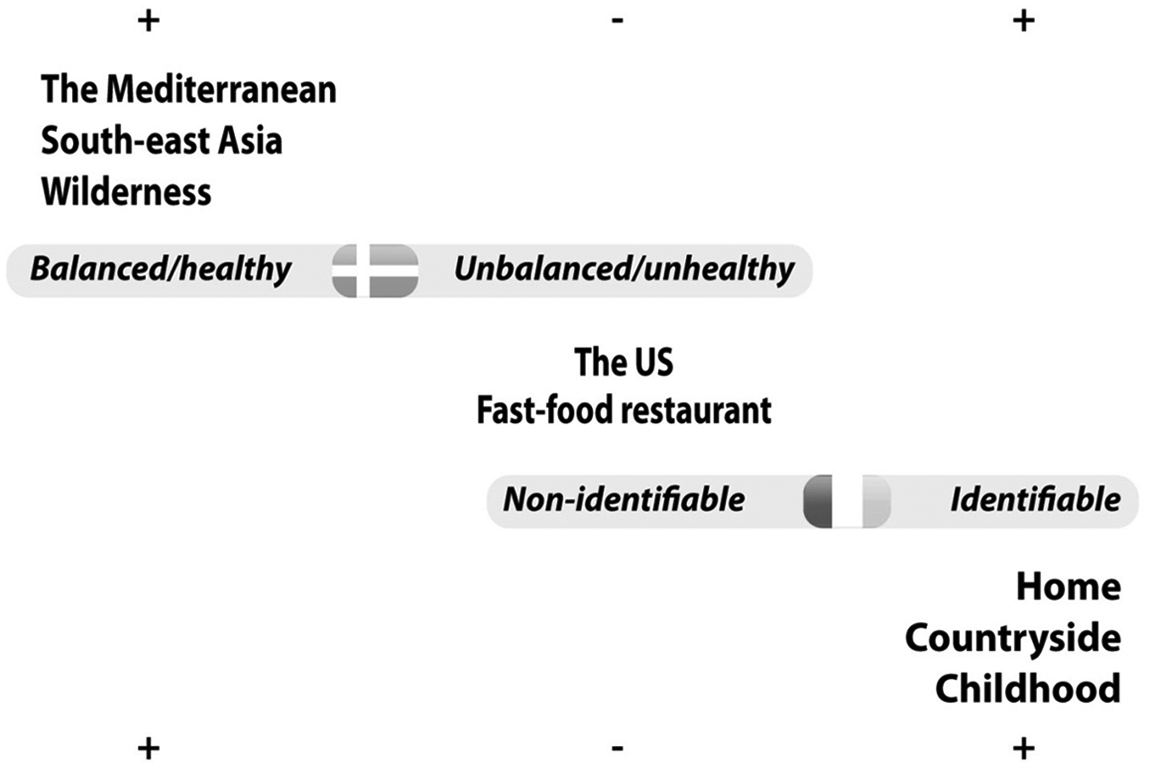
Where the Swedish and French respondents would like to go (and not to go) to eat well and the rationalities that guide them (rationalities tinted grey)
The Swedish respondents proceed from a health-oriented rationality that is expressed and legitimized by nutritional science and expertise – I call this a nutritional rationality. This rationality tends to make them critical of places that offer foods that are problematic from a nutritional standpoint, such as fast-food restaurants or the US, because they are seen to offer little space for healthy food choices. In this context, the representation of the US is reminiscent of a giant fast-food outlet, with no healthy food options. At the other end of the scale the same rationality orients the Swedish consumers toward places that offer healthy foods; more precisely, places that offer foods that are ‘automatically’ healthy and thus free the consumer from the burden of reflective consumption, which is associated with consumption in excess societies. This is clearly the case with the Wilderness but also with Southeast Asia and the Mediterranean region. The latter responses tend to add that these are places that manage to conciliate the values of pleasure and health.
In contrast to the Swedish respondents the French tend to proceed from a rationality of origin, which is expressed and legitimized by local and national culinary traditions and expertise. This rationality focuses on how food can support a sense of identity and belonging (geographically, socially, culturally) that helps the consumer maintain ontological integrity in an increasingly complex world. The rationality of origin makes desirable that which is traditional and genuine for the place where the individual belongs and is familiar with. Such food communicates to the French consumer a sense of belonging. This can operate on different levels: the food in one’s garden expresses belonging through communion with a physical place; regional food expresses belonging through local tradition and geography. French food expresses the individual’s place within the national community. These foods all have a taste of place, which can be deciphered by those who belong to that place. As Trubek puts it: the French consumer who eats a piece of cheese or drinks a glass of wine can ‘taste the earth: rock, grass, hillside, valley, plateau’ (Trubek, 2008: 9). We might, after reviewing the data, add that it also has the taste of the tradition and community of that same place. The rationality of origin thus leads the French consumer to look to the heart of domestic tradition – to the home, the countryside and their childhood – when they choose where they would like to go to eat well. At the same time this rationality leads the French respondents to problematize fast foods and the foods of the US, not primarily in health terms, but in terms of their anonymity. These foods and foodways do not contribute to the consumer’s sense of identity and belonging but lead to disorientation and disorder. They raise the existential question related above: if you do not know what you eat, then how can you know who you are?
The rationalities of nutrition and origin, respectively, draw up a space of alternative place choices that can be conceived of as sensible and desirable within that rationality, while allowing for some freedom in what can be construed as rational. The choices of the Swedish and French respondents, although superficially they might seem random and internally different, all fall squarely in the centre of these respective spaces. The governing power of these rationalities is perhaps best demonstrated if we try to switch the choices: For the French, going to the Mediterranean region and to Southeast Asia would not decrease but rather increase the anonymity of the food offered to them. For the Swedes, going to the Swedish countryside a couple of decades ago would not solve the contradiction between pleasure and health that is highlighted by nutritional rationality (in fact some of the Swedish respondents problematize the food of their parents in health terms). Instead the dominant choices in each country flow logically from the rationality used to think about what it means to eat well in that country.
A short genealogy of the rationalities of nutrition and origin
As it happens, nutritional rationality and the rationality of origin have strong similarities with the inherent logics of what Boltanski and Thévenot (2006) call the industrial and domestic worlds. In the following I briefly use their distinction to suggest some of the wider implications of both these rationalities before I trace their origin. Boltanski and Thévenot use the figure of an industrial world to describe an order where people and objects, such as food, are valued according to their contribution to a functionally arranged space, such as a factory or an organization. My suggestion here is that the question of what it means to eat well belongs to an industrial order in Sweden, and that the nutritional rationality which governs the imaginary choices of the Swedish respondents stems from a historico-political interest in creating citizens who can take up positions in the functionally arranged space(s) of Swedish society, as employees or health-care consumers (for a more thorough presentation of this argument, see Bildtgård, 2010). Obviously this is not necessarily the motive that drives the individual, but it has contributed to forming the subjectivity of the Swedish citizen. The domestic world, on the other hand, is used to describe a traditional order where people and objects such as food are valued according to their contribution to an order of personal relationships and hierarchies between people. Again, my suggestion is that the question of what it means to eat well belongs to a domestic order in France, and that the rationality of origin that governs the imaginary choices of the French consumers stems from a historico-political interest in joining and managing a diverse set of local and regional identities and relationships into a harmonious and ordered French nation. I now try to show the validity of this argument in relation to the historical roots of each rationality.
It is possible to trace the roots of a Swedish governmental concern about food and health back at least to the early 20th century (Bildtgård, 2002). From the very beginning this concern was linked to the wider public ambition to increase the individual citizen’s contribution to the productivity of the nation, both as a worker and as a health-care consumer. In the first decade of the new century the Swedish state introduced classes in nutritionally efficient cooking for working-class girls in the interests of providing the industry with a more efficient workforce. In the following decades these classes were expanded and made mandatory for all children. In the 1950s, a number of more far-reaching measures were introduced. Most importantly, public-school lunches were introduced to reduce the risk of malnutrition among children. The nutritional science of the period had discovered that malnutrition in childhood could cause permanent damage to health and work capacity in later adult life. The goal of the school lunches was to guarantee a satisfactory nutritional intake for schoolchildren, independent of their circumstances at home, but also to form a habit of eating nutritionally well-balanced meals that would persist into adult life. A national administration for public health was created to monitor the nutritional value of these lunches.
In the early 1970s, a third ‘wave’ of initiatives was introduced with the aim of creating a more reflective, health-conscious consumer who would be able to balance the pleasures and risks offered by the consumer society. A more-than-decade-long national nutritional campaign was launched to inform consumers about nutritionally good food choices. A new comprehensive food legislation was passed in which nutritional information was an important issue. A National Food Administration was established to act as a national authority on nutritional issues. At the same time nutritional science was established as a research subject at four universities around the country, together with university degrees in dietetics. Today the nutritional expertise generated by these institutions and activities is present in a number of food- and health-related environments such as media, cookbooks, cooking shows, gyms, restaurants, the food industry, food marketing, etc., so that the nutritional perspective on food is always accounted for. All these initiatives were introduced with the intent of producing a more rational citizen, such as a more productive worker or a less expensive public health-care consumer. The introduction of nutritional rationality was thus directly connected to a moral message: the responsible citizen manages his or her health through rational food choices.
Just as in the Swedish case, the French concern with food and place fits into a wider historical governmental concern, in this case with the creation of a French national identity. Csergo (1999) traces the strong connection between food and place in the French imagination back to the revolution. The post-revolutionary regime collected statistics that showed systematic differences in food habits between different French regions. These differences were explained by the specific geographic conditions that prevailed in each region and the traditions they engendered. Thus a very strong connection was made between the land and its people. In the effort to establish a national consciousness France was defined as the sum of its different regions, and regionality came to be strongly associated with local farm products. Regional museums were created that gathered information about and displayed local farming traditions. And maps of France were created that displayed regional differences in the form of their typical farm products. In that way, from the start, regions came to be associated in the budding national consciousness with their geography and traditions and the food they created, and the social and cultural identity of the individual Frenchman came to be expressed by what he or she ate.
According to the theory of ‘terroir’, the specific characteristics of a particular speciality are the product of the unique geographical conditions of a particular place and the local traditions that these conditions create (terroir). Natural conditions thus have a certain priority over cultural conditions, but it is the combination that creates the unique characteristics of the food. Trubek (2008) finds references to terroir and its relation to local specialities dating all the way back to the 17th century, but it is in the early 20th century that a concrete, codified, language connecting taste and place emerged in a new genre of French gourmet literature. This literature gathered regional recipes and presented them in national collections that represented French cooking as a collection of regional cuisines. Gourmet writers wanted to reconnect the urbanized masses with their rural past through the link of local food. Again, through the medium of food, individual identity was construed as place-based. This was further aided by the development of the tourist industry, which made local foods part of the tourist experience. Early tourist guides started to include directions to places that served ‘authentic’ regional fare (Csergo, 1999).
Over the course of the 20th century the connection between food and place was gradually institutionalized through the AOC (Appellation d’Origine Contrôlée) system (Bérard & Marchenay, 2004; Trubek, 2008). Bérard and Marchenay trace the origin of the system to 1905 when it became punishable by law to mislead a buyer regarding the origin of a product, whenever it might be considered as a reason for the purchase. Originally the system guaranteed that a product carrying a certain place-name was indeed from that place. But with time it came to emphasize the connection between terroir and product, such that a labeled product had to meet a set of predefined criteria that make the product typical of a certain place and that set it apart from other products. These criteria could and can incorporate everything from climate and soil characteristics to local traditions and practices. In 1935 the system was finalized in law and a government agency, the INAO, was created to monitor the certification process and encourage consumers to valorize place in their food choices. Today the INAO is involved in a number of initiatives directed at encouraging consumers to sense and appreciate place in their food. One such initiative is for example the national week of taste (Semaine du Goût) where schoolchildren learn about local products, meet with producers, eat and learn to discern different tastes and map them onto the geography and terroirs of France (Trubek, 2008: 47–48) – a pedagogical effort not entirely different from the effort to teach the basic principles of nutritional science to Swedish primary schoolchildren. At the same time the French government has pushed for regulations that valorize place within Europe (Bérard & Marchenay, 2004) and through the WTO (Barham, 2003). Even though these initiatives are clearly about protecting the French export market, they still proceed from, and promote, a rationality of origin in food choices.
Above I argued that nutritional rationality as well as rationality of origin are part of wider historico-political projects of national competitiveness and cohesion in Sweden and France, each with their particular constructions of citizenship, in which the functional and the traditional eater plays an important part. This is not to say that consumers have no choice. Both rationalities allow for many different choices to be construed as rational. This possibility is used by companies in both countries, who compete in marketing foods from different places as healthy and authentic, respectively. However, these constructions tend to relate to the dominant rationality in each country.
From ideas to choices: the effects of national rationalities of food and place
Knowledges are never ontologically neutral; they make worlds of objects and relations unfold. Knowledges make certain objects and relations cognizable while others remain invisible and literally unthinkable. There are at least two ways in which knowledges may govern thinking that are of interest to this study. The first is the way in which knowledges reveal objects that can be judged to be desirable or not from within a certain rationality. The second is the way in which a great many possible objects and relations are left invisible and unthinkable and thus outside any judgement. The question I want to proceed with is: what is left invisible by the knowledges that express and legitimize the rationalities of nutrition and origin?
Nutritional science visualizes the nutritional value of different foods and ascribes value to them accordingly. Since nutritional science is based on universal principles, it can be used to think without restrictions about food from all corners of the world, different periods in time and even imaginary places such as the future, alien cultures or paradise. This is exactly what happens in the Swedish respondents’ answers – they consider a wide variety of possible and impossible places and judge their food on nutritional merits. In comparison with the French respondents the Swedish respondents seem very open to new food experiences and play creatively with a large number of alimentary possibilities (also ‘non-foods’, such as pills and mixtures) in relation to the nourishment and the pleasure they bring to the body. This points to a strength in the universality of the principles of nutritional knowledge: no food, in fact no object, is beyond judgement. But there are also limitations to this rationality, which the French comparison helps us notice. Aspects of eating that don’t relate to the nourishment and pleasure of the organism are not judgeable within this framework. Other aspects that might be important to the consumer in deciding where he will go to eat well are suspiciously absent from the Swedish responses, such as belonging, conviviality or a pleasant eating environment. Not that these are unimportant for Swedish consumers (as other parts of this project have shown), but it seems that the nutritional rationality makes them perceive these aspects as only complementary niceties to the real function of food, which is to nourish the organism.
The rationality of origin works quite differently. Within this rationality place is not desirable primarily in relation to an abstract value such as nutrition but in relation to the specific, localized, knowledge of the consumer. The French consumer uses his knowledge about different terroirs to determine the authenticity of different foods and specialities. Of course, such a deep ‘empathy’ with the food on one’s plate presupposes a deep knowledge of the particular geographical, cultural and social conditions of the food’s place of origin – a knowledge that is best held by those who have been raised in that particular region and know it by heart. This creates a strong, literally visceral, connection between the French eater and his place of origin. The act of eating shows and confirms the consumer’s place in the social and geographical space of France and reminds him where he belongs. But, on the other hand, the specificity of this traditional knowledge also makes it hard to understand and judge foreign foods that have their roots in other terroirs, unknown to the French consumer. The food of the world outside France is to some extent left unjudgeable by the rationality of origin. This is arguably the reason why almost none of the French respondents want to leave France or even their own region in order to eat well, and even express anxiety at the thought of eating foreign foods – something which is never mentioned by the Swedish respondents. Even more to the point, the rationality of origin cannot decipher and value fast foods, which literally have no point of origin that can be identified. Within the origin paradigm these foods verge on the abject.
In conclusion it would seem that both rationalities come with their own blindspot(s): the nutritional rationality tends to make Swedes look at food from different places in an instrumental manner and disregard the social aspects of eating, while the rationality of origin tends to make the French shy away from the unknown and look to the local for comfort.
Concluding remarks
In this article I’ve demonstrated that there are clear differences between where Swedes and French people want to go in order to eat well. I’ve argued that different rationalities operate behind the choices made by respondents in each country and that these rationalities work by defining what is considered desirable in eating and which choices can be thought of as sensible, but also which choices are blocked out as not sensible or even unthinkable. Moreover, I’ve argued that the differences between the two countries have a strong connection to wider governmental agendas on the national level.
Rationalities of food, I would argue, have great importance for cultural stability and change. It is often argued that one effect of globalization is the homogenization of food cultures. This argument, I believe, misses the point that food and the act of eating are part of much wider, national, governmental agendas that have evolved over time and become institutionalized, and that lend wider significance to the act of eating than simply feeding oneself, such as being a responsible citizen (Sweden), or expressing social and cultural belonging (France). These linkages, I would argue, force their own culturally dominant rationality onto new global food impulses and make them understandable within that rationality. As a consequence, the second step of the fetishization process that Cook and Crang (1996) describe might look very different in Sweden and France. New food trends might be perceived and marketed very differently in the two countries, creating very different narratives for these trends in each country. Thus, even if we witness a relatively rapid expansion of the selection of foods on offer in our supermarkets, the underlying rationalities that determine how we perceive our food remain national constructions that might not be quite so malleable to global influences.
Footnotes
Funding
This text was written with financial support from the Swedish Science Council, the very kind invitation from the Centre Edgar Morin (formerly CETSAH) in Paris, France and the help of OCHA, who allowed me to use some of their data. I would like to thank Peter Öberg for reading and commenting on the manuscript.