Abstract
The social science disciplines are strongly differentiated both on an epistemological level and in problem choice. It can be argued that they are characterized by a number of different epistemological ways of position-taking or ways of legitimizing social scientific knowledge production. Furthermore, different scientific problems and social institutions are allocated as research objects to different social science disciplines. This article looks into how these different epistemological styles and choice of scientific problems not only are internal principles of differentiation but also constitute important relations to other powerful social interests and institutions in the field of power. I argue that we can understand the social sciences as a field of force and struggle, where different disciplines compete in producing legitimate representations of the social that also represent specific societal interests. Using the language of Bourdieu, I construct a space of social scientific epistemological position-taking using Multiple Correspondence Analysis (MCA). Into this space I project a number of supplementary variables representing social science disciplines, position-taking towards non-academic institutions, interests and research subjects, and thus show how different epistemological position-taking is connected to specific societal interests, problems and institutions. The article draws on data from a survey conducted among Danish social scientists in autumn 2009.
The purpose of this article is to look into the epistemological and social differences within the social sciences and their relation to non-academic interests and institutions; or in other words to discuss the relationship between the social sciences and what, using a Bourdieusian term, I will call the field of power. The differences regarding both epistemological convictions and methodological practices within the social sciences have been an on-going object of both discussion and frustration, but few studies have looked empirically into knowledge production in the social sciences, despite the growth of the sociology of sciences in the last twenty years (Camic et al., 2011). There is thus much knowledge to be gained from a closer empirical look at the differences in epistemological convictions and methodological practices, and at the relationships between different parts of the social sciences and non-academic interests and institutions. Drawing on Bourdieu’s notion of field, I analyse the social sciences as a field, with homologous structures between position and position-taking (Bourdieu, 1988, 1996a). This theoretical framework, combined with sophisticated statistical analysis, leads me to claim that we cannot understand the relationship between the social sciences and important societal institutions and interests as one-dimensional. Social scientific knowledge production is not only orientated towards either ‘pure’ academic problematics or ‘applied’ non-academic interests or institutions. In addition to this important distinction, the social sciences are also differentiated in ways of engaging with non-academic institutions and interests. We can say that the ways in which the relations to non-academic institutions and interests are handled and legitimized differ widely. The various social sciences disciplines thus relate to different problematics and legitimize their knowledge in very different ways both in relation to academic and to societal claims.
Social science relations to state and society
The connection between the social sciences and powerful social interests and institutions, mainly the state, has been an important research topic for social scientists looking into the development and formation of both the cognitive and the institutional structures of the social sciences from the late 19th century onwards. In this article I address the science/society relation as one between the social sciences and what Bourdieu terms the field of power. In the following section, I sketch out the historical context of the relationship between the social sciences and the state so as to specify and highlight the character of that relationship.
Peter Wagner has designated the relationship between modern states and the social sciences established after the Second World War as ‘reform coalitions’ (Wagner, 2001; Wagner & Wittrock, 1991). In his historical analysis of the genesis and formation of the social sciences, he shows how in this period the social sciences were institutionalized and how they grew in state-supported institutions. Furthermore, he shows how, at the discursive and institutional levels, the social sciences entered into different forms of ‘reform coalitions’ with powerful social institutions and interests in the aim of reforming and governing the post-war Western states (Wagner, 2001, 2003). The ‘reform coalitions’ built not only on shared ideas about political and social problems and solutions but also on the increasing demand for positive empirical knowledge about the social world in general, as well as about particular social problems such as unemployment, poverty, ethnicity, economic development, etc. (see also Fizpatrick, 2003), knowledge that should enable the growing welfare states to regulate and prevent social problems. This demand resulted in changes to the organization of the social sciences, enabling them to conduct societal-oriented, large-scale studies on society by producing representations of the social closely connected to ideas of state and social problems that could be used in building state institutions (Desrosières, 1991). Simultaneously with the organizational changes in the field, ways of legitimizing social science shifted towards a more scientific or positivistic mode of representing both means and ends for the social sciences that mimicked the natural sciences (Haney, 2008; Steinmetz, 2005).
In the process of establishing the social science disciplines and their relation to important social interests and institutions, specific problems and empirical topics were allocated to the different disciplines (Heilbron et al., 1998). These were related to different social institutions and interests not only through their institutional connection to specific labour markets and financial sources but just as much through their different representations of society, its problems and their solutions.
This analytical description applies generally to social sciences in Western countries, where they are closely connected to the national states. It is, however, important to underline the specific properties of the relationship between social sciences and the field of power in the Scandinavian welfare states. As Fridjonsdottir describes them, the social sciences in Scandinavia were institutionalized with close links to, and shared reform ambitions with, the growing Social Democratic welfare state (Fridjonsdottir, 1991). In the Danish case this relationship was upheld over the troublesome period of the late 1960s to the late 1970s largely through specific research institutions devoted to social problems and other matters of concern to the welfare state. Throughout the 1990s the relationship between the reformed Danish welfare state and the social sciences was reinforced through changes in allocation of funding, which directed money towards more specific areas, as well as through a conjunction of academic and bureaucratic strategies and interests (Kropp & Blok, 2011). The following analysis focuses on a specific national setup, from which we can learn about the general properties of the relationships between the social sciences and the field of power.
Theory: Social sciences as a field
How can we connect this historical description of the relationship between the social sciences and different societal interests to the everyday practices of ordinary social scientists and the epistemological differences setting the social sciences apart? As Wagner showed in his analysis, the relationship between social sciences and the field of power works both through institutions and through the different choices of problems, methods and theories made by individual social scientists in the course of knowledge-making. I draw on Bourdieu’s theoretical framework to show and explain the connection between the particular ways social scientists build and think about social scientific knowledge, what I call epistemological position-taking, and relations to the field of power (Bourdieu, 1975). Using the concepts of habitus, capital, field and field of power enables me to show how ways of position-taking in the social sciences are differentiated in a space of epistemological position-taking and how this space in homologues is structured in accordance with the field of power in a field-like structure (Bourdieu, 1996b).
I here understand habitus as relatively durable mental dispositions acquired through practical academic activities, mental dispositions that tend to reflect the actions of the social scientists in accordance with the structures under which they were acquired. The habitual disposition is thus produced and inscribed into the body of the social scientists through their education and professional training, and through their professional activities and trajectory (Bourdieu, 1981, 1996a). In the statistical analysis, I understand the answers of the social scientists to the questionnaire as expressions of their habitual disposition, or as their ways of taking position with regard to a central line of conflict and difference within the social sciences.
In a field analytical approach, the specific actions and beliefs of the social scientist are, however, always related to the actions and beliefs of other social scientists in the field. I here understand fields as relatively autonomous social spaces, bounded by a set of specific rules and practices (doxa), and held together by a common belief or interest in the game of the field (illusion) (Bourdieu, 1996a). The field of social sciences I construct in the following section can be understood as a social structure differentiated by a horizontal struggle over the type of social and symbolic resources or academic capital and a vertical struggle encompassing amount of capital (Bourdieu, 1988). Academic capital is here understood as the social and symbolic resources that can be mobilized in order to change or maintain the social and symbolic structure of the field and positions within it. Bourdieu differentiates between institutionalized and specific prestige capital (Bourdieu, 1998c). Fields are structures of objective relations between positions that tend to structure the strategies applied by the agents in view of improving or maintaining their position. In the struggle in the field, agents mobilize various forms of academic capital in terms of both institutionalized and specific prestige capital. The field can therefore be understood as a field of both force and struggles, a more static opposed to a more dynamic view of the social structures. In this article the field of social sciences is analysed mainly as a field of force.
By saying the fields are relatively autonomous social spaces, I have indicated that they are nonetheless related to struggles and structures that do not directly concern the activities and struggles of the field, here the production and legitimizing of social scientific knowledge. Drawing on the concept of field of power enables me to understand how the social sciences relate differently to forms of non-academic interest and institutions. I here understand the field of power as a social space where agents of power struggle over the right to legitimize and impose specific principles of vision and division on other social fields (Bourdieu, 1996b: 264–272). The field of power is thus the locus of struggles over general principles of vision and division imposed in different ways throughout the social space. In the struggle between social interests and institutions, social scientists play an important role in producing legitimate representations of the social, potentially representing specific institutions and interests in the public sphere (Lebaron, 2001) and likewise producing what we can understand as informational capital for both state bureaucracy and private enterprises (Bourdieu, 1998b). But concurrently with this process, the field of social sciences stands in an antagonistic relation to other fields in the field of power, located in an intermediate position between the economic and the cultural production fields (Bourdieu, 1988: 118–127; 1996b, Part III).
Following this, we need to understand the structure of the field for social sciences and the distinct ways of position-taking within it not only as practices concerning different ways of producing social scientific knowledge but also as related to the struggle in the field of power. In the following empirical sections, I show how the different ways of position-taking are related both to specific structures within the field of social scientific research and to the field of power. It is of course also important to draw attention to the relative autonomy of the field. The relations between the field of social sciences and the field of power that I construct in the following sections are thus not mere reflections of a dominant social structure but are also related through institutional and personal connections and arrangements by means of which different kinds of capital are accumulated and used to strengthen positions and promote carriers and research programmes. In these processes, resources and recognition from non-academic institutions and interests must be converted into recognized academic forms, such as peer-reviewed publications and research projects.
Research question: Following the theoretical framework I have sketched out, I address two key questions through empirical analysis:
What characterizes the differences in the space of epistemological position-taking?
How do different parts of the field of social sciences relate to the field of power through choice of research subject, funding and views on means and ends for the social sciences?
Methods and data
In order to analyse differences in epistemological position-taking and the relationship between the social sciences and other important societal institutions and interests, I use data from a survey carried out among all Danish social scientists in Autumn 2009. The research was carried out as a Web survey, which was sent out to social scientists in 65 social scientific institutions encompassing all the major social scientific environments in Denmark. The survey was sent to 2692 researchers, of whom 1296 responded – a response rate of 48%. The data is representative with regard to gender, position and institutional affiliation. The researchers in the sample were found by contacting the selected social scientific institutions and by tracking them through their institution websites. The questionnaire included items on educational background, institutional affiliation, financial resources, publications, views of epistemological questions, use of different types of empirical material and social background. 1
The data was analysed using Specific Multiple Correspondence Analysis (SMCA) (Le Roux & Rouanet, 2004, 2010). 2 This method was used by Bourdieu in his Distinctions to show differences in the structuring of social space (Lebaron, 2009). Using this technique allowed me to construct a social space and study the distribution of both individuals and modalities in a multidimensional space. The distance between individuals and modalities in the space depends on individuals’ response patterns. Those with similar response patterns are located close to each other; so too are modalities that are often chosen together.
The analysis is conducted in two steps. First I construct a space of epistemological position-taking within the social sciences and analyse the initial research question; afterwards I use supplementary variables in a structured data analysis for the second research question (Le Roux & Rouanet, 2010: 68–80). The supplementary variables are projected into the clouds, making it possible to add further analytical perspectives to the constructed space and scrutinize the thesis of homologies. This analytical strategy allows me to open up the descriptive method through a theoretically informed sociological analysis.
Construction of a space of social sciences in epistemological position-taking
Following the study by Le Roux et al. (2008), I construct a social space using dispositional variables as active variables. In constructing the space of social science epistemological position-taking, I use variables representing classical lines of conflict and difference about means and ends in the social sciences. The variables in the statistical model follow five headings: (1) inspiration for the research question, (2) use of empirical data, (3) assumptions about human nature, (4) assumptions about society, and (5) aim and purpose of the social sciences. The model consists of 15 variables with 76 modalities, of which 60 are active (Table 1).
Active questions with number of modalities (abbreviations used in the following maps in parentheses).
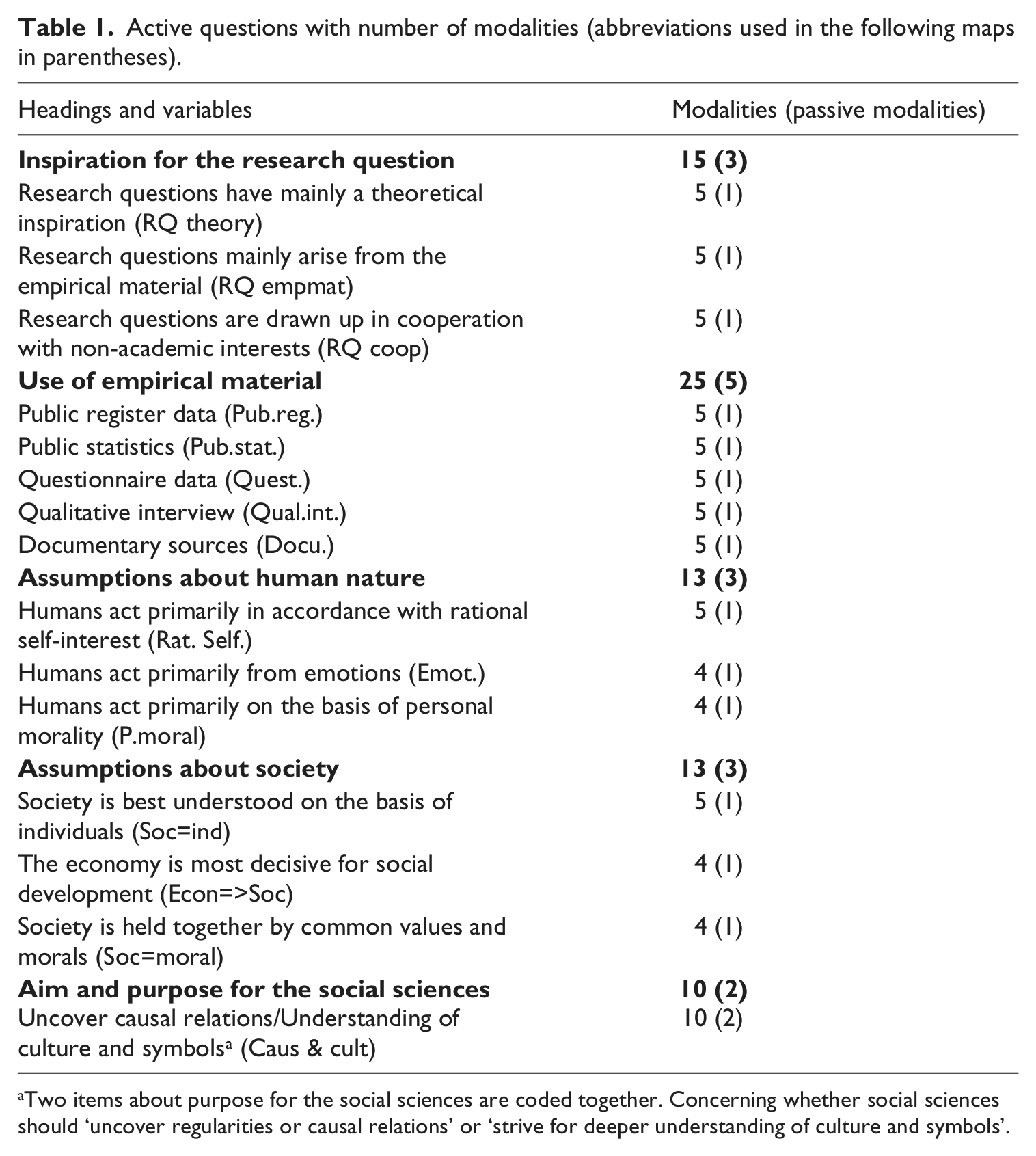
Two items about purpose for the social sciences are coded together. Concerning whether social sciences should ‘uncover regularities or causal relations’ or ‘strive for deeper understanding of culture and symbols’.
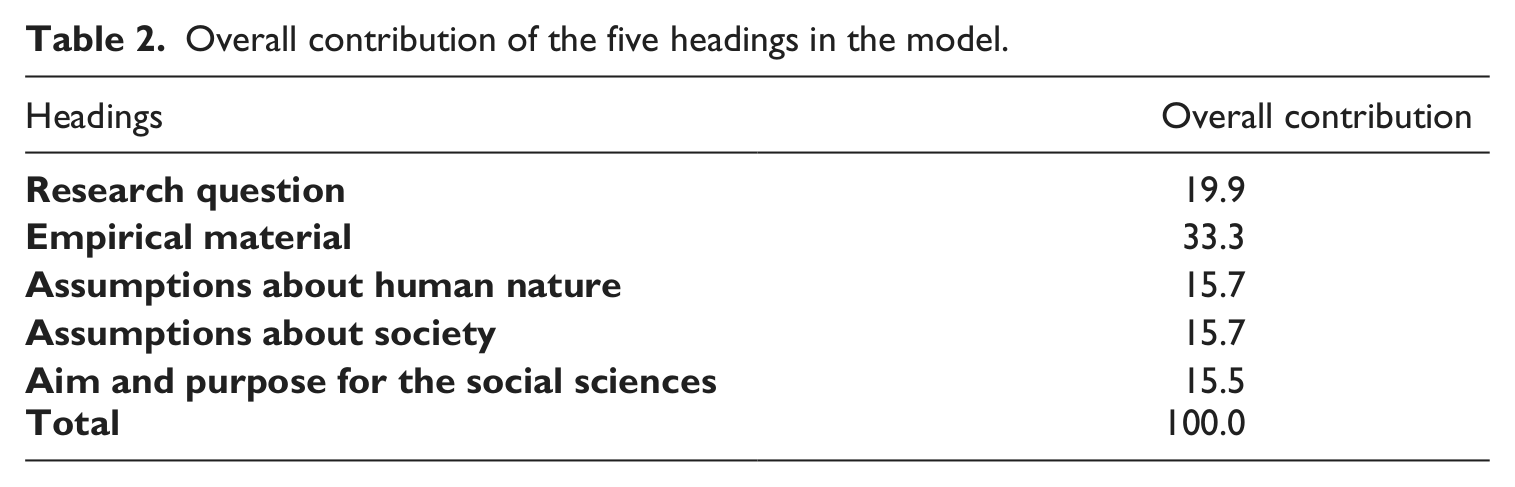
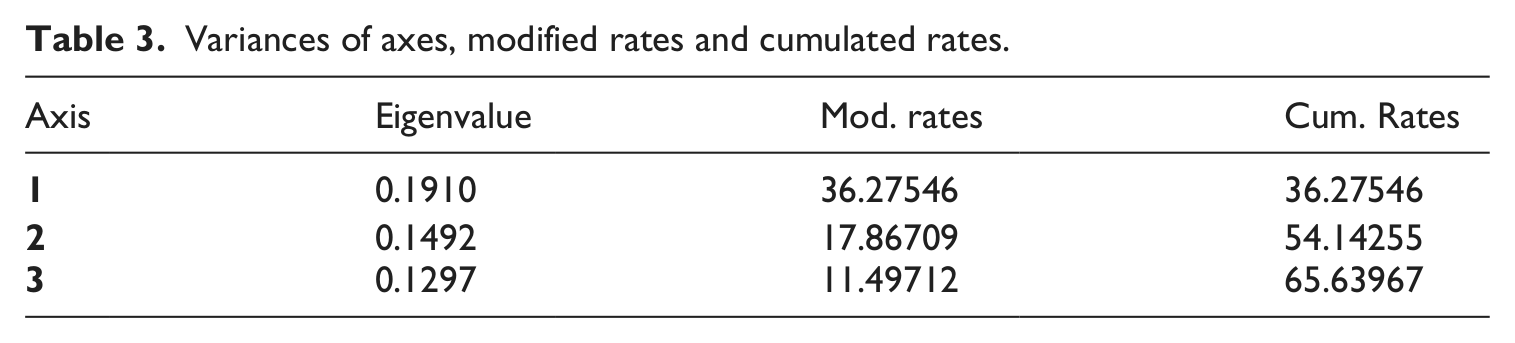
The five headings are balanced so that none of them dominates the entire model (Table 2). The axes produced in the statistical analysis are stable if a variable is omitted or replaced by another relevant variable. The first three axes represent 65.6% of the variance and are kept for further analysis (Table 3).
Overall contribution of the five headings in the model.
Variances of axes, modified rates and cumulated rates.
Summary interpretation of the axes
Most of the variance on the first axis is accounted for by the headings: (2) use of empirical data, (3) assumptions about human nature, (4) assumptions about society, and (5) aim and purpose of the social sciences; but heading (1), inspiration for the research question, does not contribute. The second axis is accounted for by headings (2) and (1). The third axis is mainly accounted for by heading (3).
First axis
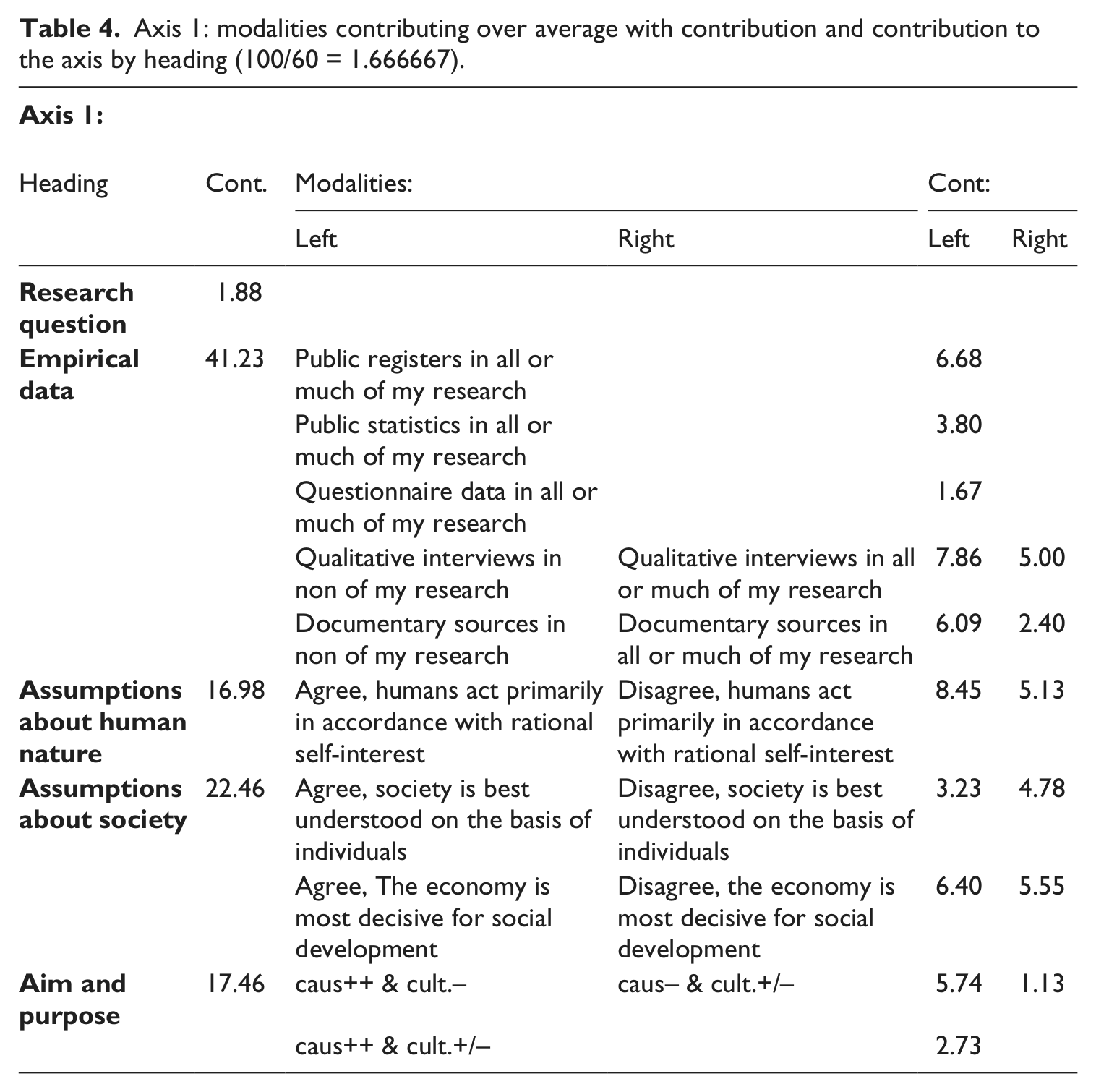
Seventeen modalities contribute above the average on the first axis (100/60 = 1.66667) and account for about 85% of the variance of the axis (see Table 4 and Figure 1). On the left-hand side we find 10 modalities representing extensive use of quantitative material, no use of qualitative material, rationalistic assumptions about human nature and methodological individualism. Together with these modalities, we find modalities representing a social science aimed at determining causal relations and regularities. On the right-hand side we find the modalities representing the use of qualitative material, and a rejection of rationalistic assumptions about human nature and methodological individualism. We also find modalities representing a social science that favours interpretations of cultures and symbols over the search for causal relations and regularities.
Axis 1: modalities contributing over average with contribution and contribution to the axis by heading (100/60 = 1.666667).
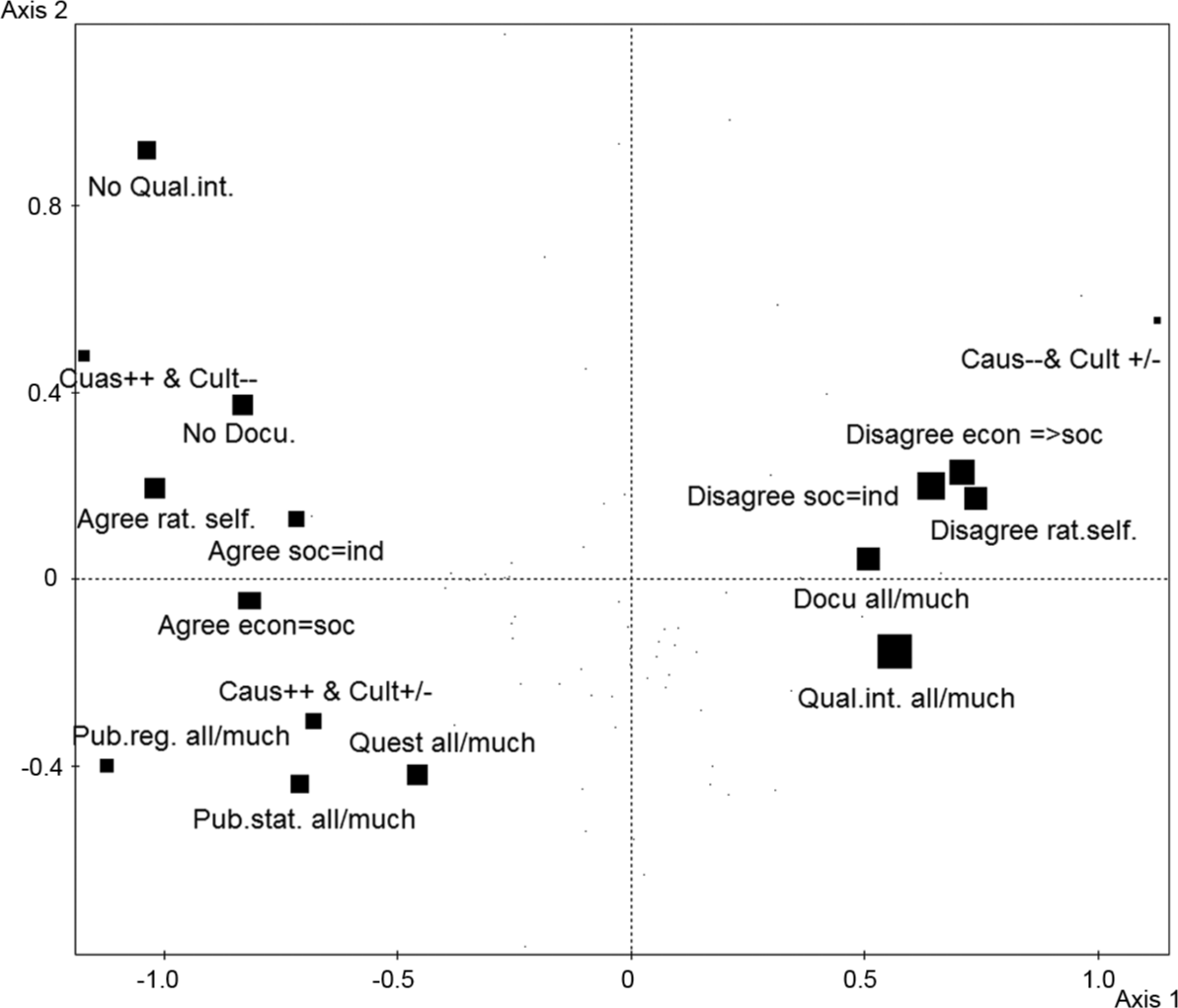
Plane 1–2 active modalities on axis 1: nomothetic and quantitative opposed to idiographic and qualitative.
Hence, the first axis represents common epistemological and methodological differences found within knowledge production in the social sciences and in the theoretical and methodological debates about methods and theoretical styles. It thus represents a distinction between a nomothetic and quantitative-oriented epistemological position-taking as opposed to an idiographic and qualitative one.
Second axis
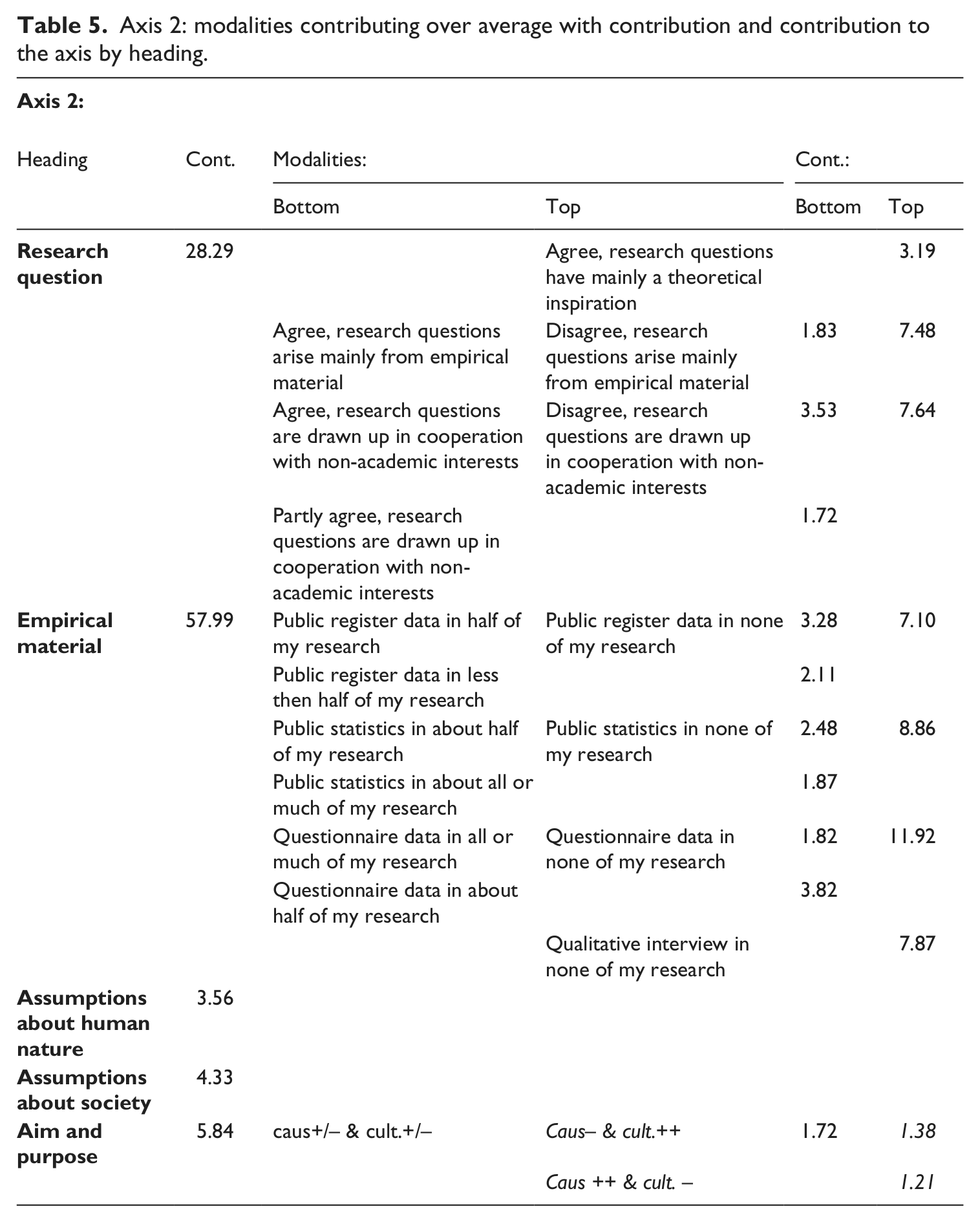
On the second axis (see Table 5 and Figure 2) 20 modalities contribute over the average, accounting for almost 80% of the variance of the axis. On the upper part of the axis we find modalities representing theoretical position-taking and forms of practice. We thus find several indicating no use of empirical materials and theoretical inspiration for the research questions, nor cooperation with non-academic interests. To these modalities I have added two others, which do not contribute over the average but are very close to it (Le Roux & Rouanet, 1998), both of which represent clear-cut theoretical positions and aspirations for the social sciences (in italics in Table 5). On the lower part of the axis we find opposite modalities representing the use of various forms of empirical material, but mostly quantitative and research questions formulated in cooperation with non-academic interests. The part of the axis concerning the aim and purpose of the social sciences is represented by more moderate or pragmatic forms of position-taking.
Axis 2: modalities contributing over average with contribution and contribution to the axis by heading.
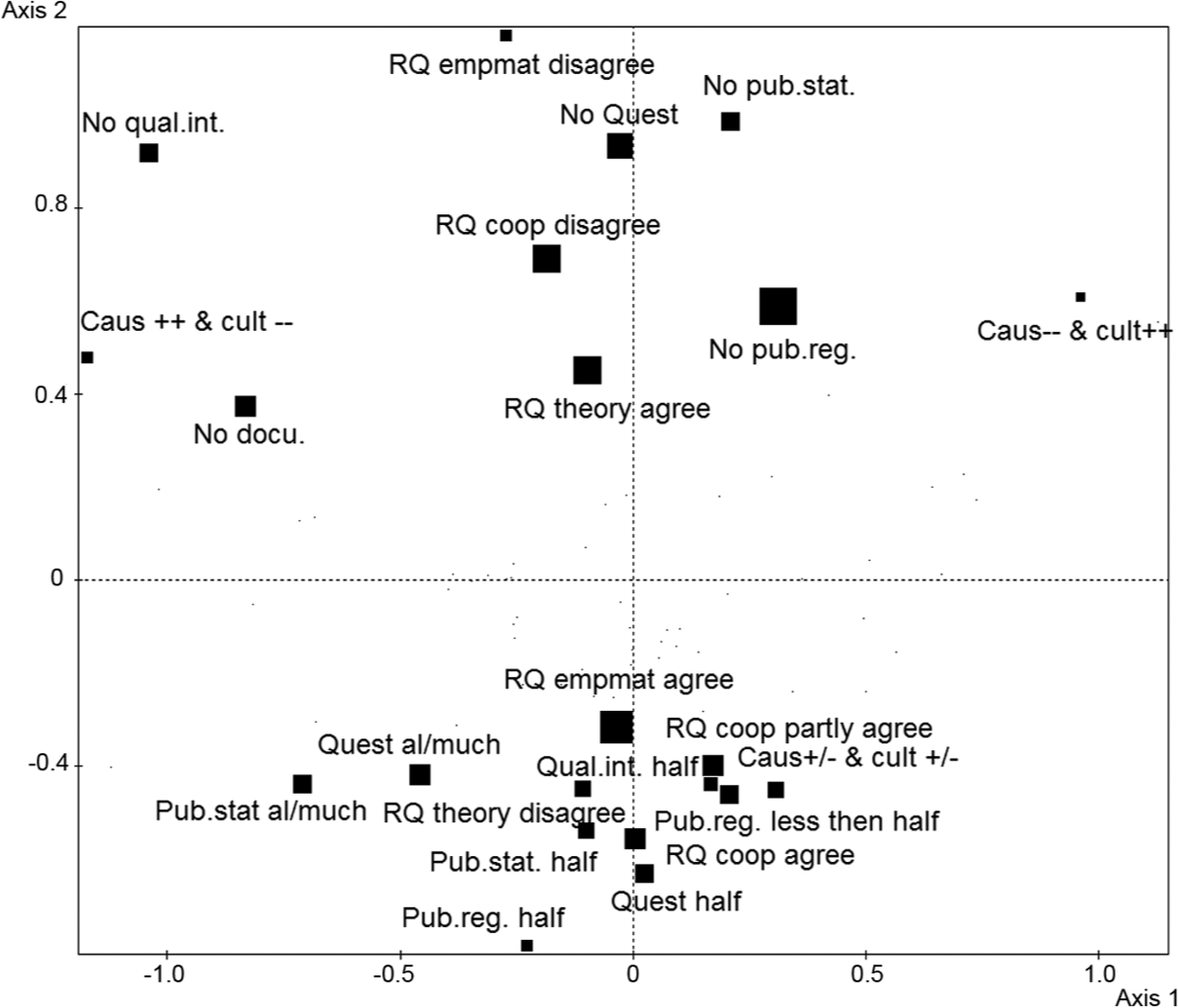
Plane 1–2 active modalities on axis 2: orientation of research.
Summing up: the second axis represents different orientations of social scientific research. On the upper part of the axis we find academic orientation and theoretical epistemological position-taking oriented towards academic audiences; on the lower part we find a more empirical epistemological position-taking and an orientation towards non-academic audiences.
Third axis
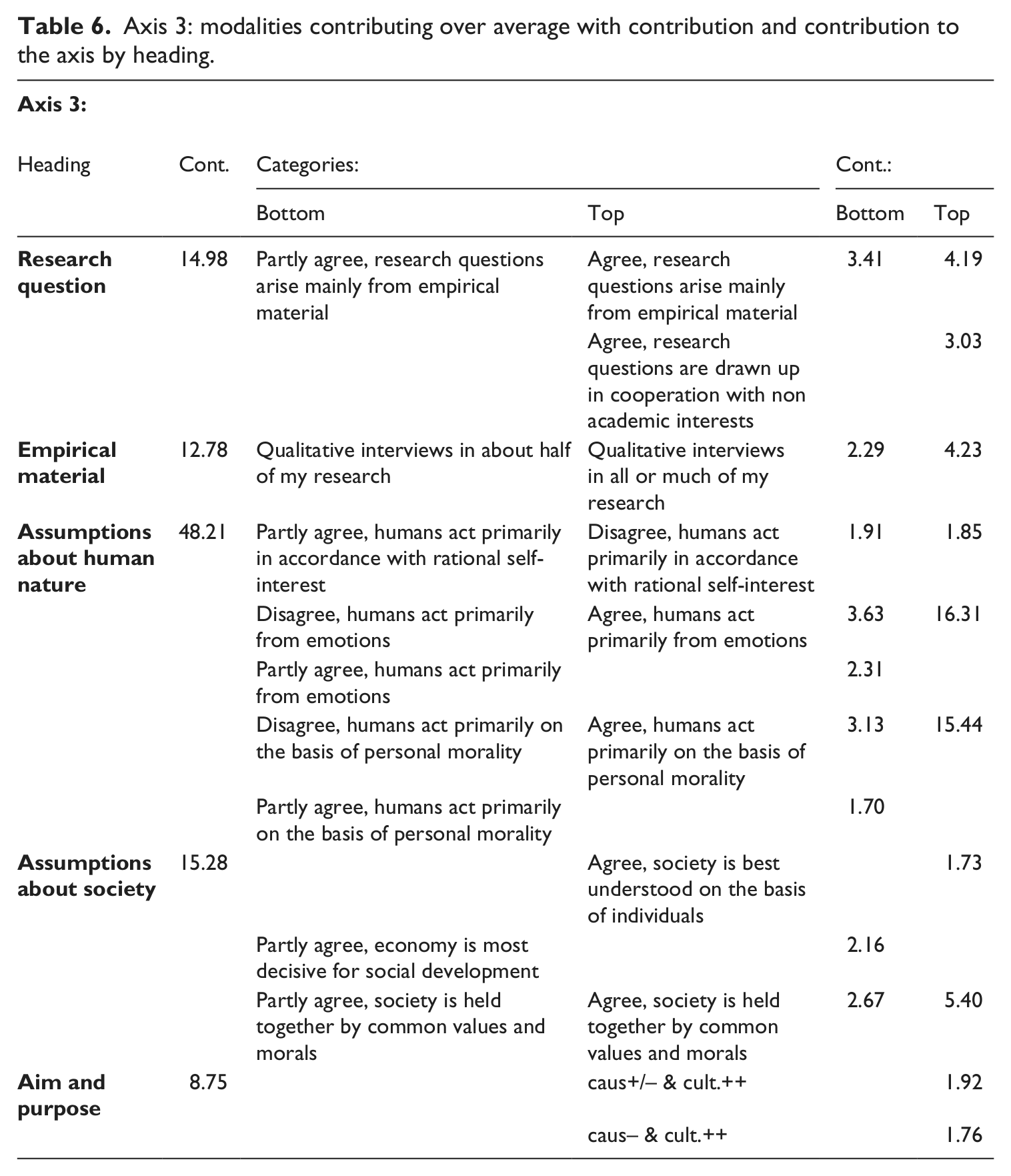
On the third axis (see Table 6 and Figure 3) 19 modalities contribute over the average, accounting for almost 80% of the variance. On the upper part of the axis we find modalities representing use of qualitative empirical material. Here we also find a rejection of a rationalistic view of human nature and instead a view of humanity as governed by emotions and personal morals. Likewise, society is seen as being held together by common morals and values. On the lower part of the axis we find not only the opposite modalities, but also those representing the intermediary position.
Axis 3: modalities contributing over average with contribution and contribution to the axis by heading.
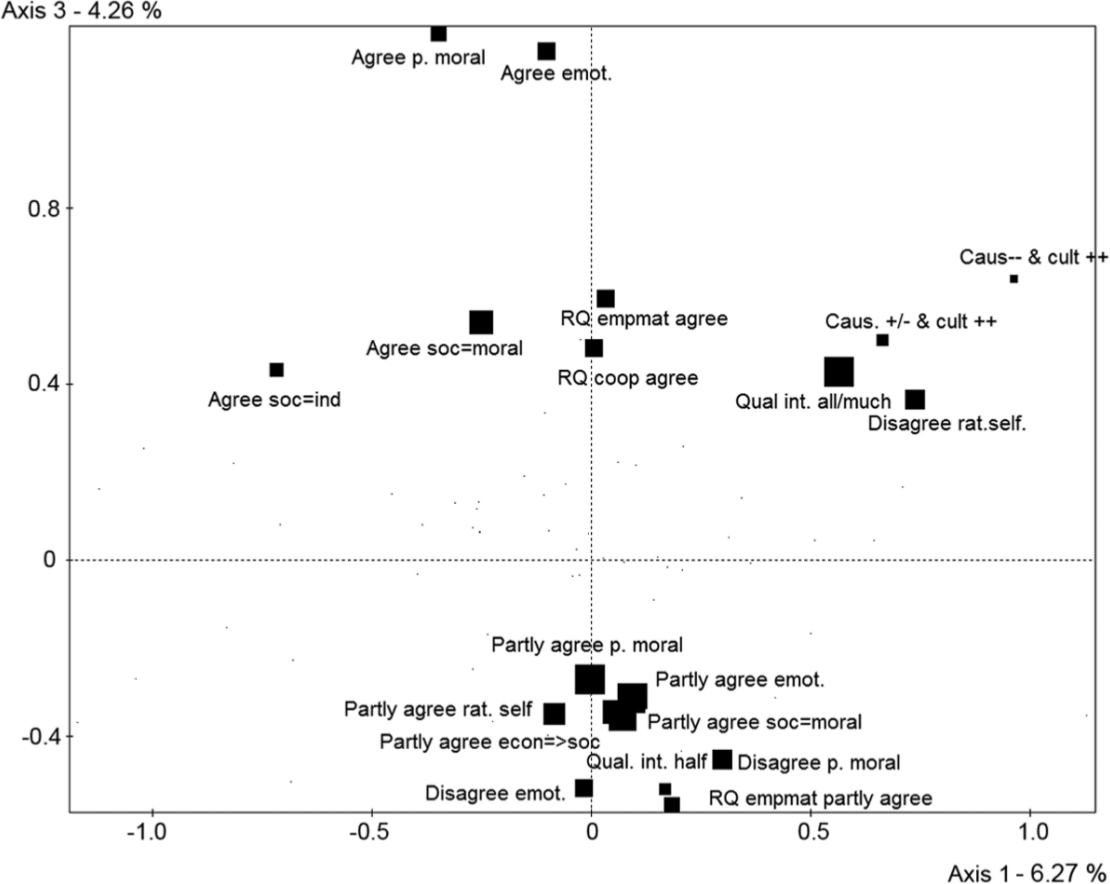
Plane 1–3 active modalities on axis 3.
The third axis is to a very large degree a repetition of the first, but with modalities from the heading ‘assumption about human nature’ instead of from ‘empirical material’ and ‘assumptions about society’. We can thus understand the axis as representing some of the same differences in position-taking as the first, but expressed here in different assumptions about human nature.
The space of epistemological position-taking
The space of epistemological position-taking is differentiated by two main principles of distinction represented on three axes. On the first axis we find a difference between the classical oppositions within philosophy of social science and methodological discussions. Thus, we find a nomothetic and quantitative position-taking opposed to an idiographic and qualitative one. The second axis represents the second principle of difference, the orientation of research. Here, we find an opposition between a theoretical and academically orientated position as opposed to an empirical position orientated towards non-academic interests. The third axis repeats the distinction found in the two first axes, but adds a difference in assumptions about human nature in the opposition found on the first axis. In the next section of this article, I relate this different way of position-taking to other social properties and sketch out a field for social sciences.
In the structured data analysis, I project supplementary variables into the space of social scientific epistemological position-taking in order to address the second research question. The structured data analysis shows that the difference in position-taking represented in the third axis does not differentiate with regard to relations to the field of power. The following analysis is therefore restricted to the first two axes.
The relation to the field of power
As pointed out earlier, the social sciences – their institutions and problematics – stand in a very close relation to non-academic institutions and interests, especially those of the nation-states. The issue of the relation to non-academic interests and institutions constituted the second axis in the space of epistemological position-taking and thus empirically reconfirmed the centrality of the relationship. And as all who take part in social science activities know, the relation to non-academic interests and institutions can mobilize social scientists to engage in heated debates about autonomy and societal relevance, discussions not only about engagement or distance, but just as much about types of engagements and the epistemological aims and purposes of the social sciences (for some recent contributions to the discussion, see Boudon, 2002; Burawoy, 2005; Cole, 2001; Flyvbjerg, 2010; Goldthorpe, 2004).
The differences can be understood by using Bourdieu’s model of fields of cultural production (Bourdieu, 1996a). In this model, drawing on the basic theoretical assumption about social fields, we find two different orientations for cultural production in the struggle for recognition: an orientation of production towards other producers as opposed to an orientation of production towards non-producers. In an academic context associated with production for producers, we find modes of production that use internally recognized products, such as peer-reviewed publications, and address problems that have arisen within the academic institutions, such as social theory and sophisticated econometrics. Opposed to this mode of production we find production for non-producers; associated with this mode of production are different forms of cooperation with non-academic interests looking into problems that have arisen in non-academic contexts. Likewise, we find different kinds of commissioned work and funding from more application-oriented agencies very often dealing with contemporary problems, from unemployment to migration and to the organization of public institutions and human resource management. The two modes of production represent two different forms of legitimate social scientific labour and products, or two ways of engaging with the struggles in the field.
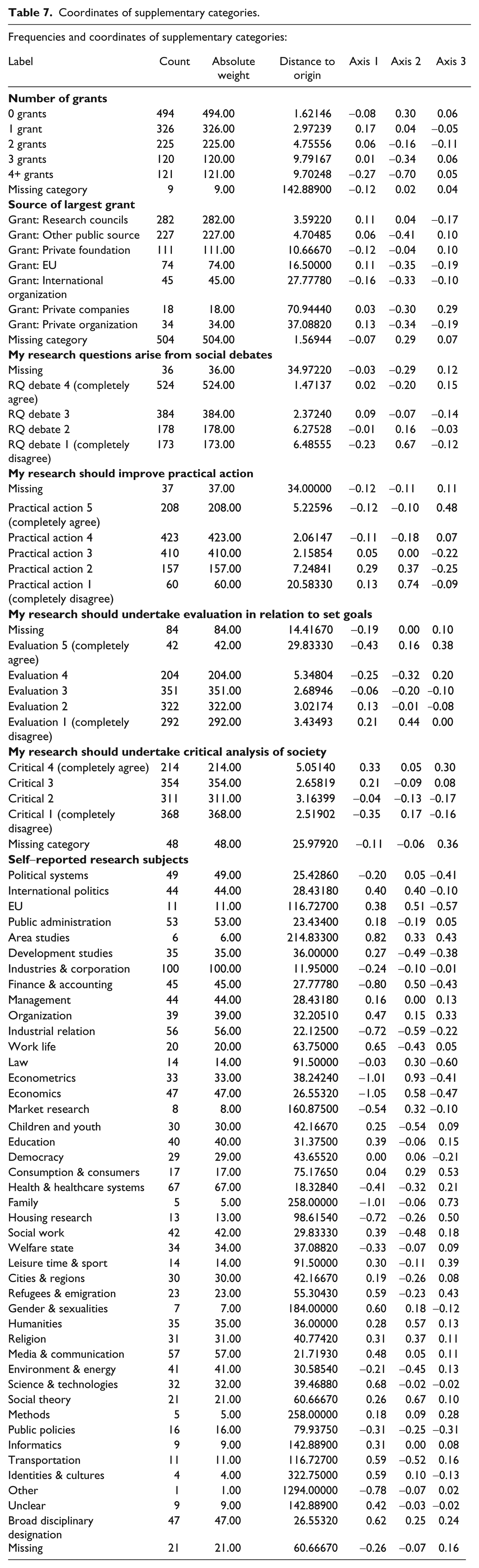
In the concept of field lies also the hypothesis that such differences in the field tend to be homologues structured in the mental and institutional structures of the field. In the following analysis, I have therefore used variables representing both institutional and mental structures. The institutional part of the difference is represented by two variables: (1) number of projects with external funding and (2) source of funding. The mental structures are represented by four variables, one concerning inspiration for research questions, and three concerning aim and purpose of the social sciences. Furthermore, I use research subjects to show how different parts of the field of social science relate to different parts of the field of power by addressing specific subjects and producing knowledge about specific areas or problematics of the social. (For frequencies and coordinates of supplementary categories, please see Table 7 in the Appendix.)
The axes
First axis
The finding on the first axis (Figure 4) illustrates the interpretation of the different epistemological position-takings as relatively distinct social spaces with their own division of academic labour, following the overall principle of the distinction between production for non-producers and production for producers. There is thus no difference regarding the number of external projects or source of external financing between the nomothetic and idiographic parts of the axis. Likewise, we find no differences in position-taking regarding inspiration for research questions from public debates or whether the social sciences should contribute to improving the foundation for practical action. The differences found on the first axis relate to epistemological conviction between different epistemological positions. They first regard different ways of engaging with non-academic interests and institutions, and represent different views on the relations of social sciences to society; and second they present different views on the character of social scientific knowledge. Thus, we find associated with the nomothetic part of the axis modalities representing an instrumentalist view of the purpose of social sciences as well as rejection of any critical ambition. On the idiographic part of the axis we find opposite modalities representing a more engaged and critical view of both relation to non-academic institutions and purpose of the social sciences.
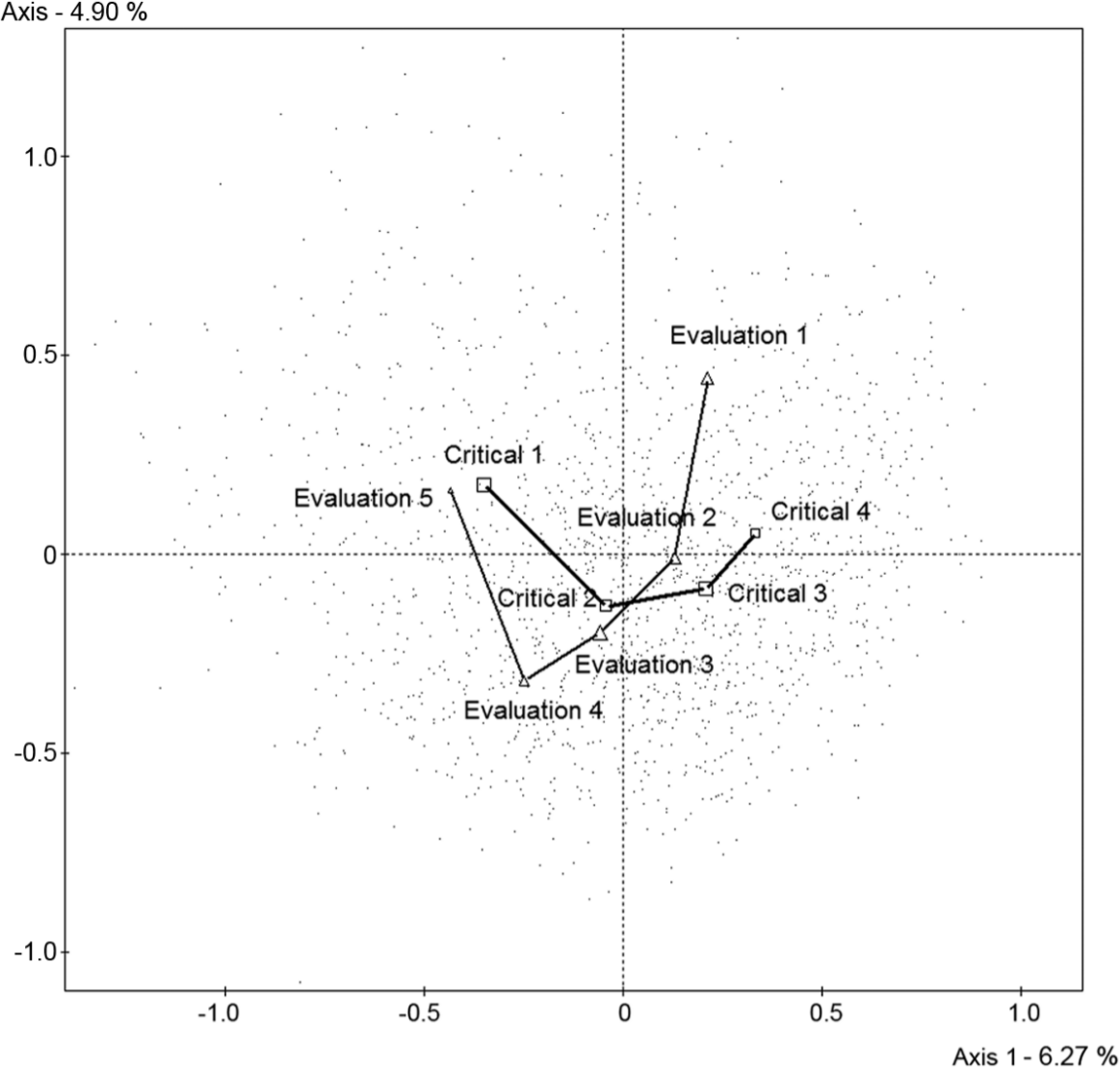
Position-taking regarding relation to non-academic institutions and interests on axis 1 (Likert scale 1 = completely disagree, 5 = completely agree).
Second axis
In the space of epistemological position-taking, the second axis (Figures 5 and 6) is constituted by a difference between what I designate as production for producers as opposed to production for non-producers. Using variables representing institutional and mental structures illustrates this interpretation. Regarding the institutional structures, we find an opposition between many and no grants, and likewise a difference in sources on this axis. Associated with production for producers, we find funding from research councils; and associated with production for non-producers we find funding from various non-academic institutions ranging from public institutions to private companies and organizations. Furthermore, the axis is constituted by differences in position-taking regarding the orientation of the social scientific production. On the upper part of the axis we find modalities representing a rejection of non-academic problematics as an important inspiration for the research questions and a rejection of more instrumental and application-oriented purposes for the social sciences. Opposed to this we find on the lower part of the axis position-taking which is positive towards both engaged and more instrumental purposes for the social sciences.
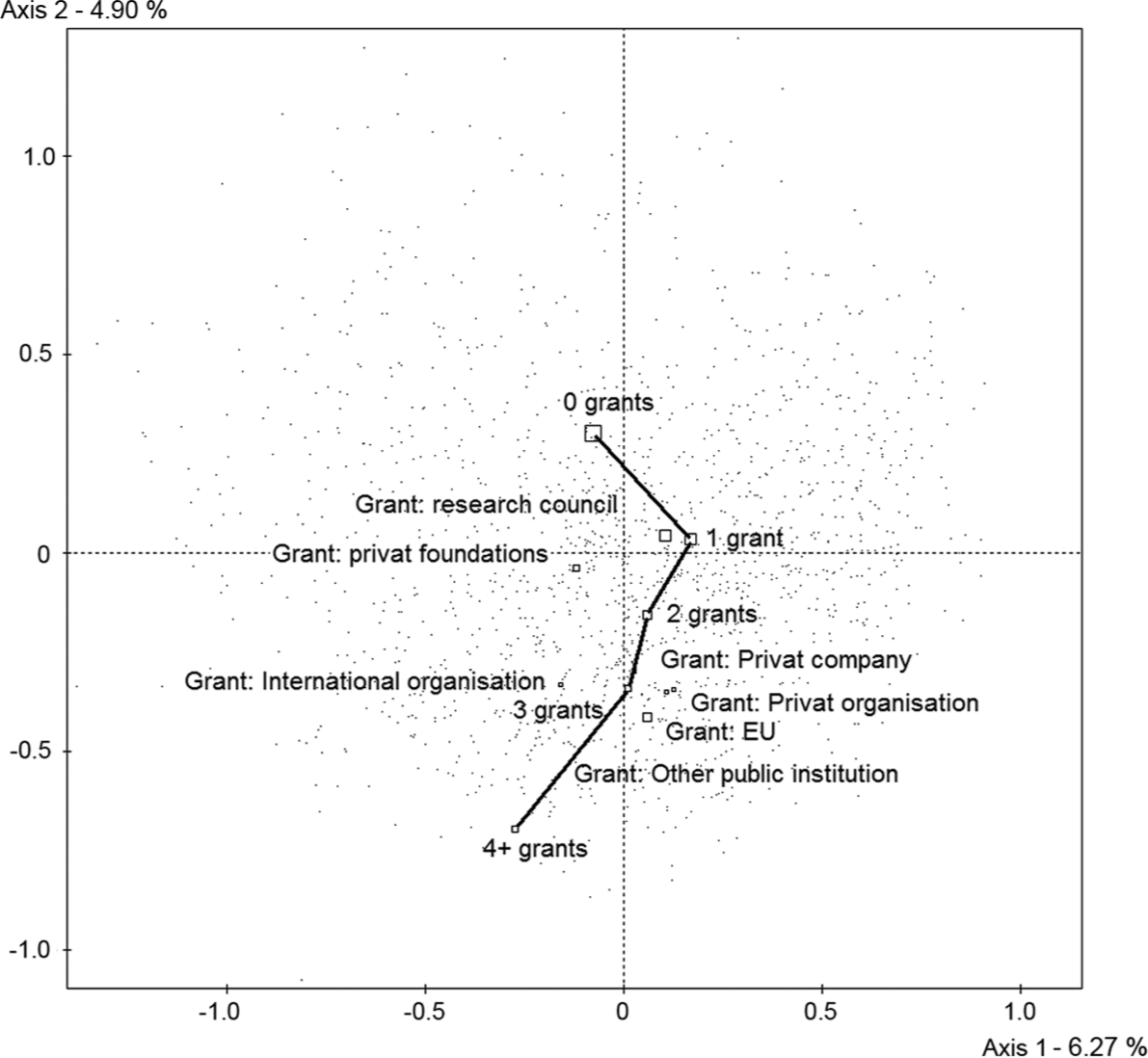
Number and source of grants in planes 1 and 2.
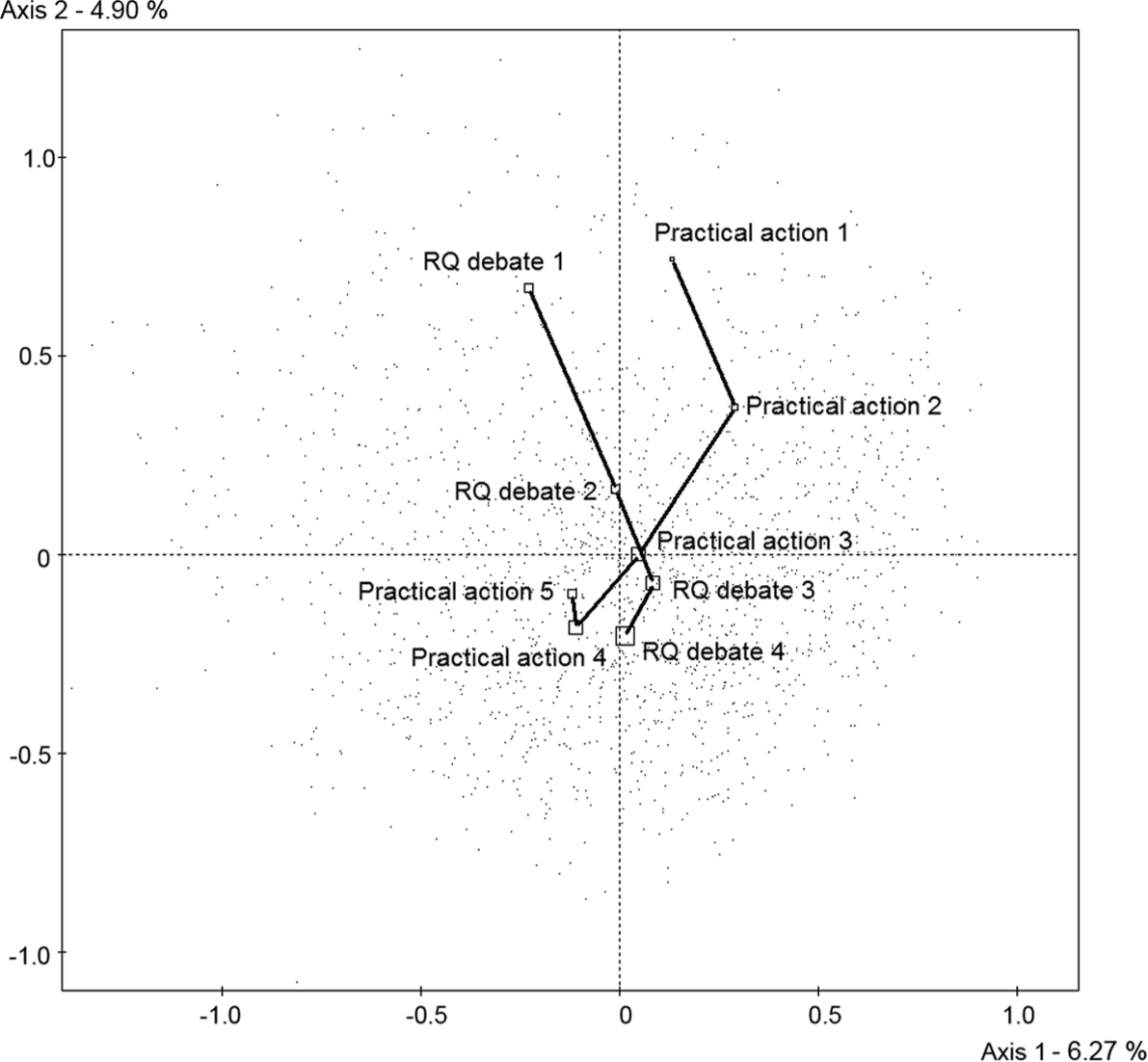
Position-taking regarding relation to non-academic institutions and interests on axis 2 (Likert scale 1 = completely disagree, 5 = completely agree).
Research subjects in the field of social sciences
We have now seen how different ways of looking at and practising social science are distributed in structures that we can understand as a field of cultural production. As pointed out earlier, the social sciences stand in a very close relationship to various social institutions and interests and, as we saw above, the views on the relationship to non-academic interests and institutions differ not only between ‘basic’ and ‘applied’, but just as importantly on the relationship to non-academic institutions and interests and the character of social scientific knowledge (see Figure 7).
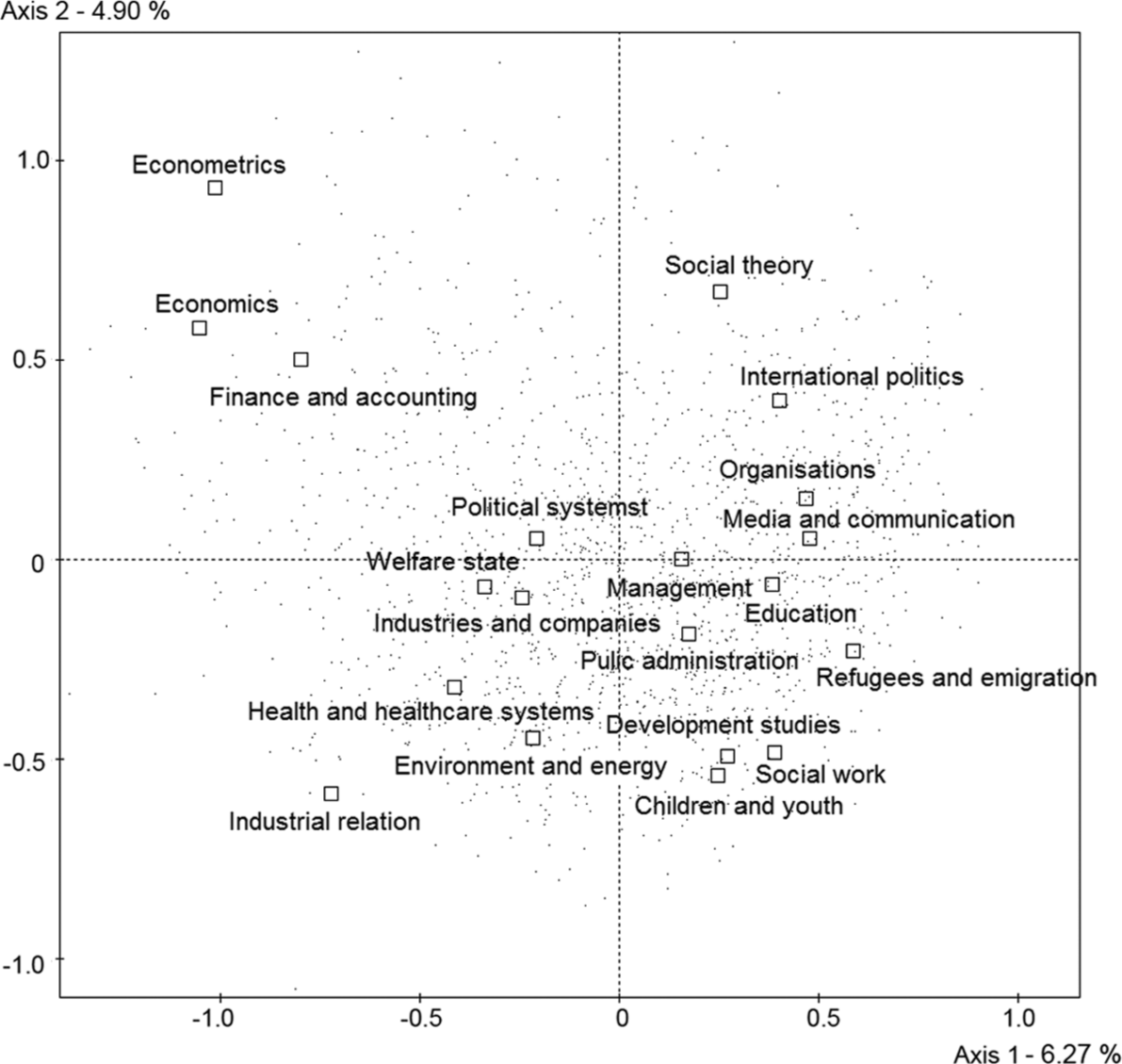
Research subjects in planes 1 and 2.
Looking at the research subjects in relation to the first axis, we find a distribution of research subjects among the social science disciplines. On the left-hand side we find research subjects such as management studies, labour market studies, public policies, welfare studies, economics, financing and accounting. In other words, forms of knowledge associated with economic disciplines and powerful social institutions and interests. On the right-hand side we find social scientific research addressing the less favoured parts of the social space, including classical areas of welfare-state policies such as social problems, children and youth, education, refugees and immigrants. Thus, we find among the more applied research subjects a difference between research orientated towards what Bourdieu designates as the right and left hands of the state bureaucracy. Using this distinction, Bourdieu originally pointed to different positions in the struggles over reforms in welfare-state bureaucracies between agents representing the institutions and ministries responsible for minimizing the social consequences of reformed welfare states and the market (the left hand), as opposed to theocrats in the ministries of finance and the like, controlling both budgets and citizens (the right hand) (Bourdieu, 1998a; Bourdieu et al., 1999; 181–254; Wacquant, 2010). Here we see how different parts of the field of social sciences – often through the problems and sectors historically allocated to the different social science disciplines – are related to specific social institutions and interests by the knowledge they produce and through which the social world is represented with specific problems and solutions.
The second axis adds to the earlier interpretation of this differentiation between production for producers and production for non-producers. Here, we find more ‘applied’ subjects of research on the lower part of the axis, such as labour-market studies, management, social work, youth and children, work life, public administration, etc., and on the upper part of the axis we find subjects such as econometrics and social theory oriented towards an academic audience.
Conclusion
This article set out to understand the relationship between the structure of the field of social sciences and the field of power. Using SMCA on survey data, I showed how we can understand the social sciences as a social space structured by two antagonistic struggles. Drawing on concepts from Bourdieu’s sociology of sciences, I constructed a field of social sciences, starting with a space of epistemological position-taking and thereafter using supplementary variables in a structured data analysis.
The social sciences have since their institutionalization had a close relationship with important societal interests and institutions that has been decisive for both institutional settings and the cognitive content of the social sciences. In this article I showed how different parts of the social sciences, through choice of research subjects, theory and methods, relate to specific social interests and institutions. These relations can be used in the internal struggles for recognition in the field and in the struggles over principles of vision and division in the field. The analysis followed two main research questions, and I summarize the results here.
(1) The space of social scientific epistemological position-taking follows two main principles of differentiation. The first axis follows a classical difference within the philosophy of social sciences and methodological debates between a nomothetic and quantitative epistemological position-taking as opposed to an idiographic and qualitative one. The second axis differentiated according to the orientation of research between a theoretical and academic epistemological position-taking as opposed to an empirical and non-academic one. The third axis repeated the difference found on the first axis. The analysis thus adds an important social and epistemological aspect to the understanding of the lines of conflict in the field of social sciences, namely the orientation or audience structure of the social sciences (Whitley, 1984: 234–238).
(2) In the analysis of the relationship of social sciences to the field of power, I used Bourdieu’s model for fields of cultural production and his distinction between the right and left hands of the state bureaucracy. From the model for the field of cultural production, we drew a distinction between production for non-producers and production for producers. On the first axis we found no difference regarding the amount or source of funding, but important differences in the way different parts of the field of social science engage with non-academic institutions and interests, and the way they viewed the character of social scientific knowledge. We thus found a difference between an instrumentalist and disengaged position-taking as opposed to a more critical and engaged one. Furthermore, the first axis differentiated between research subjects orientated towards the right hand of the state bureaucracy and the private sector associated with the nomothetic and quantitative parts of the axis, as opposed to the idiographic and qualitative part of the axis associated with research subjects orientated towards the left hand of the state bureaucracy. On the second axis we found a difference between production for non-producers and production for producers. This distinction was found in variables representing both mental and objective structures, as well as in research subjects.
The main conclusion of this article is straightforward but important, both in relation to future studies of the social sciences and in order to understand differences in their relations to the field of power. The empirical findings in this article emphasize the findings of other studies indicating that several epistemic cultures or modes of knowledge production coexist within the social sciences (Albert, 2003; Lamont, 2009; Mallard et al., 2009;Ylijoki, 2000), but in the present case we have utilized sophisticated statistical tools. This emphasizes that one should not envisage academic research – and especially not the social sciences – as a homogeneous unit. On the contrary, we need to understand these different modes of knowledge production as distinct epistemic cultures (Knorr Cetina, 1999) or fields of cultural production (Heilbron, 2004). It is important, however, to maintain a truly relational view of the social sciences in order to understand how changes and institutional settings influence the different disciplines and their modes of knowledge production, and in consequence the power structure and struggles in the field. We thus have to think about and empirically analyse how the relations of power are affected by the current changes in higher education and science policies sweeping across academia, both in regard to relations between the disciplines as well as within them, and of course how it effects the production of social scientific knowledge. In this regard, the article shows how specific parts of the social sciences are related to specific parts of the field of power. The question is: how does the strengthening of specific positions in the field of power affect power relations in the field of social sciences? With regard to the main question of the article, I have shown that different parts of the field of social sciences relate in very different ways to the field of power. Using Wagner’s notion, we can say that different parts of the social sciences enter into coalitions with different parts of the state bureaucracy and other parts of the field of power. The nomothetic and quantitative-oriented parts are associated with the dominating factions in the field of power; they also mimic the dominating modes of knowledge production in the academic field at large – the mode of knowledge production in the natural sciences through quantification and formalization economics, as well as through parts of business studies and political sciences; and likewise the more instrumental and disengaged stance of the natural sciences towards the social use of the knowledge produced. As Lebaron shows, in this way of position-taking, representing and seeing social scientific knowledge as neutral and disengaged scientific knowledge are important properties for understanding the symbolic function of economic knowledge when mobilized in the struggles in the field of power (Lebaron, 2000, 2006). Thus, it is important to recognize the various ways in which the social sciences enter into coalitions and strategic cooperation with institutions and interests from different parts of the state bureaucracy and the field of power, and thereby produce symbolic legitimacy for both specific forms of social scientific knowledge and specific positions in the field of power, symbolically underpinning specific social interest. In this way, the article underlines that the organization of power relations in the field of social sciences and relations to the field of power are not only interesting and important in order to understand the specific condition for social scientific knowledge production. Understanding these relations also contributes to our understanding of the functioning of advanced societies and of the state (Wacquant, 2010). The article shows very important principles of vision and division setting the field of social sciences apart. Likewise, it shows differences in the ways social sciences enter into coalitions with non-academic institutions and interests. We need to keep this in mind when studying social science knowledge production, the social use of social scientific knowledge, and the interactions between social scientists and non-academic institutions and interest.
Footnotes
Appendix
Coordinates of supplementary categories.
| Frequencies and coordinates of supplementary categories: | ||||||
|---|---|---|---|---|---|---|
| Label | Count | Absolute weight | Distance to origin | Axis 1 | Axis 2 | Axis 3 |
|
|
||||||
| 0 grants | 494 | 494.00 | 1.62146 | −0.08 | 0.30 | 0.06 |
| 1 grant | 326 | 326.00 | 2.97239 | 0.17 | 0.04 | −0.05 |
| 2 grants | 225 | 225.00 | 4.75556 | 0.06 | −0.16 | −0.11 |
| 3 grants | 120 | 120.00 | 9.79167 | 0.01 | −0.34 | 0.06 |
| 4+ grants | 121 | 121.00 | 9.70248 | −0.27 | −0.70 | 0.05 |
| Missing category | 9 | 9.00 | 142.88900 | −0.12 | 0.02 | 0.04 |
|
|
||||||
| Grant: Research councils | 282 | 282.00 | 3.59220 | 0.11 | 0.04 | −0.17 |
| Grant: Other public source | 227 | 227.00 | 4.70485 | 0.06 | −0.41 | 0.10 |
| Grant: Private foundation | 111 | 111.00 | 10.66670 | −0.12 | −0.04 | 0.10 |
| Grant: EU | 74 | 74.00 | 16.50000 | 0.11 | −0.35 | −0.19 |
| Grant: International organization | 45 | 45.00 | 27.77780 | −0.16 | −0.33 | −0.10 |
| Grant: Private companies | 18 | 18.00 | 70.94440 | 0.03 | −0.30 | 0.29 |
| Grant: Private organization | 34 | 34.00 | 37.08820 | 0.13 | −0.34 | −0.19 |
| Missing category | 504 | 504.00 | 1.56944 | −0.07 | 0.29 | 0.07 |
|
|
||||||
| Missing | 36 | 36.00 | 34.97220 | −0.03 | −0.29 | 0.12 |
| RQ debate 4 (completely agree) | 524 | 524.00 | 1.47137 | 0.02 | −0.20 | 0.15 |
| RQ debate 3 | 384 | 384.00 | 2.37240 | 0.09 | −0.07 | −0.14 |
| RQ debate 2 | 178 | 178.00 | 6.27528 | −0.01 | 0.16 | −0.03 |
| RQ debate 1 (completely disagree) | 173 | 173.00 | 6.48555 | −0.23 | 0.67 | −0.12 |
|
|
||||||
| Missing | 37 | 37.00 | 34.00000 | −0.12 | −0.11 | 0.11 |
| Practical action 5 (completely agree) | 208 | 208.00 | 5.22596 | −0.12 | −0.10 | 0.48 |
| Practical action 4 | 423 | 423.00 | 2.06147 | −0.11 | −0.18 | 0.07 |
| Practical action 3 | 410 | 410.00 | 2.15854 | 0.05 | 0.00 | −0.22 |
| Practical action 2 | 157 | 157.00 | 7.24841 | 0.29 | 0.37 | −0.25 |
| Practical action 1 (completely disagree) | 60 | 60.00 | 20.58330 | 0.13 | 0.74 | −0.09 |
|
|
||||||
| Missing | 84 | 84.00 | 14.41670 | −0.19 | 0.00 | 0.10 |
| Evaluation 5 (completely agree) | 42 | 42.00 | 29.83330 | −0.43 | 0.16 | 0.38 |
| Evaluation 4 | 204 | 204.00 | 5.34804 | −0.25 | −0.32 | 0.20 |
| Evaluation 3 | 351 | 351.00 | 2.68946 | −0.06 | −0.20 | −0.10 |
| Evaluation 2 | 322 | 322.00 | 3.02174 | 0.13 | −0.01 | −0.08 |
| Evaluation 1 (completely disagree) | 292 | 292.00 | 3.43493 | 0.21 | 0.44 | 0.00 |
|
|
||||||
| Critical 4 (completely agree) | 214 | 214.00 | 5.05140 | 0.33 | 0.05 | 0.30 |
| Critical 3 | 354 | 354.00 | 2.65819 | 0.21 | −0.09 | 0.08 |
| Critical 2 | 311 | 311.00 | 3.16399 | −0.04 | −0.13 | −0.17 |
| Critical 1 (completely disagree) | 368 | 368.00 | 2.51902 | −0.35 | 0.17 | −0.16 |
| Missing category | 48 | 48.00 | 25.97920 | −0.11 | −0.06 | 0.36 |
|
|
||||||
| Political systems | 49 | 49.00 | 25.42860 | −0.20 | 0.05 | −0.41 |
| International politics | 44 | 44.00 | 28.43180 | 0.40 | 0.40 | −0.10 |
| EU | 11 | 11.00 | 116.72700 | 0.38 | 0.51 | −0.57 |
| Public administration | 53 | 53.00 | 23.43400 | 0.18 | −0.19 | 0.05 |
| Area studies | 6 | 6.00 | 214.83300 | 0.82 | 0.33 | 0.43 |
| Development studies | 35 | 35.00 | 36.00000 | 0.27 | −0.49 | −0.38 |
| Industries & corporation | 100 | 100.00 | 11.95000 | −0.24 | −0.10 | −0.01 |
| Finance & accounting | 45 | 45.00 | 27.77780 | −0.80 | 0.50 | −0.43 |
| Management | 44 | 44.00 | 28.43180 | 0.16 | 0.00 | 0.13 |
| Organization | 39 | 39.00 | 32.20510 | 0.47 | 0.15 | 0.33 |
| Industrial relation | 56 | 56.00 | 22.12500 | −0.72 | −0.59 | −0.22 |
| Work life | 20 | 20.00 | 63.75000 | 0.65 | −0.43 | 0.05 |
| Law | 14 | 14.00 | 91.50000 | −0.03 | 0.30 | −0.60 |
| Econometrics | 33 | 33.00 | 38.24240 | −1.01 | 0.93 | −0.41 |
| Economics | 47 | 47.00 | 26.55320 | −1.05 | 0.58 | −0.47 |
| Market research | 8 | 8.00 | 160.87500 | −0.54 | 0.32 | −0.10 |
| Children and youth | 30 | 30.00 | 42.16670 | 0.25 | −0.54 | 0.09 |
| Education | 40 | 40.00 | 31.37500 | 0.39 | −0.06 | 0.15 |
| Democracy | 29 | 29.00 | 43.65520 | 0.00 | 0.06 | −0.21 |
| Consumption & consumers | 17 | 17.00 | 75.17650 | 0.04 | 0.29 | 0.53 |
| Health & healthcare systems | 67 | 67.00 | 18.32840 | −0.41 | −0.32 | 0.21 |
| Family | 5 | 5.00 | 258.00000 | −1.01 | −0.06 | 0.73 |
| Housing research | 13 | 13.00 | 98.61540 | −0.72 | −0.26 | 0.50 |
| Social work | 42 | 42.00 | 29.83330 | 0.39 | −0.48 | 0.18 |
| Welfare state | 34 | 34.00 | 37.08820 | −0.33 | −0.07 | 0.09 |
| Leisure time & sport | 14 | 14.00 | 91.50000 | 0.30 | −0.11 | 0.39 |
| Cities & regions | 30 | 30.00 | 42.16670 | 0.19 | −0.26 | 0.08 |
| Refugees & emigration | 23 | 23.00 | 55.30430 | 0.59 | −0.23 | 0.43 |
| Gender & sexualities | 7 | 7.00 | 184.00000 | 0.60 | 0.18 | −0.12 |
| Humanities | 35 | 35.00 | 36.00000 | 0.28 | 0.57 | 0.13 |
| Religion | 31 | 31.00 | 40.77420 | 0.31 | 0.37 | 0.11 |
| Media & communication | 57 | 57.00 | 21.71930 | 0.48 | 0.05 | 0.11 |
| Environment & energy | 41 | 41.00 | 30.58540 | −0.21 | −0.45 | 0.13 |
| Science & technologies | 32 | 32.00 | 39.46880 | 0.68 | −0.02 | −0.02 |
| Social theory | 21 | 21.00 | 60.66670 | 0.26 | 0.67 | 0.10 |
| Methods | 5 | 5.00 | 258.00000 | 0.18 | 0.09 | 0.28 |
| Public policies | 16 | 16.00 | 79.93750 | −0.31 | −0.25 | −0.31 |
| Informatics | 9 | 9.00 | 142.88900 | 0.31 | 0.00 | 0.08 |
| Transportation | 11 | 11.00 | 116.72700 | 0.59 | −0.52 | 0.16 |
| Identities & cultures | 4 | 4.00 | 322.75000 | 0.59 | 0.10 | −0.13 |
| Other | 1 | 1.00 | 1294.00000 | −0.78 | −0.07 | 0.02 |
| Unclear | 9 | 9.00 | 142.88900 | 0.42 | −0.03 | −0.02 |
| Broad disciplinary designation | 47 | 47.00 | 26.55320 | 0.62 | 0.25 | 0.24 |
| Missing | 21 | 21.00 | 60.66670 | −0.26 | −0.07 | 0.16 |