



Abstract
The Triple Helix model of innovation systems is widely diffused. The fundamental idea of the model is that ‘university’ can play an enhanced role in innovation in knowledge-based societies and that the three helices – ‘university’, ‘industry’ and ‘government’ – interact in order to produce innovation and therefore regional and national economic growth. This is, however, only one model among several different systemic approaches for explaining regional differences in innovativeness. While the triple helix model emphasizes the role of the university for regional innovativeness, the other systemic approaches call attention to either industry or government as having the lead role in innovation. Further, the triple helix model is developed and primarily explored from a macro-level perspective and not from a firm-level perspective. Finally, while the theoretical value of triple helix interactions are reasonably confirmed, there are still gaps in the triple helix concept, and the practical value is only just beginning to realize its potential. From a firm-level perspective, the purpose of this article is therefore to test the applicability and practical value of the triple helix model when exploring the formation and growth of firms using the case of Google Inc. Useful when exploring a firm’s formation and growth, the triple helix model forces the exploration to start even before the entrepreneur enters the scene, which provides a more holistic picture of firm formation. The three helices were all found to play important but changing roles in the different phases of firm formation and growth. The Google case contributes further understanding of the nature and historical evolution of interactions between the three helices, thereby filling some gaps in the triple helix concept. The Google case also identifies a number of mechanisms for interaction and the important role of the bridging organizations that connect the helices and contribute to the development of interactions. Finally, the concept of ‘spaces’ proved relevant and useful, although in the perspective of a firm, the concept has a broader meaning and exists on different levels.
The Triple Helix model or concept – terms we use interchangeably in this article – is built on the assumption that interaction between ‘university’, ‘industry’ and ‘government’ is the key to regional innovation and growth in a knowledge-based society (Etzkowitz, 2008). The triple helix model aims to be a platform for new organizational forms in terms of increasing the innovativeness of a region and securing continuous firm formation. The three helices – ‘university’, ‘industry’ and ‘government’ – are partly independent and partly interdependent as each can also take on the role of one of the other entities. Today several countries have adopted the triple helix model for generating more innovative regions and new firms.
However, the model is one among several different systemic approaches to explaining regional differences in innovativeness. While many of the other systemic approaches, such as regional innovation systems (e.g. Asheim et al., 2011) and cluster theories (e.g. Porter, 1990), consider the firm to have the leading role in innovation or, as in the Sábato’s Triangle model (Sábato & Botana, 1968), view the state as privileged, the triple helix model emphasizes the role of the university in regional innovativeness (Etzkowitz & Leydesdorff, 2000). While, according to Ranga (2011), the theoretical value of triple helix interactions is reasonably confirmed, there are still gaps in the triple helix concept, such as: How do the helices of university, industry and government actually interact and who are the specific actors within each sphere? What kinds of relationships are established during the interaction? What are the drivers of the interaction? How does the interaction evolve over time? At which stages in a product’s life-cycle is the interaction between the two helices, university and industry, most successful? And what can be considered a successful outcome of interaction? In addition, the triple helix model is developed from a macro-level perspective (Brännback et al., 2008), not from a firm-level perspective or from the perspective of an entrepreneur.
The purpose of this article is, from a firm-level perspective, to test the applicability and practical value of the triple helix model when exploring the formation and growth of firms. This is done by testing the model on the formation and growth of Google Inc.
Google was founded in 1998 by two graduate students from Stanford. By 2012, only 14 years after inception, Google had already been one of the world’s most valuable brands for 5 years in a row (BrandFinance Global 500, 2012). In the same year, the company made (unaudited) US$50.175 billion in revenues and US$10.737 billion in net income (Google homepage, February 2013). Today Google is known as one of the world’s most innovative companies.
By applying the triple helix model to the case of Google, it is not only possible to test the model’s applicability from a firm-level perspective, but also to investigate the ‘drivers of innovation’ in the form of the different helices. In addition, the nature and historical evolution of interactions between Google and actors within the three helices could thereby be better understood and potentially contribute to filling some of the gaps identified in the triple helix concept.
Methodology
The methodology chosen was a literature review in combination with a single-case qualitative study of Google. 1 Literature on and potential criticism of the triple helix model was reviewed, as was literature on other systemic approaches to national and regional innovation systems.
The initial data collection was based on 28 interviews conducted at Google in 2010. Most of the interviewees were at the director level, 25% were women, and collectively the interviewees covered several functions, product areas and geographical regions, although the majority were located at the headquarters in Mountain View, California. The interview guide was semi-structured with open-ended questions. The aim of the interviews was twofold: to better understand the organizational characteristics behind Google’s innovativeness 2 and to learn how Google as a management model was created, diffused and sustained. The interviewees had different levels of knowledge and experience of how Google was created and has developed in interaction with other actors in Silicon Valley. The interviews were digitally recorded and then transcribed.
The data from the interviews was analysed using a grounded-theory-inspired approach. 3 The initial analysis focused on organizational characteristics behind Google’s innovativeness (Steiber & Alänge, 2013). It was already clear at this stage that the external environment had influenced the formation and growth of Google Inc. in a major way. In a subsequent analysis of the data, now focused on how Google was created, diffused and sustained, data pointed directly to the roles of Stanford University/UC Berkeley, of the US government in the form of the National Science Foundation, and of business angels, 4 venture-capital firms, start-ups and industry ventures. This new insight into the three helices’ potential role in the formation and growth of Google was further strengthened after analysing the secondary data, in the form of articles, books and other documents about Google (e.g. Auletta, 2009; Girard, 2009; Iyer & Davenport, 2008; Vise, 2005). In this secondary analysis, relevant data was categorized in the light of the three helices: ‘university’, ‘industry’ and ‘government’. The data was then complemented in 2012 with four additional interviews. The first two represented the university helix, the third was a Google employee actively interacting with people in the government helix, and the fourth was a Google employee who had previously worked for many years in the government helix. The aim was to triangulate among sources from the various helices even if the study was mainly from a firm’s perspective. Finally, the concept of ‘spaces’ was not used during the data collection and initial analysis but was added and used for a refined analysis in the discussion section (see Figure 1 in that section).
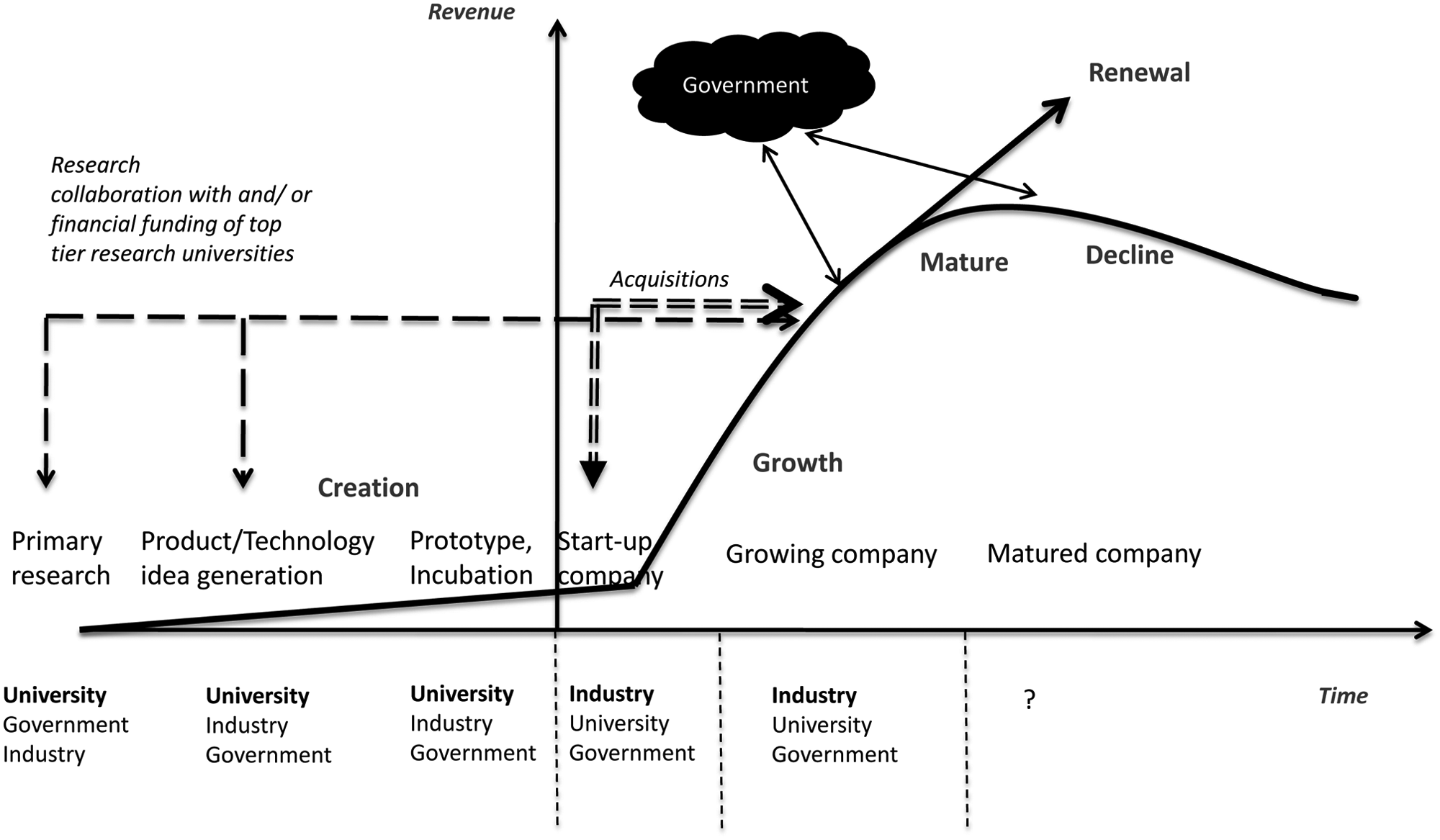
Model of research collaboration with and/or financial funding of top-tier research universities.
A literature review
Over the years researchers have made the observation that firms typically innovate and develop in relationship with other firms and organizations, including universities and research centres. The concept of the ‘national innovation system’ has been used when studying the participants and their environment, including the regulatory mechanisms (institutions such as laws and culture) involved in creating and diffusing new technology and innovations (e.g. Freeman, 1987; Lundvall, 1992; Nelson, 1993). Related concepts are ‘technological systems’ (Carlsson, 1997) and ‘sectorial systems’ (Malerba, 2002). Other systemic concepts are Sábato’s Triangle (Sábato & Botana, 1968: 7), in which government plays the primary role as incentive provider and director of national and regional development, and the ‘Triple Helix concept’ (Etzkowitz & Leydesdorff, 1995), which focuses on the dynamic interaction between the three helices: industry, university and government.
Empirical observation has noted that these relationships are typically facilitated through co-location, i.e. that economic activity has a tendency to be concentrated in certain regions. This has been expressed in various terms, such as ‘industrial districts’ (Marshall, 1890/1916), ‘development blocs’ (Dahmén, 1950), clusters (Porter, 1990), and regional innovation systems (Cooke, 2001). In parallel, other systemic frameworks that do not specifically focus on the spatial dimension have been used to analyse innovation processes in regions, for example ‘social networks’ (Granovetter, 1973), ‘actor-networks’ (Callon & Law, 1989), ‘business networks’ (Håkansson & Snehota, 1989) and ‘innovation ecosystems’ (Williamson & De Meyer, 2012).
The purpose of this article is to analyse the applicability and practical value of the triple helix concept in exploring the formation and growth of firms in a regional context and the literature review below therefore starts with this concept. The review then goes on to focus on concepts that can aid our understanding of innovation processes and development from a company perspective and in a regional setting.
Triple helix
The triple helix concept is a systemic approach emphasizing the dynamic relationship between industry, academia and government (Casas & Luna, 1999; Etzkowitz & Leydesdorff, 1995, 2000; Leydesdorff & Etzkowitz, 2001), and the increasingly entrepreneurial role of universities in technological innovation (Etzkowitz, 2002, 2003a, 2004; Etzkowitz et al., 2000). Etzkowitz & Leydesdorff (2000: 109) make a strong claim for the increasing role of the university:
The Triple Helix thesis states that the university can play an enhanced role in innovation in increasingly knowledge-based societies. The underlying model is analytically different from the national systems of innovation (NSI) approach (Lundvall, 1998, 1992; Nelson, 1993), which considers the firm as having the leading role in innovation, and from the Triangle model of Sábato (1975), in which the state is privileged … We focus on the network overlay of communications and expectations that reshape the institutional arrangements among universities, industries, and governmental agencies.
The primary argument put forward for the university’s augmented role in innovation processes is based, as was seen above, on the development of a knowledge economy. Etzkowitz and Leydesdorff (2000: 117) see the strength (and uniqueness) of the university primarily in the vitality introduced through its students: ‘Teaching is the university’s comparative advantage, especially when linked to research and economic development.’ Students represent a dynamic flow-through of ‘human’ capital in academic research groups, and this turnover insures the primacy of universities as a source of innovation. Hence, in relation to industrial laboratories and research institutes, this dynamic in combination with the ‘faculty research memory’ creates the university’s comparative advantage by combining continuity with change.
Etzkowitz, Leydesdorff and research colleagues have published a considerable number of articles concerning the triple helix concept, an approach that was also stimulated by a series of triple helix conferences organized in different parts of the world. A review of the writings of Etzkowitz and his partners reveals at least three broad streams. First, there are the writings of Leydesdorff (sometimes co-published with Etzkowitz), which present the logic of the triple helix model for interaction from a complexity perspective, emphasizing the inherent characteristic of a non-linear process involving a high degree of variation. Leydesdorff and his co-workers include simulation of triple helices as a viable way to reach new knowledge. Second, there is a line of texts by Etzkowitz that is built on thorough analyses of historical processes in the US (e.g. the development of new models for company formation around MIT in Boston and similar processes around Stanford University), as well as accounts of changes in government processes, including the introduction of new laws (e.g. the Bayh–Dole Act in 1980 to secure university intellectual property rights to knowledge developed using federal government funds). Third, in addition to these two fundamental lines of analysis, there are contemporary observations from all over the world, typically involving co-researchers from countries discussed in the articles. This line of research results in more generalized statements and normative implications for a second university revolution and the global emergence of the entrepreneurial university. 5 In this context, the first academic revolution came about when the educational university started embracing research. Then, in order to become the entrepreneurial university, a second academic revolution was required to further the university’s mission to include economic development as well. Etzkowitz (2004) sees this as a step-wise process based on earlier development in the university world where, due to limited internal funding, researchers had already taken steps towards running the research groups as ‘quasi-firms’, which he defined as research groups that ‘…operate as firm-like entities, lacking only a direct profit motive to make them a company’ (Etzkowitz, 2003b: 111).
The triple helix metaphor has an intuitive explanatory power that has made it very popular, not least among policymakers and other government personnel who were looking for new ways of working to support innovation processes. Among many academics, too, the metaphor is attractive, especially when linked to the new role in society of the entrepreneurial university. Hence, the triple helix metaphor has been widely diffused, intuitively understood, and has become a basis for discussions concerning the interaction between the sectors industry–university–government.
The triple helix metaphor provides a starting-point for viewing innovation processes where the three helices interact in an unpredictable way so that the sources of innovation generate ‘puzzles for participants, analysts, and policymakers to solve’ (Etzkowitz & Leydesdorff, 2000: 112). There are ongoing transformations within each of the helices, which simultaneously shape each other in a way that may lead to stabilization along a trajectory. However, there are many selection and intervention mechanisms in place also simultaneously, thus leaving room for uncertainties and chance. These may lead to a lock-in that can affect further development of the system. Examples of interlocking dynamics are ‘…institutional transformation, evolutionary mechanisms, and the new position of the university’ (Etzkowitz & Leydesdorff, 2000: 114). However, ‘[t]he Triple Helix hypothesis is that systems can be expected to remain in transition’ (Etzkowitz & Leydesdorff, 2000: 113). So the triple helix provides a picture of an innovation system which is continuously changing and whose parts re-create themselves in their interactions with the other helices. According to Etzkowitz and Leydesdorff (2000: 118–119), one implication of these transformations is that there will be tensions in the helices. These do not need to be resolved, however, since that ‘would hinder the dynamics of a system that lives from the perturbations and interactions among its subsystems’.
Etzkowitz’s primary concern is the entrepreneurial university
6
and the changes in the way government interacts and creates new rules of the game. The third helix, industry, is less well developed in Etzkowitz’s structure, except as a funder of universities and university research projects, client to academic specialists, and participants in different kinds of collaborative arrangements and forms of hybrid organizations (e.g. Etzkowitz, 2002, 2008). Etzkowitz (2008: 84) cites an empirical example where Saab Aerospace encouraged high-tech entrepreneurs and participated in a triple helix cooperation with state government and a local university. However, Etzkowitz (2008: 50) has developed his thoughts about the firm in a triple helix:
A triple helix firm based on organizational and technological innovation, occurring through networks across institutional spheres, differs from the ‘contractual firm’, based upon transactions across discrete boundaries … the triple helix firm is part of a collaborative process that may include other firms and non-firm entities, such as university research groups and government agencies. (Etzkowitz, 2008: 50)
He also emphasizes that knowledge-based firms emerge through a concatenation of academic, government and business elements where:
[T]he more advanced the technical idea … [t]he likelier is that government money … will be the initial source of funds … government is often willing to fund start-ups with a grant or ‘soft loan’ long before angels and venture capitalists feel ready to consider an investment. [Hence, according to Etzkowitz] Only later, if and when innovation subsides, does it take shape as a traditional firm. (Etzkowitz, 2008: 52–53)
Finally, related to the triple helix concept, Etzkowitz and Ranga (2012: 52–62), building on Casas et al. (2000), introduce the concept of ‘spaces’ in order to analyse content and interactions over time between the three helices. The ‘knowledge space’ concerns the generation, diffusion and use of knowledge, and more specifically issues such as relocation or aggregation of existing research organizations and formation of new ones where an essential condition is the existence of a ‘critical mass’ of academic research and educational resources as well as other R&D actors in a local area. The ‘innovation space’ is concerned with ways to encourage and promote innovation, including forming new organizations, typically with hybrid formats. Finally, in the ‘consensus space’, the triple helix actors can come together to formulate strategies for realizing and enhancing local growth potential.
Clusters and regional innovation systems
What can be learned from adjacent systemic frameworks? Based on a broad empirical study, Porter (1990) presents factors contributing to the competitiveness of nations, including the existence of clusters and a stimulating rivalry between similar kinds of firms. Clusters are defined as ‘…co-located and linked industries, government, academia, finance and institutions for collaboration’ (Sölvell et al., 2003). In Porter’s ‘cluster’ framework, the industrial firm is the major player in the creation of innovations, but the immediate business environment outside the company plays a vital role as well. Furthermore, actors from the private sector, entrepreneurs, have an important role in forming clusters. Cluster research has pointed to the importance of one or a few industry leaders performing the role of what we could call a ‘social entrepreneur’, 7 facilitating and contributing to the emergence of an innovation cluster (Alänge, 2008). 8 The role of the entrepreneur was also emphasized in a study conducted by Brännback et al. (2008: 260–264), who found that most research on innovation systems failed to include the entrepreneur, as those models are macro-level concepts. Brännback et al. argue, with reference to Carlsson and Stankiewicz (1991), that ‘the Schumpeterian perspective requires us to look at both the system and the individual’(2008: 260). Brännback et al. further claim that: ‘… any changes in a higher level are strictly a function of changes at a lower level’ (2008: 270). They conclude by ‘Therefore, we need to rethink models of innovation systems and we need models that start from people and ideas [and] Hence, to develop truly functional innovation systems we have to start from the entrepreneur and entrepreneurship’ (2008: 274).
The regional innovation system (RIS) builds upon the national innovation system (NIS) concept combined with input from economic geography focusing on the spatial dimension, based on Marshall’s (1890/1916) pioneering work on innovation and geography (Asheim et al., 2011). RIS literature claims that co-located firms benefit from knowledge externalities because ‘geographical proximity’ facilitates sharing of knowledge, especially of tacit knowledge. Four mechanisms of inter-firm knowledge flows contribute to a strongly localized character: information exchange through informal social networks, direct inter-firm cooperation links, labour mobility and spin-offs (Ter Wal & Boschma, 2011). Recently there has also been an interest in the functioning of labour markets and their role in knowledge generation and transfer, as well as their contribution to regional competitiveness, but this area is under-researched within RIS (Asheim et al., 2011). Alternatively, Ter Wal and Boschma (2011) comment that the role of geographical proximity tends to be overemphasized in economic geography, whereas the effect of networks has been underestimated, as ‘firms may take advantage from being connected to a network – irrespective of where their partners are located’. Nooteboom et al. (2007) instead use the concept ‘cognitive distance’ and argue that both too much and too little distance reduce learning in inter-firm alliances during exploration, while low distance provides higher value during exploitation.
Networks
The literature on networks and social capital can contribute to an understanding of innovation processes (Ahuja, 2000; Coleman, 1988). The centrality of location in a network matters, and companies that have a central position have a growth advantage (Powell et al., 1996) when the development follows a given technological trajectory or dominant design (Utterback, 1994). However, a central position in a network can also be a disadvantage as it can contribute to inertia and a lock-in effect in times of discontinuous technological development. Chassagnon and Audran (2011) investigate the impact of interpersonal networks on the innovativeness of inventors. Based on patent data, they found that repeated collaborations in a network of inventors influence innovativeness. They highlight the importance of cohesive elements, such as trust, commitment, reputation and relational interdependence, for cooperation between inventors, seen as economic actors embedded in social relationships. By working together and cooperating, the inventors acquire experience, trust and reputation that strengthen their ability to innovate, which in turn improves the innovativeness of their firms. Chassagnon and Audran emphasize the importance of interpersonal strong-ties networks, although they also recognize the value of weak ties (Granovetter, 1973) for acquiring new knowledge. The value of weak ties for innovation was also identified in Hauser et al. (2007) based on the European Values Study. Ahuja found that both direct and indirect ties have a positive impact on innovation, but there is no single answer to what constitutes the optimal structure. He therefore emphasizes that the form social capital takes is likely to be contingent on what actors seek to enable through it: ‘Under the appropriate circumstances, exclusive, cohesive, and non-redundant connections all constitute social capital’ (Ahuja, 2000: 452).
The importance of the ‘entrepreneur’ in cluster theory also bears some resemblance to the ‘broker’ in social network theory, who can bridge ‘structural holes’ and create competitive advantage by controlling information (Burt, 2001). A structural hole is defined as a weak connection between two groups (or ‘weak ties’ in Granovetter’s [1973] terminology), which functions as an insulator and hence provides an opportunity for the person that has contacts with both groups. This person is in a position to broker the flow of information and control potential projects that can bring people together from opposite sides of the hole (Burt, 2001: 155). However, Granovetter (2002: 50) comments that the opportunity to seize an advantage for brokers depends on the prevailing structure of networks, which can be different in different geographical regions. For example, Route 128 in the Boston region is characterized by a highly decoupled system with strong barriers between firms, which block brokers. Silicon Valley, on the other hand, has the opposite structure, with strongly coupled networks allowing for both personnel and information flow; in this highly cooperative culture, there is limited opportunity for brokers, and coordination from a centre. The real opportunity for an entrepreneur lies in weakly coupled systems with enough weak ties to allow brokering and amassing of power and influence to create competitive advantage (Granovetter, 2002: 50). However, Granovetter (2002: 50–51) comments that, in the supporting finance and law infrastructure in Silicon Valley, there is a more striking stratification and hierarchy of power, where ‘the right’ venture capitalist (e.g. Kleiner Perkins Caufield & Byers) or ‘the right’ law firm could be a major contributor to success for a start-up. And indeed, during earlier periods when faced by a fragmented resource base, these leading support firms had been ‘unusually successful in mobilizing across separate networks and sources’ (2002: 51). However, as Saxenian (1990) pointed out, also in a region like Silicon Valley that is characterized by open networks, individual firms that mature may turn inward and focus on standardization and cost cutting, thus losing contact with the informal networks that once made them successful, as was the case for Intel and AMD in the late 1970s. On the other hand, this disconnection of important actors opened opportunities for others, visible in many new start-ups in the 1980s, and can hence be seen as an example of the region’s dynamics.
From a company perspective, strategic alliances as well as social networks in a more general sense can be of immense importance for innovativeness. Some theories recognize the importance of both inbound and outbound linkages, for example open innovation (Chesbrough, 2003a), but the relations are here primarily seen from a contractual perspective. However, other theories recognize that actors also need to shape their context. In the ‘innovation ecosystem’ concept, the aim is to build advantage by creating loosely coupled networks (ecosystems) through orchestration, i.e. shaping the ecosystems indirectly, rather than through direct negotiation, command and control (Williamson & De Meyer, 2012). An example is Adner and Kapoor (2010), who elaborate on the constraints imposed on the focal firm and the effects on its competitive advantage depending on location of external innovation challenges from suppliers or complementors. 9 However, in comparison to the triple helix model (and other broad-based models reviewed), the ecosystem approach is typically built around the industrial firm’s value chain and does not explicitly include the other helices. Håkansson and Ford (2002) point out that a network is both a way to influence and a way of being influenced by others, and as networks are built on variety but also have systemic properties, firms need to interact to continuously learn and develop the way they are embedded. However, ‘from an innovation perspective it is dangerous to try to achieve overall control of a network … instead companies must seek to manage inside networks, attempting to influence others in order to benefit from their resources and even more importantly from their initiatives and their creativity’ (Håkansson & Ford, 2002: 138). Similarly, starting from a techno-economic network perspective, 10 Callon and Law (1989) comment that it is necessary to recognize from the start that the boundary between inside and outside a ‘firm’ (as a network) is continuously negotiated, created and sustained by actors. The implication of the assumption of generalized and radical ‘distributedness’ is that the network always extends beyond the boundaries of the innovating agent that attempts to ‘manage’ innovation (Alänge & Fogelberg, 2013).
Let us now turn our attention to Google and see how it was created and how it currently interacts within the three helices.
The case of Google
Our appraisal of Google Inc.’s creation and current business practices is presented in light of the three helices: university, industry and government. Traditionally, the case of a start-up begins with the founders. However, looking at the case of Google Inc. from a triple helix perspective, we need to start the story even before the founders came into the picture.
Role of the three helices in the creation of Google
In the mid-1990s, the Stanford Integrated Digital Library Project, under the leadership of principal investigators Hector Garcia-Molina and Terry Winograd, expressed its goal as being to ‘develop enabling technologies for an integrated “virtual” library to provide an array of new services and uniform access to networked information collections’ (The Stanford Digital Libraries Group, 1995). The project involved several private companies and was funded by the National Science Foundation (NSF) together with the Defense Advanced Research Projects Agency (DARPA), with contributions from five other government agencies. Stanford had a strong history of company start-ups in the vicinity of the Computer Science Department, including the professors that would become supervisors of the Google founders. This was the research environment where the initial ideas leading to the formation of Google would be articulated, formulated into conference papers, and developed into a working prototype.
The two Google founders, Larry Page and Sergey Brin, met in 1995 at Stanford University. Brin had obtained his MSc in Computer Science at Stanford in 1995 and was supported by a National Science Foundation Graduate Fellowship. In 1996, Larry Page was hired as project assistant on the Stanford Digital Library Project. As a dissertation topic, Page was encouraged by his supervisor, Terry Winograd, to explore the mathematical properties of the World Wide Web, understanding its link structure as a huge graph (Page et al., 1998). This research project, called BackRub, was operated on Stanford servers and was made available internally to students, faculty and administrators at ‘google.stanford.edu’, and the university’s Office of Technology Licensing sought a patent. It operated there for more than one year, but eventually took up too much capacity to suit the university. In 1997, Page and Brin decided to re-name BackRub ‘Google’, based on their mission to organize a seemingly infinite amount of information on the Web. Another Stanford professor, ‘large database guru’ Jeffrey Ullman, who was Brin’s supervisor, tried to obtain further funding for the project through the internal Stanford centre CIFE, but the industrial advisory group (consisting of 30 large companies from around the world) did not believe in the project, and it did not receive funding. However, one of the industry advisors, McGraw-Hill, funded a minor project for Ullman based on using McGraw-Hill’s internal database ‘Dodge’. Simultaneously, Page and Brin joined with a business-school student experienced in writing business plans, and participated in a business plan competition – which they did not win.
In August 1998, Sun Microsystems’ co-founder and then Cisco executive, Andy Bechtolsheim, acting as a ‘business angel’, provided Page and Brin with US$100,000. He was introduced to Page and Brin by the Stanford University professor David Cheriton. Another early business angel was Ram Shriram, introduced to Page and Brin by Ullman. Shriram, who today has his own angel venture investment company, had experience with Amazon and Netscape. He offered to introduce the two students to InfoSeek, Yahoo, AltaVista and Excite. Although Page and Brin did not succeed in selling their solution to these existing known players, after the ‘tour’, Shriram had the ‘aha moment’ (Auletta, 2009) as he understood for the first time that the Google search engine was something disruptive. This aha moment was also, in turn, based on the reaction from Yahoo. Shriram offered to make an initial investment and help them incorporate. He also helped them work out a licensing agreement with Stanford. In September 1998 he wrote out a check for US$250,000 and became a Google board member. Professor Cheriton became the third early investor. The fourth and final early investor was Amazon founder Jeffrey Bezos, who wrote his check in November (Auletta, 2009).
Page and Brin set up a workspace in the garage of a friend, Susan Wojcicki, in Menlo Park, and they hired their first employee, Craig Silverstein, a fellow computer science graduate at Stanford. They later hired PhDs (e.g. Orkut Büyükkökten, who had worked on the Stanford Digital Library Project). 11 In addition, in 2002–2003, Page’s former supervisor Terry Winograd took a year’s leave of absence to work for Google and has continued in an advisory role ever since (http://hci.stanford.edu/winograd/cv.html).
Based on advice from the early investors, Page and Brin decided to reach out simultaneously to two venture-capital firms in Silicon Valley. In 1999, a round of equity funding totalling US$25m was announced. The major investors were the venture capital firms Kleiner Perkins Caufield & Byers (KPC&B) and Sequoia Capital, contributing equal shares of capital. The experience of the two private venture-capital firms became important when the company started to grow from just a couple of people to 40 people in 1999. In addition to funding, Sequoia Capital sent Michael Moritz to join Google’s board. Moritz had written a book about Apple Computers and had been involved in investments in companies such as Yahoo, PayPal, Apple and Cisco. KPC&B contributed similarly with John Doerr, who had a past connection with Intel and experience of investing in companies such as Sun Microsystems, Amazon and Intuit. Both these board members were introduced to Page and Brin by some of Google’s angel investors (Auletta, 2009). The venture-capital firms acted as advisors to the founders of Google and supported, among other things, recognition of the need for and identification of a professional CEO. They also encouraged the implementation of a goal and monitoring corporate system (the ‘OKR system’). Later, at the time of the IPO, the board was expanded further by senior people from both the academic and business sectors. John Hennessey, president of Stanford University, and Paul Otellini, executive director of Intel Corporation, joined in 2004. In 2005, Shirley Tilghman, president of Princeton University, joined together with Ann Mather, board member and executive director of mobile and media companies. Later, in 2012, Diane Greene, board member, co-founder and executive director of several IT companies, also joined. Altogether the current board represents the university and industry helices by including the founders, the angel-investment sector, venture-capital sector, universities and, more or less, the local Internet, IT, mobile and media sectors.
In addition to a competent and experienced board, the two founders played a crucial role in the further development of the company. From the very beginning, the two entrepreneurs set their mission: to organize all of the world’s information and make it universally accessible and useful, but also to create one of the world’s best places to work. Over the years, the founders have kept their commitment to the company and their focus on continuous innovation, and have, together with board members and carefully selected employees, developed a unique organizational model for continuous innovation (Steiber & Alänge, 2013).
Role of the three helices in Google’s current business operations
The three helices – university, industry and government – were all found to have played specific roles in Google’s current business operations, as described below after some more general comments.
Google today frequently interacts with organizations within all three helices. The university was thought to play an important role for both Google and the Silicon Valley region: ‘[to] filter and provide an endless supply of talents’. The university was also viewed as important for providing the forums where entrepreneurs meet each other, and ideas meet up with the entrepreneurs. The local environment at the university was therefore seen as important in the very early stages of a company’s creation. In addition, professors at Stanford were viewed as potential early investors and as a mechanism for transferring competences to start-up companies. The industry helix also played an important role. One example was research forums, e.g. the Computer Forum within the Computer Science Department at Stanford, which was sponsored by a group of companies, among others Google. This collaboration provided Google with access to researchers and potential future employees, and provided Stanford researchers with industry contacts and access to Google infrastructure and data. Industry was not only thought to play a very important role for the regional innovation system but was also viewed as the largest and most fragmented of the three helices. One interviewee saw a resultant need to break down ‘industry’ into sub-categories of ‘entrepreneurs’, ‘financing’ and so forth. Finally, government was viewed as playing an important role but more as an enabler to create a ‘welcoming regulatory environment’ that encourages innovation. Issues like immigration policy, tax incentives, export and import policy, and bankruptcy laws were all mentioned as important mechanisms. The government was also viewed as playing a role in financing primary research or ideas at an early stage. One interviewee said ‘…we have less relations with the government in terms of innovation but it provides another source of funding of resources for the researcher at universities. The government and industry are helping the researcher to move forward by providing different things.’ The government was in general not viewed as the entrepreneur other than in very specific areas such as the military. Finally, government was also identified as a potential threat to the company. With bigger company size comes scrutiny, which one interviewee viewed as primarily driven by competitors. For this reason, ‘lobbyism’ in Washington and Brussels was seen to be a necessary activity for Google as a major global corporation.
Turning now to the current interaction between Google and the three helices, we look at each in turn.
1 The University
According to Google there are many examples where cooperation with the university has produced innovations. The number one goal for Google is to extend its research-and-development capabilities and at the same time provide academics with access to Google’s research. Google therefore interacts with universities in several formalized ways. First, Google provides external education (tools and material) around engineering for K12 to university level. Second, it develops and maintains strong research cooperation with academics. This is done by University Relations, which is internally viewed as an organization that funds a number of research programs.
Google has primarily two major programs for cooperating with universities. First, there is the Faculty Research Award Program. Twice a year Google makes an open call to research faculties all over the world. The requirement is that the applicant is a full-time faculty employee. Google is not allowed to fund non-faculty researchers or research institutes today, which might exclude a research collaboration between Google and the government and/or industry helices. The funding is instead for one year for a graduate student. The number of applicants has increased over the years since Google began this program, with a total today of 200 funded per year, 100 at each call.
The second program is the Focused Award Program. Here Google identifies faculty and projects that are critical to its business. One example mentioned was an ‘energy-efficiency project’ that was started two years ago and was a cooperative venture with five universities. Funding and providing access to Google’s internal research team pushed the project forward. Currently Google has 40 Focused Award Programs across wide sectors. The majority (75%) of the ideas for these programs come from internal sources like distinguished engineers, and 25% from external faculties that Google has close interactions with. Today Google also tries to promote internal competition among their engineers in order to generate proposals for company-critical research. The funding of a focused award takes the form of a gift and is based on the requirement that the result will be open source. In this way Google, the faculty and others can benefit from the results, and potential problems such as IP rights are minimized. Since the funding is a gift, Google does not have any documented expectations of the project. However, the focused awards are very carefully monitored by Google and may lead to participation in a Visiting Faculty Program, where Google brings in specific senior researchers in order for them to be able to access all Google data. These visiting programs are very selective and number between 20 and 25 in all.
In addition to these programs, Google’s own researchers are also active on conference committees and journal editorial boards. Google also offers internships for computer science graduates and special programs like the Summer Code Program. To foster collaboration and innovation, they also sponsor and organize events that bring academics together at faculty summits and workshops, and sponsor research symposia that ‘highlight the latest and best research from scientists and engineers across the globe’ (www.research.google.com, June 2012). According to one interviewee, University Relations has a ‘fairly large budget’, which has increased over the last 2½ years.
The interaction with universities has intensified over the years as a result of increased funding but also due to more services. The interaction seems, however, to differ depending on whether the university is among the top-tier research universities or not. It may also differ depending on whether the university is private or public. In the case of private universities like Stanford and MIT, Google worked directly with the faculty, which is in line with the private universities’ regulations. Public universities had other types of restrictions/regulations and therefore, according to interviewees, had to be ‘more creative’ in finding funding. Internally, Google uses a number of methods to measure the level of interaction with universities. Team members’ evaluation score depends on how the level of interaction develops over time.
2 Industry
The interaction with industry has been a major driver behind Google’s creation and growth, but industry’s contributions must be analysed both from the perspective of specific actors within industry and by considering the specific time-period in Google’s creation and growth. As mentioned earlier, the financial community were of considerable importance in terms of business angels and venture-capital firms once the initial idea had been formulated, prototyped and tested in a university environment. By connecting the Google founders to an excellent network in Silicon Valley and by remaining in board positions for longer than an angel investor or venture-capital firm typically stays before exit, Google has continuously benefited from access to funding, knowledge, experience and other resources, such as contacts with people with an extensive operational business expertise in areas such as Internet, IT, mobile and media. Later in the company’s development, Google’s products (e.g. platforms, APIs) by definition created numerous linkages within the industry helix, e.g. to industrial players viewed either as customers, suppliers or developer partners to Google. Google has also been involved in various open-source initiatives and contributed in various ways to the development of the Internet. 12 In addition, Google interacted with helices ‘industry’ and ‘university’ in their acquisitions of technology companies. A considerable number of new products introduced by Google come from smaller companies acquired by Google, e.g. Android and YouTube. Looking into triple helix dynamics, this is yet another way for Google to access industry- or university/government-initiated research ideas that, through their packaging as new start-ups, have been able to show a market potential. The reason for acquiring a company could be the innovation itself, or the fact that Google sees an advantage in further developing the idea or product into something with a higher potential that might be linked to existing Google products. The acquisition can also be based on the fact that the entrepreneurs/engineers behind the company have proved they have the unique competence that Google needs and, hence, the company formation could be viewed as another filtering process to identify and access competence. Finally, Google also acts directly as a venture capitalist through Google Venture and is also actively involved in spin-offs of internally generated ideas.
3 Government
The role of government was thought to be important as a source of financing for faculty researchers and as a regulator. According to one interviewee, the regulatory environment in Silicon Valley was ‘welcoming’. Another interviewee expressed the idea that ‘government has an important role in areas where industry does not have the incentives to work or invest’. In the interview, however, a new role for government was identified, namely as a catalyst for creating regional growth by getting smaller companies to move their business online. The interaction between Google and government was in this case based on shared values and interest. The interaction was also based on the assumption that government wants to support local businesses in order to increase local economic growth and prosperity, and that local government has a good network and a voice in local businesses. Google has been the driving force in these programs where local government first met local businesses in order to make them aware of the impact of getting online, and then Google provided tools, training and resources to local businesses in order to increase their growth. The interaction with government in this case was on several different levels, both local and state. Organizations such as the Federal Trade Administration and Small Business Administration were mentioned. In the case of government as a regulator, the interaction was clear. Currently Google has a big team working on regulation and standardization issues. The dialog was found to be two-way, however. First, Google, often together with other companies, interacted with government on a local, federal, but also supranational level on business-critical issues such as SOPA (the Stop Online Piracy Act). Second, federal or local government could ask for advice in matters of a business or technological nature. The first example is the most frequently discussed in the media, and in 2011 the US computer/Internet industry spent US$126m on lobbying activities, Google alone spent US$9.7m. However, as was seen above, this is only one example of the interactions between government and Google.
The three helices – a summary
What was the role then of the three helices in the creation, growth and consolidation of current business practices at Google?
The university helix provided the environment for the initial idea development and has since functioned as a continuous supplier of filtered competence to Google and as a partner in joint research programs of interest to Google. The Industrial Advisory Board of CIFE at Stanford said ‘no’ to funding the Google project. Silicon Valley’s financial system was therefore important for the company’s creation: initially through angel investments and later through experienced venture-capital firms that provided not only capital but also knowledge and linkages to other sources of business competence. In its more mature state, Google has been a driver of change and development in several sub-sections of the industry helix. Google has also frequently acquired industry- or university-originated small technology firms and acted as a venture-capital firm through its Google Venture and as a ‘breeder’ of new entrepreneurial ideas spun off by Google or realized by entrepreneurs who actively chose to leave Google to start their own companies. Finally, government played an important role in the creation of the idea on which Google is based by funding the Stanford Digital Library Project and the BackRub project. Government as a provider of funding was found to be important for contributing to innovative research at universities, which sometimes is co-funded by Google. Government took many different shapes, however, sometimes as a legislator/scrutinizer, but in the form of local government also as a catalyst for regional growth. A continued dialog with government was also crucial in terms of market regulations, especially for larger companies such as Google, Microsoft, Apple and Facebook.
Discussion
This section discusses the applicability of the triple helix model in the case of Google, and then offers some conclusions.
Triple helix model as illuminated by Google
The case of Google indicates that the triple helix model could be useful for analysing the creation, growth, but also business practices of Google. It was clear that all three helices played an important role in Google’s development and that there is frequent, both formalized and less formalized, interaction between the helices and within the ‘industry’ helix of which Google is a part.
By applying the triple helix model to the analysis of Google’s creation and growth, the story had to start even before the two founders came into the picture. This provides a more holistic picture of firm formation than when the story and analysis start with the entrepreneur, which in turn could have important implications for theory and methods of entrepreneurial studies. Should the analysis start with the entrepreneur, the understanding of how innovative ideas are originated can be lost or understood less well. This can mean that a model that operates purely on a micro-level and centres on the entrepreneur can limit our understanding of regional innovativeness. On the other hand, the analysis of Google showed the crucial importance of a committed entrepreneur, which illustrates why a macro-level model that does not emphasize this actor can limit our understanding of how regional innovation is created and improved.
The different helices played different roles and became the ‘driver’ in different phases along Google’s creation and growth curve. It is therefore not relevant to discuss which is the driving helix in general in an innovation system, as the different helices take on different roles in different phases of a company’s life-cycle. 13 An example is university’s driving role in the idea/prototype phase, which later changes to a role of filtering and feeding talents to the company in the growth phase. In Figure 1, the relative importance of the helices in different phases is presented along the creation and growth curve of Google (visualized in the order in which the helices are documented in each phase). 14
Figure 1 illustrates the dynamic interaction between the different helices in the triple helix model focused on the creation and growth of Google. It emphasizes the importance of the different helices over time (bold = most important/driving). The unbroken curved line shows a simplified picture of the revenue streams (costs are not indicated in this view), initially money that comes into a project that is not yet a company. At Time 0, the company is formally registered, and if it is successful the revenue streams increase until the product line reaches maturity; subsequently the revenue will decline. At this point in time (or preferably already during the growth phase), the company needs to renew itself, typically through the development of new technology.
If we first examine the phases before Google became a formalized firm, the university had a leading role. The primary research phase is financed mainly by government, especially when it comes to basic research. However, industry in the form of companies could play a role in funding and providing access to infrastructure, as the case of Google shows (see the dotted arrow). In this phase, Google today provides financing according to an open-source approach, i.e. the outcome should be accessible by everyone. In this ‘knowledge space’ (Etzkowitz & Ranga, 2012), university continues its organizing role in subsequent phases as well, delimited by government’s decisions to support basic and/or applied research, and by industry’s general inclination to focus on applied-knowledge development. However, existing advanced companies can return to interact with universities and in symbiosis with government funding if advances in university research can be perceived as a prerequisite for the development of more discontinous innovation and technology (cf. Chesbrough’s 2003 account of IBM’s support in developing computer science as an academic subject at Columbia University in the 1950s).
In the following phase of idea generation, university is still the main actor, but industry can also show interest. In the Google case, part of the research funding is done in this phase (see the dotted arrow). Government funds are still of great importance for this phase and the following phase, when research-based ideas are tested and are being prototyped and potentially incubated on campus. This is part of the ‘valley of death’, where only limited resources are available from venture-capital firms (Auerswald & Branscomb, 2003; Wessner, 2009). However, by keeping projects as applied-research projects, the researchers/students gradually turning entrepreneurs are able to finance their emerging company, primarily through government funding. According to Auerswald and Branscomb (2003), in the US the federal share in funding of total early-stage technology development can be estimated at roughly 20% to 25%, excluding government procurement. Other important sources were corporations and business angels. 15 In the case of Google itself, business angels appeared during this phase, and before it became formalized the Google founders received a substantial sum that helped them establish their company.
The formalization of Google as a company is a phase where the entrepreneur-founder is in the lead, but after having demonstrated the viability of the project, the new company can also access business angels or venture-capital funding and, perhaps even more important, gain access to experience and network with industry specialists and executives through venture-capital investors. This is especially so in the Silicon Valley region, where venture capital is well known also for providing ‘intelligence’ based on industrial/business experience and access to knowledge networks – and in the case of the Google start-up this was a major strength. Google’s choice to let two venture-capital firms provide equal funding was an interesting way of balancing the impact of the individual firms’ interests. The phases described are typical for a knowledge-based company resting on university research. In this phase, senior academics can also play a role as private investors and/or mechanisms of knowledge transfer. In addition, government now plays a role as a regulator that can create a more or less supporting regulatory environment for start-ups. According to Girard (2009), Page and Brin founded Google when start-up funding was available, and the legal envionment facilitated the mobility of expertise and free circulation of ideas. The social networks and culture of engineers facilitating free mobility of labour and ideas are however characteristic of Silicon Valley (Granovetter, 2002; Saxenian, 1994). The empirical data showed that the engineering culture was also a characteristic of Google, although our initial impression from interviews inside Google was that the mere supply of exciting contacts inside the company made employees interact less with the outside world; later interviews revealed that parts of Google are in continuous interaction with external actors and that the flow of labour has not only been to Google but also from Google to other companies in the vicinity.
Various other mechanisms have evolved in this ‘innovation space’ (Etzkowitz & Ranga, 2012) both in the university and in the broader university–company context. While Stanford University has traditionally played a strong role in the ‘knowledge space’ and helped students/researchers develop into entrepreneurs while allowing its professors to make good investments as private persons, traditionally the university itself benefited less from the success of new-company formation. However, the Google IPO in 2004, from which the university through its Office of Technology Licensing (OTL) earned a relatively modest US$250m, resulted in the proposal ‘that the university reserve the right in OTL’s standard licensing agreement to make a modest investment in each new firm [where] OTL licenses a university originated technology’ (Etzkowitz, 2012). Another innovation space organization is the open-source movement with participants from university and industry. While this movement is an essential component for many companies in Silicon Valley, Google is its major beneficiary and provides support to a wide variety of technical and advocacy organizations, such as The Apache Software Foundation, The Free Software Foundation, Kernel.org, The Linux Foundation and The Mozilla Foundation. Although of primary importance for Silicon Valley’s development, these organizations span a much broader and global geographical dimension.
During the growth phase, other industry actors can play a major role in further growth as partners, suppliers and customers. Google has gone even further and has orchestrated the development of an innovation ecosystem around e.g. Android (Open Handset Alliance) involving a large group of partner developers (Williamson & De Meyer, 2012). In order to keep or develop the innovativeness of this ecosystem (or network of developers), it is essential not to try to achieve overall control but to manage inside the network, benefiting from others’ resources, initiatives and creativity (Håkansson & Ford, 2002). The role of the university in the growth phase might change to primarily supplying competent people through a filtering process. Google has utilized this opportunity by systematically hiring graduates from top-tier universities. In the generalized phase of company growth, the company and its product lines at some point in time mature and start to decline.
Then comes the question of how the company can once again access research competence and new innovative ideas in order to renew itself. In the Google case, the company had already during the growth phase been focused on gaining access to university research that could contribute to the existing product lines and to further growth, and open up new areas beyond the existing product lines, i.e. create continuous renewal. Google has developed several mechanisms to tap into this research resource (see the dotted arrow), e.g. through its open-call research funding, which can even supplement primary research, or its focused research collaboration, where faculty and PhD students work on more specified areas of importance for the company, built on the idea of mutual benefits to the university (professor/PhD student) and the company. In the case of focused research collaboration, this was done primarily with ‘top-tier research universities’ and did not include leading research institutes. A limited number of top-class researchers are connected to Google’s own researchers through strong ties that exist over longer periods of time. In other research, this has shown to contribute to innovativeness (Chassagnon & Audran, 2011). Likewise these relationships contain cohesive elements such as trust and commitment, and are designed to create relational interdepence. In this phase there is another, and probably even more important, mechanism for accessing new technologies: this comes about through acquisitions, which typically are made when the acquired company is in its initial growth phase (see the dotted double arrow). In this case, the university–government funding and incubation may have brought the specific technology to its first market tests and then Google may, after the formal start-up and some market trials, acquire the firm or enter more or less as a venture-capital firm. As the dotted double arrow indicates, however, Google can also be the ‘breeder’ of new start-ups as entrepreneurs choose to leave the company or as the company spins off good ideas, at times spinning back promising new firms that fit, although in other companies the latter has turned out to be difficult to accomplish in practice (Chesbrough, 2003b). Government plays a role in this phase as well. In the case of Google, frequent interaction on regulatory issues took place between the company, either alone or together with other firms in the industry, and government on different levels (see the cloud and the two fine arrows). The ‘consensus space’ (Etzkowitz & Ranga, 2012) in the case of SOPA was not on a regional level, but on a national US level. This means that consensus spaces exist on different levels in a society and possibly also on a more international level, as the issue of Internet restrictions could affect development across the globe. Government also acts as a catalyst for boosting local growth by getting smaller companies online. This program was initiated and driven by Google as part of the industry, and this included Google’s participation in several more local consensus spaces.
The phase of maturity–decline was for natural reasons (Google still being a growth company not yet having reached this plateau) not explored in the case of Google.
The empirical study points to a variety of bridging mechanisms in place, e.g. research funding, both from the company and from government, organizational units at universities as well as at the company, and of course the venture-capital industry and business angels, which perform important linking operations for a new company. Governmental linking organizations are an additional type of bridging organization that can create links between government and the other helices, but also facilitate links between university and industry through various incentive/funding schemes. In the case of Google’s own early development, no such organizations were mentioned, although individual professors initially, and business angels later on, served as brokers bridging ‘structural holes’ (Burt, 2001) to different resources, including funding and competence. However, Google today, as a large organization, interacts with different bridging organizations, facilitating contacts with small companies, such as local city/state governments and small-business administrations, which also can be viewed as bridging mechanisms between the government and industry helices. However, Google having been born in the open Silicon Valley environment, the company still relies to a large extent on interpersonal communication and a combination of strong and weak ties.
Based on the discussion above, it was found that the triple helix model is applicable and even beneficial when analysing the creation and growth of Google. The value of the triple helix model is that the analysis is forced to start even before the entrepreneur comes into the story and provides insight on how important university, but also government, can be in providing a foundation for and financing of innovative ideas. The value of the model also appears in the analysis of a firm’s interaction and business practices within and between different helices. By investigating a firm’s interaction not only within the industry helix but also with the university and government helices, an increased understanding is gained of how the company networks with local industry actors, universities and governmental organizations to create regional innovativeness. This form of analysis could serve as a complement, contributing to a deeper understanding of firm-based perspectives such as Porter’s (1990) cluster theory and innovation ecosystems (Adner, 2006) by increasing our understanding of how both a company and a region can benefit from interaction between important players in the innovation system.
However, the empirical data from Google indicates that, in order to improve our understanding of not only the different helices’ importance and roles in each phase of a company’s creation and growth, but also more specifically different players’ importance and roles, there may be a need to break down the industry helix into sub-categories. The case of Google highlights the roles of university and government. However, in the case of industry, business angels, venture-capital firms, business executives and specialists, technology start-ups, major industry firms and entrepreneurs were all part of Google’s creation or growth. In the current triple helix model, those players are all grouped together in the industry helix. In order to make the triple helix model more ‘actionable’, 16 it could be of interest to expand the model with more helices or identify and break the industry helix down into sub-categories. These sub-helices/sub-categories could for example be: ‘financial & business services systems’, ‘entrepreneurs’ and ‘companies’. Along a similar line of reasoning, Adner and Kapoor (2010) suggested distinguishing between suppliers and complementers of a focal company’s innovation–market process in order to analyse these categories’ potential influence on competitive advantage. However, expanding the model into more helices or sub-categories presents the risk that the model may lose the intuitive explanatory power that has made it popular, intuitively understood, ‘adaptable’ as an analytical model and, partly because of this, widely diffused. A negative correlation has been identified between the degree of complexity of a model and the rate of its diffusion (Steiber, 2012), something that should be considered before alternative, expanded models are suggested and applied.
Evolutionary theory (Nelson & Winter, 1982; Schumpeter, 1934, 1942) has had an impact on systemic approaches (Nelson & Winter, 2002: 39), and some assumptions from evolutionary theory are present in several, such as the basic assumption that companies operating under uncertainty use routines to cope, which leads to inertia and path dependency (e.g. Lundvall, 1992; Ter Wal & Boschma, 2011). Some approaches explicitly adopt an evolutionary starting-point focusing on variety and selection mechanisms under conditions of bounded rationality (e.g. Carlsson, 1997). After a process of ‘dominating design’ (which destroys variety) leading to a mature industry with less variety, renewal comes from outside the mature industry, for example from university research. Thus, the driving force for renewal follows Schumpeter’s (1942) perennial gale of creative destruction. This is very much in line with the triple helix model’s emphasis on the increasing role of the university in creating new knowledge through its students and different hybrid organizations, including the ‘triple helix firm’ (Etzkowitz, 2008), making this new knowledge useful both for new start-ups and for renewal of incumbents (Etzkowitz & Leydesdorff, 2000). It has been observed that lock-in and path dependency exist not only in industry, but also on a more societal level (Alänge & Steiber, 2011), and the triple helix model throws additional light on the dynamic interaction between industry, university and government which may be necessary for breaking the inertia. 17 For example, as the case of Google also shows, during early phases, government together with university may play the most important role for renewal and future growth of new industries, both through research and by teaching students who will play a major role in these new industries. However, the helices change continuously internally, influence each other, and are influenced by many selection mechanisms simultaneously; and this also creates uncertainty on the system level. The result has been a call for different approaches to intervene in the system; the literature is full of policy implications, although most of the data used are from studies of existing systems and not of the process of developing systems (Alänge, 2008). The ‘spaces’ concept presented by Etzkowitz and Ranga (2012) is one way of focusing on the need for mobilization processes involving participants from all helices to intervene and remedy regional weaknesses in the knowledge, innovation and consensus spaces.
With respect to Etzkowitz and Ranga’s (2012) ‘spaces’ concept, which originated in a regional context, it is evident when analysing Google that its spaces have a broader meaning and at times a global outreach. While Stanford and Silicon Valley were the starting-point for Google, the ‘knowledge space’ today is broader. This is based partly on the fact that Google’s development organization is distributed over more than 40 locations worldwide, as well as on the fact that Google interacts with university researchers worldwide. The ‘innovation space’ is also broader, as earlier accounts of Google’s direct involvement in various organizations indicate. Finally, there are various ‘consensus spaces’ to be found at local, regional, national and international levels, which are facilitated by various virtual meeting-places, including Google’s own products. Hence, seen from a regional perspective, Google as a global company could potentially participate in many different knowledge, innovation and consensus spaces. However, the organization of spaces is not only the responsibility of government and university (Etzkowitz & Ranga, 2012), industry and the entrepreneur too have a role (cf. Porter’s clusters initiated by entrepreneurs). The organizing of an innovation space, however, is complex and can be similar to the organization of innovative networks, which is typically an indirect endeavour (Håkansson & Ford, 2002). The challenge, from the perspective of the firm initiator, is to inspire the network participants and not to dominate them to such an extent that creativity and innovations risk being suffocated. From a company perspective this innovation space can include a global dimension, such as Google’s Android ICT operating system, where its network of co-developers lacks spatial limitations. Thus, although it has been advocated in RIS literature (Asheim et al., 2011) that innovation knowledge which contains more tacit elements is more spatially bound than scientific knowledge, there are clearly areas where the innovation space must be seen in a less spatially restricted way.
Conclusions
The case of Google shows that the triple helix model is applicable in exploring the formation and growth of a firm. By applying the triple helix model, some of the gaps in the current triple helix concept identified by Ranga (2011) were addressed, such as: How do the U–I–G institutional spheres actually interact? Who are the specific actors within each sphere? What are the drivers of the interaction? How is the interaction evolving over time? At which stages in a product life-cycle is U–I most successful?
It is clear that the three helices played important roles in Google’s formation and growth. There were frequent formalized and less formalized interactions between the helices and within the industry helix, of which Google is a part. In applying the triple helix model to the analysis of Google’s formation and growth, the story needed to start before the entrepreneurs came on the scene, and this provided insight into how important university and government could be in providing a foundation for a start-up firm. This form of analysis could contribute to a deeper understanding of how both a company and a region can benefit from interactions between important players in the three helices. In addition, it provides a more holistic picture of firm formation, which could have implications for entrepreneurship studies. This type of understanding can also benefit policy-makers and the business community.
While different systemic models emphasize the role of either industry, university or government, this article shows that all three can be of importance for the formation and growth of a firm. As the helices take on different roles in different phases of the formation and growth of firms, it is relevant to discuss which helix is driving only when studying a specific phase. For example, in the case of Google, university was highlighted as important, and a driving force even before the firm was formally founded. University played a role in breeding innovative ideas, providing a platform on which entrepreneurs meet or on which an idea and an entrepreneur meet, filtering and providing talents to the company, and acting as a partner on company-critical research projects. Government, too, was important in very early phases for funding early research, but also for creating a ‘welcoming’ regulatory environment and for being a catalyst for local business growth in which Google was involved. Industry played a driving role a little later, when the firm was more established. Industry then played a crucial role for Google’s initial funding and continuous growth. Angel investors contributed early on, but the main inflow of capital and competence/network came later when the company had proved its viability in the marketplace.
Regarding the industry helix, the empirical data pointed to a potential need to either expand the number of helices or to pinpoint different sub-categories inside the helix. However, one risk of making the model more ‘complex’ is that it loses the intuitive explanatory power that made it popular, intuitively understood, ‘adaptable’ as an analytical model and, partly because of this, widely diffused.
In addition to the insight that all three helices played important but different roles, it became evident that it is also important to understand and maybe even orchestrate the interactions between the helices in order either to create a good environment for the formation and growth of firms (policymakers), to further refine analytical models for explaining and understanding formation and growth of firms (research community), or to search for and capitalize on innovative ideas and later maximize growth of firms (business community).
The empirical data also show a number of mechanisms for interaction, e.g. accessing university research/ideas and new products/technologies, including open calls for research funding, collaborative research and acquisitions. Further, both from a company perspective and a regional-development perspective, there is a need to analyse the role of bridging organizations that connect the helices and contribute to the development of interaction.
The concept of ‘spaces’, too, may be an interesting dimension to include in further triple helix studies with a firm perspective. However, in the case of Google, it is clear that the concept had a broader meaning and existed on different levels. Hence, seen from a regional perspective, Google as a global company could potentially participate in many different knowledge, innovation and consensus spaces. Furthermore, social-network theory can contribute to a deeper understanding of the interaction between firms and other helices, an interaction that is built on interpersonal relationships composed of both strong and weak ties.
While this article tested the applicability and practical value of the triple helix model in a single case, it could be of interest to empirically expand the scope in future research: for example, a comparison of the Google case with the formation and growth of rival firms in the region, or other regions in or outside the USA, in order to further explore the applicability of the triple helix model and generate additional empirical data. Finally, it could be useful to advance the analysis as a next step towards more normative policy recommendations.