



Abstract
Since Darwin, emotions have been defined as adaptive reactions that increase the probability of survival. In this framework, a situation in which individuals fight for their life with an imposing, aggressive animal should be an ideal elicitor of emotions and their corresponding facial expressions. We tested the correspondence between the facial expressions of 22 bullfighters (toreros) and their reported emotions at different stages of the fight. Toreros reported intense experiences of happiness or fear, but there were no observable instances of the facial expressions predicted for these emotions (e.g. smiles). Instead toreros displayed frowning, nostril dilatation, parted lips, and, protruding funneled lips in particular. In a second study we found that 149 judges could not recognize toreros’ facial movements as expressions of emotion. Absence of a universal signal value strongly suggests that toreros’ expressions are not an undescribed expression of basic emotions. The observed non-correspondence between intense reported emotions and their predicted expressions casts doubt on one of the most popular assumptions in contemporary psychology and provides new evidence for an alternative theoretical view. In this view, facial expressions are not signals of emotion, but actions that are roughly coextensive with other processes and structures in the framework of an emotional episode.
Following Darwin’s lead, ethologists and psychologists have long sought to describe the facial expressions of intense emotions. Knowing the outward expression of an emotional state is of great theoretical and practical importance. Yet creating intense emotions in the laboratory is difficult, and showing observers pictures of actors with posed facial expressions is a weak substitute. Here we report two studies of people (bullfighters) in an actual intense emotional situation (confronting a bull). Their facial expressions were not the ones that might have been expected from previous research.
Naturalistic observation of facial expressions in intense emotional situations has been an extremely informative way of exploring the nature of intense emotion and its expression (for a review see Fernández-Dols & Crivelli, 2013). The common findings are puzzling: in intense emotional situations, people display facial expressions traditionally thought to be related to other emotions (e.g. crying for happiness, see Fernández-Dols & Ruiz-Belda, 1995), components of the supposed expression of fear as a response to physical contact in the Paris metro (Aranguren & Tonnelat, 2014), mixtures of supposed expressions of anger and fear in distressed babies (Camras, 1992), or apparent expressions of pain while experiencing sexual pleasure (Fernández-Dols et al., 2011).
Bullfighters (toreros) provide a conspicuous instance of facial expression in a highly emotional situation. Since Darwin, most theories of emotion have emphasized the role of emotions as adaptive reactions that increase the likelihood of survival of the individual. If so, it is difficult to imagine a situation with higher emotional relevance than an individual confronted with an imposing, aggressive animal (as in William James’ classic example of an encounter with a bear in the forest). We can also hypothesize that confronting such an animal was also a situation common in our evolutionary history (something that cannot be said for many emotion elicitors used in laboratory studies). Thus, bullfighting is an ideal elicitor of intense emotion.
We report here two studies of the facial expressions of toreros during confrontation with the bull. In the first study, we recorded and coded toreros’ facial expressions. We also obtained reports from them of their emotions. This study allowed us to test whether toreros, in natural episodes of presumably intense emotions, display the facial expressions predicted for those emotions by the Basic Emotions Theory (Ekman & Friesen, 1975), and possibly other not predicted expressions as well. In the second study we explored lay judges’ perception of some of the most frequent facial expressions observed in the first study. This second study allowed us to examine the signal value of toreros’ facial behavior, a central question in the study of facial expressions.
Bullfighting
Bullfighting reenacts a situation that was probably frequent in our evolutionary past (i.e. a man and a beast fighting each other for their respective lives). The bull taking part in bullfighting (the Lidia breed, Bos taurus ibericus) is an imposing animal that has been selectively bred for aggression. Bullfighting takes place in an agonistic and structured situation (lidia) in which the torero’s role consists of dominating the bull gradually.
Bullfighting consists of three main actions: Toreros provoke (citar) the bull to attack (Action 1) and they perform pases, drawing the animal toward them by gaining control of their charge with a red cape (Action 2). At the end of the lidia, toreros must halt the already exhausted animal at a close distance (approx. 1.5 meters). At this particular point, the tables are turned and the man charges the bull (Action 3, entrar a matar). This is the most dangerous action of the lidia because the torero throws himself onto the bull’s horns while trying to thrust his sword into the animal (Figure 1).
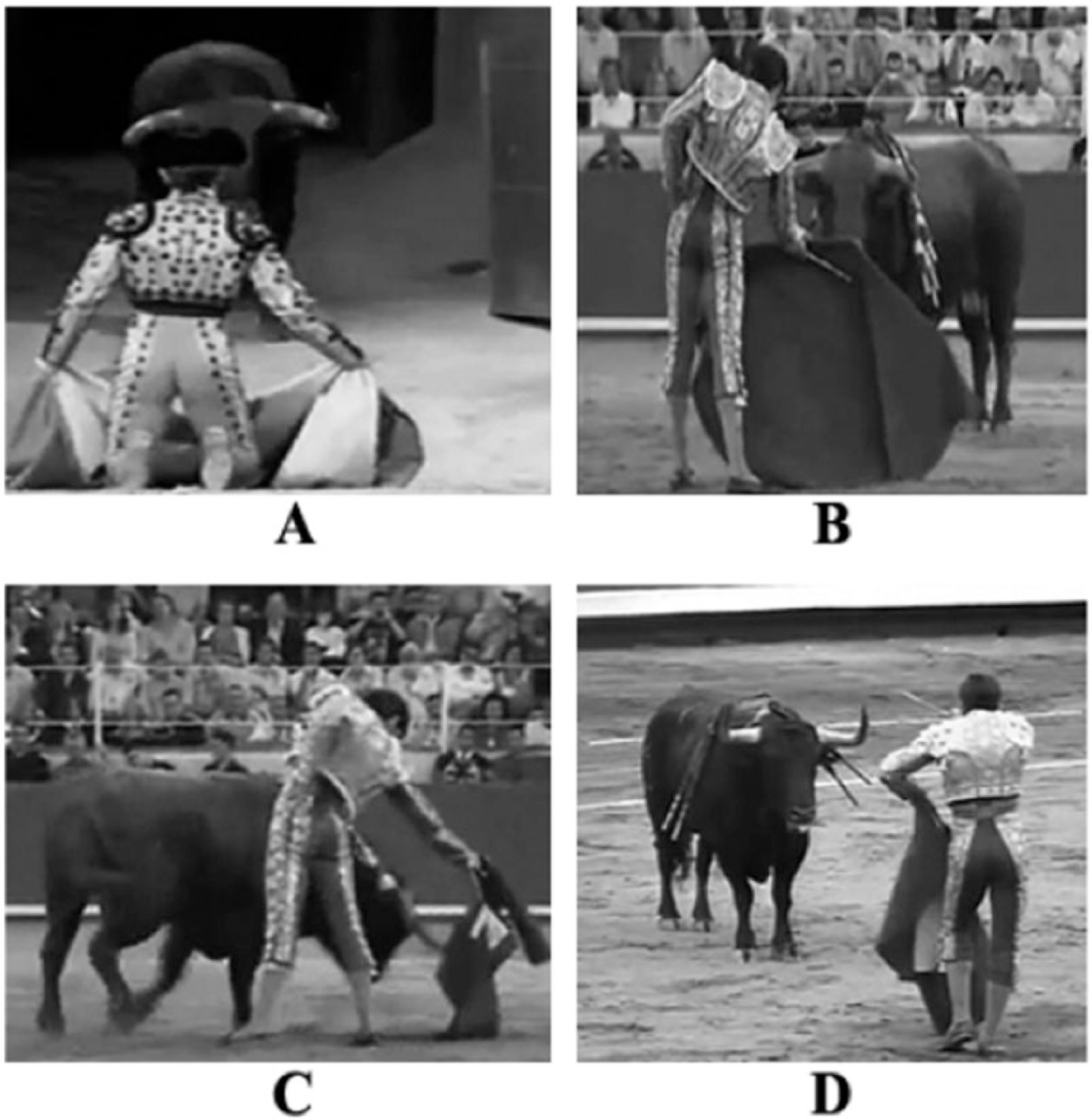
Four situations at the bullring: Picture A shows the moment when the bull enters the ring while the torero is waiting; B shows a torero provoking the bull to attack (Action 1: citar); C shows Action 2; a torero performing a pase with a red cape; D shows a torero charging to kill (Action 3: entrar a matar).
These actions constitute a ritual performed in the bullring, a round amphitheater in which the crowd loudly shows their approval or disapproval of the torero’s performance. Music is played if the torero’s fight (faena) is especially good. Each torero usually has a little team (cuadrilla) of subordinate toreros who support their leader (e.g. attracting the bull to a specific area in the bullring, if needed).
In either case, this situation is obviously emotional for the fighter and for the audience. Bullfighting involves real death risks, and every year a number of toreros are seriously hurt or even killed by the bull. Despite the colorful and noisy situation in which it is performed, the fighting requires extreme concentration on the part of the toreros, who are fully aware of the risks they incur. Every stage in bullfighting is governed by rules and standards, and the toreros can be awarded the bull’s ears or tail by a referee (presidente) if they excel in the fulfillment of such norms. For this reason, toreros have to go through a number of stages in their careers, which correspond to different levels of mastery. Today, young torero candidates can learn those rules and standards in bullfighting schools. None of these rules concern facial expressions, but rather technical skills such as distance to the animal, precision when charging to kill, and so on. Nor are the torero’s expressions easily visible to the audience while he fights the bull.
Study 1. Toreros’ facial expressions and subjective experience
Participants
We observed the facial expression of 22 advanced students (level C) of the Marcial Lalanda National Bullfighting School. All were Spanish, except two, who were visiting from the Cali Bullfighting School (Colombia). All the toreros were male. A sub-sample of 15 toreros participated in a semi-structured interview and filled out a questionnaire reporting their subjective experience during the bullfighting stages.
Method
Facial expression
Two video cameras were placed at opposing angles in the first row of the amphitheater of the School bullring. 1 The bulls moved freely inside the bullring, being gradually controlled and dominated by toreros, who in turn moved at different angles and took up various positions. As a result, the number and duration of the observations was not uniform across the 22 toreros.
Facial expressions were analyzed with the Facial Action Coding System (FACS; Ekman & Friesen, 1978; Hjortsjö, 1969). FACS is an anatomically based coding system for categorizing the contraction of facial muscles and other gross behaviors like head and eye movements. Discernible muscular movements are called Action Units (AU); these are then assigned a number code (e.g. AU12, a smiling mouth, refers to the contraction of the zygomatic major). Video-recordings were edited in order to remove footage in which facial expression could not be observed.
The unit of observation included brief behaviors (approximately 1–4 seconds) of every bullfighter through the main actions of the lidia (i.e. Action 1: citar; Action 2: performing pases; Action 3: entrar a matar). The duration of every observation was bounded by the situation: for example, a pase lasts 1–3 seconds, whereas charging to kill lasts an even shorter 1–2 seconds.
Two independent certified FACS coders (inter-rater reliability, Kappa = 0.83) recorded a specific FACS AU in a unit of observation only if there was at least one clear occurrence of that AU. For example, the occurrence of at least one lip funnel (i.e. AU22) of a particular torero during Action 2 (performing pases) was coded as 1, and its absence as 0.
Subjective experience
A sub-sample of 15 out of the 22 toreros agreed to be interviewed by the first author; the interviews lasted between 45 minutes and 3 hours, depending on the circumstances, and always followed a specific protocol aimed at obtaining information about the toreros’ affective experiences and their facial expression. The interview also included a number of distractive questions about other stages of the lidia, in order to keep toreros unaware of the targeted experiences and their corresponding expressions.
The first goal of the interview was to explore toreros’ subjective experiences through the main actions of the lidia (i.e. Action 1: citar; Action 2: performing pases; Action 3: entrar a matar).
A second crucial goal of the interview was to determine if toreros were consciously controlling their expressions during the bullfight. The interviewer showed them stills of their own expressions, asking whether they were aware of displaying those expressions, and if they might have learned to display them.
Finally, a third goal of the interview was to test whether toreros had different affective representations of the above-mentioned bullfight actions. Toreros reported their levels of pleasure and arousal for the three above-mentioned actions (Action 1: citando; Action 2: performing a pase; Action 3: entrar a matar) on the Affect Grid (Russell et al., 1989).
Results
Facial expressions
We did not find any significant pattern of action units across the three different actions of the lidia, although the lip funnel occurred at significantly high rates in two out of three actions of the lidia (88% for Action 2, performing pases, and 89% for Action 3, entrar a matar). We computed right unilateral binomial tests (with chance level set conservatively at .50) for all action units’ proportions of occurrence (see Table 1). The most common AUs were: jaw drop and jaw thrust during Action 1 (citar); frowning, parted lips, dilated nostrils; funneled lips during Action 2 (performing a pase); and funneled lips during Action 3 (entrar a matar).
Percentage of action units’ occurrences during the main actions of the lidia.
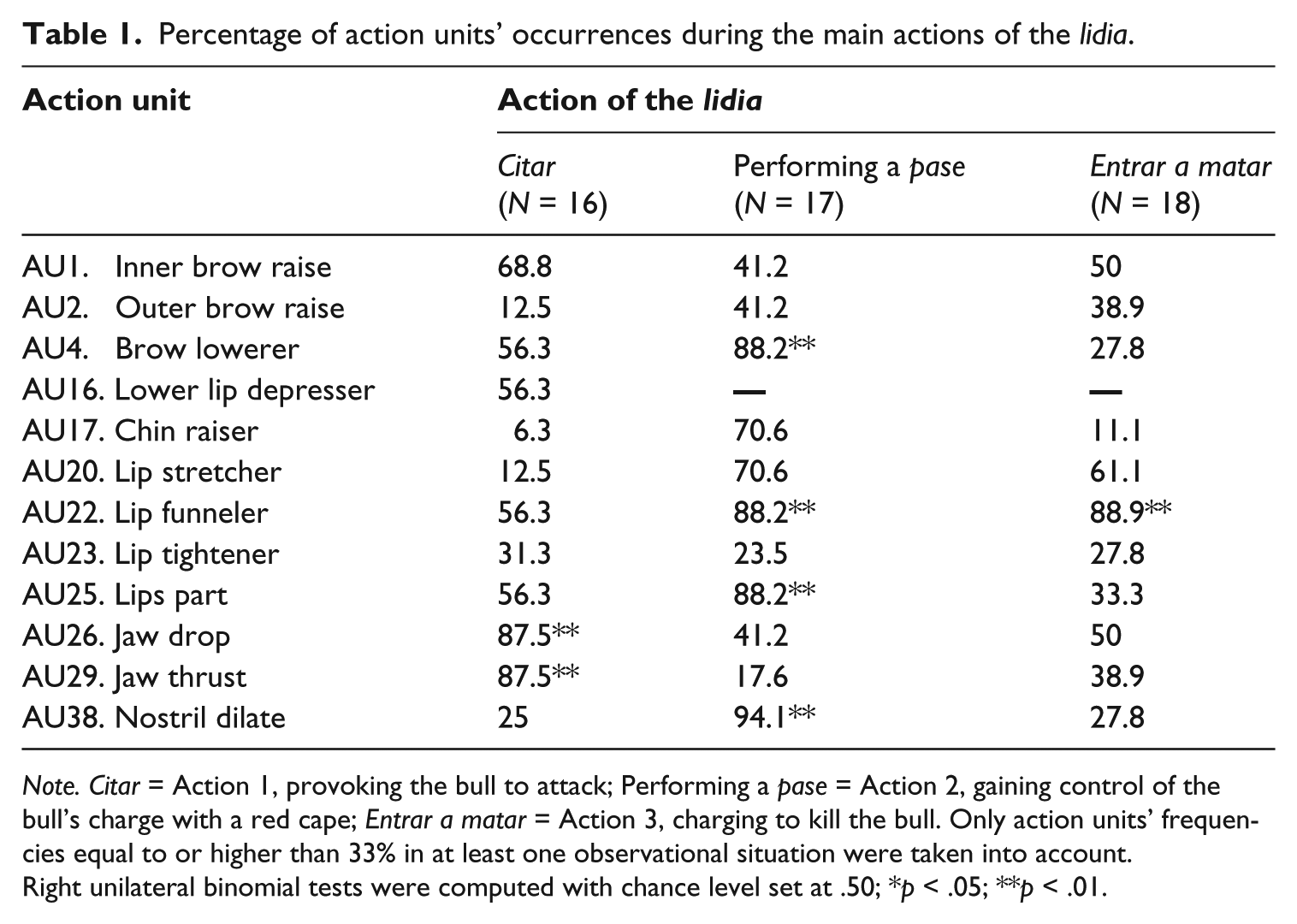
Note. Citar = Action 1, provoking the bull to attack; Performing a pase = Action 2, gaining control of the bull’s charge with a red cape; Entrar a matar = Action 3, charging to kill the bull. Only action units’ frequencies equal to or higher than 33% in at least one observational situation were taken into account.
Right unilateral binomial tests were computed with chance level set at .50; *p < .05; **p < .01.
Another important finding when analyzing toreros’ facial expressions was the absence of key action units supposedly associated with the prototypical expression of fear (i.e. AU5, upper lid raise) or happiness (i.e. AU12, zygomatic major contraction).
Subjective experience
The 15 interviewed toreros reported two main kinds of subjective experience: private speech and emotions (see Table 2). During Action 1 (citar), 11 toreros (73%) mentally reviewed their plans, and their emotions depended on the assessment of their own performance. When performing pases (Action 2), toreros were completely absorbed in their performance and could not report any private speech. With respect to emotions felt during Action 2, most of them (80%) reported happiness and an intense experience of ‘indescribable’ emotion (60%), whereas a minority reported negative emotions such as fear (33%) or anger (13%). As for Action 1, emotions were dependent on performance assessment rather than on appraisal of the bull’s or the audience’s behavior. Finally, for Action 3 (entrar a matar), they spontaneously distinguished two moments: before charging the animal (reporting technical self-instructions: 80%, and fear: 47%) and while thrusting the sword into the animal (reporting positive emotions such as happiness, pride, and relief: 73%, but also sadness for the animal: 27%, or other negative emotions if they did not perform the killing properly; anger and frustration: 27%).
Toreros’ reports of subjective experience across the main actions of the lidia.

Note. N = 15. Only descriptors’ frequencies higher than or equal to 5% are taken into account.
With respect to the toreros’ awareness of their expressions, all but one of the 15 toreros (93%) reported that they were not aware of their expressions, and all of them reported that they had neither learned nor been instructed to put on any expression.
A Friedman test was computed for toreros’ reported arousal and pleasure levels across the three different bullfighting actions (Action 1: citando; Action 2: performing a pase; Action 3: entrar a matar). The arousal and pleasure levels reported by bullfighters were significantly different over three different bullfighting stages, χ2(2) = 8.04, p = .016; and χ2(2) = 21.64, p < .001; respectively. 2
Figure 2 depicts a characteristic torero expression. The most salient action unit is AU22, i.e. protruded, funneled lips, which are a feature of toreros’ expressions while interacting with the bull (see Table 1). This finding is intriguing because neither the facial expression predictions in terms of basic emotion (e.g. Ekman & Friesen, 1975) nor the facial expression predictions from componential approaches (Scherer & Ellgring, 2007) included AU22 as an emotion expression or an appraisal signal.

Torero displaying the lip funnel (AU 22) while charging to kill the bull. (Reproduced by permission of EFE Agency, Spain).
Study 2: Lay judges’ perception of toreros’ expressions
What do the toreros’ expressions mean? Do they have any signal value? Some anecdotal evidence suggests that perhaps toreros’ expressions (and particularly the funneled lips) might have some intimidating function. For example, the Maori Haka, a traditional warriors’ dance performed these days by New Zealand rugby players, includes many instances of funneled lips. In Study 2, we tried to answer this question through a recognition study involving three consecutive recognition tasks, ordered in such a way that recognition criteria were increasingly specific. The first recognition task concerned one of the most usual meanings of ‘recognize’: to perceive something or someone as previously known (Merriam Webster Online) and was common for all the participants. We checked whether participants were familiar with toreros’ expressions in everyday situations. The second and third more specific recognition tests were aimed at testing whether judges were capable of assigning meaning to these expressions, either as typical of some situations (i.e. as a transient state, e.g. ‘playful’) or as typical of some persons (i.e. as a stable trait or disposition, e.g. ‘dominant’).
Finally, the most specific and relevant question, for the purposes of this study, was whether toreros’ facial expressions were undescribed expressions of basic emotion. Some researchers have recently claimed to have discovered new expressions of basic emotion (e.g. Tracy & Robbins, 2004), considerably enlarging the number of emotions included in the broad families of basic emotion (Ekman & Cordaro, 2011). Toreros might have expressed a basic emotion but not been able to report it, a plausible scenario from an empirical and theoretical point of view (Lambie & Marcel, 2002). According to some influential supporters of the existence of basic emotions (e.g. Ekman & Cordaro, 2011), one necessary feature of any expression of basic emotion is a universal signal value. We therefore tested whether toreros’ facial expressions were uniformly recognized as an expression of emotion.
Participants
In order to use only those who were unfamiliar with bullfighting, participants were recruited in the United States through Mechanical Turk (a commercial website on which online surveys are posted for volunteers to fill out in return for a small payment). The sample consisted of 149 Internet respondents residing in the United States (93% of them were native English speakers). Age distribution ranged from 18 to 65 years of age (Mdn = 30, SD = 11.51). Gender was almost equally distributed (52% male). Each participant received 20 US cents for their collaboration.
Method
Stimuli
We randomly selected four high-definition video excerpts from the sample of facial expressions coded in Study 1. One video of Action 1 (citar), two videos of Action 2 (performing a pase), and one video of Action 3 (entrar a matar). An additional video of a torero displaying a Duchenne smile was used as a control stimulus. 3
All videos were edited using Final Cut Pro X and Motion 5 to stabilize, rescale, correct color, create a black mask covering everything in the scene except the face, and produce a tracking motion leaving only the face in the center of the screen with no other visual cues available. Stimuli were uniformly treated even in respect of some minor details like gaze axis. Time duration was variable, ranging from the shortest presentation for the first performing-a-pase video (1 second and 6 frames) to the longest for the charging-to-kill video (3 seconds and 29 frames). All videos were preceded by a black screen with a 3-second countdown alerting participants to the incoming video.
Procedure
A Web-based implementation and study design was conducted with Qualtrics Labs, allowing us to randomize blocks and responses within each block, measuring the time spent in every task, the number of characters allowed in open-ended response boxes, as well as preserving a uniform presentation of stimuli and questions. Filters to avoid fraud were settled a priori (e.g. blocking IP addresses for accessing our study twice). After participants had completed an informed consent form and provided some general information (e.g. gender, age), they were shown five short videos with toreros’ facial expressions to assess their prior knowledge (have you ever seen that expression before?). Response format was dichotomous (yes/no), and only when a stimulus was found to be known were participants asked to relate facial expressions to situations, behaviors, or emotion descriptors in an open-ended response format. By programming an automatic player mode for every stimulus presentation, we made sure that participants watched every video at least once. Furthermore, participants were informed beforehand that they could freely watch every video as many times as they wanted. The reason for allowing repeated exposures to stimuli was to avoid alternative explanations for a hypothesized low previous-knowledge response (e.g. videos were too short to make an assessment in only one presentation).
Participants were randomized to one of the three between-subjects conditions (Situation, Disposition, and Emotion), and the wording of the questions was changed accordingly:
– Situation condition: Describe briefly the situation surrounding the people that you have seen in the past when displaying the expression shown in the video;
– Disposition condition: Describe briefly what the people that you have seen in the past were doing when displaying the expression shown in the video;
– Emotion condition: Describe briefly what the people that you have seen in the past were feeling when displaying the expression shown in the video.
Participants were allowed to answer with a maximum of 200 characters per stimulus.
Results
Two judges coded participants’ responses into a number of general categories (e.g. joking and singing were categorized as ‘play’, labels such as fighting and arguing were categorized as ‘dominance’). When there were disagreements, discussion between judges allowed them to reach consensus.
Previous knowledge
Percentage of observers reporting previous knowledge and categorizations of toreros’ expressions.
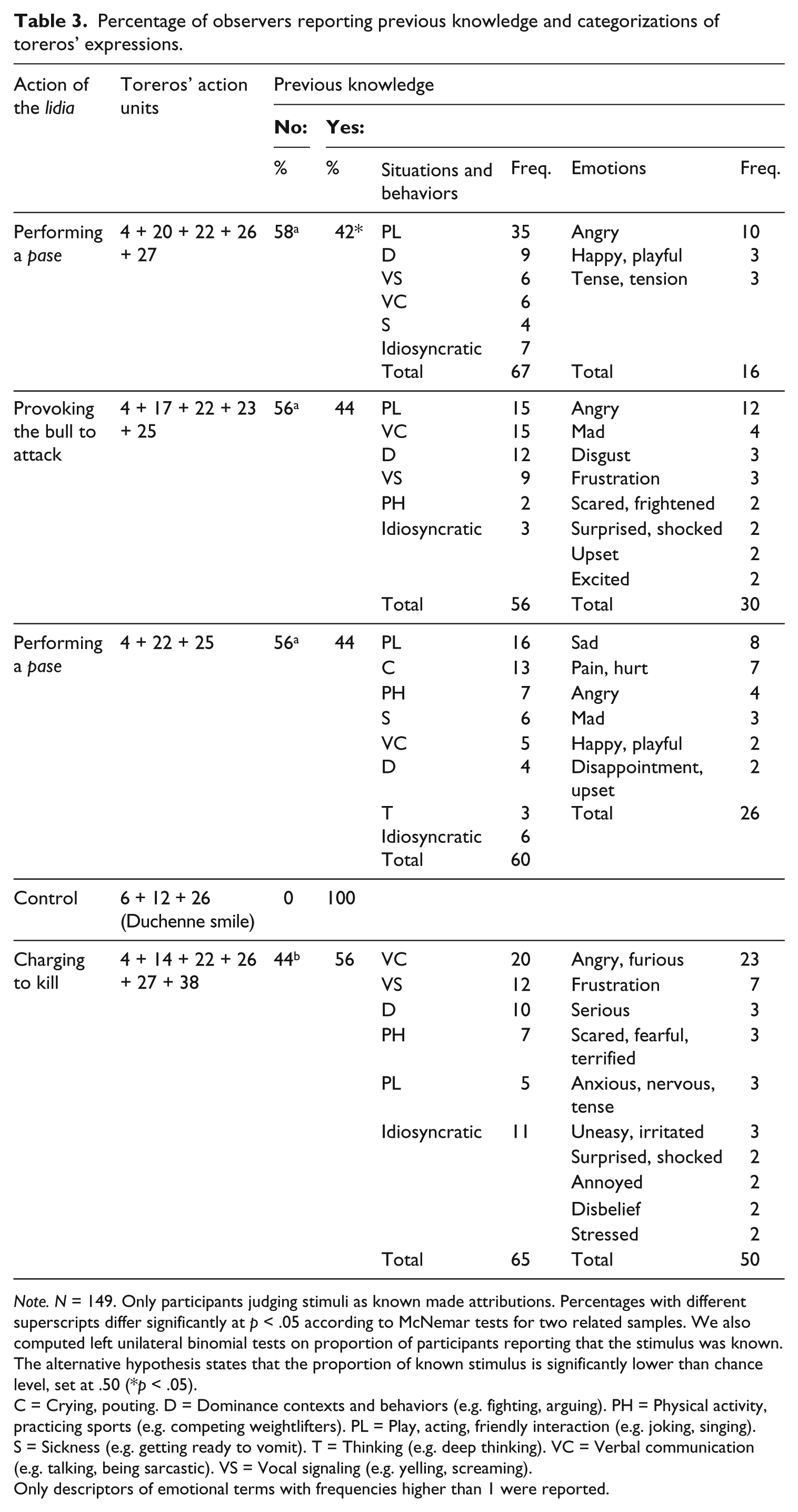
Note. N = 149. Only participants judging stimuli as known made attributions. Percentages with different superscripts differ significantly at p < .05 according to McNemar tests for two related samples. We also computed left unilateral binomial tests on proportion of participants reporting that the stimulus was known. The alternative hypothesis states that the proportion of known stimulus is significantly lower than chance level, set at .50 (*p < .05).
C = Crying, pouting. D = Dominance contexts and behaviors (e.g. fighting, arguing). PH = Physical activity, practicing sports (e.g. competing weightlifters). PL = Play, acting, friendly interaction (e.g. joking, singing). S = Sickness (e.g. getting ready to vomit). T = Thinking (e.g. deep thinking). VC = Verbal communication (e.g. talking, being sarcastic). VS = Vocal signaling (e.g. yelling, screaming).
Only descriptors of emotional terms with frequencies higher than 1 were reported.
We computed a left unilateral binomial test for detecting whether the proportion of each stimulus’s familiarity judgments was significantly lower than chance level (set at .50), finding that only the first performing-a-pase stimulus was significantly lower than chance (z = −1.88, p = .030).
Attribution of behaviors, situations, and emotions
The stimuli did not have a clear uniform communicational function, either in terms of generic attributions or in terms of emotions. The most frequent attributions of behavior or situation ranged from positive states such as play, to negative states such as crying. Participants also made some attributions of personality traits such as dominance. For emotions, the most frequent attributions were negative emotions such as angry, sad, pain, and frustration (Table 3).
General discussion and conclusions
The results of Study 1 provide evidence of the existence of facial expressions – in which funneled lips are patterned with other facial movements such as frowns and dilated nostrils – that are characteristic of bullfighters. These expressions did not fit into the prototypical expressions predicted for any of the emotions reported by them (fear, happiness). Additionally, in Study 2 we did not find a clear signal value for these expressions when they were considered out of context.
As is the case with most field studies, ours has a number of important limitations. First, our design does not allow carrying out a direct assessment of the relations between the toreros’ emotions and the expressions they might simultaneously be displaying at that time. A second problem lies in the difficulties of recording a moving target at some distance. This circumstance did not allow us to obtain an exhaustive record of all the toreros’ facial expressions and their emotional experiences at that time precisely. Although toreros might have displayed expressions of basic emotion that could not be observed in the video obtained, the absence of recorded prototypical expressions such as fear or happiness makes it reasonably implausible. Another reason for discarding a potential systematic oversight of prototypical expressions in our data is that, in strong contrast to the lack of records of such expressions, we found repeated records of facial expressions that did not fit into the expressions predicted for the reported emotions (Ekman & Friesen, 1975). Toreros’ facial expressions showed a remarkable inter-individual uniformity in their facial behavior through the different actions performed in the lidia.
Although the power to detect significant effects was limited due to the sample size in Study 1, frowns, open mouth, and dilated nostrils were significantly frequent at the most intense moment of the fight (Table 1). The most striking and characteristic facial expression of the toreros was the lip funnel (AU22), an expression rarely seen in everyday encounters and which has been associated with anger (Sell et al., 2014). Actually, the lip funnel can be considered as the quintessential representation of the toreros’ facial expression (see Figure 2). For example, when conducting a Google Image search of 130 current professional senior toreros, the first returned close-up of 63 of them included a display of funneled lips.
What do the toreros’ funneled lips, frowns, or dilated nostrils mean? Two potential answers maintain the hypothesis of coherence between emotion and facial expression, whereas our final interpretation is grounded in an alternative view of facial expression and emotion.
A first potential explanation of the toreros’ expressions would be that toreros displayed their expressions following some sort of display rules or some sort of gestural models (Ekman & Friesen, 1975). But toreros’ responses reported in Study 1 forcefully discard that interpretation. Toreros reported not being aware of these facial expressions and not having been encouraged or instructed to perform them. One of the authors obtained some additional evidence of the uniformity and automaticity of toreros’ facial expression. Toreros, as well as their teachers, did not display funneled lips when performing the pases out of context (e.g. while in an explanatory performance), but they showed that expression if they were asked to reenact a real pase at the bullring. Furthermore, there are rare graphic documents of actors performing the role of a torero (e.g. Rudolph Valentino) and of real toreros at the bullring. Whereas actors did not display any characteristic expression, toreros displayed funneled lips on photographs from the 1920s, 1940s, and 1960s, across the 20th century. Although sparse, this documentary evidence strongly suggests the absence of acting or display rules, given that bullfighting audiences were not able to watch the toreros’ facial expressions in action until the end of the 20th century (thanks to high-definition TV cameras).
If toreros’ facial expressions are not the outcome of display rules, an alternative potential explanation is that they were displaying the facial configuration of some basic, but not-yet-described, affective program within one of the basic emotion families (Ekman & Cordaro, 2011). Lambie and Marcel (2002) have pointed out that first-order, engrossing emotional experiences are expressible without being reportable. It might be argued that toreros, while completely absorbed in the fighting, could only express, but not report their emotions. This line of thought would also be coherent with some current approaches to the Basic Emotion Theory aimed at claiming the discovery of new emotions (e.g. Tracy & Robins, 2004). If this is the case, toreros’ characteristic facial configurations should be distinctive universal signals of such emotional experiences. As Study 2 shows, this is far from being the case.
A final potential explanation for our findings is that the torero’s facial expression is not an outcome of a unitary affective program (basic emotion), but results from a process concurrent with different affective and cognitive processes such as core affect (Russell, 1980, 2003), appraisals (Scherer & Ellgring, 2007), or emotion-regulation, as well as some actions. For example, open mouth and dilated nostrils are a typical consequence of enhanced breathing due to physical effort and high arousal. Frowns have been characterized as signs of appraisal of an anticipated effort (Smith & Scott, 1997).
Finally, funneled lips might be a dominant behavior included in an agonistic behavioral strategy, i.e. a form of animal communication in tune with the primitive character of this encounter between man and animal. Table 4 shows a brief review of the dominance displays reported in observational naturalistic studies (Andrew, 1963, 1964; Blurton-Jones, 1971; Camras, 1977; Grant, 1969; Keating et al., 1981; Young & Décarie, 1977; Zivin, 1982). Although not all the reported expressions were observed in Study 1 (e.g. AU16, lower lip depress), lip funnel was included in five out of the seven reviewed reports, and other expressions were also observed in all or some of the different situations in which we recorded toreros’ expressions (see Table 1).
Dominance displays reported in human ethology studies.
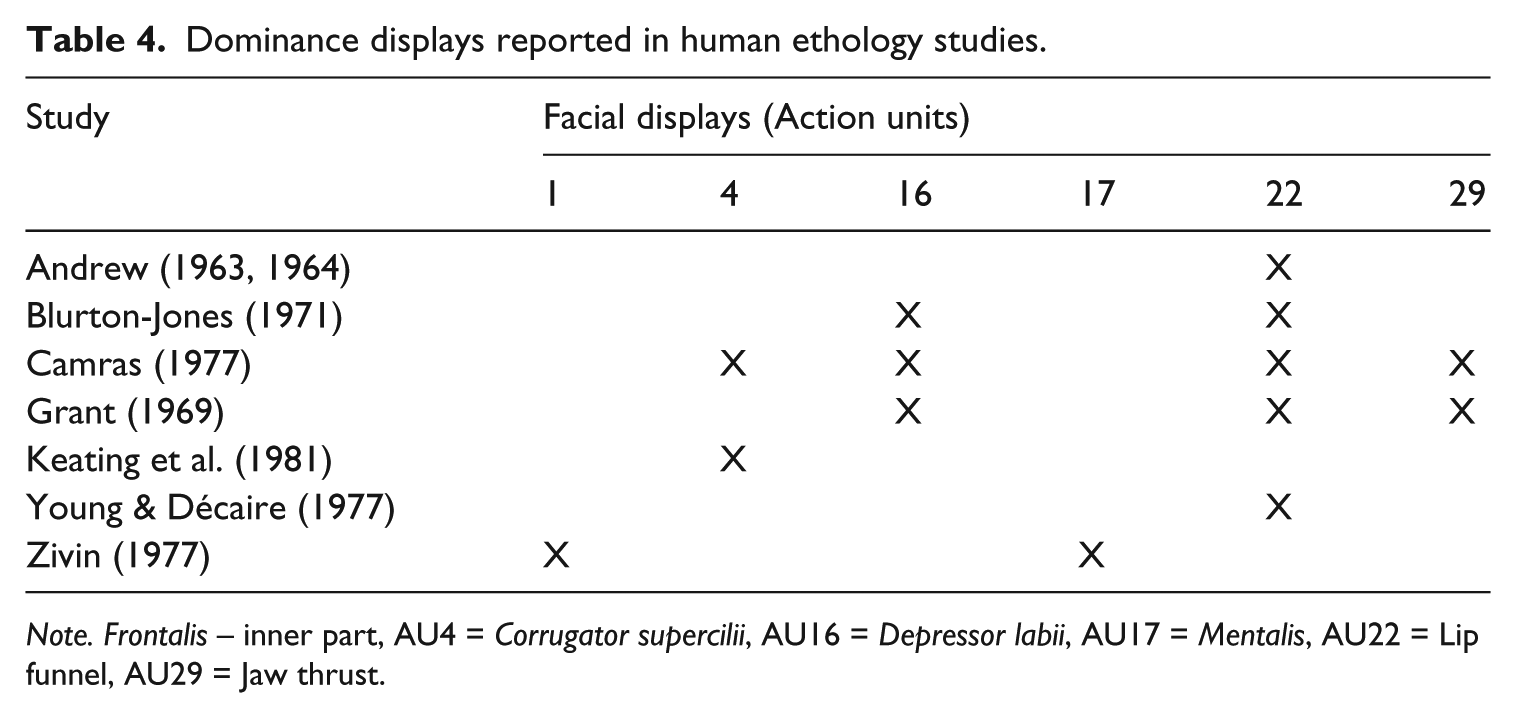
Note. Frontalis – inner part, AU4 = Corrugator supercilii, AU16 = Depressor labii, AU17 = Mentalis, AU22 = Lip funnel, AU29 = Jaw thrust.
From our cumulative evidence on unexpected facial expressions in intense emotional situations (e.g. Fernández-Dols et al., 2011; Fernández-Dols & Ruiz-Belda, 1995), our current conclusion on these findings is that the facial expressions produced by bullfighters are actually courses of action roughly coextensive with their intense emotional experience. Our choice of the term ‘coextensive’ implies an important qualification of the old but still influential read-out model about emotion and facial expression. In our view, emotion experience is not automatically signaled by prototypical, fixed expressions. A facial expression is a complex natural or learned course of action, and is an interactive tool with multiple causes and consequences. Facial behaviors may be influenced separately by different features of an emotional episode, such as, for example, its causes and content, its time course, and the individual’s attentional focus and level of awareness (Lambie & Marcel, 2002; Russell, 2003). This view, although still based on a limited amount of evidence, opens the way to a much more complex and intriguing view of what psychologists call ‘facial expression of emotion’.
Footnotes
Acknowledgements
We would like to thank Antonio Pardo, the Marcial Lalanda Bullfighting School, and the bullfighters who volunteered to participate in these studies. Study 1 reports part of Garcia-Higuera’s doctoral thesis (Garcia-Higuera, 1998).
Funding
This work was supported by the Spanish Government (grants number PS95-0042, and PSI 2014-7154P); and Universidad Autónoma de Madrid (predoctoral grant number FPI-2014).