



Abstract
Play in public space pauses the everyday and allows for fictional collective worlds to emerge. In this article I focus on the unintended ‘frictions’ triggered by these collective fictions. When players inhabit these fantastical worlds, they tend to become more aware of the invisible rules of ownership and property that shape their everyday. This article questions play as an open-ended modality of emergence. I argue that these fictions are ephemeral instances of collective awareness, and by definition preclude sustained forms of collective action to enact long-lasting, structural change; yet they are potentially transformative. I draw on my work as co-founder of Department of Play, a Boston-based interdisciplinary group that works at the intersection of art, urban theory and ethnography. I reflect on the organization and implementation of Boxtopia, a recent play project in a low-income neighborhood of Boston that sits along a ‘development corridor’.
On Sunday 7 June 2015, the fence enclosing a vacant lot adjacent to the Fairmount Train Line in Codman Square, one of Boston’s southern neighborhoods, opened to welcome residents. Festooned with colorful balloons and bright-colored tape, the fence became the backdrop setting for Boxtopia (Figure 1), a neighborhood party. Department of Play (DoP), a Boston-based public art collaborative, and Codman Square Neighborhood Development Corporation (CSNDC), a local organization owner of the lot, collaborated to host a public play date with the residents. During the play date, residents turned hundreds of cardboard boxes into models representing their visions and aspirations for Boston in 115 years. Children and adults built structures, like a solar satellite, a giant arch to be placed at the entrance of the futuristic city, a robot and a variety of shelters, ranging from domes to huts and small nooks. Later that day, the Minister of Play from Boston 2130 (an actor dressed in a futuristic outfit) arrived on site. He asked participants to share their visions for the future. The next day, the Minister of Play boarded the Fairmount Line (a commuter train servicing the area) to show passengers the futuristic city visible from the train and start conversations about people’s aspirations for the future.

Boxtopia. Photo by Department of Play.
In planning and implementing what was intended to be a fun event for collective visioning, DoP inadvertently exposed the buried structural market forces that preclude Bostonians who do not own property from enjoying the city in the same ways as property owners. During the play date, residents asked questions about the lot and how DoP had been able to access it to organize Boxtopia. One woman in particular wanted to use the lot to host a barbecue with her neighbors. When DoP answered that it had secured the lot by working in partnership with local organizations, and with CSNDC, the woman made disparaging comments alluding to the fact that these organizations rarely work in the neighbors’ interests. Further adding to the woman’s suspicion, the representative of CSNDC on site explained that CSNDC could not rent out the lot to residents for a barbecue where there most likely would be alcohol served because, if someone got injured, CSNDC, as owner of the lot, would be legally responsible.
The process of securing the lot, of engaging neighbors and of working with organizations to make the play date possible bared the otherwise invisible structural conditions of liability and property ownership that shape Bostonians’ uneven access to privately owned ‘public’ spaces. Through the play date, DoP learned that, in Boston’s lower income neighborhoods, local development organizations own or have access to vacant land that individual renters do not have access to. The play date further revealed that, even though local organizations strive to serve the community, the pressures these organizations face to ensure ‘safety’ at times hinder the formation of horizontal, diverse publics that can equitably use neighborhoods’ resources. Chiefly the play date showed that, for renters to access these resources, they have to comply with the rules of use established by the owners of the private property. These rules produce highly scripted spaces for public interaction that reinforce social norms and social stereotypes (Fairfield, 2010; Harvey, 2007).
The play date offered an opportunity for participants to experiment with an ‘ethics of discomfort’, a space where they could ‘[take] part and take sides without letting oneself be taken in’ (Foucault, 2000: 445), where they could decouple from the tight grip of the rules and assigned identities that mediate their everyday. Boxtopia’s seemingly naïve goal to have fun together bared a mismatch between CSNDC’s intentions and goals, and the aspirations of Codman Square’s residents. In getting together with no other purpose than to play and to have fun, neighbors questioned who has the right to play in the city. What spurred the conversation was the uncomfortable fact that DoP and its collaborators were not from the neighborhood (most came from more affluent areas of Boston), and yet could access the vacant lot more easily than neighbors to the lot. By using the lot in the name of fun and play, DoP opened a space for neighbors to collectively imagine alternative worlds and envision unconventional ways of belonging together different from those outlined by the organizations that dictate the ‘rules of use’ of privately owned ‘public’ spaces. In other words, Boxtopia unintentionally triggered frictions. Frictions, as Tsing writes, are ‘the awkward, unequal, unstable and creative qualities of interconnection across difference’ (2005: 4).
In this article, I argue that fictional play produces unstable moments of collective reflection where participants can become something else in the game, question their established identities and also reframe their relationship to structural conditions that shape their everyday interactions with their neighborhoods. In these moments, play offers an instance of pause to collectively question city politics at large, to question who can use the city and how. These instances are ephemeral and by definition preclude sustained forms of collective action to enact long-lasting structural change, yet they are also potentially transformative. In play participants can imagine another way of existing together even though these imaginations do not transcend beyond the duration of the game.
Using Boxtopia as a case study, this article questions play as an open-ended modality of ‘the emergent’. What we learn about ‘the emergent’ from playing out Boxtopia, a concrete action that deliberately intended to disrupt the everyday, is that an ‘emergence’ is not only an unanticipated form of becoming that supersedes and reorders the system in place, but a form of becoming that can be unstable and ephemeral, and yet potentially transformative. Although DoP designed Boxtopia with the intention of starting a public conversation about what a common future would look like in a city with strong neighborhood identities, Boxtopia unintentionally perturbed the invisible threads of property ownership that underlie neighborhood politics, making them visible. Working as an uncanny spotlight of sorts, Boxtopia suspended the commonsense and taken-for-granted assumptions of residents and organizations about property ownership in the city, and presented them under a new, unfamiliar light. This light agitated and rerouted the flows of the everyday, interrupting also residents’ relation to the neighborhood, even if only for the duration of the play event.
Collective play in public space gives rise to a mode of ‘emergence’ that can be characterized as unstable moments of collective awareness that overflow the existing paths for collective action. These moments of becoming a group transcend the established norms and referents of living together, offering a space to safely question the rules that organize daily life. Paradoxically, for this very same reason, these moments of collective becoming in which participants envision alternative ways of living together and question city politics at large are not easily transportable into sustained forms of social change.
Conversely, when inquiring into play as a modality of emergence, we learn that play is an open-ended, creative force. At a practical level, play disrupts the regular flow of the everyday and facilitates the creation of horizontal and morally diverse publics different from the existing ones. Fictional play in public space offers a reflexive collective experience in which participants can denaturalize normative social identities and carve out an alternative sociopolitical space from where to articulate novel ways of existing together, and from where to safely question the rules that organize everyday life. Yet at an epistemological level, we learn that play is an open-ended practice: play provides alternative scripts for interrelating (i.e. building Boston in 115 years) which produce unintended outcomes that the existing fictional and non-fictional scripts cannot fully absorb.
I develop the argument in three sections. First, I describe DoP’s concept of play, which came to life as part of a broader critical exercise sponsored by the Design Lab for Social Intervention (DS4SI). Second, I examine the organization of Boxtopia in relation to the structural conditions that the project exposed. Finally, I conclude that play is an open-ended practice that eludes synthesis and elucidates the many ramifications and scales at which these structural conditions operate.
Why play?
DoP conceptualized and created Boxtopia as part of Expressing Boston, a nine-month public art fellowship. DoP – a collaborative between Katarzyna Balug, an artist and urban planner, and the author, an anthropologist – applied to Expressing Boston with an interest in testing play actions as an alternative public language to talk about the city and residents’ relation to it, especially in the presence of powerful market forces (what Bostonians identify as gentrification) and widespread neighborhood segregation (Bostonians’ self-identify as a city of neighborhoods). 1 In participating in Expressing Boston and in planning Boxtopia, DoP deployed several play actions with the aim of creatively addressing the invisible social and cultural boundaries that hinder Bostonians from participating in the same public conversations and sharing ideas horizontally.
Expressing Boston is an ongoing project between DS4SI and the Boston Foundation, which seeks to support ‘artists in thinking through and testing new ways to do their art practice in public spaces, in ways that increase the authority which artists and community members feel to claim public spaces in their neighborhoods’ (Design Lab for Social Intervention, 2015). The fellowship prioritizes artists who live or work in neighborhoods along the Fairmount Commuter Rail Line, a traditionally underprivileged area of Boston, home to African American and recent immigrant communities. Up until 2012, the neighborhoods along the Fairmount Line were vastly underserved in transportation. Despite the fact that the infrastructure for the commuter line has existed since 1855, only freight trains used it (Boston Redevelopment Authority, 2015). Meanwhile residents had to rely on slow and overcrowded bus lines to transport them in and out of their neighborhoods. As part of community organization efforts spanning 30 years, the Fairmount Commuter Line 2 opened its week service in 2012, and its weekend service in 2014 (Figure 2). Although residents generally have welcomed the improved infrastructure, the new rail line has also stirred fears about gentrification and displacement.
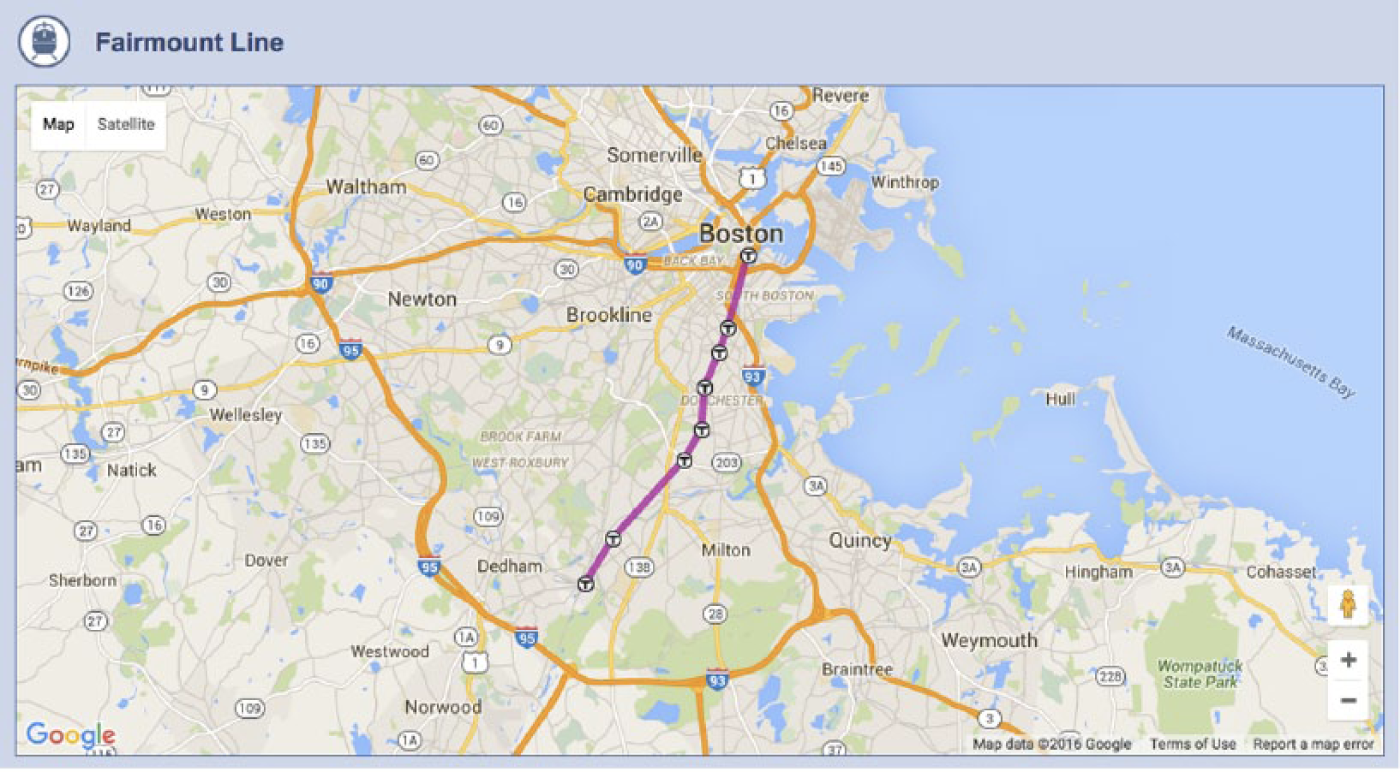
Fairmount commuter train map. www.mbta.com.
Sensitive to the widespread fears and public sentiments of powerlessness resulting from these transportation improvements, the Expressing Fellowship called on local artists to creatively address issues of structural inequality in Boston. Using a wide range of media, from photography to music, and diverse esthetics, from parody to nostalgia, the artists’ projects addressed heartfelt topics such as black masculinities, the commodification of race, immigration and fair opportunity, among many others. DoP’s project Boxtopia answered the call from a different angle. As immigrants and transplants to Boston, both Balug and the author felt that Expressing Boston was uniquely positioned to start a public conversation about what being a Bostonian means in a city that takes pride simultaneously in its historical tradition and in being an open port for immigrants.
In the months prior to Boxtopia, DoP created several Temporary Play Zones (TPZs) to ‘test’ play as a reflexive form of world making and unmaking, in which participants could collectively address questions of difference, inequality and public space. In these TPZs, DoP provided building elements (like abstract building blocks) and a general prompt of what that world would be, and the rest was left up to the players to decide. For example, DoP created Block Party, a TPZ in which players used custom-made blocks to create the first human city on Mars (Figure 3). In the game, children and adults collaborated in building the structures, and participants actively imagined the different elements that make a livable city, including interconnected shelters.

Block Party. Photo by Nickolas Peter for Department of Play.
In these TPZs, DoP observed that the physical act of collaboratively making a world suspends the relationship that players have to a specific place and temporarily creates new relationships, thus infusing space with new identities and new symbols. In this co-production of a common fiction, participants negotiate how they belong together and reimagine alternative ways of existing as a collective – at least for the duration of the game. These fictional worlds entail the negotiation of personal and collective aspirations for the future and frame people’s wants in a positive light. For example, in Block Party, DoP observed how children, their parents and other adults collaborated to create interconnected structures in a way that reframed the everyday vertical relations between children and adults. There was no right or wrong way of building that world, and therefore even the wildest, most abstract and absurd idea, like making a gigantic structure with all the blocks, was plausible.
Through Block Party, DoP learned that a modality of fictional play in public space that emphasizes building together is very effective in revealing to participants naturalized forms of status and hierarchy, of who has the right to use the city and how. In participating in and in producing these fictions, participants re-make themselves and the surrounding world, and call into question their everyday. As anthropologists and play theorists have explored, play is a form of self-awareness (Ortner, 1999). What Malaby terms ‘a disposition’ (Malaby, 2009), Lancy calls ‘moral gamesmanship’ (Lancy, 2008), or Sicart identifies ‘as a portable tool for being’ (Sicart, 2014: 2). Play intervenes at a symbolic level in which the experience of becoming someone or something else in the game elucidates the instability and arbitrariness of the cultural symbols that construct our familiar everyday (Sutton-Smith, 2001; Turner, 1982). Going back to the example of Block Party to illustrate my point, as children and adults co-produced the first human dwelling on Mars, hierarchical forms of identity based on age difference disappeared. Instead, in the presence of a tangible yet imaginary task, children and adults redefined themselves as co-producers on an equal footing with a common world.
Yet unlike canonical conceptions of play that understand play as an extraordinary space separate from the practical world (Caillois & Barash, 1961; Huizinga, 1955), DoP also learned that the fictions produced in the TPZs are in an open-ended relation with the productive, ‘real-life’ world. In this modality of play in public space, the design of the TPZs cannot anticipate how the real world will manifest in the game, nor can it control the outcomes resulting from the game. Therefore, inspired by Victor Turner (1982), DoP articulated an understanding of play as a combination between a ritual-like space, where people reflexively fashion their individual and collective identities, and a ‘free space’ outside the logics of economic production, from where players can contest the system of production they belong to. DoP intentionally designed the TPZs to invite city residents to experiment with their established individual and collective identities, and also to question city politics at large.
For the purpose of the Expressing Boston fellowship, DoP designed Boxtopia. DoP designed this TPZ with the intention of bringing residents of different neighborhoods together in a common fiction. For this purpose, the project entailed a series of workshops with youth across the city to come up with a blueprint for a city of the future that would be built collaboratively with residents of different neighborhoods in a lot visible from the Fairmount Line. On the train, Boxtopia would become a conversation starter with commuters about the future of Boston, and about their place in that future. All of these ‘visioning’ exercises contained in the project aimed to displace the conversations about gentrification, and the feelings of powerlessness attached to them, into a more agentive realm.
Boxtopia
The process of planning Boxtopia inadvertently exposed the structural forces that modulate the interactions among city agencies, local organizations and neighborhood residents. Boxtopia showed that the laudable goal of promoting equality and inclusion is a difficult task to accomplish when market forces set the beat to which cities pulse. At the citywide level, Boxtopia revealed that the fears of gentrification and the actions set in place to counteract this trend have accentuated Boston’s traditional neighborhood isolation and segregation. At the neighborhood level, Boxtopia uncovered the dual, and sometimes uncomfortable, role that local development organizations play – they both organize residents and secure resources for the neighborhood, and they act as gatekeepers that determine who can use these resources and under what parameters.
The macroscopic
The fears of gentrification along the Fairmount Corridor that DoP intended to creatively address through Boxtopia have been particularly exacerbated by Boston Redevelopment Authority’s (BRA) planning efforts along, what they have termed, ‘The Fairmount Corridor’. Since 2012, the BRA has carried out a series of community workshops in the different neighborhoods. In these meetings, BRA representatives invite community ‘stakeholders’, mainly businesspeople and local organization leaders, to share redevelopment opportunities in these areas. As part of the research process involved in designing Boxtopia, and to effectively understand the BRA’s role in agitating residents’ fears about gentrification, Balug and I attended one of these meetings on 13 January 2015, set in a community center in one of the neighborhoods sitting along the corridor.
An equal number of ‘stakeholders’ and BRA representatives participated in the meeting. After the welcoming remarks, a BRA representative highlighted that the objective of the community workshops was to encourage ‘diversity in the corridor’ while bringing ‘together one vision’. This overall goal guided the methodology of the workshop. The group of people split up into five worktables. At each table, a BRA representative provided a land-use map and moderated the discussion. I sat at a table that focused on business development. The moderator of the table kicked off the discussion by asking ‘how to advance prosperity?’ After this, he asked the participants in the table to point out vacant lots in the area and what they would want to see on these lots. Although participants raised questions about safety, having more and better playgrounds and having more opportunities for the youth, the moderator emphasized economic redevelopment in connection to business promotion and land vacancy.
The BRA’s emphasis on land vacancy in the Fairmount Corridor resonates with widespread media representations of the area as an empty land waiting to be redeveloped by private investors (McMorrow, 2014). In an area populated by low-income families and where most residents are renters (Forry, 2014), this stereotype is dangerous. The public notion that these neighborhoods are empty spaces for sale to the best bidder advances the idea that residents in these neighborhoods are transient, that they do not share a history, nor do they have any community ties, and therefore they can be easily displaced to other areas.
In an attempt to counteract this private redevelopment trend along the Fairmount Corridor oblivious to existing social relations in place, neighborhood-specific and citywide organizations, like DS4SI, came together to form the Fairmount Cultural Corridor initiative (FCC). FCC is a ‘creative placemaking initiative that combines collaborative efforts of residents, artists, community organizations and businesses to support vibrant, livable neighborhoods along the Fairmount Commuter Line, made stronger through an active local creative economy … designed to advance a vision that draws upon the local cultural assets and ethnic traditions of the Corridor’s residents’(Fairmount Cultural Corridor, 2014). FCC deploys artistic and creative public interventions to promote an alternative economic model where ethnic diversity, local social relations and local creativity are the building blocks for strong local economies. Working within a neoliberal rationale which considers cultural authenticity an economic asset (Comaroff & Comaroff, 2001), FCC promotes local cultures and local creativity as a viable business strategy for generating wealth from within and counteracting the gentrification trend.
The Expressing Boston art fellowship was one of the strategies deployed by FCC to achieve this objective. Once a month, an eclectic group of artists who lived or worked along the corridor met at DS4SI to workshop their projects. In these meetings, the fellows exchanged ideas, shared resources and also engaged in critical conversations about the role of art in urban redevelopment. The fellows were particularly critical of a recent trend across American cities in which the arts have been positioned as spearheads of urban renewal – renewal understood in economic terms.
Attuned to Richard Florida’s ‘creative economy’ theory (Florida, 2002), city governments across the USA have turned their attention to planning cities around local culture. This understanding sees ‘culture’ as a set of local capacities to be cultivated in service of promoting economic prosperity. Florida, for example, advocates for making cities appealing to the ‘creative core’ (described as the ‘thought leadership’ and which comprises artists, scholars, scientists, architects, writers, etc.), and ‘creative professionals’ (described as professionals in the service sector who engage in creative problem solving). The thought being that, if cities are able to attract and retain this class of creative workers, this will increase economic growth. 3
The concept of creating a ‘creative economy’ has taken root in Boston as a result of a booming tech economy. In recent years, public and private organizations have promoted the establishment of so-called ‘innovation districts’ in different neighborhoods to attract and retain workers in the tech economy in hopes of spreading the wealth to these areas. Similarly to Richard Florida’s representations of a ‘creative class’ as a group of people attracted to tolerant, progressive, hip, ethnically diverse and ‘artsy’ areas, different neighborhoods in Boston have invested resources in public art, in co-working spaces and in retail space to secure private investment.
During the monthly workshops, the Expressing Boston fellows, however, were critical of instrumentalizing art in the name of economic profit. Resonant with recent critiques of artistic production in the neoliberal era (Harvie, 2013), in the monthly workshops, fellows questioned the reach, purpose and scope of their public art practices. Some fellows feared that with their public art practices, and by making their neighborhoods ‘hip’, they were helping advance a private, profit-centered redevelopment agenda oblivious to social and racial inequalities, which would ultimately end up pushing out low-income residents (including the artists who contribute to making these neighborhoods appealing to outsiders). Other fellows conceived of public art as a socially transformative practice but questioned the burden placed on artists to counteract the forces of the market, when unjust economic, political and social conditions are left intact.
The conversations among the artists, DoP would learn, mirrored anxieties about gentrification at the neighborhood level that have prevented inter-neighborhood resident-led initiatives exchanging ideas and resources. Particularly, the artists’ concerns about cities using and exploiting local artists’ labor to drive gentrification and unjust social conditions spoke to a widespread concern along the Fairmount Corridor about newcomers taking advantage of the local capacities of neighborhoods to the detriment of the residents. These anxieties about gentrification have had a negative effect on building horizontal, resident-led coalitions in Boston to address these widespread and common problems. Instead of bringing people together, these widespread fears have deepened the ethnic and neighborhood divisions that have traditionally defined Boston’s civic life. Trying to safeguard their own neighborhoods, residents and neighborhood organizations tend to work independently from each other. For example, neighborhoods that are experiencing similar redevelopment processes, such as East Boston (a predominantly Hispanic neighborhood), Fields Corner (a predominantly Vietnamese, Caribbean and Cape Verdean neighborhood) and Roxbury (traditionally an African-American neighborhood) rarely participate in the same city planning conversations. 4
The microscopic
Planning Boxtopia exposed the complex dynamics and unintended consequences of protecting neighborhoods against the influence of outside developers. Although local neighborhood organizations have in mind the best interests of the neighborhoods they work in, the pragmatics of protecting ‘the community’ preclude residents from using the neighborhood’s resources for purposes different from what these organizations consider appropriate.
Prior to the build day, accessing a vacant lot and engaging residents for the visioning workshops leading to Boxtopia proved to be difficult. In underserved areas of Boston, a variety of local organizations, such as neighborhood-specific Community Development Corporations (CDCs), non-profits servicing minorities and vulnerable populations, and Main Streets Organizations, which, among other things, promote local businesses and organize neighborhood initiatives, own vacant land 5 and/or have access to city-owned land. DoP contacted several organizations to access residents and also secure a vacant lot. However several of these organizations were already tied to their own programming, and they did not have the capacity to work on another project. Some of these organizations invited DoP to participate in their own programming, but the timelines did not coincide.
At some point, DoP contemplated working without partnering with a local organization, but the range of work and the kinds of resources needed for a project like Boxtopia required working with organizations. Local organizations administer local resources, ranging from housing options to educational programming to service the community. 6 These organizations act like ‘unelected representatives’ that guarantee services to the neighborhood and speak for its residents before the city (Levine, in review). In other words, without the neighborhood organizations, DoP could not reliably access residents nor could it use the public spaces in the neighborhoods.
After many phone calls, emails and conversations with neighborhood organizations, DoP ended up accessing some residents of the Fairmount Corridor through fellow Expressing Boston artists. Artist Claudia Paraschiv, who had established a robust place-based artistic practice in Four Corners (one of the Fairmount Line stops), invited DoP to participate in her weekly salons with residents to carry out some of the visioning workshops. Barrington Edwards, also a fellow artist and a teacher at Boston Arts Academy, invited DoP to talk to some of his students interested in participating in the visioning process. To access a lot visible from the train, DoP partnered with CSNDC. This organization became interested in bringing Boxtopia to their neighborhood as part of a larger ‘creative place-making’ initiative. In recent years, CSNDC has been invested in turning the area into an ‘eco-innovation district’, and ‘creative place-making’ initiatives have been a central part of this effort.
Working with different groups of residents from different neighborhoods, and who were not directly involved with CSNDC or who did not live near to the vacant lot where Boxtopia would happen, was challenging. First, it was difficult to make a case to residents for why they should be involved in an activity that was not happening in their own neighborhoods. For this reason, there was little continuity in the residents’ participation in the visioning workshops. Each workshop gathered completely different crowds, and in each workshop DoP had to start from scratch. Second, the workshops in some areas were poorly attended. Since DoP had to work with specific organizations to access residents, Boxtopia was subject to the schedules and decision processes of each organization. In many cases, organizations’ timelines were not compatible with DoP’s project timeline. Some of these workshops were therefore advertised with such short notice that hardly any residents showed up.
Communication with residents became a particularly contentious issue in the organization of Boxtopia. Two days prior to the big build-day event on CSNDC’s lot, DoP found out that the event had not been advertised among the neighbors of the lot. The community organizers who had access to the residents and who worked in partnership with CSNDC claimed not to have had enough time to advertise properly. The relationship between DoP and these neighborhood organizations was further strained when members of another organization working in the area found out that the MBTA (Massachusetts Bay Transportation Authority) had given DoP 100 free tickets for the train to be distributed among the residents during the building event. As a member of that organization put it, ‘he strongly suggested’ that DoP handed off half of the tickets to the community organizers to appease them for all the trouble caused. Trying to maintain some harmony, DoP instead suggested giving the organizers the remaining tickets after the event, highlighting that the tickets were ‘for the residents to have’. The member of said organization disagreed with this proposition. After negotiating, and talking to some of the community organizers directly, it was finally agreed that DoP would hand out the remaining tickets to the community organizers after the event.
After overcoming these obstacles with the local organizations, the building day arrived, and DoP together with collaborators and a representative of CSNDC arrived early at the lot to set up the play date. The set-up included mowing the tall grass that had been growing for months, picking up garbage and marking the ‘safe’ areas where people would play (meaning areas with an even terrain and free of garbage). During the set-up, DoP learned why these organizations were so eager to getting hold of the MBTA tickets: the complimentary tickets would help smooth existing tensions with residents. Surprised neighbors who did not know Boxtopia was happening met the event with enthusiasm. To many, it was nice to see that there was an event open to the neighbors on a lot that they could not use and that gave the appearance that the rest of the street was equally abandoned.
Unexpectedly, the play date also exposed that CSNDC’s decision to keep the lot locked stemmed from a commitment to protect ‘the community’, a form of protection that in the presence of market forces takes the form of protection against risk and liability. As a vehicle for enforcing property rights and standards of personal responsibility, American common law is primarily focused on questions of liability, and has developed in conjunction with insurance companies (Abraham, 2009). In this system, insurance companies dictate the rules that a private party has to follow in order to avoid disputes, while the legal system assigns this liability. Working within this system, CSNDC’s decision to keep neighbors from using the lot without their permission resembled the action of other private entities in the USA by taking precaution; a precaution ‘akin to self-censorship’, as Rex Baker, lawyer and collaborator of DoP noted.
Boxtopia illuminated a contradiction between commitments and actions. Although citywide and local organizations strive to strengthen local communities to bring economic prosperity to these areas, the reality of managing communities and resources in a system of market competition undermines these efforts. As the neighbors’ frustration with the neighborhood organizations illustrates, even though these organizations claim to work in the neighborhoods’ best interest and to revitalize the ‘community’, the realities of liability tamper with these efforts, even to the detriment of communal life. Boxtopia exposed the fact that certain activities (like having a barbecue and a few beers with friends) are only accessible to land owners. This observation raised questions about the types of collectivities that emerge in neighborhoods where most people rent, and in neighborhoods where most people own their homes. And, more importantly, it also raised questions about the role of the city as a democratizing space that bridges these asymmetries. If ‘public’ spaces in many low-income neighborhoods in Boston are privately owned and privately regulated, in what kinds of spaces can residents experience the equalizing force of the city? Although the answer was not clear, this question started a larger discussion among DoP members and collaborators about the relation of play and city politics, and the possibility of play as a political project. Could play in public space unleash the city’s democratizing force?
Open-ending
One of DoP’s collaborators was particularly critical of the issue of resident access to vacant lots in Codman Square, and questioned the potential of play as a political project, as well as the role of DoP in this context. In his view, Boxtopia had opened a space to question residents’ access to neighborhood resources but only for the duration of the build day – after that, the neighborhood went back to business as usual. Therefore, this collaborator called on DoP to continue pressing the issue.
The criticisms of DoP’s role provoked conversations among DoP members and collaborators about their place in neighborhoods that were not their own. On the one hand, the ephemerality of play granted DoP independence. DoP as an outsider to the neighborhood, and therefore as an independent entity that did not have a stake in neighborhood politics, could facilitate difficult conversations. Moreover DoP was critical of traditional paternalistic approaches to Boston’s low-income neighborhoods in which experts from the many universities in the area flood underserved neighborhoods to ‘aid’ their residents. Being true to play, DoP wanted to open spaces where these asymmetrical relations could be questioned, even subverted, if only for the duration of a play event.
In the different TPZs organized, including Boxtopia, DoP observed that the distance that play affords is especially powerful in building a public imagination that acknowledges the identities and lived histories of its individual members, but that also transcends these particularities. In a neoliberal political moment where atomized identity politics (based on moral categories such as ethnicity, gender and religion, for example) have mostly replaced the liberal class-based and interest-based forms of political representation (Jameson, 1991), play offers a roadmap to articulate a common imagination respectful of these positioned ways of being. Play opens the possibility to conceive of political collectives not only as stable assemblages of individuals that organize around a common interest (Habermas, 1989), a common practice (Hirschkind, 2006; Warner, 2002), a common object (Hartigan, 2015; Latour & Weibel, 2005) or a shared, synchronic moral imagination (Anderson, 1991), but as perennially becoming, not quite fully formed assemblages where individuals with different identities, moral commitments and social positions constantly negotiate how they fit together. Play as a form of ‘emergence’ unsettles and reroutes everyday norms. It offers a glimmer of what the world could be, and how we could live together differently (of alternative moral and normative systems, and different ways of organizing our everyday rules), even if only for the duration of the play event.
On the other hand, nevertheless, the lack of a sustained presence and continuity in the neighborhood after Boxtopia showed DoP that the ephemerality of play was also a double-edged sword. Although it had the potential to create an equalizing space where residents with different moral commitments could play as equals and collectively reflect about the neighborhood they wanted to live in, this same ephemerality could render play irrelevant. After many conversations and exchange of possible ideas to overcome this tension, DoP members and collaborators did not reach a resolution. More than differences in opinion, DoP learned that play eludes synthesis. In play participants collectively make a common fictional world that sheds light on the otherwise invisible structural conditions that shape the ‘real-life’ world. Yet these fictional worlds fail to provide a clear roadmap (for example policy prescriptions) for how to change these conditions: they instead show the many ramifications and scales at which these structural conditions operate.
Fictional play in public space overflows the structures of action set in place. The presence of strong local organizations allows for politically viable collectives to form. For example, as explored, local organizations played a vital role in organizing neighbors to demand the opening of the Fairmount Line. However the high level of coordination of action that organizations afford sometimes hinders the expression of other forms of collective identities that do not necessarily align with the organizations’ missions – in this case-study, a barbecue among neighbors. In order to craft a politically viable public voice, organizations set the rules and parameters for neighbors to come together, both by dictating the rules of use of the available spaces for public assembly and by setting a political agenda. Play, on the contrary, thrives on difference.
At a second level of observation, however, play also revealed that the creation of horizontal, morally diverse collectives that come together to imagine a common world while also acknowledging that they have different interests, different identities and different goals is possible, although it is an ongoing, unfinished process. This unresolved characteristic of these pluralistic collectives makes them ephemeral, and may render them politically irrelevant in the immediate sense. Although in play participants can build a common world where they can collectively imagine transforming political projects, the question then is how to inhabit this ever-emerging, ever-changing collective world? DoP continues to search in play for the answer.
Footnotes
Funding
The ExpressingBoston Public Art Fellowship is a nine-month fellowship funded through the Boston Foundation with creative leadership by Design Studio for Social Intervention (DS4SI) focused on fostering a community of practice for those engaging in innovative public art. This case study was part of the 2014 Expressing Boston Fellowship.