




Abstract
This article studies mobile social interactions and, in particular, the embeddedness of talking and walking, and their intertwined organizations. Within a conversation analytic and ethnomethodological perspective, and on the basis of a corpus of video recorded guided visits, the article shows the implications of asking questions in a mobile versus a stationary context: whereas the former are answered in a collective participation framework, the latter are given a more private, interpersonal answer. The article also analyses how speakers manage to transform an answer given on the move into a stationary one, radically modifying the participation framework characterizing the sequence. In this way, the analyses contribute to better understand the finely tuned coordination of human actions in mobile social contexts, and to show how walking and talking are reflexively organized, mutually shaping each other, one revealing what the other is performing and vice-versa.
Introduction
Objectives
Walking is a fundamental form of mobility. It is also a social practice, relying on the coordination of walkers in many ways. Walking together is a form of embodied socially co-organized conduct, requiring mutual attention and alignment. Walking while engaging in a joint activity, either related (as in searching for the right way, visiting a city, hunting, etc.) or unrelated to the walk (as in chatting together), constitutes a form of multiactivity (Haddington et al., 2014) that requires even more coordination. In this article, I focus on walking and talking, considered as a typical and fundamental form of human mobile activity.
Drawing on ethnomethodology and conversation analysis, I offer a systematic study of a particular mobile configuration, in which participants in a guided visit engage in actions such as asking questions, and answering and giving explanations while walking and stopping. The aim of the article is to show the delicately intertwined articulations between walking and talking, and more precisely between mobility and intersubjectivity, between forms of mobile conduct, recipient design and the design of participation, between variations in the detailed organization and progression of the walk and transformations of talk. To do this, the article relies on video data of people walking and talking together, and on the detailed transcription of their multimodal conduct, including not only talk and steps, but also gaze and gesture as well as head, torso and lower-body orientations.
The article thus aims at contributing to a better understanding of human mobility in walking, of its coordination with talk, of the way in which participation in walking and talking together is not only shaped but carefully spatialized in mobile interactional spaces, and how this mobile ecology shapes and is shaped by the emergent, interactional, sequential organization of talk.
Walking as an intersubjective practice
From Aristotle’s Peripatetic school to zazen kinhin and other forms of Buddhist walking meditation, walking has been considered as an orderly socio-cognitive practice. Philosophers and poets have long prized walking: Kant practiced walking for thinking, Rousseau’s philosopher is a promeneur solitaire (a ‘solitary walker’) and Wordsworth composed poetry while walking (Amato, 2004). Moreover, walking is a way to connect with the environment, to inhabit it, be it nature as in Rousseau’s promeneur, or the city as in Benjamins’s flâneur. Walking is also a body technique acquired across time and cultures (Ingold & Vergunst, 2008; Mauss, 1973[1934]), a social practice that supposes synchronized coordination between the walkers.
This latter aspect has been described in ethnomethodology and conversation analysis in studies dealing with walking as a socially organized practice: ‘Doing walking’ is a methodical practice and a concerted accomplishment (Ryave & Schenkein, 1974: 265). Members achieve ‘walking together’, being recognized both as a ‘vehicular unit’ (Goffman, 1971: 8) and as ‘withs’ (Goffman, 1971: 19). These F-formations (Kendon, 1990) can be static but also mobile (Broth et al., 2014; McIlvenny et al., 2009). Conversely, people can also display that they are not in a ‘with’, exhibiting civil inattention and minimizing the effects of co-presence (Goffman, 1971; Sudnow, 1972). Walking together is an interactional achievement: participants organize their concerted action both within their vehicular unit – maintaining proximity and pace, speeding up and slowing down – and with respect to other passers-by (Mondada, 2009). They build the recognizability of their walk, avoiding collisions, adjusting to the trajectory of others, making accountable interruptions of their own trajectory (Watson, 2005), or the walk of a blind person in a public space (Relieu, 1997), thanks to a variety of ‘body glosses’ (Goffman, 1971).
Talking is a human action that is often performed while walking. In this case, walking together is organized by orienting in a finely tuned way to the organization of talk – and even to the details of the emergent construction of turns (Mondada, 2014a). Turn design is sensitive to the spatial ecology of the activity; managing turns and stopping together are often articulated (Broth & Lundström, 2013; Broth & Mondada, 2013; Mondada, 2009, 2014a, 2015; Relieu, 1999; vom Lehm, 2013). In an early article, Relieu (1999) showed how a turn-at-talk is adjusted to a contingency in the walking – a corridor that becomes narrower. The issue is how talk adjusts to walk, and walk to talk. In Mondada (2009) I pinpointed the systematic organization of bodies approaching together in the opening of encounters in a public space, creating a new interactional space. Mondada (2012a, 2014b) shows the relation between stopping and initiating a new sequence, introducing a new focus of attention; Broth and Mondada (2013) as well as Mondada (2015) highlight the reflexive articulation between walking again and the completion of turns and sequences. More broadly, initiating, expanding, closing and negotiating closing of sequence are reflexively observable in the participants stepping, stopping, turning back, walking back (Mondada 2014a). In this article, I expand earlier findings by focusing on the subtle articulations between mobile practices – walking and stopping – sequences of actions – questions/answers – and their participation frameworks – restricted to a few participants or enlarged to larger groups.
The data: Guided visits
The analyses presented in this article are based on a video-recorded corpus of guided visits. This includes a guided tour of a campus known for its architecture, a visit led by a gardener in his experimental garden, several visits to a construction site with the main architect and his collaborators, and a visit by urban youngsters to the countryside guided by a local inhabitant.
Guided visits are a perspicuous setting in which to investigate issues of space and mobility, embodied interaction and coordination of groups (Best, 2012; Birkner & Stukenbrock, 2010; De Stefani, 2010; Mondada, 2012a). Visits are typically organized around stops at which the guide explains something about a visible landmark: the guide stops the group and establishes a new interactional space for the explanation of the visible item; the group moves on at the completion of the explanation, dissolving the interactional space (Broth & Mondada, 2013; Mondada, 2013b).
In this article, I deal with how mobility is organized within and impinges on the organization of sequences of actions within guided visits. The focus on particular actions – asking and answering questions – and on the interactional space within which they are performed contributes to revealing how human mobility in social interaction is carefully designed.
The ecology of questions/answers: Sequence organization, mobile interactional space and modes of participation
Walking has been studied within different perspectives, but its precise relation to talk, and more specifically to sequence organization of social interaction, remains under-investigated. Although walking and talking as a kind of multiactivity has already been discussed by Goffman (1963: 49), this has concerned talking as a side-involvement, unrelated to walking. However, these cases of multiactivity concerning autonomous activities have led to ignoring the reflexive relations between the organization of the talk and the organization of the walk.
An alternative view invites us to consider how the organization of action in turns and sequences is both revealed and achieved by the details of the walk. This reveals, on the one hand, how the organization of turns and sequences is profoundly related to the local ecology, exploits its occasions and contingencies, is shaped by them and shapes them. On the other hand, it reveals how walking as a social practice reflexively shapes other social activities, like talking (Mondada, 2014a).
In particular, the initiation and completion of a sequence may be implemented within particular arrangements of the bodies, drawing a specific interactional space, that is, a space that emerges and dissolves within and through social interaction, by the way bodies mutually position themselves and orient towards other bodies or other details within the environment (Mondada, 2009). The way in which interactional space is dynamically organized achieves specific formats of participation and mutual orientation, contributing to the situated and social interpretation of actions.
In order to further explore these issues, the following analyses focus on a particular social, spatial, material and mobile context in which walking and talking are particularly intertwined: questions and answers produced in guided visits while participants are walking, either continuing to walk or stopping. This section shows the relevance of the positioning of participants in question/answer sequences by describing two typical environments for question/answer in guided visits, contrasting a stationary and a mobile ecology (for a systematic study of the latter see Mondada, in press). The remainder of the article will discuss hybrid cases in which questions are initiated in a mobile context and are answered in a stationary one, within an evolving ecology that reveals the articulation between mobility and sequentiality, space and participation.
Guided visits represent an institutional context in which questions constitute a typical action initiated by the guided and addressed to the guide – they are a category-bound action characteristic of a standardized pair, guide/guided, relying on a series of rights and obligations, and distributing epistemic claims (De Stefani & Mondada, in press; Mondada, 2013a, in press; Sacks, 1992).
Guided visits are not only characterized by mobile moments alternating with stationary moments; they are also characterized by a distribution of activities within these moments. Typically explanations to the group are given in a stationary way, with the guide addressing the guided arranged in front of or around him/her. Upon completion of the explanation, the guide walks away (Broth & Mondada, 2013), dissolving the current interactional space. Questions are sensitive to this environment and tend to be asked before the guide moves forwards. In this, they are tied back to the explanation, which they expand, both maintaining and exploiting the stationary interactional space. But questions can be asked in other environments, too, for example by exploiting occasions in which the guide walks alone and in silence from one spot to another. These mobile questions rely on the constitution of a new interactional space, the guided approaching the guide and establishing a new vehicular unit, or a ‘with’ (Goffman, 1971). While initiating questions, the guided co-participants orient to the current or emerging configuration of the interactional space: questions asked immediately after explanations before the guide moves on are given a collective answer, whereas questions asked after the guide has moved – is on the move – are responded to privately. Thus the issue is when questions are initiated (as a first pair part) and how answers (as a second pair part) are provided (Schegloff & Sacks, 1973): this concerns not only the normative expectations related to the projections of the first action but also to the way the ecology affects the format of the responsive second actions.
The following extracts contrast two types of questions within two distinct ecologies. The first shows questions asked in a stationary situation, the second shows questions asked on the move. The excerpts are rendered within a multimodal transcript, in which the first numbered line, in bold, refers to the actual talk, the second line in italics to its translation (which is voluntarily close to the original, in order to help the reader to refer to it), the third and following lines, in roman, to the embodied actions of the participants, which are related to the temporality of the talk by some symbols (one for each participant) and which are described in their emerging trajectories (see the conventions at the end of this article).
We first join the action in a guided visit of a construction site. The guide, Guarnieri, an engineer working on the project, is explaining how they treated the trees visible in front of them during the construction work (fig. 1 in the extract):
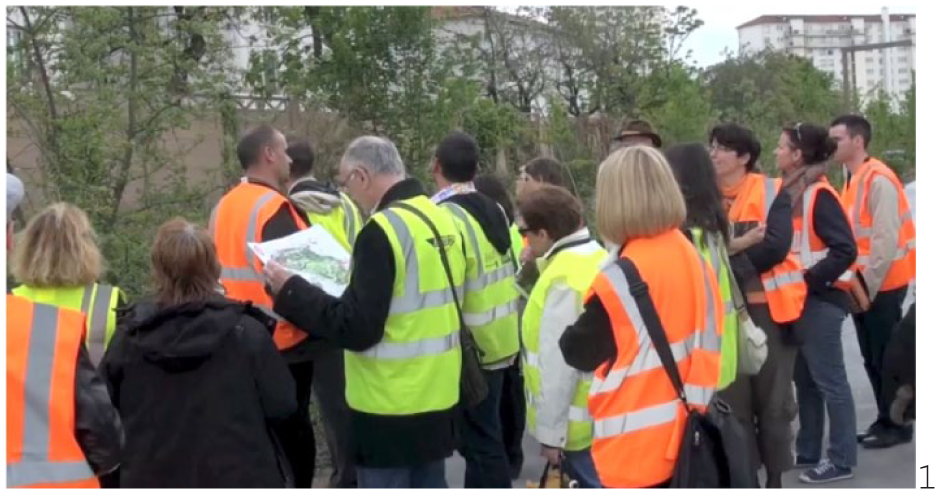
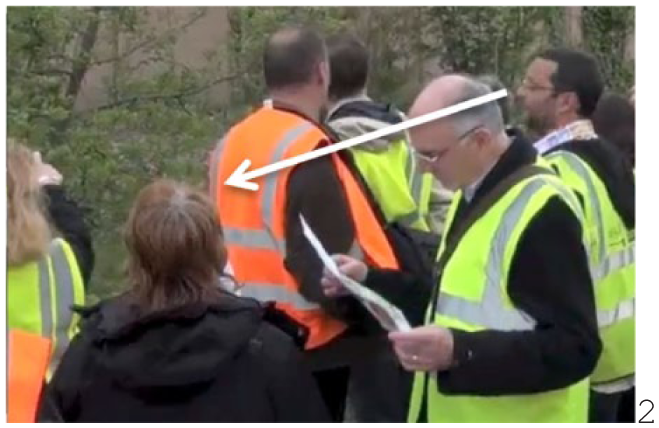
The completion of Guarnieri’s turn is explicitly marked by the final particle ‘quoi’ (3). Two participants, Ferran and Fanan, identify this transition-relevance point as a slot for asking a question (4–5). They both orient to the previous completion and they both ask their question immediately, without pausing and before the guide, or the group, has begun to move. In this sense, they orient to the currently established stationary interactional space and exploit it for asking questions, thereby also occasioning its prolongation.
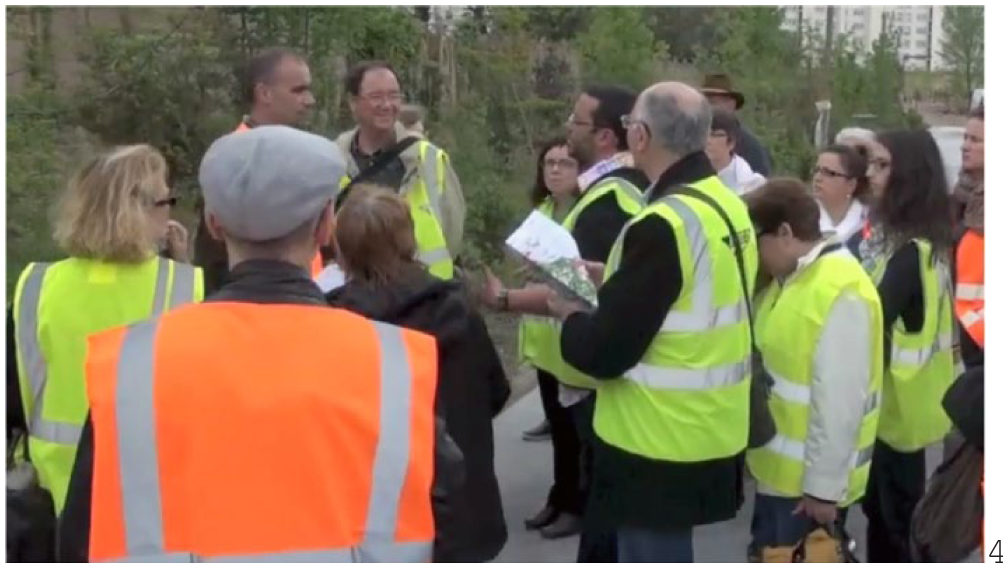
These questions are oriented to by the guide, who turns his head towards both women, on his left, before answering. He answers the first question (7) in overlap, merely confirming it, and the second (8) in more extended way. Two other persons orient to the questioners, too (Vince and Vanard): they are placed between the guide and the two women, and they pivot back. This movement changes the interactional space: whereas it was organized by all the co-participants’ bodies turned towards the trees – to which Guarnieri’s talk was referring – the new interactional space is reorganized around the guide and the questioners (fig. 3). The camera orients to the same relevances, by moving to the left, in order to capture that new space (8–9, fig. 3).
This type of question thus orients to the stability of the interactional space in order to exploit and prolong it; these questions are produced as addressing issues just tackled by the guide and as collectively audible; consequently, they receive an answer addressed collectively to the entire group. The previous stationary interactional space is preserved.
Alternatively the participants can ask another type of question, taking advantage of the mobility of the guide, asking them on the move, and expecting them to be answered on the move, too, in private, without addressing the group. We join the same visit as Guarnieri, the guide, is walking ahead:
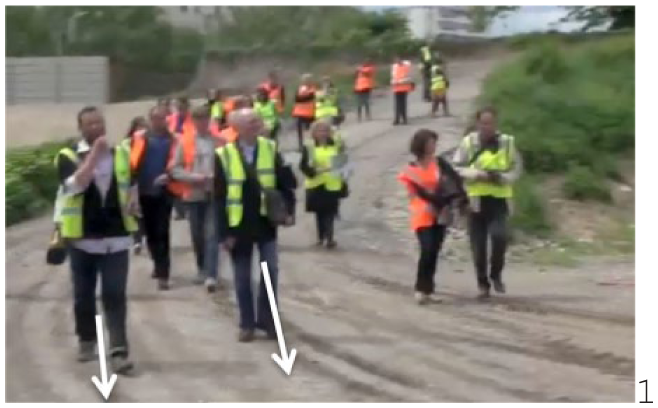
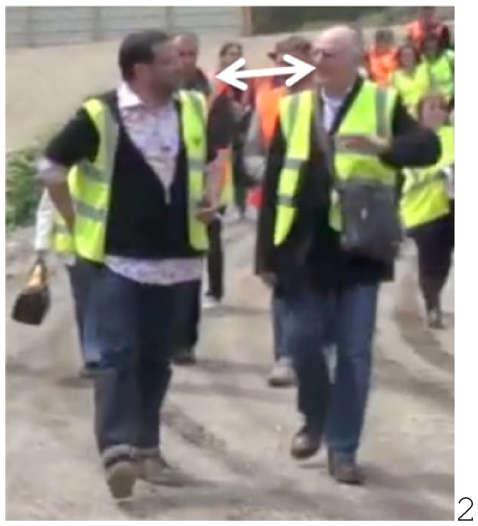
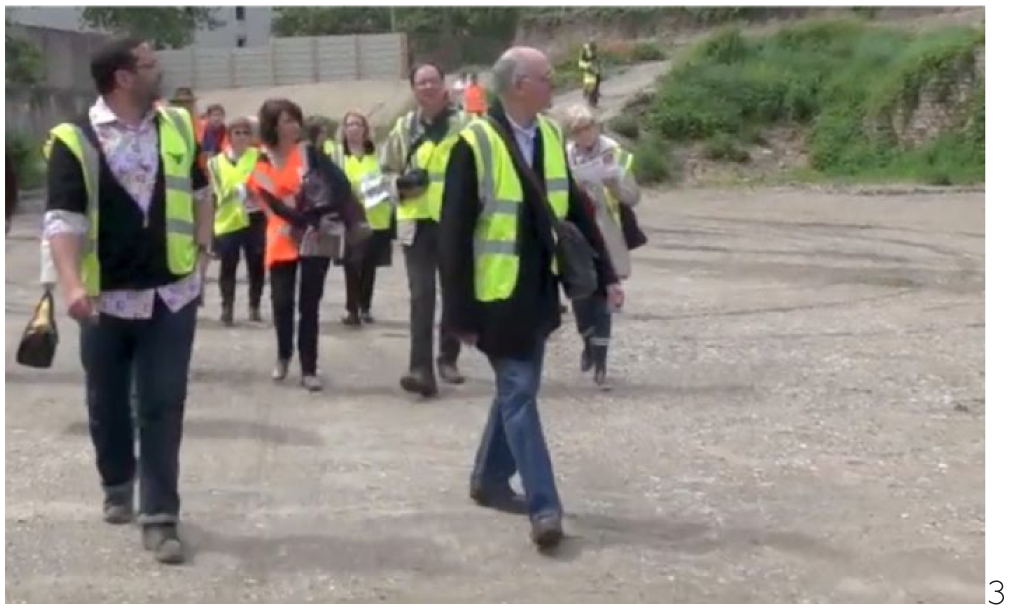
Visart is walking at some distance from Guarnieri (fig. 1). While asking his question, he comes closer to Guarnieri, who looks at him (2). By the end of the question, questioner and questionee are walking side by side (fig. 2). This mobile formation continues for the entire sequence. After some expansions of the answer (8–14), the questioner steps away (15, fig. 3), treating the sequence as closed.
So, the sequence ends with the dissolution of the interactional space created by and for the question/answer. This organization of the sequence exploits mobility to achieve, make recognizable and delimit the action: the sequence is opened by joining and creating an interactional space characteristic of a ‘with’ constituted by the couple questioner/questionee. The interactional space is dissolved when the sequence is closed.
In sum, two types of questions can be observed in guided visits, which exploit opposite participation frameworks: the first is stationary, exploits the existing interactional space created by the guide’s explanation and is collectively audible and collectively answered; the second is mobile, establishes a new mobile interactional space, is privately asked and privately responded to, before the interactional space dissolves. These two sequences are typical of guided visits. In this article, I focus on a third, specific configuration that hybridizes the former two, in which questions are asked on the move and answers are made when stopped, thus exploiting relevances that belong to both.
But before moving on with a systematic analysis, let us stop at an important aspect that makes these analyses possible. As shown by the two first excerpts, the analysis strongly relies on the temporality of both the talk and the walk, as well as that of other embodied features (Mondada, 2016). Talk-in-interaction is organized in an emergent way, moment by moment, and in a reflexive way, that is, by orienting to what other co-participants do or do not do and by possibly adjusting to them (Goodwin, 1979, 2000). Participants make their action intelligible not only through audible (language) but also visible (the body) resources: some actions may be silently embodied, and talk may respond just to them; the movement of a body may be responded to by the movement of another body adjusting to it. These embodied forms of sequential coordination are central for studying how walk and talk are organized together. Consequently, the analysis crucially relies on their multimodal annotation: this includes the verbal aspects and a range of embodied ones: gaze, gesture, body postures and movements. All these features are transcribed in a way that captures their temporal trajectories (allowing us to analyse the occurrence of a multimodal conduct in order to show its sequential relation to a previous action and sequential consequence to the next one) and their relevances (anything may be exploited as a resource by the participants, who may selectively mobilize available, discovered or created-on-the-spot features of the local ecology).
Last but not least, a further detail is transcribed: the movements of the camera filming the scene. These movements show that the cameraperson is also a participant, and that s/he also interprets what is happening and adjusts to it in a temporal and relevant manner. This represents a form of ‘proto-analysis’ (Mondada, 2012b) that is situated between the participants’ endogenous interpretation of what happens and the researcher’s analytic interpretation (Mondada, 2014c). Importantly, this proto-analysis, embodied in the movement of the cameraperson, and made visible by him/her, both adjusts to and shapes the framing of the scene for us, writer and readers of this article, and for the participants, who may in turn reflexively also adjust to it – typically by using it for orienting to and ‘seeing’ details of the scene that are thereby made relevant.
Multimodal transcripts therefore are much more than a mere ‘retranscription’ of what happened: they are a form of analysis, and offer a detailed representation of the action for the readers, enabling them not only to follow but to reconstruct and check the analysis.
On this basis, the remainder of the article focuses on a specific mobile sequence, which is initiated with a private question on the move and ends up in a stationary collective answer. The mechanisms of this transformation reveal the detailed organization of mobility in interaction and how the ecology of questions is finely related to the dynamic evolution of participation and the assemblage of mobile bodies in space.
The study offers a collection of questions all initiated on the move. Some are answered on the move, others by stopping. The analyses discuss the implications of these forms of mobility. First (in the third section of the article), I focus on cases in which the question/answer sequence is achieved on the move, followed by a new version of the answer, given in a stationary way to a larger group of participants. Second (in the fourth section of the article), I analyse instances in which the question is asked on the move, and an answer is given while progressively slowing down and stopping. Finally (in the fifth section), I discuss how an answer to a question asked on the move can be postponed in order to be answered later in a stationary way. These possibilities show how guides and guided persons constantly exploit specific forms of mobility in order to configure and reconfigure the participation framework and the interactional space of the actions and sequences they are engaged in.
Giving an answer privately on the move, then expanding it in a collective stationary explanation
Sequences initiated on the move may be completed either in mobile or in stationary environments. These options have a series of consequences, explored in the following analyses.
In the first cases studied, a question is initiated by a guided co-participant on the move, approaching the guide, who walks ahead of the group and in silence. The sequence is initiated as both participants, guided and guide, questioner and questionee, are walking side by side. The answer is also given as they are walking together; however, at its completion, the guide, instead of walking on, stops and offers a second version of the answer to a wider group of visitors.
We join the action as Ligour, the chief architect, is leading a group of visitors through a construction site (the same as in the previous examples, but within a different visit) (Figure 1). Fonseca is walking behind him; he accelerates and asks him a question:
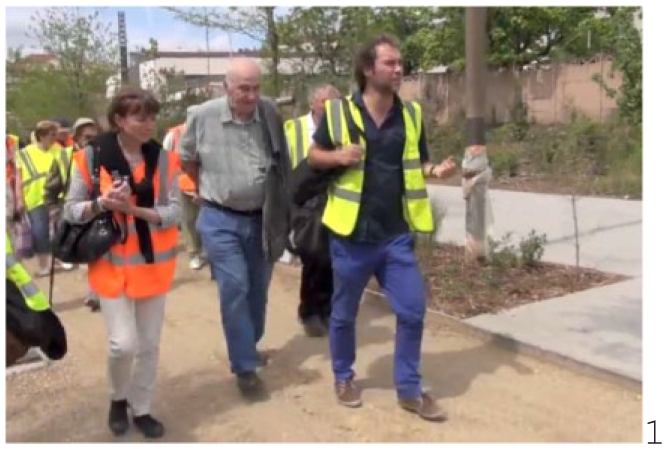
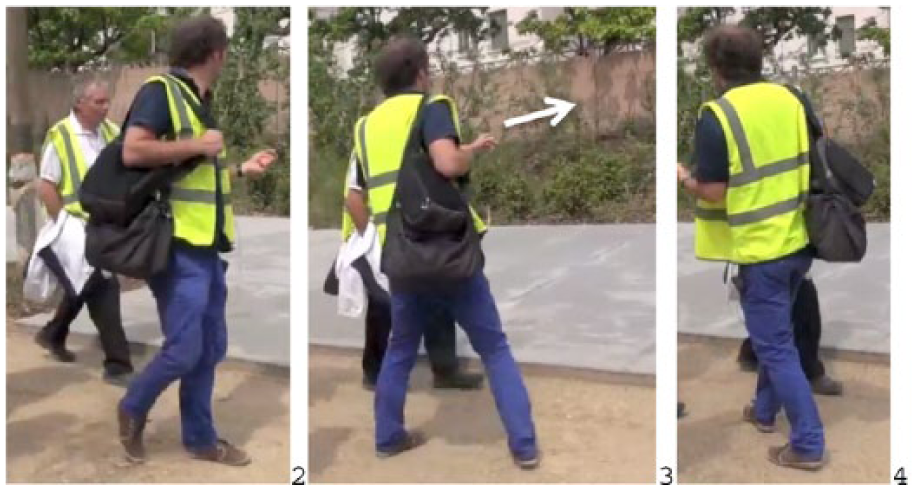
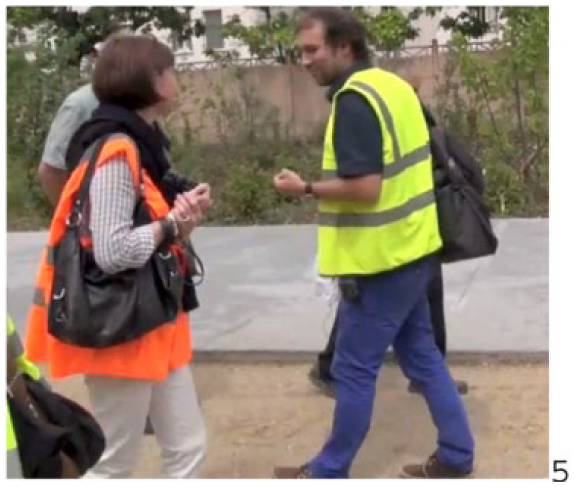

Fonseca, walking behind Ligour (1, fig. 1 in the extract), points at the wall on their left, and asks a question about it. The stretched self-repaired article (‘le::’/ ‘the::’) works as an attention-getting device; the use of a deictic locative, together with the pointing gesture (fig. 2), hints that something has to be seen in the environment.
As a response, Ligour first turns his head to his left (fig. 2), then pivots (3–4), orienting not only to the questioner but also to the referent pointed at. Ligour’s answer (4) is produced as he pivots and begins to walk backwards (4). This position permits both the progressivity of the walk and a full orientation towards the questioner and the object referred to.
What characterizes the closing of this sequence is the fact that it is responded to by several other participants, who have overheard the Q/A: Felds laughs (6) and Bailey produces some response tokens (8). Ligour immediately turns his head and gazes at Felds (6, fig. 5), orienting to her laughter, which conveys some delicate matters (actually, the wall has been the target of many controversies, considered as too ugly by citizens who would like to replace it).
Although Ligour closes the sequence with a terminal ‘voilà’ (9), he also modifies the trajectory of his walk backwards (10), so that, continuing to walk, he steps laterally, taking some distance from Fonseca and replacing himself in front of the entire group (fig. 6). In this new position, Ligour initiates a related sequence, with the deictic ‘là’ (11): he engages in an explanation accounting for the current treatment of the wall. At this point he stops (fig. 7). We can see on the last screenshot that the group, which was walking forwards (fig. 6), now aligns and stops, too (fig. 7).
So, Ligour closes the Q/A sequence on the move, but exploits some closing thirds by overhearing participants, as well as his orientation backwards facing the group, to transition from a private Q/A sequence to a collective informing sequence. The practice of walking backwards facilitates and affords this smooth transition into a different participation framework and interactional space.
In this case, the sequence initiated by Fonseca is closed on the move; then Ligour recycles the same topic to initiate an explanation to the larger group, without any reference to the previous sequence. The separation of these two sequences – although the second is triggered by the overhearing of the first – allows the guide to deal with two very different participation frameworks and to recipient-design his talk in two ways: with Fonseca in a private, inter-individual, dyadic exchange; with the larger group in a collective action. These two very different actions are achieved in different ecologies, thanks to the transformation of the interactional space from a mobile and private one to a stationary and collective one. Nonetheless, these two different actions are also built one out of the other thanks to the spatial proximity occasioning the possibility of being overheard: the transition from one to the other is generated by the audible responses of participants overhearing the answer and possibly by the production of the question in an audible and visible way that is offered to the overhearing of others. In this sense, the extract is also interesting for the spatial, mobile and public organization of overhearing.
Smoothly transforming a mobile answer into a stationary one
While in the former extract the answer to an individual participant and the explanation to the group were organized within distinct interactional spaces, in the following instances, the answer is expanded, while the current interactional space is progressively and smoothly transformed from a mobile/private to a stationary/collective space. In this case, the public audibility of the initial part of the answer is crucial for the transformation.
We join a guided visit in which Yves, an inhabitant of a rural village on the border between France and Switzerland, is guiding a group of young people from the neighbouring city. The group is walking along a footpath. Yves has just mentioned that a railroad was planned in that region a century before. Sophie picks up the topic and asks a question (1–2):
.
.
.
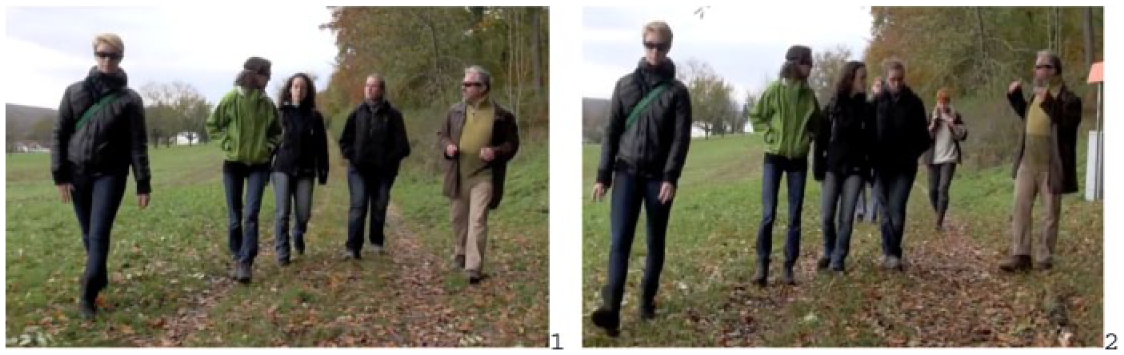
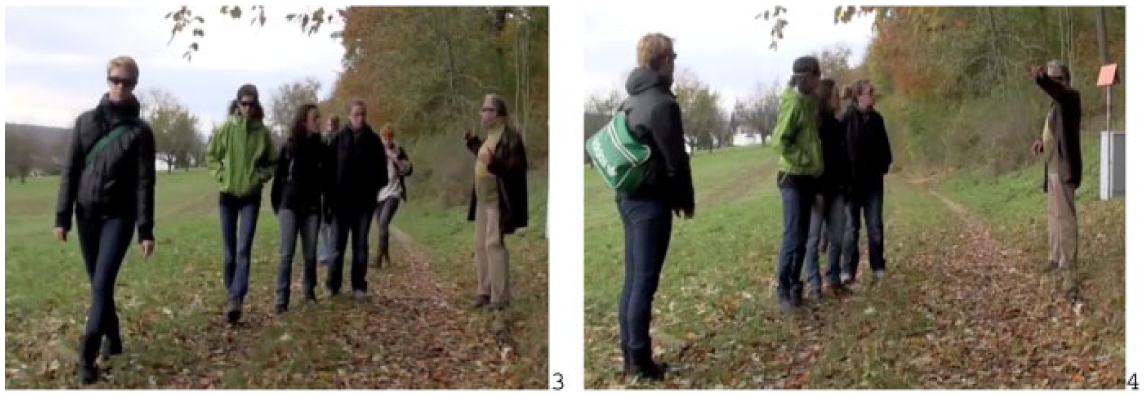
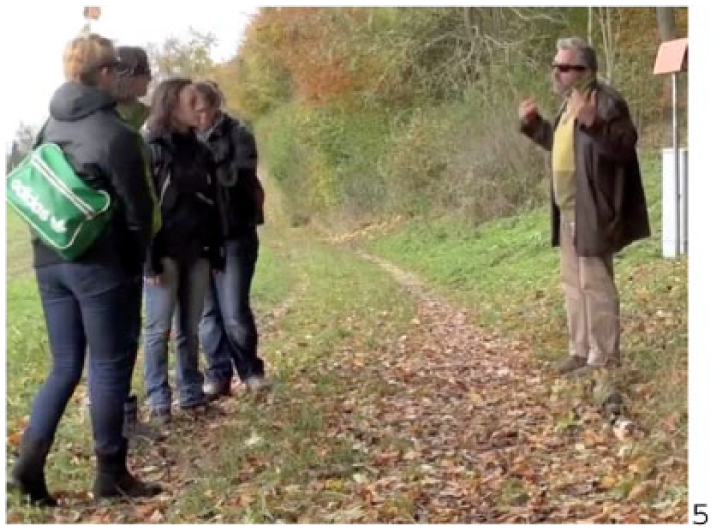
While the group is walking (fig. 1), Sophie asks for a confirmation of the previously mentioned historical fact (1–2), and Yves responds promptly (3–4). His turn is bodily formatted as a moving multimodal Gestalt: as he confirms the date of the event (3), he slows down. While he produces a guttural sound (eugh) previous to initiating something that could be the beginning of a story (c’q- c’était prévu de/’wh- it was planned that’), he begins to walk sideways on the left edge of the path (Figure 2). This oblique posture orients both to the progressivity of the walk and to the participants. It also constitutes a transitional posture preparing a reorientation of the body: immediately after (4), Yves stops and turns perpendicularly to the path towards the visitors (fig. 3). The co-participants also slow down and stop (4), orienting to this new interactional space, shaped as a face-to-face positioning of the guide and the guided (fig. 4). Interestingly, as Yves continues, the person who has stopped a bit ahead of the group, Marie, ends up taking a step towards the group and aligning with this new interactional space (11–12, fig. 5), also orienting to the normative organization of the group.
This modification of the interactional space is also responded to by the camerapersons filming the action. Camera 1 adjusts to this change from a mobile ecology – filmed by following the group – to a stationary one, by turning around the group (3) and finally stopping behind them (10). Camera 2 adjusts to the action in a different way: she was preceding the group and continued to move forwards (like Marie); at line 10, she zooms back to re-adjust the frame to the stopped group.
In sum, an action is initiated on the move, designed as a sequence that is addressed by one participant to another, although being overtly produced to be overheard by the others. After a possible completion, the sequence is expanded, more participants are addressed, and the participation framework is enlarged, generating a new interactional space. This kind of participation seems to be too complex to be managed on the move; the interactional space is transformed by slowing down and rearranging the bodies around the main speaker in a stationary way. It is dissolved as soon as the extended sequence is complete as the participants resume walking.
A similar transformation happens in the following excerpt, in which a gardener, Luc, is guiding a small group of visitors across the garden of a campus. We join the action as Luc has just finished explaining the water treatment of the aralia – some plants on their right. Jean orients to this moment as a transition place favorable to a more private question (3).
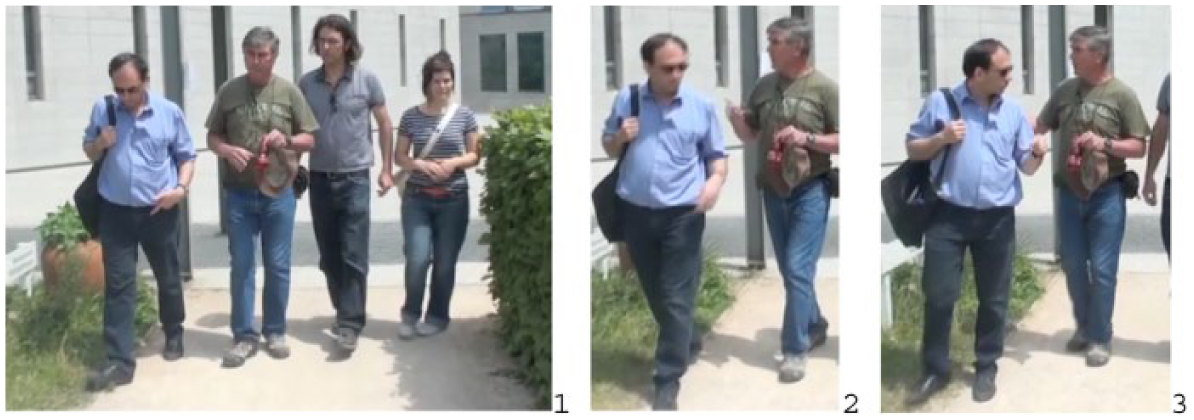
As the group walks forwards in silence (1, fig. 1), Jean’s question is bodily initiated, treating the pause following the previous explanation as a transition point (1): he turns to Luc and begins a gesture towards him (fig. 2). As Luc adds a comment extending the previous sequence (2), Jean pursues the preparation of his self-selection. Continuing to turn to Luc, he raises and then lowers his hand, orienting to Luc’s speakership, but raises his hand again as the end of Luc’s turn is projectable (fig. 3). On their side, Yan and Elise turn their head to their right, re-engaging as hearers of Luc turn (2).
As soon as Luc comes to completion, Jean self-selects and asks a question about the sources of the water used by the gardener (3). He addresses Luc explicitly at the beginning of his turn (toi/’you’, 3) and adopts a torqued position (Figure 4) (Schegloff, 1998): walking forwards, he turns backwards with the upper part of his body. At completion of Luc’s answer, met with a decidedly positive token and a nod (4), Jean turns forwards during the next pause (5). At this point, the sequence seems to be brought to completion – designed as a short sequence, produced on the move, between Jean and Luc.
But, after a pause, Luc elaborates on his answer, expanding the sequence:
that’s it but, [but that’s it [but it’s though
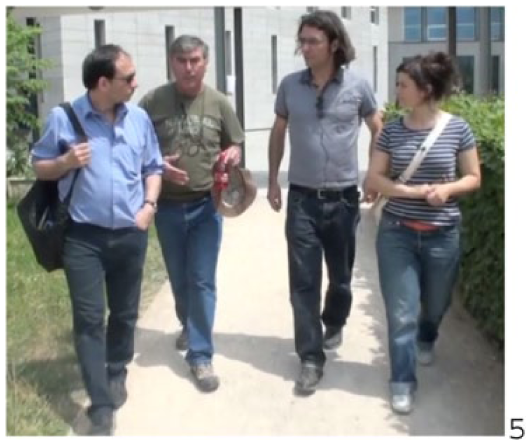
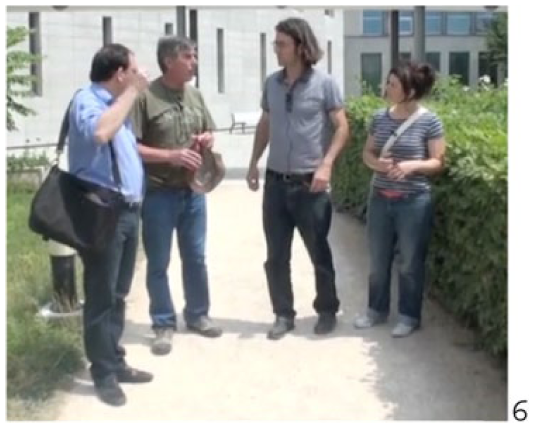
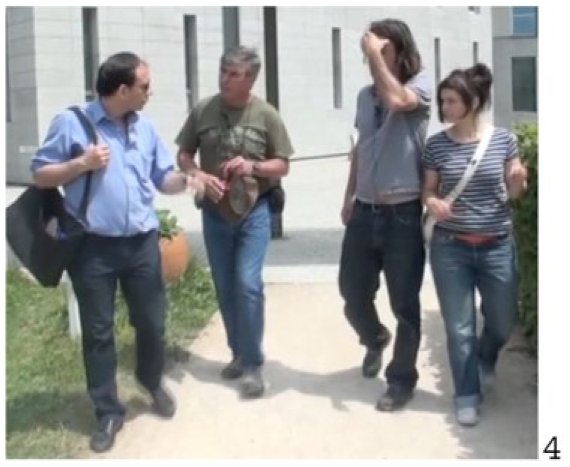
Luc’s turn (7) elaborates on his previous oui/’yes’ (8) in a way that both confirms (with the particle voilà) and reorients it (mais/’but’). By reframing his positive answer, he orients to possible implications of Jean’s question (which differentiates two possible sources of the water: if the water comes from the ground, then it can be used more freely). Jean turns immediately back towards him, responding as the addressee of this turn. Another participant, Yan, also produces a short, overlapped segment (9), nodding. Jean nods immediately after, and, continuing to be slightly turned back, seems now to look at him (fig. 5). So Luc’s turn both expands the previous sequence and is responded to by a new active participant – Yan.
Orienting to – and resisting – the contrast transpiring in Luc’s turn, Jean responds with an elaboration of his previous one, making a distinction between water coming from the ground vs from the pump (10–11), while gesticulating and pointing back where the pump is probably located. Luc aligns with him. Elise (13), and Yan align, too, the latter repeating Jean’s expression (14). So during this post-completion expansion of the sequence, more participants join the discussion and a larger interactional space is established.
This happens as they are still moving on, but they also slow down and eventually stop. A progressive transition from walking to stopping is collectively achieved and a new, more stationary interactional space emerges. This is stabilized in the next turns (13–14) in such a way that they are now positioned in a new stabilized interactional space (fig. 6). So when Luc continues his argumentation, reformulating Jean’s distinction between the two sources of water, the exchange between Jean and Luc takes the form of an emerging disagreement about the moral issues related to the way in which water can be considered, assessed and preserved. This coincides with all the participants, and not only the two initial interlocutors, participating in the exchange, recognized and integrated as such (Yan is looked at by Luc, 14). This also corresponds to them slowing down and stopping: at the end of line 14, they have rearranged their bodies within a new interactional space (fig. 6).
At this point, nonetheless, the projection of the sequence completion – and ending of the controversy – is already emergent, visible in Yan and Elise stepping forwards (16) and in Luc and Jean also beginning to walk again (20) after the closing of the argument with agreeing particles (17–19).
To sum up, this episode of talk begins as a question/answer sequence between two participants, produced on the move (3–4). The group slows the walk and stops, as this sequence is expanded, as it takes a more disagreeing trajectory and as more participants join in. As soon as the extended sequence is completed with agreement tokens, the walk is resumed. Thus the walk is strongly related to what happens in the discussion; its step-by-step organization is finely tuned to the step-by-step organization of talk.
Postponing a mobile answer and delivering a stationary one
In the previous sections, a question asked on the move receives an answer that is sooner or later transformed from a private into a collective one. In the last section, I focus on yet another configuration, in which the answer to the initial questioner is suspended and postponed; later, a collective answer is given, rather than a private one.
In the next extract, the guiding gardener has just completed an explanation, given to the stationary group around him. ‘Voilà’ is a closing particle explicitly displaying the completion of the previous sequence: at this sequential point, some visitors begin to move, while Luc looks at them around him (Figure 1); before walking forwards as well, he offers the opportunity to ask a question (3):

Even if Luc offers an opportunity to ask questions, he immediately walks forwards (fig. 2), privileging the progressivity of the walk and of the visit over the persistence of the current interactional space. This prompt walking is also a way to reposition himself ahead of the crowd of visitors following him.
A few steps further, Luc is intercepted by a visitor, Max, who stands in the middle of the footpath, facing him arriving (fig. 3):
Max asks a question (5–6), beginning with a response token (‘>oui<‘/ ‘>yes<‘ 5) quickly uttered and connecting to Luc’s initial offer. His question is also preceded by a pointing gesture, projecting the question as such as well as the reference to a detail in the environment (verbalized by the deictic ‘là’/ ‘there’ 6), showing some stairs in the middle of the greenery. The format of Max’s question is peculiar: it categorizes the question as possibly relevant and formulates it without any reference to his own agency in asking it. This presents the question as not just a personal curiosity but as a topic potentially interesting for everyone.
This feature is picked up by Luc’s response:
.
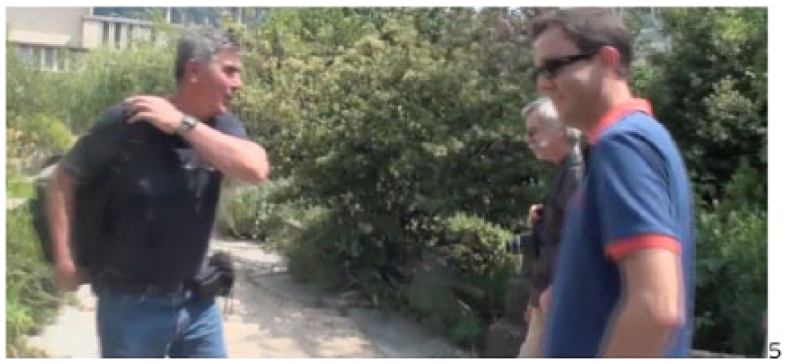
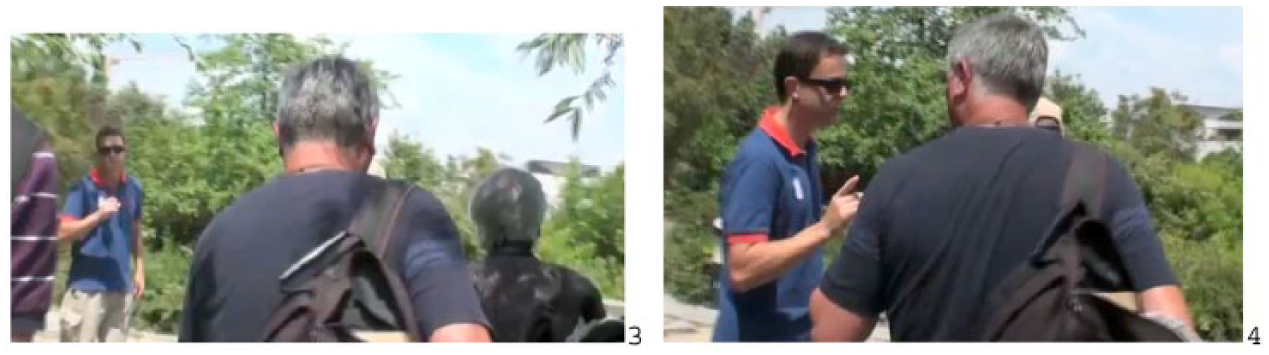
Luc’s response does not answer Max’s question but rather postpones it for later. By using the future tense (‘we will talk about it’ 7) and by walking forwards – instead of standing with Max – the guide indicates not only another time but also another place where the answer will be produced. Max aligns with him, walking beside him.
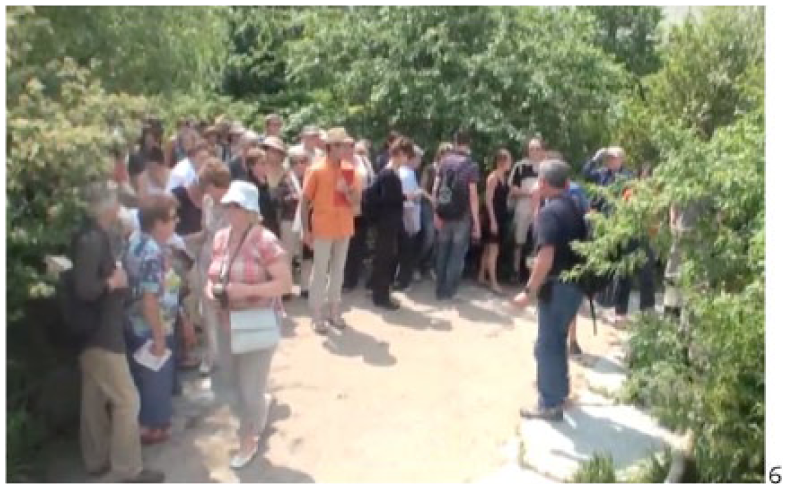
Moreover, Luc adds a positive assessment of the question (9), then repeated (11): this clearly accounts for the momentary absence of an answer as not disregarding the question but, quite the opposite, treating it as important. While these assessments are produced, the movements of the participants prepare the next action to come (fig. 5): Max does not walk with Luc any more, but stands to one side (9) – thereby orienting to, and reflexively achieving, another participation framework and interactional space for the next announced action. Luc continues to walk forwards and then pivots back (11), now facing the crowd of visitors approaching. In this way, both participants bodily orient towards the emergence of a new participation framework, in which they will occupy two distinct spatial positions, corresponding to their emergent categories of speaker vs member of a larger audience. This contrasts with the positions they were formerly holding, side-by-side, indexing and reflexively achieving a more symmetric standardized pair, questioner/questionee, concerning two individuals rather than two parties.
Interestingly, the cameraperson also orients to these emerging relevances. First, she was following Luc; when Max initiates his question, she turns around the newly constituted participation framework (5). As the two participants re-position themselves, the camera follows Luc again (11); during the pause following the post-posing of the answer and assessment of the question, the camera orients and projects a new interactional space and moves on the opposite side of the scene, in such a way as to be able to focus not only on Luc but also on the crowd of visitors coming and re-assembling in front of him (fig. 6). In this sense, the work of the cameraperson clearly adjusts to the same relevances as the participants, and constitutes with them – at the same as documenting it – the new interactional space for the action to come.
During the pause (12), the participants – including both Luc and Max, and the larger group of visitors – reassemble in a new interactional space. The time it takes is used by Luc to produce a comment, still addressed to Max, about the opacity of the intentions of the garden’s architect. This treats a possible reason for Max’s question, referring to some stairs in the middle of the garden that do not lead anywhere as pointing at a somehow-mysterious object in the surroundings. This comment still addresses Max, while the group gathers around Luc – and thus operates a further transition from a restricted participation framework to its transformation into a larger one.
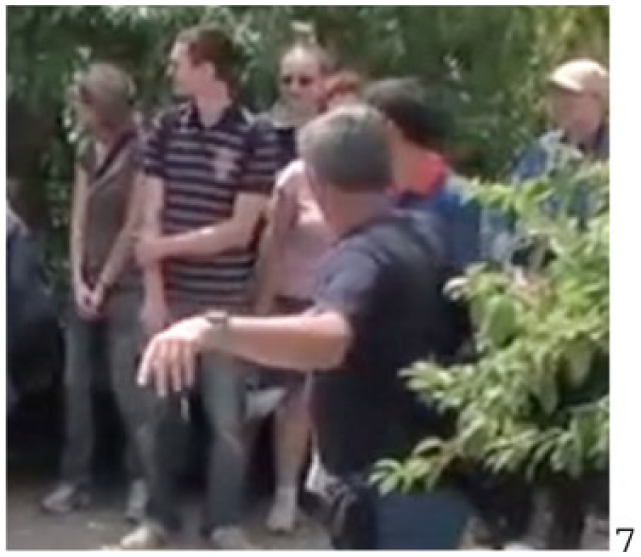
After a new pause (16) – waiting for the visitors to assemble into a stationary interactional space, which projects a prolonged state of talk – Luc begins a long multi-unit turn. The turn beginning locates the group within a specific section of the garden (17–18). Then it formulates Max’s question, making it publicly available for the entire group. At this point, Luc achieves a double orientation by a body torque (Schegloff, 1998): his left hand points at the stairs, on his left, while his head turns quickly back to Max (fig. 7). In this way, although the verbal turn does not refer to the author of the question (Luc uses the impersonal third-person pronoun ‘on’), the direction of the head indicates him. The explanation of the stairs is explicitly introduced as generated by a previous question.
As soon as the formulation of the question is completed, Luc turns to the audience and initiates the proper answer by looking at them and gesticulating towards them. This achieves a clear separation between the reminder of the question and the answer, which is produced as a collective explanation. In this respect, it is significant that Luc was about to begin the answer part with a relative clause (‘qui:’/ ‘which:’ 21), which is abandoned – thus allowing him to restart an autonomous explanation.
While, in the previous excerpt, the private question originating the explanation as a collective answer is publicized thanks to its formulation for the larger audience at the beginning of the collectively addressed turn, in the following excerpt, the private question originates a collective explanation that is rather autonomously formatted, without referring back to it.
We join again the visit of the construction site with Ligour, the architect, who is walking ahead of the group. Laffont, a woman walking with crutches behind him, accelerates and joins him while asking a question:
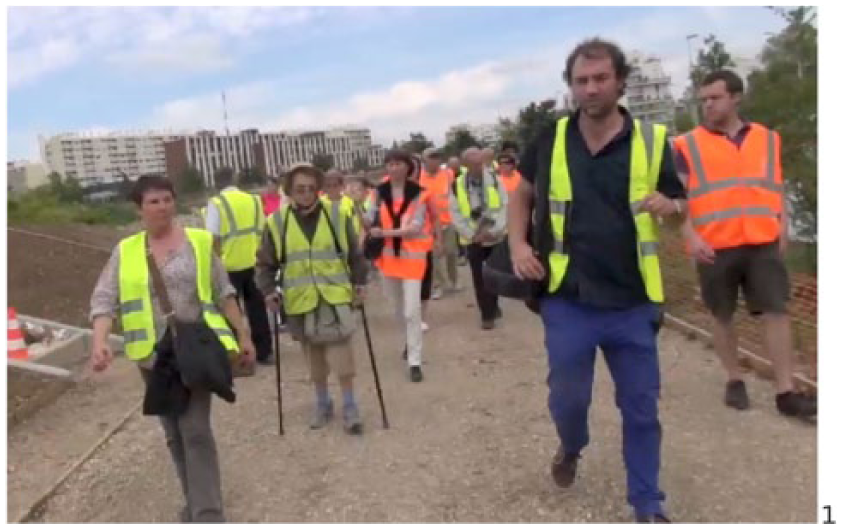
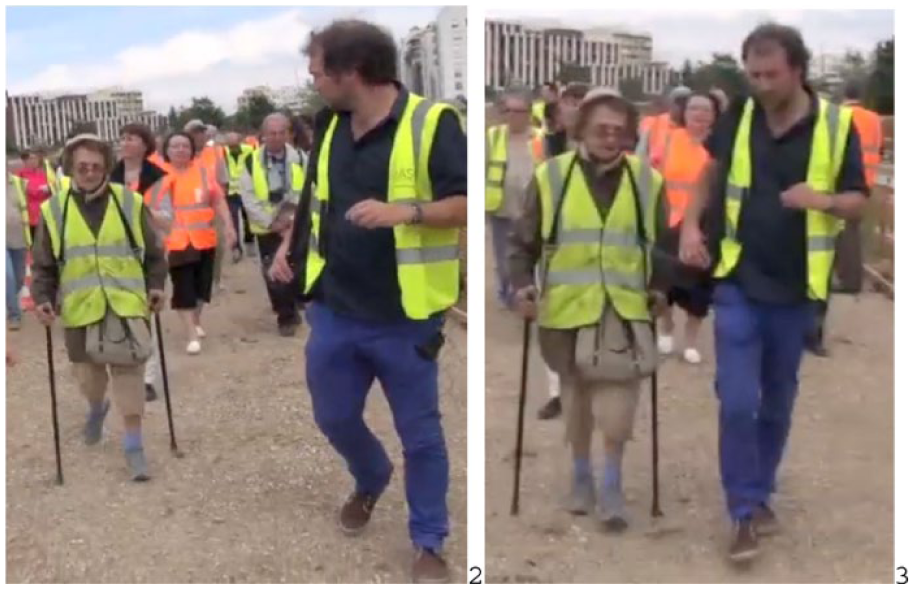
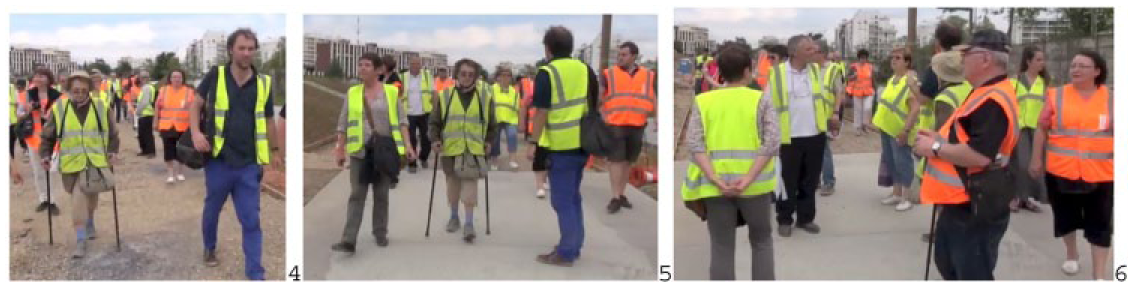
Laffont’s question (2) is responded to by the architect looking back and slowing down the pace of his walk. He also initiates a repair (4). When he repeats her question, they are walking side by side (6). Ligour begins a negative answer, disconfirming what Laffont is asking and engaging in elaborating on it (‘[c’est::’ 7). But he does not continue: instead, he postpones the answer and announces a future ‘petit mot’/ ‘bit of talk’ (8). The future tense, the formulation of imminent talk as not being an answer indicates that the talk will be addressed not only to the elderly woman. Moreover, the closing of the sequence with her is achieved with a compliment (10), positively assessing the question.
From then on, Ligour accelerates the pace of his walk and moves forwards (11), leaving the former questioner behind. When he reaches the beginning of a cemented path, he turns back to the group, addressing them. He formulates his action first as a ‘petit mot’ (12): this preface gives the participants time to gather around him; when the assembly of visitors is stabilized, he goes on with his talk directed to the entire group.
This last case shows how one action trajectory can be converted to another one, organized by an alternative form of mobility, type of action and recipient-design. Trajectories are emergent phenomena that are shaped by the number of participants, their spatial and mobile position, the type and format of action, etc., and that can also be re-oriented in the course of their trajectory. Here the fact that Ligour accounts explicitly for what he is about to do shows a normative orientation towards the conditionally relevant production of an answer right now, within the ongoing mobile interactional space. The alternative action he proposes departs from these normative projections and expectations, and this is addressed through the production of positive assessments of the question, showing its relevance and praising its author.
Immediate transformation of the answer into a collective one
As shown by the previous cases, the transition from a private to a collective answer can be addressed by the guide in different ways, crucially relying on the timing of the transformation of the participation framework as well as of the walking trajectory. In the last excerpt analyzed in this study, I discuss a case of immediate transition from a side-by-side-asked question by an individual visitor on the move into a stationary answer to the group.
While walking beside the guide (Luc), a visitor (Pierre) asks a question about a tree they are passing. This occasions a collective explanation by Luc, stopping under the tree:
.
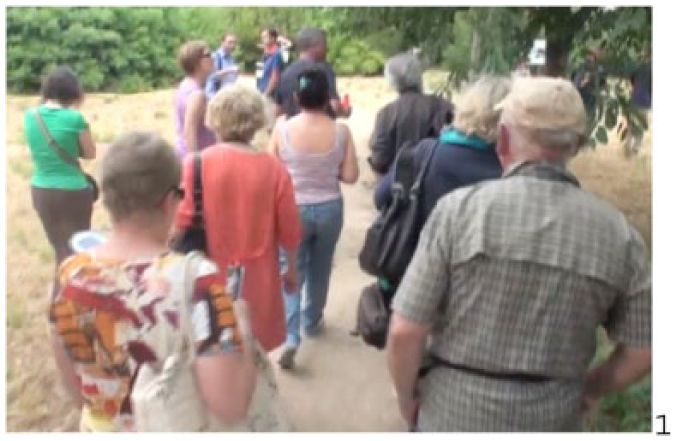


Pierre asks Luc a question, exploiting the contingency of their proximity at that moment within the visit – while the group is walking along a footpath in the garden. Pierre’s question uses a turn-initial and turn-final demonstrative (‘ça’/ ‘this’, 1), a device that not only focuses the attention on the pointed-at surroundings but often stops the guide.
Luc responds with aligning tokens at turn-beginning but immediately refers to another question, previously asked by a woman (2). He also turns back and points to the woman possibly walking within the group (fig. 2). In this way, Luc connects Pierre’s question to another one, enhancing the collective relevance of their concerns. Pierre aligns with him (3, 5), as well as another person in the group (6: maybe the woman?), overhearing their exchange.
The woman’s question is formulated as reported talk (2), which introduces another topic, grafting, which will be connected later to the cherry tree. While mentioning this topic, Luc walks off the lane, towards the cherry tree pointed at by Pierre (4). He touches the tree, rests on it (fig. 3), visibly displaying with his body position and connection with the tree the establishment of a new focus of attention. This stable position also projects further extended talk. After a short pause (7), Luc begins a general explanation about the cherry tree (then explaining that it has been grafted).
In this case, the response to Pierre and reference to the woman operate as a transition towards a collective response. This transition is addressed to Pierre, but produced with a louder voice designed to be heard by others. The transition is also achieved by a change in the direction of the walk and stopping at the tree – which becomes both the visible focus of attention and the topic of the explanation. The explanation begins with a proper beginning – without reference to the previous turns – and is uttered in the same louder, ‘lecturing’ voice, while Luc pivots in a manner that positions him in front of the audience.
The participants immediately orient to this change of interactional space: at the very beginning of Luc’s explanation, as he self-repairs the initial demonstrative, Pierre walks off the lane, too, as does another visitor (8). Very quickly the group reassembles around the tree (fig. 3) and the collective explanation continues.
Conclusion
This article contributes to the study of walking and talking by providing a systematic analysis of how sequences of actions may be formatted in mobile contexts and by outlining the consequences of mobile vs stationary interactional spaces for the way actions are formatted, are addressed and are treated by the participants.
The article has focused on a type of sequence – question/answer – in a particular social setting – guided visits – where it represents a typical activity in which the participants engage. After contrasting typical question/answer sequences in guided visits produced in a stationary interactional space with mobile sequences, the study has unpacked the organization of a third, hybrid form of sequence, initiated while walking and completed while stopping.
The analysis has shown the systematic relations between question/answer, mobile and stationary interactional space, and forms of participation. In answering privately on the move a question initiated by the guided, the guide closes the sequence within the same restricted participation framework, then eventually expands it in a collective stationary explanation autonomously initiated by him (third section). In smoothly transforming a private answer on the move into a collective answer in a stationary position, the guide reconfigures the answer as addressed to a larger group of participants (fourth section). Finally by suspending and postponing the answer given on the move, the guide radically transforms the activity, abandoning the initial sequence initiated by the guided and initiating a new sequence addressed to the audience, often without reference to the previous one (fifth section)
These analyses provide some more general hints about the relation between sequences of talk, mobile embodied actions, participation frameworks and interactional space, showing the crucial importance of the spatial-material ecology for the organization of human action. More specifically, the particular analytical focus of the article highlights issues revealed by the transformation of a mobile into a stationary action, an individual into a collective action, a type of sequence of actions, like question/answer, into another sequence, like explaining or lecturing. This also relates to the transformation of categories bound to these actions: from questioner/questionee into audience/performer. This transformation reverses agency and initiatives: while in the former case, the guided is the questioner initiating the sequence and the guide is the questionnee answering, in the latter case the guide is the performer initiating the action of explaining and the guided is just part of the audience listening to it. These forms of action, categories and participation strongly relate to the possibilities and constraints of mobility.
Thus the analysis of questions initiated and answered on the move shows the possibilities and constraints of mobile talk: it is well designed for inter-individual talk, within a restricted participation framework, and is indeed exploited by individual guided persons to have a more private exchange with the guide (this is also an environment in which small talk is initiated; Mondada, 2014a). But there seem to be limitations relative to the size of the mobile interactional space that can be established in this context. The analysis of talk produced while slowing down and stopping the walk shows alternative potentialities offered by stationary interactional spaces: these can be built by a larger number of participants progressively assembling, and consequently they are tailored for distinctive types of actions, such as ‘lecturing’, in which the performer addresses an audience of multiple participants constituting a single ‘party’ (Schegloff, 1995). Within this larger participation framework, individually addressing the initial instigator of the question remains possible, through body-torqued embodied practices more or less explicit in talk, although the individual themselves aligns with a marginal participation within the group and does not claim any specific attention any more. The study of transitions from one interactional space to another also shows interesting features concerning practices of overhearing and talking to be overhead. They rely both on turn design (loudness) and spatial positioning relative to the group (closeness), blurring in interesting ways the distinction between private and collective action.
These detailed analyses contribute to a better understanding of human action in mobile social contexts. Mobility – here: walking – is achieved through socially situated organized practices – stepping, walking, accelerating, slowing down, stopping, etc. – which are finely coordinated among participants – following behind/guiding ahead, approaching/adjusting to somebody approaching, walking side by side, walking alone again, etc. These mobile practices are social not only by virtue of these forms of subtle coordination and mutual alignment, but also because they constitute category-bound activities – of guides and guided within an asymmetric array of rights and obligations, or of walkers having more symmetric relationships – within socio-institutional settings. Moreover these practices involve other social dimensions in being finely tuned with talk: walking and talking are reflexively organized, one shaping the other and vice-versa, one revealing what the other is achieving and vice-versa. Not only are discontinuities in talk visible in the walk, and discontinuities in the walk audible in the talk; but they are socially and interactionally and publicly intelligible and oriented to as such by the co-participants. Multimodal analysis reveals the extent to which these phenomena impinge on the smallest details of both talk and walk.
Transcript conventions
Talk has been transcribed according to conventions developed by Gail Jefferson (see Jefferson, 2004 for an extensive presentation). A line-by-line indicative translation is provided in italics. The aim is to provide help with reading the original, rather than an idiomatic rendering of the language used. Multimodal details have been transcribed according to the conventions developed by Mondada (see https://franz.unibas.ch/fileadmin/franz/user_upload/redaktion/Mondada_conv_multimodality.pdf).
Footnotes
Funding
This research received no specific grant from any funding agency in the public, commercial, or not-for-profit sectors.