



Abstract
The development of an instrument is often analysed in a rather heroic fashion, as though it had single-handedly brought about the evolution of a whole scientific field. But instruments can also be regrouped within a wider instrumentation, in which they may be regularly reconstructed and rearticulated in such a way as to serve many different scientific purposes. This flexibility has a cost, which is on one hand the task of reconstruction, and on the other the monitoring systems that must be designed in order to discover scientific perspectives with the greatest potential, and the instrumental set-ups to develop in order to implement them. This article analyses a rare and complex instrumentation – a synchrotron – to determine links between instruments, and types of organization behind the functioning and evolution of these links.
While it has never been its central theme, the sociology of science has shown a strong interest in the creation processes of several instruments (Joerges and Shinn, 2001), such as, for example, the laser (Bromberg, 1991), detectors (Galison, 1997), the electronic microscope (Rasmussen, 1998), the barometer (Golinski, 1999) and the scanning tunnelling microscope (Mody, 2011). This interest is due first of all to the fact that these instruments have enabled new experiments that were impossible – unimaginable even – before their development; and, second, to their appearing in themselves as products of research and scientific activity. They have made it possible to detect objects and elements which were only at the stage of hypotheses at the time to measure unknown phenomena and produce the conditions for experiments previously impossible to carry out. From this perspective, we define an instrument as a physical device necessary for the realization of a scientific objective.
Nevertheless, while such studies focus on a single instrument and sometimes tend to give it a rather heroic image, as though the instrument in question had singlehandedly transformed a scientific field – for example, biology (Rasmussen, 1998), or nanotechnology (Mody, 2011) – they show, at the same time, that an instrument’s creation is permitted and conditioned by a whole series of instruments already in existence. In this way, an instrument is primarily the result of instruments that have come before it, and which have raised scientific questions that the new instrument must address. The bubble chamber would thus not have existed if the cloud chamber had not come before it, and Galison (1997) identifies pedagogical, technical and epistemic continuity between instruments that follow one another in the same research tradition.
Instruments also represent alternatives, and Galison distinguishes, for example, two traditions among detectors: the image tradition (cloud chambers, nuclear emulsions, bubble chambers) and the tradition of logic and statistics (counters, spark chambers, wire chambers). Depending on their research tradition, researchers subscribe to one family of instruments and rarely use the other. Different instruments can therefore respond to the same scientific need, and researchers can choose between them, but in fact they do not choose an instrument but rather a family of instruments, meaning a set of instruments which are quite similar, rely on the same logic (image/logic in the case of the detectors) but are not optimized for exactly the same kind of experiment. In this article, we would like to emphasize that the choice of instruments within their families is increasingly becoming a daily activity for most of the researchers who have to incorporate each of these instruments into an instrumentation, i.e. the whole set of instruments adopted and used by the research tradition to which it is linked. Overall, most instruments fit indeed within a wider instrumentation in several of the modes we will describe, but each will cause it to transform to a varying degree of perceptibility, since each corresponds to a particular degree of autonomy and to a type of adaptation to the needs of scientific users.
Different – and more or less irreversible – enrolment modes are available to instrumental sequences, which themselves vary in length and complexity. By instrumentation, we then mean a set of instruments that are complementary and whose combination is necessary for scientific purposes. Whereas an instrumental family comprises instruments that are similar but represent alternatives, an instrumentation is the result of choices made by the researchers between these alternatives in each of these instrumental families to attain their scientific objectives. To think in terms of instrumentation has the advantage of focusing attention not only on how the instruments themselves – their invention, and their evolution within the same instrumental family – may enable new experiences, but also on how the development of a new combination of already well-known instruments can allow new experiments to be conducted.
The first mode in which instruments fit within a wider instrumentation is that of ‘autonomy.’ In this mode, instruments can be isolated and remain separable from their environment, even if the results achieved are dependent on those that precede and follow them in the experimental sequence. The enrolment is fully reversible and the instrumental sequence fairly reduced. The barometer and the electron microscope have thus retained considerable autonomy, and can be used in diverse experiments without varying much themselves from one experiment to another, but merely undergoing fine-tuning (see figure 1a). They require little of their users, for whom they are most often an instrument in the truest sense of the word, whose operation is scarcely of interest. With respect to the article by Marcovich and Shinn in this section, which describes the design of these autonomous instruments and emphasizes the few resources required, our hypothesis is therefore that autonomy can continue after the development of an instrument, and this may be characteristic of the use made of these instruments, as well as of their creation. In absolute terms, however, any instrument, even a ‘bureaucratic’ (Marcovich and Shinn, this section) instrument can operate in the autonomous mode, although, in most cases, its role is to test or fine-tune.
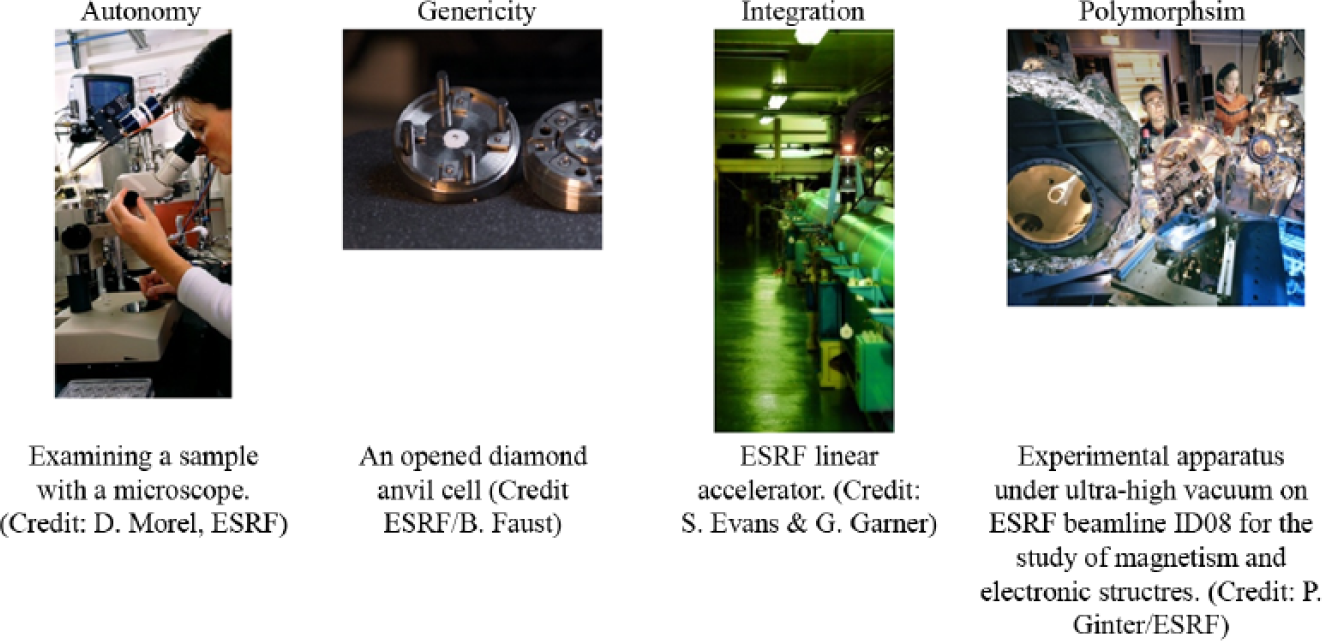
Four examples of instrumentation.
The second mode in which instruments fit within a wider instrumentation is that of ‘genericity’ (Shinn, 1997). Like autonomous instruments, ‘generic’ instruments have the capacity to be applied to diverse fields and to achieve multiple scientific and even industrial and social objectives. However, while the former succeed with relatively little need of modification, the capacity of generic instruments to serve multiple uses is based partly on their flexibility – their ability to adapt to user requirements – and partly on the work of specific communities, which are positioned at the interface between research and instrumentation and whose members typically have highly fluid careers between science, industry and research administration. It is, in fact, these members who assume the labour cost of flexibilization. The diamond anvil cell we can see on Figure 1 is an example of this kind of fitting mode, its characteristics (size, weight, etc.) changing heavily according to the experiment.
The third mode in which instruments fit within an instrumentation is a strong integration of the instrument, to the extent that it is specified according to the wider needs of this set-up and can scarcely serve other purposes in other instrument configurations. ‘Integrated’ instruments come under the category of ‘large instruments’, in other words, groups of instruments intended for the realization of types of pioneering experiment that are complex to carry out, such as particle accelerators in high-energy physics (Traweek, 1992). Certain detectors are thus introduced into the instrumental sequence, and detect phenomena produced by other instruments before them, and are followed by other instruments which analyse their changes: for example, electron microscopes (and an instrument that is ‘autonomous’ at its conception can thus play a lasting part within an ‘integrated’ instrumentation – thereby losing its autonomy, and only recovering it if isolated again). Integrated instruments put high demands on their users since it sometimes takes years of effort at considerable cost to prepare them for a single experiment. The reversibility is very low while the instrumental sequence is highly extended. We believe Marcovich and Shinn are right to qualify them as ‘bureaucratic’, since they are investigating the circumstances of these instruments’ creation; an investigation into the way they fit within an instrumentation leads us rather to emphasize their integration. The linear accelerator, which can be seen in Figure 1, is an example of this kind of instrument with its great size and its covering, which prevents recurrent change.
We also identify a fourth mode in which instruments fit within instrumentation, the importance of which appears to have increased considerably in the last three or four decades: that of ‘polymorphism’. In this sense, instruments fit within a set of instruments, technical objects and devices, chosen in relation to one another, and governed, calibrated and adjusted to achieve a high number of scientific results. The grouping of these instruments encourages multiple associations and varied set-ups of instruments to facilitate the undertaking of differentiated experiments. A given instrument can thus prove essential for one experiment, and altogether secondary or absent in another. The reversibility is high here, while the instrumental chains are extended to a great extent. These instrumentations, which we will call ‘polymorphs’, also put considerable demands on their users, but this time in terms of workload, because the instruments they comprise must be regularly realigned. The experimental apparatus in Figure 1 is a good example of this fitting mode, which we will describe in detail in this article.
Two consequences emerge, in effect, from the definition we propose for these polymorphic instrumentations. The first is that the instrumental sequence available to researchers thus requires a combination of multiple instruments. The task of selecting and putting the instruments into order involves coordinating actors who specialize in a certain instrument, and bringing together professional communities which each have an identity at least partially founded on the characteristics of the instruments they devise, maintain and develop. This therefore also establishes hierarchies and subordinations between these communities and instruments (Simoulin, 2007). The second consequence is that the same polymorphic instrumentation may give rise to the establishment of series of instruments which are, to some degree or even completely, different from one another. And this leads not only to the implementation of different experiments, but also to the pursuit of different aims such as detecting and quantifying phenomena, or reproducing experimental conditions that are difficult to achieve. Our hypothesis is that genericity – the capacity to serve various scientific needs – also arises from the links between multiple instruments in a complex instrumentation giving a large differentiation, or from the way a group of instruments can be arranged differently depending on the objective.
The sociology of scientific knowledge is above all interested in solo instruments, that is to say the development of a single instrument, while daily scientific activity frequently entails managing the workings of an orchestra. Therefore, highlighting the increasing role of polymorphic instrumentation in science leads primarily to a better appreciation of the reality of contemporary research practices and to a more balanced reconstitution of the whole scene than that which analysis foregrounding a single instrument would produce, however important that instrument may be.
This also brings into question the ‘organizational work’ (De Terssac, 2003) that is required for this flexibility to come about, and for the link between the instrumentation and the requirements of an experiment to be established effectively. How does such organizational work, which makes a rare instrumentation available to researchers, come about? And, in particular, what is the driving force that makes the instrumentation more flexible according to the specific requirements of each experiment? How can all the actors necessary for this instrumentation and its flexibilization coexist within the same organization, and how can this organization last despite this differentiation, and even evolve over time?
We will seek to respond to these issues through the longitudinal study that we have conducted on the construction of a synchrotron: the European Synchrotron Radiation Facility (ESRF). Located in Grenoble, this equipment was originally built by 11 European countries 1 and is open to all researchers whose experiment proposals (‘beamtime requests’) have been chosen for their scientific interest by a selection committee. We have studied it by way of three investigations conducted through semi-structured interviews in 1992 (76 interviews), 1996 (62 interviews) and 2005 (74 interviews); or, respectively, at the end of the construction of the first accelerator; at the end of construction of the first beamlines (and the launch of the ESRF); and, finally, during a period of routinized operation, which coincided with a relaunch phase.
We will first show that the rare instrumentation offered to researchers by the ESRF is indeed based on the link, which is constantly reworked, between multiple instruments and their calibration according to the requirements of the experiment to be carried out. We will then see that the communities shaping, maintaining and developing these instruments are themselves divided into two main groups, which has the potential to weaken the organization and raises the question of its unity over time. We can then examine the organizational structures that have facilitated the design, then the construction and finally the renewal of this polymorphic instrumentation. This flexibility can pose a risk to an organization’s identity insofar as it corresponds – in the case of a synchrotron – to both a synchronic differentiation (each of the 40 beamlines being configured differently each week) and a permanent evolution (the various beamlines operating strategic choices – which are not always congruent – for the development of the instrumentation). The continual task of rearranging the instruments addresses researchers’ needs, but represents a daily challenge in terms of defining and prioritizing the workload of the ESRF members as they serve external researchers, and in terms of maintaining unity in the organization despite the seeds of dissolution planted by differentiation and flexibility.
A synchrotron: Instruments ordered within an instrumentation
A synchrotron basically consists of a set of instruments ordered in such a way as to produce an x-ray beam and a whole series of other instruments calibrated to use this beam to successfully carry out experiments (Doing, 2009; Hallonsten, 2011, 2015; Heinze, Hallonsten and Heinecke, 2015a, 2015b; Simoulin, 2012a, 2012b). This dual character should not, however, mask the fact that all these instruments are indeed constantly redeveloped, either to improve their performance or to adapt them to a specific experiment. In this dual role, a synchrotron is a good example of the way in which polymorphic instrumentation comprises multiple instruments – and of its continual development, within the constraints that its multiplicity represents.
A dual instrumentation
To produce x-rays, a linear accelerator (Linac) propels the electrons with an initial acceleration to bring them to their definite speed and energy by means of a ‘booster’ (the synchrotron itself); they then circulate within a tube, the ‘storage ring’ (see part 1 of Figure 2). The electrons move through the ring by means of magnets, which cause them to turn in a vacuum chamber, and the x-ray beam is directed to each of the beamlines by an ‘insertion device’.
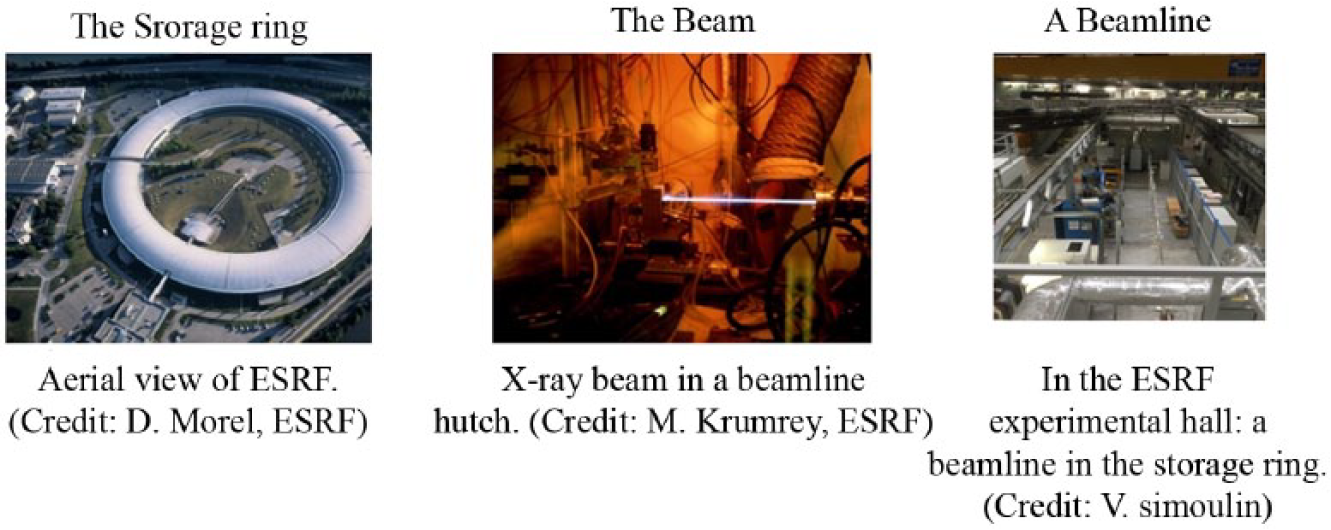
The components of a synchrotron.
This accelerator is not fundamentally different from those that are used in high-energy physics, but here it is not optimized to cause a single shock of particles but to create the most powerful, durable and stable beam (see part 2 of Figure 2) possible to power many experiments at once. Its designers and developers also seek to make it work according to different ‘modes’, which is of crucial importance to the users conducting experiments on the beamlines. These methods correspond to the way in which the electrons circulate within the ring (continuously, in bunches spaced out to varying degrees, etc.), giving an intense, stable beam, or flashes of light (in order to study the temporal variations of the matter). The accelerator can only operate according to a single mode at a time, but it can change modes from one week to another. Therefore, accelerator specialists strive to design and develop a flexible instrument.
Each beamline is adapted to varying degrees to each mode, and some cannot operate when a certain mode is adopted which does not suit them. The allocation of modes on a weekly basis in fact leads to tough negotiations. All synchrotrons have their own range of modes, because they attempt to adapt to their clientele of users (and to use innovative modes to attract them), particularly as their specific range of energy does not allow them all to be equally effective in each mode. In other words, far from being stable, the particle accelerator is designed to change from week to week while being used to produce x-rays, whereas it remains stable for months or even years when it is at the heart of a high-energy physics experiment.
The performance of each element depends not only on its own characteristics, but also on those of the group, in particular on the precision with which each is positioned in relation to the rest. Accordingly, specialist geometers regularly reorganize them to increase the accuracy and quality of the beam. For a particle accelerator to work well, it requires the coordination of a whole set of competencies and components, for example, vacuum, magnet, and radio-frequency device specialists. 2 It follows that the sphere of accelerators is fundamentally different from that of experiments, which is much more individualistic, competitive and anomic.
Within the sphere of accelerators, numerous small groups of engineers (many of whom have written theses) and technicians work in close communication under the auspices of a manager, who is constantly looking to improve the accelerator, increase its performance and diversify its possibilities at a moment’s notice. This does not, of course, mean that there is no conflict among accelerator specialists, nor local variations between the systems of action corresponding to each accelerator; but these conflicts and variations are inherently framed by the necessary involvement of all in a shared goal and objective.
Once the x-ray beam has been produced, it is captured and diverted away from the ring by a ‘beamline’ (see part 3 of Figure 2), the aim being to study the structure of very diverse samples. Most synchrotrons have 20 to 40 beamlines, meaning they host dozens of simultaneous, quick experiments – lasting at most a few weeks, sometimes a few minutes.
Regarding the beamlines, all consist of four main parts. The first gathers optical instruments (mirrors, slits, etc.) responsible for guiding the x-ray beam to the sample and giving it the desired properties (width, intensity, wavelength, etc.). The second part of the beamline comprises the ‘sample environment’, which is the section that varies most depending on the beamline – and sometimes even depending on the experiment conducted, since many are based on varying conditions (pressure, temperature, etc.), which are difficult to obtain as such. The third part of the beamline is made up of a detector. This is responsible for collecting the x-rays after their passage through the sample, indicating any changes they have undergone, and instigating the system of data acquisition. 3 Finally, the control cabin directs the whole beamline. It is here that users check that the experiment is proceeding well, and intervene in the event of a problem. A beamline may employ dozens, hundreds, of engines, involving, of course, varying degrees of complexity for the user – the most highly motorized beamlines offer the most variables to control, rather than the other way around.
Each of the 40 lines that make up the ESRF is therefore specific and – if we consider that the accelerator itself changes according to the mode used – there are in fact dozens of different instrumental set-ups which may be proposed to users each week. Furthermore, the flexibility of the synchrotron, a piece of scientific equipment that can accommodate dozens of very varied experiments simultaneously, is not only ensured by the multiplicity of the instruments we have just described, but also by their continual development.
Instruments constantly redeveloped
A particle accelerator experiences fairly frequent modifications to a greater or lesser extent (Simoulin, 2016). All synchrotrons evolve not only according to the pace of developments in the field of accelerators, but also according to changes in the requirements of the users who conduct experiments on the beamlines. The finer and better positioned the x-ray beam, the further it can in effect facilitate the study of small and complex samples. The more intense it is, the shorter the sample’s exposure time will be, which allows either the multiplication of experiments at any one time, or a particularly delicate sample to be exposed to the beam. The longer a beam lasts, the easier and more likely it is that a difficult experiment can be conducted without interruption of the operation and without having to continually restore the settings. Although it may be at the start of the experimental sequence, and technically independent of them, development of the accelerator therefore depends as much on the endogenous dynamics of the accelerator field (research into reliability and performance) as on users’ changing requirements and the characteristics of the experiments they carry out – while the reverse is often not the case. 4
Even more than the accelerator – which depends on the combined performance of thousands of components which must not fail nor lead to failure in neighbouring operations – each beamline is evolving continually and significantly. Up to a certain point, no line is ever stabilized, since the requirements change as much as the technology develops. Indeed, those responsible for a beamline seek to create new set-ups adapted to the changing experiment requirements. The beamline should be prepared and configured to incorporate, or not, a certain number of elements (oven, etc.), depending on the characteristics of the proposed experiments.
Ultimately, it is this plasticity of the beamlines that means we can consider the synchrotron as a generic piece of equipment (Shinn, 2008). It may be used in very varied ways, but this implies a local organization that can adapt the beamlines and the beam to the ever-changing needs of users. Initial analysis shows that this organization is also twofold, combining both the accelerator and the beamline specialists.
Dual community/multiple communities
At first glance, the synchrotron community – the community of those who participate in the shaping, maintenance and development of instruments used in a synchrotron – is dual. But a more in-depth look prompts us to highlight the existence of multiple communities among scientific users. The fact that the synchrotron can be used to serve multiple and diverse scientific uses is reflected here in the great differentiation between the communities that rely on it.
A dual synchrotron community
The synchrotron community as a whole is both relatively open and continually expanding. Among those interviewed during our investigations, many had had no contact with synchrotrons prior to their experience at the ESRF (in the case of engineers, designers and technicians). We are dealing, therefore, with a social group keen to increase in number of members and audience to guarantee the continuation of its development. It would be more accurate to say that there are communities, since the sphere of accelerators and that of beamlines are in many ways separate, neither sharing techniques nor transmitting the same values and references.
The accelerator community advocates an engineer culture. It places great importance on deadlines, task optimization and organization, and seeks as far as possible to pinpoint requests and reorganize them; it even has a multi-year vision of priorities and work to be done. Junior members of the accelerator sub-community learn the value of high-quality work, are geared towards the long term and planning, and seek to rationalize their work.
The beamline community prioritizes the values of creativity, inspiration and originality, never counting or measuring work, instead being ultimately validated only by the publication of articles. Junior members learn to value originality, which published articles must demonstrate, and to live within the short-term cycle of experiments and publications, and only pay attention to the end-result. Socialization also takes place via participation in specialized symposia and the publication of articles in scientific journals highlighting the importance of instrumentation or of experiments carried out using synchrotron light.
Multiple scientific communities
While the community at first appears dual – the accelerator sphere being very different from that of the beamlines – the latter is in fact much more diverse, housing highly differentiated communities within its ranks. According to one of its founders (Farge, 2012), around 15–20% of experiments conducted at the ESRF are in physics, 25–30% in engineering, 15% in chemistry, and 25–30% in biology. And, in each of these communities, use of the synchrotron may be different: the focus being instead on the detection of phenomena, their production or their quantification.
Historically, it was physicists and chemists who developed synchrotrons, who used them first and to a large extent designed their use. Among other possibilities, their aim may be to see how a material loses its shape when crushed (Maaß et al., 2006) and subjected to modifiable characteristics (specimen thickness, etc.), or the magnetic and electronic properties of ultra-thin films (Valvidares et al., 2004). The synchrotron is used here as a miniature laboratory.
Macromolecular crystallography corresponds to a particular type of user (Duke and Johnson, 2010) who essentially uses the synchrotron as a ‘measuring’ instrument. Their experiments are short, standardized and numerous. They consist of exposing a series of molecules to the x-ray beam to determine their structure. The experiment itself only takes a few minutes for each molecule to be exposed, which means that one user comes with dozens of samples to expose one after the other. The beamline no longer appears as a laboratory, but as a valuable instrument – albeit one of no great interest by itself.
Biologists and doctors either use the synchrotron as a microscope, or as a means of treatment, for example, as a device with which to focus precise and intense radiation on a defined area to treat certain cancerous tumours. Preventing harm to the animal – or even the human being – put beneath the beam to be irradiated is crucial. We cannot, therefore, automate this type of beamline too far in a bid to multiply experiments. These uses call for serious and very knowledgeable staff. The ESRF has been transformed to accommodate these users, notably via the creation of an animal house, as well as via building partnerships with the INSERM 5 and the CHU 6 in Grenoble. Given that the synchrotron has not been designed with biologists entirely in mind, and to ensure that the promises of its instrumentation may actually be suited to their discipline, they must create independent laboratories, animal facilities or, simply offices, to accommodate their teams.
Finally, we must give special consideration to the groups who are just beginning to rely on the synchrotron: doctors, palæontologists, museum curators, etc. (Bertrand, 2014; Simoulin, 2012b). For them, the synchrotron is above all an imaging instrument, an extremely powerful microscope. From a detection perspective, the synchrotron’s interest lies in a three-dimensional reconstruction of objects of which there is only a (sometimes tiny) piece left, and dating them or seeing how a pigment from an ancient painting has evolved. It can also tell us how an ancient object was built, why it has eroded, and how we can limit or stop this erosion.
In view of the instrumentation’s dual nature (the accelerator and the beamlines) and of the diversity among its users, we must now examine the ESRF’s construction. In doing so, we aim to describe more precisely the structures or organizational choices made to ensure, on the one hand, a link between the sphere of the accelerator and that of the beamlines, and, on the other, adaptation to the continual development and re-articulation of user demands.
The three organizations of the ESRF
How was such a differentiated instrumentation built, and how have communities as different as that of the accelerator and those of experiments coexisted and even cooperated? Questions about the organizational basis of such a flexible instrumentation force us to consider the temporal dimension, since this basis changes over time. We can, in fact, distinguish three successive organizations between 1986 and 2016: the phase of the accelerator’s construction; construction of the beamlines; and the operation phase. While they partly overlap, these phases appear to be represented by fundamentally different approaches.
Construction of the accelerator (1986–92)
Founded in 1988, the ESRF had five divisions and a management board. The Machine division was responsible for the construction of the accelerator and the ring. The Experiments division’s task was to construct the beamlines and their instrumentation; 7 the Technical and Computing Service divisions, and Administration were the support divisions which depended on the budgets of the operational divisions.
During the accelerator construction phase, the Machine division predominated in terms of numbers (representing nearly a quarter of the total workforce in 1989), but this went beyond numbers because the period 1986–92 constituted the crystallization phase of a collective and cohesive organization in which the values of efficiency, coordination and speed were prioritized by a leadership heavily involved in the day-to-day activity of the ESRF.
The first members of the Experiments division were certainly active, but they were not very visible. They worked on the establishment of the beamlines and set up meetings with potential users to determine their scientific needs and design a suitable instrumentation. However, they found it difficult to obtain the support of the Technical and Computing Service divisions, and even of the Administration, all of which were at this point overwhelmed by the demands of the Machine division, as attention was on construction of the accelerator.
The beamline construction phase (1992–2001)
This second period was primarily characterized by growth in size of the Experiments division workforce, which gradually became the largest at the ESRF by a long way (nearly half the overall workforce since 1992), while the other divisions have remained more or less stable. Boosted by this strength, and concerned that the Technical and Computing Service divisions might be overloaded by the construction of the accelerator, at the start of the 1990s, the Experiments managers created two previously unforeseen groups: an engineering office, the Beam Line Project Office (BLPO), and an IT group, Programming. They chose to use their budget to create their own technology and computing services, since the two divisions which would otherwise have taken on this role were challenged to meet the increasing support needs of the beamline teams in determining the instrumentation.
These two groups were the main support for those in charge of the beamlines. Lauded in particular for its willingness to bridge the gap between Experiments and the Technical Service division, the BLPO applied principles taken partly from the construction of the accelerator and partly from having adapted itself to a universe it perceived to be different, from that of the beamlines. From the Machine division, it assumed the concerns of standardization, of thinking long term, of each of its members specializing in one element and of carrying out the scientists’ wishes as far and as fast as possible. But to this it added a willingness to listen to those in charge of the beamlines, and serve as translator and buffer between the overstretched support services and scientists who did not speak the same language. The Programming group was more outright in its opposition to the IT Service, but fully attentive to those in charge of the beamlines.
The transitional organization primarily driven by the BLPO can be considered as the first phase (1992–97) in the reorganization of the ESRF. This was successful for as long as the BLPO’s components remained relatively basic, but was more problematic once the elements discussed became more specific. The complaints from scientists that arose from the desire for standardization of the BLPO sparked a new reaction from the Experiments managers. In 1997, the directors imposed not only the reorganization of the BLPO and Programming (which became Technical Beamline Support (TBS), which alone had almost as many members as the Technical and Computing Service divisions combined), but also a change in philosophy for all support services. In this, the desire to standardize, although it did not totally disappear, was entirely subordinated to the differentiation of the beamlines and to the possibility of developing them. The whole ESRF model, driven by the Machine directors and based on the needs of the engineers, guided how the Machine was built, and was adapted to the beamlines by the BLPO at one point. It was then replaced by a model based on the scientists, whose priority was keeping in step with users and serving their needs.
This phase in fact led to a significant differentiation of the beamlines; four types can be distinguished within the ESRF at the end of construction:
- The ‘multi set-up’ beamlines have a configuration which varies greatly depending on the experiment, because they meet the needs of several small communities. These have several different set-ups – equipment is disassembled and reassembled differently for nearly each experiment. They often operate according to unusual or new accelerator modes, and the experiments carried out on them are highly innovative and exploratory. They are ‘generic’ instruments.
- The ‘disciplinary beamlines’ are based on a relatively pivotal community. They are fairly stable, meaning they are not significantly rebuilt for each experiment, but they often reach the limit of current possibilities. These beamlines act as intermediaries between integrated and generic instruments.
- The ‘multi-user beamlines’ are characterized by the diversity and lack of experience of the users they host, such as physicians, palæontologists and museum curators. As they are sometimes dealing with users who do not know how a synchrotron works, the teams on these lines are bigger and have a more tiered structure. What we are faced with here is an instrument with a tendency to become ‘autonomous’.
- The ‘streamlined beamlines’ are essentially those used in macromolecular crystallography. They attempt to streamline and industrialize the user experience as far as possible. Researchers who use these lines do not have any interest in the synchrotron itself. Experiments are standardized and quick (sometimes a few minutes). According to the established terms, they are closer to ‘measurement’ than science. These, too, are ‘autonomous’ instruments, the researchers’ aim being to develop techniques of remote control of the beamline to the extent that they no longer have to come to the facility themselves – only their samples need move.
This typology is of course ideal-typical and evolutive, which means, on the one hand, that many beamlines are in an interim state between two types, and, on the other hand, that the characteristics of each beamline can vary greatly over time – the beamline sometimes shifting from one type to another. A multi set-up beamline can, for example, come to focus on one discipline if one of the communities using it becomes dominant, proposing increasingly interesting experiments and involving a growing number of members. This evolution takes place according to the daily rhythms of the team that develops the beamline and those of its community; it is via this continual reconfiguration that the ESRF and the beamline team meet the perceived expectations of the community. This pattern of beamline elasticity according to the evolution – both from one week to another and over time – of research proposals can be described as ‘morphing’.
The operation and renewal stage (2002–16)
After 1998, when the 40 beamlines had been built and were hosting users, the organization shifted towards user selection and welcoming in the researchers who succeeded past this stage. All beamtime requests first went to the user office. This was an internal group at the ESRF which carried out the selection process and passed research proposals on to independent expert committees for scientific assessment, as well as to the person responsible for the requested beamline to check it was the most suitable and propose the beamtime to be made available.
These beamline review committees were also important because they allowed user needs to be assessed and, potentially, gave an indication of how the characteristics and use of the beamlines should be modified according to their development. Every five years, they were complemented in this role by the organization of an expert committee responsible for assessing the activity of each line over that period. Each year, several independent expert committees were thus set up on a rotating basis to assess each beamline and potentially propose a reorientation of its scientific activity, or even its closure and reallocation.
All at the ESRF scrutinize the research proposals, seeing them as indicators of the way in which they ought to be developing the beamlines. Areas which enjoy high demand such as, for example, crystallography or imaging, have obtained more beamlines than initially expected in order to carry out more of these experiments. On many of the beamlines, robots have been designed and installed to change samples more quickly and complete more experiments. The line manager observes exterior signals to decide which of these objectives to focus on. We can refer to all the methods employed by the ESRF to listen to its users and adapt to their changing demands as ‘scanning systems’.
While a risk of routine loomed at the end of the exciting construction period and new competitors emerged with the construction of a whole series of new synchrotrons inspired by the ESRF (Simoulin, 2012a, 2016), the ESRF Council, led by the Director General, launched its first upgrade programme in June 2006 (ESRF, 2014), partially funded by the European Commission in the form of the first European Strategy Forum on Research Infrastructures (ESFRI) roadmap. The roadmap set out to reconfigure 18 lines and to devote two of them to instrumentation tests (optics, detectors, etc.) for the whole of the European scientific communities in order to respond to the instrumentation needs common to all synchrotrons. This initial upgrade programme is being followed by a second one (2015–22), with the following objectives: renovate the accelerator and the storage ring, build four new beamlines and implement a new instrumentation for data collection during experiments. This desire for permanent evolution is typical of polymorphic instrumentation, whose purpose is to constantly propose new links between instruments according to the latest research proposals.
Thus, the ESRF’s capacity to substantially evolve the beamlines available to users and the accelerator to better meet the ever-changing research proposals was based on its ability to identify where development was needed thanks to its scanning system. During its operational phase, the entire ESRF organization was in fact designed to provide for not just daily adjustments, but also regular development of the instrumentation. This leads us now to discuss what it is that maintains an organizational unity in the face of these frequent and major developments.
Sources of unity at the ESRF
In what way is the sphere of the accelerator builders linked to that of the beamline builders, and how do they form a coherent whole? Again, it appears that the answer to this question must be adjusted over time. We can, nevertheless, identify three mechanisms that have helped unite actors from different spheres and of many nationalities to form one group, more or less successfully and fully at different times.
Maintaining separations
We should first of all say that there has certainly not been a true transformation of either of the spheres involved, or even true contagion from one to the other during any of the phases we have described.
Regarding publications, each of the two spheres has thus preserved its essence. Those from the sphere of the accelerator do not seek to publish in more varied journals over time, just as on the Experiments side, although publishing in an ever-increasing number of journals, the core they favour stays the same (Simoulin, 2012a). Similarly, no great transfer of staff from one division and sphere to the other has occurred. Of course, the actors have changed: they have learned to live together but, although they have learned to know each other better and to interact, they have in no way merged.
At no point has the sphere of Experiments adhered to the rationale of order and the primacy of efficiency that have continually been the focus of the Machine sphere, no more than the latter has been influenced by the creative and inspirational approach of the sphere of Experiments. From this point of view, the ESRF organization is a site of meeting and collaboration between two different spheres, but not of their fusion.
The first mechanism which has linked these two spheres is therefore based on maintaining their separation. The difference between the two communities is frequently underlined in meetings: the sphere of the Machine appears hierarchical, or even military, to the scientists, while that of Experiments seems to represent an image of chaos to the members of the Machine. These differences also stem from their different missions; indeed, the accelerator is a single instrument which requires the coordination of multiple components, whereas Experiments brings together, without totally uniting, around 40 competing and almost entirely independent beamlines. This fosters, respectively, the cohesive and rationalized organization of the Machine and, conversely, the individualistic and inventive organization of Experiments.
A shifting hierarchy
The second mechanism which helps to link these two spheres is that of their shifting hierarchy. At the time of the accelerator’s construction, its builders imposed their values of speed, efficiency and excellence, whereas those constructing the beamlines were then in the minority and were faced with the strong personalities of the Machine directors. Moreover, they were absorbed by the task of defining their beamline in conjunction with their community. Then, a temporary arrangement resulted in a certain levelling of these two spheres – spearheaded by the BLPO, translating the values of the two spheres and organizing interactions between them. Finally, a new, inverted hierarchy formed as of 1997: the sphere of the beamline constructors and that of the users enforced their priorities and working methods on the Computing and Technical Services divisions, which gradually adapted to them.
We cannot continue at this point without considering the demographic developments taking place alongside organizational time frames. The first era clearly corresponds to a demographic domination of the sphere of the Machine, which was even greater because it encompassed several sub-contractors, many of whom were present on a more or less regular basis on the site. The second era is that of a fragile balance between a Machine system, which gradually lost its sub-contractors, and Experiments, which recruited and relied increasingly on the support divisions, and trained young members who identified with this sphere. The third era, which resulted from these developments, corresponds to Experiences’ far-reaching, demographic domination, which attracted, furthermore, greater numbers of users. The last mechanism which helped to join these spheres was their fragmentation, particularly during the third time.
Flexibility from fragmentation
In the case of the Machine, once its construction was complete, all the groups linked to the accelerator varied from one another. For Experiments, the different types of beamline public, during construction and even more during use, led to different relationship systems being implemented between beamline teams, their users, and the rest of the ESRF – meaning the four types of beamline previously described. Among other consequences, including the fact that it was this fragmentation which led to the ESRF developing insight into its environment, this has had the result that, although the two spheres have remained separate from one another, their respective divisions have avoided appearing as two blocks in direct opposition.
Our study presents an example of a large scientific facility that is as open as possible to multiple users, including some from spheres with few links to this type of instrumentation, such as, for example, museum curators and archaeologists. The search for high versatility in instrumentation has had the twin results of serving very varied scientific uses, and making instruments almost available to everyone without sacrificing the high level of sophistication that they continue to improve upon. On this basis, we could consider that the true genericity of this equipment is based on a genuine service policy and a strategy of flexibilization of the accelerator and beamlines.
The spread of generic instruments is based on both in-demand adaptations of instruments, and the high mobility of the careers of those who develop them and carry out these adaptations. For autonomous instruments it is a matter of their relative simplicity of use. And for integrated instruments, again, organizational devices (for scanning and morphing) as well as their capacity to adapt to demand have been key to implementing the continual reconfigurations that this adaptation entails. In fact, polymorphic instrumentations can only exist when linked to dedicated facilities. This means that they are localized and that it is the researchers who move – or at least their samples, because new technologies make it increasingly possible for their handling to be controlled remotely.
In this sense, the continual evolution of the instrumentation relies on the entire internal organization of the ESRF (those in charge of the beamlines, technical support, etc.). This system strives on a daily basis to achieve greater flexibilization of the beamlines in terms of experiments, and, longer term, to develop the beamlines according to the evolution of experiment proposals. It also relies on a whole external system (research proposal assessment committees, beamline review committees, etc.), which continually scans beamtime requests to guide the evolution of the beamlines. The plasticity of the beamlines, and of the collectives serving them and served by them, means that the synchrotron is broken down into about 40 very specific instrument groups whose characteristics may vary from week to week.
From this point of view, polymorphic instrumentations are localized in the same way as integrated instrumentations. This therefore necessitates a selection process and access that is not automatic, but conditional on review by a selection committee. Meanwhile, access to autonomous and generic instruments may be limited to their acquisition or usage cost – microscopes and barometers, for example, being easily accessible in the market. It is, however, much easier to gain access to a synchrotron than to a high-energy physics particle accelerator, because thousands of experiments, for instance, take place each year at the ESRF, although access is nonetheless dependent on an assessment.
Polymorphic instrumentations not only make it possible to conduct very diverse experiments, they also facilitate an effective interdisciplinarity. Through regularly using the same facilities, different disciplinary communities are inadvertently drawn together, and new ones gradually learn to use synchrotrons. Since 2005, symposia on the radiation synchrotron in art and archaeology have been organized, the first of which was held in Grenoble. A few decades after biologists learned to use facilities developed by physicists and the chemists, museum curators and archaeologists have created a meeting place to exchange techniques and train the other members of their community.
The instrumentation’s profuse and multiple characteristics and its relative openness are not only illustrative of synchrotrons, even if the latter are exemplary to a high degree. The construction of large scientific facilities is one of the most noticeable and significant research developments since the Second World War. The function of such equipment is to make a set of instruments and staff responsible for their preparation available to outside users for proposed experiments. Synchrotrons are equipment just like, for example, telescopes or neutron sources.
The growth of scientific facilities is more recent than that of the large organizations required by high-energy physics, and this is no doubt an initial explanation for the relative lack of interest that they have generated, at least until recently. A second, wider, explanation lies in the common oversight of work relating to instrumentation and of what are seen as secondary’ actors in research, such as technicians and administrative staff, and even regular researchers within a fundamentally unequal scientific system (Merton, 1973). These scientific facilities rely, however, on an organizational effort to continually develop and grow more flexible to suit the needs of their users. This gives them a generic and polymorphic character, which alone merits the devotion of a specific research programme.
Footnotes
Funding
This article was made possible by the support from Labex Structuring of Social Worlds (SSW) (ANR-11-LABX-006).