



Abstract
We sought contributions from the widest possible spectrum, asking the authors to reflect upon the notion of ‘AnthropOcean’: theory, fiction, journal, ethological accounts, or ethnographic material from time spent at sea, testimony by those who have gained experience from the ocean, encounters with ocean inhabitants (no species preferred), etc. The aim is to build imagination and sensitivity upon these contributions in order to invent new narrative forms coherent with our contemporary experiences of an animated world. We would like to suggest that oceanic sensitive-anthropology can provide precious sense-ideas in order to think, feel and imagine the contemporary ecological crisis. Considering our present as anything but an ‘end of the world’, and more as a profound transformative process, how can ocean-sense-ideas bring useful intuitions? How can ocean inhabitants, ecosystems and dynamics, teach us a lesson in imagination? Can we dream other dreams than that of industrial exploitation?
‘Le rêve de ceux qui rêvent concerne ceux qui ne rêvent pas, et pourquoi cela ça les concerne? Parce que dès qu’il y a rêve de l’autre, il y a danger. … Méfiez-vous du rêve de l’autre, parce que si vous êtes pris dans le rêve de l’autre, vous êtes foutu.’ ‘Aucune rumeur humaine ou bestiale ne saurait donner l’idée des fracas mêlés à ces dislocations de la mer.’ Le rêve est l’aquarium de la nuit. ‘No organism wholly soft can be preserved. Shells and bones will decay and disappear when left on the bottom of the sea, where sediment is not accumulating.’
Living under the sea
The perspective of living under the sea has interested several architects, inspired by the challenge to create non-land oriented habitats, one of the most famous being Jacques Rougerie. The Jacques Rougerie Foundation ‘Innovation and Architecture for the Sea’ awards are for cutting-edge projects aiming for non-terrestrial-habitats. Recently, the ‘Coup de Coeur’ distinction for 2017 was awarded to a bioluminescent reef project lead by Olivier Bocquet from Tangram Architectes 1 in collaboration with the MIO (Mediterranean Institute of Oceanography) in Marseille: this eco-virtuous coastal habitat (Figure 1) proposes various solutions for future kinship modes of existence in ocean spaces. The structure is printed in 3D from recycled plastics, it will produce its own energy, will act as a coral reef, protecting the coast from the ocean swell and hosting marine ecosystems, and will create a bridge between the scientific world, that of the arts, and the general public. Trash becomes resources and the ‘alien ocean’ becomes a kin world, neither ‘wild’ nor domesticated. In order to better understand this recent project we met Olivier Bocquet who first began working on the concept of ocean-based habitats with a deep-sea habitat project, the Biolum-Lab. With conditions of pressure 200 times that of the surface, the sense-idea for a shared aquatic existence emerged. The Biolum-Lab is a deep ocean scientific lab, autonomously connected with its environment, 2,000 meters below sea level, in an underwater canyon of the Calanques National Park in the Mediterranean. The lab is a multilayered surface, with only the core being impermeable to the surrounding water and pressure, allowing human life within it. The exterior membranes, on the contrary, are thought of as connection surfaces rather than isolation: built as artificial reefs, they favour micro-climates and protect against currents, hence welcoming colonizing species who could benefit from the organic waste of the facility while providing energy, nutrients and an enriched surrounding environment, both for research and contemplation. The lab is bioluminescent. The interior is lit by bioluminescent bacteria lamps, which regulate the 24-hour cycles of the space by their natural rhythm, and the exterior layers should soon become ideal niches for bioluminescent bacteria drifting in the currents. The entire structure is energetically self-sufficient and symbiotically mind-settled. It is inspired by the mutualistic relationship between a small shrimp and the Venus’ flower basket (Euplectella aspergillum). The sponge provides a shelter and a food trap for the shrimp, who by living in the sponge, attends to its well-being. The Biolum-Lab, like the sponge, is meant to be an open positive response to its environment. The structure of the lab itself is inspired by the fabric of the sponge (silica as thin as lace, allowing porosity, yet incredibly resistant), and in order to resist the immense pressures at 2,000 meters deep, is built along systems of resistance and equilibrium, both rigid and compressible, capable of maintaining its integrity as a form, as well as its balance within continuous currents and deep ocean swell, but unfixed (Figure 2).
‘Si j’étais hôtelier, sous l’eau mes chambres; quel gazouillis là-dedans, des coups de queue nacrés parmi les rêveuses algues.’
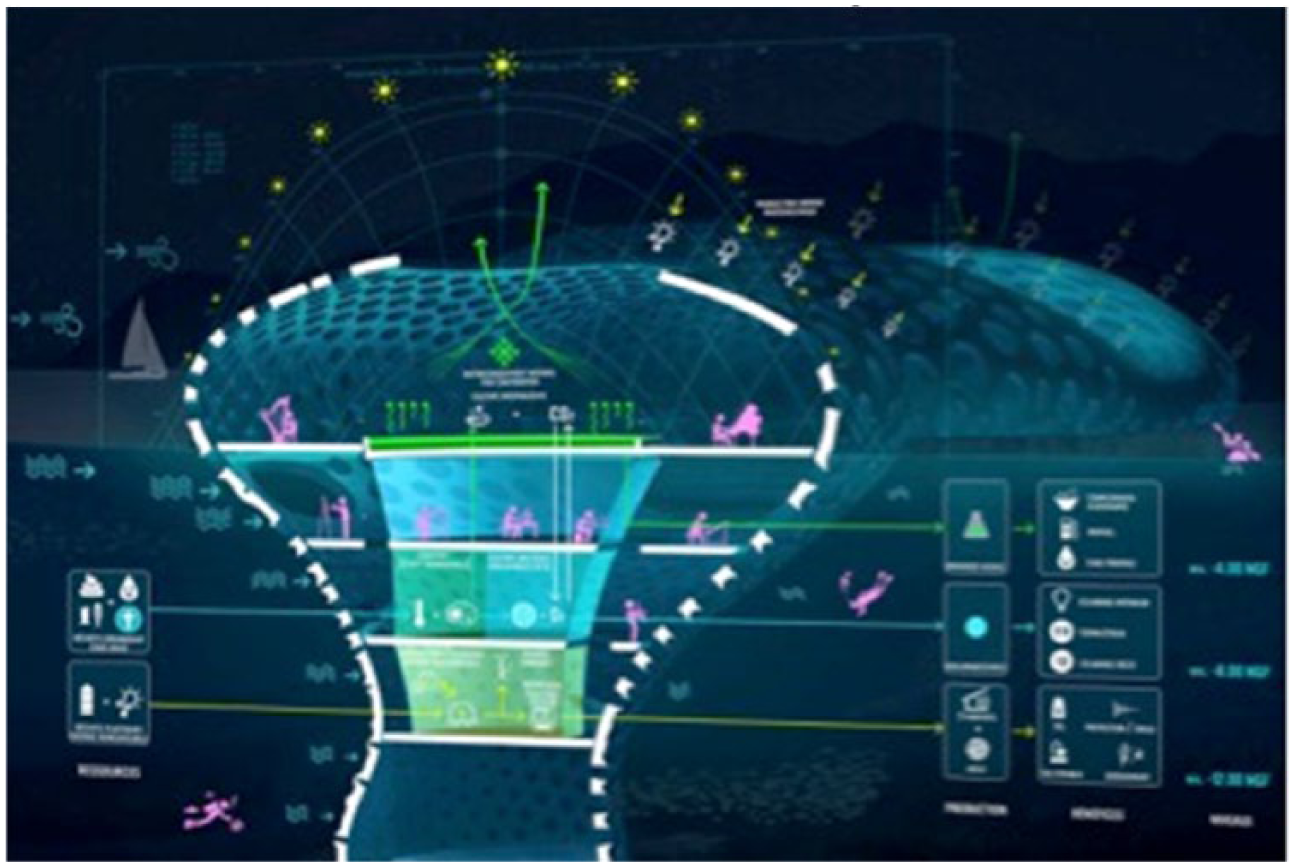
Biolum reef habitat.
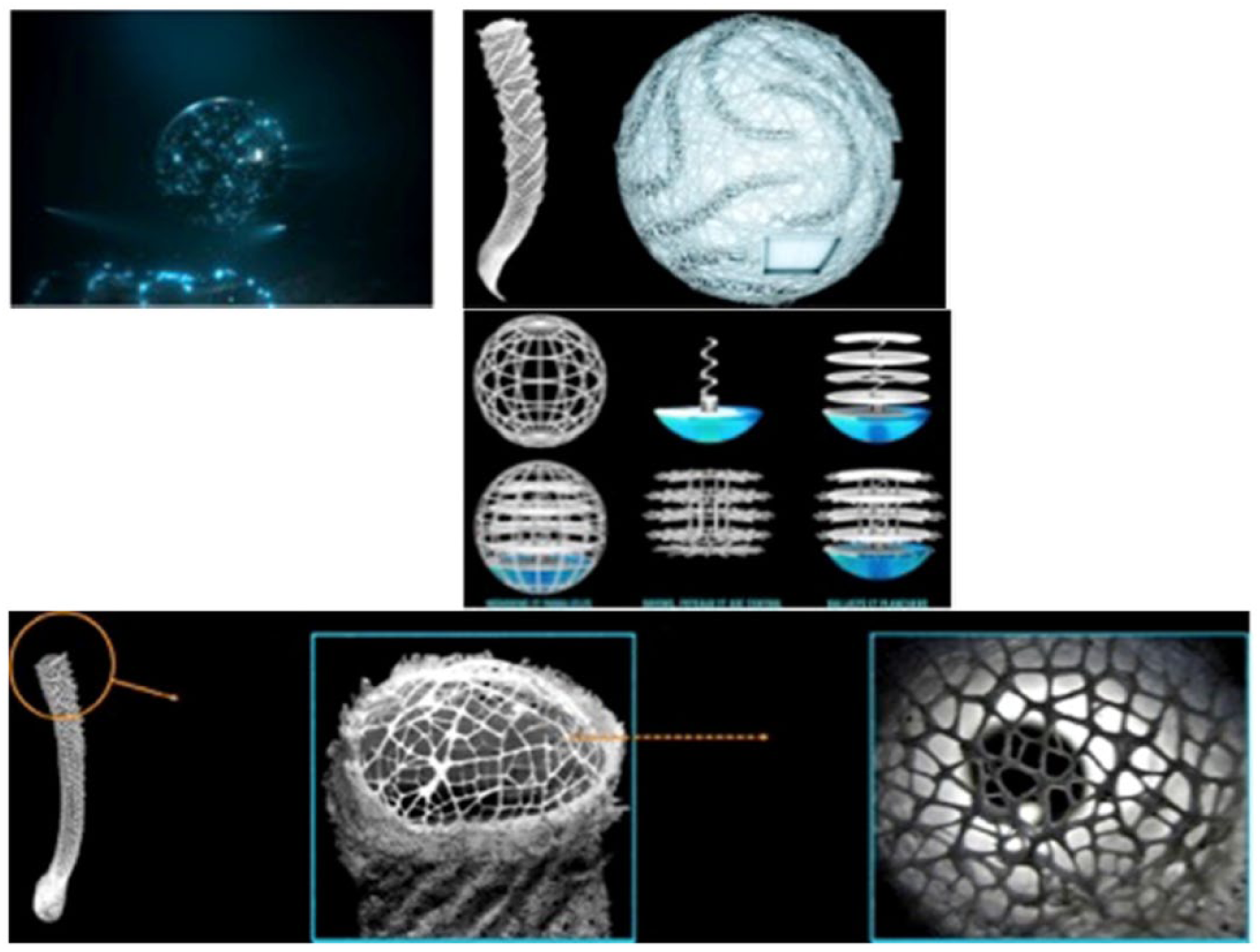
Biolum-Lab concept.
Bioluminescence is central to the project: it is the intended research subject, but also an architectural, sensorial and ecological paradigm. Only a virtuous cycle of waste emission can allow micro-algae and bacteria to colonize and biodiversify the structure, hence attracting bioluminescence, which in turns attracts more species, etc. The entire life in-board is structured by bioluminescent circadian rhythms and light intensity. Space and time in a deep-sea bioluminescent sphere take new dimensions. Who knows how the future inhabitants will begin to think after some time in-board such an ecosystem, how will it affect the mind processes, the sensitivity to ocean ecologies, the imagination and the dreaming? What lives can we share with the inhabitants of the other side of the surface? And how do we wish to share those lives? ‘We want to have ourselves translated into stone and plant, we want to go for a walk in ourselves when we wander in these halls and gardens’ (Nietzsche, 1910[1882]); can anthropos be translated into ocean? After several months spent at sea, Jean-Pierre Abraham (Abraham, 1967), lighthouse keeper of Ar Men, ‘the rock’ at the very western point of Finistère – ‘the end of the world’ – writes in his journal ‘C’est moi la Méduse’ – ‘I am the jellyfish’.
Back in the 1960s Jacques Cousteau began his grand project of colonizing the oceans. With his ‘Continental Shelf’ Stations One, Two and Three, he went on to prove that life underwater for humans was possible. 2 Not only possible, but necessary for the future generations who will lack available space on land for habitat and farming. Cousteau saw these things possible underwater, and his two habitats in the Red Sea were to prove his theory of the forthcoming era of the ‘oceanautes’. But first he had to test if the human minds and bodies could cope living at such pressures for long periods. Cousteau’s habitats were small isolated spheres, thick walls of steel with only very small views towards the outside. The paradigm was not that of the open circuit, but of enclosed occupancy, which was applied upon the marine life itself with strange underwater glass and plastic aquariums in which the oceanautes kept the (their?) fish (Figure 3).
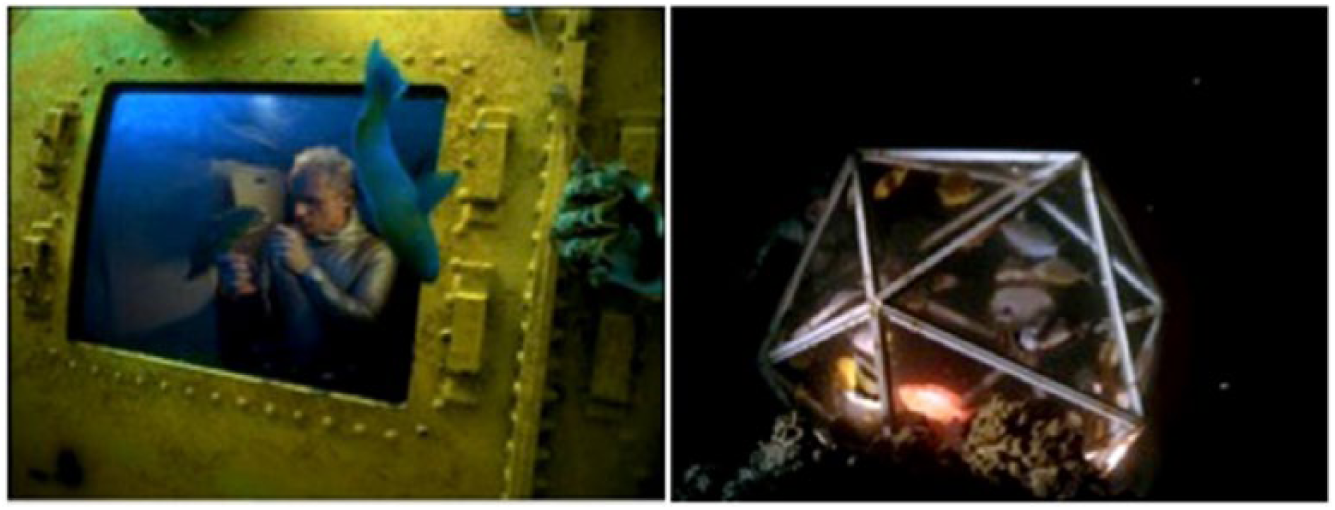
Le monde sans soleil (1965)
Before this project, the people living at sea were either ‘those who live(d) from the sea’ (Smith, 1977), that is to say coastal communities of fishermen, or, in non-western parts of the world, societies of sea-nomads like the Vezo, Moken or Bajau. Studies led among the Bajau or the Moken showed that their bodies became genetically adapted to the oceanic milieu, because of the long periods of time they spent freediving and living at sea (cf. Gislén et al., 2003; Ilardo et al., 2018). The evolution of human bodies through contact with the ocean can also appear over one generation, such as the ‘surfer’s exostosis’, a typical bone growth occurring in surfers’ ears.
Cousteau’s project was a lab to test human resistance and ingeniosity in confronting ocean transformative processes but it also aimed at testing the exploitation potential of ocean space. The project was contemporary to the United Nations’ efforts to establish the rights and responsibilities of nations in respect to the world’s oceans: in 1956 the first Conference on the Law of the Sea (UNCLOS I) was held. These rising efforts began a substantial shift from the geomorphological ocean to the resource-ocean, an ocean that calls upon the human species for its colonization, domestication – in other words, for its entry into history as useful space (cf. Starosielski, 2012). The human-ocean is an intermingled multilayered territory of State-Scientific-Capitalist processes, and Outer Space research is looking back at Cousteau’s inventions with novel technologies in order to colonize extraterrestrial oceans.
Today Cousteau’s ‘Conshelf’ One and Two are famous dive sites (Figure 4): one can admire the colonization of these human habitats by corals, seaweed, crustaceans, and other local imperialists. Inhabitation is always a cohabitation, implicating strong power relations. These power relations are crucial to bring to light as the territorialization of deep-sea space is radically evolving with the prospects of deep-sea mining: no legislation exists for extractionism in international waters, debates are currently underway in the scientific community concerning long-term impacts on deep-sea ecosystems, yet mining leases are already being distributed. 3 The ocean also tends to be colonized by political entrepreneurs looking for outer-State fields. While Elon Musk is dreaming of Mars-based communities, in 2017 a company named Blue Frontiers started an exploratory study in French Polynesia in order to create the first site of their ‘Seasteads’ Project. 4 Their goal is to build new offshore islands with autonomous legal frameworks, offering blank spaces for volunteers to develop society concepts and ‘innovative governance’ within a totally private world with its own cryptocurrency. 5 The AnthropOcean is an increasingly more geopolitical reality today, not only for ocean resources, but also considering the recent migration fluxes, reminding us that the ocean could also be an open political and moral arena. The Atlantic used to be the medium of the Triangular Trade. More recently, in 2014, international waters off Thailand were discovered hosting a slave fishing industry producing food for Western multinationals like Carrefour or Walmart. The Mediterranean is currently the field of the refugee crisis. This special issue is a first step towards a critical and compositional approach to power relations in oceanized worlds.

Cousteau’s Conshelf habitat today.
Sea monsters and ocean-morphism
‘Ceux de l’obstacle de l’air regardent étrangers ceux de l’obstacle de l’eau’. Upon the 22nd of June 1834, in latitude 46° 57’, longitude 58° 39’, Captain Neil of the ship Roberton of Greenock, then upon a voyage from Montreal to Greenock, saw the head and snout of a great fish or sea-monster, of which the accompanying sketch or drawing was at the time made. (cf. Jardine et al., 1837; see Figure 5)
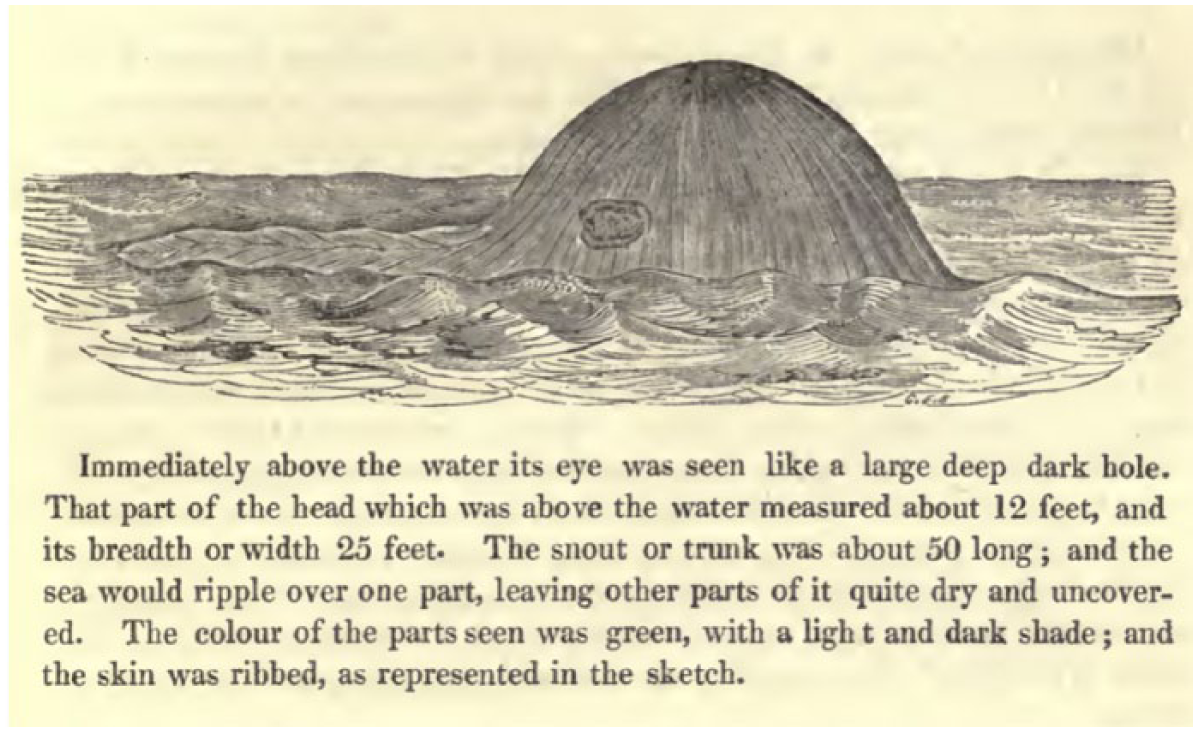
Drawing of the 19th-century sea monster.
Scientific discoveries and misunderstandings shared an equal relevance in out-of-landish encounters. The ocean, since the great discoveries of the end of the 19th century and the increasing industrial reality of Westernized lands, has become a model of ‘The World’s Last Wilderness’. 6 According to the historian Alain Corbin, the relation between Western countries and the ocean takes roots in fear and admiration (Corbin, 1988), either way in some kind of repulsion until modern times. Yet, just as the ocean is neither a lifeless world, nor a silent world, nor a dark world, neither is it pure wilderness: this leads to misconceptions of the ocean as a neutral and awaiting-to-be-exploited space. On the contrary the ocean is constructed and made meaningful in many ways, as we will see. However we still ponder on our misunderstandings of it, and its misunderstanding of us, or how we contaminate each other, if we do, and if not, if we should.
Those from the ocean seem to have a better intuition of moving ecologies and of the impermanence of land itself, but they remain ‘monsters’ from the perspective of landers, strange entities of undetermined materialities, metamorphosed beings. In 1859, Forbes declared that below 300 meters no life could occur. Before the end of the 19th century and the expeditions of the Challenger, the Valdivia, the Travailleur, the Talisman, etc. life was restricted to the realm of the landers. Italo Calvino illustrates this through the tale of ‘The Aquatic Uncle’, in which the phylogenetic evolution that brought life from the oceans onto land is turned into a family affair: those who live on land still have close relatives in the ocean, but they are strangely unfamiliar to one another (Calvino, 1968). The proximity yet antinomy of skin and scales creates an eerie repulsion between those of the land and those of the sea, and as Roy Wagner noticed between subjectivities of different cultures: ‘their misunderstanding of me was not the same as my misunderstanding of them’ (Wagner (1981[1975]: 24). How do we misunderstand the ocean? And what would it mean to ask the following: how does the ocean misunderstand us? This is the true perspectivist question asked in Calvino’s text, and which we seek to pursue in this special issue. Trying to understand by misunderstanding: the aquatic uncle, named ‘N’ba N’ga’, seems to embody an empirical knowledge about the living and its constant transformations, somehow invisible to the landers caught in the apparent immobility of continental life.
Contemporary imaginary still situates the ocean in a strange realm, between the beloved familiar (our blue planet) and the utter unfamiliar. In the film Interstellar by Christopher Nolan (2014), the space explorers travel to inhuman depths of space-time in order to set foot on a handful of potential life-bearing planets. One minute out there is seven years on Earth. The first planet they ‘land on’ seems to be made of a single, giant, 1 foot deep, ocean. Given this ocean, it is targeted as a potential alternative Earth. But a tremendous, periodic wave forces them off the planet, nearly wiping them out. They travel along light and gravitational waves, to the outermost limits of our imaginary capacities, only to encounter and be put off by ocean waves. Lisa Messeri showed how scientists turned exoplanets into familiar narratives, making some of outer-space into outer-places (Messeri, 2016). It is less a matter of physical presence than of remote sensing and the projection of associated milieus (that in which we are functionally and semiotically bonded) through technological means. The telescopes not only receive light forms, they also project forms of light. From a distance, then, placemakers participate in a broad territorialization of homogeneous horizontal outerness: but then where now is the ocean? How close/remote are we from the ocean? Life is linked to oceans (our interest in Jupiter’s Moon Europa is focused on its possible hidden oceans) but settling under the sea for humans still hasn’t happened on Earth, despite the recent experimental submarine habitats mentioned above. Valerie Olson, through her extensive research on environmental systems, technologies and extremes has explored the relations people create with outer-places, places with which they have no direct experience, but that have nonetheless crucial social importance. The paradox of conducting anthropology in human-less environments is only apparent, and makes it all the more interesting according to Olson, since by challenging the limits of ethnography it questions our anthropocentrisms (Olson, 2012).
The ocean covers 79% of the surface of our planet, and 99.5% of livable volume with an average depth of 3,700 metres; 7 however, we remain foreign to mid and deep ocean areas (see Herring, 2002: 2). The Western knowledge of ocean ecosystems, topographies, dynamics, role within global phenomena, etc., is still challenged by its ‘alienness’. Even the toughest seamen will insist on the hostility of the ocean. One of our correspondents, a commanding officer in the diving operations of the French Navy, still emphasizes during our interviews on the immensity of waves at sea. Fisherman is the most dangerous job in the world according to several rankings (National Health Insurance in France for instance). Evolutionary narratives seem to tell the story of our evasion of the ocean: a microbiologist said during an interview that he often dreamt we were all big pockets of sea water slowly evaporating, some transducing (or should we say uploading) into clouds quicker than others. The sea is a No Man’s Land? Yet humans have settled mostly nearby, and many keep returning to it, mapping it, using it, thinking it, exploring it … A world very much humanized in many ways: not only a resource space used by society, but a space of society, progressively territorialized by capitalism (merchant, industrial, post-modern), as Philip E. Steinberg noted (2001: 4), made ‘soundable’ by science, 8 and explorable by heroic narratives (see Höhler, 2009). But also a space modeled and rendered by society and its biopolitics into places, progressively scaling down from the macro (monsters, whales, dolphins) to the micro (bacteria and hydrothermal extractionism), extending the span of the ocean’s meaningfulness 9 and resourcefulness (cf. Höhler, 2014). Stefan Helmreich in his exemplary work on ocean biopolitics (2009) made an ambiguous point by calling it ‘Alien Ocean’: encountering ocean matter and biotechnocapital processes at work forces new understandings of what we consider as part of our world, and how we make things part of our (capitalist) world. Capitalism and science together invented marine routes, ocean depth, deep-sea resources, and today the mysterious ocean is yet full of sensors (ARGO floats being one of the most common), of undersea cables materializing post-colonial power relations (cf. Starosielski, 2015), of geopolitical zones, national commercial fishing legislations, and cultural zones of Science–State interest. 10 Various territorial strategies create the actual emplacement of a heterogeneous ocean space, gradually more involved with the materiality of remote connections, hence with the history of media economies and territorial politics. 11 Far from overcoming space, far from being a smooth space, the ocean is striated by an endless structuring strongly interconnected with the external environment and the archaeologies of media.
The ocean is a paradoxical environment, both humanless and heavily mediated, that in return, as we explore it and materialize it in many ways in order to ‘picture’ it, shapes those who sound it through its specific mediative properties. 12 In our fields of research, working on top or within seawater implies fundamental extensions of the human body and senses, radical alterations of scale and pattern as reminded by Mcluhan’s insights concerning the ecologies of media. 13 This is a fundamental question for the practice of anthropology today, as we realize the extent to which ‘we have never been modern’ as Latour (2011) initially put it; that is, the extent to which things ‘we’ moderns said were pure and distinct have always been made intermingled and hybrid. This is notably the case for bodies and technologies, for sensations and thoughts. This is what Stefan Helmreich (2007) has pointed out as ‘transductive’ rather than immersive, concerning human involvement in ocean environments. 14 Life matters and materializes very differently in the ocean. Bodies are involved in specific ways. Human bodies at sea epitomize mediacy: attention and gestures circulate within mediations, these being mainly industrial today.
The recent Blue Planet II series by the BBC has shown a major shift both in global ecosystems and in wildlife filmmaking narratives. The series showed the actual unwildness of the oceans, as all of our industrial productions ended up entangled in a fin, enmeshed in a stomach, metabolized in a muscle. The impact on audiences was so great (winner of the Impact Award at the 2018 National Television Awards) that the UK parliament recently quoted Blue Planet as a call for political action. These documentaries, as well as the increasingly numerous videos published and watched by thousands on the social networks, showing the activities and transformations of ‘wildlife’, participate to the incomprehensible yet tangible ways in which the planet is in some sense responding, and in some sense, demanding a different response from us.
Recently a collective work has been published in correspondence with an exhibition at the Thyssen-Bornemisza Art Contemporary Academy (TBA21) in Vienna on these inquiries: Tidalectics (2017). Touching on the fields of ecology, migration, biology, physics, history, the exhibition, as manifested by its title, aimed to shift the viewers’ and listeners’ perspective towards fluid sensory realms. Through images, installations and sounds, the exhibition mapped a very different territory from that of solid land. This is remindful of Jakob von Uexküll’s paradigmatic shifts from one species’ world to another. Every animal carries around it, like a sphere or an island, its Umwelt, and if we are attentive and sensitive, we can catch glimpses of these remote lands, unfixed spaces that move with the animal. But ‘Man does no longer move with a space that follows him faithfully, as his senses tell him, he moves instead in a space at rest, a space that is cut loose from him and has its own centre. Space has become autonomous as have the objects within it’ (von Uexküll, 2001). With the ocean we hope to provide speculative maps, which can combine more than one point of view, inspired by a paradigm of moving space.
‘The oceans are very large and very deep, and life occurs everywhere. The vertical dimension provides a convenient way of describing some of the different environments and their inhabitants as epi-, meso-, or bathypelagic, with their benthic parallels. It is necessarily an artificial distinction insofar as there are no sharp boundaries between these categories. The absence of physical boundaries sets the oceans apart and, in theory, should simplify the task of thorough sampling. In practice, the scale of the sampling problem defeats all but the most persistent of attempts to quantify the physics, chemistry and biology, all of which are continually reshuffled at all scales by the circulation patterns. This reshuffling is the oceanic equivalent of terrestrial ‘weather’ and the oceanic ecosystem is far more closely coupled to this ‘weather’ than is the terrestrial one to its atmospheric equivalent; the physics and biology of the oceans react on similar timescales. The properties of seawater define and determine both the characteristics of the individual organisms that live within it and the forcing functions of the ecological processes by which they live and die’. (Herring, 2002: 26.)
In the wake of the oceanic turn (Deloughrey, 2017), this ocean-based special issue aims at rethinking the relationships among and with the oceanic narratives by putting an emphasis on the imaginaries, politics, relations, and aesthetics that the ocean leads to produce. Not only is the ocean a surface both shaping and shaped by transnational and postcolonial capital (Linebaugh and Rediker, 2000; Deloughrey, 2007; Starosielsky, 2015), but it embodies and harbors other-than-human forces outing new non-anthropocentric ontologies upsetting the terrestrial narratives and its linear vision of time and space (Blum, 2013; Steinberg, 2013): 15 sea-ontologies (Deloughrey, 2017).
The research of Melody Jue, a contributor to this special issue, has been dedicated to understanding ocean-based transformations and relational epistemologies. These ocean-based philosophies are strong starting points for this proposition. Therefore thinking and feeling differently through bodies and places shifts our conceptions of both: things can be affected although remote, things can be disconnected although co-present; fieldwork happens in place and out of place. This seems important to keep in mind in order to move beyond the overwhelming anthropocenic narrative (Howe and Pandian, 2016) on the one hand, and classic ethnographic narrative on the other. We aim to explore such a challenge, both in the topic, the method and the language. The question concerns less what is done to the ocean, how it is constructed or how it is involved in broader geopolitical strategies, than what the ocean does, or can do, to those who work on, in and with it, how it can participate to the construction of alternative concepts.
Staying with the trouble: Shape shifters
Our idea to build this special issue stems from our experience with workers at sea, our efforts to film (visual and sound recording) at sea, and from this idea that on a fishing boat you can never really tell if your dreams are more ocean-like or more industrial-like. Conducting our research as academics (PhD), writers (Clouette, 2015, 2016) and filmmakers (Bx46 – 74-minute feature documentary – Brugidou and Clouette, 2014), indistinctly, created inspiring encounters and thought processes, which we also like to think as an anthropoceanic method of research. The aesthetic dimension of human–environment relations raises novel inquiries and descriptions. The attention to sensations at sea, how they are shared or not, with whom, the attention to how the sensory world is divided, are common problems to cinematographic and ethnographic obsessions. We noticed that workers at sea do not always interact in the same way with different species: at sea there are often unwanted fellow predators: unwanted, but companions (cum-panis) nonetheless. The many pictures taken with these special animals made us think it was very different from trophy pictures, although similar, but in what ways? There was something that both the ocean and the industry did to us to make us think that this was not (a) game. Fishermen stand alongside gigantic fish, hold them tight in their arms, sharing ontological scales (a matter of distance and epidermis). ‘You really have to understand him, you know, this mania for living like a fish has finally even made him look like a fish’ (Calvino, 1968). Again, we are reminded of Calvino’s Aquatic Uncle who embodies an in-betweenness of worlds, a realm of liminal realities and entities. Victor Turner has analysed the processes of cultural evolution as built out of moments of liminality and ‘pollution’ during which categories, social status, collective structures, etc. are undefined, invisible and potentially dangerous. The individuals of a culture embody these ontological processes as they grow up, passing through stages of transformation, initiation, recombination and reaggregation.
‘Transitional beings are particularly polluting, since they are neither one thing or another; or may be both; or neither here or there; or may even be nowhere (in terms of any recognized cultural topography), and are at the very least ‘betwixt and between’ all the recognized fixed points in space-time of structural classification’ (Turner, 1967: 37).
We chose to mostly focus on commercial fishermen in order to target the thin membrane between the hostility of industrial logics and the hostility of an alien milieu. It appeared to us that the anthropocenic tale, and its inscription into a geological time was in a way a denial of the possibility of metamorphosis. Industry needs fixity, because it brings a stability of output. As Marx (2011[1867]) and others after him (for instance Crary, 2014 ; Virilio, 1993) noticed, it needs a kind of destruction of time and space, realized in a place: the firm. Yet an industry at sea works differently from one on land, where our perceptions of dimensions and temporality are already very affected by the milieu and non-human encounters. We gathered many stories and manifestations of contamination and metamorphoses among the tales and the pictures the sailors gave us, or shared between them on the decks and on private online Facebook groups (Figure 6, images 1 and 2). Some of these images echoed with other instances of composite beings found in cinema culture (French filmmaker Jean Painlevé’s experimental science films since the 1930s – Figure 6, image 3) and scientific research (the rigged technology used by the CNRS for example to sound foraging depths of the sea lions off Kerguelen Islands, Figure 6 image 4). 16 The pictures of fishermen morphing into fish-headed entities are only the core of an immense web of intermingled multispecies improvised relationships occurring at sea, relationships that seldom anyone is able to actually name or even acknowledge within our Western and land-based ontologies.
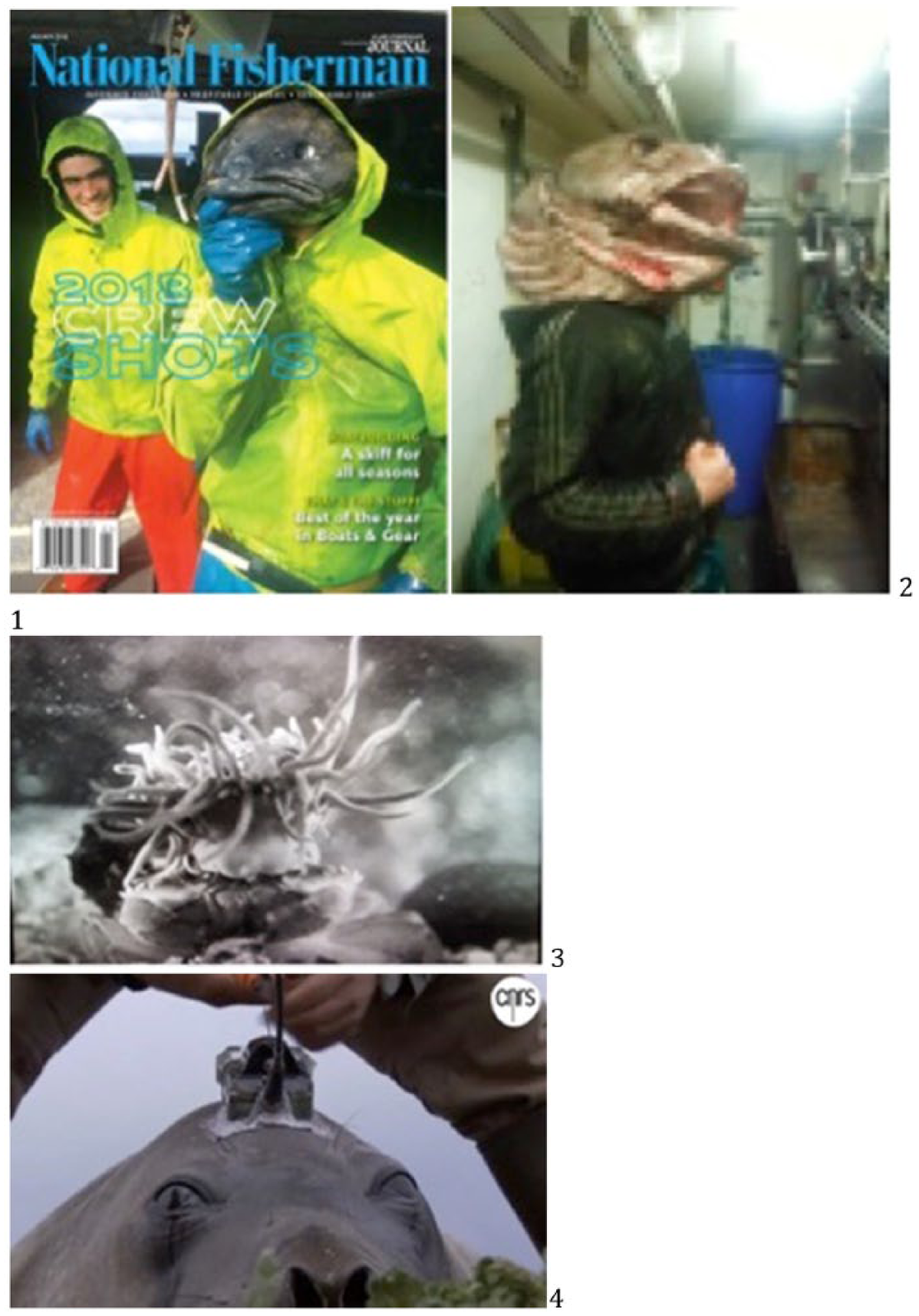
Facebook picture of commercial fisherman, Jean Painlevé, Crabes (1930) and the rigged technology used by the CNRS to sound foraging depths of the sea lions off Kerguelen Islands.
In the light of the many and diverse occurrences of trans-cephalized entities in the field of oceanic environments, we wondered what this meant in terms of misunderstandings and metamorphoses. This triggered some questions: are landers using ocean masks or is the ocean altering land bodies? Is the crab dreaming the anemone or the anemone dreaming the crab? Is the seal caught in the scientific dream or do these scientists end up getting caught in the seal’s dreams of unimaginable foraging depths?
Is the ocean caught in the dream of the Anthropocene?
The dream of those who dream involves those who do not dream. Beware of the other’s dream, because if you are caught in the other’s dream, you are finished. Can the subalterns dream? Of course, they can dream, they can ‘speak’, they can act. But can we be sensitive to the subalterns’ dreams and words? Can we listen? Can we see? Can we feel? In these conditions, should they speak to us, should they tell us their dreams?
We take the notion of subaltern as a grammatical shifter: a subaltern is always that which is not, in a given context, the suprasubjectivity, the overwhelming dream, the hegemonic discourse. Gaïa can be a subaltern in the industrial discourse. However, Gaïa is the suprasubjectivity in the anthropological discourse today. Gaïa is the planet, but from the perspective of the land. It includes the oceans, but as they are theorized by landers. Bergson has taught us that ‘time’ from the perspective of ‘space’ is not the same as ‘time’ from the perspective of ‘time’, and that our concepts are generally caught in the dream of ‘space’, a divided and discontinuous sensitivity. This is the same for the majority of our binary divides, there is always a privileged ‘view point’: the mind/body divide exists in the mind’s dream; the day/night divide is experienced in the day’s dream, land/ocean, industry/ecology, etc. Roy Wagner’s intuition was that anthropology had to think through the ‘anti-twins’ of the Western–human usual perspective, the limit being the perspective of death on life, or of Coyote on Roy. 17
We would like to suggest that oceanic sensitive-anthropology can provide precious sense-ideas in order to think, feel and imagine the contemporary ecological crisis. Considering our present as anything but an ‘end of the world’, and more as a profound transformative process, how can ocean-sense-ideas bring useful intuitions? How can ocean inhabitants, ecosystems and dynamics, teach us a lesson in imagination? Can we dream other dreams than that of industrial exploitation?
The ocean erodes the Anthropocene. The industrial-human is a highly visible and loud Earthshaper, but must they remain the main character (focal point) of all our narratives? Thinking and feeling with the ocean gives texture to the unease caused by the term ‘Anthropocene’, in which an abstract ‘human’ becomes the main character of a cosmic narrative counting the story of a generally abstract phenomenon shaping us and ‘them’. But at sea one loses one’s dominant position, and any earthshaping prerogative vanishes in the swell. One feels the mutual metamorphoses, the back and forth between Twin and Anti-Twin, between lander and oceaner, the whole politics of ‘shaping’, in which every living form participates within a locality. The ocean is full of shape-shifters.
– Can the ocean be a useful ‘situated knowledge’ in order to gather other shapeshifting paradigms in order to think differently the land’s transformations?
– Can ocean ecologies (organism-to-milieu and organism-to-organism relationships) teach us other forms of (s)cene-ing?
– If the ‘Anthropocene’ is the point of view of the land on the ocean, what would be the point of view of the ocean on the land?
– Taking note of Latour’s politics of nature, which aimed to rescind the split between society and nature, what would a politics of ocean add to the discussions? Can we think governmentality the same way on the ocean as on land? Who governs at sea?
As Deborah Danowski and Eduardo Viveiros de Castro have put it (2014: 328), there remains a tremendous work to be done by the contemporary imagination in order to come up with a mythology that suits its present.
Anthropocene mythology
The ‘Anthropocene’ was brought to public attention by a geological congress in Australia (34th International Geological Congress in Brisbane, Summer 2012). Interestingly enough, the concept was coined by a biologist (Eugene Stoermer) studying aquatic species (diatoms), on which anthropogenic processes were having dramatic impacts. Eugene Stoermer and Paul Crutzen (an atmospheric chemist) have popularized the term of ‘Anthropocene’ to an extent that it has sedimented into geological terminology (Crutzen and Stoermer, 2000: 41). The idea born in water evaporated into gaseous structures before solidifying into lithic imaginaries. And today we are finding more and more evidence of this ‘Anthropocene’ in the ocean, from coral bleaching and global warming to microplastics and microbiopolitics of deep-sea exploitation. But must we stick to these modes of attention? Is that all there is to see? What other stories can we thread out of this alter-ego of land? For example, do microplastics sediment or are they metabolized into inventive organic countermeasures? The ocean in a sense is timeless, or rather it is timed very differently from land: there are no marks of eras, those layers of earth that geologists divide in cenes. It is definitely affected by human activity, but how exactly does the ocean’s affective realm work ? What does the ocean do to those that interact with it? What does the ocean do to the ‘Anthropocene’?
To some extent, it seems as though anthropos as a whole has colonized every possible place on Earth, from the stratospheric scale of carbon emissions to the microscopic scale of metabolized plastics. The term ‘Anthropocene’ of course exemplifies this impression. The notion has been brought in question several times, not only by geologists, but also in the Humanities, bringing forth the critique that implicating anthropos as a species in the environmental transformations is not only erroneous, but also a deception, which erases power relations, socioeconomic disparities, and the primal role of industrialization, capital and fossil economies. Malm and Hornborg have shown that climate change was less an anthropogenic phenomenon than a ‘sociogenic’ one with uneven consequences. The abstraction of the human species implicated by the ‘Anthropocene’ indicates a dominance of the natural sciences’ narratives as well as a dark spot in critical thought and political horizons (Malm and Hornborg, 2014). The Anthropocene paradigm seems like an easy walk around a complex problem: measuring the extent of post-industrial markings in the environment is not enough. A constructive critique of our epoch doesn’t rely on further inventories, but in committed inventions conscious of the prismatic entanglements of our subjectivities with the landscape: making curiosity more common than tagging (see Swanson, 2017). In any case, as many have noted, it is a period that demands ‘response-ability’ (Haraway, 2007), and for Cymene Howe (Howe and Pandian, 2016), if the Holocene was our age for letters and agriculture, ‘the Anthropocene demands schooling in a more reflexive genealogy of circulation and reciprocity among humans and other beings caught up in messy meshes of intraconnectivity’ (Barad, 2007). In this sense, as Cymene Howe and Anand Pandian have noted, paraphrasing Levi-Strauss, ‘The Anthropocene is “good to think”’. 18 It has indeed been quite a stimulating paradigm to play with, fueling the imagination in need of proposing alternative namings to better point out the processes at work. Following a trend in the ‘proliferation of “alters”’, consisting in the variation of prefixes to replace ‘anthropo’ before -cene, Cymene Howe and Anand Pandian recently edited for the journal Cultural Anthropology a ‘Lexicon for an Anthropocene Yet Unseen’. 19 It is an inspiring list to reinvigorate the ‘many names of resistance’ (Demos, 2017): Anthrobscene (Parikka, 2015), Anthroposcene (Pandian, 2015), Corporatcene (Schneiderman, 2015), Chthulucene (Haraway, 2015), Eurocene (Grove, 2017), Misanthropocene (Clover and Spahr, 2014), Phytocene (Myers, 2015), Plasticene (New York Times Editorial Board, 2014), Androscene (Salleh, 2016), Prometheocene (Campbell, 2016), Entropocène (Stiegler, 2015), Simulocene, to name only a few. Cymene Howe and Anand Pandian suggest a Betacene in a desire to think forth for future designs where human no longer rhymes with alpha, but with ecological implicatedness and openness to revision and common creativity. What if the ocean were such a beta-cene, a radical alternative set from which to look at the scene of the land, an anti-scene that actually undermines the very notion of -cene, seldom put into question within the listed lexic of resistance. But, what about the geological paradigm? What about the (s)cenery implicated by the suffix –cene ? The ‘AnthropOcean’ paradigm suggests complex entanglements with another form of materiality and other ecological dynamics; the anthropos designates less the species as a fixed entity, than a process of anthropomorphism inherent in our projections and identifications with the world. However this anthropomorphism is simultaneously oceanized, morphed from multiple powerful perspectives. Our project is similar to that of Cleo Woelfle-Erskine and July Cole in ‘Transfiguring the Anthropocene’ in which they ‘pick up the thread of shifting, transing, relational humanimal materialities from the perspective of the beaver’ (Hayward and Weinstein, 2015). Eva Hayward and Jami Weinstein mention this essay to remind us that the Anthropocene paradigm guarantees the old ideology of manifest destiny, according to which the human species can but overpower nature, a homogeneous, neutral and useless space until it is conquered and laboured. The question then becomes less ‘what is the Anthropocene?’ than ‘what does it mean to be in the Anthropocene?’ This question raised by Valerie Olson and Lisa Messeri reminds us that a critical exploration of the Anthropocene implies an unrooting of its admitted spatiality. 20 Surprisingly enough, these unrootings have seldom been brought out to sea. Is there a real possibility for ‘latent commons’ (Lowenhaupt Tsing, 2015) in the ocean, where the industrial capitalist ruins can’t sediment? We wish to fill in the gap between the impressive literature in Ocean Studies and that in the Anthropocene Studies.
Guattari (1989) made a point about ‘returns’ while writing about the motives of ecosophy: ‘Tchernobyl and AIDS have brutally revealed the limits of technico-scientific powers of Humanity and the nasty turns [“retours de manivelle”] than “nature” can hold for us.’ 21 This ‘return’ is effective in a context where nature and culture are opposed, 22 and climate change is considered a kind of war. Considering sea-rising progress associated to land erosion on the Chesapeake Island called Tangier, Donald Trump promised the residents to build a sea-wall to stop the process, inspiring the TV journalist Stephen Colbert come up with this metaphor: ‘Yes, Trump is going to get them that wall, and then make the ocean pay for it!’ Guattari later exposes an example from the ocean: on French television, the businessman Alain Bompard shows two aquaria. The first one is filled up with polluted water – the same type of water one can find in a harbour like Marseilles – and hosts a dancing and lively octopus. The other one is filled up with pure ‘normal’ water. When Bompard grabs the octopus and puts it in the second aquarium, the animal stops dancing, curls up and dies. If the ocean ‘returns’, octopuses adapt and flourish in the evolved yet polluted milieu, but die in a fixed and stable environment. What this example shows according to Guattari is that nature and culture are more intermingled for other-than-human entities. This is not only a question about evolution and connectivity, but one about involution: octopuses are parts of a moving ecology from which humanity is in a constant struggle to extract itself. This ecosophy starting point focuses on relationships and revolutionary subjectivities. It shows that the Anthropocene seems more like a matter to compose with, or even a support for metamorphosis, than a steamroller.
Hence this issue stems out of a very dynamic contemporary field of research concerning extreme environment,(cf. Valentine et al., 2012) outer-spaces, and our ways of accessing these zones in an era (Anthropocene) of a generalization of industrial-humanness (‘late industrialism’, Fortun, 2014) within the very structure (timescale) and matter (geological strata) of our – only – planet. The challenge though seems to be to think and feel beyond our emplacement and embodiment. Thinking beyond the human, as Eduardo Kohn has explored, necessitates building new semiotic patterns (Kohn, 2013), and for Edward Casey ‘our sensing body, reflects the kinds of places we inhabit’ (Casey, 1996: 19). In his own words, more so than Earthlings are we ‘Placelings’: bodies and places are “connatural terms. They interanimate each other’ (Casey, 1996: 24; see also Tuan, 2001).
The wake of our story
‘Je dis qu’ils ont trouvé quelque chose de plus fort qu’eux. Ce quelque chose a un nom. Ce nom est : l’océan!’
Our aim with this special issue is to build an underwater architecture, both autonomous and connected to its exterior environments; both resistant and undetermined; nourished and nourishing; a conceptual habitat that takes the risk of deep-sea pressure and ocean swell in order to find inspiring and efficient ways to shape-shift according to ocean -based dynamics and proposals. We sought a range of contributions that would cross the ocean surface with different inclinations and speed, proposing a wide spectrum of chromatic displays with its materiality. The width of this spectrum that we were able to gather remains herein of course limited; however, it is meant to be an open-host proposition, an ecological niche for further ocean sense-ideas that would find it a suitable habitat. We hope to participate in the biodiversification of concepts and explorations dedicated to suggesting alternative relationships to the world than that of exploitation. We think that the fluid sensitivity of the ocean may open novel approaches to our land ecologies. The following articles, or chapters in the bigger story, are all steps towards an ecology of ocean-mind.
Through the articulation of these contributions we aimed to tell you a story: the story of a journey through the materialities and politics of ocean ecologies (Figure 7). You will find field-based analyses as well as inspiration drawn from literature and cinema; scientific and artistic approaches; from micro to macro scales; through intimacy and remoteness. We tried to put all these texts in resonance with one another so that in the end what should remain is a taste of seawater at the back of the tongue. The story is articulated around a narrative proposition that aims to exemplify the notion of ‘wake’ as a fruitful concept to think ocean-morphism, but also to put forward the dreaming as an ethnographic research method. The notion of ‘wake’ linked with that of Anthropocene can also be found in a recent essay by Josh Lepawsky, ‘The Wake of the Anthropocene’ (Lepawsky, 2016). Lepawsky’s text deals with ‘offworld rubbish’, the remainders of human activity in outer space, which he names the wake of the Anthropocene. Following Latour’s analyses of Sloterdijk’s spheres and envelopes, defined as ‘life support systems’ or the Umwelt allowing human life (Latour, 2011), Lepawsky defines them as wakes to which we need to become more sensitive. Just like bioluminescent dinoflagellates reveal the wake of a ship or of a submarine, Lepawsky calls us to build ‘visual inventories of offword rubbish’ which would reveal the traces of our messy envelopes. Today, rubbish is increasingly rendered more obvious in the ocean. The wake reveals our movement, but most interestingly it reveals our movement in respect to a specific milieu, which in return affects our movements and alters ‘our’ wake. Marine biologists specialized in fish movement have started analysing the wakes of fish in the water instead of directly observing the movement of their fins (Drucker and Lauder, 2002: 243–257). Muscular force on land can be measured directly with force plates. But the force exerted through fluid must be measured through the study of the hydrodynamics of the moving body. The attention to the relationship between propulsor activity and water movement in the wake brought up new sensory pathways revealing different aspects of ‘the wake’: its geometry, structure, morphology and interaction among fins. This special issue aims to propose such ‘wake visualizations’ of the multiple and shared passages through ocean-milieu.
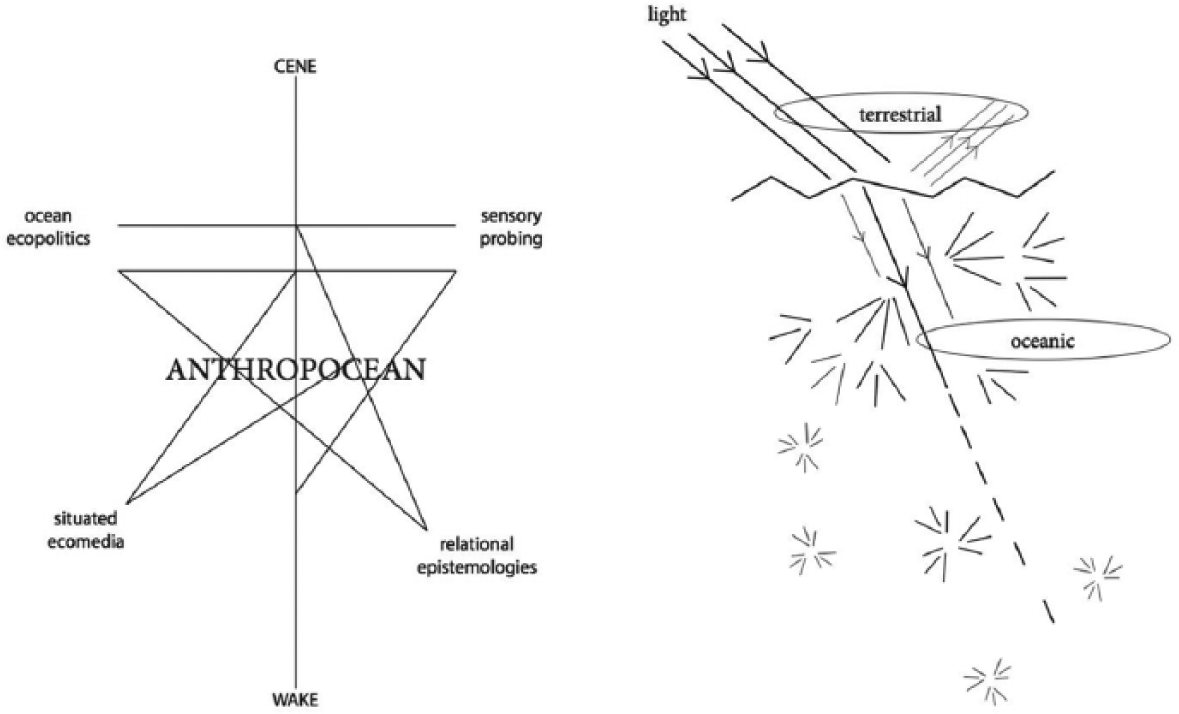
Graphic proposition of the special issue by authors
Contributions
Marine route 1: Epipelagic sensing – getting familiar
Ocean ecopolitics 1 – returning the map
We chose to open the issue with a literal revolution of spaces: the ocean is constantly returning. The ocean is the other side of our terrestrial map
Industry and waste sedimentation on Earth epitomizes this idea of the surface of a planet being made by anthropos, through accumulation of matter under the feet of the inhabitants. The action of this cenefication is the one of a destruction giving – in return – poor conditions of existence for the beings of this planet, inequalities, environmental racism (Pulido, 2000), disparition of species. In the ocean the impact is different and more like a ‘return’, since the milieu won’t fix our shit so we can erode it in the end. This movement finds a good incarnation in microplastics oceans, in poisonous materials within fish flesh, in hurricanes devastating cities. Probyn here explores what this return/regurgitation means not only for a unified ‘anthropos’ but in terms of domination and exploitation, class and gender. The example of mercury as the main character of Probyn’s studies gives us a glance of these intermingled interspecies intrications in a marine–terrestrial context. The ocean affects time and space as we knew it from the perspective of linear and eroding land: nothing disappears, everything can come back.
Relational epistemologies 1 – inverting the focus
The ocean returns, marks and opens novel spaces of interaction. What then can we identify as agency?
David Scheel’s article offers insights on the forming of relationships between non-human individuals and humans. A few years ago, while looking for examples and prospectives of the human colonization of the ocean, we ran into a story of an interaction between an octopus and a diver showing, in a way, that octopuses happen to be aware of agency and the other’s (diver’s) perspective. This was in En Avion sous la Mer, a book by Dimitri Rebikoff, part of the Cousteau crew, and inventor of underwater camera and transportation devices. The inventor described the interaction between a spearfisher, ‘Loulou’, and his prey, an octopus from the Cap d’Antibes. As soon as the octopus would see the diver coming, it would take a bright red Italian hand grenade which was lying on the seafloor, and put it on its head, between the arrow and itself like a last chance shield. The octopus noticed this made the diver-predator swim away. Everytime Loulou swam away, the octopus replaced the grenade with the other stones and objects it had gathered in its own ‘miniature blockhaus’, as Rebikoff calls it. And everytime Loulou came back to hunt the octopus, the same interaction happened. The intuition of the divers was that the octopus triumphantly found a tactic to get rid of the hunter, like the legendary stubborn Spanish captain that sunk his own ship in the Tobermory bay, prefering to destroy the treasure than to give it to the Hebrideans. Either the diver explodes with it or he snorkels away. What David Scheel from the Alaska Pacific University tells us in his article, is that this intuition has some scientific validation, since octopuses also seem to act in roles and recognize each other as individuals. Their body patterns anticipate their actions, revealing intentions they have acted on the presumed visual perspective of the diver. This suggests awareness of itself in relation to the diver and the diver’s perspective. Scheel raises a fundamental question: ‘are human–octopus relationships also octopus–human relationships?’, inviting us to invert our perspectives within relation-making processes with ocean inhabitants.
Marine route 2: Mesopelagic sensing – sounding the unfamiliar
For this special issue we wanted to include a number of theoretical provocations: Robertina Šebjanič Melody Jue, and ourselves suggest in this section some speculations for further exploration. These works are situated at the intersection of art, technology and science, both through fieldwork and aesthetic attentiveness. Robertina Šebjanič offers us the perspective of a multimedia artist on the transdisciplinary and collaborative approach we wish to advocate through this special issue. In our text, both as ethnographers and filmmakers, we engage with sensorial metamorphoses at sea. Following Stefan Helmreich’s work on the double meaning of ‘sounding’ the ocean, and his ‘athwart theory’, remembered in Elspeth Probyn’s contribution, this section wishes to connect unexpected perspectives around the notion of ocean ‘sounding’. Therefore we asked Melody Jue if she could provide a short text in order to open novel and provocative questions concerning media in the AnthropOcean.
Relational epistemology 2 – steps towards an ecology of the aquatocene
Stepping back from an anthropocentric approach of the notion of Anthropocene’, Robertina Šebjanič suggests a perspective from a shared Umwelt between artist and jelly fish. As a multidisciplinary artist–researcher, Robertina Šebjanič chose to engage directly with the ocean ecomediative properties of sound. Her work explores the effects of our anthropogenic productions within other’s praxi-sensorial worlds (Umwelt) not through moral considerations but through interactive experiences with auditory vibrations. Sounds and soundscapes have been the field of recent engaging artistic works about inter-species ecologies (such as Bernie Krause and his Great Animal Orchestra (2017), or Boris Nordmann and his Blind Trips workshops (2015)). Robertina Šebjanič chose to create her own protected ecologies by sharing an auditory space with jellyfish. Through her works and preparatory research notes she teaches us the way towards cnidariomorphism in the making of an aquatocene.
Situated ecomedia 1 – narrating the territories
Our own contribution is a narrative proposition around the question of being a-wake at sea: both to be wakeless, or a-wakening in the sense of wake erasers. In Derrida’s text ‘And Say the Animal Responded’ 23 (Derrida, 2008), Derrida noted that leaving a trace is always erasing another, but that in our Western minds, we think of ourselves alone as the master subjects or subjecting subjects, that is to say, only we have the power to destroy ‘their’ traces. Again we follow Deleuze’s warning: never get caught in the other’s dream, or wake. Henri Michaux expressed his frustration while crossing the Atlantic on a ‘big blind’ cargo ship (Michaux, 1929), complaining that he couldn’t see a thing, and that humans always try to put themselves ‘on top of Nature, and never into it’. Michaux wanted to open relations with the maritime world – which is under the surface – he wanted to immerse himself and to share the dreams of the algae in an underwater hotel. 24 The materials we bring up are fieldwork ethnographic notes from time spent on boats and transcripts from interviews. We chose to focus on those who work on and within the ocean, in France, in order to target the thin membrane between the hostility of industrial logics and the hostility of an alien milieu. Inspired by Helmreich’s explorations as an anthropologist underwater, we propose a manifold dream in ocean ecomedia.
Situated ecomedia 2 – submerging the media
Our telepresence in the ocean requires thinking the articulation of bodies and milieu in submerged ways. Melody Jue is an ocean-based philosopher. Through multiple texts she has unraveled the shared epistemologies of media and seawater, which invite us to pursue David Scheel’s text with a cosmogonic underlying question: can there be an Anthropocene for the Vampire Squid? 25 Jue’s insights on the shifting perspectives provided by ocean-based philosophies are crucial to our approach in this special issue. For this contribution Melody Jue brings up a series of questions raised by the Google mapping processes in the ocean in order to invert the usual conversion of underwater spaces to urban mapping patterns. Instead she suggests that natural media and digital media can retrospectively be made indistinct in terms of recording potentials, and proposes an enviro-material consciousness of ecomedia critique in which the usual teleological theory of media is complicated by mixed temporalities. The ‘cnidaria-chronology’ reveals the remediation processes inherent to the eco-multiplicity of the archive and its reshaping dynamics thus inviting us to think through ‘milieu-specific analysis’ in order to become sensitive to allo-morphisms. This is an important shift with which the entire AnthropOcean concept is aiming to play with. If coral are information-bearing structures, what might it mean to track the wakes of these other-than-human dynamics? Instead of taking for granted Kittler’s claim that media determine our situation, Melody suggests methods and vocabulary revealing the wake of ‘agential world-making’, hence opening the path for new mapping processes.
Marine route 3: Bathypelagic sensing – co-mapping
Sensory probing 1 – sharing the soundscapes
How do these media-narratives compose new mapping processes?
Michel André is a scientist and engineer in bioacoustics, specialized in the sounds of marine mammals. Michel reveals to us the complex realm of ocean soundscape thanks to an online application, LIDO, which allows us to listen to deep ocean sound environments all over the world. Along with his work in the changing geopolitics of the melting Arctic, these probing devices make sensible the territorial struggles occurring in the ocean, notably between humans and other sound-sensitive species. Invertebrates as well are beginning to be considered within these politics of noise as new cephalopod pathologies linked to noise-induced lesions have been detected. Through sound-probing devices, Michel André’s work participates in the construction of Noise Descriptors for future framing of marine strategies. The attention to sound ecologies brings up new cartographies of inhuman kind, crucial to our general project towards kinship driven cohabitation.
Ocean ecopolitics 2 – opening the spectrum to the scale of ocean governance
Mapping decision making for ocean legislation opens the issue to the political dimension of macroscale perspectives as revealed in Michel’s hydrophone map. With Apolimer we read through field notes of a team tracking the political decisions linked to ocean governance. They develop multisite methods for a political critique of oceanography, building out of a plurality of agencies constructing ocean space; questioning the place anchorage of fieldwork in political anthropology. Apolimer’s singularity is to put together biologists, chemists and social science researchers doing fieldwork together, telling the story of ocean governance through scientific and political decisions. Their work on ocean governance aims at considering political and environmental, human and non-human agencies or frictions on a same scale level. We chose to publish here an excerpt from field notes, to show this attention they provide while studying the ‘politics of the oceanography’, but also to share the voice of a political anthropo-ecology in the making.
Sensory probing 2 – perceiving from remoteness
Whatever the scale of our attention and the remoteness of our sensing, the ocean returns
In the opening to this special issue, Elspeth Probyn reminded us of the strong symbolic impact of gigantic waves. It seems to us that Stefan Helmreich, unaware of Elspeth Probyn’s statement, took this note seriously, and offers us a vast overview of wave-imagination through visual culture. Waves embody the response-ability of the planet to our anthropo(s)ceneing, but wave temporality and dynamics also bring new intuitions to the notion of crisis we are facing today. If waves unground the fundamental orderings of geological logics, they are also involved in processes of domestication. Domestication is always a two-way process; therefore if we are able to detect more and more responses from the ocean, maybe this is a sign of an ongoing metamorphosis. With Stefan Helmreich’s article, we chose to conclude with the radical ambivalence highlighted throughout the entire special issue regarding our relationship to ocean ecologies.
Footnotes
Funding
This research received no specific grant from any funding agency in the public, commercial, or not-for-profit sectors.