




Abstract
This study examines Mozambican citizens’ positions regarding corruption amnesty laws. A series of realistic vignettes was presented to 303 Mozambican adults who were asked to rate the extent to which amnesty applicants deserved to be amnestied, according to three factors: (a) the applicant’s status (e.g. former minister), (b) the amount of money embezzled, and (c) the applicant’s attitude during the hearing (e.g. revelation of important information). Three qualitatively different positions were found. For 30%, officials convicted of corruption would never deserve to be amnestied. For 28%, repentant attitude was the only determinant of acceptability, and for 42% the amount of money embezzled also mattered.
This study examines the extent to which Mozambican citizens judge corruption amnesty laws to be acceptable. Amnesties are ‘laws or executive policies designed to remove criminal and/or civil sanctions from specified categories of offenders or offences’ (Mallinder and McEvoy, 2011: 109). From the end of the Second World War, diverse types of amnesties have been granted by transitional regimes to former perpetrators of violence as a way to end bloody conflicts and/or to ease the transition to democracy (Ludwin King, 2011; Mallinder, 2007). Nevertheless, amnesties have not been restricted to post-conflict situations. They have also been used as a mean to facilitate the shift from intractable situations in a society (e.g. full-scale corruption involving the police) to more tractable ones (David, 2010). In the USA, for example, many states have, since the beginning of this century, repeatedly issued tax amnesty programmes that allow taxpayers to report and pay tax liabilities and clean up their tax record without paying fines and interests (Weinreb, 2009). The present study focuses on political amnesties for corruption, and on people’s views about them.
Corruption
Corruption has been defined either narrowly or more broadly. According to Treismann (2000: 399), it is ‘the misuse of public office for private gain’(see also Werlin 1973; Shleifer and Vishny, 1993; Svensson, 2005). Osoba’s definition (1996: 372) is, however, more complete: Corruption is ‘a form of antisocial behaviour by an individual or social group which confers unjust or fraudulent benefits on its perpetrators, is inconsistent with the established legal norms and prevailing moral ethos of the land and is likely to subvert or diminish the capacity of the legitimate authorities to provide fully for the material and spiritual well-being of all members of society in a just and equitable manner’.
When the first definition is considered, the case of a government leader who distributes to wealthy schools of the main cities a sum of money originally intended to build schools in rural villages, knowing that residents in these rich quarters provided support during his electoral campaign, is undoubtedly a case of corruption. However, the case of a busy citizen who offers to give money to a policeman in order to escape being fined for speeding violations is not a case of corruption. In contrast, when the second definition is considered, both cases would be cases of corruption.
People’s views on corruption
The extent to which the public considers specific behaviours by state officials, professionals or citizens as corrupt (or unacceptable) has been studied. Lascoumes and Tomescu-Hatto (2008) showed that 90% of a sample of French participants considered unacceptable the communication by an employee of a list of clients to a competing company, and 87% considered it unacceptable to offer money to a policeman. Other breaches to the ‘prevailing moral ethos of the land’ were, however, considered more acceptable such as obtaining a letter of recommendation from an elected official for having one’s children enrolled in a specific school (83% judged it acceptable) or joining a political group just for obtaining social housing (50% judged it acceptable). According to these authors, 61% of their participants were highly tolerant of favouritism.
The Latin American Public Opinion Project (2011) in Colombia reported that 96% of a sample of Colombians considered it unacceptable that an elected official received a huge amount of money from a company or that a policeman agreed to look the other way in exchange for a bribe by a reckless driver. As in the previous study, however, lighter breaches were more tolerated. For example, the case of a person who offered a small amount of money to a civil servant in order not to have to queue was judged acceptable by 65%.
Gong and Wang (2013) showed that 28% of a sample of Hong Kong students expressed ‘zero tolerance’ for corruption in academia, business or government, although 5% of them expressed tolerance, and the remaining participants had a limited but ‘non-zero’ level of tolerance. Yu et al. (2013) showed that a sample of Taiwan citizens considered that vote-buying by elected officials during political campaigns was worse than lobbying by corporate executives or bribing public officials. Kpanake et al. (2014) showed that a majority of a sample of Togolese patients thought that informal payments for healthcare was an acceptable practice when patients were wealthy and physicians were underpaid. Baji et al. (2013) reported similar findings from a sample of Hungarian patients.
Finally, López López et al. (2017) examined the impact of three factors describing acts of corruption. These factors were (a) the position in society of the target person (e.g. an entrepreneur); (b) the main motive underlying bribery (e.g. monetary gain); and (c) the means used by the target person to achieve his/her ends (e.g. threatening the person). A majority (60%) of their sample of Colombian adults expressed a zero tolerance position, 32% expressed a limited although non-zero level of tolerance, 7% considered that it depended on the means used – illegal information sharing was largely tolerated – and 1% considered that such acts were always acceptable. The authors concluded that ‘although only a small minority of participants agreed with the last two views, it is probably enough to create a climate of suspicion in the country’ (2017: 259).
To sum up, many people in most circumstances express intolerance to corruption. Some people, however, express tolerance to corruption, especially when the consequences of the behaviour were apparently benign (e.g. offering money to a civil servant in exchange for minor services) or when there were extenuating circumstances (e.g. bad governance).
A conflict of ethics
Understanding people’s positions regarding corruption by simply invoking cultural or circumstantial factors is not sufficient (Treisman, 2000). Full understanding requires putting this phenomenon into perspective by considering the broad context of human evolution (Fox, 2011).
Tribes are the first societal structure in which Homo developed and evolved (Marshall Thomas, 2006). Living in tribes offered key survival advantages, namely protection from predators and from neighbouring tribes, and protection from natural catastrophes. In such a context, anything that allowed members of the tribe to survive or simply to live better was deemed appropriate whatever the means that were used to get it (foraging in the open field, fair exchange with members of neighbouring groups, deliberate theft, bloody fighting or killing). Failing to do so was deemed bad. Stated briefly, ethics was, in the remote past, defined in terms of tribe members’ survival. This implicit definition of ‘appropriate behaviour’ has lasted until very recently and has durably shaped the human mind (Fox, 2011).
As societies have become larger and more diverse, codes of ethics have considerably evolved (Besley, 2006; Gintis et al., 2005; McCoy and Heckel, 2001). Bringing food to tribe members through fighting with other families is nowadays deemed inappropriate and blameworthy. Failing to struggle with neighbouring groups in order to steal their weapons is now deemed appropriate. The perspective has reversed. At the present time, persons in charge (e.g. government leaders) are expected to behave in the interest of all members of society (e.g. the nation). Failing to do so by favouring the family is deemed bad. Civil servants are, in turn, expected to implement the laws irrespective of family ties and to provide everybody with the same quality of services.
In some parts of the world, this new ethics has largely, but not completely, superseded tribal ethics. In other parts of the world, tribal ethics is still largely dominant, even among ‘educated’ people. In both cases, anyway, the two ethics have adjusted to one another. Their commands may in some cases truly converge. For example, if parents spend, through personal inclination, more time with their own children than with other children, and take care of them with great affection and dedication, there is nothing inappropriate in that (Gilligan, 1982; Shweder, 1997). Tribal ethics, therefore, which demands that people take care of their relatives more than they take care of strangers, remains, in many cases among family members, largely valid (Haidt, 2012). Another example of convergence is when persons make a lot of money illegally without sharing their wealth with their close relatives or with other members of their extended family. From both ethical perspectives, such behaviour is deemed bad, although not for the same reasons.
The commands of tribal ethics and of modern ethics may in other cases fully differ. When a public administration needs to recruit civil servants, its head (the minister in charge) is expected, according to the commands of modern ethics, to publicize job vacancy and application procedures. According to the commands of modern ethics, failing to do so would be deemed condemnable. According to the commands of tribal ethics, however, the minister would be expected to give priority to the citizens who belong to his/her extended family: failing to do so would be deemed bad. The minister is not only expected to withhold information but also to discretely communicate interview topics. In truth, full compliance with the commands of tribal ethics would in this case require the minister to directly name the new civil servants without going through any public procedure.
Our view is that many cases of what we class as ‘corruption’ can be analysed as resulting from a clash between (a) the code of ethics that has governed Homo’s views and behaviours from time immemorial; and (b) a newcomer, the ‘modern’ code of ethics that, owing to its ‘modernity’, is only slowly gathering momentum in our societies, explaining why tribal ethics remains the dominant code in many places and in many domains, and even among well-developed societies (Persson et al., 2013). Nowadays, and although ‘tribes’ have taken the form of nations, religious groups, military alliances, political parties, trade unions and corporations, to quote only a few, the out-group versus in-group distinction (Tajfel, 1974) that characterizes their philosophy remains valid.
Sticking to partial views regarding what we call corruption would, therefore, bind us to misunderstanding this global and resilient phenomenon. Taking the minister mentioned above simply as a ‘rotten’ representative would be naïve. For people forming part of his/her extended family, this person, far from being viewed as a corrupt individual, is certainly perceived as an affectionate and sensitive man of power – that is, as a potent member of the group who, through his/her conduct, has truly substantiated his/her claim to represent it. In addition, this same individual may, simultaneously, feel proud for having favoured his tribe and feel miserable for not having followed the principle of justice that is inherent in the modern code of ethics. In other words, the clash between the two codes of ethics may be, at least in some people, internalized.
A broader view regarding what we call corruption should, therefore, incorporate an analysis in terms of conflict of ethics. In developed societies, many – if not all – cases of corruption result from the (mis)application of tribal ethics (e.g. recruiting one’s cousin) to cases requiring the application of ‘modern’ ethics (e.g. recruiting the best applicant after a public contest has been organized) (Newell, 2008). Most people tend, according to the authors mentioned above (e.g. Lascoumes and Tomescu-Hatto, 2008), to agree with this view.
There are, however, cases, even in modern societies, where the application of tribal ethics has been advocated as more appropriate than the application of the principle of justice. When policemen dare to denounce cases of abuse by their colleagues, they are generally blamed as severely lacking solidarity (with members of their in-group), and they may be ostracized by their colleagues for a long time. When journalists release information on illegal activities by their country’s government, they are usually at risk of being prosecuted as traitors (vis-à-vis their compatriots). When politicians open their countries’ borders to migrants flying from war zones, they may be accused of political weakness and may even lose their voters’ support (Ivković and Sauerman, 2015; Henley, 2018).
Political amnesties
Political amnesties of all kinds, namely those that have been of benefit to former members of violent governments or to corrupt managers, have always been heavily criticized (Espindola, 2014). As perpetrators of serious offences who have been amnestied can no longer be prosecuted, amnesties have often been considered as basically unjust (Ricœur, 2004). As most beneficiaries of amnesty are unwilling to show any indication of remorse even if they have committed what international law considers as crimes against humanity, amnesties have often been considered immoral (Baron, 2015). As many supporters of authoritarian regimes have used their position to amass fortunes, amnesties have been viewed as economically – and socially – inappropriate. As these people are not necessarily willing to admit that their conduct was immoral and as their supporters – members of their extended family – would keep following them anyway because they share their views and have benefited from their actions, amnesties have even been denounced as dangerous: wealthy, unrepentant amnestied people may become a threat to democracy if they are not properly deterred from resuming their ways (McEvoy and Mallinder, 2012).
The rationale behind political amnesties is that they are deemed to be necessary for the greater good of a society. As Ludwin King (2011: 577) suggested, ‘national leaders often face the task of weighing the peace they believe will result from an amnesty against the justice that results from holding trials’. In extreme cases, former powerful heads of state, guilty of mass killings and other crimes, have firmly requested that amnesty was granted to them and their accomplices before any peace talks could take place (Nalepa and Powel, 2016). Despite these instances of extreme tension between conflicting duties – insuring that justice is done versus trying to restore some measure of order and peace – some people strongly disagree with amnesty policies in all cases. In their views, a state has always the duty to prosecute criminals, even if the prospect of prosecution will make violent heads of state determined to escalate the conflict rather than surrender (Nalepa and Powel, 2016).
As suggested by Harari (2014), the tension between justice and order has been around since the beginning of civilization. Whether people pay more attention and lend more weight to order than to justice or more attention and more weight to justice than to order in this world, they are bound either to support amnesties, which restore some order and peace, or to view them as an evil perpetuation of injustices.
If many studies expressing political scientists’, philosophers’, or lawyers’ views on political amnesties have been published (Wilson, 2001; Cobban, 2007; Drumbl, 2007; Du Bois-Pedain, 2007; Verwoerd, 2007; Mallinder, 2008; Freeman, 2009; Hayner, 2010[1970]), very few studies reflecting laypeople’s views on political amnesties are available. Using a simulation paradigm, Gibson (2002), working in South Africa during the years following the end of the work of the Truth and Reconciliation Commission, examined the factors influencing peoples’ judgements as to whether a political amnesty was fair or not. He presented Black Africans, Coloured Africans, Africans from Asian-origin and White Africans with 16 vignettes describing an amnesty situation where the level of four between-subject factors were systematically varying: (a) whether victims had been properly compensated for the harm inflicted or not; (b) whether victims accepted the apology that was offered by the applicant or not; (c) whether victims had the opportunity to voice their grief publicly or not; and (d) the extent to which applicants suffered as a consequence of the revelation of their past behaviour. Overall, 50% of participants – 72% of the members of the Black group – agreed with the granting of amnesties when all four factors of justice were present. Sincere apologies from applicants and the opportunity for victims to tell their story impacted as much on fairness judgements as monetary and punitive factors (Gibson, 2004).
Kpanake and Mullet (2011), working in Togo during the months following the death of the former dictator in 2005, examined, in a similar way, the relationships between the varied circumstances in which amnesties were granted and people’s judgements of their acceptability. They presented their participants with 48 vignettes depicting a former police officer testifying in front of a commission to receive amnesty. The vignettes’ composition was based on a five within-factor design: quality and quantity of the information that amnesty applicants were willing to reveal, presence–absence of sincere apologies, opportunity given to victims to tell their story, compensation for the harm done, and level of punishment for amnesty applicants. Overall, in only five cases (out of 48), acceptability ratings were positive. For an amnesty to be judged acceptable, (a) sincere apologies must be present – that is, applicants were expected to demonstrate that they have realized that their political conduct was wrong; (b) very important facts must have been revealed – that is, applicants were expected to demonstrate their willingness to contribute to the truth seeking process; and (c) at least two of the other three factors must have a positive value (e.g. applicants have personally suffered as a result of their misconduct and victims have been compensated).
The present study
The present study aims at complementing these previous works by focusing on amnesties for corruption. As stated earlier, the study is about the acceptability, in Mozambican people’s views, of the corruption amnesty laws that the current government was considering passing. In Mozambique, a first Anti-Corruption Law was passed in 2004 (Procuradoria-Geral da República de Moçambique, 2004). A specific anti-corruption body (Central Office for Combating Corruption) was set up and its mission was to conduct investigations into suspicion, complaints and allegations of corruption. This institution was, however, largely under the control of political and governmental power. As a result, its effectiveness in fighting corruption had been strongly questioned by non-governmental organizations specialized in this field (Centro de Integridade Pública, 2017).
As suggested above, corruption mostly results from the application of the principles of tribal ethics to situations in which most people expect the application of modern ethics. From this standpoint, corruption includes acts such as petty bribery, misappropriation of public money, extortion and nepotism (Argandoña, 2006; López López et al., 2017). According to the International Monetary Fund (2016), between 1.5 and 2 trillion dollars are paid each year in bribes around the world, and the total economic loss from corruption is estimated to be many times that number, a figure that dwarfs the value of all development assistance.
In Africa (the continent in which the present study was conducted), there is considerable evidence that the operations of foreign actors are the main source of significant illicit financial flows (Dutt and Traca, 2010; Kar and Cartwright-Smith, 2010). For example, between 1995 and 2014, out of 1,080 cases of cross-border corruption reported in this continent, 99.5% concerned non-African companies (United Nations Economic Commission for Africa, 2016). The multinational corporations in the extractive sector appear as the main corrupting agents (Bhattacharyya and Hodler, 2010), and the multinational banks are points of passage to other continents for money derived from African corruption, namely money resulting from embezzlement of public funds and bribes received by local corrupted government officials (Boyce and Ndikumana, 2012; Kar and Cartwright-Smith, 2010; AlixPartners, 2015).
According to Transparency International (2015), Mozambique ranked 112th out of 168th on the Corruption Perception Index. The government recently admitted (Hanlon, 2016; Macauhub News Summarized for Mozambique, 2016) that public debt would reach 130% of the gross domestic product (GDP), that poverty and inequality would increase, that inflation would hit 30% and that devaluation would exceed 100% (Hanlon, 2016; Macauhub News Summarized for Mozambique, 2016). Moreover, because of government mismanagement and corruption, the International Monetary Fund which, in the past, funded the national budget through aid for development programmes, ceased to do this in November 2015 (Hanlon, 2016). Developed countries have also halted their development assistance programmes.
Given the failure of the fight against local corruption, which, in our view, is largely linked to the fact that tribal ethics is still largely operating in many people’s minds (Charron, 2011; De Maria, 2010), and given an increasing citizens’ sensitivity to the issue of top-level corruption owing to the adverse economic context (Zechmeister and Zizumbo-Colunga, 2013), a public debate has been going on in Mozambique as well as in other African countries (Vera Cruz, 2016) about the possibility of passing corruption amnesty laws that, under certain conditions, would benefit the authors of past corruption offences. After a period of some months, zero tolerance measures would then be introduced.
The rationale behind corruption amnesty laws is that, owing to their very nature (a conflict of ethics), ‘corrupt’ practices are generalized and there is no will or no possibility to change them. Those theoretically in charge of fighting corruption are themselves corrupt and, consequently, at a high risk of being denounced in turn. Corrupt people are, in some way, trapped in a prisoner’s dilemma game (Gorsira et al., 2018) in which the most favourable outcomes are obtained if nobody in the community unveils the numerous secret pacts that link or have linked officials and officials, officials and entrepreneurs, and entrepreneurs and entrepreneurs (Hudon and Garzón, 2016). As a result, dramatically altering the rules of the game would be the only way to unblock the system.
Amnesty laws are precisely aimed at altering these rules. The mechanism by which corruption amnesty laws can work has been well described by David (2010: 405): By its nature, collective amnesty instantly reduces the ratio between the corrupt and non-corrupt officials by the inclusion of those who are willing to accept the second chance offered to them. At the same time, it creates uncertainty among the officials who hesitate to accept the second chance since their fellows may go forward to report cases of corruption, as demonstrated in Hong Kong throughout the year after the amnesty was declared. This effect may be enhanced when the amnesty is conditional on the exchange of information. The interaction of these factors may intensify the snowball effect to overcome the threshold after which corruption can be contained.
For the effect described by David (2010) to be initiated, it only takes a small number of ‘corrupt’ officials and entrepreneurs who ask to benefit from the amnesty laws. These people might be the ones who have experienced the strongest internal moral conflict described earlier. Corrupt people are not necessarily seen as evil people. They are people who, for a plurality of reasons, either have decided or have had no other choice than to rely on tribal ethics codes in situations in which most people in the Western world expect modern ethics codes to be applied. Corruption amnesty laws offer them an opportunity to go from a situation in which tribal ethics is the moral of reference to a completely different situation in which modern ethics becomes the moral of reference. Reducing psychological conflicts by adopting behaviours that are in conformity with modern ethics may be a strong incentive. Once the process is initiated, it may gather momentum and it may bring people, whose motivations were essentially to escape prosecution, to join the initiative. As the key to the success is a global change of dominant moral perspective in a society – that is, not only among officials and entrepreneurs but also among all citizens – the conditions under which such a change is possible must all be present. In particular, citizens in a country must understand that corruption amnesty laws have the potential to positively alter the behaviour of people in charge, and agree with their implementation.
In order to gather at least some empirical knowledge regarding Mozambican people’s possible reactions if amnesty laws were to be implemented, we decided to use a technique similar to the one devised by previous authors (Gibson, 2004; Kpanake and Mullet, 2011). A set of vignettes was created by varying the levels of three factors considered to be relevant: (a) the applicant’s level of responsibility (e.g. former minister or director of a state-owned enterprise); (b) the amount of money embezzled; and (c) the applicant’s attitude during the hearing (whether he/she apologized and cooperated or not).
We expected to find at least two different positions among participants regarding the acceptability of corruption amnesty laws in each condition. The first one would have reflected the primacy of justice over order mentioned above (Ricœur, 2004). People holding this position would have rated the amnesty as unacceptable in all situations; that is, irrespective of circumstances. The second one would have reflected the primacy of order over justice (Espindola, 2014). People holding this position would have taken into account the information in the vignettes. In particular, when applicants apologize and cooperate – that is, when they demonstrate that they are aware of having been trapped into a moral system to which they have never adhered or to which they no longer adhere – acceptability ratings would have been higher than in opposite cases.
Method
Participants
The participants were 303 unpaid volunteers from Mozambique; 153 lived in the south of the country (Maputo, Gaza and Inhambane provinces), 85 lived in the centre of the country (Sofala, Manica and Tete provinces) and 65 lived in the northern part of the country (Zambezia, Nampula, Cabo Delgado and Niassa provinces). Their ages ranged from 18 to 57 (M = 27.58, SD = 10.11). Other demographic characteristics are shown in Table 1. Compared to the general population in the country, women and people older than 30 were underrepresented, while young people (16–28) and the more educated (high school and more) were overrepresented.
Demographic composition of the sample and of each cluster.
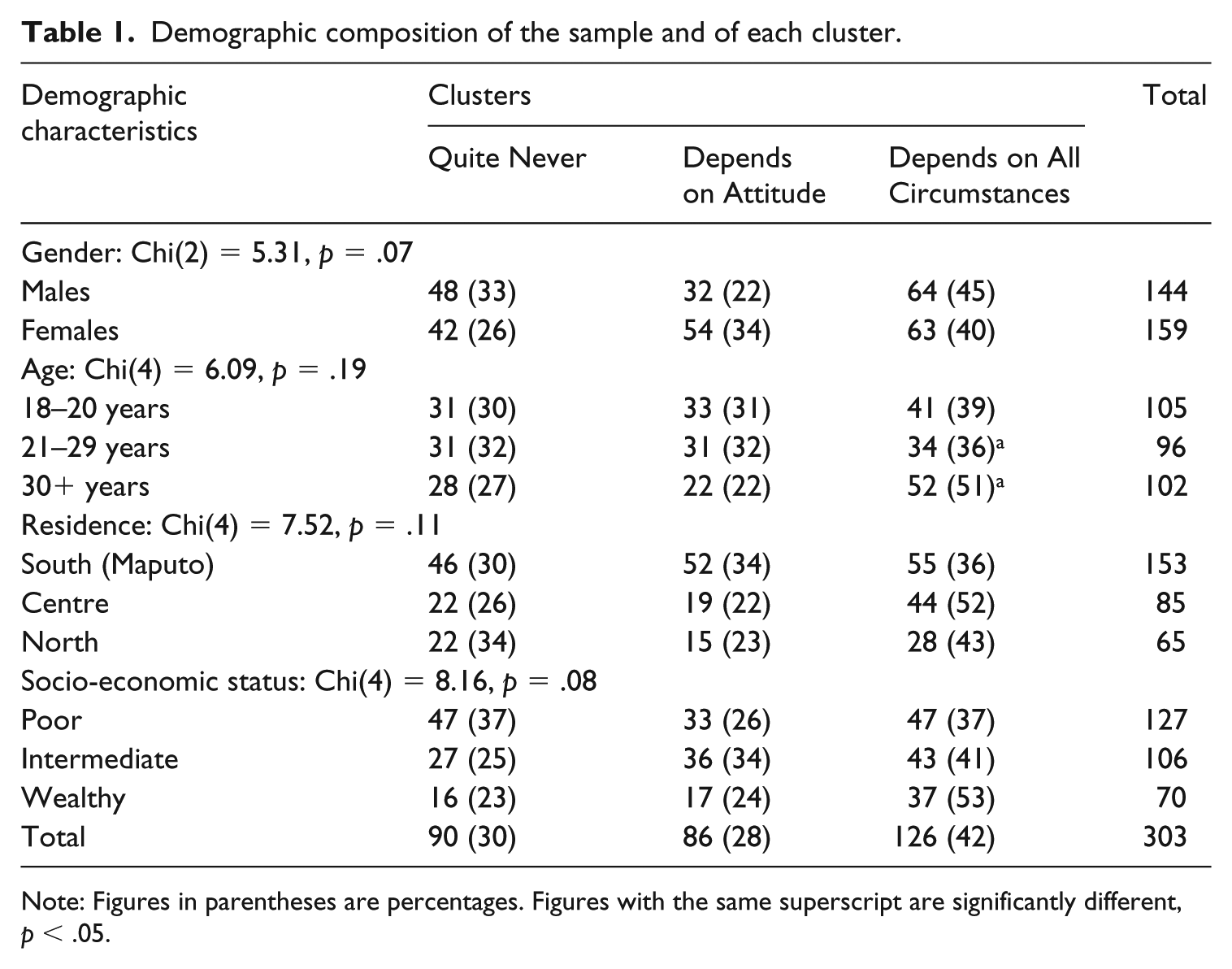
Note: Figures in parentheses are percentages. Figures with the same superscript are significantly different, p < .05.
Participants were approached during daylight hours in the university campus or in the main streets of the towns, usually in the vicinity of the main open-air markets, the school centres, the churches and the post offices. The participation rate was 50.5%. The main reason for refusal to participate seemed to be the lack of available time.
Instruments
The material consisted of 18 cards containing a vignette of a few lines, a question and a response scale. The composition of the vignettes was based on a three within-subject factor design: applicant’s status (former minister or director of a state-owned enterprise) × amount of money embezzled ($10,000, $100,000, or $1,000,000) × apologies–information (neither apologies nor information, apologies but no information, or apologies associated with important revelations); that is, 2 (status) × 3 (money) × 3 (apologies and revelations). Under each vignette were a question and a response scale. The question was: ‘To what extent do you believe that this applicant deserves to be amnestied?’ The response scale was an 11-point visual analogue scale with a left-side anchor stating ‘Not at all’ (0) and a right-side anchor stating ‘Completely’ (10).
Below is an example scenario: Mr. Langa was the director of a state-owned enterprise during the previous government. It has been demonstrated that he embezzled funds from the company that he managed. A probable total amount of $100,000 was misdirected or misappropriated. Mr Langa has wished to take advantage of the transitional period and to benefit from the corruption amnesty law. He has appeared before the Amnesty Commission. He started by apologizing to the Mozambican people. Then, he spontaneously proposed surrendering to the state an important percentage of the commissions that he had illegally earned. During his court hearing, he seemed to be really moved. He has also revealed important information regarding the way the corruption systems worked, and regarding the identity of the people involved.
Procedure
Testing took place either in a vacant classroom of the local university or at the participant’s home. Each participant was tested individually. The procedure followed Anderson’s recommendations (2008, 2019) for this kind of study (see also Armange and Mullet, 2016). The cards were arranged in a randomized order that differed for each participant. The participants took 15 to 25 minutes to complete the ratings. The participants were told in advance of the approximate length of the experiment. No participant voiced any complaint about the number of vignettes they were required to evaluate or about the credibility of the proposed situations. The participants answered additional questions regarding age, gender and educational level. No questions were asked about participants’ political views, because, at the time of the study, most potential participants would have been reluctant to indicate their political orientation, even verbally.
Ethical considerations
Ethical approval for the study was granted by the Board of Trustees of the University Eduardo Mondlane, Maputo, Mozambique. The study conformed to the ethical recommendations – that is, full anonymity was respected and informed consent was obtained from all participants.
Data analysis
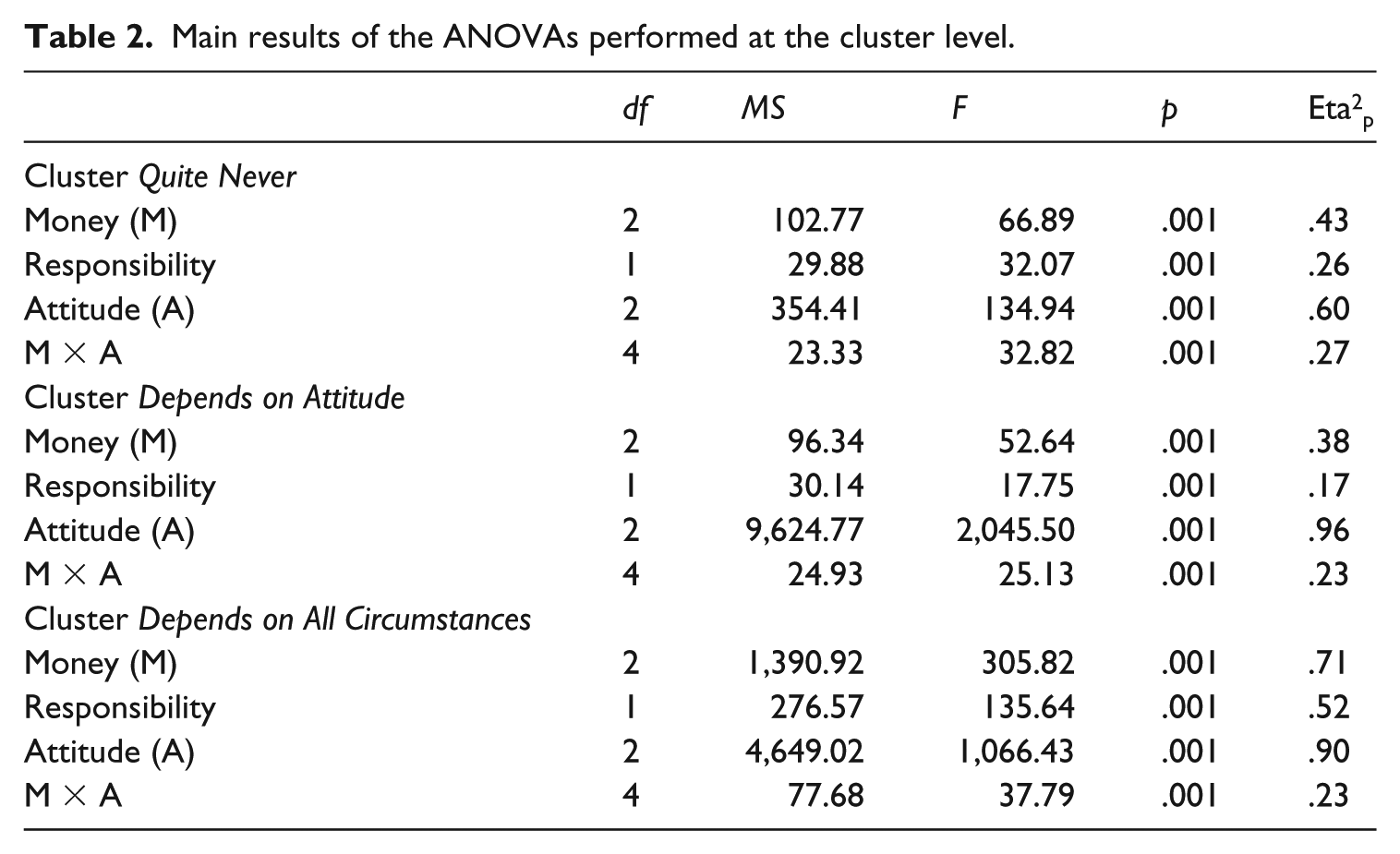
Each rating made by each participant was converted into a numerical value expressing the distance between the point on the response scale and the left anchor serving as an origin. These numerical values were then subjected to graphical and statistical analyses. As qualitatively different positions were expected, a cluster analysis using the procedure recommended by Hofmans and Mullet (2013) was applied to the raw data. Then, an analysis of variance (ANOVA) was conducted on the raw data of each cluster with a design of Status × Amount × Attitude, 2 × 3 × 3 (Table 2).
Main results of the ANOVAs performed at the cluster level.
Results
A three-cluster solution was retained because it was the one that produced the most meaningful findings. The main patterns of ratings corresponding to these clusters are shown in Figure 1. The first cluster (30% of the sample) was the expected cluster expressing the primacy of order over justice: all ratings were low (M = 1.03). It was called ‘Quite Never’. The highest rating (M = 2.81), still largely lower than the middle of the response scale, was attributed to the situation depicting the director of a state-owned company who had embezzled only small amounts of money and who agreed to reveal important information.
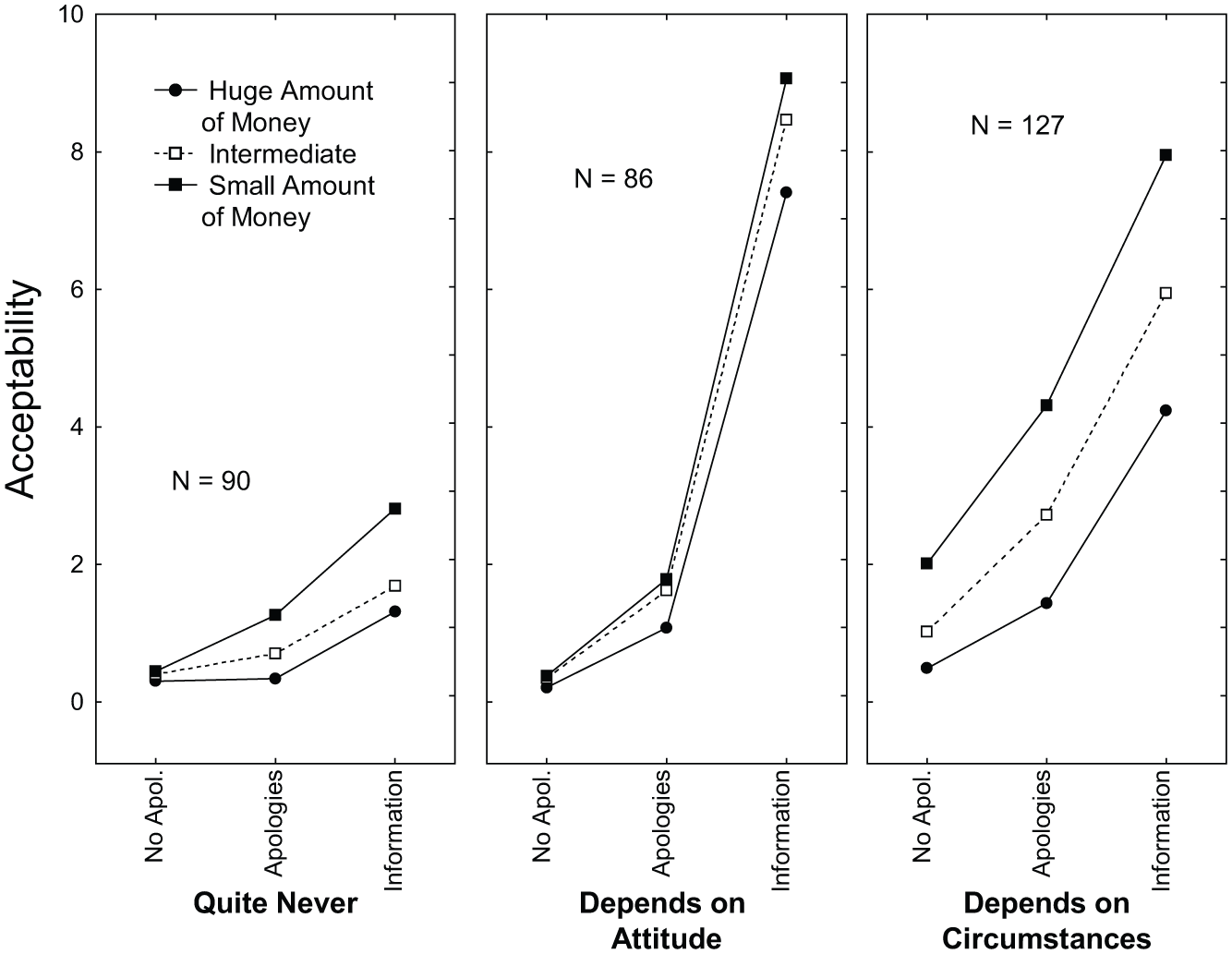
Judged deservingness (y-axis) as a function of amount of embezzled money (curves), and applicant’s attitude and behaviour during the hearing (x-axis). Each panel corresponds to one cluster.
The second cluster (28%) was called ‘Depends on Attitude’ because this factor was clearly the dominant one. Deservingness was judged much higher when the applicant apologized and revealed important information (M = 8.31) than when he only apologized (M = 1.49) or when he did not even do so (M = 0.31). In the former case, amount of money played some role: ratings were higher when a small amount (M = 9.06) rather than a huge amount of money had been diverted (M = 7.41).
The third cluster (42%) was called ‘Depends on All Circumstances’ because all three factors impacted on judgements. As in the second cluster, ratings were higher when the applicant apologized and revealed important information (M = 6.04) than when he only apologized (M = 2.82) or when he did not even do so (M = 1.17). Ratings were also higher when a small amount (M = 4.76) rather than a moderate (M = 3.23) or a huge amount of money had been diverted (M = 2.05), and this effect depended on the level of the apology factor. It was stronger when apologies were present (7.96 – 4.24 = 3.72) than when they were absent (2.00 – 0.49 = 1.51). Ratings were also slightly higher when the applicant was the director of a state-owned company (M = 3.70) than when he was a politician (M = 3.00).
Several additional ANOVAs were conducted on the whole sample with a design of Demographic characteristic × Status × Amount × Attitude, 2 × 3 × 3. Wealthy participants’ ratings (M = 3.04) were higher than other groups’ ratings (M = 2.33 and 2.81), F(2, 299) = 5.58, p < .005. In addition, the effect of the amount of money was stronger among wealthy participants (4.02 – 2.08 = 1.94) than among poor participants (3.02 – 1.73 = 1.29), F(4, 598) = 4.68, p < .001.
The ratings of participants from the Southern part of the country (M = 3.79) were higher than the ratings of participants from its Northern part (M = 3.37) but the difference was not significant (p = .20). When both socio-economic status and residence variables were introduced as between-subject factors in the same ANOVA, (a) the effect of socio-economic status remained significant, F(2, 293) = 5.05, p < .01; and (b) the Money × Status mentioned above also remained significant, F(4, 586) = 3.72, p < .01. The effect of the attitude was stronger among participants from the Southern (5.86 – 0.71= 5.15) than among participants from the Northern part of the country (4.76 – 0.66 = 4.10), F(4, 598) = 3.93, p < .005. This effect remained significant once both variables were considered in the ANOVA design.
Finally, older participants’ ratings were, overall, not different from younger participants’ ratings but the effect of attitude was stronger among older participants (4.03 – 2.90 = 1.78) than among younger participants (3.20 – 1.84 = 1.36), F(4, 598) = 7.49, p < .005.
Discussion
As expected, two contrasting positions were found. For three participants out of ten, former members of government or directors of state-owned enterprises who have been convicted of corruption would never deserve to be amnestied even if they repent, agree to collaborate and refund part of the embezzled money. Spontaneous statements from people holding this position insisted that corrupt managers and politicians must be prosecuted and condemned, and that the ones who seem to repent for their bad deeds were only willing to do so, temporarily, to escape prosecution.
In contrast, for a majority of participants, corrupt managers and politicians who repent and agree to collaborate with the new regime could benefit from full amnesty. For some of them, applicants’ attitude was the main determinant of acceptability of amnesty (Baron, 2015). Corrupt people who expressed a ‘change in moral perspective’ were granted a second chance, irrespective of the severity of the offences. For the majority of them, however, the severity of the offence mattered. Small cases were treated more leniently than big cases. This last finding was consistent with results from all previous studies showing that, on average, people’s level of acceptability of deviant behaviours depended on their perceived severity (e.g. Lascoumes and Tomescu-Hatto, 2008).
Spontaneous statements from people holding one or the other variant of this position were at least partly consistent with the analysis presented above. These participants insisted that, corruption being a collective initiative, the fight against it must also be collective. Only exceptional, transitory measures may have any chance of resulting in a change in managers’ and politicians’ moral perspectives and management practices. This change would, in addition, open up the possibility that international organizations would resume helping the country to develop.
The fact that wealthy participants were more favourable to amnesty than poor participants, irrespective of their residence, may be explained by the fact that these people were certainly apt to understand the reasons for the poor performance of the country’s economy and the motives for the suspension of the financial aid from developed countries. Therefore, they, more clearly than others, may have understood the vital necessity to attempt to collectively solve the corruption issue in order to improve the functioning of the economy and to convince developed countries to reactivate their financial assistance (Vera Cruz, 2016). An alternative explanation would be that, in general, people from upper social classes have, more than others, benefited from corruption and political cronyism.
The fact that the effect of attitude was stronger among participants from the Southern part of the country, irrespective of their social status, may be explained by their greater proximity with the centres of power and information: these people have more information regarding the very system of corruption, its mechanisms and its consequences. They know that if many applicants publicly express repentance, this is likely to give a moral pledge to the amnesty process. In other words, they, more than others, are sensitive to the idea that public acts of contrition may make the whole process more acceptable to the public’s eyes, and more credible to foreigner’s eyes.
Limitations
This study has, of course, limitations. First, the group of participants was a convenience sample, and was only of moderate size. Generalizations to other people in the country (namely the rural areas) or to people in neighbouring countries must be made with care. Second, the participants were presented with realistic scenarios, not with real cases. The use of vignettes, however, enables statistical analyses to reveal how people weigh and combine separate factors. This technique has been validated (Ulrich and Ratcliffe, 2008). Third, the character in each vignette was a top ranking official or executive. It is uncertain whether participants would have been more or less likely to approve of amnesty for low ranking civil servants or shop owners. Fourth, the experimenter did not ask further questions to elucidate the reasons for the participants’ responses, although there is little doubt that they were both personal and cultural.
Conclusion
To sum up, when realistic scenarios are presented, (a) about seven out of ten adults do not appear to be systematically opposed to corruption amnesty laws; and (b) the most important factor for judging deservingness in each case was the applicants’ demonstration, through cooperation and truth telling, of their willingness to change their ethical/moral perspective. No participant holding a ‘blanket amnesty’ position was found.
These findings suggest that in Mozambique, and possibly in other African countries severely affected by corruption, temporary amnesty laws may be considered provided that they involve (a) preliminary consultations through national public interest associations about the conditions that applicants must fulfil (e.g. to refund at least part of the embezzled money), the level of transparency of the process, and the length of time such laws would be in force; and (b) the creation of a credible anti-corruption body that would be independent of governments, and that would be empowered with the material, legal and coercive means necessary to prosecute all individuals presumed guilty of a corruption offences, regardless of their level of wealth or power (de Sousa, 2010). These provisions are necessary to convince the (substantial) minority who consider that amnesty laws are always inappropriate, so that, even if they appear unfair, they may have empirical justifications.
Finally, it should be fully recognized that fighting against corruption cannot be anything other than a long-term educational project (United Nations Office on Drug and Crime 2015). Critical analyses of ancient tribal ethical standards, teaching of modern ethical standards, and study of anti-corruption issues should be integrated into the curricula of high schools, universities and business schools (Becker, Hauser, and Kronthaler, 2013). The final objective of these educational programmes would be to forge personal norms and societal norms that would be far removed from tribal ethics and intolerant of corruption (Gorsira et al., 2018).
Footnotes
Acknowledgements
The authors would like to thank Paul Clay Sorum for his numerous suggestions regarding an early version of this article.
Funding
This research received no specific grant from any funding agency in the public, commercial, or not-for-profit sectors.
