




Abstract
Empathy is the ability to experience affective and cognitive states of another person, whilst maintaining a distinct self, in order to understand the other. It is a multidimensional phenomenon, ranging from vicarious distress to near complete understanding, with many shades in between. As an almost universal and integral human construct, empathy has been considered in many disciplines and contexts, from evolution to gender, politics, economics, ethics, human rights and neuroscience. Each of these disciplines offers a range of definitions of empathy, and provides unique insights into the role of empathy in achieving different types of social outcomes, including those with both prosocial and antisocial intentions. The conceptualization generated from interdisciplinary perspectives is important because it allows us to identify commonalities that could be mobilized synergistically to achieve greater social benefit through prosocial empathy. This review discusses the benevolent and malevolent manifestations of empathy from the perspective of social, legal and psychological sciences in order to lay the foundation for a theoretical discussion on the potential of harnessing prosocial empathy to advance equality and non-discrimination.
Introduction
Empathy has been defined as the ability to experience affective and cognitive states of another person, whilst maintaining a distinct self, in order to understand the other (Guthridge & Giummarra, under review). Empathy involves three distinct, but interrelated processes: affective empathy, cognitive empathy and empathic concern (Davis, 1980). Affective empathy is associated with subconscious, automatic processes such as mimicry and emotional contagion. Cognitive empathy relates to perspective-taking associated with Theory of Mind, and empathic concern is aligned with personal distress, sympathy and compassion. The focus of our review is to discuss contextual factors that generate or influence empathic processes and how those empathic processes manifest in either prosocial or antisocial behaviors directed at both Self and Other. While empathy may not lead to specific behaviors, Fritz Breithaupt (2018) notes that ‘empathy is usually seen as a prosocial and morally positive influence’ (2018: 166). We join with Breithaupt in recognizing that empathy can also lead to antisocial behaviors. In this respect, we define prosocial empathy by circumstances in which empathic understanding is used to help others (through compassion, altruism, etc.). Antisocial empathy, however, is defined by circumstances in which empathic understanding is used to harm others, such as in the Dark Tetrad traits: psychopathy, sadism, narcissism and Machiavellianism (as opposed to an empathy deficit, which can occur in people with developmental disorders like autism). While prosocial empathy has been described as a social glue, antisocial empathy may be thought of as involving processes that ‘deepen divides, rather than bridge them’ (Breithaupt, 2018: 168). This manifestation has been referred to as the ‘dark side of empathy’ (Kanske, 2018: 120).
From altruists to sadists, the manifestations of empathy define the world we live in. For example, some terrorists can be seen to have great prosocial empathy and affiliation towards people who practice their religion, but active antisocial empathy towards those who do not. Stalkers, ‘bullies’ and ‘trolls’ could all be seen to show an empathic understanding of the experience of their human target, but with the goal of inducing harmful social, emotional or physical consequences (Breithaupt, 2018). Bullies use empathy destructively to manipulate, control, exploit and cause pain (Walsh, 2014). In this respect, an understanding of the distinction between the interest of self and the interest of others may lead to a better understanding of how to create just civilizations interested in reciprocal and respectful relationships and societies.
Long before the word empathy came into usage, the concept was considered fundamental to humanity. In 1873, Robert Vischer first conceptualized the German term Einfühlung as the feeling between a person and an object in an aesthetic experience of art (Lux & Weigel, 2017). In 1908, Edward Titchener translated the German word Einfühlung, which literally means ‘feeling into’ (Lux & Weigel, 2017: 22), to the word we know today in its Latinized form: empathy (Gerdes et al., 2011). By the end of World War II, empathy was no longer associated with things, nature and the inanimate world in Western philosophy, and it became a concept that exclusively applied to interpersonal relations (Lux & Weigel, 2017). However, long before the development of the concept in Western history, Chinese philosophers had been considering empathy for more than 2,000 years before its linguistic manifestation in the West (Slote, 2010). Wang Yang Ming in the 16th century spoke of becoming one body with another and Cheng Hao in the 11th century saw empathy as an essential condition in Confucianism (Slote, 2010). Both Wang and Cheng spoke of benevolent individuals being intertwined with other beings (Slote, 2010). This Western and Eastern linguistic history is still important today because it highlights that empathy has been and still is an elusive, yet enduring word and concept.
Notable expressions of empathy in literature throughout the ages include the poetry of John Donne and the work of novelist Harper Lee. In the 17th century, Donne wrote ‘no man is an island, entire of itself’ (Krznaric, 2014). In 1960, Lee wrote her Pulitzer Prize winning novel To Kill a Mockingbird in which Atticus Finch offers his daughter Scout the following wise counsel:
‘First of all’, he said, ‘if you can learn a simple trick, Scout, you’ll get along a lot better with all kinds of folks. You never really understand a person until you consider things from his point of view. . . until you climb into his skin and walk around in it.’ (Lee, 1960: 40).
Empathy is recognized by Donne and Lee as a feature of our humanity. And not just any feature, but the very foundation. It is not a grandiose exaggeration to say that empathy is the cornerstone of both humanity and equality, as we all are innately empathic creatures (Inzlicht et al., 2012). In the context of Donne and Lee, Lynn Hunt (2007) contends that reading does not only affect the mind, but the whole body as readers immerse themselves within empathy-laden pages.
Since this time, empathy has been studied in many disciplines, including evolution, gender, politics, economics, ethics, human rights and neuroscience. The present review seeks to distil the unique perspectives that each discipline brings to our understanding of empathy, including its prosocial or antisocial manifestations, before discussing the potential to draw together these perspectives to modulate prosocial affective empathy for our benefit through a new theoretical framework. Each discipline will be considered in turn below.
Empathy according to gender
Historically, the literature on gender and empathy identified empathy as a feminine trait in contradistinction with reason as masculine; where even situational empathy in men was and is frowned upon, such as crying in concern for another. Many authors, such as Robyn Bluhm et al. (2012) acknowledge that pervasive and persistent gender stereotyping cultivate these social tendencies in addition to biological differences. Many studies have found that women score higher than men on standard trait empathy tests (Krznaric, 2014). However, the validity of these findings has been questioned on at least two bases. First, women are socialized from birth to embody a stereotypical gender role that includes displaying empathic traits more than men (Bluhm et al., 2012). Second, self-report tests are notorious for catalyzing social desirability biases (Bluhm et al., 2012), whereby responses are tailored to meet social expectations regarding gender roles, rather than true self-reflective responses. For both women and men this becomes problematic because kindness is best expressed universally, rather than being dependent on social constructions. In fact, research shows that preschool children do not show significant gender differences in empathy responses (Buck, 2011).
Although the cognitive ability to take another’s perspective is present by adolescence, studies have shown that girls’ cognitive empathy traits are higher than boys’ during adolescence (Van der Graaff et al., 2014). Gender specific socialization leads to this stereotypical behavior where girls tend to exhibit more caring and nurturing behaviors and boys inhibit these behaviors (Van der Graaff et al., 2014). For example, in adults, Tania Singer et al. (2006) conducted an experiment in which males and females undertook an economic game in which some played fairly and others unfairly. Functional Magnetic Resonance Imaging (fMRI) showed brain activity in the fronto-insular and anterior cingulate cortices in both sexes in response to ‘fair’ players, suggesting similar empathic responses in men and women. However, empathic responses were markedly altered in males when witnessing unfair players such that there was an increase in neural activity specifically when witnessing the unfair player being punished that suggested a desire for revenge in male participants. According to Singer and colleagues, women showed lowered empathic responses toward unfair players when punished. These findings are important as they highlight a potential harmful manifestation of empathy. Whilst punishment is not necessarily negative, it can manifest as revenge devoid of judicial fairness. For this reason, we must consider how gender differences, whether they are driven by bottom-up biological processes or top-down cognitive and social influences, could be used to harness prosocial empathy that helps rather than harms the self or others, especially in boys and men. This leads to a consideration of the origins of empathy in humans.
Empathy according to evolution
Empathy according to evolution has been defined by Richard Dawkins (1976) with the concept of the ‘selfish gene’. In this sense, empathy can be used as an exploitative and manipulative process that manifests through competition rather than cooperation. But empathy also ‘reaches beyond its evolutionary origins, extending beyond inclusive fitness among kin and social group members’ (Decety, 2011: 36). While Dawkins suggests that empathy is hereditary, a genetic basis is yet to be identified. As empathy may be considered innate, it cannot be excised whilst still maintaining a whole identity.
In contrast to Jean Decety’s notion that empathy extends beyond kin, according to Dawkins (1976), prosocial empathy across all populations does not make evolutionary sense. Survival of the fittest demands that we are, genetically speaking, selfish. In fact, Dawkins (1976) contends that it only takes one selfish individual in a group of altruistic people to exploit all of the resources and decimate the altruistic gene pool or, as he states, ‘niceness dies a Darwinian death’ (1976: 246). However, Dawkins (1976) suggests that many of our psychological characteristics, such as envy, guilt and sympathy, have developed through natural selection for the very purpose of identifying and overcoming the selfish gene. In this respect, we recognize that competition is a limiting factor that can stabilize community resources and ultimately ensure group survival (Dawkins, 1976). This leads us to the existential question of whether humanity is intrinsically good when we are faced with our evolutionary roots of parochialism, xenophobia and ethnocentrism (Aarssen, 2013). Critics of Dawkins assert he over-simplifies his theories and uses inaccurate language. In this respect, leading scholar on empathy Frans B. M. De Waal (2008: 9) refers to Dawkins’ work as ‘veneer theory’ and notes that we should ultimately be reminded that both nature and nurture are at play when it comes to our proficiency in expressing empathy.
Sharing resources with everyone equitably, however, is both achievable and desirable. Prosocial empathy is indeed considered to be ‘the glue that makes social life possible’ (Eisenberg & Morris, 2001: 95). Yet, we predominantly empathize within our tribal boundaries, limited by our self-imposed social constructs of race, religion and gender (Decety & Cowell, 2015). We should not, however, disregard the fact that humans can and often do act prosocially towards strangers, and prosocial empathy extends far beyond kith and kin.
Although competition remains part of our DNA, cooperation also plays a significant role in the survival of the fittest (Martinez, 2016), both as individuals and as groups. However, empathy beyond the tribe is not so easily explained by Charles Darwin’s theory of natural selection (Decety & Jackson, 2004). From a genetic point of view, empathizing with everyone indiscriminately has been said to have the potential to lead to a depletion of resources (Keysers & Gazzola, 2014). At the same time, social and empathic processes that focus on self-benefit at the expense of others may sometimes exploit other’s vulnerabilities. Competition may result in resources being monopolized by some, rather than shared equitably within society. This pattern is manifest worldwide in the inequality between the few rich and many poor. By harnessing prosocial empathy we may be able to minimize the stark divide between the haves and the have-nots. For instance, a more empathic economy may mandate greater resource distribution. In this respect, it is valuable to consider how empathy develops in each of us.
Empathy according to human development
We have seen that nature plays a large role in the expression of empathy. However, nurture also plays a prominent role, which includes gender stereotyping from infancy. A sense of human interaction, of shared feelings that is a corollary of being empathic, has been touted as being of greater importance to human development than food and shelter (Krznaric, 2014). All humans are born with an innate desire to connect with others (Krznaric, 2014). The greatest determinant of a person’s level of empathy derives from their primary caregiver’s ability to express empathy (Lux & Weigel, 2017). A securely attached child bonds with its empathic caregiver, forming the foundation of the child’s attachment to others (Lux & Weigel, 2017). Conversely, a child who has an unempathic caregiver becomes reluctant to imagine the minds of others (Lux & Weigel, 2017). Living with caregivers who do not show empathy in the formative years stunts the child’s ability to connect with others throughout its life (Krznaric, 2014), as demonstrated by the tragic plight of children held in Romanian orphanages under the Ceausescu regime. Furthermore, children are not equally empathic to all and display socially influenced biases from a very young age (Decety & Cowell, 2014b).
The development of empathy occurs along a continuum (see Figure 1 for a summary of the empathy and social mimicry development timeline). Infants begin mimicking facial expressions, and much later develop higher level cognitive processing capacity (Gerdes et al., 2010). Personality traits, temperaments and cultural norms also contribute to the development of empathy. For example, it has been said that children from collectivist cultures that promote reciprocal relations are generally better at perspective-taking than children from individualistic cultures (Decety & Meyer, 2008). Furthermore, children who are high empathizers tend to become adults that are also high empathizers (Christov-Moore et al., 2014). However, the development of empathy-derived prosocial or antisocial behaviors in children is a much debated subject. Given that trait empathy is predominantly established throughout childhood, it is essential to interrogate the ways that caregivers can nurture prosocial empathy. Moreover, teaching prosocial empathy to children may catalyze empathic values within and across groups.
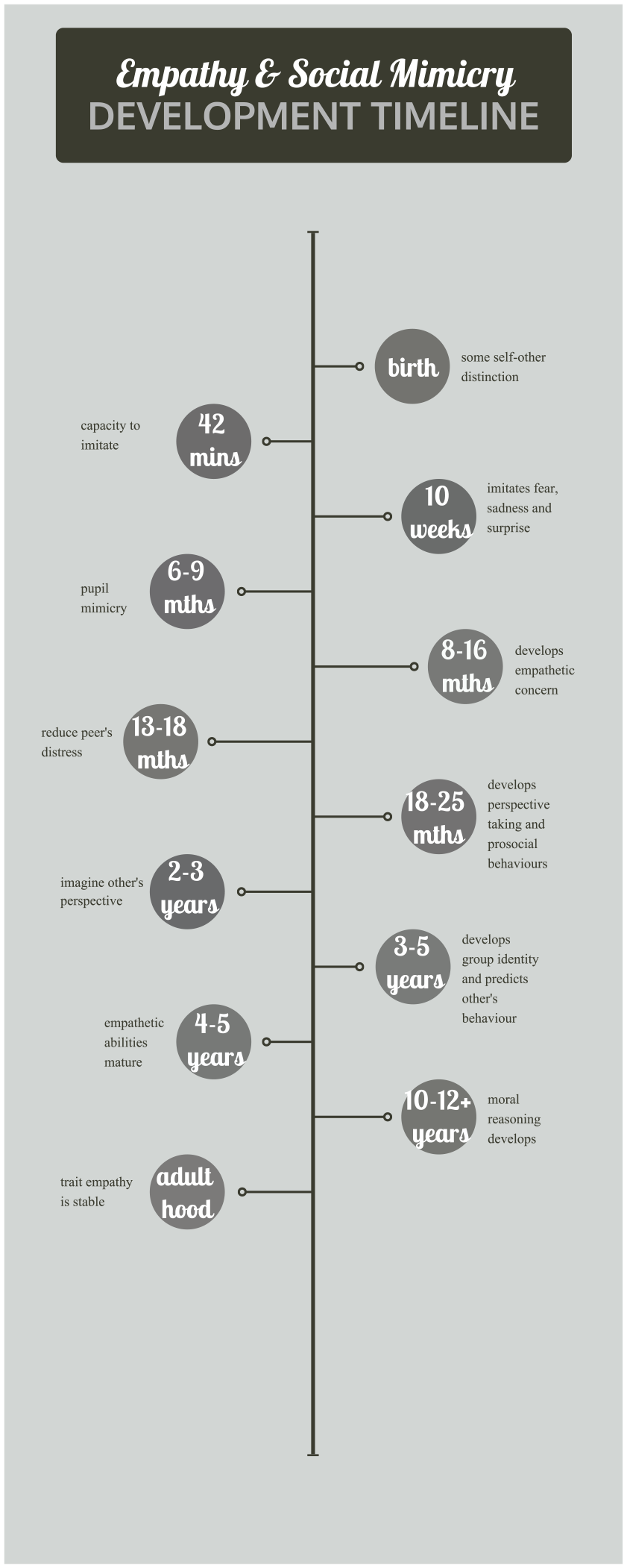
Empathy and Social Mimicry Development Timeline.
Empathy according to group dynamics
The capacity to differentiate ‘us’ from ‘them’ is fundamental to human cognition (Amodio, 2014). We care about people who are most similar to us (Bloom, 2016) and our decision-making is highly modulated by perceived social contexts (Decety, 2011). Inducing empathic understanding of the emotions or experiences of a member of an outgroup can nevertheless improve attitudes towards that outgroup as a whole (Batson et al., 1997). However, C. Daniel Batson et al. (1997) warn that even if we receive information that counters stereotypes about a maligned group, we may individualize them as an exception to our racist or sexists beliefs. In general, people express greater prosocial empathy towards their own group because, evolutionarily speaking, they are more likely to share resources within their group (Mathur et al., 2010). Furthermore, ingroup biases reinforce social cohesion within the group. However, whilst some groups are formed based on shared interest or love, others are united by common enemies due to shared oppression, disenfranchisement, enslavement or the desire for power and wealth.
An extreme example of ingroup and outgroup bias is seen in the recruitment of terrorists by Islamic State of Iraq and Syria (ISIS). Potential terrorists are led to believe that loyalty to Islam requires the rejection of Western values and idols and are indoctrinated in the stark divide between believers and non-believers. This includes the belief that if one Jihadist is wounded, it is ‘as if’ all true believers are wounded through empathy (Callimachi, 2019). In general, people are more likely to help an ingroup member than an outgroup member in similar need (Hein & Singer, 2008) and this may drive much more than inequality and discrimination because empathy, in both its prosocial and antisocial manifestations, infiltrates every aspect of our day-to-day lives.
We are constantly creating arbitrary ingroups and outgroups that seem to be relatively mundane tribes, such as sports fans, feminists and friends on social media that we may avidly defend and support with little rationale. These group divisions begin at a very early age in the playground. As Charles Efferson et al. (2008) explain, ‘the research on intergroup processes indicates that people have a willingness to show ingroup favoritism, and in particular this holds even when groups are trivial and evanescent’ (2008: 1848). However, at the other end of the spectrum, ingroup favoritism can determine whether someone lives or dies. Egregiously, ‘the dehumanisation and persecution of the “other” is often presented as a virtuous act – a demonstration of patriotism, solidarity and loyalty’ (Martinez, 2016: 28–29). In this case, those ‘left behind’ seek out alliances and communities for support to create a sense of belonging. The creation of ingroups and outgroups is the foundation of the social constructs of racism, sexism, discrimination and inequality towards outgroup members. Whether one manifests antisocial or prosocial behaviors in these circumstances is largely unknown and remains a paradox to be resolved.
Racism, ableism, sexism and heterosexism however, are not inevitable and can be learnt (and unlearnt) based on the cultural acquisition of non-biased attitudes (Chiao, 2011). In this way, prosocial empathy ‘is a prejudice-reducing factor’ (Bäckström & Björklund, 2007: 11) such that as empathy increases, biases decrease. A number of studies on empathy have explored race-based decision-making. One such study showed that Caucasian observers reacted emotionally to pain suffered by African people significantly less than to pain of Caucasian people (Forgiarini et al., 2011). This close relationship between empathy, race and sex has many real-world implications (Forgiarini et al., 2011) as they are relationships that are evaluated subconsciously within milliseconds, but have profound long-term consequences in world affairs (Azevedo et al., 2013). Furthermore, ‘unlearning’ racism and sexism is not only possible, it may be within our grasp as we gain a better understanding of the prosocial and antisocial manifestations of empathy. This understanding is elucidated below in a consideration of the impact of culture on empathy.
Empathy according to culture
Whilst we have detailed the importance of evolution in the expression of empathy, Dawkins (1976) points out that human life is prominently influenced by cultural revolution as opposed to genetic evolution. Pure unadulterated empathy, devoid of sentiment, semantics and symbolism has been described as a myth (Hollan, 2012). In this respect, empathy involves decoding the internal experience of another by accurately and appropriately analyzing externally expressed experiences, (e.g. facial expressions, body postures, etc.). Translation of these expressions is vital for a cohesive society (Rasoal et al., 2011). Although the processing of others’ emotions is biologically adaptive, cultural adaptation to empathic experiences occurs at rapid-fire speed compared to the snail-pace of genetic adaption over generations (Boyd & Richerson, 2009). In this scenario, the cultural context of empathy is omnipresent and social conditioning is paramount to the facilitation of prosocial or antisocial empathy in society. Furthermore, evidence indicates that we are currently experiencing a sharp decline in empathy amongst young adults in Western society (Krznaric, 2014). Sara Konrath et al. (2011) support this contention and have found a decrease in both empathic concern and perspective-taking since the year 2000. In the gap created by declining empathy, unfettered narcissism seems to fill the void. This has been attributed, in part, to the surge of online culture that curtails real world interactions (Konrath et al., 2011).
We should, however, interrogate this contention and ask whether there is in fact a lack of empathy, a rise in antisocial empathy, or just a greater focus on self rather than others? We have, in many respects, either become the culture of the uncaring (lack of empathy), or the culture of the callous (antisocial empathy). With reduced real world interactions, we may not be given the opportunity to practice, receive and strengthen our prosocial empathy. Considering the desire for others to understand how we feel, antisocial manifestations of empathy have the potential for horrific outcomes, such as victims of bullying perpetrating school massacres as revenge for their mistreatment. We speculate that it is not a simplistic binary choice between a lack of empathy or a rise in antisocial empathy. Rather, it is probably a toxic combination of both, with additional factors in the mix. Further research in this area would enhance our current understanding of the differing manifestations of empathy.
Despite the value of empathy, it has been argued that its manifestation in Western culture is characterized by an individualistic ‘me’ culture (Krznaric, 2014). Empathy may be seen as defined by social norms and values that lead to prejudice and discrimination, rather than benevolence and compassion. This does not imply that some cultures are inherently more empathic than others. Rather, culture-based communication is an important conductor (Cheon et al., 2010) when recognizing that different cultural values produce different empathic responses (Duan et al., 2008). That is, how we express, interpret and respond empathically is culturally-bound (Cheon et al., 2010). For example, abuse towards an animal may arouse empathy in some cultures, but not in others, demonstrating a culturally defined empathic response (Breithaupt, 2019).
Kelly Thompson and Eleonora Gullone (2003) contend that Western culture is not conducive to the promotion of empathy development. But many non-Western societies proliferate antisocial empathy too. In this respect, our lack of care for others will divide rather than unite us. Therefore, we need to learn how to channel our prosocial empathy in order to create cohesive communities and cultures. Within these cultures we also have to consider the political systems and ideologies that harbor and engender harmful manifestations of empathy. Empathy in this sense is not just a product of culture, it is a political idea.
Empathy according to politics
Since the origin of political ideologies there has been a ‘politicisation of empathy’ (Ward, 1994: 929). Historically poignant examples of malevolent empathy, such as South Africa’s Apartheid regime, Nazi Germany or the genocide in Rwanda are not merely relegated to the annals of history. Current examples in global politics include the Rohingya crisis in Myanmar and the ongoing humanitarian crises in Syria and Yemen. Even graphic images of the horrific death of the three-year-old boy, Alan Kurdi, whose body was washed ashore in Turkey after he fled Syria with his family did not sustain a collective prosocial empathy for the plight of Syrians. In many ways, Alan Kurdi has been forgotten.
While horrific violence and division breed ongoing fear and prejudice (Martinez, 2016), prosocial empathy holds the potential to counter these emotions (Krznanic, 2014). Empathizing with the enemy, someone who is ideologically opposed to you (when manifested as altruism), is a viable antidote to the seemingly insurmountable challenge of resolving conflict. While we acknowledge that there can be no peace without a modicum of prosocial empathy, we also recognize the empathy-altruism link can counteract violence and form a basis for fruitful peace talks (Rasoal et al., 2011). Prosocial empathy has a uniquely potent healing quality (Pedwell, 2012b) and offers hope in the world we now face traumatized by terrorism, disease and seemingly insoluble ideological division. Although political ideologies are difficult to change at an individual level, we can alter how people feel through affective empathy. This is explored below in the section ‘A theoretical proposal’.
Antisocial empathy has gained prominence in recent years, with a resurgence of right-wing populism as seen in the United Kingdom’s ‘Brexit’ vote and the election of leaders such as Donald Trump in the United States and Jair Bolsonaro in Brazil. In this context, Breithaupt (2019) describes Trump as the ‘master of empathy’. The current political climate has been fairly characterized as being marred by the manipulative side of empathy as it aligns strongly with the politics of hate and identity. These political belief systems can override our genetic and social predisposition for cooperative empathy, and draw us into vicious ingroup and outgroup divides. Whilst privileged groups (middle class, white and/or Western) have little incentive to develop their positive empathic platitudes towards outgroups, disadvantaged groups (poor, non-white and/or non-Western) have been depicted as the passive objects of empathy in misguided and sometimes harmful attempts at international aid and development (Pedwell, 2012a). We all have group biases and a social contract to our fellow humans. Yet, we should heed the dire warning that the unequal transmission of empathy is the catalyst for exclusion and the creator of a great divide between ‘us’ and ‘them’ (Pedwell, 2012a).
Although globalization could enable a widespread seeding of empathy, figurative and literal walls are being built across the globe that undermines individual and communal wellbeing. Narcissism, empathy’s enemy, is now epidemic (Aarssen, 2013) and we more readily recognize empathy through its absence, that is, through psychopathy and artificial intelligence. Just as empathy can be enduring and intractable, so too is prejudice (Stephan & Finlay, 1999).
Empathy can also exacerbate political polarization whereby people who display high empathic concern have been found to simultaneously show greater partisan biases (Simas et al., 2020). In this respect, empathy according to politics is often defined by its antisocial manifestation, such as utilitarianism characterized as a means to an end. In politics, empathy may be used as a manipulative tool, or propaganda, to leverage greater support (e.g., votes at the ballot box or to achieve greater acclaim). Manipulative communication campaigns are the hallmarks of antisocial empathy. As a response, it is important to promote prosocial manifestations of empathy in order to eliminate inequality and discrimination. As Paul Bloom (2016) reminds us ‘every charity, every political movement, every social cause, will use empathy to motivate action’ (2016: 43). Yet, empathy can also be viewed as political correctness ‘gone mad’. In this respect, people who manifest positive empathic traits are castigated as ‘bleeding hearts’, ‘tree huggers’ and ‘radical feminists’ (Bloom, 2016). It would seem that empathy is an aspect of leftist politics, as acknowledged by Elayne Greenberg (2017) in her observation that ‘the empathy issue has become a political buzzword that divides liberals and conservatives’ (2017: 468). We contend that empathy is used equally by the left and right. Understanding empathy as a benefit to some and harm to others transcends political ideologies.
Prosocial empathy has been associated with strong democracies (Lux & Weigel, 2017) and ultimately, serves to facilitate social understanding that strengthens society as a whole (Lux & Weigel, 2017). This in turn creates harmony and reduces political tension and conflict. For this reason, empathy should not be viewed as a ‘soft’ option, but as hard political currency (Johnson et al., 2009: 2). Former United States President Barack Obama famously declared ‘the biggest deficit that we have in our society and in the world right now is an empathy deficit’ (Bloom, 2016). We contend that rather than an ‘empathy deficit’ we suffer from ‘empathy inequality’ whereby we empathize too much with some and not enough with others. The need to find new ways to overcome this empathy inequality is explored further in our theoretical proposal outlined below.
While Obama embraced the importance of empathy, we believe that Nelson Mandela distinguished himself among political leaders in embracing the potential of positive empathy. Mandela consistently challenged all citizens to ‘step into the shoes’ of their adversaries, affording the ‘enemy’ the humanity that was denied to him. He did this not for superiority, but to unite a broken nation that could have easily descended further into civil war. This was averted to a degree by prosocial empathy (Krznaric, 2014). And beyond its clear relevance to political ideologies, empathy also plays a role in economics.
Empathy according to economics
As in politics, empathy according to economics is defined by its manipulative potential. As Gary Olson (2013: 212) reminds us Wall Street is a ‘Darwinian jungle’. Capitalism, neoliberalism and neocolonialism reward corporate, predatory psychopathy. Capitalism, the economic antithesis of prosocial empathy, fosters unfettered greed, ruthless competition, rampant exploitation, immoral exclusion and selfish individualism (Olson, 2013). Converting this into an economic system that privileges prosocial empathy is hard to conceive, but is a necessary antidote to rising inequality. As Raoul Martinez (2016) questions: ‘How can rich nations justify their hugely disproportionate consumption of the world’s resources without implicitly believing in their own superiority?’ (2016: 29); that is, a belief in the prevailing ‘myth of Western benevolence’ (Martinez, 2016: 50).
As Carolyn Pedwell (2012b) states, it is not the prosocial manifestation of empathy that drives capitalism, but rather its equally powerful antisocial manifestation. This drives profit as a proliferation of greed, resulting in massive disparity between the rich and poor. However, the rhetoric surrounding the burgeoning prosocial empathic economy is an illusion designed to extract greater wealth and power for the very few (Pedwell, 2012b). In this respect, businesses ‘walk in others’ shoes’ simply to increase profit margins. Empathy has become the ‘commodification of feelings, with which the concept of empathy is inexorably loaded within a commercial context’ (Yeomans, 2016: 88). Business has, at the very least, identified how powerful empathy is without concern for whether it is good or bad, or good for some and not for others. If we are to function as societies and not merely economies, we must demand that our economic systems are just and equitable and founded in prosocial empathy. Through this we can begin to build ethical and moral systems to enhance equality and non-discrimination and unshackle them from the antisocial manifestations of empathy.
Empathy according to ethics and morality
Empathy according to ethics is another paradox, witnessed in the prosocial and antisocial manifestations that play out in everyday situations. Bloom’s treatise Against Empathy is a powerful exhortation that empathy is not always positive, but can manifest in negative outcomes. In particular, Bloom (2016) tells us that empathy is ‘a poor moral guide. It grounds foolish judgments and often motivates indifference and cruelty. It can lead to irrational and unfair political decisions’ (2016: 13). But is such an attack on empathy warranted, or somewhat naïve about the exigencies of real life? While it may be possible to have moral codes unmediated by empathy (Prinz, 2011), empathy is often a precondition or catalyst for much of our moral, ethical and legal reasoning (Prinz, 2011). In fact, prosocial empathy may be seen as a building block to morality. Bloom (2016) himself acknowledges that ‘every moral revolution, from antislavery to gay rights, has used empathy as a spark’ (2016: 82). Empathy, however, is not a neutral medium. Rather, it provides the context and predicts the consequences of many moral dilemmas (Hollan, 2012). There is ample evidence to suggest that empathy can guide sound moral judgments, despite history being scarred by cases of antisocial empathy producing inhumane responses (Decety & Cowell, 2014a). For example, nepotism can be viewed as a harmful consequence of the partiality of empathy.
Empathy can be unpredictable as it can be swayed by myriad environmental factors. Despite this volatility, Roman Krznaric (2014) contends that empathy, when characterized by altruism, is a means to achieving greater morality. In fact, some argue that empathy-based reasoning is the new religion because of its prosocial benefits, and Marco Iacoboni suggests it is ‘the basis for a secular morality’ (Olson, 2013: 20). Breithaupt (2019) notes that we ‘need to build ethical checks on the seductive power of empathy, while nevertheless endorsing and supporting it’ (2019: 200). We should heed the warning that empathy is both a virtue and a vice, something that is also relevant in the context of human rights law.
Empathy according to human rights and social justice
Human rights are important in synthesizing interdisciplinary perspectives on empathy because they decipher what is right and what is wrong, the cornerstone of lawful civilizations. Human rights can be said to function as a check on the vagaries of empathy: the perpetual undulation between prosocial and antisocial empathy, highlighted in such cases as the denial of the rule of law, or denial of due process. That is to say that we should not be guided by how we subjectively feel for another. Rather, our behavior should be determined objectively by a set of commonly agreed upon rules. Paradoxically, human rights can be defined as the codification of prosocial empathy, while punishment may be characterized as unempathic or antisocial empathy depending on the jurisdiction. To this end, we are reminded that one of the greatest predicates of human rights is their inalienable and universal nature; that we are all born endowed with its protection, without precondition or exception. Human rights derive ultimate validity through unwavering impartiality. By remaining blind to any manipulation or corruption, human rights are impervious to the swings and roundabouts of parochial human empathy. Although human rights are a critical safeguard for all humanity and must be upheld, we should also recognize that when we deny empathy for antisocial purposes, we simultaneously deny another key component of humanity; that is, our capacity for prosocial empathy. Empathy is a contradiction, an incompatibility between its potential to be used to our advantage or disadvantage. Despite this dichotomy, it is fundamental that human rights law is unambiguous and functional, not just to judges but to the broader community.
Krznaric (2014) notes there have been ‘waves of collective empathic flowering’ (2014: 29) in respect of human rights, most notably beginning with the humanitarian revolution in Europe in the 18th century. This was followed by the rise of the movement to abolish slavery, the normative advancement of the prohibition of torture, and the recognition of children’s and workers’ rights in the context of industrialization. The second wave of collective empathy occurred after World War II and further codified the empathic sentiment of the times through the adoption of international human rights instruments. For example, the Universal Declaration of Human Rights of 1948, which states in Article 1:
All human beings are born free and equal in dignity and rights. They are endowed with reason and conscience and should act towards one another in a spirit of brotherhood. (emphasis added)
Here we see ‘reason and conscience’ as the antithesis of empathy, as the necessary stalwart that ensures against the harmful manifestations of empathy, but the ‘spirit of brotherhood’ counterbalances this as it encapsulates prosocial empathy. Article 2 of the Universal Declaration continues:
Everyone is entitled to all the rights and freedom set forth in this Declaration, without distinction of any kind, such as race, color, sex, language, religion, political or other opinion, national or social origin, property, birth or other status. (emphasis added)
Here again, ‘without distinction of any kind’ may refer to the denial of an expression of empathy that is tempered by any potential discriminating qualities, such as ingroup and outgroup biases.
In these two articles of the Universal Declaration of Human Rights we see the unsolvable conundrum that empathy is both the inspiration of human rights (prosocial empathy) and an entity to be guarded against in the normative content of human rights treaties (antisocial empathy). In this sense, empathy is both yin and yang, two faces, the light and the dark. However, unlike human rights, empathy is not (in reality) universally prosocial. As explained above, empathy is in fact partial to our many human proclivities and taciturn fancies. Human rights curtail the individual tendency for antisocial empathy in order to protect equality for all. It would seem that it is more important to guard against antisocial empathy than to advance prosocial empathy; however, because of the interrelated, interdependent and indivisible nature of both forms of empathy we may not be able to separate antisocial empathy in favor of prosocial empathy. What determines whether empathy is expressed positively or negatively is a deeply complex question.
Equality and non-discrimination are embedded in all human rights instruments and are overarching meta-principles of the human rights system. It therefore seems paradoxical that empathy could be an essential catalyst for human rights. Empathy is the foundation of human rights (Krznaric, 2014: 401) and is essential to rights-based law and rights-based behavior, positioning the human as central to all human rights (Murrow & Murrow, 2015). Legal philosophers, including Cesare Beccaria and Jeremy Bentham, have long proposed that:
Pain and empathy [. . .] are essential to motivating compliance with the moral dimensions of the law, including criminal law and equality-based rights, or to providing a natural, utilitarian motivation to accept and act in accord with others’ basic human rights. (Murrow & Murrow, 2015: 347).
Empathy, according to human rights, is also defined by its predilection for social justice. Social justice is defined by its distributive power; that is, social justice motivates the redistribution of wealth and privilege to promote equality. Although empathy is considered a requisite for social justice, people do not necessarily want mere empathy. It is justice that they seek (Boler, 1997). Whilst empathy recognizes both our similarities and differences, it is prosocial empathy that has the capacity to achieve cross-cultural harmony (Pedwell, 2012a). To this end, empathy is often pinned as ‘The Solution’ to our social ills and wrongs (Pedwell, 2012a); however, we should be mindful that justice ‘must be free of passion because emotions distort our capacity for rational and ethical judgements’ (Head, 2012: 37). In this respect, justice is declared to be ‘blind’, whereas empathy is not blind. Rather, prosocial empathy brings social justice into sharp focus. Inspired by cognitive perspective-taking, empathy can precipitate justice through an open emotional exchange (Decety & Yoder, 2016), despite the vulnerabilities it may expose. In this respect, justice can stabilize empathy and reduce its inherent biases (Decety & Yoder, 2016). The dichotomous and symbiotic relationship between empathy and justice is both complex and ever-changing, but ultimately essential if we seek the realization of universal human rights.
Listing examples of other disciplines concerned with empathy beyond human rights seems endless. Empathy is at the center of Human-Centered Design, is key to the provision of health care and the practice of mindfulness, is the foundation of veganism and the next frontier of robotics and artificial intelligence. It is the title of a plethora of songs, inspiration for endless artworks, and at the heart of ‘biosphere consciousness’ (Elze, 2018: 161). It is also fundamental to religion, as it encapsulates the quintessential parable of good versus evil, and ‘love thy neighbor’ edict. But the greatest contribution to our understanding of empathy is found in neuroscience.
Empathy according to the neuroscience of the cognitive state
Cognitive empathy, which includes processes such as Theory of Mind or mentalizing, is conceptualized as taking another’s perspective. Through perspective-taking we can appreciate our ‘sameness’ despite our many differences. Cognitive empathy is a ‘top down’ process that is cognitively demanding and engages our executive function (Decety & Cowell, 2015). Perspective-taking, in turn, can facilitate both prosocial or antisocial intergroup relations (Burke et al., 2015). If it is a positive experience it can reduce implicit bias (Greenberg, 2017) as we imagine how another feels as compared to how we feel (Lamm et al., 2008). However, by imagining and understanding how another feels, we can both exalt or exploit an opportunity for altruistic or sadistic ends.
Cognitive empathy has the equal potential to provide a conduit to care or a conduit to callousness (Decety & Cowell, 2014b). Therefore, it must be used cautiously in order to enable perspective taking to reduce bias and prejudice. Cognitive empathy, however, can be used not only to manipulate others through knowing the other’s state, it can also, by extension, improve attitudes towards a target group defined, for instance, by their race or gender (Shih et al., 2009). This does not necessitate that we feel the same way as others, but rather that we are able to acknowledge and respond to the other’s experience (Chung et al., 2010). In this way, cognitive empathy aids our understanding of the thoughts, beliefs and emotions of others, despite the fact that we may not ourselves express or have those same thoughts, beliefs and emotions in that same moment (Rameson & Lieberman, 2009). In this respect, cognitive empathy is also a catalyst for social competence and social reasoning, both of which can be used as a strategy to reduce bias (Decety & Cowell, 2015). Cognitive empathy, or imploring someone to take another’s perspective, is used to reduce racism and sexism. But it may be more effective to use affective, rather than cognitive empathy, for advancing equality and non-discrimination.
Empathy according to the neuroscience of the affective state
If cognitive empathy can be conceptualized as ‘I understand how you feel’, affective empathy is described as ‘I feel what you feel’. Both cognitive and affective empathy work symbiotically as environmental information is shared between each process (De Waal & Preston, 2017). Both cognitive and affective empathy are, to some extent, considered to be ‘hardwired’ (Meltzoff & Decety, 2003: 24), although they can also be learned or modified throughout development or intervention. Affective empathy is a ‘bottom-up’ automatic computation that uses mimicry to feel what another is feeling via mirror neuron mechanisms. This requires some preliminary explanation.
Mirror neuron mechanisms
A landmark discovery occurred in 1992 in Parma, Italy, when three researchers, Giacomo Rizzolatti, Maddalena Fabbri-Destro and Luigi Cattaneo decided to have lunch in the lab: they were startled by the neural readings of the macaque monkeys they had been testing. Rizzolatti et al. (2009) stated, ‘we began to notice something strange: when one of us grasped a piece of food, the monkeys’ neurons would fire in the same way as when the monkeys themselves grasped the food’ (2009: 55). Over the subsequent decade concrete evidence of what are now known as mirror neurons in humans remained elusive. It was not until April 2010 when Shaul Mukamel and colleagues produced a direct single cell recording of mirror neurons in 21 patients awaiting surgery for intractable epileptic seizures (Olson, 2013) that established the first evidence to support mirror mechanisms in humans. The study by Olson (2013) established that mirror neurons fire not only when we execute an action, but also when we observe someone else performing the same or similar action. This means that not only might we ‘read’ the minds of others through cognitive processes, but we also, to a certain extent, feel what another is feeling by mimicking the action in the same neural regions.
Mirror neuron mechanisms are critical because they enable us, in conjunction with other neural and cognitive processes, to understand the actions, intentions and emotions of other people (Pfeifer et al., 2008). While Michael Inzlicht et al. (2012) remind us that we are more likely to mirror emotions and behaviors of our ingroup members, it is notable that neuroplasticity could allow us to close the ‘empathy gap’ and enhance prosocial empathy towards outgroups. In fact, empathy can be learned and mirror neurons may play a role in this social learning and interaction (Pfeifer et al., 2008). Mirror neurons appear to break down the walls between me and you, and between us and them. In this way, mirror neuron mechanisms allow us, to some extent, to enter the minds of others (Barry, 2009). This is important to our present discussion because we need to understand the potential neural mechanisms that underlie prosocial empathy in order to modulate empathy for the benefit of others.
A theoretical proposal: The modulation of prosocial affective empathy for a more equal world
Although discoveries are being made at a phenomenal rate with respect to neural mechanisms underlying empathy, Grit Hein and Singer (2008) pointed out more than a decade ago that ‘almost nothing is known about the plasticity of the empathic brain’ or ‘the trainability of empathy’ (2008: 157). Neuroplasticity is ‘the ability of the brain and nervous system to remodel in response to new information, whether that be due to experiences, behavior, emotions or injury’ (Lu, 2017). Neuroplasticity has been studied in many areas but has not been extensively examined in relation to affective empathy.
Culture influences our brain by ‘repeated participation and engagement in culture’s conventions, routines and socially shared scripts for action’ (Olson, 2013: 126–127). Moreover, as one becomes acculturated through socialization, the neurobiological architecture is shaped by cultural norms and values, both prosocial and antisocial (Cheon et al., 2010). However, acculturation can be inhibited or overridden in the same way we learn to control other automatic responses, such as respiration (Hollan, 2012). In this way, empathy is not static. It is malleable, and much more than a social or emotional reflex (Bloom, 2016). Empathy can be a choice and a skill that can be improved with attention, dedication and practice (Olson, 2013). Targeted mental training could be a powerful way to alter the very structure of our brain, for better or worse.
It is possible to increase our automatic empathic tendencies (Rameson et al., 2012). And if we increase our prosocial affective empathy towards outgroups, we may increase social tolerance and harmony, which opens up a pathway to achieving equality and non-discrimination. The perception-action model (Preston & De Waal, 2002) of empathy proposes that empathic responses do not require conscious processing, and often occur automatically (Xu et al., 2009). We can nevertheless augment automatic processes with frequent and persistent exposure.
Brain training for prosocial affective empathy could involve more than an amplification of empathy. It could involve an attempt to enhance prosocial attitudes and actions towards people outside our ingroup (Lamm & Majdandžić, 2015). While we all have empathic biases, we have the concomitant ability to overcome these biases (Eisenberg & Morris, 2001) through priming and conditioning (Alloway et al., 2014). Inzlicht et al. (2012) contend that by increasing the association between oneself and an outgroup we can alter our level of prejudice, both positively and negatively. However, in the case of people with psychopathic traits, it may lead to increased antisocial behaviors. Further study is required to understand this dynamic more comprehensively.
In order to produce ongoing benefits of neuroplasticity, continued exposure and plasticity, promoting interventions may need to be developed and evaluated (Cramer et al., 2011). Arne May et al. (2006) suggested that as little as one week of training can cause neuroplasticity (although age may limit this capacity). Moreover, according to Yaniv Sagi et al. (2012) neuroplastic changes may even be seen within two hours of training. Little is known about the changes in empathy and related behavior when considering minutes to hours, but it highlights the potential to break the habit of bias. Traditionally, biases and behavior change have taken considerable time, effort and intensity. Now, however, a new model for advocating for equality based on prosocial affective empathy (e.g. a game of mimicking outgroups to prime for prosocial behaviors) could empower us through a great ‘mind hack’.
Conclusion
The dichotomy between experiences with high versus low empathy is not easily delineated, just as the demarcation between prosocial and antisocial behaviors are not easily drawn. However, societies have evolved in which inequities are rampant due to individual and systemic factors. Without exposure to new environmental information that celebrates altruism and prosocial empathy towards others, humanity is unlikely to evolve beyond the current state-of-play; that is, a world marred by antisocial empathy. We argue that to truly interrogate how we can change the approach taken by regressive governments, opportunistic corporations, inflammatory political and religious leaders and members of the community who continue to use antisocial empathy for its manipulative and exploitative qualities, we must consider how to modulate affective empathy. New, innovative approaches, such as those described in our theoretical proposal above could enhance prosocial affective empathy and diminish antisocial empathy, thereby helping us achieve both individual and group benefits by advancing equality and non-discrimination.
As Breithaupt (2019) contends ‘the new empathy is not so much a form of human compassion as it is an attitude of extending the self and finding it mirrored elsewhere’ (2019: 146). We can be assured that we will never live in a world devoid of all empathy. As integral to our sense of humanity, empathy inspires our greatest human sentiments; both love and hate. By tuning into empathy, we begin to understand how another feels (Smith, 2017). Empathy is in essence a connection that creates a sense of belonging. Through successful connections we are able to build incredibly complex societies and civilizations. The catalytic connections create communities rather than disparate and isolated individuals. As Martinez (2016: 5) reflects:
When we empathize with someone, we humanize them. Labels, categories and the prejudices that accompany them fall away and, instead, we perceive a person worthy of moral concern. It is this potential that gives empathy such power.
To this end, empathy profoundly shapes and influences the landscape of our social lives (Decety & Cowell, 2015). By transcending selfishness, prosocial empathy leads us to a more mature civilization based on a vast web of interdependence (Pavlovich & Krahnke, 2012) with the ultimate goal of understanding one another on a vast continuum of empathy.
Footnotes
Funding
The author(s) received no financial support for the research, authorship, and/or publication of this article.
