



Abstract
This article examines the sociological value of Elias Canetti’s work on crowds and power. It explores crowd action and imagery in the push for Catalan independence through the analysis of materials published on Twitter by Tsunami Democràtic, which emerged to coordinate the response to the sentencing of Catalan political leaders after the unilateral declaration of independence. It then goes on to discuss how a crowd-based approach offers a supplementary perspective to contemporary studies of populism, on the one hand, and to accounts that primarily focus on the role of social media in organizing political protest movements, on the other. An analysis of crowds not only avoids both methodological holism and methodological individualism. It also helps to understand why so many people were mobilized beyond the power of concepts, ideologies and discourse.
When a revolt miscarries and people do not finally get rid of their stings, they none the less remember the time when they were a crowd. (Canetti, 1981: 329)
Introduction
When Theodor Adorno discussed with Elias Canetti the subject of the latter’s book, Crowds and Power (Canetti, 1981), in spite of his sympathy and very positive appreciation of Canetti’s outlandish life project, he challenged the author with a question that Canetti could not answer. Adorno’s ‘really simple question’ concerned the primacy of images and representations of crowds, the work of the imagination – Canetti’s subjective approach, which Adorno referred to as ‘something of a scandal’ – over the social significance of real crowds and powers and the relationships between the two (Adorno and Canetti, 1996). This article provides an investigation of precisely this relationship by examining how crowd images and symbols have been deployed in the ongoing push for independence in Catalonia to mobilize real crowds.
A hundred years ago, José Ortega y Gasset dissected Catalanism not as a symptom of a peculiar nationalist affirmation, but as the expression of a much more general movement of disintegration that characterized Spain and that was also indicative of a condition affecting the whole of Europe. The particularism that had come to distinguish Spanish life through long centuries of decadence marked by the lack of a ‘suggestive project of a life in common’ was mirrored in the particularism of social classes (1972). This was most clearly expressed in what Ortega famously called ‘the revolt of the masses’ to refer to their increasing unwillingness to recognize and vest their social energies in select elites that could elevate the quality of public life. This article will defend an alternative conception of the nature of crowds and their actions, but adopts a similar perspective in which ‘the political is certainly the window display, the shape or the skin of the social’ (Ortega y Gasset, 1972: 100) to reveal the significance of recent events in Catalonia as an expression of wider symptoms of democratic exhaustion in the West and beyond.
In the first section, a reconstruction of Canetti’s most valuable insights on the nature of crowds and their relation to power is provided. After that, the use of crowd imagery by Tsunami Democràtic, which sought to coordinate mass protests after the sentencing of the Catalan political leaders involved in the failed unilateral declaration of independence, is analyzed through materials published on their Twitter account. A final section discusses how a crowd-based approach offers a supplementary perspective to contemporary studies of populism, on the one hand, and to accounts that primarily focus on the role of social media in organizing political protest movements, on the other. The article seeks to make a distinctive contribution at two different levels. The first is to build on theoretical accounts that explore the relevance of Canetti’s investigation of crowds for sociology. The second is to interpret Catalonia’s independentist bid in a distinct new light and to identify how recent events in Catalonia are indicative of more general social and political developments of our times.
Canetti on crowds
Canetti’s study of crowds could be described as eminently sociological in its intention of delineating and grasping collective forces that both confront and sublate individuals. Yet, at the same time, it adopts an apparently extra-sociological approach by recurring to the most distant and archaic crowd forms drawn from anthropological sources and by systematically avoiding academic discourses and methodologies. In fact, Canetti does not even mention Sigmund Freud’s Group Psychology and the Analysis of the Ego (1921) – despite its direct determining influence upon his own work – let alone Émile Durkheim, with whom he shared an interest in the phenomenon described by the latter in terms of collective effervescence and in Australian totemism. 1 Canetti’s intention of unearthing the crowd as a powerful but evanescent collective phenomenon could very well be the main reason for which Crowds and Power has been considered crowd theory’s first masterpiece (McClelland, 1989: 1), offering a positive account of the crowd’s liberating effects and political potential. 2 Yet, because of the reasons already specified, sociology has been reluctant to engage with Canetti’s interpretative and classificatory excess or with his distinctive contribution to dissecting the nature of power. Not only does crowd theory seem a strange pursuit that is somewhat distanced from the core concerns of the sociological tradition, but Canetti’s own work proves particularly resistant to assimilation. 3
For the purposes of the present analysis, three aspects of Canetti’s approach to crowds will be discussed. The first refers to how Canetti conceives of what he calls the open crowd and describes its inherently liberating effects, as opposed to previous conceptualizations. Second, the relationship between crowds and power in Canetti’s account will be analyzed. Although Canetti himself refuses to trace the implications of his approach for a conceptualization of crowd politics, it will be argued that his work advances such a conceptualization in several key ways. Finally, Canetti’s very wide focus and his interest in pre-modern formations and universal aspects and representations of crowds will be tackled, with the purpose of showing how such an account also provides sufficient elements to distinguish modern crowds from old, archaic forms, while at the same time revealing significant links between both.
If the crowd exists ‘suddenly there where there was nothing before’ as a ‘mysterious and universal phenomenon’, the open crowd is the natural crowd, characterized by the urge to grow as its first and supreme attribute (Canetti, 1981: 16). It disintegrates as soon as it stops growing. By contrast, the closed crowd renounces growth for permanence, accepting its limitation and establishing boundaries (Canetti, 1981: 17). Whereas Freud had taken as his model two examples of closed crowds – the church and the army – to reveal aspects which in less artificial groups could remain hidden, most notably the visible or invisible presence of a leader, it is the open crowd that Canetti asserts as of paramount significance and through which he defines the crowd’s main features. In addition to unlimited growth, these include equality, density and direction towards a goal. In this respect, Canetti explicitly distances himself from a tradition which had sought to explain the psychological effects of the crowd upon individuals, whether in terms of hypnotic suggestion (Gustave Le Bon), imitation (Gabriel Tarde) or libidinous identification (Freud).
Canetti’s primary concern is the crowd itself as a specific entity. However, the evanescent character of the crowd, its necessary and sudden extinction, also calls against its hypostatization. The crowd, according to Canetti, liberates individuals from the fear of being touched; in the pressing of bodies against each other in crowds of maximum density ‘it is as though everything were happening in one and the same body’ (Canetti, 1981: 15–16). Yet, it can never constitute a reality of its own that exists beyond the physical circumstance defined by the close presence of numerous individual bodies. For Andrea Mubi Brighenti, Canetti’s approach represents an alternative to the debate between methodological holists and methodological individualists, calling into question their founding and taken for granted categories (2010). It is from such a conception of the crowd’s multiplicity as a distinct qualitative order (Brighenti, 2010: 299, 305), that the notion of a leaderless crowd as a fundamental realm of equality can emerge.
Equality frees individuals from the distances (physical distances but also differences of status and property) of ordinary social life, which weigh heavily upon them: ‘Man petrifies and darkens in the distances he has created’ (Canetti, 1981: 18). According to Canetti, ‘It is for the sake of this blessed moment, when no-one is greater or better than another, that people become a crowd’ (Canetti, 1981: 18). However, the crowd’s liberating potential cannot be fully grasped without reference to its relation to power. As Johann Arnason has argued, mainstream sociological accounts circumscribe, streamline and sanitize the impact of power on social life: ‘power becomes, in other words, an instrument, a medium or a resource under the control or jurisdiction of more fundamental forces’ (1996: 87). By contrast, Canetti’s object is ‘that terrifying growth called power’ (1981: 191) which suffocates humanity’s most invaluable gift: its capacity for transformation, considered by Canetti through the concept of metamorphosis as the source of words and objects and, more generally, of the incorporation of everything that represents human culture (1981: 217–218).
The nature of power, a dangerous and insatiable passion associated with killing for survival, is dissected by Canetti through the notion of the command, consisting of ‘momentum’ and ‘sting’: ‘The momentum forces the recipient to act, and to act in accordance with the content of the command; the sting remains behind in him’ (1981: 305). The sting, which only appears when a command is carried out, is an external element that sinks deep into the person, remains unaltered and is never lost (although it can be released by the production of a new command, through which the sting of an old command can be passed through to a new bearer). In this context, the significance of the crowd is precisely that it liberates its members from the tyranny of commands and the burdens they leave behind: Within a crowd all are equal; no-one has a right to give commands to anyone else; or, one might say, everyone gives commands to everyone. Not only are no new stings formed, but all the old ones are got rid of for the time being. It is as though people had slipped out of their houses, leaving their stings piled in the cellars. This stepping out of everything which binds, encloses and burdens them is the real reason for the elation which people feel in a crowd. Nowhere does the individual feel more free and if he desperately tries to remain part of a crowd, it is because he knows what awaits him afterwards. When he returns to his house, to himself, he finds them all there again, boundaries, burdens and stings. (1981: 324, emphasis in original)
It is perhaps here that Canetti’s distance from Durkheim can be more clearly perceived. For Canetti, collective effervescence expresses no more than the joint liberation of individuals from the burdens of the multiple commands that they inexorably accumulate throughout their lives, which can only be collectively achieved. It is also in such context that ‘class and caste cease to be mere concepts and become reality, operating as though they were actually composed of equals’ (1981: 328). Crowd politics, an expression that Canetti does not use, is thus conceived not as a bid for power, but as the pursuit of liberation from its grip. From this perspective, the crowd appears as the antidote to the loneliness of the powerful. Canetti thus reverses crowd psychology’s traditional stance by considering crowds not just as the malleable instrument of the tyrant’s will, but precisely as the place where an alternative to the hubris of power can be found. To be sure, there is in this respect an inherent unresolved ambiguity in Canetti, who cannot remain oblivious to the crowd’s ambivalent attitude and to its domestication and dissolution in the hands of the powerful. This is why he seeks in Daniel Paul Schreber’s paranoiac delusions, which are populated by crowds, ‘a precise model of political power, power which feeds on the crowd and derives its substance from it’ (1981: 441, emphasis in original). Significantly, it is in the crowd’s concrete imagery that an alternative, more direct perspective on power can be found, whereas ‘An attempt at a conceptual analysis of power can only blur the clarity of Schreber’s vision’ (ibid.). This is why a madman’s paranoia can provide a better guide to the entrails and workings of power than Hitler or Napoleon (1981: 448).
The final theme of this introductory discussion concerns Canetti’s somewhat misleading insistence on primitive and remote crowds and his abundant use of stories and myths drawn from a wealth of anthropological sources, which could lead readers to ignore that the main purpose of Crowds and Power was, in Canetti’s own words, ‘grabbing this century by the throat’ (1978: 185). It is modern crowds and the rise in totalitarianism that unleash Canetti’s persistent search for understanding the nature of crowd formation, although it is also true that Crowds and Power apparently is, as Michael Wood once called it, ‘the most displaced book imaginable’ (1979). In particular, it is from Canetti’s lived experience of two workers’ demonstrations in Frankfurt in 1922 and Vienna in 1927 that the idea of writing a book on crowds originates. Canetti directly addresses revolutionary crowds as instances of what he calls reversal crowds. However, his description also clearly evokes an experience of modern urban crowds that is also powerfully captured by Georg Simmel (1997), Edgar Allan Poe and Charles Baudelaire (Benjamin, 2006). Elective affinities with these authors could be particularly explored through Canetti’s view of crowds as the reversal of the fear of being touched and the notion of density. Only modern crowds have the possibility of unlimited growth and the density that is required by the open crowd; primitive crowds are bound to remain closed crowds. The latter are analyzed by Canetti through the concept of the pack which, in its most synthetic definition, ‘consists of a group of men in a state of excitement whose fiercest wish is to be more’ (1981: 93, emphasis in original). The fact that the pack cannot grow is thus compensated for in terms of intensity. In this context, density can only ever be ‘something of an illusion’, a representation: Of the four essential attributes of the crowd which we have come to know, two are only fictitious as far as the pack is concerned, though these are the two which are most strenuously desired and enacted. Hence the other two must be all the more strongly present in actuality. Growth and density are only acted; equality and direction really exist. (1981: 93, emphasis in original)
It is my contention that Canetti could have found in the possibilities that this perspective opens up an answer to Adorno’s challenging question regarding the prevalence of images and representations of crowds over the significance of real crowds. In the dynamics of the pack, real crowds are made possible by the representation of the basic qualities they lack. The pack is simpler, easier to grasp; it is the formation from which modern crowds are directly derived and the traces of which are still present everywhere (1981: 94). In particular, the pack is somewhat similar to what Canetti conceives in terms of crowd crystals; the small, limited but constant groups of individuals which serve to precipitate crowds (1981: 73). Such a perspective is connected to, but also distinguished from, Canetti’s notion of crowd symbols, which do not consist of individuals – ‘they are only felt to be a crowd’ (1981: 75, emphasis in original) – and through which ‘the crowd itself can be approached in a new and profitable way’ (ibid.). It is such an approach that will guide the analysis of recent crowd events in Catalonia pursued in the next section.
Making a democratic tsunami
Tsunami Democràtic appeared on the public scene at the beginning of September 2019 with the placing of numerous posters in streets and squares of villages and towns throughout Catalonia and the chronicling of these activities on its Twitter account, where in addition to short tweets, images and videos, longer statements were made available. Its simultaneous presence in physical and virtual space attests to the significant relationship between both, as highlighted by Paolo Gerbaudo, who identifies social media use as a complement to and a vehicle for the creation of new forms of face-to-face interaction, rather than a substitute for them (2012: 13). The initial motive of the posters ‘Canviem l’estat de les coses’ (Let’s change the state of things) was deliberately enigmatic and was soon accompanied with what became Tsunami Democràtic’s central motto: the call for ‘Drets, llibertat, autodeterminació’ (Rights, freedom, self-determination), in conjunction with the image of a menacing wave (Figure 1).

The launch of Tsunami Democràtic as a campaign to organize the response to the sentence of the Supreme Court.
The first longer statement, dated 2 September 2019 and entitled ‘Primera onada: Una mar de fons’ (First wave: A swelling sea), situates the actions in the context of the imminent sentencing by the Supreme Court of the Catalan leaders involved in the organization of the referendum of 1 October 2017 and the ensuing unilateral declaration of independence. It also specifies, regarding the nature of its mobilization:
No som una nova organització: som una campanya constant, contínua i inesgotable.
Hi ha resposta. Hi ha estratègia. Comença una nova onada i tu n’ests protagonista.
Tu ets el TSUNAMI. Canviem l’estat de les coses.
We are not a new organization: we are a constant, continuous and inexhaustible campaign. There is an answer. There is a strategy. A new wave is forming and you are the protagonist. You are the TSUNAMI. Let’s change the state of things.
Before going into the novelty that replacing a logic based on organization building by one based on permanent mobilization signifies, it is appropriate at this point to refer also to significant continuities with the preceding period. Neither crowd imagery nor the proficient use of social media for mobilizing purposes that are fundamental aspects of Tsunami Democràtic were new. In fact, both were notable features of the process that gained sudden visibility in 2012 and that would culminate in the unilateral declaration of independence of 27 October 2017. Nor must a significant coincidence with the Indignadas movement be ignored, as both emerged at the confluence of the economic crisis that began in 2008 and a wider crisis of representation of liberal democracy, which has been progressively emptied of meaning. 4 In relation to the latter, the ambiguous and destabilizing use of central political concepts such as democracy, rights and freedom within the Catalan independence movement has been consistently analyzed in Peter Wagner’s work (2018). Not even the word tsunami in association with the mass mobilizations for independence is, in this context, new. A news article published in newspaper El País described the mass demonstrations for independence of 11 September 2012 and 2013 in terms of tsunamis, not only because of the sheer number of people that were mobilized far exceeding the organizers’ expectations, but also because of the pressure such popular response exerted particularly on Catalonia’s regional government, evidencing the crisis of the major political parties at the center of the political spectrum (Valls, 2013).
Nevertheless, the appearance of Tsunami Democràtic as a ‘constant, continuous and inexhaustible campaign’ also marks a new, fundamentally different approach that is centrally articulated around crowd imagery, symbolized by the powerful, if somewhat puzzling, adoption of the tsunami as its central motive. It not only presents a social movement as a force of nature, but it also foregrounds the sea’s most deadly face, even though the Catalan independence movement is avowedly non-violent. According to Canetti, the sea is one of the most powerful mass symbols – only second to fire – and is characterized by its persistence, as well as its immensity (it can never be filled). The sea expresses the feeling of strength that is created when one yields to others as though they were oneself, which is the foremost characteristic of the crowd. The notion of a tsunami adds to the constancy of the sea the violence that is the most impressive characteristic of fire. Canetti refers to two constitutive elements of the sea: waves, characterized by their dense coherence, and drops, which appear powerless and ‘only begin to count when they can no longer be counted, when they have again become part of a whole’ (1981: 80). The two elements are amply present in the short tweets of Tsunami Democràtic as well as in the manifesto-type longer statements that were made available on its Twitter account especially during the first weeks of its existence, and are both discursively and graphically represented. The notion of a wave that cannot be stopped – ‘no hi ha força que pugui aturar el poder de la multitud que avança’ (No force can stop the surge of the advancing crowd) – and, with its sheer force, can ‘change the state of things’, is complemented with the imagery of drops, which are everywhere and constitute ‘la força de la gent’ (the power of the people). At the same time, individuals are directly interpellated through the motto ‘el tsunami ets tu’ (you are the tsunami) with calls to civil disobedience and to organize the response to the sentence. Moreover, Tsunami Democràtic explicitly assumes this task, which implies devising different actions, coordinating people through the use of a parallel Telegram account created for this purpose, and directing them in order to successfully carry them out (Figure 2).

Tweets to organize the response to the sentence. They specify that Tsunami Democràtic will last as long as it takes to achieve the objectives and call people to join its Telegram channel.
The adoption of crowd symbols as a central strategy not only radicalizes a previously existing emphasis on the grassroots, bottom-up nature of the independence movement. 5 It also fundamentally departs from independentists’ insistence on national unity, expressed in the call ‘Catalunya, un sol poble’ (Catalonia, one people), which had been one of the most repeated slogans during the whole process. In the context of the mobilizations proposed by Tsunami Democràtic, the call for the national unity of the people becomes as superfluous as any memberships to collective groups (either political parties or civil society organizations) or even ideological beliefs themselves, as the focus is exclusively on the crowd events that are to take place in what is portrayed as a ‘self-organized citizen network’ and a ‘campaign for continued action’. There is here an evident and unresolved paradox, however, because the existing organizing nucleus, which remains invisible, becomes all-powerful in deciding the type of action that is to be carried out, as well as in devising communication strategies to followers and beyond. This surely represents a strange turn to what Canetti only approached under the rather fleeting concept of the crowd crystal, without wishing to acknowledge the real possibility for the existence of hierarchies and power dynamics within the crowd itself.
These paradoxes can be fully appreciated with reference to Tsunami Democràtic’s first and most successful action, planned for the day the sentence was announced. The unwillingness to divulge the concrete details of the action until 1pm (other than a few general words of advice, including the instruction to travel to Barcelona for those living outside and to prepare for an action of several hours with food and drink, comfortable shoes and a radio and a mobile phone with charged battery), a gesture of controlled crowd mobilization, was met with evident discontent by many of its followers, who were advocates of immediate action, as evidenced in multiple angry tweets. When the action – to stop all activity at Barcelona airport – was finally revealed, these contradictions were dissolved in the growing densities of crowds marching towards the airport and gathering there, provoking generalized chaos and effectively stopping travel activities at Terminal 1. The success of the action and its international repercussions were then, in turn, amply described on Tsunami Democràtic’s Twitter account (Figure 3).
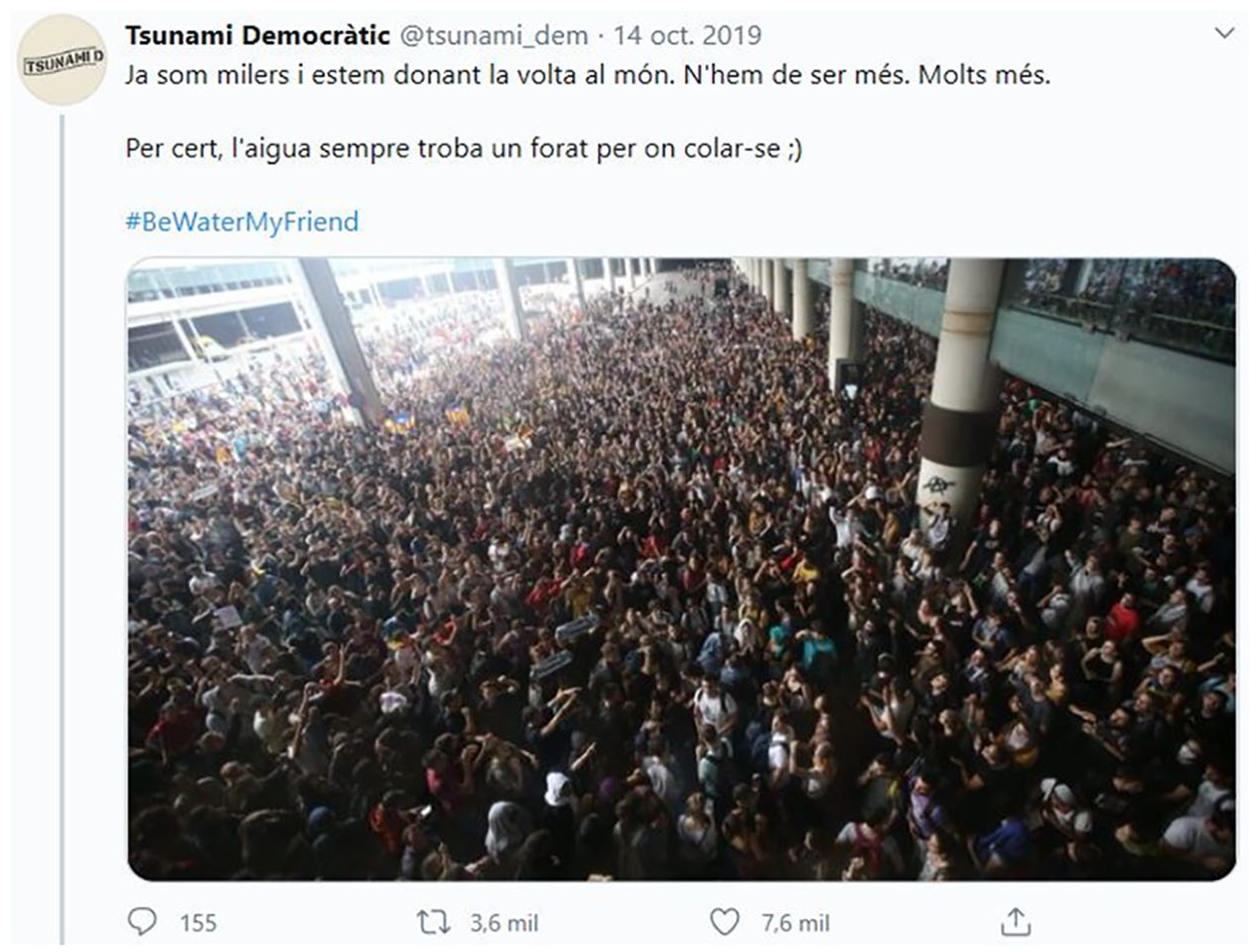
Tsunami Democràtic’s first and most successful action at Barcelona airport. The text reads: ‘We already number in the thousands and are making news around the world. We must be more. Many more. By the way, water always finds a crack to seep through ;)’.
Social media thus became the main means for the formation of physical crowds while echoing, at the same time, their successful actions. But virtual crowds became, in their own right, also a stated objective of Tsunami Democràtic with the promotion of a call to the Spanish government to ‘sit and talk’ as a world-trending topic on Twitter (Figure 4). It had first been pronounced in a statement read by Pep Guardiola, as designated ‘intermediary with the public opinion’, on 14 October 2019. The call ‘omplim les places i les xarxes’ (let’s fill the squares and social networks) remained present throughout, just as the repeated insistence that ‘Tsunami Democràtic és tothom’ (Tsunami Democratic is everybody), in parallel with the reminder of the need to grow even more: ‘Cal que el Tsunami sigui encara més gran i que creixi gota a gota’ (The Tsunami needs to be bigger and bigger, growing drop by drop); ‘Hem de ser milers de gotes d’aigua més’ (We must be thousands of waterdrops more).
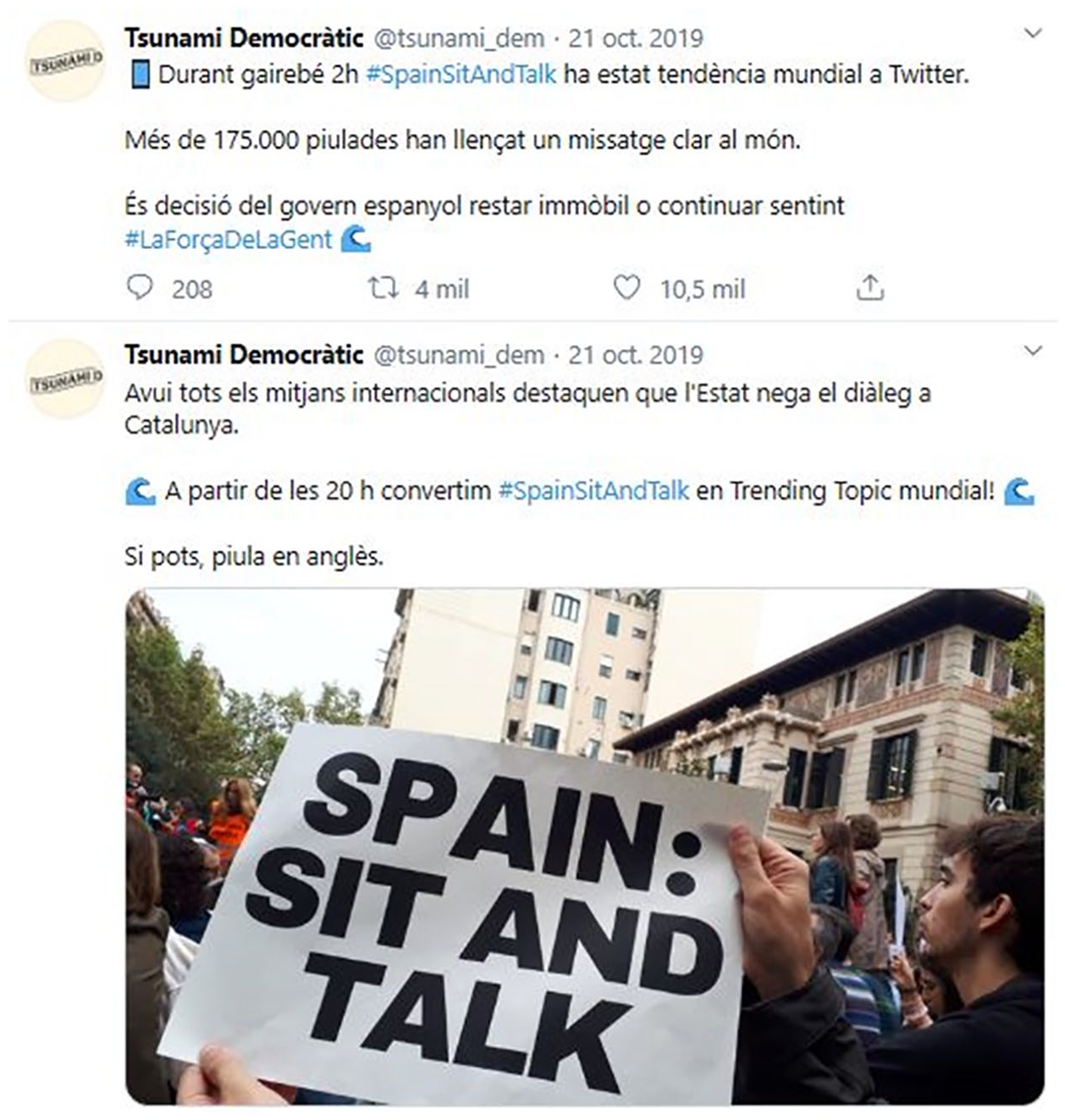
Messages calling followers to tweet in English to promote #SpainSitAndTalk as a world trending topic.
Tsunami Democràtic’s actions continued through November, with crowd events taking place during the Spanish general elections, as well as prolonged highway blocks at the French border which resulted in ‘L’estat Espanyol aïllat d’Europa per la força de la gent’ (The Spanish state isolated from Europe by the power of the people), and December, when a new world-attention capturing event was set to take place during the football match between Barcelona and Real Madrid – ‘una jornada que serà seguida per 650 millions de persones arreu del món’ (a match that will be viewed by 650 million people around the world). The latter, announced to the world in the morning through a tweet written in English (‘Hello, world! Tonight Tsunami has a message for you’) failed to achieve the desired effect. After this, the progressive but inexorable fading of Tsunami Democràtic attests to the Canettian observation that the disintegration of the crowd starts as soon as it stops to grow.
Neither imagined communities nor networked individuals
Traditional forms of collective identification and political representation have been profoundly transformed under the combined dynamics of globalization and individualization, which have led to a hollowing out of the nation-state and to a growing fragmentation that makes political mobilization increasingly complex. At the same time, the global triumph of neoliberal reason has led to a remaking of the state in economic terms, quietly undoing basic elements of democracy from within through the economization of political life (Brown, 2015: 17). Neoliberalism has both constricted and de-democratized the political, instituting management, law and technocracy in place of democratic deliberation, contestation and power sharing (Brown, 2019: 57). In this context, the ‘unpredictable dilemmas’ that arise for the organization of politics at the national level (Beck and Beck-Gernsheim, 2002: 28) have found expression in what has been variously approached in terms of populism (Mudde and Rovira Kaltwasser, 2017; Müller, 2016), authoritarian democracy (Delanty, 2019) or even post-fascism (Traverso, 2019), on the one hand, and the personalization of politics through the increasingly significant role of new digital media in the mobilization of individualized publics (Bennett and Segerberg, 2013; Gerbaudo, 2012), on the other. In this final section I will first briefly review how these perspectives relate to recent events in Catalonia, before turning to examine how a crowd-centered analysis can provide an alternative approach.
The recent push for Catalan independence has predominantly been analyzed through the prism of populism, not just because of what can be identified as an increasingly populist drift on the part of Catalan political leaders and mainstream nationalist parties (Barrio et al., 2018; Miró, 2021; Ruiz Casado, 2020), but also because of a more general cultural and discursive turn in the literatures on populism and nationalism that has facilitated their present entanglement (Brubaker, 2020: 48–49). Indeed, the articulation of nationalism and populism in the contemporary context has become a thriving area of academic interest, not only in the analysis of specific forms of right-wing xenophobic authoritarian populism, but also in general theory development (Brubaker, 2020; De Cleen and Stavrakakis, 2017). On purely theoretical grounds, Rogers Brubaker’s arguments for an ‘impure’ definition of populism are convincing, because they posit populist discourse as defined by ‘a two-dimensional space that is at once a space of inequality (economic, political and cultural) and a space of difference (of culture, values and ways of life)’ (2020: 55–56, emphasis in original), that is, at the juncture of the politics of inequality and the politics of identity. Such multidimensionality is also justified on the basis of the undeniable polysemy of the populist notion of ‘the people’, which denotes at once plebs, demos and nation (2020: 49), highlighting its productive ambiguities. Empirically, this definition also has evident advantages over more restrictive approximations to the relationship between nationalism and populism, especially in highly ambivalent forms such as in the Catalan case, which has been previously noted to be ill-fitted to populist frames and presented as an instance of an ill-defined form of hybrid populism (Gamper Sachse, 2018). Yet such an analysis of the Catalan movement for independence that builds on the productive ambiguities, entanglements and confluences of populism with a type of nationalism that is still centrally driven by the problem that ‘the state is not yet a nation state’, as opposed to one where the nationness of the state has been eroded so that the problem is ‘that it is no longer a nation-state’ (Brubaker, 2020: 51, emphasis in original; see also Delanty, 2019: 386–394; Guibernau, 2004), is still largely lacking and outside of the scope of the present article.
In contrast to populism, the role of social media in the Catalan independence movement has not attracted a great deal of attention, with the relevant exception of Kathryn Crameri’s previously cited contribution (2015). This is remarkable because the 15-M Indignadas movement that emerged across the whole of the Spanish geography roughly at the same time has provided a model case for the theorization of the new forms of political action and organization that are enabled by social media (Bennett and Segerberg, 2012, 2013; Gerbaudo, 2012). The 15-M or so called movement of the squares that spread as a result of the dire economic crisis and the neoliberal policies adopted to tackle it, leading to mass protests in some 60 cities that attracted a participation of between 6 and 8 million people, was characterized by the low level of involvement of conventional political organizations, as digital and interpersonal communication networks became its most visible form of organization (Bennett and Segerberg, 2013: 20–21). Impressive levels of communication with outside publics were achieved not only directly via the images and messages spread through social networks, but also through the use made by traditional news media of these sources, a coverage which attracted world attention (2013: 21).
W. Lance Bennett and Alexandra Segerberg consider the 15-M movement in terms of what they call ‘crowd-enabled connective action’, which ‘entails technology platforms playing the role of virtual political organizations to coordinate the actions of people operating in geographically scattered face-to-face settings, where important but otherwise potentially isolated decisions, plans, and actions take place’ (2013: 22). Crowd-enabled connective action is distinguished from both ‘organizationally enabled connective action’, where large scale personalized engagement through technological networks is still facilitated by formal organizations operating in the background and which is considered a hybrid type, and from more conventional collective action, which takes place through traditional forms of collective association, organization and identification.
In their book, Bennett and Segerberg examine how connective action networks have enabled multiple forms of political mobilization around two central concerns of our time, economic justice and global climate change. By contrast, self-determination struggles are bound to be of limited appeal in a context marked by widespread transnationalization and the erosion of all forms of collective identification. If we examine how the logic of connective action has operated in the Catalan case, however, we arrive at interesting paradoxes. Tsunami Democràtic’s actions do not neatly fit with the ‘most intriguing’ hybrid form of connective action that Bennett and Segerberg theorize as organizationally enabled, but are rather indicative of an anomalous combination of hierarchically organized action in pursuit of thinly disguised traditional collective ends, digitally networked action, and discursive representation as self-generated crowd phenomena. The possibility of such atypical and inherently contradictory forms, which would seem to challenge the authors’ straightforward contrast between a collective and a connective logic of action, is left entirely unexplored in their account. More problematically, any understanding of the crowd as crowd is conspicuously absent from their conception of crowd-enabled action, which is simply seen to emerge from the sum of (networked) individual actors. 6
The realm of crowds is neither that of a reified collective entity such as ‘the people’, however ambiguously defined, nor that of atomized individuals brought together by technological networks, but one that possesses its own specificity, which can perhaps best be described as that of an ambiguous multiplicity (Brighenti, 2011). Moreover, while the mass – a phenomenon produced and daily reproduced out of individuating efforts and sociating impulses – can certainly be approached as the individual’s nightmare (Bauman, 2001: 108), it provides a refuge from individuality, even if only a temporary one. It is Canetti’s merit to have alerted us to a positive vision of the crowd and to have called attention to its profound and enigmatic effects, which are both liberating and frightening in equal degrees, and can be remembered long after its physical presence has faded.
The notion of the multiplicity of the crowd refers most directly to how it achieves unity out of heterogeneity, to the crowd’s great equalizing effect. The crowd does not erode existing individual differences or subsume them into constructed, apparently homogenous wholes; it simply renders them irrelevant. This is the origin of the elation that transports its members to a completely new realm, the source of the mysterious social energies that have become known to sociologists as collective effervescence. Above all, the crowd escapes from the hegemony of discourse by positing the immediacy of the body and the perception of touch; it is the pressing and rubbing of bodies against each other that liberates individuals from the fear of being touched. It similarly eludes the perversity of organization: as the incommensurable alternative to organization, it is the anti-organization par excellence (Brighenti, 2010: 303). This is why a focus on crowd dynamics provides an alternative perspective to both the discursive excesses of populism and the organizational technocracies of digital media.
The crowd is also a reservoir of unexplored transformative political energies which are conveyed in symbols, images and sound. Canetti learned more from this expressivity without concepts than from the views of the powerful. Because, as Marinus Ossewaarde has stated, ‘crowds not only negate but also transcend: they pave the ways for new alternatives without being able to define these. Such a definition would necessitate forms that they cannot provide. Music and dance, rather than argumentation, are the typical expressions of crowds.’ (2013: 138). In a context in which neoliberalism has emptied democracy of meaning, crowds also persistently remind us that ‘Democracy has to do with a certain metamorphosis of the mass’ (Malabou, 2015: 29).
It is no doubt the appeal of the crowd’s ambiguous multiplicity that led to the adoption of powerful crowd symbols in the push for Catalan independence at a time of impasse when the chosen institutional paths had been exhausted and the visible heads of the movement were either in prison or exile. In exchanging organization for permanent action and recurring to the power of crowds, Tsunami Democràtic was seeking to channel popular discontent, provoking and managing a mass eruption after the sentencing of the pro-independence political leaders, so as to continue the fight for independence through new means. If we take into account the acute divisions that have since then prevailed among pro-independence political parties, the progressive loss of significance of civil society movements for independence and the irrelevance of the organization purposely created to defend the Catalan republic (Comité de Defensa de la República (CDR); Committees of Republican Defense), Tsunami Democràtic’s strategy appears to have been successful, at least temporarily.
However, and precisely because of the ephemeral character of crowd action, it was also fraught with irresolvable contradictions since its very inception. The paradoxical character of crowds, which are capable of representing the actual qualities they lack, has been commented upon above. For Canetti, it is in these representations that the nature of crowds can be most clearly discerned, as in the fervor of packs that are unable to grow or in the masses of insects that populate Schreber’s paranoias. But what was relatively easy to achieve in the pre-modern pack, an imaginary substitution of growth and density by intensity, has become infinitely more complex for modern crowds, faced with a loss of immediacy. Canetti’s approach to the crowd captures its irreducible multiplicity, but it does not provide an account of how its transformative powers can be directed towards political ends. Moreover, by insisting on natural symbolism and imagery, Canetti runs the risk of obscuring the crowd’s political dimension. This contradiction is appropriately illustrated in Tsunami Democràtic’s presentation of political protest as a force of nature.
Tsunami Democràtic’s strategy cannot be easily considered alongside other forms of artificial crowds, such as the church or the army. Yet, it inevitably represents an attempt of domestication of the crowd towards external political ends that are alien to it. Some of Tsunami Democràtic’s actions attracted the presence of real crowds, such as for instance the long marches of people walking towards Barcelona airport and occupying its terminal building. At other times, the constructed nature of actions towards Tsunami Democràtic’s strategic objectives was more clearly visible, such as in the choosing of football star Pep Guardiola as ‘intermediary’ to achieve worldwide visibility. Above all, the crowd’s evanescent immediacy was sacrificed for the permanence of a hierarchically planned ‘constant, continuous and inexhaustible campaign’. Meanwhile, open crowds spread like wildfire through Barcelona, momentarily rekindling the past of a city once known as the rose of fire.
Conclusion
Crowds marching against racism in numerous cities across the world in defiance of social distancing measures and of the very threat posed by the Covid-19 pandemic have recently reminded us that ours is still the age of the crowd. The power of crowds often suddenly erupts when ordinary democratic avenues seem exhausted or no longer possible, constituting perhaps the most salient similarity between the present and the decade of the 1930s, to which it is often compared. In the crowd’s spontaneous rage the transformative potential that anticipates the possibility of a different history is made concrete, even though only temporarily.
This article has argued for the significance of the crowd for an understanding of relevant social and political developments of our time, finding in Canetti’s work an appropriate conceptualization that offers an alternative to both methodological holism and methodological individualism, while allowing to examine how crowd imagery and the work of the imagination relates to the formation of real crowds. It has also emphasized how attending to the crowd’s expressivity without concepts can provide a perspective on processes of political mobilization that is lacking in accounts exclusively centered on ideological, conceptual or discursive analysis. An understanding of the crowd’s irreducible multiplicity also offers an alternative to the methodological individualism that prevails in analyses of the role of social media in contemporary protest movements.
The Catalan case provides an interesting instance of the still relevant but increasingly paradoxical occurrence of self-determination struggles in nations without state. Perhaps more significantly, as Ortega maintained, it is an alarming symptom not of positive nationalist affirmation but of a more general trend of disintegration that is common to national democracies in the contemporary context.
Footnotes
Acknowledgements
This article has greatly benefited from the research assistance provided by Xavier Rengel, to whom I am very grateful.
Funding
The author disclosed receipt of the following financial support for the research, authorship, and/or publication of this article: This work has received financial support from ICREA (Catalan Institution for Research and Advanced Studies).
