



Abstract
Social mobility is one of the concepts which is the most intrinsically bound to sociology. Hence, the diachronic analysis of this concept contributes to our understanding of sociology and the way that the discipline has changed, as it turned to individual social trajectories according to different topics. Aimed at contributing to this understanding, I’ve developed a literature review based on a systematic collection of the scientific publications in social sciences directly addressing social mobility. A database with conceptual and methodological variables was compiled (N=1054) and worked on. Distinct periods in the life course of this concept have been identified, with the emergence of a scattered concept (1920–1959), the golden age of social mobility (1960–1989), followed by a period of fragmentation and resistance (1990–2012). These three periods are characterized by different methodological and geographical hegemonies, flows and volumes of publications, and also by different tendencies and theoretical and disciplinary rivalries.
Introduction
There are probably few concepts as intrinsically bound to sociology as social mobility. It represents one of the most developed areas of sociology (Miller, 1998: 145), and for several decades has shown an ‘impressive conjunction of theoretical, methodological, and empirical rigour’ (Room, 2011: 192). As a flourishing field of studies, its internal heterogeneity, debates and evolution has been paving the way for our understanding of the actual history of the sociological discipline. The evolution of this concept, of its centrality and of its approach, testifies – even if only partially and indirectly – to how the sociological agenda adapts and adjusts to overall social and economic changes. Social mobility is a moving target, where origins and destinations evolve, together with their comparability and measurability. The way the discipline, as set by the community of sociologists, is able and willing to adapt and adjust its research work to the ever-new socioeconomic context is revealing of the sociological identity. Although the very simple premise of social mobility may very well be latent in all sociological research, regardless of the theoretical framework, of national traditions, of the social classes, strata or scale denominations, or the method of enquiry or measurement used, it has its particular identity and autonomy as a field. Using social strata as a covariate or time-varying covariate in a particular outcome of life is indeed not the same as studying the production and process of social stratification through the individual as a means of its own. The social mobility sociological concept, which has always been at the heart of the discipline and disputed within the quantitative-qualitative methodological divide, has validly contributed to the discussion on fundamental vs. applied social science, and this has never ceased to pose comparative, theoretical and methodological challenges to the scientific community. The findings have contributed immensely to the study of social change, as this research field is indeed a gate to the observation of sociological change.
While this article offers insights for our understanding of the history of sociology, this is not its immediate objective. Social mobility is not only a theoretical concept but also a social process of the utmost real significance in the lives of individuals, families and societies, considered ‘integral to the very metabolism and core regulation of societies’ (Bertaux and Thompson, 1997: 1). Under this premise, and using the research designs, methods and approaches in the study of social mobility as indications on how sociology has adapted to societal, stratification and social changes, this article aims to impart a panoramic view and understanding of the field. It does not provide an ‘integrative literature review’ and does not aim to ‘assess, critique, and synthesize the literature on a research topic in a way that enables new theoretical frameworks and perspectives to emerge’ (Snyder, 2019). Rather, our intention is to provide the results of a systemic literature review, or semi-systematic research review, ‘as a way to synthesize research findings in a systematic, transparent, and reproducible way’ and to ‘compare and to identify patterns, disagreements, or relationships that appear in the context of multiple studies on the same topic’ (Snyder, 2019). Here, we are more concerned with the design, methodological and approach response than with the conclusions themselves.
To attain this goal, a systematic literature analysis was developed, aimed at mapping the publishing trends on the subject and revealing a panoramic overview. It purposely does not take into account the reception, the importance or the impact of the publications themselves, so it includes all publications specifically dealing with the subject of social mobility that were found, regardless of their impact. Thus, I endeavored to produce a census of the publications directly on social mobility which appeared in various sources and formats. These documents, each one representing a unit of analysis, were organized and coded (by type of publication, author’s institutional nationality, type concept used, unit of analysis, geographic scope of the study, methodology, etc.). Then, using SPSSStatistics21® statistical software, univariate and bivariate analyses were performed in order to identify and characterize the main stages in the evolution and oscillations of this concept in the social science literature. The structure of this article follows precisely the order of the phases identified above: the emergence of a scattered concept (c. 1920–1959); the golden age (of the sociological concept) of social mobility (c. 1960–1989); and the fragmentation and resistance of social mobility (c. 1990–2012), characterized by different geographical and methodological hegemonies, by different flows and volumes of publication, and different theoretical tendencies and disciplinary rivalries.
Data and methods
The analysis developed in this article is situated at the intersection between two traditions in the analysis of literature. On the one hand, the qualitative analysis of the conceptual evolution, of the disciplinary appropriation and of the agenda-setting of a given phenomenon or concept (usually done through a smaller number of interconnected elite publications – from specific authors or renowned research endeavors). This would be more in line with the traditional literature review in social sciences. In the case of the concept of social mobility, this can be found, for instance, in contemporary cross-national research that identifies key issues on social stratification and mobility, such as in the work of Gunn Elisabeth Birkelund (2006), Gil Viry, Vincent Kaufmann and Eric Widmer, (2006), Alex Nunn, Steve Johnson, Surya Monro, et al. (2007), Thomas DiPrete and Gregory Eirich (2006), Claire Crawford, Paul Johnson, Steve Machin et al. (2011), among others. This tradition tends to use elite works or authors as representatives of the field, regularly following and citing the usual suspects and the known debates to present the narrative or story of the field (Ganzeboom et al., 1991). On the other hand, quantitative analyses of literature on social mobility have been used for a different propose. Individual patterns of publications are the raw material through which academic and scientific trajectories in specific countries or scientific fields are accessed (Bornmann and Enders, 2004; Golub, 2002; Markova et al., 2016; Sandström, 2009, among others). These analyses are also frequently made from within, by key actors and authors of the research field, and are particularly used as an introduction to specific research, as the legitimatization of a particular niche or research gap, or to contribute to a particular debate or argument. Although evidently valid, these are biased analysis of the field, made through the surviving or best theories and do not represent the great heterogeneity of the field.
The approach followed – in between these two approaches – in this article is not new. Various studies on social science concepts have recently followed similar approaches, although steering towards multiple correspondence analysis rather than to a descriptive approach (Hanappi et al., 2015), or to a content analysis of the abstracts as a complementary approach (Eicher et al., 2011). Systematic literature reviews are still mostly used outside the social sciences and more tendentially in the medical sciences, as noted by Hannah Snyder (2019). Accordingly, social mobility has not been subject of such analysis, in spite of having to gain from it. This specific approach provides a complete, and more systematic interpretation of the overall disciplinary evolution of the concept, by including publications beyond the ones developed by the elite in the field, promoting a clearer analysis of the relations and positioning of the social sciences in this regard. Standing close to a semi-systematic literature review, our approach aims to ‘look at how research within a selected field has progressed over time or how a topic has developed across research traditions’ (Snyder, 2019). This analysis is based on a comprehensive collection of the publications directly about social mobility in the understanding that a bibliographic census would be destined to be a mere attempt since, on the one hand, the universe of publications is not previously known and its delimitation is not necessarily straightforward or objective and since, on the other hand, the complete identification of the entry points in this literature field is also undeniably fallible. To try to overcome these obstacles, the process of the collection of information went through several steps, in a systematic approach:
Choice of the working languages
As mentioned above, the goal was to collect the largest possible number of publications on social mobility. To this end, the search essentially targeted documents written in the English language. 1 But it is important to note that this did not mean an exclusive search of authors from countries where English is the official language. 2 The predominant language in the collected documents is English, but the scientific debate about social mobility expressed therein is not.
Types of documents
The three types of targeted documents were articles in scientific journals, books and book chapters. A significant number of working papers were also collected from websites of previously identified research centers. Reports, conference papers, reply articles, reviews and monographs are among the remaining collected documents.
Observation window
No limitations were imposed. The oldest collected document was published in the 1920s – although I am aware that material has been collected since 1904 (by Perrin, as mentioned by Ganzenboom et al., 1991), and the collection of documents was conducted systematically until 2012. We believe the field may have evolved since then, but this does imply a different interpretation of the map or of its reading up to 2012. An update based on the same collection data strategy shall be made in the future.
The databases/search engines used
Most of the documents were collected between March and May 2012 at Brown University and Rockefeller Library (Rhode Island, United States [US]) and complemented between October and November 2012 in the Library of the London School of Economics and Political Science (London, United Kingdom [UK]) (covering international datasets). Several strategies were used for this research: search within the catalogues of the libraries referred to above, direct search in generalist search engines or online search websites (Google, Google scholar, Google books, Amazon.com, Amazon.uk, Amazon.fr), 3 direct search in the databases JSTOR, SciELO and Ingenta Connect, 4 search in every specialized or generalist journal of social sciences, search for specific items identified in the curriculum vitae of some of the important protagonists in social mobility, 5 review of all the articles titles in certain thematic journals or issues on social mobility, 6 or whose search engines did not provide satisfactory or credible results. For books the search also involved some of the search engines or online shopping sites mentioned above in addition to specific publishers and collections such as Brill, Routledge, Sage, Palgrave Macmillan, Elsevier, among others. The search was not always necessarily or totally automatic, but simply took advantage of some search engines.
The search criteria
The search criteria were mainly words in the title, abstract, keywords or results considered relevant by the search engines (general, by publisher or series). The most used expressions were ‘social mobility’, ‘intergenerational mobility’, ‘occupational mobility’, ‘professional mobility’, ‘income mobility’, ‘wage mobility’, ‘meritocracy’, ‘educational mobility’, ‘class mobility’, ‘social reproduction’ and ‘transmission’. Social mobility is used in this article as an umbrella for all this sub-terms or subfields. In a way, these prefixes (class, social, income, etc.) indicate the area where the emphasis of researching social mobility was placed, but are not evidently mutually exclusive. After having been identified and collected, these documents were subject to a second – not automatic but intellectual – filter. Through this filter, only the documents in which social mobility was the main process being analyzed were maintained. This means that after confirming that the text was indeed about any of the aforesaid manifestations of social mobility, only texts where social mobility was the main object of analysis (and not a factor or a consequence of the analysis of other processes) were included in the final set. Ultimately, the sample comprised 1092 documents. However, in 38 of these documents it was not possible to determine the date of the publication, so the diachronic analysis conducted herein concerns a maximum of 1054 documents.
Organizing the data set
Once the publications directly addressing social mobility were collected and selected, each document – representing an independent unit of analysis – was subject to a non-automatic coding process. Each unit of analysis has the same ‘weight’ in the results reached and conclusions drawn. Variables were then created and coded: year of publication (recoded into decade and period of the concept), researcher’s institutional nationality, the concept/approach used (social mobility, intergenerational mobility, class mobility, vertical mobility, social reproduction, transmission of inequalities, upward mobility, etc.), discipline (sociology, economics, anthropology, geography, history, demography, etc.), type of publication (article, chapter, book, working paper, report, etc.), method (qualitative, quantitative, mixed, documental, theoretical, etc.) and scope (national, comparative, continent, OECD countries, etc.). The analysis developed herein is mainly based on univariate and bivariate statistics, never losing sight of the diachronic analysis. The organization and analysis of this data was carried out with SPSSStatistics21® software.
The three periods
The division of the results into three periods is one of the conclusions of the descriptive and multivariate analysis developed. A thorough analysis demonstrated that the time periods was one of the variables that showed highest discrimination measures (in the tentative multiple correspondence analysis made), which enabled grasping the evolution of the field in terms of its theoretical and methodological trends and heterogeneity. This had also already been approved in early presentations and conversations with colleagues, some of them well-known experts on social mobility and key actors in the field. The distribution of documents into three periods should be taken into consideration in the interpretation/extrapolation of the results. Although the oldest text collected dates back to the 1920s, the documents in our dataset published between the 1920 and 1950 represent only about 5% of the total. Those dated in the period of 2002 to 2012 represent 40% of the total of documents collected. Scientific articles from the golden age of social mobility (1960–1989) account for the remaining 55%.
There is also an overrepresentation of scientific articles from this golden age and articles by authors with Anglo-Saxon institutional affiliation. This distribution not only reflects our increasing accessibility to the documents, but also the phenomenon of fast science 7 and the dependency of assessment of academic teaching and research careers on scientific publication indices. It is assumed that this increase in quantity reflects a structural evolution common to the publications on many other topics in the field of social science history as a whole. A critical and more complete analysis of the meaning and consequences of this quantitative growth in the publications on (social) sciences, namely in terms of manpower and knowledge, is important to bear in mind (Gilbert, 1978). By using each time period as an autonomous observation (each corresponding, in the following bivariate analysis, to 100% when relating to other variables), we aimed precisely not to overanalyze or emphasize this quantitative growth as specific to the social mobility field, as it is obviously not (Gupta et al., 2002).
By having a longer timeframe covering past evolutions of the field (besides the distinct and more inclusive material collected, namely different from that used by class theorists who do not necessarily advocate that social mobility is quantitatively measurable), this article presents a different periodization than the ‘generational’ one, attributed to Harry Ganzeboom, Donald Treiman and Wout Ultee (1991). These authors suggest three generations of studies, with the second and third pretty much overlapping in time (1960s and 1970s onwards). These are both included in the ‘golden age’, the second period, identified in this article, as they tend to refer to a coexistence in time of different theoretical trends.
The life course of a concept through literature review, a part of the story
The history of a concept – and in this particular case simultaneously and indirectly the history of a discipline – is extraordinarily complex. The story can be told from many angles and complex relations of co-causality (Figure 1). Moreover, this requires an even more accurate reflexivity, specific of the scientific analysis of the scientific field. The analysis developed herein humbly addresses only one of these vectors. Therefore, based on a systematic literature analysis of scientific production specifically on social mobility, this article only intends to identify and characterize the main theoretical and methodological trends in the study of this concept over time (vector ‘c’ in Figure 1). This relationship shall be drawn primarily using descriptive methods. In addition to the broader social, economic and demographic context, the scientific production on social mobility and other topics is directly influenced by the conditions and restrictions of the academic field (‘d’) namely through phenomena such as fast science, the disciplinary or theoretical rivalry over the ownership of a subject 8 , the impact of the appearance of certain software to support statistical or content analysis, the position occupied by ‘science’ and ‘social science’ in each national context. It is also directly affected by the scientific agenda itself (‘a’), which is in itself also affected by the conditions and restrictions of the academic field (‘e’), and is furthermore the result of what the social, demographic and economic context imposes, suggests or demands as a social priority and/or from scientific research (‘b’). The analysis of these impositions, suggestions and demands, stays out of this analysis because it would necessarily have to be developed through a comparative analysis between various subject topics and national contexts.
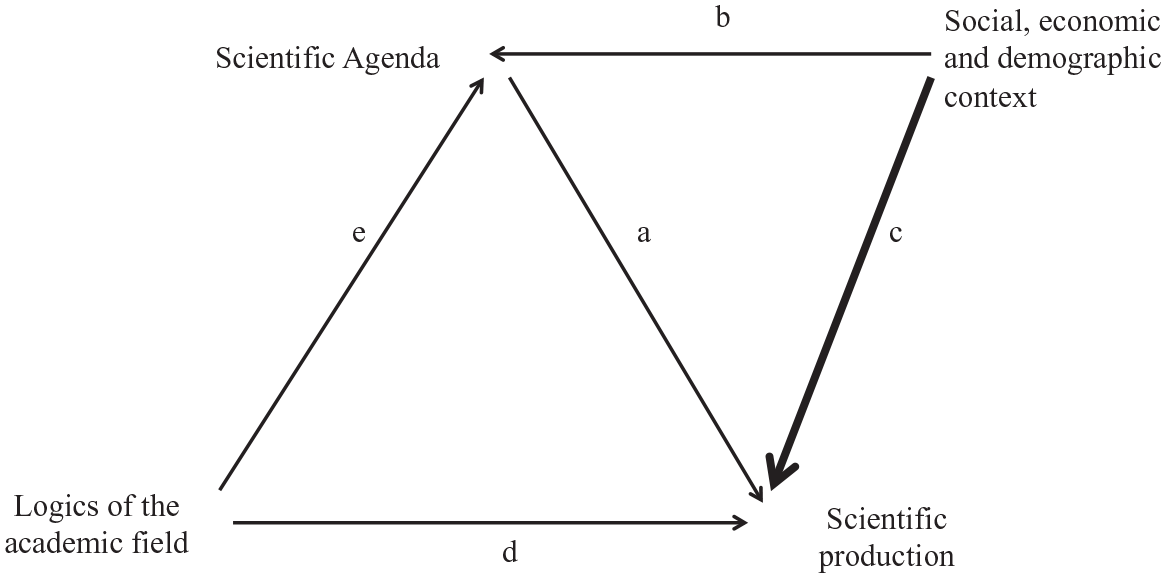
Influences over the scientific production on social mobility.
As already mentioned, the delimitation of the three periods of the concept was the result of a descriptive analysis by decade. However, the border years between these three periods do not actually correspond to turning points in the history of the concept, but rather to fluid and flexible delimitations between three evolving blocks of the concept. As is the case in other analyses of the evolution of the social mobility field, in generations, one era begins before the previous has fully drawn to a close (Ganzeboom et al., 1991).
The emergence of a scattered concept (c. 1920–1959)
Publications specifically and directly on social mobility began to emerge in the 1920s. However, given that this concept is at the very heart of the history of sociology, the actual emergence of this concept dates back to the first steps of the institutionalization of sociology itself. Nevertheless, the first work to be consistently cited as an example of the emergence and thematic autonomy of social mobility is Pitirim Sorokin’s Social and Cultural Mobility, in 1959. Here, the examination of the development of the concept was taken from the notion of autonomy and its lexis specificity (particularly), and inspired by fledgling publications. This led to the detection of the emergence of a concept that was once scattered and/or somewhat implicit in the bibliography of social sciences and sociology in the period roughly between the early 1920s and the late 1950s.
In this period, the great depression is part of the socioeconomic context, covering both the preceding period and the recovery period. At this time, there is a strong relationship between the economic cycle and demographic trends. The Great Recession peak clearly corresponds to the inverted peak of the average number of children per woman in that timeline. The economic revival, mainly pertinent around the Second World War, is then accompanied by a very sharp increase in the birth rate that led to the so-called ‘Baby Boomers generation’, substantially born between 1945 and 1955. From the point of view of the academic field, this period precedes the boom in the massification of the higher education system, and so it is characterized by a very small academic community, by borders, identities and disciplinary institutionalizations of the social sciences still under negotiation 9 and by the non-existence of the hyper-specialization processes within the field that came some decades later. 10 Therefore, in this period, we are referring to a relatively small number of publications directly on social mobility (N=52), as would be the case in other topics.
This minute intellectual and academic community was also hegemonically Anglo-Saxon. This is the only period in which almost all the articles collected belong to countries where one or the only official language is English (97%) and where the vast majority of collected documents are authored by researchers whose institutional nationality is American, but come also from the United Kingdom, Canada, Australia and New Zealand. Looking at the concept of social mobility, the Anglo-Saxon countries joint percentage will not be as high in any of the other periods (due to the later but obvious institutionalization of sociology and other social sciences, especially in Europe), and the percentage of documents authored by intellectuals with affiliation with American educational and research institutions will fall sharply in the later stages. In this period, this institutional concentration is reflected in the scarcity of comparative studies between two or more countries. Even though scientific articles represent, as in the following stages, the largest portion of the collected documents on social mobility (77%), this is the period of the concept where books, as products of a slow and mature science, account for a greater percentage.
As a discipline, sociology is the most highly represented in the set of documents collected on social mobility, at all stages of development of the concept identified in the analysis. In this first phase of the development of the concept of social mobility, however, demography also plays a very important role, accounting for about 13% of the total documents (whereas sociology accounts for 83%). This is mainly due to the impact of sharp demographic changes during this period in the life course of individuals, with especially pronounced oscillations in birth rates. Demography would never regain the same protagonism in the study of social mobility, at any other historical moment. Considering that changes in age structures are one of the most important root causes of social stratification, the subsequent dismissal or absence of demography in the study of social mobility is both regrettable and surprising. This may have to do with the dynamics of the academic field, more specifically to the proximity of demography to sociology of the family (especially American). This partnership eventually facilitated the institutionalization and recognition of this shared knowledge, but burnt other bridges. Therefore, demography and social mobility overlap less in subsequent periods.
The scattered concept period is partly equivalent to Ganzeboom et al.’s (1991) first social mobility field generation. However, by having included other less known or even purely sociological publications in the analysis, I was able to identify a distinctive relationship between the concept of social mobility and demographic structures, somewhat interrupted by the strong institutionalization, standardization and comparability of the field that followed in the subsequent period (golden age). Some of these aspects are illustrated by the word clouds based on the publications’ titles (Figure 2). Although occupational mobility (more than class or education) is the most visible, we can see the ideas of measurement, fertility and industrialization as satellite important words.

The 50 most frequent words in the titles of papers on social mobility between 1920–1959 (words ‘social’ and ‘mobility’ have been excluded to avoid over-representation).
Arising not only from the demographic and economic context, but also from the relative disciplinary closure mentioned above (with the exception of demography), the concepts of social mobility to which attention is drawn are mainly related to occupational trajectories, but also related to social stratification and social classes, to education as a key driver for intergenerational processes of upward social mobility, and to issues concerning the measurement of social mobility (Figure 2). As an example, it should be noted that studies recognized today as inescapable references are included in this figure, such as Social Mobility (Sorokin, 1927), ‘Social mobility and interpersonal relations’ (Blau, 1956), ‘Occupational bias and mobility’ (Blau, 1957), The Rise of Meritocracy 1870–2033: An Essay on Education and Equality (Young, 1958), ‘The decline and fall of social class’ (Nisbet, 1959) or Social and Cultural Mobility (Sorokin, 1959). Pioneering studies on the statistical importance of temporality (continuous and not only at two points in time) are also included (Gabor, 1955; Geiger, 1955).
The golden age (of the sociological concept) of social mobility (c. 1960–1989)
Given the disciplinary and geographical diversification of the concept, combined with an explosion of statistical, methodological and measurement innovations, and the proliferation of debates and reviews between authors and theoretical tendencies, the period between the 1960s and mid-1990s may be considered the ‘golden age’ of the concept of social mobility. This is the period when more attention was paid to this process, and when it showed most development and impact in various Western societies (in its upward vertical version). In this period, science was not fast due to any professional constraint, but due to the pressing thirst for new knowledge and for answers. There is not a single year during this period without publications on social mobility. More than mere ‘publications’, many of these documents are engaged pieces of discussions and conversations held by the experts and main protagonists on social mobility. Not surprisingly, a much higher number of publications was recorded during this period (N=389).
Despite the unquestionable expertise of and the rivalry exercised between schools and theoretical perspectives on social mobility during this period, 11 the institutional nationality of the (first) authors of the collected publications diversifies sharply in relation to the previous period. Although the percentages of documents authored by researchers with English institutional nationalities (from 6% to 7%) and Canadian (from 3% to 4%) increased slightly, the most important change was the decline in the percentage of American authorship (from 84% to 69%).
At this stage, the publications by authors from French (6%) and Scandinavian institutions (4%) begin to appear to some extent. Among the authors with affiliations in French institutions we find a relevant concentration of works by Daniel Bertaux such as ‘Sur l’analyse des tables de mobilité sociale: le domaine d’étude de la mobilité sociale’ (Bertaux, 1969), ‘Mobilité sociale biographique. Une critique de l’approche transversale’ (Bertaux, 1974), ‘An assessment of Garnier and Hazelrigg’s paper on intergenerational mobility’ (Bertaux, 1976), ‘Social destinations and class structures’ (Bertaux, 1978), ‘Heritage and its lineage: A case history of transmission and social mobility over five generations’ (Bertaux and Bertaux-Wiame, 1997), Une enquête sur la boulangerie artisanale (Bertaux and Bertaux-Wiame, 1980) or L’apprentissage en boulangerie dans les années 20 et 30. Une enquête d’histoire orale by Isabelle Bertaux-Wiame (1978), or Roger Girod’s work such as ‘Système scolaire et mobilité sociale’ (Girod, 1962), ‘Family background and income, school career and social mobility of young males of working-class origin: A Geneva survey’ (Girod and Tofigh, 1965), ‘Mobilité séquentielle’ (Girod and Fricker, 1971), Inégalité-inégalités: analyse de la mobilité sociale (Girod, 1977) or ‘Intra- and intergenerational income mobility: A Geneva survey, 1950–1980’ (Girod, 1986). And of course, the works by Maurice Garnier and Lawrence Hazelrigg (1974), Charles-Henry Cuin (1983, 1987), Raymond Boudon (1962, 1973) Pierre Bourdieu (1972) or Philippe Bénéton (1975), among others.
The studies developed within the French context of institutional nationality predominantly focus their concerns on social mobility around issues of social reproduction, transmission of poverty and inequality. This remark is obviously not exclusive to researchers of this nationality (Mann, 1994; Miller, 1998).
Comparing the self-descriptions of Research Committee 28 and Research Committee 38 of the International Association of Sociology, we find that they are differently composed in terms of institutional variety. The first (RC28) has a very concentrated composition in just a few countries, reproducing national research networks on the same boards. The second (RC38) is more dispersed over time and within each board, and features a greater variety of institutional nationalities (around double of RC28). These self-descriptions succinctly illustrate their different approaches: RC28 general objectives are to promote high quality research on social stratification and social mobility, and the international exchange of scientific information in this field. (Source: Official Site of the Research Committee Social Stratification) The purposes of the RC38 are: to help develop a better understanding of the relations between individual lives, the social structures and historical processes within which they take shape and which they contribute to shape, and the individual accounts of biographical experience (such as life stories or autobiographies); to promote meetings in this field at national, regional and international level; to circulate information about advances in this field, whether in sociology or in other disciplines; and develop links among all scholars working in this domain. (Source: Official Site of the Research Committee Biography and Society)
Authors from French institutional settings use qualitative methods significantly more than other institutional nationalities (being in a clear and stable minority during the three identified periods of the concept development, in the study of social mobility). 12 Publications from French institutional settings also focus (proportionally) more than others, but alongside Scandinavian institutional nationalities, on issues related to the measurement of the phenomenon, the construction of tables or mobility indexes and establishment of hierarchies/class typologies. Thus, among the works produced within institutions of Scandinavian countries, we find works by Robert Erikson, such as ‘Changes in social mobility in industrial nations: The case of Sweden’ (Erikson, 1983), ‘Is social mobility increasing? A tale of the reversed revolution: A rejoinder to Gunnar Persson’ (Erikson, 1975), ‘Intergenerational class mobility and the convergence thesis: England, France and Sweden’ (Erikson et al., 1983), ‘Are American rates of social mobility exceptionally high? New evidence on an old issue’ (Erikson and Goldthorpe, 1985), ‘Social mobility in the 19th and 20th centuries: Europe and America in comparative perspective’ by Hartmut Kaelble (Erikson, 1987), but also by Gunnar Persson (1974, 1976) and by Lucienne Portocarero (1985, 1989).
This diversification of the authors’ institutional nationality also had consequences at the level of the geographical scope of the actual research. Accordingly, comparative studies involving two or more than two countries increased by about 8%. This was more due to institutional but personalized partnerships among experts from or in different countries than to simple single authors focusing their research on more than one country (Erikson and Goldthorpe, 1985; Goldthorpe and Portocarero, 1981; Kerckhoff al., 1989). Social mobility had also become a central theme for sociology, being the subject of many articles that came to be the first numbers of the first volumes of several journals. It also became a transnational subject not only due to the individual and institutional partnerships referred to above, but also due to a refusal to restrict the subject to national borders – visible in the circulation of the results of French, American and English research in journals from these three nationalities.
It was in this golden age that sociology claimed the subject of social mobility for itself, seizing that role from other disciplines, namely demography, that had upheld some protagonism in the previous period. In this period, we can see that 95% of the publications directly about social mobility are admittedly sociological and correspond to an increase of about 13% of them in this discipline, compared with the previous period. The subject of social mobility was one of the few that significantly contributed to the institutionalization of sociology itself. Although the types of publications only diversified marginally, the articles in scientific journals remained hegemonic among the total publications (80% of publications on social mobility in this period), with very frequent ‘review’ articles (about 10% of the total publications of this period) and with the barely noticeable emergence of other types of publications, such as books chapters (in books coordinated by others), working papers or research reports.
As we can see in Figure 3, sociology’s claiming of the phenomenon of social mobility implied a limited focus on a particular type of social mobility: occupational mobility. This is why, as recognized by Ganzeboom, Treiman and Ultee, ‘mobility tables’, ‘mobility rates’, ‘mobility chances’ become the legitimate and common – and comparable – instruments for the study of social mobility. When studying social mobility in this period we are mainly talking about changes of occupation, profession, earnings, ‘professional class’. This is particularly true in the case of the United States and Canada where the highest percentages of studies explicitly follow this approach (around 25% of the studies conducted in institutional nationality context).

The 50 most frequent words in the titles of papers on social mobility between 1960–1989 (words ‘social’ and ‘mobility’ have been excluded to avoid over-representation).
Some of these aspects are illustrated by the word clouds based on the titles of the publications (Figure 3). In fact, although class and especially occupation dominate the social mobility sub-topics, we can see stratification, structural and intergenerational approaches at the center of the discussions (that we know were intense and, in some cases, polarized). It was during this time of coexistence (even if with tension) of different theoretical trends that mobility stepped outside the box it had emerged from. Intergenerational mobility became explicitly more complex, with the level of industrialization of the society being constantly put in the discussion (as mentioned by Ganzeboom et al., 1991, referring to the second generation). Other ‘satellite’ sectors became prominent such as prestige, education, status. Social mobility was again holistic, multifaceted and a time and context varying concept. A total fact, perhaps.
Fragmentation and resistance (c. 1990–2012)
This period finds some equivalence in the fourth generation identified by Harry Ganzeboom and Donald Treiman (2000), although it includes more than one decade and as such a different overview of the probable route taken by the field. In the period between, roughly, 1990 and 2012, the publications directly on social mobility, available and collected by the abovementioned systematic process, increased to nearly double that of the previous period (N=613), which of course may be a transversal trend affecting other topics and sciences. With regard to nationality, the hegemony of US institutions decreased dramatically, by almost half (70% to 37%), revealing an openness and increased comparability of the field (also stated by Ganzeboom and Treiman, already in 2000). This happened as a result of the relative increase in publications of researchers from European institutional nationalities, with the UK accounting for 23%, Germany for 3%, the Scandinavian countries for 6%, the countries of Southern Europe for 8% and with the exception of France, which showed a decrease of about 1%. Other countries of Europe and other continents were responsible for relative increases of publications on social mobility. Thus, the geographic range of the concept overflowed the boundaries of the sociological production centers, now reaching countries affected by negative social mobility mechanisms and which are more peripheral from the point of view of sociological production. However, within Europe, a renewed and much stronger hegemony of institutions from the UK is visible. To a large extent, Richard Breen, Geoffrey Evans, Jonathan Gershuny, Stephen Jenkins and John H. Goldthorpe contributed to this gradual process over this period.
This migration of the concept from the center to peripheries is also visible in relation to the disciplines admittedly concerned with processes, measurements and barriers to social mobility. Except for the case of demography, which has progressively shown less interest in these issues – or at least has expressed it less – since the middle of the first period considered, and of sociology, which clearly reduced its near monopolistic interest for this concept, social mobility has also engaged the scientific interest of researchers from other social sciences. This applies, most of all, to economics, which began to represent about 23% of total publications directly about social mobility (but also to social sciences in general (6%) and to anthropology, geography and ‘housing studies’, history and political science). Despite this diversification, or perhaps because of this diversification, there has not been an impact on the type of methodologies used. Social mobility is, and it seems that it will continue to be, classically and irreversibly dominated by quantitative methods, despite the richness of data that could be extracted from the research with mixed methodology, ‘with both eyes’ (Thompson, 2004: 237).
The type of publications also diversified in this last period, with a reduction of the relative percentage of articles, which now represent only two thirds of the total publications of this period, compared to 80% in the last period. This does not necessarily mean that the fast nature of the science underlying this topic has slowed down. On the contrary, the working papers and conference papers (especially between 2000 and 2012) increased in number, but at the same time, the number of critical and transparent reviews of publications decreased.
Although three major periods have been identified in the life course of the concept of social mobility through the collected documents, this last period, called ‘fragmentation and resistance (c. 1990–2012)’, is in itself very dense and heterogeneous. For this reason, the conceptual approach – the most heterogeneous variable in this period – will be analyzed in two sub-periods, from 1990 to 1999 and from 2000 to 2012. The hypothesis laid down here is that this heterogeneity is due to the effects of the demographic and mainly economic events on the conceptual course of publications (‘c’ in Figure 1). Thus, in the first part of this period and as seen in Figure 4, the almost monogamous relationship between class analysis and social mobility was strengthened. The concept, in that sense, ‘has returned’ to the scientific arena, but is much more focused on discussions of theoretical and epistemological nature (with words such as ‘research’ and ‘analysis’ being among the 50 most frequent in this sub-period – Figure 5), and is very much related to the classifications or delimitations of the actual social classes. These publications may have been in indirect response to postmodern theories, which by this time had popularized the idea that the effects of social belonging would have been eliminated – or almost eliminated – from social trajectories. However, the intergenerational issue of social mobility emerges here with a much higher relative frequency. This might also be motivated by the widespread decline in the number of children per woman in the Western sphere of the globe. Some of these aspects are illustrated by the word clouds based on the publications’ titles (Figure 4), namely the idea of intergenerational comparability and complexity, the proxy phenomena of inequality, and the ‘back to class’ publications and arguments.
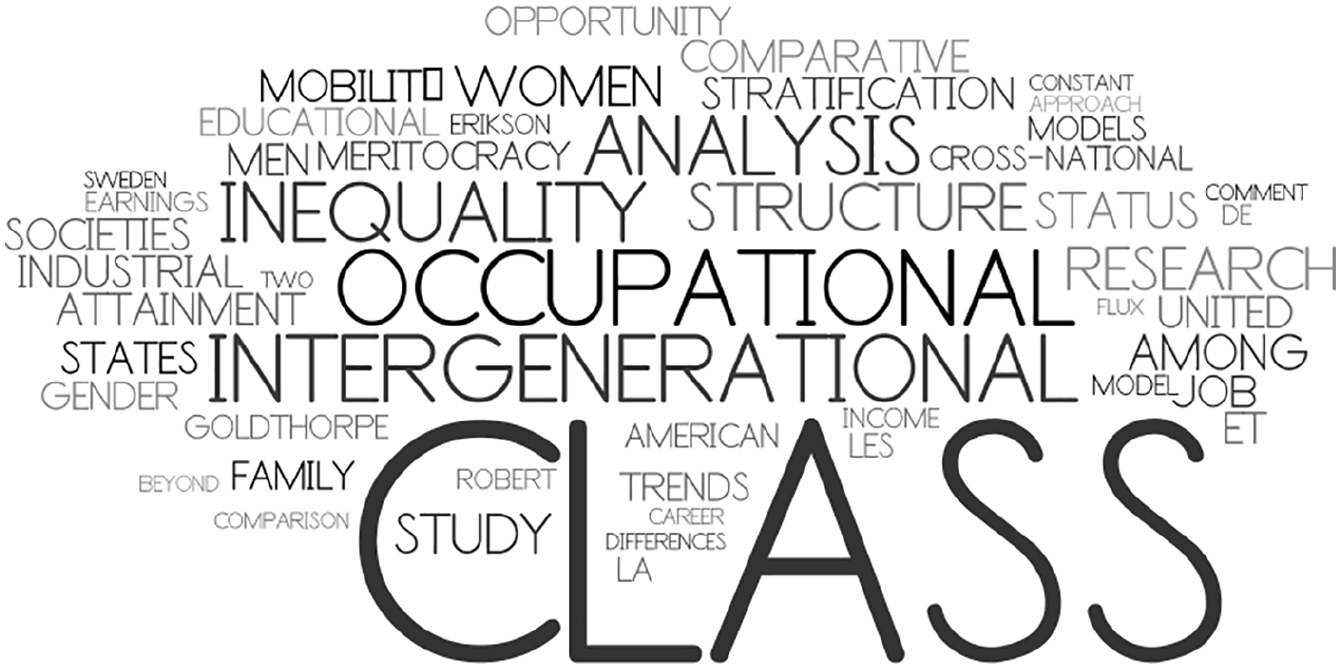
The 50 most frequent words in the titles of papers on social mobility between 1990–2000 (words ‘social’ and ‘mobility’ have been excluded to avoid over-representation).

The 50 more frequent words in the titles of papers on social mobility between 2000–2012 (words ‘social’ and ‘mobility’ have been excluded to avoid over-representation).
The results of the non-automatic coding of the type of the concept used for social mobility show very strong growth of research on ‘reproduction’, ‘transmission’, ‘persistence’. In short, the studies admittedly on social reproduction, which in the previous period occupied only 3% of the total studies directly on social mobility, represented 8% in the period from 1990 to 2012 and then doubled to 16% in the period from 2000 to 2012. This trend is also observed in the analysis of the trajectories of ‘income’, ‘wages’, etc. This will have shifted the interest in social mobility from the more ‘social’ or ‘methodological’ aspects (such as issues of measurement, construction of indices and ratios that decreased significantly over the life course of the concept) towards issues more related to social inequalities, on the one hand, and to transmission and social reproduction, on the other hand. Hence the intergenerational question is particularly highlighted in the most repeated words in the titles of publications (Figure 5).
One of the most active journals in the publication of studies and theoretical reflections on social mobility is Elsevier’s Research in Social Stratification and Mobility. This is the journal of the Research Committee (RC28) of the International Sociological Association (which has played a major role in the history of sociology and of the concept of social mobility according to Goldthorpe, 2003). It is therefore relevant that in the presentation of the online journal, the emphasis is precisely on ‘social inequalities’ (see the following quote). The issues of stratification and social mobility have given rise, in these last decades, to concerns about the growth of social inequalities.
The study of social inequality is and has been one of the central preoccupations of social scientists. Research in Social Stratification and Mobility is dedicated to publishing the highest, most innovative research on issues of social inequality from a broad diversity of theoretical and methodological perspectives. The journal is also dedicated to cutting edge summaries of prior research and fruitful exchanges that will stimulate future research on issues of social inequality. (Source: Official site of the journal Research in Stratification and Social Mobility)
The emergence of this relationship between social mobility and social inequalities is due partly to some of the experts on social mobility who traversed part of the life course of the concept considered here, as illustrated by the publications by Michael Hout (2003, 2004), Richard Breen (2000), Breen and Jan Jonsson (2005), Thomas DiPrete and Gregory Eirich (2006) or John Goldthorpe (2012). As a whole, these publications address the inversely proportional relationship between social mobility and social inequalities (Hout, 2003, 2004; Tåhlin, 2004), the reproduction of social inequalities (Jenkins and Van Kerm, 2003; Erikson and Goldthorpe, 2002; DiPrete and Eirich, 2006; Fergusson et al., 2008; Hillmert, 2011), or the role of education in correcting this reproduction of inequalities (Saar, 2010; Breen and Jonsson, 2005).
Conclusions
Social mobility represents an exemplary balance between empiricism, theory and methodology (Room, 2011); which simultaneously contributes to the disciplinary institutionalization of sociology (Goldthorpe, 2003). However, this has not been a process closed to other disciplines and areas of knowledge. Indeed, its openness has enabled the rejuvenation of the field and the adaptation of the field to macro social change. All this without losing its scientific integrity and identity.
To analyze the evolution of this field in a panoramic approach, we carried out an analysis of the publications explicitly and directly on social mobility in social sciences, through the systematic collection of the literature published roughly between 1920 and 2012 (N=1092 in total, N=1054 with dates). These units of analysis were subject to authorial, conceptual and methodological coding and to univariate and bivariate analyses (using SPSSStatistics21®). A previous analysis of the heterogeneity of the field led to the identification of three major periods: between 1920 and 1959, including the Great Depression and a negative peak of the number of children per women; between 1960 and 1989, covering the baby boom peak and the subsequent decrease in the number of children per women which remains low to the present day (being a widespread European tendency); and between 1999 and 2012, with the growth of inequalities and their study.
The first period is the emergence of the concept. At that time, the concept of ‘social mobility’ has not yet been consolidated. It was still scattered throughout different disciplines, views and sub-topics, was not subject to autonomous analyses, was characterized by being developed by a small intellectual community directly interested in this subject and hence by a low number of publications (N=52), and benefited neither from methodological standardization nor specialization. The relatively small research community was almost completely Anglo-Saxon, and likewise the countries subject to analysis (the absence of comparative studies is very obvious in this period, an aspect that changes radically in the next period of development of the concept). This Anglo-Saxon concentration tends to disappear during the life course of this concept. Besides obviously sociology, it is demography that mostly deals with the concerns about social mobility. The approaches to the concept are somewhat theoretical, empirically and methodologically scattered but the classical precedents of the study of social mobility were definitely opened to occupational trajectories, issues of measurement of the phenomenon, issues of class identity and delimitation, related to social stratification in a broader sense and the study of the role/effect of education in the processes of upward mobility. In a certain way, this last topic was the promise of this period.
In the second period, herein named the golden age of the sociological concept, roughly between 1960 and 1990, a disciplinary and geographic diversification of the concept occurred together with a boom of publications (N=389), statistical innovations and assiduous debates on the subject. This boom of publications was accompanied by a decrease of the Anglo-Saxon hegemony (and especially American), and a significant increase of publications by researchers with French or Scandinavian institutional nationalities, demonstrating an increase of inter-national and inter-institutional collaboration and comparison, on the one hand, but also an important and polemic co-existence of different theoretical and methodological approaches on the other hand (as in the case of France). These tendencies showed more pronounced concerns with issues of social reproduction and transmission of poverty, which is perhaps linked to their use of more qualitative methodologies than in the Anglo-Saxon tradition. But this did not mean, at this point, a theoretical closure. This period is characterized by both strong rivalries and strong partnerships between authors and institutions with different research practices in social mobility. This period witnessed a large increase of comparative studies with two or more countries. This was a period when the concept of social mobility, mainly professional, was dominated by sociology, which accounted for 95% of the publications on social mobility (15% more than in the previous period), maturing knowledge on ‘mobility tables’ or on the ‘OED triangle’ which became part of the general heritage of sociology.
Finally, the third period identified herein, of fragmentation and resistance, is dense and characterized by a very fast pace of change. During a first stage, the publications on social mobility mainly focused on indirect theoretical answers to some postmodernity theories that argued in favor of a strong decrease of the effects that social classes belonging and origin have on individual trajectories, thus being characterized by a return of class analysis, class mobility and class definitions (Figure 4). During a second stage, I speculate that as a consequence of the climate and social events of the Great Recession, the publications on social mobility showed a sharp increase in concerns with ‘reproduction’, ‘transmission’, ‘persistence’ of social inequalities. The disciplinary dispersion that social mobility as a concept has endured also contributed in this period to the increased number of publications about wealth and poverty, wages and income coming from other social sciences, especially economics.
Over this last turn of the century, despite the changes in the scientific production on social mobility, other aspects should definitely be emphasized: the immunity of the concept to postmodern theories of individualization which claim the decrease or even the disappearance of the effect of class on individual life trajectories (Beck and Beck-Gernsheim, 2006; Beck et al., 1994), the containment of the conceptual and methodological reconfiguration of the concept within its sociological assumptions, and finally the way it perfectly illustrates the dual role of sociology. A discipline which is not exempt from a theoretical, empirical and methodological dedication but, at the same time, which does not renounce the follow-up, reaction to, analysis and understanding of the real problems of individuals and societies.
Footnotes
Funding
The author disclosed receipt of the following financial support for the research, authorship, and/or publication of this article: The English revision of this text was supported by the Fundação para a Ciência e a Tecnologia (FCT) through the Strategic Funding of the R&D Unit CIES-Iscte, Ref. UIDB/03126/2020.
