



Abstract
John Cochrane, a leading economist, has consistently expressed a skeptical view toward behavioral economics and libertarian-paternalism. Specifically, he has consistently voiced his disagreement with the premise of “protecting” people from their own choices. However, in his hobby of piloting gliders, he has strongly argued that pilots will make behavioral errors. Indeed, he notes that pilots can be tempted to make unsafe decisions and has argued for specific rules to help prevent pilot error. In this article, we examine this contradiction. In doing so, it provides an interesting case study of how our beliefs in one system can be quite different in another.
Do economics and finance thought-leaders really do what they say? Consider the story of Harry Markowitz, the Nobel-laureate financial economist. A number of years ago, Markowitz was working at the RAND Corporation and trying to determine how to allocate his retirement account. He acknowledged that his research in modern portfolio suggests, “I should have computed the historical co-variances of the asset classes and drawn an efficient frontier.” But, he said, “I visualized my grief if the stock market went way up and I wasn’t in it—or if it went way down and I was completely in it. So I split my contributions 50/50 between stocks and bonds” (Zweig, 2007, p. 4). As Zweig notes, Mr. Markowitz had proved “incapable of applying” his breakthrough theory to his own money. Economists in his day believed powerfully in the concept of “economic man”—the theory that people always acted in their own best self-interest. Yet Mr. Markowitz, famous economist though he was, was clearly not an example of economic man. (Zweig, 2007, p. 4)
Indeed, this response from Markowitz shows that even he, the founder of modern portfolio theory, uses rules based on heuristics rather than a rational/scientific approach. This lack of consistency in belief and action is also true for many other notable academics and economists. Consider Nouriel Roubini, who has a reputation as the most pessimistic economist in academics. He has issued numerous predictions on CNBC that markets are overvalued and about to crash. Indeed, a relatively recent paper of his is titled “Can the Fed and Policy Meltdown?” Yet in spite of all this pessimism, Roubini has 100% of his 401K assets in equities (Tett, 2010).
In this article, we examine another interesting case of someone who says and does quite different things. Specifically, we will investigate the case of John Cochrane, the famous free-market economist. While Cochrane is a well-known academic, he is also an exceptional competition glider pilot, writer, and former member of the sport’s rules committee. Gliding is the flying equivalent of sailing, harnessing the energy in the sky to allow the aircraft to soar long distances. Ironically, in his writings on competitive gliding, he clearly recognizes that pilots can be prone to temptation, and that regulation is necessary to help protect them from these limits of self-control. This is surprising, as in his writings and interviews on economics, he questions the ability of anyone and especially government to enforce decisions for others. He strongly believes that while the market is not perfect, it is much better at allocating resources than any government intervention—that the problem with the economy is the regulation. For example, he states, Regulators can ruin your life, and your business, very quickly, and you have very little recourse. That this power is damaging the economy is a commonplace complaint. Less recognized, but perhaps even more important, the burgeoning regulatory state poses a new threat to our political freedom. (Cochrane, 2015b)
Continuing on this theme, he asserts when talking about the financial crisis that “the centerpiece of our crash was not the relatively free stock or real estate markets, it was the highly regulated commercial banks” (Cochrane, 2009). Given his negative views on regulation, he has, not surprisingly, been quite skeptical of the role of psychology within economics, declaring, The observation that people feel emotions means nothing. And if you’re going to just say markets went up because there was a wave of emotion, you’ve got nothing. That doesn’t tell us what circumstances are likely to make markets go up or down. That would not be a scientific theory. (Adler & Clark, 2010)
What is so interesting about these views of Cochrane is to see them in contrast with his opinions as a competition glider or soaring pilot. While he admits in his blog that he is “quite a ‘behavioralist,’ in [his] hobby life as a competition soaring pilot” (Cochrane, 2015, May 22), he does not present the full picture of his contradiction. After all, in gliding, he presents himself as someone who thinks that regulation is necessary to help protect pilots from their own judgment. For example, in his aptly titled article “You Will Be Tempted,” he argues that the rationality of pilots is “bounded” when facing certain critical in-flight situations. In this article, we investigate this apparent duality in this man’s views. As such, it provides another example of how people often say and do very different things.
The rest of the article is organized as follows. First, we will present John Cochrane’s established views about economics and policy. Next, we will conduct an analysis of Cochrane’s behavioral perspectives in gliding. We will follow this with an examination of Cochrane’s solutions for behavioral problems in gliding, and how these contradict his views regarding regulation in economics and financial markets. Finally, we will conclude with Cochrane’s response to this analysis and the impact of his contradiction and other academic thought-leaders on policymaking.
Cochrane and Economics
John Cochrane is a very well-known figure within economics and finance as an outspoken defender of free-markets and the libertarian approach to policymaking. He is a professor at the Hoover Institute at Stanford and an adjunct scholar at the Cato institute, a libertarian think tank. Immediately prior, he was the AQR Capital Management Distinguished Service Professor of Finance at the University of Chicago Booth School of Business and was the President of the American Finance Association. He is a top scholar in the field with a litany of impressive publications including Asset Pricing, a textbook that won the prestigious Paul A. Samuelson Award.
When asked in a New Yorker piece about how relevant the efficient markets hypothesis and the rational expectations hypothesis are, he replied, “I think everything . . . Rational expectations and efficient markets theories are both consistent with big price crashes” (Cassidy, 2010). Similarly, he has been quite skeptical of the role of psychology within economics, declaring, A common complaint is that “behavioral” approaches study small-potato effects . . . In the big picture of growth, unemployment, inequality, climate—you name it—has it risen past “cuteconomics”? How do I use psychology to study the everyday problems of everyday economics? (Cochrane, 2015, May 22)
As an extension of Cochrane’s underlying views about behavior, freedom, and the role of authority, he consistently voices a skepticism of government and regulation. A running theme in his writing is that regulation is both inefficient and stymies overall economic growth. As a result, he asserts that “someone as critical of current regulation as I am would conclude that forcing cost-benefit analysis on the whole process would lead us to a free-market financial nirvana and throwing out 90 percent of the pointless regulatory structure” (Cochrane, 2014b). Furthermore, Cochrane believes that government should stay out of people’s lives, stating that he disagrees with the premise of “protecting” people because the bureaucracy just thinks it knows how to run people’s lives better than they do (Cochrane, 2012a). He goes even further, questioning the ability of anyone to meaningfully make choices for others, claiming that, “It follows that super-rational aliens or divine guidance could make better choices for people than they often make for themselves . . . If psychology teaches us anything, it is that people in groups do even dumber things than people do as individuals” (Cochrane, 2014a). Finally, Cochrane voices specific objections to the concept of libertarian-paternalism, rejecting the premise that policymakers should act upon the bounded rationality and self-control of their constituents. Specifically, he counters, The case for the market is not that each individual’s choices are perfect. The case for the free market is long and sorry experience that government bureaucracies are pretty awful at making choices for people . . . The central problem with Libertarian-Paternalism as an alternative to Homo Economicus . . . where is the hyper-rational [person] that will guide things for us better? (Cochrane, 2015, May 22)
Cochrane and Gliding
While most people know Cochrane through his work in economics and finance, he is also somewhat of a celebrity within the sport of soaring. This niche sport is basically the flying equivalent to sailing, wherein the participants take engineless aircraft and use air currents to fly hundreds of miles. Pilots at a high level compete against each other in week-long contests. Cochrane is an accomplished sailplane pilot, having won numerous regional competitions in addition to a national contest in 2004, beating 27 other competitors to become the national champion. In 2010, he represented the United States in a world championship in Hungary.
Beyond his flying exploits, he applied his mathematical and behavioral insights to optimizing soaring tactics and safety, passionately advocating for innovative ways to change rules and policies to improve the safety of the competitions. To help put his ideas into action, Cochrane ran and became elected to the Soaring Society of America’s rules committee, serving between 2008 and 2014. His policy views have been hotly contested by competition pilots. He himself has noted that the responses to his suggestions were “horrendously controversial . . . I’ve heard screams of protest, been called the ‘safety Nazi,’ accused of ‘social engineering’ and worse” (Cochrane, 2011). We will now explore what was exactly so controversial about his beliefs regarding the behavior of pilots.
Fundamentally, Cochrane recognized that pilots are like any other people in that they can be tempted to make irrational and sometimes life-threatening decisions due to the limits of rationality and judgment. Just like how people succumb to the temptation to trade too much, smoke, have unprotected sex, drink excessively, text while driving, or countless other examples of human irrationality, pilots in competition can fail to follow their training and make terrible decisions.
Cochrane spent a lot of time analyzing glider accidents that occurred during competitions and determined that there was a pattern of pilots choosing to maneuver their aircraft dangerously low to the ground. In other words, rather than attempting to land when they get close to the ground as they were trained to do, pilots were taking an abnormally high risk by continuing to fly at very low altitudes. The consequence of this irrational behavior was that some pilots were forced to crash land, causing serious injuries or death.
The next question is “why, despite their knowledge and training, would pilots knowingly put themselves in such high risk?” To understand this, we must consider how gliding works. What allows gliders to fly considerable distances are rising air currents called “thermals.” They are small and localized and require gliding quite far before encountering the next one. When a pilot finds a thermal, he will tightly circle in the narrow column of rising air, slowly gaining several thousand feet. The added height now gives the glider a greater range to find the next thermal. Think of a thermal like a gas station and the altitude gained as the glider’s fuel. Once the glider has “tanked up,” it will slowly use up its “fuel” as it gradually descends to the next thermal.
If the pilot is able to continuously find thermals, gain altitude, and glide along the course defined by the competition director, all will be well and the pilot will eventually complete the course. However, if the pilot fails to find his next thermal, he will slowly descend lower and lower and eventually be forced to land. This is referred to in the sport as “landing out.” For the situations when pilots fail to find a thermal, they are trained to divert to airports or large farmer’s fields while they still have the altitude to make a safe landing. Following landing, gliders are designed to be easily taken apart and then trailered on the road. The vast majority of these somewhat-rare instances tend to be completely routine and uneventful.
However, if a pilot fails to admit that he must land and attempts to find a thermal while quite low, the pilot rapidly exposes himself to much more risk. The reason is that attempting to thermal low requires the pilot to put his glider right on the edge of its flying envelope. Circling in a thermal requires the pilot to slow down the glider as much as possible to keep it in the tight radius of the narrow rising column of air. If the glider gets too slow, or if the pilot encounters a significant gust of wind, the glider’s wing will abruptly stop flying, causing the glider to enter into a “spin” which may cause it to lose several hundred feet. When a glider is high, this is of no consequence as the pilot can very quickly recover. However, when low, the pilot may fail to recover before hitting the ground. Furthermore, due to the interaction of the wind with obstacles on the ground, the air tends to be considerably gustier, which greatly increases the probability of losing control. All of these factors add up to making it ever riskier to circle lower to the ground; thus, pilots are trained to abandon the effort with considerable height to spare.
While most pilots would rarely even consider to maneuver in such a manner, competition pilots have a major incentive to do so because “landing out” is extremely costly. Failing to complete a task on a given contest day is usually enough to take the pilot out of running to win. The scoring structure of glider competitions is such that half the points on a given day are awarded for simply completing the task and the other half are awarded as a percentage of the winner’s speed. The winner takes the full 1,000 points, a pilot who flies at 90% of the winner’s speed will earn 900 points, and so on. However, no matter how slowly the pilot flew, he is guaranteed to earn at least 500 points for the day. On the flipside, if he fails to complete the task, he will earn no more than 500 points for the day. At the end of the contest, the pilot with the highest cumulative score wins.
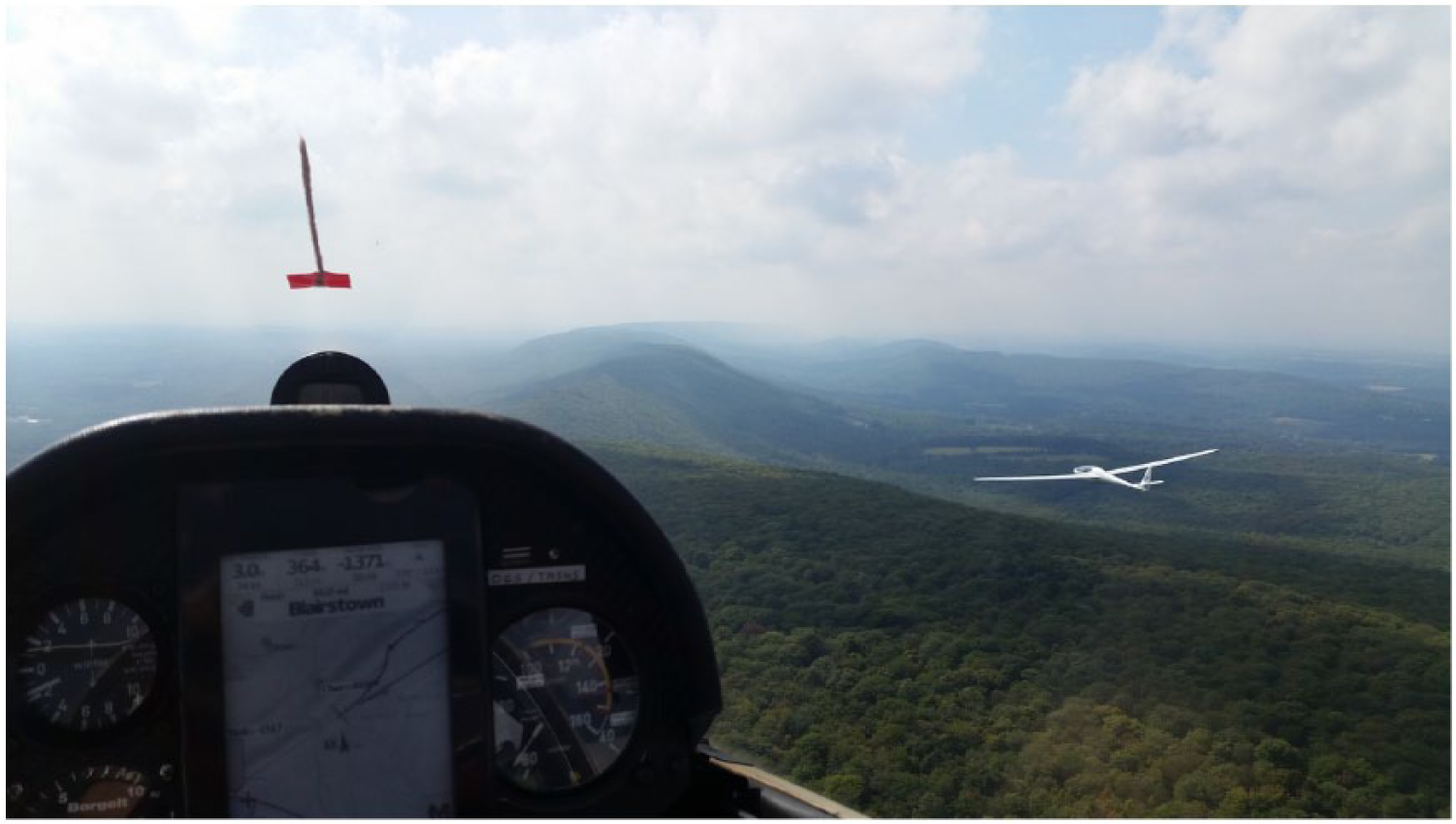
An example of a sailplane in flight. Photo by Daniel Sazhin.
With the point spreads often being quite low at the top of the scoresheet, losing over 500 points on a given contest day is usually an insurmountable loss. This makes the more prudent pilots quite risk-averse to landing out. However, if a pilot is confronted with a situation that may force him to land out, he will become quite risk-seeking to avoid this loss. As a result, if a pilot finds himself in a situation where he is so low that he may have to land out before the completion of the task, he is quite tempted to try to find another thermal to tank up in. As the pilot gets lower, this becomes more and more dangerous; the lower the pilot maneuvers, the greater the possibility that he may get injured or killed doing so. Indeed, in Cochrane’s study of accident reports and their respective GPS flight tracks he learned, The pilot does not deviate to landable terrain anywhere near early enough . . . The pilot often will see something wrong at the last minute, and try to change plan. The [actual crash itself is] the last straw. (Cochrane, 2012c, p.12)
Strikingly, Cochrane argues that pilots rapidly change their risk preferences due to competitive pressures, which results in irrational behavior. In his article titled You Will Be Tempted, he warns his fellow pilots that: You can say, “well I’m a great pilot, I wouldn’t do those things.” It’s much wiser to realize that you will be tempted and start preparing now to overcome that temptation, rather than just pretend you’re such a superior pilot it won’t happen to you. We’re all great pilots on the ground. I have heard great lectures from pilots, describing eloquently how not to do the exact things that later got them into trouble. The key is figuring out how to make in the air decisions you understand perfectly on the ground. That’s harder than it sounds. Did I say, you will be tempted? (Cochrane, 2012c, p.12)
Cochrane’s underlying argument is that no matter how a pilot appraises his own skill, given the wrong incentives and a dangerous situation, he will likely not have the self-control or discipline to overcome his predicament. Later in the article, he goes on to state that pilots should develop quantitative guidelines, monitor stress, not evaluate their flying in the air, and avoid self-pity to help make better choices (Cochrane, 2012c). Fundamentally, he expresses his belief that pilots can and will make predictable errors despite their best intentions, and they will do this because they are experiencing the pressures of competition.
The most surprising aspect about his descriptions of pilot behavior is that he has effectively argued that pilots are irrational at times. The very choice of the word temptation to express pilot judgment suggests an emotionally driven set of choices rather than cold calculation. Furthermore, Cochrane’s observations about temptation very closely relate to the psychological concept known as the hot/cold empathy gap. According to Dan Ariely, who has researched this effect at length, Our experiments at Berkeley revealed . . . Even the most brilliant and rational person, in the heat of passion seems to be absolutely and completely divorced from the person he thought he was. Moreover, it was not just that people make wrong predictions about themselves—their predictions are wrong by a large margin. (Ariely, 2008, p.57)
Cochrane recognized that when pilots experience stressful, emotionally arousing situations, they are much more likely to be tempted to make choices that they normally would not make.
Cochrane’s Solution to Gilding Problems: Paternalism and Regulation
To rectify the problem of competition pilots entering these hot states, Cochrane’s suggested rule changes embodied many elements of paternalism and regulation, which he notably contradicts in his writings about policy and economics. Specifically, he argues that the incentive to maneuver low must be taken away to help protect pilots from their own irrationality. He states, “If we remove temptations—places in which pilots can earn hundreds of points by accepting a physical risk—we can lower accident rate” (Cochrane, 2011).
The way he suggested that this incentive could be taken away is by adjusting the default of where the race “stops.” Whereas pilots would normally receive points until they have finally landed, his suggestion was to create an invisible “hard-deck,” below which a pilot would receive no score for the day (Cochrane, 2012b). This hard-deck would be established at a prescribed altitude, such as 1,000 feet above the ground. The implicit suggestion is that the pilot would have better self-control in deciding to land sooner if he no longer has a competitive incentive to keep trying to find a thermal to tank up below this altitude. Finally, the pilot would receive immediate feedback, knowing his exact altitude on his GPS flight computer display. As the invisible “hard-deck” would be programmed into the display, the pilot would be aware of the exact moment that he has flown below the deck and should therefore focus on making a safe landing.
With this combination of incentives, defaults, and feedback mechanisms, the choice architecture nudges the pilot toward making the safer choice of executing an orderly landing in a field or airport rather than attempting to maneuver lower and lower for competitive gain. Ultimately, this policy has paternalistic elements in that its objective is to protect pilots from the possibility of being tempted to make bad choices; it limits their freedom to earn points for attempting to gain altitude once below the prescribed altitude.
It is noteworthy that this particular policy was never fully implemented due to push back from pilots and others on the rules committee. However, Cochrane has advocated for other rule changes that employed similar reasoning and methods. In fact, he succeeded in pushing through a particular hard-deck in the immediate vicinity of the finish so that pilots finish the task no lower than a prescribed altitude. He has suggested changes in start procedures that take away the incentives to start at or above the sailplane’s maximum speed. Ultimately, he has used consistent methods to convey how incentives can cause pilots to be tempted to make dangerous choices and he suggested methods to nudge people from doing so.
By using these elements of paternalism, Cochrane contradicted his beliefs about this sort of policymaking. Fundamentally, he conveyed that certain people are doing things in a way that is dangerous and that he believes there is a better set of choices they should be making. While he has taken grievance toward government doing this in economics and other policy areas, he saw no issue in conveying his beliefs to his gliding peers in this exact manner. Indeed, his approach in gliding is very similar to what is advocated in behavioral economics. He first used empirical evidence to demonstrate that there is in-fact a self-control/temptation problem. Then, he established that pilots are unable to resolve these problems on their own. Next, he assessed the severity of the problem and the spectrum of ways to resolve it. Finally, he established a solution that directly resolves the problem using a paternalistic policy to nudge pilots to make better decisions.
Cochrane’s Response
Cochrane was directly interviewed about his contradicting views by one of the authors, and he provided a number of claims to attempt to reconcile his dueling perspectives. The most significant of his statements was the following: The charge that I’m paternalist about soaring (gliding) is a calumny. Were the founding fathers paternalists because they wanted to write a constitution that governed how they work? No. Racing rules give incentives. People follow incentives. When we get together ahead of time to decide what the rules are, we should think hard about how those incentives govern the safety and fun aspects of the race. We’re not the government, [the Rules Committee is] a self-organizing group of people. Is it paternalist, when getting together with your buddies and thinking what drinking game to play, to advocate that maybe we would all have fun if we could all agree that Russian roulette with loaded guns isn’t the best game to play? (J. Cochrane, email, September 20, 2016)
Responding this way, Cochrane still fails to reconcile his views about economics and his own writings about how gliding should be regulated. While Cochrane now claims that unsafe pilot behavior is simply caused by “incentives,” what actually made his policy paternalistic was his desire to take away the temptation to make unsafe choices. The fact that he tried to accomplish this by adjusting how points are allocated is irrelevant as he already prejudged that pilots are irrationally making unsafe choices due to their unstable risk preferences when in-flight. Cochrane noted that on the ground, pilots think that they would make “safe” decisions in the air and avoid maneuvering dangerously. However, in the air, they actually lack the self-control to abide by their own advice (Cochrane, 2012c). It simply follows that Cochrane later proposed a way to “help” pilots overcome temptation through a “hard-deck” at 1,000 feet above the ground. His solution was a simple adjustment of incentives, thereby nudging pilots to act in a way that he deems acceptable. As such, what made Cochrane’s policy paternalistic was his suggestion that points should be allocated differently to protect pilots from their lack of self-control in life-critical situations.
His second objection that his suggestions were not paternalistic because the rule-making process in soaring is democratic also fails to reconcile his views. He likens the regulatory process in gliding to a group of friends deciding what game to play rather than a strict authority imposing regulations in an unlawful manner. However, the article does not suggest that the rules committee or Cochrane for that matter are authoritarian tyrants, but rather that his suggested policy incorporates elements of paternalism. What made his proposal paternalistic was that it incorporated ways to protect pilots from themselves, not that it was to be implemented in a coercive fashion.
However, it should also be noted that Cochrane seems less concerned about how policies are suggested, but rather how they are implemented. His view is that it would be ideal if all the competition pilots get together: In a big room . . . and each of us say, “I won’t beat you by doing it if I can guarantee you won’t beat me by doing it.” As, essentially, athletes do with drugs. That’s not practical. As the US is a republic, a representative democracy, so is the SSA [Rules Committee]. That’s why there is the whole poll, season-long consulting, long meetings, release of RC meetings, more comment, approval by SSA directors, more season long meetings, trying things at regionals, polling again, and so on. The mechanism is NOT [the Rules Committee] decides.” The mechanism is, [the Rules Committee] facilitates a collective decision. (J. Cochrane, email, September 20, 2016)
This may explain why Cochrane seems exasperated at being labeled a paternalist as he proposed regulatory policies in a transparent fashion. Cochrane was satisfied that his suggestions went through a democratic process wherein pilots are actively part of the regulation making process. Rather, he is much more concerned that within regulatory bodies, unelected officials have far-reaching powers that are far removed from their constituency. As such, the article does not make the case that Cochrane is a paternalist, but rather that his policies in soaring embody elements of libertarian-paternalism. Being open about the rule-making process and affecting pilot freedom as little as possible are quite admirable ways of remedying what he views as dangerous behavior. However, none of this reconciles the fact that he claimed that only “super-rational aliens or divine guidance could make better choices for people than they often make for themselves” (Cochrane, 2014a) when he himself suggested ways to help pilots make better choices in the gliding competitive scene.
A Psychological Explanation?
All this leads one to the question, how is it that Cochrane has such divergent views about soaring, policy, and economics? Why is it that when we show outsiders the differences in his beliefs that almost everyone can see the contradiction, but he apparently cannot? This may be at least partially explained by the concept of “cognitive dissonance.” This refers to the psychological state when “an individual’s cognitions—beliefs, attitudes, and behaviors are at odds. People experience cognitive dissonance as aversive and are motivated to resolve the inconsistency . . . ” (Egan, Santos, & Bloom, 2007). Despite the fact that Cochrane previously used sports psychology to explain the dangers of temptation in soaring and recommended ways to curb this temptation through regulatory action, he was unable to realize how this conflicts with his views in economics. Instead, he tries to show how his policy suggestions in gliding easily fit into a neat, utility maximizing model of pilot behavior that simply follows incentives. In doing so, he simply avoids confronting his contradiction, thereby not having to recognize his inconsistency between economics and sports psychology. This shows that he was motivated to rationalize an explanation that would help protect him from admitting the duality in his views.
Conclusion
Ultimately, it is rather paradoxical that Cochrane has such divergent views about soaring, policy, and economics. The very fact that he uses psychology to justify regulatory action in soaring is quite dissimilar to his established views about policy and economics. While there are notable differences between his advocacy about regulatory policy at the level of government and soaring, he fundamentally contradicts his stance that it is not possible or reasonable to use paternalism to protect people from themselves. Cochrane evidently sees things differently in the big picture of macroeconomics and finance than in the micro world of gliding. At the micro level of gliding, he recognizes that people are human and can have self-control issues. Yet at the macro level of economics and financial markets, he lives in the world of models that simply look at the movements of the prices of tomatoes rather than the underlying psychology of the people buying them. It seems much easier for Cochrane to be paternalistic to pilots in gliding but apparently not in other contexts, such as financial markets.
In his defense, he does use objective measures to justify his assertion that these self-control issues are a problem in gliding rather than simply expressing that he knows better about what pilots should do in certain situations. Moreover, he uses empirical evidence to show that several pilots each year are getting killed because they are failing to follow these guidelines. Finally, he goes on to prove that the cost of implementing a small paternalistic nudge does not meaningfully affect the experience of flying gliders in contests. However, what is so interesting about this approach is that they fly in the face of his views on nudging and regulation in financial markets and economics and general. He shows that if it is possible to prove that people experience temptation, then it is reasonable to regulate that behavior. If it is possible to implement these concepts in gliding, why is it not possible to do this in other cases?
Cochrane’s lack of consistency when it comes to regulatory policy in gliding and in economics reflects further, far-reaching consequences for policymakers. Cognitive dissonance within thought-leaders shows that policymaking is not generally so simple that it can be boiled down to idealistic views. The actions of the many economists, academics, and scholars that show lack of consistency in their own views further reflect the difficulty of implementing policy based on simple axioms or optimal models of human behavior. Policymakers should strive to incorporate the limits of human judgment and consider the realistic results of their suggestions. Even Cochrane admits that “the right way to think about public policy is not ‘what’s right’ or ‘what’s fair.’ You have to start with cause and effect” (J. Cochrane, email, September 22, 2016). As a result, policymakers should incorporate Cochrane’s attitudes toward rule-making within gliding, which is to isolate a problematic behavior, determine its root causes, and propose ways that least intrusively changes such behavior. Instead of categorically viewing that any kind of paternalistic action is impossible or immoral, policymakers should use all the tools available to them that accomplish the most effective result while infringing upon choice as little as possible.
Footnotes
Declaration of Conflicting Interests
The author(s) declared no potential conflicts of interest with respect to the research, authorship, and/or publication of this article.
Funding
The author(s) received no financial support for the research, authorship, and/or publication of this article.