




Abstract
A very high percentage of sub-Saharan African college-graduate immigrants in the United States have college degrees in science, technology, engineering, and mathematics (STEM) disciplines compared with native-born college graduates. This study uses a pooled cross-section (2013–2018) from the American Community Survey to compare the distribution of undergraduate majors of sub-Saharan African immigrants and native-born college graduates. We estimate ordinary least square (OLS) earnings functions that include detailed college major variables. We find that undergraduate major area of study is a significant predictor of earnings and that there is an overrepresentation of sub-Saharan African immigrants with high-paying undergraduate majors. However, after controlling for human capital differences, college-educated African immigrants have not achieved pay equity with their native-born counterparts.
Introduction
From 1980 to 2018, the sub-Saharan African immigrant population in the United States increased from 130,000 to 2,019,000 (Echeverria-Estrada & Batalova, 2019). This rapidly increasing population is more likely to have college degrees than the native-born population (Anderson, 2018; Connor, 2018; Echeverria-Estrada & Batalova, 2019). Also, the large number of sub-Saharan African immigrants with college degrees are more likely than their native-born counterparts to have advanced degrees and complete undergraduate majors in science, technology, engineering, and mathematics (STEM) disciplines (Ikpebe & Seeborg, 2018).
In this article, we use a pooled sample from the American Community Survey (ACS) to explore differences in the undergraduate major fields of study between Black sub-Saharan African immigrants and two groups: (a) all native-born Americans and (b) African Americans. We find significant differences, with sub-Saharan college graduates being much more likely than natives to have majors in STEM. Ordinary least square (OLS) regression is used to determine the effects that the choices of undergraduate majors have on the earnings of college-graduate African immigrants and natives. These earning functions include dummy variables for degree level, academic major, and a set of standard human capital and demographic control variables. A unique feature of this analysis is the inclusion of interaction variables to determine whether there are significant differences between immigrant and native returns to the choice of academic major.
Literature Review
Immigration has been a subject of intense policy debate for many years and was a significant issue in the 2016 presidential race (Abramitzky & Boustan, 2017). Given the importance of immigration and the intensity and vitriol that characterizes the immigration debate, policymakers must have a clear picture of the economic contributions and assimilation success of the current wave of immigrants, particularly immigrants from less developed countries. This article contributes to our understanding of this population through an economic analysis of the unique educational characteristics of college-educated sub-Saharan African immigrants.
Abramitzky and Boustan (2017), in a survey of the literature on the economics of immigration, indicate that research can be grouped into three related topic areas:
Positive and negative selection of immigrants from their sending countries;
The effects of immigration on the labor market experience of U.S. natives;
Assimilation of immigrants into the U.S. economy and society (p. 1311).
Our study, with its focus on the effects of college major on the assimilation of African immigrants in the United States, is in the third group.
However, assimilation success depends on several “selection” considerations, both in the source country and in the United States. Several studies (Abramitzky & Boustan, 2017; Borjas, 1987; Chiswick, 1999) conclude that immigrants tend to be “positively” selected from source countries. Because of the high costs of migration, those who choose to migrate will tend to have higher levels of education, ability, and motivation, relative to those who do not migrate (Duleep & Regets, 1999). Since most migrants have an incentive to succeed in the host country’s labor market, they are likely to choose academic disciplines that are in high demand in the destination country. Thus, we expect an overrepresentation of college-graduate African immigrants in high demand STEM fields of science, technology, engineering, and mathematics. Unfortunately, since consistent data on college-graduate characteristics, including their choice of undergraduate major, are not available for many of the source countries of African immigration, we cannot analyze the extent of positive selection.
The second area of immigration research discussed by Abramitzky and Boustan (2017) is how immigrants affect the labor market performance of natives. This question is often addressed by following the labor market performance of the two groups over time and seeing if native performance is adversely affected by immigrants by the influx of immigrants (Borjas, 2003; Card, 1990, 2001). In general, these studies show that the influence of immigration on natives’ labor market performance is limited. However, since the sub-Saharan African immigrant population is relatively small, we do not expect their presence in the labor market to have large effects on natives.
Our research falls within Abramitzky and Boustan’s (2017) third category of immigration research, namely, the assimilation of immigrants in the United States. This research often focuses on the effects of specific immigrant characteristics on the earnings of immigrant groups in comparison with native wages. For example, Chiswick (1978) uses 1970 census data to show that although immigrants who have just arrived in the United States earn significantly less than natives, they were able to catch up with natives in 10–15 years after arrival. Borjas (1985) examined the progress of arrival cohorts and showed that because arrival cohorts often possess disadvantageous human capital characteristics, the speed of convergence is often slower than suggested by Chiswick, and for some immigrant groups, may take more than one generation.
Lubotsky (2007) uses longitudinal data to show that return migration may also be nonrandom, with less productive immigrants tending to experience return migration. This nonrandom return migration will improve the distribution of skills for the immigrant pool that remains in the United States and, thus, positively affect their assimilation rate (Borjas, 1996; Ward, 2017). In addition, college-graduate immigrants who have academic majors that are not in demand are more likely to experience difficulties in the U.S. labor market and to return to their countries of origin. Those with high demand majors in STEM disciplines are more likely to remain.
Many studies attempt to isolate specific immigrant characteristics that promote or hinder assimilation. For example, research shows that age of immigration affects earnings (Friedberg, 2000; Ikpebe & Seeborg, 2018; Sandford & Seeborg, 2003). Immigrants who obtain much of their education and training in their countries of origin and do not emigrate until adulthood may find that their skills are not transferrable to the destination country labor market. This lack of skill transferability causes youth immigrants to have higher returns from educational investments than their adult counterparts. Because existing literature clearly shows that age of immigration is a significant determinant of immigrant earnings, we attempt to measure the effect of age of arrival in the United States on the earnings of college-graduate African immigrants.
English language proficiency is another immigrant characteristic that has been shown to be a determinant of assimilation. Chiswick and Miller (2010) show the importance of having English language skills, especially in industries where communication-based skills are important. Because nearly all college-graduate African immigrants indicate that they speak English “very well,” it is not necessary to control for English language ability in our earnings estimation.
Some recent research focuses on the importance of cultural assimilation. For example, Abramitzky et al. (2020) find that immigrants from poorer countries tend to choose foreign-sounding names for their children when they first arrive in the United States but quickly shift to more native sounding names. This tendency to adopt the English language and American culture, suggests that immigrants make choices that will assist with economic assimilation as well.
A relatively new area of economic research on assimilation is the effect on earnings of immigrant choice of major. Recent changes in labor demand have increased opportunities in STEM disciplines. Autor et al. (2003) argue that technological change generated by the computer revolution has shifted employment opportunities away from routine manual and routine cognitive occupations toward nonroutine problem-solving occupations. In general, this change increases the demand for college-educated workers, especially those with the skills to apply computer technologies in creative problem-solving. We expect that the increase in the demand for STEM skills benefit sub-Saharan African immigrants who have chosen majors in STEM disciplines.
Several studies focus on the labor market consequences of unique immigrant skill sets. Peri and Sparber (2009), for example, find that there is significant task specialization between immigrants and natives and that this differentiation of skills between natives and immigrants is one reason that immigration does not have a substantial effect on native wages. Yang (2015) uses ACS data to show that the concentration of Chinese college-graduate immigrants in business and science disciplines has a significant positive effect on their earnings. Finally, Ikpebe and Seeborg (2018), in a study of all fully employed African immigrants in the United States, show that having a major in any STEM discipline is a significant predictor of wage and salary income. An essential purpose of the current study is to extend this research by examining the influence of specific majors on the earnings of African immigrants and their native counterparts.
The distribution of African immigrants across academic majors is affected by immigration policy. The current wave of immigrants has been influenced by the 1990 Immigration Act, which introduced several visa classifications, including H-1B visas, to allow entry of high-tech workers for up to 6 years (Yang, 2015). Employers of these temporary immigrants often subsequently sponsor them for permanent residency. In addition, the Optional Practical Training (OPT) program for international students with F-1 visas, favors students who have completed designated STEM degrees in the United States by giving them up to 36 months of postgraduation practical experience. This amount of practical experience time is much more than the 12 months offered to F-1 visa holders with non-STEM degrees (U.S. Citizenship and Immigration Services, 2016). The additional OPT time puts STEM degree holders at a significant advantage as they find employment and gain enough practical work experience to incentivize their employers to sponsor them for permanent residency. Immigration policies like the H1-B visa program and the OPT Program are designed to fill specific skill shortages. They favor potential immigrants who hold degrees in STEM disciplines, as well as those who study STEM disciplines in the United States. Since occupations with labor shortages tend to pay more, we expect this type of selective immigration policy to affect the earnings of African immigrants favorably.
Overall, the reviewed literature suggests three reasons to expect an overrepresentation of African immigrant college graduates in STEM majors. First, high demand and high pay for STEM skills in the United States should cause positive selection of those with STEM skills from their country of origin (Abramitzky & Boustan, 2017; Borjas, 1987; Chiswick, 1999). Second, the literature on return migration (Borjas, 1996; Lubotsky, 2007; Ward, 2017) suggests that immigrants with STEM skills will be less likely to experience return migration because they experience higher levels of compensation and employment success. Third, the fact that U.S. immigration policy favors immigrants with STEM skills (U.S. Citizenship and Immigration Services, 2016; Yang, 2015) contributes to the number of African immigrants who obtain degrees in STEM disciplines.
Our study examines detailed distributions of undergraduate majors to determine the extent of overrepresentation of college-graduate African immigrants in STEM disciplines. We then develop earnings functions that explore the effect of college major on the earnings of college-graduate natives and African immigrants. Because STEM skills are in short supply in the United States, we hypothesize that having a STEM major should increase the earnings of natives and African immigrants who have academic degrees in STEM disciplines.
The next section of the article describes the data used in the analysis and presents some descriptive statistics on three groups of adults: sub-Saharan African immigrants, all native-born respondents, and African American respondents. This is followed by development of the earnings function and presentation of results with a focus on the effects of undergraduate major variables on earnings. A unique feature of this analysis is the inclusion of interaction variables to determine whether there are significant differences between immigrant and native returns to the choice of academic major.
Data
We use a pooled sample of sub-Saharan African immigrants and native-born residents from 2013 through 2018 from the ACS, which we extract from the Integrated Public Use Microdata Series (IPUMS) (Ruggles et al., 2020). We restrict the sample to sub-Saharan African immigrants and native-born college graduates who were 25 through 65 years of age during the survey year and resided in the United States for at least 1 year before the survey date. The college degree could be attained anywhere in the world.
The sample includes only those sub-Saharan African immigrants who identify as being Black racially. This last restriction facilitates a comparison between native-born African Americans and sub-Saharan African immigrants. However, restricting the immigrant population to blacks does result in an underrepresentation of immigrants from South Africa. The wage analysis, including the wage regressions, further restricts the sample to those who are employed full-time (at least 36 hr per week) year-round (at least 48 weeks during the past year), and not currently enrolled in college.
The main reason for excluding individuals who are less than 25 years is that we want to give members of our college-graduate sample enough time to complete their college education. Of course, many persons are pursuing higher education after they are 25 years. Thus, we also exclude enrolled individuals from the sample that we use for wage analysis. These restrictions remove from the sample a substantial number of graduate students who have part-time employment at their university, but whose earnings are low because they receive much their compensation through tuition waivers, research support, and so on.
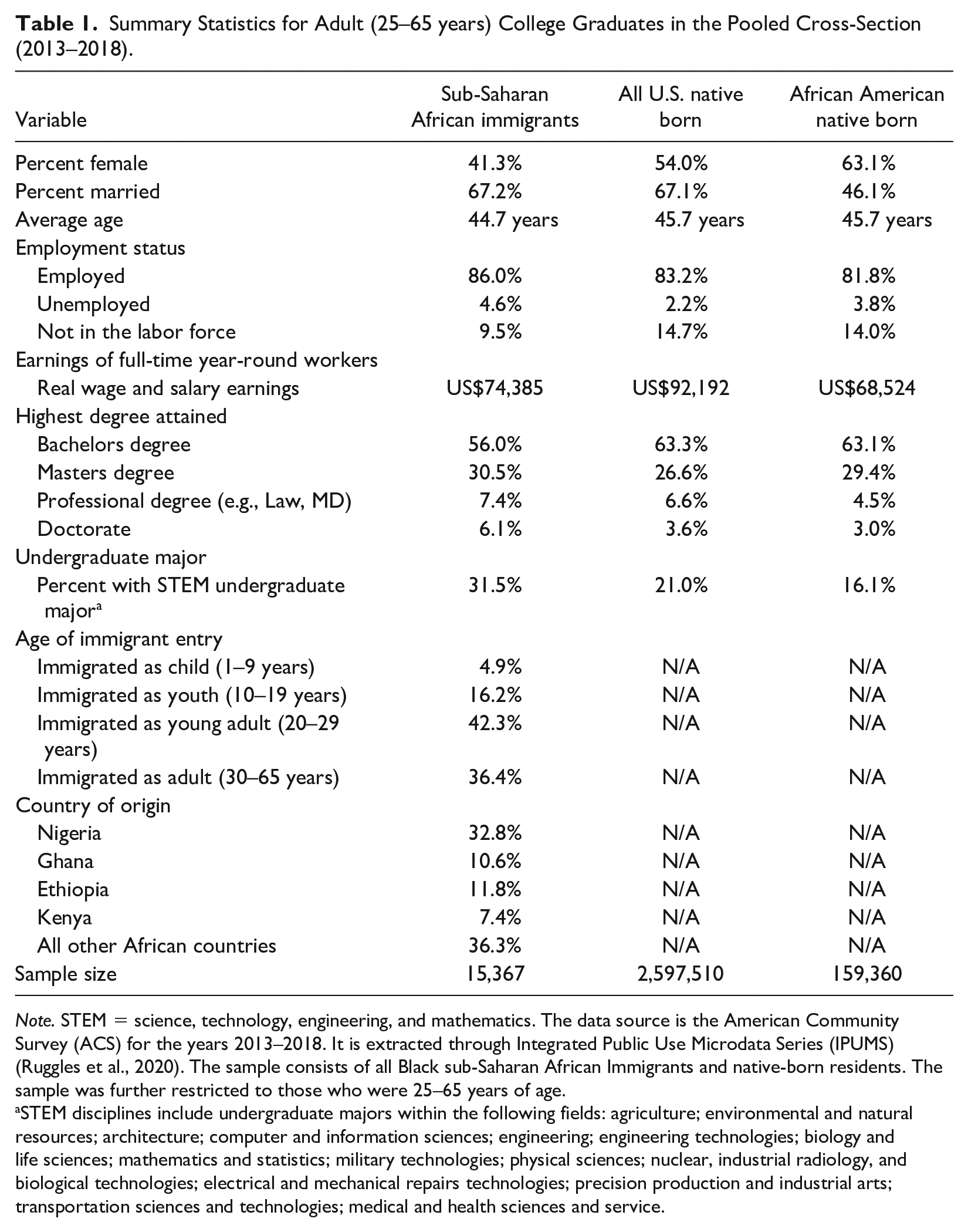
Table 1 shows descriptive statistics for three groups of adult college graduates: sub-Saharan African immigrants, all U.S. native-born residents, and African American native-born residents. Sub-Saharan African immigrants are much more likely to be male than those in both reference groups, and more likely to be married than those in the African American reference group. Sub-Saharan African immigrant college graduates are also more likely to be labor force participants than native-born college graduates. For example, only 9.5% of the sub-Saharan African immigrants are not in the labor force compared with 14.7% for the total adult native-born group and 14.0% for the African American native-born group.
Summary Statistics for Adult (25–65 years) College Graduates in the Pooled Cross-Section (2013–2018).
Note. STEM = science, technology, engineering, and mathematics. The data source is the American Community Survey (ACS) for the years 2013–2018. It is extracted through Integrated Public Use Microdata Series (IPUMS) (Ruggles et al., 2020). The sample consists of all Black sub-Saharan African Immigrants and native-born residents. The sample was further restricted to those who were 25–65 years of age.
STEM disciplines include undergraduate majors within the following fields: agriculture; environmental and natural resources; architecture; computer and information sciences; engineering; engineering technologies; biology and life sciences; mathematics and statistics; military technologies; physical sciences; nuclear, industrial radiology, and biological technologies; electrical and mechanical repairs technologies; precision production and industrial arts; transportation sciences and technologies; medical and health sciences and service.
Sub-Saharan African college-graduate immigrants who are employed full-time, year-round, have annual average earnings of US$74,385, which is about US$6,000 less than the average income of all native-born college-graduate workers and about US$6,000 more than the average wage and salary income of college-graduate native-born African American workers. However, these earnings differences are gross differences, and the regression analyses presented later show that they change when we control for educational and demographic differences between the groups.
Table 1 also shows that sub-Saharan African immigrant college graduates have some educational advantages over the native-born groups. They are more likely to hold PhD degrees and postbaccalaureate professional degrees (e.g., law and MD). Sub-Saharan African immigrants are also more likely to have completed their bachelors degrees in STEM disciplines compared with the native-born comparison group (31.5% for sub-Saharan African immigrants vs. 21.0% for U.S. natives vs. 16.1% for African Americans).
Sub-Saharan African immigrants in the ACS sample come from many countries of origin; however, most come from Nigeria (32.8%), Ghana (10.6%), Ethiopia (11.8%), and Kenya (7.4%). Age of immigration also varies, with a substantial number having immigrated as adults. A young age of arrival suggests the possibility of acquiring more U.S.-specific human capital and should be a significant determinant of earnings. Those immigrants who arrive as adults, on the contrary, are likely to have obtained more education outside of the United States, and some of the skills acquired through this education may not be transferrable to the U.S. labor market.
In sum, college-educated sub-Saharan African immigrants are quite different from native-born college graduates. They are more likely than natives to be male, to be married, to hold advanced degrees, and have bachelors degrees in STEM disciplines.
Undergraduate Major
Table 2 shows percent distributions of undergraduate academic majors for the three groups. A cursory examination of these distributions shows that sub-Saharan African immigrants tend to be overrepresented in nursing, accounting, finance, economics, and many STEM majors.
Percent Distributions of Undergraduate Major for Pooled Sample of Adult College Graduates: 2013–2018.

Note. STEM = science, technology, engineering, and mathematics. The data source is the American Community Survey (ACS) for the years 2013–2018. It is extracted through Integrated Public Use Microdata Series (IPUMS) (Ruggles et al., 2020). The sample was restricted to Black sub-Saharan African immigrants and native-born residents who were 25–65 years of age.
To determine how different the distributions are, we compute a simple index of dissimilarity (Echenique & Fryer, 2007; Jahn et al., 1947). This index shows the percentage of African immigrants that would have to switch majors to make the distributions between the two groups identical. This dissimilarity index

where ai = the number of African immigrant college graduates with major i; A = the total number of African immigrant college graduates; ni = the number of native-born college graduates with major i; N = the total number of native-born college graduates; J = the number of majors.
We calculate two indexes of dissimilarity: one that compares the distribution across academic majors for sub-Saharan African immigrants to the distribution for native-born, and another that compares the distribution of sub-Saharan African immigrants to the distribution for native-born African Americans.
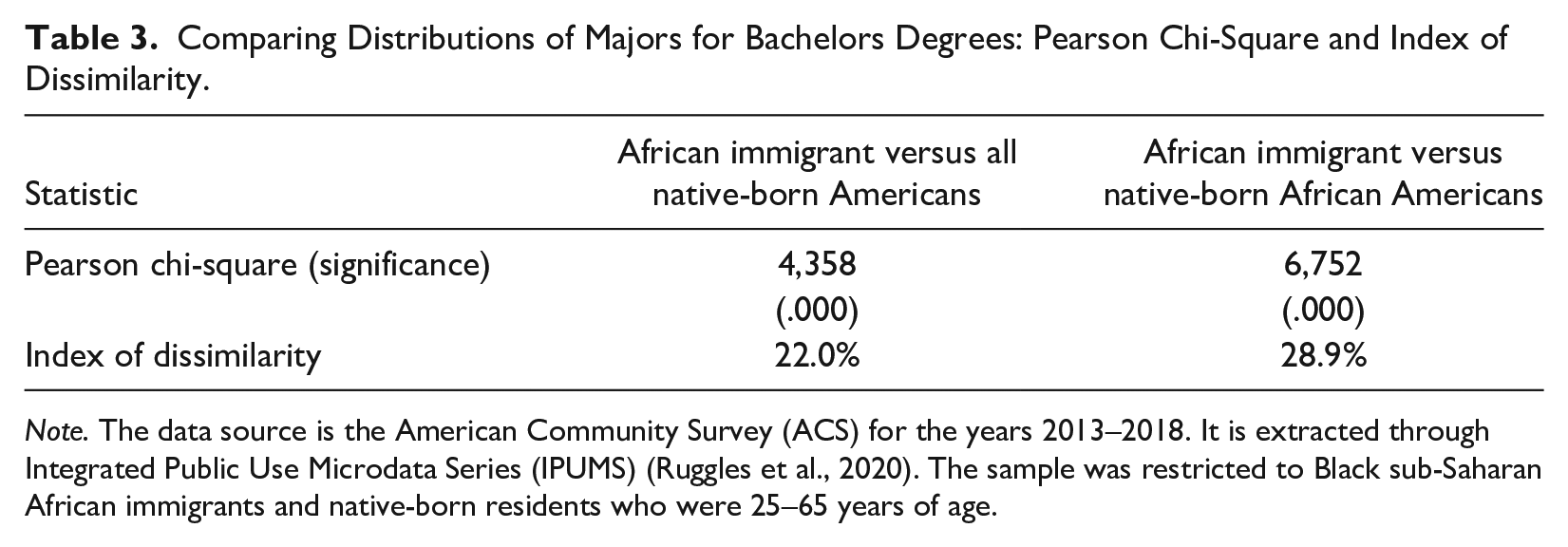
Table 3 indicates that the distribution of majors differs significantly between sub-Saharan African immigrants and each of the two reference groups. First, the high chi-square statistic shows that there are statistically significant differences between the distributions. Second, the two dissimilarity indexes presented in Table 3 show that a substantial proportion of African immigrants would have to change majors to make the African immigrant distribution identical to the distribution of each of the two native-born resident groups. The index comparing sub-Saharan African American immigrants to all native-born residents is 22.0%, and the index comparing the African immigrant college graduates to the African American college graduates an even larger 28.9%. Thus, the skill set of sub-Saharan African immigrant college graduates, as measured by the distribution of majors, is very different from the skill sets of their two native-born comparison groups. These measures of dissimilarity are consistent with the observation of actual distributions in Table 2, which show an overrepresentation of African immigrant college graduates in STEM disciplines, nursing, accounting, finance, and economics.
Comparing Distributions of Majors for Bachelors Degrees: Pearson Chi-Square and Index of Dissimilarity.
Note. The data source is the American Community Survey (ACS) for the years 2013–2018. It is extracted through Integrated Public Use Microdata Series (IPUMS) (Ruggles et al., 2020). The sample was restricted to Black sub-Saharan African immigrants and native-born residents who were 25–65 years of age.
In the next section, we include dummy variables for undergraduate academic major in earnings functions that we estimate for respondents that are employed full-time and year-round. We measure earnings as annual wage and salary incomes in constant dollars, expressed in 2018 prices (consumer price index [CPI], urban consumers).
Model
Using OLS regression, we estimate the earnings function below for the pooled sample of African immigrants and natives:

where LnWagei is the natural logarithm of individual i’s real hourly wage. LnWage, is computed by dividing average weekly wage by the usual hours worked per week.
Ii is a set of four dummy variables for the age of immigration. The four age at immigration groups are: child at entry, youth at entry, young adult at entry, and adult at entry. The reference group is all native-born respondents.
Ei is a vector of dummy variables that represent the highest degree level attained. The reference group are respondents who have the bachelors degree as their terminal degree.
Mi represents a vector of dummy variables for the major area of study for the bachelors degree. The reference major is elementary and secondary education.
Xi represents a vector of typical human capital and demographic variables included in earnings functions (age, age squared, marital status, gender).
Fi represents a set of dummy variables that control for the fixed effects associated with year of the survey in the pooled cross-section (2014−2018), and the U.S. state of residence of the respondent. These fixed effect variables are included to reduce bias from unobserved time- or place-related determinants of income. All regressions include the fixed effect variables, but we do not report the fixed effect coefficients in the results.
ui is the random error term.
Table 4 gives definitions of the regression variables. As we use 6-year pooled data, the wage and salary data have been adjusted into real wages by applying the CPI (urban consumers) with 2018 as the base year. We then take the natural log of real hourly wage (LnWage) and use that as the dependent variable.
Variable Definitions for Regressions.

Fixed effects include dummy variables for the survey year (2014–2018), and the U.S. state of residence of the respondent. These fixed effect variables are included to reduce bias from unobserved time or place related determinants of income. The fixed effect variables are included in all regression models but are not reported in the results.
The three dummy variables that define educational attainment are Masters, Professional, and Doctorate. The reference group is respondents whose terminal degree is a bachelors degree. Undergraduate majors are indicated with a large set of dummy variables for each of the majors listed in Table 2. The reference undergraduate major is elementary and secondary education. The reason for choosing elementary and secondary education as the reference group (omitted variable) for the set of undergraduate major dummy variables is that it is a large major that has graduates who tend to pursue teaching, which is an occupation that most people understand and can relate to. The coefficients to each of the 30 undergraduate major variables indicates the earnings advantage (or disadvantage) of persons in that major relative to the earnings of elementary and secondary education majors.
Estimation of equation 1 allows us to determine the impact of immigrant age of arrival in the United States on the earnings of sub-Saharan African college-graduate immigrants. Because skills acquired in the source country may not be completely transferrable to the U.S. labor market, we expect that immigrants who arrive at a younger age to be at an earnings advantage, ceteris paribus, compared with those who arrive when they are older (Friedberg, 2000; Sandford & Seeborg, 2003).
The second regression model builds on this baseline model by replacing the immigrant age of arrival variables with a vector of interactions between immigrant status and area of study. Formally:

Equation 2 replaces β1Ii from equation 1 with the term ρ1[(Mi)(Ii)]. This new term is a set of interactions between being an African immigrant and their undergraduate major. Since 31 majors are defined (Table 2), we have included a total of 31 interaction terms. Each of these dummy variables assumes the value of 1 when the person in the undergraduate major (say history) is a sub-Saharan African immigrant and is zero otherwise. The coefficient to this interaction term indicates the difference in returns for immigrants in that major compared with native-born persons in the same major. We expect that the coefficients to these interactions to have negative signs because of the disadvantages that sub-Saharan African immigrants are likely to face in U.S. labor markets because of normal assimilation challenges and the possibility of racial discrimination.
We estimate the models described in equations 1 and 2 above for two groups. The first group includes the sample of adult (25–65 years) college-graduate natives and college-graduate sub-Saharan African immigrants. Their college degrees can be achieved anywhere in the world. We limit this sample to those who are employed full-time, year-round, have reported positive income from wages and salaries, and are not enrolled in school. This large sample permits analysis of the earnings performance of Black sub-Saharan African immigrants relative to all native-born respondents in the sample. We hypothesize that sub-Saharan African immigrants will be at a significant earnings disadvantage relative to the overall sample of natives.
The second group is restricted to Black respondents and includes sub-Saharan African immigrants and African Americans. Again, we limit the sample to adults (aged 25–65 years) who are employed full-time, year-round, have reported positive income from wages and salaries, and are not enrolled in school. We expect that college-graduate sub-Saharan Black African immigrants will earn less than their African American counterparts. However, since both groups face race-based discrimination, the earnings disadvantage of the immigrants should be less than when sub-Saharan Black immigrant earnings are compared with the sample that includes White natives.
Results
Table 5 presents the baseline model (equation 1) results for the two groups. The first group includes 1,578,216 White and Black native-born respondents and Black sub-Saharan African immigrants. The second group consists of a smaller sample of 111,033 native-born African Americans and Black sub-Saharan African immigrants. Rather than including a single dummy variable indicating “immigrant,” we included four dummy variables depending upon the immigrant’s age at arrival in the United States. These four variables indicate whether the immigrant arrived as a child (below 10 years), a youth (10–19 years), a young adult (20–29 years), or as an adult (30 years and above). The coefficients to the four immigrant group variables indicate the earnings disadvantage of each of the four immigrant groups compared with native-born respondents, ceteris paribus. We expect negative coefficients.
Regression Results for Pooled Sample (2013–2018) of African Immigrants and Natives.

Note. Dependent = natural log of real wage; STEM = science, technology, engineering, and mathematics. Included in the regression but not reported are state and year fixed effect variables. The data source is the American Community Survey (ACS) for the years 2013–2018. It is extracted through Integrated Public Use Microdata Series (IPUMS) (Ruggles et al., 2020). The sample consists of all Black sub-Saharan African Immigrants and native-born residents who were employed full-time and year-round. The sample was further restricted to those who were 25–65 years of age and not enrolled in school.
p < .05. **p < .01. ***p < .001.
To make the results more intuitive, we convert the coefficients in Tables 5 and 6 to percent change in our discussion of the results. Thornton and Innes (1989) show that the common practice in labor economics of interpreting the untransformed coefficients in semilogarithmic earnings functions as “percent change” can result in substantial errors. The conversion of a dummy variable coefficient in the semilogarithmic earnings function to percent change is done by subtracting one from the exponent of the coefficient times one hundred ([eΒ − 1]100). This conversion is done to the coefficients presented in Tables 5 and 6 in the discussion below.
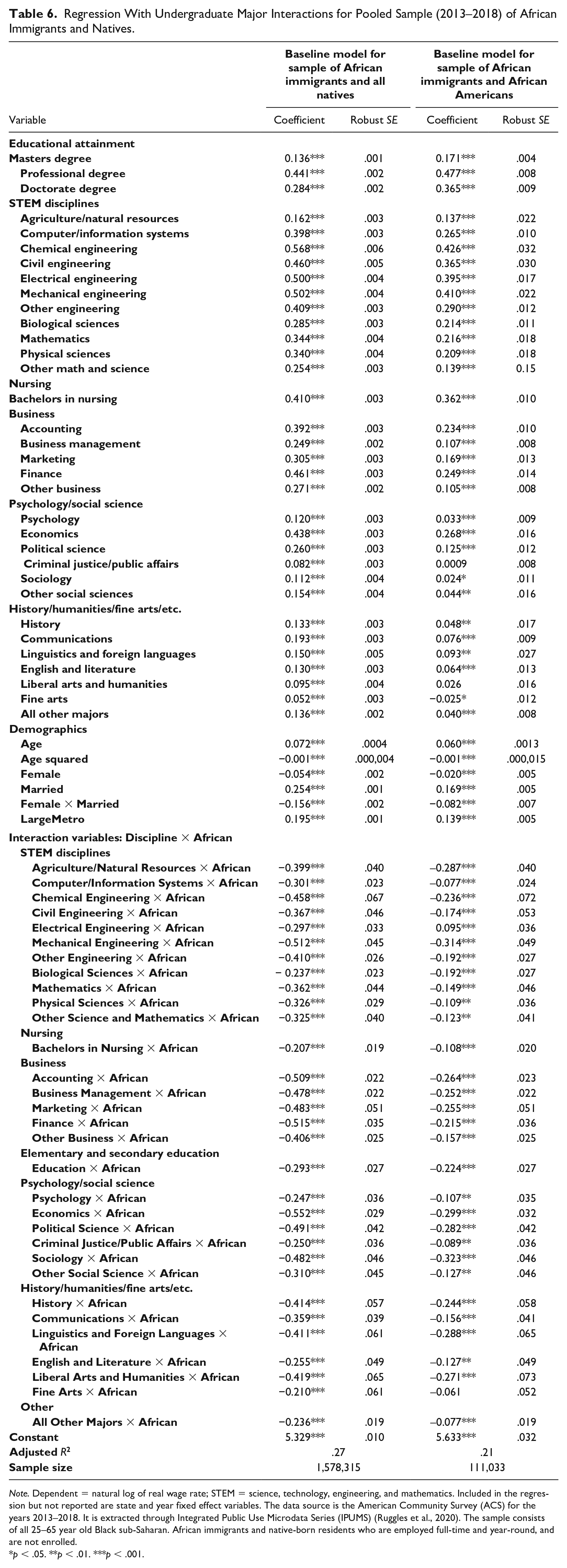
Regression With Undergraduate Major Interactions for Pooled Sample (2013–2018) of African Immigrants and Natives.
Note. Dependent = natural log of real wage rate; STEM = science, technology, engineering, and mathematics. Included in the regression but not reported are state and year fixed effect variables. The data source is the American Community Survey (ACS) for the years 2013–2018. It is extracted through Integrated Public Use Microdata Series (IPUMS) (Ruggles et al., 2020). The sample consists of all 25–65 year old Black sub-Saharan. African immigrants and native-born residents who are employed full-time and year-round, and are not enrolled.
p < .05. **p < .01. ***p < .001.
Since human capital acquired in source countries is generally not wholly transferrable to the United States, we expect those who arrive at a younger age to have an earnings advantage over immigrants who come as adults. The results are consistent with these expectations. Table 5, for example, shows that sub-Saharan African immigrants who arrive as children have a 10.5% disadvantage to their native-born counterparts. This disadvantage is much lower than the 41.5% disadvantage experienced by sub-Saharan African immigrants who came as adults. In general, the model for the overall sample shows that sub-Saharan African college graduates have much lower estimated earnings than their native counterparts regardless of age of arrival.
The results are similar when we restrict the sample to sub-Saharan Africans and African Americans, as shown in the last two columns of Table 5, but there are notable differences. For example, the coefficients to the four immigrant variables are smaller than they are in the sample that includes all natives, and only three of the four immigrant variables are statistically significant. Sub-Saharan African Immigrants who arrive in the United States as children have reached earnings parity with their African American counterparts, while those who arrive as adults have a 29.0% wage disadvantage when compared with their African American counterparts. These results support prior research showing that those who immigrate at a younger age have an earnings advantage over those who immigrate when they are older (Friedberg, 2000; Liao & Seeborg, 2015; Sandford & Seeborg, 2003).
An important conclusion that we can draw from the results presented in Table 5 is that the estimated difference between natives and immigrants in Table 5 is larger than the actual earnings differences reported in Table 2. For example, Table 2 shows that the actual average earnings of full-time employed college-graduate sub-Saharan African immigrants are higher than their African American college-graduate counterparts (US$74, 386 vs. US$68,524). However, this earnings advantage turns to a disadvantage in the baseline regression model reported in the last two columns of Table 5, which shows that being an immigrant significantly reduces estimated earnings for three of four age of arrival groups. It appears that controlling for degree level, academic major, demographics, and state and year fixed effects in the baseline model cause college-graduate sub-Saharan African immigrants to be at an earnings disadvantage to native-born college graduates. We know from the descriptive statistics discussed earlier (Table 1) that sub-Saharan African immigrants are more likely to be male, to be married, to have higher levels of education and to have undergraduate degrees in higher-paying disciplines than their native counterparts. When we control for these determinants of income, the results show that sub-Saharan African immigrants have lower estimated earnings than native-born African Americans except for those who immigrate as youth.
Table 5 also shows that undergraduate majors are significant predictors of earnings even after controlling for degree level attained, age, gender, marital status, and time and place fixed effects. The model includes a large set of dummy variables indicating the primary undergraduate major. The reference major (omitted variable) is elementary and secondary education. For example, Table 5 shows that the effect of majoring in, say, economics is to increase earnings by 54.6% over elementary and secondary education majors for the overall sample and a much smaller 27.6% for the African American sample. An examination of the coefficients of the 30 undergraduate major coefficients shows the highest returns for those who major in the STEM disciplines, nursing, accounting, finance, and economics. Remarkably, these are the precise majors that sub-Saharan African immigrants have an overrepresentation (Table 2). Thus, it appears that college-educated sub-Saharan African immigrants tend to acquire skill sets that are in demand.
Next, we estimate equation 2 for two samples: (a) the large sample of African immigrants and natives and (b) the smaller sample of African immigrants and African Americans. This model is different from equation 1 model in that it replaces the four age at immigration dummy variables with a complete set of interactions between immigration and the undergraduate major variables. For example, the interaction variable for the economics major (Economics × African) assumes the value of one if the respondent is an immigrant from sub-Saharan Africa and is an economics major. The coefficients of these interaction variables show the difference in returns between college-graduate sub-Saharan African immigrants and college-graduate natives in the same major. Table 6 reports the coefficients to these interaction terms. As expected, most of these interaction terms have negative and statistically significant coefficients, indicating that sub-Saharan African immigrants do not realize as high returns to selecting specific majors as their native counterparts. Notice that interactions with largest negative interaction coefficients include several engineering majors, all business majors, economics, political science, and sociology.
The interaction coefficients for the sample of African immigrants and African Americans also tended to be negative and statistically significant, which indicate that African immigrants are at an earnings disadvantage to African Americans. However, these interaction coefficients are much smaller than for the comprehensive sample of all natives and African immigrants. Thus, African immigrants are closer to wage parity with African American natives than with all natives.
Table 7 presents “returns” for 11 major areas of study for the overall sample of sub-Saharan African immigrants and natives. Each of these 11 majors has at least 2.5% of the sample of sub-Saharan African immigrants. The “return” from a particular major for native-born respondents is the coefficient to that major’s dummy variable expressed in percentage terms, while the return to sub-Saharan African immigrants who pursue that major is the sum of the coefficient to the major variable and the coefficient to the respective interaction term, also expressed in percentage terms. All of the returns for native-born respondents are statistically significant since they reflect a coefficient to a single variable.
Returns a to Selected Undergraduate Academic Disciplines Relative to Elementary and Secondary Education for Natives and African Immigrants (2013–2018).

The return for each major in percentage terms is determined from Table 6 by multiplying the relevant coefficients by (eΒ − 1)100. The reference major is education. Thus, the returns for “All native born” represents the percent that earnings in the major exceeds wages of education majors. The returns for African immigrants differ from the returns for all native born by the adjusted coefficients to the related interaction terms.
Native-born respondents with majors in elementary and secondary education are the reference group for all of the rates of return calculations. Table 7 shows substantial differences in these returns between native-born respondents and sub-Saharan African immigrants. We see, for example, that the estimated earnings of all native-born respondents with a major in economics is an estimated 54.9% greater than native-born elementary and secondary education majors, and the earnings advantage of sub-Saharan African immigrants with a major in economics is an estimated 12.6% greater than native-born elementary and secondary education majors.
Table 7 shows that college-graduate sub-Saharan African immigrants realize especially high returns in computer/information systems (22.9%), electrical engineering (39.1%), and nursing (32.0%) relative to the reference group (natives in elementary and secondary education). Still, these high returns where still significantly less than the returns of their native counterparts in the same majors. Nursing had the greatest earnings parity between sub-Saharan Africans and natives with an 18.7% gap, as shown in the last column of figures in Table 7. The long-standing shortage in nursing seems to have benefited sub-Saharan African immigrants.
Table 7 also shows the gap in returns between natives and sub-Saharan African immigrants is greatest for majors in accounting, business management, finance and economics. Although sub-Saharan African immigrants did have positive returns in three of these disciplines, their returns were much less than for natives.
Three majors in Table 7 show negative returns for African immigrants relative to the reference group. However, African immigrants are underrepresented in all three of these majors relative to natives (Table 2). It appears that African immigrants tend to avoid majors with unfavorable wage opportunities.
Discussion and Conclusion
This article uses a pooled cross-section of employed college graduates to explore the effects of educational choices on the earnings of a large sample of college-graduate sub-Saharan immigrants and natives. We find that African immigrant college graduates are more likely to have acquired advanced degrees (i.e., masters, professional, and doctorate).
Using chi-square statistics and a dissimilarity index, we find that African immigrant college graduates also differ from native-born college graduates in their choice of undergraduate major. They are overrepresented in STEM majors, nursing, accounting, economics, and finance. Graduates from these disciplines generally face favorable employment prospects in jobs that pay well. The propensity of sub-Saharan African immigrant college graduates to acquire skill sets that are in high demand suggests that many of them fill important labor market shortages.
Descriptive statistics in Table 1 show sub-Saharan African college-graduate immigrants have annual average earnings advantage over their African American counterparts and a relatively small disadvantage compared with their native-born counterparts. However, the regression results presented in Tables 5 and 6 show that African immigrants are at a significant earnings disadvantage when controlling for demographic, human capital, and fixed effect variables.
Future research could explore these unusually large estimated earnings gaps between native college graduates and sub-Saharan African immigrant college graduates. A probable explanation is that sub-Saharan African immigrants may face discrimination on the bases of immigrant status and race. Another possible explanation of the earnings gap is that knowledge acquired in source countries is only partially transferrable to the U.S. job market. Evidence for this is found in the regression results reported in Table 5, which show that immigrants who arrive as adults suffer higher earnings penalties than immigrants who arrive as children.
Particularly troubling are the substantial differences in returns to African immigrant college graduates who have undergraduate majors in accounting, business management, finance, and economics. Future research could explore why African immigrants lag behind natives in these disciplines at the same time that they experience considerably more success in certain STEM disciplines and nursing. One avenue of such research would be to determine the extent that these majors lead undergraduates to careers in the private sector where African immigrants may experience difficulty assimilating because of lack of networks and the presence of race-based discrimination.
Future research could also focus on measurement of selection biases that may shape the unique skill sets that sub-Saharan college-graduate African immigrants bring to the United States. This research should consider the effects of three sources of bias: (a) source country selection; (b) return migration selection; and (c) immigration law selection. This research could also compare sub-Saharan African immigrant earnings performance to other immigrant groups.
Overall, African immigrant college graduates are quite responsive to the needs of the American labor market. They are more likely than natives to have a college degree, and are more likely than natives to earn advanced degrees (masters, professional, and doctorate). They are also more likely to acquire skills in disciplines that are in high demand and pay well (STEM, nursing, accounting, economics, and finance). Unfortunately, there remains a substantial pay gap between African immigrant college graduates and their native counterparts.
Footnotes
Declaration of Conflicting Interests
The author(s) declared no potential conflicts of interest with respect to the research, authorship, and/or publication of this article.
Funding
The author(s) received no financial support for the research, authorship, and/or publication of this article.
