



Abstract
This article examines whether the author–editor social connections identified by Tommaso Colussi among general-interest economic journals offer similar benefits to contributors to three top economic education field journals. I find that 6.7% to 8.7% of articles in these journals are written by connected authors and published when the related editor is in charge. Authors who are or were employed at the same institution as an editor are found to have published significantly more papers in the journal where said editor is in charge. Authors connected to editors through co-authorship and overall connections achieve similarly positive results when using expanded parameters for social connections.
JEL Classifications: A14, A20
Introduction
Within the literature on academic economists’ research productivity, co-authorship and social connections among researchers are consistently identified as significant and positive factors. Cainelli et al. (2015) found that, alongside authors’ individual characteristics, Italian economists’ propensity to collaborate, as measured by the proportion of their total publications that had at least one co-author, had a positive impact on the number of articles they published. Taylor et al. (2006) showed that, among resource and time constraints driven by teaching and service requirements, co-authoring with other scholars serves as a positive counterbalance to economists’ research productivity, though each additional coauthor involved in a paper provided diminishing returns. Ductor et al. (2014) demonstrated that accounting for authors’ tendency to collaborate and their co-authors’ research productivity helps better the predictive power of research output models, whereas Brogaard et al. (2014) found that authors who were employed at the same institution as editors for 30 major economics journals published significantly more articles in those same journals than their non-connected peers. Other authors such as McDowell and Smith (1992), Davis and Patterson (2001), and Maske et al. (2003) have likewise shown the important role social networks and co-authorship play in economists’ research output, while also highlighting how the relatively low number of women present in the field can have a deleterious effect on female economists’ opportunities.
However, as these articles tend to only consider research output in general-interest economics journals, we are left to wonder whether these social connections play a similarly prominent role when focusing on the economic education subfield alone. As Asarta and Mixon (2019) note, economic education has already held a wide venue in a variety of general-interest economics journals, and the creation of economic education-specific journals has served as an indication of both growing interest in the topic and its continued development into its own distinct subfield. This has been helped along in no small part by The American Economist’s publishing of a substantial number of economic education articles, covering topics such as the role of economics in interdisciplinary instruction (Fuess, 2001), the relation between course structure and learning outcomes (Reyes, 2010), and how instructors extend and expand upon concepts presented in textbooks (Becker, 2007). However, as the bulk of this research has focused on economics instruction and program design (Asarta et al., 2017), little has been directed at analyzing the structure of the economic education subfield itself, either on its own or in relation to other research subfields.
As such, I seek to examine what role social connections between economic education authors and editors play in research output by replicating the research question and methodology of Tommaso Colussi (2018). Whereas Colussi investigated the effect of hypothetical 1 social connections with editors on authors’ publication outcomes across leading general-interest economics journals (American Economic Review, Journal of Political Economy, and Quarterly Journal of Economics), this article explores the same fundamental relationship for the Top 3 economic education journals as identified by Lo et al. (2015)—the Journal of Economic Education (JEE), International Review of Economics Education (IREE), and Journal of Economics and Finance Education (JEFE). More explicitly, I seek to answer the following question: For three of the top economic education field journals, does the editor in charge have a significant effect on the publication outcomes of those authors with social connections to them? As the number of economic education journals continues to grow, understanding the role author–editor social connections play within these journals will be of critical importance in assessing where existing research flows from and in which directions the subfield are headed.
Data
The initial sample consisted of every author who had published at least one economic education-related article in the JEE, IREE, or JEFE between 2008 and 2018, excluding editorials, introductions to sections, and book reviews. An article was considered “economic education-related” if it was listed with a JEL code within the A20–29 range (“Economic Education and Teaching of Economics”) or, lacking this, focused on economic instruction or examining the economic education subfield, per its abstract. This created a list of 996 unique authors, 753 of whom had complete academic and employment histories available online, gathered from a variety of public sources, including curriculum vitae posted on personal and school websites and LinkedIn profiles. The same data were also gathered for the editors of the JEE, IREE, and JEFE between 2008 and 2018.
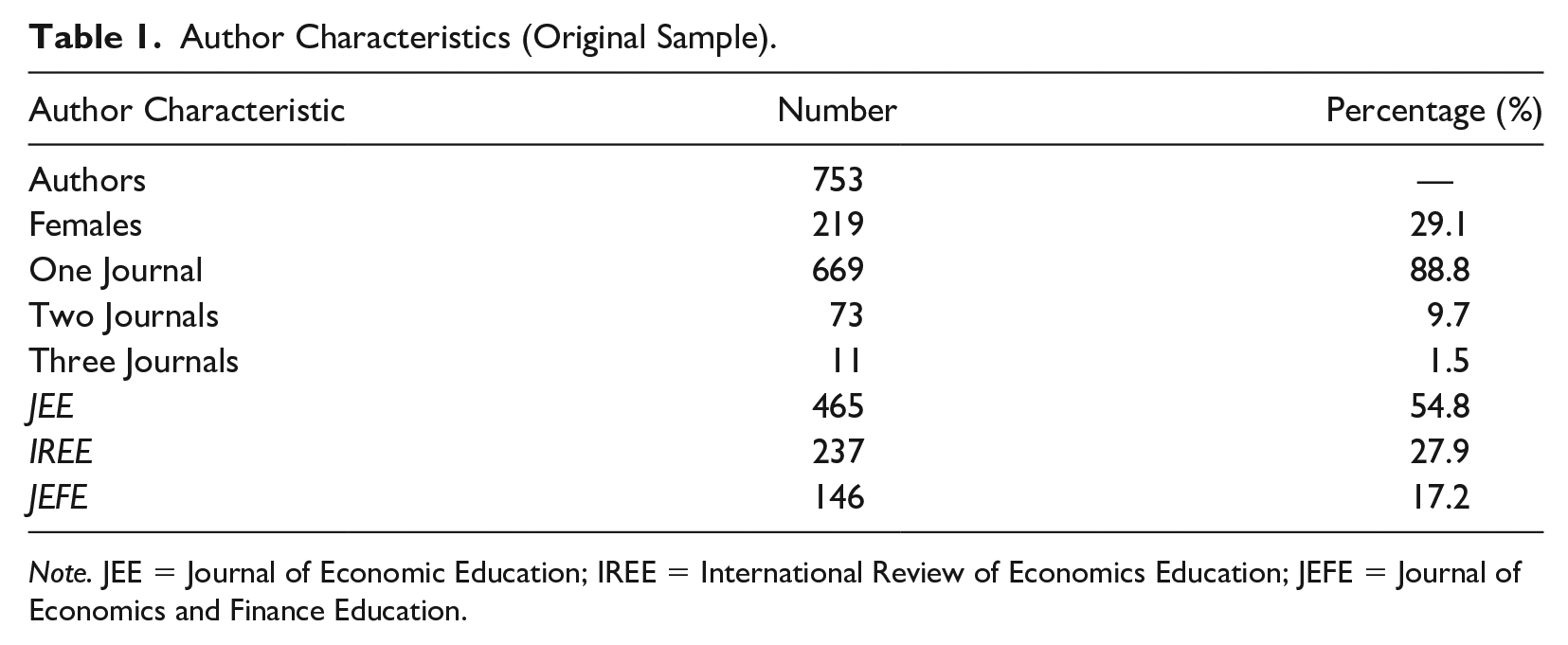
Within this original sample, 219 (29.1%) of authors were identified as females. In addition, 669 (88.8%) of authors published an article in only one of the three journals examined over the relevant time period, compared with only 73 (9.7%) who published at least one article in two of the journals, and just 11 (1.5%) who published at least one article in all three journals (Table 1). In terms of the journals themselves, the JEE was the most represented in this sample, with 465 (54.8%) of the 753 authors having published at least one article there in the relevant time frame, followed by IREE at 237 (27.9%) and JEFE at 146 (17.2%).
Author Characteristics (Original Sample).
Note. JEE = Journal of Economic Education; IREE = International Review of Economics Education; JEFE = Journal of Economics and Finance Education.
Academic and employment profiles were created for these authors and editors by listing all institutions they graduated from and had been employed at, as well as the relevant time frames. When only a graduation year was listed, it was assumed that an author took 4 years to obtain a bachelor’s degree or PhD, and 1 year to obtain a master’s degree. These author’s and editor’s data sets were then compared with one another to find any matches. If a match was found for both institution and time frame, then an author was listed as having a potential connection to an editor based on their positions at the time (e.g., the author attended the same institution as a student that an editor was working at as a faculty member in the same year). In addition, lists of all co-authors whom editors had collaborated with up to and throughout their tenure were created and likewise matched against contributors to each journal.
Restrictive Set
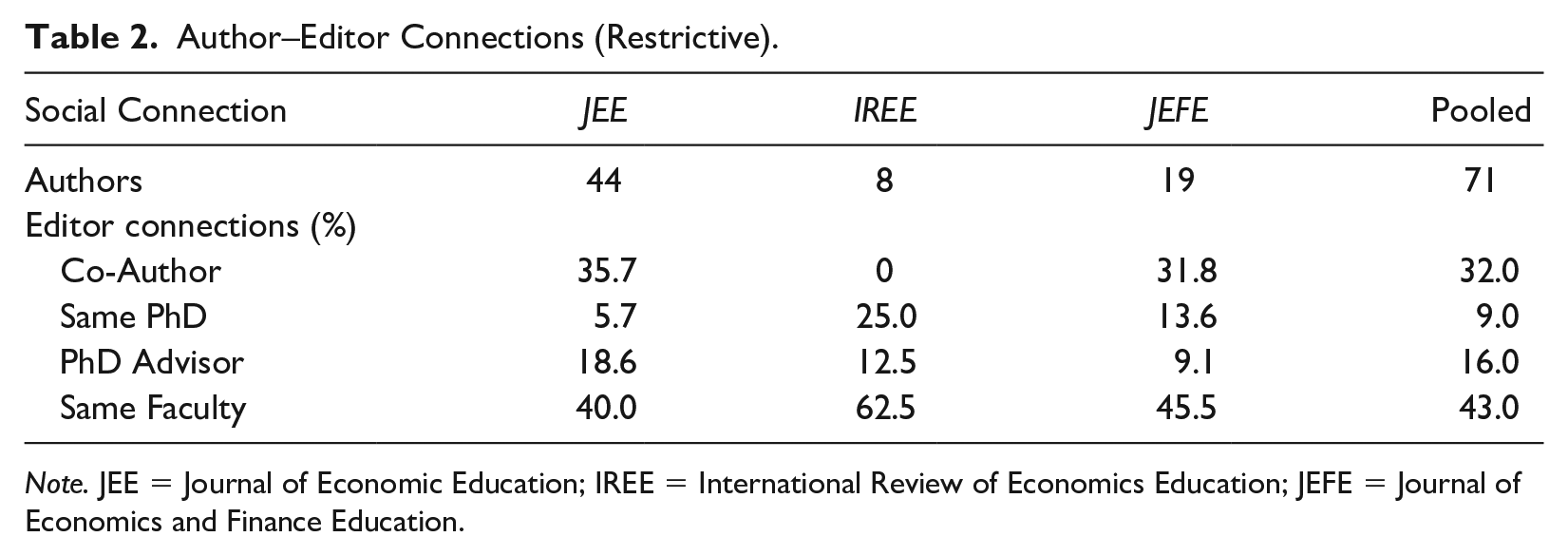
In Colussi’s (2018) research design, four types of author–editor connections were identified: Co-Author, where an author and editor co-authored at least one article prior to the editor’s appointment; Same PhD, where an author and editor received a PhD from the same institution “in the same time window” (p. 46); PhD Advisor, 2 where an author received their PhD from the same institution and in the same year an editor was employed there; and Same Faculty, where an author and editor were employed at the same institution in the same time period prior to the editor’s appointment. Based on these definitions, 71 of the 753 authors present in the original sample (i.e., those with full educational and work history available) were found to be connected to at least one editor—32% via co-authorship, 9% via Same PhD, 16% via PhD Advisor, and 43% via Same Faculty 3 (Table 2).
Author–Editor Connections (Restrictive).
Note. JEE = Journal of Economic Education; IREE = International Review of Economics Education; JEFE = Journal of Economics and Finance Education.
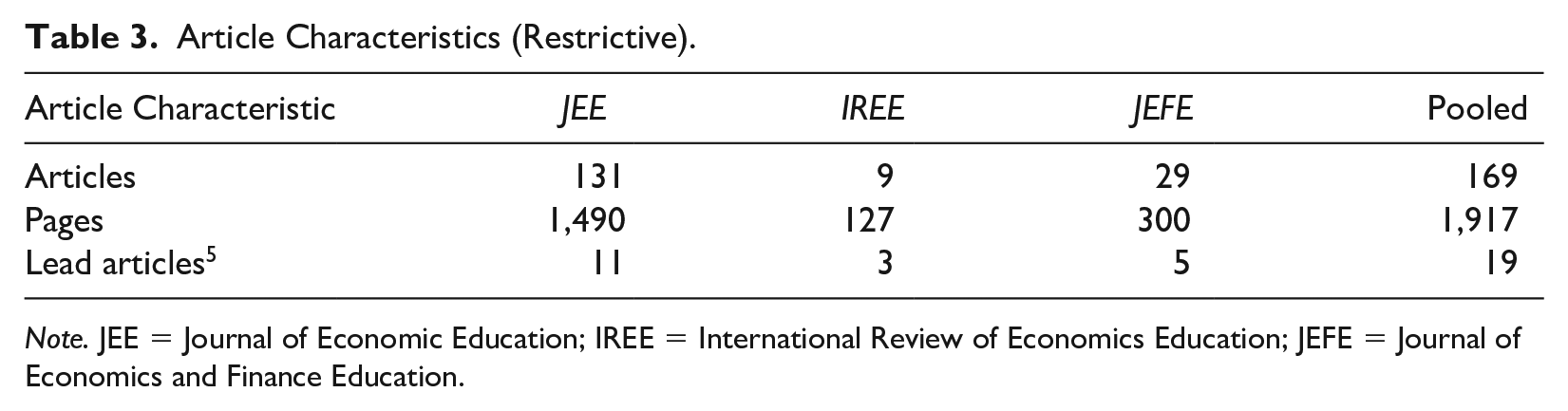
We can then see that 169 non-co-author adjusted articles 4 were written by authors who had a connection to an editor, though only 95 of these articles were published when a connected editor was actually in charge, accounting for 6.7% of articles published in all three journals from 2008 to 2018 (Table 3). Broken down further, 56 (58.9%) of these articles were written by authors with a Co-Author connection, three (3.2%) with a Same PhD connection, 17 (17.9%) with a PhD Advisor connection, and 41 (43.2%) with a Same Faculty connection. Once again it should be noted that these numbers do not represent unique authors, but rather unique forms of connections between authors and editors, as it is possible—and was indeed common within the set—for one author to have multiple connections to an editor or editors.
Article Characteristics (Restrictive).
Note. JEE = Journal of Economic Education; IREE = International Review of Economics Education; JEFE = Journal of Economics and Finance Education.
Nonrestrictive Set
What one might notice at this point is that the parameters for each social connection as originally defined by Colussi (2018) are fairly limiting, and thus may ignore similar connections that are relevant but otherwise excluded. Thus, the same initial sample of 753 authors with full educational and work histories was matched once more with the editor data using less restrictive parameters. Employing slightly adjusted terminology to differentiate between each set of terms, I redefine the four primary connections as follows: Co-Authors, where an author and editor co-authored a paper up until the year that the author published a paper in the relevant journal and time period; 6 Student–Student, where an author and editor attended the same institution in the same period regardless of level (i.e., undergraduate and/or graduate student); Student–Faculty, where an author and editor were student and faculty in the same institution in the same period regardless of level; and Faculty–Faculty, where an author and editor were employed by the same institution in the same period. While these new definitions maintain the same essence of those social connections identified by Colussi, the related assumptions and restrictions have been relaxed to allow for a broader range of potential connections.
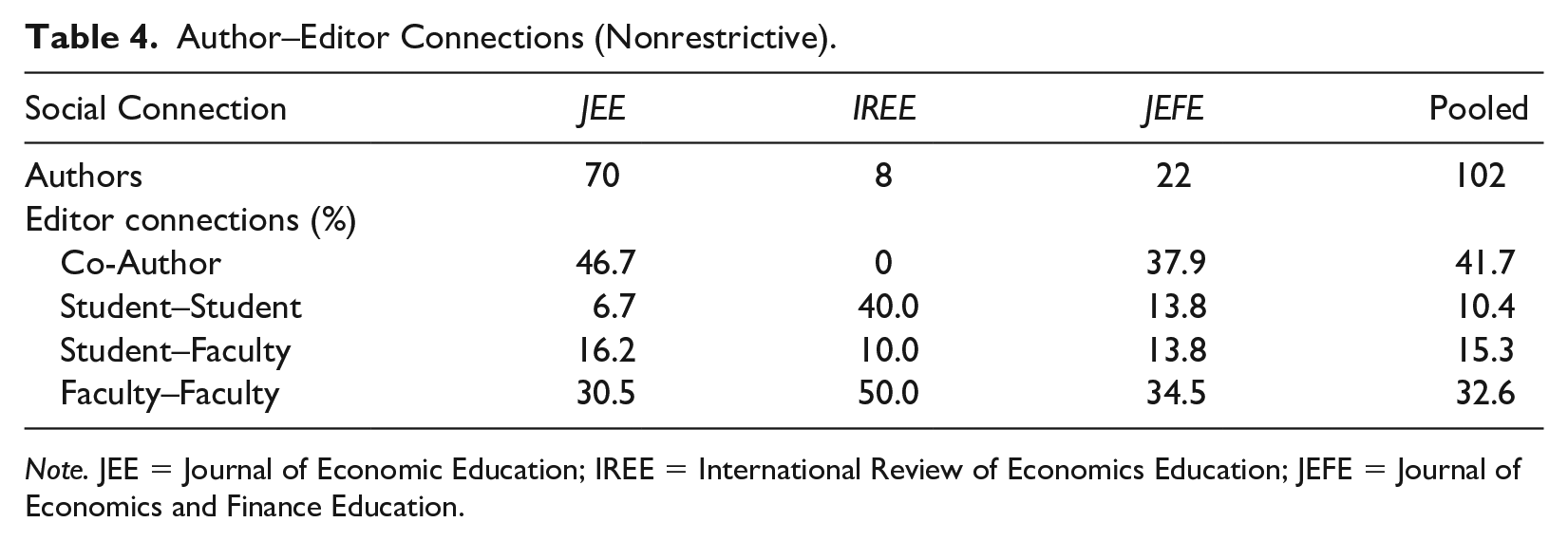
Table 5 this nonrestrictive data set includes a total of 218 non-co-author adjusted articles by 102 connected authors—an increase of 49 articles and 31 authors as compared with the restrictive set. Of these authors, 60 (41.7%) are connected via co-authorship, 15 (10.4%) via student–student, 22 (15.3%) via student–faculty, and 47 (32.6%) via faculty–faculty. In terms of articles, 123 were published while a connected editor was in charge, accounting for 8.7% of articles published in all three journals from 2008 to 2018. Of these, 87 (70.7%) were written by authors connected via co-authorship, 27 (21.9%) via student–student, 24 (19.5%) via student–faculty, and 44 (35.8%) via faculty–faculty. While it should come as no surprise that the number of connections increased in every category when using the relaxed definitions, it is interesting to note that the co-authors connection saw the largest change, nearly doubling in terms of author connections and more than doubling in terms of connected articles (Table 4).
Author–Editor Connections (Nonrestrictive).
Note. JEE = Journal of Economic Education; IREE = International Review of Economics Education; JEFE = Journal of Economics and Finance Education.
Article Characteristics (Nonrestrictive).
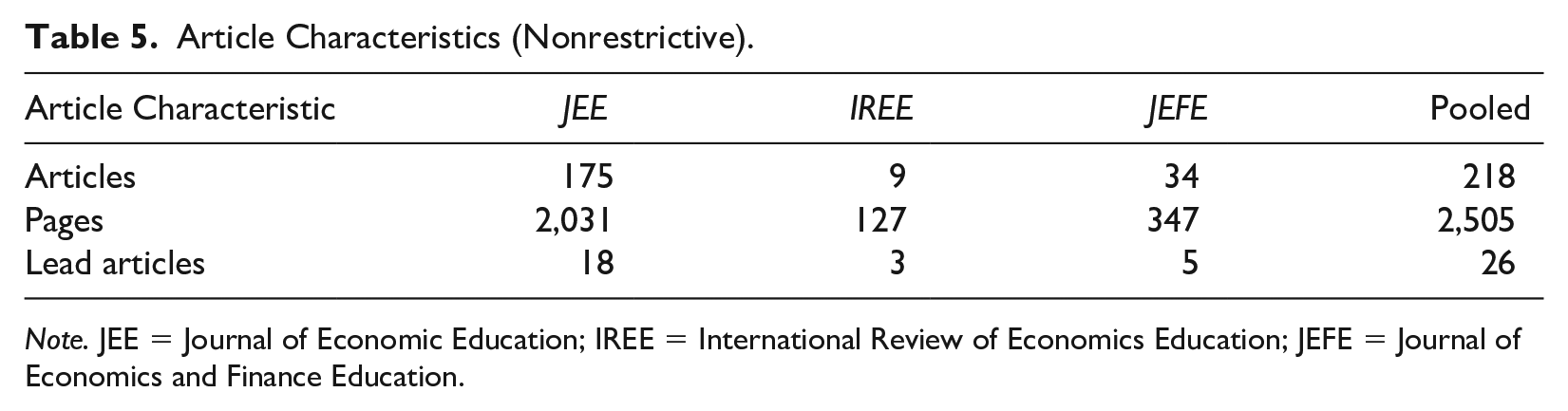
Note. JEE = Journal of Economic Education; IREE = International Review of Economics Education; JEFE = Journal of Economics and Finance Education.
This creates two similar—though slightly different—sets of data, drawn from the same initial sample of authors and editors. The first, which I have deemed the “restrictive” (or “R”) set, is limited to authors who are connected to editors only within the four ways Colussi (2018) originally described. The second, “nonrestrictive” (or “NR”) set, utilizes the same basic categories as outlined by Colussi, but expands their definitions to allow for a broader range of connections. This allows me to first replicate Colussi’s methodology as closely as possible through the restrictive data set, while also building upon his initial findings by investigating if the use of relaxed definitions has any impact on the results.
Method
As in Colussi’s (2018) article, I employ a fixed effects regression model to examine whether a connected editor being in charge has a significant effect on an author’s publication outcomes in said journal, as measured in three ways—articles, pages, and lead articles. To this end, both the restrictive and nonrestrictive data sets comprised solely authors who (a) published at least one economic education article in the JEE, IREE, or JEFE between 2008 and 2018 and (b) have a connection to at least one of the editors of the same journal in that same period. The model itself is specified as follows:

where y represents the publication outcomes of connected author i in journal j at time t. The binary variable InCharge has a value of 1 when an editor connected to author i in charge of journal j is in charge at time t, and is 0 otherwise. The term αi represents unobserved fixed effects for each author i. The structure of this model is directed toward examining the effect of within-person variation as relates to their publication outcomes in a specific journal when a connected editor is or is not in charge. As such, static characteristics (including gender) and between-person variation are not considered.
Results
The results of the regressions run on both the restrictive and nonrestrictive data sets are presented below. Each table is organized by publication outcome (articles, pages, lead articles) and editor connection (Co-Author, Same PhD/Student–Student, PhD Advisor/Student–Faculty, Same Faculty/Faculty–Faculty, Pooled) examined.
Results–Restrictive Set
As discussed briefly above, the restrictive data set comprised 71 authors with 11 observation “points” each, measuring their total number of publications, pages, and lead articles in each journal for which they were connected to an editor from 2008 to 2018. This created a total of 781 observations separated into distinct panels based on the editor connection considered, as well as a combined panel that included all editor connections (Pooled) (Table 6).
Results (R).
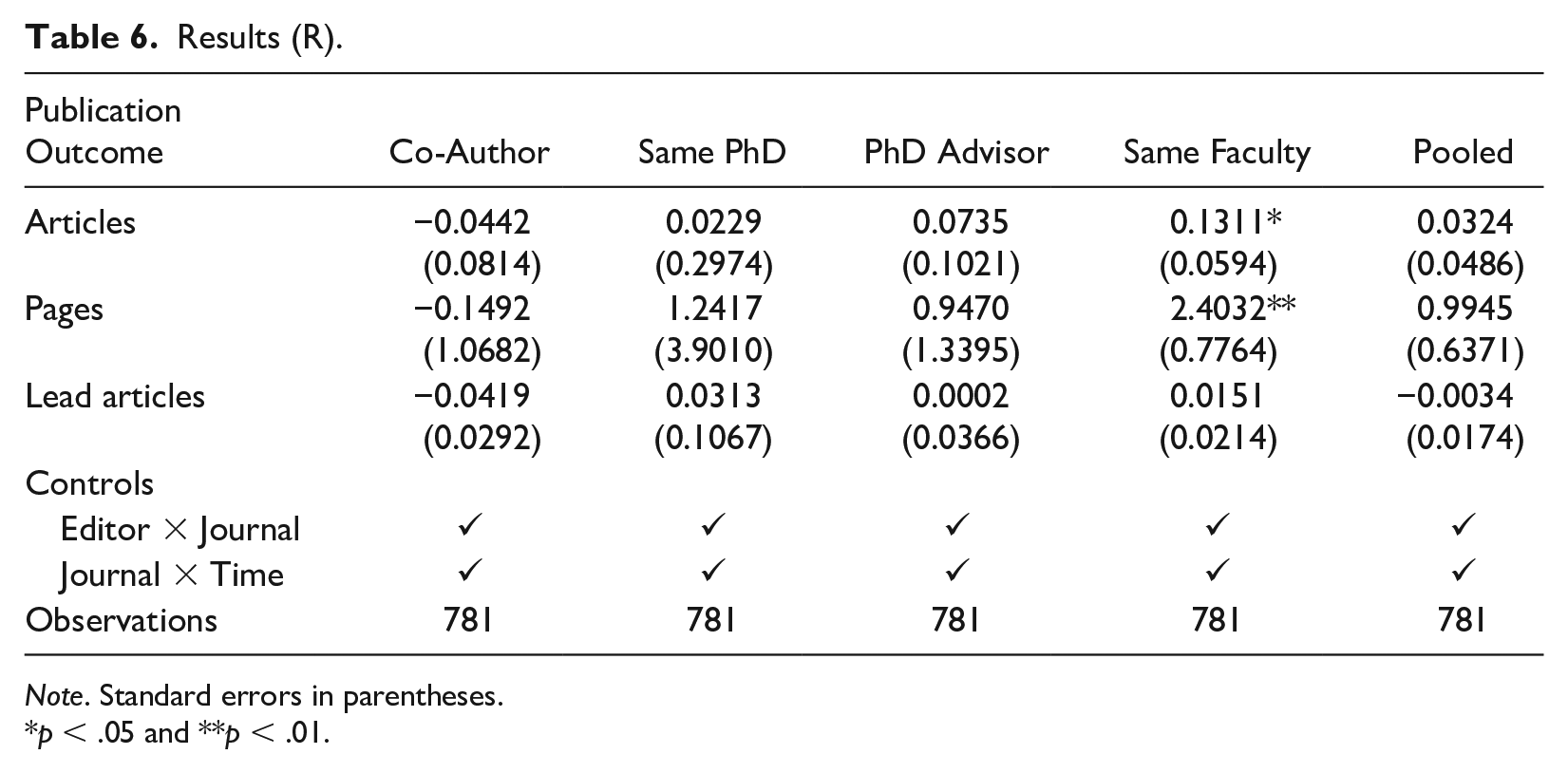
Note. Standard errors in parentheses.
p < .05 and **p < .01.
In utilizing this restrictive data set (i.e., the set of authors and editor connections that is most strictly aligned with the definitions set forth by Colussi in their original 2018 article), only the connection Same Faculty was found to be statistically significant, and only for the outcomes articles (p = .028) and pages (p = .002). Its positive value indicates that when an editor who is connected to an author via Same Faculty (i.e., they were employed at the same institution) is in charge of a journal, that author publishes about 0.13 articles and 2.4 pages more in that journal each year than when the editor is not in charge. While these individual results line up broadly with Colussi’s findings, the panels for PhD Advisor and Pooled are, unlike theirs, not statistically significant.
Results–Nonrestrictive Set
The nonrestrictive data set was organized in the same manner as the restrictive set, with publication outcome observation points created for each connected author for each year examined (2008 to 2018). With 102 authors and 11 observation points each, this created a set of 1,122 observations, once again separated into four separate panels for each editor connection, with one additional panel accounting for all connections (Table 7).
Results (NR).
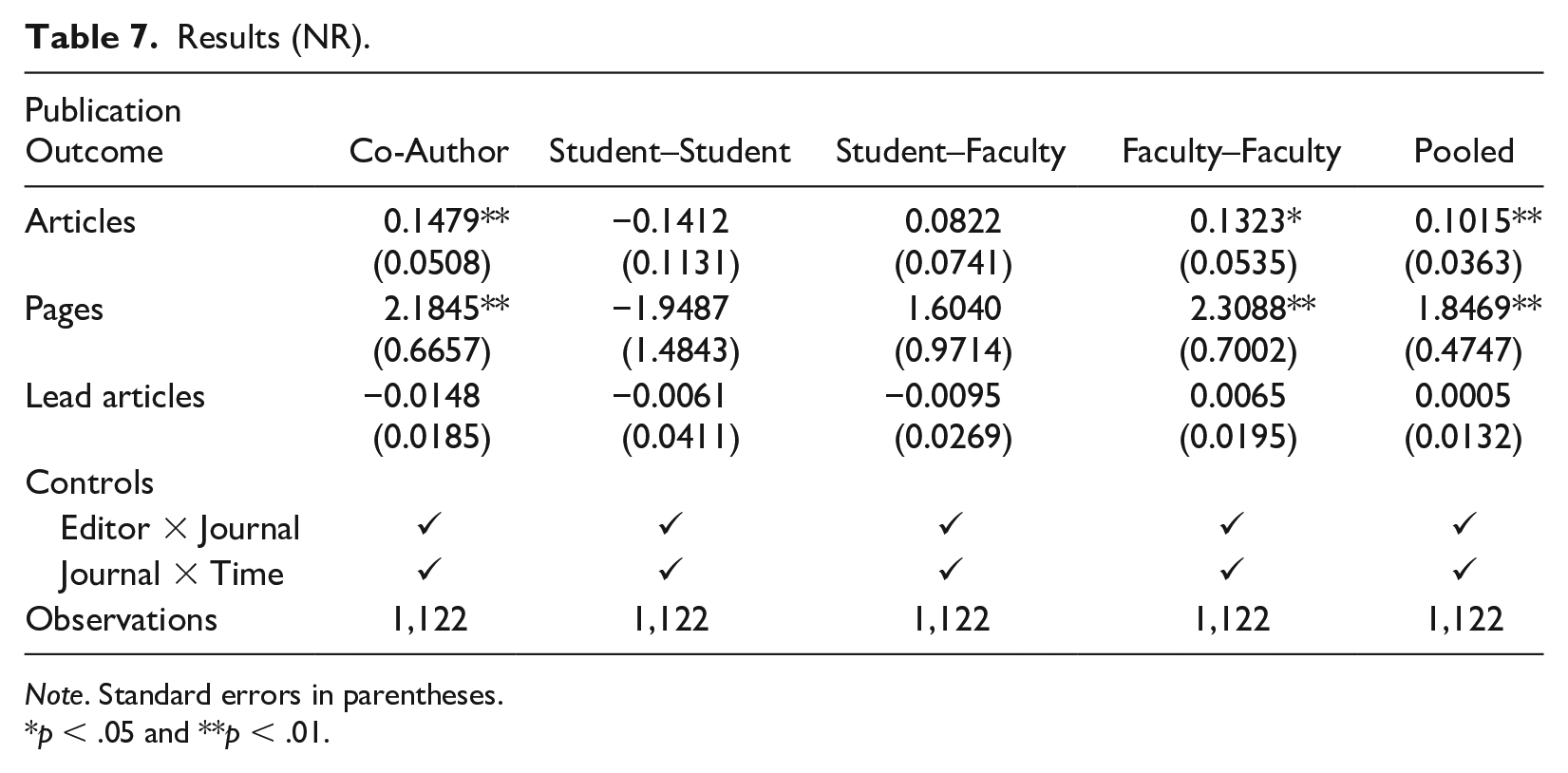
Note. Standard errors in parentheses.
p < .05 and **p < .01.
In utilizing the nonrestrictive data set, the connection Faculty–Faculty (a modified version of Colussi’s Same Faculty) was once again found to be statistically significant for both the outcomes articles (p = .004) and pages (p = .001). However, the connections Co-Author and Pooled were, unlike in the restrictive data set, also found to be statistically significant for articles (Co-Author: p = .004, Pooled: p = .005) and pages (Co-Author: p = .001, Pooled: p < .001). Overall, this indicates that when an editor who is connected to an author in any manner is in charge of a journal, that author publishes about 0.1 articles and 1.8 pages more in that journal each year than when the editor is not in charge. Likewise, authors connected via Co-Author and Faculty–Faculty publish about .15/.13 more articles and 2.18/2.31 pages more each year when a connected editor is in charge, respectively. While these results are a closer match to Colussi’s original results—specifically with the addition of the Pooled connection as significant in terms of both articles and pages—they include the Co-Author connection as significant, where Colussi’s do not.
Discussion and Conclusion
By strictly replicating Colussi’s (2018) methodology and definitions for a set of economic education authors, editors, and journals, I find that only one connection—Same Faculty—is statistically significant for the publication outcomes articles and pages. This stands in contrast to Colussi’s own findings, which show that the connections PhD Advisor and Pooled are also statistically significant for these same outcomes. Some of this discrepancy can be explained by the levels of significance used in analyzing the regression results—where Colussi sets the minimum level of significance at p < .10, I chose to adhere to the more common minimum of p < .05. If we apply this same standard to Colussi’s results (i.e., p < .05), the connections Same PhD and Pooled are no longer statistically significant for the outcome articles, though they remain significant for pages. Beyond this, further discrepancies between these two sets of findings may be due to a combination of the authors, editors, and journals included and the wider time frame examined.
Shifting focus to the second, nonrestrictive data set, two connections that were not statistically significant in the restrictive data set (Co-Author and Pooled) were found to be statistically significant when using more relaxed definitions. While the basic conclusion—that using different parameters for variable definitions will have an effect on the results of a regression—is perhaps an unsurprising one, it does foster further implications regarding which connections are included in this type of research, and why. Due to the fact that both the original Colussi (2018) piece and this article rely on hypothetical author–editor connections, rather than those actually identified by the authors and editors themselves, what we consider sufficient proof that a connection “may” exist will affect not only the statistical results but also the analytical conclusions.
While, much like the differences in minimum p values used in this article and Colussi’s, there is no best way to approach this issue, I must stress that the nature of this analysis hinges upon the assumption that—outside of the direct connection indicated by co-authored publications—authors and editors who were present in the same institution in any capacity have some recognition of one another—whether it is through actual contact during their tenure, or simply acknowledging that they both attended and/or were employed at the same institution. However, as the results are largely consistent between the two data sets employed in this article and Colussi’s own findings, there is sufficient statistical and theoretical evidence that the relaxed definitions used for the nonrestrictive data set provide an equally valid set of conclusions as that of the restrictive set which copied Colussi’s parameters—that is, any broad-based social connections between economic education authors and editors is likely to have a positive impact on the former’s publication outcomes, if only slightly.
Limitations and Future Research
The first major limitation I faced is that, by utilizing the same fixed effects linear regression model as Colussi (2018), I could not examine the effect static factors, such as gender or race, have on publication outcomes. Furthermore, I also had to presume that where there was the potential for an author–editor social connection, one did in fact exist. Although the results are nonetheless both useful and interesting—indicating that networking plays as important a role in economic education research output as other productivity factors—they leave room to question whether minority economic education contributors (who have been traditionally underrepresented in economics as a whole) have access to these networks in the same capacity as their majority peers. The results neither elaborate on how authors in differing subfields may create and foster networks with editors in unique ways nor on how they were originally introduced to the subfield itself. To this end, future research may want to employ a different model specification that can account for these effects, or couple quantitative analysis with qualitative work that directly asks participants about their connections to journal editors and how these came about.
Footnotes
Declaration of Conflicting Interests
The author(s) declared no potential conflicts of interest with respect to the research, authorship, and/or publication of this article.
Funding
The author(s) received no financial support for the research, authorship, and/or publication of this article.
