




Abstract
This note presents a simple graphical approach for deriving the profit maximizing two-part tariff when there are two types of consumers in the market. The exposition covers both the case in which a monopoly can offer only one two-part tariff plan and the case in which the monopoly can offer two different plans.
Introduction
Price discrimination as a topic of study is one of the pillars of intermediate level microeconomics, and two-part tariff is probably the most commonly taught form of second degree price discrimination.
In the case where the market under consideration has only one type of consumer, the exposition of the profit maximizing two-part tariff is straightforward—one that most of my intermediate level students are able to grasp fairly easily. Things do not move as smoothly, however, once I start teaching about finding the optimal two-part tariff pricing scheme when there are two types of buyers in the market. Several years of teaching experience have led me to the conclusion that many students have a harder time grasping how price discrimination with multiple types of buyers works because they tend to get too “caught up” in the mechanics or mathematics of the problem, and they neglect to focus on the underlying intuition for the solution. Too often, students view and treat a problem involving two-part tariffs as a mechanical, algorithmic exercise in arithmetic (finding areas that correspond to producer surplus) and calculus (taking derivatives to find the first-order condition for a maximum). A consequence of this type of “mechanical learning” is that many of them fail to understand the fundamental principles of the issue and hence struggle to solve similar problems with twists or variations that they have not seen before.
To get students to pay more attention to the concepts and ideas involved in price discrimination—and rely less on a robotic, algorithmic way of solving problems—I utilize a graphical approach—which I present below—to derive the profit maximizing two-part tariff scheme when buyers are heterogeneous in their preferences. This approach better illustrates—no pun intended—the trade-offs involved for a monopoly in devising a two-part tariff plan, and allows students to see—without using any calculus—the importance of the second-order condition for a maximum. Moreover, in a market with two types of consumers, the method described here gives a short-cut for deriving the profit maximizing two-part tariff scheme, both for the case in which the monopoly offers only one plan and the case in which the monopoly offers two plans.
Deriving the Profit Maximizing Two-Part Tariff
Consider a market with a monopoly that has a constant marginal cost of production
Two-Part Tariff: One Plan
A two-part tariff is a pricing scheme where each unit of the good is sold at price
High-fee option
For this plan, we know that the profit maximizing scheme is to set
Low-fee option
For this plan, we know from intermediate microeconomics textbooks (see, for example, Perloff [2017]) that the profit maximizing scheme is to set
To find the profit maximizing price p, consider Figure 1.
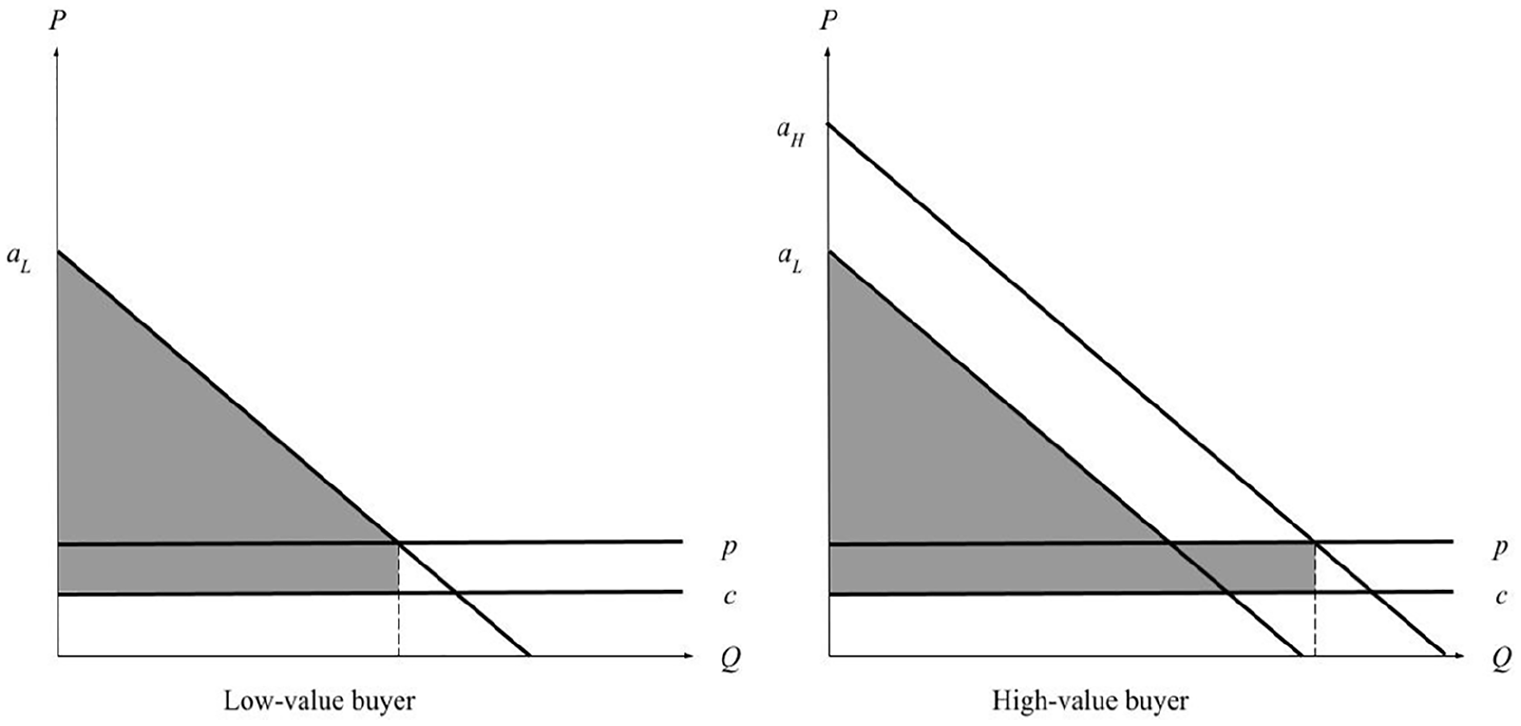
The shaded areas indicate the producer surplus the monopoly can earn from the two types of buyers when the monopoly charges a per unit price of
Mathematical approach
Mathematically, the producer surplus function is

where

which yields
Graphical approach
It is possible to derive
To see this, let us take an arbitrary price

When the unit price
When the unit price p is increased slightly, the producer surplus generated from the low-value consumer unambiguously decreases. There are, however, two opposing effects on the producer surplus generated from the high-value consumer. On the one hand, there is a negative effect on producer surplus because the monopoly sells fewer units to the high-value buyer when the unit price increases. On the other hand, there is a positive effect on producer surplus because the higher per unit price means that each unit sold yields more revenue.
The two negative effects on total producer surplus—one coming from the low-value consumer side (the red area in the left panel of Figure 2, multiplied by the number of low-value buyers); the other one coming from the high-value consumer side (the red area in the right panel of Figure 2, multiplied by the number of high-value buyers)—can be thought of as the monopoly’s marginal loss from raising p. The positive effect on total producer surplus—which occurs on the high-value consumer side (the blue area in the right panel of Figure 2, multiplied by the number of high-value buyers)—is the monopoly’s marginal gain of raising p.
When p is close to c—and the number of low-value buyers relative to the number of high-value buyers is not too large—the marginal benefit of raising p exceeds the marginal loss from raising p. Hence, the profit maximizing p cannot be too close to c. Notice, when the demand curves of the two types of consumers have the same slope, the marginal benefit of raising p does not depend on the value of p. However, the marginal loss from raising p increases with p. Therefore, as long as

When p is too high relative to c, the marginal loss from raising p (the two red areas, each multiplied by their respective number of buyers) exceeds the marginal gain of raising p (the blue area multiplied by the number of high-value buyers).
With the aid of Figure 2 or 3, the marginal benefit of raising p is

which corresponds to the positive term in (1), and the marginal loss from raising p is

which corresponds to the negative term in (1). Setting them equal to each other, taking the limit as
Two-Part Tariff: Two Plans
Assuming the monopoly cannot distinguish between the two types of consumers, the monopoly can do better—in terms of producer surplus—than the two-part tariff plan described above by offering two two-part tariff plans—one designed for the high-value consumer and one designed for the low-value consumer. To see this graphically, suppose the monopoly offers two plans.
Now, if both types of consumers choose Plan 1, then the producer surplus, consumer surplus, and deadweight loss from each type of buyers in this market are as shown in Figure 4.
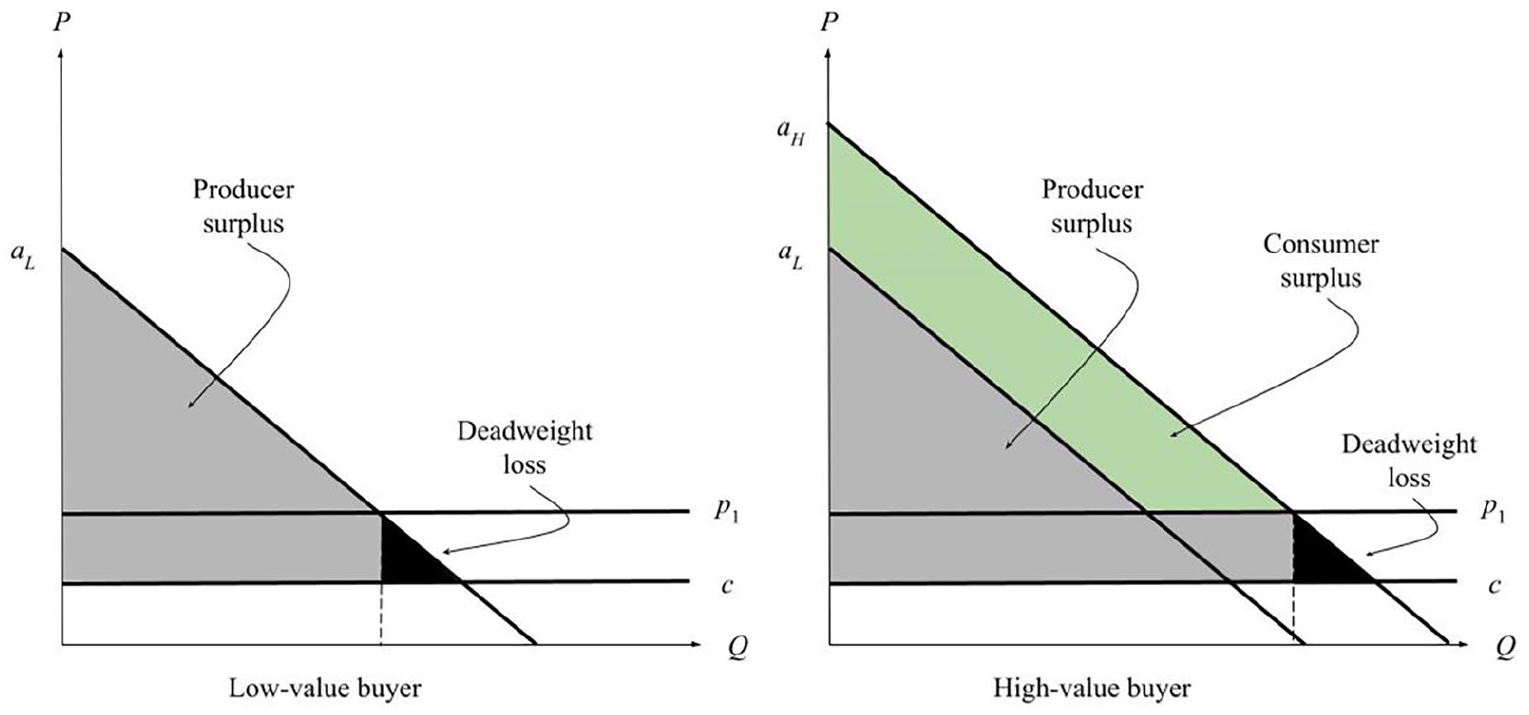
The producer surplus, consumer surplus, and deadweight loss from each type of buyers when all buyers choose Plan 1.
In order to induce the high-value consumer to choose Plan 2 over Plan 1, Plan 2 has to give the high-value consumer a consumer surplus at least equal to the consumer surplus that Plan 1 yields. Hence, by setting
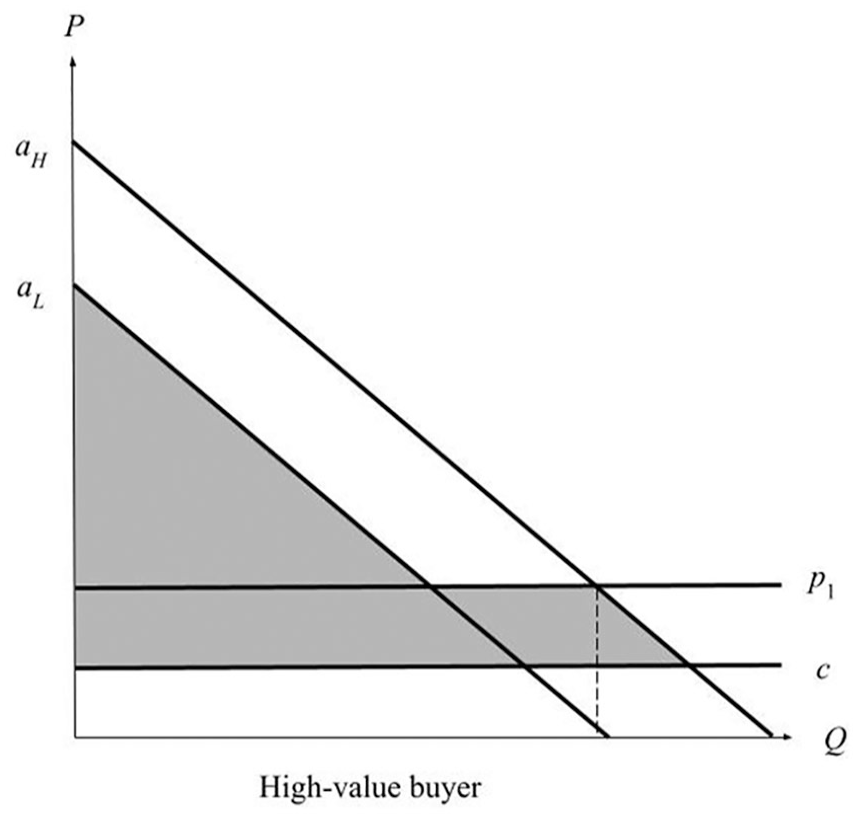
The monopoly can increase producer surplus by offering Plan 2—designed for the high-value buyer—with a fixed fee equal to the shaded area.
To see graphically how the monopoly should set

When the unit price
Increasing

and the area of marginal loss is

Setting these equal to each other, letting
Conclusion
In 20 years of teaching intermediate microeconomics, I have found that some students struggle to understand the basic intuition and principles of two-part tariff pricing plans (as well as other types of price discrimination schemes) because they get lost in the mathematics of the problems. To avoid this pitfall and allow the students to focus on the broad, general ideas, I have presented a graphical illustration of how two-part tariff works when there are two types of consumers. While the exposition is restricted to linear demand curves, it accommodates any number of buyers of either type. In addition, it covers both the case in which the monopoly offers only one plan to all consumers and the case in which the monopoly offers two different plans. The graphical approach is not intended as a substitute for the mathematical approach; rather, it should be viewed as a vital complement of it.
Footnotes
Declaration of Conflicting Interests
The author(s) declared no potential conflicts of interest with respect to the research, authorship, and/or publication of this article.
Funding
The author(s) received no financial support for the research, authorship, and/or publication of this article.
