



Abstract
The availability of and demand for water in China is an extreme case of uneven distribution in time and space. In response, the South to North Water Diversion (SNWD) project, the largest inter-basin water transfer scheme in the world, channels large amounts of fresh water from the Yangtze River in southern China to the more arid and industrialised north. In order to keep the SNWD project running smoothly, a comprehensive governance system has been implemented and innovative institutional arrangements have been created to facilitate the transfer of water itself. By taking the SNWD project’s Middle Route as one case study and drawing on primary and secondary data, this article examines the project’s emerging institutional arrangements. The article outlines the establishment of new institutions for the SNWD project with high administrative rankings at both central and local levels, the encouragement of inter-department cooperation, the adoption of a market mechanism and the integration of market functions into administrative functions. We argue that these institutional arrangements have to some extent overcome common challenges in water governance in China, including an engineering-heavy approach and what Chinese commentators have traditionally called the problem of water being managed by multiple government ministries and municipal authorities as the common metaphor of ‘nine dragons managing the water’. Our findings have significant implications for understanding the continuing evolution of water governance in China.
Keywords
China’s South to North Water Diversion (hereafter SNWD) project is the largest inter-basin water transfer in the world (South-to-North Water Diversion Project, 2018). The SNWD project transfers large amounts of fresh water from the Yangtze river in southern China to the Hai, Huai and Yellow river basins in the north. It is rationalised as a response to China’s unequal water resource distribution, in which the southern regions of China have an abundance of water resources while north China faces significant water scarcity issues. The project’s Eastern Route and Middle Route have been in operation since 2013 and 2014 respectively and have a combined annual capacity of 27.8 billion m3 (South-to-North Water Diversion Project, 2018). The Eastern Route transfers water from the Yangtze River to the provinces of Anhui, Jiangsu, and Shandong, while the Middle Route transfers water from the Danjiangkou Reservoir in Hubei through the provinces of Henan and Hebei to the cities of Beijing and Tianjin. Such a complex and large-scale cross-basin project inevitably encounters various institutional and governance challenges (Chen et al., 2013), and thus requires significant institutional arrangements in order to operate in an effective manner. This article examines the SNWD project’s emerging institutional arrangements and rationalities through a case study of the Middle Route.
To date, the limited studies on China’s SNWD project have focused on its environmental impacts (Zhang, 2009; Li et al., 2016), engineering construction (Wang and Ma, 1999; Wu et al., 2010), water pollution (Tang et al., 2014), pricing (Changming et al., 2001; Yang and Zehnder, 2005), and resettlement (Freeman, 2011). Although appropriate governance and institutional arrangements have been recognised as critical to managing water (Song et al., 2010; Liu and Yang, 2012; Hensengerth, 2015), studies that highlight the institutions and governance of the SNWD project are rare (Barnett et al., 2015). One study discusses the institutional and bureaucratic changes brought about by the project, including a move towards corporatisation, but lacks a detailed exploration of how these institutions operate (Magee, 2011). Another study focuses on financial management institutions such as water pricing, infrastructure financing and compensation (Pohlner, 2016). However, no study has mapped all of the institutions involved in the project.
This paper aims to fill these gaps. It examines the specific institutions that have been established for the governance of the Middle Route, how this system works to ensure the smooth operation of the Middle Route, and the rationalities behind these institutions. The paper argues that the SNWD project’s institutional arrangements are innovative, in that transitional institutions have been established at high administrative ranks and market functions have been integrated into administrative functions – together, these two moves have encouraged inter-department cooperation for shared goals. These actions reflect a greater degree of flexibility in China’s authoritarian water governance system than has been achieved previously – an achievement that is to date not typically acknowledged. To a certain degree, this new system also overcomes common perennial long-term challenges in China’s water governance.
Our analysis is based on semi-structured interviews with officials from various SNWD institutions, site observation, and analysis of internet news articles, government reports, and documents. We use the Middle Route as a case study because of its scale and complexity: water moves about 1400 km from the Danjiangkou Reservoir (on the border of Hubei and Henan) through several northern provinces to the cities of Beijing and Tianjin in order to support North China’s water demand pressure, economic development, social stability and environmental improvement (Sohu, 2014). The Middle Route challenges the foundation, the capacity, and the efficiency of existing institutions (Gupta and Van der Zaag, 2008), requiring new arrangements for effective water governance (Nickum, 2006).
The paper is structured as follows: we first review the literature on Chinese water governance with respect to the key concepts and theories that inform these discourse – such as ‘techno-politics’ and ‘fragmented authoritarianism’. This serves as the prelude to our critical evaluation of the extent to which the institutional arrangements for the SNWD project’s Middle Route have overcome existing challenges. We then provide an overview of all the institutions involved in the governance of the Middle Route to show the ways in which the new institutional arrangements address the challenges of large-scale technological systems meeting local and national needs alike whilst also ensuring greater administrative transparency and flexibility as well as coordination between the different levels of government. Finally, we discuss the operation of these institutions and the rationales behind the governance of water resources. The analysis highlights the increasing level of inter-department cooperation and a tendency towards market-oriented approaches.
Existing water governance issues in China
It is well established that the governance of mega-water projects and major rivers in China remains problematic (Magee, 2011). In the contemporary literature, a major reason for this is China’s pursuit of mega-water supply projects as solutions to water challenges, described as an engineering-heavy approach or a technocratic version of water governance (Cheng and White, 1991; Rogers et al., 2016; Crow-Miller et al., 2017). In other words, when encountering water stress (e.g. floods, droughts, pollution), China favours large-scale and capital-intensive projects over institutional and governance reforms (Webber, 2012). Scholars describe the SNWD project as an engineering-heavy and technocratic response to North China’s water scarcity (Moore, 2014; Crow-Miller, 2015), which fails to address underlying anthropogenic causes of water stress such as pollution (Webber et al., 2017) and inefficient use (Barnett et al., 2015). Further, Hecht (2001) defines ‘techno-politics’ as strategically using technology for political goals. Drawing on this concept, Crow-Miller (2015) concludes that water transfers are being wielded as a political instrument in the pursuit of continued rapid economic development and as a physical display of political legitimacy.
China’s engineering-heavy approach to water governance and technopolitical ideology must be traced back to its authoritarian governance system. Lieberthal and Lampton’s (1992) enduring notion of ‘fragmented authoritarianism’ describes how the administrative and decision-making process is divided among different government and non-government actors at multiple levels, further complicated by the horizontal (条 tiao)–vertical (块 kuai) structure of authority. Further, Mertha (2014) indicates that ‘fragmented authoritarianism’ asserts that ‘policy made at the centre becomes increasingly malleable to the parochial organisational and political goals of various vertical agencies and spatial regions charged with enforcing that policy’. This structure means that each government body must follow the leadership of both the local government in its jurisdiction and its upper-level line agency. The tiaokuai system has led to simmering disputes over water issues between different ministries and departments (Yan et al., 2006).
In the context of water governance, such fragmented authoritarianism is often called ‘nine dragons managing the water (九龙治水 jiu long zhi shui)’, referring to the problem of water being managed by multiple government ministries and municipal authorities (Feng and He, 2009; Jun and Chen, 2001). It is noted that ‘nine dragons managing the water’ is just a common metaphor in Chinese, and both the terms ‘nine’ and ‘dragon’ do not have specific meanings linked with them. More recent scholarship has also pointed to significant pluralisation over the past decades: through decentralisation and marketisation (Nickum, 2010), multiple actors, including the central government, local government, corporations, non-governmental organisations, media, experts and local communities, all engage in the governance of water (Zhang and Barr, 2013; Mertha, 2014; Rogers and Crow-Miller, 2017). While complexity in policy-making might allow for the interests and demands of multiple actors to be incorporated, the result is significant overlap and administrative inefficiency (Schroeder, 1987). Against this backdrop, we now turn to the emerging institutional arrangements for the Middle Route.
Institutional arrangements for the SNWD project’s Middle Route
This section introduces the functions of the institutions involved in the SNWD project’s Middle Route. These institutions include the SNWD Project Construction Committee Offices at the central and local levels, and its related committee members at each level (the SNWD Middle Route Project Construction and Administration Bureau at local levels, the SNWD Middle Route Main Canal Construction and Administration Bureau and its sub-bureaus and duty stations, and the SNWD Middle Route Water Source Limited Liability Company). Figure 1 shows the Middle Route’s three levels of governance.
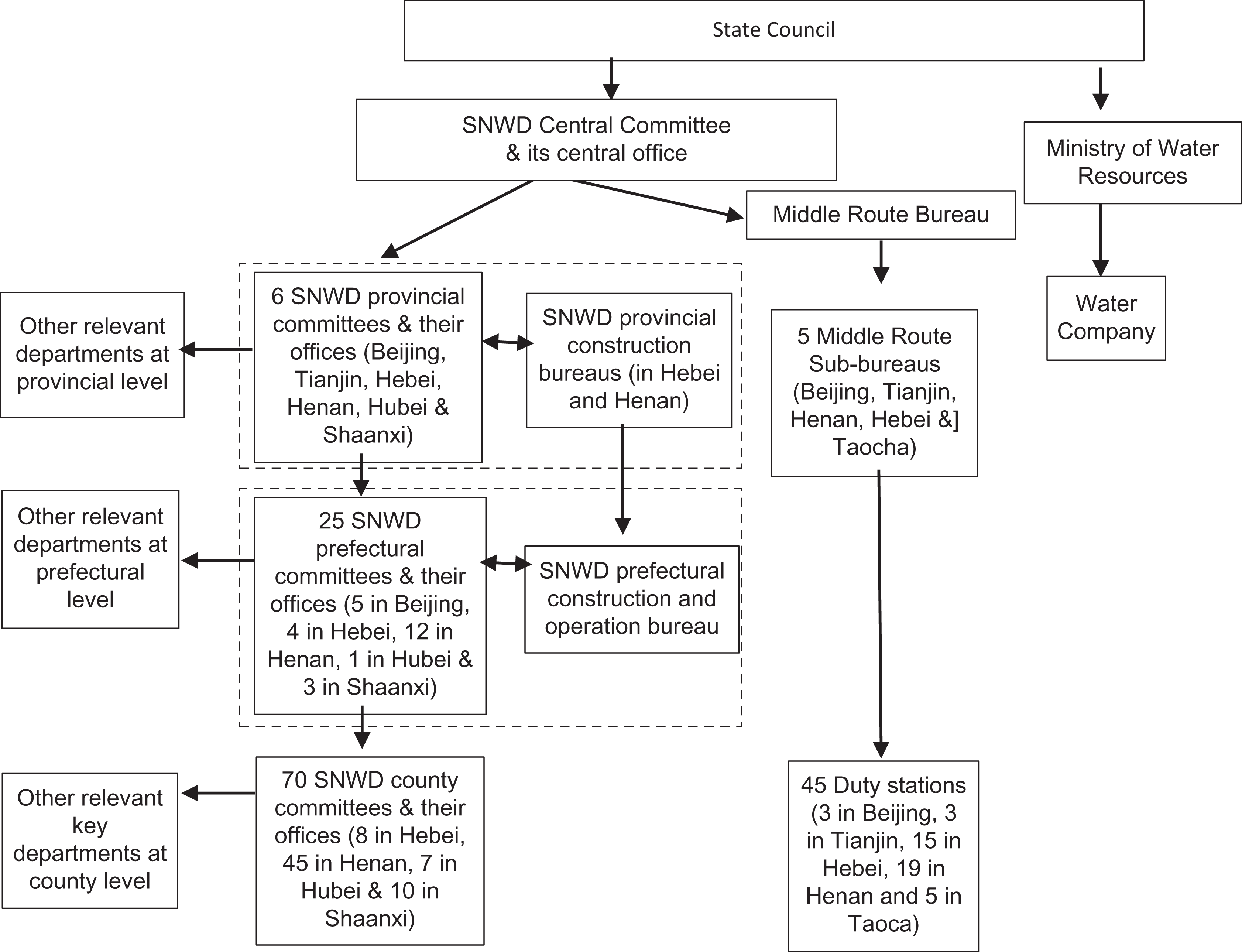
Institutional arrangements for the Middle Route in the pre-March 2018 period.
In 2003, the State Council of China established the SNWD Project Construction Committee (南水北调工程建设委员会 Nanshuibeidiao gongcheng jianshe weiyuanhui) (Central Committee) as a subordinate department and gave the Central Committee as a high-level policy-making authority responsibility for this project. The first Director of the Central Committee was China’s then Prime Minister, Wen Jiabao. The Central Committee also consisted of two vice prime ministers, ministers of major ministries and provincial governors, and mayors of the provinces and cities along the SNWD routes. It therefore encompassed all bodies with related SNWD functions: the State Council, National Development and Reform Commission, Ministry of Water Resources, Ministry of Science and Technology, Ministry of Finance, Ministry of Land and Resources, Ministry of Housing and Urban-Rural Development, Ministry of Transport, Ministry of Agriculture, The People’s Bank of China, (the then) Ministry of Environmental Protection, the State Electricity Regulatory Commission, National Cultural Heritage Administration, National Development Bank, Beijing Municipal Government, Tianjin Municipal Government, Hebei Provincial Government, Jiangsu Provincial Government, Shandong Provincial Government, Henan Provincial Government and Hubei Provincial Government (The State Council, 2003). In 2012 the Committee was updated: then Vice Prime Minister Zhang Gaoli became Director, and the Ministry of Public Security, Ministry of Railways, National Audit Office, the State Forestry Administration, Legislative Affairs Office of the State Council and Shaanxi Provincial Government were incorporated into the Central Committee.
The State Council also set up the SNWD Project Construction Committee Office (南水北调工程建设委员会办公室 Nanshui Beidiao gongcheng jianshe weiyuanhui bangongshi) (Central Office), which acts as the Central Committee’s operating body. With an administrative ranking equivalent to other ministries such as the Ministry of Water Resources, the Central Office is responsible for all project affairs. This includes drafting regulations, proposing policies, overseeing total investment, coordinating fundraising, supervising construction quality, overseeing environmental protection and ecological construction, administering resettlement, carrying out periodic inspections, publicising the project, communicating with foreign governments and organisations, and undertaking other tasks assigned by the State Council and the Central Committee. The Central Office has six functional divisions: the General Division, Investment Planning Division, Economics and Finance Division, Construction Management Division, Environment and Immigration Division, and Supervision Division (The State Council, 2003). Also, as with other governmental departments in China, the Central Office has a Chinese Communist Party Committee. An official from the Central Office explained the role of the Party Committee in these terms: The Party Committee of the Central Office is very important in terms of sustainably maintaining the power of the Party. The major function of the Party Committee is to support the current central work of the institution and to promote cultural and ideological progress. The Party Committee is responsible for spiritual education, which promotes the Party members of the institution to play an exemplary role, and therefore makes positive influences on other people who are not Party members. In fact, the Party Committee in the Central Office can be regarded as political security for the institution.
The Provincial Office takes responsibility for implementing the laws, regulations and policies relating to construction and operation, participating in the formulation of new policies and regulations, leading the daily work of the office, making the water quota allocation plan, and supporting the management and use of water charges and administrative supervision (Henan Provincial Government, 2016).
Institutional arrangement is then replicated at the prefectural and county levels. For example, Zhengzhou has a Zhengzhou City SNWD Project Construction and Administration Leading Group and related Office (Prefectural Committee and Prefectural Office). Fangcheng County has the Fangcheng County SNWD Middle Route Project Leading Group and its Office (County Committee and County Office). Again, the heads of all relevant governmental departments are included in the Prefectural Committees and County Committees. In total, there are 12 prefectural-level Committees and Offices and 45 county-level Committees and Offices in Henan, while in Hebei there are four prefectural-level Committees and Offices and eight county-level Committees and Offices.
Another branch of local-level institutions is the Middle Route’s Construction and Administration Bureau. At the provincial level, it is called the Provincial SNWD Middle Route Project Construction and Administration Bureau (Provincial Bureau). It is responsible for project construction, tenders, quality supervision, investment, water quality protection, flood control, land acquisition, demolition, statistical statements and final accounts (Henan Nanshuibeidiao, 2018). The Bureau is replicated at the prefectural level and in a few counties. In some cases, the Office and Bureau are effectively one institution. For instance, in Henan, the Provincial Office and the Provincial Bureau have the same staff and the same official address. As an interviewee from the Henan Provincial Office explained: There are two plates on the building. One is Henan Province SNWD Middle Route Project Leading Group Office, and the other one is Henan Province SNWD Middle Route Project Construction and Administration Bureau. We call this arrangement ‘one institution under two plates’. Because the Middle Route project has moved from construction stage to operation stage, the duties of the two plates are becoming more and more similar. Therefore, it is very often that one person is under two titles: both the chief secretary of the office and the chief of general affairs of the bureau. It looks like two institutions, but in fact, it is one institution.
Since the main canal crosses several jurisdictions at multiple scales, the Middle Route Bureau has a three-level administrative structure. It has five sub-bureaus (Middle Route Sub-Bureaus) for the provinces of Hebei and Henan and the municipalities/cities of Beijing, Tianjin, and Nanyang (where the Taocha canal head is located). These sub-bureaus are responsible for construction and administration within their jurisdictions. Along the Middle Route’s main canal, there are a further 45 Local Construction and Administration Duty Stations (Duty Stations) at the county level. The three-level administration puts county-level duty stations directly under the leadership of the respective provincial-level bureaus. These duty stations manage the daily operation of the Middle Route’s main canal. Henan’s Huixian Duty Station has four offices: General Affairs, Contracts and Finance, Engineering, and Diversion.
Importantly, the Middle Route Bureau, Sub-Bureaus and Duty Stations are not government institutions; rather, they are state-owned enterprises (SOE), which means they lack enforcement power. As one official from Huixian Duty Station explained: It seems like we are a governmental institution, right? We only have intervention power as an enterprise, not enforcement power. We often catch people stealing our facilities such as electronic wires, or fishing on the bridge. It is very dangerous if they fall into the canal. But we cannot do anything except education, then one week later, they come again.
Discussion
The SNWD project’s institutional arrangements highlight significant changes in the governance of water in China. First, the newly established Central Committee and Office, Provincial Committee and Office, Prefectural Committee and Office and County Committee and Office enjoy the authority of high administrative rankings. The Central Office is instructed directly by the State Council. And unlike other water-related departments in China, the Central Office does not need to follow the leadership of any local governments, nor report vertically to upper-level water-related departments.
Second is the ‘one institution with two names’ approach. We found that the Henan Provincial Office and Bureau were in fact one institution, which clarifies operational responsibilities and reduces administrative overlap. Third, two SOEs play a role in borrowing money from banks, signing construction contracts with companies, and pricing water. All these cannot be done by the government itself but SOEs can do it on behalf of the government. That said, the state still intervenes: the price of diverted water is ultimately decided by the National Development and Reform Commission (National Development and Reform Commission, 2014). And a state-centred approach still prevails as the Middle Route Bureau, Sub-Bureau and Duty Stations lack the enforcement power of government bodies and still operate under Party supervision and cannot operate in an independent way. The new institutions all have Party committees, while the Middle Route Bureau, Sub-Bureaus and Duty Stations actively carry out ‘Party-building work’ (Construction and Administration Bureau of South-to-North Water Diversion Middle Route Project, 2018a). A ‘Party leads everything’ (党是领导一切的 Dang shi lingdao yiqie de) mentality still exists for the SNWD project’s Middle Route.
Institutional adjustments continue. In the late 2018, the Central Committee was repealed. The Central Office has been incorporated into the Ministry of Water Resources (The State Council, 2018) and become the SNWD Management Division (Ministry of Water Resources, 2018), while the Central Office’s environmental protection responsibilities have been rolled into the newly established Ministry of Ecology and Environment. Offices at the provincial, prefectural and county levels will be repealed and incorporated into relevant governmental departments, while the two state-owned enterprises will be moved to the State Council’s State-Owned Assets Supervision and Administration Commission as they have fulfilled their duties (to action what the government cannot directly complete during the construction and early operation stages). The central government believes that it is not necessary to continue ranking these SOEs higher (owned directly by State Council) after the SNWD commences normal operations. The SNWD Project Construction Committees and their Offices in Beijing and Shandong have already been merged as a sub-division of their Bureau of Water Resources (Beijing Municipal Bureau of Water Resources, 2018).
It does appear that more emphasis has been placed on management, which to some extent overcomes the engineering-heavy and technocratic norms of previous projects. The Chinese government is increasingly realising that appropriate institutions and governance are key to ensuring secure and sustainable water resources (Fisher et al., 2011; Pahl-Wostl, 2019).
Conclusion
This paper has outlined the Middle Route’s institutional arrangements and found a degree of institutional flexibility that, to a limited extent, overcomes existing water governance challenges. Old characteristics still persist, such as an authoritarian style of policy-making. Nonetheless, the Party has responded to challenges on the ground – a pragmatism reminiscent of what Nathan (2003) has called ‘resilient authoritarianism’. As Li (2012) has described, resilient authoritarianism asserts that ‘China’s one-party political system is able to enhance the state capacity to govern effectively through institutional adaptations and policy adjustments’. Authoritarian systems are not necessary inefficient and do not necessarily lack innovation (Heberer, 2016).
State-owned enterprise is a typical product of state-market mechanism in China, contributing to a significant share of the country’s economy (Ralston et al., 2006). It has obvious state control characteristics although it adopts market forces. However, with incomplete market competition and heavy state-imposed policy burdens on SOEs, many have serious growth performance problems of inefficient resource allocation and thus lose money (Lin et al., 1998). Reduced Party and state intervention in the governance of water and the strengthening of market mechanisms and decentralisation would further transform the governance of China’s water.
The ongoing institutional change related to SNWD since late 2018 will fix certain old water governance problems. Water is now managed by three giant dragons rather than nine dragons. In other words, the new plan concentrates on the scattered responsibilities of different government departments into three ministries: Water Resources (MWR), Ecological Environment (MEE) and Natural Resources (MNR). MEE adopts most of the responsibilities of the Ministry of Environmental Protection and incorporates pollution-related functions from the National Development Reform Committee, the MWR and the State Oceanic Administration. MNR, on the other hand, merges the natural resources management responsibilities that used to belong to governmental bodies in charge of forestry, agriculture and land resources. The MWR has seen their mandate reduced. It is not difficult to predict that such a move will boost bureaucratic efficiency and lower the co-ordination cost among government agencies. This calls for future research into how these three water dragons can work together in the reshaped water governance system in China.
Footnotes
Acknowledgements
The author(s) wish to acknowledge the valuable comments and language polishing by Dr. Sarah Rogers and the interviews conducted in Zhengzhou by Effy Qi.
Declaration of Conflicting Interests
The author(s) declared no potential conflicts of interest with respect to the research, authorship, and/or publication of this article.
Funding
The author(s) disclosed receipt of the following financial support for the research, authorship, and/or publication of this article: This research is supported by the Australian Research Council (Grant No: DP1170104138).