




Abstract
Over the last 25 years, major research in media and cultural studies has investigated the play of affect in our cultures. ‘Affect’, as a term derived from its neurophysiological and psychological origins, defines the particular movement of feeling from sensation to its attribution as an identifiable emotion. This article explores the way that ‘affect’ to emotion is being curated online by users particularly of social media as they learn to structure how they are perceived in online culture by others. It also investigates how the specific correlating of affect to emotion is one of the essential algorithmically generated activities of social media and online corporations. To discern this flow of affect and emotion, the article works to identify how this online cultural pandemic has intersected with the COVID-19 pandemic and produced a new level and intensity of affect and emotion curation as greater parts of our connected cultures are being managed and moderated by ourselves as well as governments, corporations and institutions. The neologism ‘covidiquette’ is used to describe this new form of online curation of cultures, and a further pandemic expansion of this movement of affect into attribution – transnationally, governmentally and commercially. Key pathways for investigating this correlation – and curation – of affect are analysed in this paper during 2020 and 2021 and the ever-presence of COVID-19 and its unique capacity to produce a proliferation of sharing, connection and – critically – surveillance.
Introduction
This article investigates the way that we can understand one particularly complex cultural dimension in digital culture: the circulation of emotion in our online lives. To understand emotion in digital culture, I argue, it is best to think of it in terms of a form of negotiation. On one level, we individually, and, through online intersecting group structures, collectively, curate our online version of ourselves. With varying levels of awareness and understanding, we also ‘co-relate’ with others that are characterised as versions of ‘friends’ or ‘followers’ and, in a more commodified form on social media platforms, as ‘subscribers’. On a co-existing, reconstructed, doppelganger level, there is the curation of our emotion by the major industrial players who effectively monitor and regulate the platforms we individually and collectively inhabit. These industries also ‘correlate’ our emotions through elaborate and algorithmically constructed links – some that can be genuinely thought of as ‘emotional’ links. This paper works to discern these two forms of correlation and curation of emotion – the individual and collective human level, and the industrial institutional level.
In its exploration of emotion in digital culture the specific objective of this paper is to determine how something pancultural and overwhelming, but also specific to a moment, can be a pathway to how emotional curation, correlation and co-relation shift in online space and perhaps profoundly affect and transform wider notions of culture and cultural experience. This paper specifically investigates what has happened in and through the COVID-19 pandemic. I have developed a neologism to help map this shaping and curating of emotion digitally and online: ‘covidiquette’. Covidiquette attempts to capture the complex emotional, public, private and professional curation of the self at play while government, institutions/companies and industry also work to connect to this new etiquette of the self, and how sentiment, feelings and caring are now imbricated foundationally into online culture.
Affect and emotion as areas of study and investigation
Affect and emotion have been areas of research and investigation for millennia and can be found deeply embedded in the works of both Aristotle and Plato (Ellis and Tucker, 2015: 15–16; Plato, 261:580e). Over time, related terms such as ‘passions’ from Descartes and ‘affectus’ from Spinoza have built from equally lengthy traditions derived from the concept of emotion and its etymological derivation from ‘movement’ from the Latin word ‘motus’ that St. Augustine employed in his thinking (Ellis and Tucker, 2015: 40; Augustine, 1958: 303–4) and have been valuably integrated into the extensive recent studies of the cultural history of emotion (Lynch et al., 2019; Reddy, 2020). In the last 30 years, areas such as affective computing (Picard, 2000) and affective neuroscience have positioned affect as the precursor of emotion and cognition (Fox, 2018; Fox et al., 2018; Picard, 2000; Ellis and Tucker, 2021). Counterposing this conceptualisation of affect is Brian Massumi’s extensive work that develops an ‘infra-level’ reading of affect that helps place emotion in an intertwining and overlapping interpretation of affect: affect’s intensity moves between a cultural narrative of meaning and feeling and its relation to place and space and the various levels of individual affective interiority (Massumi, 1995, 2002, 2015). The ‘affect theory’ approach has grown widely (see Gregg, 2006; Gregg and Seigworth, 2011).
To effectively explore the digital conversion of affect and how it plays into the COVID-19 pandemic, this study builds from these traditions with a specific integration of where, first of all, affect has been investigated in media and cultural studies, and then how this direction of research has intersected with research traditions derived specifically from social psychology. This cultural studies’ derived research and deployment of affect provides a precursory connection to emotion and affect’s interplay with digital culture. Lawrence Grossberg’s concept of ‘affective economy’ helps identify patterns of collective connection in late 20th-century popular culture and its intersection with political culture that are a useful model for understanding affect’s complex interplay in 21st-century culture (Grossberg, 1997). Extending this further, the concept of ‘affective power’ (Marshall, 2014 [1997]) advances Grossberg’s conceptualisation thinking into a further comprehension between celebrity cultures, politics and audience affiliation and connection. These media and cultural studies’ pathways help explain the patterning and shaping of affect into formations of cultural influence and power in contemporary culture and are central to the analysis and interpretation of affect and emotion’s movement into collective spaces.
This media and cultural studies reading of affect can inform this study of its digital cultural conversion and pandemic-like expansion better through integrating some elements from social psychology’s 150 years study of pandemic emotional sentiments. Thus, Silvan Tomkins’ reading of affect as ‘script theory’ formation and amplification (Tomkins, 2008, Vol. 2: 663), further explicated by Anna Gibbs (2010) through understanding ‘mimesis’ as the contagious movement of affect within and through a culture, aligns importantly and valuably with this current of study of pandemic-generated affect and emotion: for example, facial expressions – as Tomkins’ psychologically and psychoanalytically-based research usefully identified (Tomkins, 2008: 113–33) – can produce a ‘mimetic impulse’ among observers (Gibbs, 2010: 191) that captures this affect flowing. Tony Sampson has investigated this viral quality of affect further through extending early social psychology readings of the crowd (Le Bon, 2002 [1895/6]). More specifically, the collective behaviour of imitation and invention developed by Tarde (1903) informs collective affect ‘contagion’ in digital culture and its structure of sharing (Sampson, 2012). There are ways of linking individuals through affect pathways ostensibly in the manner in which each of us share our concerns and feelings; but perhaps equally, the digital industry has developed an elaborate system of neural networks that connect us not only to each other but also to pathways of promoted/marketed online and platform content and ideas – an adapted and new form of ‘neurocapitalism’ (Sampson, 2016).
Curation and correlation online: A ‘structure of feeling’
To pull these interdisciplinary works on affect and emotion together for this particular study of the transformation of digital life and culture during the COVID-19 pandemic, it is important to identify how the movement of sentiment is positioned in online culture. It is critical to identify, as Massumi has done in his later work, that affect is often positioned and allocated into specific forms of power through its narration of a form of cultural and collectively curated emotion (Massumi, 2018). Affect, then, is essentially linked and intertwined with emotion, often identifying its conversion into a formation of capitalist culture and economy. Their interlinkage is effectively explained through understanding that the relation between affect and emotion is constantly a negotiation between the self – defined by the brain’s reading of the environment or ecology – and the environment, which can be defined through the Latourian concept of ‘quasi-objects’ that can be things, actions, and other people that intersect and produce sentiment and meaning (Latour, 1993: 51; Henderson, 2020: 35–53). Digital culture then produces these quasi-objects through its technological forms, which construct or function as the intermediary between affect and the potential for fuller attribution of meaning and sentiment. HCI (Human Computer Interaction) is now universalised in daily life experiences through our use of smartphones and other digitally and individual internet-connected devices along with increasingly digitised internet home, work and travelling environments and thereby connects us to the industrial platform logics of online culture.
Although identified in some research into affect (Grossberg et al., 2010: 317–19) but predating its presence by nearly 50 years, Raymond Williams’ conceptual phrase ‘structure of feeling’ (Williams, 1965: 64–88) essentially captures this movement from affect to emotion within digital culture. Williams’ ‘structure of feeling’ was working to separate the everyday sense and sensation of what culture is and how it is shared from the more hegemonically determined cultural memory of a nation and its ‘selective tradition’ (Williams, 1965). In terms of digital culture, new structures and patterns of everyday feeling circulate through our cultures. Although not totally linked to the popular culture sensation of connection that Williams conveyed, digital culture produces a sense of expected connection, alliance and, although not homogeneous, shared events and knowledge.
To interpret this new and changed structure of feeling requires an understanding of how the different constellations of connecting and sharing operate in digital culture. Essentially, there are layers and levels of curation and correlation that help determine these new movements from affect to collective emotion and sentiment. The breadth of these new systems of curation and correlation involves billions who are actively working on constructing, maintaining, and relating their online visual public selves – their personas – in contemporary culture. Over the last 15 years of the expansion of social media activity, there is a profound and planetary intersection with the elaborate social media platforms of what can be called the intercommunication industries: intercommunication identifies the new systems of blending interpersonal and highly mediated forms of communication (Marshall, 2016) and defines our current online normal and normative forms and rules of engagement.
On average, according to Hootsuite, 3.805 billion of the world’s 7.7 billion population (63 per cent of the world’s population older than 13) integrate 8.6 social media applications (6.8 in Australia; Kemp, 2020: 92) into their daily affect exchanges – our structure of feeling ensures an often cross-connection between these platforms (Kemp, 2020: 80). Our world’s engagement with social media in terms of daily time spent on sites has a global average of two hours and 24 minutes (Kemp, 2020: 90), an engagement level that has grown on average by 40 minutes over the last five years (Kemp, 2020: 91). Although rarely identified in this way, it is useful to read this expansive system as a pandemic of individual (and collective) online comportment. Tero Karppi’s recent work has focused on how social media sites such as Facebook work hard at maintaining our ‘engagement’: the social media corporate anxiety is the fear of losing this sense of connection and therefore forms of ‘disconnection’ (Karppi, 2018). The building of habitual connection through social media platforms has become a pancultural form of normalcy in its construction and perpetuation of our co-relation to others. To be sure, this world of engagement and connection through social media is not the same for everyone even though it has become a perceived normal: older adults may be less ‘engaged’, but nonetheless feel the general cultural pull of some form of related involvement through others. Recent statistical evidence indicates that 92 per cent of American young adults are involved in social media exchanges each week (Reer et al., 2019). This overwhelming level of engagement transforms somewhat across age, geography, wealth and ethnicity; nonetheless, it is worth noting that in 29 of the world’s countries, phone ownership exceeds each nation’s entire population (Kemp, 2020: 190).
There is a dual construction of emotional connection (Marshall, 2021) in and through online culture:
1. Correlation. First, the intercommunication industries of social media platforms, online search engines and the array of apps or applications are generating forms of information movement that is correlated to conceptions of affect. These ‘readings’ of our visible affects are collected and correlated through valences and vectors (Hayles, 2017) derived from neuroscience, affective science/computing and its computer science-derivative, Artificial Intelligence (AI). The information about our activities, our evident likes, our connections and sharing with particular interests and people, our digitally constructed friends and followers, and our wider level of ‘engagement’ are in effect reconstructed into algorithms – built from an elaborate patterning of extensive yeses and nos converted into 1 s and 0 s – that define what it is to be human and engaged in particular ways. This conversion of our activities has been defined in a number of ways from its mathematical bases: David Sumpter (2018: Loc. 350–390) perhaps characterises this best as predominantly linked to mathematical modelling identified as Principal Component Analysis (PCA) where links are made across categories, interests and related feelings. Social media platforms such as Instagram work to construct relevant-to-affect categories, links to other sources of information, and suggestions for whose posts one should follow (Malighetti et al., 2020). Moreover, there is a wider sharing of how the affect algorithms are used to determine what is now called ‘programmatic advertising’ in online culture (Eriksson et al., 2019). Through an elaborate mathematical recognition of a user’s affect by particular selections, further products, promotions and, in Eriksson et al.’s study, musical styles are pushed to the subscriber/social media user (Eriksson et al., 2019). What is achieved across online culture is a form of digital conversion correlation of connection via the modelling of affect through PCA algorithmic coding (Sumpter, 2018). In essence, all of us are converted into smart – at least in an affect-converted mathematical intersection of interest – versions of our likely present and future selves – something that Richard Yonck has linked to futuristically-inspired ‘artificial emotional intelligence’ (Yonck, 2020). This movement of constructed algorithmic information related to billions produces affect-conversion moments that construct our momentary, digital and algorithmically identity-persona.
2. Curation and ‘co-relation’. In contrast to this version of our shared identity generated by online applications and platforms that I have called algorithmically identity-persona, there is also another version of our digital persona that we individually and collectively curate. In each of our everyday lives, we digitally reconfigure ourselves in a manner that works for us: this includes what I have described as multiple forms of pathways for our presentation (Marshall, 2010) of ourselves. We negotiate our placement and forms of exchange on Facebook, Instagram, Twitter, Snapchat, TikTok and/or WeChat. We blend these with work identities that are privileged on sites such as LinkedIn. Our choice of digital-self construction of moving into particular spaces and interests is further constituted by the applications we depend on that provide news, information and entertainment. Our use of messaging systems such as FaceTime, sms, and the visualisation of self through Zoom or Microsoft Teams are further forms of semi-private and semi-public pathways for our digital curation. Contained in all these efforts that we actively manage is how this is not only a form of self-curation: it is also a powerfully situated form of co-relation. Co-relation, as a concept and term, resembles digital industries’ PCA-algorithmic correlations, but it is more the emotional rationalisation around the continuous feeling of connecting to others. It is a form of building relations and, at the very epicentre of this personal-to-collective construction, maintaining emotional affiliations with others. This extensive curation and co-relation work is fundamentally another form of the public self – a second persona that we work to construct for our online life and its intersection with our daily existence.
Cheney-Lippold has effectively integrated Deleuze’s concept of the ‘dividual’ – a divided entity built through connections and assemblages (Cheney-Lippold, 2017; Deleuze, 1992) that identifies this dual persona, a concept that Massumi further links to the way that capital works to construct multiple transindividuality that manifests in the dividual and the ‘processual’ persona (Massumi, 2018: 61–63, 68, 78). In the duality of industrial correlation and self-curation/co-relation, the screen and the other technologies and extensions of online culture serve as the intermediaries in the movement of emotions and the multiple expressions of the digitalised self. The communicative aspects between dividuals – the correlated and the curated/co-related – and collectives define the ‘actor network’ agency (Latour, 2007) that works through the technology. The sensation of connection via these communication bridges directs the online industry and forms a tangible realistic material relation through an apparent fundamental movement from affect to emotion. In affective computing, this movement is called cognition where emotion defines relation and significance as well as predictable future actions. For the individual, online culture via its technology serves as a prevalent pathway for the mediatised expression of what an event, image or text cognitively conveys and means.
Affect transformation: COVID-19 pandemic
Digital culture has produced a normalised relation with the transferences of affect into the industry and emotion as a curated reconstruction of the relations between individuals and collectives. Any event, whatever its status, has the potential to move in between, around and through collectives that are mediated by these ‘extensions’ (McLuhan, 1965) of humans and their interplay of affect to emotion, sense to cognition and meaning. As in Tomkins’ ‘script theory’ conceptualisation of affect and its felt meaning from a particular event reveals, we build our affect reading from past encounters as these stories or narratives inform the present feeling. In addition – again from Tomkins (2008) – the ‘amplification’ of particular affects is built from the relational visibility of other reactions to events within an environment. The COVID-19 pandemic produced new patterns with which an affective script was developed individually and new forms of co-relation for its amplification through the technologies of extension (digital devices and their applications) extended and normalised what we read and relayed in terms of affect, a form of emotional contagion (Sampson, 2016) and quantification that Massumi effectively identifies as a quantified reconfiguration of personalisation that structures the economic reconstruction of persons (Massumi, 2018: 76) through contemporary social media.
Lockdowns
COVID-19 lockdowns, in their specific national and state environments, further amended the way in which these scripts are produced by making the connection to technology more central to human experience, anxiety and related senses of amelioration. To embody this new and transformed ‘structure of feeling’ (Williams, 1965), mediatised engagement by phones/screens provided the affect circuit for individuals and institutions to connect and produce patterned cognitive and normative affects. Different nations presented an array of lockdowns: the strictness of lockdown in Australia was not identical to China, but it resembled China’s strict laws much more than Canada, the UK, the United States and much of Europe. What emerged in each of these environments was a mediatised new public ‘ethics’ and a related affect transformation.
This experience of affect ethics interestingly became associated with political structures. In Melbourne, Victoria, where I live, the state and, more particularly, the city, went into severe lockdowns for 111 days in 2020. These recurred predominantly in the latter half of 2021, until Melbourne had experienced the world’s longest period of lockdowns. Similarly, Wuhan, in China’s Hubei province, had a 76-day complete lockdown and a parallel 100-day-plus barrier at a time where the understanding of the pandemic was even more unknown and dangerous. For more than 20 months, there has been a related affective flow transformation as more of our affective scripts were built from virtual mediatised experiences through online culture and connections. Forms of isolation and self-isolation privileged affect flow in and through our collective home environments. Engagement with others – the basic human experience of moving into some collective configuration and connection – became increasingly defined not in some physical proximity, but through technologically mediated platforms and applications.
However much this sense of online connection has appeared to be freeing us in a period of lockdown, its mediatised structure of engagement also produced a new system of control or a ‘control society’ (Deleuze, 1992). Digital/new media culture is an actual ‘panopticon’ – the term used by Foucault and derived from Jeremy Bentham to describe the way that we control ourselves because we feel the presence or eyes of the state (Foucault, 1979). Interestingly, Foucault’s use of the word ‘panopticism’ is derived from his reading of ‘an order published at the end of the seventeenth century [with] the measures to be taken when the plague appeared in a town’ (Foucault, 1979: 195). Although the experience of quarantining – which captures the pandemic panopticism that Foucault explores and integrates – is a partial element of everyday life in 2020–1, the particular structure of digital panopticism during the current pandemic constitutes a different and perhaps extended form of relations and affect between and among the state, the intercommunication industries of online culture and the populace that has been reconfigured into digital dividuals as visible personas of the self. The new panopticism of the lockdown produces a new integration, curation and co-relation of the private to public persona of almost the entire populace. Government and news alerts and pushes populate billions of mobile phones screens globally and pull these forms of mass dissemination into a personalised, negotiated relation and determination of how we individually connect to our worlds.
A new public ethics
This new and actual panoptic private/public structure and control society through online culture is a mélange of industry, private social network connection, and government intersecting, curating, correlating and co-relating our entities. The flow of affect into cognitive codes of being and identity percolate through all of us and become regularised. This blend of affective curation is a new public ethos or ethics. The etymological origin of the word ‘ethics’ is derived from ancient Greek and refers to ‘character’ (OED, 2021; LII, n.d.). Ethics then is a way of comporting oneself – at the core of how persona is constituted in and through digital culture and its social media platforms. The new public ethics that has emerged with the COVID-19 pandemic acknowledges the normality of screening the entire populace. Pandemic screening – of course – can take on two definitions: screening for infection represents the central first order definition and normative ethic moving through a culture; and perhaps more centrally, it is pervasive screening and observing of the populace and citizenry of the state by and through any place and, equally, any technology.
The play and interplay of these screenings produces a re-conception of the notion of control. We, within a more visible polity, work to control ourselves. We comport ourselves through the transformed notion of both digital public and real-world public. Coursing through this form of comportment is our perceived management of personal and collective responsibility.
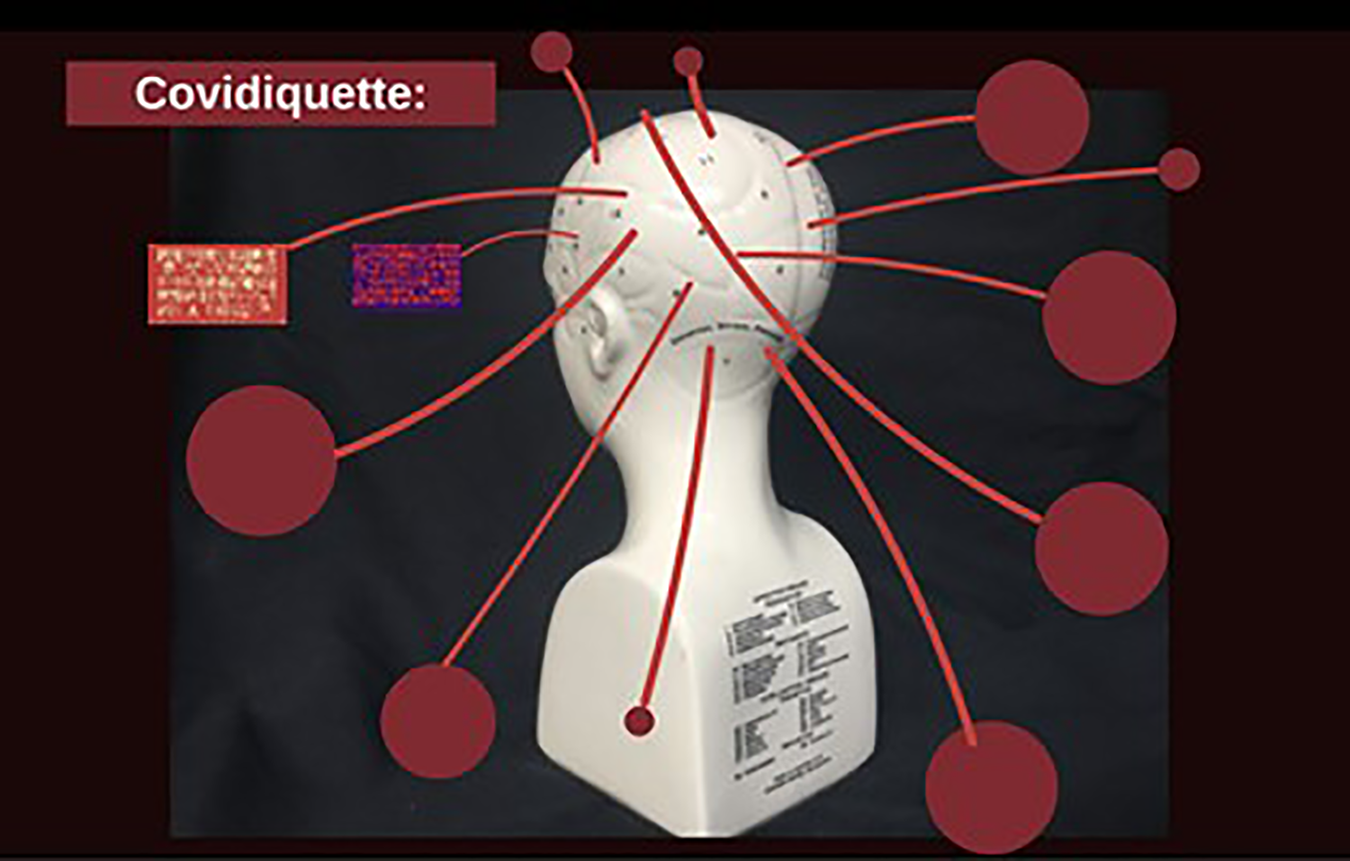
Covidiquette affect-head contagion. P. David Marshall.
Covidiquette: A new health-inspired COVID-19 etiquette
This new comportment that moves through government and industry but directly into the private and public worlds of individuals, collectives and communities can perhaps best be explained through a blended neologism, ‘covidiquette’, where COVID-19 is integrated with a distinctively parallel pervasive structure of comported and controlled behaviour and etiquette. The mutated SARS variant that is our COVID-19 with its array of further variants, through its dissemination amidst our cultures both in the real viral sense and also in an affective collective exchange and sharing, has cultivated a new generation of health-inspired ‘etiquette’. Although war-metaphors and economic crises have been the analogous expressions used by political leaders to evoke and invoke compliance in the early days of the pandemic (see Musu, 2020; Rasheed, 2020), there have been affective chains of concern and fear that have led to a new social environment. Covidiquette also incorporates the internet concept of ‘netiquette’ (Scheuermann and Taylor, 1997; Florido, 2016), a word still integrated in education to help youth manage their use and positioning of online culture and social media (Linek and Ostermaier-Grabow, 2018; Florido, 2016), in its clear shaping, building and emotionally connecting online cultural platforms. 1 Moreover, as recent evidence has revealed from 2019 to 2021, increasing daily, weekly and hourly connections internationally with online and social media became normalised: growth of active monthly users grew by 8 per cent for Twitter, 19 per cent for Facebook, 16 per cent for Instagram, 19 per cent for SnapChat, and the highest levels of growth for TikTok by 38 per cent, Reddit by 30 per cent and Pinterest by 30 per cent (Statista, 2021).
Our knowledge of COVID-19 varies incredibly, but it is easily and obviously identifiable as a form of covidiquette in how it has transformed our public spaces into a new social environment. The cognitive re-expression of state and state health ministries and administrations has created chains of concern, anxiety, fear and anger as people navigate public spaces such as parks, neighbourhood sidewalks, footpaths, and supermarkets. Any individual who has experienced a COVID-19 lockdown has incorporated a transformed presentation of the self as they walk, talk, observe, run and shop in their related cultural ecology. Moreover, each of us has also compared, contrasted and critiqued how they have seen others and their use of masks, their integration of a social distancing protocol, and then taken those normative and ethical readings of others back into their own social environments for comparison, discussion and ethical and emotion-laden judgements. Covidiquette is not a consistent conversion of affect into language: it varies as groups are characterised as included or excluded from an array of norms and normalised narratives of covidiquette.
Expansion of governmental power: Connection
There have been layers of covidiquette that have led to the affective and cognitive connection of people to their governments. Governments – perhaps as during periods of war – have developed a more visible role; but beyond 20th-century moments of propagandistic broadcasting through centralised, daily radio and television ‘public’ messages and related news reports (which are still part of the state-organised elements of covidiquette), governments have expanded their everyday relationship to their citizens during COVID-19 through online instruments, news/message alerts and applications. One of the covidiquette-interplaying effects is the interesting global phenomenon of increased governmental visibility and power. For instance, in over 50 nation-states, governments have moved into a space of converted supervision of its population through connecting a new application to ensuring a safe state (Ologeanu-Taddei, 2020). In Australia, we have the COVID-Safe app – a downloadable application that helps identify transmission risk: with active Bluetooth, the app identifies others you have been in close proximity with when in public. If someone who tests positive and also had their phone active was in close proximity to you, you are alerted and advised to isolate and quarantine as necessary. China has modelled a new level of surveillance of their citizens and COVID-19 was instrumental in implementing further GPS-related apps that track individuals. The capacity of states to actually enact this connection to our lives represents how much mobile phone use and technology has become incorporated as, to use McLuhan’s (1965) phrase, ‘extensions of our senses’. It is perhaps best to think of this normalisation of ourselves into a state environment to see it similar to how we blend traffic lights – organised by the state more than a century ago – into a normalised and naturalised sense of place and control of self to collective. It affects us and transforms how we read and feel in our environment.
The panoptic-to-control-society state has expanded and normalised. For certain countries, this is an integration of industrial techniques into governmental techniques; in other countries, it is an extension of this structure of observation. The standardisation of location identification through QR codes – which simply stands for Quick Response digitally-enhanced connections – and Bluetooth monitoring means that we have blended our social media selves with our notion of the proper citizen in many ways as we navigate through our public and formerly more private spaces. Because many governments have limited infrastructure and expertise in digital monitoring beyond intelligence operations, they have relied in overwhelming ways on Google, Apple, Facebook, Amazon and Microsoft in the West (GAFAM); integration into governmental structures of connection has extended GAFAM’s industrial power and presence.
Circulating through this new governmental/industrial AI structure and into the wider populace through the centrality of covidiquette affective cognition around behaviour is a variation of Protevi’s concept of ‘political physiology’ which is ‘the imbrications of the social and the somatic’ (Protevi, 2009: xi). Protevi identifies the ‘4EA’ of this form of cognition (‘embodied, embedded, extended, enactive, and affective’) – and how the political becomes parts of the social and the emotional forms of response to political and cultural activities (Protevi, 2009: 4, 185–91). In a structure that is partially derived from a transformed subjectivity, elucidated by rethinking neuroscience and its relation to affect, Protevi integrates what he calls the ‘proto-empathic identification or contagion’ (Protevi, 2009: 4). Our affective relation to the political explains the blend of the self to the collective and the various patterns of how collective empathic affect moves through a culture. Covidiquette has produced all sorts of these dimensions that reveal the incredible mix of the self with cognitive forms of empathic connection. Protevi’s analyses of governmental constitutions of affective politics and political physiology (in particular, his analysis of Hurricane Katrina in New Orleans) identify different structures of anger and rumour that circulate in and around the political interventions in a catastrophe (Protevi, 2009: 163–83). The political physiology of covidiquette reveals new relations to the pandemic and specifically the state’s responsibilities in shaping everyday experiences.
The new culture of co-presence
What is emerging beyond this governmentality connection as perhaps the most interesting development of COVID-19 is a further comforting factor of online connection – a form of connection which is now contrasted between COVID-19 ‘analogue activity’ (walking while wearing a mask) to ‘digital activity’ (contract tracing app/alerts and the many ways we connect online) (Crawford and Nelson, 2020). Through isolation, many of us connect with greater frequency with others: in a sense, we are producing a new culture of co-presence – a digital co-presence that, as Bodinger-de Uriarte (2019: 2) has expressed it, ‘acknowledges that physical and digital presence continuously intertwine, mediate, and influence one another’. 2
Though this digital intersection with other forms of presence predates COVID-19, the covidiquette-digital presence has expanded the affective interweaving of place and extended digital situating. We inhabit a stronger affect sense and proto-cognition of potential disconnection – an anxiety that each of us deals with in ways that gloss over the anxiety with affective connection.
The fear of disconnect: The corporate model intensified through the pandemic
This anxiety transformation is producing many iterations that are leading to an elaborate curation of the self across online platforms and back into our everyday physically present lives. Collectively and individually, we are working through a new complexity that is specifically involved with connection to others. Modelled into this mutated everyday life is an anxiety around disconnection that envelopes our online practices.
Tero Karppi, in his book Disconnect (2018), provides a close study of how Facebook maintains itself in our consciousness, our lives, and pulls this together with how social media in general is industrially driven by their own fear of our disconnection. Their industrial model of social media platforms then is to produce affect structures that keep us returning to their sites for a sense of attributed direction. Drawing from Massumi and Deleuze, Karppi reveals social media’s development of an infra-individual affectively attached to the possibilities of attachment that their service of connections provide (Karppi, 2018: 141): it is not so much participation but, as alluded to earlier, a form of ‘engagement’ that works as an industrial and algorithmic form of shared affect that plays across into the industrial dimensions of online culture and its now massive system of programmatic advertising (Eriksson et al., 2019): for example, 82 per cent to 85 per cent of Facebook’s revenues are derived from advertising (Karppi, 2018: 4), which effectively reveals the massive play of affect that continuously connects us and connects us in circuits and loops further into online culture.
What we see through our current pandemic is a parallel effort to curate the affective self through social media. Whether it is TikTok and its continuous adding on of what would affectively connect you further through the next scrolled/pushed image, or connecting to ‘family’ and ingroups through Instagram or Snapchat, we have moved into a new space of incorporating the model of partial or infrabeing – a fear of missing out – commonly known in its acronym and hashtag as FOMO. There are many exemplary social media pathways to understanding how covidiquette maintained a collective affective affirmation of coping and expressing the self. One of these was the individualised but covidiquettely positive formatting dance and singing of the more-than-a-decade-old song, ‘We’re all in this together’ (originally by Ben Lee), that populated many social media sites in 2020. TikTok and YouTube curated, through their producers, tens of thousands of memes of this particular song that, in their visualisations of the song, dealt with the covidiquette issues of self-isolation during the pandemic’s lockdowns across most of the world’s countries.
Hashtags: Sensing and producing affective connection
Connections were further made through the deployment of hashtags by social media users, a technique to provide a sense or sentiment – possibly an infra-being affect as they provided a loose sense of emotional bonding before an individual fully determined their meaning – of related connection. Hashtags are a form of interface: they are used to express what we feel, but more directly how we potentially connect to others. Although the construction of hashtags for an Instagram post or virtually any social media platform is the norm to strategically and emotionally position the affective value and sentiment of images and messages, it has become central to our new flows of affective digital ‘influence’ and its connected ‘influencer’ culture (Erz et al., 2018). Hashtags are forms of identification of the self and connection: they are derived from the basic emotions of happiness, fear, relational empathy, anger, solidarity and so on. In 2020, this structure of influence was pancultural through the effects and permutations of feeling of the pandemic: the top hashtag on Twitter for 2020 was #COVID19 with almost 400 million appearances (Pesce, 2020). #StayHome was Twitter’s third-most popular only usurped by the political physiological proto-empathic to emotional meaning of the hashtag #BlackLivesMatter in the United States in particular but across Europe and Australasia as well (Pesce, 2020). There were many other hashtags employed that attempted to take attention away from the pandemic. For instance, the top hashtags on Instagram in the United States in 2021 had the straightforward #love as number 1, #cute as number 7 and #friends as number 18 (Geyser, 2021). However, it must be added that these hashtags were often distractions in times of isolation or anxiety about the disconnections from the everyday elements of contemporary life such as schools, workplaces, restaurants and public events and celebrations as much as strategic promotional forays for massive affective connections by the online digital advertising industry.
Anxiety and interfacing: The (affective) covidiquette social media currency and circuitry
Along with hashtags, memes are also a way to read the affective currency of social media (Bown et al., 2019). Covidiquette has led to a curating of anxiety and flows through our techniques of meme-sharing to feel co-relation with others. In 2020 and into 2021, many of these co-relations were associated with positioning oneself politically in and around the COVID-19 pandemic. Rogers Brubaker (2020) captures this as a form of populism, where individuals and collectives respond visibly online, publicly and sometimes aggressively as outside of the technocratic state-centric conception of correct protocol, expertise and behaviour (Brubaker, 2020). There were many memes that migrated nationally and internationally that critiqued humorously the actions of former US President Donald Trump, and many others that pilloried the future president Joe Biden and the director of the National Institute of Allergy and Infectious Diseases, Anthony Fauci. In Australia, a range of covidiquette memes also interplayed into affective interfaces and connections, positive and negative interpretations of the Victorian Premier Daniel Andrews and his strict lockdown regimes and the slightly differently constituted and nuanced Prime Minister Scott Morrison’s management and occasional oversight. Memes identify forms of inclusion in social settings where shared sentiment is passed and potentially mutated to continue the sense of commonality, knowingness and affective flow within a digitally constituted community. Internally constructed among groups and often massively extrapolated in factory-like settings (Abidin, 2020), memes have helped build forms of affective political solidarity. Dramatically different forms of acceptable behaviour, this group covidiquette has been part of COVID-19 in its reconstruction of pandemic anxiety into different political sentiments within and among digitally large political communities, what Shana MacDonald (2021: 145) in her analysis of meme cultures during the COVID-19 pandemic describes as ‘ingroups’ and ‘outgroups’. Covidiquette thus has produced distinctively separated affect circuits in contemporary culture where transformed affect echoes are shared and re-communicated within online social groups.
Interfacing identifies our sharing of an affective component of our online identity. Whatever we observe, whatever we share and identify, connects our digital self to further linked material. Interfacing acknowledges that when we observe something online, it is also a form of algorithmic reconstruction of our digital persona. It is never simply a private experience; it is more accurate to explain it as a complex currency of the ‘dividual’ into digital affect and personal affect, which circulates like a valued currency in and through social media and search platforms. Covidiquette has intensified these forms of interface and the new value of our affective currency in contemporary culture.
Conclusion
The experience of affect and emotion is pervasive in all of our human cultures. Affect and emotion’s reconfiguration through digital pathways and through the flow of everyday life into online culture have become an interesting pancultural pandemic that increasingly defines contemporary everyday culture. As this paper has explored from a digital cultural studies’ perspective, this play with affect has been further moderated and modulated from a number of perspectives during the COVID-19 pandemic. Individually, collectively, institutionally and industrially there has been a further expansion and integration of what I have identified as curation and co-relation by users through social media and other applications online and the correlation of these sentiments and their identification by the intercommunication industries that manage these online entities. An ethos related to the COVID-19 pandemic has been advanced, debated and integrated into contemporary culture and the way we comport ourselves in online culture and its permutations in everyday life activities. Covidiquette pulls together how relations of panoptic and state-of-control surveillance have blended with the normalisation of the sharing of affect-to-emotion in constructing collectives, digital algorithmically generated personas, and our own curation of online personas as well as forms of online and public protest.
Footnotes
Declaration of Conflicting Interests
The author(s) declared no potential conflicts of interest with respect to the research, authorship, and/or publication of this article.
Funding
The author(s) received no financial support for the research, authorship, and/or publication of this article.