




Abstract

It wasn’t because Peter and I had German sounding names that drew us together. And it almost certainly wasn’t that we were both colleagues in the same university, albeit at different campuses. If either of these provided the necessary foundations for friendship, then we would have whole-nation and whole-organisation friendship groups proliferating, instead of the polarity that exists now. Friendship, it appears, is far fickler; it requires some additional qualities, a willingness to share, to walk a journey together, destination unknown.
I first met Peter Beilharz, I think, in 2004. Specific dates and timelines for me are subject to an historical blur, a soft focus. The people, the events are often un-mistakable, but are rendered in-distinct by time and memory inexactitudes. Like in an old school photograph, the board held by the student in the centre, front row is the only confirmation of the class number and year.
Our employer, La Trobe University, had in the previous decade consolidated its regional campus network as a result of the amalgamations of Colleges of Advanced Education and partnerships with Technical and Further Education Colleges. Under this new paradigm, teaching staff from the centre were expected to deliver their teaching to the periphery.
Many city academics were affronted by this directive and either actively resisted the distance education model (and filled their teaching and research allocations with centre-based commitments) or they submitted to regional teaching.
Peter affiliated himself with the latter group and, at the commencement of semester 1 in 2004, he appeared for duty at the Mildura Campus. Mildura is a city in north-west Victoria, some 550 kilometres from Melbourne. Six hours drive by car, but more pertinent, one hour and 20 minutes by plane.
Now, Peter is not a country boy (having lived in Melbourne all his life with the exception of residencies at other major cities), but he differentiated himself from the aggrieved and embraced the difference that Mildura offered. Notwithstanding the aforementioned barriers of culture and geography, Peter was/is a sociologist, a cosmopolitan, cultural and social theorist interested in the ‘premise that the common culture needed to be exercised through the cultivation of ideas and the friendships that made them possible’ (Beilharz, 2020: 51). This, he believed, was facilitated by an urban sociology involving the cross-currents of transnational and international cultural traffic.
Then what is a sociology of the rural? Who are the great thinkers of the bush? Rural sociology is surely a contradiction of terms.
In contradiction to this stereotype, Peter embraced the small town social and cultural conundrum: the fragile dynamics of sustainability and change.
The timing was right. Mildura was about to enter a period of relative cultural progress, of a type of enlightenment. On the banks of the vast Murray River, vital irrigated water supports a horticultural industry that has resulted in one of Australia’s most important food bowls. It is a major producer of wine, table grapes, citrus, nuts, vegetables and most recently, garlic. Outside the irrigated oasis, the endless expanses of semi-arid desert support national parks of World Heritage listing and the cultural practices of the traditional owners, the Latje Latje, Neri Neri and Ngintait peoples.
Extemporaneously, key individuals arrived in Mildura for different reasons at this time. Collectively, a surge of innovative initiatives crystallised: Mildura Palimpsest (1998–2015), which built on the earlier international significance of the Mildura Sculpture Triennials, Mildura Arts Festival, which then became Arts Mildura (1994–current), and Mildura Writers Festival (1994–current).
Together Peter and I (and La Trobe colleague Trevor Hogan) immersed ourselves in the vitality of ideas and energy that bubbled above and below the Mildura intellectual surface. This energy was infectious and the table near the kitchen at Stefano’s Restaurant in the cellar at the Grand Hotel was the place that hatched all manner of creative exploits. Peter writes: There were good friends in Mildura, such as our old comrades the cultural and food entrepreneurs Stefano de Pieri and Donata Carrazza, the entrepreneur and philanthropist Ross Lake and the artist Neil Fettling. The newly formed Thesis Eleven Centre immediately became involved in local activities, including the annual Mildura Writers Festival…Mildura was a central node in the countryside, a vital part of the food bowl. It was red and dry, and smelled good when you walked: asphalt, dirt, salt, eucalypt, citrus and grapevines. It was a good place to remain grounded; a world away from Lawnswood Gardens: oak and beech, shadow, moss and damp. These were my antipodes. Mildura was closer to home, even though it was drier than Croydon. These were good places to work the senses. (Beilharz, 2020: 71)
Prior to discussing some of these events, I want to discuss how Peter the interlocutor tooled his trade. How his model of engagement served this adaptation. How his commitment to trans- cultural traffic overlapped with the ambitions of the Mildura community and their curiosity to re-define their sense of place.
Peter Beilharz forged a career in the academic silos of the university system, a competitive system that pitched academic against academic for promotions, teaching and research grants. As funds increasingly became contested, individuals held close their personal, intellectual property and built their professional lifelines. Inevitably, one day (sadly it came sooner than expected), two academic positions would be rolled into one and the self-maximised and promoted would win out.
Peter was the exception to this. His ethos was based on cooperation, generosity, the collegial and the collective. He had, ‘no thoughts to be the last professor to leave the building’ (Beilharz, 2020: 20–1). He had no need for the silo and the containment that it embodied.
He was a sociologist, because every academic had to have a discipline, an office in a department, within a faculty, with a title on the door. Without these constraints would he have described himself as a sociologist? He once claimed he was a ‘refugee in Sociology’ (Beilharz, 1997: vii). There is no question regarding his understanding and credentials. He wrote sociology textbooks and taught courses in Soc 101, in addition to writing the 20-odd texts, more specialised. He was schooled in historical and contemporaneous scholarship and knew of the importance of the archive (the library, museum or bookshelf), but didn’t want to be a slave to it: I did not want to be an archive rat, a scholar who did the 16 metres of paper required for a dissertation, leaving the next length for the labourer to follow. I wanted also to see the light of day, to sit in the Oosterpark after my day at the Amsterdam Institute, or in the Museum Tavern after a day in the British Library, wondering what Marx would have said, complaining about his carbuncles, or what he had to drink, waiting for dinner or the revolution. (Beilharz, 2020: 18)
In his book, Imagining the Antipodes: Culture, Theory and the Visual in the Work of Bernard Smith (Beilharz, 1997), Peter describes Smith as a ‘civilisational thinker’ (Beilharz, 1997: 193). In relation to this, he further describes this as one who is ‘curious, more conversational and hermeneutical’ (Beilharz, 1997: 197). The mirror may well have been in place.
Peter is interested in sharing ideas and the people expressing them, and not in the infrastructure that houses them. His long-term friend and subject of his memoir, Intimacy in Postmodern Times: A Friendship with Zygmunt Bauman (Beilharz, 2020), called this ‘Stimulants’, pertaining to the materials that generate new thoughts. Peter and I shared many stimulants together, but this is yet another story.
The notion of friendship is central to Peter’s modus operandi. An academic exchange of thoughts and ideas is central to an innovative educational institution, but he did rail against its clinical delivery in the lecture halls of the establishment. He also railed against the scholarly loneliness created by the individual pursuit of knowledge.
His mantra was to ‘set out both to export our own views and to import those of others’ (Beilharz, 2020: 7). This only had value if the interlocutors put aside their unequal status, their differing views and understandings towards a shared consent, contract-free participation. This required mutual choice – the choice of friendship. Friendship goes beyond academic experience and is inseparable from work itself.
At a Mildura Writers Festival event in 2007, the South African-Australian novelist and essayist, Nobel Prize winner, John M Coetzee delivered a paper commemorating the release of his latest book, Diary of a Bad Year (Coetzee, 2007). John, despite being profoundly protective of his privacy, developed a close ongoing friendship with Peter that continues to this day. A relationship, not based on an attraction to a bright light, but based on the cultivation of ideas and the friendship that makes this possible: We developed a routine of sharing our visitors with interesting locales of different kinds, sharing our city and getting them out of town, to see nature, music, art, geography, food cultures. All this was based on high levels of trust and friendship. If you took on visitors in this way they would also work with postgraduates, share ideas and interests, dance and laugh as well as walk and talk. (Beilharz, 2020: 51)
Certainly, the ferment of intellectual exchanges, mixed liberally with a cocktail of food, wine and friendly bonhomie, were the amalgam that galvanised the developing partnerships and transformed Mildura into a site of possibility.
I mentioned earlier that Thesis Eleven and Mildura Writers Festival had been joined up for shared hosting rights of local and visiting luminaries. Because the Festival was held annually in July, this did not always correspond to the random patterns of cultural traffic and the opportunism to secure their services for a lecture/workshop, panel discussion, field trip and so on. Thus, an independent, but flexible schedule of events was often held as required at the La Trobe University Mildura campus to cater for these out of sync events.
One of the earliest transported guests was the Milwaukee-based postmodernist theorist and writer, Ihab Hassan. Hassan visited with his wife Sally and eminent Australian author, David Malouf, in 2004. This model of engagement seemed successful, so a commitment was made to formalise the arrangements.
It is not my intention here to document the entire programme, but I do want to discuss three such visits that Peter facilitated.
On Friday, 30 April 2004, the influential antipodean art historian, Bernard Smith, came to town. He delivered a paper called, ‘On Writing Art History in Australia’, that he delivered to mainly a humanities and visual arts audience.
Bernard was in his late 80s at this stage and, although stooped and physically frail, had not lost any of his intellectual sharpness. He and Peter had decided to stay on over the weekend and along with my father and me, we made a touching foursome. At times, Peter and I felt like we were the chaperones for the ageing gentlemen in negotiating them away from all manner of social temptations. In fact, Peter was like a doting son to Bernard, attentive to every need, pre-empting all requirements, always respectful of the dignity of someone he loved and respected.
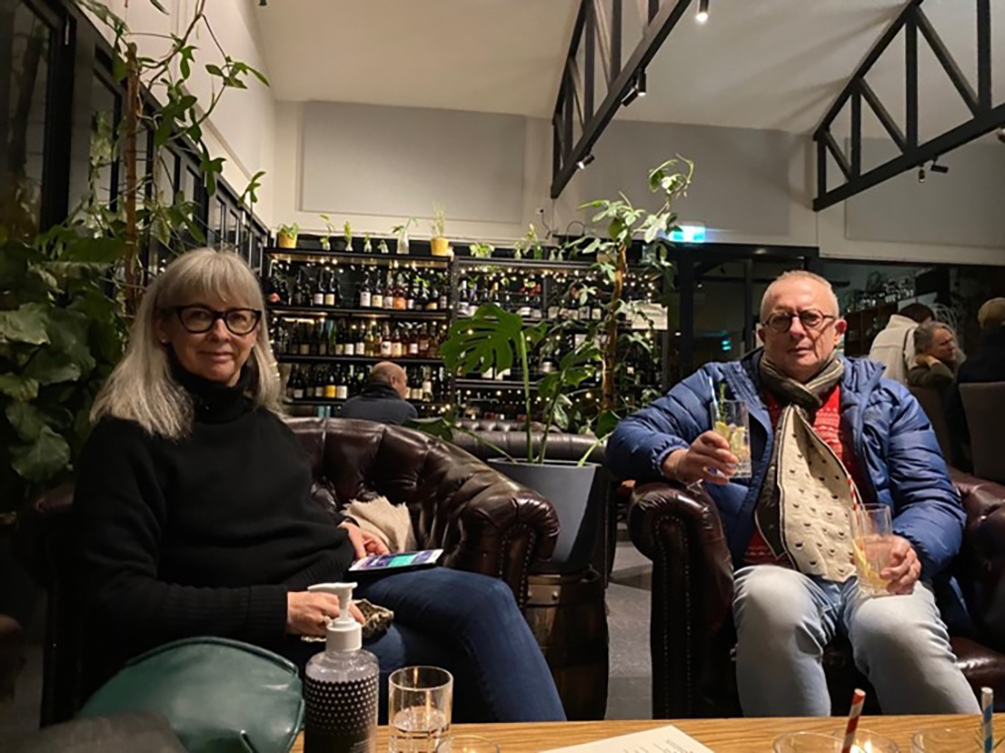
Peter and Sian at the Botanik Cocktail bar in Kyneton (2022).
Peter looked towards two giants (were they mentors?) in Australian culture, theory and visual field: that of Bernard Smith and Robert Hughes. Bob played hard to get, but Bernard was effusive.
Bernard’s paper was an interesting summation of his life, encapsulating the sequence of parts, his publications: Place, Taste and Tradition (Smith, 1945), European Vision and the South Pacific, 1768–1850 (Smith, 1960), Australian Painting, 1788–2000 (Smith, 1962), The Antipodean Manifesto: Essays in Art and History (Smith, 1975), The Death of the Artist as Hero: Essays in History and Culture (Smith, 1988), The Critic as Advocate: Selected Essays 1941–1988) (Smith, 1989), Imagining the Pacific in the Wake of the Cook Voyages (Smith, 1992), Modernism’s History: A Study in Twentieth-Century Art and Ideas (Smith, 1998), The Formalesque: A Guide to Modern Art and Its History (Smith, 2007) and so on, and other thoughts and theories.
The presentation was a scan through his oeuvre in an attempt to define a lasting legacy. This was a man and a scholar looking back on his life, assessing its worth. He was assertive about his antipodean thesis. About the challenges of being antipodean, but also about its imaginary advantages, about having a foot in each world, about knowing the local and the global simultaneously. About a history of stigma, of being other and above all the criticism of nationalism. He openly discussed his audaciously bold challenge to rename Modernism, the Formalesque, sadly a notion that achieved very scant traction or even consideration, although it was endorsed by none other than Ernest Gombrich. Peter has described Bernard’s Formalesque campaign as a ‘semantic crusade’ (Beilharz, 2020: 96) to invent new language. Maybe, in this case, an unnecessary new language.
Peter Beilharz had become interested in the work of Bernard Smith in 1992 while in England with mutual acquaintance, anthropologist, Peter Gathercole. Geographical absence tends to synthesise responses to the homeland, and akin to Fred Williams returning home from six years in Europe, where he saw the county anew; its flatness, its dominant horizon, its worn down texture, straggly and stunted vegetation, Beilharz confronted the antipodean. In 1997, Peter delivered lectures on antipodean modernity in Sao Paulo, Brazil, which then led to his publication, Imagining the Antipodes: Culture, Theory and the Visual in the Work of Bernard Smith (Beilharz, 1997) and the Harvard Chair of Australian Studies (1999–2000). I was aware of the outcries of criticism by a few precious art historians and critics, who thought a cultural theorist/sociologist shouldn’t be invading their siloed turf and writing a book about their own. Nonetheless, the silo had been breached.
What did Bernard Smith mean to Peter Beilharz? I will give the final word on this to Peter: I was deeply connected to Bernard Smith, but I am not sure exactly that I then felt love for him so much, perhaps, as an enormous admiration and an abiding affection. We worked together for years, and we remained serious friends in the time of his decline. I was among those who read to him out loud when he was past reading; he was never past thinking and talking. I read to him from his masterpiece, European Vision and the South Pacific, and was still learning from him in those last days. I am not sure that we ever embraced, even though there was good feeling between us. (Beilharz, 2020: 110)
This had always been Peter’s schtick: connect the guest to the locals, share the stories and the experiences, eat and drink, and see what evolves. Some might say a risky strategy, but playing it safe was not in the rule book.
Jeff’s paper was called, ‘Iconic experience in art and life: Standing before Giacometti’s Standing Woman: A cultural sociologist’ (Alexander, 2008). Alexander espoused a concept he called the strong program. This evolved out of Nietzsche and rejected the muscular or materiality of art, embracing instead an openness to subjectivity, to invisible forces, to symbolics, to meaning.
Using sculptor, Alberto Giacometti’s Standing Woman as an example, Alexander discussed the tension that exists between the surface of the work, its physical form and the deeper structure of metaphysical or emotional meaning that lies within. Giacometti would later refer to this as ‘the invisible object’ (Alexander, 2008: 3).
How to express in art, not a man or a woman, but the idea of a man or a woman; an archetype there of?
This work and that which followed from Giacometti ‘reveals the dark and uncertain fate of humanity’ (Alexander, 2008: 4). Considering that Giacometti was working in Europe in 1945 along with his friend Samuel Beckett gives grim context to his existential anxiety.
Alexander went on to draw an analogy with our quintessential modern condition and the materiality of our social life, where we create icons (iconography), for example family photos, domestic objects, movie stars and celebrities, clothing, and so on, which provide and express a dimension, akin to the ‘sacred “aura” of traditional art’ (Alexander, 2008: 10) in our modern and postmodern life.
There was much trust and respect between Peter and Jeff, an easy familiarity built on the non-competitiveness previously discussed. Peter, with great dexterity, pulled a lever here, pushed a button there, always mindful of the audience, the context, the comfortability of the key players. If plans had to be altered, the details tweaked or radically re-constructed, then this process was handled with the care and the delicacy of a zookeeper in a lion’s cage. But always he had confidence in those implicated or involved, that they would be able to navigate the transactions with mutual respect. To the outsider sometimes during these negotiations, he seemed to be plagued by a type of in-decision, a nervousness to be decisive. But this was always Peter being Peter, making sure the well-being of his interlocutors was assured. Humble and polite to the end.
In July of this year (2023), Peter and Sian invited Jeff and Morel back on the occasion of another International Sociological Association conference. Having left Mildura in 2013 (and the University in 2015), Katia and I divided our time between a 10-acre idyll property in Elphinstone (one hour north-west of Melbourne) and Brunswick (an inner suburb of Melbourne). Interlocutor Peter proposed a re-hosting at Elphinstone some 17 years post-Mildura. Much had changed, both persons and circumstances, but when friendship is at the core, then time and distance seemed irrelevant.
Finally, Peter had met South African writer, Ivan Vladislavic when he and Sian were on residency at the Stellenbosch Institute of Advanced Study (STIAS) in 2015. It would have come as no surprise to anybody that Ivan and Peter would attract. They not only had similar research interests but also similar philosophies of engagement: inter-disciplinary practices between the visual, theoretical and the cultural.
Not only a writer, Vladislavic is an editor, art historian and street photographer. His books include, The Restless Supermarket (Vladislavic, 2001), Portrait with Keys (Vladislavic, 2014), Double Negative (Vladislavic, 2010), a collaboration with photographer David Goldblatt, The Exploded View (Vladislavic, 2004), A Labour of Moles (Vladislavic, 2011a), The Loss Library (Vladislavic, 2011b) and The Distance (Vladislavic, 2019).
Vladislavic’s work interfaces post-apartheid South Africa, more particularly the urban spaces of Johannesburg. He enters these built architectural spaces into the labyrinth of security (and of course its opposite, insecurity), humour and irony that is always prevalent in everyday life. He collaborates with artists and photographers and their work, for example William Kentridge and David Goldblatt.
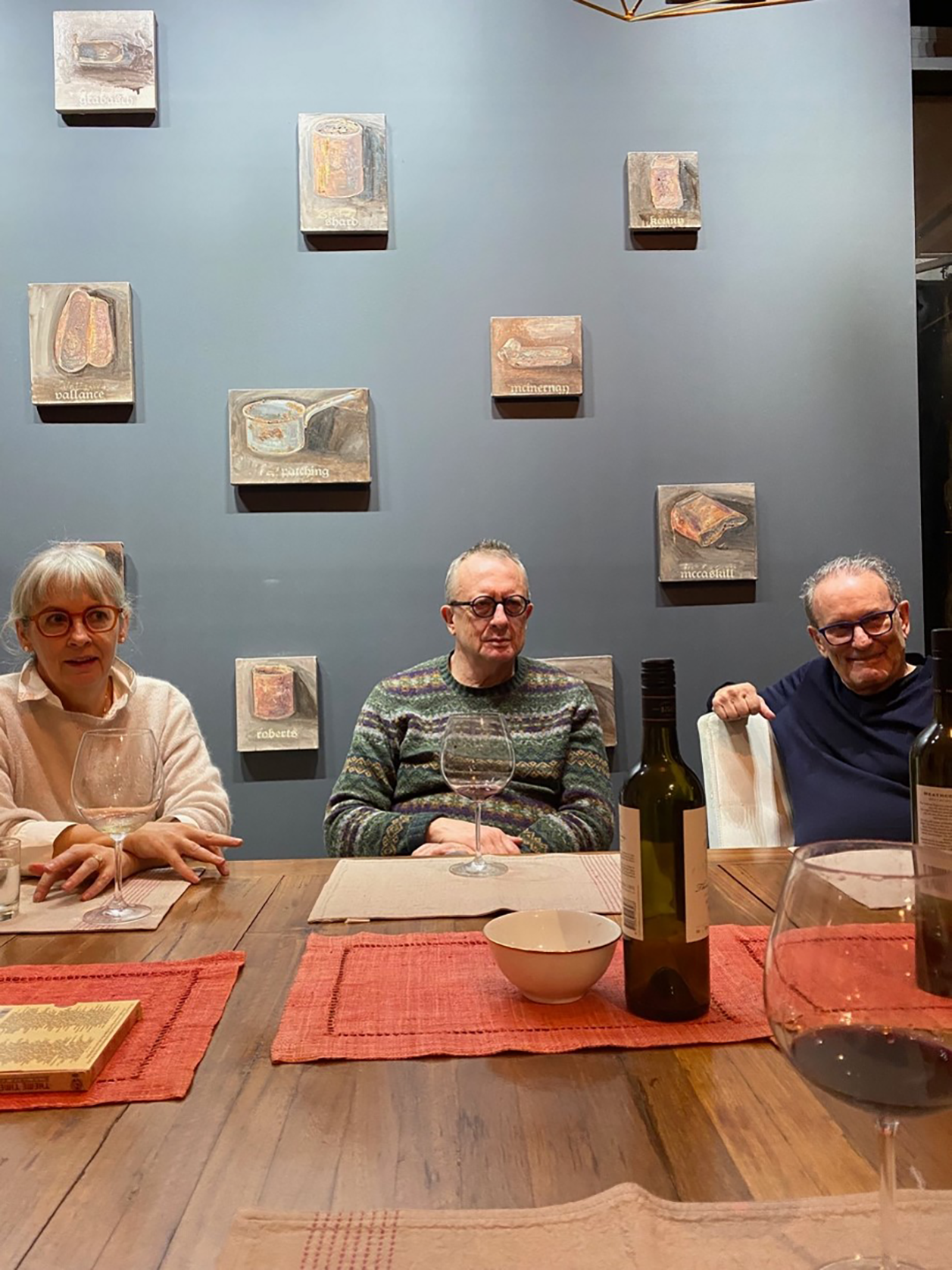
Sian, Peter and Jeff Alexander at Elphinstone in July 2023.
This was the last such event that Peter and I collaborated on prior to both our respective departures from the University. We had both fallen foul of the corporatisation and managerialism of the university sector. Budget cuts, rationalisation, endless and seemingly continuous re-structures resulted in redundancies, some so-called voluntary and others targeted. Peter was targeted because professors were expensive and a casual teacher was less expensive.
But despite this, his, in the end, was voluntary. I was targeted, because I was considered superfluous to needs, no longer aligned or of value to the strategic directions of the University. Inaugural Director of the La Trobe University Arts Institute one day, packed up and gone the next, five days before Christmas. The professional friendship trade had ended, at least at La Trobe University. But not in the personal realm.
The Ivan Vladislavic and Peter Beilharz conversation was held not in Mildura, but at the Bendigo Campus to a predominantly creative writing student cohort. It was structured around Vladislavic’s approach to writing; the importance of the archive (his and others), collaboration and joint projects, fiction/non-fiction, truth/lies, double meanings and the blurred lines between them. The written fragment, as per Portrait with Keys (Vladislavic, 2014), and the notion of the photograph as a pictorial fragment was discussed. The importance of Johannesburg (and its streets) to him is its blank canvas of opportunities for its citizenry and visitors and its accident of providence. The irony of birth, its rich gold reef (and its logical comparison to Bendigo) running underneath the city.
Following this conversation, a visit to the local studio of artist, John Wolseley, was organised. John has immersed himself in the local landscape (based in the iron bark eucalypt forests of the Whipstick) and collaborates with the land itself. John, in like-minded methodology to Ivan, surrounds himself with a natural archive, exploring the juxtaposed images inspired by scientific and geological time.
There was a strong connection between the two creatives. Although one worked the urban street archive, the other that of nature, they seem to share an interest in linking life’s fragments into vibrant connections.
Such was the impression made that afternoon, that during a subsequent conversation between Beilharz and Vladislavic the following day at a Melbourne bookshop, Ivan was still recounting the eccentric work practices of Wolseley as he frottaged or slam dunked a dead pelican onto his artwork.
Any genuine Festschrift for a Friend would not be complete if I did not discuss Peter’s contribution to my arts practice, as opposed to our shared visiting lecture programme.
I managed to maintain a studio practice in fine arts concurrent with academia, continuously since art school. The competing demands on both disciplines have been well documented by all who attempt to feed the voracious appetites of each. A serious studio presence squeezed into a professional practice day per week was always threatened by the extra university administration and student demands. Peter talks about ‘working like fury, teaching, writing, researching, organising, editing journals such as Thesis Eleven…weekend? What’s a weekend?’ (Beilharz, 2020: 20).
Like Peter, I pursued an interdisciplinary practice. My undergraduate years were largely spent in the painting studio. Internationally, painting was in decline, having had its renaissance through the frenetic period of European and American 20th-century Modernism and their respective influences in Australia. From the 1970s (coinciding with art school), postmodernism and de-construction had opened the artist to conceptual, minimal and performance-based work that shifted materials off-canvas and even out of the gallery.
In response, my various studios were filled with materials and objects, collections of mass culture and waste (ephemera) used in installation, and the new processes of digital imagery. As the paint tubes dried shut, the clamour of cultural artefacts replicated.
This was indeed an exciting time, which supported the conceptual direction of a Masters of Art and Doctorate postgraduate research programmes. Painting proved not to be dead, and its temporary dormancy ended with bursts of neo-German expressionism and trans-figuration movements. Now painting coexists amid the myriad of material and conceptual responses required to make sense of what passes for the multiplicity of contemporary society.
I have invited Peter to open two of my previous exhibitions. To open an exhibition is to talk at or around, provide thinking options, conceptual directions, even lateral departures for the work. It is never possible to explain, to encapsulate the artist’s intentions, to explain away the raison d’etre for the work or exhibition. Peter is good at this. He is able to construct a conversation that meanders through possible shared divergencies. After all, he did call his memoir of Zygmunt Bauman, ‘a thinkpiece’ (Beilharz, 2020: xiii). Peter is able to draw upon the belief that, ‘great thinkers emerge from their culture, their sum total of experience, influences, intuitions, texts and contexts’ (Beilharz, 2020: xii) and feed other individual contributions.
The first exhibition opened by Peter was titled Relics, and was held at Gallery 25 in Mildura in 2004. It was a two-person show, with Jill Antonie as the other exhibitor.
I had been exhuming the rural, informal rubbish pits of north-west Victoria for some time, collecting the discarded secular, utilitarian objects and re-installing them into large-scale monuments commemorating the failed ambition of settlement. The Mallee: A History (2000), saw 214 rusty tin food processing cans installed on Perspex shelves on an earth wall. Ephemeral objects represented ephemeral lives. This new show (Relics) consisted of a series of small paintings depicting retrieved, but broken, abandoned objects on a salt rime surface with museum text below each describing its ironical, but doomed function.
Jill also exhibited a series of paintings, but in contrast used the body (including her own) as the stretcher for acts of physical violence. The scars and their stitches, welts, bruises and burns from domestic violence alluded to the notion of a more personal relic.
Not an easy act, to dialogue about a concept (the relic) from almost opposite directions. Peter was up to the challenge, forging his own path with dexterous manoeuvrability between the two responses, offering montages of readings and performance.
More recently in November 2022, I included Peter in a panel discussion associated with a solo exhibition called, The Streets of Ferdinand de Saussure.
This exhibition responded to the world underneath our city arteries, the roadways, corridors and paths that conceal a labyrinthine network of utilities and services. These invisible networks facilitate the complex delivery of services and communications essential to the smooth operation of a functioning, modern society.
In a continual process of breakdown and repair, road maintenance workers spray-paint symbols (numbers, dots, lines, crosses and arrows), modern day hieroglyphics denoting repairs and modifications required. These indicate interventions where future work needs to take place. This palimpsest of gestures and marks (the signs and the signifiers that the French semiological and linguistic philosopher, Ferdinand de Saussure [1857–1913]) acknowledged.
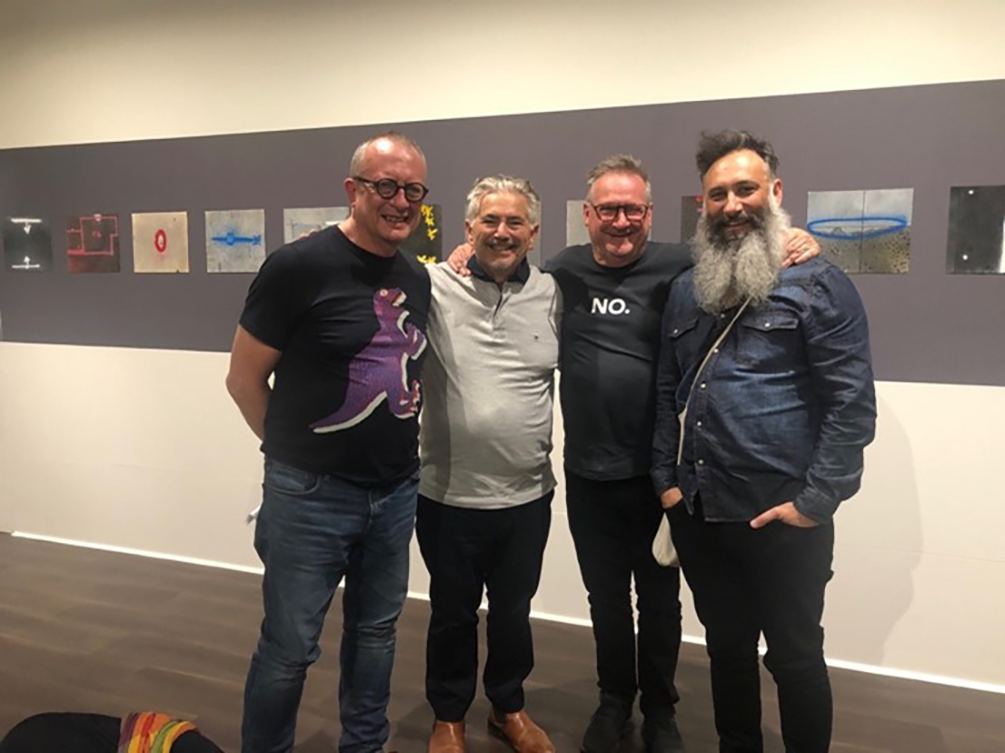
Peter, Stefano de Pieri, the author, Vincent Alessi at The Streets of Ferdinand de Saussure, November 2022.
They represent blemishes and glitches, metaphors for the breakdown of our systems under pandemic lockdown and other interrupters. They appear without reference or context, a secret language communicated in the public domain, but hermetically sealed outside the inner sanctum. The signs exist long after the repair works have been completed, muted evidence of some previous activity and purpose.
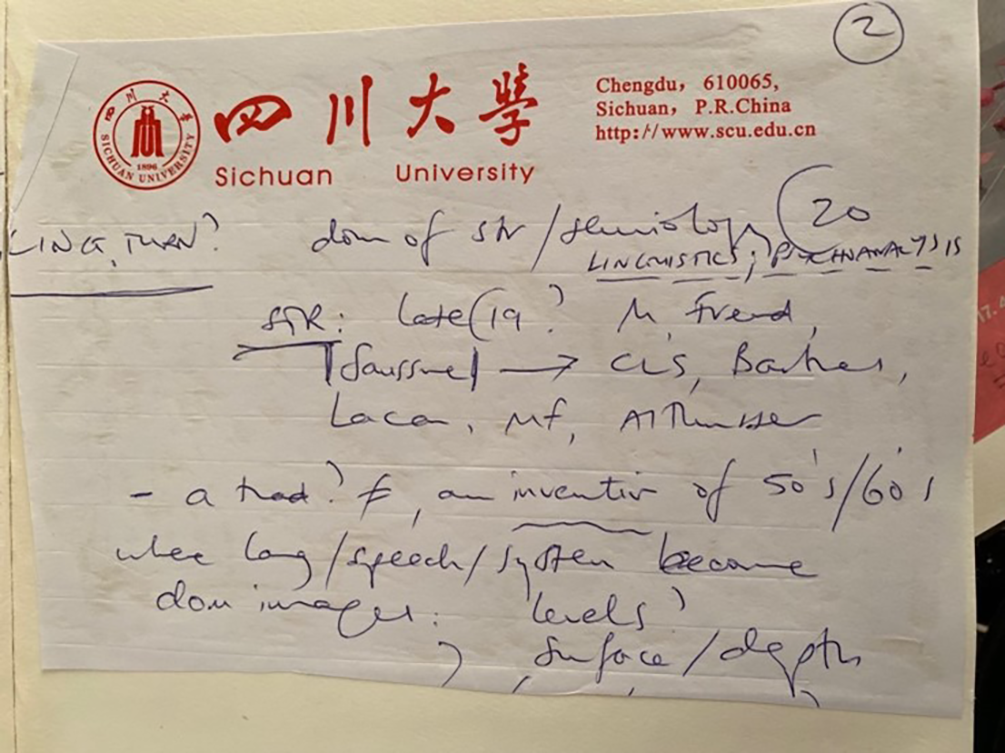
Documented on Sichuan University, Chengdu, China, letterhead notes, Peter mapped out his Thinkpiece, or maybe it’s akin to Bauman’s Stimulants, the basis for his discussion. The interrupters were primed for the interlocutor. Semiology here, Barthes’ (1957) Mythologising and Elements of Semiology (Barthes, 1964), the signs and signifiers, language, linguistics and speech, metaphor and irony, Freud and psychoanalysis, Althusser, Lacan’s (1968), reading, decoding, the system of the street…food, car, fashion and so on.
Then, page after page, illegible to the non-author, he seems to synthesise this eclecticism, these thought bubbles.
The random thoughts become less unhinged, become more formed, less thoughts and more formed into ideas. The poetics remain and the words form pictures and associations. I slightly paraphrase him: ‘A world of signs without author…think or over think…abstract presence…the biographer of the asphalt…Inhale, breathe the asphalt…spray paint and asphalt, what more is quintessentially modern…look up, look on, look down…’
Peter’s notes for The Streets of Ferdinand de Saussure, November 2022.
It was like he was composing a musical score on site. Plucking references, reading from philosophical texts, performing word dances, scanning the works on the wall for the keys to unlock the multifarious links and hence, open the realm of interpretation.
Peter Beilharz and I were thrown together by chance. He has always claimed that that boy from the burbs only ever wanted to be a humble classroom teacher. But, it was clear to all that something else burned deep within, a curiosity about the world, a fascination with all things intellectual and an unerring commitment to a scholarly regime. No shortcuts, no bullshit. He has a radar for the interesting and the authentic. The perfect ingredients for a successful interlocutor.
I’m not sure why we were thrown together and why it has lasted. Maybe my modest early ambitions had parallels with his, and I too had embarked on an intensive self-education programme, a belated finishing school, in order to close the numerous knowledge gaps I had.
I was schooled in the studio, the modern atelier. You were taught content on a needs basis. If you wanted to paint large and abstract, then you read Greenberg, you looked at de Kooning and Guston and you learnt how to scumble, to drip and to paint with impasto. Knowledge was acquired contextually, and not sequentially or chronologically. You knew everything about Cyfford Still, but very little about Barnett Newman. You read Baudrillard, but often missed Derrida.
The consolidation of art schools into the university system under the aforementioned amalgamations was, I believe, a mistake. The long toil, of trial and error, in the art school studio, in trying to synthesise the instruments and their instrumentation to the world of ideas, frankly does not fit into a three-hour lecture and tutorial format. We were all racked with indecision, false steps, poor directions and generally intimidated by the momentous task of finding an artistic vision within the bewildering options faced.
Peter Beilharz’s beyond-the-lecture approach to engagement in many ways recognised this problem and suggested an alternative pedagogy. The most effective learning was experiential.
The theme to this essay was always going to be friendship. Although much of what Peter and I did was within the university and that has ended, it is the relationship outside of this past that now continues.
Once a friendship is sought, it is valued, nurtured. He or his friends are not in constant contact; the day-to-day minutiae go often un-recognised and space is accorded for the pursuit of other priorities. There is not the constant barrage of phone and text messages observing the inane. Even the email, his preferred non-face-to-face communication tool is used sparingly, words and sentences reduced to cryptic and code messages.
But it is the physical gathering where he excels: the warmth, the affection, the joy of the shared experience. Like his sociology lectures, or his guest introductions, these occasions have been rehearsed over and over in his mind. Every rendezvous becomes a celebration where gifts are exchanged. Not a bouquet of flowers or chocolates picked up along the way, gifts that have been well considered, ruminated on. A vinyl record found in a second-hand stack, perfectly selected to challenge the taste; a book once read, or never read, or maybe just positively reviewed; an art monograph from another friendship; some local produce: artisan cheese, Burrum sourdough, a selection of viennoiserie (pastries) or small goods made by a backyard bespoke grower/alchemist.
And wine…always wine. Wine for sharing, for celebrating with, for commemoration. Or maybe, just to reward the moment. The moment of being together. Peter is not a big drinker and wine for him is transactional. Good wine = good conversation = good company = good friendship.
There are not too many advantages in the ageing process, but discernment is one. Whether it’s wine or friendship, quality should usurp quantity. Friendship is indispensable and none more than the friendship with Peter Beilharz.
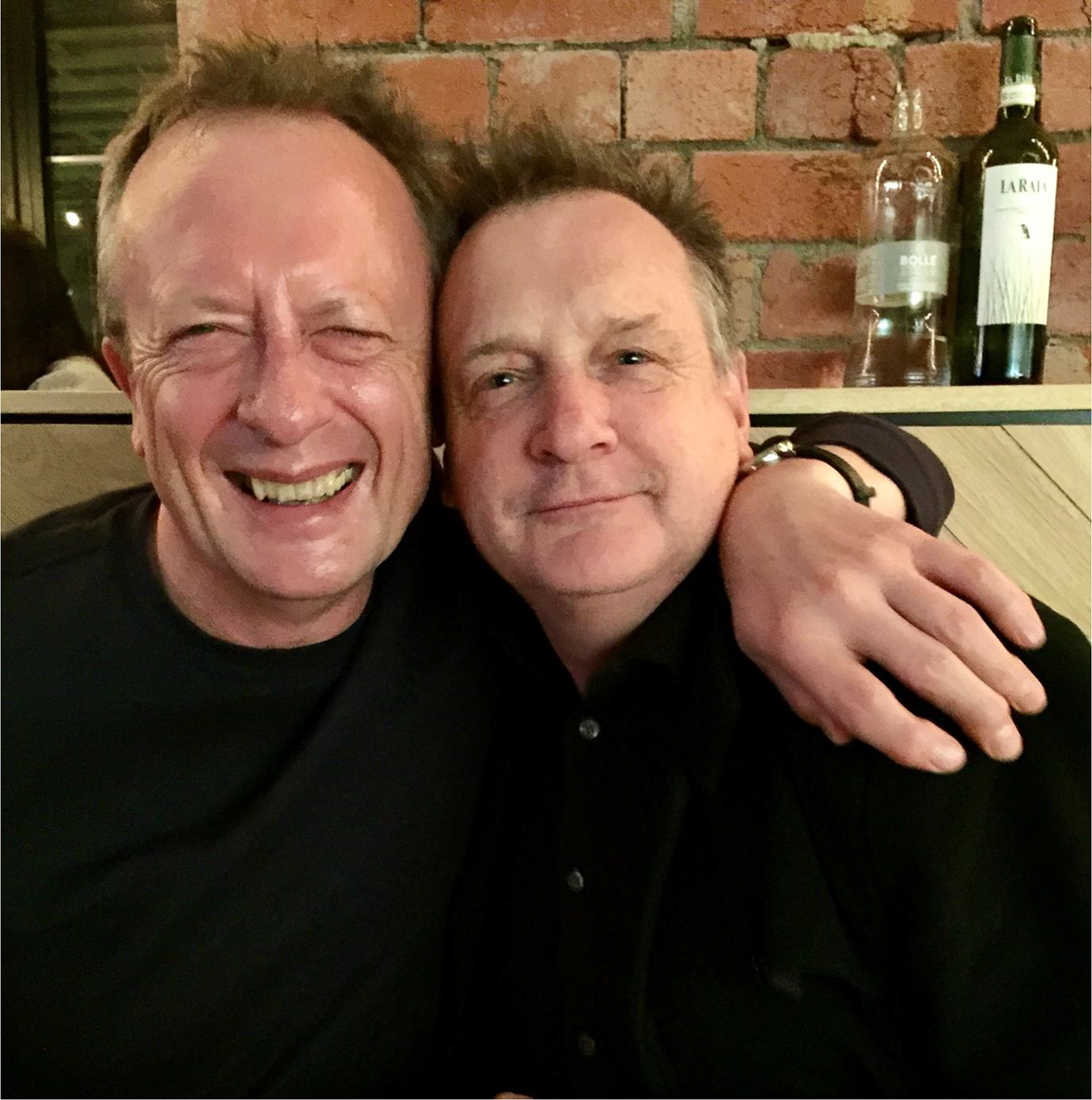
Peter and Neil Fettling, Melbourne, 2015
Footnotes
Declaration of Conflicting Interests
The author declared no potential conflicts of interest with respect to the research, authorship and/or publication of this article.
Funding
The author received no financial support for the research, authorship and/or publication of this article.