



Abstract

Yes, of course, I admired Peter Beilharz long before I came to know and like Peter. Like many of my peers in the 1980s, I knew of him through the journal Thesis Eleven. I was in awe of the rigor and relevance of this journal. I learned a great deal from it, but I was also inspired by it. Here was a journal that included Cornelius Castoriadis, Zygmunt Bauman, Agnes Heller, Alain Touraine and many others, and it was being published in Melbourne, my hometown. The pages of this journal were filled with the work of Australian theorists like Peter Beilharz, Julian Triado, and Alastair Davidson, and John Rundell also wrote with a worldliness and erudition that was breathtaking. I thought to myself: would I ever find a voice that could enter this space? I never dreamt I could be Peter’s friend. He was already in another sphere, at home with the high priests of theory.
The inspiration I drew from Thesis Eleven was neither part of the attitude of subservience and inferiority, nor the anxiety of distance and belatedness that the antipodean cultural theorist Terry Smith (1974) dissected so brilliantly in his essay on the provincialism problem. It was more to do with the antinomies in my own relationship to knowledge. My Greek heritage placed me close to the foundational thinkers of western knowledge. My education in the 1980s injected a negative disposition towards the dead white men of theory. My parents put the love of learning above all else, but as an immigrant child I was expected to get a good job, like a lawyer. When I mentioned art and philosophy, my mother would say, ‘That is for rich people, or maybe your child.’ How could I ever bridge such distant worlds?
In the early 1990s I started teaching in the Department of Sociology at the University of Manchester. My tenure coincided with the arrival and departure of Eric Cantona at Manchester United and the re-opening of the Hacienda nightclub. It was a glorious era of soccer, music, and social theory. At that time, I was writing book reviews for Sociology: The Journal of the British Sociological Association. I had written one on the brilliant theorist of liquid modernity, Zygmunt Bauman, and another on the poetry and art writings by the legendary Jimmie Durham. Then, I was asked to review Between Totalitarianism and Post-Modernity: A Thesis 11 Reader, which was edited by Peter Beilharz and John Rundell (1992). I began by declaring that Thesis Eleven was one of the most important journals in social theory. I celebrated the possibility of grievous and clear-sighted views of our contemporary condition that could come from the periphery. It is in the periphery that there is more space for the syncretic and contrapuntal perspectives that are necessary for our era. I expressed my gratitude for the pioneering role of the journal in bringing critical theory and Marxism to face contemporary challenges in politics and culture. However, I also questioned the claims that modernity was elastic and that post-modernity a mere chimera.
While I disagreed with some of the focus and pointed out the need to further explore the role of camera culture and the intersections between sexual and cultural identity, I was most impressed with the tone of curiosity and future-oriented momentum of The Reader. This volume was not determined to bolster its own authoritative grip on knowledge. Unlike many other readers, it was also not just a survey of past highpoints. It was responding to the current crises with optimism and searching for seeds of renewal and resistance. I liked this affirmative and confident stance. It was the opposite of hollow revolutionary rhetoric and the smug claims about the end of history.
This affirmative tone was even more evident in a much later book in which Peter reflected on Australia and noted that: the 20th-century reforms to welfarist agenda, innovations to legal institutions and experiments in cultural identity were of such a scale that he could proudly speak of an antipodean civilization (Beilharz, 2015). I will come back to this content, but I simply highlight for now his affirmative disposition.
Somehow, Peter spotted my review. He wrote me a beautiful and thoughtful letter. It was a time when there were more letters in my pigeonhole than emails in my inbox. His response was encouraging. He made me feel welcome. As if I was now part of a wider conversation.
Peter thought that journals, seminars, and conferences were instances of a ‘little public sphere’. I had already worked on a number of journals by the time I began my career at Manchester. I also saw them as a space where strangers encounter each other and through dialogue produce some form of exchange and mutual understanding – cultural traffic, as Peter himself would characterize such a space. The raw matter of this little public sphere is the democratic right to give voice to one’s belief and the cosmopolitan principles of curiosity and respect for the other. Today we are aware of the fragmentation and commercialization of public spaces. There has been a steady erosion of the available spaces for public debate. However, there was already a proliferation in the media with which private views could be made public.
I also felt that Peter’s letter was an invitation. I started to think that maybe we could be friends, one day.
Before saying more about Peter, let me say something about another writer whom I also had not met at that point in my life. Like with Peter, I had felt a deep sense of affinity, one that had been achieved without a physical meeting. The possibility of this kind of connection makes me want to reflect on friendship.
I turn to Michel de Montaigne (1533–92), the French Renaissance philosopher and pioneer of the essay as a literary genre. At the age of 37, Montaigne retired to his father’s castle where he dedicated himself to reading and writing. He was inspired by the writings of his contemporary, Lipsius, and often cited him with deep admiration. The range of topics that Montaigne covered in his writing is astounding. It ranged from philosophical ruminations on solitude and elaborations on Lucretius’s cosmology to a critique of the presumed superiority of European civilization over the Barbarians. Montaigne’s style was a mixture of skeptical tolerance and open-mindedness. He considered himself to be devout but not dogmatic. His modest, candid, and reflexive tone could not be further from puritanism. He had no problems confessing to erectile dysfunction and promoted a pluralist attitude of co-existence with others.
Montaigne extended the humanist tradition by constantly challenging both the nasty prejudices towards other customs and the boastful overrating of provincial culture. He enjoyed mocking the insular mindset and myopic vision that confined its reference point to the ‘length of our noses’. Having served as a negotiator for the moderate King Henry of Navarre, he had witnessed the horrors of the religious wars in Europe and concluded that the law is not a distillation of universal reason but, at best, a means to temper the brutal outbursts of human nature. His travel took him as far as Rome, but he read widely and enjoyed the reports on distant cultures. Accounts of the passions and cults that his peers dismissed with prudish disdain were for him a source of serious fascination. To him the sensory calls of the body were not confined to a scream of shame, and no culture had a monopoly over reason. Montaigne was no idealist, but he was deeply attuned to the power of the imagination and appreciative of the positive influence of others.
Montaigne’s celebrated essay on friendship was, in my mind, also an allegory on cosmopolitanism. He began by recalling Aristotle’s habitual phrase: ‘oh my friends, there is no friend!’ (Montaigne, 1958: 91). However, for Montaigne, while friendship was not an unrealizable ideal, he also insisted that it was neither the product of pragmatic mutual benefit nor the result of genuine kindness. Rather, it emerged through a rare and robust quest for understanding. In everyday scenes, we can anticipate what our friend would like to hear, but we also know that while a ‘white lie’ may console his pain, it also flatters his vanity. For Montaigne, the expression of friendship neither yields to the comfort of mutual assurance nor entraps the imagination to a cozy bubble. He claimed that friendship was more subversive and abrasive than politeness.
Montaigne’s own model for the ideal of friendship was the humanist scholar La Boetie. When they first met, Montaigne was a magistrate and La Boetie an older judge. Their friendship only lasted five years. It ended with La Boetie’s premature death. From the first instant, Montaigne claims that they became ‘as one’. A mirroring and an ineffable extension of souls that produced one of the most emphatic declarations of love in the history of letters: ‘If I were to say why I love him, I feel that my only reply could be, because it was he, because it was I’ (Montaigne, 1958: 92) Friendship, he would say, can make you feel ‘complete and perfect’ (Montaigne, 1958: 93). However, it is also the ‘hardest thing in the world to find’ (Montaigne, 1958: 93). For Montaigne, recognition of friendship is spontaneous, and the function of the friend is to complete the lack that was inside him. Once friends are together, the bond is total. When his friend died, Montaigne felt utterly abandoned. He lost his appetite for the things he loved and found himself to be ‘no more than half a man’ (Montaigne, 1958: 94). Towards the end of his life, a young woman named Marie de Gournay expressed a deep affection for his writing. She became his adopted daughter. In their love, Montaigne finally discovered that friendship is not only masculine. The point of Montaigne’s essay is that the encounter between friends opens the self to the world and the cosmos.
The humanism that transpires from Montaigne’s writing is a textual analog to the paintings of the Renaissance and Baroque. The body and the soul, the sensory and the rational are not set up in a recriminatory binary. Montaigne’s philosophical outlook was influenced by his study of the writings by the Stoic philosopher Epicurus and the recent re-discovery of the atomist theories of Lucretius. Montaigne was a cultivated aristocrat, but his disposition and his worldview was far from the ‘presumptuous dogmatism’ of the Enlightenment era (Toulmin, 1990) and closer to the peasant values that survived on the fringes of Europe. My parents were peasants in Greece. The folkloric wisdom that they embodied contained an amalgam of traces that traversed the paganism of Antiquity, Christian Orthodoxy, and Ottoman pragmatism.
I returned to Australia in 2000 and slowly I got closer to Peter. As part of the symposium at the Adelaide Festival in 2010, I invited him to be a respondent to the lecture presented by the Mexican curator Cuauhtemoc Medina. During this trip to Adelaide, I introduced him to the photographer and writer Ian North. They instantly became friends. Or as Peter would say, ‘old chums’. They would visit each other, and Peter took inspiration from Ian’s art. In particular, he was drawn to Seasons, Australia, Kongouro (North, 1987), an image that combined chromogenic photography and acrylic painting to depict the talismanic animal as if it were a hybrid creature – mouse mixed up with fox, and conveyed the stunning force of light that makes the horizon shimmer, while juxtaposing the colonial with the modern visions of the landscape. The image is in four parts, or it could be read as four images arranged as a cross window, or as four panels on a flag. Inside each frame is a second image with a giant kangaroo perched on a rock. Its neck is full rotation, surveying the tough landscape behind – this rotation of the neck is something that a dingo can also do but no other dog can. The title is: Seasons, Australia, Kongouro, incidentally, this spelling mimicking the exact way my parents pronounce it. Seasons: all four of them, captures the mysterious fluctuations of light, which, with its unique hemispheric hues, baffled the early European painters, and in this post-Fred Williams and Papunya Tula painting period is still a subject of inexhaustible fascination. There is also the subtle contrast between the ridge of mountains, whose peaks appear to be sanded down to a bumpy contour, and a snake-bend road. The road is a scar, but it seems temporary rather than as a definitive conquest over the land. Finally, there is the question of perspective. From where does the viewer gain a vantage point? High up on another mountain – this would be in keeping with the picturesque European panoramic optic, but then this God’s eye viewpoint is disrupted with the multiplication of inlaid panels. There are as many focal points as there are panels and, despite this interplay, the horizon recurs as a continuous line.
These four themes in the cover image: Kangaroo – the hybrid creature, mouse mixed up with foxes; light – a mysterious force that stuns the eyes; geography/ontology – a land without frontiers; and optics – the problem of perspective, these are also the major themes that run through Peter’s reflection on the antipodes. Peter saw this artwork as part of a step away from Eurocentric thinking and an expressive feature of the self-constitution of the culture from the South. At this stage Peter was deep into his project on antipodean civilization, which he insisted was not confined to reclaiming symbolic territory, but rather it was the outline of modality: ‘thinking the antipodes was a matter of relationships rather than place’ (Beilharz, 2015: 135).
As Peter is only painfully aware, the imaginary of an Antipodean civilization is nothing without its own institutions. Civilization is about the whole of the lifeworld. Neither is civilization an achievement that is confined to elites, nor a quality that is passed on without effort. It is a more fundamental and organizational activity. It is how we order our values, direct our attention, and shape our actions. The organization of symbols, perspectives, and activities through institutions is the action of cosmos – that is, the process of making its space attractive to the other. For Peter, antipodes is a term that carries both the colonial scars and hopes of the settler – it denotes that our feet are in the opposite end, that we have somehow landed ‘arse-up’, our head is in one place – groping for metropolitan approval, but our bodies grounded down into the bottom of the world, struggling to reconcile tensions and often making unexpected discoveries. Peter takes this term, twists it to fit into the shifting viewpoints that were formed in this continent. His aim is not just to redeem the settler in their ambition to be as good – an equal to those in the metropolis, but to demonstrate that from this position, the game can start again and, in this rupture, there can be a sudden elevation in purpose, a wider inclusion of participants, and thereby a new order can emerge. Peter had found a powerful precursor to his own ideas in the path-breaking work of the Australian art historian Bernard Smith (Beilharz, 1997).
Finally, I want to say a few words about how I see Peter as a mentor – who helped me bridge the antinomies in my world, and my experience of him as a friend. Peter is a teacher, editor, and author. These three roles should be complementary, but the recent corruption of the former, and the frequent excessiveness in the ego of the latter, tends to make this trinity an unstable, incompatible, and rare entity. As an author, Peter is authoritative but not imperious, he brings to this role the attributes more commonly associated with the art of teaching and editing – a care for the other, and attention to the rhythms of the voice that comes through their work. This requires modesty, generosity, and tolerance – but it does not make him a sucker!
For a modest man, Peter tackles big themes. At its widest point, he tackles the current condition of global culture and cosmopolitanism. He introduces a series of lenses that can bring a distinctive focus to this vast quest. Hence, he puts before us, not necessarily in descending order, the category of Australasian Civilization, Antipodean, Australian, and even a new locale – the guy who lives above Nandos, but not just any fried chicken shop, it is the one on the corner of Hosier Lane and Flinders Street.
As one of Peter’s teachers, Zygmunt Bauman, cautioned: isn’t this quest to define a distinctive Australian–Australasian–Civilization a universal project? This is a probing and far-reaching question. I suspect that it can only be answered in a contradictory way: yes, it is a universal project, but it is always undertaken from a distinctive landscape: location and history, and this point of departure will ‘possibly’ produce a unique trajectory and a difference in perspective – a hybrid viewpoint. Affirming the universality of this quest can therefore only proceed from the particularity of the points of departure, and the latter will render the horizon of universalism both visible and remote.
Peter has a great deal to say about the markers of our civilizational outlook and how they were formed in the 19th and 20th centuries. First of all, we should acknowledge that for Peter a civilizational claim is not a hierarchical objective. It does not refer to any snobbish notion of aesthetic refinement, genealogical superiority, or teleological progress. Civilization is about the whole of the lifeworld, not just our weekend latte lifestyle. Neither is civilization an achievement that is confined to elites, nor a quality that is passed on without effort. It is a more fundamental and organizational activity. It is how we order our values, direct our attention, and shape our actions. These symbols, perspectives, and activities are neither random nor fixed. Because a civilization organizes its polis through the action of cosmos – that is, the process of making its space attractive to the other – this dynamic is one that is attuned to encounters and exchanges. There is a bogus claim that when rival civilizations meet that they will invariably clash, and one will die. This may be the destiny of bogans and barbarians but, when civilizations interact, they do so because there is a preceding idea and desire for dialogue.
But what are the symbols, perspectives, and trajectories of our civilization? Peter’s answers are, on the one hand, typical of a sociologist. He displays his ambivalence, outlining the uneasy balance between historical achievements and their contemporary viability; and, on the other hand, he sustains an optimistic up-beat, one that is now almost inaudible among the usual parade of problems and paradoxes in sociology.
What are the Australian institutions that embody an Antipodean imaginary, and can they offer to the citizens of the world an Australian civilization? The institutions that hold his attention are: The socio-economic experiments in arbitration and protection – the prioritizing of a decent lifeworld for the workers as opposed to unfettered opportunity for capital. The socio-political innovations that brought migrants into the arena as agents of change. The legal-cultural innovations that sought to reverse the doctrines of terra nullius.
In all these observations Peter is spot on. Despite our much-fancied self-image as larrikin rule breakers, ‘Australians are institution builders’ (Beilharz, 2015: 38). These institutional transformations could not have appeared if our cultural outlook had not favored the ‘middling standard’ (Beilharz, 2015: 24), a deep-seated pragmatism that demands an egalitarian outlook on civility. Therefore, we are ‘children of Sisyphus rather than Prometheus’, forever climbing, struggling, returning to well-trodden paths, rather than a thief who steals the secret of divine power, supposedly for the benefit of humanity. And yet, his much-admired thinkers have that kind of Promethean glint and hunger; as in true tragic form, they are also often cut and tied down.
Perhaps Peter is also a mixture of Sisyphus and Prometheus. He has the quality of tenacity – to hold on to difficult problems and keep putting his finger into the fire of old wounds. This incessant – returning because there is real work to be done, rather than obsessive – repeating because they are compelled by a psychic drive to insist – this task is expressive of a civilizational task of excavation and renewal. Peter sees this task in both negative and positive terms. It brings forth something new into the world, and it is a consequence of an existential unhappiness. Of course, indignation with the status quo is the best trigger for change.
Thus, we all owe Anthony Blunt a huge debt when he rebuked the young Bernard Smith for seeking to embark on a non-existent research agenda. What?! Art and Australia?! Clearly an oxymoron! Nothing fires the indignant imagination more than the authoritarian blind spot. A few generations later, I experienced the same spur. Anthony Giddens, in a less supercilious but equally dismissive chuckle, provided it when he heard my outline for a doctoral dissertation at Cambridge and scoffed at the suggestion that social theory had any lessons to draw from the migrant stories in Melbourne.
This takes us back to Bernard Smith, Terry Smith, and the provincial problem. They both observed the emergence of new forms in the periphery; and they have both tried a little too hard to report on it back in the old hierarchies and categories of the center. By getting it wrong, or being late, they made something new in the world. I am not comfortable with this observation. It makes too much of a virtue of naivety. In short, their method of critique is not as hybrid, as the hybridity that both Bernard and Terry observed in their subject.
I have made this complaint before. It was over 31 years ago, so now I really feel like a child of Sisyphus. So let me end on another bitter-sweet observation: Peter recalls the experience of being asked simple questions about Australia from his super-smart Harvard students. In his typical manner, he averts the condescending reflex and turns to confront the deeper gaps in his own knowledge. This declaration is not presented to us as a kind of false modesty that is soon overtaken by the display of superior knowledge. On the contrary, it surfaces as another symptom of the ‘unhappiness’ that he seeks to dissect; it is a symptom that may arise from a philosophic melancholic disposition, maybe, or it comes out of a cultural condition – the gaps are just there, and no amount of knowledge will close them up, and, from this awareness, comes a creeping loneliness.
We thought we were living in the lucky country, that one could start from the antipodes and reach for the skies, that this place was as good a place as any for making a new world. But the globalizing world has done little to unshackle some of the old politics of provincialism. Perhaps one of the problems of our Antipodean perspective is that it has not become sufficiently connected to the new traffic networks that formed across the South. Today, the reconfiguration of global–local, North–South binaries is occurring in South–South exchanges. In Peter and throughout all his work, there is a distinctive agency, one of creativity and discipline. He is an exponent of an Australasian civilization.
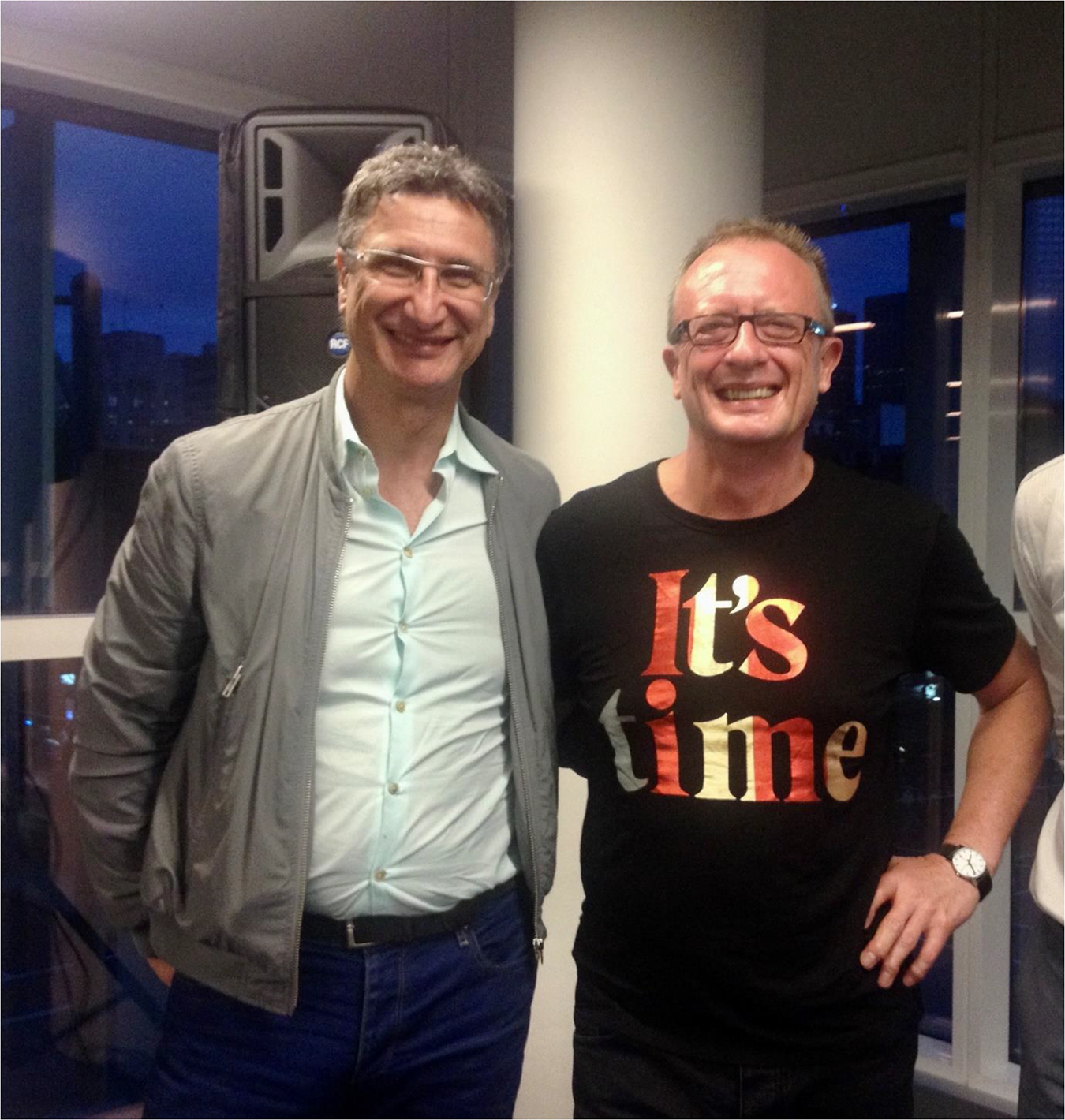
Peter and Nikos Papastergiardis at launch of Thinking the Antipodes, Melbourne, 2015
Footnotes
Funding
The author received no financial support for the research, authorship and/or publication of this article.