



Abstract
Late modern existence is built around ambivalences: subjects experience the structural paradoxes of global capitalism or information society as social suffering; yet they follow behaviour patterns reinforcing the unsustainable trajectories. The article explores the discourses justifying such structural paradoxes, while normalizing the related suffering. First, the pragmatic theory of justification (Boltanski, Thévenot) is reinterpreted from a modernization theoretical perspective: a distinction is drawn between traditional, classic and late modern ‘tests’, ‘critique’ and ‘cités’. In the second and third sections, the gradual emptying of critique is analysed: as disillusionment reaches the sphere of subjective experiences, not even personal suffering can ground critique any more (Berlant), thus the impossibility of critique is demonstrated in a cynical manner (Sloterdijk). In the fourth section, the various cynical modalities of justification fitting the ambivalent contemporary existence are overviewed. Finally, a way out from the naturalized, quotidian cynicism is sketched: by turning cynicism’s logic against itself, the dialectics of justification can move forward.
Modernization moves on an unsustainable trajectory. The threat of climate catastrophe or the social and humanitarian crises related to global capitalism are exemplary indicators of a paradox historical track resulting in widely experienced social suffering. Although, late modern subjects might be aware of diagnoses of times connecting the structural paradoxes with their personal experiences of suffering, they still tend to follow behaviour patterns reinforcing the unsustainable trajectories. One of the fundamental challenges of late modernity is the emptying of critique: even if subjects are ‘enlightened’ about the self-destructive consequences of their everyday praxes, they still cannot stop them (Berlant, 2011). Despite the alienation and the apocalyptic prospects, they rely on various strategies of escapism instead of emancipatory praxes (Skotnicki and Nielsen, 2021). This phenomenon cannot be explained exclusively on a psychological basis (by referring to individual cognitive limitations, helplessness, ignorance or irresponsibility – e.g. Jost, 2020), neither on a structuralist basis (by referring to material or discursive constraints – e.g. Bourdieu, 1984). Instead, those mechanisms need to be explored, which justify the structural paradoxes and normalize the fundamental ambivalence of late modern existence.
For this purpose, an appropriate theoretical framework is needed – one, which focuses on the reflective justification potential of the actors, without psychological or structural reductionism. The pragmatic sociology of Boltanski and Thévenot (2006) does just that: with its help, an attempt can made to describe how the actors justify the paradox structures of late modernity. In the first section, various ‘economies of worth’ are overviewed from a modernization theoretical perspective. Such analysis reveals the latent dialectics of those ‘tests’ (truth, reality, existential) and ‘bases of critique’ (authority, rationality, subjectivity), which define premodern (domestic), classic modern (market, industrial, civic) and late modern (fame, inspired, project) ‘cités’. It is also revealed that the dialectical transformation of the space of cités is based on the radicalization of critique: ‘paradigm shifts’ occur when the traditional, classic or late modern structural paradoxes cannot be justified any more within the frames of the available tests, so a more radical form of critique becomes timely.
However, such radicalization is not an infinite process: as it is explored in the second section, ultimately it leads to the dissolving of meaningful critique itself. Thus, instead of relying on mutually accepted tests, the actors have no choice but to embrace the impossibility of justification. Yet, the emptying of critique does not lead to the complete giving up on the logic of justification – instead, justification is practised in a disillusioned manner. It is now based on a ‘negative truth’, expressing the necessity of compromise and the inevitable insincerity of existing economies of worth. As it is explained in the third section, from the emptying of critique, a cynical modality of justification is born.
Cynical discourses follow their own historical trajectories (Sloterdijk, 2001). Accordingly, to explore the disillusioned justification of structural paradoxes, the various cynical narrative panels are combined with the justifications defining each cité. Based on a synthesis of Sloterdijk’s and Boltanski’s theory, a hypocritic, a rationalist, a nihilist and a quotidian cynical modality of justification is elaborated in the fourth section. Critical theories, seeking ways out from the impasses of late modernity, must explore alternatives of these cynical justifications. In the last section, a potential way out is introduced: by turning the logic of the expanding, naturalized, quotidian cynicism against itself, the negative truth at its core may also be revealed (and ridiculed). The generalization of cynical truisms proves to be just as untenable as the blind belief in any other values. Although that revelation does not provide a new substantive economy of worth, it still opens a fragile, yet hopeful horizon.
Traditional, classic and late modern economies of worth
Pragmatic sociology is based on the denial of structuralism (Blokker, 2011). 1 While structuralism – originating from the Durkheimian tradition – refers to a singular, comprehensive principle organizing the social life, the starting point of pragmatic sociology is structural pluralism. Instead of a single fundamental principle, several competing principles outline alternative values or economies of worth (Heinich, 2020). As social actors are originally embedded in a multidimensional social space, they cannot be characterized with a homogenous ‘habitus’ or ‘lifeworld’. Being destined to navigate between parallel semantics of worth, they inevitably develop a certain level of critical competence. 2 This helps them to adjust to constellations characterized by inconsistent moral regimes. Owing to their pluralism, economies of worth are given in a contingent, contested form: in every particular situation they may be criticized either from an internal (i.e. based on their own values) or an external (i.e. based on another set of values) perspective. In both cases, the critique reaches out to general concepts of worth, which are summarized by various normative discourses serving as the ultimate ground of justification (Boltanski and Thévenot, 2006: 12).
Although the basis of critique is a generalized set of principles, the way these are applied has various modalities. The first one is called the ‘truth test’, which is based on a quasi-tautological logic: institutional ceremonies based on the legitimacy of customs are responsible for the confirmation of the doubtful values. The second type is the ‘reality test’: if both the criteria of worthiness and the method of evaluation are well defined, then the dissents can be settled empirically by testing the situation according to the normative principles. Unlike in the first case, wherein authority plays a central role, in the second case, actors are entitled to a rational ‘reformist critique’, that is the proving of their position based on standardized procedures. However, in some cases, not even this form of critique is sufficient. If no consensual procedures of the reality test are applicable, the ‘objective’ basis of testing itself is questioned. In this case, an inevitably ‘subjective’ normative basis plays a crucial role, which is expressed in the form of an ‘existential test’. Based on personal experiences such as humiliation, injustice or suffering, the actors may feel that the normative framework based on truth and reality tests is inadequate, so a ‘radical critique’ is needed (Boltanski, 2011: 102–8).
Although Boltanski did not reflect upon these various forms of critique from a modernization theoretical perspective, an attempt can be made to highlight the latent dialectics of critique. Following Giddens’ theory, a differentiation can made between the idealtypical traditional, classic and late modern constellations. In traditional settings, collective memory – reproduced ritually by ‘guardians’ – links the present with the customs of the past. The authorities and normative principles are framed as a timeless, unquestionable, naturalized horizon. Modernization reconfigures this constellation: guardians are replaced by ‘experts’; naturalized eternal truths are replaced by falsifiable, conditional ones. Late modernity concludes this process: expert knowledge – which previously replaced collective memories – also loses its unquestionable authority (Giddens, 1994). The emergence of ‘risk society’ and globalization indicates the beginning of a new constellation: based on their reflective capacities, the everyday actors themselves become entitled to evaluate emerging irreversible risks (Beck, 1992).
From the perspective of this modernization theoretical sketch, the tests and forms of critique can also be reinterpreted. The truth test refers to a traditional modus operandi, wherein the space for lay doubts is minimal, as critique is attributed to institutional authorities. The reality test refers to a classic modern procedure: the corrective logic of reformism is based on expertise capable of providing evidence. The existential test expresses the late modern logic of reflexivity: in the case of radical critique, it is the individual reflection that is the basis of normative evaluations. According to Boltanski, these various tests can be applied in the context of any cités. Yet, taking a closer look at the domestic, market, industrial, civic, fame, inspired and project cités, it may be argued that the probability of using truth, reality and existential tests differs in each case. Such differentiation opens the path not only for the historical classification of various cités, but also for the theorizing about the dialectics of justification.
The domestic cité is based on hierarchies legitimized by chains of lineage and naturalized customs. Within this framework self-evident normative evaluations are applied, such as the respect of the older, the collective and the elite, compared with the new, the individual and the common. Rational argumentation has little to do with tests related to domestic cité: instead, the respectability and trustworthiness of the authority figures provides personal guarantees. The personal interest is subordinated to collective ones: as the attention is centred on the maintenance of the local community or the family, the rituals and customs are respected as self-evident values (Boltanski and Thévenot, 2006: 164–78). When confronting other cités, the domestic justifications may criticize the lack of self-discipline (in the case of the inspired cité), the exhibitionism (fame), the detraditionalized, technocratic technologies of power (civic), the commodification of customs (market), the formalism of mass production (industrial – Boltanski and Thévenot, 2006: 241–7). The domestic cité is explicitly related to traditional values. It exists as a reminiscent of premodern times: while focusing on community ties, customs and naturalized authorities, it devalues the rationalist and individualist elements of modernity. 3 The domestic cité mostly relies on truth tests based on the competence of traditional authorities: as neither objective facts, nor subjective experiences are considered to have significance, critique based on reality and existential tests have only a limited relevance.
Market, industrial and civic cités represent the core values of classic modernity: competition, efficiency and justice. The market cité is organized around a zero-sum competition: the actors are perceived as naturally selfish, only being bound by the contractual rules. The test of worthiness is decided in the competition: the sole basis of justification is the accumulated money (Boltanski and Thévenot, 2006: 193–203). Accordingly, when it comes to critique, the market cité refers to affective bias as an obstacle of purely rational decisions about profitability (in the case of the inspired cité), the bias of embeddedness (domestic), the bias of collective interest (civic), the technological rigidity (industrial), the bias of snobbism (fame). The industrial cité complements the market: it is not based on the logic of financial rationality, but on scientific and technological efficiency. The test of worthiness is organized around predicting natural processes, so the hierarchies are based on expertise (Boltanski and Thévenot, 2006: 203–11). When it comes to criticism, the industrial cité refers to inefficiency, wasting (in the case of the inspired cité), outdatedness (domestic), over-bureaucratization (civic), the neglecting of use value (market). The civic cité is based on the rationalization of the collective: instead of inherited authorities and customs, the legal-contractual mechanisms serve as the basis of justification. Only those norms are valid, which are in accordance with bureaucratic guarantees of equality and solidarity, independently from their traditional embeddedness (Boltanski and Thévenot, 2006: 185–93). When confronting other cités, the civic refers to the irrationality of impulsivity (in the case of the inspired cité), the arbitrariness and injustice of paternalistic traditionalism (domestic), the distortion of general interest by public opinion (fame), the reduction of general interest into individual interest (market) or the technocratic transformation of politics (industrial).
These three cités refer to various aspects of rationality, which is expressed in their uniform strategy of critique. While the domestic relies mainly on the truth test, the market, industrial and civic cités rely mainly on various forms of reality tests. It is not the traditional authority, but the individual expertise, which serves as the basis of critique: everyone is entitled to questioning and providing justifications and there are objective reality-checks (in the form of economic success, scientific proof or legal decision), which can settle the disputes. The market, industrial and civic cités represent a classic modern paradigm of justification, which refuses both the arbitrariness of customs and individual experiences. While these forms of critique were developed mainly in opposition to the traditional paradigm, they also have a blindspot of their own: the strict application of rationality and objective reality tests are insensitive to subjective claims and emotions. The dissatisfaction with such one-sided critique led to alternative forms of justification focusing on existentialist claims.
Although the inspired and fame cités differ on a substantive level, both express a moving away from the purely rationalist discourses of justification, while emphasizing the affective elements of critique. The inspired cité is based on the claim of the individual: it is centred on the desire for an existence enabling creativity, authenticity and the realization of one’s unique potentials. Such claims cannot be tested in an objective manner: only the passion of the subject can prove or falsify them (Boltanski and Thévenot, 2006: 159–64). When it comes to criticism, the inspired cité refers to the dullness of customs (in the case of the domestic cité), the futility of external appeal (fame), the objectifying potential of bureaucracy (civic) and economy (market) or the tyranny of functionalism (industrial). The fame cité is organized around the always changing public opinion as the ‘sole true basis of worth’. Influence, reputation, visibility, attractiveness or charisma are equally the tools of affecting the public opinion. As the disillusioned subjects lose the certainty of traditionally justified or rationally grounded values, testing the worth of things and persons becomes possible only through the measurable public opinion (Boltanski and Thévenot, 2006: 178–85). When it comes to critique, the fame cité refers to the self-delusion of authenticity (in the case of the inspired cité), the secrecy of traditional authority (domestic), the manipulative logic of advertising (market), the elitist escape to the ivory tower of expert language (industrial).
If the market, industrial and civic cités expressed a classic modern paradigm of critique (opposing the traditionalism of the domestic cité), then the inspired and fame cités represent a late modern form of critique (opposing the one-sided objectivism and rationalism of the classic modern ones). The rupture is the clearest in the case of the inspired cité, which claims that the personal experiences and feelings imply a normative basis of their own. The subjective existential test is treated as legitimate as the objective tests of the market, the industrial and the civic spheres. In the case of the fame cité, the concept of public opinion refers to an objectified version of subjective experiences: it approves the justificatory role of subjective reflections, while also trying to give them a quasi-objective sense. Both the inspired and the fame cité are in accordance with the radical criticism related to existential tests. In their eyes, neither traditional institutions, nor the expertise serve as unquestionable bases of justification. The newly entitled individuals may either embrace radical critique by testing existentially the debated issues (inspired cité), or rely on the ‘collective subjectivity’ of public opinion (fame) – nevertheless, both strategies express the disillusionment of the classic modern paradigms of justification.
The project cité based on the value of activity can be understood as the further extension of these late modern tendencies. 4 Its substantive goal is of secondary importance compared with the imperative of avoiding idleness. Activity may equally involve the cultivation of the self, the working on projects or the establishing of new relations. Doing projects for the sake of activity implies networking: the multitasking actors engage in parallel interactions, which requires the switching, connecting and disconnecting from diverse social setting. 5 By prioritizing flexibility above any other values, the project cité implies a radical critique towards any substantive cités for being overly rigid (Boltanski and Chiapello, 2005: 103–38). The project cité can be interpreted as the newest expression of the ongoing radicalization of critique. It was called to life by the disillusionment of the ‘old spirit of capitalism’: as the values of competition and social mobility (based on individual efforts) were gradually discredited by the experiences of impossible mobility and growing inequalities, the civic, industrial and market cités lost their appeal. Consequently, they became targeted by an even more radical critique emphasizing the importance of the autonomous-flexible individual. The project cité provides justifications for the disappointed subject (Silber, 2011), who is deprived of the horizon of justice (i.e. meritocratic social mobility). Even if they cannot succeed, they can still find solace in the never-ending immersion in self-fulfilment (Munro and O’Kane, 2022).
The late modern emptying of critique
The modernization theoretical reinterpretation of the various forms of tests, critiques and justifications reveals a latent dialectical trajectory. The modernization dynamics of cités is shaped by interactions between traditional (domestic), classic (market, industrial, civic) and late modern (inspired, fame, project) patterns of justification. The emergence of the reality test did not only enable new substantive normative bases relying on rationality, but also discredited the institutionalized dogmatism relying on the test of truth. Similarly, the emergence of the existential test did not simply result in new normative claims based on subjective experiences, but also discredited the positivist reality tests. Just as the reformist critique changed tradition (which was reconfigured as domestic cité instead of an unquestioned epistemic and social order), the radical critique also reconfigured reason, which resulted in the birth of late modern cités and subjectivities. However, the birth of new tests and cités did not make the previous ones obsolete: instead, mutual criticism took place, which affected both the old and new paradigms of justification. 6
Modernity as an inherently plural era is fundamentally stressed by the intensification and expansion of mutual criticism. Not only do the emerging cités function as new substantive sources of criticism, but their dialectics also implies the radicalization of critique as such. As a general tendency, every cité is weakened by the criticisms coming from the multiplying alternative perspectives, ultimately resulting in their emptying and disillusionment. If a turning point is reached, then critique is further radicalized – even if it also means the further disillusionment of existing justifications. In this sense, the dynamics of modernization – based on the expansion and intensification of critique – outlines a paradox trajectory: the invention of new forms of critique implies the faster erosion of existing and future cités, which threatens with the elimination of meaningful criticism. Not only because actors realize that the newer and newer forms of critique lose their validity at an accelerating pace (so they become disinterested in critique as such), but also because the dialectic of critique cannot continue endlessly. The radicalizing of critique has an endpoint: if both the normative potentials of tradition, rationality and subjective experiences are depleted, then critique dissolves itself.
Boltanski and his colleagues do not reflect upon the modernization trajectory of justification, neither do they investigate the possibility of dissolving the space of critique (Blokker, 2014). 7 Such potential is realized if every available source of critique becomes discredited. Based on the diagnosis of pragmatic sociology, in contemporary societies the final refuge of critique is the existential test, which channels the subjective experiences of the actors to the process of justification. Accordingly, it can be argued that the discrediting of the phenomenological basis of these existential tests indicates the next phase of the dialectics of cités. In what follows, various diagnoses of times are overviewed, which describe the erosion of the basis of radical critique.
The contemporary subjects are exposed to a profound existential ambivalence: despite being aware of the (self-)destructive consequences of their everyday praxes, they still carry on. This attitude of ‘cruel optimism’ expresses the affective structure of late modern, global capitalism: actors are entangled in a ‘double binding’ phenomenological trap (Berlant, 2011: 51). They hope to reach goals of enjoyment or progress (hence the optimism), but the implicated behaviour patterns undermine their success (hence the cruelty). Simply unveiling the trap does not set the actors free: they still insist on good-life fantasies despite the instability and unreliability. However, such self-deception comes with a price: the self gradually transforms in a depressive, dissociative, cynical or overly naive fashion (Berlant, 2011: 2). These existential strategies express the various ways of inhabiting the paradox structures of late modernity. The experience of crisis becomes ordinary, while the actors get used to the related suffering as an inevitable element of existence. Everyday suffering is not framed as a trauma, instead it is incorporated: being exposed to new fantasies of good life, while facing new disappointments (caused by the failure of living up to the expectations) prevents the breaking away from the harmful impacts, thus traps the subject. Owing to this double binding, despite the uninhabitable present, change seems to be an even more frightening possibility (Berlant, 2011: 263). Accordingly, the boundary between unbearable and bearable existence becomes blurred: as suffering is normalized, the subjects lose their phenomenological orientation point, which is also supposed to serve as the basis of radical critique.
This fundamental ambivalence is complemented by further phenomenological contingencies arising in late modernity. The technologies ‘wiring’ the everyday lifeworld (especially the information society) create a rupture on the level of experiencing: the world is not perceived directly, instead sensations are mediated by an expanding technological platform resulting in an ‘augmented’, yet phenomenologically detached reality (Lash, 1999). The social systems based on symbolically generalized communicative mediums imply functionally differentiated semantics, which observe the environment according to their specific perspective. As they gradually expand, the interpretative schemas of the lifeworld are replaced by differentiations based on the principles of efficiency, usefulness or profitability (Habermas, 1987).
Based on these diagnoses, it may be argued that subjective experiencing – as the ultimate source of radical critique – is weakened. The ‘colonization of lifeworld’ and the technological mediation of experiences further expand the space for cruel optimism: because of the discursive and technological mediation, personal experiences become even more contingent, which further reinforces ‘pathological normalcy’ (Fromm, 1991). Consequently, the actors cannot trust their own experiences and feelings any more: they become alienated from their own enjoyment and suffering (Sik, 2021). This results in elementary uncertainty, which undermines the basis of radical critique. As the subjective phenomenological basis of radical critique dissolves, 8 the question concerning the next step in the dialectics of justification becomes central.
From emptied critique to the birth of contemporary cynicism
After the disillusionment of ritualistic truths, the rationally explored reality and even the subjective experiences, there is no obvious platform where the contemporary actors could ground their critical position. However, the lack of substantive basis does not mean that critique is made obsolete. Instead, it may be argued that the substantive critical bases are replaced by ‘negative’ ones (Scott, 2017). 9 From the late modern experience of eroding normative bases, a widespread conviction has emerged, which can be described as a contemporary cynical position. 10 Cynicism is not the denial of justification and critique, it is rather their parasite modality, which twists the existing cités by negative truths (while demonstrating the impossibility of meaningful critique). To evaluate cynicism’s impact on the various regimes of justification, critique and test – the emergence of its most prevalent forms needs to be briefly overviewed.
While the history of cynicism goes back to the ancient Greek world, its generalization is a new phenomenon. Originally the cynic was embedded in a marginalized position: a provocative critique could only exist at the margins of the urban community. It required the liberal environment of the polis to tolerate the cynic’s extreme individualism and moral relativism. In exchange, the cynic helped to secure pluralism by questioning any particularistic moral positions (Sloterdijk, 2001: 3–4). The next historical layer of cynicism is related to court culture: within the space of strategic interactions relying on manipulation and pretending, moral relativism ceased to exist as a marginal position. It expressed a ‘realist’ amoral position (granting survival skills in a world full of deception and lies), replacing the ‘naiveness’ of chivalry and virtue. Later, this court culture expanded to the bourgeois society: those, who did not want to fail, had to accept the relativizing, cynical moral truth of competition (i.e. ‘the end justifies the means’). The cost of success in modern social, market and political spheres (operating outside of the realm of morality) became the loss of ‘innocence’. Owing to these structural factors, cynicism gradually became widespread: the subjects started to view it as a necessary component of modern existence (Sloterdijk, 2001: 5).
The contemporary cynicism is ‘enlightened false consciousness’. It aims at total disillusionment – thus, it cannot produce any substantive truths, only the morally emptied fetishism of survival. The contemporary cynic cannot be further enlightened by ‘critiques of ideology’; they become disillusioned of critique itself (Sloterdijk, 2001: 7). This historical process is constituted of several phases: the ‘unmasking’ of revelation, religious, metaphysical, idealist, moral, natural and private illusions indicate those substantive topics, which were discredited by the critical gaze. However, the expansion of critique did not affect only these substantive spheres: ‘historical telos’ (e.g. the Enlightenment) gradually lost its legitimizing potential; collective actors (e.g. the nation, class, party, intellectuals) are not viewed any more as motors of modernization; the ideologies as bases for emancipation are also discredited (Sloterdijk, 2001: 70).
These transformations affected the discursive-phenomenological level of everyday life as well. Exemplary reconfiguration of role models include de-heroization of bravery (e.g. Hašek’s figure of Švejk replacing the figure of brave soldiers), de-moralization of politics (e.g. Machiavelli’s figure of opportunist prince replacing the figure of the wise and fair monarch), de-romanticization of passion (e.g. Marquis de Sade’ twisted figures relativizing the romantic ideals of desire), de-personalization of suffering (e.g. the biomedical objectifying concept of pain replacing the religious model of meaningful suffering), the de-mystifying of faith (e.g. the church as an institution of governmentality and pastoral technology of power replacing spiritual involvement), the dethronement of rationality (e.g. the methodological relativism replacing positivism – Sloterdijk, 2001: 217–301). Gradually, in the popular culture, the ‘heroism of good’ was replaced by the ‘inevitability of evil’, which reframed moral expectations: the new ‘realism’ is based on expecting unscrupulous selfishness from the others and adjusting to it by similar amorality. The image of public sphere is now based on the presumption of ‘information cynicism’: the press appears as a necessarily manipulative agent serving either political or commercial interest. The social inequalities are naturalized as inevitable hardships of life. As everything and everyone has a price, the possibility of merit is deconstructed: it is not effort and hard work that make success any more, but blind luck (Sloterdijk, 2001: 301–29).
Because subjective experiences cannot function as a basis of radical critique, cynicism is repositioned in late modernity. It starts functioning as a discursive framework enabling the further radicalization of critique – thus, it represents the next step in the dialectics of justification. Cynicism provides narratives and arguments, which do not justify any normative positions, but instead demonstrate the impossibility of justification in various contexts. Discursive patterns varying from de-heroization to the deconstruction of merit do not create alternative values but enable performances of ridiculing. By framing the identification with values of the various cités as a ‘naive’, ‘childish’ devotion, and framing a purely strategic, amoral position as a ‘mature’, ‘realistic’ perspective, cynicism establishes discursive power structures based on a negative truth.
The undermining of any kind of substantive truths (including traditions, expert knowledge or subjective experiences) creates space for attractive truisms. Even if meaningful critique cannot be grounded on such basis, at least its supplement becomes available in the form of relativizing and ridiculing moral orders. Obviously, cynicism cannot create a cité of its own, instead it remains attached to other cités as a parasite modality: it needs the other cités’ values, tests and justifications as a platform, where the impossibility of critique can be demonstrated. 11 Accordingly, cynicism necessarily intertwines with the available justifications: it sacrifices the last normative reserves of critique, so that a reminiscence of critical agency could be maintained. However, while fitting the structural constraints of the ambivalent late modern existence, cynicism also contributes to the reinforcement of the paradox structures causing the ambivalences in the first place. Accordingly, besides understanding the idealtypical cynical modifications of the cités, critical theories must also explore the possibility of overcoming these parasitic discursive modalities.
The cynical modalities of justification
In the case of each cité, a cynical modality can be reconstructed expressing a de-heroized, de-moralized, de-personalized, de-mystified or de-rationalized version of its original values. The emergence of cynical justifications starts in the ‘compromising’ interactions with alternative cités. Despite their substantive core values, cités are far from being unchangeable – thus, compromises belong to their inherent features. As the actors negotiate cooperation, they give up elements of their own claims, while implementing external principles (Boltanski and Thévenot, 2006: 278). However, compromising does not automatically imply cynical disillusionment, only if it becomes an overwhelming structural constraint.
The value of compromise became predominant with the emergence of the project cité, which considers cooperation, flexibility and connectivity as central imperatives of late modern existence. The spreading of the value of compromise affects actors outside the project cité as well. The substantive values in each cité are under pressure due to their rigidity: dogmatic identification with core values is the sign of a blind, ‘immature’ attitude, while a responsible, ‘realist’ attitude is linked to the readiness to give up substantive principles in the name of cooperation. Consequently, the dividing line between a cynical and compromising attitude becomes blurred: not only because the acceptance of complementary values weakens one’s conviction, but also because the continuous interaction with competing values results in an inherently relativist perspective. As the compromising dynamics (originally belonging exclusively to the project cité) gradually spread to other cités (Boltanski and Chiapello, 2005: 273), the ground is prepared for cynicism.
A structural cleavage is born within each cité: that is a distinction between fundamentalist (insisting on the conservation and protection of the core values even at the cost of risking conflict) and compromise-seeker positions (focusing on the adjustment of core values in order to avoid the clash with alternative cités). 12 The former group is in an unambiguous position, as it defends a certain value in a dogmatic way. However, the latter faces a paradox: while contesting the fundamentalists, the compromise-seeker must argue against their own values; while negotiating the representatives of other cités, they must rely on their own values. In this sense, the compromise-seeker is in an inherently ambiguous position, which ambiguity can be handled by the discursive tools provided by cynicism. Cynical semantics enable the actors to remain within a cité, while also self-distancing from it: by relativizing the core values in the name of ‘mature realism’, the fundamentalist is ridiculed; by instrumentalizing the core values in the debates with other cités, the embeddedness in the original cité remains intact. This way, the cynical modality of justification empties and secures the cités at the same time, while helping the actors’ navigation in an ambiguous discursive position.
In sum, the dialectics of cités (culminating in the ‘export’ of the flexibility values, originally belonging to the project cité) creates a structural pressure of compromising, which results in the spreading of cynical discursive strategies. Cynicism becomes a universal discursive tool not because of a general ‘moral decline’ characterizing postmodernity (Bewes, 1997), or the deterioration of political culture (Goldfarb, 1991: 65), but rather because of structural transformations favouring unconstrained compromise. In the case of each cité, it might be explored how the cynical arguments deconstruct the original justifications, without destroying them. Such analysis requires first the description of the original compromising tendencies; second, the mapping of the internal conflict potential between fundamentalist and compromise-seeker positions; third, overview of the triumphant cynical narratives.
In the case of the domestic cité, the original compromising narratives include the approval of fame as an expertise of creating good public relations; civic legal frames as an opportunity for applying common sense in the political sphere; market as a chance to transform business relationships into informal exchange based on familiarity and trust; industrial cité as an opportunity of developing traditional forms of production based on tacit knowledge and local customs (Boltanski and Thévenot, 2006: 304–17). Within the traditional cité, the internal conflict arises between hard-liner conservatives and progressive reformists: the perspective of influencing other cités and extending the impact of traditions in a cooperative manner is a motivational basis for relativizing the strict dogmas and authorities, which are defended by the fundamentalists. The compromising actors might de-heroize the inherited authorities and values by highlighting the interest behind them, and de-mystify traditions by revealing the absurdities of blind respect, piety or dogmatism. At the same time, the compromise-seekers defend traditional customs on a pragmatic basis, while trying to influence other cités. The continuous switching between ridiculing and defending traditions implies a morally emptied strategic perspective: as the truth tests and authority-based justificatory narratives are ridiculed, while also maintained and cultivated (as instruments of external and internal influence), a horizon of hypocrite cynicism is born. 13
In the case of civic, market and industrial cités, the compromising narratives are related to the complementary classic modern cités: the market fits the industrial world, as both aim at creating operational and sellable products in instrumentally rational processes; the civic and industrial are also potential allies, as both are interested in the reproduction of a stable and reliable workforce, which requires the security of social rights and the welfare state (Boltanski and Thévenot, 2006: 325–35). These cités constitute an interrelated semantic universe of mutual approval. However, the rigidity of reality tests and rational justification leaves only limited space for any sort of external compromises: cooperation is imaginable only along the lines of objective mutual interests, which also affects the discursive space of cynicism. The internal conflict between market, civic and industrial fundamentalists and compromise-seekers is centred on the rigidity of each basic value. In each case, a narrow-minded and a more liberal position can be identified: that is, miserliness vs. entrepreneurship, legal dogmatism vs. hermeneutics, technical rigour vs. innovation. The reformists may dethrone the dogmatic rationalism (for being ridiculous misinterpretation of expert knowledge) and de-moralize the related hierarchies (for being pathetic abuses of expert authority). At the same time, they might rely on the supremacy of reason in the interaction with other cités. This ambivalence can be described as a cynicism of instrumental reason: despite seeing the absurdity of its extreme forms, instrumental rationality is used in an expansive manner due to its efficiency. 14 Even if market, civic and industrial rationality leads to paradoxes, the control they provide still validates their application. However, this means that instead of substantive values, their cynical versions are based on the inherently amoral ‘will to power’.
The inspired cité is open to many kinds of complementary values: the domestic authorities are approved as bases of master–pupil relationships; the fame is valued for the similar idol–fan relationships; the civic enables the manifesting of a revolutionary ‘collective genius’; the industrial is seen as an opportunity for inventions transforming the material environment (Boltanski and Thévenot, 2006: 293–304). The fame cité compromises mostly with rationalistic cités: influencing political opinions makes it an ally of the civic world; advertising goods makes it a fit for the market (Boltanski and Thévenot, 2006: 317–25). Within these late modern cités, the internal conflicts arise between idealist defenders of personal authenticity and pragmatic advocates of instrumentalizing subjectivity. Actors in the latter position dispute the authenticity claims of the former, while blaming them with self-romanticizing or self-idealizing misunderstandings. Yet, they still rely on subjective experiences as reference points in existential tests and justifications questioning tradition and rationality. Such a self-contradictory position implies a radical existential emptying: while a hypocritical or rationalist cynics could rely on reasons for instrumentalizing the fundamental values of their cités (e.g. reforming traditions or domination), the relativizing of subjective experiences threatens with total disillusionment. By becoming detached from their personal lifeworld, these actors lose the ability to aspire, which results in the birth of a nihilistic cynicism. 15
In the case of the project cité, the need for compromise does not create internal conflicts, as it is included among the central values. Being flexible – that is relating to substantive values and the self in a distancing and relativist way – is an evident requirement of competent late modern actors seeking self-fulfilment. Accordingly, the experience of switching between various cités, while relating to their values in an instrumentalizing manner comes as a self-evident praxis. Within these frames, cynicism loses its moral stakes: it does not provoke conflicts, and it does not get noticed – instead, it becomes a naturalized, evidently given feature of reality. As the actors internalize its discursive praxes as part of their ‘technology of the self’ (Foucault, 1997), cynicism is finally generalized. Such a de-moralized and naturalized version can be labelled as quotidian cynicism. 16
Conclusive remarks: Overcoming cynical justifications
After overviewing the modernization dynamics of justifications, the late modern emptying of the basis of critique and the emergence of cynical modalities fitting such a disillusioned discursive space, we may return to our initial question: how do late modern subjects inhabit the paradox structures? Table 1 helps to overview the line of thought.
The cynical modalities of justification and their modernization dynamics
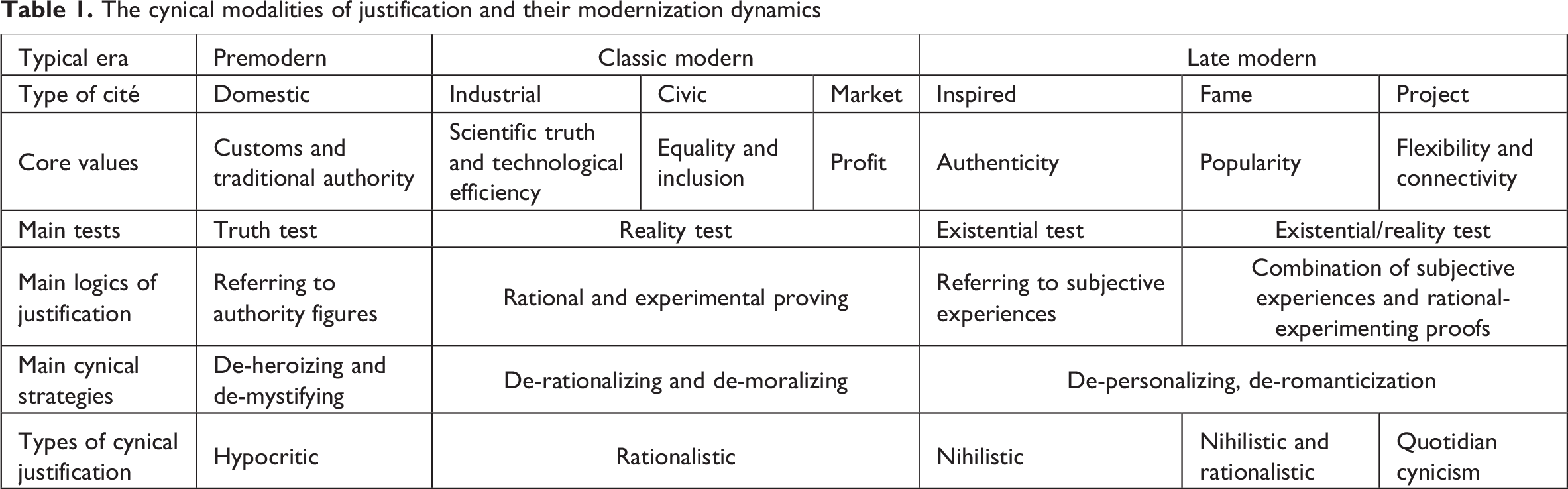
Originally modern justifications were born as discursive tools giving sense to the plural social world. However, contemporary subjects must deal not only with the challenges of contingency originating from plurality and the dissolution of traditional certainties. As the structural paradoxes of instrumental rationalization and global capitalism unfold, they cannot avoid facing their own contribution to the reproduction of the distortions manifesting as social suffering. Identifying with the justifications provided by various cités becomes less and less possible, yet, neither is simply turning against them an option. In such an ambivalent position, not only do particular tests and critiques become discredited, but the very logic of justification as well. Thus, instead of seeking new normative bases, the inadequacy of critique is demonstrated in a way fitting the ambivalent position of contemporary subjects. They adjust to the paradoxes by incorporating self-distancing (i.e. relativizing the core values) and instrumentalism (i.e. representing the core values).
In this context, those previously marginal, cynical discursive strategies become important, which enable the dealing with such ambivalence. Their de-heroizing, de-romanticizing, de-personalizing, de-mystifying and de-rationalizing narratives can be used while dealing with the inner conflicts between hard-line and compromising positions within each cité. Cynical narratives also provide discursive tools for the contemporary subjects trying to deal with existential paradoxes: as certain values are approved and repudiated at the same time, ambivalence is embraced. While nihilism leads to a reduced existential position, quotidian cynicism refers to a naturalized everyday praxis indicating the banalization of a cynical ‘technology of the self’, which routinely deals with late modern ambivalence. At this point, the previously parallel stories of the structural paradoxes of modernization, the justifications answering these challenges and the development of cynical discursive panels interconnect. Cynical modalities of justification become widespread, because they can stabilize the existential ambivalences and the structural paradoxes at the same time.
The reconstruction of this ‘genealogy’ not only helps to better understand the emergence of contemporary cynicism (which is a phenomenological cornerstone of late modern structural paradoxes), but also reveals the potential scenarios of overcoming generalized cynicism. Emancipatory attempts cannot simply return to a previous phase of modernization: they must advance the dialectics of justification to the point where contemporary cynicism dissolves itself. Historically, cynical arguments are based on the relativizing of hegemonic epistemic and moral positions: by revealing their blindspots and limitations, the predominant positions are deprived of the aura of unquestionability; in the case of insisting on that aura, they become ridiculous. Such disillusionment of epistemic truths and moral values not only undermines authorities, but also grounds an instrumentalizing attitude: because the so-called truths and values lose their taken-for-granted status, the subject is authorized to act in a completely unconstrained manner, which includes the right to misuse those truths and values that are still considered to be valid by the unperceptive, naive others. Hence, cynicism opens a path for free experimenting, even in the realm of conventionally amoral action.
To overcome contemporary cynicism, this script needs to be applied on cynicism itself. First, it needs to be shown that even cynical discourses produce their own ‘truths and values’, which can be unmasked as mere truisms. The hypocrite argues that even if tradition is not actually a transcendental dogmatic truth, it still needs to be framed that way, so that the lay people could enjoy the ontological security it provides (inside and outside the domestic realm). The rationalist argues that even if scientifically tested truths are not absolute, they still need to be presented as such, so that the users of technology could control their own environment (while also being controlled). The nihilist argues that existence as such is meaningless, however that does not mean temporary enjoyment (or even hedonism) is impossible, so the subjects should play along. For the quotidian cynic, relativizing and flexibility is the fabric of existence, that is, an evidently given truth not requiring further justification.
However, even these so-called truths of cynicism can be exposed as truisms by revealing their limitations and blindspots. The genealogy of late modern cynicism does just that: it reveals that each version of contemporary cynicism is related to a particular structural constellation, accordingly, it does not express a universal truth, but rather a particular one. It is not universally true that only hypocritical tradition can provide ontological security; that only the fetishism of rationality can provide control; that meaningful life is inherently impossible; that relativizing is a necessity. These are specific answers given to specific structural challenges by actors in specific positions. If they are applied as a universal truth, they turn out to be truisms: that is ridiculous attempts of maintaining an aura of unquestionability despite the evident limitations. 17
Such unveiling and ridiculing of the truisms of contemporary cynicism enables the freedom of instrumentalizing the related discourses in a self-dissolving manner. As the epistemic and moral bases of hypocritical, rational, nihilistic or quotidian cynicism proves to be only relatively valid, the justifications based on them are also freely instrumentalizable. Instead of using these narrative panels for the purpose of inhabiting an existentially ambivalent position (which also contributes to the reproduction of the structural paradoxes), they might be used for experimenting with alternative strategies. By relying on the provided freedom, instead of naturalizing the structural paradoxes, actors might try out ‘absurdities’, such as experimenting with moral responsibility and agency, which can be used for criticizing and shaping the structural environment. They do not have to think of these possibilities as evidently given or justifiable ‘truths and values’, as they lack the tests that could provide such certainty. But being freed from the negative truisms of cynicism, the subjects regain the liberty of turning their ‘disillusioned defeatist’ existence into a ‘disillusioned yet naively hopeful’ one.
That is a horizon, which does not promise any certain solutions to the structural paradoxes, the consequent social suffering or the adjustment to the ambivalences – but it provides a chance to ground an existence, which is not completely, irrevocably hopeless. Of course, this perspective is extremely fragile, as it is not based on any substantive justification, only on the disillusioning of the self-defeatist demonstration of the impossibility of justification – that is the overcoming of cynicism through double-negating. Yet, such a step might be inevitable to start moving away from a structurally unsustainable, existentially futureless dead-end. 18 Based on this fragile horizon, new agencies might flourish, while incorporating the lessons learned from the previous traps of modernization. On the one hand, they do not seek new absolute truths and values in the traditional, material or subjective spheres, instead they relate to the truths and values as conditional, experimental ones (being used in the absence of a better one). On the other hand, they avoid the trap of denying truths and values in a totalizing, cynical way. Even if such a fragile horizon might prove to be insufficient in many situations, it still helps reclaiming and reinforcing freedom and agency. Therefore, its application is indispensable for contemporary actors seeking a way out from the structurally and existentially unsustainable trajectory of modernization.
Footnotes
Declaration of Conflicting Interests
The author declared no potential conflicts of interest with respect to the research, authorship and/or publication of this article.
Funding
The author disclosed receipt of the following financial support for the research, authorship and/or publication of this article: Hungarian Academy of Sciences – Bolyai János Kutatói Ösztöndíj
Notes
Author biography