




Abstract
Little is known about how work schedules affect social connectedness beyond family relationships. The authors use detailed time diary data from 12,140 respondents in the 2008 through 2010 American Time Use Surveys to examine how work schedules affect six forms of community involvement. Results show that night and evening shift work reduces community involvement, but only on weekdays. Daytime shifts reduce community involvement when they are very short, when they involve working from 8 to 5 instead of from 7 to 4, and when they are on weekends. These results call into question tacit assumptions about how shift work affects workers’ social lives.
Due to the neoliberal revolution, the expansion of the service sector (Bell, 1973), and rapid developments in computer and other technologies that support flexible production (Piore & Sabel, 1984), the economy increasingly operates 24 hr a day (Presser, 2003a). One consequence of these changes has been the growth of a variety of labor arrangements that involve work schedules that depart from the standard full-time daytime work schedule (e.g., see Beers, 2000; Kalleberg, 2009; Kalleberg, Reskin, & Hudson, 2000; Presser, 2003a; Wharton & Blair-Loy, 2002; Wight, Raley, & Bianchi, 2008). This trend has occurred in both service and manufacturing sectors (e.g., Mayshar & Halevy, 1997) and is more widespread in low-skilled occupations and those that are dominated by women and minorities (Millward, 2002; Presser, 2003b). Estimates of the prevalence of such nonstandard work arrangements vary widely, depending on how nonstandard is defined, what data are used to measure it, and what period is being examined. Beers (2000) reported that in 1997, 17% of all full-time workers worked outside of the 6:00 a.m. to 6:00 p.m. window. McMenamin (2007) showed that by 2004, 18% of Americans were working primarily in the evening, at night, or on rotating shifts (see also Presser & Ward, 2011). And Presser (1999) noted that, more broadly, by the late 1990s, 71% of American workers either worked a majority of their hours in the evening or at night, worked more or less than 35 to 40 hr per week, or worked on weekends.
The timing of work can have numerous individual-level consequences. Shift workers tend to suffer from more physical and mental health problems, such as anxiety, depression, and lack of sleep (Bianchi & Milkie, 2010; K. D. Davis, Goodman, Pirretti, & Almeida, 2008; Gareis & Barnett, 2002; Hertz & Charlton, 1989; Strazdins, Clements, Korda, Broom, & D’Souza, 2006; Wight et al., 2008). Many scholars are particularly interested in some of the social implications of work schedules. Much of this work focuses on the issue of work–family conflict (e.g., Berg, Kalleberg, & Appelbaum, 2003; Glavin & Schieman, 2012; Wharton & Blair-Loy, 2006). Because rotating schedules and shift work reduce synchrony between workers’ and others’ schedules, nonstandard workers spend less time with family and have more strained familial ties, especially among single or cohabiting parents (Hosking & Western, 2008; Kalil, Ziol-Guest, & Epstein, 2010; Liu, Wang, Keesler, & Schneider, 2011; Presser, 2000; Wight et al., 2008). On the other hand, some scholars have pointed out that shift work can be beneficial in that it allows parents to spend more time with their children during the day (Connelly & Kimmel, 2010; Wight et al., 2008) and gives parents the opportunity to establish a division of labor (via nonoverlapping work shifts) that maximizes the amount of time their children spend with at least one parent in the house (e.g., Lindsay, Maher, & Bardoel, 2009; Liu et al., 2011).
Because most of the research that has been done on the consequences of work schedules has focused on either health or family relationships, little is known about the implications of work schedules for individuals’ more general social connectedness. The community is an expansive domain that intersects with and can complete with work and family domains for workers’ time and energy (Voydanoff, 2007). For many of the same reasons that work schedules affect workers’ family ties, they may also affect individuals’ abilities to form and maintain weaker types of social connections—such as to neighbors and to community organizations. Shift work schedules are poorly synchronized with schedules that are maintained by other members of the community. This can reduce workers’ abilities to maintain connections to their communities. This is an important issue because community involvement provides individuals with a sense of belonging and camaraderie, access to information and resources, and social support (see Wellman & Wortley, 1990; Wilson, 2012). In addition, community ties contribute to community-level social capital, which is crucial for building generalized trust, collective efficacy, and other social resources that benefit the community itself (Paxton, 2007; Putnam, 2000; Sampson, Morenoff, & Earls, 1999). Moreover, some scholars have implied that a lack of community involvement may be one factor that exacerbates shift workers’ strained relationships with their partners and children (see Presser, 2004; Strazdins et al., 2006).
Our goal in this paper is to examine the association between workers’ work schedules and their social connectedness to their communities. We examine nationally representative data on work schedules and the likelihood of various types of social contact from 12,140 working adults’ 24-hr time diaries, collected in the 2008 through 2010 American Time Use Surveys (ATUS). We begin by examining work schedule information to classify workers into work-schedule types, and then we show that this typology significantly predicts individuals’ likelihood of various forms of community social contact. We close by discussing the implications of trends in work for individual social connectedness and community social capital.
Work Schedules and Social Life
Scholars are increasingly interested in the implications of work demands for workers’ social relationships. The vast majority of research on this topic focuses on how work schedules affect workers’ ties to their partners and children. Much research in this vein turns on the issue of work-family conflict (Berg et al., 2003; Parcel, 2006; Wharton & Blair-Loy, 2006). Both work and family require considerable investments of time and energy from individuals, so the obligations of one domain often detract from or spill over into the other. This is evidenced, for example, by the ongoing negotiations that occur within dual-earner couples with regard to coordinating work schedules, the division of household labor, and career-prioritizing decisions (e.g., see Clarkberg & Moen, 2001; Hochschild, 1997; Jacobs & Gerson, 2004; Moen, 2003; Pixley, 2008; Sweet & Moen, 2012).
Research shows that long and tedious work hours can both reduce the time and energy workers have for family commitments and lessen the quality of the time they spend with their families (e.g., Rothbard, 2001; Voydanoff, 2004). Some scholars therefore focus on the relevance of scheduling flexibility to workers’ nonwork relationships. In general, research shows that the ability to control when the workday begins and ends, and to take time off when necessary, helps to reduce overlap between workers’ family and work obligations and thus to sustain workers’ social relationships (Gareis & Barnett, 2002; Golden, 2001; Jacobs & Gerson, 2004; Kelly, Moen, & Tranby, 2011; Tausig & Fenwick, 2001; Voydanoff, 2004; Wharton & Blair-Loy, 2006). At the same time, spillover between work and family is in some cases less likely when individuals have more rigid work schedules, which can prevent work and family roles from blurring (see Ashforth, Kreiner, & Fugate, 2000; Blair-Loy, 2009; Glavin & Schieman, 2012).
Shift Work and Social Relationships
An increasingly important issue, given recent changes in the economy, is shift work—that is, work that occurs primarily in the evening or at night (see Beers, 2000; Kalleberg, 2009; Kalleberg et al., 2000; Presser, 2003a; Wharton & Blair-Loy, 2002; Wight et al., 2008). Shift work often produces asynchrony between workers’ schedules and the schedules of other people, thus constraining opportunities for social contact. This can be understood in terms of broader sociological theories about the prevalence of highly institutionalized calendar practices that are designed to regulate and synchronize social activity throughout the 24-hr day and the 7-day week (Giddens, 1984; Sorokin & Merton, 1937; Zerubavel, 1981).
Scholars have noted that the timing of work—above and beyond the length, irregularity, tedium, or tenuousness of one’s work schedule—has important implications for workers’ social relationships (Bianchi & Milkie, 2010; Connelly & Kimmel, 2010; Kalil et al., 2010; McMenamin, 2007; Presser & Ward, 2011; Wight et al., 2008). Shift workers have less time to contribute to and coordinate childcare in tandem with their partners and less time to enjoy shared activities such as family meals and joint community activities (Craig & Powell, 2011; Fagan, 2001; Heymann & Earle, 2001). Most scholars also agree that full-time shift workers spend less time with their spouses or partners than full-time workers who work standard hours (Wight et al., 2008). Shift workers experience higher rates of work-family conflict and strained relationships with their spouses, which often leads to lower levels of marital happiness, disagreement, and sexual problems (Barnett, Gareis, & Brennan, 2008; Bianchi & Milkie, 2010; K. D. Davis et al., 2008; White & Keith, 1990). This is especially true among cohabiting couples, which tend to have fewer resources and therefore tend to work longer nonstandard shifts (Liu et al., 2011). These problems help to explain why shift workers experience greater risk of relationship dissolution (Kalil et al., 2010). Shift work has spillover effects for offspring as well, resulting in strained parent–child relationships that contribute to children emotional and behavioral problems, poor academic performance, and health problems in children and adolescents (e.g., Han, Miller, & Waldfogel, 2010; Joshi & Bogen, 2007; Strazdins et al., 2006).
At the same time, some studies have found that while mothers who engage in shift work spend less time on typical activities with their children (i.e., helping with homework, eating family meals), they also spend more time with their children overall (Connelly & Kimmel, 2010; Wight et al., 2008). This is partly because evening and night workers have the opportunity to spend time at home during the day when their children are awake. Some research suggests that parents, especially mothers, voluntarily enter nonstandard work arrangements so they can spend more time with their children during the day (Garey, 1999), although many have little choice over the timing of such work (Presser, 2003a). Likewise, some dual-earner couples who work full-time opt for nonoverlapping work shifts, such that one partner works a standard daytime shift and the other works nonstandard hours, which creates a more rigid division of labor for managing childcare and household tasks (Liu et al., 2011; Presser, 1988). Thus, shift work can lead to difficult tradeoffs between important social relationships.
The Importance of Community Ties
While scholars have considered the implications of work schedules for close social relationships, we know little about the implications of work schedules for other types of social ties. Our central argument is that some of the same mechanisms that hamper shift workers’ abilities to maintain family relationships also make it difficult for them to establish (weaker) connections with others in the surrounding community, both in terms of ties with neighbors and to broader community institutions. It is important to consider this possibility for several reasons. Sociologists emphasize numerous benefits of extrafamilial social ties. Most generally, connections to nonkin, such as friends and neighbors, provide access to a wider variety of instrumental support resources, facilitate integration into the broader community, and give rise to a sense of belonging (e.g., see Fischer, 1982; Wellman & Wortley, 1990). Community ties can boost self-esteem and may be self-validating, depending on the type of community activity (e.g., Wilson, 2012). Community ties facilitate access to information about local issues and social norms, and for some groups yield embeddedness in a supportive network (see Portes, 1998). Involvement in community activities helps people cultivate individual social capital as well (e.g., A. E. Davis, Renzulli, & Aldrich, 2006; Mollenhorst, Volker, & Flap, 2008; Prouteau & Wolff, 2008; cf., Van Ingen & Kalmijn, 2010). People who attend informal community events are more familiar with their neighbors and larger social networks overall and are more aware of the resources that are available to them (Molitor, Rossi, Branton, & Field, 2011). Granovetter (1973) showed that weak ties are invaluable for gaining access to distinct social domains and therefore nonredundant sources of information and other resources.
This issue also has implications for the broader community. Social connections among neighbors are crucial for maintaining the capacity for collective action and collective efficacy in general, which plays a role in suppressing crime rates (e.g., Morenoff, Sampson, & Raudenbush, 2001). Connections among community residents are often maintained through local groups, clubs, and other voluntary associations, which help to build generalized trust and social capital (e.g., Paxton, 2007; Putnam, 2000).
Work Schedules and Community Involvement
Our focus on the link between work schedules and community ties extends Voydanoff’s (2007) work–family–community intersection perspective as well as related work on the link between employment and community ties. Consistent with the role overload perspective (e.g., Markham & Bonjean, 1996), research has found that part-time workers are more likely to volunteer work than are full-time workers (cf., Evans, Kunda, & Barley, 2004). At the same time, employment in general, and longer hours, may actually increase community activities such as volunteering by increasing individuals’ integration and investment in the community and reducing their desire to allocate off-hours to work-related activities (e.g., see Devoe & Pfeffer, 2007; Einolf, 2010; Wilson, 2012). Another aspect of work that expectably affects community involvement is self-employment, which increases schedule control and flexibility and therefore increases activities like volunteering (Freeman, 1997).
The timing of work likely has independent effects on workers’ extra-familial social connections. It is reasonable to expect that shift workers—for many of the same reasons that they have more strained family relationships—also have fewer connections to neighbors, voluntary associations, and other community ties. This expectation follows most directly from the fact that shift work schedules are not well synchronized with the schedules of other community members, especially with the majority of other workers who work standard daytime work shifts (e.g., Wight et al., 2008). Because of this asynchrony, people who work in the evening or at night may have fewer opportunities for casual face-to-face contact with neighbors who sleep, work, and socialize on a different clock. Their commutes take them through their neighborhoods, local stores, third places, and other locations in the community at different times, reducing the likelihood of even incidental contacts that can give rise to more sustained and focused social interactions.
This asynchrony also likely affects workers’ more formal ties to community institutions. Because daytime shifts are more common than other types of shifts, formal gatherings (e.g., PTA meetings), business operations, and other activities and events in the community are usually scheduled for the convenience of the majority (i.e., day-shift workers). Stores, restaurants, and other social venues are often closed at night, just as many community activities such as sports events, parties, and fairs are organized around standard workers’ schedules. Thus, people who work nonstandard schedules may have fewer opportunities to participate in formal community activities and organized events. Thus, shift work is detrimental to workers’ community involvement only to the extent that it yields asynchrony between their schedules and the availability of opportunities for community activity.
Research finds that shift work reduces the quality of workers’ leisure time and sleep time (Wight et al., 2008) and increases fatigue (Akerstedt & Wright, 2009). For these reasons, it is also possible that shift workers are less motivated to become involved in community activities, even when given the opportunity. Finally, it is worth considering the implications of the previously mentioned finding that some workers choose shift work so as to achieve an optimal division of labor with their partners for the purpose of maximizing the time available to manage child care and household tasks (Liu et al., 2011; Presser, 1988). This may have the unintended effect of increasing shift workers’ household obligations during the day and thus reducing the time available to them to engage in scheduled community social activities.
On the other hand, it is worth considering that shift work may have some advantages. This possibility is foreshadowed in the just-mentioned research on the benefits of split-shift parenting schedules (Liu et al., 2011; Presser, 1988), in that it suggests the possibility of split-shift neighborly cooperation. People who work in the evening or at night might make convenient contacts for neighbors, for example, to the extent that they can be counted on to do daytime favors such as babysitting, house-sitting, and keeping an eye on the neighborhood when most other people are at work. From this perspective, neighborhoods that comprised a mixture of standard and nonstandard workers may be better off because there are eyes on the street at different times of the day and night. As such, it is difficult to make claims about shift workers being seen as less attractive social contacts within the community.
In sum, there are many factors that reduce nonstandard workers’ opportunities for exposure to community social activities, whether with their family, with friends, or on their own. Thus, we expect that the majority of shift workers enjoy less social interaction with friends and neighbors and are less likely to engage in community activity than workers who work standard daytime shifts. This may occur for a variety of reasons as we have just discussed: because they are constrained by the unaccommodating hours of local community establishments and groups and therefore have fewer opportunities to have such contacts, because they also must work harder to maintain family ties, and because they are more fatigued during the day.
Data and Method
We use time diary data collected by the Bureau of Labor Statistics in the annual ATUS of 2008 to 2010 to assess individuals’ work schedules and community involvement. ATUS collects 24-hr recall diaries from respondents over the telephone, yielding a full account of their activities on the day immediately preceding the interview. ATUS interviewers start by asking respondents about the beginning of the previous day: “So, let’s begin. Yesterday [e.g., Thursday], at 4:00 a.m. What were you doing?” They then work forward through the day, collecting information about (a) what the respondent was doing, (b) the times each activity began and ended, (c) where each activity occurred, and (d) whom the respondent was with. The shortest unit of time reported for any given activity is 5 min, allowing for a maximum of 288 distinct activity reports for a given day. 1
To obtain its samples, the ATUS begins by drawing a random sample of households from those leaving the Current Population Survey (CPS) rotation each month. An eligible person from the household (a civilian who is at least 15 years old) is randomly selected from this household to be interviewed by phone (Bureau of Labor Statistics & U.S. Census Bureau, 2010). The ATUS includes nationally representative data from working adults from a wide variety of backgrounds throughout the country. For consistency with recent research on labor arrangements, we retain only those respondents who are between the ages of 18 and 64 and who are not still in high school (Wight et al., 2008). We also restrict the sample to cases that included at least 2 hr of validly reported nonwork time.
Measuring Community Involvement
Our main goal is to assess how work schedules shape patterns of community involvement. First, we construct a measure of connectedness to neighbors. The ATUS includes information about who was with the respondent at each point on the day in question. Each contact who is named is categorized as one of 20 types (e.g., spouse, neighbor). Our first measure is a dichotomous indicator of whether respondents reported spending any time with a neighbor on the day in question. We also calculate four measures that reflect different community activities. ATUS classifies every activity described by respondents into one of 438 specific activity codes (e.g., walking, exercising). We use these codes to determine whether respondents engaged in each of the following activities: (a) attending or hosting any events or otherwise spending time in another person’s home on the day in question 2 ; (b) volunteering; (c) engaging in recreation such as sports (e.g., playing on a team) or arts and entertainment, while away from home and work; (d) eating or drinking at a restaurant or bar; and (e) engaging in religious or spiritual activities away from home and work or otherwise visiting a place of worship. 3 We create dichotomous indicators for each of these activities. These six measures of community involvement are poorly correlated with each other (α = .239), suggesting that they capture dissimilar forms of social involvement.
Work Schedule Classification
Factors such as hours worked and self-employment can affect community involvement, so we measure how long the respondent worked on the day in question. This alone does not capture the potential for asynchrony between respondents’ work shifts and community activity. Therefore, our main explanatory measure of interest captures when an individual worked on the day in question. We make no a priori assumptions about the proper classification of work schedules (e.g., by classifying all workers as day, evening, or night). Instead, we use optimal matching (OM) analysis (see Abbott, 1995; Aisenbrey & Fasang, 2010; MacIndoe & Abbott, 2004) to compare each worker’s work schedule (composed of a string of 288 indicators per person indicating whether he or she worked during each of the day’s 5-min time slots) to the schedules of every other worker in the data set. We then analyze those comparisons using cluster analysis to identify sets of disproportionately similar schedules. 4
In an OM analysis such as this, two respondents who worked at different times during the course of the day are treated as more distant from each other. This distance is determined using a sequence alignment algorithm that examines whether, at each of the 288 time slots, Person A’s and Person B’s work status (i.e., working or not working) aligned. The algorithm assigns a cost for each slot that does not match, reflecting the idea that one worker would have to change his or her work status at that time to more closely align their schedules. Unlike conventional OM algorithms that assign lower costs to pairs of sequences that may be aligned by inserting or deleting time slots in one of the sequences (e.g., see MacIndoe & Abbott, 2004), we use an algorithm that was designed by Lesnard (2010) to calculate the distance between workday schedules without insertions or deletions. 5 By not inserting or deleting periods, we preserve the 288-period length (i.e., 24 hr) of each sequence, thus ensuring that the OM analysis does not warp the time scale of any sequence (see Corrales-Herrero & Rodríguez-Prado, 2012; Lesnard, 2004, 2010; Martin & Wiggins, 2011).
This algorithm assigns costs wherever corresponding time slots do not align, but it assigns greater costs where this asynchrony is less likely to occur given prevailing work norms at that particular time. For example, two schedules whose only dissimilarity is that Person A worked at 8:00 a.m. whereas Person B did not will cost less to align than two schedules whose only dissimilarity is that A worked at 10:00 p.m. whereas B did not. The greater cost of alignment in the latter case reflects the assumption that it is less likely to see one of those two workers experience a transition in their work status at 10:00 p.m. than it is at 8:00 a.m. Operationally, the determination of the cost that is to be applied for a given substitution involves first assessing the probabilities of the two possible states (work vs. nonwork) at each time point. The observed probability that anyone in the sample transitioned from a given state, W (e.g., work), at time t to another state, N (e.g., nonwork) in the subsequent time point, t + 1, or vice versa, as well as the observed probabilities that these transitions occurred from the preceding time point (i.e., from t − 1 to t), are used to weight the cost of substituting N for W, or vice versa, at time t:

The result of this OM analysis is a matrix of N(N−1)/2 distances, which are then analyzed using the Ward’s linkage algorithm in Stata’s cluster analysis software. Cluster analysis uses the dissimilarity measures to group less dissimilar work schedules into clusters.
Cluster analysis can use more or less liberal thresholds of similarity to group cases together. The goal in this data reduction exercise is to strike a balance between adopting a manageable number of clusters that each have recognizable features and a large enough number of clusters to avoid overly simplistic classifications of work schedules (e.g., day shift vs. other shift). The key question at this stage is how many clusters should be used to classify respondents’ work schedules. Sequence analysts use several criteria to determine an appropriate number of clusters (Aisenbrey & Fasang, 2010). We use the Calinski-Harabasz F-statistic, which reflects the ratio of the distances between cases between clusters to the distances between cases within clusters (see Calinsky & Harabasz, 1974). Higher ratios indicate clearer cluster boundaries. We also inspected dendrograms that display the intergroup distance between clusters for evidence of spikes that indicate that distant clusters must be joined in order to achieve a smaller number of clusters.
Note that because the ATUS diaries cover only a single day, it is impossible to know whether these classifications reflect respondents’ typical work routines (Wight et al., 2008), as work routines are best classified at the week level (see Lesnard & Kan, 2011). As such, this analysis relies on what are perhaps best thought of as person-day observations, which are only crude proxies for individuals’ typical daily schedules and therefore suffer from some measurement error. However, these data do provide some sense of work obligations that are likely to shape opportunities for community involvement on the diary day in question.
Many ATUS respondents were interviewed about weekend days, and many of these respondents worked on those days. We retain both weekday and weekend diaries in our analysis to assess whether work schedules matter the same regardless of the day of the week. However, we conduct analyses separately for the weekday and weekend diaries. We likewise assume that work schedule clusters for these types of interviews are different, and therefore conduct the OM and cluster analyses separately for weekdays and weekends. Nonetheless, using the previously mentioned criteria, we determine that five-cluster solutions provide the best representations of both weekends and weekdays (discussed in greater detail later).
Controls
Descriptions of Variables Used in the Analyses (N = 12,140).

Note. Estimates are weighted to adjust for oversampling, differential nonresponse, sample selection, and to ensure equal representation for each day of the week.
Analysis
The main analyses include the 12,140 respondents who have nonmissing data on all variables. All dependent variables are dichotomous, so logistic regression is appropriate. Analyses adjust for ATUS’s multistage sampling design by utilizing weights and incorporating scrambled pseudo primary sampling unit (PSU) clusters and strata. This analysis is vulnerable to selection bias for several reasons. First, response rates for the annual ATUSs are modest, at an average of around 56% (Abraham, Helms, & Presser, 2009). ATUS therefore supplies individual-level weights that take into account differential nonresponse, which it is able to assess using attributes of the CPS sample from which ATUS respondents are drawn. The analytic sample is also restricted in several ways. We do not consider nonworkers. And because the ATUS collects 1-day diaries, we cannot analyze work schedules of people who usually work but were not working on the day in question (e.g., weekend interviews). To attenuate any selection bias due to these restrictions, we conduct a first-stage logistic regression analysis that predicts whether ATUS respondents ended up in our main analysis (i.e., were in the focal age group, worked on the day in question, and did not have missing data on key variables). The ATUS-supplied person weights are multiplied by the inverse of the predicted probabilities that are derived from this first-stage model. This transformation effectively gives greater weight to respondents who were the least likely to participate in ATUS, thus bringing estimates closer in line with where they likely would have been had some respondents not been eliminated from the analysis (Morgan & Todd, 2008).
Findings
We begin by summarizing findings from the OM and cluster analyses of work schedule sequences for time diaries that were collected on weekdays. Five clusters of weekday work schedules were identified. The nature of the work schedules for respondents in each cluster is displayed in the tempograms in Figure 1, which show the proportion of people in the cluster who were working at given times throughout the day. Of the 8,993 workers who provided weekday diaries, 42.9% fell into the largest work schedule class, which we term 8 -to-5 because most people in this class were at work by 8:00 a.m. and most did not leave until after 5:00 p.m. The second-largest group, which contains 33.3% of respondents, also fits the conventional definition of a daytime shift, but it differs slightly in that it is more aptly described as a 7 -to-4 shift. This provides the opportunity to explore what are usually undetected differences in ties among dayshift workers.
Tempograms showing the proportion of workers who were working at specific time points throughout the day in question for each of the five weekday clusters.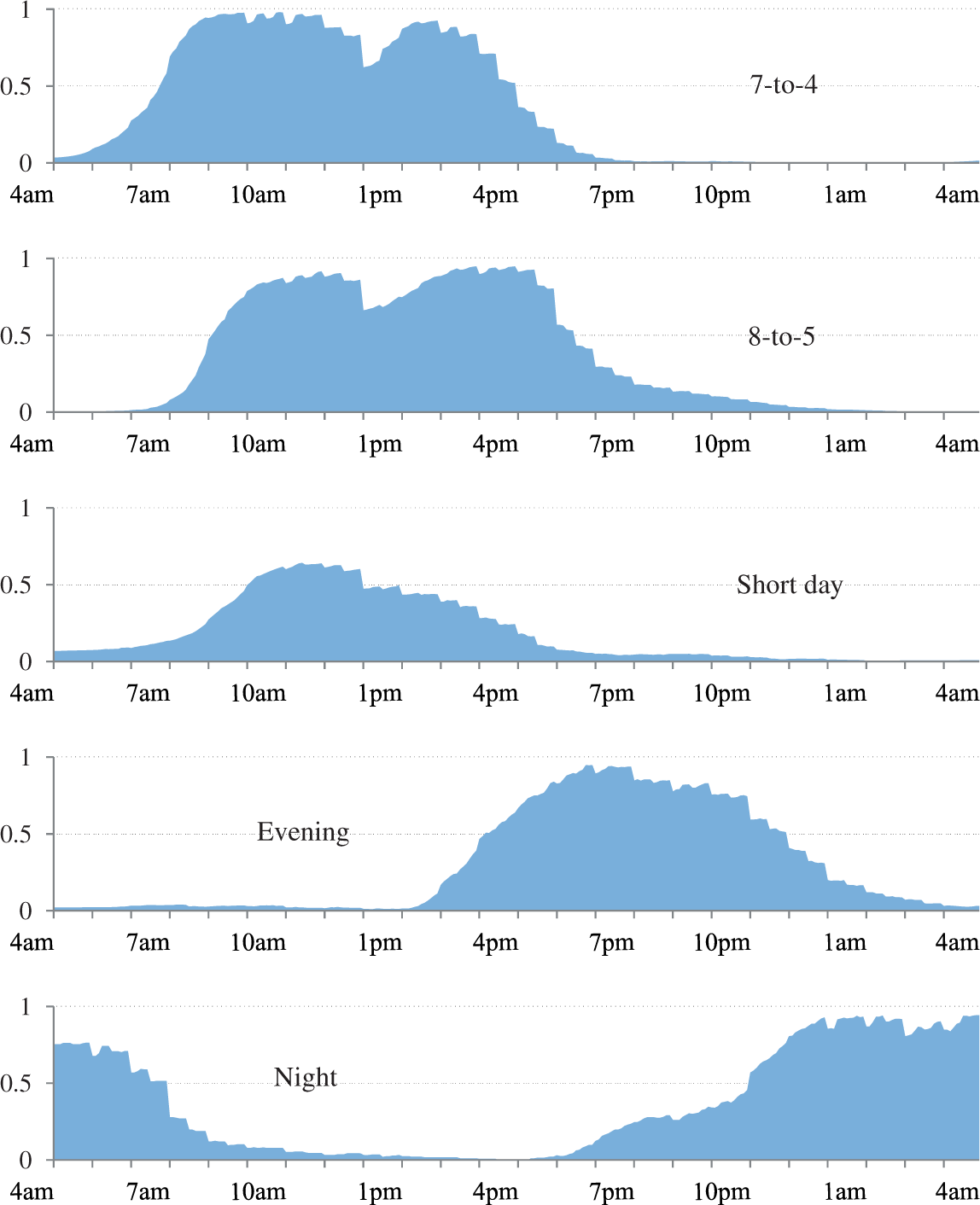
The remaining three work schedule clusters are considerably smaller than the first two. The short shift cluster contains 15.6% of the weekday diary sample, and these workers' schedules typically involved just a few hours of work in the late morning or early afternoon. 7 Finally, there is an evening cluster that is composed of 453 people (5.6% of the sample) who went to work in the late afternoon and clocked out at around 11:00 p.m., and then a smaller cluster of 223 workers (2.7%) who clearly worked the night shift.
Weekday Diaries
Odds Ratios from Logistic Regression Analyses Predicting Several Types of Community Exposure on Weekdays (N = 8,997).

Note. Estimates are weighted to adjust for oversampling, differential nonresponse, sample selection due to work status, and to ensure equal representation for each day of the week. All models account for survey design, and include controls for year, month, day of the week, the number of activities in the respondent's diary, as well as race/ethnicity, and the amount of time the respondent spent in transit on the day in question.
Because information about whom the respondent was with is not collected during certain times (e.g., when R reports doing private activities), this model also includes a control for the total number of minutes for which “with whom” data were validly collected given the respondent's diary.
This row presents an adjusted F-statistic, along with degrees of freedom (df) in the parentheses immediately after.
p < .05. **p < .01. ***p < .001 (two-tailed tests).
Odds Ratios from Logistic Regression Analyses Predicting Several Types of Community Exposure on Weekends (N = 3,143).

Note. Estimates are weighted to adjust for oversampling, differential non-response, sample selection due to work status, and to ensure equal representation for each day of the week. All models account for survey design, and include controls for year, month, day of the week, the number of activities in the respondent's diary, as well as race/ethnicity, and the amount of time the respondent spent in transit on the day in question.
Because information about whom the respondent was with is not collected during certain times (e.g., when R reports doing private activities), this model also includes a control for the total number of minutes for which “with whom” data were validly collected given the respondent's diary.
This row presents an adjusted F-statistic, along with degrees of freedom (df) in the parentheses immediately after.
p < .05. **p < .01. ***p < .001 (two-tailed tests).
A larger number (22%) of respondents attended or hosted a group event or meeting or otherwise spent time at someone else’s home on the day in question. The second column presents odds ratios from the analysis of this aspect of community involvement. Again, whereas neither the amount of time worked nor self-employment status are significant predictors of this form of community involvement, work schedule classification is. In particular, those who worked 8-to-5 shifts were about 81% as likely to attend a group event as those who worked 7-to-4 shifts (95% CI [.70, .93]), and night workers were 58% as likely to attend a group event (95% CI [.38, .88]). Those who worked short shifts or in the evening exhibited no significant differences with respect to this type of community involvement.
A total of 11.3% of respondents engaged in a form of community recreation such as attending a sports event, art exhibit, or live performance. Column 3 of Table 2 shows that time spent working is negatively associated with this outcome, whereas self-employment is marginally positively associated with it. Net of these factors, night-shift workers were only 42% as likely to engage in community recreation as those who worked 7-to-4 shifts (95% CI [.22, .82]). It should be noted also that those who worked short shifts were marginally less likely to engage in recreational activity in the community (OR = .80, 95% CI [.62, 1.04]).
Slightly more people (16.5%) reported going out to eat or for a drink on the day in question. As shown in column 4, those who worked longer hours were less likely to eat in a restaurant, while self-employed workers were more likely to do so. Net of this, evening and night shift workers were significantly less likely than those who work 7-to-4 shifts to eat or drink in a bar or restaurant, net of other controls (OR = .54, 95% CI [.38, .76], and OR = .45, 95% CI [.27, .77], respectively).
Few workers reported volunteering (3.3%) during the week. Working longer hours is negatively associated with the likelihood of volunteering, and self-employed workers were marginally more likely to have volunteered on the day in question. Workers who worked the evening shift were only 26.6% as likely to volunteer as those who worked 7-to-4 shifts (95% CI [.11, .66]). It is worth mentioning that there is marginal evidence that those who worked short shifts and those who worked 8-to-5 shifts were less likely to volunteer (OR = .66, 95% CI [.42, 1.03], and OR = .77, 95% CI [.58, 1.01], respectively). There is no evidence that working the night shift was related to volunteerism.
The last form of community involvement is participation in religious services or attending a place of worship, which was also reported by 3.3% of workers in the weekday sample. Column 6 shows that neither work time nor self-employment status are significant in this model. Net of these factors, work schedule significantly predicts religious participation. Those who worked a short shift were 61.8% as likely to be religiously involved as those who worked 7-to-4 shifts (95% CI [.41, .94]), those who worked 8-to-5 shifts were 73.4% as likely (95% CI [.56, .97]), and those who worked evening shifts were less than half as likely (OR = .46, 95% CI [.23, .93]).
Weekend Diaries
We now turn to the analysis of community activity among respondents who were interviewed about a weekend day and who reported working on that day. About one quarter of those who reported working in the 2008 through 2010 ATUSs provided a weekend diary. The OM analysis reveals five clusters of work schedules among these respondents (see Figure 2). Of the 3,143 respondents who provided weekend diaries that included some work, 29.8% fall into the largest class, which we term morning because most people in this class worked between the hours of 7:00 a.m. and 2:00 p.m. Unlike the respondents who reported work in weekday diaries, a large group (26.3%) of those who reported work in weekend diaries worked very brief shifts in the day or evening. A third cluster consisting of 25.8% of the weekend sample includes people who worked between the hours of 9:00 a.m. and 6:00 p.m. The two remaining clusters were smaller and contained workers who worked relatively long nonstandard shifts. The evening cluster contains 9.7% of workers, and 8.5% of workers were classified as night workers.
Tempograms showing the proportion of workers who were working at specific time points throughout the day in question for each of the five weekend clusters.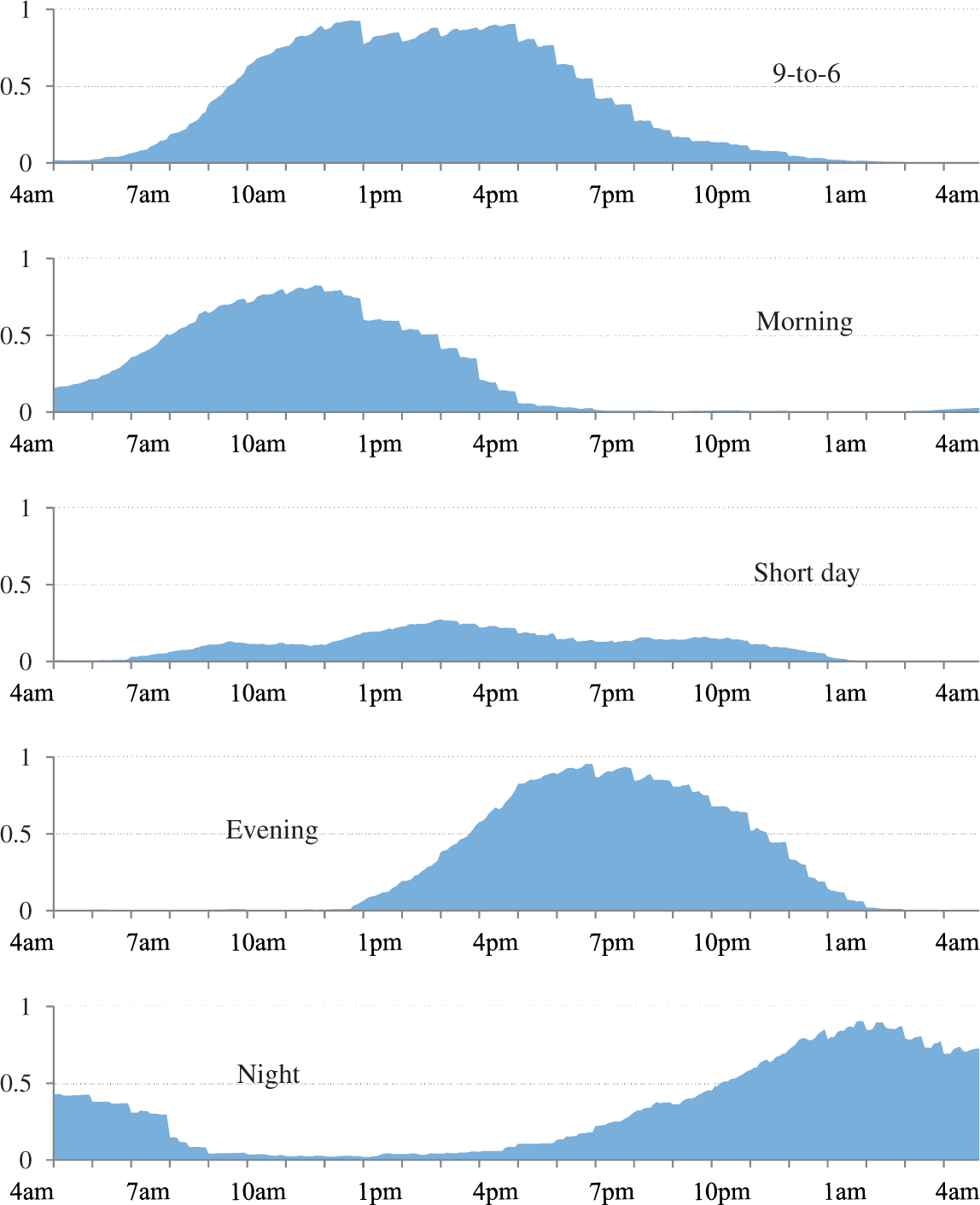
Community activity among these respondents was more prevalent in general than community activity in the weekday diaries. Sustained neighbor contact was still relatively rare, with only 4.0% of weekend workers reporting any. On the other hand, 31.1% of workers in the weekend pool reported attending or hosting a group event or meeting or otherwise spending time at someone else’s home. About 12.8% of workers in the weekend sample engaged in community recreation, and 17.1% ate or drank in a restaurant or bar on the day in question. A smaller number (3.6%) reported volunteering, but a larger percentage (9%) reported attending religious services or a place of worship.
The results of logistic regression analyses predicting the six forms of community involvement in weekend diaries are presented in Table 3. In the first model (column 1), we see that none of the work-related measures are associated with neighbor contact. The second column presents odds ratios from the analysis predicting whether respondents attended or hosted group events. Those who worked longer hours were less involved in the community in this way, whereas self-employed workers were more likely to report his or her type of community activity. Work schedule classification is also significant. Those who worked morning shifts were about 1.40 times as likely to attend a group event as those who worked a 9-to-6 shift (95% CI [1.03, 1.92]), and evening shift workers were only half as likely to attend a group event when compared to the same group (OR = .50, 95% CI [.34, .76]).
Results from the analysis of recreational activity in the community (e.g., attending sports events or live performances) are presented in column 3. Time spent working is negatively associated with this aspect of community exposure, whereas self-employment is marginally positively associated with it. Respondents who worked the 9-to-6 shift generally were less likely to engage in recreational activity. Those who worked a morning shift were 1.87 times as likely to engage in some recreational activity (95% CI [1.21, 2.89]) and those who worked very short shifts were 1.77 times as likely (95% CI [1.01, 3.11]).
Respondents who worked longer hours were less likely to eat in a public place, whereas those who were self-employed were more likely to. The timing of work schedules was not related to this aspect of community involvement. Likewise, few variables are predictive of volunteering on weekends. Of the work-related variables, working longer hours inhibited volunteerism, whereas being self-employed facilitated it. Work shift timing was not related to volunteerism among this set of respondents, however.
Religious participation is the last form of community involvement. Respondents who worked longer hours were significantly less likely to attend religious services. Net of these factors, those who worked in the evening were more than twice as likely to attend religious services as were those who worked the 9-to-6 shift (OR = 2.17, 95% CI [1.24, 3.79]). It is also worth noting that those who worked the night shift were marginally more likely to report religious involvement than were those who worked during the standard day shift (OR = 1.69, 95% CI [.92, 3.08]).
Discussion
Most research on the implications of work schedules for individuals’ social lives has focused primarily on workers’ relationships with their partners and children (e.g., Craig & Powell, 2011; Fagan, 2001; Kalil et al., 2010; Kalleberg, 2009; Presser, 2003a; Strazdins et al., 2006; Wight et al., 2008). Few studies have examined how work schedules affect workers’ ties to the broader community, thus overlooking potentially important effects of nonstandard work on community social capital. Building on research that emphasizes intersections among work, family, and broader community domains (e.g., Voydanoff, 2007), we have argued that the timing of work affects individuals’ capacities to cultivate and maintain ties to the community. We tested these ideas using recent nationally representative data from the 2008 through 2010 American Time Use Studies on 12,140 workers’ reports of daily community-related social activity.
Our analyses show that community involvement is in part a function of the timing of work schedules. An expectable finding in this vein is that, among respondents who were interviewed about weekdays on which they worked, those who worked night and evening shifts reported some of the lowest levels of community involvement on weekdays compared to other people in the sample. This finding is consistent with the ideas that shift work creates asynchrony between workers’ schedules and those of community institutions and residents (Heymann & Earle, 2001) and perhaps increases fatigue and thus decreases motivation among workers (Akerstedt & Wright, 2009; Wight et al., 2008). Moreover, because some workers split shifts with their partners so as to optimize their division of labor within the household and family (Liu et al., 2011; Presser, 1988), evening and night shift workers may have more family and other obligations to attend to at home when they are not at work.
Shift work is not inherently detrimental to community involvement, however. It is only detrimental to the extent that a person’s work schedule produces asynchrony with the community. Night work tends to reduce workers' informal and recreational types of community activity, whereas evening work primarily reduces workers' involvement in more formal activities such as volunteering and religious services. This may be due to the fact that evening workers’ shifts peak precisely during that time of the day when formal community activities (which also often involve community leaders) typically occur—which is after the shifts of daytime workers (Heymann & Earle, 2001). Night workers have the option of reorganizing their nonwork schedules, family time, and other activities (e.g., sleeping) around these events.
The importance of asynchrony is also reflected in the finding that shift work does not reduce community activity on weekends as it is on weekdays. Taking work schedule into account did not even improve the fit of most of the models predicting community involvement in weekend diaries. This may reflect the more varied timing of formal and informal community social events on weekends, which likely attenuates the socially constraining effects of work schedules. If anything, the situation appears to be reversed on weekends, in that weekend respondents who reported working standard daytime shifts reported lower levels of community involvement than others—namely, recreational community activities like attending live performances, as well as religious services attendance.
Other findings suggest that asynchrony plays a role in shaping community involvement even among individuals who work daytime shifts. Among respondents who were interviewed about weekdays, those who worked abbreviated shifts were less involved in the community than those who worked standard shifts. Short-shift workers were less likely to report spending time with their neighbors, to attend religious services, and (marginally) to engage in recreational activities or to volunteer. One explanation is that full-time workers who work longer hours are better paid and thus less prone to think about volunteer time as a loss of potential wages. It is also possible, however, that their lower levels of contact with neighbors is partially due to the fact that short-shift workers’ schedules involve patterns of movement that are out of step with the routines of neighbors, which may limit occasions for incidental contacts that stem from having similar schedules (e.g., commuting or arriving home at the same time).
Similarly, our OM analysis also shows that there is more than one standard day shift. Like Lesnard and Kan’s (2011) analysis of United Kingdom workers’ time diaries, we find multiple clusters of day shift workers within both the weekday and weekend samples. In the case of weekday diaries, we identified one group that goes to work between 7:00 or 8:00 a.m. and leaves work by around 4:00 p.m., and another that goes to work closer to 9:00 a.m. and leaves work by around 5:00 p.m. Even this subtle distinction aids in efforts to understand the social implications of asynchrony between individuals and their communities. Those who go to work on the earlier side of this day shift are significantly more likely to attend group social events or religious services than those who go to work on the later side of it. To be sure, the 8-to-5 shift workers do work slightly longer hours than the 7-to-4 shift, but the difference in community involvement remains after work time is controlled. It is worth noting that those who work on the later side of this standard day shift have the longest commutes of any group of workers, which may be due to their getting more caught up in rush hour. Their involvement in a busier commute does suggest a form of synchrony with a large number of other workers, but it may represent enough of a delay to account for less involvement with certain community events.
These associations between work schedules and community involvement suggest that shift work itself is not the problem—it is the mismatch between shift work and community activity schedules. The asynchrony between workers and their communities is a social construct that is produced by institutionalized calendar practices that regulate activity throughout the 24-hr day and the 7-day week (Giddens, 1984; Sorokin & Merton, 1937; Zerubavel, 1981). In this sense, our findings are consistent with other research that points to the role of asynchrony in reducing contact between workers and their families (Craig & Powell, 2011; Fagan, 2001; Heymann & Earle, 2001; Wight et al., 2008), thus highlighting the need to consider other points of intersection among work, family, and community domains (Voydanoff, 2007).
Conclusion
Our findings have important implications for workers as well as for their families and communities that deserve closer attention. They suggest that, like family relationships, workers’ ties to the broader community are affected by the asynchrony that is associated with some shift work. Community ties are important for the availability of social support (Fischer, 1982; Wellman & Wortley, 1990), psychological well-being and sense of belonging (Wilson, 2012), access to information and other resources (Molitor et al., 2011; Portes, 1998), the capacity for collective action (Morenoff et al., 2001), and other dimensions of social capital (e.g., Prouteau & Wolff, 2008). Future research should address the possibility that community connectedness is one mechanism through which shift work indirectly affects these important outcomes.
It is worth exploring the possibility that work schedules may also indirectly affect workers’ family members’ community ties. Research has already shown that nonstandard workers’ family members experience more psychological strain (fatigue, stress) and other health problems (Bianchi & Milkie, 2010; Han et al., 2010; Joshi & Bogen, 2007; Kalil et al., 2010; Strazdins et al., 2006). Similarly, if workers have difficulty attending local events, their children may also have greater difficulty maintaining connections to the community through such activities as weekly sports team practices and games (see Monk & Folkard, 1992). This is especially likely when nonstandard work arrangements occur in the context of socioeconomic disadvantage, single parenthood, and other circumstances that limit parents’ abilities to accommodate their children’s social lives (e.g., see Millward, 2002; Presser, 2003b).
To the extent that the effect of shift work on community involvement creates other individual and family problems, employers should consider expanding existing flexible work schedule policies to accommodate not only workers’ family obligations (e.g., Golden, 2001; Kelly et al., 2011) but also their community involvement. Flexible policies that encourage workers’ ties to the local community could amount to a significant investment in the surrounding community. A reasonable hypothesis, given the findings presented in this paper, is that the nature of work schedules within certain areas—especially neighborhoods—is related to levels of social capital and cohesion (e.g., Putnam, 2000; Sampson et al., 1999) in those broader areas. Specifically, communities that have a larger share of nonstandard workers may experience lower levels of attendance at community events and less support for local organizations that host such events. The declines in some forms of social capital (and associated public goods, like generalized trust) that have been observed in some communities (e.g., see Putnam, 2000) may be attributable in part to the rise of asynchronous work schedules in the wake of economic restructuring. Given the fact that nonstandard arrangements more commonly ensnare minorities and low-skilled workers (Presser, 2003b), the implications of these developments for the quality of community social institutions in disadvantaged areas should be considered.
Footnotes
Acknowledgments
We thank Cara Costich for providing research assistance, and Michael Corey, Erin York Cornwell, the editor of Work and Occupations, and an anonymous reviewer for providing useful comments and suggestions as the paper progressed.
Declaration of Conflicting Interests
The author(s) declared no potential conflicts of interest with respect to the research, authorship, and/or publication of this article.
Funding
The author(s) received no financial support for the research, authorship, and/or publication of this article.