




Abstract
Although well theorized at the individual level, previous research has neglected the role of national context in shaping overall levels of nonwork–work and work–nonwork interference. This study fills this gap by examining how a national context of gender empowerment affects the likelihood of experiencing nonwork–work and work–nonwork interference at the individual and national levels. Controlling for individual-level differences in the distribution of job demands and resources, results from our multilevel models indicate that women’s empowerment has significant net gender and parenthood effects on nonwork–work interference. By contrast, gender empowerment equally structures work–nonwork interference for these groups. Our results highlight the need to investigate interference bidirectionally and in a multilevel context.
For many workers, the boundaries between work and nonwork life are porous. Despite efforts to keep them separate, work and family are considered “greedy institutions” that compete for one’s time and contribute to the interference between work and nonwork life (Coser, 1974; Piftman, 1994; Van der Lippe & Peters, 2007; Voydanoff, 2007). Couples’ increasing reliance on a dual-earner wage implies that the number of individuals balancing work and nonwork demands is higher than in the past (Eagle, Icenogle, Maes, & Miles, 1998). Indeed, conflict between these domains has increased since the 1970s, especially for men and parents (Nomaguchi, 2009; Winslow, 2005), with pernicious and widespread effects. For example, those who report greater conflict also show higher rates of depression and marital dissatisfaction (Allen, Herst, Bruck, & Sutton, 2000). And, recent scholarship has shown that boundary-spanning work demands (e.g., receiving work-related contact during nonwork hours) can have negative mental health consequences, especially for women (Glavin, Schieman, & Reid, 2011). Moreover, employers have a stake in minimizing conflict, as it limits productivity through its association with employee turnover, organizational commitment, and absenteeism (Brummelhuis, Bakker, & Euwema, 2010; Kelly et al., 2008; Spilerman & Schrank, 1991). Finally, because women disproportionately experience home life interfering with their working lives (Bianchi & Raley, 2005; Hill, 2005), this form of spillover helps sustain gender inequality at work.
To better understand conflict across nonwork and work domains, previous research has investigated the individual, organizational, and state characteristics associated with work–nonwork interference. At the individual level, gender, family characteristics, and workplace resources and demands are important predictors of work and family interference (Bakker & Geurts, 2004; Crompton & Lyonette, 2006; Glavin & Schieman, 2012; Schieman, Glavin, Melissa, & Milkie, 2009). At the organizational level, organizations in labor markets where women have higher status are more likely to offer family-friendly workplace benefits (Ruppanner & Huffman, 2012) that are associated with less work and family interference (Allen, 2001). And at the state level, family-responsive welfare state policies are enacted with the specific aim to alleviate conflict between work and family (Gornick & Meyers, 2003). Although this body of research identifies important characteristics associated with work and family interference at various levels, it neglects how the levels may interact (for exceptions, see Crompton & Lyonette, 2006; Edlund, 2007; Grönlund & Öun, 2010; Kmec & Gorman, 2010; Lyness, Gornick, Stone, & Grotto, 2012; Ruppanner, 2013). As a result, we do not know whether key relationships that determine individuals’ experiences of nonwork–work and work–nonwork interference depend on larger, macrolevel contexts. This study investigates these relationships by focusing on both types of interference: work to nonwork (e.g., when one’s job demands spillover into one’s nonwork life) and nonwork to work (e.g., when one’s family demands impinge on one’s job). A unique feature of our analysis is that it explores the determinants of interference cross-nationally, allowing us to engage institutionalized power relations theory and provide new findings about the role of the national context in shaping work–nonwork interference.
The need to understand work and nonwork interference cross-nationally has become increasingly important. Although a growing stream of comparative research has documented cross-national variation in work–family interference (e.g., Crompton & Lyonette, 2006; Edlund, 2007; Gallie, 2003; Hill, Yang, Hawkins, & Ferris, 2004), it ignores the role of country-level factors, such as the level of women’s empowerment, in shaping nonwork–work and work–nonwork interference. This omission is unfortunate given the growing body of research linking countries’ relative gender empowerment and other macrolevel variables to individual-level indicators of gender equality (Batalova & Cohen, 2002; Fuwa, 2004; Hook, 2006; Ruppanner, 2009; Stier & Mandel, 2009). Further, recent work highlights macrostructural influence on worker control, which reduces work–family conflict (Lyness et al., 2012). Moreover, equality becomes institutionalized, thus structuring individual-level outcomes (Brady, 2009). Thus, country-level variation in women’s empowerment may be integral in structuring how individuals experience both types of interference. This may be especially true for women and parents. Targeting the omission of macrolevel factors is one of our most prominent contributions.
Specifically, our analysis is based on cross-national data that include respondents in 31 countries. These data allow us to empirically evaluate how individual characteristics and both types of interference are affected by countries’ level of gender empowerment. Applying institutionalized power relations theory, we are able to assess whether this macrolevel theory structures individual-level work and nonwork experiences. Our data permit us to assess unexplored but weighty questions, such as whether country-level differences in interference depend on the level of gender empowerment, net of individual-level differences. We also assess the variability in the size and nature of the gender gap in interference, asking whether gender empowerment helps account for that variation. Finally, we directly examine whether gender empowerment reduces nonwork–work and work–nonwork conflict for respondents with children present in the home. Our results are important not only for those interested in inter-role conflict and work–family dynamics, but also for scholars of gender inequality more broadly.
Work–Nonwork Interference: An Overview
Defining Work and Nonwork Interference
Greenhaus and Beutell (1985) define nonwork–work interference as a form of inter-role conflict through which events in one’s nonwork life interfere with those in one’s work life, and vice versa. Because each domain can impinge on the other, interference may be experienced in two ways. First, when one brings work home with them—either literally or figuratively—it can interfere with one’s nonwork life. Second, interference may occur when life outside of work negatively impacts how one functions at one’s job. For example, parents may experience family–work interference when caring for a sick child affects one’s job performance. Childless respondents may experience nonwork–work interference when care for parents, spouses, or other relatives or household maintenance is required during work hours. These demands may be especially severe for single people who cannot as easily share nonwork demands with a spouse. Some have argued that both types of interference are experienced as a single event and should be measured cumulatively (Crompton & Lyonette, 2006; Schieman et al., 2009; Stevens, Kiger, & Riley, 2006). However, we follow others (e.g., Ferrarini, 2006; Frone, 2003; Grzywacz, Almeida, & McDonald, 2002; Hill, 2005; Jacobs & Gerson, 2004) who argue that nonwork–work and work–nonwork interference should be treated as analytically distinct.
Further, we focus on gender and parental differences in interference, and expect women and parents to experience more inter-role conflict. Because women are disproportionately responsible for housework and childcare (Batalova & Cohen, 2002; Bianchi, Milkie, Sayer, & Robinson, 2000; Fuwa, 2004; Hook, 2006), they experience greater nonwork demands than men. Also, women are more likely than men to reduce their work hours to accommodate family demands, but report more nonwork–work interference, net of work hours, than men do (Bianchi & Raley, 2005; Hill, 2005). This may be because women’s employment is more likely to be viewed as interruptible by nonwork demands than is men’s employment. Indeed, employed mothers report that their family interferes with their work life more frequently than do employed fathers (Dilworth, 2004). Thus, women’s heavier household workload and child-care responsibilities put them at higher risk for nonwork–work interference, even after adjusting for work hours. We therefore expect working women, and mothers in particular, to be more likely to experience nonwork–work interference. Furthermore, the greater family workload may increase overall strain resulting in bidirectional interference. In other words, employed parents may also report more work–nonwork interference, and this effect may be strongest among mothers who have the heaviest nonwork responsibilities. In sum, we expect women and parents to experience higher levels of both nonwork–work and work–nonwork interference.
Theorizing Work and Nonwork Interference: The Macro Context
In no small measure, a country’s macrolevel context reflects structural variation in key resources and opportunities. Brady’s (2009) institutionalized power relations theory identifies four components of nation-states that structure individual-level inequality: (a) welfare generosity, (b) leftist collective political actors, (c) latent coalitions for egalitarianism, 1 and (d) institutionalized politics. Briefly, welfare generosity reflects state-provided cash transfers and publically funded services that benefit citizens by managing risk, organizing the distribution of economic resources, and institutionalizing equality; leftist political actors reflect organizational and institutional commitment to gender equality reflected through female parliamentarian representation (Brady, 2009). These concepts are tightly coupled, as female parliamentarian representation often structures welfare state generosity. Specifically, female parliamentarians are more likely to propose and vote for family-friendly legislation (Swers, 1998). Also, women’s parliamentary representation is positively associated with spending on social programs, including services that benefit employed women and mothers (Bolzendahl, 2009) and help reduce poverty (Brady, 2009). Taken together, these studies indicate that female parliamentarian representation creates a more gender and family-friendly environment. The question remains: Do these benefits reduce nonwork–work and work–nonwork interference? As outlined above, the expectation is clear: Female parliamentarians’ support for family-responsive welfare state policies should alleviate nonwork–work interference, a relationship that should be strongest for parents. Further, we expect female parliamentarians to underscore the need for work–life balance policy enactment, which may create an environment where workers experience reduced work–nonwork interference as well.
Theories of institutionalized politics highlight the role of formal organizations in exacerbating or alleviating inequality. Women’s labor market patterns reflect macrolevel arrangements with respect to organizational gender equality, which may structure work and nonwork interference. Specifically, women are more likely to work full-time in countries with policies that support employed women (Gornick & Meyers, 2003; Pettit & Hook, 2005). Women’s greater labor market attachment may make women and their families more vulnerable to interference in one direction—from work to nonwork—as couples are forced to balance competing work and family demands. On the other hand, women are more likely than men to use benefits that encourage work–life balance (Blair-Loy & Wharton, 2002; Jacobs & Gerson, 2004) and, in countries where more women are employed full-time, the demand for and use of these types of benefits may be high. Indeed, workers report greater work–life balance in more expansive dual-earner policy countries (Grönlund & Öun, 2010). Consequently, women may have better work–life balance and, as a result, may be less likely to report nonwork–work and work–nonwork interference.
Furthermore, women’s economic parity may reinforce these benefits. A more equal female–male wage ratio indicates that men and women have comparable earning power and suggests that families rely more heavily on women’s wages. Indeed, in countries with stronger policies favoring gender equality, women contribute a larger share of the family income at the individual level (Stier & Mandel, 2009). As women’s relative wages increase, nonwork–work interference becomes more costly. Thus, workers may turn to other arenas, such as government or the market, to reduce their nonwork responsibilities. Indeed, women’s earnings are more often used to reduce family responsibilities through outsourcing than are men’s (Ruijter, Treas, & Cohen, 2005), which may ease nonwork–work interference. By contrast, earning parity may contribute to work–nonwork interference as women’s employment carries greater financial benefits. These arrangements may structure individual work–nonwork conflict as well. Thus, the cost of work–nonwork interference may outweigh the benefit of potential earnings for all workers.
Although these factors influence overall patterns of inequality, their effects may also differ by gender and parental status. Counter to our expectations for women, we hypothesize that men in more empowered countries will be more likely to report nonwork–work interference. While a country’s gender empowerment may promote women’s status in the political and economic arenas, it may also increase gender equality in the home. Indeed, gender empowerment has been shown to be associated with gender equality in housework (Batalova & Cohen, 2002; Fuwa, 2004) and broader ideological support for equality in men’s and women’s roles (Brady, 2009). This greater accountability in the home may extend to men’s nonwork–work interference as well. Additionally, gender empowerment may play a specific role for fathers for whom nonwork demands are substantial (e.g., caring for a sick child or picking up children from school). For work–nonwork interference, gender empowerment may have equalizing effects for women. Specifically, women in more gender-empowered countries may experience work–nonwork interference at similar levels as men. In other words, gender empowerment may affect all workers equally, regardless of gender. In sum, we expect gender empowerment to have strong effects by gender and parental status for nonwork–work interference only.
From this review, we expect country-level gender empowerment to reduce the odds of reporting individual-level nonwork–work interference for women and, in particular, mothers. For work–nonwork interference, we present competing hypotheses. Gender empowerment may facilitate work–life balance, which reduces both types of interference. This benefit may extend to women and parents for whom competing demands are high. Conversely, gender empowerment may encourage work–nonwork interference as women gain more economically from devoting time to work. This relationship may affect all workers equally as gender equality in labor force participation creates gender equality in interference.
Individual-Level Theories of Interference: The Job Demands-Resources and Stress of Higher Status Hypotheses
The main contribution of this research is situating nonwork–work and work–nonwork interference within a macrolevel context of gender empowerment. As such, we describe the individual-level theoretical approach to interference—the job demands-resources (JD-R)—briefly in the following. The JD-R model posits that work characteristics can be classified as either resources or demands (Bakker & Demerouti, 2007; Bakker, Demerouti, Taris, Schaufeli, & Schreurs, 2003). Predictably, work demands are associated with negative physical, psychosocial, and organizational costs, whereas work resources bring positive benefits in these domains (Bakker & Geurts, 2004). The JD-R model has been supported in empirical research (Jacobs & Gerson, 2004; Schieman et al., 2009; Schieman & Young, 2011; Voydanoff, 2007). For example, Schieman et al., (2009) find that work demands, including job insecurity, noxiousness, pressure, and long hours, contribute to conflict between nonwork and work life. In contrast, Jacobs and Gerson (2004) identify flexible scheduling as an important job resource for balancing work and nonwork demands. Indeed, schedule control is a central organizational strategy to provide workers’ resources to reduce family impediments on work time (Gornick & Meyers, 2003). From the JD-R model, we expect that work–nonwork interference will be positively related to job demands and negatively related to job resources. We also expect job demands and resources to affect nonwork–work interference. Specifically, job resources, including flexible scheduling and social support, may help employees limit the encroachment of nonwork demands on one’s work. Further, demanding jobs may increase inter-role strain, producing bidirectional interference. Importantly, we also measure gender differences in the effects of job demands and resources on nonwork–work and work–nonwork interference to control for the distribution of demands and resources by gender.
Data, Measures, and Statistical Models
Data
Answering our research questions requires information about individuals in their national contexts. Therefore, we constructed a two-level data set with individuals nested in 31 countries. Variables are measured at both levels. The individual-level data come from the 2005 International Social Survey Programme (ISSP) module on work orientations. The ISSP is a cross-national collaboration of international researchers. The data are collected annually from a rotating list of topics, and the 2005 data represent the third wave of the work orientations module for 31 nations, including Australia, Bulgaria, Canada, Cyprus, the Czech Republic, Denmark, the Dominican Republic, Finland, Flanders, France, Germany, Great Britain, Hungary, Ireland, Israel, Japan, Latvia, Mexico, New Zealand, Norway, the Philippines, Portugal, Russia, Slovenia, South Africa, South Korea, Spain, Sweden, Switzerland, Taiwan, and the United States. They are intended to reflect a representative sample of individuals aged 18 years and older, and households are randomly selected to participate in the survey with one person in each household being interviewed for the survey. The ISSP has been used to assess gender equality in a variety of important studies (Batalova & Cohen, 2002; Edlund, 2007; Fuwa, 2004; Treas & Widmer, 2000). We analyze individuals who reported being currently employed. This yielded a total of 24,055 individuals for use in the analyses. The individual-level sample sizes range from 469 in Hungary to 1,330 in Taiwan. The mean is 787 respondents.
To form the macrolevel, the individual-level records were matched with country-level data (N = 31 nations) from the 2005 and 2007/2008 United Nations Development Reports (UNDR). The 2005 UNDR included measures of women’s parliamentary representation for 2005, and the 2007/2008 UNDR measures of women’s employment and wage ratios for the same year.
Measures
Dependent variables
Nonwork–work interference was measured with the question, “How often do you feel that the demands of your family life interfere with your job?” This measure has been used in previous research on work–family conflict (Ferrarini, 2006; Frone, 2003; Grzywacz et al., 2002; Hill, 2005; Jacobs & Gerson, 2004). Responses follow a 5-point scale: always (1.3%), often (4.4%), sometimes (21.3%), hardly ever (34.5%), and never (38.5%). Because of the small number of responses for the always and often categories, we combined them with the sometimes category. At the low end of the scale, we collapsed the hardly ever and never categories, forming a dichotomous measure, coded 1 for those reporting always, often, or sometimes (27%) and 0 for those answering hardly ever or never (73%). Because those reporting that they only experience interference sometimes are included with those reporting it often or always,our outcome variable is a conservative measure of work–family interference.
Work–nonwork interference is measured with the question, “How often do you feel that the demands of your job interfere with your family life?” Responses also follow a 5-point scale: always (3.7%), often (12.4%), sometimes (34.3%), hardly ever (26.7%), and never (22.9%). We dichotomized this measure by collapsing the same categories as the nonwork–work item. We note that in preliminary analyses we also analyzed this outcome based on the original 5-point response set and found no substantial difference in the key results. Therefore, for consistency with our nonwork–work outcome, we report results based on the dichotomized measure.
Country-level gender empowerment
To capture women’s status at the country level, we constructed a modified gender empowerment measure (MGEM) similar to the United Nations’ (UN) gender empowerment measure (GEM). The GEM is one of the few measures of women’s status with respect to economic and political power across a diverse set of countries (Fuwa, 2004). It has been, and continues to be, the gold standard in cross-national research on gender inequality, a fact underscored by its frequent use and investigation (e.g., Batalova & Cohen, 2002; Fuwa, 2004; Ruppanner, 2009).
Although we planned to match the GEM with the ISSP data, the GEM is unavailable in Taiwan and South Africa. Because these countries cluster with the low-MGEM countries, their exclusion could limit the generalizability of our results. To retain these countries, we constructed the MGEM by taking the mean of three indicators: the percentage of parliamentary seats held by women, the rate of female to male employment for those 15 years and older, and the ratio of female to male earned income (α = .74). Our measure shares two indicators with the UN’s GEM measure: the percentage of parliamentary seats held by women and the ratio of female to male earned income. However, the GEM is incomplete for all of the ISSP countries on its other two indicators: the percentage of female legislators, senior officials, and managers and the percentage of women in professional and technical positions. To capture women’s employment status at the country level, we draw on the UN data for the rate of female to male employment, which was available for all 31 ISSP countries. Our MGEM is highly correlated with the GEM for the countries where both measures are available (r = .78, p < .01), increasing our confidence that our MGEM measure is a suitable alternative to GEM, and enables us to analyze the maximum number of ISSP countries. 2 Descriptive statistics for all variables appear in Table A1.
Main individual-level predictors: Gender and parental status
At the individual level, we use a dummy variable for gender (female = 1) to estimate the gender gap in interference. The household composition measure captures the presence of a child living in the home at the time of the interview. This is coded dichotomously (child in home = 1). Unfortunately, the ISSP does not include the ages of the children living in the home, so we know only whether children are present. We interacted this variable with gender to capture variation in the effect of children for mothers and fathers. The sample is distributed among parental statuses as follows: childless men (29%), childless females (28%), mothers (20%), and fathers (23%). Thus, we have sufficient variation to compare these groups.
Individual-level controls
We include a series of independent variables tapping work-related resources. First, job quality is an additive index comprising six indicators: (a) job autonomy, (b) job security, (c) job well-paid, (d) opportunities for advancement are high, (e) job gives me a chance to improve my skills, and (f) personal earnings scale (0–1 based on maximum country-specific reported earnings). The reliability (α) equals .64. A second index measures social support and is based on two measures of respondents’ rating of the relations (a) between managers and employees and (b) among colleagues (α = .68). Responses ranged from “very good” (high values) to “very bad” (low values). Respondents were asked their current occupation, which are coded based on the 1988 International Labour Organization’s International Standard Classification of Occupations. Given our theoretical framework, we include those in professional positions (legislators, senior officials, managers, professionals, technicians, and associate professionals) dichotomously coded. The reference category includes four professional groups: administrative (clerks), service (service workers and shop and market sales workers), craft (craft and related trade workers and skilled agricultural and fishery workers), and labor (plant and machine operators and assemblers and elementary occupations). Schedule control is based on how much control respondents have over their work hours. Responses include (a) I cannot change/fixed time, (b) I can decide within certain limits, and (c) I am entirely free to decide. We include those with full control (yes = 1) to capture those with the most resources. Those with limited or no control are treated as the comparative group. Control of daily work measures the extent to which respondents can control the organization of their daily work tasks. The responses include (a) no freedom to decide, (b) deciding within certain limits, and (c) complete freedom to decide. We include those with full control over daily work (yes = 1) to compare with the other groups. Irreplaceability measures how difficult it would be for the firm to replace the respondent in their current position. Responses followed a 5-point scale ranging from very easy (lowest value) to very difficult (highest value).
We use four measures of job demands. Physical demands is an index comprising four measures of the frequency one finds one’s job exhausting, physical, dangerous, and stressful (α = .65). Emotional demands is an index made up of two measures of the frequency one finds one’s job boring and dissatisfying (r = .64). Respondents also reported their work hours—the number of weekly hours typically worked in their main job.
We also include dummy variables to control for various demographic characteristics. We measure age categorically (in years): 18–24, 25–34, 35–44, 45–54, 55–64, and 65 or older. Respondents were also asked their current marital status and whether they are living with a partner in two separate measures. We represent these with a set of dummy variables for separated or divorced, widowed, and never married. Thus, the dummy measures reflect those in these statuses without a partner present in the home. To control for differences in educational attainment, we relied on the ISSP variable that standardizes education cross-nationally. Specifically, we use three dummy variables to capture differences across four categories: less than high school (no formal qualification, lowest formal qualification, or above lowest qualification), high school completed (higher secondary education completed), some college (above higher secondary level), and college completed (university degree completed).
Statistical Models
Because our data span two levels (individuals nested within countries) and our outcome variables are dichotomous, we estimate a series of hierarchical logistic linear models (Guo & Zhao, 2000; Raudenbush & Bryk, 2002). Multilevel models allow simultaneous estimation of a microlevel model (here, an individual-level model predicting the likelihood of reporting each type of interference) and a set of macrolevel (here, country-level model) equations. This approach circumvents potential problems, such as biased standard errors, associated with estimating a standard logistic regression model, which assumes that observations are independent (DiPrete & Forristal, 1994; Guo & Zhao, 2000). The microlevel coefficients, which capture the relationship between individual-level variables and the likelihood of reporting interference, become the outcome variables in the country-level equations. This allows us to evaluate the effects of country-level variables not only on the likelihood of reporting each type of interference, net of individual-level factors, but also on the relationship between individual-level characteristics and interference.
Results
Descriptive Overview
Country-Specific Descriptive Statistics.

Note. 2005 ISSP data. N = 24,408 individuals nested in 31 countries.
*p < .05. **p < .01. ***p < .001 (two-tailed tests).
For work–nonwork interference, a significantly higher percentage of men report work–nonwork interference in five countries: Cyprus, France, Great Britain, Norway, and the United States. Women report a larger work–nonwork interference burden in two countries: Australia and Japan. Overall, the descriptive results show that men experience more work–nonwork and women nonwork–work interference, suggesting a traditional allocation of work and nonwork responsibilities. We also hypothesize that nonwork–work interference varies by MGEM context. Turning to our MGEM index, the Asian and developing countries cluster at the bottom of the MGEM distribution. In contrast, women are most empowered in the Scandinavian countries (Denmark, Finland, Norway, and Sweden). The countries show substantial variation in MGEM, which permits an assessment of our country-level research questions.
Contextual Effects on Interference: The Role of Gender Empowerment
Hierarchical Linear Model for Nonwork–Work and Work–Nonwork Interference: Binary Estimates for Country-Level Gender Empowerment.

Note. 2005 ISSP data. N = 24,055 individuals nested in 31 countries. Models control for all individual-level variables included in Models 2 and 4. All models also control for the country-level variables GDP and GINI.
*p < .05. **p < .01. ***p < .001 (two-tailed tests).
In Model 1, which includes no individual-level controls, we find a gender difference by parental status but no net gender effect at the individual level. Specifically, fathers are 71% [(e0.539 − 1) × 100 = 71.4] and mothers 98% [(e0.539 + 0.144 − 1) × 100 = 97.9] more likely to report that their nonwork lives interfere with their work lives compared with similar respondents without children. Thus, the presence of children increases everyone’s odds of reporting nonwork–work interference, but the effect is significantly stronger among women. Given the inclusion of dummy measures for gender and parental status, the intercept reflects those who are zeros on both of these measures or childless men. The country-level results demonstrate that MGEM increases the likelihood that parents (3.05 + 1.53 = 4.58), childless men (3.05), and childless women (3.05 − 1.66 = 1.39) will report nonwork–work interference. However, this model does not include the individual-level controls. Model 2 assesses the robustness of these results net of the full set of individual controls, which includes the gender distribution of job demands and resources. With these controls included, the net gender effect becomes positive and significant and the effect of MGEM at the intercept (childless men) loses statistical significance. At the individual level, this indicates that women are more likely to report nonwork interferes with their work life net of their job characteristics. Indeed, women are 71% [(e0.536 − 1) × 100 = 70.9] more likely than childless men to report nonwork–work interference, net of these controls. In other words, the exclusion of individual-level controls leads to a misspecified nonwork–work model, especially for women. What is more, net of individual-level controls, the positive effect at the intercept from Model 1, indicating that childless men are more likely to report nonwork–work interference in more gender-empowered countries, loses significance in Model 2, yet the negative effect of MGEM for women and the positive effect for parents remain robust net of controls. This indicates that individual-level job demands and resources have important mediating effects for country-level MGEM at the intercept. In other words, the distribution of job demands and resources to childless men contributes to their nonwork–work interference, not country-level gender empowerment.
Because the relationships in Table 2 defy simple interpretation, we present the key results graphically. Figure 1 is based on Model 2 and displays the predicted log-odds of nonwork–work interference by MGEM for four groups: fathers, mothers, men without children, and women without children. At the intercept, the ordering of groups is as expected: Men without children are the least likely to report nonwork–work interference, followed by fathers, women without children, and mothers. In other words, in countries where women are not empowered, mothers experience the greatest nonwork–work disadvantage and men without children the greatest advantage. However, the pattern changes as MGEM increases. Specifically, in the least empowered countries in our sample (Mexico and the Dominican Republic; MGEM = 0.38), fathers are the most likely to report nonwork–work interference, followed by mothers, men without children, and women without children. These patterns magnify with the subsequent increases in gender empowerment. It is important to note that the models predict the log-odds of interference, not the volume. Women may experience a higher volume of nonwork–work interference but expect some degree of interference and thus are less likely to report conflict, especially in high MGEM countries where access to resources to reduce family demands family is high. On the other hand, men expect stricter boundaries on average and thus find nonwork–work interference to be more salient, especially in higher MGEM countries where men are probably called on more frequently to accommodate family demands. These results highlight MGEM’s importance in explaining nonwork–work interference for our cross-national sample.
Predicted likelihood (log-odds) of nonwork–work interference by sex, parenthood status, and MGEM.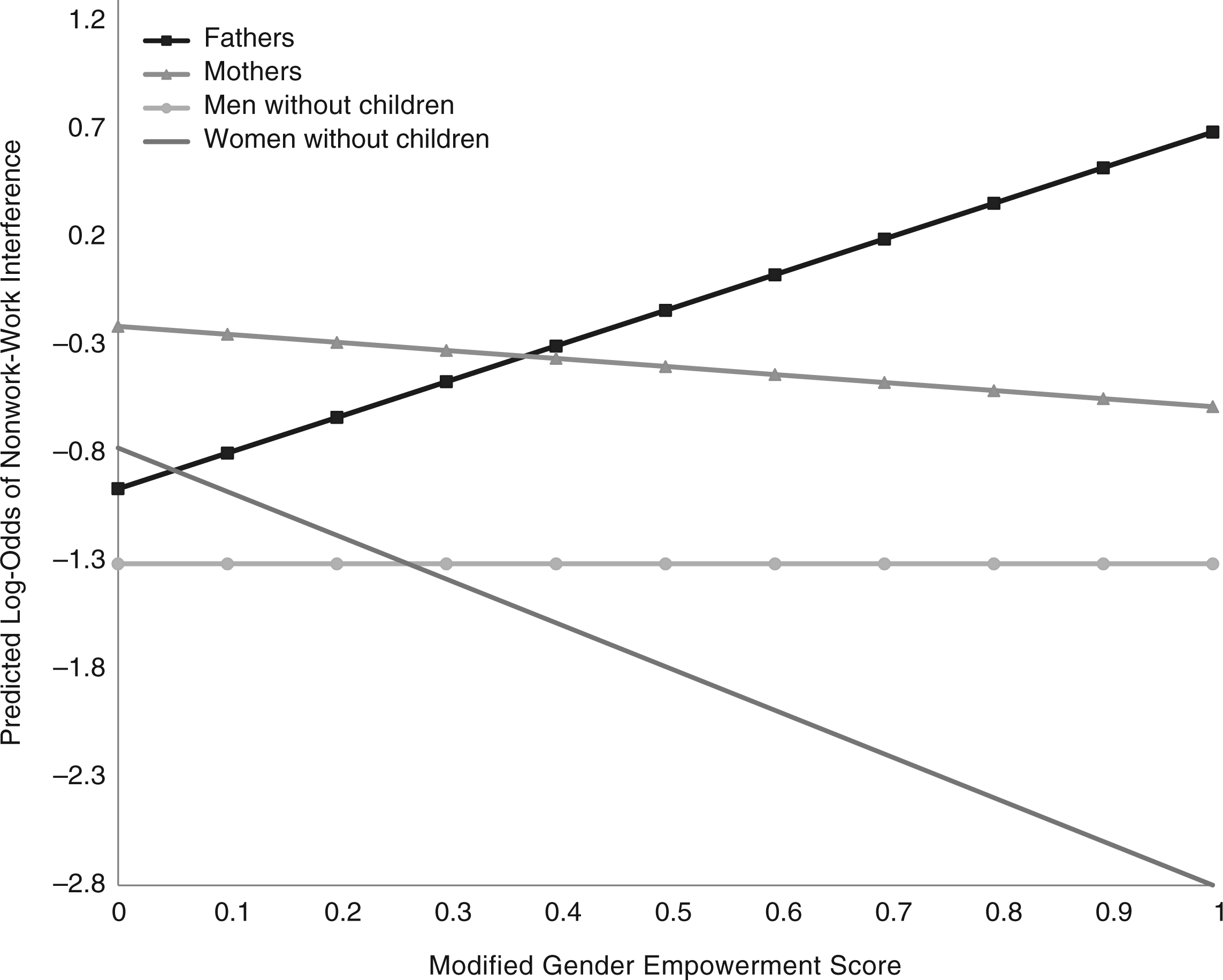
Models 3 and 4 target work–nonwork interference and follow the same specification as Models 1 and 3. Without individual-level controls, we find women are less and parents are more likely to report work–nonwork interference. Once we include controls in Model 4, we find the net gender effect is nonsignificant, indicating that the gender distribution of job demands and resources explains the net gender effect. In other words, it is the distribution of job demands and resources among women, not gender, that structures work–nonwork interference. Looking across countries, this type of interference is reported at a higher rate, on average, in a context of women’s empowerment (significant, positive effect of MGEM on the model intercept in Models 3 and 4). However, neither the gender gap in work–nonwork interference nor the effect of children on the likelihood of reporting work–nonwork interference varies significantly as a function of MGEM. Robust to individual controls, children in the home do increase one’s odds of reporting work–nonwork interference by 34% (coefficient = 0.292, odds ratio = e0.292 = 1.34, p < .001); however, that effect does not depend on a country’s level of gender empowerment. Thus, net of individual-level differences, those in countries with relatively high levels of gender empowerment are, on average, more likely to report work–nonwork interference. However, neither the gender gap nor the effect of children varies as a function of women’s empowerment. Also, the presence of children does not appear to affect women and men differently with respect to this type of interference, as indicated by the nonsignificant interaction effect for Gender × Children in the Home. Taken together, these results indicate that gender empowerment equally contributes to employees’ work–nonwork interference net of gender and parental status. Because the results in Models 3 and 4 are less complex due to many nonsignificant effects, we do not plot the results from this model.
Discussion
Our analysis examines both nonwork–work and work–nonwork interference in a cross-national and multilevel context, and informs our hypotheses as follows. First, our results support our initial hypothesis that country-level gender empowerment would reduce the odds of reporting individual-level nonwork–work interference for women and, in particular, mothers. Figure 1 indicates that MGEM benefits childless women the most but has alleviating effects for mothers as well. Indeed, fathers in our most gender-empowered countries are most likely to report nonwork–work interference, indicating that gender empowerment increases men’s vulnerability to nonwork interfering with work. For work–nonwork interference, our results support our second hypothesis that gender empowerment encourages work–nonwork interference as women gain more economically from devoting time to work. Indeed, we find that all respondents, regardless of gender and parental status, are equally vulnerable to work interfering with family life as gender empowerment increases. This suggests that gender equality in labor force participation creates gender equality in interference.
Conclusion
This study investigated bidirectional interference—nonwork–work and work–nonwork—within the context of country-level gender empowerment. Our results identify some important and novel conclusions, but ultimately these results fill important gaps in the literature and help satisfy the call for multilevel approaches to work–family conflict (e.g., Kelly et al., 2008). Specifically, we build directly on institutionalized power relations theory, which posits institutionalized gender empowerment structures individual-level inequality. Our results for nonwork–work interference indicate that fathers are most vulnerable to interference in more gender-empowered countries. This may be a consequence of women’s better labor market position in higher MGEM countries, as mothers’ nonwork–work interference may have bigger economic consequences and thus mothers and fathers may work together to mitigate this damage. Mothers in gender-empowered countries may also feel empowered to demand fathers’ accountability for nonwork demands, thus increasing the likelihood that fathers will be called on for nonwork demands. In this context, institutional gender equality may equalize parents’ vulnerability to nonwork–work interference beyond traditional gender role expectations. These arguments are supported by previous cross-national research. For example, gender empowerment is tied to gender equality in housework (Batalova & Cohen, 2002; Fuwa, 2004; Hook, 2006; Ruppanner, 2009; Stier & Mandel, 2009). Our results suggest gender empowerment also encourages fathers to be more accountable for nonwork demands while they are at work. This supports a burgeoning body of research that documents the importance of structural resources in encouraging work–life balance (Fuwa, 2004; Gornick & Meyers, 2003; Kelly et al., 2008; Moen, Lam, Ammons, & Kelly, 2013; Ruppanner, 2010).
For work–nonwork interference, the results are less complicated but equally provocative and inform previous research in two ways. First, our results suggest that the mixed gender results identified in previous research (Bellavia & Frone, 2005; Hill, 2005) may be driven by the nonsignificant gender effect for interference in one direction—from work to nonwork. Our findings stress the importance of modeling interference directionally. Second, work’s encroachment on nonwork life is equally detrimental for men and women and, moreover, country-level gender empowerment makes all workers more vulnerable to work–nonwork interference. This suggests that institutionalized gender empowerment is not sufficient to overcome the greedy reach of work into nonwork life. This indicates that additional institutional reforms are necessary for employees’ work–life balance, a finding consistent with previous research (Edlund, 2007; Grönlund & Öun, 2010).
This study is not without limitations. One centers on the outcome variables. As noted elsewhere (e.g., Schieman et al., 2009), there may be a selection effect whereby women with the most negative interference may be the most likely to drop out of the labor force and therefore are not represented in our sample. Relatedly, the interference measures are based on self-reports, which may be subject to reporting and recall bias. This would be especially concerning if those biases are systematically related to gender. A time-diary study would inform the frequency of nonwork–work and work–nonwork interference more accurately and would allow us to untangle the differences in men’s and women’s reports. Finally, our data set’s limited measures of family characteristics impose limitations on studying boundary-spanning interference. This problem plagues other nonwork–work interference research that apply family data modules that narrowly measure work characteristics (Crompton & Lyonette, 2006; Hill, 2005). As the interest in the work–nonwork nexus grows, the need to collect detailed data on work and family characteristics becomes paramount.
Researchers interested in the issues we address would be well served by investigating macro–micro relationships for strategically selected populations. For example, childcare policies may have particularly strong effects on parents’ nonwork–work interference. Additional analyses for such strategically selected populations would provide firmer empirical grounds for specific policy recommendations. This points to the importance of cross-national and multileveled investigations in future research. We hope that our approach provides fertile ground for future research in this area.
Footnotes
Acknowledgments
We thank Catherine Bolzendahl and Judith Treas for helpful comments and suggestions. Remaining errors and omissions are our own.
Declaration of Conflicting Interests
The author(s) declared no potential conflicts of interest with respect to the research, authorship, and/or publication of this article.
Funding
The author(s) disclosed receipt of the following financial support with respect to the research, authorship, and/or publication of this article: This research was supported by the Stockholm University and its Linnaeus Center on Social Policy and Family Dynamics in Europe. Stockholm University supports some of Leah’s cross-national research.
Notes
Author Biographies
Leah E. Ruppanner is an assistant professor of sociology at the University of Melbourne. Her research broadly examines the relationship between macrolevel environments and gender inequality. Her current research focuses on the relationship between work–family conflict and social policy in a cross-national perspective.
Matt L. Huffman is professor of sociology at the University of California, Irvine. He also holds a joint appointment with the Paul Merage School of Business. His current research examines gender and racial inequality within and across organizations. He is currently writing a book (with Philip N. Cohen) on changes in access to managerial positions for women and racial minorities and the consequences of those changes for other workers.
References
Supplementary Material
Please find the following supplemental material available below.
For Open Access articles published under a Creative Commons License, all supplemental material carries the same license as the article it is associated with.
For non-Open Access articles published, all supplemental material carries a non-exclusive license, and permission requests for re-use of supplemental material or any part of supplemental material shall be sent directly to the copyright owner as specified in the copyright notice associated with the article.
