



Abstract
This research examines variation in the relationships between college expectations, planfulness, and intense adolescent work by socioeconomic factors using data from Add Health (n = 8,836). Results show that higher college expectations are related to higher odds of intense school-year work among lower social class youth, but lower odds of intense work among youth from higher social class backgrounds. Moreover, planful adolescents are more likely to work intensely during the school year among youth from disadvantaged neighborhoods, but less likely to work intensely among those from advantaged neighborhoods. Results also show less variability in these relationships when considering summer work.
The average employed American aged 15 years and more works approximately 7.7 hours a day (U.S. Department of Labor, Bureau of Labor Statistics, 2013). Entrance into the formal workplace thus constitutes a major life-course transition, as individuals begin taking on adult roles and responsibilities. For many, this transition into the formal workplace begins in adolescence. Monitoring the future data indicated that approximately 35% of 8th graders and 40% of 10th graders worked during the school year between 1991 and 2006 (Staff, Messersmith, & Schulenberg, 2009). Moreover, 75% of adolescents worked during the school year by the 12th grade, with a majority working more than 16 hours per week. Adolescent employment has declined since the Great Recession, however, especially among those working longer hours (Morisi, 2008, 2010; Staff, Johnson, Patrick, & Schulenberg, 2014).
Although many begin working in adolescence, the extent and nature of work varies across subgroups of the population. Social class is especially important in shaping the timing, nature, and extent of work in adolescence (D’Amico, 1984; Greenberger & Steinberg, 1986; Staff & Mortimer, 2007; Warren & Lee, 2003). School-related factors also impact the work experience. Despite frequently being discussed as a negative outcome of work (Largie, Field, Hernandez-Reif, Sanders, & Diego, 2001; Roisman, 2002; Steinberg & Dornbusch, 1991; Tyler, 2003), some have argued that youth who do poorly in school select into the workplace earlier and with greater intensity (Warren, 2002). Yet, research examining the extent to which adolescent work represents purposeful action that interacts with a youth’s embedding within larger processes of social stratification has been limited (see Staff & Mortimer, 2007 for exception), and few studies have considered work during the summer.
This study uses data from the National Longitudinal Study of Adolescent Health 1 (Add Health) to more closely examine pathways to work in adolescence by emphasizing the importance of strategy and opportunity. Specifically, the current study examines whether adolescent planfulness and college expectations predict intense work and whether these relationships vary by socioeconomic disadvantage. Both school-year and summer work outcomes are compared to further specify potential selection processes.
Literature
Academic Orientations and Selection to the Workplace
Previous studies have found that adolescent work intensity is associated with lower levels of school performance, including lower grades (Largie et al., 2001; Roisman, 2002; Steinberg & Dornbusch, 1991; Tyler, 2003) and less time spent on school-related activities (D’Amico, 1984; Safron, Schulenberg, & Bachman, 2001; Steinberg & Dornbusch, 1991). Adolescent work has also been related to dropping out of high school (Apel, Bushway, Paternoster, Brame, & Sweeten, 2008; D’Amico, 1984; Marsh, 1991; Warren & Lee, 2003) and lower levels of college attendance (Carr, Wright, & Brody, 1996).
Some research, however, raises questions as to consistency of this association across subgroups of the population. For instance, work intensity appears to only be related to poorer academic outcomes for some race and sex groups (D’Amico, 1984; Gottfredson, 1985; McNeal, 1997) and those from economically advantaged backgrounds (Entwisle, Alexander, & Olson, 2005; Lee & Staff, 2007; Leventhal, Graber, & Brooks-Gunn, 2001). The detrimental impact of adolescent work may also be contingent on the type of job (Barling, Rogers, & Kelloway, 1995; McNeal, 1997), amount of hours worked (D’Amico, 1984; Mortimer, Finch, Ryu, Shanahan, & Call, 1996), or motivations for working (Marsh, 1991).
Other researchers have questioned the causal nature of the relationship between adolescent work and academic outcomes, suggesting that it may be spuriously driven by preexisting characteristics that lead some youth to select into the workplace at the expense of school (Sabia, 2009; Schoenhals, Tienda, & Schneider, 1998; Warren, LePore, & Mare, 2000). Research by Sabia (2009), for instance, found that the negative relationship between work and grades was substantially reduced using a fixed-effects approach to account for unmeasured time-invariant characteristics.
Several researchers have demonstrated that the association between adolescent work and delinquency is partially accounted for by demographic factors (Bachman & Schulenberg, 1993; Mihalic & Elliott, 1997; Paschall, Flewelling, & Russell, 2004; Paschall, Ringwalt, & Flewelling, 2002). Using advanced statistical procedures, other studies have reported either a weaker or nonsignificant relationship between adolescent work and delinquency, and, in some cases, a negative relationship mirroring that among adults (Apel et al., 2007, 2008; Brame, Bushway, Paternoster, & Apel, 2004).
In explaining such selection effects, some argue that there is an adult-like trait or characteristic that drives some adolescents into the workplace (Bachman, Safron, Sy, & Schulenberg, 2003; Bachman & Schulenberg, 1993; Jessor & Jessor, 1977; Newcomb & Bentler, 1988). Others have suggested that poor academic achievement causes adolescents to select into the workplace. Warren (2002), for instance, asserted that the relationship between adolescent work and academic outcomes is conditional on the primary orientation of the student; successful students are primarily oriented toward school and more likely to limit work, whereas students who do poorly in school are primarily oriented toward the workplace and thus work with greater intensity.
Planfulness, Social Class, and Selection Into the Workplace
A number of studies have shown that social class shapes how adolescents experience work and school. Adolescents from more economically disadvantaged backgrounds are less likely to be employed (Entwisle, Alexander, & Olson, 2000; Entwisle, Alexander, Olson, & Ross, 1999; Keithly & Deseran, 1995; Leventhal et al., 2001; O’Regan & Quigley, 1996; Phillips & Sandstrom, 1990), but when they do work they do so with greater intensity (Staff & Mortimer, 2007; Warren & Lee, 2003). In contrast, those from lower social class backgrounds have less success in the classroom (Alexander, Entwisle, & Olson, 2001; Lareau, 2003; South, Baumer, & Lutz, 2003).
Mortimer (2003) further situated the interrelationships between social class, academic orientations, and adolescent work within a larger life-course framework. Using a longitudinal sample of Minnesota youth, she identified two distinct pathways of preparation for adult careers: one through the workplace with adolescents being less engaged in school and pursuing adult-like work, and another through the educational system with adolescents more engaged in school and working more moderately. Mortimer suggested that adolescents strategically select which pathway to pursue based in part on family social class. Economically disadvantaged adolescents, who are less likely to obtain a college education, tend to follow the workplace pathway to adulthood. Supporting this contention, Staff and Mortimer (2007) found that low promise adolescents (i.e., those with early academic difficulties, low aspirations, and from lower socioeconomic status families) were more likely to work intensely. In contrast, high promise adolescents with early academic success, higher aspirations, and more advantaged backgrounds tended to limit their work hours.
That early entrance into the formal workforce represents strategic behavior among youth from disadvantaged backgrounds is consistent with Clausen’s (1991) notion of planful competence, described as the extent to which choices are thought through. Clausen argued that adolescents vary in levels of planful competence and that this variation predicts the degree to which positive and realistic goals are achieved later in life. Research has illustrated the importance of agency or planful competence with respect to early entrance into the workforce (Bozick, 2009; Shanahan, Elder, & Miech, 1997; Shanahan, Miech, & Elder, 1998). For example, studies have found that youth are more likely to leave school and enter the labor force when there are greater job opportunities (Bozick, 2009; Shanahan et al., 1998).
Current Study
The current study seeks to gain further insight into these issues by considering how strategy and opportunity interact to influence decisions to work intensely in adolescence. The first research question examines the extent to which work and school represent divergent life-course pathways, in a manner consistent with Mortimer (2003). The first hypothesis is that the negative relationship between college expectations and intense work during the school year will be weaker for those from economically disadvantaged backgrounds. This study also examines how agency is related to intense work. Using a measure closely related to planful competence (Clausen, 1991), the second hypothesis is that more planful adolescents from disadvantaged backgrounds will be more likely to work intensely during the school year, whereas more planful youth from advantaged backgrounds will be more likely to limit their engagement in work.
Previous studies have tended to only examine adolescent work during the school year. As such, work is more likely to conflict with academic performance and involvement. It is also important, however, to consider work during the summer to more completely understand the interplay between work, academic orientations, agency, and social class. To the extent that work and school represent competing pathways (Mortimer, 2003), it follows that selection processes may be less pronounced in the case of summer work that less directly competes with educational demands. Thus, the third hypothesis is that there will be less variability by economic disadvantage in the relationships between college expectations, planfulness, and intense work for models predicting intense work in the summer.
Methods
Data and Sample
This study uses the first two waves of data from the National Longitudinal Study of Adolescent Health (Add Health). Add Health is a nationally representative sample of students in grades 7 to 12. Students from 145 junior and high schools across the United States were randomly selected to participate in the longitudinal study, stratified by age and sex. The first wave of data collection was conducted in 1994–1995, with 90,118 students completing in-school questionnaires, and a core longitudinal sample of 20,745 students interviewed from home. The response rate for the Wave I in-home survey was 78.9%. Approximately 15,000 students were reinterviewed about a year later in 1996. The response rate was 88.2% at Wave II. It is important to note that Wave I seniors were excluded from this second wave of data collection.
The analytic sample is drawn from the 13,568 students who participated in both Wave I and Wave II. For the purposes of this study, it is crucial that respondents are both old enough to work significant hours and young enough to still be considered in adolescence. The sample is thus further restricted to respondents aged between 14 and 17 years at Wave I. Respondents who are already taking college classes in Wave II are also excluded from the analyses, as college expectations is a key variable. These restrictions reduce the sample to 9,624. Lastly, list-wise deletion of a small number of cases with missing data on key variables (no variable had more than 3% missing) yields a final analytic sample of 8,836 adolescents.
Measures
Adolescent work
School-year adolescent work is based on the Wave II question “How many hours do you spend working for pay in a typical non-summer week?” Because youth working long hours are especially at risk for problem behaviors, and moderate work may be beneficial to youth (Mortimer et al., 1996; Paschall et al., 2004; Valois, Dunham, Jackson, & Waller, 1999), three categories are created: no work, moderate work (1–20 hours per week), and intense work (21 or more hours per week). A variable for summer adolescent work is created in similar fashion based on the Wave II question “How many hours do you spend working for pay in a typical summer week?”
Social structural factors
Two separate social structural measures are used to more thoroughly examine how economic disadvantage impacts patterns of work in adolescence. Following Ford, Bearman, and Moody (1999), social class is constructed by adding together two 5-point scales of parent educational attainment and occupation, producing a 10-point scale. Only education is considered if the parent is not working. Mothers’ and fathers’ social class positions are calculated separately, with the highest social class of either parent contributing to the scale. Missing data from the in-home adolescent reports are filled in (when available) from parent reports of education and from adolescent in-school reports of parent education and occupation. For interpretive purposes, dummy variables are created for low (1 standard deviation below the mean), average (within 1 standard deviation of the mean), and high (1 standard deviation above the mean) social class groups.
The second social structural variable, neighborhood disadvantage, is created from 1990 Census data by taking the mean of the following census tract measures: proportion of single-mother households; proportion of households with less than $15,000 in annual income; and the proportion of persons unemployed. For ease of interpretation, mean neighborhood disadvantage is multiplied by 100 so that a 1-unit increase represents a 1% change in neighborhood disadvantage. This variable is based on a similar measure used by Vazsonyi, Cleveland, and Wiebe (2006). Dummy variables for low, average, and high neighborhood disadvantage are created based on 1 standard deviation above and below the mean of neighborhood disadvantage.
Social psychological factors
Planfulness is based on how much adolescents agree with the following statements at Wave I: “When you have a problem to solve, one of the first things you do is get as many facts about the problem as possible;” “When you are attempting to find a solution to a problem, you usually try to think of as many different ways to approach the problem as possible;” “When making decisions, you generally use a systematic method for judging and comparing alternatives;” and “After carrying out a solution to a problem, you usually try to analyze what went right and what went wrong.” Responses for each question are reported on a 5-point scale ranging from strongly agree to strongly disagree. The planfulness construct yields an alpha of .7. These items have also been used by previous researchers to identify impulsivity (Beaver & Wright, 2005; Daigle, Cullen, & Wright, 2007) and thoughtfully reflective decision making (Paternoster & Pogarsky, 2009).
Another social psychological factor thought to impact patterns of work in adolescence is college expectations. This variable is obtained from Wave I and is based on a question asking respondents how likely it is they will go to college. Responses are measured on a 5-point scale from low to high.
Controls
A number of demographic controls from Wave I are incorporated in analyses. Race and ethnicity is classified into the following mutually exclusive categories: Non-Hispanic White, Non-Hispanic African American, Hispanic, Non-Hispanic Asian, and other. Age and gender are also controlled for in analyses. Family structure is a dummy variable where respondents from two-biological-parent households are coded 1 and other family structures are coded 0. Last, grade point average is based on self-reported grades in English or language arts, mathematics, history or social studies, and science. Responses for this measure range from 0.5 to 4.0.
Analytic Strategy
Analyses use multinomial logistic regression in SAS and incorporate Add Health project weights to account for the complex sampling design. Contrasts are made between intense work and no work, and then between intense work and moderate work across analyses. The first groups of models assess the relationships among measures of college expectations, planfulness, and socioeconomic factors with intense work, net of controls. A second set of models examine the extent to which the relationships between college expectations, planfulness, and intense work vary among adolescents from different social class and neighborhood disadvantage backgrounds. Analyses are carried out for both school-year and summer work outcomes to further capture potential differences in patterns of work among adolescents. Supplemental analyses using ordinary least squares regression in SAS indicate no issues with multicollinearity, as the variance inflation factors are all between 1.0 and 1.3.
Results
Descriptive Statistics
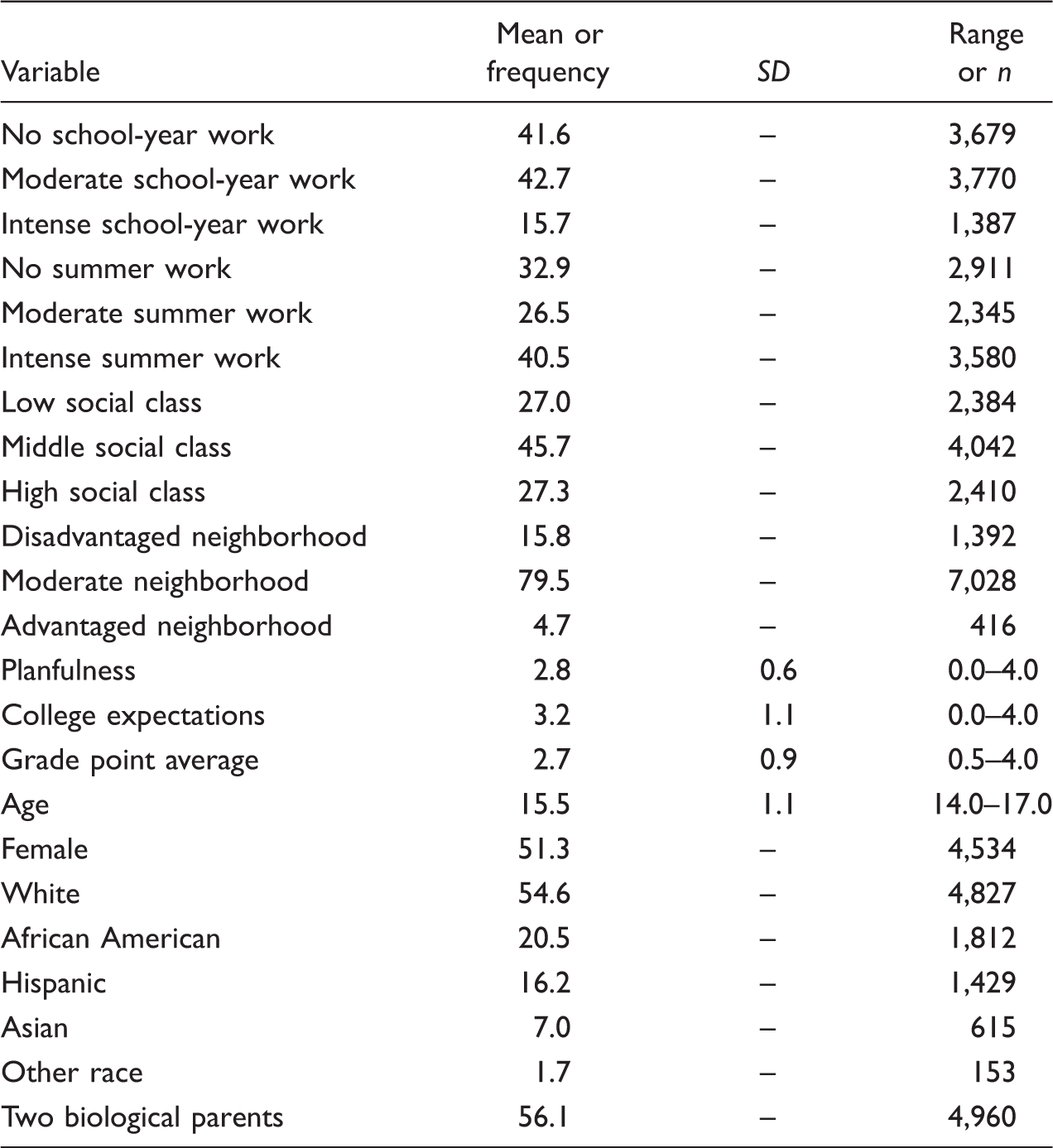
Descriptive Statistics (n = 8,836).
Intense School-Year Work: Multivariate Models
Multinomial Logistic Regression of Intense School-Year Work on Social Psychological and Social Structural Factors (n = 8,836).
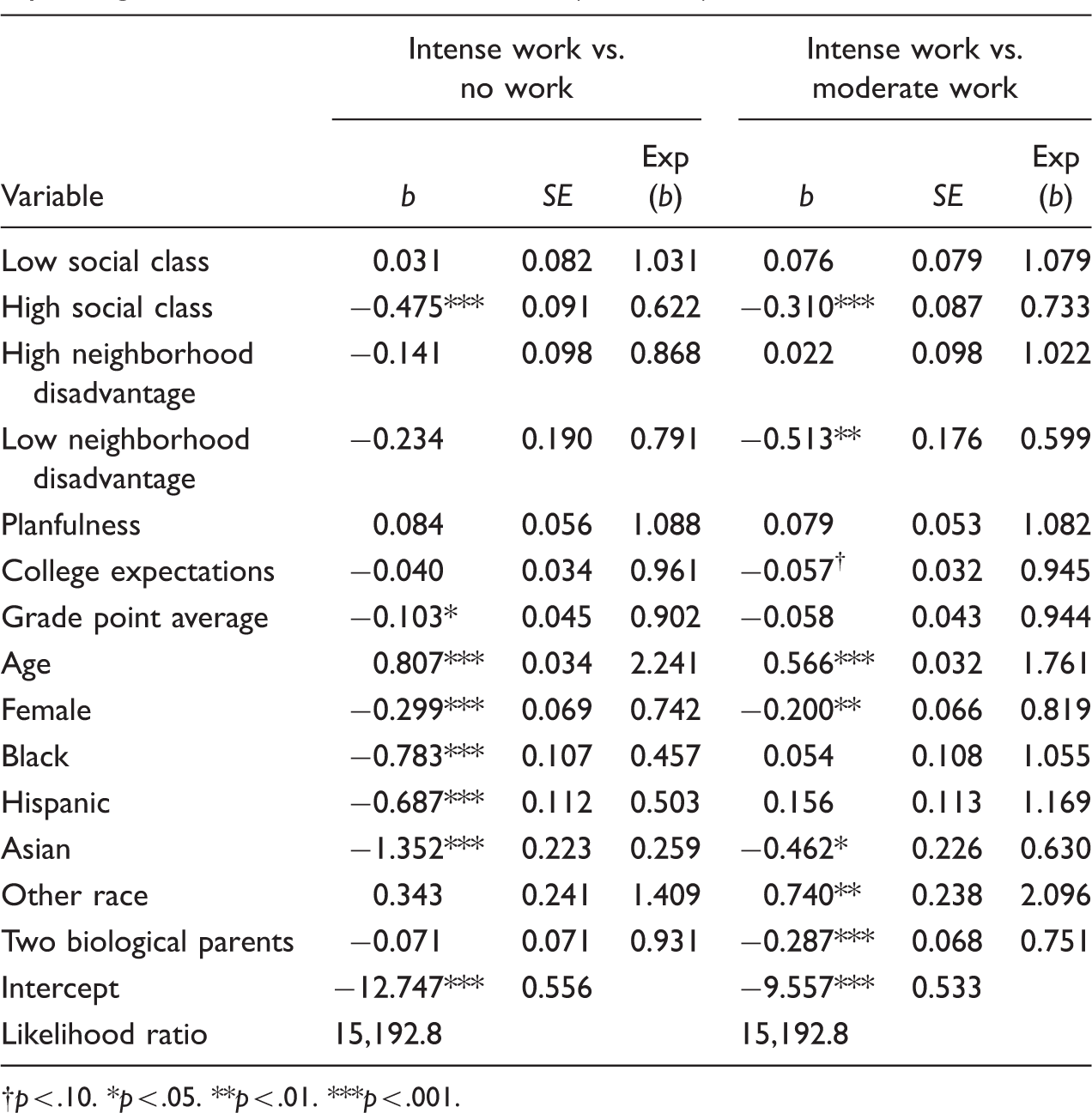
p < .10. *p < .05. **p < .01. ***p < .001.
Also in Table 2, Wave II intense work during the school year is regressed on social psychological and social structural factors, net of controls, where adolescents who work moderately are the contrast group. As before, those from higher social class backgrounds are less likely to work intensely compared with those from average social class backgrounds. However, a similar pattern is now observed with regard to neighborhood disadvantage, where adolescents from relatively advantaged neighborhoods are less likely to work intensely compared with adolescents from average neighborhoods. Increases in age are again associated with higher odds of intense work, and females are less likely to work intensely compared with males. Interestingly, when those who work moderately serve as the contrast group, much of the racial and ethnic differences are not significant, with the exception that White adolescents are more likely to work intensely than Asian adolescents and less likely to work intensely than those from the other race or ethnicity group. Results also reveal that adolescents from two-biological-parent families are less likely to work intensely compared with those from other family backgrounds.
Intense School-Year Work: Interactions Between Social Psychological and Social Structural Factors
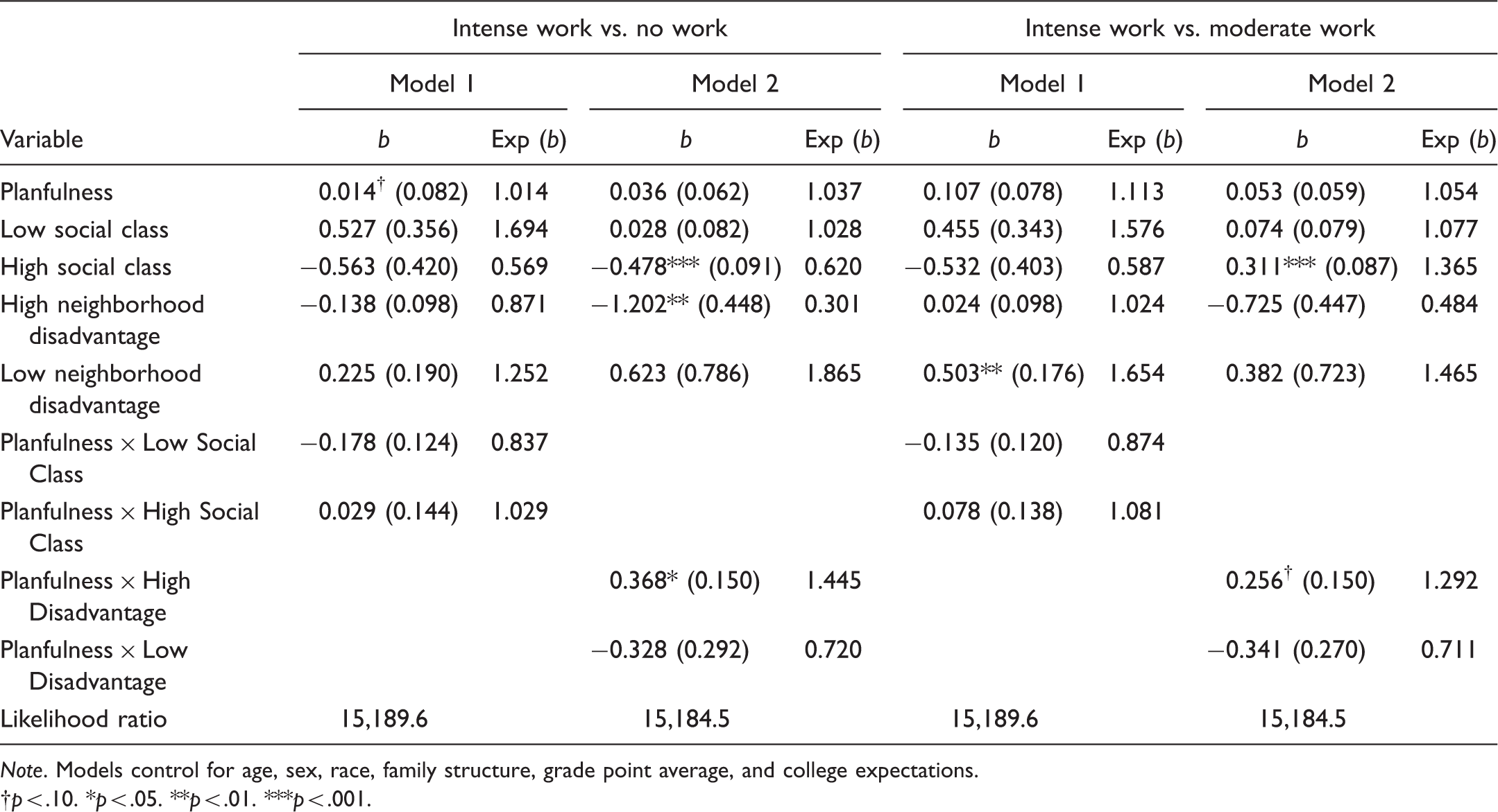
Results from Table 3 show significant differences in the effect of planfulness on school-year intense work by levels of neighborhood disadvantage, especially when contrasting intense work versus no work. In particular, the effect of planfulness on intense work is greater among those from relatively disadvantaged backgrounds, as reported in Model 2. Figure 1 further illustrates this difference by showing the predicted probabilities of intense work for adolescents with low (0), mid (2), and high (4) levels of planfulness across levels of neighborhood disadvantage. In addition to the more positive impact of planfulness on intense work observed among those from relatively disadvantaged neighborhoods, adolescents from relatively advantaged neighborhoods are the only group to report lower odds of intense work with greater levels of planfulness. Figure 1 also reveals that, among low planful youth, those from relatively disadvantaged neighborhoods are the least likely to work intense hours; but among highly planful youth, those from relatively disadvantaged neighborhoods are the most likely to work intense hours.
Probability of school-year intense work across levels of planfulness among categories of neighborhood disadvantage (contrasted with those who did not work). Multinomial Logistic Regression of Intense School-Year Work on Social Psychological and Social Structural Factors, Interactions by Planfulness (SEs in Parentheses; n = 8,836). Note. Models control for age, sex, race, family structure, grade point average, and college expectations. p < .10. *p < .05. **p < .01. ***p < .001.
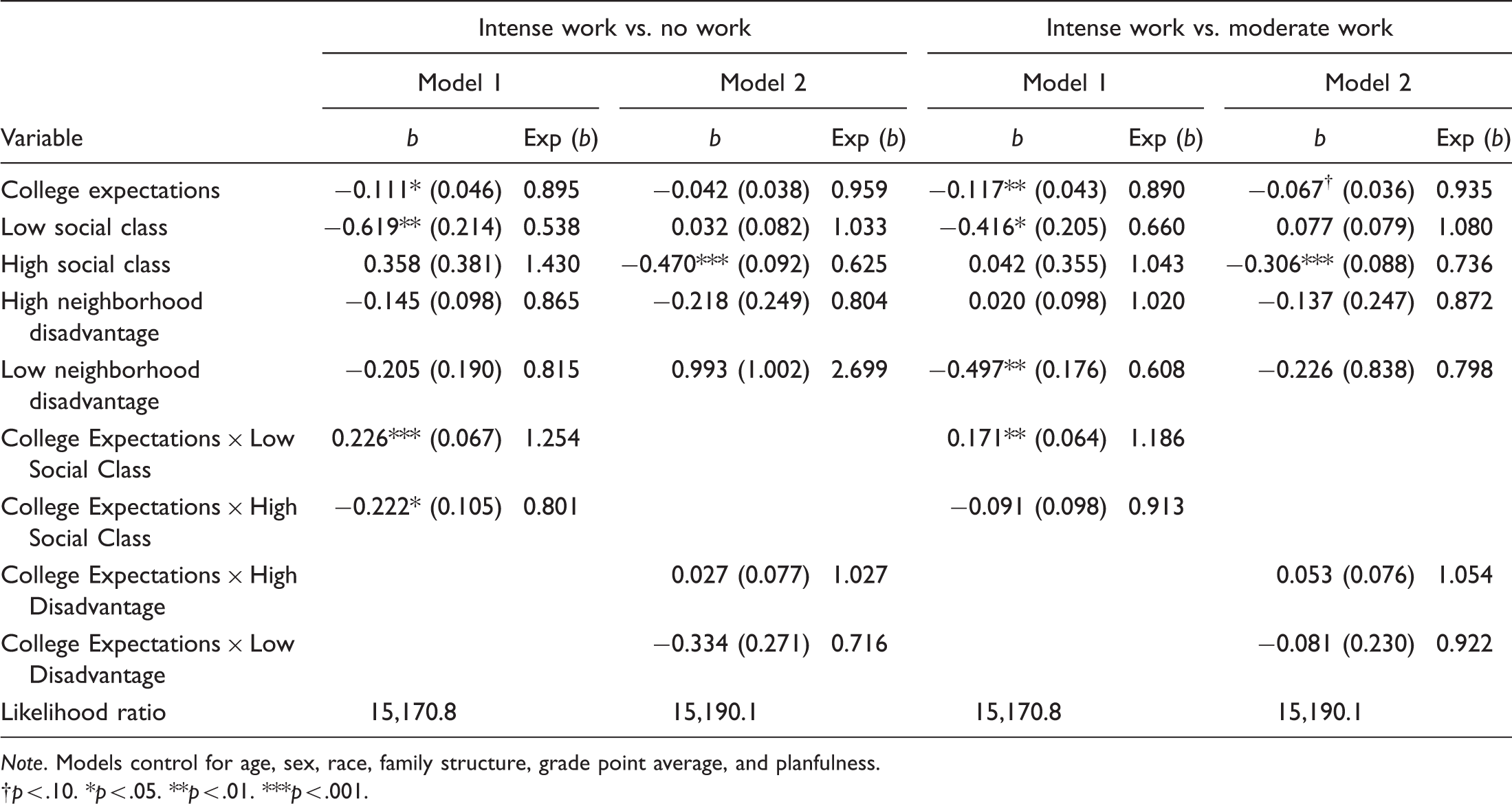
Results presented in Table 4 show interactions between college expectations and the social structural factors for models predicting school-year work. A similar pattern arises, as there is a significant interaction between college expectations and the lower social class background category. Again, the differences are particularly stark when adolescents who do not work are the contrast group in Model 1. Figure 2 graphs the interaction by showing the probability of intense work across levels of college expectations (low = 0; mid = 2; high = 4) by different groups of social class backgrounds. As seen in the graph, while higher college expectations are associated with lower odds of intense work for adolescents from average and higher social class backgrounds, it is associated with higher odds of intense work among those from lower social class backgrounds. As before, among adolescents with lower college expectations, those from disadvantaged backgrounds are the least likely to work, whereas among adolescents with high levels of college expectations, those from lower social class backgrounds are the most likely to work intensely. Figure 3 displays a similar pattern when comparing intense versus moderate work from Model 1.
Probability of school-year intense work across levels of college expectations among categories of social class (contrasted with those who did not work). Probability of school-year intense work across levels of college expectations among categories of social class (contrasted with those who worked moderately). Multinomial Logistic Regression of Intense School-Year Work on Social Psychological and Social Structural Factors, Interactions by College Expectations (SEs in Parentheses; n = 8,836). Note. Models control for age, sex, race, family structure, grade point average, and planfulness. p < .10. *p < .05. **p < .01. ***p < .001.

Intense Summer Work: Multivariate Models
Multinomial Logistic Regression of Intense Summer Work on Social Psychological and Social Structural Factors (n = 8,836).
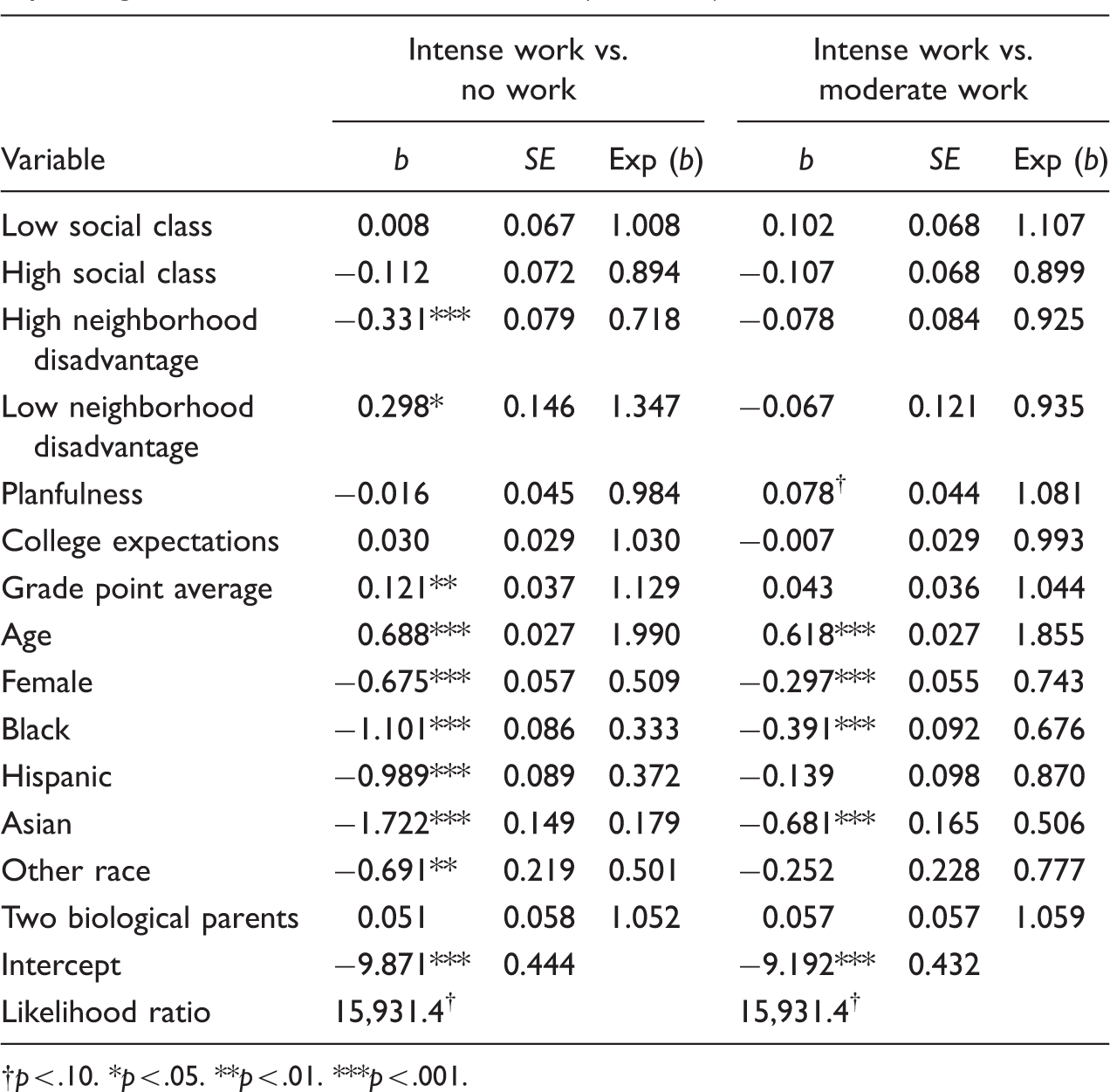
p < .10. *p < .05. **p < .01. ***p < .001.
Intense Summer Work: Interactions Between Social Psychological and Social Structural Factors
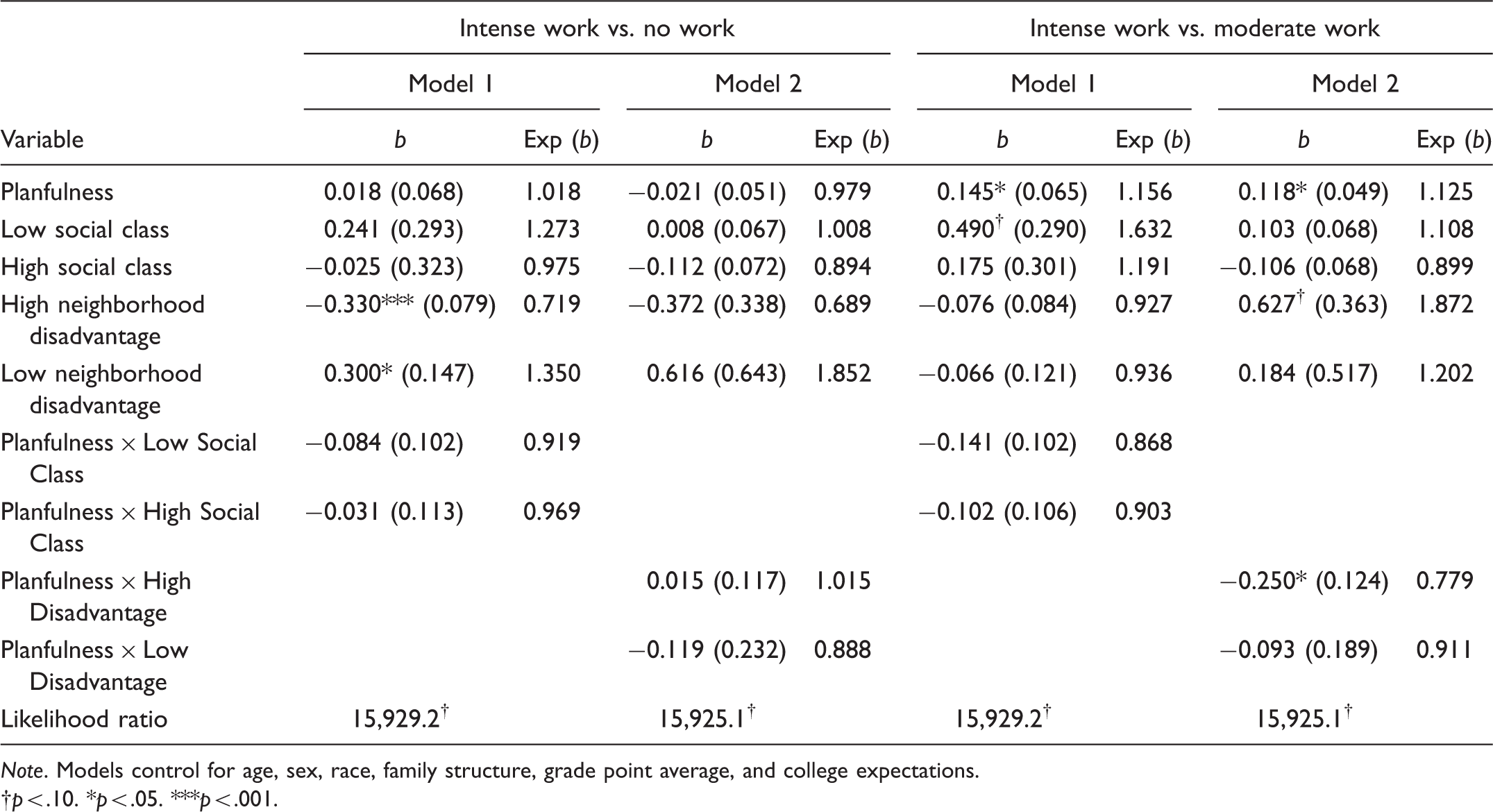
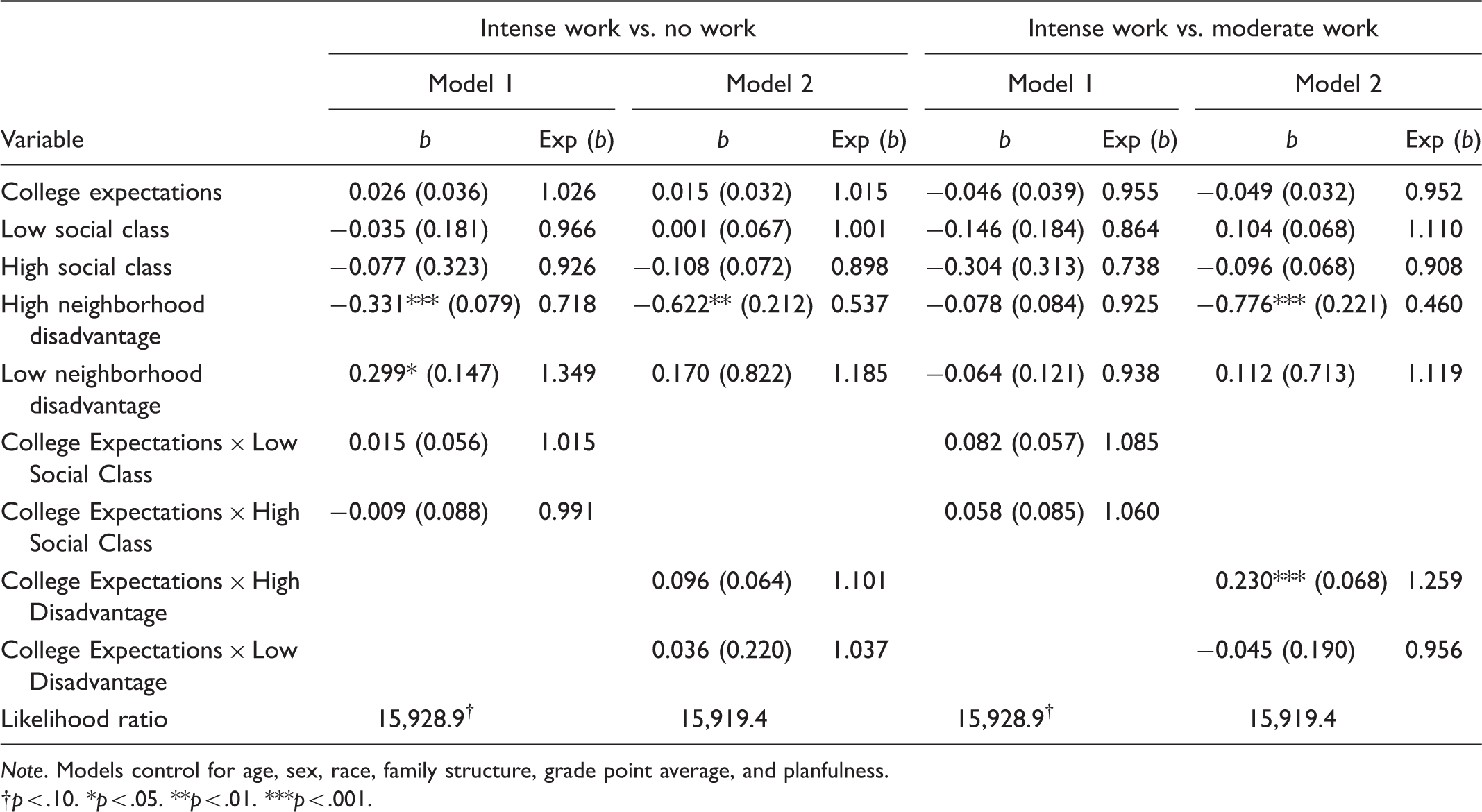
Tables 6 and 7 show interactions between social structural and social psychological factors. Unlike the models predicting school-year intense work, here the only significant variations in relationships are observed between adolescents from relatively disadvantaged and average neighborhoods. Moreover, the interactions indicate a more complicated set of relationships. Specifically, the patterns for planfulness and college expectations are inconsistent with each other. Figure 4 illustrates that higher levels of planfulness are related to higher odds of intense summer work for those from average and relatively advantaged neighborhoods, but lower odds of intense summer work for those from relatively disadvantaged neighborhoods. Conversely, Figure 5 shows that higher levels of college expectations are related to lower odds of intense summer work for adolescents from average and relatively advantaged neighborhoods, but higher odds of intense summer work for those from relatively disadvantaged backgrounds.
Probability of summer intense work across levels of planfulness among categories of neighborhood disadvantage (contrasted with those who worked moderately). Probability of summer intense work across levels of college expectations among categories of neighborhood disadvantage (contrasted with those who worked moderately). Multinomial Logistic Regression of Intense Summer Work on Social Psychological and Social Structural Factors, Interactions by Planfulness (SEs in parentheses; n = 8,836). Note. Models control for age, sex, race, family structure, grade point average, and college expectations. p < .10. *p < .05. ***p < .001. Multinomial Logistic Regression of Intense Summer Work on Social Psychological and Social Structural Factors, Interactions by College Expectations (SEs in Parentheses; n = 8,836). Note. Models control for age, sex, race, family structure, grade point average, and planfulness. p < .10. *p < .05. **p < .01. ***p < .001.

Discussion
This study examined the extent to which adolescents pursue work strategies during the school-year and summer months, focusing on differences by social psychological and social structural factors. This study found that the relationships between college expectations and intense work varied by levels of economic disadvantage, as did the relationships between planfulness and intense work. Moreover, there were key differences with how college expectations, planfulness, and economic disadvantage related to intense work when considering work during the school-year and summer months.
The most important findings of this study were that the effects of college expectations and planfulness on work intensity varied by social structural factors. Results largely supported the first hypothesis that the negative relationship between college expectations and intense work during the school year would be weaker for those from more disadvantaged social class backgrounds and neighborhoods. When looking at social class background, higher levels of college expectations were related to lower odds of intense work during the school year for those from higher social class backgrounds in a much more pronounced way compared with those from average social class backgrounds. Moreover, higher levels of college expectations were related to higher odds of intense work among those from lower social class backgrounds.
The second hypothesis was that more planful adolescents from disadvantaged social class backgrounds and neighborhoods would be more likely to work intense hours, but more planful adolescents from advantaged circumstances would be less likely to work intensely. Partial support for this hypothesis was garnered. On the one hand, no significant differences in the relationship between planfulness and school-year intense work were observed between adolescents from lower and average social class backgrounds, as well as between those from higher and average social class backgrounds. On the other hand, this hypothesis was supported when considering neighborhood disadvantage. Specifically, higher levels of planfulness were associated with intense work during the school year for adolescents from average and relatively disadvantaged neighborhoods, but with lower odds of intense work for those from advantaged neighborhoods.
The finding that economically disadvantaged adolescents are more likely to be disengaged in school and to pursue adult-like work conditions, whereas economically advantaged adolescents are more likely to be engaged in school and to work only moderately, is consistent with Mortimer’s (2003) characterization of adolescent work representing diverging pathways for youth. Mortimer suggested that the decision to work intense hours in adolescence is indicative of a life-course principle—agency. In other words, the decision to work to varying degrees in adolescence is a strategic course of action. This study suggests that involvement in intense work may indeed be a planful approach to adolescence for economically disadvantaged adolescents, who are strategically pursuing intense work to prepare for adulthood. Conversely, involvement in moderate work may be a playful approach to adolescence for economically advantaged adolescents, who are strategically limiting the amount of time spent working while focusing on school and other extracurricular activities.
Differences in social, human, and financial capital may explain social class and neighborhood disadvantage distinctions in the effects of college expectations and planfulness on intense work. More economically advantaged adolescents who have high college expectations already have a surplus of capital and can focus their time and energy in school. The divide between school and work is wider, as they do not provide comparable rewards for this group of adolescents. Economically disadvantaged adolescents who have high college expectations, however, may have to work while in high school to supplement their family income or play catch-up to more economically advantaged adolescents in terms of building social and human capital through the workplace. Moreover, economically disadvantaged adolescents with high college expectations may simply be more motivated and responsible individuals and thus more likely to work than others.
The third hypothesis was that there would be fewer differences by social structural factors in the relationships between college expectations, planfulness, and intense work during the summer months compared with the school year, as work is not likely to compete with school demands during the summer. Results partially supported this hypothesis. Considering the relationship between college expectations and intense work, support for the third hypothesis was found, as there was less variation by economic disadvantage during the summer. In fact, significant differences during the summer were limited to those from relatively disadvantaged neighborhoods and only when contrasted with those who worked moderately.
An unexpected finding, however, was that compared with those who work moderately, higher levels of planfulness were related to lower odds of intense summer work for those from relatively disadvantaged neighborhoods, but with higher odds of intense work for those from average and relatively advantaged neighborhoods. This pattern is completely counter to that observed during the school year. Perhaps the more planful youth from disadvantaged neighborhoods limit their hours worked during the summer to supplement their free time with other activities, such as volunteer work or camps. Future research should examine why more planful adolescents from disadvantaged neighborhoods would be less likely to work during the summer and identify other points of contrast between school-year and summer work.
This research also provided evidence that the transition to work, a key transition in the life course, is shaped by other social and demographic variables. Older, White, and male adolescents were all more likely to work intense hours during the school year and summer compared with others. Overall, these patterns of relationships between demographic characteristics and intense work are consistent with prior research (Bachman & Schulenberg, 1993; Mihalic & Elliott, 1997).
It is not surprising that racial and ethnic minorities were less likely to work intense hours during the school year and summer compared with White adolescents, given the history of discriminatory hiring practices (Bertrand & Mullainathan, 2004; Pager, 2003) and the idea that workplace experiences constitute opportunities for youth to gain social, human, and economic capital. Certainly, one contributing factor is the sheer unavailability of jobs in poor, inner-city neighborhoods that are disproportionately non-White (Wilson, 1987). It may also be, however, that disadvantaged adolescents have fewer connections and social networks at their disposal needed to obtain and retain work (Coleman, 1988), or that disadvantaged youth are perceived as less hirable by employers in terms of lacking communication and other job-related skills (Anderson, 1999; Johnson & Troppe, 1992).
That those from more economically advantaged backgrounds were more likely to limit the number of hours worked is consistent with previous research (Staff & Moritmer, 2007; Warren & Lee, 2003). One potential explanation is that these adolescents have a surplus of social, human, and economic capital, and working a lot of hours is therefore a less desired commodity (Coleman, 1988). In addition, with increased financial security, adolescents from more economically advantaged backgrounds may be more able to forego work and concentrate on academic capital, the long-term investment. This latter explanation may account for why there was no difference in intense work status between adolescents from higher social class backgrounds and others during the summer months. In fact, during the summer when jobs may be more highly sought after among youth, adolescents from more disadvantaged neighborhoods are less likely to work compared with others.
There are limitations with this study. One limitation is that the data were based on a school-based sample. To the extent that work and school represent divergent pathways (Mortimer, 2003), those who work the most hours in adolescence may have already dropped out of school (D’Amico, 1984; Marsh, 1991; McNeal, 1997; Shanahan & Flaherty, 2001; Warren & Lee, 2003) and thus would not be included in the study.
A second set of limitations involves measures of adolescent work not available in Add Health. While researchers have noted the importance of intense work, it is also important to consider other characteristics of employment, such as the type of job or the type of tasks. Future research would benefit from a closer examination of contextual factors other than the amount of hours spent working.
Another limitation is that this sample is based on youth in the mid-90s. Employment rates for youth have steadily declined since this time both during the school-year and summer months (Morisi, 2008, 2010), especially since the Great Recession and among those working intensely during the school year (Staff et al., 2014). With fewer job opportunities for adolescents, those who are strategically seeking to work intensely during the school year are likely less able to realize this preference. Those from disadvantaged backgrounds who have less social and human capital at their disposal may be particularly unable to carry out their preference to work intensely during the school year in today’s market. Future research should examine the extent to which planfulness, college expectations, and economic disadvantage relate to intense work with a more contemporary sample.
Conclusion
This study emphasized how strategy and opportunity impact the intensity of adolescent work. Results underscored the importance of socioeconomic status as it relates to the decision to work in adolescence. The more planful and college expecting students from economically disadvantaged backgrounds are stockpiling their resources by strategically choosing to work more hours during the school year. Conversely, the more planful and college expecting students from economically advantaged backgrounds tend to work fewer hours. This study also examined selection to work by comparing school-year and summer processes. Considering work during the summer, a different picture of selection emerged, as more planful adolescents from disadvantaged neighborhoods now limited the number of hours worked. The approach to work and characteristics of who works thus appears to be vastly different based on the socioeconomic background of youth, as well as on whether youth are working during the school year or summer months.
The overall policy implication from these findings concerns federal and state laws restricting the amount of time youth may spend in the workplace. Limiting the amount of time adolescents may work disproportionally impacts those from low and middle social class backgrounds, who are more likely to work intense hours compared with youth from higher social class backgrounds. This is problematic because work may present more meaningful opportunities for advancement for this group of youth, especially the more ambitious and those from more economically disadvantaged backgrounds.
Footnotes
Declaration of Conflicting Interests
The author(s) declared no potential conflicts of interest with respect to the research, authorship, and/or publication of this article.
Funding
The author(s) received no financial support for the research, authorship, and/or publication of this article.