




Abstract
Retail offers notoriously bad jobs that exist at the nexus of work and consumption. Previous brand-based retail studies assert that youth workers see the stores’ coolness and the employee discount as compensating for the low pay and variable schedules. The authors use interviews with 55 former and current young clothing retail workers to examine how they experience retail work in relation to their consumer identities. The authors find that while some workers identify with the brand, all workers criticize the poor working conditions. Workers draw on their consumer identities to understand what good service entails and sometimes to resist managers’ orders that they interpret as bad deals for shoppers. This article concludes that youth retail workers’ consumer identities do not compensate for the low pay and poor work conditions but instead help them navigate the interactive aspects of service work and find fulfillment on the job.
Understanding low-wage retail work is crucial to addressing the inequalities that service workers experience in the postindustrial labor market (Warhurst, Nickson, Witz, & Marie Cullen, 2000; Williams & Connell, 2010). Unpredictable schedules and minimal wages characterize most retail jobs, but some scholars note that retail workers’ identification with the brand may compensate for these poor working conditions (Besen-Cassino, 2014; Gatta, 2011; Williams & Connell, 2010). We examine how youth retail workers’ own consumer identity shapes their perspectives and experiences of customer interactions. In this way, our article contributes new insights into how worker identity shapes their subjective experiences of the service work-consumption nexus.
Within the economy, retail continues to grow and is now the largest sector and one of the most influential (Carré & Tilly, 2008). Clothing and accessory stores are among the largest retail employers. Nearly 1 million U.S. workers—almost 1% of all workers—were employed in clothing retail in 2014, which pays less than most other retail positions (Bureau of Labor Statistics, 2015; Fiscal Policy Institute, 2008). This industry disproportionately employs people who are young, not unionized, women, and racial and ethnic minorities, making it a key area to study to examine vulnerable workers (Bronfenbrenner, 2005; Macdonald & Merrill, 2008; Macdonald & Sirianni, 1996; Ruetschlin & Asante-Muhammad, 2015; Traub, 2014).
Much retail work exemplifies bad jobs (Frenkel, 2003; Kalleberg, 2011; Kalleberg, Reskin, & Hudson, 2000; Mouw & Kalleberg, 2010; Smith, 2012), given the low pay, variable and limited hours, and minimal benefits. Previous research on youth retail and similar brand-based jobs explored the cultural elements of this work, where workers’ consumer identities and interests compensate for the poor job quality (Besen-Cassino, 2014; Gatta, 2011; Pettinger, 2005; Williams & Connell, 2010). These scholars highlight the role of identity and consumption that workers perform as part of their labor, positing that young student workers seek these jobs for consumer-driven benefits—including self-identifying with the store brand, having customers and friends associate them with the store brand, spending time with cool coworkers, and receiving discounts for items that they otherwise would consume.
We reach a different conclusion. While employers may attempt to appeal to workers’ consumer identities through hiring practices and employee discounts, the workers recognize numerous disadvantages of these jobs and most do not find that “cool” compensates for poor working conditions. Further, regardless of their own consumption of the store brand, they draw on their consumer identities to provide good customer service.
Retail Employment and Consumer Identities
Given the prominence of retail jobs, understanding how this work is organized and how youth workers experience their jobs is important. We seek to contribute to the growing body of research on the service sector that conceptualizes labor process to highlight the particular practices in the organization and the experience of service sector employment (Braverman, 1998; Erickson & Wharton, 1997; Gutek, Cherry, Bhappu, Schneider, & Woolf, 2000; Korczynski, 2007; Leidner, 1993; Lopez, 2006, 2010; Macdonald & Sirianni, 1996; Sallaz, 2002, 2010, 2015; Sloan, 2004, 2012; Troyer, Mueller, & Osinsky, 2000).
Studying workers gives us traction with regard to both the organization of work and inequality in the retail industry. Our aim is to understand how consumer identification shapes the experiences of youth retail workers. We build on existing literatures on retail work, consumer identification, and the employer–customer–worker triangle in interactive service work.
Working Conditions in Retail Employment
Many retail clothing workers receive minimum wage and are excluded from benefits through part-time scheduling, which leads to high levels of employee turnover (Carré & Tilly, 2008; Carré, Tilly, & Holgate, 2009; Cauthen, 2011; Fiscal Policy Institute, 2008; Leslie, 2002; Luce & Fujita, 2012). Nonstandard schedules, while growing in the economy more broadly, are particularly endemic to retail work (Broschak, Davis-Blake, & Block, 2008; Golden, 2015; Henly, Shaefer, & Waxman, 2006; Lambert, 2008; Presser, 2003). Almost half of all frontline retail employees in the United States work part time, compared to less than a fifth of all workers (Carré & Tilly, 2008; Carré et al., 2009; Cauthen, 2011; Huddleston, 2011; Luce & Fujita, 2012). Many retail stores are open seven days a week, for relatively long hours; workers are required to adapt to constantly changing schedules with little advance notice (Henly et al., 2006; Lambert, 2008).
Retail is also often based on “zero competence, zero qualifications, zero training, and zero career” (Andersson, Kazemi, Tengblad, & Wickelgren, 2011, p. 255). Employers do not focus on experience in hiring, assuming that workers can be trained to perform the work (Carré & Tilly, 2008; Carré et al., 2009; Huddleston, 2011; Luce & Fujita, 2012; Nickson, Warhurst, Commander, Hurrell, & Cullen, 2012; Warhurst & Nickson, 2007). Ironically, they also do not invest heavily in worker training, given high turnover (Luce & Fujita, 2012; Osterman, 2011; Roberts, 2011; Williams & Connell, 2010). Stores with lower turnover and more worker training do perform better (Ton, 2012), as skilled workers and quality customer service are important to maintaining loyal customers (Bolton & Houlihan, 2010; Bozkurt & Grugulis, 2011; Carré et al., 2009; Gatta, 2011; Gatta, Boushey, & Appelbaum, 2009; Huddleston, 2011; Korczynski, Shire, Frenkel, & Tam, 2000; Korczynski, 2007; Sallaz, 2010; Ton, 2009, 2012). Overall, the literature on retail suggests that these jobs are fairly low quality.
Consumer Identification
Given that these jobs pay poorly, provide little opportunity for advancement, and require navigating unpredictable schedules, how do employers find workers and why do workers choose retail jobs? Research on retail workers emphasizes the role of consumer identities as driving both employers’ hiring, as well as workers’ acceptance of jobs in retail (Warhurst et al., 2000; Williams & Connell, 2010). Workers’ consumer identity is particularly salient in niche stores that appeal to middle-class or upper middle-class consumers (Gatta, 2011; Pettinger, 2004, 2005; Warhurst & Nickson, 2007; Williams & Connell, 2010). Research suggests that employers seek out workers who identify with—and even embody—the store brand (Besen-Cassino, 2014; Gatta, 2011; Leslie, 2002; Pettinger, 2004, 2005; Warhurst et al., 2000; Warhurst & Nickson, 2007; Williams & Connell, 2010).
The nexus of work and consumer identity is particularly visible in how employers hire workers who possess requisite customer service skills through fit with the store brand. The hiring process may focus on assessing applicants’ consumer identities and abilities to communicate insights about the brand (Besen-Cassino, 2014; Carré et al., 2009; Gatta, 2011; Nickson, Hurrell, Warhurst, & Commander, 2011; Nickson et al., 2012; Shaw, 2015; Warhurst et al., 2000; Warhurst & Nickson, 2007; Williams & Connell, 2010; Williams, 2011). As employers judge workers on their appearance, speech, and self-presentation (Besen-Cassino, 2014; Nickson et al., 2012; Nickson, Warhurst, & Dutton, 2005; Warhurst & Nickson, 2007), “middle classness is being recast as a skill” in certain brand-based markets (Nickson et al., 2011, p. 84). Workers not only complete assigned tasks but also look the part, representing the brand and acting in ways that demonstrate the store’s aesthetic (Gatta, 2011; Pettinger, 2005; Warhurst et al., 2000; Williams & Connell, 2010).
Identity is also key to existing accounts about why workers choose retail jobs. Besen-Cassino (2014) argues that brand-based employers “maintain a body of employees who do not mind the low pay and long shifts, and truly enjoy the atmosphere and the products being sold” (p. 69). Her coffee shop worker respondents emphasized the opportunity their jobs provided for hanging out with friends: “Work was more akin to a leisure activity, like going to the movies or to a club, than it was to an economic activity” (Besen-Cassino, 2014, p. 63). Just as employers may seek workers who fit the brand, workers may seek jobs that fit their consumer-based identities.
These workers may further accept low pay because store discounts compensate for meager earnings by satisfying their consumer identities and interests (Besen-Cassino, 2014; Bozkurt & Grugulis, 2011; Gatta, 2011; Huddleston, 2011; Williams & Connell, 2010). Thus, discounts on merchandise subsidize workers’ low wages, making their pay more competitive. As Williams and Connell (2010) note, “offering steep discounts is one way to identify workers whose principal motivation is the desire to be associated with a cool brand—not the conventional worker concerns of decent pay, working conditions, future opportunities, or benefits” (p. 360). Therefore, this literature discusses consumer identification as one approach to recruiting and retaining retail workers, despite the poor job quality.
Service Work and Customers
Embedded in an argument about workers’ consumer identities is the potential to speak to broader literatures on service work and models of employer–worker–customer relations (Bolton & Houlihan, 2010; Frenkel, 2003; Gutek et al., 2000; Korczynski et al., 2000; Korczynski, 2007, 2009, 2013; Lopez, 2010; Macdonald & Sirianni, 1996; Porter, 1987; Sallaz, 2002, 2010, 2015). As the last two decades of research on interactive service work have shown, labor process in service work identifies the essential role of the customer in shaping employment. Rather than a more traditional manager–worker binary, this research identifies a more unstable triangle of manager–worker–customer (Korczynski, 2007, 2013; Leidner, 1993, 1999; Lopez, 2010; Macdonald & Sirianni, 1996; Porter, 1987; Sloan, 2012; Troyer et al., 2000). 1
Customers may serve as allies to either employers or workers, at different points in the labor process (Leidner, 1993; Lopez, 2010; Sallaz, 2002, 2010; Villarreal, 2010). Managers may attempt to use customers and their feedback to control workers, broadening managerial power; yet workers may similarly wield customer satisfaction as a tool to resist managers (Bolton & Houlihan, 2010; Gamble, 2007; Leidner, 1993; Lopez, 2004, 2006, 2010; Rosenthal, 2004; Sallaz, 2010, 2015). Gamble (2007) argues that both managers and workers make claims in the name of good customer service. Workers also take meaning and satisfaction from this aspect of their job, with customer service interaction representing “a social act and a human relationship” (Bolton & Houlihan, 2005, p. 686; Gamble, 2007; Korczynski et al., 2000; Lopez, 2006; Sallaz, 2010, 2015). However, while customer service is a common trope, both workers and employers further attempt to regulate and manage customers (Gamble, 2007; Rosenthal, 2004; Sallaz, 2015). Analyzing how workers relate to customers offers important insights into labor process and worker resistance (Villarreal, 2010).
To integrate across these literatures, we ask: If poorly compensated workers identify as customers, what does this mean for their work? Do these workers’ perspectives as both workers and consumers affect why they choose retail employment or how they do their jobs? We consider work conditions for retail workers, worker identification with their brands, and worker identification with their customers. We aim to understand how workers’ customer identification may serve as a resource for clothing retail workers, to make broader contributions to theory on the service triangle and the nexus of work and consumption.
We use interviews with youth workers in one work sector—retail clothing. Student workers increasingly play a key role in meeting retail employers’ demands for a low-wage, middle-class workforce (Besen-Cassino, 2014; Huddleston, 2011; Nickson et al., 2011). Youth workers also represent workers at an important stage of the life course, when they may feel a particularly strong sense of consumer identity and be willing to accept a certain level of precariousness, as they make employment decisions based in a broader context of education and career opportunities (Frenette, 2013; Johnson & Monserud, 2010; Rocheleau, 2014; Umney & Kretsos, 2015).
Do young workers experience these jobs as all fun and cool clothes, as the extant literature on youth brand-based workers suggests (Besen-Cassino, 2014; Bozkurt & Grugulis, 2011; Gatta, 2011; Williams & Connell, 2010)? Does consumer identification compensate for the poor working conditions these workers face? How does consumer identification work in retail employment? Finally, are workers able to resist employer control through their identification with consumers?
Research Method
Our focus is on youth workers in retail clothing stores. We interviewed 55 retail clothing workers in the niche market aimed at secondary school- and college-aged youth (such as Abercrombie & Fitch and Urban Outfitters), although we also sampled workers in stores that appeal to a wider customer base (such as Macy’s and Old Navy). Most stores represented in our sample market themselves as lifestyle retail brands (Besen-Cassino, 2014; Pettinger, 2004, 2005; Williams & Connell, 2010). Our research design focuses on clothing retail workers because this group allows us to specifically address questions of identity, consumption, and interactive service work, as previously studied in brand-based stores.
To recruit interviewees, we posted flyers on social media websites, in public places, as well as at a local public university and community college. Compared to the overall population of clothing retail workers, our sample is younger and more educated. The interview sample allows us to speak to the experiences of these particular workers. Because many of these workers identify as temporary retail workers who hope to leave these jobs for nonretail careers after graduation, we focused on this group to consider whether the transient nature of the job would lead them to be either critical or accepting of its working conditions.
Sample of Clothing Retail Workers by Self-described Gender and Race/Ethnicity.
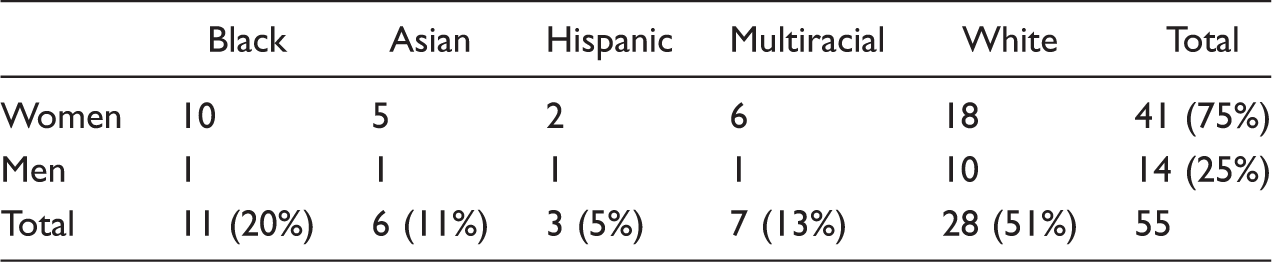
Although we posted flyers in a range of settings to attract a class-diverse sample, our youth workers had high levels of education. According to Cardiff, LaFontaine, and Shaw (2011, p. 37) in 2010, 11% of retail workers had less than high school education, 38% had a high school education, 31% have some college, 15% have a Bachelor’s degree, and 8% have an advanced degree. 4 In our sample, approximately 91% had some college or an Associate’s degree, 7% had a Bachelor’s degree, and 2% had a Master’s. Forty-four of the workers were currently enrolled at a predominantly White public 4-year university, which reflects a middle-class population, who often incur student debt to attend college. Three workers were currently attending a 2-year public community college with working class population, who also incur debt but are more racially diverse. Two were 4-year college students at private institutions that attract more upper-middle-class and upper-class students. Three of those with college degrees were working as managers or assistant managers and the fourth held a lead sales position at the time of the interview. The worker with a Master’s worked part time retail in addition to a professional full-time job. The only systematic differences between student workers and other respondents was that the more educated workers tended to be working as frontline managers. Our sample is then less generalizable to the overall population of retail workers, as they are primarily college students—but still of interest because college students are the target workforce for these youth-oriented niche stores.
Participants received a $15 gift card to an online merchant and an additional $5 gift card for referring other workers. As we could not recruit in the stores, this incentivized respondent-driven sampling widened our access to potential participants. We conducted 49 interviews in person and interviewed six people online using video calls. Most participants worked in the Northeast: primarily Massachusetts, but also New Jersey, Connecticut, and New York; we also interviewed participants who worked in California, Georgia, Michigan, and North Carolina. In most cases, our interview participants held frontline service positions, where the majority of their work consists of customer interactions. We also interviewed seven people who worked primarily in the store stockroom. Of the 55 people, nearly half were currently employed in clothing retail at the time of the interview and the remainder had held a clothing retail job in the past 3 years (usually within the past 6 months). We thus also capture perspectives of workers who turned over and may express more dissatisfaction with retail jobs.
The employment context for these young workers was relatively limited. Some of the workers felt that they had little other opportunity, such as Carmen who argues, “I’m a college student. I’m not qualified for anything else.” Many of the workers had previous experience at other retail jobs (often having a history at multiple stores) or in food service. Some had worked in summer camps, play centers, babysat children, or volunteered. Most continued to work in retail, even after they left retail clothing, and some worked in food service. Others were not currently employed but had hopes for more fulfilling employment opportunities, including internships. For example, Anise notes, “I think my next job will be something where I can do something more meaningful.” Many who had already left clothing retail critique these jobs for the poor working conditions and dubious selling tactics, deciding to leave this work to seek out more career-oriented positions or other entry-level service jobs. Although about half of our sample continues to work in this sector, most are not interested in building careers in retail, viewing these positions as limiting and unable to provide enough income.
Interview duration ranged from approximately 40 minutes to more than 2 hours, with most lasting about 75 minutes. The interview questions spanned workers’ entire employment experience, from hiring, training, and scheduling, to their interactions with customers, coworkers, and managers. The semistructured interview design created space for fluid conversation. Our presentation of these data draws heavily on interview quotes because workers’ voices and their subjective experiences remain underrepresented in existing retail scholarship. All names are pseudonyms.
Data analysis occurred in three overlapping iterations. We initially coded the data set using inductively derived codes developed in relation to our theoretical frameworks of retail labor, service work, and aesthetic labor. Subsequent data analysis involved revising and specifying previous codes, identifying new patterns and contradictions that made us reconsider the findings. This article examines work conditions, consumer identity, and the role of workers’ consumer identities in shaping customer interactions.
Work Conditions in the Clothing Retail Industry
Entry-level sales associates fold and organize clothing, refresh merchandise, and interact with customers. Frontline customer service work in clothing retail largely consists of greeting shoppers, cashiering, monitoring for shoplifting, helping customers find particular items, and promoting sales. We first examine the work conditions in the retail industry, including training, compensation, hiring, and scheduling practices before engaging with consumer identity in this work. Our findings extend previous studies showing that clothing retail work features the major characteristics of bad jobs: little training, paltry wages, and variable scheduling (Bozkurt & Grugulis, 2011; Kalleberg, 2011; Luce & Fujita, 2012). This analysis demonstrates that clothing retail workers critique these poor working conditions, rather than accepting them on the basis of their consumer identities.
Training and Compensation
Sales associates received fairly limited training. Many respondents laughed when we asked about their training experience. Our interviewees describe learning by doing, often during peak hours. Steve explains, “A lot of times they kind-of feed you to the wolves, put you in on Saturday or really busy times.” This type of training confirms that retail employers do not heavily invest in skill development of their workforce, particularly for new hires (Luce & Fujita, 2012; Roberts, 2011; Ton, 2012; Williams & Connell, 2010). While department stores did include more sustained training (Pettinger, 2005; Porter, 1987), most stores use a minimalist training model that directs workers to engage with customers in routinized ways and renders workers relatively disposable (Leidner, 1993; Mulholland, 2011; Warhurst & Nickson, 2007).
As other scholars have shown, retail work is often poorly paid, and workers are scheduled for varying hours, making total weekly wages unpredictable. Our respondents describe similar experiences. The majority of sales associates report that they were paid between $8 and $9 per hour, although department store workers tended to earn more. The sales associates in our sample are almost entirely part time and none receive benefits. Our workers resent these low wages and see the compensation as unfair. As Heather remarks: “It’s just like you’re not compensated for the amount that you do.” Some workers seem to resign themselves to the low wages such as Lillian, who notes, “It’s not a job that someone would try to have if they need to pay for bills etcetera because they will not make enough.” The longer workers have held their retail job, such as Charlotte who reports earning minimum wage for 4 years, the more frustration they express about their treatment. Carmen who had worked in several clothing retail jobs that paid “like nothing,” notes: “It makes you realize how awful these retail jobs are because they don’t pay their employees enough for all the work they do.” As in other studies, many interviewees supplement their jobs with other (often retail) jobs to earn enough money to survive (Jordan, 2011).
Most workers have never received a raise; others received only very small raises. As Glenn states, “Raises were sparse.” Respondents who receive regular raises describe them as minimal. Frank explains, “Like every 6 months or then every year, you get like a raise for 12 cents.” Even for workers with multiple years of experience in their position, raises keep them hovering just above minimum wage. For instance, Marshall confides, “My first year I got . . . like 5 cents. I’m surprised I didn’t quit right then and there. I got 5 cents for the whole year like for a raise, and I thought that was awful, but everyone in my department got that.” Steve, who has an associate’s degree, has spent 8 years at one clothing store and earns only $10 per hour. Many workers express frustration that despite doing good work, they do not receive meaningful financial compensation through raises.
Workers also suggest that stores manipulate staffing to limit pay increases. As Pauline explains, stores sometimes terminate sales associates and then rehire them to avoid giving raises: “That way we’re never technically in the system for when they’re having their raises.” Pauline’s assertion may support the notion that employers prefer student workers (Nickson et al., 2011), in part because they are easier to pass over for raises and other benefits. Other workers report raises as arbitrary or relating to physical attractiveness or friendships with managers, rather than work ethic and performance.
With the exception of two managers and other workers with strong attachments to their employers (often at department stores), workers employed in retail for longer periods (a year or more) appear to be more disenchanted. For example, Carolyn, who has been in her position for 4 years earning $8 an hour, while her employer is in a “slump” and not giving out raises notes, “me and everyone else who had worked there for so long were just so bull shit pissed.” Pauline, who has spent 4 years in retail, when asked whether she would recommend the job to a friend, responds, “If they were a friend? Of course not!” Corinne has spent 5½ years in retail and is relatively happy in her current department store position but says regarding one store where she had worked for 2 years, “I would never tell anyone to work [there]. Ever. Like if they want to keep their sanity.” These workers feel that despite their hard work, their employers do not value them. Overall, our interviewees describe frustration with how they are compensated and treated.
Scheduling
Scheduling is central to narratives of retail employment and appears to be a major factor in the hiring process. Julian, a manager, explains, “I think availability is the biggest reason we would have to rule someone out.” Other researchers similarly find that employers often require flexibility at the point of hire (Henly et al., 2006; Lambert, 2008; Williams & Connell, 2010). This flexibility demand from employers (Clawson & Gerstel, 2014) leads to stress for workers, who also want assurances that they would be regularly scheduled for a reasonable number of hours. As schedules are variable, and often posted less than a week in advance, most workers hope to maximize their hours (and, therefore, wages).
Workers observe a lack of hours throughout their employment in clothing retail. Lance recalls that the worst thing about the job was: “The inconsistent hours, because I really needed the work going into college, like one week I’d get a lot, [but] the next I wouldn’t.” Such scheduling practices reflect strategic attempts to increase profits, where stores and managers increasingly try to attune staffing to match consumer demand (Cauthen, 2011; Henly et al., 2006; Lambert, 2008). Liz explains, “They’re like, ‘We just have a lot of people, so you’re not going to get that many hours’.” Low and unpredictable hours are a challenge for retail workers (CLASP/RAP/Women Employed, 2014; Ruetschlin & Asante-Muhammad, 2015; Traub, 2014).
In the clothing retail market, where there are many workers and too few hours to go around, employers use schedules as a form of compensation—giving the “best” workers the best schedules, even if they cannot substantially raise their pay. Charlotte describes how her manager responded to concerns about her low pay: “‘I try to make up for those things by giving you guys [senior workers] all the extra hours.'” Luce and Fujita (2012) similarly find that rather than competing for promotions or bonuses, retail workers may compete for enough hours to support themselves. Yet, as with raises, some respondents criticize how employers assign hours, suggesting that workers receive more hours if they are friends with the store managers. Brendan recalls: “If our manager didn’t like someone . . . they would definitely not get hours as much.” Some workers also say that rather than firing workers, managers slowly reduce certain individuals’ hours until they quit. Risa argues, “Sometimes I wouldn’t get a shift at all, per week . . . I think that was like their way of trying to make me quit.” Gwen, a manager, explains this practice: People were just taken off the schedule for weeks at a time and they would call and say, “I really need to work, do I have hours this week,” and they’d always say, “I’m sorry, your availability doesn’t match what we need.” . . . Then they’d have no choice but to look for another job.
Not only is scheduling workers a way of rewarding good workers, but it also is a way of cooling out less valued or excess workers. Employers also avoid paying unemployment benefits through these methods.
When employers post schedules also matters (see also Cauthen, 2011; Clawson & Gerstel, 2014; Halpin, 2015; Henly et al., 2006; Lambert, 2008; Luce & Fujita, 2012). Many respondents recall short notice of their work schedules. Pauline remarks, “It was said to be up on Thursday and it wouldn’t come up until like that Saturday, and I’m just like ‘OK, how was I supposed to know I was supposed to work for Sunday if I didn’t get it till like Saturday night?’” Lori also explains the last-minute scheduling process: “The schedule starts Sunday, so Saturday is when you know your next shift, so if you made plans next week you better cancel them.” This creates uncertainty and strain for retail workers, who need to know when they will work and how much money they will be able to earn (Cauthen, 2011).
Just-in-time scheduling requires employers to maintain large numbers of workers in order to schedule people when demand is high without making commitments to workers (Henly et al., 2006; Lambert, 2008). Store managers would contact on-call retail workers or workers would have to call the store and check to see whether they were needed within an hour or two of the shift. Gwen, the manager cited earlier, explains the on-call system: “If they haven’t made a lot of money that day, they’ll be like, ‘Don’t come in.’” Many retail workers juggle multiple jobs, compounding the problems of little advance notice. Stacey remembers how the on-call system “ended up taking away hours from my other job that I could have been working.” This particular tactic reflects managerial attempts to match customer flow with workers and minimize labor costs. But for workers, it means keeping their schedules open from other work commitments and social plans, and more often than not, receiving too few hours. Our respondents describe on-call shifts and other just-in-time practices as deeply disruptive and among the most challenging problems created by their jobs.
Almost all 55 of the interview participants’ voice concern about the variability in their schedules and low wages. Many also identify better schedules as the way employers reward these workers, rather than providing better pay and benefits. They also describe how employers use hours to punish workers, allowing firms to cool out less favored employees and avoid firing workers. Overall, workers describe these retail jobs as including little training, poor compensation, and unpredictable schedules.
Consumer Identity at Work
Shopping for Jobs?
Given such poor conditions, why do these retail workers accept these jobs? Besen-Cassino (2014) argues that youth workers may “shop for jobs” that fit their identities and allow them to get to know other “cool” people (p. 23). While workers at stores that recruit recognize the corporate goal of hiring workers who “fit the brand,” most do not resonate with this idea and simply see their jobs as a way to earn money.
For many of our youth workers, food service or clothing retail was their first job and relatively few had held formal jobs outside of retail. Many workers report that they applied to several positions in person or online, such as Gabe who applied to several youth-focused clothing stores or Stacey who applied to Bath & Body Works, American Eagle, Old Navy, and Marshall’s. As Lori says, “I just went around the mall and applied everywhere. They were the first people to call me.” Similarly, Melissa remembers, “I really just applied anywhere.” These accounts differ from suggestions that workers primarily aim to gain employment at stores where they shop (Besen-Cassino, 2014; Bozkurt & Grugulis, 2011; Gatta, 2011; Huddleston, 2011; Williams & Connell, 2010).
Yet, we also find evidence of hiring criteria that emphasize personality, style, and attractiveness. Employers look for cool workers, even if workers themselves are not entirely focused on finding cool jobs. Interviews determine hiring, as survey research on employers shows (Nickson et al., 2011, 2012; Warhurst & Nickson, 2007). Most respondents see the job interview as giving managers a feel for what they are like but do less to assess work experience. Sabrina recounts that one question posed during her group interview asked about the applicants’ favorite TV show: “The [other] girls would always try and bring it back to like their sales experience and stuff. But I was just like, ‘Well, I like the show House.’ . . . And it just so happened that both of the managers were like obsessed with House.” Managers appear to seek workers who would be pleasant, reliable, and a good fit.
Indeed, some workers say they were store customers before gaining employment, as the literature suggests. For example, Stacey comments: “My mom would take me shopping there so, yeah. That’s definitely one of the appeals of wanting to work there.” Yet in answer to a question of whether workers shopped there before getting their job, many are fairly unenthusiastic. A number of workers mention that they shopped at these stores when they were younger. Anise responds, “When I was like in middle school . . . [but] no, not really. It’s not really my style,” while Gabe explains, “The only time I shopped at American Eagle before I was hired was to buy a shirt for my interview for American Eagle.”
Part of determining fit is assessing whether the workers understand the store’s brand. During interviews, managers quizzed many of the youth retail workers about whether they shop at the store and why they want to work there. This finding fits with previous accounts on retail workers as consumer workers (Besen-Cassino, 2014; Gatta, 2011; Pettinger, 2005; Williams & Connell, 2010). It is important to be able to describe the store, its clientele, and even its merchandise. Carmen says that in her interview she was asked: “‘What do you think the age range is for our store?’ And it was an exact number . . . like 22. I was like, ‘Oh, I thought it was like a range’. She was like, ‘No, it’s 22.’” Thus, the interview operates not only to test the applicants’ knowledge of the store but also to educate potential workers about the brand and its targeted customer base, which management sees as important to providing good service.
Our participants do discuss having the right look to work in youth clothing retail as a job requirement. The stores that recruit workers on the basis of appearance usually have a narrower style and refer to sales associates as models or brand representatives (Williams & Connell, 2010). Anise recalls being approached: “You have a great look; we’re looking for people.” Gwen similarly describes being explicitly recruited for her look: “I remember exactly. She said, ‘You’re pretty and tall. Do you want to work here?’” Recruitment of workers based on their looks is not new to our study (Leslie, 2002; Pettinger, 2005; Warhurst & Nickson, 2007; Warhurst et al., 2000; Williams & Connell, 2010). Yet our respondents criticize these processes. For example, Gwen later comments: “I don’t particularly agree with hiring based on someone’s appearance.” This critique is fairly consistent in our sample, particularly among those who no longer hold these jobs. Current workers who discuss “looking good” as part of their retail jobs are somewhat more accepting of this dimension and say it feels flattering.
While some of our workers were recruited because they have the store look, many more were simply seeking employment. In keeping with previous research (Nickson et al., 2011, 2012; Warhurst & Nickson, 2007), most workers also describe how employers assess whether applicants are a good fit with the store brand, though we diverge with other literature (Besen-Cassino, 2014; Williams & Connell, 2010) in that most of our sample do not report choosing a job because of a strong identification with the store.
Discounts and Identity
Another benefit is employee discounts on merchandise, which might encourage workers to accept lower pay as they receive discounted merchandise (Bozkurt & Grugulis, 2011; Huddleston, 2011; Williams & Connell, 2010). Although most stores do offer employee discounts, these discounts vary widely in terms of both amount and timing. While full-price clothing is too expensive, given low wages, workers often have the first chance to buy clearance items. David states, “I do buy things on clearance because like in the back we have more clearance than we put out, so I get really good deals on like, stuff . . . that customers don’t see.” Our study finds evidence that workers appreciate their discounts but in more nuanced ways than reported in previous scholarship.
While many workers see these discounts as the best part of the job (Williams & Connell, 2010), their positive assessment of discounts should be read in the context of a job where they otherwise feel devalued. When asked, Tia exemplifies this feeling by saying in response to a query of what she likes most about her job: “I guess the discount because I guess a discount is better than nothing at all, but it was still a crappy discount.” Others suggest that they feel that employee discounts treat them as captive markets for unsold inventory. Carl notes: “But that’s things that aren’t selling as well, and they would try to motivate us to buy, instead of the more popular items that are selling.” Our participants exhibit varying levels of interest in the discount, thus calling into question whether youth workers generally place high value on their potential personal consumption within these jobs. Most of our workers do not identify strongly with the store brand of their clothing retail workplaces.
Many interview participants comment that they bought more after getting the job. This increase was partially due to the expectation that they wear the store’s merchandise to work, which can be costly. Bryan argues, “That’s like our uniform, and we’re supposed to like buy it off of them like every season.” Gabe recounts his managers selling to him while he was working a shift, “You would look great in this shirt, you should buy this.” Workers also state that prohibitive costs create problems when the dress code requires that workers wear full-price items. For example, Lillian explains, “You barely make enough money and have most of your pay go towards the clothes that you need to buy.” Trent, who works in a higher-end brand store, further critiques discounts: “That is the biggest problem that we talk [about] amongst staff, because we don’t get enough discount, especially for how much our clothes cost.” Workers largely interpret the requirement to purchase clothing, coupled with relatively meager discounts and low wages, as a burden of their retail jobs.
Overall, workers do not suggest that the clothing discounts compensate for the low wages and poor work conditions of these jobs. This finding contrasts such assertions from workers in other retail studies (Besen-Cassino, 2014; Williams & Connell, 2010). This difference may be because we explicitly asked about discounts or because we included people who have left clothing retail jobs. While our respondents do generally receive and use store discounts—and may even see the discounts as one of the main perks of the jobs—they also express criticisms of how employers use discounts to coerce and manipulate workers into spending at the store. Their questioning of the coolness of the clothes and the jobs themselves appears to increase the longer they work in clothing retail. For many in our sample who have turned over, their disillusionment with the “cool” brand-based work supports their reasoning to leave these jobs.
Expectations for “the Look”
Scholars theorize clothing retail at the nexus of consumption and work by focusing on the labor of “looking good” and “sounding right” (Gatta, 2011; Gruys, 2012; Leslie, 2002; Pettinger, 2005; Warhurst & Nickson, 2007; Warhurst et al., 2000; Williams & Connell, 2010). To do so, they draw on the concept of aesthetic labor, emphasizing the labor clothing retail workers perform with regard to doing customer service and embodying gendered, classed, and racial ideals reflected in the brand or the store’s “look.” In this article, we focus on workers’ consumer identity and the organization of retail work, considering looks as part of this identity. While workers in our sample tend to dismiss the look as an important quality for retail work, they do recognize that customers and managers see their bodies as part of the service experience. For example, Anise notes that management expects workers “to definitely keep our appearance up because . . . you became a part of the brand,” while customers expect workers to be “very modelesque.” Similarly, Carmen says, “You had to embody the lifestyle and sell that, basically.” Workers understand that representing the look of the store is a work requirement, similar to folding and cashiering.
Further, workers’ appearances shape their customer interactions. A handful of workers claim that they enjoy using their look to sell to customers or have friends who see their job as cool. For example, Glenn refers to a customer who told him he looks like he works at Abercrombie, commenting, “I know it sounds bad but that made me feel good.” Yet, he also critiques the store: “It’s bad but you would definitely notice more good looking people would be in the front of the store than in the back.” Jason remembers that customers “expected you to be good looking . . . a lot times people just came in there just to look at the employees.” While some workers acknowledge that having friends associate them with a cool brand is a job perk, many of them do not see it as something that outweighs the negative aspects of these jobs. As Claire says: “Obviously ‘I’m a model at Hollister’ sounds better than ‘I literally serve coffee and hash browns at Dunkin’ Donuts’.” (Laughs.) It’s very different, but I don’t think that makes a difference. I would much rather work at Dunkin’ any other day than Hollister.” Brand association and discounts may lessen some workers’ frustration with the poor working conditions, but for the most part, consumerist aspects do not mitigate their experience of clothing retail as bad jobs. Instead, workers use their own consumer identities to relate to shoppers, deliver customer service, and critique the brands.
Many of the workers see the stores as superficial or promoting harmfully superficial values. Liz, for example, says the store brand “definitely just like makes people who can’t afford or fit into their clothes, that don’t fit into their ideal, feel bad about themselves.” Claire further critiques the way looks shape retail work: “It’s just like really pressuring, and I felt self-conscious all the time . . . It was just really stressful. I didn’t like it.” For some workers, having the look creates anxiety about whether they can maintain it, while also making them feel that they are supporting shallow values that make others feel bad.
Attention to looks may make workers feel good at being seen as attractive but also conjures harsher feelings about undergoing constant appearance-based judgment from managers and customers. Many workers express criticism of these practices. Workers who describe enjoyment of the “looking good” and “sounding right” aspects of their labor come the closest to exemplifying workers who find pleasure in their association with a store brand, but they still remain critical of the practices around the look.
Defining Good Service Through Worker–Consumer Identities
Many of the workers we interviewed describe less self-investment in the brand than we expected, in terms of both how seriously they shop for jobs that align with their consumer identities (Besen-Cassino, 2014) and in how they see discounts as substituting for better wages (Williams & Connell, 2010). Yet, we find that the workers often draw upon their own experiences as consumers in understanding how to provide good customer service. Workers frequently associate themselves with customers to determine how to give the best service, look for meaning and sincerity in their relationships with customers, and use ideas about good service to ignore or challenge managers’ expectations (Bolton & Houlihan, 2010; Gamble, 2007; Korczynski et al., 2000; Leidner, 1993; Lopez, 2006, 2010; Rosenthal, 2004; Sallaz, 2010, 2015).
Identifying With Consumers
Much of what workers say about what constitutes good service reflects their positions as worker–consumers, drawing on their own experiences as customers to think about what they, themselves, seek from retail workers. For example, Kathleen notes, “I just try to be like . . . imagine if it was me in the position, I would definitely want to just see somebody that’s happy, somebody that wants to be, who actually wants to help me, not just trying to make money.” Sherrie similarly finds pushing sales uncomfortable because she dislikes that type of shopping experience: “When I go into a store, I feel so uncomfortable when I can tell someone’s pushing an item on me . . . So I wouldn’t really suggest things to customers unless you could tell they genuinely wanted my help.” These workers identify how to provide good service through reflecting on their own consumer interests.
In fact, these workers often relate to customers in opposition to recommendations from their managers to sell particular items or to chat up customers—tactics that the workers suggest might actually drive customers away. As Hannah describes her experience: At Aeropostale she would always tell us to add as much as you can. Add on, like suggest things that would like, so they’ll buy more. But customers, I find, like no one really wants your help when you’re out shopping . . . so many times I would ask people if they needed help and everybody would say ‘no’ . . . But I mean, like I’m like that when I go into a store, too. I want to be left alone and look for my own stuff.
Much of workers’ perception of what makes good customer service recognizes shoppers’ interests, which often contrasts retailers’ profit motive. For customers, buying clothes is about feeling good through looking good, not maximizing purchases. Melissa recounts: At the end of the day when they leave the store . . . the reason you get this outfit, you want to get compliments, you want to feel good about yourself. But if you’re wearing it and you realize later on that it was really not the best decision. I don’t know, I just feel like you wouldn’t want them to come back. You want [them] to be fully satisfied.
These workers develop their own approaches to assisting customers, which sometimes oppose managerial expectations to get the immediate sale, but which they believe improve overall satisfaction.
Providing Good Service
Workers use a variety of approaches to provide what they see as good service. Many explain that some customers want to be left alone when browsing while others crave interaction. As Antonia argues, “Obviously if you seem like you need help I’ll come over, but if not, then, it doesn’t make sense to me to bombard you with questions and stuff like that.” Charlotte notes that years of retail work taught her that [customers] “expect me to be there when they want my help and to stay away from them when they don’t want it.” Being good at customer service means anticipating the needs of different customers as well as their needs at different moments in the interaction.
Many workers seem concerned with helping customers find flattering outfits, without necessarily spending a lot of money. Brendan describes how providing good service means that shoppers would become repeat customers, and over multiple interactions, he would be able to provide genuine, engaged service: “It felt good to help people find what they want or give them a good deal.” The interaction itself is meaningful, as Carl says: “It’s more about making them happy and representing the product well, not just like pushing sales.” Angela states the importance of relating to shopping on a budget: “I have people who come in, and I’m not afraid to say, ‘Let’s check the clearance rack first.’”
Our interviewee respondents emphasize helping shoppers make reasonable and satisfying purchases as providing good service. Lori says, “Definitely having my customers leave happy is just the goal, for me at least.” Yet, as the qualifier “for me at least” suggests, this goal may contradict the goal of managers, who focus on ensuring a certain amount of daily sales. One worker describes how important it is to help young teenagers find clothing that suit their changing bodies, another discusses the meaning in helping customers choose clothing for major life events, including funerals, and another describes the challenges of helping women who have weight fluctuations feel good about themselves. For example, Rachel references the effects of eating disorders on young girls, arguing: “If I can go to work every day and help people and see their body in a better light . . . then I’ve done my job.” In all of these cases, the workers focus on connecting with customers, rather than maximizing sales.
One particularly challenging part of customer service in clothing retail is in providing feedback that informs their selections without seeming to criticize their choices or bodies (Gruys, 2012). Again, workers would think about their own experiences to shape their notions of appropriate customer assistance. Charlotte states: “I just tell them honestly. Yeah. Because that’s what I would want,” while Anise argues, “I would never interject, because I feel like that’s so rude. But if I was asked, ‘What do you think of this?’ . . . I’d be [like] ‘Oh yea, that looks great,’ or ‘You know what? I think this would look better.'” Kathleen remarks, “I understand I sell clothing, but I would still tell you . . . ‘I don’t like how it looks on you’ . . . I know when somebody tells me something looks nice on me, and I know it doesn’t.” Workers draw on their own customer identities and experiences to inform their understanding of what quality service entails, often highlighting the importance of balancing honesty and consideration.
Some workers vehemently oppose encouraging shoppers to buy more. Sherrie notes her discomfort with up-selling customers, saying, “I don’t like to think of myself as just a selling robot in a store.” Workers thus attempt to maintain their humanity within these jobs by resisting management directives to push sales. As Rachel states, “I’m going to be a friend before I’m going to push my numbers up.” This statement reflects her amicable way of relating to customers, which buttresses her resistance of the managers’ orders to sell more. Carmen recounts a story about a $150 raincoat that had been returned and that the manager really wanted to sell. Carmen did not want to sell the coat, feeling that it was both expensive and poor quality. However, the manager convinced a customer to buy it: Then when [the customer] came up to get it, to ring it up, she was having doubts about it. And, I was ringing her up by myself, and she . . . was like, ‘I don’t know. I have one that looks exactly like it.’ I was like, ‘Then maybe you like shouldn’t get it.’ I basically told her not to get it, and she didn’t get it.
Others are less empathetic and more practical, noting that selling customers clothes that are not flattering would probably lead to returns they would have to process. As Joyce comments, “I definitely want to sell them what they want because I don’t want them to have to come back and make a return, because that would just be a pain.” Others see honesty as avoiding customers from returning irate about a sale, as Pauline explains: “I can’t have somebody coming back and blame me and coming back . . . ‘You told me I looked good in this, but I got laughed at.’” Of course, workers may follow managers’ directions when it is prudent to do so, like Danielle who remembers, “If I was working in close proximity to the managers I’d be like, ‘Yeah, you should really get this because I bet it would look great on you’. Even if it doesn’t.” However, most workers draw upon their experiences as customers to guide their service interactions. At times, this means taking approaches that contradict their managers’ orders.
However, this finding does not suggest that workers identify so much with the customers that they are uncritical of them or never allied with managers. Retail workers had various stories about challenging customers, and many relate to their store managers’ need to sell. Indeed, frontline managers are also frustrated with corporate pressures to sell. Yet, workers’ identification with customers in trying to provide good service complicates previous theorization about the nexus of work and consumption in retail.
Discussion
Entry-level workers’ accounts of retail jobs help clarify the subjective employment experience in this growing low-wage and brand-oriented industry. In their study of retail workers in high-end chain stores, Williams and Connell (2010) find that interviewees’ accounts highlight their consumer-based identities and enjoy the store discount on cool clothes. Besen-Cassino (2014) similarly concludes that student baristas at a chain coffee shop see their labor as expressing their identity, rather than meeting their economic interests as workers.
Yet the young retail workers in our sample identify a host of problems with the organization of the work and the ensuing inequalities. Our participants express frustration about the low pay, unpredictable hours, burdensome cost of clothing, and managerial expectations about selling. While many of the stores that employed our respondents may be culturally cool (Besen-Cassino, 2014; Williams & Connell, 2010), this status does not counteract the poor work conditions found within this industry. These workers also mostly appear to seek these jobs for economic reasons, rather than because they identify with the brand. While workers recognize that employers recruit them for their look, they are generally critical of these practices.
Rather than compensating for the poor work conditions within clothing retail, workers’ consumer identities shape their understanding of good customer service. We find that many workers attempt to provide service that reflects what they prefer as consumers. Workers do not focus on their attachment to the brand but instead think about themselves as shoppers and use those ideas to determine how to provide good service. The retail workers in Williams and Connell’s (2010) study saw themselves as “knowledgeable consumers” (p. 363), with some even suggesting “most people [working] in retail don’t need the money” (p. 365). Our respondents are more critical of the low wages but demonstrate using a consumer orientation to guide their work, even when they do so in ways counter to their managers’ preferences.
This finding allows us to consider how retail workers experience employer–worker–customer relations in the service sector. Customers play a vital and visible role in interactive service workplaces, such as retail. Managers in the stores emphasize providing certain types of customer service—including selling customers and selling the look. Workers, on the other hand, use their own identification with customers to develop other strategies, which they suggest are more meaningful and may create greater customer loyalty. Workers, then, seek to respond to managers and reshape their sales practices in the name of customers (Gamble, 2007).
Conclusion
Similar to previous research (Besen-Cassino, 2014; Bozkurt & Grugulis, 2011; Gatta, 2011; Williams & Connell, 2010), we see these store workplaces as complex environments in which work and consumption intertwine. Yet, our analysis suggests that rather than workers pursuing employment in stores in order to fit their consumer identities and receive a store discount on clothing, retail firms organize and define the work to create and expand upon the consumerist aspects of the employment relationship. Unlike workers in other upscale retail settings, clothing retail workers are encouraged and even required to buy the merchandise that they are selling. While managers and customers may expect retail clothing workers to embody the brand (Nickson et al., 2011, 2012; Pettinger, 2004, 2005; Warhurst et al., 2000; Warhurst & Nickson, 2007; Williams & Connell, 2010), retail firms also treat workers as something of a captive market for the goods, as the store products often double as their “uniform”. In our sample, this practice reflects the employers’ efforts to capture their workers as consumers, rather than the hopes of workers to attain a brand-based job that embodies and indulges their consumer identity. While retail clothing workers may work in stores that resonate with these identities, they do not all see the work itself as “cool” nor the discounts as making up for the meager pay, variable hours, and other dismal work conditions.
Our youth clothing retail workers—who mostly are from middle class or lower middle class backgrounds—appear to be clear-sighted about the problems that sales workers face. The organization of these jobs, particularly the low and stagnant wages as well as the just-in-time scheduling practices, constitutes the major critiques that workers vocalize, even among this sample of mostly college students. Lack of consistent hours and raises leads workers to negatively evaluate the organization of retail work, noting that these jobs do not provide a reliable livelihood. This group not only recognizes the limited prospects of these jobs but also explicitly hopes to find something better after gaining work experience and graduating college. Far from being a reasonable way station for student workers, the low investment that retail employers make in workers, and the perceptions of unfair working conditions and practices, render these jobs unappealing to many.
While our sample supports the argument that student workers are a temporary labor supply for retailers (Huddleston, 2011; Lynch, Price, Pyman, & Bailey, 2011), their accounts also suggest that they dislike these jobs. The more temporary character of their employment in the retail industry—though some have years of experience in retail—lends itself to more critical perspectives for these young workers. Those with limited experience did tend to be more positive. Workers who had spent more years in retail tended to be disenchanted, except for the few long-term workers in positions with career advancement possibilities (e.g., management or department store workers). For the most part, workers suggest that these jobs are not all fun and cool clothes. These jobs are challenging and employees experience them in real economic terms.
Further, we find that workers’ consumer identities do not compensate for the low pay and other work conditions. Yet, providing good service to shoppers is a key aspect of the job. Many of the workers we interviewed draw on their own expectations as consumers to assist shoppers and find meaning in their jobs. Despite directives from managers to push sales, our findings highlight that workers use their consumer identities to resist their supervisors’ orders and do what they think customers want.
This finding contributes to the literature on labor process in service work by illuminating the worker–consumer nexus. Workers’ consumer identities help them define good service and resist certain managerial expectations. Rather than overlooking the poor working conditions in favor of cool clothes, workers recognize the various ways that companies exploit them. Our findings demonstrate that meaningful customer interactions become the main vehicle for workers to maintain a semblance of their humanity despite employer expectations to push sales (Dodson, 2011). Workers appear to rely on their own consumer identities to perform what they view as quality customer service. This may, in part, reflect the lack of formal training that retail employers provide. However, because young workers are new to labor process, they may be able to more readily anchor their workplace performance in relation to customer identities. Navigating clothing retail in this way allows workers to find fulfillment and resist managerial expectations to take advantage of customers.
Our findings depart from previous studies, which may be because we explicitly asked questions meant to explore worker identities in relation to consumption, discounts, and work conditions. Additionally, just over half of our sample had recently left retail work, providing insights into experiences of dissatisfied workers who have turned over. Our work is limited by our attention to a particular sector—clothing retail, and the relatively educated and young nature of our sample. Yet, retail clothing remains a large sector of the labor force, and understanding these workers’ experiences is important.
Our study calls into question employer practices in the retail industry. Employers organize retail work to minimize labor costs despite the negative consequences of low wages and few and variable hours, as well as high turnover for employees and employers alike (Ton, 2009, 2012). Giving workers more stable and predictable amounts of hours, with less variability of timing, would allow for more certainty of income and would not require as many workers to juggle multiple jobs (Cauthen, 2011; CLASP/RAP/Women Employed, 2014). Opportunities for raises, promotions, and career ladders would also strengthen these jobs. Even in consumer-based niche clothing stores, workers’ “uniforms” should be provided, rather than required to be purchased. Improvements to clothing retail jobs would directly impact nearly a million employees, with potential for spillover effects into the wider retail industry. Our findings echo other calls for major interventions into retailer labor practices (Carré & Tilly, 2008; Cauthen, 2011; Luce & Fujita, 2012; Ruetschlin & Asante-Muhammad, 2015; Ton, 2009, 2012; Traub, 2014). The retail industry requires further research and recognition by policymakers, employers, and labor activists as the work-consumption nexus becomes increasingly prominent in the postindustrial economy.
Footnotes
Authors’ Note
In February 2014 and August 2015, an earlier version of this article was presented at the Invisible Work in Visible Work Mini-Conference at the Eastern Sociological Society Annual Meeting in Baltimore, MD, and the American Sociological Association Meeting in Chicago, IL.
Acknowledgments
The authors thank Steven Boutcher, Derek Doughty, Tom Juravich, Eunmi Mun, Yalçin Özkan, Anthony Paik, Donald Tomaskovic-Devey, Editor Daniel Cornfield, and our Work & Occupations reviewers for their insightful feedback on a previous version of this paper.
Declaration of Conflicting Interests
The author(s) declared no potential conflicts of interest with respect to the research, authorship, and/or publication of this article.
Funding
The author(s) disclosed receipt of the following financial support for the research, authorship, and/or publication of this article: This paper was supported in part by a research grant from the Labor Research and Action Network.