




Abstract
This article challenges a key assumption of underemployment scholarship: that the modal underemployed worker is involuntarily underemployed. Drawing from in-depth interviews, the author analyzes one particular type of underemployment: overqualification among college graduates. Findings demonstrate (a) that workers differ markedly in their perceptions of overqualification, (b) that these perceptions create distinct overqualification experiences, and (c) that these experiences vary by social class background. While some respondents report being overqualified at no choice of their own and are struggling to find better work, many others narrate their overqualification experience as voluntary. Among these graduates, who are likely to come from middle-class backgrounds, some understand overqualification as a temporary period of exploration; others think of it as potentially permanent and see themselves as opting out of the typical postcollege career path. Importantly, typical factors that have been analyzed as consequences of overqualification (job dissatisfaction and distress) covary with perceptions, such that the most negative outcomes tend to be among the disproportionately working-class graduates who view themselves as involuntarily underemployed.
Keywords
Since the 1970s, a series of deliberate policy decisions (Madrick, 2012) have resulted in a wide range of changes in the American labor market, many of which have had deleterious effects on workers. Scholars have documented increasing polarization and precarity (Kalleberg, 2011), the privatization of risk (Hacker, 2006) and cultural idealization thereof (Vallas & Prener, 2012), various mismatches between workers and their work (Feldman, 1996; Kalleberg, 2007), and the unequal consequences of precarity for various segments of society (e.g., Gatta, 2014; Williams & Neely, 2015). Among the issues pushed into the foreground of both the popular and scholarly imagination during the Great Recession was underemployment, specifically college graduate overqualification.
In the media, images of the college-educated barista (e.g., Galston, 2014; O’Brien, 2014) became ubiquitous, and doomsday headlines such as “Is the Economy Creating a Lost Generation?” (Samuelson, 2012) and “The Economy Is Still Terrible for Young People” (Thompson, 2015) continue unabated. And while scholars have written about underemployment for a number of decades, the years following the recession saw a resurgence of interdisciplinary interest in the topic, including the publication of a bevy of review articles and programmatic statements (Kalleberg, 2007, 2008; Liu & Wang, 2012; Maynard, 2011; McGuinness, 2006; McKee-Ryan & Harvey, 2011; Peiró, Hernández, & Ramos, 2015; Scurry & Blenkinsopp, 2011) and a scholarly handbook (Maynard & Feldman, 2011).
In the broadest sense, underemployment is defined as “working in a job that is below the employee’s full working capacity” (McKee-Ryan & Harvey, 2011, p. 963) or when there are “mismatches between individuals’ human capital, their expectations and preferences, and their job characteristics” (Kalleberg, 2007; Peiró et al., 2015, p. 83). Recent reviews of the interdisciplinary literature by scholars from a number of disciplines are remarkably consistent in their perception of the field. Among the aggregate findings is that underemployment is costly for organizations and employees, alike. Review authors also agree on areas in need of further development, including qualitative work on the experience of underemployment and how it is perceived by workers. More specifically, scholars have called for research on sensemaking among underemployed workers (Scurry & Blenkinsopp, 2011), the meanings underemployed workers apply to their jobs (Maynard, 2011), and relationships between underemployment and life goals (McKee-Ryan & Harvey, 2011).
Perhaps most importantly, review authors agree that a general lack of a sociocultural perspective in the literature has left fundamental assumptions of the literature unexamined. Driven by human capital theory (e.g., Becker, 1964, 1993), 1 most studies assume that workers become underemployed involuntarily and that if not for circumstances beyond their control, such as labor market dynamics and economic fluctuations, they would be more adequately employed (McGuinness, 2006; Scurry & Blenkinsopp, 2011). Recognizing the significance of this assumption, scholars have repeatedly called for scholarship on the role of volition in underemployment. Noting that some workers may place a premium on job characteristics other than pay, full-time status, or skill utilization, McKee-Ryan and Harvey (2011) “call for studies that more fully incorporate the role of choice into the underemployment question by examining the motivation of such choices” (p. 989, emphasis added). Scurry and Blenkinsopp (2011) note that “an assumption that graduates will always strive to avoid underemployment” (p. 646) pervades the literature. They call for research on perceptions of underemployment as voluntary or involuntary and how such perceptions shape the underemployment experience.
In this article, I draw from in-depth interviews with a sample of recent college graduates to respond to these repeated calls. I analyze worker perceptions of a particular type of underemployment: graduate overqualification, or the state of a degree-holder working in a position that requires less than her or his achieved level of education (Feldman, 1996; Kalleberg, 2007). The involuntary assumption has been pronounced in overqualification research, as scholars tend to assume that educational overqualification is transitional, a temporary experience that will end once a worker finds or is promoted into a position that matches her or his level of education (Mason, 2002; Scurry & Blenkinsopp, 2011). Researchers have posited a number of possible reasons why workers may choose to work in positions for which they are overqualified (Blenkinsopp, Scurry, & Hay, 2015; Brynin, 2002; Elias & Purcell, 2004; McKee-Ryan & Harvey, 2011), but these suggestions have rarely been empirically examined (Scurry & Blenkinsopp, 2011).
To conceptualize what alternatives to involuntary graduate overqualification might look like, I draw from scholarship on transitions to adulthood. Scholars have amassed an impressive array of evidence demonstrating that the transition to adulthood has lengthened, as millennials, on average, are prolonging their transitions into traditional adult roles (e.g., Settersten, Furstenberg, & Rumbaut, 2005). Yet, considerable disagreement remains over the causes of these changes (i.e., whether they are due to cultural or economic conditions) and whether they represent a new stage of the life course or a type of exploration that only the privileged are able to experience. These debates parallel the scholarly conversation over the in/voluntary nature of graduate overqualification and thus provide a substantive framework for examining potentially voluntary overqualification among young adult workers.
Findings demonstrate that overqualified graduates are a diverse group, many of whom perceive their overqualification as a voluntary state. More specifically, I argue that the perceptions graduates hold of their overqualification generate distinct underemployment experiences. Those who view overqualification as involuntary typically think of their experience as a struggle, as they desire degree-commensurate employment in the present and expected to obtain it upon graduating from college. The experiences of these graduates most closely match the involuntary assumption that has driven the literature, and negative consequences that have been linked to overqualification (job dissatisfaction and distress) are most evident among this group. Importantly, graduates who experience their overqualification in this way are likely to come from working-class backgrounds.
However, the experiences of other graduates do not so neatly reflect prevailing assumptions. Indeed, more than half of the sample perceive their overqualification as a voluntary state. Some of these graduates believe overqualification to be temporary. These respondents resemble the young adults that have been described as “emerging adults” (Arnett, 2015). Long term, they want traditional careers that make use of their degrees and expect to obtain them but are presently focused on such things as self-exploration and finding their passions. Yet, others who understand their underemployment as voluntary believe it to be longer term or potentially permanent. These graduates describe their experiences as opting out of the pathways typically expected of college graduates and have no intentions of one-day settling into a traditional career. Compared with those who are involuntarily underemployed, both types of graduates who perceive overqualification as voluntary report lower levels of job dissatisfaction and distress. Importantly, they are likely to come from middle-class backgrounds.
Overqualification
Given the broad definition of underemployment mentioned earlier, the phenomenon can take many forms, ranging from educational and credential overqualification to involuntarily working part-time hours (Feldman, 1996; Kalleberg, 2007). In this article, I am concerned specifically with underemployment with respect to educational attainment, which has been variably referred to as overqualification, overeducation, educational mismatch, graduate underemployment or overqualification (in the case of college graduates), or oftentimes, simply underemployment. Throughout this article, I opt most frequently for the terms overqualification and graduate overqualification, although others appear in various locations for stylistic purposes. In all cases—unless otherwise noted—I am referring to the situation in which a college graduate is working in a job that does not typically require a college degree.
While rates of graduate overqualification can be difficult to pin down due to measurement difficulties (McGuinness, 2006; Scurry & Blenkinsopp, 2011), analyses by the Federal Reserve Bank of New York (Abel, Deitz, & Su, 2014) suggested that in 2012 some 40% of college-educated young adults between the ages of 22 and 27, and more than 30% of all college graduates, were working in jobs that do not typically require college degrees. Further, while overqualification has grown even in good economic climates since the 1970s (Vaisey, 2006), its nature has changed in important ways since the economic downturns of the 2000s. More specifically, the quality of jobs held by underemployed college graduates has slipped. Fewer overqualified graduates are working in “good” noncollege jobs that pay well and have the potential to develop into a career (e.g., lab technicians, skilled tradespersons), and more are working in low-wage jobs (Abel et al., 2014).
Scholars have argued that the prevalence of overqualification is problematic on a number of levels. Widespread overqualification represents a threat to national welfare as the underutilization of workers results in “billions of dollars in lost productivity” (Kalleberg, 2008, p. 37; McGuinness, 2006). Overqualification is also costly for employers because it is associated with job dissatisfaction (Burris, 1983; Feldman & Turnley, 1995; Nabi, 2003), lack of affective commitment to work (Maynard, Joseph, & Maynard, 2006; McKee-Ryan, Virick, Prussia, Harvey, & Lilly, 2009), high levels of turnover (Alba-Ramírez, 1993; McKee-Ryan & Harvey, 2011; Tsang, Rumberger, & Levin, 1991), counterproductive work behaviors (Liu, Luksyte, Zhou, Shi, & Wang, 2015), and possibly even lower productivity (Tsang, 1987). 2 At the societal level, high rates of overqualification (and the related issue of credential inflation) may further entrench patterns of social inequality (Bourdieu, 1984; Vaisey, 2006). Being overqualified has costs for individual workers, too, the most obvious of which is a substantial wage penalty of between 8% and 27% (McGuinness, 2006) that tends to linger throughout careers (Korpi & Tåhlin, 2009). Further, workers who perceive themselves to be overqualified report higher levels of depression and psychosomatic symptoms than others (e.g., Bolino & Feldman, 2000; Johnson & Johnson, 1992, 1996; Johnson, Morrow, & Johnson, 2002).
Despite some research pointing to high rates of job mobility (e.g., Alba-Ramírez & Blázquez, 2003), intentions to leave (Hersch, 1995; Robst, 1995), internal promotions (Dekker, de Grip, & Heijke, 2002), and employer intentions to more fully utilize overqualified workers (Bills, 1992) as evidence that overqualification may be short-lived, recent research suggests that the experience and its costs are more persistent (Dolton & Vignoles, 2000; Frenette, 2004; Wilkins & Wooden, 2011). High rates of job mobility among overqualified workers seem to be due largely to workers switching between positions for which they are overqualified, rather than finding work that better matches their skills (McGuinness & Wooden, 2009). This makes unlikely the possibility that the bulk of overqualification reflects “stop gap” employment (Cassidy & Wright, 2008) or “career indecision” (Feldman, 2003).
As with the underemployment literature as a whole, research on graduate overqualification tends to adopt the assumption that graduates are overqualified involuntarily (Scurry & Blenkinsopp, 2011). While often left implicit (McKee-Ryan & Harvey, 2011), most studies are undertaken with the assumption that individuals make decisions about human capital acquisition based upon expected returns. College graduates are expected to seek to maximize the return on their degrees. Thus, scholars tend to begin with the notion that overqualification is a “transitional phase for graduates” that allows them to get a “foot in the door” to avoid unemployment (Scurry & Blenkinsopp, 2011, p. 649). Once in a position for which they are overqualified, graduates are then expected to strategize to find more adequate work or be promoted into a position that matches their level of educational attainment (Mason, 2002; Scurry & Blenkinsopp, 2011).
Similar assumptions are also found in earlier social research and theory, which was largely inspired by Marxist principles (Burris, 2005; Vaisey, 2006). Many of these studies predicted that overqualified workers would become alienated and radicalized, having followed normative pathways that were supposed to bring them success (e.g., Berg, 1971; Blumberg & Murtha, 1977; Derber, 1979; Gorz, 1967). Thus, similar to contemporary research in management and employment relations, these social perspectives generally assumed that workers became overqualified involuntarily.
While very little empirical research has explored the possibility, a number of researchers have acknowledged the possibility that some individuals may choose to work in jobs that do not fully utilize their education (Brynin, 2002; Scurry & Blenkinsopp, 2011). Such heterodox suggestions, which have rarely been explored (Scurry & Blenkinsopp, 2011), include the possibilities that some workers may choose to be overqualified due to “lifestyle” choices (Elias & Purcell, 2004), in the hopes of establishing an “authentic” career (Blenkinsopp et al., 2015), or to find meaning in or make a difference through their work (McKee-Ryan & Harvey, 2011).
In a review of the literature on graduate underemployment, Scurry and Blenkinsopp (2011) persuasively argue that research is needed to determine whether the involuntary underemployment assumption is warranted. Among their reasons for skepticism is that college graduates are increasingly heterogeneous in both social background and area of study, such that their employment expectations cannot be taken for granted. In addition, they cite research (Terjesen & Frey, 2008) that suggests the millennial generation increasingly values work–life balance. I explore these possibilities through an analysis of in-depth interviews with graduates from a large, Midwestern university. Before outlining research design and method, I briefly set the context for the study by describing broad social changes influencing the lives of young Americans as they transition from education to work.
The Social Context: Millennials, Adulthood, and Work
A vast body of evidence now makes clear that the transition to adulthood, on average, looks different among millennials than prior generations. While scholars disagree markedly regarding the causes, implications, and universality of “emerging adulthood” (Arnett, 2015), there is a general consensus that millennials are taking longer to transition into traditional adult roles, such as marriage, childbirth, and stable, career-type jobs—if indeed they transition into those roles at all (e.g., Settersten et al., 2005). Further, the path to adulthood has become quite individualized, such that scholars recognize that it is more accurate to talk about transitions to adulthood in the plural (e.g., Settersten & Ray, 2010).
While these changes are well-documented, there is little consensus about what they mean. Explanations tend to come in two stripes, emphasizing either value change or structural factors. Psychologist Jean Twenge has been the most prominent academic advocate of the value change perspective. Having coined the term “Generation Me” (Twenge, 2006), she has argued that millennial goals and values differ markedly from their parents and grandparents. Among her findings is that millennials are more interested in leisure and less interested in work than prior generations (Twenge, Campbell, Hoffman, & Lance, 2010). This perspective might expect these values, coupled with self-absorption and entitlement, to cause young adults to privilege self-exploration over traditional success or to be unwilling to do the work necessary to become traditionally successful. A more optimistic perspective also centered on value change (e.g., Howe & Strauss, 2000) emphasizes the progressive cultural environment millennials were raised in and their general optimism toward the future. This perspective might similarly expect graduates to be less interested in occupational success, but due to values that challenge the capitalist work ethic rather than self-absorption.
A vastly different perspective focuses on changing socioeconomic conditions (e.g., Bynner, 2005; Côté & Bynner, 2008; Danziger & Ratner, 2010). This perspective holds that millennials are transitioning from education to work (and from youth to adulthood, more generally) differently from prior generations, in part, because their lives are unfolding in a very different social and economic context. According to this logic, delays in the transition to adulthood (e.g., independent living, marriage) reflect grim labor market prospects for members of the millennial generation. That is, the changes are involuntary, rather than due to shifting goals and values. The expectations of this perspective would thus align with the prevailing assumptions of underemployment scholarship.
A related perspective points to a complex interplay between changing youth orientations and the broader socioeconomic context. Sociologist Jennifer Silva (2012, 2013, 2014), for example, has persuasively argued that orientations that de-emphasize traditional markers of adulthood in favor of increasingly individualized pathways should be understood as a reasonable response to a socioeconomic context that is not conducive to the attainment of traditional milestones. This perspective combines aspects of those discussed earlier in that it embraces the notion that the goals, values, and orientations of young adults have changed, but it ascribes them to socioeconomic change rather than self-absorption (Twenge, 2006) or youthful naïveté (Arum & Roksa, 2014).
In brief, the literature on transitions to adulthood among the millennial generation raises the possibility that high rates of graduate overqualification may reflect not only changing economic conditions, but changing cultural conditions as well. Indeed, expectations derived from these perspectives run the gamut from graduates struggling to find traditional, occupational success in difficult economic times to graduates unconcerned with traditional milestones because they are directed by a different set of goals altogether. They thereby further problematize the assumption that graduate overqualification is, by default, an involuntary experience.
A related issue is whether the emerging adulthood phenomenon, in which young adults delay transitions into adult roles because they are busy exploring their passions (Arnett, 2015), is applicable across the social class spectrum. In other words, scholars disagree on whether there are different causes for delayed adulthood in different segments of society. As a leading proponent of the theory, psychologist Jeffrey Arnett (2015) has argued that social class differences in the experience of emerging adulthood are minor and that the vast majority of twenty-somethings, regardless of social positioning, experience young adulthood as a time of self-exploration. Yet, some scholarly evidence indicates that young adults from less privileged backgrounds may not be afforded the same opportunities to explore and pursue alternate pathways. Bynner (2005) has shown that, in the UK, many of the markers of emerging adulthood (e.g., extended higher education) are less applicable to young adults from lower socioeconomic backgrounds. In a study of early-career jazz musicians in London, Umney and Kretsos (2015) demonstrate that the ability to pursue a heterodox career path like music depended in large part on access to parental support. Similarly, Silva (2012, 2013) demonstrated that among working-class young adults who faced limited opportunities, de-emphasizing occupational success as a measure of self-worth was only effective among respondents who had social network contacts who supported such a reassessment. Thus, an additional contribution of the article is an analysis of whether and how perceptions of overqualification vary by social class background.
Data and Method
Study Design and Data Collection
Data for this study consist of 36 in-depth, semistructured interviews with overqualified recent college graduates from a large, public university in the Midwest (hereafter Midwest University or MU). I define overqualified recent graduates as persons who graduated from college in the years 2011–2013 and are working in jobs that do not require college degrees.
To identify and recruit participants, a brief, online survey was sent to 2011 and 2013 alumni of MU’s College of Arts and Sciences (COAS) via the university’s alumni directory. COAS offers a wide range of majors, ranging from Folklore to Biochemistry; yet, they hold in common a liberal arts curriculum. Targeting COAS graduates allowed me to hold relatively constant the meaning of the degree received, particularly compared with students in more specialized programs, such as MU’s business and education schools, who are more likely to be training for particular jobs.
Responses to questions about job title and duties were used to identify overqualified graduates, as well as an item that asked directly: “is a college degree typically required for your job?” Such self-reports of overqualification are one of several established methods of measuring the concept in quantitative studies (Halaby, 1994; Vaisey, 2006). I targeted as potential interviewees those who, based upon information available in the screening survey, were clearly working in jobs that do not typically require degrees, who were not pursuing another degree at the time, who were not above the age of 33 (millennials were born between 1982 and 1999; Twenge et al., 2010), and who indicated interest in being interviewed.
In total, 255 of 1,166 total respondents answered that they were working in jobs for which college degrees were not typically required. Of these, 60 were pursuing another degree, 9 were older than 33 years, 9 were not actually employed (per answers to a separate question about employment status), and 37 were not willing to be interviewed. These respondents were not considered for follow-up interviews. For the remaining 140 respondents, I carefully reviewed and triangulated the information respondents provided about their job titles and duties to determine eligibility for the interview.
The heterogeneity of jobs held by respondents who indicated that they were working in a position that did not require a college degree underscores the difficulty of measuring overqualification in fixed-response surveys (Scurry & Blenkinsopp, 2011). Twenty potential interview-eligible respondents were working in jobs that their degrees clearly prepared them for that nevertheless did not technically require a degree. For example, two of these respondents had earned BFA degrees in photography and were working as photographers, a ballet dancer had earned a degree in ballet, and several Criminal Justice majors were working in law enforcement. Four respondents had joined the military or were working for AmeriCorps or Teach for America. An additional 13 respondents seemed to have interpreted the question about degree requirement as a question about whether they were working in the field they had earned a degree in, rather than whether a degree was typically required for their position. For example, an Anthropology major was working as a corporate trainer, and a Biology major was working in corporate real estate. Seven respondents owned their own businesses, including a Graphic Design major running a graphic design business and a Political Science major who owned and managed a franchise business. An additional 10 respondents appeared to have simply answered the degree requirement question incorrectly, as the information they provided about job title and duties made clear that they were working in jobs that required degrees. For example, a Spanish major was a Digital Planner and Marketing Coordinator for a major, Spanish-language television network, and a Political Science major was Director of Policy at a nonprofit. These respondents were not considered as potential interviewees.
After triangulation of all information available from the screening survey, 86 respondents were targeted for interviews. I initially extended interview invitations to 48 overqualified graduates who lived within a 2-hour radius of MU. Of those, 27 agreed to meet for an in-person interview. The remainder either responded that they were too busy or simply ignored repeated attempts to contact them via email, telephone, and text message. I then sent invitations for telephone interviews to overqualified graduates living in other parts of the country. This yielded an additional nine interviews. This second round of data collection served the dual purpose of extending the sample and countering the potential bias of not including those who had moved further away from MU (or those who had come to the university from out of state). Interviewees received an honorarium of $10 as a token of appreciation.
Interviews were conducted from January to July 2015. The majority (27) were conducted face-to-face in locations within a 2-hour drive of MU, including the college town itself, a nearby major city, and a nearby minor city. These interviews took place at locations of the respondents’ choosing, including coffee shops, food courts, and a public library. The remaining nine interviews were conducted over the telephone with graduates from around the country, including major East and West Coast cities, as well as noncoastal cities and more rural parts of the country. Interviews averaged almost an hour and a half.
Roughly speaking, the interview guide proceeded chronologically through respondents’ lives. The primary goals of the interview questions were to understand how graduates assigned meaning to their employment experiences and constructed aspirations for the future, as well as how those meanings may be rooted in their social backgrounds. The guide opened with questions about the past, including social background, the decision-making process that preceded college, the college experience, and experiences on the job market. Examples of questions from this section include the following: Can you walk me through your experiences on the job market since you graduated from college? How long do you plan to stay at your current job? Are you looking for other work? How many jobs would you say you’ve applied for? What types of work are you pursuing or considering pursuing? What do you do to find job openings? It then drilled down into the present, with a series of questions about respondents’ present work and financial situations. This section of the interview guide also included questions about job search strategies, work identity, social comparisons, and adulthood. The following were representative questions: What, if anything, is most rewarding about your current job situation? What bothers you most about it? At this point in your life, do you consider yourself an adult? The final section was more future-oriented and included questions about conceptions of success and life goals. Questions in this section included the following: Is having a career important to you? How would you define career? What does success mean to you? The interviews were semistructured, open enough for respondents to introduce topics not explicitly covered on the interview guide and to tell their narratives as they saw fit, but sufficiently structured to make sure all key questions were asked.
In a number of important ways, the composition of the sample reflects patterns among overqualified college graduates more broadly. Employed in a wide range of industries—ranging from human services (e.g., as direct service providers) to food and retail (e.g., as baristas and sales associates), office work (e.g., as receptionists) to call centers—the jobs held by respondents in this study generally reflect the occupational distribution of overqualified graduates in the United States (Vedder, Denhart, & Robe, 2013). Further, scholars have estimated that approximately one fifth of overqualified, recent college graduates are employed in low-skill service jobs (Abel & Deitz, 2015). My sample reflects this reality, as 25% of respondents were working in these types of jobs. In terms of college major, research shows high overqualification among two types of majors: Liberals Arts and General Business (Abel & Deitz, 2015). The former were the subject of this study, and findings are thus more likely generalizable to that group than to General Business majors. (Future research would do well to examine the experience among Business graduates.) Within the broad umbrella of Liberal Arts majors, respondents’ fields of study generally reflect broader trends. The 36 respondents in this study graduated with degrees in 18 separate fields. With just two exceptions (Biology [N = 4] and Economics [N = 1]), recent graduates in these fields experience overqualification at a rate of 50% or greater (Abel & Deitz, 2015). So in terms of job type and college major, respondents are fairly typical of overqualified recent graduates more generally.
Respondents also share several key characteristics with the broader millennial generation. Most basically, respondents ranged in age from 22 to 31, with an average age of 25, and as such are clear members of the generation. In addition, approximately 40% of millennials between the ages of 18 and 25 have moved back home with their parents for a period of time (Arnett, 2015). A comparable share of my sample (33%) have shared this experience. And consistent with the national median age at first marriage approaching 27 (Arnett, 2015), only a small share of my sample (11%) were married. (An additional two identified as lesbians and were living with partners they planned to spend their lives with, raising the share of respondents in marriage-like situations to 18%.) These similarities signal that, in terms of transitioning into important adult roles, my respondents are typical of the millennial generation.
In other ways, respondents are less typical of overqualified college graduates and millennials. For example, the sample is relatively racially homogenous, compared with the millennial generation as a whole, 3 and respondents graduated from just one type of institution in one American region. In addition, women are overrepresented in the sample. 4 I discuss these issues further in the conclusion.
Analytic Strategy
With the permission of interviewees, all interviews were recorded, then transcribed verbatim and verified. I personally conducted all of the interviews and either transcribed or verified each so as to revisit the conversation before beginning systematic analysis. As a first round of analysis, I conducted line-by-line, open coding of the transcripts, identifying key themes and patterns as they emerged from the data (Charmaz & Belgrave, 2002). For this step of the analysis, I used QCAmap, an open-access, web-based, qualitative data analysis program that facilitates coding and extraction of key data points (Mayring, 2014). As part of this first stage of analysis, I also wrote analytic summaries of each transcript so as not to isolate codes from the rich context in which meaning-making took place (Biernacki, 2014). It was during this initial round of analysis that it became clear that graduates’ experiences were quite diverse.
In a second round of focused coding (Charmaz & Belgrave, 2002), I sought to delineate the dimensions along which respondents’ experiences and perceptions differed, including whether respondents perceived their overqualification as voluntary or involuntary and as temporary or potentially permanent. Respondents, who, in telling their stories, conveyed that they never sought degree-commensurate employment after graduating were coded as perceiving their overqualification as voluntary. Those who tried unsuccessfully to find such employment were coded as perceiving their overqualification as involuntary. Respondents whose plans included clear aspirations to find degree-commensurate employment were coded as temporary because they perceived themselves as temporarily overqualified. Those whose aspirations did not include goals that were likely to involve degree-commensurate employment were coded as potentially permanent. As a final step in this second round of coding, I read transcripts for job dissatisfaction and distress, which have been studied as consequences of underemployment.
Two data arrays (Abramson & Dohan, 2015; Bernard & Ryan, 2009), presented as Figures 1 and 3, were then developed to identify covariation between these consequences and (a) perceptions of overqualification and (b) social class background. Consistent with research on culture and inequality, I operationalize social class background using parental education and occupation (Aschaffenburg & Maas, 1997; Calarco, 2011, 2014; Condron, 2009). Respondents were coded as middle class if they have at least one parent with a college degree and professional career and working class if they do not.
5
The sample is roughly evenly divided by social class background, with similar numbers of respondents coming from middle- (N = 20) and working-class (N = 16) backgrounds.
Data array: consequences by overqualification perception. Note: Darker shades indicate more negative outcomes. Overqualification Perceptions, by Social Class Background (N = 36).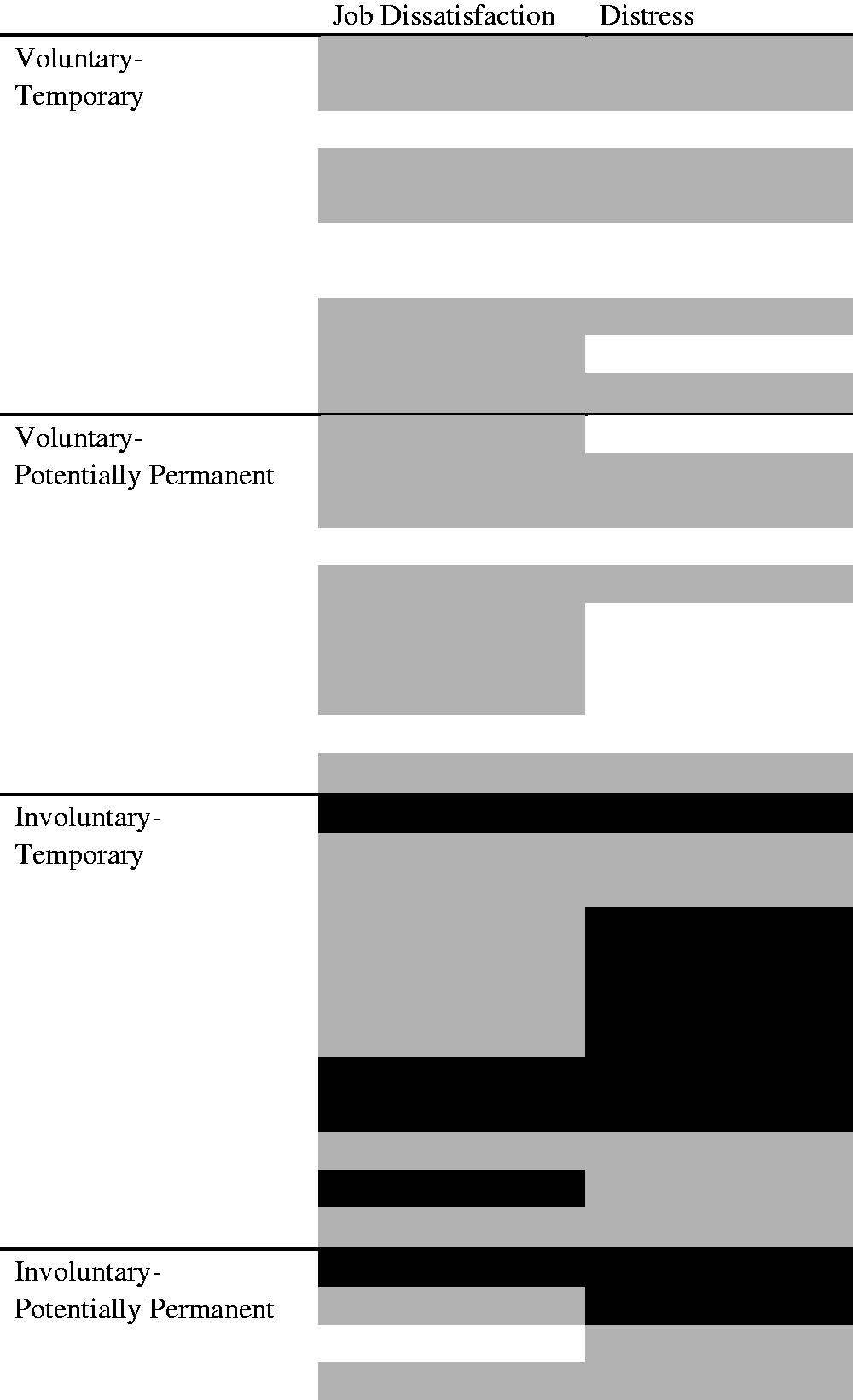

Among the benefits of data arrays is that they can summarize massive amounts of data (such as the approximately 1,000 pages of interview transcripts used in the present study) in a compact and interpretable figure. Analytically, this provides the advantage of being able to clearly see patterns that may otherwise be obscured in complex, textual data. The data arrays in this study display individual respondents as rows and job dissatisfaction and distress as columns. In Figure 1, individuals are categorized by overqualification perception (voluntary-temporary, voluntary-permanent, involuntary-temporary, and involuntary-permanent) to visualize how the consequences of overqualification vary with perceptions. Figure 3 categorizes individuals by social class background. In the arrays, darker shades represent more negative outcomes, such that black represents those most dissatisfied with their jobs and those who report the highest levels of distress as a result of their employment. More extensive discussions of what exactly shades designate and how they were determined are included in the findings section for both of the consequences.
Findings
Perceptions of Overqualification
Perceptions of Graduate Overqualification.

Involuntary Overqualification
While the majority of scholarship on overqualification proceeds as though workers are overqualified involuntarily, less than one half of respondents narrated their experiences in that way. These respondents reflect prevailing assumptions in that they generally graduated from college and sought work commensurate with their degrees: As soon as I graduated I was applying to a lot of science jobs. But the feedback I was getting is I didn’t have enough experience for entry-level jobs, which was frustrating to me because the way I look at it is how do I get experience if I need experience to get experience? (middle-class female; Biology; working as office worker for leasing company) It was cold. I must have sent out over 100 applications … I kid you not, I was sending applications out to everybody and my main problem was they all wanted experience. (middle-class male; Telecommunications; working as line cook)
6
Mostly internet-based. MU has their site, I was there a lot. I was constantly checking that. I was on several different online sites, Monster, Career Builder, I occasionally check the classifieds, but I never really found much there. I reached out to some of my, like my old boss … who said she would let me know if she found anything or she gave me a couple recommendations … I also talked to a lot of my old co-workers who went to other companies, a little bit of networking. I spoke with my great uncle, who knew a couple of people at the education school at Midwest University. I was on LinkedIn and I made sure that was all up to date, networked a little bit that way … (working-class female; assistant retail manager) I would seriously be driving around if I saw a van with like such and such lab, wrote it down, looked “em up. I mean that’s—even with some billboard or something. I would drive around and if I saw the name of the company that I’m like, ‘I’ve never heard of that.” Google it … (working-class female)
With only four exceptions, graduates who narrate their overqualification as an involuntary experience also see it as (hopefully) temporary. In other words, they have clear aspirations to climb their way out of it and find work that requires a college degree. For some, like a Sociology major who moved across the country in search of a research career, this means persisting on the path he has been on all along. He described his goals: Getting a basic, entry-level job. Like if I would stay there for the next 5–10 years, right now I would be happy with that. Doing research for the next 5–10 years, even in that position I feel like I would still be happy … I would like to work up levels in the job to become like a senior researcher. (working-class male; working as a barista)
A few graduates reported having become overqualified involuntarily but now think of their situation as potentially permanent (N = 4). These respondents either had abandoned their hopes of degree-commensurate employment for practical purposes or had found meaning in the line of work they ended up in. For example, a Human Biology major working in a hospital’s supplies department sought to alleviate her financial hardships by obtaining an Associate’s degree in surgical technology: See, I’m doing it backwards. Most people go through Associate’s then Bachelor’s. I’m going back from Bachelor’s to Associate’s. (working-class female) I don’t know necessarily about long-term, like I don’t see myself working there forever, but since I started working there, I’ve considered getting my CNA license. (working-class female)
Voluntary-Temporary Overqualification
In contrast, slightly more than half of the sample narrated their postgraduate experiences as though they had become overqualified voluntarily. Importantly, analyses revealed two distinct types of graduates who see their overqualification as voluntary: those who believe it to be temporary and those who see it as potentially permanent. Both types narrated their underemployment as though it has always been a part of some longer term plan.
In this section, I document the perceptions of respondents who see their overqualification as both voluntary and temporary. These respondents accounted for just over a quarter of the sample. Many understand themselves to be in a period of exploration before moving on to a more serious career. When asked to describe her experiences on the job market after graduating, a Communications major talked primarily about choosing where to live rather than finding work: I was actually looking to move outside of [the state]. And so I went to Austin, Texas for a week and kind of looked at the city and tried to see if that was some place I wanted to go. And I ended up not moving there because I didn’t know anyone and didn’t have a job and so I just felt like that was a really gutsy, jumpy move to do. I think right now I really am focused on what I need in life to be happy and working on [finding] a career that I really, really love and that totally shapes me as a person. (middle-class female) Really, I was just kind of floating—I have to say I was just kind of floating by life. I hadn’t really put a lot of effort into applying for jobs ‘cause I just had no idea. And I thought maybe I was going to go to Europe. (middle-class female; temporary position in pharmaceutical office) By the second semester of junior year, I was just so burnt out that I decided that med school was not the right option for me. So I looked into the field of physician’s assistant instead, so I kind of decided to go that route. And then after graduating … I obtained my license to be a certified nursing assistant, which I just did through a local program, you can get that at a community college or through a technical school … Because to get into PA school, you are required to have so many hours of direct patient care. (middle-class female; working as certified nursing assistant) I can’t actually remember a moment where I decided. I sort of just resigned myself to that when I studied science. You almost can’t do anything with a degree in science unless you have higher education, it seems. It has always been a future endeavor in my mind. (middle-class female; working as part-time blogger and barista)
Unlike the graduates in the voluntary-permanent category discussed in the next section, those who perceived overqualification as voluntary but temporary all aspired to careers that would make use of their degrees. A Linguistics major explained that he had not tried to find a degree-commensurate job after graduating. Instead, he saw this as a transition phase: I enjoy [college town]. It’s a wonderful town for what it is with all the opportunities from the university, culture and event-wise … But I never intended it to be a permanent place for me. I saw myself as sticking around for a couple of years and having this as a job for a couple of years, and then moving on to establish more of a career. (middle-class male; office assistant)
Respondents in this category often made clear that they planned to establish the sorts of careers typically expected of college graduates, when I asked, “So in the grand scheme of things, how important is having a career?” One Psychology major answered, I’d say it is pretty important in the grand scheme of things … I think a career is not necessarily one job or one placement, but it’s in a field. I think you can build like your human services career, from being what I do to being a case manager … you can grow. (middle-class female)
Voluntary-Potentially Permanent Overqualification
The final set of respondents (just more than a quarter of the sample) also see their overqualification experience as voluntary but have no clear intentions of establishing careers that would make use of their degrees. This group is diverse, as some graduates base their decisions not to pursue traditional careers on political or moral convictions, while others opt for meaningful work regardless of its educational requirements, and yet others simply prioritize aspects of life above work. Yet, as a whole, the experiences of graduates who fall into the voluntary-potentially permanent category can be characterized as value-based underemployment.
As with voluntary-temporary respondents, these graduates did not report undergoing major job searches after college. A common theme was working in a job that had “just presented itself”: I would say both positions just kind of presented themselves to me in this weird way. (International Studies; middle-class female; non-profit assistant and pizza delivery) Well kind of everything I’ve done even in college and since I’ve graduated, the opportunities have just kind of presented themselves. (Sustainable Design; middle-class female; part-time innkeeper and babysitter) [I applied for] I mean, nothing special. Just anything I could find—dishwasher, working at a plant. (General Studies; middle-class male; working as dishwasher) [I applied for] maybe only like four or five [jobs], then I heard back from [current employer] right away and was like … “Yeah, okay.” (English; working-class female; direct service provider) I figured I’m always going to be doing something in this line because otherwise what a freaking waste. Yeah I survived, but for what? So yeah, it’s pretty important. (General Studies, working-class female) I feel like I’m able to just be myself in the work that I’m doing …. I’m committed to my work, I’m committed to the community, I’m committed to helping out with the intern program …. People growing up now, just they don’t feel loved or they don’t get to sit around a table and they get to do that at camp and just experience that maybe for the first time. And so it’s just really cool to have that experience. (middle-class female)
A second voluntary-potentially permanent subset opted out of the traditional school-to-work transition because of political or moral convictions. An International Studies and Fine Arts major, who had attended MU on a full scholarship, brought up her political commitments during the interview. When I asked whether they “shape the way you live your life,” she responded, Yeah, I would say they shape the way I think about things in my life and that’s part of the reason I don’t subscribe to normative society all the time. A lot of that is political. I have a lot of critiques of the capitalist system and how it affects people on an emotional level and I think that I’m trying to withdraw from feeling those pressures and trying to live an emotionally fulfilling life. I think that they’ve played heavily. Just kind of trying not to be cut-throat about where I’m headed …. I honestly think that if I didn’t have those beliefs, I would’ve been much more likely to actively pursue a full-time job and that I would’ve been really competitive. (middle-class female)
Finally, a third set of voluntary-potentially permanent graduates prioritized work–life balance over the establishment of a degree-commensurate career, not buying into the notion that work should be a defining feature of life. When I asked a Linguistics major, who had been working in a call center in a southern city, what kind of job she was wanting when she graduated from college, she replied, “I was more interested in my hobbies at that point.” That theme had continued to dominate her thinking in the years since she had graduated. Regarding success, she said, I’m more concentrated with having the experiences while I’m young. You know, like most people wait until they’re retired to travel, but I want to be able to do things when I can enjoy it more. And be able to have a rich experience, not necessarily you know, put my whole life into my 9-5 …. And you know I’ve got my name on a few cave maps that I’ve helped survey. It’s those kinds of accomplishments that are more important. (working-class female) I just kind of blew up in her face because I got tired of it and was like, It’s just a job! It’s something you do for ten years and then you wish you could do something else. If you found your passion in your job, great and all that stuff. But personally, I just feel like, okay, what do I like more than my job? Everything else in life. Family, friends, going out to eat, taking a walk. And it just seems too singular to focus solely on your job and try to find your happiness that way. (middle-class male)
Consequences of Perceptions
Beyond the purposes of theory-building, does it matter that overqualified graduates perceive their underemployment in such different ways? In Figure 1, I present a data array that visualizes the association between ways of viewing overqualification and two phenomena that have often been treated as consequences in the underemployment literature: job dissatisfaction and distress. I demonstrate that the extent of these negative outcomes varies with the ways graduates perceive their overqualification. In the array, dark colors are associated with negative outcomes, such that black indicates highest levels of dissatisfaction with current employment and distress associated with being overqualified. Overall, those who understand their overqualification as an involuntary experience exhibit the most negative outcomes.
Job Satisfaction
In Figure 1, respondents who expressed a clear disdain for their jobs are indicated in black, those who expressed mixed feelings in gray, and those who expressed a real joy for their work in white. The majority of respondents, regardless of their perception of overqualification, communicated ambivalence about their work. Some graduates found things to like about their work, but overall felt unchallenged. For example, the International Studies major discussed earlier, who saw her overqualification as voluntary and was working as an assistant at an area nonprofit, expressed mixed feelings toward her job: So I really like working there, really good environment, it’s really a good place. I like working for a non-profit in general. I love my coworkers … and I like working with kids. I like it but it’s a job that—it’s a customer service job. It’s kind of an elevated customer service or secretary job so it is like not—there wasn’t a degree requirement. It’s not super challenging and I like that about it but it also has, you know it’s not pushing me to develop my skills or … (middle-class female) I was good at what I did and it kind of gave me a sense of empowerment I guess that I could succeed in really any field that I went into …. Sometimes when you’re like rushing, pushing out, selling maybe like 6,000 per rush just on like one grill side, it kind of gives you a feeling of like being a rock star almost. No matter how hard I worked I seemed to be underappreciated. I still think we should’ve gotten paid more for what we do …. It’s pitiful. And I think just the back of house is so mistreated for how hard we work. (middle-class male) So we are getting paid very little for working a lot and it doesn’t matter if you have a degree, which in my opinion you should have a degree. (working-class female) Well I really like working with people. I do enjoy the customer service environment and similar to what I was doing in hospitality, working with people. I really do enjoy that. I think the company’s great. I do want to grow with it. I may end up transferring to another location at some point, and then trying to kind of work my way up through the ranks. (middle-class female) I have found my passion and I am living it. (Q: And what exactly is that for you?) I think I love being around people. I think sometimes it’s hard for me to meet new people. But I love having people I know and I’m able to go deeper with rather than just surface-level relationships. And so I feel like I’m able to do that and at the same time like every year we have interns that come in and I am meeting new people and I am outreaching to new people …. I feel like I’m able to just be myself in the work that I’m doing. (middle-class female)
In contrast, those who were most fully dissatisfied with their work tended to narrate their overqualification as an involuntary experience. An East Asian Languages and Cultures major working as an administrative assistant, who had applied to many jobs in her field before accepting the one for which was overqualified, said bluntly: “I hate it.” She elaborated, It’s just unfulfilling. Like I told you what I do. I just don’t really … I email people. Like literally a high school student could do my job. Sometimes I shred paper for like 30 minutes. And I’m just like, “oh man …” I actually liked waitressing more, I think than my job. I think I used more brain power being a server. (working-class female) I don’t like it …. It’s a lot of dealing with idiots and ignorant people and it’s just a pain in the neck when they ask … It’s like they ask questions and you explain things to them and you say the same thing six times and they don’t understand and they expect you to know everything. Plus it just feels like it’s beneath me. I went to college for this and yeah I’m really not too happy there. It’s kind of annoying, but it pays. (middle-class male)
Distress
In Figure 1, respondents who reported feeling severe stress and anxiety as a result of their overqualification are indicated in black, those who reported moderate levels in gray, and those who reported being unfazed by their overqualification in white. The relative distress a respondent experienced as a result of overqualification was revealed in response to specific questions (e.g., what bothers you most about your job situation?) but also in the tone and sentiment expressed throughout the interview. Thus, respondents were coded as having experienced severe, moderate, or mild distress through analysis at the level of the interview. Nevertheless, interview excerpts are illustrative of respondents’ overall distress.
Even a cursory glance at Figure 1 makes clear that graduates who perceived their overqualification as voluntary reported feeling much less distress than those who saw it as involuntary. The graduate who moved across the country for an internship and desperately wanted a career in research, but found himself working as a barista, explained his feelings: I mean I’m not really happy where I am, and my mom said that’s why I have a lot of the anxiety that I have, is because of more or less the job I have and not really being happy in the sense of the job I’m in, but … And not really like making that much money and, cause like my parents helping me, helping me out here, and I just feel bad cause I can’t find anything. And then I’m costing them more and more money. And then while, at the same time, my friends are getting these really decent jobs at, to be like accountants at these corporations and being lawyers and stuff like that. Yes, I’m still looking here and there. I don’t know … I kind of get, not really depressed, it’s kind of like I just feel hopeless to even kind of look any more for jobs, since I feel like I looked so much that I haven’t found anything. I just feel like it’s hopeless. (working-class male) Sometimes I, especially at the beginning I would just lie, say, “Yeah I’m a student.” And just pretend I didn’t graduate. And my friends would be like, “You graduated from college, you should be proud of that!” And I’m like, “But I’m not.” I don’t know. Sometimes I think my grandparents, they’re like disappointed in me. Like they can’t brag to their friends about the job I have because it’s not that great, stuff like that. I often think about how long I’ve worked at [big box store] and how much longer I’m going to, and what I’m doing about it. But that doesn’t always motivate me to do something about it. Because I’m kind of at a point where I’m just discouraged, like, “Why doesn’t anyone want to hire me?” Or like, “Why can’t I get a job that I really want?” Or, “Will I always work there even though I don’t want to?” (working-class female) I just feel like—because growing up I was like the golden child. I got amazing grades. I was an athlete. I had really big expectations from my family and for myself. So being in this position, it is kind of a downer. Yeah I definitely feel like I could be doing more and I feel like I’m letting them down. (middle-class female) I just, maybe it’s a money thing, but I just feel so helpless. That it’s like—I don’t know, I feel like an adult should be able to make decisions for themselves, which I can but like I can go to Kroger and buy ice cream and eat it for dinner if I want. But I am trapped financially that I don’t have the level of freedom or the lifestyle that I would want. (working-class female) All the time. I mean we had a fight about it yesterday. I mean it’s just the way it is. We don’t like butt heads all the time but whenever something financial is brought up it just, we both kind of tense up and then we both, you know. It’s finances that makes me crazy. And it’s just depressing to me. For her to get a job so quickly out of college and me to wait like, you know, two years before getting anything …. It just made me distraught and depressed I guess. (middle-class male)
In sharp contrast, many graduates who see their situation as voluntary reported that this was an intentional and even desirable stage of their postcollege development. After all, they perceive overqualification as the path they have chosen. One place where this difference was most pronounced was in discussions of social comparisons and pressures. Although these topics evoked feelings of shame and despair among most graduates who understand their overqualification as involuntary, they held much less power over those who see it as voluntary. For example, a Sustainable Design major answered the following way when I asked about comparisons to college peers: (Q: Do you ever compare where you are to people you graduated from college with that took the more traditional route and got fulltime jobs?) I guess I mean I – I don’t know if compare is really the right word. I mean I have lots of friends who did wind up doing more traditional sorts of things who wouldn’t want to do what I’m doing and I wouldn’t want to do what they’re doing. They’re really supportive. They’re awesome. They tried and yeah they try and help and make suggestions. You know like they’re constantly sending me articles, stuff that they have found about sustainability or tiny houses or whatever. (middle-class female) They both know that I’m saving for school so they both know this is temporary and that I have other goals in life. (middle-class female) (Q: So when you have a chance to sort of take a step back and take stock of where you are in life, is there a person that you compare your life with?) Probably. I kind of think about where my parents were at and what they were doing at this time. It almost kind of makes me feel better. Neither of them were exactly doing what they were supposed to be, or what they went to school to be doing at my age. (middle-class female) I’m really happy right now. I feel great. I’m excited about upcoming opportunities and I enjoy my days right now a lot. I feel happy with my relationship with my parents, my partner, my brother, and my friends. And socially I feel really satisfied. At work it’s not everything that I want and more but there’s a new challenge there coming up. I’m getting more responsibility and I work with nice people. (middle-class female) I think it’s something that I have thought about often like in terms of time or age. I want to have that figured out, like I haven’t placed as much priority on that, but I hope to do that by the time I am 30 or 35. So I kind of like extended my youth if that make sense. But I do want to be—I don’t want to be like working at a pizza shop when I’m 35. But yeah I hope to have a more secure and fulfilling job when I’m older. I’m just enjoying where I’m at right now. (middle-class female)
The Role of Social Class Background
While a full social class analysis is beyond the scope of this article, findings do provide evidence that the experience of graduate overqualification is fundamentally classed. The preceding sections demonstrate that there are several distinct overqualification experiences, ranging from a voluntary period of exploration to an involuntary struggle to find work that more properly matches one’s educational qualifications. The former represents a prototypical “emerging adulthood” experience (Arnett, 2015), the latter a form of labor market problem, not entirely dissimilar from unemployment (i.e., respondents perceive their work as falling short of full employment). Findings suggest that working-class graduates are more likely than middle-class graduates to experience overqualification as a struggle.
Figure 2 provides the breakdown of overqualification perceptions along the lines of social class background. The black bars represent middle-class respondents and the gray bars working-class respondents. The patterns are clear. Graduates raised middle class are far more likely to experience overqualification as voluntary than working-class graduates, who overwhelmingly experience it as involuntary. Overall, 75% of middle-class respondents narrate their experiences as voluntary. Among these respondents, roughly equal numbers believe they will be overqualified temporarily and for a longer period, or even permanently. The majority of graduates from working-class backgrounds discuss overqualification as both an involuntary and hopefully temporary experience (56%). Importantly, however, there is also variation within social classes, as nearly a third of working-class graduates narrate their experience as voluntary and a quarter of middle-class graduates discuss it as involuntary.
Data Array: Consequences by Social Class Background. Note: Darker shades indicate more negative outcomes.
The class-based disparity in how overqualification is perceived means that the experience often has different consequences for college graduates from middle- and working-class backgrounds. The data array presented as Figure 3 visualizes the relationship between social class background and the two consequences analyzed earlier: job dissatisfaction and distress. As with Figure 1, the consequences are in columns, where darker shades indicate more negative outcomes, and rows represent individual respondents, who are now grouped by social class. Even a quick glance at the figure suggests that overqualification is an overall more troublesome experience for the typical working-class graduate than for the typical middle-class graduate (as the bottom half of the figure is darker than the top half). Overall, compared with their middle-class peers, overqualified working-class graduates are likely to be less satisfied with their jobs and more likely to be distressed by their postcollege labor market experiences.
Yet, this relationship is probabilistic, rather than absolute. The data provide examples of middle-class graduates who narrate overqualification as involuntary and experience quite negative consequences, and of working-class graduates who experience it as voluntary and remain relatively unfazed by the experience. While the qualitative data used in this study do not lend themselves to a conclusive explanation for social class differences in perceptions and experiences, these negative cases do point to some potential factors. For example, two middle-class respondents reported very negative outcomes (i.e., both of their cells are shaded black in Figure 3). Both of these respondents were raised by older parents and reported both pressures to establish traditional careers and only limited financial assistance. Consequently, they experienced overqualification as involuntary and, like the majority of working-class graduates who adopted such a lens, they were dissatisfied with their work and distressed by their situations. Similar to prior studies, this points to the potential importance of family background, support, and assistance (Umney & Kresnos, 2015) in facilitating the pursuit of alternate career paths. Put differently, supportive families and parental financial assistance may create a context that allows college graduates to experience overqualification as voluntary, or even as an opportunity, rather than an involuntary struggle.
Discussion
This study was developed in response to repeated calls for research on the lived experience of underemployment. It sought to examine a prevailing assumption in the underemployment literature broadly, and in the literature on overqualification more specifically: that the modal overqualified worker is overqualified involuntarily. Guided by human capital theory, the scholarly literature on overqualification generally assumes that workers will seek to maximize the financial return on their education and that they will therefore attempt to find work that makes full use of their skills and credentials. While a number of authors (McKee-Ryan & Harvey, 2011; Scurry & Blenkinsopp, 2011) have suggested that such an assumption may be inadequate, it has continued to guide scholarship and remains largely unexamined.
Through analysis of in-depth interviews that captured college graduates’ experiences of overqualification, this study has demonstrated that many workers are overqualified, at least in part, because they have chosen not to seek work that makes use of their degrees. Indeed, more than half of the graduates in my sample narrated their job market experiences as though they had become underemployed voluntarily, never having sought degree-commensurate employment. The frequencies from this study cannot, of course, be generalized, as they capture the experiences of graduates from just one university. Nevertheless, the data provide clear evidence that prevailing assumptions in the literature need to be rethought. The default assumption that workers become underemployed involuntarily does not seem to match lived reality, at least among overqualified college graduates.
Overall, both economic and cultural forces contribute to the prevalence of graduate overqualification. Many graduates have fallen victim to a weak labor market for young adults (coupled with an oversaturation of graduates in the market). These graduates have gone to great lengths to find the type of work they envisioned for themselves when they enrolled in college, work that provides a return on their educational investments, in the forms of money, status, and intrinsic reward. Nevertheless, many other graduates have thought very little about capitalizing on their degrees. Some of these respondents reflect social and cultural trends that have seen young adults redefining what it means to be an adult and delaying transitions into traditionally adult roles. Others understand themselves to be on more radical trajectories and are rethinking the traditional career path altogether. These respondents are part of a larger wave of, often highly educated, young adults opting for low-status, manual work (Ocejo, 2017).
Some might argue that these findings suggest graduate overqualification is less of a social problem than previously thought. Yet, data indicate that such an interpretation would be unwarranted. Beginning with the obvious, a large share of disproportionately first-generation graduates are overqualified involuntarily and struggling to find jobs that they could develop into careers. These graduates were not “slackers” or otherwise “bad” students. Involuntarily overqualified graduates had an average grade point average of 3.2 and included a triple major who left MU with a perfect 4.0. Further, while many graduates experience overqualification as a means of exploring or opting out of the career rat race, that does not imply enthusiasm about working in low-wage, often exploitative jobs. Indeed, the ambivalence most graduates in the voluntary-temporary and voluntary-permanent categories felt for their jobs largely reflects this reality (e.g., the middle-class male working as a line cook and the working-class female working as a direct service provider in the mental health field). So the finding that many graduates narrate underemployment as voluntary should not be interpreted as indication that talk of graduate overqualification has been overblown.
Overall, I argue that scholarship on overqualification would do well to problematize the assumption that college graduates, by default, seek to find degree-commensurate employment or that their primary concern is maximizing the financial return on their investment. It may not be wholly inappropriate to proceed on the assumption that graduates are seeking to “maximize” something about their college experience, but I argue that a key question is, maximize what? Those overqualified involuntarily are often trying to maximize financial and status returns on their degrees. But others are focused on maximizing other things. Those in the voluntary-permanent category are most concerned with maximizing the fit between their values and their lives (both within the realm of work and without). Further, it may not be a stretch to suggest that graduates in the voluntary-temporary category, who are concerned with self- and career-exploration, are most concerned with maximizing the fit between their perceived uniqueness and their lives (both within the realm of work and without). This is not to say that graduates select among these job benefits (financial return on degrees, value-fit, or a match between self and career) in a mutually exclusive way, or that prioritizing one means a wholesale rejection of the others. Indeed, even those who are intentionally opting out of the traditional career track want, at a minimum, financial peace of mind. And not even those who are most concerned with maximizing the financial return on their educational investments want to end up in jobs that make them miserable. Nevertheless, the respondents in this study clearly differ in the sorts of careers they consider desirable and the work values they most cherish.
Conclusion
My findings also suggest that the well-documented consequences of overqualification may be most severe among those who experience it as involuntary. While most respondents expressed ambivalence about their work, enjoying some aspects of it but not others, those who were fully and unequivocally dissatisfied were overqualified involuntarily. In contrast, nearly all of the graduates who reported truly enjoying their work reported voluntary overqualification. An important avenue for future research is investigating potential feedback loops whereby unexpected job satisfaction alters perceptions of overqualification (e.g., by making it seem voluntary). Such research may do well to attend to potential influences of labor processes (e.g., workplace control, opportunities for creativity) on perceptions and thus the costliness of overqualification. Finally, those overqualified involuntarily were more likely to report severe levels of distress. Voluntarily overqualified graduates were less likely to be severely distressed, in large part because they understood themselves to have chosen the paths they were on and thus had much hope for their futures. In brief, the relative costliness of overqualification seems to depend, at least in part, upon how workers make sense of their employment situations.
Importantly, however, findings also suggest that overqualification experiences are rooted in social class background. The finding that graduates are equipped with different—and unequal—sets of schemas and resources (Sewell, 1992) to respond to overqualification lends credence to Bourdieu’s (1984) concern that high rates of overqualification could reproduce existing inequalities. Graduates from working-class backgrounds are more likely to experience overqualification as involuntary. They thus tend to be disproportionately harmed by postcollege overqualification. Findings provide preliminary evidence that emotional and financial support from families may be key mechanisms, but additional research is needed to more fully flesh out the causes and implications of these unequal experiences. Future research would also do well to adopt an explicitly intersectional lens and analyze how underemployment may vary along the lines not only of social class, but also race, gender, family status and the intersections thereof. Findings related to social class background also add to a growing body of evidence (Bynner, 2005; Silva, 2012, 2013; Umney & Kresnos, 2015) that suggests the phenomenon of “emerging adulthood” may be fundamentally classed, rather than a new, universal stage of the life course (Arnett, 2015).
This study’s findings raise a number of questions and suggest various directions for future research. Most obviously, because this study dealt with only one specific type of underemployment, researchers would do well to extend a focus on perceived volition to other types of underemployment and to other populations. Beyond studies of graduates from other types of universities or different fields of study, similar research designs could be used to better understand the overqualification experience among mid- and late-career individuals, as well as workers who were previously retired. There are plenty of reasons to think that a share of these overqualified workers, too, perceive their situation as voluntary. For example, an executive may choose to simplify her life at the peak of her career, or a worker nearing retirement may desire less responsibility for the remainder of his career. Further, researchers could examine whether the costs of other types of underemployment (e.g., time- and income-based; Feldman, 1996) also vary with perceptions and whether those perceptions are rooted in social location.
Findings also raise a number of questions about postcollege overqualification specifically. For example, do those who perceive their overqualification as potentially permanent maintain this conviction over time? Aside from social class background, are there antecedents of perceiving overqualification as voluntary or of not seeking degree-commensurate employment after graduation? Do student loans and other types of financial strain—or parental assistance and financial buffers— play a significant role? How about employment experiences during and prior to college (Mortimer, Vuolo, Staff, Wakefield, & Xie, 2008)? Do perceptions of overqualification vary intersectionally, by social class, race, or gender? The composition of the present study’s sample did not allow for such an intersectional analysis. Indeed, a key limitation of the present study is the relative racial and ethnic homogeneity of its sample, compared with the millennial generation as a whole. This makes analyzing the experiences of a more racially diverse sample an important avenue for future research. Immigrant background may be particularly interesting, as well. Are children of immigrants less likely to buy into cultural tropes that frame career success as less important? Research could also examine whether the lingering wage penalty that has been well documented, applies across the board to the types of overqualified graduates identified in this study. Most generally, this study demonstrates that there is not a generic overqualification experience, but a set of distinct and unequal experiences. Future research would do well to continue fleshing out the contours of these experiences and their social, political, and economic implications.
Footnotes
Acknowledgments
This study has benefited from much sharp and insightful feedback. The author would like to thank Brian Steensland, Art Alderson, Peggy Thoits, Jessica Calarco, Aaron Ponce, the editor, and anonymous reviewers.
Declaration of Conflicting Interests
The author declared no potential conflicts of interest with respect to the research, authorship, and/or publication of this article.
Funding
The author received no financial support for the research, authorship, and/or publication of this article.