



Abstract
Relying on an ethnographic study of in-house public affairs professionals, this article sheds light on the process by which boundary-spanning occupations can shape an organization’s environment. Public affairs professionals are responsible for devising and implementing a firm’s political strategy. By focusing on their work practices both internally as they make sense of their environment and strategize, and externally, where they interface with the organization’s audiences, the authors develop a model of political influence as a boundary-spanning activity. The authors demonstrate that influence is best understood as a cyclical process in which public affairs professionals embed themselves in sociopolitical networks by building and maintaining relationships with external actors. Their embeddedness facilitates influence in three ways: First, being embedded in networks allows public affairs professionals to monitor the political environment and decide when and how to be politically active. Second, embeddedness supplies resonant frames for constructing political narratives to persuade audiences. Third, their sociopolitical networks constitute the channels through which public affairs professionals disseminate narratives that mobilize support for their position.
Keywords
In the late 1960s, organizational sociologists turned from examining the internal dynamics of bureaucracy to studying how an organization’s environment affects its structure and internal processes (Lawrence & Lorsch, 1967; Miller & Rice, 1967; Perrow, 1967; Thompson, 1967). These scholars cemented the field’s imagination on an idea that Burns and Stalker (1961) had articulated a few years earlier: Organizations are systems that are shaped by and that adapt to their environments, in particular, their technological and economic environments. Because so much of organizational theory at the time had focused on the internal workings of an organization, Thompson (1967) argued that if we wish to understand how organizations interact with their environment, we need to study what he called “boundary-spanning units.” These units presumably monitored elements of the environment and provided intelligence to top executives who would adapt the organization’s strategies and structures accordingly (Leifer & Huber, 1977). Scholars who contributed to the ensuing literature on boundary spanners paid the bulk of their attention to scientists and engineers who tried to keep up with developments in their fields and subsequently imported that knowledge into the organization to facilitate innovation (Allen & Cohen, 1969; Keller & Holland, 1975; Tushman & Scanlan, 1981).
Research on boundary spanners was explicitly structural and often evoked images of networks in which individuals became bridges linking their own organization’s network to networks within other organizations or professional communities. Their role was primarily conceived as a conduit for bringing information and intelligence from the environment into the organization to help the organization adapt to changes and developments on the outside. Despite occasional calls to study the reverse dynamic—how organizations actively try to shape their environments (Hinings & Greenwood, 2002; Parsons, 1956; Perrow, 1972, 2002; Pfeffer & Salancik, 1978; Stern & Barley, 1996)—organizational scholars have paid little heed. Only relatively recent research on institutional work and institutional entrepreneurship has begun to move in this direction (e.g., Greenwood, Suddaby, & Hinings, 2002; Lawrence & Suddaby, 2006; Weber, Heinze, & DeSoucey, 2008).
Yet, to the degree that organizational theorists have attended to the environment, it has largely been conceptualized in economic terms and more recently in terms of legitimating new markets, innovations, or business models. Significantly, organizations are also embedded in political environments composed of regulators, legislators, and activists, among others. Recognizing that changes in policies and regulations can constrain or enable organizational activity, many organizations dedicate considerable resources to influencing their political environments. Yet, only a small subset of organizational scholarship has focused explicitly on “corporate political activity” (CPA), that is, how firms attempt to shape their political environment in ways favorable to the organization (Getz, 1997; Hillman & Hitt, 1999; Hillman, Keim, & Schuler, 2004; Keim & Baysinger, 1988; Keim & Zeithaml, 1986). Scholars studying CPA have looked at the antecedents of political activity and the efficacy of certain influence tactics such as forming political action committees (PAC), making campaign contributions, or lobbying government officials (Schuler, Rehbein, & Green, 2016). However, scholars have not closely studied how organizations interact with their political environments to shape it in ways favorable to the firm. As a number of scholars of CPA have recently noted, by attending to measurable political tactics and their antecedents and outcomes, researchers have parsed the phenomenon of political influence into ever smaller pieces for analysis. As a result, the study of CPA has lost an understanding of the processes that underwrite political influence (Lux, Crook, & Woehr, 2011; Schuler, 2002). One way to regain such a holistic understanding is to study the day-to-day work that goes into exercising influence. This is the goal that we seek to accomplish in this article.
The lack of attention to organizational work aimed at influencing the political environment partly arises because organizations often delegate this work to specific occupations such as public affairs professionals and lobbyists—occupations that have rarely been the focus of organizational research. A focus on occupations for understanding organizational action is beneficial in several ways: An occupational lens demarcates groups of actors who are responsible for carrying out certain organizational tasks—in this case, exercising political influence—thus directing research efforts to observing those actors. An occupational lens also helps us identify expert practices that members of the occupation employ when seeking solutions to problems. As some commentators have argued, organization theory risks developing shallow theories of organizational activity unless scholars take into account occupations and the work that their members do (Anteby, Chan, & DiBenigno, 2016; Barley & Kunda, 2001; Bechky, 2011). This article seeks to contribute to this call. We shall show how taking an occupational lens allows one to better identify processes and systematic ways of behaving that are informed by shared practice and expertise. In short, our argument is that boundary spanning is often not a matter of individual action but rather a matter of action based on the expertise of an occupation or profession. To develop a grounded model of organizational political influence, we turn our attention to the day-to-day work of the occupation charged with managing an organization’s interface with the political domain: public (or government) affairs professionals.
Public affairs professionals are a type of lobbyist. Like all lobbyists, they seek to sway legislation and regulation in favor of those they represent. In many organizations, public affairs professionals are not consultants who serve as “hired guns”; rather, they are employees of the organizations whose interests they represent. They are responsible for designing and implementing the organization’s political strategy. In contrast to CEOs or other senior executives who spend a relatively small portion of their time trying to shape the political environment, public affairs professionals are immersed full time in managing relations between the organization and its sociopolitical environment (Post, Murray, Dickie, & Mahon, 1983). Public affairs work involves monitoring the political environment, evaluating the implications of changes in that environment, and devising and implementing strategies to influence legislative and administrative bodies at all levels of government (Baysinger & Woodman, 1982). 1 Public affairs professionals, thus, are boundary spanners who not only bring intelligence about the political environment into the organization but who also act on the environment to try to shape it in ways favorable to their employer. Understanding their day-to-day work would not only help us understand how organizations influence their political environments but also contribute to the boundary-spanning literature that has mostly overlooked the role of boundary spanners as “agents of influence” (Adams, 1976) and which only recently began to ask how boundary spanners negotiate interests to shape the thinking and the actions of outsiders (e.g., Carlile, 2002, 2004).
To explore how organizational members who span the boundary between the organization and its political environment operate, we present the results of 6 months of fieldwork among public affairs professionals employed by a large organization attempting to influence city and county politics relating to land use and development. We show that public affairs professionals exercised political influence through the construction and dissemination of narratives intended to guide cognition and mobilize political support. However, these narratives were not constructed in a vacuum inside the organization. Public affairs professionals expended considerable effort to establish themselves as accepted participants in policy-making circles. By maintaining a network of relationships in the political arena, they became privy to information that allowed them to make sense of the environment and construct narratives that resonated with their target audiences. Thus, public affairs staff not only made the outside world understandable to the organization, they constructed persuasive arguments that spoke to members of local governments, planning commissions, and members of nearby communities to garner their support and shape local politics in ways favorable to the organization.
Ultimately, our analysis offers a grounded model of political influence as a boundary-spanning activity that can be used by researchers as a point of comparison for understanding other types of influence work carried out by other boundary-spanning occupations such as public relations, advertising, and lobbyists who work at the state and federal level, among others. Before presenting our analysis, we provide brief overviews of the three literatures that inform our work: boundary spanning, CPA, and the construction of narratives. We then describe how we conducted the study and analyzed our data, before turning to our findings and analysis. We end the article with a discussion of how our research contributes to our understanding of boundary spanning and CPA and explicates the role of relationships in the construction of persuasive narratives.
Literature Review
Boundary Spanning
Boundary-spanning roles link the organization to its environment (Organ, 1971). Early theorists argued that boundary roles serve two broad purposes: information processing and external representation (e.g., Adams, 1976; Aldrich & Herker, 1977). As information processors, boundary spanners filter information coming from the outside world and communicate it to members of the organization in a way that they can understand. In their external representation role, on the other hand, boundary spanners can buffer, moderate, or influence the environment (Aldrich & Herker, 1977, p. 218). Even though early theorists laid out the various functions that a person in a boundary role might fulfill, empirical studies primarily took an outside-in approach to boundary spanning (Allen & Cohen, 1969; Keller & Holland, 1975). Importantly, scholars noted that an organization and its external world have different interpretive frameworks. As part of their information processing role, boundary spanners serve as translators; they make the outside world understandable to members inside the organization. In fact, Allen and Cohen (1969) noted that boundary spanners (or “gatekeepers” as they called them) are “good translators.” By bringing information about new developments into the organization, boundary spanners enable the organization to adapt to changes in the environment (Leifer & Delbecq, 1978; Leifer & Huber, 1977; Thompson, 1967).
Later empirical studies of boundary spanning shifted attention from the external environment to innovation and collaboration across boundaries within a firm (Rosenkopf & Nerkar, 2001), emphasizing organizational functions (Carlile, 2002, 2004), occupational communities (Bechky, 2003), and teams (Ancona & Caldwell, 1990, 1992; Marrone, 2010; Marrone, Tesluk, & Carson, 2007). Hence, boundary spanning was no longer seen as an outside-in activity, but an exercise in communication and collaboration at the interface between internal groups. As boundary-spanning literature became more concerned with collaboration and knowledge management among groups within an organization, it continued to neglect how boundary spanners can act as “agents of influence” (Adams, 1976), especially agents of political influence on the organization’s environment.
Exercising Political Influence
How organizations attempt to influence their sociopolitical environment has been investigated by scholars of CPA. Their research has a close affinity with the political science literature on the effect of business on politics. Nevertheless, CPA researchers separate themselves from their counterparts in political science by focusing on firm-level antecedents and outcomes of political activity. 2 CPA scholarship has also provided insights into the efficacy and profitability of various political strategies (Schuler et al., 2016).
Without focusing on organizational roles or the actions of people who are responsible for exercising political influence, CPA scholars have primarily studied two political tactics: PAC contributions and lobbying (measured in terms of annual expenditures). Taking an exchange view of politics, CPA scholarship views PAC contributions as payments made for favorable policy outcomes. Lobbying is similarly seen as a form of exchange. Through lobbying efforts, organizations provide policy makers with information on the true policy preferences of their constituents, thus helping policy makers make decisions that can get them reelected (Getz, 1997; Keim & Zeithaml, 1986; Schuler, Rehbein, & Cramer, 2002). In fact, Hillman and Hitt (1999) devised their categorization of CPA strategies (information, financial incentive, and constituency-building strategies) to correspond to the three goods that are exchanged in political markets: information, money, and votes.
Although scholars recognize that there is more to political influence than measurable strategies and tactics (e.g., Schuler, 2008), the quantitative approaches taken by CPA scholars have prevented them from looking into the multitude of activities that make up the interaction between organizations and their political environments. 3 Lux et al. (2011) wrote, “Like the proverbial blind men touching an elephant, scholars interested in CPA have produced a volume of empirical evidence without being able to develop an overall understanding of the business and politics relationship” (p. 224). Or as Schuler (2002) put it, “Researchers have broken apart the Corporate Political Cycle into smaller and more tractable parts for empirical analysis. One challenge is to reassemble these pieces in a manner to give us a complete, or even reasonable, picture of the overall phenomenon.” (p. 338)
One way to regain a grounded and complete picture of the political activities of an organization is to observe the work of occupations, such as lobbyists or public affairs professionals, charged with influencing the political environment. We know relatively little about a lobbyist’s daily work regardless of whether this work is carried out in-house by public affairs professionals (Marcus & Irion, 1987; Meznar & Nigh, 1995; Post et al., 1983), public affairs consultants (i.e., Lord, 2000; Walker, 2014), or lobbyists-for-hire (Drutman, 2015). The most detailed reports of how these occupations carry out their mandate can be found in journalistic accounts of the lobbying activities that surround a particular piece of legislation or the activities of a particular lobbyist (e.g., Birnbaum, 1992; Kaiser, 2009; Silverstein, 1998). In these accounts, one senses that framing issues and constructing persuasive narratives are crucial. Yet, journalists are largely silent on how these actors develop persuasive narratives. As we shall see, framing issues and constructing narratives was highly salient in our data. Moreover, discovering framings that resonated with target audiences and constructing narratives around those frames constituted a major part of public affairs work.
Framing and the Construction of Political Narratives
A frame is a “schema of interpretation” (Goffman, 1974), a “central organizing idea for making sense of relevant events and suggesting what is at issue” (Gamson & Modigliani, 1989, p. 57). By suggesting what is at issue, a particular frame and its associated narratives guide evaluations of and responses to a situation (Kaplan, 2008). Any situation can be interpreted through multiple frames because situations are multifaceted (Benford & Snow, 2000; Fiss & Zajac, 2006). Each frame highlights different aspects of the situation as worthy of consideration and, hence, points to different responses as appropriate. 4
Because frames and narratives are such powerful mechanisms for guiding cognition and informing action, they are widely and strategically used by those with political agendas to garner support for their preferred positions (Baumgartner & Mahoney, 2008; Jacoby, 2000; Nelson, Oxley, & Clawson, 1997). As a result, “framing, or setting the terms of the debate, is recognized by practitioners and political theorists as fundamental to determining the outcome of a legislative vote, a debate, or an election” (Berry, Baumgartner, Hojnacki, Kimball, & Leech, 2007, p. 8).
At the same time, political advocates are limited in the range of frames they can employ because a frame must be culturally resonant, in other words, have narrative fidelity to be persuasive (Benford & Snow, 2000; Fisher, 1984). Snow, Rochford, Worden, and Benford (1986) argued that “one of the key determinants of the differential success of framing efforts is variation in the degree of frame resonance” (p. 477). Although scholars are well aware that political actors develop and employ frames and narratives, they have not studied how advocates for a position construct narratives that resonate with the “cultural toolkits” of their targets (Swidler, 1986). 5 To do so, researchers need access to settings in which lobbyists discuss and devise narratives based on the information they acquire from the environment. Because we were able to study the daily work of public affairs professionals both inside the organization in their own offices, and outside as they interacted with their targets of influence, we were able to observe resonant narratives being constructed and how those narratives flowed from and then shaped the organization’s relationships with other political actors.
In sum, when we look at the CPA literature, we see political tactics but no people or processes. In the boundary-spanning literature, we see people and how they translate information across boundaries and coordinate interrelationships, but we see little in the way of political influence. Finally, in the literature on framing and narrative construction, we see how influence is exercised at a cognitive and cultural level, but we do not see how resonant frames are chosen or narratives are formulated by political advocates. Looking at organizational agents charged with exercising political influence as boundary spanners can help us provide a more integrated picture. While boundary-spanning literature has not attended to political actors per se, its focus on communication across boundaries and the need for making different thought worlds or interpretive frameworks understandable to each other is crucial for understanding how political persuasion works. In what follows, we present our findings on how public affairs professionals embedded themselves, and by extension their organization, in political networks and how these relationships facilitated the construction of resonant narratives for exercising political influence.
Research Setting and Methodology
Fieldwork for this project took place at the public affairs department of a large organization located in Northeastern United States, which we will call Devo. 6 With more than 10,000 employees, Devo was a major employer and landowner in the region. It had a public affairs department with dedicated personnel who specialized in lobbying at the federal, the state, or the local level. At the time of fieldwork, Devo was in the process of trying to get approvals from local legislative bodies to redevelop two pieces of land that it owned in nearby cities. As a result, many of the political issues that arose on a daily basis for the public affairs staff concerned the approval and permitting of the development projects, as well as managing community relations in the neighborhoods surrounding the proposed project sites. The activities of the public affairs team responsible for local government affairs, including community engagement and grassroots lobbying, became the focus of our fieldwork.
Devo’s public affairs team had long-standing relations with the local governments of the jurisdictions in which Devo owned land. 7 When the need arose to redevelop this land, members of the public affairs team were the primary actors who communicated with local authorities. They negotiated project details with city officials, monitored public sentiments, and engaged with local communities to respond to the communities’ concerns and elicit their support.
When fieldwork started, one of Devo’s development projects was under review in the city of Springfield. In another city, Fairview, Devo had a project proposal under review when an antidevelopment grassroots group formed and submitted an initiative to the city government proposing to limit all future development in the city. Devo’s public affairs staff found itself trying to engage with the community and the city council while also trying to decide the future of the project.
Fieldwork at Devo took place from May 2014 to October 2014 during which the first author visited the field site roughly 2 days a week to observe the practices of the public affairs team. She explicitly gained access as a researcher interested in understanding the occupational work of public affairs. Her role was strictly as observer and researcher, and she was introduced as such both internally and externally. She observed the public affairs team as they went about their day-to-day work in the office. She attended a total of 18 internal meetings, 16 of which were weekly strategy meetings lasting an hour and a half each. She also accompanied the public affairs team to 11 off-site meetings with elected officials and community members. Four of these off-site meetings were city council and planning commission meetings where land-use issues were discussed. At two of the city council meetings, Devo’s projects were debated, and the public affairs personnel, along with an executive from Devo’s real estate division, were called on to represent Devo and answer questions about the projects. On top of numerous informal conversations with all members of the public affairs team, seven semistructured interviews were conducted with the four public affairs staff members who were specialized in local political activity. Two of these staff members held senior executive roles and were interviewed multiple times over the course of fieldwork. Each interview lasted 45 minutes to an hour. The first author also collected roughly 30 official political communications regarding the two development projects produced by the public affairs team. These communications included letters and e-mails to local legislative bodies and other political contacts, as well as communications produced for public distribution. She also collected city council meeting minutes and staff reports that talked about Devo’s development projects. Finally, she collected articles and opinion pieces about Devo published in local news outlets. Our data, thus, consist of observations, informal conversations, semistructured interviews, and archival materials.
We analyzed our data using ATLAS.ti software, following the principles of inductive analysis and grounded theory building (Glaser & Strauss, 1967; Strauss & Corbin, 1990). Initially, we open-coded the field notes, interview transcripts, and archival data to inventory the various activities of the public affairs professionals and the ideas they expressed during meetings, informal conversations, and interviews. For example, we coded instances of meetings with city officials, speaking at city council meetings, networking, storytelling, gift giving, and statements about what public affairs work entails and about the role of other political actors. The role of relationships and the use of narratives emerged early on as key themes in our data. The code building relationships—an emic term used by public affairs staff—exemplifies how we coded actions. We applied the code to passages where public affairs staff actively approached new contacts in a social setting and tried to find common ground to “cultivate a relationship,” as our informants called it. We applied the code maintaining relationships, on the other hand, when public affairs staff interacted informally with policy makers or community members whom they already knew, accepted invitations to social events, and extended invitations in a spirit of reciprocity.
We then moved on to axial coding, focusing on specific themes that organized and aggregated the daily actions and interactions that we coded in the first round. Six overarching themes were particularly common and important to our informants’ activities. Passages in which the public affairs team discussed whom to invite to an event or whom to reach out to strategically were coded as planning relationship needs. We subsumed trying to find common ground with new and existing political contacts, sharing a meal or exchanging gifts and invitations under building and maintaining relationships. We used the code, monitoring, for passages in which public affairs professionals actively sought information about political issues by reading the media, by attending public meetings, or by talking to political contacts to get their opinions. Monitoring was the emic term that our informants used to describe such information gathering activities. When public affairs workers discussed newly acquired insights and information with the rest of the public affairs team, we coded the passage as sharing and interpreting information. These instances often were marked by such openings as “I talked with (key political figure). She said … ” or “I was having breakfast with (community member) and I learned that … ” and was followed by a collective effort at making sense of the newly acquired information in light of Devo’s goals and needs.
Our code, narrative construction, was also partially derived from the emic vocabulary of our informants. They used the term story or message when talking about accounts in the media and Devo’s responses to such accounts. We applied the code to all instances where the public affairs team collectively engaged in crafting messages for target audiences by initially asking each other “Can we say … ?” “What is the answer we give to … ?” “How do we respond to that?” and where the team collectively rehearsed a narrative by vocalizing different ways of stating Devo’s position. Finally, we applied the overarching code narrative dissemination to all instances initially coded as “writing official letters” to the government and regulatory agencies, “speaking at public meetings,” “lobbying key political figures,” and “educating the public,” which was the public affairs team’s emic term for lobbying members of the community.
In what follows, we organize our findings and analysis around three layers of activity as shown in Figure 1. Each layer of activity consisted of work done internal to Devo (left-hand column) and work done in the political environment (right-hand column), as the public affairs staff spanned the boundary of the organization to exercise influence. The first tier of activity we identified was the planning of relationship needs and establishing and maintaining relationships. These actions were all geared toward creating the foundation on which other activities could be conducted. In our model, we call this layer of activity Foundation Work. Monitoring and then sharing information internally with team members to make sense of the environment constituted another layer of activity, which we call Sensemaking Work. Finally, we found that narrative construction and narrative dissemination constituted another layer of activity, intended to mobilize support for Devo. This layer we call Sensegiving Work. 8 It is important to recognize that sensegiving could not happen before sensemaking and that both in turn depended on the relationships that the public affairs staff built and maintained. In other words, our data suggest three tiers of activity and action, each of which would not have been possible without the preceding tier. Furthermore, these activities were so entwined in daily work that in any given episode of action, multiple layers of activity could take place at the same time. For example, in one interaction episode, a public affairs official could be maintaining a relationship, trying to collect information from that person (monitoring) and simultaneously disseminating a narrative intended to persuade the person to change how he or she thought of Devo’s actions and give Devo their support. Thus, we will initially discuss our findings tier by tier, before showing how the various activities were entwined.
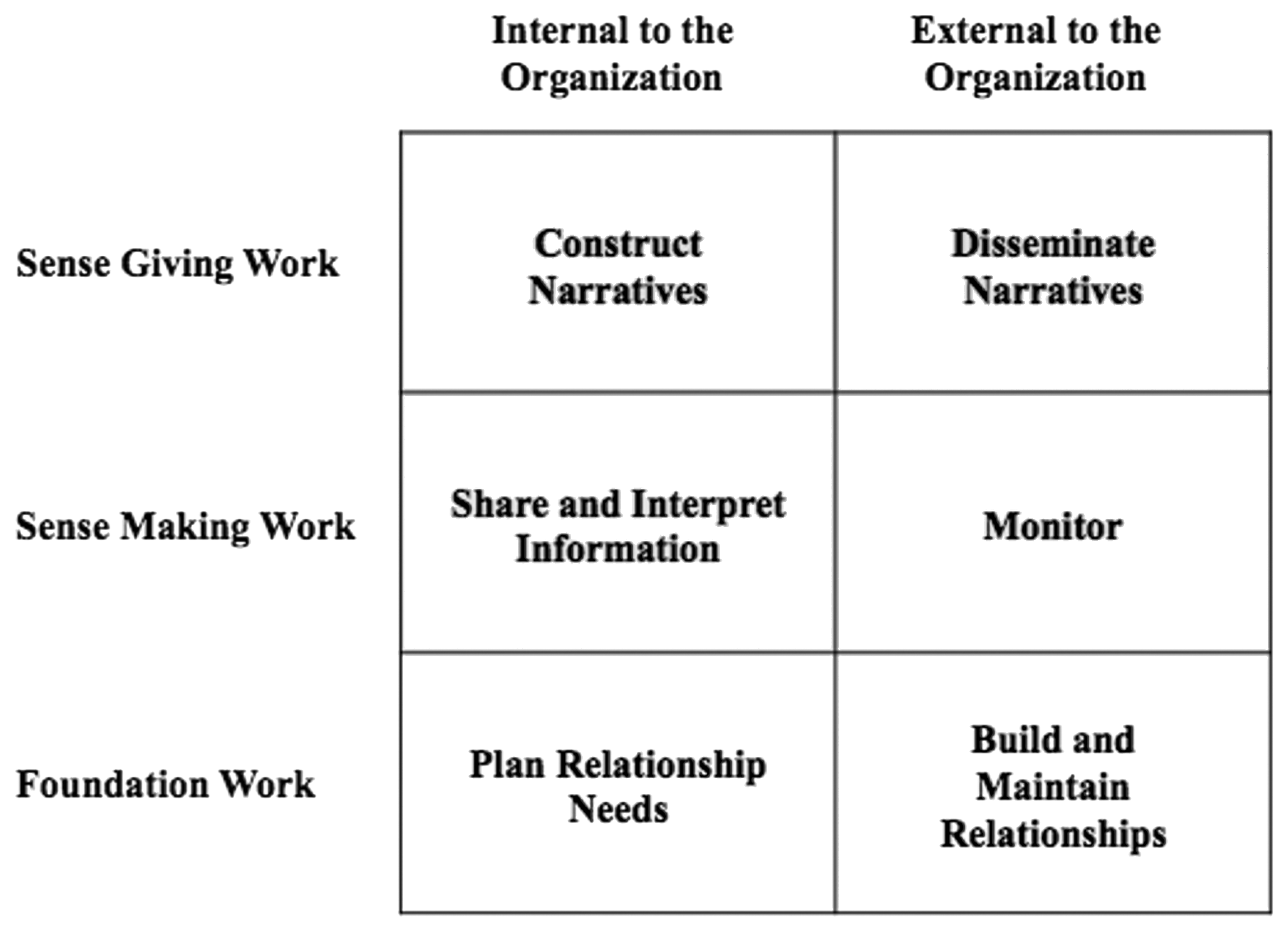
Daily work activities of public affairs professionals.
Findings
Foundation Work: Planning for, Building, and Maintaining Relationships
Building and maintaining relationships was the sine qua non of public affairs work. The public affairs staff strategically planned for, built, and maintained relationships with key political figures in the various cities and counties where Devo owned land. These political contacts included mayors, council members, government staff, and planning commissioners. They also included influential members of the community such as former council members, principals of local schools, leading members of neighborhood associations, and many others interested and active in local politics. Throughout the article, we will refer to these officials and community members as “key political figures” in Devo’s environment.
Planning relationship needs
Based on Devo’s political agenda, the public affairs staff identified potential allies in the political environment and reached out to them to establish new relationships. The mechanism for establishing relationships was finding a “connecting opportunity.” For example, the public affairs staff attempted to “connect” with newly appointed county officials in the surrounding districts several years ahead of negotiating a new General Land Use Plan, which was a primary document guiding future development in the County. Julia, a public affairs executive, explained how they approached these officials: Devo needs to develop relations with those districts. We need to understand how people live to get a better sense and monitor what is going on… .Each District Supervisor maintains his own website, for example. I asked [the junior staff] to look for information there and do research to understand what the districts’ problems and issues are….By learning more about them, we want to cultivate good relations with the newly appointed officials. We don’t want to just go to them when we want something [Emphasis added]. We have to cultivate relationships… .If we know what their social problems and needs are, we can offer to help them out in areas that concern them. We need to find those connecting opportunities. Then, when we need something, we can ask.
Building and maintaining relationships
Public affairs staff attempted to transform newly formed relationships into long-term ones that they maintained on a personal basis. Everyone in the office had their own contacts with whom they talked regularly. They attended informal social gatherings and even shared meals with their contacts. For example, one day a senior public affairs executive reported that he had had lunch and went to a movie with one of Fairview’s community leaders and his wife. In another instance, Jim, a public affairs manager, attended a mixer organized by Springfield’s Chamber of Commerce where he mingled with old acquaintances and exchanged business cards with new ones. In another instance, he went to a Downtown Business Association meeting in Fairview and gave a presentation about a project that Devo had received approval for from the city council a few months ago. Jim explained his efforts at building and maintaining relationships in both Springfield and Fairview: I have been coming to community meetings such as this one [referring to the downtown business association meeting in Fairview] for the past several years. I have slowly and carefully cultivated a casual relationship with the local business leaders at Fairview… .It is very important to be present at these kinds of gatherings… . [He starts talking about an earlier experience with Springfield] Before we signed a 10-year development agreement with Springfield, I went there for 4 years doing government relations and community relations. I did several town halls to talk about our plans. I went to a lot of community events. I talked with the City officials regularly and kept them up to date on our plans.
The public affairs staff carefully determined which relationships needed to be strengthened and reinforced based on the political issues on their agenda. During their internal meetings, public affairs staff discussed these strategic relationships, and how they should reach out to whom. One way the public affairs team built and maintained relationships with key political figures was to extend invitations to events hosted by Devo. For example, the public affairs department had corporate box seats to the games of a local baseball team, and they used these sporting events to entertain key political figures. At the beginning of a baseball season, the public affairs staff sat down in their conference room with a list of contacts and considered whom to invite to upcoming games. The list contained names, addresses, and the roles that made each person relevant for Devo. The role might be mayor, council member, or planning commissioner, in which case the person’s official position signaled their relevance. If the key political figure was a member of the community, the identifier was the political issue that the person supported, such as Springfield Housing Project.
At one internal meeting, the public affairs team discussed whom to invite to each of the season’s games. Julia, a senior public affairs executive, argued: We should do a full, targeted Fairview game. We need to boost up our Fairview connections since we’ll be pulling permits soon [a term used in construction to refer to applying for building permits]… .Our other themes for this year can be the housing project in Springfield. I also thought we’d invite some people from the VA [Veteran’s Administration] as well. Bring them in to let them know who we are. Do some relationship building.
Before an event, the public affairs team put much thought into where to seat everyone so that guests would be entertained and given an opportunity to network with each other, as well as with the public affairs team. Linda explained how she thought about the seating chart for the box seats for the baseball games. I consider what they might talk about. So in my mind I am keying up the conversations that might eventually help Devo. I also think about personality. For example this guy [she points to a name on the seating chart] is a big joker. But he can also be very serious. So I have to sit him next to a person who gets that … [Name] is a psychiatrist who specializes in substance abuse problems. He works at the VA. Perhaps he and [Name] can talk about substance abuse problems in the district… .It is like planning a seating chart for a wedding or a party!… .Of course these are all guesses. I welcome people at the beginning of the game and introduce them to one another, but that’s it. Afterwards I let things go on organically.
Guests viewed invitations to events as a favor. For example, a representative from the Fairview school district approached Jim and said, “Thanks so much for inviting us. This is great!” She went on to tell Jim which neighborhoods she was well acquainted with and said, “I know the people and the culture very well. You can give me a call if ever you need to.” Invitations to events, thus, reinforced Devo’s relationships with its political contacts by establishing reciprocity and encouraging future interactions and exchanges.
The public affairs team extended invitations broadly, especially in the case of elected officials or government staff. Liz explained, “We don’t just invite the people we’re on good terms with… .Even if you don’t see eye to eye with someone on a majority of issues, you might still potentially agree on an issue in the future.”
Sensemaking Work: Monitoring and Interpreting the Environment
Monitoring
We have shown how the public affairs team built and maintained relationships with key political figures in Devo’s environment. These relationships and being integrated in local public life enabled public affairs staff to be in constant dialog with political actors and become knowledgeable about new developments in the environment. They learned about emerging political issues, how various groups perceived those issues, and what consequences might arise for Devo. While they gathered the opinions and perspectives of their political contacts, the public affairs staff also shared their own opinions and perspectives in these interactions. Our data indicate that knowledge gathered through this kind of monitoring was crucial for forming Devo’s political strategies.
A large part of monitoring was done informally through the staff’s contacts in the political environment. Julia explained the personal, informal nature of monitoring through contacts: Everyone has their antennas out… .We all have different contacts that we are talking to, that we are hearing things from. Jim has got people that he’s connected to that I don’t and vice versa. You just run into people and you’re just talking about what’s going on. A lot of it is pretty informal … Greg: So what was your take on it? Jim: Sometimes we agree, sometimes we don’t agree. We shouldn’t fight. We’re all friends here. Are you going to the Springfield Comprehensive Plan Update meetings by the way? Greg: Nope. Can only do so many things at once. Jim: Well you might want to go to those some time. It gives you a broader perspective on what’s going on. I had expected that the Commissioners would build on each other’s comments and provide a more clear direction for staff, but they seemed very disconnected and I did not sense there was much consensus… .Commissioner [Name] and [Name] were vocal with a smart growth “it’s coming, so we should plan for it appropriately” approach with comfort expressed for exceptions to the [building] height limit … Commissioner [name] was trying to encourage a “Quality of Life” alternative approach …
Reporters routinely attended such public meetings and published newspaper articles about the meeting the next day. Nevertheless, the public affairs staff monitored important public meetings in person to acquire the full story rather than rely on the media’s framing of what had happened. Media coverage formed the final part of the public affairs team’s monitoring activities. The public affairs team subscribed to a news tracking service and had an office assistant who carefully followed local news outlets and sent a daily digest of relevant news clips to the team.
Sharing and interpreting information gathered through monitoring
The public affairs team held several informal meetings a week where they pooled the information they had collected through their monitoring efforts. As they shared insights, they tried collectively to make sense of Devo’s evolving political environment. One meeting started as follows: Audrey opens the meeting by asking “So, what’s going on?” After a brief pause, Jim volunteers, “I went on a construction site tour for the hospital in Fairview. They do this tour every Thursday. While they were showing me around, I thought there were clearly some things we can provide them information about.” Scott reports on a community meeting he attended in Fairview: “I went to this meeting of what I call the ‘flow study’. They are looking at how you get traffic on [main road] to flow better. They have hired the same company as we did for their traffic study. They passed the mike around. There were people who argued there should be no bikes, versus the bikes people.”
The public affairs team also held weekly meetings dedicated to specific issues on which Devo was taking an active stance. One example was a weekly meeting concerning community engagement efforts in Fairview where Devo had a project proposal under review. The following excerpt is drawn from field notes of the meeting at a point where the public affairs team tried to make sense of an op-ed that appeared in a local newspaper. A prominent member of the community with antidevelopment views had written the op-ed. The author argued that Devo’s multipurpose project would be unprofitable for the city of Fairview because having more offices than shops the project would generate little revenue for the City. The public affairs team discussed the meaning of the op-ed, whether Devo should respond and if so, how, Robert: [Came with a printed copy of the op-ed in his hand. He waved the piece of paper as he talked.], I am annoyed by this op-ed: “Office buildings don’t bring the City revenue!” It is not true! Don’t you think this is factually wrong? Shouldn’t we say something about this? Or ask [an influential member of the community] to say something about it? Julia: [Who had also read the commentary.] I think they are thinking of tax revenue. Sales tax revenue in particular. Jim: The question is: In what form do we do a rebuttal? Julia: Should we get someone from the community to write a letter to the editor saying offices can generate tax too? Aaron: Who’d be a good person to write that letter? Jim: Maybe someone from the Chamber? Julia: That would be nice… .If we could get someone who knows the sales taxes in the area … Jim: Perhaps we could even take out an ad in the paper? Julia: I don’t think it’s worth buying an ad.
Sensegiving Work: Constructing and Disseminating Narratives
Constructing narratives
The public affairs staff exercised influence by constructing and disseminating narratives built around frames that they believed would influence how target audiences interpreted and responded to issues. Narrative construction was a collective process that occurred in weekly coordination meetings. One such case of narrative construction happened when Devo faced strong opposition to its Fairview project.
Devo’s project proposal was under review by the Fairview city council, which had formed a subcommittee to meet with Devo’s public affairs team to discuss the project’s details and what benefits the community might see. While these negotiations were taking place, an antidevelopment grassroots group emerged opposing several development projects, including Devo’s. The grassroots group argued that the buildings would be too tall, too ugly, increase traffic, and generally disrupt the quality of life in Fairview. The grassroots group drafted an initiative proposing to limit all future development in Fairview, jeopardizing Devo’s project.
After weeks of deliberation, the public affairs team decided to stop negotiating with the city council until after the uncertainty around the initiative was resolved. Given the possibility that the initiative might pass and kill Devo’s project, the public affairs team did not want to commit to further negotiations. Several council members wanted the negotiations to continue and took Devo’s withdrawal as a strategic move to avoid delivering the benefits that the city wanted. They accused Devo of going back on its promises. When this accusation circulated in the media, the public affairs team met to discuss how Devo should respond: Jim: If only they could say ‘thanks for letting us know that Devo’s taking a pause [in the negotiation process]. Julia: Because there is all this uncertainty caused by [the initiative]… .I think neither our earlier letter [to the city council] nor the email was disrespectful to the process. We only have a problem with the timing of these discussions. We think the timing is inappropriate prior to the vote. Audrey: Doesn’t an initiative mean time out? There is so much uncertainty! Jim: Why doesn’t Robert say, “We are standing behind our earlier letter to the city council. We are happy to meet with the subcommittee on [date] and we’d like to continue this conversation after the vote?” Aaron: I like it. Dan: You can send it out as a letter to a council member and hope that it’ll be picked up by the media… .We can add that we are willing to continue meeting with technical staff to discuss the technical aspects of the project. Julia: I like it. We are willing to continue meeting with staff to discuss the technical details and the cost calculations [for the community benefits]. [Emphasis added]
When constructing narratives, such as the one just mentioned, the public affairs team consciously used frames that they hoped would resonate with their target audiences: in this case, the citizens and public officials of Fairview. They were aware of the issues concerning Fairview’s residents because they had been monitoring the political landscape for several years. They knew that the public discourse around development was divided between those who emphasized the quality of life in Fairview and those who emphasized the importance of economic vitality. The quality of life frame used by those against development encompassed opinions about traffic, building heights, and the balance of offices and residential units. The antidevelopment camp also argued that development would not fit with the look and feel of their small city. Finally, they argued that new office buildings were not needed, and the preservation of residential neighborhoods was important for the preservation of the quality of life.
The public affairs team knew that the prodevelopment camp emphasized the need for greater economic vibrancy in Fairview. These residents thought their downtown was “dead” and needed to be “revitalized.” They wanted to see more shops and restaurants. To mobilize support among Fairview residents, the public affairs team had to construct narratives using the community’s frames. In response to the antidevelopment camp, the public affairs team argued that Devo’s project did not pose a threat to the quality of life at Fairview. To support the claim, they presented traffic studies sponsored by Devo that showed the project would not increase traffic. They circulated renderings of the project showing that none of the buildings were as tall as some citizens thought. To mobilize residents who supported development, the public affairs team argued for the economic benefits of the project that would revitalize the downtown because it would bring many people to the downtown area. The retail spaces incorporated into the project would become shops and restaurants that would not only make Fairview more economically vibrant but also that residents would enjoy. Note that the frame Devo chose to use was not developed de novo but rather drew on rhetorics that were native to the political environment that Devo sought to influence.
Disseminating narratives
The sociopolitical networks in which the public affairs staff embedded themselves not only enabled monitoring and supplied the organization with culturally resonant frames; these ties also constituted the communication channels through which the staff disseminated narratives. During our fieldwork, the public affairs staff routinely used four modes for disseminating narratives: writing official letters to city governments and regulatory bodies, speaking at public meetings, lobbying policy makers (politicians and governmental or regulatory staff), and lobbying members of the community. These modes of dissemination can be thought of as lying on a spectrum ranging from more to less formal. Formal communications were typically written or rehearsed beforehand and were intended to become part of the public record. Informal communications were targeted at specific individuals, were typically delivered in person and were less tightly scripted.
Devo sent several formal letters to the Fairview and Springfield city councils during the course of the study. As noted earlier, after the public affairs team decided not to meet with Fairview’s subcommittee before the ballot, they communicated this intent through a letter to the city council. Formal letters recorded Devo’s official stance on particular issues and became part of the public record. Other modes of narrative dissemination often accompanied formal letters. For example, the public affairs team was asked to attend city council meetings in both Fairview and Springfield. In both cases, they sent a letter to the council beforehand, laying out Devo’s stance. Then, on the day of the city council meeting, several members of the team attended and spoke publicly to deliver Devo’s narrative. These speeches were given in response to questions raised by council members. Designated persons from the public affairs team would take the stand and deliver a premeditated narrative explaining Devo’s stance.
For example, at a Springfield city council meeting where Devo’s housing project was being discussed, one council member asked if Devo could create an extra road through its property. One of the public affairs representatives took the stand to reply. Good evening, mayor and council members. The issue of a permanent road through the parking lot on Exeter Road has come up several times over the past several months, and it has been discussed and debated. So this is not a new issue. Certain residents in the neighborhood have also raised this question. We’re not willing to make this [option] available because we do not believe it is necessary to mitigate traffic problems in the neighborhood, and there is no basis for deviating traffic from the public street grid. We have a well-designed project that integrates with the street grid system in a safe way and that has been a guiding principle for us the entire time in developing this project. We hope that you take this design guideline into consideration. We hope you understand that it was our imperative to make sure the development and the street system integrates seamlessly, and that’s what we have done. We have spoken with the neighborhood association representatives at great length to meet that goal, and we are excited to move forward with this project.
In addition to sending official letters and speaking in public meetings, the public affairs staff also regularly met with government officials in person. They used the emic term “lobbying” for these occasions. Lobbying policy makers was considered a routine activity intended to “brief” policy makers on issues about which they would be asked to make decisions in the near future. For example, prior to a city council meeting, a public affairs official e-mailed all city council members asking for an opportunity to brief them on the subject.
9
Two public affairs staff members went together to the meetings and delivered Devo’s narrative in person. Julia explained why the staff conducted these lobbying meetings, So we have to go there and explain ourselves. What [we] are doing is we’re meeting with each council member to explain what’s going to be in front of them in a couple of weeks. This is what you would call lobbying… .[We] sent all of them an email saying we’d love to come and brief you on this issue for 30 minutes.
When public affairs staff disseminated narratives to members of the general public, they referred to the activity as “community engagement” or “educating the public.” Julia explained the purpose of lobbying members of the community: The goal is to educate….Get the right information out to people that may themselves be sources of information for other people….So we continually want to be available to meet with people and talk with people and make sure they have the right information [i.e. The portion of Devo’s narrative that spoke to a person’s or group’s particular concern].
After their meeting with the donor, Julia and Robert reported on their interaction at a subsequent staff meeting: Julia: Robert and I met with Tom for breakfast… .He said he is fine with development as long as the traffic aspect is fixed. He is big on public transit … we talked a lot about public transit… .Robert did a really good job of explaining how mitigation measures are taken during development, and cities get developers to pay for those mitigation measures… He seemed like the kind of person who has strong opinions that won’t change soon. Robert: Yeah, he won’t join the other side any time soon, but he might be a little more neutral. Julia: I agree that the best we can do is neutralize him.
“Educating” members of the community had a dual purpose. Staff certainly sought to influence the listener, and they also hoped to mobilize the listener to disseminate Devo’s narrative to a broader audience. By “finding the right folks” who were well-connected, influential members of the community who believed in growth and development, the public affairs staff sought to spread their narrative through a larger sociopolitical network. The staff were implicit network theorists; they understood the value of working through central actors. As Jim explained: We’ll reach out to someone like Sam [who is publicly known to support growth and development and who is an influential member of the community]… .We don’t say why don’t you write a letter to the editor [of the local newspaper] on our behalf. We use a softer touch than that. We usually say, “Hey we think there is some information [about our development project] out there that is not true. The facts are these”, and we ask “do you think this is useful information for a broader audience?”
Disseminating narratives through formal written communications, speaking at public meetings, lobbying policy makers and community leaders, and educating the public were usually pursued in concert and in support of one another. In the Fairview case, for example, public affairs staff lobbied council members and city staff, but they also wrote formal letters to the city government to explicate Devo’s position. They spoke at public meetings when invited to do so. In addition, they reached out informally to members of the community who could support Devo’s project and mobilized those citizens to speak on Devo’s behalf.
The Entwining of Political Influence Activities in Daily Practice
As noted earlier, the literature on CPA tends to focus on a few measurable political tactics—PAC contributions and lobbying expenditures—and does not capture the rich range of activities that members of particular occupations take on behalf of organizations to influence the political environment. Moreover, political tactics are generally treated as discrete activities in the literature. In contrast, we found that the various influence activities carried out by public affairs professionals were entwined in two ways. First, any episode of interaction with outsiders could and often did simultaneously involve a combination of influence activities. For example, when interacting with policy makers or citizens, public affairs staff might simultaneously work on building new relationships or maintaining existing ones, monitor political developments of importance to Devo, and also disseminate their narratives. Second, the influence activities of our informants were interwoven in the sense that they inscribed a cycle of work that the public affairs staff enacted every time they targeted a political issue.
Simultaneous interweaving
During their informal interactions with key political figures, public affairs staff simultaneously learned about political issues that were arising and how members of the community and city officials viewed and reacted to issues (i.e., they monitored the environment). Public affairs staff also used these informal interactions for sharing Devo’s stance with regard to those issues (i.e., they disseminated their narratives). Moreover, such exchanges of information and opinions reinforced the relationship between key political figures and the public affairs staff. Dan, a political consultant to Devo, described such interweaving when talking about informal encounters the public affairs staff had with officials and members of the public: We have a lot of conversations. A lot of phone calls… .A lot of opinions shared. You know, monitoring. Watching what the politicians post on their websites, following them around… .Beating the streets, talking to people of influence. Asking them what they’re doing, what’s up, asking them what their world looks like; bouncing ideas off of each other. Just influencing the thinking that way is really the best you can do.
For example, during the public comment section of the city council meeting, the public affairs team noticed several members of the community, whom they did not know, speak in favor of growth and development. Julia and Jim approached these individuals at the end of the meeting to get to know them, to understand how well connected or politically organized they were, and to see if they could support Devo in the future. Julia later explained how she built a relationship with a member of the community, and how Jim approached another potential ally after the city council meeting: I had heard about [name] from some other people but I had never met her. She lives in downtown. She spoke very thoughtfully [at the city council meeting]. So I walked up and introduced myself, gave her my card. I said “I’ve heard about you from some other people, let’s get together, I’d love to meet you”. So we met yesterday. She is an architect. She and I were agreeing that there are places that more density and more development could be beneficial. In fact you could make the argument that more density near transit is actually what helps transit be more successful! Jim did something similar with some of the individuals that spoke during public comment. They are kind of organizing. They added Jim to an email circle. I think they were going to meet last week. They are trying to figure out how to continue to be involved in the Springfield Comprehensive Plan update process. I think Jim is going to try to stay connected and potentially go to some of their get-togethers.
For example, at one point, the public affairs team wanted to write an official letter to the Springfield city council to explain Devo’s stance on the city’s potential for growth. They collectively composed a detailed letter that drew on multiple sources of information that they had gathered while talking to staffers at City Hall, planning commissioners, and various other contacts. The team circulated the draft among themselves and collectively composed and edited the draft. The final version of the letter included, among other arguments, several quotes from the planning commissioners who had expressed progrowth sentiments at a Commission meeting. These quotes, which were taken from Jim’s verbatim notes on the Planning Commission meeting, were used to construct a narrative on the benefits of growth for the City of Springfield, and how it could be achieved without harming the quality of life.
Cyclical structure
Figure 2 emphasizes how public affairs staff’s various influence activities inscribed an underlying cyclical structure that moved back and forth across the organization’s boundary. These cycles were evident in the day-to-day work that we observed over the course of our study. Planning with whom they needed to develop relationships and the construction of narratives, respectively, shaped the staff’s establishment and maintenance of relationships, and the dissemination of narratives (the rightward facing arrows in Figure 2). Conversely, monitoring informed the sharing and interpretation of information (the leftward facing arrow in Figure 2), which could then indicate the need for building new relationships, or revising narratives. In the former scenario, monitoring provided information on other people within the community with whom the staff needed to establish or reaffirm relationships. Such information spurred internal discussions about strategies for reaching out to political contacts (the lower cycle in the Figure 2). While monitoring the environment, staff also became privy to new political information that could lead them to revise or refine their understanding of the situation and recraft their narratives (the upper cycle in Figure 2). In short, Figure 2 depicts how the exercise of political influence is an ongoing process composed of interconnected activities through which public affairs staff could cycle many times back and forth across the boundary between Devo and its political environment before an issue was resolved either for or against the organization’s favor.
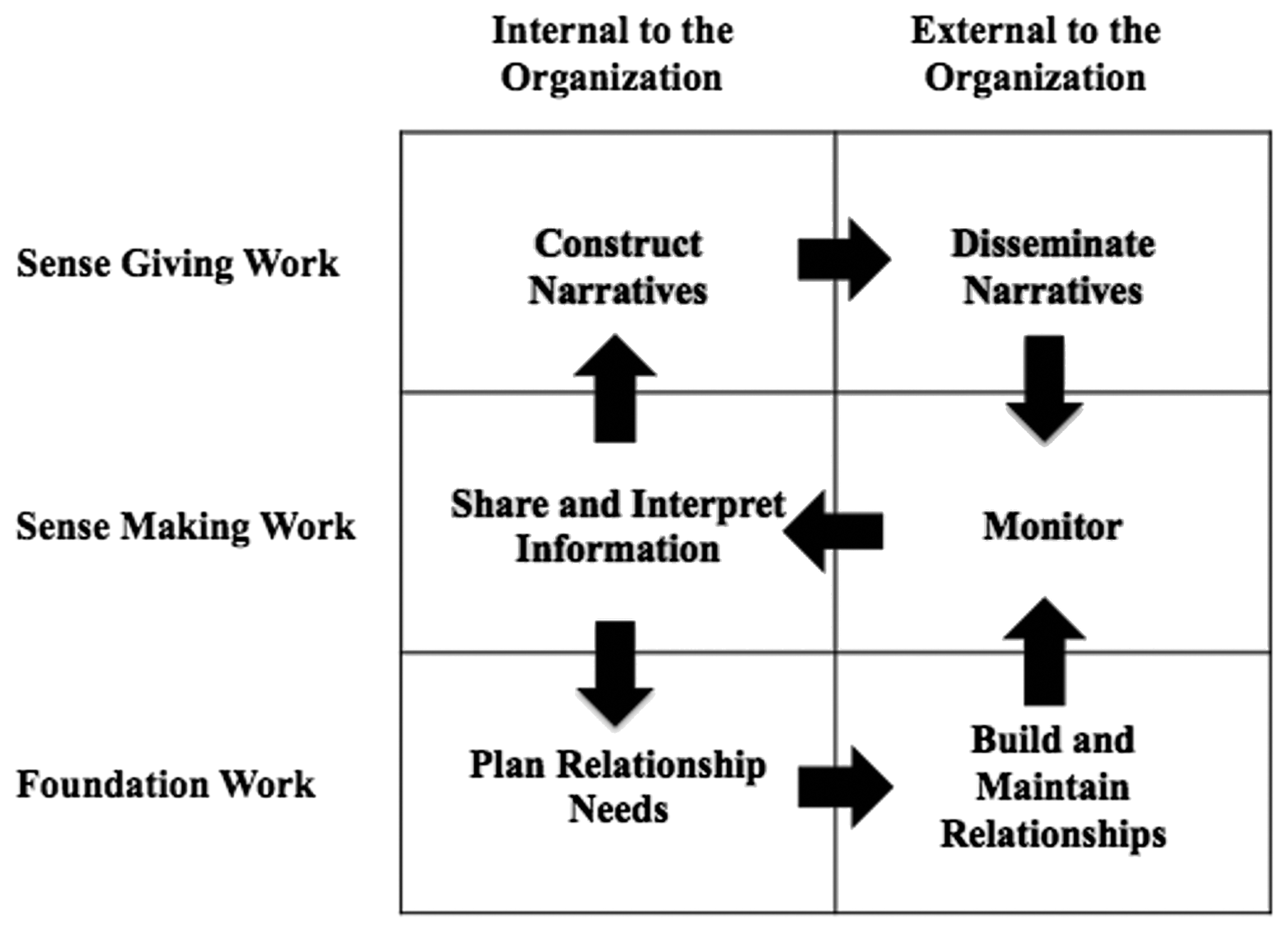
The cyclical nature of influence work.
Conclusion
Through ethnography, we have explored the daily activities of a boundary-spanning occupation tasked with influencing an organization’s environment: public affairs. In doing so, we have shown that exercising political influence on the environment involves planning for relationship needs, building and maintaining relationships, monitoring and making sense of the environment, and based on that information, constructing and disseminating resonant narratives to target audiences to shape their perceptions and behaviors. Furthermore, we have shown how these activities are tightly entwined and constitute repetitive cycles of work that link the organization to sociopolitical networks outside the organization.
Most previous research on boundary spanning has treated boundary spanners either as individuals who import information into the organization or as individuals who enable knowledge sharing and collaboration between an organization’s teams or subunits. In contrast, we studied boundary spanners who act on the environment as agents of influence. We have shown that, to exert influence, public affairs professionals established relationships with members of communities and governments. They effectively became insiders in multiple social worlds beyond their own organization. These relationships provided the communication channels by which the staff kept informed about the environment and disseminated persuasive narratives. Being insiders in various political circles enabled public affairs professionals to do more than transmit information, it allowed them to translate and transform their political goals into arguments that spoke to the concerns of target audiences, a phenomenon that has been recognized but not sufficiently studied in the boundary-spanning literature.
Moreover, our ethnography of public affairs professionals offers a different view of the structure of boundary spanning than is normally found in the literature. Boundary spanners are most often portrayed as single individuals who reach out from the organization into the organization’s environment in search of information and intelligence. The notion of a boundary spanner as an individual began with the notion of gatekeepers (Allen, 1977), was reinforced by those who sought to differentiate the structural positions that boundary spanners hold with respect to the social worlds they span (Gould & Fernandez, 1989), and has most recently been solidified by the imagery and mathematical definitions of actors who span structural holes (Burt, 1992, 2005).
The structure that linked public affairs staff to policy makers and community members was quite different. First, spanning boundaries was not a role for lone individuals; it was the mandate of an occupational group within an organization. Second, the public affairs staff not only brought information into Devo, they also disseminated messages into Devo’s external environment. Finally, and most important, Devo’s public affairs professionals became integrated members of networks of people involved in local politics. Thus, rather than depict public affairs professionals as typical boundary spanners or individuals whose social ties span structural holes, we submit that Figure 3 offers a more appropriate depiction of political boundary spanning.
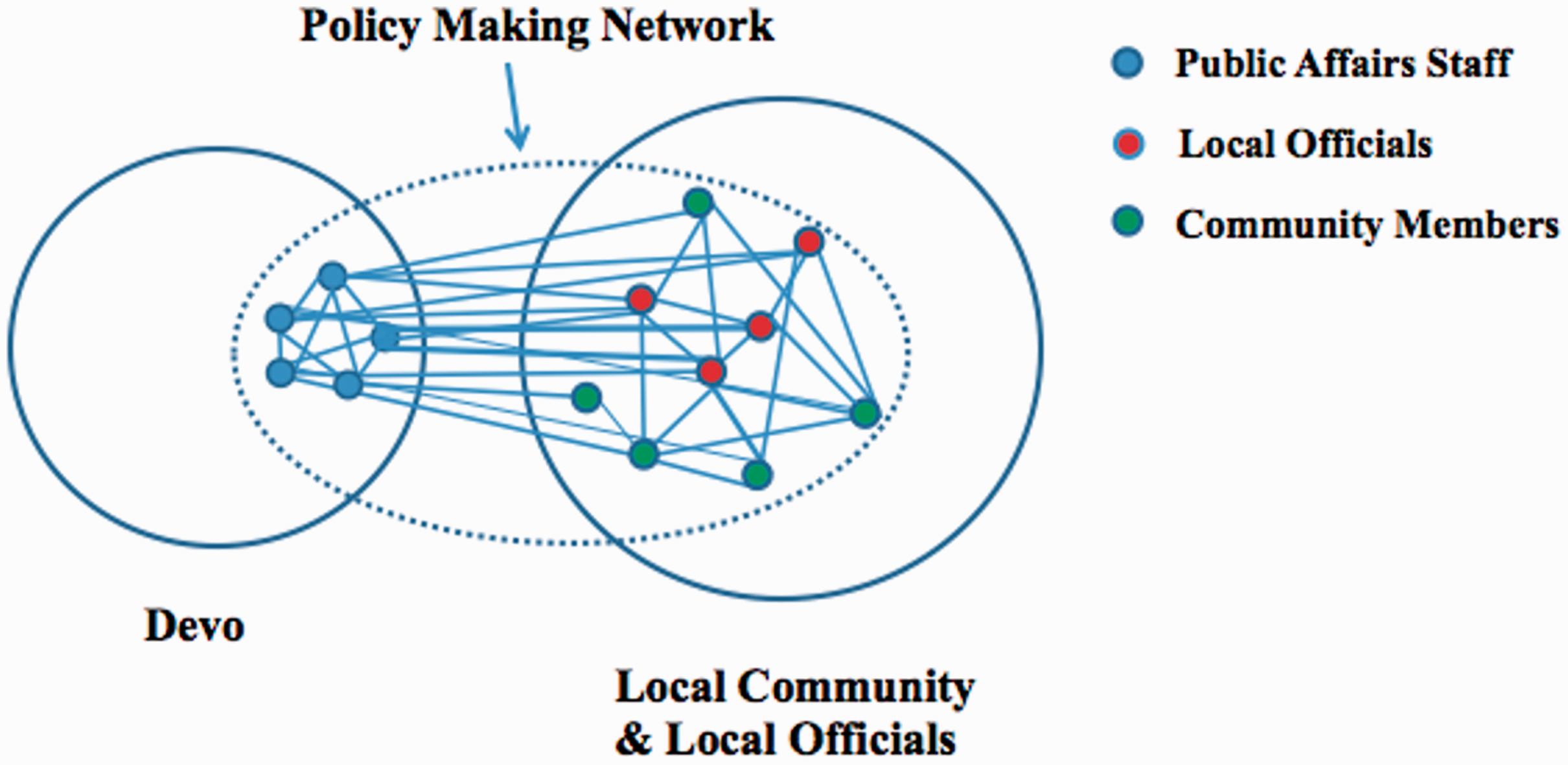
Public affairs as a boundary-spanning occupation.
Figure 3—meant as an ideal illustration—depicts dense ties not only among public affairs staff and dense ties among city officials and influential members of the community but also dense ties between the two. As a result, the public affairs staff join with public officials and community members to form a close knit policy-making network. In other words, with respect to the social world of policy making, the public affairs staff were as much members as they were boundary spanners who operate as representatives (Gould & Fernandez, 1989). One might say that the job of public affairs professionals was not simply to span an organization’s boundaries but to informally merge with the environment. In this way, the organization could be said to enter the environment at the same time that the environment enters the organization. In other words, lobbyists and public affairs professionals acting as agents of influence became enmeshed in the social system they wished to influence.
Becoming enmeshed facilitated the exercise of influence in three ways. First, being enmeshed in external sociopolitical networks allowed public affairs professionals to monitor the political environment and decide when and how to be politically active. Second, this embeddedness supplied them with resonant frames for constructing narratives to persuade their audiences. Third, their sociopolitical networks constituted the channels through which public affairs professionals disseminated narratives to mobilize support for their position. To some readers, the various components that constitute public affairs work might seem unsurprising. Indeed, sociologists and others studying political communication have long known that people form networks, rely on relationships, and attempt to influence others through the use of frames and narratives, but these activities are largely treated in isolation from each other (e.g., Apollonio, Cain, & Drutman, 2008; Berry et al., 2007). For example, the literature on CPA recognizes the importance of relationships for gaining access, but it does not operationalize or measure access directly or delineate how access undergirds influence (e.g., Schuler et al., 2002). At best access is said to be necessary but insufficient for exercising influence. Importantly, most scholars have also eschewed the study of process to focus on the antecedents and outcomes of measureable and specific political tactics such as campaign contributions at the expense of an holistic understanding of how political influence is exercised by organizations (Lux et al., 2011; Schuler et al., 2016). In contrast, our agenda has been to develop a process model of CPA that demonstrates how public affairs professionals carry out various influence activities, how they are interrelated, how they reinforce each other, and how they define an ongoing cycle of work that links the organization to its political environment. In short, we have shown that by focusing on processes, it is possible to piece back together what Schuler (2002) called the corporate political cycle, which previous researchers broke apart for methodological reasons.
In addition, our study reinforces important insights for students of framing and narratives. Scholars ranging from sociologists to political scientists have argued that narrative construction and framing efforts are important in influencing how others perceive situations. By highlighting different aspects of a situation as worthy of consideration, frames suggest different responses as appropriate for the concerns of different stakeholders (Abolafia, 2004, 2010; Fiss & Zajac, 2006; Gamson & Modigliani, 1989; Kaplan, 2008). Yet, scholars of framing and narrative construction rarely talk about how agents of influence discover and select frames that are persuasive and that resonate with different audiences. We show that by embedding themselves in political networks outside the organization, members of a boundary-spanning occupation come into close contact with the actors they hope to influence. As are result, they are able to learn what their targets value and, hence, how they should construct narratives to speak to those interests. In short, boundary spanning enables a kind of bilingualism that enhances the odds that target audiences will find a narrative to be credible.
Overall, exercising political influence and shaping political opinion was a dynamic and general process. Public affairs professionals used the same general approach regardless of the specific issues, the specific town, or the specific people that they were attempting to persuade. 10 We, therefore, suggest that the model in Figure 2 may be useful as a starting point for understanding the work of other boundary-spanning occupations that act as agents of influence, for example, public relations professionals, marketers, labor negotiators, and lobbyists-for-hire.
We also note that the process of exercising political influence can span long periods of time. We studied Devo for 6 months. Neither of the projects that figure prominently in this study began during the fieldwork or had ended when the fieldwork was over. Many of the relationships we observed during the course of this study had been established years ago. In other words, for any given issue, public affairs professionals may well iterate through the process we have outlined many, many times before an issue is resolved. It would be a mistake to assume that public affairs work consists of discrete campaigns launched at particular times with distinct outcomes. This is a key problem with studies of CPA, which assume that campaign contributions and other specific acts can be unambiguously linked to favorable or unfavorable votes and policy outcomes. For this reason, we submit that many studies of corporate political action are at best snapshots of an ongoing process taken at a specific point in time and may, therefore, yield mistaken conclusions.
Studying boundary-spanning occupations that attempt to affect an organization’s environment may be of considerable use to neo-institutionalists who have in recent years turned their attention to how actors attempt to create, modify, or sustain institutions (Garud, Jain, & Kumaraswamy, 2002; Hallett, 2010; Maguire, Hardy, & Lawrence, 2004; Munir, 2005; Munir & Philips, 2005). Although this literature has made significant steps in trying to link human action to institutional dynamics, it typically focuses on specific individuals and organizations (DiMaggio, 1991) or on general processes (Lawrence & Suddaby, 2006) by which actors can effect structure. With the exception of Greenwood and his coworker’s work on the institutions of accounting, most of the literature overlooks the role of occupations (Greenwood & Suddaby, 2006; Greenwood et al., 2002). Members of occupations and professions embody expertise, which they enact in the service of the organizations for which they work. In the case of the public affairs professionals we studied, this expertise involved a detailed understanding of laws and regulations and the workings of government. Some of them were lawyers by training and could also assess the legal ramifications of Devo’s actions, or the actions of their political contacts. The public affairs team brought not only technical expertise to Devo but also know-how in relationship building and maintenance and the crafting of persuasive arguments. As such, observing their day-to-day work gave us a rare and more complete view into the practice of political influence. We suggest that taking a closer look at the everyday work of boundary-spanning occupations charged with affecting the institutions that comprise an organization’s environment may offer scholars a better handle on how institutional change and stability are negotiated over time.
Our research has at least two significant limitations. First, our focus has been on public affairs agents who are employed by and serve a single organization. Second, our informants were focused almost entirely on political issues at the level of local politics. For this reason, we cannot speak to whether our model adequately describes the work of for-hire lobbyists who have multiple clients or in-house lobbyists who work at the state and federal level. This is an empirical question that requires further fieldwork among public affairs professionals and members of other occupations who lobby state and federal policy makers. What our research does show is that undertaking ethnographies of those who seek political influence yields insight into the processes that undergird what students of lobbying can only glimpse in readily available databases or from surveys. The promise of ethnographic studies of lobbyists and other boundary-spanning influencers is that researchers may discover the actual processes that allow organizations to shape their environments.
Footnotes
Declaration of Conflicting Interests
The authors declared no potential conflicts of interest with respect to the research, authorship, and/or publication of this article.
Funding
The authors received no financial support for the research, authorship, and/or publication of this article.