



Abstract
This article offers a new explanation for union decline by focusing on a currently neglected site that exemplifies the fragility of unions—the shop floor in the computer revolution era. Using data from several sources including the National Labor Relations Board, it analyzes the effect of using a computer at work on the odds of being a union member and the broader effect of computerization on union strength within detailed industries between 1973 and 2002. Workers who used a computer at work were found less likely to be union members, and computerization of workplaces accounted for about a quarter of the decline in union density within industries; partly by changing the skill composition of industries’ workforces and partly by enhancing employers’ resistance to unions as measured by their use of unfair labor practices and decertification elections as documented by the National Labor Relations Board. The findings are explained in a new theoretical framework that specifies what computerization does to unions by (a) reshaping the way products are made and services are provided and (b) boosting a profound power shift throughout workplaces.
Keywords
For lengthy stretches of the 20th century, the labor movement underwrote social welfare and restrained inequality through its economic and political roles. But over the past few decades, the labor movement’s organizational strength in the economic sphere—that is, the labor unions—has been in decline. This situation has been more severe in the United States than in other Western countries (Godard, 2009). Some even argue that today U.S. unions are basically dead (Ghilarducci, 2015), as only 11% of the United States’ total labor force was unionized in 2018, and less than 7% in the private sector (Hirsch & Macpherson, 2019), its lowest level since the New Deal (Troy & Sheflin, 1985).
Given their steady decline, it seems surprising that unions increasingly find themselves in the news. Arguably, this is largely because union decline has played a significant role in some of the most important social and economic changes of our time, including rising wage inequality (Western & Rosenfeld, 2011), family income inequality (Jacobs & Myers, 2014), and the dramatic takeoff in managerial pay (Lin & Tomaskovic-Devey, 2013). Union decline has also led to growth in the numbers of the working poor (Brady, Baker, & Finnigan, 2013) coupled with a decrease in their political participation (Rosenfeld, 2014), the shrinkage of the middle class (Freeman, Han, Madland, & Duke, 2015) and the deepening influence of economic elites in the political system (Mizruchi, 2013). Economic mobility for African Americans and new immigrants has also fallen as unions have declined (Rosenfeld, 2014).
The profound implications of union decline have fueled extensive research on the reasons for it. This literature (detailed in the next section) demonstrates that it was a result of much worse economic and political conditions for organized workers, but less attention has been devoted to factors that enabled those changes at the workplace level. Here, I propose a new explanation for union decline by focusing on the effect of the computer revolution on the shop (or office) floor. I argue that computerization catalyzed the changes in the economic and political conditions on the shop floor that led to union decline. That computer-based technologies interacted with union decline was first noted 30 years ago in a book edited by Daniel Cornfield (1987) that examined the effects of computerization on labor relations in 14 case studies of U.S. industries. More recently, Acemoglu, Aghion, and Violente (2001) linked the interaction between union decline and computerization to rising income inequality, a relationship that was demonstrated by Kristal (2013), Kristal and Cohen (2015), and King, Reichelt, and Huffman (2016). Unique to the present study are (a) the concrete conceptualization of how computer-based technologies have enhanced union decline, (b) the first comprehensive analyses of the effect of computerization on union density, and (c) the first consideration of the effect of computerization also on factors that determine unionization, including employers’ resistance to unions and organizational efforts.
The article proceeds as follows. In the next section, I clarify what we already know about the causes of union decline, and then, I articulate a theoretical rationale for how computer technology plays out in union decline. Next, I stage the research strategy for analyzing the effects of computerization on unions and describe the data and method of analysis. Based on individual-level data on using a computer at work and data on workplace computerization in detailed U.S. private industries, I present empirical evidence that computerization has decreased union density and new organizing efforts under the National Labor Relations Board (NLRB) while increasing employers’ resistance to unions. To the best of my knowledge, this is the first attempt to estimate the effect of computerization on unions. In the Conclusions section, I discuss the implications of the findings for employment relations in the era of the computer revolution.
The Causes for Union Decline
What do we already know about the decline of American labor unions since the heyday of the so-called capital-labor accord in the 1950s? That it was entirely a private-sector phenomenon. Two major changes in the structure of employment are common explanations for the postwar decline in union density in the private sector. First, jobs shifted from unionized core industries (manufacturing, mining, construction, transportation) to less unionized service industries. More important, about 80% of the actual decline is attributed to unions’ decline within industries and occupations (Hirsch, 2008) as economic and political conditions for organized workers have gotten much worse (Farber & Western, 2001) and have made it harder for unions to organize new workers (Farber, 2015; Wallace, Fullerton, & Gurbuz, 2009).
Overseas competition, capital mobility, and employers shifting their operations to nonunion establishments undermined organized labor (Slaughter, 2007). Unions also found themselves under relentless attack by employers using legal and illegal antiunion tactics (Bronfenbrenner, 2009; Freeman & Medoff, 1984; Logan, 2006), and striker replacement became normalized (McCartin, 2005; Minchin, 2001), while the NLRB was unable effectively to police and remedy employers’ unfair labor practices (ULPs; Weiler, 1990). For example, a prounion worker involved in a union election campaign in the 2000s faced about a 1-in-52 chance of being illegally fired, compared with 1-in-100 in the 1970s (Schmitt & Zipperer, 2009). The radicalization in employers’ antiunion strategies is usually traced to the antiunion political climate created by President Reagan’s administration (Jacobs & Dixon, 2010; Tope & Jacobs, 2009) and to state and federal labor legislation that altered the balance of power between employers and unions (Jacobs & Dixon, 2006). Recent local successes in mobilizing workers that made gains among women and minorities in the service sector (Martin, 2008; Milkman, 2006), the NLRB’s shifting of resources to new organizing under John Sweeny’s presidency, and growing workers’ demand for union representation (Freeman, 2007) did not succeed in reversing or even suspending the aggregate decline in union density and coverage.
Common to these explanations is the observation that the 1970s and early 1980s were a turning point for organized labor in the United States. An important factor at this turning point was the diffusion of new computer-based technologies across workplaces, which began as early as the late 1960s and intensified with the launch of the IBM personal computer in 1981. Indeed, certain evidence suggests that union defeat emerges within the organizational context of computerization (King et al., 2016; Kristal, 2013; Kristal & Cohen, 2015); yet all these studies offer evidence that the effect of computerization on income inequality was channeled through union decline, without any evidence on the direct impact of computers on unions.
If indeed computerization further diminished the economic and political conditions for organized workers on the shop floor, as this article argues, it should hold in particular for the United States’ pluralist industrial relations and less for European corporatist relations. In the United States, the pluralist system of industrial regulation subjects the workplace to a system of labor-management self-regulation in which parties are encouraged to determine their own norms through collective bargaining, while external norms and public policy are largely kept out (Stone, 1992). Collective bargaining under the National Labor Relations Act (NLRA) is done at a particular workplace (the “bargaining unit”). If workers show sufficient interest (30% or more of the employees) at a particular workplace (a so-called card drive), the NLRB holds an election among employees working in the unit to determine whether a majority favor the union. 1 When unionists have won both the right to hold a representational election and the election itself, they negotiate a contract with the employer. The workplace elections system requires unions to organize through these three phases in each new establishment or firm individually rather than entire industries organizing. This makes it essential for U.S. unions effectively to conduct the struggle on the shop floor. 2
Is Computerization Class-Biased?
Evidence suggesting that union defeat emerges from the organizational context of computerization creates the need for a clearer conceptualization of the links between computer-based technologies on one hand and labor unions on the other. The general argument I wish to advance here is that computerization of production processes has reshaped the practical and relational aspects of production, with the concomitant result that unions have been suppressed. Hence, computerization is a class-based process with classed outcomes. My argument therefore has two parts (see Figure 1) that articulate how computer-based technologies affect what Burawoy (1979) terms respectively the “practical” (i.e., the set of activities used to produce a product or service) and the “relational” aspects of the labor process, therefore the unions. (“Relational,” i.e., “relations in production”: the ensemble of informal practices that shape and express the distribution and exercise of power within the firm.)

Study’s hypothesis on the mechanisms that link computerization and union decline.
First, by changing the practical aspect of the production process, computerization has led to a downsizing of unionized jobs and to the spread of flexible employment relations that have altered workers’ skill composition and their organizational strength (summarized under the Computerization, Practical Aspect of Production, and Union Decline section). Second, by transforming the relations in production through making production information less personalized and localized by storing most of it in databases, and by easing the monitoring of work and workers, computerization has led to a power shift from labor to management, enabling firms to intensify their opposition to union organizing (summarized under the Computerization, Relational Aspect of Production, and Union Decline section). Taken together, by changing the practical and relational aspects of the production process, computerization has generated classed outcomes, while in transforming the relations in production, computerization is in fact a class-based process.
Computerization, Practical Aspect of Production, and Union Decline
It is well known that computer-based technologies have changed how products are made and services provided. This is the major story articulated by the Skill-Biased Technological Change (SBTC) thesis (Acemoglu & Autor, 2011). The SBTC theory and empirics extend only as far as explaining skill composition and wage gaps in the labor market. Further impacts on unions are largely neglected (see Acemoglu et al., 2001, for an important exception). That computerization is biased in favor of high-skilled workers has major implications for organized labor, for three main reasons.
First, a major change caused by computerization is the machine displacement of low-skilled workers from tasks that they previously performed. As computerization has prompted firms to use computer equipment in routine tasks previously performed by blue-collar or white-collar workers, it has downsized the jobs available to many low-educated workers and those employed in routine-tasked occupations (Autor, Levy, & Murnane, 2003), as well as many manufacturing jobs (Baumol, Blinder, & Wolff, 2003). The computer-controlled machine displacement of workers has most likely affected workers’ skill composition and also their organizational strength since the unionization level among less educated workers and those employed in manufacturing industries has been historically higher (Freeman & Medoff, 1984).
Not all occupational tasks, however, lend themselves to computerization. The rise of computer technology in the workplace has increased the productivity of, and demand for, high-skilled workers who largely perform nonroutine tasks, thereby raising their wages compared with less skilled workers (Acemoglu & Autor, 2011). This other side of the story might also undermine unions. Because computer technology is biased in favor of high-skilled workers, the wage benefits provided by unions no longer outweigh the costs of wage compression for skilled workers, as unions impose wage compression across workers with different skills (Freeman & Medoff, 1984). By increasing the wages of already well-paid workers, computerization has weakened their incentive to join the unionized sector and has caused skilled workers to quit unions. Evidence in support of this thesis is that in the new high-technology-intensive workplaces, unions have not been able to gain a foothold. Rather, employee organizations that have emerged in them provide employees with some “voice,” but they have little bargaining power or effect on compensation (Hyde, 2001).
Third, computerization has also affected the practical aspect of production in workplaces by leading to organizational redesign complementary with computerization, what Bresnahan, Brynjolfsson, and Hitt (2002) have termed Skill-Biased Organizational Change. They find that computerization has decentralized workplace organization into team-based work and the use of employee involvement groups or quality circles. Introduction of new computer-based technologies was also found to facilitate the organization’s use of temporary workers (Appelbaum & Albin, 1989) and fixed-term contractors (Uzzi & Barsness, 1998). These new work practices can occur with a union present, but traditional union practices and goals formed under the NLRA and termed job control unionism (Kochan, Katz, & McKersie, 1986)—such as seniority, internal promotion, compensation structure, no-subcontracting, and limitations on dismissal—are inconsistent with the erasure of the traditional work unit’s boundaries and hinder the flexibility that employers seek (Stone, 2004). In fact, Hatton (2014) demonstrated that employers strategically use temporary workers as weapons against unions in the organizing process, as also to intimidate striking workers.
Computerization, Relational Aspect of Production, and Union Decline
With most attention focused on workers’ skills, a less discussed issue in the literature on rising inequality is the class-based implications of computer technologies (see Skott & Guy, 2013, for an important exception), meaning whether and how computerization affects the rights and privileges attached to jobs in the workplace and markets, net of the incumbents who occupy them. While the SBTC scholarship approach to computerization is usually a class-neutral process with overlooked classed outcomes, the Class-Biased Technological Change (CBTC) thesis developed by Kristal (2013) sees computerization as a class-based process with classed outcomes. In the following, I further develop the CBTC thesis by providing a more concrete conceptualization of how computer-based technologies have enhanced union decline.
A promising line of thinking about the class-based process and implications of computer technologies is the labor process tradition in the sociology of work, which has long emphasized that the workplace is an arena rife with power differentials that influence the technical and social organization of work within organizations. Focusing on the link between the technology of production and workplace inequality, early statements by labor process scholars, deriving from Marxist theory, contend that technology is a political construct and in turn has a powerful influence on social relations in the capitalist firm (Edwards, 1979; Marglin, 1974).
With close relevance to the current study, Harry Braverman (1974) and David Noble (1978, 1984) in particular viewed mechanization and automation as a system of workplace control on which managers rely; Braverman identified scientific management, or Taylorism, as going hand in hand with automation to pursue management control of the labor process. David Noble more directly studies social relations in the capitalist firm in the computer revolution era. Focusing on the postwar automation of the metals industry, Noble (1984) argued that computer-based industrial automation was introduced to increase efficiency, but more importantly to discipline unions. Unions were a pressing managerial concern at that time due to their relative power and influence among manufacturing workers who could provoke persistent shop floor unrest and strike activity. New computer technology enabled deskilling (i.e., programming-removed decision-making and judgment from the shop floor) and displaced labor. This intensified and concentrated management authority over production. Everything worked to discipline unions.
Computerization is not restricted to automation of the labor process, as more recent studies on the boundaries between technology studies, labor process, and control have pointed out. These studies conceptualize two more ways whereby computerization empowers managers by improving their access to organizational resources and decision-making while restricting the bargaining power of rank-and-file workers. Heightened managerial control possibly enables firms to intensify their opposition to unions.
First, computers at the workplace have increased the scope and reach of workplace surveillance, giving managers the ability to monitor each individual worker’s performance and effort second by second (Vallas, 1993), even when workers are engaged in team-based industrial work (Sewell, 1998), or dispersed in space, rather than directly observable (Levy, 2015), making efficiency wages redundant (Skott & Guy, 2007). Zuboff (1988) appropriately termed electronic surveillance in the workplace—a new form of information technology—“the information panopticon” (p. 319); Poster (1995) called it the “super panopticon” (p. 87). Management information systems are not unique to industrial labor process. Cornfield (1987) described how in the insurance industry computer terminals are used to record the volume of work performed by insurance claims processors and data entry operators. Levy (2015) illustrated how managers use electronic monitoring (and the data it generates), such as the electronic onboard recorder, as part of electronic fleet management systems to control truck workers by making their day-to-day practices more visible and measurable. Employers can also take advantage of such monitoring technologies to enforce workplace rules by using electronic surveillance. For example, Pierce, Snow, and McAfee (2015) described firm investments in technology-based employee monitoring (i.e., a point of sale of IT systems) to reduce misconduct by restaurant servers. Increasing organizational control through technological monitoring can also operate through monitoring workers’ union activity. Examples are photographing organized employees without their knowledge when they came to see the manager (20-CA-035123); an employer videotaping his employees as they picketed in front of the workplace (20-CA-038252).
Second, information and communications technology facilitates the process of digitization or codification—setting some knowledge in a standard form (a code), which converts workers’ knowledge of the production process into information that is widely available, but explicable mainly to expert workers and valuable particularly to those in managerial positions. Kalleberg, Wallace, Loscocco, Leicht, and Ehm (1987) and Betcherman and Rebne (1987) describe how in the newspaper and warehousing industries computerization has led to a transfer of ownership of production knowledge from labor to management. Digitizing knowledge means abstracting actionable knowledge from labor to centralized databases, making experienced workers who possess organization-specific knowledge and intimate knowledge of the labor process more redundant. One can imagine how simpler it has become to replace accountants, for example, with a decade’s tenure in a firm that digitizes all information on suppliers and buyers, by a centralized database. One way digitization of production knowledge has weakened unionized workers’ bargaining power is by limiting their disruptive capacities, which are determined by the cost of replacing them during a strike (Kimeldorf, 2013). Given that production knowledge is less personalized and localized, it has become cheaper to replace unionized workers with strike breakers in the event of a work stoppage.
As managers enjoy more power due to computerization, they can more frequently, aggressively, and effectively oppose union organizing. Employer opposition has played a major role historically in U.S. workers’ ability to organize into unions (Freeman & Medoff, 1984; Lichtenstein, 2002; Rubin, Griffin, & Wallace, 1983), and no less in recent years (Greenhouse, 2008; Kleiner, 2001). The NLRB’s representational elections provide several opportunities for employers to defeat a unionization drive using legal tactics such as providing procompany and antiunion information. However, many employers do not limit their activities to what is legally permissible. They often use illegal tactics, defined by the Wagner and Taft-Hartley Acts as “unfair labor practices,” covering a multitude of them—from raising wages during the election campaign, through firing or threatening employees with job loss if they support a union, to surveillance of union activities and refusal to negotiate in good faith once a union is recognized. These antiunion actions applied not only to new unions but also to many companies with a history of a stable collective bargaining relationship with the majority of their workforce. And they carry major costs. Ferguson (2008) found that an ULP charge during the organizing process had a 40% smaller chance of holding elections and a 30% smaller chance of reaching a first collective agreement.
Data, Variables, and Method
To estimate what computerization has done to unions in recent decades, I used the two common practices for measuring technological change—individuals who use (or do not use) a computer at work and the scope of computer investments at the workplace or industry level—and analyzed their effect on several indicators for labor unions. Hence, I have three main datasets. Individual-level data on computer use at work are available from the October supplements to the Current Population Survey (CPS). For a quarter of the sample, information on union membership was also collected. This information is available for 1984, 1989, 1993, 1997 (September), 2001, and 2003.
Longitudinal data on computerization at the two-digit industry level are available from the Bureau of Economic Analysis (BEA) Industry Economic Accounts data. I combined these data with data on union density available from the CPS samples and made use of three decades of the NLRB-published data on the progress and outcomes of a wide range of legal actions connected with the NLRA that are available at the industry level. The combined industry-year dataset comprises 39 (two-digit) industries under the NLRB’s jurisdiction 3 that cover most of the nonagricultural private sector for the years 1973–1999. It is impossible to analyze earlier data because information on labor union indicators from the NLRB annual reports relates to very different industrial categories. Although labor-saving technology should pressure the public-sector unions as it does the private sector, data on computerization are not available for government and cover only the private fragment of the educational and health services. I did not analyze more recent years due to the major change in the industry classification structure and also because by the 2000s unions had almost vanished from the private sector.
I have more detailed information on manufacturing industries (393 industries) for 1977–2002, enabling us to analyze more closely the effects of computerization on labor unions as the data approximate organizational-level data. Longitudinal data on computerization for manufacturing industries at the four-digit industry level are available from the Annual Survey of Manufactures (ASM). I combined these data with those on union density from the CPS samples. I also combined them with data on NLRB elections and ULPs at the three-digit industry level for 1984–1999 from the various files of the NLRB Case Handling Information Processing System, which are hosted by the Cornell Institute for Social and Economic Research. I obtained detailed data on ULP charges and elections under the NLRB for detailed manufacturing industries in 2000–2002 through a Freedom of Information Act request.
Computer Technology Indicators
To measure computerization at the individual level, I follow studies that have used an admittedly incomplete measure of computer technology: whether (or not) workers directly use a computer keyboard at work (Krueger, 1993). This measure misses some computer-based technologies, as well as the wide-ranging effects of computers also among workers who do not use a computer at work. But it does reflect a particularly prevalent form of computer technology.
Extending the effect of computerization from the individual who uses (or does not use) a computer at work to the broader implications for the workplace, I follow previous studies that made use of BEA and ASM data on the magnitude and composition of each industry’s capital investments to measure the presence of computer-based technologies, or the intensity of technology use. I use a simple measure of computer technology by measuring real investments in computers, computer-peripheral equipment, and software as a share of total nonresidential fixed assets investments. While the BEA and ASM data do not directly measure the kind of technology implemented in the production process, which is affected by both the quantity and prices of computer technology, I assume that when firms invest in computing equipment, they are most likely to use this new equipment at different stages of the production process. For example, firms may invest in industrial robots to automate stages of the production process; in surveillance cameras, in in-vehicle black boxes, or in monitoring software for better supervision of work and workers; or in computer data input devices (barcode reader equipment, scanners, punch card readers) and storage devices for easing the process of digitization of knowledge into databases.
Labor Union Indicators
The theoretical model posits that computerization negatively affects union density and union organizing efforts while increasing employers’ efforts to de-unionize. I therefore use six indicators for union organizing and resistance to organizing which are presented in Table 1. The most common indicators for union strength are number of union members and their share of the workforce. The available information in income surveys, including the October CPS, on unions is whether an individual is a union member. Union membership figures at the industrial level have been compiled from the May/Outgoing Rotation Group CPS for all employed civilian wage and salary workers, aged 16 and older. Union density is measured by dividing the number of union members in each industry by the number of wage and salary workers (data for 1982 were imputed). The CPS series are available only at the three-digit level, which made me assume that the three-digit unionization information is relevant to the distribution process at the four-digit level in manufacturing industries. An additional indicator for union strength obtained from the NLRB data is new union organizing, measured by the percentage of eligible voters in union-won elections out of all those employed in an industry. While union density incorporates workers who unionized in all proceeding years, new union organizing indicates union strength in each specific year.
Descriptive Statistics of Relevant Variables.

Note. NLRB data for manufacturing industries are only for 1984–2002. NLRB data are published according to 1972 Standard Industrial Classification codes. I recorded it to 1987 Standard Industrial Classification codes. Statistical tables in the annual reports until 1976 are for the fiscal year from July to June. From 1977 onward, the NLRB’s annual reports are for the period October to September (the annual report for 1977 is for 15 months). I therefore adjusted the elections data for 1977 by 15/12 months and lagged the relevant independent variables by 1 year. Under unfair labor practices, I include cases filed with the NLRB against employers under Sections 8(a)1 through 8(a)5 of the Taft-Hartley Act. Representational elections include all elections defined as “certification” elections to determine whether a union should represent a group of currently nonunionized workers. Decertification elections determine whether incumbent unions will continue to represent employees. CPS = May/Outgoing Rotation Group Current Population Survey; CPS-IPUMS = CPS Integrated Public Use Microdata Series; NLRB = National Labor Relations Board; BEA = Bureau of Economic Analysis; ASM = Census Bureau’s Annual Survey of Manufactures; EEOC = Equal Employment Opportunity Commission; NRTWC = National Right to Work Committee.
Like other studies on employers’ resistance to unions (Martin & Dixon, 2010), the strategic research site I have chosen for measuring employers’ antiunion actions is representational elections supervised by the NLRB, the federal agency charged with overseeing union–employer relations in the private sector. I collected data from the NLRB on the number of ULP cases filed against employers concerning labor’s right to organize unions and bargain collectively with employers. Following the NLRB, I term these unfair labor practices. I also collected data from the NLRB on a somewhat more dramatic tool for employers wishing to resist unionization, namely “decertification” elections, which allow the firm’s employees to vote to remove an existing union as their collective bargaining representative. Admittedly crude, these measures still capture instances of employer opposition to union organizing, and they make it possible to quantify this feature over a long period and across detailed industries, thereby enabling an empirical test of the hypothesis on the relation between computerization and the increased intensity of management antiunion actions.
ULP charges can be a noisy measure of employers’ resistance to unions for two main reasons. First, union organizers can file them for strategic reasons even when no illegal activity has taken place. However, Ferguson (2008) found that all ULP charges—those found meritorious by the NLRB or not—had a negative cumulative impact on organizing success; this finding suggests that all ULP charges do indicate an obstacle to organizing. A second reason for suspecting ULP charges is that, as suggested by Holly McCammon (2001), they indicate a more general tendency of workers more frequently to use legal strategies in their confrontations with employers in the workplace. To “screen out” this “noise,” I modeled this general tendency with data from the Equal Employment Opportunity Commission on the total number of charges of employment discrimination filed by workers, including discrimination on the basis of race, sex, national origin, religion, color, age, disability, and retaliation. I obtained industrial-sector data (one-digit) for the period of investigation through a Freedom of Information Act request.
I also obtained from the NLRB data on union organizing efforts under the NLRB and win rates. I measure organizing efforts by the total number of representational elections. Finally, organizing success is measured by the percentage of elections in which representation rights were won by unions (without classification by union type).
Other Variables
I am mainly interested in the effect of computerization on the measures of unionization, resistance to unionization, and union organizing efforts, which are the dependent variables in the following analysis. For the industrial analyses, the models include other relevant variables affecting union decline for which it is possible to obtain consistent industrial data over time. Unemployment is measured by dividing the number of unemployed in each industry by the number of employed and unemployed persons. Import penetration is measured by imports from low-wage countries as a share of an industry’s value added. Increasing foreign imports from low-wage countries jeopardize unionized workers and have increased union decertification. I analyze foreign trade for all industries by “offshorability,” a concept first introduced by Blinder (2009, p. 42), measuring the share of jobs in each industry that face potential competition from Indian or Chinese workers, say that a task can be shipped abroad does not imply that it can be physically (spatially) separated and actually offshored. Yet it can jeopardize unionized workers and diminish organizing efforts. To build this measure, I used Blinder’s (2009) published data on a subjective two-digit index number of offshorability assigned to 799 occupations based on “eyeballed” O*NET data. I followed Blinder’s conservative estimate and took only highly offshorable occupations. 4
To account for changes in the workforce skill level, I measured education level by the fraction of the workforce with at least a college degree, based on the CPS data. For more detailed information for manufacturing industries, I used data from the ASM on the fraction of the workforce that are nonproduction workers, defined as workers engaged in factory supervision above the line supervisor level. I also analyzed the March CPS for industry-year data on the percentage of workers from right-to-work states, which have historically depressed unionization rates, partly due to right-to-work laws that permit employers to create “open shop” environments in which workers in unionized companies are not compelled to join unions or pay union dues. By weakening unions’ ability to sustain themselves financially, such laws have undermined the organized workers’ bargaining power. An additional political variable, which is constant across industries, is Republican control of the NLRB. This measure aims to capture the level of the NLRB’s proemployer bias. The NLRB has significant implications for unions, as it makes important decisions regarding issues such as union organizers’ access to company property and e-mail, representation rights for nonunion employees, and the conditions for the withdrawal of union recognition.
Method of Analysis
I use the individual-level data on using a computer at work to estimate the effect of using a computer at work on the odds of an individual being unionized, controlling for the usual suspects. To this end, I estimate logistic regressions where the dependent variable is whether workers are union members, and the main independent variable is whether workers directly use a computer at work. The logistic regressions include independent variables known to be relevant to explaining the likelihood of being a union member: gender, race, age, marital status, region, education, occupation, and industry. I use the results from the models for a counterfactual estimate: How much of the decline in unionization is attributable to the growth in computer use. This estimate is very similar to Freeman and Medoff’s (1984) estimates when explaining the decline in private-sector unionism.
The statistical model in the industrial analyses aims to test whether industries that undergo similar measurable economic and political changes, but in which computerization is more intense, are more detrimental to unions. I use a pooled cross-industrial, time-series design to analyze union outcomes across industries and over time. Because I estimate fixed-effect models, which control for any time-invariant industry attributes by (in effect) including dummy variables for each industry, the results explain changes in union outcomes within industries. I estimate single-equation error correction models (ECMs) that can accommodate stationary and nonstationary variables, given that the errors are stationary; these are much used specifications in the study of inequality (Kristal, 2013; Lin & Tomaskovic-Devey, 2013). The main advantage in using ECMs over other econometric models lies in the ECMs capacity to “rule out” the possibility of “spurious relations” as a result of the variables trending together over time. In ECMs, current changes in the dependent variable (measured in first difference, i.e., Yt–Yt–1) are a function of both the short-term changes (i.e., first differences) in the independent variables and their long-term levels. While first-differencing is a convenient technical solution to the “spurious relations” problem, estimating models with only short-term changes in the independent variables throw out any long-run information about the variables and restrict the type of relationship that can be uncovered to those in which the effect of an explanatory variable is constrained to a single point in time.
Findings: What Does Computerization Do to Unions?
Using a Computer at Work and the Odds of Being a Union Member
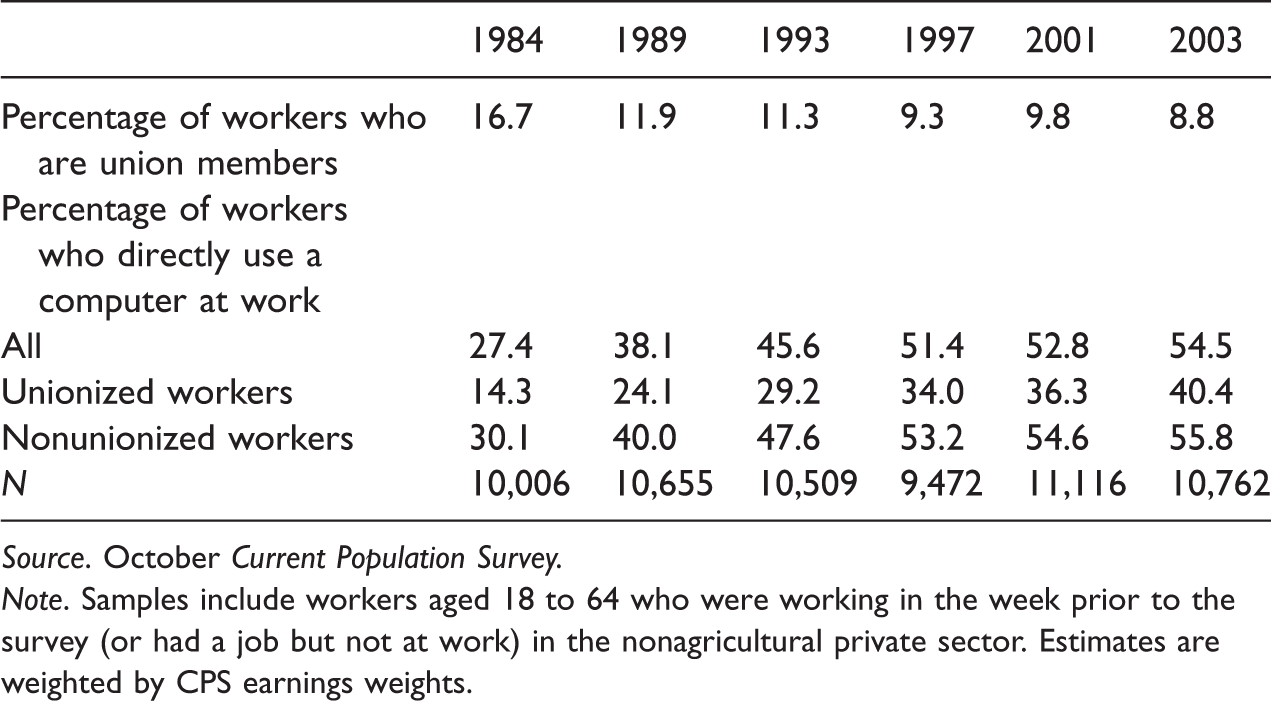
Table 2 shows the percentage of workers who directly use a computer at work, the percentage of workers who are union members, and the percentages of workers who directly use a computer at work among unionized and nonunionized workers in the years for which this information is available: 1984, 1989, 1993, 1997, 2001, and 2003. Two commonly known facts are revealed. First, in the same years that unionization declined, the percentage of workers who used a computer at work increased. Second, unionized workers are less likely to use a computer at work. In 2003, for example, 55.8% of workers who were not union members used a computer at work, compared with only 40.4% among union members. These numbers, of course, can be read the other way around too—workers who use a computer at work are less likely to be union members.
Percentage of Workers Who Are Unionized and Percentage Who Directly Use a Computer at Work.
Source. October Current Population Survey.
Note. Samples include workers aged 18 to 64 who were working in the week prior to the survey (or had a job but not at work) in the nonagricultural private sector. Estimates are weighted by CPS earnings weights.
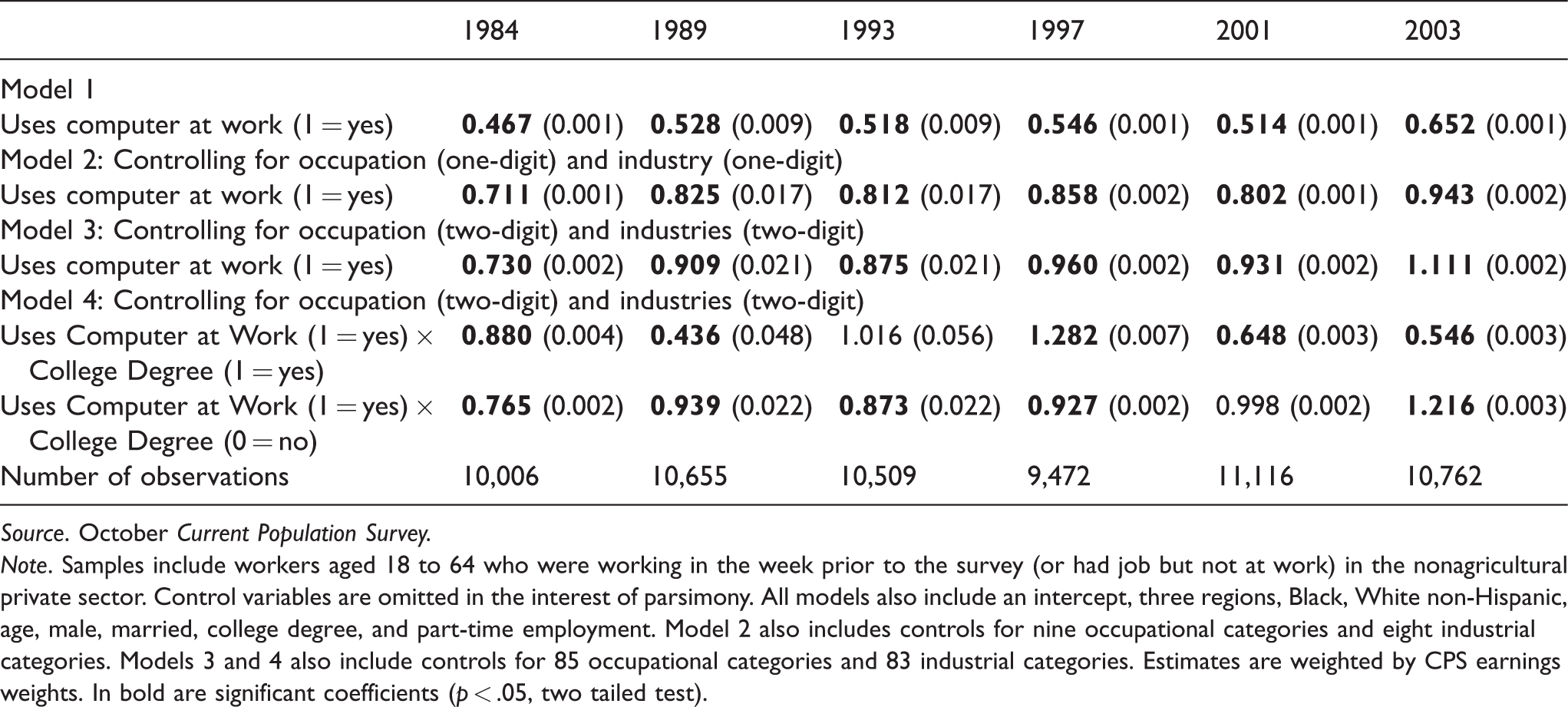
Table 3 presents the effect of using a computer at work on the odds ratio of being a union member. The value 1 denotes equal odds. In the years 1984–2003, using a computer at work decreased the odds ratio of being a union member for workers with the same demographic, educational, and employment characteristics (Model 1), even when workers’ jobs are classified under broad categories of occupation and industry (Model 2). The relation between using a computer at work and the likelihood of being a union member diminishes over time, as the predicted probability of workers who do not use a computer at work being union members declines more than the predicted probability of workers who do use a computer at work (data not shown). In Model 3, I analyze the odds ratio of computer users being union members within detailed industry and occupational categories. The results show that even within jobs, in 1984–2001, workers who used a computer at work were less likely to be union members than were workers who did not use a computer at work. In 2003, however, job characteristics accounted for the whole computer/union effect. Results from Model 4 further indicate that the negative association between using a computer at work and union membership in the early 2000s remained mainly among educated workers.
Odds Ratios From Logistic Regressions of the Effect of Using a Computer at Work on the Probabilities of Union Membership.
Source. October Current Population Survey.
Note. Samples include workers aged 18 to 64 who were working in the week prior to the survey (or had job but not at work) in the nonagricultural private sector. Control variables are omitted in the interest of parsimony. All models also include an intercept, three regions, Black, White non-Hispanic, age, male, married, college degree, and part-time employment. Model 2 also includes controls for nine occupational categories and eight industrial categories. Models 3 and 4 also include controls for 85 occupational categories and 83 industrial categories. Estimates are weighted by CPS earnings weights. In bold are significant coefficients (p < .05, two tailed test).
To estimate how much of unionization decline can be attributed to computerization, I multiplied the estimated impact of computer use at work by the changed proportion of workers who used a computer at work between 2 years. The logic of the procedure follows that of Freeman and Medoff (1984). If workers who use a computer at work are (everything else the same) 2.9 percentage points less likely to be union members than workers who do not use a computer at work, 5 and if the proportion of the workforce that use a computer at work increases from 27.4% in 1984 to 38.1% in 1989, the calculation attributes 0.3 percentage points of the decline in unionization between these years to the growth in computer use at work. Adding the five pairs of years, I obtain that the growth in the percentage of workers who use a computer at work between 1984 and 2003 decreases union density only slightly, by 0.51 percentage points, while union density actually declined by 7.9 percentage points overall.
A measure of using a computer at work captures only part of the far-reaching effects of computers on the practical and relational aspects of the labor process. Accordingly, in the next section, I use a measure that extends the effect of computerization from the individual who uses (or does not use) a computer at work to the broader implications for the workplace.
Computerization at Workplaces and Labor Unions
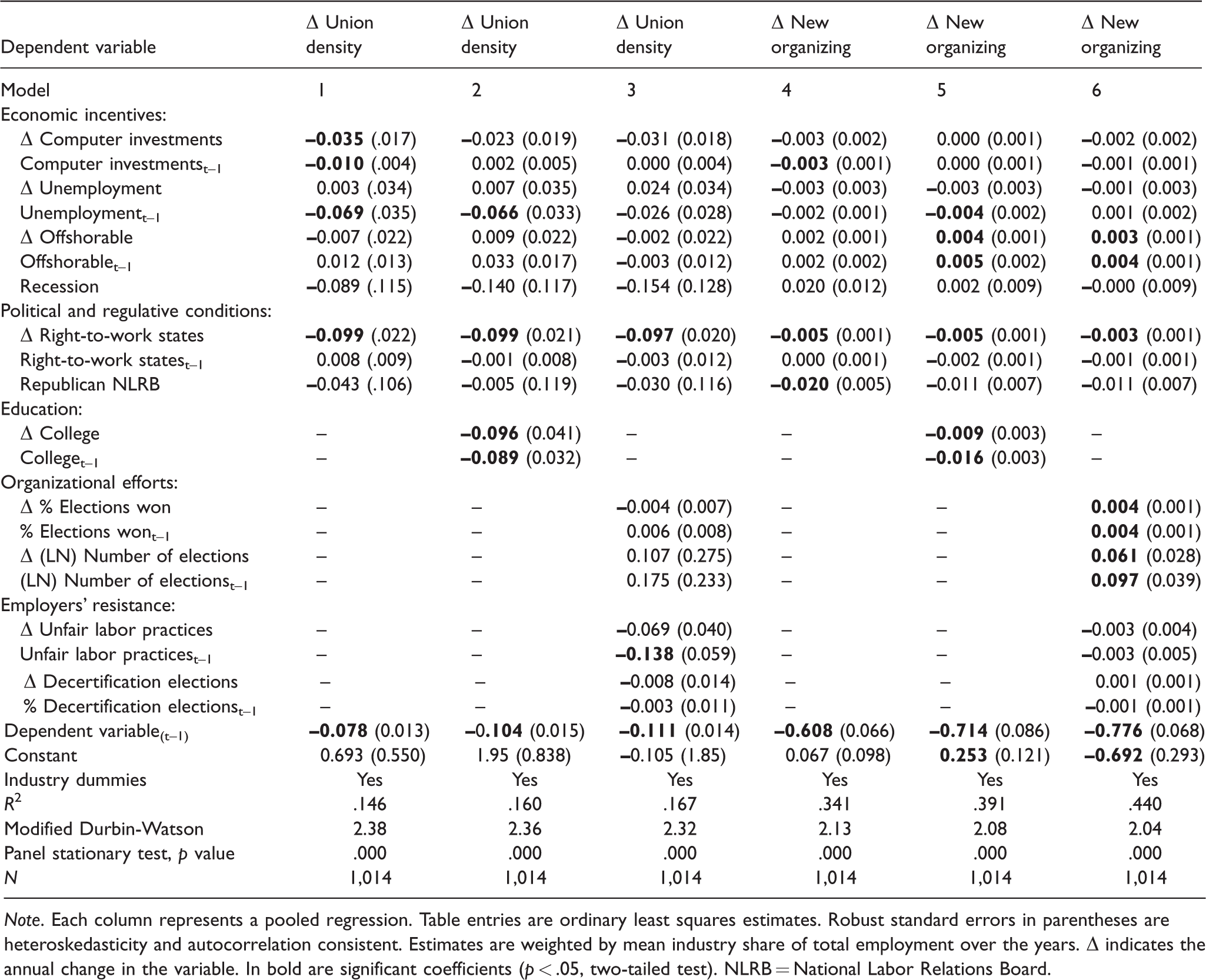
The first conclusion of interest from findings presented in Table 4 is that computerization had negative consequences for union density (Model 1) and new union organizing (Model 4) within private industries that have undergone similar measurable economic and political changes. This conclusion is based on the negative coefficients of both the short-term changes in computerization and their long-term levels. To determine the importance of the results for union decline, I calculated the maximum longitudinal impact (i.e., the long-term multiplier 6 multiplied by the average within-industry range of the independent variable) of computerization and how much of overall union decline between 1973 and 1999 is accounted for by this maximum longitudinal impact. Based on the model specifications, which include only variables affecting union decline for which it is possible to obtain consistent industrial data over time, I find that computerization accounts for 28% of the decline in union density (Model 1) and 49% of the decline in new organizing (Model 4). These results indicate that computerization played an important part in union decline in U.S. private industries.
Computerization and Within-Industries Changes in Organizational Strength (39 Private Industries, 1973–1999).
Note. Each column represents a pooled regression. Table entries are ordinary least squares estimates. Robust standard errors in parentheses are heteroskedasticity and autocorrelation consistent. Estimates are weighted by mean industry share of total employment over the years. Δ indicates the annual change in the variable. In bold are significant coefficients (p < .05, two-tailed test). NLRB = National Labor Relations Board.
The relationship between changes in the political and regulative conditions and unions’ decline within private industries also proved important, albeit less than computerization. As expected, Republican control of the NLRB is a stumbling block for new union organizing more than for the historic figure for industries’ union strength as measured by union density. Globalization, measured here only by the share of jobs in each industry that face potential global competition, was unexpectedly found less related to overall union decline within private industries.
The industrial analyses allow a closer study of the possible mechanisms that link computerization and union decline by measuring workers’ skill, employers’ efforts to de-unionize, and union organizing efforts. A second main conclusion is that the effect of computerization on unionization was channeled partly through changing the skill composition of industries’ workforces, measured by an increase in the share of college graduates who were less likely to be union members, presumably because of computerization’s impact on the practical aspect of the production process. Controlling for changes in the educational composition of the workforce (Models 2 and 5), computerization had no effect on changes in union density and new union organizing within private industries. 7 Why did the computer-controlled machine displacement of workers affect their skill composition and also their organizational strength? Figure 2 demonstrates the relation between workforce skill composition and unionization by showing union density by educational group and by occupational tasks based on Autor et al.’s (2003) measures from the Dictionary of Occupational Title. Clearly, less educated workers and occupations intensive in both nonroutine and routine manual tasks, whose share of the workforce had declined substantially over the previous four decades (Autor, Katz, & Kearny, 2006), had a higher level of unionization historically—around 30% in the 1970s. 8 As the economy moved toward employment in nonroutine tasks, unionized jobs were displaced by computerization, and unions experienced a severe hit.
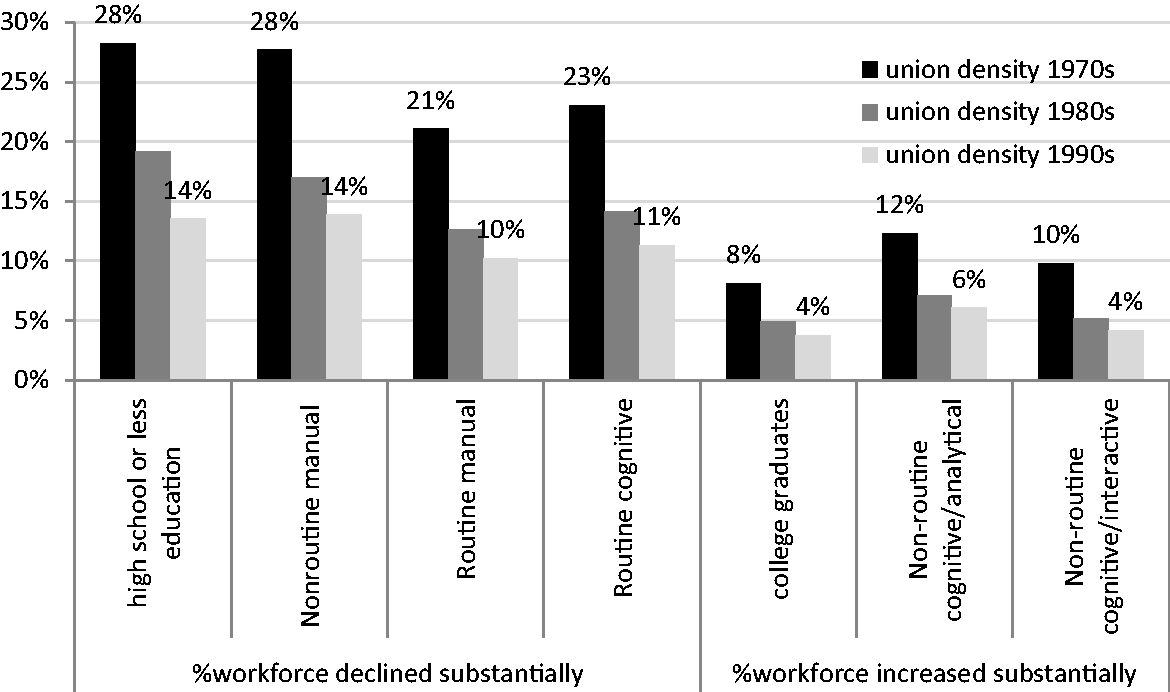
Union density in nonagricultural private industries by decades, educational and occupational groups.
The third conclusion of interest from Table 4 is that the relational aspect of the production process matters as well for understanding union decline. Supporting the argument that the effect of computerization on unionization was channeled partly through the trends shown in Figure 3—increasing employers’ resistance to unions—Models 3 and 6 in Table 4 reveal that controlling for changes in these variables, computerization had no effect on union density and new union organizing. Figure 3 presents the number of ULP cases filed against employers and the number of decertification elections standardized by the total number of representational elections held under the NLRB in each year-industry. The number of charges per election has continuously increased in parallel with the computer revolution. Flanagan (2005) showed this trend up to 1999. But during the 2000s, there was an additional dramatic increase, particularly from 2006 to 2010. In all industrial sectors—unionized (manufacturing, transportation, mining, construction) and nonunionized (services, trade, FIRE)—the rate of ULP per election increased. Decertification elections—firms’ efforts to rid the workplace of unions—also increased through the 1970s, declined for most of the 1980s and 1990s, and increased again from the late 1990s. Surprisingly, there were no marked differences between the unionized and the nonunionized sectors in fighting unions: All industrial sectors evinced a trend of increasing opposition to unions in NLRB elections.
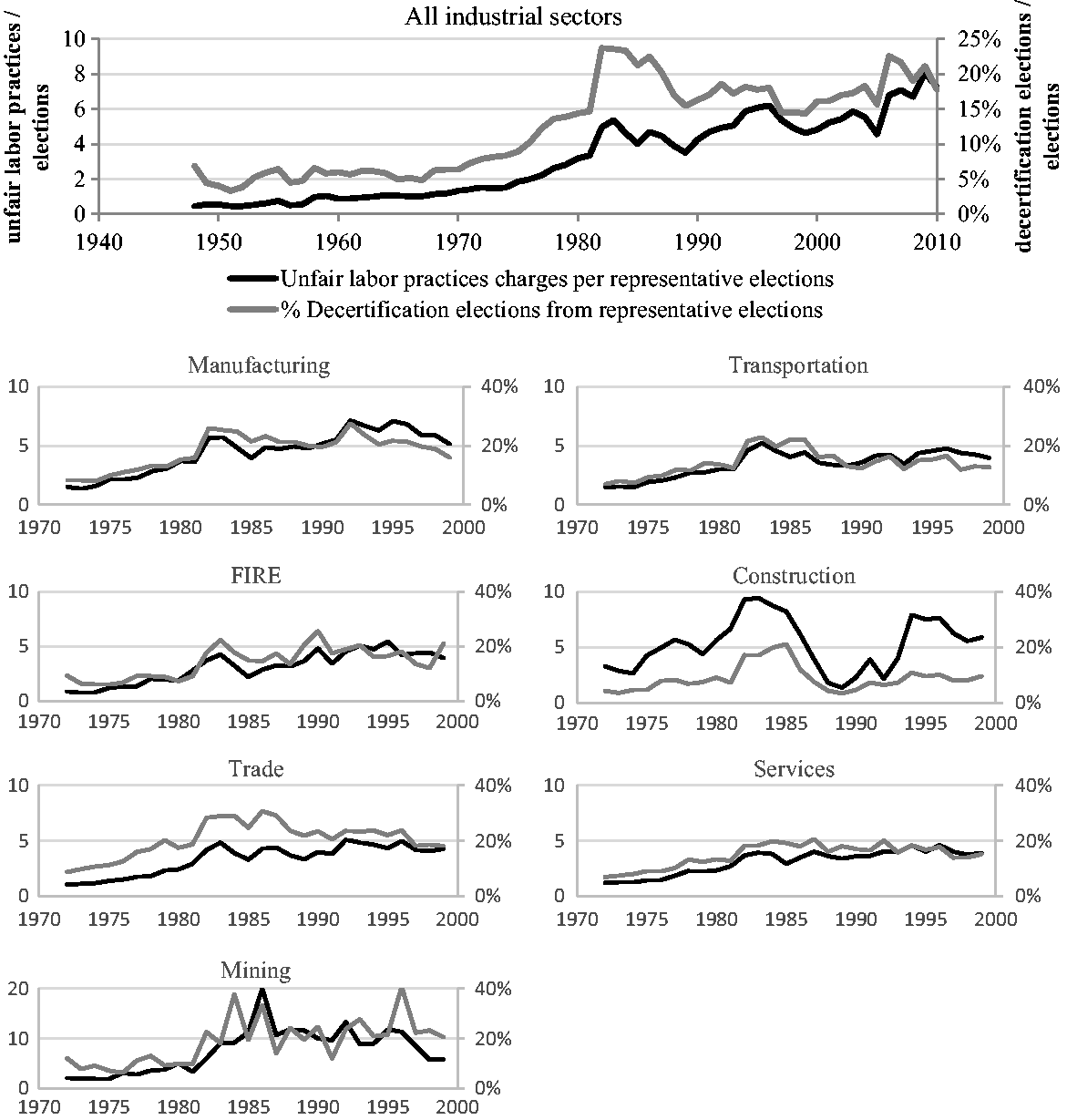
Unfair labor practices charges and decertification elections per representational election for all industrial sectors (1947–2010) and by industrial sector (1972–1999).
Table 5 more directly portrays whether computerization facilitated union decline by decreasing organizational efforts (Model 1) and intensifying employers’ opposition to unions, as measured by the number of ULPs (Model 2) and the percentage of decertification elections (Model 3). As is evident from the results shown in Table 5, an increase in computer investments over time within industries hardened employers’ resistance to unions under NLRB elections. This conclusion is based on the positive coefficients of both the short-term changes in computerization and their long-term levels. Based on the model’s specifications, computerization accounted for 26% of the increase in ULPs and for 72% of the increase in decertification elections. These results indicate that computerization, through changing the relational aspect of the production, had an important role in union decline in U.S. private industries. The results for organizational efforts, however, are less robust.
Computerization and Within-Industries Changes in Representational Elections, Unfair Labor Practices Charges, and Decertification Elections (39 Private Industries, 1973–1999).
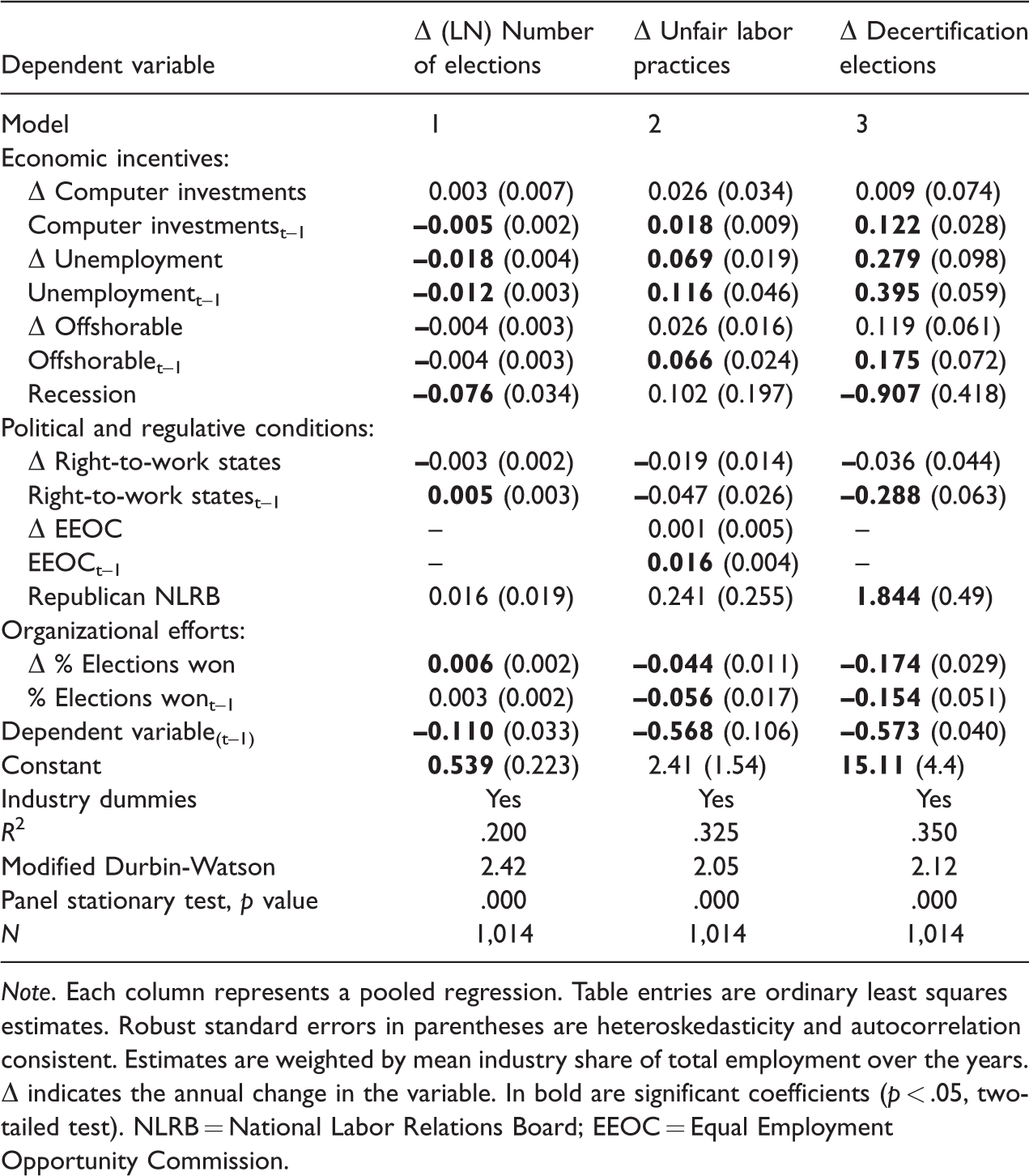
Note. Each column represents a pooled regression. Table entries are ordinary least squares estimates. Robust standard errors in parentheses are heteroskedasticity and autocorrelation consistent. Estimates are weighted by mean industry share of total employment over the years. Δ indicates the annual change in the variable. In bold are significant coefficients (p < .05, two-tailed test). NLRB = National Labor Relations Board; EEOC = Equal Employment Opportunity Commission.
Findings for 393 detailed industries in manufacturing (Table 6) reinforce the finding for the 39 private nonagricultural industries that computerization of labor processes decreased workers’ organizational strength by changing the skill composition of the workforce, but even more importantly by increasing the frequency of employer opposition to unions. Calculating the same rates as I did for private-sector industries, I obtain that computerization accounted for 11% of the decline in union density (according to Model 1) between 1977 and 2002, only for about 2% between 1984 and 1999, controlling for skill composition (Model 2) or organizational efforts and intensifying employers’ opposition to unions (Model 3). In line with the study hypothesis, computerization increased employers’ use of ULPs within manufacturing industries (Model 5). The coefficients are in the expected direction, but no significant effect is seen of computerization on organizational efforts and decertification elections in manufacturing industries.
Computerization and Within-Industries Changes in Union Density, Unfair Labor Practices Charges, and Representational Elections (393 Manufacturing Industries, 1977–2002).
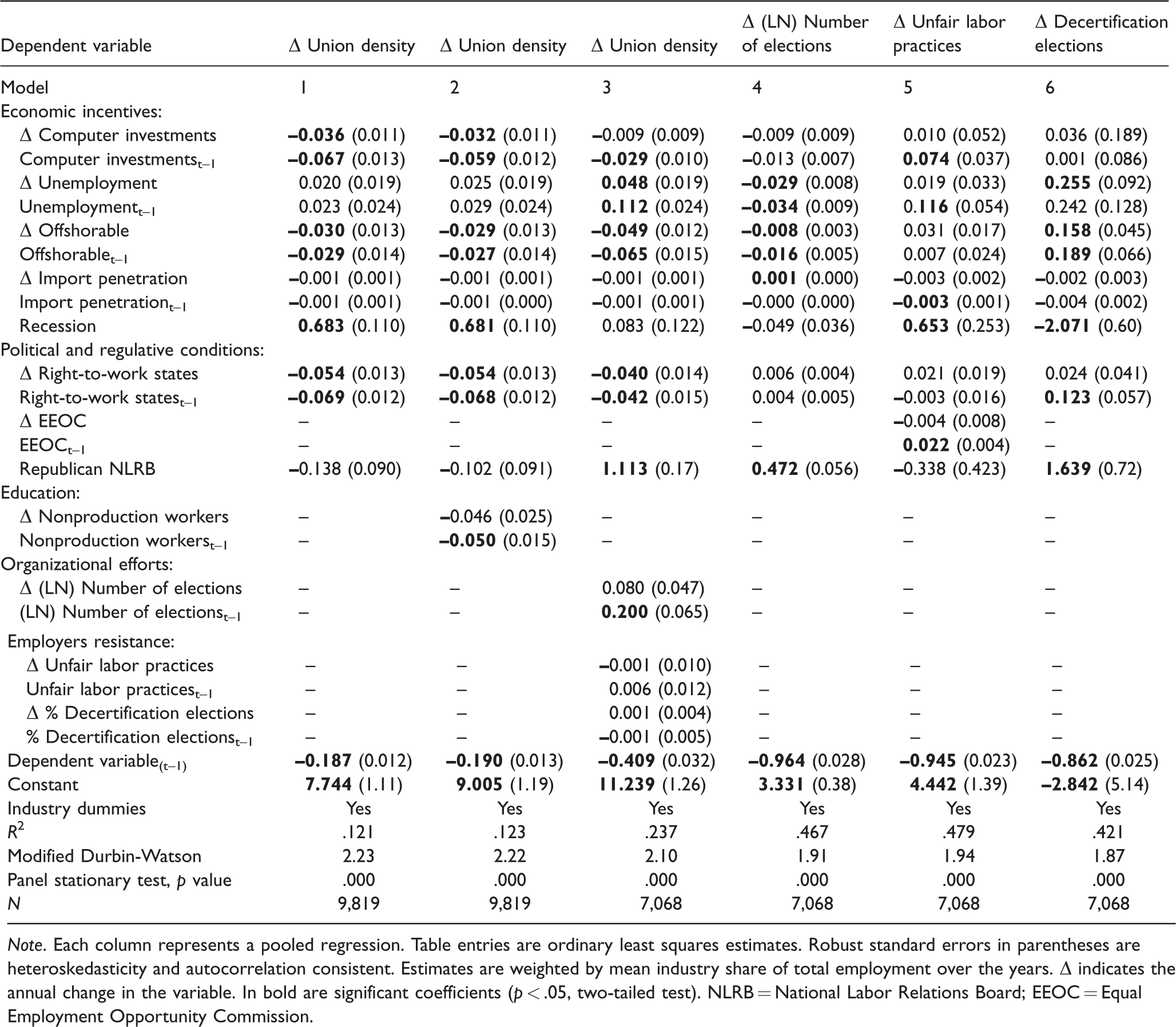
Note. Each column represents a pooled regression. Table entries are ordinary least squares estimates. Robust standard errors in parentheses are heteroskedasticity and autocorrelation consistent. Estimates are weighted by mean industry share of total employment over the years. Δ indicates the annual change in the variable. In bold are significant coefficients (p < .05, two-tailed test). NLRB = National Labor Relations Board; EEOC = Equal Employment Opportunity Commission.
These results, based on analysis of 393 detailed industries in manufacturing between 1977 and 2002, indicate that computerization had an important—but not central—role in union decline in manufacturing industries. Because the computer revolution was also a catalyzer of the growth of globalized container shipping and globalization of production chains, the overall “computer effect” might have been more considerable. Most interestingly, I find that an increase in offshorability, a feature of globalization for which it is possible to obtain consistent industrial data over time by measuring the share of jobs in each industry that face potential global competition, decreases union density while increasing employers’ resistance to unions.
Discussions
In this article, I highlight a new explanation for union decline by focusing on a currently neglected site that exemplifies unions’ fragility: the shop (or office) floor in the computer revolution era. Computerization, I argue, (a) has increased the difficulty of organizing by changing the practical aspect of the production process and, in so doing, the skill composition of the workforce and, more directly, (b) has enabled union decline by changing the relational aspect of production, thereby empowering firms to intensify their opposition to union organizing. The findings reveal that the increase in workers who use a computer at work explains only a minor part of union decline (6.5%), but computerization at workplaces accounts for an important share of the decline in the rates of unionization in private-sector industries (28%) and in manufacturing industries (11%). Consequently, while new technology obviously has led to a richer world, this study suggests that the costs of workplace computerization to the U.S. labor movement have been high.
There are several possible explanations for the negative relation between using a computer at work and being a union member during the 1980s and 1990s (though no longer in 2003 for less educated workers). The findings may be a result of changes in the practical aspect of the labor process that was followed by a lesser motivation of workers who use a computer at work to join a union and benefit from a union wage premium, as they already benefit from a computer wage premium. This explanation is supported by studies on the effect of unionization on wages for private-sector workers, which have produced estimates from 15% to 25% for the wage premium on union membership, a figure that has somewhat declined since the early 1980s (Hirsch, 2008). By contrast, the wage premium associated with computer use at work increased over time from 17% in 1984 to 23% in 1993 (Autor, Katz, & Krueger, 1998). Hence, as the union wage premium declined and the computer wage premium increased, workers may have had less economic motivation to join a union.
An additional explanation for the findings is that workers who use a computer at work find it harder to organize. This may be because computers generated changes in the relational aspect of the labor process, which have given managers the ability to monitor workers more closely, empowering employers and management. Using a computer at work has also isolated workers physically and socially from their coworkers, diminishing social interactions at work among workers and solidarity sentiments. Reverse causality may also explain the findings. Unionized workers may resist the implementation of new technology at work as they have concerns about the impact on job security and the nature of the work and, in some cases, can delay computerization of workplaces by demanding notification in advance, consultation first with the union, or creating a joint committee to oversee problems when introducing new technology. 9
The current study does not model the practical and relational mechanisms directly; nevertheless, the industrial-level analyses enable a closer evaluation of the theory spelled out in Figure 1. Particularly, outcomes for the skill composition of the workforce (i.e., practical) compared with outcomes for employer resistance (i.e., relational) partly reflect these different paths. I find that the effect of computerization at workplaces on unions is in part structural via changing the workforce’s skill composition—new technology substitutes for unionized labor, while new jobs that come into being thanks to the new technologies are less likely to be unionized. Industrial robots—along with the legions of computerized machines that are becoming smarter and cheaper, more attractive to industry as they can stay on the job 24 hours a day yet maintain the quality of their work, and have begun to do some higher cognitive tasks (e.g., building cars, writing tax reports)—do not join unions.
More notably, I find that a significant part of the effect of computerization at workplaces on unions was directly through factors that determine unionization, namely fanning employers’ resistance to unions and reducing organizational efforts, thus further enhancing union decline. To be sure, computerization was not an independent cause of the restructuring of power relations at workplaces, but a catalyst of changes in the economic and political conditions on the shop floor and in the labor market, changes that led to union decline. How does computerization relate to a surge in employer militancy in the form of ULP or decertification elections? I argue that computerizing workplaces increased firms’ ability to fight unions. Computerization has transformed the relations in production by easing the monitoring of work and workers and by making production information less personalized and localized, causing a power shift from labor to management. As managers enjoy more power due to computerization, they can more frequently, aggressively and effectively oppose union organizing, assisted by a multimillion-dollar concern (Logan, 2006) of antiunion consultants, law firms, and strike management firms.
This study is not without limitations. First, the results discussed here are an average in private industries and manufacturing industries. Yet the effects of computerization on unions should depend on the legacy of unionization and collective bargaining. In industries where cooperative industrial relations are institutionalized, the negative effects of computerization on unions should be muted by joint labor-management forums for cooperative decision-making on company issues such as controlling the implementation and outcomes of technological change. That is not to say that computerization has not increased employers’ opposition to unions in unionized workplaces, but it might have done so a little less.
In addition, the relation between computerization and unions may be driven by unobserved heterogeneity in two possible ways. First, the computer use/union relation could be due to unobserved differences between computer users and nonusers due to the nonrandom assignment of computers in the labor market. It may also be due to observed differences between computer users and nonusers as there is most likely a selection bias of individual earners into using a computer at work, based, for example, on their educational level. Hence, at least part of the computer use/union association is an outcome of the positive effect of college graduates on computer use at work and its negative effect on union membership. Second, the effect of computerization on union density (but not on employers’ resistance to unions and organizational efforts) over time may be driven by a change in organizational demography within most industries—the growth of new nonunionized workplaces relative to older unionized establishments in the same detailed industry, which is unrelated to computerization.
These limitations notwithstanding, this study makes a number of important contributions to theory and research on labor unions and the role of computer-based technologies in rising inequality. First, findings that computers in the workplace have transformed labor–capital power relations and hampered unions provide important evidence to understudy explanation for union decline. Second, the adverse effects of computerization on unions channeled through a transformation in labor–capital power relations offer more direct evidence than presented by Kristal (2013) of the CBTC thesis that computerization’s power over the wage structure is also governed by workers’ organizational power.
Conclusions
This study highlights the value in bringing back labor process to the sociology of technology. In this line of theory, grounded in Marx’s Capital (MacKenzie, 1984), social relations are a major factor affecting the technology of production and, in turn, affect social relations. The industrial revolution was not simply a matter of replacing technology of production: It was a matter of reshaping jobs themselves into the sort that enabled capital to maximize profits. The study’s findings that computerization has fanned employers’ resistance to unions are in line with this general theme: Computerization is a social process that reflects preexisting social reality, that is, a profit-maximizing economic system that attempts to drive down wages and increase managerial control. Computerization is a class-based process, but it also has classed outcomes. By being a catalyst for changes in the economic and political conditions on the shop floor, changes that led to union decline, computerization has generated classed outcomes.
Some may contend that this article documents a specific historical period of the United States, which may be difficult to generalize to the current period and or other comparative-historical settings. Yet the idea of power relations and technological developments going hand in hand has materialized in recent years in the ununionized, no full-time contract employees’ gig economy (i.e., companies that supply labor and services on demand) managed by online platforms (e.g., Uber). The smartphone has enabled connecting to more data and minimizing transaction costs but at the same time has augmented management control over the content, timing, and costs of work, pressuring toward atomization of the labor process (Kalleberg & Dunn, 2016; Shestakofsky, 2017). That some workers respond to challenges of alternative work arrangements through reliance on individual strategies (Sallaz, 2015) and collective resources (Schwartz, 2018) even reinforces the bottom line, namely algorithmic bosses are still bosses even when companies insist that their workers are independent contractors and not employees. A growing number of on-demand employees, with no rights such as minimum wage, sick pay, and overtime, can give employers at firms with more standard structures an incentive to cut back labor rights and to enhance their capacity to control labor.
Obviously, there is the potential upside of new communication technologies for union organizing. The spread of the Internet as a popular means of communication enables an interactive platform for unions to provide workers with information about the workplace and job market, to communicate about workplace issues, to enhance democracy in unions, and to strengthen the international labor community; all offer unions opportunities to improve services and attract members (Freeman & Rehavi, 2008). Indeed, the rise of the Internet has enabled new means of transmitting information and communication that has in turn enabled the rapid emergence of social protest movements that are organized and coordinated through the Internet. Because the empirical estimations of the current study end in the early 2000s, whether the Internet is intrinsically a technology that will facilitate union organizing is an open question. But as studies on the “digital divide,” a term used to describe the gap between the “information rich” and the “information poor,” reveal that even the Internet cuts with the powerful most of the time, hesitation is necessary before we aver that the Internet will indeed facilitate union organizing. In fact, the current study is part of accumulated evidence exposing computerization as a social process that reflects and reproduces preexisting social inequality by enabling employers to use technology to secure the upper hand.
Footnotes
Acknowledgments
I wish to thank Yinon Cohen for helpful comments and discussions on earlier drafts.
Declaration of Conflicting Interests
The author declared no potential conflicts of interest with respect to the research, authorship, and/or publication of this article.
Funding
The author disclosed receipt of the following financial support for the research, authorship, and/or publication of this article: This project was supported by the United States–Israel Binational Science Foundation and by the European Research Council Starting Grant (Agreement No. 677739/2015).