




Abstract
In this study, the authors investigate the health associations of different employment arrangements in the contemporary European labor market. In doing so, a new approach based on the concept of “employment quality” is introduced. Employment quality refers to the multiple dimensions characterizing the employment situation of wage- and self-employed (European Working Conditions Survey 2015 – N = 31,929). Latent class cluster analyses were applied to construct an overarching typology of employment quality for the waged and self-employed. Using logistic regression analyses, strong associations were found with mental well-being and self-reported general health, pointing at a disadvantaged situation for the most precarious employment arrangements. The study shows that employment quality should be taken seriously as a health determinant both among waged workers and the self-employed. Our (novel) holistic approach offers an alternative to current analyses of the health associates of labor market segmentation that were criticized for being overly simplistic and amounting to inconclusive findings.
Keywords
Because of economic restructuring toward the end of the 20th century, the dominance of the Standard Employment Relationship (SER; typically characterized as permanent, full-time, waged employment with a strong regulation of employment conditions) started to decline steadily (Amin, 1994; Bosch, 2004). This tendency involved a breakdown of training and promotion ladders, declining job security and a rise of nonstandard work arrangements—for example, (short-term) temporary work, involuntary part-time work and contract work (Cappelli, 1995; Lewchuk, 2017). At the same time, in many European countries, also the nature of self-employment started to change, with new types of self-employment gaining importance (Arum & Müller, 2004). Particularly in the service industries, this was the case (Arum & Müller, 2004; Gottschall & Kroos, 2007). Trends toward outsourcing and decentralization caused a growth in “new forms of self-employment,” including small and solo self-employment (Boltanski & Chiapello, 2005) in the form of freelancing and subcontracting (Román et al., 2011).
Overall, these tendencies led to an increasingly destandardized and segmented labor market in the early 21st century (Schmid & Wagner, 2017)—and therewith a process of precarization for part of the labor force (Kalleberg, 2016). More specifically, it is often assumed that some “new forms of self-employment” are associated with the deterioration of occupational health and safety (Mai, 2017), as well as increases in insecurity and unpredictability, less sustainable income, and low bargaining power (Arum & Müller, 2004; Carré, 2016), which in turn are alleged to affect health and well-being negatively. For example, researchers find that job insecurity is associated with suboptimal self-rated general health, poor mental health (Virtanen et al., 2011), as well as sleep-related problems (Mai et al., 2019). Many scholars thus warn for the adverse health and well-being effects of nonstandard forms of employment and of self-employment (Benach et al., 2016). However, a review of the evidence shows that the patterns of association are not that clear-cut (Walker, 2011). Certainly, the self-employed are commonly seen as a healthier worker population, compared with those in traditional waged employment (Lange, 2012; Stephan & Roesler, 2010). However, recent research highlights the huge diversity in job quality and related worker well-being among the self-employed, including both well-off and precarious types of self-employment (Eurofound, 2017). For wage-earners, evidence for so-called “high-road” de-standardization strategies (e.g., “total workplace innovation models” and “high performance work systems”; Appelbaum & Berg, 2001; Van Hootegem, 2016; time- and place-independent work) suggests positive consequences for employee well-being (Huang et al., 2016)—and thus challenge too broad generalizations about the adverse health effects of nonstandard (precarious) forms of waged employment.
In this study, we try to bring clarity to those previous findings by looking into the health implications of different types of employment arrangements in the contemporary European labor market. In doing so, the objectives of this study are three-fold. First, our study fills a gap in the field, by applying a novel, multidimensional approach toward employment characteristics which enables us to construct a typology of “employment arrangements” representing the dominant employment types in a given labor market. Such a holistic, person-centered approach (Morin et al., 2018) offers an alternative to current studies of the health associates of labor market segmentation that can be criticized for being overly simplistic and have often revealed inconclusive findings related to workers’ health and well-being (Vanroelen, 2019). In previous research, we have already applied the underlying methodology to cross-national samples of European wage-earners. In this study, this approach is extended toward the self-employed. Constructing a typology of “employment arrangements” for both the waged and self-employed has not been done before, except for a recently published study by Peckham et al. (2019) using data from the United States. This study is therefore the first, to extend the typological approach toward employment quality to the European waged and self-employed workers. As a second objective, we then examine how the obtained typology relates to workers’ health and well-being. As a third objective, we furthermore investigate the mediating influence of characteristics intrinsic to the work task.
Theoretical Framework
Employment Quality on the Segmented Labor Market
Segmented labor market theory argues that a compartmentalization of different groups of workers exists in our labor markets (Wilkinson, 1981). Such groups represent strong social cleavages in which different opportunity structures are offered to workers with different employment and sociodemographic profiles (Peck, 1989).
A basic distinction in segmented labor market theory is that between a “primary” (i.e., standard, full-time, permanent jobs with higher wages, stability and possibilities for career progression) and a “secondary” segment (i.e., nonstandard, poorly paid, instable and flexible jobs). Workers in each of these segments have a particular sociodemographic profile: That is, in the secondary segment lower skilled, women, young people and ethnic minorities tend to be overrepresented, while the primary segment is more likely to be composed of skilled midcareer, White males (Peck, 1989). The primary-secondary-distinction is considered overly simplistic (Davidsson & Naczyk, 2009; Dekker & van der Veen, 2017) because of hiding a variety of contemporary employment arrangements (Lukac et al., 2019), including both “low-road” and “high-road” types of nonstandard work (Bosch, 2004). The “high-road” is reserved for higher skilled workers in strategically important functions and implies versatility, place- and time-independent work but at the same time leaves opportunities for worker-induced flexibility, career prospects, and strong bargaining power on the basis of desired skill sets (Kalleberg, 2003). The “low-road” is reserved for lower skilled and generally less strategically important workers and often implies different combinations of contractual and temporal flexibility, including temporary (agency) work, (involuntary) part-time work, or unpredictable working times (Eichhorst & Marx, 2015).
Today’s segmented labor market structure also cross-cuts the self-employed (Bögenhold, 2019; Conen & Schippers, 2019), resulting in a variety of self-employment arrangements, with varying employment quality (Eurofound, 2017). Moreover, distinctions between the waged and self-employed are getting blurred in contemporary labor markets (Wynn, 2016) because (dependent) solo self-employment (Eurofound, 2017) and autonomous, self-steered waged employment are characterized by typical features of both self- and waged-employment (Wood et al., 2012).
In short, dichotomous distinctions of primary and secondary labor market segments and between the waged and self-employed are becoming increasingly shallow as approximations of the contemporary labor market (Lukac et al., 2019). Furthermore, a lack of consensus on how to measure contemporary employment arrangements hampers clear insights in potential outcomes of employment quality (Mai, 2017). In this study, the multidimensional concept of “employment quality” is applied as a way to break with traditional approaches for studying the structuring of employment arrangements over the labor market. In doing so, the SER model of employment is used as a benchmark against which to assess the characteristics of contemporary employment arrangements for both wage-earners (Julià, Vanroelen, et al., 2017) and the self-employed (De Moortel & Vanroelen, 2017). Although concrete employment characteristics among wage-earners and the self-employed differ, we propose five overarching dimensions of employment quality that are based in the employment relations literature (Julià, Vanroelen, et al., 2017; Kalleberg, 2016; Muñoz de Bustillo et al., 2011) and can be considered as valid for both groups. These dimensions are (a) job security, (b) economic sustainability, (c) working time, (d) skill development, and (e) empowerment. In addition, we include a separate sixth dimension for wage-earners (e.g., 6w. workers’ rights and social protection) and for self-employed (e.g., 6s. business magnitude).
Our model assumes that different characteristics on the dimensions constitute different types of arrangements in terms of employment quality (see e.g., Lukac et al., 2019; Van Aerden et al., 2014). Such a multidimensional, typological model can take into account situations where, for example, unpleasant working conditions are being compensated by high earnings or other additional benefits (Oesch & Piccitto, 2019). Furthermore, previous research (Lukac et al., 2019; Van Aerden et al., 2014) shows that the typological approach offers a better approximation of the structure of contemporary European labor markets than conceptualizations merely distinguishing types of contracts (Julià, Vives, et al., 2017). This study is the first in Europe to apply the typological approach to a sample of waged and self-employed simultaneously.
Health Implications of Employment Quality
In this study, health is defined by means of two indicators. First, self-rated general health, which is a well-known indicator for the overall health status of individuals. The indictor aligns with the World Health Organization’s (2006) broad definition of health as a complete state of physical, mental, and social health. Moreover, its simplicity makes it a practical and globally comparable measure that has been shown to be a good predictor for clinical outcomes (Fayers & Sprangers, 2002). Second, the World Health Organisation – Five Well-Being Index (WHO-5) will be used. The WHO-5 has hedonistic foundations (Kusier & Folker, 2020), meaning that positive well-being is defined in terms of pleasant affective states (Kusier & Folker, 2020) and as an individual’s own judgment about what makes him/her happy (Sirgy, 2012). It is increasingly used as a mental health indicator in working populations (Topp et al., 2015; Wright et al., 2007).
Review studies have already demonstrated the health associates of many components that are underlying the employment quality concept: for example, job (in)security (De Witte et al., 2016) and temporary employment (M. Virtanen et al., 2005), long working hours (Bannai & Tamakoshi, 2014), empowerment (Spreitzer, 2008), and personal income (Cummins, 2000). Furthermore, Kalleberg (2016) argues that overall good quality jobs provide a foundation for healthier workers, while overall bad quality jobs contribute to stress and poor health. Multidimensional operationalizations of employment quality are, however, relatively new—and have therefore generated less evidence for their relationship with health. Later, we provide a short overview of previously reported research findings.
A study by Scott-Marshall and Tompa (2011), for example, recognizes the multidimensionality of employment quality but differs from our study in that it merely adds several separate indicators to a regression model without summing them together in a scale or creating a typology based on a combination of indicators. Other European studies, however, have applied “linear scoring approaches”—that is, these studies identify several indicators of employment quality and construct a summed score out of them, representing the situation of workers in terms of employment quality. For example, Vives et al. (2010) found evidence for associations between perceived general health and the employment precariousness scale on a sample of wage-earners. A second example of a strong association between a linear scale of employment quality and poor health outcomes is Lewchuk’s (2017) Employment Precarity Index (i.e., a multidimensional, linear approach applied to a sample of waged employees which they divide into quadrants afterward). Compared with Lewchuk (2017) and Vives et al. (2010), the typological approach applied in our study has the primary advantage of following a person-centered—or holistic—approach, meaning that the approach is able to realistically reflect the health implications of employment as a “real-life situation,” by taking into account specific configurations of variables (Howard & Hoffman, 2018). In other words, we relax the assumption of linearity that is underlying most of the summed precariousness or employment quality indicators. Thereby, we explicitly take into account those situations where particular configurations between employment characteristics may create a situation where “unfavorable features” (e.g., intensive and very flexible schedules) are counterbalanced by more beneficial features (e.g., benefits or resources in the form of pay or career development opportunities; Oesch & Piccitto, 2019).
The study by Van Aerden et al. (2014) already applied the typological approach explained earlier; however, the analyses were solely focused on European wage-earners. Finally, the study by De Moortel and Vanroelen (2017) has applied the approach solely among a self-employed sample. In this study, we go a step further by investigating both wage-earners and self-employed from one single sample using the outlined typological approach. To our knowledge, only Peckham et al. (2019) have included both waged and self-employed simultaneously in a U.S.-study about the health implications of a multidimensional measure of employment quality. They have found that especially employment quality types characterized by an accumulation of several unfavorable employment conditions (such as high workplace harassment, low development opportunities, low control over schedule, and low employee involvement) are associated with poor general and mental health as well as occupational injury. In our study, we will do similar analyses in a European context. Our study, however, allows for a more detailed exploration of self-employment, given the large sample of self-employed (N = 5,677) from 27 European Union (EU) countries we dispose of. Moreover, results might differ importantly between a U.S. and an EU context. The contextual influence on job quality has been a long-standing issue in the sociology of work. Inanc (2020) for example, highlights how precarious work will manifest differently depending on differences in welfare institutions and labor market policies. Furthermore, the February 2017 Special Issue of Work and Occupations is dedicated to how job quality changes contextually depending on state actions, institutions, and power relations (Bosch & Weinkopf, 2017; Findlay et al., 2017). A notable factor in that regard—and one that is useful for our study—is the degree of polarization surrounding self-employed work. In Peckham et al.’s (2019) study, only two contrasting self-employment types appear, reflecting a clear distinction between a “good” and a “poor” type of self-employment in terms of employment quality. Consequently, their study provides evidence for a clear-cut polarization among self-employed workers in the United States (Arum, 2004). European researchers, however, did not find such pervasive job polarization among the self-employed. Because of specific historical, political, and institutional factors, U.S. self-employment appears to be much more a story of success or outspoken vulnerability than it appears to be the case in Europe (Luber & Leicht, 2000; Oesch & Piccitto, 2019). In our European sample, we therefore expect to find a less polarized and more nuanced picture of self-employment. Furthermore, vast historical differences in the way European and American labor laws have been organized as well as in terms of labor market evolutions (Diprete, 2005) and sociocultural ideologies (Arum, 2004) will potentially lead to differences between Peckham et al.’s (2019) and our study results.
Finally, intrinsic quality of work—meaning characteristics of the work tasks themselves and the conditions under which these tasks have to be performed (Muñoz de Bustillo et al., 2011)—have an important impact on various health (Cottini & Ghinetti, 2017; Gunnarsson, 2010; Rydstedt et al., 2012) and well-being outcomes (Cox et al., 2000; Gregoire, 2002) as well. In addition, workers with less advantageous employment quality generally also experience less advantageous intrinsic quality of work (Lewchuk, 2017; Underhill & Quinlan, 2011).
Objectives
In this study, the multidimensional approach to employment quality will be applied to both the waged and self-employed in order to construct a typology of contemporary employment arrangements. Therefore, the first objective of this study is as follows:
Data and Analytical Strategy
Data
Data from the European Working Conditions Survey (EWCS)—Wave 6 (2015) were used. The sample is representative of workers aged 15 and older, who are in employment and are residents of one of the countries under study (Eurofound, 2016). In our study, only waged and self-employed respondents residing in the EU member states (with the exception of Croatia) were selected and respondents in the armed forces (N = 123 or 0.4%) were excluded. The final sample included 31,929 respondents (26,252 waged employed and 5,677 self-employed workers) and the age range varied from 15 to 89 (with N + 65 years old = 926 or 2.9%).
Measures
Dependent Variables
Poor Self-Rated Health
The question “How is your health in general?” was answered using a 5-point Likert-type scale ranging from very good to very bad. The original item was collapsed into a dichotomous variable contrasting fair to very bad self-rated health against the other categories, which is common practice (Manor et al., 2000).
Poor Mental Well-Being
The WHO-5 Well-Being Index (Psykiatric Center North Zealand, 2017) was used and consisted of five items (α = 0.881): I have felt cheerful and in good spirits, I have felt calm and relaxed, I have felt active and vigorous, I woke up feeling fresh and rested, and My daily life has been filled with things that interest me. Because of nonnormality (Figure A.1.), the original sum scale (0–10) was dichotomized using a recommended cutoff value of 5, which is indicative of reduced well-being (Topp et al., 2015).
Employment Quality
The main explanatory variable is a constructed empirical typology of employment quality. Two Latent Class Cluster Analysis procedures were conducted for constructing separate typologies for waged- and self-employed using Latent Gold 4.5™ software. Latent Class Cluster Analysis allows to rearrange respondents into groups, based on their similarity on a number of manifest indicators—in our case, these were proxy indicators for the employment quality dimensions derived from the EWCS (see Table 1; Hagenaars & McCutcheon, 2002).
Proxy Indicators (and Response Options) Constituting the Employment Quality Dimensions.
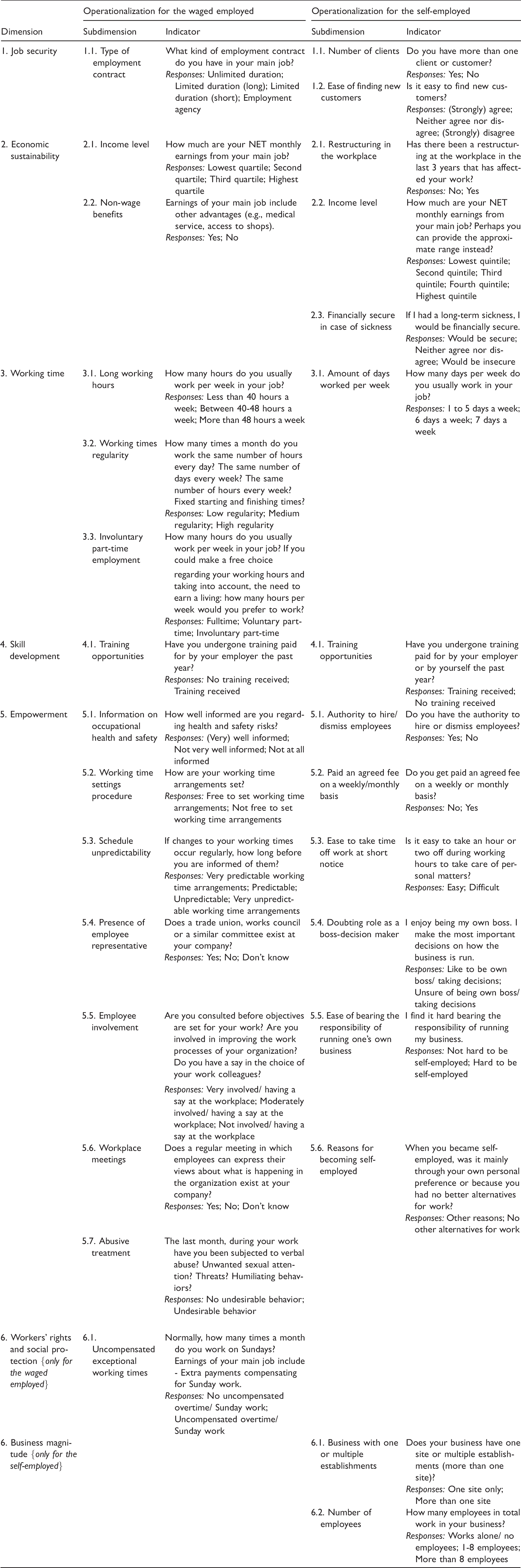
The best-fitting cluster models were selected upon using Bayesian information criteria (see Table A.1.) and considering their theoretical meaning. The latter is done by interpreting latent class probabilities, showing the association between the latent categories of the cluster solution and the manifest indicators of employment quality (see Tables A.2. to A.3.). For both the waged- and self-employed, a five-cluster typology was the most parsimonious solution. Direct effects between the country of residence and the manifest employment quality variables were specified, in order to obtain a “standardized cluster solution” valid for all EU countries. For the waged employed—in line with the guidelines of Hagenaars and McCutcheon (2002)—direct effects were set between the following indicators: “schedule unpredictability,” “working times regularity,” and “working times setting procedure” and also between “employee representative” and “workplace meetings,” as these groups of indicators measure theoretically related concepts.
Finally, the cluster solutions for the waged employed and the self-employed were merged into one categorical variable using modal assignment.
Intrinsic Quality of Work
Intrinsic quality of work was operationalized through five subindices as suggested by Green and Mostafa (2012). Colleague support was based on the item your colleagues help and support you coded into three categories “yes, I am supported,” “no, I am not supported,” and “not applicable.” Because 39% of the self-employed indicated “not applicable,” this category was included as an instrumental category in the analyses. All other variables were scales ranging from 0 to 10: work intensity (11 items [α = 0.569]; e.g., “working at very high speed”), poor physical environment (α = 0.775) including (a) ergonomic risks (four items [α = 0.674]; e.g., “vibrations from hand tools, machinery, etc.”), (b) biochemical risks (four items [α = 0.735]; e.g., “breathing in smoke, fumes, powder or dust etc.”), and (c) ambient risks (three items [α = 0.706]; e.g., “high temperatures”), autonomy (three items [α = 0.781]; e.g., “are you able to choose/change your order of tasks”), and task variation (four items [α = 0.626]; e.g., “solving unforeseen problems on your own”; for a detailed item list of all scale variables, see Table A.4.). Because of many missing values for task variation (N missing = 948 which is 2.9% of the full sample) and autonomy (N missing = 430 which is 1.3% of the full sample) values were imputed using the expectation–maximization algorithm (E-M) in SPSS (McLachlan & Krishnan, 1997).
Sociodemographic Control Variables
Gender (men/women), age (<35/35–49/≥50), educational attainment (primary/secondary/tertiary), migration background (born in country, parents born in country/born in country, parents not born in country/not born in country, and parents not born in country), and country of residence were included as control variables.
Analytical Strategy
First, a sociodemographic description of the clusters (Table 3) is made, followed by a description of associations between the independent variables and the health outcomes (see Table A.5.). Then, logistic regression analyses were applied. For both outcomes, next to bivariate analyses, three regression models were fitted. In Model 1, employment quality types were related to the outcome, controlled for country of residence. That model was expanded with gender, age, education, and migration background (Model 2). Finally, intrinsic quality of work was included (Model 3). Due to missing values for some variables, there was a loss of 890 (2.8%) cases between Model 3 and Model 1 for poor mental well-being and 928 cases (2.9%) for fair to bad self-rated health.
Findings
Describing the Employment Quality Types
The latent class cluster analyses revealed 10 employment quality types, which we can describe based on an interpretation of the latent probabilities of the final cluster solution (Tables A.2. and A.3. in the Online Appendix).
The first cluster (SER-like jobs) generally resembles the standard employment model because the workers in this group often hold permanent contracts with high incomes and additional benefits. They also tend to have good working time quality, feel informed and involved, and have generally received training. Instrumental jobs are also quite stable and largely consist of full-time jobs with a moderate income and relatively good working time quality. However, often the relationship between them and their employers is rather “instrumental” because they rarely get additional rewards, have a lower likelihood of participation in decision-making, and have little discretion over how and when the work is done. Two “precarious employment quality clusters” rather represent the “low road” toward destandardization. Overall, the respondents resembling these clusters are more likely to accumulate unfavorable employment quality scores (e.g., temporary contracts with low incomes and no additional benefits, no training and poor information, little representation, and low involvement in the workplace). The two clusters, however, differ from each other in the sense that precarious unsustainable jobs show a high probability of having predictable and regular working times, few working hours, and low incomes. Therefore, it can be assumed that these jobs are “unsustainable” from the perspective of providing a living wage. Precarious intensive jobs on the other hand are characterized by frequent uncompensated exceptional working times, long working hours, and high schedule unpredictability. Contrary to the former two clusters, the last cluster for employees—portfolio jobs—represents a “high-road” toward destandardization, showing high probabilities of long working weeks, irregular working time arrangements, but also permanent contracts, high incomes and benefits, investment in training, and strong involvement in the workplace.
The first self-employment type—dependent self-employment—inscribes itself in the “low road” toward destandardization. This type—while respondents formally classify themselves as self-employed—lacks many characteristics of actual self-employment (e.g., low empowerment, high proportion of necessity self-employment, and doubting their role as business leaders). The small- and medium-sized employers, however, can be considered the well-off, traditional type of self-employment with generally beneficial employment conditions (e.g., an overrepresentation in high-income quintiles and a preference motive for becoming self-employed). These jobs often involve working from multiple sites and steering several employees. The third type, insecure self-employment, presents another less favorable condition in self-employment, characterized by a high probability of features like having only one client, difficulty finding new clients, low income, insecurity in case of sickness, low training possibilities, being self-employed out of necessity, and not liking being their own boss. Moreover, this group also has low empowerment, a low number of working hours, and find it easy to take time off on short notice, making these self-employed insecure in terms of being able to keep their business alive. In contrast, a “high road” type among the self-employed is represented by stable own account work. This type shows high probabilities of quite beneficial employment quality features (e.g., having more than one client, having an economically sustainable business, being self-employed out of preference, being happy to be one’s own boss, not finding it hard to be self-employed). Furthermore, they report high scores on empowerment, a moderate number of working hours, and high investment in formal training. Finally, another “traditional” form of self-employment, however, not as well off as the small- to medium-sized employers, is small trades and farming. This type is characterized by beneficial scores on most items, although they also have a high degree of economic insecurity in case of sickness. A considerable portion also works 6 to 7 days a week and tends to find it hard to be self-employed, making it a quite intense employment situation.
In line with segmented labor market theory, specific sociodemographic profiles for the employment quality types were found as well (Table 2). The waged employed with poor employment quality (e.g., precarious unsustainable and intensive jobs) were younger than the overall sample, had a higher proportion of secondary educated, and were either female-dominated or evenly distributed with regard to gender. They were also more likely than workers in other employment quality types to have been born in a different country than the country of residence. The self-employed with poor employment quality (e.g., insecure self-employment and small trades and farming) were older than the overall sample, had quite high proportions of primary educated, and were mostly males (the latter was a common trend among all self-employed). Types with high employment quality (e.g., portfolio jobs, small- and medium-sized employers and stable own account work) were dominated by male, middle-aged, or older and highly educated workers who were native-born to their country of residence. The sociodemographic profile of SER-like and instrumental jobs resembled the profile of the general sample.
Sociodemographic Composition by Employment Quality Type, EWCS 2015, EU27.
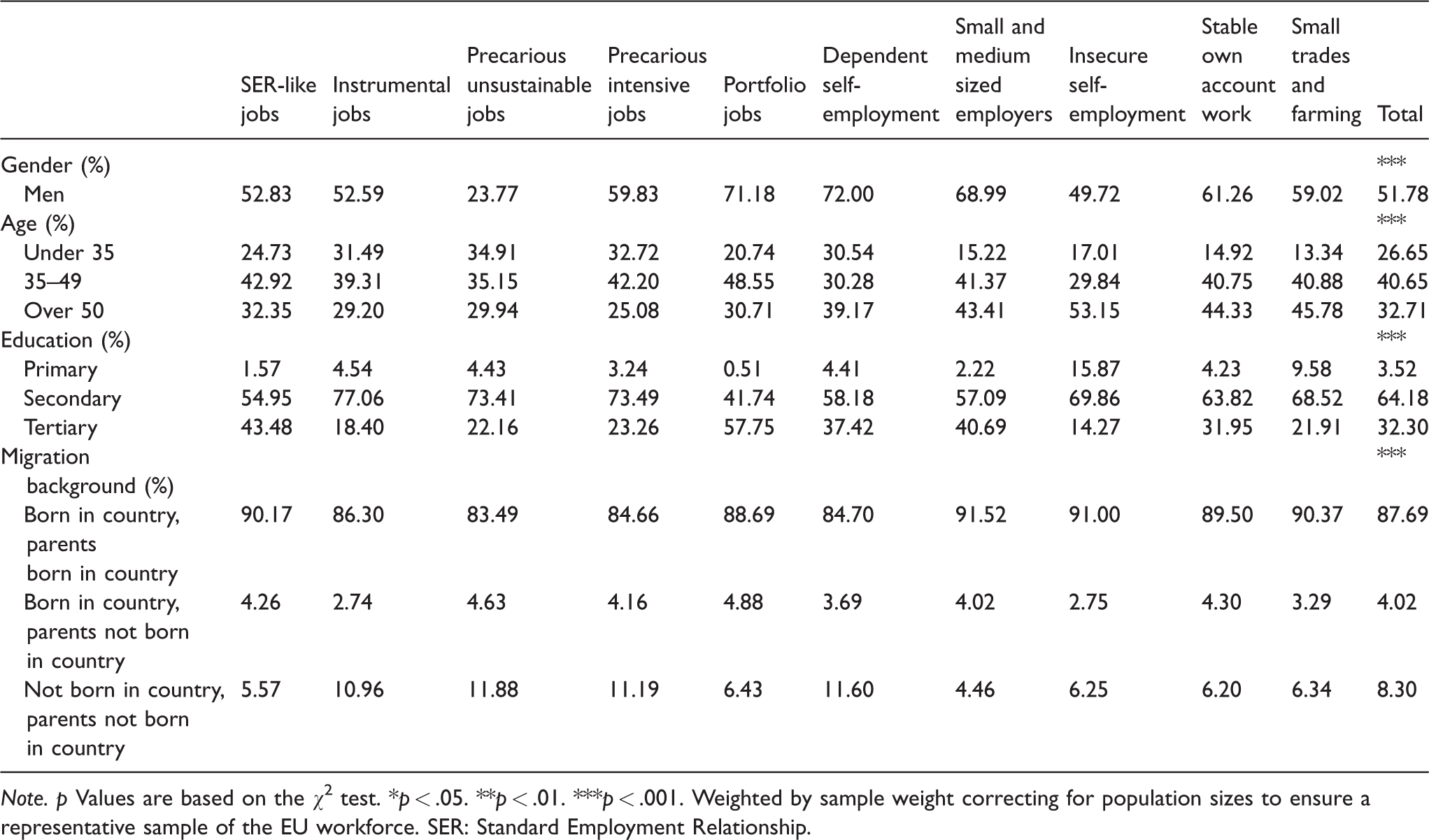
Note. p Values are based on the χ2 test. *p < .05. **p < .01. ***p < .001. Weighted by sample weight correcting for population sizes to ensure a representative sample of the EU workforce. SER: Standard Employment Relationship.
Associations of Employment Quality Types With Self-Rated Health and Mental Well-Being
The regression results are reported in Table 3 and Figure 1. Portfolio jobs and small- to medium-sized employers did not significantly differ from SER-like jobs (reference category) in terms of fair to bad self-rated health. However, for the other employment quality types, in comparison with SER-like jobs, significant statistical differences were found; insecure self-employment (odds ratio [OR] 3.12), small trades and farming (OR 1.66), dependent self-employment (OR 1.58), precarious unsustainable jobs (OR 1.53), precarious intensive jobs (OR 1.41), stable own account work (OR 1.27), and instrumental jobs (OR 1.25) had more elevated odds. Controlling for country of residence, sociodemographic characteristics and intrinsic quality of work slightly diminished the magnitude of the contrast with SER-like jobs but did not fundamentally alter the crude estimates. The model fit of the crude model was small (R2McFadden 1.83%) but increased by expanding the model.
Odds Ratios and Confidence Intervals for the Associations Between Employment Type and Health Outcomes Controlled for Potential Confounders, EWCS 2015, EU27.

Note. Estimates achieved using logistic regression; the results shown are odds ratios with 95% confidence intervals in the square brackets. For categorical variables, the reference category is in the round brackets; Results for country of residence are not shown. LL = log likelihood; SER = Standard Employment Relationship.
p < .05. **p < .01. ***p < .001.
Model controlled for country of residence.
Model controlled for country of residence, gender, age, education and migration background (
Model controlled for country of residence, gender, age, education, migration background and intrinsic quality of work indicators.
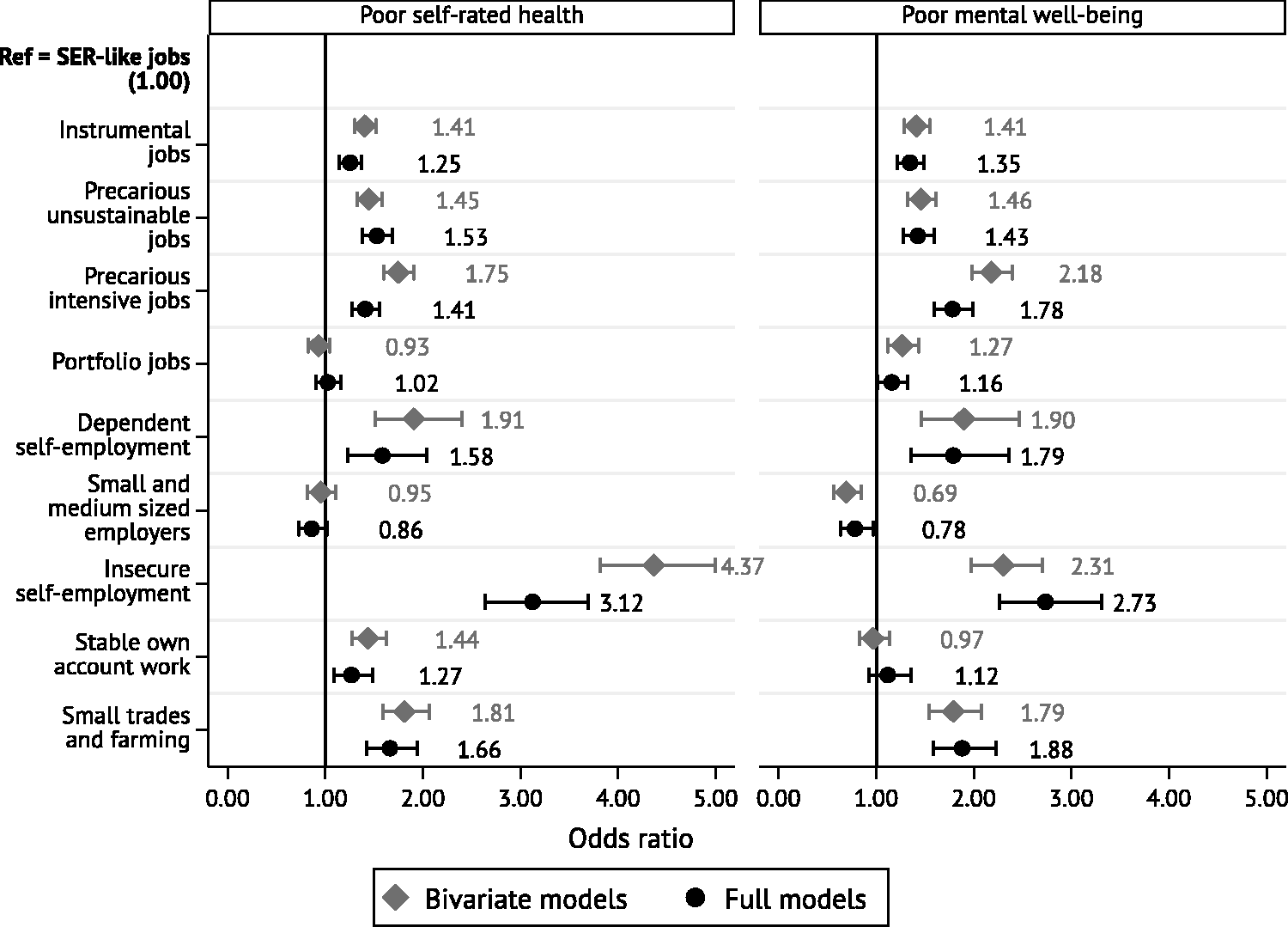
Odds ratios and confidence intervals for the associations between employment quality type and health outcomes, EWCS 2015, EU27. Estimates achieved using logistic regression; bivariate models: crude estimates (for the association between employment quality types and the dependent variables); full models: estimates controlled for country of residence, sex, age, education, migration background, and intrinsic quality of work indicators. SER = Standard Employment Relationship.
For poor mental well-being, stable own account work was not significantly different from SER-like jobs. Small- and medium-sized employers (OR 0.78) however, had lower odds for poor mental well-being. Furthermore, compared with the reference category, insecure self-employment (OR 2.73), small trades and farming (OR 1.88), precarious intensive jobs (OR 1.78), dependent self-employment (OR 1.79), precarious unsustainable (OR 1.43), instrumental jobs (OR 1.35), and portfolio jobs (OR 1.16) had greater odds of poor mental well-being in the fully controlled model. Adding control variables to the crude model did not fundamentally alter the results. The model fit of the crude model was again small (R2McFadden 1.45%) but increased by expanding the model.
Discussion
This study examined the health implications of contemporary employment arrangements of both waged- and self-employed. To investigate these employment arrangements and its health implications, we used the EWCS of 2015 which contained detailed information on the working conditions of 31,292 waged and self-employed workers in the EU27.
The first objective of this study was to compose an empirical typology of employment quality for both the waged and the self-employed. The study revealed 10 different types of employment quality: SER-like jobs, instrumental jobs, precarious unsustainable jobs, precarious intensive jobs and portfolio jobs—among wage-earners; and dependent self-employment, small- and medium-sized employers, insecure self-employment, stable own account work and small trades and farming—among the self-employed.
Our second objective was to examine how the aforementioned employment quality types relate to the respondents’ health and well-being. We found clear evidence for a health gradient among the employment quality types. This gradient crosscut the distinction between waged- and self-employment. The poorest health situation was found for insecure self-employment, small trades and farming, precarious intensive waged employed jobs, precarious unsustainable jobs, and dependent self-employment. It is particularly noteworthy that “low employment quality” self-employed—and more specifically the insecure self-employed type—had on average the worst health scores. The health scores of these self-employed were (far) worse than those of all other employment quality types, including those of the “low employment quality” waged employed. In contrast, SER-like jobs, small- and medium-sized employers, portfolio jobs and stable own account work showed the most favorable health profile.
The third and final objective was to study how the relationship between employment quality types and workers’ health and well-being is mediated by the influence of work-task intrinsic characteristics. We found that controlling for intrinsic quality of work slightly diminished the magnitude of the contrast with SER-like jobs for most employment quality types but did not fundamentally alter the direction and significance of the (crude) associations.
Conclusion
Earlier empirical research suggests that the “old” Fordist employment standard—for example, the typical SER configuration—is associated with the most favorable situation in terms of health and well-being for employees (Van Aerden et al., 2016). Based on the results of this study, a similar image can be extended to the self-employed: Small- and medium-sized employers—reflecting the “traditional” capitalist and petty bourgeois classes of self-employment (Steinmetz & Wright, 1989)—seem to find themselves in the most favorable situation in terms of health and well-being. Nevertheless, another long-standing form of self-employment (i.e., small trades and farming; Schippers, 2019) shows poorer health, compared with standard employee jobs, which is consistent with Conen and Schippers’s (2019) finding that also “traditional” self-employment can be prone to precariousness.
Our findings also confirm the results of earlier research showing that those employment situations that diverge from the SER by taking the “low road” toward destandardization (e.g., precarious unsustainable and precarious intensive jobs) show the most negative health associations (Van Aerden et al., 2014; Vives et al., 2010). This study, adds to that finding, showing that also “low road forms of self-employment” (e.g., insecure and dependent self-employment) are associated with poorer health and well-being.
In contrast, “high-road” solutions toward destandardization—often characterized by rather beneficial employment characteristics, with the exception of long and flexible working hours—typically present more favorable relations with health outcomes (Van Aerden et al., 2014). In our study, this pattern can be observed in portfolio jobs among employees but also among “stable own account workers,” which presents an equivalent “high-road type” among the self-employed. Most probably, stable own account workers have a relatively powerful bargaining position on the basis of their skills, which are “desired” on the labor market. An awareness of this advantageous labor market position makes stable own account workers to be the best-off among nonstandard workers (Mckeown, 2005). While these jobs do imply versatility and flexibility in terms of working time, this flexibility is often worker-induced or at least worker-mediated, giving them a strong sense of control over working life. In sum, the workers in these jobs tend to live a “boundaryless” professional life but tend to be in charge of their own careers (Vanroelen, 2019). Our study is the first to demonstrate that this “high-road” pattern exists among both the waged and self-employed.
As the low-road/high-road distinction crosscuts the traditional distinction between wage- and self-employment, our results suggest that the often-made, dualistic assumption that the self-employed enjoy better job quality and thus higher well-being compared with wage-earners is too simplistic (Stephan, 2018). As it is the case among wage-earners, also among the self-employed a fair amount of heterogeneity exists in terms of employment quality and work-related well-being. This heterogeneity might also relate to reasons for becoming self-employed, contrasting “opportunity” versus “necessity” entrepreneurship (Cooper & Artz, 1995). The so-called “opportunity self-employed,” who made a well-informed decision to become self-employed instead of being wage-employed, generally report better health and better job quality, compared with the “necessity self-employed” (Cueto & Pruneda, 2017; Stephan, 2018). The latter group tends to engage in self-employment as a “negative choice” due to a lack of opportunities for waged employment (Binder & Coad, 2016; Stephan, 2018).
In general, when it comes to associations between precarious types of work and adverse health, selection effects (i.e., an adverse health situation determining moves toward precarious work) can be assumed (Ross & Mirowsky, 1995). Additional descriptive analyses (Table A.7.) show that two of the most precarious employment quality types have the highest prevalence of long-term illness (e.g., insecure self-employed and precarious unsustainable jobs). Determining characteristics of these types are, on average, a low number of working hours and low income, which is suggestive for the fact that they more or less serve as “forms of employment of last resort” for workers suffering health problems. Health selection could also explain why the least favorable employment quality type among the self-employed, insecure self-employment, had on average worse health than the least favorable types among the waged employed: Probably, the “healthy worker effect” (Li & Sung, 1999) is stronger for employees. Unhealthy waged employees might more frequently leave employment, certainly in cases of poor employment quality (Li & Sung, 1999), as in most countries they will be able to fall back on more extensive social protection than the self-employed. Thus, presumably the very unhealthy waged employed are likely to be out of the labor force. The lack of adequate social protection might in turn keep the self-employed—certainly the most “precarious” ones—in the labor force regardless of their ill-health and the perceived health effects of their jobs. The additional analyses (Table A.7.) show that the self-employed in our sample (21.2%) are more likely to have a long-term health problem compared with employees (18.1%). At the same time, a lower proportion of them indicated staying at home due to a health problem (26.1%) and more of them kept working despite being sick (48.4%; 47.6% and 43.1% in waged employed).
On the other hand, also social causation effects can be assumed when interpreting our findings. Through a number of pathways, the employment situation can affect health (Julià, Vanroelen, et al., 2017). For example, the results from the third objective of this study showed a clear descriptive association between employment quality and poor intrinsic quality of work tasks (as can be seen from Table A.6. for example, the employment quality types diverged strongly in terms of the level of autonomy and task variation they experience at work). In the regression analyses, however, these intrinsic quality of work characteristics only mediated the associations between employment quality types and health to a small extent. Although mediation by intrinsic quality of work is an established pathway linking “precarious” employment types to adverse health, our results thus suggest an autonomous effect of employment quality. Most likely, this relates to the powerful negative health-affecting psychosocial consequences of employment precariousness—for example, low sense of control over one’s working life, insecurity, instability and unfairness (Bosmans et al., 2016; De Witte et al., 2016; M. Virtanen et al., 2005). Finally, the type of employment also determines other factors related to economic well-being and exposure to social and material deprivation, which could further affect health and mental well-being (Benach et al., 2014; Vancea & Utzet, 2017).
Strengths and Weaknesses
A clear limitation of our study is the fact that it was conducted on cross-sectional data, which made us unable to make strong empirical claims on causality. An important future challenge lies in validating our approach using longitudinal data. The issue of causality also makes us argue for future in-depth qualitative research. Qualitative research might shed light on the drivers of workers toward specific employment situations and trajectories as well as further reveal the mechanisms relating certain employment situations to poor health. Finally, sensitivity analyses, restricting the sample to involve only workers under pension age (maximum 65 years old), showed that our analyses slightly underestimated the positive effect of small- to medium-sized workers and slightly overestimated the negative effects of insecure self-employment and stable own account work in terms of fair to bad self-rated health. However, because working beyond pension age is common for self-employed workers (Conen, 2019), we felt it was essential to grasp this reality for workers. We, therefore, kept our sample as is. Apart from its limitations, this study contributes greatly to knowledge on the health effects of employment conditions. The results have shown that a nuanced, multidimensional approach of today’s segmented labor market based on the concept of employment quality is more accurate than rather blunt dichotomous distinctions between waged and self-employment or between types of employment contracts. To our knowledge, only Peckham et al. (2019) have done such analyses before—although in the United States.
Recommendations for Future Policy
These results must raise awareness among policymakers concerning the health risks related to certain employment niches in contemporary European labor markets. As adaptable and flexible work is quite welcome with employers (Weil, 2014), putting policy in place aiming to ensure good employment quality for nonstandard and flexible workers, is a challenging issue. Certainly, with regard to precarious employment situations for the self-employed (i.e., the insecure self-employed came out as the worst performing employment quality type with regard to health), awareness should be put in place about their vulnerable position on the labor market. This also entails a discussion on the role, systems of social and income protection have to play in order to prevent negative outcomes from (insecure/unstable) self-employed work. It must be clear that assuring minimum employment regulation and social protection for all types of workers is critical for promoting “healthy work for everyone” (International Labour Office, 2015). The recent European Council Directive of May 24, 2019, on transparent and predictable working conditions for all, including the self-employed, might be a step in the right direction.
Supplemental Material
sj-pdf-1-wox-10.1177_0730888420946436 - Supplemental material for Employment Quality as a Health Determinant: Empirical Evidence for the Waged and Self-Employed
Supplemental material, sj-pdf-1-wox-10.1177_0730888420946436 for Employment Quality as a Health Determinant: Empirical Evidence for the Waged and Self-Employed by Jessie Gevaert, Karen Van Aerden, Deborah De Moortel and Christophe Vanroelen in Work and Occupations
Footnotes
Declaration of Conflicting Interests
The authors declared no potential conflicts of interest with respect to the research, authorship, and/or publication of this article.
Funding
The authors disclosed receipt of the following financial support for the research, authorship, and/or publication of this article: The research was facilitated by research project Number G.0368.16N funded by Research Foundation Flanders (FWO). The research has also received funding from the EU’s Horizon 2020 research and innovation program under Grant Agreement Number 730998, InGRID-2—Integrating Research Infrastructure for European expertise on Inclusive Growth from data to policy. The Travel Grant allowed us to gain input from professor Natalie Shlomo, professor Yaojun Li and professor Wendy Olsen from the Social Statistics/Cathie Marsh Institute for Social Research and professor David Holman from the Alliance Manchester Business School, for which we are very grateful. Finally, Deborah De Moortel is an FWO (PEGASUS)2 Marie Skłodowska-Curie fellow. Her research has received funding from the FWO and EU’s Horizon 2020 Research and Innovation Program under the Marie Skłodowska-Curie Grant Agreement Number 665501.

Supplemental Material
Supplemental material for this article is available online.
Author Biographies
References
Supplementary Material
Please find the following supplemental material available below.
For Open Access articles published under a Creative Commons License, all supplemental material carries the same license as the article it is associated with.
For non-Open Access articles published, all supplemental material carries a non-exclusive license, and permission requests for re-use of supplemental material or any part of supplemental material shall be sent directly to the copyright owner as specified in the copyright notice associated with the article.
