



Abstract
The COVID-19 pandemic precipitated a global economic recession resulting in widespread unemployment and worker furloughs. Using national survey data (n = 2,000), this study examines whether and how employment-based discrepancies in financial strains, anticipatory stressors, and personal coping resources contribute to elevated psychological distress among those who experienced involuntary job displacement due to COVID-19. Disaggregating displaced workers into those who were furloughed and those who lost their job due to the pandemic, I find that both groups report more depressive symptoms and anger than the stably employed and respondents whose unemployment is not COVID-related. Greater financial strains and smaller reserves of coping resources contribute in varying degrees to heightened levels of distress found among displaced workers, however, anticipatory stress about economic security is the predominant factor driving disparities in psychological distress. These findings, and the central role of anticipatory stressors in shaping employment-based differences in mental health during the pandemic, are discussed.
The onset of the coronavirus (COVID-19) pandemic sparked a global economic crisis. In the United States, accelerated viral transmission during the spring of 2020 compelled state-mandated shutdowns and stay-at-home orders, inducing widespread unemployment and worker furloughs. The unemployment rate crested at 14.8% in April 2020, surpassing the height of unemployment during the Great Recession in just over a month's time. During this same period, over 40 percent of Americans reported that members of their families had lost jobs, work hours, or wages due to the outbreak (Karpman et al., 2020). A corresponding body of social science evidence has documented growing economic precarity as a result of the pandemic, with concerns about material conditions concentrated among individuals already more susceptible to downturns in the economy (Perry et al., 2021; Schneider et al., 2020).
Mental health has degraded considerably in the United States since the start of the pandemic. An emerging literature suggests that a variety of pandemic-related stressors including worries about potential exposure to the virus (Zheng et al., 2021), social isolation (Bierman & Schieman, 2020), and financial hardship caused by the sudden economic contraction (Bierman et al., 2021; Donnelly & Farina, 2021; Zheng et al., 2021) all contribute to elevated rates of depression, anxiety, and psychological distress found throughout the population. Building on this research, this study uses national survey data to examine (1) whether those who were furloughed or experienced job loss due to COVID-19 report greater psychological distress than the stably employed and individuals unemployed for non-pandemic reasons, and (2) how differences in stress exposure and coping resources across these groups contribute to employment-based disparities in mental health.
Consistent with expectations, respondents who experienced furlough or job loss due to COVID-19 reported more depressive symptoms and anger than the stably employed and those unemployed for reasons unrelated to the pandemic. Relative to these groups, respondents who experienced COVID-related job displacement reported more financial strains; greater worry about their future economic security and the course of the pandemic; and, to a lesser extent, smaller inventories of personal coping resources (i.e., mastery and self-esteem). Although more pervasive financial strains and limited reserves of coping resources among those who experienced job displacement explain an appreciable amount of the mental health disparities identified across groups, much of the gap in psychological distress is attributed to higher levels of anticipatory stress about economic security among those who experienced furlough or job loss due to COVID-19. These findings pose implications for future research on the economic toll of the pandemic, underscoring the necessity of disaggregating those who were furloughed from those who lost their jobs due to COVID-19, and accounting for how these employment transitions lead individuals to more persistently ruminate on the stressors that await; much to the detriment of their mental health.
Background
The Endemic Nature of Precarious Work and the Case of the COVID-19 Pandemic
The COVID-19 pandemic has laid bare the tenuous financial circumstances faced by millions of Americans. Yet, job insecurity and precarious work were pervasive in the United States long before its arrival. Growing economic uncertainty emerged amidst a maelstrom of social, political, and economic forces in the mid-1970’s. During this period, competition resulting from a combination of government deregulation and globalization led American firms—particularly in manufacturing—to outsource jobs to low-wage countries and to recruit cheaper labor domestically from recent waves of Latin American immigrants (Kalleberg, 2012; Sharone, 2014). To further reduce costs, firms engaged in aggressive union busting and lobbied the government to loosen worker protections (Sharone, 2014). The former diminished the bargaining power of workers, whereas the latter sharply circumscribed the ability of federal regulatory agencies to enforce minimum acceptable labor conditions (Kalleberg, 2011). Concurrent with these assaults on worker protections, changing logics within capital markets, typified by pressures from institutional investors to generate short-term stock revenue (i.e., financialization), led managers to become increasingly beholden to the whims of shareholders (Kalleberg, 2012). To create more immediate profits, firms began to shift from a work force characterized by long-term positions replete with benefits, to an interchangeable stable of temporary, at-will employes whose work was distinguished by precarity—namely, low wages, sparse benefits, and limited job security (Kalleberg, 2011). Against this backdrop, a sizable portion of Americans live under the looming threat of losing their jobs, experiencing lapses in healthcare coverage, or having a catastrophic illness beset, and potentially bankrupt, their family.
The fragility of millions of Americans’ employment was cast in sharp relief at the outset of the COVID-19 pandemic. During its first month, over 26 million Americans filed unemployment claims (Karpman et al., 2020). But although many employers permanently reduced their workforce due to the sudden economic contraction, others were able furlough employes, placing them on temporary leave or reducing their work hours while keeping work-related benefits intact. Regardless of the circumstances underlying employment separation, those who experienced any loss of work-related income during this period experienced notable decrements in mental health (Donnelly & Farina, 2021).
Job Loss as a Stressful Life Event and its Mental Health Correlates
The stress process paradigm is a sensitizing theoretical framework for understanding how structural arrangements can undermine multiple facets of mental health (Pearlin et al., 1981; Pearlin & Bierman, 2013). In their canonical work “The Stress Process,” Pearlin et al. (1981) describe involuntary job loss as an archetypal major life event. In the immediate aftermath of job loss, people experience a diminution of income, the annulment of work-related benefits, and departure from a major social role in their lives (Burgard et al., 2007). In the longer term, displaced workers contend with lower rates of subsequent employment, reduced wages, debt accrual, and more limited autonomy in future positions (Brand, 2004). Perhaps unsurprisingly, a sizable literature provides convincing evidence that involuntary job loss is inimical to mental health. People who experience job loss, unemployment, and underemployment report substantially more depressive symptoms and general psychological distress (Burgard et al., 2007; Dooley et al., 2000; Turner, 1995).
Consistent with this research, Americans who experienced a loss of employment income following March 2020 reported more symptoms of anxiety and depression (Donnelly & Farina, 2021), with over half of unemployed adults reporting serious mental health issues since the start of the pandemic (Parker et al., 2021). Work-related stressors can also foster feelings of anger (Ross & Van Willigen, 1997). Sociological research on mental health conceptualizes anger as a constitutive element of psychological distress. Serving as a counterpoint to the “internalized” nature of depressive symptoms, anger instead taps into a person's propensity to “externalize” distress. Anger may be especially relevant to understanding the associations between COVID-related job loss and mental health insofar as its emergence is fundamentally rooted in perceptions of social inequality and unjust treatment (Ross & Van Willigen, 1996). To this point, a national survey revealed that over 40% of unemployed adults reported greater conflict and more arguments with family and friends since the beginning of the pandemic (Parker et al., 2021). Cumulatively, these studies signal that job loss resulting from the pandemic is detrimental to mental health.
Research on the unique experiences of furloughed workers during the pandemic is more limited, however a notable exception can be found in work by Mimoun et al. (2020). Using a sample of Israeli workers, they find those who were furloughed not only report greater psychological distress than those who remained fully employed, but also, respondents whose unemployment predates the pandemic. Although it is not immediately apparent why those who experienced COVID-related job displacement would report more distress than those unemployed for other reasons, one potential explanation can be found in prior research on the travails of job-seekers during economic downturns. In his landmark study of white-collar workers, Sharone (2014) describes the job search process as a “chemistry game,” wherein job-specific technical skills are a necessary, but insufficient, requisite for employment. Sharone (2014) proposes that in an American context, equal if not greater importance is assigned to demonstrating one's “fit” with a firm's culture. Those who remain jobless despite these efforts attribute their unemployment to a personal failure to convey sufficient passion for a position. Moreover, because failure is attributed to intrinsic factors, these individuals ultimately engage in self-blame rather than ascribing culpability to macro-level circumstances.
More recently, Lopez and Phillips (2019) have extended this work to demonstrate how the chemistry game is sensitive to the tumult of extraordinary economic conditions. As they found during the Great Recession, feelings of self-blame among the unemployed persisted, yet they were accompanied by a palpable sense that the chemistry game was rigged, instigating feelings of anger and a sense of betrayal among those who lost their jobs due to the recession. Respondents’ accounts were also suffused with feelings of helplessness and despair, spawned by a creeping realization that the economic system was irreparably broken (Lopez & Phillips, 2019). Given the parallels between the Great Recession and the sudden economic contraction induced by the pandemic, it is plausible that individuals who were furloughed or lost their jobs due to COVID-19 will not only report more depressive symptoms and anger than those who remain employed, but also, those unemployed for reasons unrelated to the pandemic.
Mechanisms Linking Job Loss to Mental Health
Turner (1995) outlines two major pathways linking involuntary job loss to adverse mental health outcomes. First, job loss creates resource scarcity and chronic financial strains that necessitate substantial readjustment and adaptation. Second, because employment is closely tied to identity and self-worth, its absence diminishes self-concept—including both self-esteem and mastery—rendering a person more vulnerable to stressors. I take up each of these mechanisms in turn in the following sections.
Involuntary Job Loss and Social Stressors
Chronic financial strains impose a daily threat to one's survival. Returning again to “The Stress Process” (Pearlin et al., 1981), a central contention of this work was that stress researchers had overestimated the relative contributions of major life events (e.g., job loss) to psychological outcomes at the expense of documenting the more pernicious chronic strains that emerge in their wake. To this point, Pearlin and colleagues (1981) discovered that people who experienced involuntary job loss were beset by economic hardships including an inability to afford sufficient housing, to purchase food, or to pay their bills. Beyond its “independent” association with psychological distress, Pearlin et al. (1981) also found that financial strains mediate the relationship between job loss and depressive symptoms. Subsequent research has further substantiated these findings. These studies indicate that transitions out of employment are linked to greater financial strains (Ali & Avison, 1997), with measures of economic privation that commonly follow job loss including food insecurity (Bergmans & Wegryn-Jones, 2020) and debt accrual (Ruining Sun & Houle, 2020), in turn predicting more depressive symptoms.
Contemporary studies of American households reveal mounting financial strains amidst the pandemic. Roughly one-in-four adults report difficulty paying their bills, one-third have accessed retirement or savings accounts to make ends meet, and nearly one-fifth have had problems paying their rent or mortgage (Parker et al., 2020). A study by Schneider and colleagues (2020), which examined the financial challenges faced by unemployed workers, found this group was twice as likely as full-time workers to not have enough savings set aside for short-term needs. In one longitudinal study, the accretion of different forms of economic hardship during the early months of the pandemic—including difficulty paying bills, not having enough money to buy food or clothing, and struggling to make ends meet—was associated with higher levels of psychological distress over time (Bierman et al., 2021). But while these studies suggest causal effects of pandemic-related job loss on the accumulation of financial stressors, it is worth noting that selection processes are also in operation. Both Bierman et al.’s (2021) study of Canadians and Perry and colleagues’ (2021) study of Indiana residents provide evidence that individuals beset by economic insecurity prior to the pandemic face a cascade of additional financial issues in its wake. In view of these findings, and the specific limitations of the data used in this study (i.e., their cross-sectional nature), I assume that selection effects are occurring alongside social causation, though I am unable to explicitly test this proposition.
In addition to contemporaneous financial strains, unexpected job loss might also lead to greater consternation about one's long-term financial security. These concerns about the future, or anticipatory stressors, represent threats that may or may never be realized, but nevertheless loom as worrying possibilities (Pearlin & Bierman, 2013). Research finds that perceptions of job insecurity—including concerns that one's job is under threat or might not exist in the future—are positively associated with depressive symptoms (Burgard et al., 2009). Other research suggests that anticipatory stress about an even broader set of economic concerns, including affordable housing, career security, and loan repayment also predict greater depressive symptomology (Grace, 2020).
Recent surveys of the American public allude to growing anticipatory stress about economic security. A notable segment of the population reports they are worried about their ability to repay their debts (33.1%), work enough hours (38.5%), or afford housing and utilities (each 28%) (Karpman et al., 2020). These concerns are amplified among individuals whose families have lost jobs or work-related income, with 65.2% of this group anxious about receiving sufficient work hours, 50.6% worried about repaying debts, and over 40% uneasy about housing (45.6%) and utility costs (43.8%). Because the employment status of these individuals is contingent on the trajectory of the virus, there is reason to suspect that people who are furloughed or out of work due to COVID-19 might also experience greater anticipatory stress about the societal and economic fallout of the pandemic.
Job Loss and the Mediating/Moderating Effects of Coping Resources
Turning to the second pathway proposed by Turner (1995), stressful life events also wear away the coping resources people use to buttress their mental health against adverse social conditions. Coping resources collectively refer to the beliefs and cognitions people have about the social world, which can be used to mitigate the threat of stress-provoking situations (Pearlin & Schooler, 1978). Foremost among these resources are self-esteem and mastery. Self-esteem reflects to a person's appraisals of self-worth (Rosenberg, 1965), whereas mastery captures personal efficacy, or belief that one has control over the vagaries of life (Pearlin & Schooler, 1978). Possession of these resources safeguard mental health by minimizing the hazard posed by challenging circumstances, and also, bolstering confidence that one has the capacity to surmount obstacles through active coping. A number of studies have documented an inverse association between personal coping resources and psychological distress, with individuals who possess higher levels of self-esteem and mastery reporting fewer depressive symptoms (Turner, 2003) and less anger (Jackson et al., 2010).
People who are underemployed or experience involuntary job loss report precipitous declines in self-esteem and mastery (Ali & Avison, 1997; Koltai & Stuckler, 2020; Pearlin et al., 1981). A recent Pew Center survey of Americans who are unemployed, furloughed, or temporarily laid off due to the pandemic found that approximately half of these individuals are pessimistic about their prospects for future employment, while slightly more than half (53%) feel they have lost a piece of their identity (Parker et al., 2021). Although these findings are not based on explicit measures of coping, they nevertheless hint at diminished self-concept among people experiencing pandemic-related job loss or furlough.
Coping resources act as both mediators and moderators of the association between job loss and mental health. Paralleling Pearlin et al.’s (1981) finding that mastery and self-esteem mediate the relationship between involuntary job loss and mental health, recent scholarship on recession-related hardship (including job loss) indicates that economic challenges operate on psychological distress via lower levels of personal control (Koltai & Stuckler, 2020). Consonant with stress theory's emphasis on the stress-buffering effects of coping resources, other studies have examined whether self-esteem and mastery moderate the effects of job loss on mental health. This research finds that higher levels of self-esteem and mastery obviate the injurious effects of job displacement on depressive symptoms, anxiety, and psychological distress (Kessler et al., 1988; Koltai, 2018; Koltai & Stuckler, 2020).
Research Aims and Study Expectations
Following from the literature on job loss and mental health, this study is guided by two overarching aims: (1) To determine whether those who were furloughed or experienced job loss due to COVID-19 report greater psychological distress than those who remained employed or were unemployed for non-pandemic reasons, and (2) to assess whether and how differences in financial strains, anticipatory stressors, and coping resources contribute to employment-based discrepancies in psychological distress. Figure 1 depicts study expectations. To begin, I anticipate that respondents who experienced furlough or job loss due to COVID-19 will report higher levels of psychological distress than those who are stably employed or unemployed for reasons unrelated to the pandemic (E1). Aligning with the stress process literature, financial strains (E2) and anticipatory stressors (E3) will be associated with greater psychological distress, whereas higher levels of self-esteem and mastery (E4) will be negatively associated with these outcomes. Next, I expect that respondents who are furloughed/unemployed due to COVID-19 will report more financial strains (E5), greater anticipatory stress about both economic security and the societal consequences of the pandemic (E6), and lower levels of self-esteem and mastery (E7) than the stably employed and the unemployed. These discrepancies in financial strains (E8), anticipatory stressors (E9), and coping resources (E10), in turn, will mediate differences in psychological distress between those who experienced furlough or job loss due to COVID-19 and those who are stably employed or unemployed for non-COVID reasons. Finally, I expect that the positive association between furlough/job loss and psychological distress will be moderated by higher levels of coping resources (E11).

Model of the associations among job displacement, social stressors, coping resources, and psychological distress.
Data and Methods
Data
Data for this study come from 2,000 Americans surveyed between July 8 and October 13, 2020. Qualtrics, a professional research firm, conducted recruitment for the study using a quota sampling approach designed to approximate the sex, race-ethnicity, educational attainment, and household income of the American population based on U.S. Census Bureau estimates. Qualtrics fills each quota by recruiting respondents from online panels comprised of hundreds of thousands of individuals representing different subsets of the population. Respondents who met selection criteria (American citizens over 18 years of age) were invited to participate. A total of 82,354 individuals were contacted in order to generate the study's sample of 2,000 respondents.
Measures
Psychological Distress
This study examines two dimensions of psychological distress: depressive symptoms and anger. Depressive symptomology was operationalized using the Center for Epidemiological Studies of Depression (CES-D) Scale (Levine, 2013) seven-item short form. CES-D items ask about symptoms experienced during the past week (e.g., feeling depressed, a loss of appetite), with response categories spanning from 0 = rarely or none of the time to 3 = most or all of the time. Responses on these items were summed to create a depressive symptoms scale (
Employment Status
Respondents’ employment status was derived from two survey items. The first inquired about respondents’ current employment, with response categories including 1 = working full-time, 2 = working part-time, 3 = currently unemployed, 4 = retired, and 5 = disabled. The second item asked, “Are you currently furloughed or out of work due to COVID-19?” (1 = yes). Responses to these two items were merged to create a series of dichotomous variables where, 1 = furloughed, 1 = unemployed due to COVID = 19, 1 = unemployed, 1 = retired, 1 = on disability, and 0 = employed full- or part-time (omitted reference group). Respondents who signaled they were either furloughed or out of work due to COVID-19 and also indicated full- or part-time as their employment status were coded as “furloughed.” By contrast, respondents who said they were furloughed or out of work due to COVID-19 and indicated “currently unemployed” as their employment status were coded as “unemployed due to COVID-19.”
Financial Strains
Chronic financial strains were measured using four items from Turner et al.’s (1995) chronic stress inventory. These items asked respondents to specify the veracity of the following statements: “You don't have enough money to buy the things you or your kids need;” “You have a long-term debt or loan;” “Your rent or mortgage is too much;” and, “You don't have enough money to take vacations.” Responses to these statements—spanning from 0 = not at all true to 2 = very true—were averaged across items to create a financial strains scale (
Anticipatory Stressors
A battery of items was used to gauge respondents’ experiences of anticipatory stress regarding economic security and COVID-19. Response categories for these items range from 1 = never to 5 = almost always. Worries about economic security are measured using an expanded eleven-item version of an index used in prior research (Grace, 2020). Respondents were asked how frequently they worry about a variety of financial issues when they think about the future, including finding a job, being able to pay off loans or credit card debt, and being able to financially support one's family. These items were averaged to create an anticipatory stress about economic security scale (range = 1–5,
Coping Resources
Respondents’ inventory of coping resources were measured using Pearlin and Schooler’s (1978) seven-item mastery index (range = 1–4,
Controls
To limit confounding, analyses include controls for sociodemographic and anterior factors that might otherwise explain associations among involuntary job loss, financial hardships, and psychological distress. In light of higher levels of stress exposure (Turner & Avison, 2003) found among members of marginalized racial-ethnic groups, race-ethnicity is measured using a series of dichotomous variables where 1 = American Indian/Alaska Native, 1 = Asian, 1 = Black/African American, 1 = Hispanic/Latinx, 1 = else, and 0 = White. Because women routinely report higher levels of psychological distress than men (Ross & Van Willigen, 1996), an indicator is included for sex (1 = female). Sexual orientation is operationalized as 1 = gay/lesbian, 1 = bisexual, 1 = else, and 0 = straight. Given the negative associations of age with financial insecurity (Perry et al., 2021), age is measured categorically from 1 = 18–24 years old to 6 = 65+ years old. To account for the broadly protective effects of marital status against the negative repercussions of unemployment (Dooley et al., 2000), relationship status is measured as 1 = single, 1 = committed relationship, 1 = divorced, 1 = widowed, 1 = separated, and 0 = married. Evidence suggests that educational attainment is negatively associated with unemployment during the COVID-19 recession (Parker et al., 2021), and thus I include a categorical variable ranging from 1 = less than a high school degree to 6 = graduate degree. I also adjust for annual household income, measured categorically from 1 = <$25,000 to 7 = $200,000+.
Research indicates that Americans who experienced economic insecurity following the onset of the pandemic were beset by a multitude of challenges prior to COVID-19 (Perry et al., 2021). To partially adjust for these issues, models also include controls for antecedent stressors, including instances of major discrimination and traumatic life events. To adjust for lifetime exposure to discriminatory events, I use Kessler et al.’s (1999) major discrimination checklist (range = 0–10,
Analytic Plan
The research expectations outlined in Figure 1 suggest a five-step logic of analysis. To begin, I estimate linear models using an OLS estimator where depressive symptoms and anger are regressed on employment status and study controls to determine whether measures of psychological distress differ between the stably employed/unemployed and those who experienced job displacement due to COVID-19. Next, social stressors and coping resources are added to these models in stepwise fashion to examine their associations with psychological distress. Third, social stressors and coping resources are regressed on employment status to discern group differences on these measures. Fourth, qualifying measures of social stress and coping resources are examined as mediators of the difference in psychological distress between the stably employed/unemployed and those who experienced furlough or job loss due to COVID-19. Specifically, I use a multiple mediator method developed by Breen et al. (2013) to examine the unique contributions of each measure to group differences in distress when considered simultaneously. Finally, to discern whether coping resources moderate the association between involuntary job displacement and psychological distress, I estimate a series of models predicting distress where self-esteem and mastery are interacted with employment status. In addition to the state-level controls detailed earlier, other aspects of state-level policy contexts might also bear upon respondents’ mental health. Thus, to excise stable, state-level characteristics, regression models presented in Tables 2–4 incorporate state fixed-effects. In a similar vein, the multiple mediator models presented in Table 5 include state dummy variables to adjust for unobserved state-specific characteristics.
Descriptive Statistics for Sociodemographic Measures and Key Study Variables (N = 2,000).
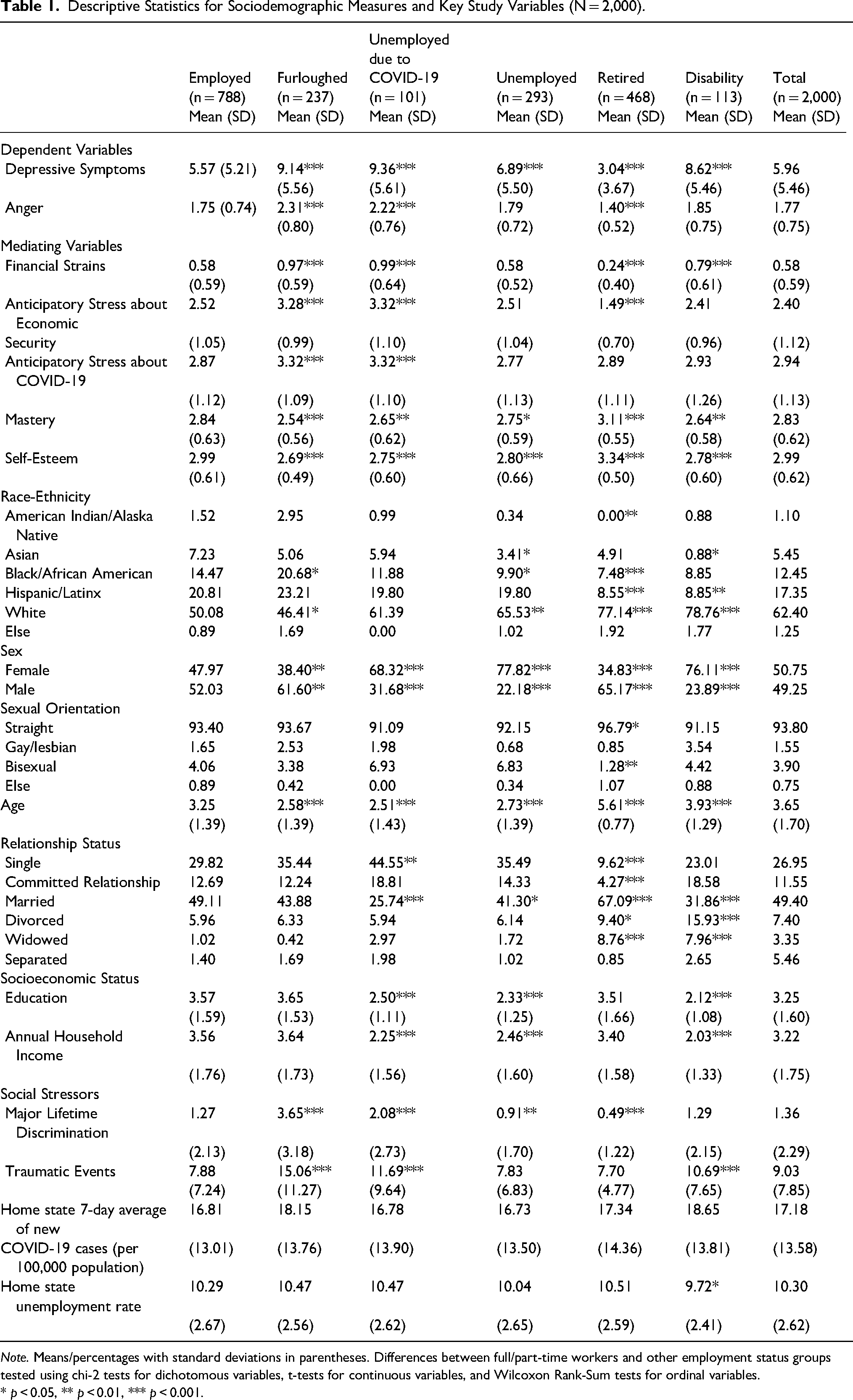
Note. Means/percentages with standard deviations in parentheses. Differences between full/part-time workers and other employment status groups tested using chi-2 tests for dichotomous variables, t-tests for continuous variables, and Wilcoxon Rank-Sum tests for ordinal variables.
* p < 0.05, ** p < 0.01, *** p < 0.001.
OLS Regressions of Depressive Symptoms on Employment Status, Mediators, and Study Variables (n = 2,000).
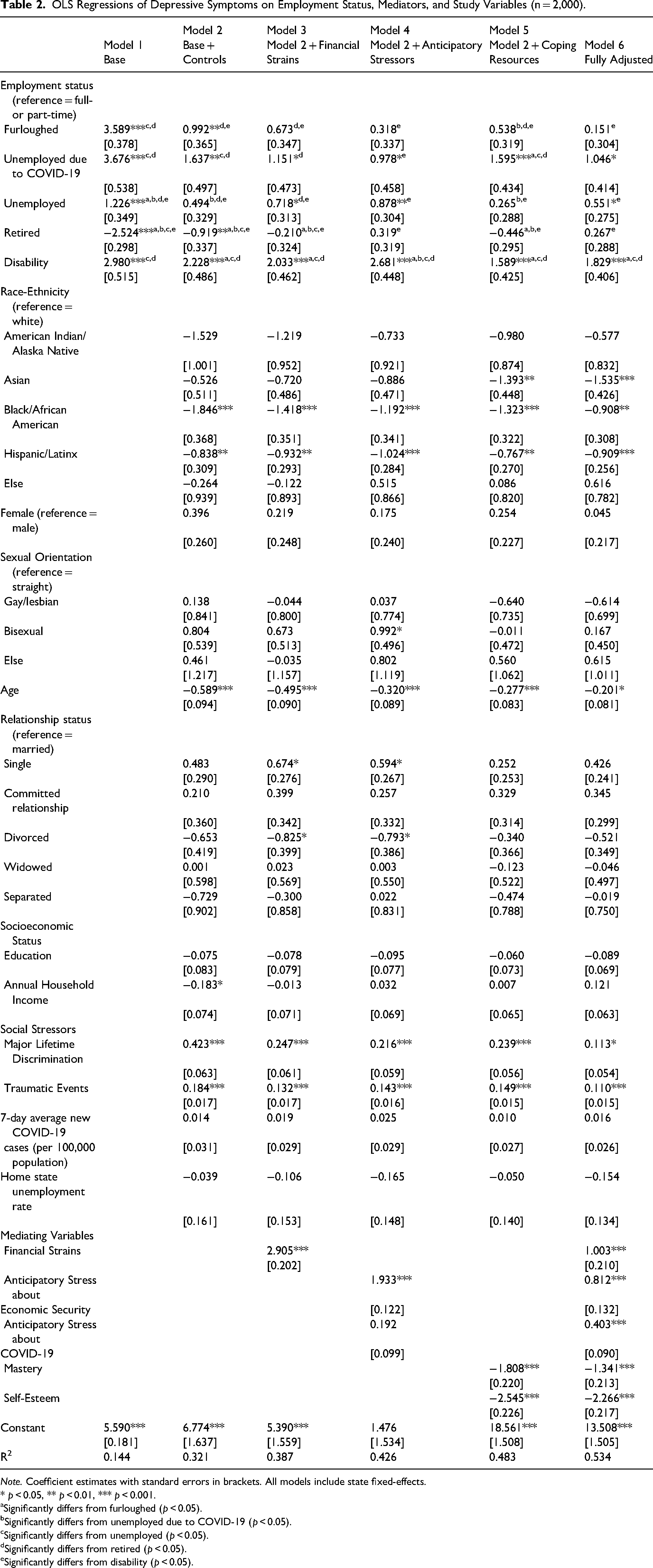
Note. Coefficient estimates with standard errors in brackets. All models include state fixed-effects.
* p < 0.05, ** p < 0.01, *** p < 0.001.
Significantly differs from furloughed (p < 0.05).
Significantly differs from unemployed due to COVID-19 (p < 0.05).
Significantly differs from unemployed (p < 0.05).
Significantly differs from retired (p < 0.05).
Significantly differs from disability (p < 0.05).
OLS Regressions of Anger on Employment Status, Mediators, and Study Variables (n = 2,000).
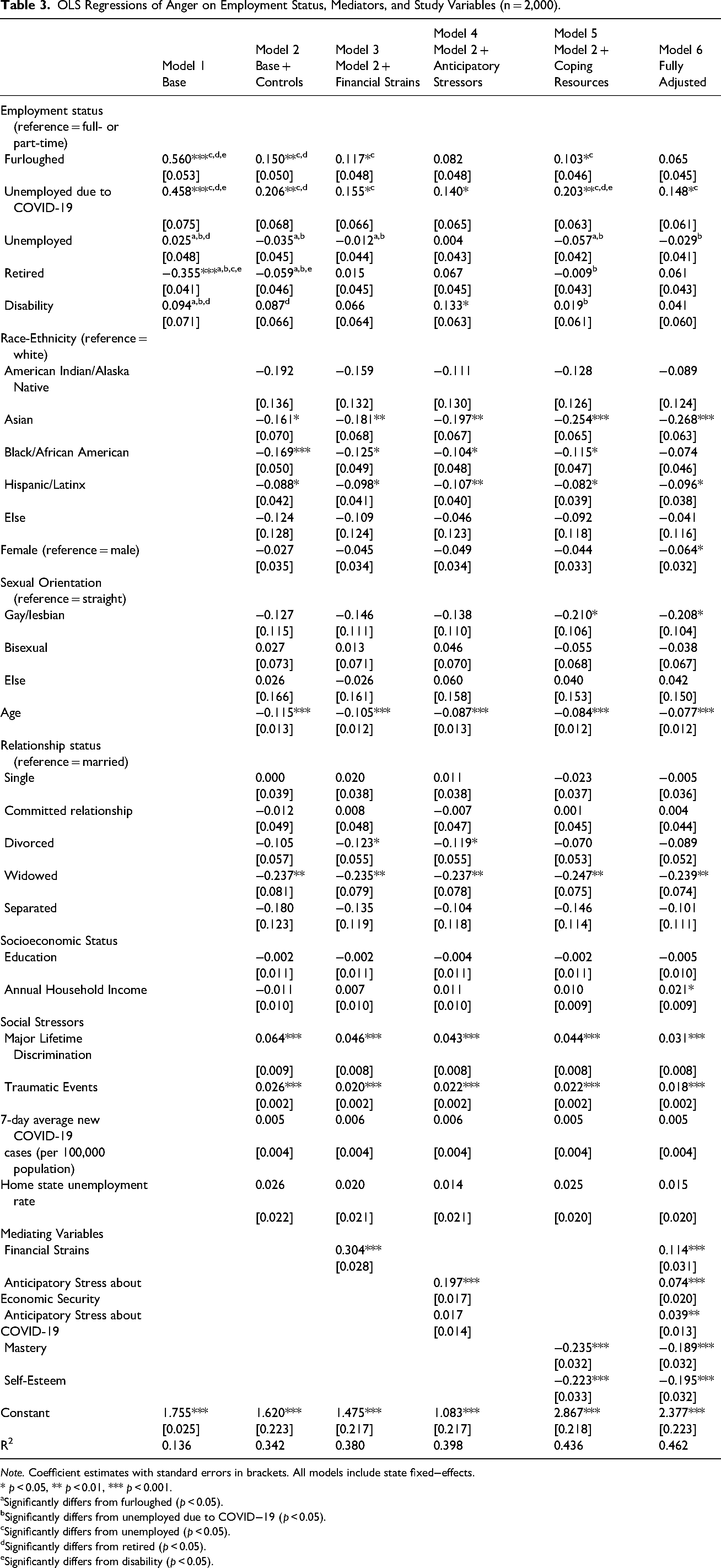
Note. Coefficient estimates with standard errors in brackets. All models include state fixed−effects.
* p < 0.05, ** p < 0.01, *** p < 0.001.
Significantly differs from furloughed (p < 0.05).
Significantly differs from unemployed due to COVID−19 (p < 0.05).
Significantly differs from unemployed (p < 0.05).
Significantly differs from retired (p < 0.05).
Significantly differs from disability (p < 0.05).
OLS Regressions of Social Stressors and Coping Resources on Employment Status and Study Variables (n = 2,000).

Note. Coefficient estimates with standard errors in brackets. Models include all control variables featured in Model 2 of Tables 2 and 3 and state fixed−effects.
* p < 0.05, ** p < 0.01, *** p < 0.001.
Significantly differs from furloughed (p < 0.05).
Significantly differs from unemployed due to COVID−19 (p < 0.05).
Significantly differs from unemployed (p < 0.05).
Significantly differs from retired (p < 0.05).
Significantly differs from disability (p < 0.05).
Tests of Mediation for Group Differences in Depressive Symptoms and Anger.

Note. Each row represents the results of separate mediation tests. Statistics depict the proportion of the difference in depressive symptoms/anger between the two groups that can be explained by the corresponding mediating variable. Models include dummy variables for state of residence and all control variables featured in Model 2 of Tables 2 and 3.
NT = not tested because the two groups did not significantly differ on the mediating variable in Table 4.
*** p < 0.001.
Results
Descriptive Results
Table 1 presents descriptive statistics for the sample. Nearly 12 percent of respondents report they have been furloughed from their job due to COVID-19, whereas approximately 5 percent are unemployed due to the pandemic. Sociodemographic variation in job displacement among respondents approximates several national trends. A higher percentage of Black respondents are furloughed than employed full- or part-time (p < 0.05). In a similar vein, a greater percentage of women in the sample are unemployed due to the pandemic than are employed (p < 0.001). In contrast to those who are employed, respondents who are unemployed or furloughed due to COVID-19 also tend to skew younger (each p < 0.001).
Employment Status Differences in Psychological Distress
Tables 2 and 3 present coefficients from linear models where depressive symptoms and anger are regressed on employment status and study controls. Turning first to differences in depressive symptoms, in the base model (Table 2, Model 1) respondents who are furloughed (ß = 3.589, p < 0.001) or unemployed (ß = 3.676, p < 0.001) due to COVID-19 report significantly more depressive symptoms than those who are employed full- or part-time. When controls for sociodemographic factors, prior stress exposure, and contextual measures of unemployment and COVID-19 infection are introduced in Model 2, the difference in depressive symptoms between those who are furloughed and the employed is reduced by approximately 72% ([0.992–3.589]/3.589 × 100] = −72.36), whereas the difference between those experiencing unemployment due to COVID-19 and the employed is reduced by 55% ([1.637–3.676]/3.676 × 100] = −55.47). Despite sizable reductions in the magnitude of these coefficients, however, depressive symptoms remain significantly higher among those who are furloughed (p < 0.01) or unemployed due to COVID-19 (p < 0.01).
An analogous pattern unfolds when turning to differences in anger presented in Table 3. In the base model, those who are furloughed (ß = 0.560, p < 0.001) or unemployed due to the pandemic (ß = 0.458, p < 0.001) report significantly more anger than respondents who are employed. With the addition of controls in Model 2, the discrepancy in anger between the employed and those who are furloughed is reduced by roughly 73% ([0.150–0.560]/.560 × 100] = −73.21), whereas the difference between the employed and those who are unemployed due to the pandemic is reduced by 55% ([0.206–0.458]/.458 × 100] = −55.02). Once again, these differences remain statistically significant despite notable diminutions in the size of coefficients following the addition of control variables.
Consistent with expectations, respondents who are furloughed or unemployed due to COVID-19 also report significantly higher levels of depressive symptoms (respectively, p < 0.05 in Table 2, Model 1) than those who are unemployed for reasons unrelated to the pandemic. With the addition of controls in Model 2, the difference in depressive symptoms between those who experienced job loss due to the pandemic and those unemployed for other reasons remains statistically significant, however the difference between those who are furloughed and the unemployed is fully attenuated. By contrast, in Table 3, those who are furloughed or unemployed due to COVID-19 report greater feelings of anger (respectively, p < 0.05 in Table 3, Model 1) than those unemployed for reasons unrelated to the pandemic, with these differences remaining statistically significant with the inclusion of controls in Model 2.
Turning to other noteworthy contrasts, both groups that experienced job displacement as a result of the pandemic report more depressive symptoms (respectively, p < 0.05 in Table 2, Model 1) and anger (respectively, p < 0.05 in Table 3, Model 1) than retirees. These differences remain intact with the addition of controls. Finally, respondents experiencing furlough or job loss also report more anger than those on disability in the base model (Table 3, Model 1), although these differences become non-significant following the inclusion of control variables in Model 2.
Associations of Stressors and Coping Resources with Psychological Distress
Tables 2 and 3 present the results of models where depressive symptoms and anger are regressed on social stressors and coping resources. Starting first with Table 2, respondents with more chronic financial strains report greater depressive symptomology (p < 0.001, Model 3). Similarly, respondents experiencing greater anticipatory stress about economic security also report more depressive symptoms (p < 0.001, Model 4), though the relationship between anticipatory stress about COVID-19 and depressive symptoms is not significant despite being in the expected direction. As expected, in Model 5 there is a negative, significant association between depressive symptoms and both mastery (p < 0.001) and self-esteem (p < 0.001). These associations are virtually identical in models predicting anger (Table 3).
Although anticipatory stress about COVID-19 was not initially significant when included alongside anticipatory stress about economic security, when all mediating variables are included simultaneously, its association with both depressive symptoms (p < 0.001, Table 2, Model 6) and anger (p < 0.01, Table 3, Model 6) becomes statistically significant. Ancillary analyses probing this suppression effect reveal that it is primarily a function of controlling for the protective aspects of self-esteem and mastery. These results suggest coping resources serve as an appreciable barrier against the psychological toll of worrying about the course of the pandemic.
Employment Status Differences in Social Stressors and Coping Resources
Results presented in Table 4 examine variation in social stressors and coping resources by employment status. In Model 1, respondents who are furloughed or unemployed due to COVID-19 report greater financial strains than the stably employed (respectively, p < 0.01), those unemployed for reasons unrelated to the pandemic (respectively, p < 0.05), and retirees (respectively, p < 0.05). These groups also report significantly greater anticipatory stress about economic security (respectively, p < 0.001 and p < 0.01 in Model 2) and COVID-19 (respectively, p < 0.05 and p < 0.01 in Model 3) than full- and part-time workers, those unemployed for non-COVID reasons (both at p < 0.05 in Models 2 and 3), and retirees (both at p < 0.05 in Models 2 and 3). Although respondents who are unemployed as a result of COVID-19 do not significantly differ from other groups across measures of coping resources, furloughed workers report significantly lower levels of mastery and self-esteem than the stably employed (p < 0.05 in Models 4 and 5) and retirees (p < 0.05 in Models 4 and 5).
Social Stressors and Coping Resources as Mediators
All prospective mediating variables that were independently associated with psychological distress, and on which respondents experiencing job displacement significantly differed from the stably employed or those unemployed for non-pandemic reasons, were included in formal tests of mediation. The results of these models are presented in Table 5. In Panel A, financial strains, anticipatory stressors, and coping resources significantly mediate (p < 0.001) the difference in depressive symptoms between furloughed workers and employed respondents, explaining a total of 93.26% of the elevated depressive symptoms found among furloughed workers net of controls. Parsing the unique contributions of each mediating variable, greater financial strains among furloughed workers explain roughly 14% of this difference, whereas greater worries about economic security and COVID-19 among this group contribute 34.58% and 12.12%, respectively, to the disparity in depressive symptoms. In terms of coping resources, lower levels of mastery and self-esteem among furloughed workers serve to explain 9.32% and 22.87% of the difference in depressive symptoms, respectively.
A somewhat smaller percentage (45.94%, p < 0.001, Panel A) of the difference in depressive symptoms between respondents who are unemployed due to COVID-19 and those who are stably employed is explained by measures of social stress. Greater financial strains among respondents experiencing COVID-related unemployment explain approximately 11% of this difference, whereas elevated worries about future economic security explain a more considerable 27.68% of the discrepancy between these groups. Higher levels of anticipatory stress about COVID-19 among those who are unemployed due to the pandemic contributes roughly 7.5% to the difference in depressive symptoms between these groups.
Although furloughed respondents did not significantly differ from the unemployed in terms of depressive symptoms net of controls (see Model 2, Table 2), respondents who experienced job loss due to the pandemic remained more likely to report depressive symptoms than those unemployed for non-COVID reasons. Unpacking this discrepancy in Panel B, differences in social stressors between these groups explain approximately 63.5% (p < 0.001) of the gap in depressive symptoms. Greater financial strains among those who experienced job loss due to the pandemic explain 28.82% of this difference, whereas greater trepidations about economic security among this group contribute a comparable 23.52% to this gap. Greater anticipatory stress about the course of the pandemic among those who experienced job loss due to COVID-19 explains a less notable 11% of the elevated depressive symptoms found among this group.
Turning to Panel C, all variables significantly mediate (p < 0.001) the difference in anger between furloughed and employed respondents, explaining a total of 80.59% of the difference between these groups. Disaggregating the relative contributions of each mediator reveals that greater financial strains among furloughed workers explains 15.11% of this difference, whereas elevated concerns about future economic security and the course of the COVID-19 pandemic contribute 22.78% and 13.08%, respectively, to this disparity. Smaller reserves of mastery (13.27%) and self-esteem (16.35%) among furloughed workers make similar contributions to the difference in anger between these groups. Turning to the gap in anger between those experiencing unemployment due to the pandemic and the employed, 14.43% of the difference between these groups can be explained by greater financial strains among the former, whereas 21.05% and 8.79% are attributable to more frequent worries about economic security and COVID-19 among those who lost their jobs due to the pandemic.
Respondents who experienced COVID-related job displacement reported greater anger than those who are unemployed for reasons unrelated to the pandemic. As depicted in Panel D, measures of social stress significantly mediate the differences in anger found among these groups, explaining 40.65% (p < 0.001) of the discrepancy in anger between the unemployed and those who are furloughed, and a smaller, but non-trivial 32.05% (p < 0.001) of the difference between the unemployed and those who experienced job loss due to the pandemic. Decomposing these statistics further, greater financial strains among furloughed respondents relative to the unemployed explain approximately 16.09% of the difference in anger, while an even larger 24.39% of this difference is attributable to greater anticipatory stress regarding economic security among furloughed respondents. A negligible amount of the difference—less than one percent—can be accorded to worries about COVID-19. Turning to the anger gap between the unemployed and those who experienced job loss due to COVID-19, greater financial strains and anticipatory stress about economic security among the latter explain similar amounts of the disparity between these groups (17.51% and 12.83%, respectively), whereas worries about the pandemic make a relatively minor contribution (1.71%).
Moderating Effects of Coping Resources
Contrary to expectations, the results of models featuring interactions between coping resources and employment status (available on request) fail to provide evidence that higher levels of mastery or self-esteem buffer mental health against COVID-related job displacement.
Discussion
A central goal of this study was to adjudicate the relative contributions of different forms of social stressors and coping resources to disparities in psychological distress between those who experienced job loss or furlough due to COVID-19 and those who remained stably employed or were unemployed for reasons distinct from the pandemic. Consistent with expectations, respondents who experienced job loss or furlough due to the pandemic reported more depressive symptoms and anger than those who were stably employed or unemployed for reasons unrelated to COVID-19. With the exception of the difference in depressive symptoms between furloughed workers and those who were unemployed for non-pandemic reasons, these contrasts remained statistically significant even after the inclusion of controls for sociodemographic factors, antecedent stressors, and state-level variation in unemployment and COVID-19 mortality. Similarly aligning with expectations, respondents who endured unexpected job displacement reported more financial strains and greater anticipatory stress about both their future economic prospects and the trajectory of the pandemic than those who were employed or unemployed for non-COVID reasons. There were far fewer employment-based differences in coping resources, with only furloughed workers reporting less self-esteem and lower levels of mastery than the stably employed.
Differences in social stress and coping resources contributed in notable ways to employment-based disparities in psychological distress. These factors explained over ninety percent and eighty percent, respectively, of the difference in depressive symptoms and anger between furloughed workers and the employed. Of note, higher levels of economic anticipatory stress among furloughed workers contributed more to disparities in psychological distress than any other mediating variable. Although a smaller proportion of the difference in anger between respondents who were furloughed and those who were unemployed for non-COVID reasons—approximately forty percent—was explained by discrepancies in stressors, economic anticipatory stress once again explained a greater proportion of this difference than either ongoing financial strains or worries about the pandemic. In a similar vein, nearly half of the difference in depressive symptoms and anger between those who experienced job loss due to the pandemic and the stably employed were explained by higher levels of social stress among the former. Across these different contrasts, economic anticipatory stress was again the predominant factor driving mental health disparities. A somewhat different picture emerged when decomposing the difference in depressive symptoms and anger between those who experienced job loss due to the pandemic and those unemployed for other reasons. In this case, financial strains contributed slightly more to the gap in psychological distress than economic anticipatory stress. Finally, running counter to the stress-buffering hypothesis, results failed to provide evidence that coping resources moderated the effects of job displacement on either measure of distress.
Conclusion
Study findings hold important implications for research in the stress process paradigm and point to several practical measures that might serve as a bulwark against unexpected recessionary shocks. Foremost, results suggest that anticipatory stress about economic security is more deeply implicated in the elevated levels of psychological distress found among people experiencing COVID-related furlough or job loss than either ongoing financial strains, lower levels of self-esteem, or diminished personal control. That trepidations about future economic security explained a greater proportion of the distress gap than contemporaneous financial hardship across most group contrasts speaks to the insidious nature of anticipatory stressors. Yet, this finding also raises the question of why future-oriented worries about material conditions are more meaningful for understanding employment-based disparities in mental health than tangible financial strains? Human beings are uniquely equipped with the cognitive capacity to draw upon prior experience, the experiences of those around them, and events transpiring in the larger social world to forecast their susceptibility to a variety of challenging circumstances (Pearlin & Bierman, 2013). For workers who have recently experienced job loss or furlough, rumination on an uncertain economic future might reasonably lead to apprehension, pessimism, and hopelessness about the future. Whereas exposure to economic hardship might eventuate in adaptation, the specter of economic ruin looms as an unresolvable tension with correspondingly injurious consequences for mental health. More generally, the finding that future-oriented worries about economic security contribute to employment-based differences in mental health over and above ongoing financial strains provides further evidence for the contention that anticipatory stressors represent an important, albeit underexamined, class of stressors for understanding mental health disparities (Grace, 2020; Pearlin & Bierman, 2013).
Given that future-oriented concerns about economic security were particularly salient for explicating the association between job displacement and psychological distress, it is worth considering what practical measures might serve to alleviate people's worries about economic precarity. Several studies suggest that legislation passed on a temporary basis at the start of the pandemic might be permanently enacted to safeguard mental health against job loss. The Coronavirus Aid, Relief, and Economic Security (CARES) Act, passed in March 2020, provided economic impact payments of $1,200 per adult; extended unemployment insurance for thirteen weeks; and, dispersed an additional $600 per week in unemployment payments. The passage of this legislation led to notable reductions in food insecurity among the unemployed during the early months of the pandemic (Raifman et al., 2021). These benefits, however, were allowed to expire in July, and as a result, an increasing share of unemployed adults were unable to pay their bills or have enough savings on hand to address short-term needs (Schneider et al., 2020). A continuation of the CARES Act would logically stand to benefit those who experienced job displacement by attenuating their higher levels of economic anticipatory stress. Yet, it is important to acknowledge that even with the CARES Act in place, many Americans still experienced psychological duress. If these mental health issues are fundamentally rooted in the precarity of contemporary work arrangements, it suggests that more concerted efforts must be undertaken to fortify worker protections. One possible solution, advocated by labor studies scholars, is to strengthen unions as a means of counteracting the corporate decision-making that gives rise to precarious work (Kalleberg, 2011). Efforts to grow union membership would enhance the bargaining power of workers in terms of both negotiating higher wages and petitioning for stable, long-term contracts. As recent, innovative empirical work demonstrates, union membership is robustly associated with both increased wages and a reduced likelihood of experiencing poverty (VanHeuvelen, 2018; VanHeuvelen & Brady, 2021).
The finding that psychological distress was elevated among respondents who experienced job loss or furlough is neither surprising nor remarkable. However, by disaggregating these groups, this study sheds light on the role of personal coping resources as an important factor underlying higher levels of distress among furloughed workers relative to the employed. Furloughed workers reported significantly lower levels of mastery and self-esteem than the stably employed, which jointly explained nearly one-third of the difference in depressive symptoms and anger between these group. That furloughed workers, but not those who experienced job loss due to COVID-19, reported smaller reserves of coping resources, speaks to the distinctive uncertainty, and consequent self-doubt, induced by furloughed workers’ predicament. Furloughed workers occupy a liminal space, where they remain connected to their employer (and may receive benefits), but no longer receive wages. As a result, many of these workers may be in the midst of a “status passage” (Glaser & Strauss, 1971), where for the first time they are experiencing a slide into a lower rung of the social hierarchy, accompanied by a loss of privilege and influence. This sudden shift might reasonably explain the diminished self-concept and reduced sense of control found among furloughed respondents. To further extend this line of inquiry, future research on the mental health of furloughed workers might examine whether decrements in coping resources endure over time, and how the career trajectories and mental health of furloughed workers fare relative to those who remained continuously employed during the pandemic.
Consistent with research which indicates that furloughed workers experience more distress than individuals whose unemployment predates the pandemic (Mimoun et al., 2020), I found that respondents who were furloughed or experienced job loss due to COVID-19 reported more anger than respondents who were unemployed for non-pandemic reasons. Greater feelings of anger among those who experienced job displacement might be better understood in the context of research on job-seekers during the Great Recession. Whereas Americans typically engage in self-blame when they are unable to find employment (Sharone, 2014), those who lose their jobs during economic contractions are more inclined to credit job loss to macro-level causes, ultimately manifesting in anger and a sense that the system is rigged against them (Lopez & Phillips, 2019). Another possible explanation for displaced workers’ greater propensity to experience anger can be gleaned from a recent survey of unemployed Americans, which found that mental health issues were most prominent among those with a college or graduate degree (Parker et al., 2021). In view of the higher levels of educational attainment found among respondents experiencing COVID-related job displacement relative to those unemployed for non-COVID reasons, it is possible that greater anger among the former reflects the fact these individuals previously enjoyed greater job security, and as a consequence, are less equipped to contend with unanticipated crises that undermine their material wellbeing.
The stress-buffering effects of coping resources represent one of the more animating and provocative ideas articulated in the stress process model (Pearlin et al., 1981). But whereas prior research demonstrates self-esteem and mastery moderate the damaging effects of recessionary hardships on mental health (Koltai, 2018; Koltai & Stuckler, 2020), I failed to find evidence that either resource weakened the positive associations between COVID-related job displacement and psychological distress. It is worth noting that prior research takes a longer view, examining how personal coping resources mitigate economic hardships related to the Great Recession several years following its onset. By contrast, respondents in the present study were surveyed anywhere from four-to-seven months into the recession. Losing one's job in the midst a global pandemic exemplifies a crisis within a crisis. The gravity of these compounding events may quite understandably overwhelm a person's adaptive capacity, in turn, vitiating the traditional stress-buffering effects of these coping resources. Thus, future research may identify stress-buffering effects more consistent with prior research after these individuals have had time to acclimate to their new economic circumstances.
This study is not without limitations. Due to the cross-sectional nature of these data, there is an inability to establish causal or reciprocal relationships between job displacement and financial strains, anticipatory stressors, coping resources, or psychological distress. Thus, while the relationships identified in this study are consistent with the stress process model and the findings of recent research on mental health and pandemic-induced financial hardships (Bierman et al., 2021; Donnelly & Farina, 2021), these results require verification with panel data more suited to addressing these questions. Furthermore, although the study's quota sampling approach serves to approximate the demographic composition of the U.S. population, the sample is nevertheless self-selected, and as such, lacks some of the attractive properties of a random probability sample (i.e., generalizability to the true population). Despite these drawbacks, this method of data collection has utility for providing rapid insight into people's evolving experiences of the pandemic.
The COVID-19 pandemic has had devastating effects on the mental health of people who experienced job displacement. The findings of this study reveal that people who were furloughed or experienced job loss during the first months of the pandemic endured more financial strains, greater worries about future economic security, and an erosion of coping resources, each of which contributed to elevated distress among members of these groups relative to the stably employed and those unemployed for reasons unrelated to COVID-19. Worries about long-term economic security were especially palpable among workers who experienced job displacement, and contributed more so than other factors to employment-based discrepancies in psychological distress. Despite its limitations, the findings of this study suggest that anticipatory stressors warrant more rigorous examination as a source of mental health disparities in future research.
Footnotes
Acknowledgements
Support for this study was received from Hamilton College through an early career faculty grant. This study was approved by the Institutional Review Board at Hamilton College: Protocol #S20-105. I am grateful to the special issue editors and two anonymous reviewers for their generative comments on earlier versions of this article.
Declaration of Conflicting Interests
The author(s) declared no potential conflicts of interest with respect to the research, authorship, and/or publication of this article.
Funding
The author(s) disclosed receipt of the following financial support for the research, authorship, and/or publication of this article: This work was supported by the Hamilton College, (grant number Early Career Faculty Grant).
