




Abstract
In an age of insecurity, what is it like to hold a secure job with a single employer? While extensive research documents the challenges of job insecurity, the experiences of the stably employed have gone largely unexamined. Drawing on interviews with 126 white-collar workers in highly secure positions at large firms in Korea, I find that job security is devalued. These jobs are viewed not as a privilege but as an obstacle to embodying a “culture of enterprise,” which idealizes self-responsibility, flexibility, and mobility. Interviewees highlighted the social risks tied to staying in their jobs, citing the lack of “growth,” meaning the development of marketable skills and experiences that are portable across organizations. I term this fear of failing to meet the prevailing cultural ideal of self-entrepreneurship stagnation anxiety. This led some to quit and pursue alternative careers better aligned with enterprise culture, while others stayed but struggled with feelings of inadequacy. Only a small minority rejected enterprise culture in favor of even more secure employment. These findings reveal that shifting understandings of what constitutes a successful career has created new dilemmas even for those in highly secure employment.
Over the past several decades, the decline of “standard” employment has been a central concern among social scientists. A large body of research documents the transformation from stable, long-term employment arrangements—a cornerstone of the Post-war era—to a new economy characterized by greater labor flexibility, increasing job insecurity, and the expansion of precarious work, a trend that extends to the highly-educated, white-collar workers (e.g., Hacker, 2006; Kalleberg, 2011; Katz & Krueger, 2016). Sociologists have maintained a critical view of this shift, focusing on its negative consequences for workers’ health (Burgard et al., 2009; Fullerton & Anderson, 2013; Norris, 2016) as well as their personal and family lives (Gerson, 2017; Pugh, 2015; Rao, 2017). These studies often end with the punchline that the erosion of the traditional employment contract has undermined workers’ quality of life, suggesting a need for stronger employment protection and support for collective action among workers.
Implied in this literature is the idea that job security is a rare and desirable asset—something that workers would seek as a protection against the risks and uncertainties in today's economy. Given such extensive evidence on the detrimental effects of job insecurity, one might reasonably expect individuals to prize stable employment. Yet, this contrasts with research on how workers think about themselves, work, and careers, which highlights the rise of a “culture of enterprise.” (Du Gay, 1996; Illouz, 2008; Rose, 1992; Vallas & Prener, 2012). Studies repeatedly show that many workers today embrace the notion of the “enterprising self” (Foucault, 2008), whereby they take responsibility for managing their economic risks by continually enhancing their personal and professional capacities, strive for flexibility and adaptability in response to market uncertainties, and view these endeavors not as burdensome but as fulfilling (Barley & Kunda, 2006; Gershon, 2017; Lane, 2011; Osnowitz, 2010; Sharone, 2013; Smith, 2001; Snyder, 2016; Vallas & Christin, 2018). This research, however, is primarily based on the experiences of workers who face unemployment or precarious work conditions—those who embrace the entrepreneurial ethos against the backdrop of lack of job security. This raises the question of whether workers are genuinely embracing enterprise culture or are merely complying with organizational and market demands. To better understand how workers experience the tension between security and flexibility, we must move beyond cases that epitomize the new economy and explore where structural impositions that dictate the embrace of enterprise culture may be relatively absent. This article takes up this task.
In this study, I examine a unique case in which employees are expected to pursue long-term careers within the organization, and organizational structure is set up to provide them. In South Korea (hereafter Korea), the chaebol—large, family-owned business conglomerates such as Samsung and Hyundai—continue to provide employees with high levels of job security and adhere to practices and customs rooted in the lifetime employment model. Studying this case allows us to observe how workers experience and respond to the clash between organizational structure that promotes security and stability on the one hand, and broader culture that encourages flexibility and mobility on the other. Drawing on 126 in-depth interviews with former and current full-time white-collar employees of these firms, I ask: How do these workers evaluate their job security within the broader context of insecurity, and what are the resulting implications for their career trajectories?
I find that, rather than treasuring their jobs for the rare security and stability they offer, most workers consider them lacking in fostering a desirable career path, drawing on enterprise culture as a benchmark. Respondents were anxious about the risks of staying in their secure jobs, citing a lack of opportunities for “growth,” understood as the development of marketable skills, experience, and knowledge that are portable across organizations. They equated job stability with an undesirable state of stagnation, in terms of a lack of enhancement of their value and mobility within external labor markets. I term this fear of “falling behind,” or becoming irrelevant in a culture that values flexibility and mobility stagnation anxiety. Stagnation anxiety prompted many workers to leave their secure employment in pursuit of alternative careers that they perceived as more in tune with the prevailing enterprise culture—namely, portfolio careers, licensed professions, and entrepreneurship. Others decided to remain in their current positions but struggled with feelings of inadequacy and embarrassment over their inability to quit. Only a small minority, whose experiences of overwork outweighed their concerns about stagnation, resisted enterprise culture, seeking even more stable careers.
This study makes three contributions. First, it offers new empirical insights into the subjective responses of the stably employed, a population that has received little empirical attention. While their declining representation may explain this oversight, I argue it is precisely this change in their social position from norm to exception that makes their perspectives essential to a fuller account of workers’ experiences in the new economy. Second, the article extends scholarship on enterprise culture by showing that it operates not only by normalizing the erosion of job security, but also by undermining the appeal of job security itself. Finally, the concept of stagnation anxiety reveals that workers who enjoy job security also engage in intensive “employment management work” (Halpin & Smith, 2017), but their labor takes a distinctive form: cultivating the capacity for job mobility rather than finding or maintaining employment. Although structurally able to opt out of the relentless pressure to remain marketable, they still feel compelled to meet these expectations, and some opt in.
Worker Subjectivity, Job Insecurity, and Enterprise Culture
The culture of enterprise valorizes economic self-responsibility and encourages individuals to cultivate techniques of risk management (Du Gay, 1996; Foucault, 2008; Illouz, 2008; Rose, 1992; Rose & Miller, 2008). It advises workers to become “entrepreneurs of themselves”; that is, to view themselves as businesses—“bundles of skills, assets, qualities, experiences, and relationships,” rather than as “property that could be rented to an employer for a certain period of time” (Gershon, 2017, pp. 1–2). The notion of the self-entrepreneur captures the form of subjectivity most attuned to the needs of the neoliberal economy. The emphasis is placed on constantly developing human capital, the skills and abilities that make individuals “employable” (Smith, 2010b; Southwood, 2017). Workers are represented as revenue-generating products who must strive to enhance their market values, similar to how businesses improve their products to stay competitive in the market.
By celebrating autonomy, self-discipline, and risk-taking as key traits of the successful entrepreneurial self (Du Gay, 1996), enterprise discourse recasts economic risk as a privileged opportunity to pursue individual choice and freedom. Within this cultural frame, paid work becomes a site that promises fulfilling endeavors requiring autonomy and continuous self-improvement (Honneth, 2004). Enterprise culture has thus reframed the notion of entrepreneurship from the form of self-employment to actively pursuing risky work opportunities to enhance one's market value, a way of being and feeling that should be pursued by all types of workers (Freeman, 2014). Arthur and Rousseau's (1996) notion of the “boundaryless career” and Hall's (1996) “protean career” capture the defining features of careers under this cultural landscape. Pink (2001) further portrays this shift as an expansion of freedom and opportunity, championing the rise of what he calls the “free agent.”
The theory of enterprise culture developed in the context of increasing need for firms to become flexible, and thus set out to explain how the new managerial initiatives that reshaped the structure of work and staff governance reshaped the workplace culture (Du Gay, 1996). Enterprising subjectivities have thus been understood as “promoted” by organizations through “regulatory practices and techniques,” (Rose & Miller, 2008, p. 172), mainly to serve organizational needs and objectives. Organizational programs, such as Total Quality Management and Just-in-time staffing, were meant to shed bureaucratic trappings in favor of developing enterprising organizations.
More recent empirical research on workers’ experiences in the new economy corroborates this perspective. Studies on a wide range of occupations and industries show that, while workers do indeed embrace enterprise culture, this is largely dictated by structural conditions, namely, the threat of involuntary job loss and contingent work contracts, which compel and incentivize them to adopt this mindset (e.g., Ho, 2009; Lane, 2011; Neff, 2012; Sharone, 2013; Snyder, 2016). For example, in her study of high-tech workers who were laid off during economic crisis, Lane (2011) finds that workers engaged in what she terms “career management,” a doctrine that they are responsible for their economic survival, operating as a “company of one.” While this mindset is deeply internalized by workers, including those who are long-term unemployed, Lane cautions that it may represent “less a matter of deeply felt identity than strategic cultural performance” (p. 61). Lopez and Ibañez (2023) show how dislocated job seekers embrace narratives of flexibility and self-reinvention as they navigate labor market uncertainty. Sheehan (2021) shows how cultural discourses place responsibility on unemployed individuals to accept the terms of precarious employment, effectively legitimating the new employment regime.
In other words, the perceived inevitability of job insecurity functions as a self-disciplining tool, driving workers to embrace market uncertainty and focus on maintaining their employability. As Smith (2010a) notes, workers essentially “submit to” precarious work in an effort to “prove” that they are worthy of permanent employment. Neff et al. (2005) similarly points out that working on one's employability is “compulsory” in the contemporary labor market. Snyder (2016, p. 4) describes the quest for the enterprising self as “a kind of Faustian bargain with the working self,” where workers have no choice but to sacrifice security and predictability in exchange for “opportunities to be more personally responsible for carving out a unique path in life.” Taken together, the implied assumption running through these studies is that workers inherently desire security and would reject the entrepreneurial ethos if different work conditions were in place.
Beyond Job Insecurity: Stagnation Anxiety
In this study, I explore the possibility that enterprise culture, rather than imposed by employers and labor market conditions, could be taken up by workers themselves, even without—or in opposition to—organization-driven measures. What happens when enterprise culture circulates beyond structural conditions of precarity? Can entrepreneurial subjectivities take hold even among workers whose employment conditions do not incentivize this mindset? And if so, what are the psychological consequences for workers who find themselves unable to embody the entrepreneurial ideal?
Here, I take my cue from Vallas and colleagues (2012, 2015, 2018), who examined the popular business press as a vehicle for disseminating the enterprise discourse. Through an analysis of the “personal branding” discourse in the career advice genre as one form of enterprise culture, Vallas and colleagues show that the conception of self, work and employment represented in popular literature does indeed exhibit an entrepreneurial turn. They also find overwhelming support for the narrative among interview subjects. This suggests that enterprise culture has become pervasive far beyond where it initially emerged. As it takes on a life of its own, it could expose workers across virtually all types of organizations and employment conditions.
This article thus attends to the repercussions of enterprise culture as a normative construct itself. As I discuss next, I use the case of young, white-collar employees of the Korean chaebol, which is largely a bureaucratic organization that neither necessitates nor encourages the uptake of enterprise culture among its employees. These firms offer exceptional job security, seniority-based advancement, and comprehensive welfare benefits—the antithesis of the flexible, market-driven employment celebrated by enterprise culture. This case thus allows us to assess whether, and if so how, the character of the self as the entrepreneur would still assume such an “ontological priority” (Du Gay, 1996, p. 81) among workers even in the absence of organizational structural impositions that incentivize the uptake of this ethos.
The Case of Standard White-Collar Employment in Large Firms in Korea
During and after the Asian financial crisis in 1997, Korea underwent a thoroughgoing neoliberal transformation, largely driven by the conditions imposed by the International Monetary Fund bailout (Lim & Jang, 2006; Shin, 2011). Scholars highlight that the historical context preceding this event has fostered a particularly strong prevalence of neoliberalism in Korea (Park, 2009). The authoritarian regime from the 1960s to the 1980s suppressed individual freedoms under the guise of industrialization and economic development (Chang, 1999). The subsequent state-led neoliberal reforms following the 1997 crisis fulfilled to some extent these repressed desires for autonomy, aligning the neoliberal subject with the ideal of the “competent and creative citizen” (Chun, 2008). Consequently, neoliberalism has permeated various facets of Korean society, including education, labor market, and family (Abelmann et al., 2009; Chun, 2008; Park, 2009; Suh, 2010). For many Koreans, the concept of “self-development,” which closely resembles Foucault's (1979) notion of ‘technologies of the self,” is well-known (Suh, 2010).
Standard white-collar employees of the chaebol—the focus of this study—are a privileged group in this context. The chaebol, large family-owned business conglomerates, were central to the country's rapid economic development. They received extensive government support, including subsidies, tax incentives, and protective tariffs, which helped them secure their dominant market position (Chang, 1999; Eckert, 2016; Steers et al., 1989). To fuel their rapid expansion, the chaebol invested in on-the-job training to produce firm-specific skilled labor, and developed internal labor markets characterized by seniority-based wages, promotion, and lifetime employment guarantees to retain these trained workers. Over time, this evolved into a comprehensive firm-based welfare regime for standard workers in these firms (Lee, 2016). Although the 1997 crisis and subsequent neoliberal restructuring led to a decline in the share of these workers in the Korean labor market (Jung and Cheon, 2006; Kim, 2004), their robust employment protections and comprehensive welfare benefits remain largely intact (Lee, 2016). 1 Consequently, researchers studying Korea often view these regular, white-collar employees of large firms as counterpoints to the numerous workers in precarious employment that has proliferated in the new economy (e.g., Kalleberg et al., 2021; Koo, 2022).
Three organizational practices that point to the persistence of this strong employment protection are particularly noteworthy. First, rather than hiring individuals with specific skills or experience on an as-needed basis, these conglomerates conduct large-scale recruitment of college graduates biannually. 2 Job categories are broadly defined, with new hires having minimal input on their workgroup assignments. 3 Once hired, recruits participate in several weeks of training camp, designed to foster a strong sense of organizational membership (Janelli, 1993; Um, 2023) and subsequently receive workgroup-specific on-the-job training. Another practice that reflects the organizational approach to cultivating a loyal, well-rounded generalist workforce is the internal transfer policy, which rotates employees among different workgroups every few years. Although large firms have adopted Western training programs since the neoliberal shift—including in-house online and offline specialist training, as well as sponsored MBA programs at prominent domestic and international business schools—these opportunities are typically reserved for a select few (Froese et al., 2018; G.-C. Yu & Rowley, 2009). Lastly, seniority-based pay and promotion systems remain largely intact (Lee, 2016). While individual performance may influence bonuses, it typically does not affect base pay, which increases annually regardless of performance reviews (Froese et al., 2018). Promotions, especially below the manager level, follow a rigid timeline, mostly independent of individual job performance. As a result, promotion evaluations often depend more on timing than individual performance and contribution, with those scheduled for promotion in a given year receiving favorable ratings at the expense of others. This creates an impression of arbitrary evaluations and demotivates workers (Prentice, 2022).
Together, these organizational practices illustrate a career model based on lifetime employment, reminiscent of the Fordist-era work arrangements. Discontent with organizational life among white-collar employees is not new (Mills, 1951; Whyte, 1956), and, chaebol workers are no exception. Ethnographic fieldwork conducted in the late 1980s, when Korea was rapidly developing, documented dissatisfaction among its employees, particularly young workers early in their careers (Janelli, 1993; Kearney, 1991; Kim, 1992). However, these earlier accounts show that workers’ grievances about rigid hierarchies and limited autonomy were often tempered by a desire for the security and stability these jobs provided, especially given that alternative career paths were limited. What appears to have changed, then, is not workers’ attitudes tied to their career stage or life course but rather the cultural framework through which they assess their careers.
Neither “neoliberal economy winners” (Pugh, 2015) who leverage their highly-valued skills and expertise to transform the risks of the new economy into opportunities (Barley & Kunda, 2006; Osnowitz, 2010) nor “losers” who are taken advantage of by it, the young chaebol workers today are uniquely positioned to reveal the less obvious effects and manifestations of enterprise culture. Although insulated from the threat of unpredictable, involuntary job loss, they lack opportunities to embody the virtues celebrated by enterprise culture. What does this imply about how they evaluate their careers and perceive their position in the broader labor market? Do they view themselves as privileged, immune from the relentless demands of self-improvement, or as deprived, excluded from participating in such opportunities?
Data and Methods
I answer this question using 126 semi-structured, in-depth interviews conducted between 2018 and 2021. My sample consists of 66 women and 60 men aged 24–39 (born 1981–1995), or 52 former and 74 current white-collar employees in full-time positions at large firms associated with the Korean chaebol. 4 This cohort is well-positioned to illuminate the tension between two eclipsing models of career-building today: an organizational career anchored in a single employer versus the portfolio career premised on flexibility and cross-firm mobility. Their subjective responses thus reveal how enterprise discourse may shape workers’ orientations even when structural constraints are relatively absent. Focusing on this cohort also situates the analysis within ongoing scholarly debates about work and careers that have largely centered on similar populations.
Given the exploratory nature of the study, I created a theoretical sample (Gerson & Damaske, 2020). To recruit participants, I periodically posted recruitment advertisements on online portals for alumni of four different top-tiered universities located in Seoul. Large firms are well known for preferentially hiring graduates from prestigious institutions, and research indicates that a degree from a metropolitan-area institution increases the likelihood of employment with large firms (Hwang & Kim, 2012). To achieve comparability in gender and employment status (i.e., former and current) and to represent a wide range of job functions, firms, and industries in the sample, I also used chain referral from the interviewees as well as from my extended social network. This approach was particularly useful for identifying participants with specific characteristics that were difficult to find, such as male, former employees. I allowed a maximum of four referrals from each tie.
Table 1 summarizes key sample characteristics. The average age was 29.8. Among former employees, the average employment period was approximately three years, with almost all having left their jobs within four years. Most of their employment spells fall between 2012 and 2019, situating their experiences in the late 2010s and early 2020s—the same period reflected in the accounts of current employees in the sample. Current employees had an average tenure of slightly over four years. Most interviewees (seventy-two percent) were never-married and did not have children. Of those who were married, about forty percent had at least one child. All participants had a bachelor's degree. Nearly half graduated from top three universities in Korea, commonly known as the SKY universities. 5 The rest graduated from other high- and mid-tier universities in Korea, with a small minority having degrees from the United States and China.
Sample Profile.
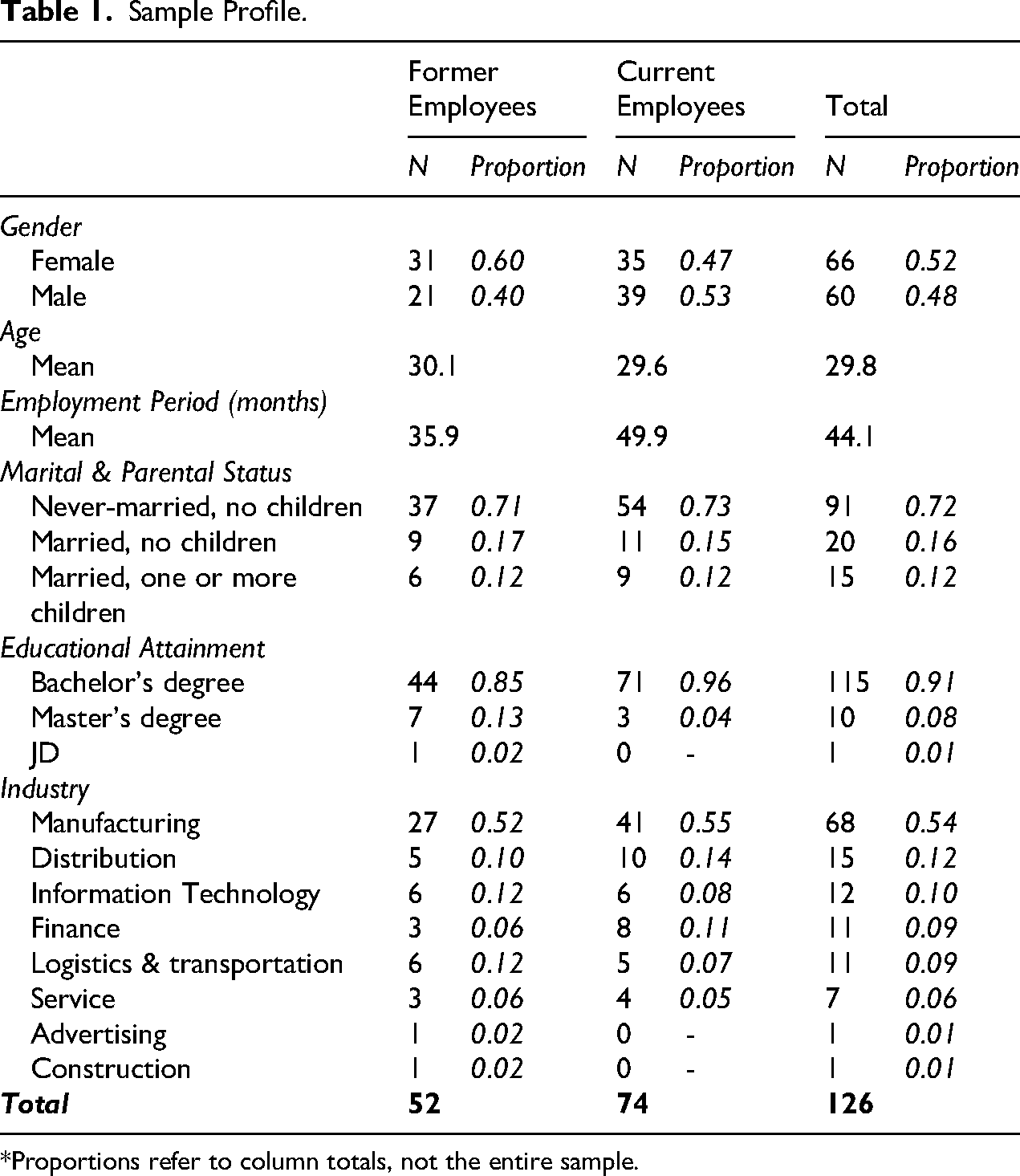
*Proportions refer to column totals, not the entire sample.
The sample represents 77 different companies across eight industries, broadly defined as: manufacturing (e.g., electronics, automobile, food), distribution (e.g., department store, online shopping mall), Information Technology (IT), finance (e.g., bank, insurance, asset management), logistics and transportation (shipping, aviation, trading), service (e.g., hotel, entertainment, real estate), advertising, and construction. All of these establishments are affiliated with top domestic business groups. Taken together, my sample is privileged in many ways: most of them are born from middle-class families, received private education consistently through schooling years, graduated from high-ranking universities, and secured full-time employment in the country's primary labor market.
All interviews were conducted in Korean and lasted from one hour to two hours and 30 min, averaging about 90 min each. I asked a wide range of open-ended questions about respondents’ life histories, but this article centers on individuals’ perceptions and feelings about their experience working for a large firm, decision-making processes about leaving or staying, meanings they attach to these decisions, and their career and personal goals for the future. I initially coded the interview data inductively (Charmaz, 2006) using the qualitative data analysis software Atlas.ti. Upon comparing interviews with one another, I found a surprising similarity in how respondents, both former and current employees, discussed their work—specifically, their dissatisfaction with their work. This indicated a shared understanding of what they find in their jobs as undesirable, and by extension, what they ideally want in a job. Considering such a universal conception of what makes a job “good” and “bad,” I analyzed the data in dialogue with relevant literature—namely, enterprise culture—using abductive analysis (Tavory and Timmermans, 2014). I then created new, more fine-grained codes to capture the factors and processes to account for variation in their career decisions. All names of respondents quoted are pseudonyms.
Findings
In the following discussion, I first show how respondents draw on enterprise culture as a benchmark to evaluate their jobs. The perceived deficiency of their jobs against the cultural ideal of the enterprise gives rise to what I term stagnation anxiety, the fear and distress of failing to adapt to a culture that values constant development of one's market value and job mobility. I then outline three ways in which interviewees respond to stagnation anxiety: quitting for an entrepreneurial career, staying with ambivalence, and rejecting enterprise culture. 6
Stagnation Anxiety
The vast majority of respondents (119 of 126), both former and current employees, expressed disillusionment with their jobs. The primary reason cited was the lack of opportunities for “growth” (seongjang), meaning the development of marketable skills, knowledge, and experience that are transferable across organizations. In discussing their frustrations, interviewees highlighted the risks they faced and the anxieties they experienced—all tied to staying in their secure jobs. Importantly, the risks refer not to the economic risk of job loss and unemployment, but to the social risk associated with the stagnation of one's market value itself, even in the absence of any pressing need to find another job. As Hyunah (27F)
7
explained: The feeling that I’m valuable, that I’m being properly used for my value, and that I’m growing in some way, that's really important … But I’m not sure if I’m building a meaningful career here, if I’m learning and growing, or if I’ll ever grow if I stayed here … If I believed things would get better in a year or two, or even five, I could endure without a pay raise. But I don’t think that will happen, so I can’t tolerate this feeling. If I wanted to leave and go somewhere else, it has to be somewhere better than here, right? … But everything I’ve learned here is meaningless elsewhere. I don’t have any license, skills that are applicable outside this firm, or any kind of expertise. All I’ve learned here is social skills, like how to put on a persona … and that means nothing beyond this firm.
Rather than finding comfort or taking pride in their secure jobs, respondents expressed unease and restlessness about how working for a single employer was out of sync with the expectations of the prevailing enterprise culture, as well as the anticipated consequences of doing so. Many referred to their situations and future outlooks as “falling behind” (dotae)—a sense of becoming obsolete or irrelevant in society. Stagnation anxiety refers to this fear and distress of failing to live up to the expectations of flexibility and mobility—developing marketable skills that are portable across organizations and the capacity to build a mobile career path.
Respondents generally delineated stagnation anxiety when discussing their perceptions of their bosses and other senior figures—namely, middle managers in their late 40s and 50s, whom they often referred to as “stagnant water” (goinmul). These older figures embodied everything that enterprise culture advises against—they are dependent on their employer for their economic well-being, or even “parasitic,” as some mentioned, and their public status and compensation reflected not their market value but only their loyalty and inertia. Junhee (31F) described higher-ranking employees with long tenure at her firm as “recipients of a welfare institution.” When I asked whether the sense of long-term job security brought any satisfaction or relief, she responded: “I don’t see that as hope. I just feel dread that I’ll become goinmul like them. The older employees don’t have any skills that are valued outside … All they do is read off PowerPoint slides that their subordinates made.”
Even when I asked whether their frustrations were specific to their current situation and could improve as they advanced up the corporate ladder or moved to different workgroups, respondents insisted that these issues would persist. As Gahyun (28F) noted: It's the same everywhere. I’ve talked to people on other teams, and they’re all stressed about the same things—there's no sense of accomplishment, just following orders from above, you have no control. Everyone's like, ‘I don’t know what I’m doing here.’ … After all, no matter how hard you work, one contradictory word from an executive, and it's all for nothing. That happens at every rank. I feel like nothing would change even if I stayed longer. I think I became more attached to the company over the years. I want the company to do well and keep changing for the better… I’d like to become an executive here. If not, I’d be open to jobs in government-funded research institutes or other private companies.
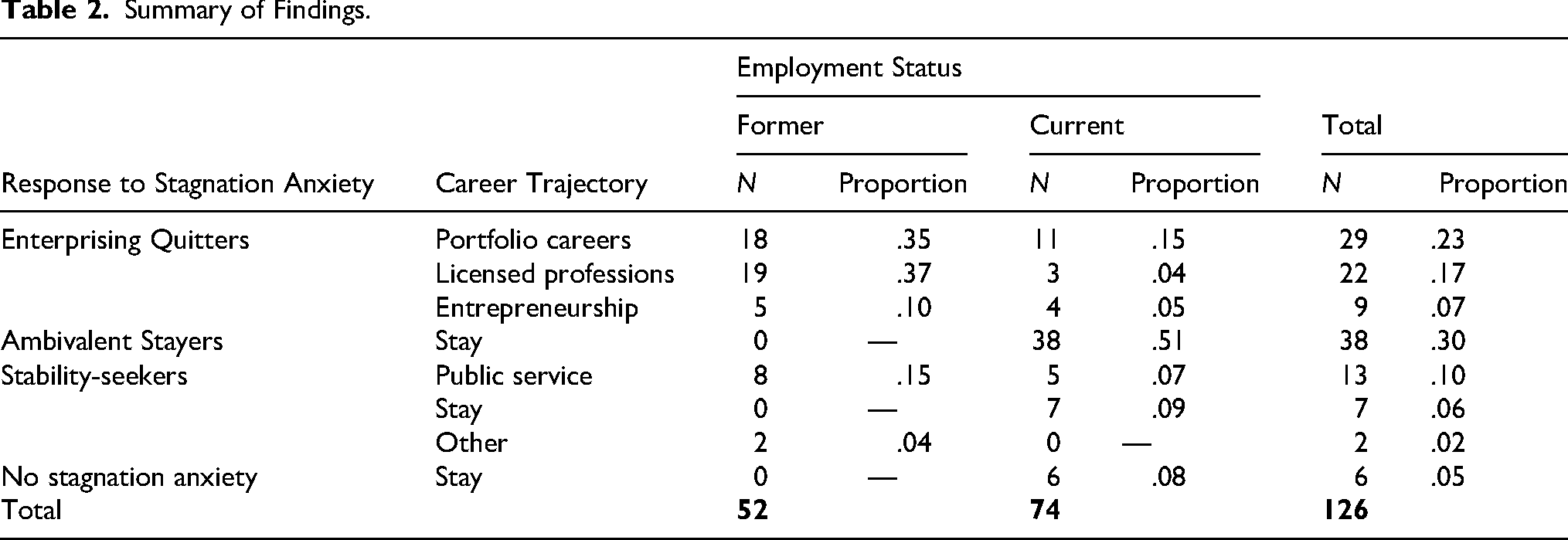
Summary of Findings.
Enterprising Quitters
For nearly half of the interviewees (60 of 126), including 81 percent of former employees (42 of 52) and 24 percent of current employees (18 of 74), stagnation anxiety was not merely an abstract concern. They decided to leave their secure jobs in pursuit of alternative careers in other occupations or organizations that they believed better aligned with enacting the enterprising self. In their accounts of why they left or wanted to leave, as well as how they made their subsequent career choices, they frequently mentioned concepts such as growth, expertise, independence, self-fulfillment, and the pursuit of a “lifelong occupation.” These individuals were more likely than others in the sample to report frequent and intense conflict with superiors, as well as abuse and harassment—including sexual harassment, among female respondents specifically. These incidents have likely worked as “tipping points,” accelerating their process of seeking alternatives and putting their plans of leaving the organization into action (Ebaugh, 1988).
I found three types of post-resignation careers: portfolio careers, licensed professions, and entrepreneurship. Though diverse, this group is united by their decision to transition into fields that involve greater investment of time and effort, and higher risks, but promise increased control over their careers and economic futures.
Twenty-nine respondents pursued portfolio careers, which involve building a diverse set of skills and experiences by moving from job to job and reflect the emerging cultural ideal for white-collar workers in the new economy (Tobias Neely, 2020). They were generally satisfied with their job functions and sought employment in the same roles specifically within foreign multinational corporations, small and medium-sized enterprises (SMEs), and startups. While these organizations typically provided lower salaries and less prestige compared to chaebol companies, respondents believed that the gains in terms of increased job autonomy, opportunities for skill development and career mobility, and the potential to become an “expert” in the field—or even entrepreneurs—as worth the sacrifice.
Seungheon (32M), who felt “ashamed of trading my time for money without growth,” moved into a similar sales position at a smaller domestic firm. Despite acknowledging the company's lower reputation and slower pay growth, he was certain that he made the right decision to achieve his desired future of running his own business: In a large firm, your job is very limited. You get a purchase order from your clients and manage the shipments. That's all you do for three, four years … So once you’re out, and want to start your own business or something, you can’t. Because you don’t know how. That's probably the biggest reason I left … Now, I get to meet the clients myself, build business relationships with them, and win a contract … and [learn] all the things you need when you’re running a business. So now I’m confident that, even if I’m laid off, I can survive on my own.
Twenty-two individuals, who were not interested in office-related careers, pursued licensed professions, where expert credibility is secured through formal credentialing. Examples included law, medicine, pharmacy, doctoral-level research, and piloting. They believed that institutionalized credentials would provide them with a higher degree of freedom to switch employers and potential for high income depending on performance, perks they could not imagine as office workers. As Taehee (26F), who resigned from her job in new market development, declared: My division had a fancy name, but in reality, I was doing secretarial work for the emeritus chairman, whipping up reports for whatever he told us to look into. I can’t move anywhere with that kind of shitty work experience! I decided I didn’t want to be just an office worker … I wanted to have a profession that has a name, not just the job rank given by an organization.
At the time of the interview, Taehee was preparing for the national exam to become a certified tax accountant. When asked why she chose that occupation, she said that her friend, already studying for the exam, had informed her about the profession and its long-term prospects. Like Taehee, many individuals in this group indicated that their career choices were shaped by their social networks, including close friends, parents, and siblings. Taeri (26F), for instance, was studying to enter pharmacy school, a decision inspired and supported by her mother, who was a pharmacist. These connections likely played a crucial role in raising awareness about the profession and providing inside insights on job entry, daily work life, and career prospects, helping respondents to envision themselves in these roles. Additionally, a few respondents noted that they received financial and moral support during periods of career transition, such as when preparing for law school admissions tests, by living with their parents and avoiding rent and living costs. This support is significant, as attaining high-income, high-prestige professions typically demands a greater investment of time and effort than securing white-collar corporate work.
Lastly, nine individuals pursued or were preparing to pursue full-time entrepreneurship. Within this subgroup, some launched businesses by leveraging their work experience (primarily in sales and marketing), professional networks they developed from their previous roles, and financial support from family. Others turned hobbies—or in one case, family real estate—into self-employment ventures, such as a pottery studio, flower shop, or guesthouse. When discussing their post-resignation choices, these individuals emphasized having agency and control over the kind of work they do and their schedule.
8
One example is Sunhee (27F), a logistics staff-turned-florist. When asked about her career change, she said: I’m a future-oriented person. There are many people who are content with the present, you know, with the paycheck every month and enjoying life, here and now. But that's not me. I’m like, what about when I’m older? I need to do what I love. I have a life I want to live. I can’t live without that kind of romance and hope, you know. I feel like I have finally developed a true ego. Looking back on my life [before quitting], sure, I thought I was making decisions on my own, but really, I was just following what other people or society said was good. It was through quitting that I found what I really wanted to do, and I put that into action. It has a pretty big meaning in my life. I feel like I jumped off a train that never stops. Like a hamster wheel that keeps spinning, I had to keep running even when nobody was telling me to do so, but I got off that wheel by my own will. To be honest, if I had stayed, I could have gone on with some level of satisfaction, but I decided to take a different path.
Stayers Itching for Flexibility
A slight majority of current employees in the sample (38 of 74) said that they intended to stay in their jobs, typically until their mid-40s or early 50s, or in some cases, “as long as I can.” These individuals enjoyed two significant pulls from the workplace that made their work lives “bearable” or even “satisfying.” Unlike the previous group, who experienced negative or insufficient social support at work that fueled their process of exit, most in this group reported having strong, positive social support that slowed and interrupted the process. This included strong peer networks that provided daily moral support and a sense of belonging, as well as relationships with supervisors that offered practical assistance during critical moments, such as facilitating transfers to desired workgroups. Additionally, a good work-life balance contributed to their decision to stay; having time for leisure allowed them to feel fulfilled and rejuvenated, deterring them from seeking change.
Despite such clear incentives, it was clear in their narratives that they were feeling guilt and shame about the decision to stay. For instance, when asked what, if anything, motivated them to continue working in their jobs so far, many respondents used phrases like “inability to quit,” “lack of triggers to leave,” or “no alternatives.” They viewed their situation not as a result of active decision-making driven by career or life goals, but rather as a passive state of being “stuck,” reflecting their endurance. As Gwangmin (33M) explained: The strength to endure and the strength to make something happen with your passion are two very different things. Enduring means not overcommitting to work, managing your workload wisely, and being able to stay in a job for a long time. If it weren’t for the people here, I would’ve left already. I keep weighing the pros and cons of leaving, and yeah, I know, I’m just making excuses. If things were really shitty, I’d put in the effort to leave, but I like the people here. So here I am, watching the folks who are leaving this sinking ship, and I’m like, don’t go! Take me with you! I’ve always thought that I’m complacent. I’m getting too comfortable with this comfortable life. I know I should change my job, I’ve thought a lot about it. But even when I make up my mind to do so, life gets busy, and I think, oh well, this life isn’t too bad after all. I’m stuck in this kind of endless cycle.
Interviewees’ feelings of inadequacy and guilt for staying—or more precisely, not leaving—were evident in how they described their peers who had quit. The vast majority expressed admiration or envy for those who had left, associating them with positive traits like the courage to give up the privileges of security and stability, a willingness to take risks, self-awareness, and hard work. As Inhee (30F) remarked: “I’m so jealous! They’re finally escaping from here, because they have somewhere to go … [Meanwhile] I’m staying here but not because I want to. I don’t have a vision or a dream here.” Similarly, Woojoo (31M) said: “They have a clear idea of what they want. It's not an easy decision … because it's comfortable staying. So to bring upon change on yourself means that you know yourself really well, to chase after what you want.”
To cope with the disjuncture between their normative aspirations of quitting and future projections of staying, respondents engaged in the emotional work of downplaying the importance of their professional identities and achievements in shaping their sense of self. Several described this practice as “loosening up at work,” which involved lowering their ambitions and expectations for fulfillment at work. Instead, they redirected their energy toward hobbies and social activities with family, friends, and romantic partners, hoping these connections would become their primary sources of life's meaning and purpose. In addition to this emotional detachment, some respondents—overwhelmingly male—turned to personal finance management as a means of finding fulfillment. They dedicated significant time after work to learning how to generate investment income through stocks, real estate, and cryptocurrency, achieving varying levels of success. While these activities are not new, my respondents differ from previous generations. Earlier counterparts invested to supplement their salaries and afford a comfortable middle-class lifestyle while continuing to work for their employers (Yang, 2018). In contrast, these younger individuals aim to reduce their financial dependence on employers and, ideally, replace their salaries entirely with alternative sources of income to achieve financial freedom (Fridman, 2016).
The emotional work of detachment from work and financial management strategies only partially alleviated feelings of inadequacy, however. Without a counter-narrative to challenge the prevailing discourse of enterprise culture, respondents struggled to manage their stagnation anxiety. The alternative discourse that some mobilized was a tepid acknowledgement that their lives were “not bad” when compared to the unemployed college graduates or those working in small companies that fail to uphold even the most basic labor rights. Although they had employment security, they did not feel secure. Such a disjuncture between economic security and emotional security underscores the pervasive influence of enterprise discourse on how one ought to achieve security—not through a lockstep, lifelong career with a single employer, but through the freedom to navigate the labor market based on one's own value in the marketplace.
Stability-seekers
Finally, twenty interviewees form a third group that represents a rejection of enterprise culture. In contrast with the other two groups, these individuals neither felt the need nor the desire to participate in enterprise culture. Among them, thirteen—eight former and five current employees—were particularly firm in their stance. They decided to step away from the corporate track in favor of alternative careers that, in their view, rendered enterprise culture irrelevant to their professional lives: low-grade civil service and employment in the public sector. These jobs promised standard work hours, low work intensity, and guaranteed lifetime employment, which allowed workers to “leave work on time,” “not have to work so hard,” and “not be good at the job” while still maintaining employment until retirement.
While individuals in this group also reported experiencing stagnation anxiety, they were more profoundly affected by another aspect of their work experience: long and intense periods of overwork that took a hard toll on their physical and mental health. They indicated that they worked over 50 h a week, not including frequent after-work drinks and weekends, for several months or throughout much of their employment. This grueling experience transformed the idea of constant development of one's market value into an overwhelming and stress-inducing burden. Suyoung (31F), who frequently worked from 9am to 11pm, recounted: I had a panic disorder. The pressure to meet sales goals was huge. I had nightmares about my project going wrong. My heart was pounding, and I was always anxious. I thought I was going to get cancer if I continued living like this, so I even bought cancer insurance … I didn’t care about self-actualization. I just wanted to leave work early.
Of the remaining seven respondents in this group, all of them current employees, three similarly reported how the experience of overwork led to their determination to prioritize their well-being over professional growth. However, their period of overwork was relatively brief and, at the time of the interview, they expected their future schedules to be manageable. Dissatisfied with her role being “limited to an intermediary role with no expertise,” Sarang (31F) voluntarily transferred to a different workgroup, hoping to enhance her career portfolio and improve her job mobility prospects. However, after six months of struggling with overwork and a competitive atmosphere, she moved to another workgroup similar to where she originally worked. This experience profoundly shifted her perspective on work: I realized how important it is to have work that keeps me emotionally stable. After that team, my mindset changed—even if my career growth is limited, I’m going to try to be content with it … I’ve learned to let go … and focus on my hobbies and exploring what's really important to me.
Discussion
Much of the existing literature on the new economy has focused on the rise of precarious work, unemployment, and the erosion of stable careers. Implicit in these critiques is the assumption that secure employment provides a much-needed remedy for the anxieties plaguing today's labor market. This study challenges that assumption. Enterprise culture has reshaped the criteria through which even securely employed workers evaluate their careers, generating new forms of insecurity that cannot be reduced to the threat of job loss alone.
To capture this subjective dimension of insecurity, I introduced the concept of stagnation anxiety—the fear and distress of failing to adapt to a culture that valorizes the constant development of one's market value and job mobility. This concept makes three key contributions to the sociology of work and culture. First, stagnation anxiety extends our understanding of labor market insecurity beyond the conventional focus on job security. Research has predominantly examined how workers respond to unemployment and precarious contracts (e.g., Lane, 2011; Sharone, 2013; Snyder, 2016), and even frameworks that attend to how structural conditions shape the quality of insecurity workers perceive remain confined to the context of employment insecurity (Ayala-Hurtado, 2026). Stagnation anxiety extends this insight further. It emerges from a different structural context altogether: not the conditions governing one's relation to employment, but the shifting cultural conditions that govern what stable employment means. When long-term organizational careers are recast from a marker of success into a marker of stagnation, the insecurity workers experience is not about losing their job but about what holding onto it now says about them.
Second, and relatedly, stagnation anxiety illuminates an emerging moral hierarchy regarding how economic security ought to be achieved. Findings reveal that earning security through one's own marketable skills is viewed as more legitimate and valuable than inheriting it from a paternalistic employer. For my respondents, remaining in a secure job was equated with dependence and maladaptation. Even when able to opt out of relentless pressures to demonstrate flexibility, they felt compelled to engage with these expectations—and many chose to opt in by leaving their jobs. This suggests that as the ideal worker norm has evolved under neoliberalism to emphasize flexibility and self-reliance, so too has the ideal job norm.
Third, this study advances our understanding of enterprise culture by demonstrating that it operates not merely through structural imposition but as a normative construct that has an autonomous effect on worker subjectivity. Prior research has shown that workers embrace entrepreneurial mindsets primarily in response to job insecurity and precarious contracts (Ho, 2009; Lane, 2011; Neff, 2012)—suggesting that enterprise culture is largely a strategic adaptation to threatening labor market conditions. My findings challenge this structural-compulsion account by showing that enterprise culture can take hold even among workers whose employment conditions do not necessitate its adoption. The chaebol workers in my study faced neither the threat of job loss nor organizational pressures to develop portable skills, yet most still evaluated their careers against enterprise culture's benchmarks, and experienced stagnation anxiety as a result. This suggests that enterprise culture has become a powerful cultural discourse that shapes how workers define success and evaluate their worth regardless of their immediate structural circumstances. Enterprise culture thus operates not only by normalizing the erosion of job security but also by undermining its appeal itself.
Finally, this study highlights voluntary job exit as a critical site where cultural processes unfold. Much literature on work and culture has examined career entry (Cech, 2013; DePalma, 2021; Pagis, 2021), employer evaluation practices (Rivera, 2012, 2015; Tobias Neely, 2020), and involuntary exit (Lane, 2011; Sharone, 2013). Yet voluntary quitting—a common feature of contemporary working life—has received far less attention. The findings presented in this article extend the concept of “employment management work” (Halpin & Smith, 2017)—the labor individuals undertake to manage their employment and labor market experiences—by revealing a critical dimension among securely employed workers: the effort to align one's career with culturally valued trajectories even in the absence of economic necessity. Stagnation anxiety highlights how contemporary cultural imperatives around flexibility and mobility have transformed what counts as successful employment management, shifting the benchmark from securing stable employment to building careers that demonstrate employability and entrepreneurial potential. Understanding why workers may voluntarily leave secure jobs—and how they make sense of these choices—is crucial for capturing how cultural ideals shape labor market behaviors and broadening our understanding of what employment management work entails.
Conclusion
In an age of insecurity, what is it like to hold a secure job with a single employer? While extensive research documents the challenges of unemployment and job insecurity, how workers in stable employment experience their jobs has gone largely unexamined. This study addresses this gap by examining white-collar workers in large Korean firms maintaining “standard” employment practices and customs rooted in the lifetime employment model.
Through 126 interviews with former and current employees of these organizations, I find that job security is devalued—these jobs are viewed not as a privilege but as an obstacle to embodying a culture of enterprise that idealizes self-responsibility, flexibility, and mobility. Respondents expressed anxiety about the risks tied to staying in their jobs—specifically, the lack of opportunities for “growth,” meaning the development of marketable skills and experiences that are portable across organizations. I term this fear of becoming irrelevant in a culture that values flexibility and mobility stagnation anxiety. Stagnation anxiety prompted nearly half of my respondents to leave their secure employment in pursuit of alternative careers better aligned with enterprise culture—portfolio careers, licensed professions, and entrepreneurship. Others decided to stay but struggled with feelings of inadequacy over their inability to quit. Only a small minority, whose experiences of severe overwork outweighed concerns about stagnation, pursued even more stable careers in public service.
Several limitations of this study point toward directions for future research. First, while my sample encompasses a variety of job functions, companies, and sectors, its modest size and nonrepresentative nature precludes systematic analysis of how stagnation anxiety might vary by these characteristics. Some observations are of note, however. Some of the strongest stagnation anxiety emerged among those in sales and organizational administrative support functions such as general affairs, where their roles are embedded in specific organizational contexts, making their skills and experiences appear less transferable to other employers or translatable into entrepreneurship. In contrast, engineers and researchers with postgraduate degrees were less likely to experience stagnation anxiety. This pattern suggests that stagnation anxiety may not be inherent to stable employment itself but arises when stability becomes decoupled from skill development and mobility prospects. Future research using larger samples could clarify whether and how stagnation anxiety varies across these dimensions.
Second, future research should investigate the mechanisms through which enterprise culture is disseminated and internalized. Several respondents in my study mentioned that social media—particularly YouTube—played a significant role in fueling their aspirations to quit their corporate jobs and embody the enterprising self. Indeed, there is a substantial body of YouTube content (as well as other popular media) encouraging young white-collar workers to quit; much of this content is produced by quitters themselves and takes the form of how-to-quit guides and memoirs collectively referred to as “quitting preparation.” As these producers often present themselves as having been successful in their corporate careers, or as having gone on to build successful businesses after leaving, they may lend considerable legitimacy to the decision to quit for those contemplating a similar exit (for a similar finding in the creative industry in Korea, see Yu & Noh, 2025). Exploring how social media, popular business press, and other cultural intermediaries promote enterprise culture would provide valuable insight into how contemporary work ideals are constructed and reinforced.
Finally, while this study documents how workers respond individually to stagnation anxiety, questions remain about collective responses. Are there contexts where workers organize collectively to resist enterprise culture or redefine career success? How might labor movements, professional associations, or workplace activism challenge the devaluation of organizational careers? Understanding both individual adaptation and collective resistance would enrich knowledge of how cultural ideologies shape—and are shaped by—worker agency.
Despite these limitations, this study reveals that the insecurities experienced by contemporary workers are more pervasive and diverse than previously recognized. Even those with high job security—ostensibly “good jobs”—are not immune to feelings of self-doubt.
Footnotes
Acknowledgements
I would like to thank Kathleen Gerson, Nahoko Kameo, Carly Knight, Golda Kaplan, Byungkyu Lee, Claire Sieffert, Belicia Teo, and Larry Wu for their helpful comments. Support for this project was provided by the Department of Sociology at New York University. Previous drafts were presented at the 11th International Conference of NextGen Korean Studies Scholars (NEKST) at the University of Michigan and the 119th ASA Annual Meeting in 2024.

Ethical Approval
This study received ethical approval from New York University IRB (#FY2020-4561) on August 3, 2020.
Informed Consent Statement
Informed consent was obtained from all subjects involved in the study.
Funding
This work was supported by the Department of Sociology at New York University.
Declaration of Conflicting Interests
The author declared no potential conflicts of interest with respect to the research, authorship, and/or publication of this article.
Data Availability Statement
Data presented in this study are not publicly available due to IRB restrictions but are available from the author on reasonable request.