



Abstract
Research has evaluated the impact of military service on socioeconomic outcomes, but little research has assessed the association between such outcomes and military occupations. The following article examines this relationship by analyzing the National Longitudinal Study of Youth 1979. It evaluates whether military occupations produce associations that are consistent with hypotheses based on theories of skills mismatch, selection, or turning points. Contrary to expectations, veterans of combat occupations did not have different earnings from those of other occupations, which suggests that any apparent effects of combat exposure reflect neither skills mismatch nor selection into these roles. Yet veterans earned less than nonveterans at the same years of combined military and civilian experience, regardless of occupation. These findings indicate that employers did not value time in the military as much as time in the civilian labor market.
The U.S. armed forces both train and employ large numbers of workers, yet relatively little is known about how socioeconomic success is related to time spent in different occupations in the military. In 2010, the Department of Defense was the largest employer in the world, with 3.2 million employees (The Economist 2011). Among people in the civilian labor force, approximately 11 million, or 7 percent, had served on active duty and were therefore classified as veterans (Bureau of Labor Statistics 2013). These veterans served in different historical contexts, occupational categories, and at different military ranks.
Since at least World War II, scholars have been concerned with how men readjust to the civilian lives to which they return after serving in the armed forces during wartime, particularly if they experienced combat (Elder 1987; Ginzberg 1943). Some have demonstrated that combat veterans have worse socioeconomic outcomes both immediately after service as well as later in their lives (MacLean 2010). These veterans suffer the physical and mental health effects of being exposed to combat, which, in turn, may affect their socioeconomic attainment (Prigerson, Maciejewski, and Rosenheck 2002).
Yet combat veterans may also earn less or have lower status for two reasons not associated with exposure to battle. First, they may have lower attainment because of the treatment they received separate from their exposure to combat itself. In other words, they may learn skills in their military training and, more broadly, during the time they spend in the military, which are not useful in the civilian labor market. Second, the lower attainment of these veterans may stem not from treatment but from selection. Service-members may indicate that they want to serve in combat positions or be assigned by the armed forces to these occupations if they have worse financial prospects independent of either the experience of combat or the skills learned in the armed forces. Yet little previous research has assessed these possibilities. These alternatives are evaluated in the following article using data from respondents who served between the mid-1970s and mid-1980s, who had little chance of being exposed to combat, but who nevertheless served in combat positions.
In examining respondents from this era, researchers have tended to focus not on questions related to specific military experiences but have more commonly assessed how veterans may have been affected differently according to their preservice characteristics and postservice experiences (Bryant, Samaranayake, and Wilhite 1993; Teachman and Tedrow 2007; Xie 1992). Some have assessed whether these veterans have different outcomes after they leave the armed forces than do nonveterans, focusing on how these experiences may differ, particularly by race and education (e.g., Angrist 1998; Teachman and Tedrow 2007). In sum, they find that military service may have penalized more privileged veterans and disproportionately benefited disadvantaged veterans, particularly those who make use of educational benefits through the GI Bill (the Servicemen’s Readjustment Act of 1944 and its successors).
The following article extends this previous research to evaluate whether men were affected differently if they served in combat rather than noncombat occupations, and if such effects varied by veterans’ preservice characteristics. It draws on accounts that were developed to explain how socioeconomic outcomes may differ not just due to military service but also due to higher education, developing two competing narratives: skills mismatch and selection. It also develops a third, potentially overlapping narrative that suggests that disadvantaged veterans benefit from features that make the military a turning point. It examines two questions. First, did veterans earn relatively more or less than each other and nonveterans in their later civilian lives depending on whether they were trained for and served in combat or noncombat positions but did not fight in wartime? Second, did these associations vary by veterans’ preservice characteristics?
To answer these questions, the article compares veterans of combat occupations to other veterans and to men who did not serve in the military. It sheds light on whether combat veterans may have lower socioeconomic attainment than other men because they were traumatized or for other reasons associated with their military service. The following analyses are based on data in which the respondents were assigned to combat occupations but had little chance of being exposed to battle. Thus, they evaluate how socioeconomic outcomes are related not to the experience of combat but to selection into and service in combat positions. They shed light on the findings of previous research regarding combat exposure in two ways. First, men may have differed if they served in such positions from those who did not regardless of combat exposure before they entered the military, or due to selection. Second, they may have earned less than other men when they were veterans not because they were exposed to war but because they learned skills in those occupations that were less useful in the civilian world.
The article presents results from mixed linear models of earnings, and compares random and fixed effects models to evaluate whether selection contributes to any observed patterns. It tests three theories: skills mismatch, selection, and turning points. According to mismatch theory, combat veterans learn skills that are less rewarded in the civilian labor market than those learned by noncombat veterans. Alternatively, they may earn less because they have preservice characteristics that are less rewarded by employers. It may also be that less privileged veterans benefit more from serving in combat occupations, or more generally, than those with more preservice advantages, as is predicted by hypotheses based on the view of service as a turning point.
Briefly, the article finds that veterans from the early peacetime volunteer era appear to suffer a skills mismatch relative to nonveterans on average, earning less at the same years of experience. Veterans did not differ from each other in the extent of this mismatch if they served in combat or noncombat positions. Thus, combat veterans likely suffer worse outcome not due to selection or training, but due to the experience of combat itself. These findings are consistent whether the results are estimated in the mixed linear context, or in random and fixed effects analyses. In addition, veterans do not have different levels of earnings based on their preservice characteristics, suggesting that they did not experience military service as a turning point. Taken together, the findings suggest that veterans of combat occupations who served in peacetime did not suffer the same socioeconomic penalty as those who served during wars.
Skills Mismatch
Scholars evaluating how people are affected by educational attainment have suggested that some people may suffer in the labor market from a skills mismatch, learning skills that are less valued by contemporary employers (Handel 2003), which may also apply to veterans. Researchers developed this account to explain why people in the United States have become increasingly unequal from one another over the last three decades (Autor, Katz, and Kearney 2006). Previous scholars have not tested whether this narrative describes how people may be affected by military service. Yet, people may learn skills that are not rewarded by civilian employers if they serve in the armed forces, particularly in combat occupations.
Sociologists and economists have long assessed the extent to which people succeed in the labor market because of what they learn or the credentials they attain in the educational system (Blau and Duncan 1967). Over the last 40 years, college-educated workers have earned increasingly more than high-school-educated workers (Fischer and Hout 2006; Morris and Western 1999). Scholars have evaluated whether this gap in earnings by education stems from a skills mismatch (Handel 2003). According to this theory, college-educated workers earn more than high school-educated workers because of what they learned in school. In particular, they spend more time learning how to use technology, which makes them more valuable in the current “knowledge economy” (DiNardo and Pischke 1997; Krueger 1993; Powell and Snellman 2004). By contrast, people with less than a college degree learn less about technology. In addition, some college graduates earn more than other graduates after majoring in particular disciplines. College graduates earn more, for example, if they majored in the math and science disciplines than if they majored in the humanities or education (Berger 1988; Gerber and Cheung 2008; Griffin and Alexander 1978; Shauman 2006). They may have learned skills in these disciplines that are more valuable or more rare, accumulating higher quality human capital (van de Werfhorst and Kraaykamp 2001).
Scholars have not previously extended this narrative to explore how people are affected by serving in the armed forces, yet the account may also apply to veterans in general. While some have argued that the narrative holds questionable value (Handel 2003), this framework is relevant to the study of veterans’ attainment because service-members gain experience in the military that may or may not transfer to the civilian labor market. If veterans of recent years have lower socioeconomic attainment than nonveterans, this deficit may be explained by either lower education or less civilian experience. Some scholars have shown that peacetime veterans suffered lower socioeconomic attainment because their time in the military was not a perfect substitute for civilian experience (Berger and Hirsch 1983). People tend to enlist in the armed forces at the same age as they would enroll in college; thus, service-members may get fewer years of schooling than they would have otherwise (Mare, Winship, and Kubitschek 1984). In addition, veterans have less experience in the civilian labor market than equivalent nonveterans at the same age, which could also explain their lower earnings. They may earn less and have lower status than comparable nonveterans because employers do not value time spent in the military as much as they do civilian experience.
Regardless, some veterans may suffer from a skills mismatch not just relative to nonveterans but also compared with other veterans. Similar to college students, military recruits do not all learn the same skills but gain specific capacities and earn different credentials based on their military occupations. The armed forces assign recruits to occupations based on service-members’ preferences and on scores on the Armed Services Vocational Aptitude Battery (ASVAB) tests, which assess, for example, mechanical aptitude and experience. They assign troops to one of 11 broad occupational categories, ranging from combat to health care, and from engineering to transportation occupations (Bureau of Labor Statistics 2012). Service members then receive occupation-specific training, which teaches them the expertise they need to perform their military jobs. The skills that are the focus of the mismatch narrative are most commonly learned in occupations that the military refers to as medium-skill jobs, such as mechanics, support, and administration, and as high-skill jobs, such as communications and intelligence (Department of Defense 2005). They are less likely to be incorporated into the training for combat occupations. In combat positions, service-members learn skills that are little used in civilian jobs except for particular positions, such as those of security guards and police officers. Several scholars have implicitly argued that veterans who served in combat occupations should be less successful in their later civilian work lives than those who served in noncombat positions because they suffer a skills mismatch (Barley 1998; Mangum and Ball 1989).
Scholars have shown that combat veterans had lower socioeconomic attainment than did nonveterans and noncombat veterans. Veterans, for example, are more likely to be disabled and unemployed if they fought than if they did not fight in wars (MacLean 2010). Combat was also found to account for substantial proportions of unemployment and job loss at the population level (Prigerson et al. 2002). Yet few researchers have evaluated the extent to which the negative effect of combat stems not from veterans’ exposure to war but from their occupations. The following analyses, therefore, address whether service in combat specialties without combat exposure affected socioeconomic outcomes positively or negatively, or at all.
Only three papers have previously assessed how veterans are affected by serving in different occupations, coming to differing conclusions (Bryant and Wilhite 1990; Kleykamp 2009; Mangum and Ball 1989). Two of the papers are based on the same source of data, the National Longitudinal Survey of Youth, that is used in the following analyses, although they address slightly different questions and rest on data derived from different subsamples. According to two of the papers, some veterans may have suffered a skills mismatch or have experienced discrimination after serving in combat occupations. They were less likely to hold jobs that used skills similar to those they developed while in the armed forces if they had trained in combat arms than if they had trained for other jobs (Mangum and Ball 1989). They may have been less likely to do so because combat positions impart capabilities that are not often used by civilian employers. In addition, black veterans were less likely to be called in for job interviews than were comparable nonveterans if they had served in combat occupations (Kleykamp 2009). According to the third paper, however, veterans appear to have succeeded to a greater degree in the civilian labor market after serving in combat rather than in noncombat occupations. Men saw increases in their wages if they trained to serve in the infantry, but not if they trained, for example, to serve in military medical occupations (Bryant and Wilhite 1990). These contradictory conclusions may stem from the way that the questions were posed or the samples were selected. Based on the preceding theory and research, therefore, the article tests the following prediction:
Selection
Although people may appear to earn more or less if they serve in the military and in combat occupations, this association could be spurious if the people who enlist differ from those who do not, and if the service-members who perform combat occupations differ systematically from other military personnel. People may enlist in the military and have better or worse labor market outcomes due not to the time they spent in the armed forces but to the characteristics they had before they enlisted. Several researchers have tried to disentangle selection into the military from how people are affected by the treatment of military service. To deal with nonrandom selection, they have used a variety of methods. Some have included measures of differences between veterans and nonveterans, including race, test scores, and family background (Cohen, Warner, and Segal 1995). Others have used regressions, including instrumental variables (Angrist 1990). Still others have used fixed effects models (Teachman and Tedrow 2007). Taken together, the findings of this previous research suggest that the people who enlist in the armed forces do differ from civilians in ways that alter and sometimes explain the estimates of the effects of service on labor market success.
People may also select not just into the military but also into positions in the armed forces based on their preexisting characteristics, which could explain any apparent effects of military occupations. In a related vein, some researchers have argued that the apparent association between college major and later socioeconomic attainment stems from the characteristics that cause people to choose different disciplines. They have argued that preexisting math ability causes people both to choose particular majors and to have higher earnings, suggesting that the association between major and earnings is spurious (Paglin and Rufolo 1990). Service-members may also have characteristics that cause them both to perform particular occupations and to attain higher or lower status when they become veterans.
Some researchers have produced evidence that could be consistent with the selection account. Men enlisted in the contemporary military at greater rates if they were black than if they were white. They also enlisted at greater rates if they grew up in poor rather than rich families or in families that did not have two biological parents (MacLean and Parsons 2010). Once in the military, servicemen were less likely to serve in combat occupations if they grew up in “intact” families, those with two biological parents. Servicemen were also more likely to serve in combat occupations during the Vietnam war, as well as the 1970s and 1980s, and the more recent war in Iraq, if they had lower cognitive test scores (Gimbel and Booth 1996; MacLean and Parsons 2010). More recently, service-members report being more motivated by patriotism and less by monetary and other benefits if they serve in combat than in support occupations (Burland and Lundquist 2013). It may therefore be that a negative association between military occupation and later socioeconomic success stems from the characteristics that people had before they enlisted in the military.
This reasoning and evidence suggests that preliminary results could be consistent with the Skills Mismatch Hypothesis but reflect instead selection. Recall that the previous hypothesis stated that veterans of combat occupations would have lower earnings than veterans of noncombat occupations and comparable nonveterans. The article therefore evaluates the following, competing prediction:
A Turning Point
Although the preceding two narratives suggest that service-members are potentially affected, or not, by serving in combat occupations regardless of their preservice characteristics, veterans may also be affected by service in ways that are consistent with the life course concept of turning points (Elder, Gimbel, and Ivie 1991; Sampson and Laub 1996). Scholars developed the view of military service as a turning point shortly after the Second World War to describe how military service might affect less privileged men. According to this work, disadvantaged men benefit from joining the armed forces because their service “knifes off” the negative experiences and environment they knew before they enlisted (Brotz and Wilson 1946). They then experience more positive outcomes than if they had remained civilians. According to related work, such men benefit from features of the military that make it a “bridging environment” (Bouffard 2005; Lopreato and Poston 1977). Far from experiencing their service as producing a skills mismatch, they learn useful skills in the armed forces, such as how to meet deadlines, follow directions, and work in a bureaucracy, skills that disproportionately help less privileged service-members (Poston 1979). They may, in addition, attain more education after their service than they would have had they not enlisted due to GI Bill benefits (Angrist 1993). More recently, researchers have argued that the military provides a counterfactual environment in which blacks face less discrimination than they do in civilian society (Lundquist 2008). Yet researchers have also suggested that military service may serve as a turning point that is not positive but negative, leading more privileged men to experience worse outcomes than they would have otherwise (MacLean 2005).
Researchers have produced a number of findings that are consistent with the turning point account, particularly among the cohorts of men who were eligible to serve after the end of conscription, that is, during the last four decades. While the account suggests that less privileged men benefit from service, in practice, researchers have focused on how the impact of service varies by race and educational attainment. Black men earned more if they were veterans than if they were not, while white men earned less (Angrist 1998; Teachman and Tedrow 2007). Among blacks, service-members experienced more positive marital outcomes than did civilians; they were more likely to get married and less likely to get divorced (Lundquist 2004, 2006). Veterans also earned more than comparable nonveterans among high school dropouts. Among high school graduates, however, they earned less (Teachman and Tedrow 2007). Thus, people appear to have been affected differently by service during recent years depending on their race and education. Research in this vein has not assessed the differences between combat and noncombat occupations. Nevertheless, these findings could be extended to these military positions with the following two predictions:
Data and Method
Data
The article tests whether veterans earned more or less than nonveterans and each other due to their military occupations by analyzing data derived from a sample drawn from the National Longitudinal Survey of Youth 1979 (NLSY; Center for Human Resource Research 2004b), which is the only nationally representative dataset that has asked the questions that could be used to test the foregoing hypotheses. NLSY staff began collecting information in 1979 from people who were between the ages of 14 and 21 (U.S. Bureau of Labor Statistics 2011). Between 1979 and 1984, they obtained information from an oversample of 1,280 people who were serving in the military in the first year that data were collected. In 1985, the survey dropped 84 percent of the respondents in the military sample, when these people were between the ages of 23 and 26. Yet in the first year and the years after the survey began, 552 male respondents enlisted in the armed forces although they were not technically included in this oversample. In 1979, 87 percent of those contacted participated in the initial interview of the survey (Bureau of Labor Statistics 2011b). In 1996, the 17th wave of the survey, the response rate was 88.8 percent (Bureau of Labor Statistics 2011a). The analyses are based on men because very few women reported serving in combat occupations.
The findings are based on information provided by the initial sample of 6,403 men (including the military oversample). Data are multiply imputed by chained equations in Stata, using ordinary least squares (OLS) regressions when the variables are continuous, ordered logistic regressions when they are ordinal, multinomial logistic regressions when they are nominal, and logistic regressions when they are binary. They are imputed for all of the analysis variables, including the dependent variable. Observations are excluded from the analyses, however, if they are missing data on the dependent variable, earnings. They are also excluded during years in which the respondents were either in the military or in school. Following previous research (e.g., Lemieux 2006; Western and Rosenfeld 2011), respondents are excluded if they reported zero earnings. The mixed linear models are, therefore, based on a final sample of 5,615 cases in five imputed datasets, in which 6 percent of the data are imputed. 1 Some men also reported serving in noncombat occupations (90) and in combat occupations (35), but only on reserve duty. In the analyses presented, they are counted as nonveterans, preserving the total sample, or dropped. Other analyses (available by request) show that the results do not differ if these men are dropped from the sample.
The article evaluates the association between military occupation and later civilian earnings trajectories by focusing on two key variables. The main outcome variable reflects how much money men reported earning in the previous year. It is deflated to 1984 dollars and, in the regression analyses, is logged.
The main predictor variable consists of three categories: (1) did not serve, (2) served on active duty in a noncombat occupation, or (3) served on active duty in a combat occupation. Men are classified as having served in a combat occupation if they reported being trained for a military occupational specialty (MOS) that fell within the “Infantry, Gun Crews, and Seamanship Specialists” category established by the 1977 Department of Defense 3-Digit Enlisted Occupational Classification System, which also includes people who worked in combat engineering and artillery occupational specialties (Center for Human Resource Research 2004a). During this era, the armed forces classified all people who served in the Navy as serving in a combat specialty. Even among those who served in the Navy, however, the respondents reported that they were more likely to have served in noncombat than in combat occupations. These Navy veterans are thus allocated to the specialty, combat or noncombat, that they indicated on the survey. While it is possible that service-members may change occupations during the course of their service, the article merely tests whether having been trained at the outset of one’s military career in a combat occupation is associated with greater or lesser success in the civilian labor market between the ages of 24 and 31. In some models, this variable is treated as fixed, while in others it is treated as time-changing.
The skills mismatch hypothesis is tested by estimating models in which the primary independent variable is total experience, which includes both time spent working for civilian employers and time spent in the military. In the NLSY, respondents reported the number of weeks that they had worked since the last wave of the survey, as well as the number of weeks that they had served in the military. The analyses, therefore, combine these two measures. This combined number of weeks is divided by 52 to obtain a measure of years of experience. The analyses also include the square of this experience variable, to account for the fact that the relationship to earnings may be curvilinear. If veterans earn less than nonveterans net of years of experience, this suggests that their time in the military is less valued by civilian employers. 2
The analyses test the Selection and Turning Point Hypotheses by including measures of the following five fixed characteristics: birth year, intact family, parents’ education, race/ethnicity, and cognitive test scores. In 1979, the NLSY asked respondents the year they were born and with whom they lived at age 14. Respondents are classified as having been raised in an intact family if they said that, at that age, they lived with their biological father and mother. Parents’ education is captured by the average years of schooling completed by the respondents’ parents. If the respondent only provided information on the educational level of one parent, this measure is used. In some households, the NLSY surveyed more than one respondent. If the parental education for one sibling is missing, the data substitute the parental education information from another sibling who reported information on parental education and reported the same family structure. This measure is converted into degrees in the following fashion: <12 = less than high school; 12 = high school graduate; 13–15 = some college; and >15 = college graduate. The race/ethnicity measure contains the following categories: non-Hispanic nonblack, non-Hispanic black, and Hispanic. In 1980, the NLSY administered the Armed Forces Qualifying Test (AFQT) to all respondents, not just those who served in the military. The test was taken by a majority of respondents, 94 percent. These scores are converted to percentiles ranging from 0 to 100, and these percentiles are then translated into the categories used by the military: 1 = 91−100, 2 = 65−90, 3 = 31−64, 4 = 10−30, 5 = 0−9 (Laurence and Ramsberger 1991). Because there are few respondents in the highest and lowest categories, the respondents are combined into one category if they fell into either the first and second categories, and into another category if they fell into either the fourth and fifth categories.
The analyses also test the Selection and Turning Point Hypotheses by assessing the main effect and interactions with service and educational attainment. Previous research examining military service has alternately treated such attainment as a dependent (MacLean 2005; Teachman 2005), independent (Mazur 1995), and jointly determined outcome variable (Kleykamp 2006). Therefore, the following prtesents models both with and without educational attainment. It is accordingly cautious in making causal claims about the relationship between educational attainment and military service. At each survey wave, respondents reported the number of years of schooling they had completed. The educational attainment measure for respondents has the same categories as that for their parents (see above). In some models, educational attainment is measured at the level of education that the respondents had achieved by age 24, or the age at which they were first observed in the data. Some respondents increased their educational attainment after they turned 24, including 17 percent of nonveterans, 15 percent of combat veterans, and 20 percent of noncombat veterans. (In the interests of brevity, the article refers to veterans who served in combat positions as “combat veterans” and those who served in noncombat positions as “noncombat veterans.”) As with the measure of military occupation, educational attainment is treated in some models as fixed, and in others as time-changing.
Statistical Models
The following analyses present results from models estimated using three different methods: mixed linear, random effects, and fixed effects models. In the mixed linear context, the analyses predict the earnings trajectories of respondents between the ages of 24 and 31 using multilevel models with random intercepts and coefficients, or growth curve models (Rabe-Hesketh and Skrondal 2008). These models are similar to those using longitudinal data from the Panel Study of Income Dynamics to assess whether women face barriers to promotion that are consistent with a “glass ceiling” (Maume 2004). In this case, they have three levels, in which observations at particular points in time are nested within individuals who, in turn, are nested within households. The models contain two sets of coefficients. The coefficients in the fixed part present average associations of both time-varying and time-fixed characteristics with earnings. Thus, the slope of experience, for example, represents the average change in earnings across all respondents. The random part contains coefficients at the three levels, estimating the variance at the observation, individual, and household levels around the intercept. In addition, it includes variances around time-varying characteristics that vary at each succeeding level. Thus, it presents the variance around the slope of experience and of experience squared. At the individual level, the model also estimates a variance-covariance structure between the time-varying characteristics and the intercept.
Methodologically, the selection hypothesis is assessed in two ways. First, in the mixed linear models, measures are added sequentially to assess whether any apparent association between military occupation or service is reduced by including measures of family background or individual achievements. Second, results are compared across models estimated in the random effects context to those based on fixed effects, in which individuals serve as their own controls. In these models, the measures of military occupation and of veteran status are time-varying, and the respondents are observed both before and after they enter the military.
In the current case, therefore, men must report earnings both before and after they entered the armed forces. They are compared with others who did not enlist but also reported wages and salaries at an equivalent stage in the life course. These models are thus based on respondents who were first observed when they were 18 years old, had not yet entered the military, and had valid measures of earnings. These requirements lead to relatively small samples: 35 combat veterans and 167 noncombat veterans. Unlike the growth curve models described above, there are not enough cases to multiply impute missing data; imputation models fail to converge. Therefore, these analyses are presented based on data from complete cases. (Note that results do not differ substantively when models are based on either complete case or multiply imputed data in the mixed linear models, although point estimates are larger in the multiply imputed data. Models based on complete case data are thus more conservative.)
The analyses compare the earnings trajectories of those who entered the military and served in combat occupations, with those who did so in noncombat occupations, and those who did not enlist. In this case, the measures of military occupation or veteran status vary over time, as do educational attainment and experience. The models also include measures of unchanging characteristics, such as race, intact family, parents’ education, and AFQT scores, although these drop out in the fixed effects models.
The Turning Point Hypotheses suggest that people from more disadvantaged backgrounds experience more positive effects of military service than those who grew up with more privileges. The analyses, therefore, test for interactions between military occupation, veteran status, and race (Turning Point Hypothesis 1). They also test for interactions with educational attainment (Turning Point Hypothesis 2). In addition, they evaluate interactions between occupation and experience.
Findings
How Veterans Differ
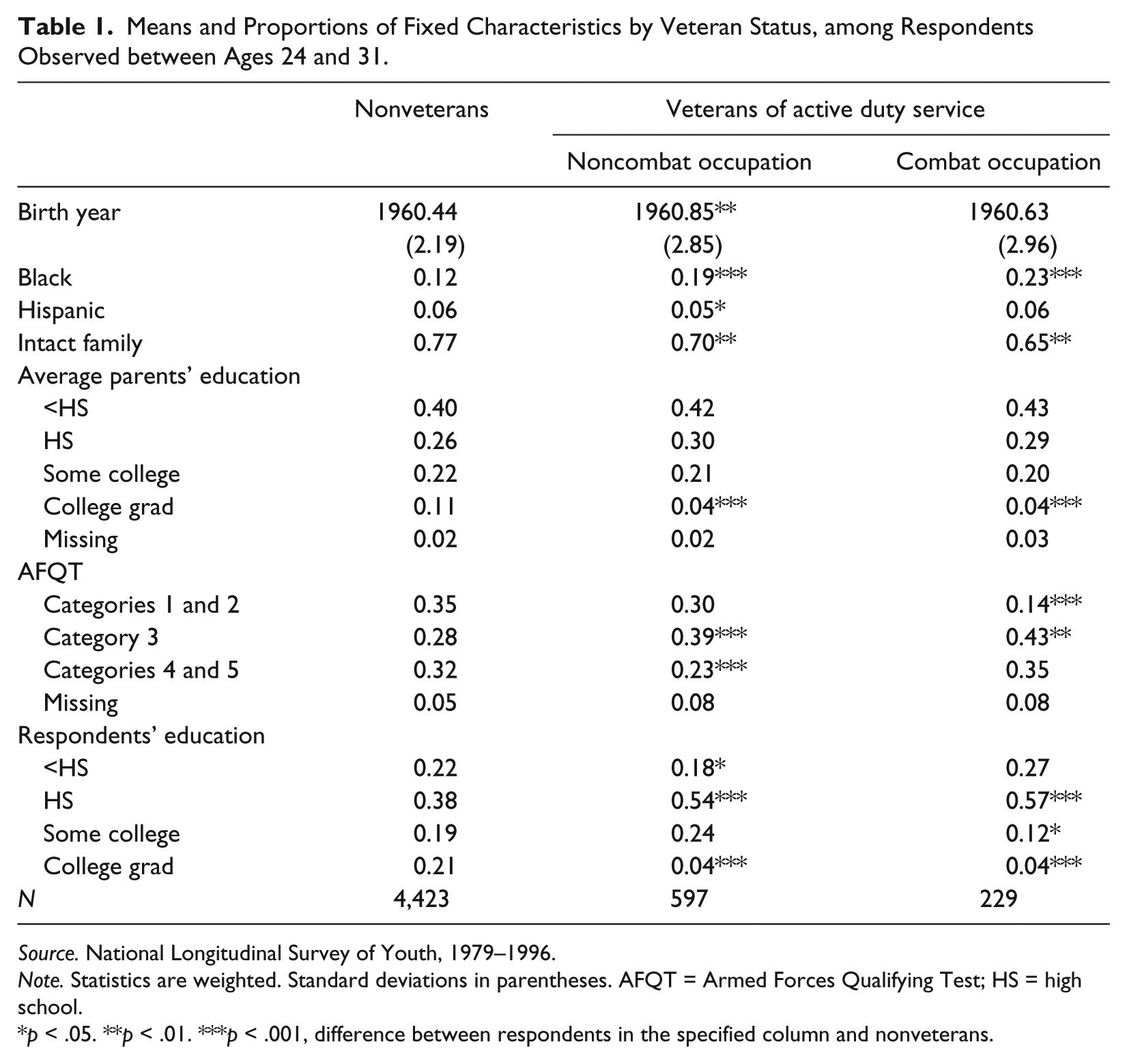
Table 1 describes the characteristics of the respondents that do not change. Among the men in the sample, a majority did not serve in the military, approximately 84 percent. A relatively small share of the men did serve, 16 percent, of whom a little more than one-quarter did so in combat occupations. Column 1 presents the characteristics of men who never served in the armed forces on active duty, column 2 contains those of men who served in noncombat occupations, and column 3 includes those of men who served in combat occupations. The statistics are weighted using custom longitudinal weights generated by the NLSY for survey respondents included in the years between 1979 and 1998 (Zagorsky n.d.).
Means and Proportions of Fixed Characteristics by Veteran Status, among Respondents Observed between Ages 24 and 31.
Source. National Longitudinal Survey of Youth, 1979–1996.
Note. Statistics are weighted. Standard deviations in parentheses. AFQT = Armed Forces Qualifying Test; HS = high school.
p < .05. **p < .01. ***p < .001, difference between respondents in the specified column and nonveterans.
According to the table, veterans differed from nonveterans in their family backgrounds and cognitive abilities, as did those who served in combat from those who served in noncombat positions. The respondents were, on average, born in the same year, although noncombat veterans were slightly younger on average than the other groups. Veterans were more likely than nonveterans to be black, with those who served in combat occupations the most likely to be in this racial category. Nonveterans were more likely to have grown up in intact families, or with both parents, while veterans of combat occupations were the least likely to have done so. The respondents grew up in families in which the parents tended to have different levels of educational attainment. Nonveterans were more likely than veterans to have grown up with parents who had graduated from college. They reported relatively high rates of this parental educational level, 11 percent. They were nearly three times as likely to do so as veterans who served in both occupational categories (4 percent). Veterans of noncombat occupations were less likely than nonveterans to have dropped out of high school. All veterans were more likely than nonveterans to have just a high school degree. More than half of both types of veterans had this level of education. They were much less likely than nonveterans, however, to have graduated from college. More than 20 percent of nonveterans had a college degree, while only 4 percent of veterans had one. Veterans of combat positions also had relatively low test scores. They were less likely than both nonveterans and other veterans to have scored above the 65th percentile on the AFQT, or the top of the distribution. They were more likely than other veterans, but as likely as nonveterans to have scored below the 35th percentile, or the bottom of the distribution. These statistics confirm previous research that finds men come to serve in the military and in combat occupations on the basis of family and cognitive characteristics (MacLean and Parsons 2010).
How Attainment Changed
Figure 1 presents average annual earnings by veteran occupational status for the respondents between the ages of 24 and 31, which indicates that nonveterans consistently earned more than did veterans. Earnings are deflated to 1984 dollars and presented in $1,000 increments. These figures are derived from repeated cross-sections at each year of age and therefore do not represent longitudinal change among a constant group of respondents. At the age of 24, nonveterans earned more than did veterans who served in both combat and noncombat occupations. Among veterans, those who served in noncombat occupations tended to earn more than those who did not but only at the younger ages. Starting when they are in their mid-20s, veterans of noncombat occupations earned similar amounts to those who served in combat occupations. This result is particularly noteworthy because veterans of noncombat positions had more preservice advantages in terms of both test scores and family background. It provides preliminary evidence that veterans of combat occupations did not suffer a skills mismatch but that all veterans may have suffered such a mismatch when compared with nonveterans.
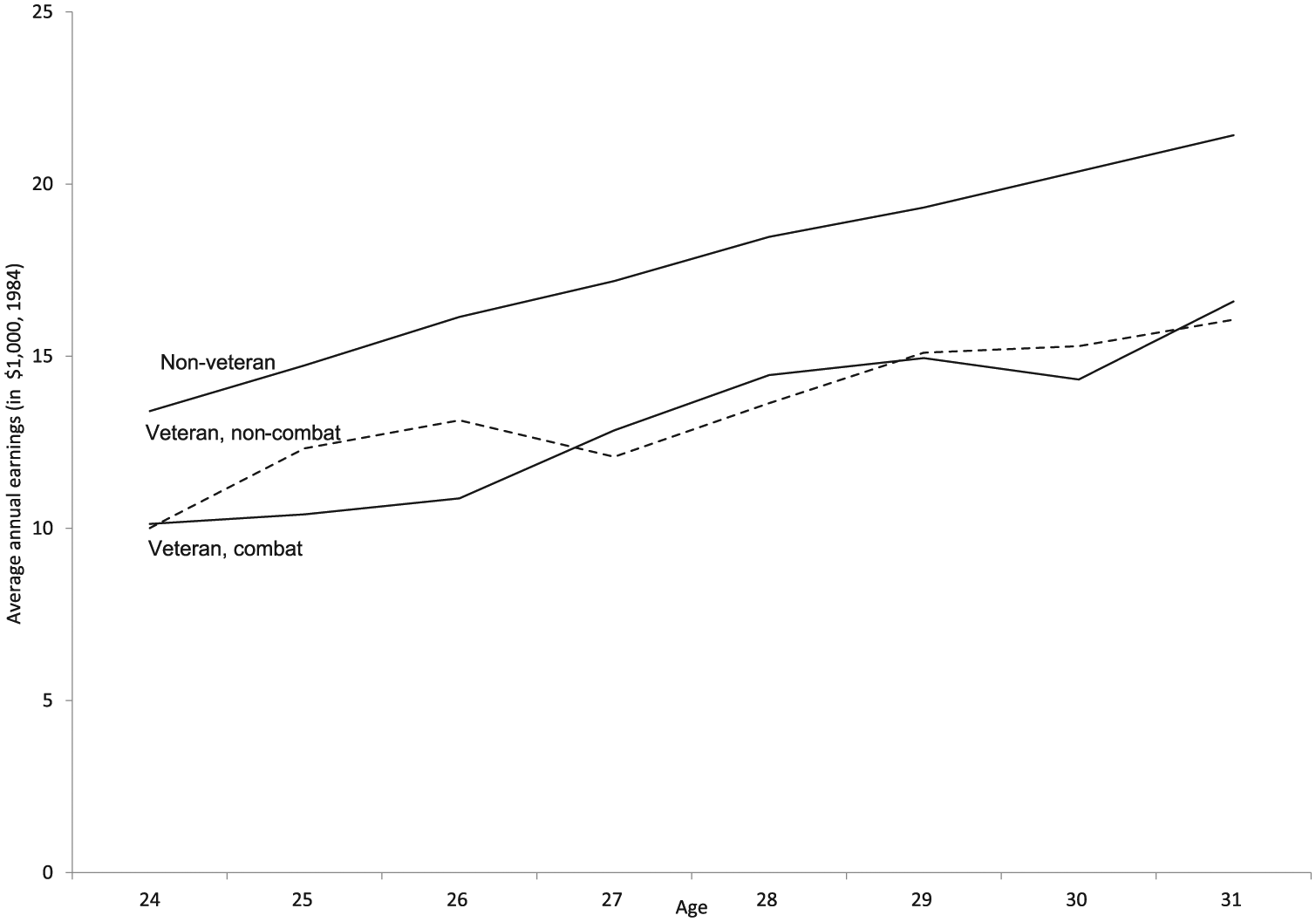
Average annual earnings by veteran and military occupational status.
Nonveterans may have earned more than veterans because, at every age, they had more years of civilian experience, although not of total experience. Figure 2 shows the average civilian and, in the case of veterans, total experience by veteran and occupational status. Civilian experience refers to the years spent working for civilian employers. Total experience refers to the years spent working both for those employers and for the armed forces. At each age, veterans of noncombat occupations had the most total experience, on average, followed by veterans of combat occupations, and then by nonveterans. Both types of veterans, however, had significantly less experience than did nonveterans in working for civilian employers.

Average experience by veteran status, occupation, and experience type.
Models of Growth in Earnings
Table 2 presents fit statistics for selected models, testing for the interactions indicated by the Turning Point Hypotheses. The first set of models use a measure of military occupation that contrasts men who served in combat occupations with those who served in noncombat occupations and with nonveterans. The second set collapses military service into one rather than two categories.
Fit Statistics for Selected Models.

Note. BIC = Bayesian Information Criterion.
In each set of models, the baseline model is designed to capture a skills mismatch, and includes military status along with years of experience. The second model adds characteristics that have been associated with selection into service: test scores, educational attainment, as well as family background, captured by parents’ education, intact family status, and race. The third and fourth models interact the military variables with experience, allowing the association of these variables with earnings to vary over time. The fifth and sixth models test the Turning Point Hypotheses, assessing whether these associations vary by race or by educational attainment.
According to the statistics, the preferred model includes background characteristics along with the measure not of military occupation, but of veteran status. None of the models with interactions are preferred. These findings indicate that the association of military service with earnings does not differ according to veterans’ occupational categories. They are also not consistent with the turning point narrative. Other analyses (not shown, but available by request) suggested that race and educational interactions may be sensitive to the way that the models are specified and samples are selected. They tested for interactions between military occupational status and race and education, and found evidence that such effects may exist in only two out of the 36 specifications that were tested. Thus, these effects are not robust to sample selection or model definition.
Table 3 presents the mixed linear models. The baseline model includes just the intercept and the random effects at the individual and household levels. It presents the variance at each level around earnings. The intraclass correlation coefficient (ICC) among households is .300, among individuals within households is .347, and within individuals .353, suggesting that earnings varies some at each level.
Growth Curve Models of Log of Earnings by Years of Experience, Men Age 24–31.

Note. Standard errors in brackets. AFQT = Armed Forces Qualifying Test.
p < .05. **p < .01. ***p < .001.
In model 1, veterans are separated according to whether they served in combat occupations or not, and these coefficients are estimated net of years of experience. 3 The measures of years of experience also vary at level 2, the level of the individual, introducing a variance-covariance structure at that level. (In the interests of parsimony, the table does not include the covariances.) Both types of veterans earned less than nonveterans, suggesting an overall skill mismatch. The estimates of military occupation do not differ statistically between models with and without measures of selection. Nor do the estimates of the associations between combat and noncombat veterans differ statistically from each other within the models. These findings are not consistent with the view that the association of service with earnings is explained by selection.
The last column presents the preferred model derived from the fit statistics, which suggests that veterans earned less on average than nonveterans, and that this veteran disadvantage is not explained by family background, individual attainment, or test scores. Net of these measures, veterans earned less than nonveterans with the same years of experience, which suggests that they suffer an overall skills mismatch. Figure 3 represents a modified version of this last model. The earnings trajectories are presented for white men, who had test scores in the middle category, were born in 1960, and had graduated from high school.

Fitted earnings by experience and veteran status.
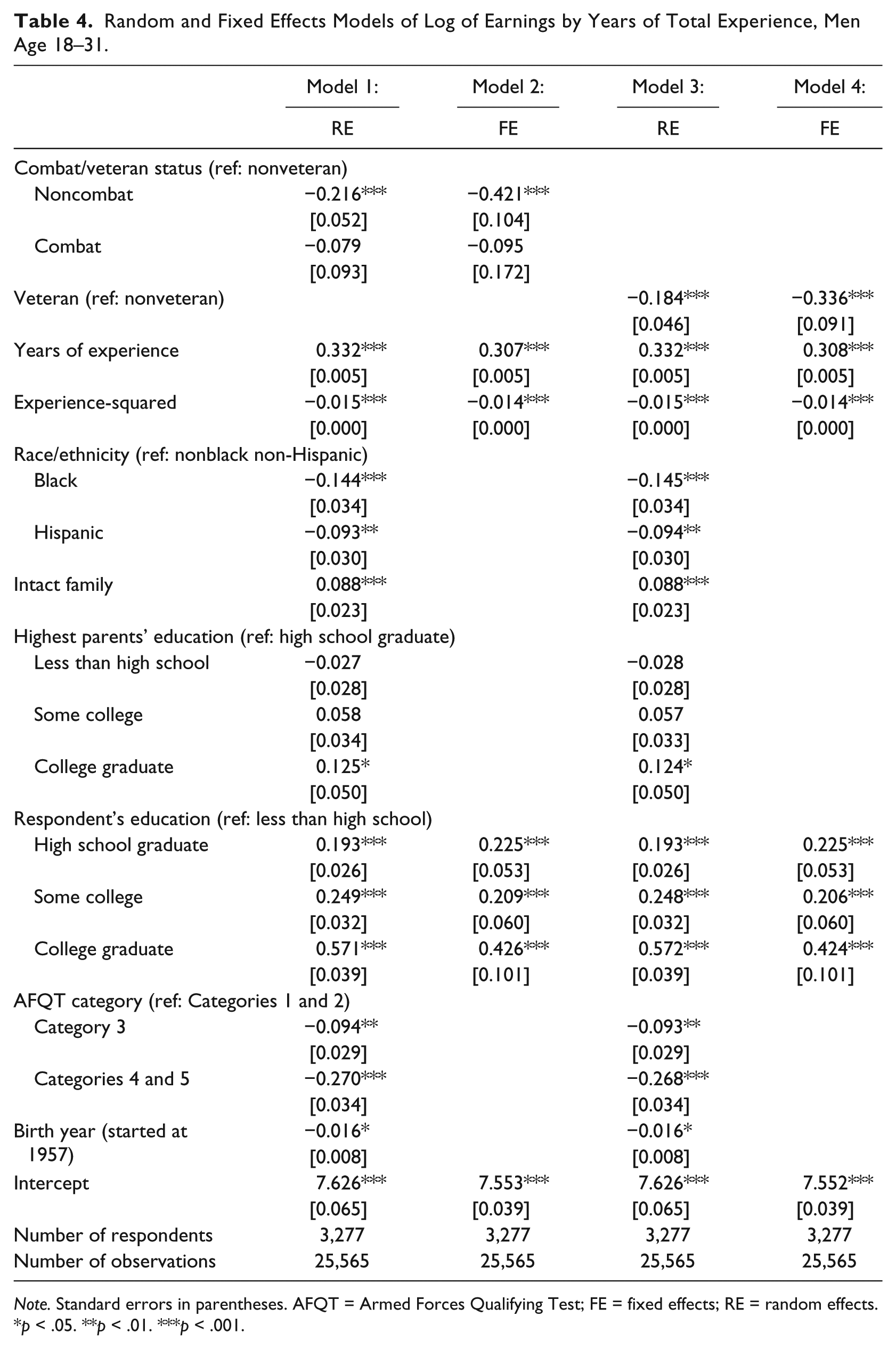
Table 4 assesses the potential impact of unmeasured selection on these results. The first two columns present models of random and fixed effects when veterans are specified by military occupation, followed by models in which veterans are combined into one category. (The Hausman statistics are 769.24 with 7 degrees of freedom and 768.03 with 6 degrees of freedom, indicating that the fixed effects model is preferred.) According to the first two models, noncombat veterans suffered an earnings penalty relative to nonveterans at the same level of experience, in both the fixed and random specifications, while combat veterans did not. These models correspond with model 3 in the previous table. In that earlier table, however, men were first observed at age 24, while in this table, they are first observed at age 18. As with the mixed linear models just presented, however, the coefficients between combat and noncombat do not significantly differ. Recall, however, that the models are based on only 35 combat veterans because of the restrictions that are necessary for fixed effects estimation. They may, therefore, not have enough power to detect differences between combat veterans and other men. Nevertheless, the fixed effect model (model 2) suggests that the impact of noncombat status is net of unmeasured differences. It is nearly twice as large as the same estimate in the random effects model.
Random and Fixed Effects Models of Log of Earnings by Years of Total Experience, Men Age 18–31.
Note. Standard errors in parentheses. AFQT = Armed Forces Qualifying Test; FE = fixed effects; RE = random effects.
p < .05. **p < .01. ***p < .001.
According to models 3 and 4, which are preferred, veterans earned less than nonveterans. The fixed effect estimate of this earnings penalty is a similar size to that in the mixed linear model, model 4, presented in Table 3. Regardless of how the models are estimated, therefore, veterans had less success in the civilian labor market than nonveterans at the same years of experience.
Conclusion
The findings suggest that veterans did not have different outcomes during peacetime if they were assigned to combat rather than noncombat occupations and are thus consistent with none of the original hypotheses. They differ from other research that suggests that veterans suffered relative to other men if they fought in battle (MacLean 2010; Prigerson et al. 2002). Combined with that previous research, the current findings suggest that combat veterans do worse than noncombat veterans due not to selection into or service in these occupations, but rather to the experience of combat itself.
At the outset, the article expanded on the theory of a skills mismatch, which was developed to account for the growth of inequality between high school and college graduates. Scholars have also applied the theory to discuss horizontal stratification, such as when some college graduates earn more than others based on their majors. Contrary to the skills mismatch hypothesis laid out in the beginning, veterans did not appear to disproportionately suffer after serving in combat occupations. Veterans of these occupations who served in peacetime did not undergo the same socioeconomic penalty as those who served during wars. Veterans of both types of occupations did, however, earn less on average than nonveterans, which could reflect an overall mismatch between the general skills conveyed by the armed forces and those that are valued in the civilian labor market. Veterans earned less than nonveterans simply because they spent time in the armed forces, which led them to accumulate less experience working for civilian employers. Employers likely did not value the years that men spent in the military at the same rate that they valued civilian experience. The analyses, however, do not directly test how the skills learned by service-members differ from those learned by civilians. Nevertheless, these findings are similar to those reached by other researchers, demonstrating that veterans did not benefit as much from time spent in the armed forces as did nonveterans from time spent in the labor market (Berger and Hirsch 1983).
The findings thus underscore how socioeconomic attainment is shaped by institutions. Previous researchers have demonstrated that former prisoners have lower earnings after they leave the justice system (Western 2002). According to the current research, men also experience lower earnings after leaving the institution of the military. Future research could examine how these and other institutions intersect in influencing a wide range of outcomes throughout the life course.
Veterans may earn less because employers do not adequately appreciate their talents. Relatively few researchers have examined whether employers discriminate against veterans. Yet some have demonstrated that employers likely do not discriminate against veterans nor do members of the general public (Kleykamp 2009; MacLean and Kleykamp 2014). These findings suggest that veterans likely did not experience discrimination but rather did not accrue skills at the same rate as do civilian workers.
The findings are not consistent with the Selection Hypothesis. The association between veteran status and earnings is net of measured and unmeasured selection (to the extent that such selection is captured by fixed effects models), and persists across a variety of specifications.
Surprisingly, the current findings present little evidence that is consistent with the view of military service as either a bridging environment or a turning point. Some disadvantaged veterans may have benefited from their service as a turning point but only in limited circumstances. It is possible that the benefits of time in the armed forces only obtain in particular contexts, and do not apply more generally. These findings are consistent with at least one previous article that called into question the view that the military provides disadvantaged men with a bridging environment (Cutright 1974). Future research should test the particular circumstances under which such veterans do or do not see positive effects of service more directly.
The preceding analyses are based on data from men who reported earnings between the ages of 24 and 31, thereby excluding men who were unemployed. Yet combat veterans may be more likely to have difficulties finding and keeping work. In the NLSY, veterans were slightly more likely than nonveterans to be unemployed. Other analyses (not shown, but available by request) provide random effects logistic regression models in which the dependent variable was unemployment. These models suggest that there was no statistical association between military service and unemployment. Unfortunately, the numbers of combat veterans and rates of unemployment are too small to be definitive. For example, at the age of 29, one veteran of a combat occupation was unemployed. Thus, these data do not provide enough power to test for an effect of service on unemployment. Future research should more directly examine the question of the impact of serving in a combat occupation on unemployment.
Men may have been affected differently by serving in the military, and by their occupational training, if they also served as officers. Officers earn more and are healthier than both nonofficers and nonveterans (MacLean 2008; MacLean and Edwards 2010). The preceding analyses cannot test the effect of officer status because sample sizes become quite small. In 1979, only eight of NLSY respondents reported that they were officers. In subsequent years, these numbers never rise above 32. Future research should use data with larger subsamples of officers classified by occupational categories to test whether these men have different outcomes from the primarily enlisted sample tested in the article.
While the preceding analyses do not evaluate whether and how veterans were affected by serving in the recent wars in Iraq and Afghanistan, they do provide evidence regarding how people may be affected by serving in the armed forces in general, which, in turn, suggests how the effects of these wars may be compounded. Combat veterans likely do not suffer because the skills they learned in their military training are less likely than those learned in other military occupations to transfer to civilian jobs. While the veterans in the current set of analyses were unlikely to have experienced combat, contemporary veterans in these positions may suffer worse outcomes if they also fought in wars. More generally, all veterans of the contemporary era may be at a disadvantage relative to their age peers when they start working, with time spent in the military not transferring directly to the civilian labor market.
Footnotes
Acknowledgements
I am grateful to Monica K. Johnson, Meredith Kleykamp, and David R. Segal for input on earlier versions of the project.
Author’s Note
An earlier version of this article was presented at the 2009 meetings of the Population Association of America, in Detroit, Michigan.
Declaration of Conflicting Interests
The author(s) declared no potential conflicts of interest with respect to the research, authorship, and/or publication of this article.
Funding
The author(s) disclosed receipt of the following financial support for the research, authorship, and/or publication of this article: This research was partially funded by a research grant from the National Institute on Aging (R03 AG 029275).
Notes
Author Biography
References
Supplementary Material
Please find the following supplemental material available below.
For Open Access articles published under a Creative Commons License, all supplemental material carries the same license as the article it is associated with.
For non-Open Access articles published, all supplemental material carries a non-exclusive license, and permission requests for re-use of supplemental material or any part of supplemental material shall be sent directly to the copyright owner as specified in the copyright notice associated with the article.
