



Abstract
Scholarly work has discussed the ways in which stigmatized groups may resist their stigma, along with various resources at their disposal that facilitate such resistance. However, it has not explicitly considered how organization can serve as one such resource. Bringing into dialogue scholarly work on stigma, organizations, and social movements, this article examines the role of organization as a key resource for managing and resisting stigma. In doing so, it draws from a comparative analysis of two groups of dumpster divers in New York City. It finds that whereas informal social organization allowed one group to develop shared views regarding the practice, formal collective organization enabled another group to confront the stigma itself. The findings therefore highlight the role of organization in both mitigating shared stigma and challenging its basis—thereby providing insights into the social conditions of stigma management and the collective resources at the disposal of stigmatized groups.
Many folks know the waste that goes on in America, but do not wish to be seen rummaging through a garbage can or dumpster to retrieve the wasted assets. There is much opprobrium associated with it. I know from comments I get from others. No skin off my nose.
1
Since Erving Goffman’s (1963) pioneering work, scholarly work on stigma has discussed the ways in which stigmatized individuals may engage in “destigmatization” (Gussow and Tracy 1968) or “resistance” (Riessman 2000; Thoits 2011; Zajicek and Koski 2003). However, less work exists on the social conditions that allow stigmatized groups to collectively manage their stigma. How do the various resources at their disposal influence stigmatized groups’ management strategies? Without a sophisticated understanding of these resources, stigmatized groups are less able improve their status in the eyes of their judging audience.
This article highlights the ways in which informal and formal organization can serve as effective stigma management resources for marginalized groups. The article presents findings from an analysis of two groups of dumpster divers in New York City and compares the role of informal and formal organization in the stigma management strategies exhibited within each group. It finds that while informal social organization among one group of dumpster divers mitigated the stigma associated with the practice, formal collective organization allowed another group of self-identified “freegans” to mount a collective challenge to the stigma itself. These findings thus explicitly draw attention to the role of organization in enabling stigmatized groups not only to mitigate their shared stigma, but also challenge its very basis.
The article begins with a discussion of the study’s theoretical background and methods, followed by a brief description of the stigma associated with dumpster diving. The following two sections present evidence drawn from the study’s two cases. The article then concludes by summarizing the study’s findings, discussing their implications, and highlighting some areas for future research.
Theoretical Background
Within Goffman’s (1963) framework, stigma is a deviant attribute, behavior, or reputation that incites the scorn of others. In parallel to the present study’s discussion of formal and informal organization, Goffman distinguished between identifying with one’s “in-group,” or those that share the same stigma, and one’s “out-group,” or “the normals and the wider society they constitute” (Goffman’s 1963:115). In their in-group interactions, he noted that stigmatized individuals may “flaunt some stereotypical attributes which [they] could easily cover” or praise the qualities that make their group different (Goffman 1963:113). Other research has similarly shown how stigmatized individuals may “attempt to construct a buffering life space” (Oyserman and Swim 2001:1) by surrounding themselves with others in a similar position, and more generally, how social interaction among peers who share the same stigma may mitigate its effects (e.g., Cohen [1955] 1997). This article adds to these insights by more specifically highlighting informal social organization as a context for the development of such in-group stigma management strategies.
In turn, scholarly work on stigma has discussed as another form of stigma management the possibility of “destigmatization” (Gussow and Tracy 1968) or “resistance” (Riessman 2000; Thoits 2011; Zajicek and Koski 2003). In building on the distinction between “primary” and “secondary” deviance (Lemert 1951), where primary deviance refers to a deviant act itself and secondary deviance refers to one’s acceptance of the stigma placed on oneself, John I. Kitsuse (1980:9) introduced the concept of tertiary deviance “to refer to the deviant’s confrontation, assessment, and rejection of the negative identity imbedded in secondary deviation, and the transformation of that identity into a positive and viable self-conception.” Work on stigma resistance has since shown how factors such as social class and age may mediate stigmatized individuals’ resistance processes, and more generally, how stigmatized individuals may draw on resources outside of themselves to resist their stigma (e.g., Riessman 2000). Overall, however, “research on stigma has had a decidedly individualistic focus” (Link and Phelan 2001:366; see Falk [2001] for an exception), with more research needed on the “conditions under which individuals are resistant” (Thoits 2011:6). In addressing these shortcomings, the present article highlights organization as an additional condition under which stigmatized individuals may cope with or challenge their status.
In discussing informal organization, I define it broadly, much like James R. Taylor and Elizabeth J. Van Every (2000), as a network of recurring interactions. As a result, “formal” organization refers here to any established means of coordination beyond this standard, rather than more common understandings that often include the presence of a fixed set of rules, registered members, and/or hierarchical structure. In this sense, I find that informal organization was present in both of the study’s comparative cases, as it emerged through socialization and sociability among the members of each group. 2 In discussing the role formal organization, in turn, I draw on the common insight in the scholarship on social movements that organization provides a form of collective empowerment to previously disempowered individuals and allows them to work toward shared objectives they would not otherwise be able to accomplish individually (e.g., McCarthy and Zald 1977; Schwartz 1976; Zald and Ash 1966). These characteristics of formal organization allowed the members of the more formal “freegan” organization to launch a collective challenge to the stigma associated with dumpster diving.
In describing the specific stigma resistance strategies employed by members of the more formal freegan organization, the article additionally utilizes the concept of framing. Initially coined by Erving Goffman (1974:21), who described frames as “schemata of interpretation” that enable individuals “to locate, perceive, identify, and label” occurrences within their life space and the world at large, the concept has been most commonly applied in the scholarship on social movements to describe attempts by social movement participants to craft a positive image of themselves and their activities (Benford and Snow 2000; W. A. Gamson and Meyer 1996; Snow et al. 1986). Although scholars have in separate instances drawn a connection between framing and formal organization (Clemens 1996) and between formal organization and stigma resistance (e.g., Epstein 1996; J. Gamson 1989; Whitesel 2014), little work exists that explicitly analyzes the relationship between framing and stigma resistance. In addressing this oversight, the present article highlights how the framing strategies enabled by formal organization can help advance a group’s stigma resistance strategy. More specifically, its analysis incorporates the three core framing tasks necessary for mobilization identified by David A. Snow and Robert D. Benford (1988), where diagnostic framing refers to the identification of a problem, prognostic framing points to a solution, and motivational framing provides a rationale for action. Overall, integrating these areas of research enables a more precise understanding of how stigmatized groups utilize formal organization to reorganize perceptions of social reality and engage in stigma resistance.
Methods and Context
The data presented here are primarily drawn from five months of ethnographic field research in a number of settings in the New York City area where dumpster diving was a prominent feature. After being introduced to the practice by a friend, I began spending sustained amounts of time at the sites of various dumpsters, in addition to participating in the practice myself, and soon made acquaintances with a group of dumpster divers at one particular location, many of whom came on a regular basis. As the dumpster divers at this location were particularly social, the site lent itself to analyzing group processes and dynamics. After investigating more about the practice, I soon came across freegan.info, whose members held regular meetings and events in New York. While continuing to return to the site of one particular dumpster, then, I also participated in the group’s volunteer/organizer meetings, social gatherings, and public events. The differences in the way the members of each group represented dumpster diving were immediately apparent and provided the basis for further comparative inquiry. In this way, the research followed a “peopled ethnography” approach, relying on multiple research sites and attending to each group’s local distinctiveness while “transcending the dilemma of uniqueness” (Fine 2003:53).
The objective of data collection was to gather information on the social contexts in which dumpster diving was practiced, and on understandings of dumpster diving and freeganism. During field research, I assumed the role of “peripheral-member-researcher” (Adler and Adler 1987:36) in that I did not play any critical functional role in the activities of each group, even as I nonetheless sought to obtain an “insider’s perspective on the people, activities, and structure of the social world” in which each group was immersed. In my conversations with individuals in each group, I asked questions about why they dumpster dive, when and how they began doing it, their understanding of dumpster diving and freeganism (for self-identified freegans), and how they viewed the stigma associated with the practice. Although the study did not incorporate formal recorded interviews, the depth of my immersion as a participant observer provided me with detailed, firsthand knowledge about what was happening on the ground in each case.
As a supplement to field research, I also analyzed the freegan.info organization’s Web site and e-mail listserv, in addition to a nonprobabilistic sample of a handful of news sources (Miles and Huberman 1994). Although the freegan.info Web site provided a written presentation of the organization’s objectives and philosophy, the listserv featured forwarded news articles and offered a space where members would hold occasional discussions about their experiences. I also consulted a number of media reports to develop a general understanding of how dumpster diving was represented within a broader discursive context. The analytical focus in each of these sources, as with the data obtained through participant observation, was on understandings and representations of dumpster diving and freeganism.
The advantage of comparing these two groups is that although all of their members engaged in the same stigmatized activity, the groups dramatically differed in their representation of it, thus requiring an explanation for this difference. In addition, little direct overlap between the two groups allowed for the two cases to be analyzed distinctly, as none of the dumpster divers I encountered at the first site either identified as freegans or were familiar with the freegan.info Web site. Data collection took place alongside its analysis, and I concluded data collection after I encountered no new or relevant data in either group regarding the influence of organization on their members’ representations of dumpster diving or the stigma associated with it. In the next section, I describe the basis of this stigma before discussing each of the two cases in more detail.
Garbage, Dumpster Diving, and Stigma
A central premise of this article is that a stigmatic element is associated with waste and, by association, the act of sorting through it (Douglas 1966; Ferrell 2006). As the concept of “garbage” is used to refer to objects that have been deemed unworthy by the person throwing them out, the word assumes an implicit meaning as “that which is undesirable”; as a result, garbage is commonly viewed as “dirty” or “filthy.” In turn, the meanings associated with trash not only carry over into judgments about those who sort through trash, but also into the common assumption that trash, and especially perishable food, is not suitable for human consumption. In various news reports consulted on the topic, this view was displayed time and again in variations of the question, “But won’t you get sick from this food?” Rather than considering the most appropriate response to this question, it is more important here to note that such questions themselves reflect widespread views that there is at least something questionable about the practice.
An additional situational characteristic of the practice that may also contribute to perceptions about it is that due to trash collection schedules, dumpster diving in New York City largely takes place at night. This places a large majority of scavengers in a position where they are less visible to the public (though some scavengers, such as bottle recyclers, do work during the day; see Gowan 2010). This invisibility at the very least contributes to a lack of knowledge about the practice, if not stigmatic labeling itself. In cases where stigmatized practices are largely invisible, attempts to increase their visibility may serve as part of a broader resistance strategy (Armstrong 2002), as the efforts of the freegan.info organization discussed below illustrate. Even so, the “spoiled” identity associated with dumpster diving is distinct from others in that it is concealable, or in Goffman’s (1963) framework, “discreditable,” rather than inherently discrediting.
In considering the differing stigma management strategies of dumpster divers, a growing body of research has made clear that individuals have a wide variety of motivations for dumpster diving that may extend beyond economic desperation (e.g., Brosius, Fernandez, and Cherrier 2013; Carolsfeld and Erikson 2013). Indeed, other research has portrayed dumpster divers expressing critiques of consumerism and constructing a new identity through the practice (e.g., Clarke 2004; Fernandez, Brittain, and Bennett 2011). In this sense, it is important to note that the differences between the two groups discussed here cannot simply be reduced to organization, as the members of each group expressed differing motivations. For instance, whereas mitigating the stigma associated with dumpster diving was simply not a primary concern for the first group, the second group discussed here had as its basis a specifically political agenda. To be sure, then, organization does not itself explain the management strategies of stigmatized groups. Even so, the findings discussed here suggest that for stigmatized groups wanting to challenge the basis of their shared stigma, formal organization can be a useful means for doing so.
It is worth noting here that the resistance strategies of the freegan organization discussed here closely parallel the work of Hieu P. Nguyen, Steven Chen, and Sayantani Mukherjee (2014:1877), who utilize the concept of “reverse stigma” to describe a process in which “stigmatized individuals re-direct stigma onto normative culture.” The present article builds on these insights by highlighting formal organization as a specific means by which stigmatized individuals can engage in “reverse stigma.” However, informal organization may function to mitigate a stigma’s effects, as demonstrated in the first case discussed below.
Informal Organization: The Trader Joe’s Dumpster Divers
The act of dumpster diving, especially in New York City, features a notably social component: Although many scavenge alone, they will at one time or another encounter others at the same site. Dumpster diving can thus be viewed in much the same way as Gary Alan Fine (1998) has analyzed mushroom gathering or art collecting—“as occurring within social space, as a collective enterprise” (Fine 2004:142). In this section, I describe the role of socialization and sociability among the dumpster divers at one particular site. I define socialization as the sharing of knowledge, experiences, techniques, and information, and sociability, as described by Georg Simmel (1950), as interaction for its own sake. Together, socialization and sociability formed the basis for an informal or “emergent” organization (Taylor and Van Every 2000) featured by recurring social interactions. I argue that this informal organization, not unlike the social ties and interactions more generally described by others (Cohen [1955] 1997; Goffman 1963), mitigated the stigma associated with the practice for the dumpster divers at this particular site.
Dumpster Diving Skills and Socialization
One condition that provided the basis for interaction and especially socialization among the dumpster divers at this site was the fact that a certain set of skills and site-specific knowledge proves useful for engaging in the practice. Although those who are less experienced gain the most from the company of other dumpster divers, other types of information that may vary depending on time and location can prove useful to even more experienced dumpster divers. All dumpster divers thus stand to benefit from exchanging information, as it is more efficiently acquired from others than from personal experience.
In sorting through the dumpsters themselves, novices may learn a series of useful techniques from others. In many cases, for example, a novice might learn how the “feel” or weight of a trash bag can be an indicator of whether it could contain heavier edible food, or simply miscellaneous trash. One may also learn to bring a range of potentially useful objects such as a flashlight (or headlamp to keep both hands free), certain types of gloves, and different tools to access out-of-reach objects.
Even after one has learned the basic skills and knowledge about where to go, other less apparent information can also prove useful. In some cases, for example, one ought to use caution when seeing large quantities of one particular item, as there is a possibility that the item was recalled. Similarly, determining the edibility of “orphans”—or single items unaccompanied by any others of the same kind—may require a different set of knowledge or experience. In short, beyond one’s own judgment, the opinions and experience of others may be useful in assessing the edibility of certain objects.
Site-specific knowledge can also prove useful for even more experienced dumpster divers. For instance, the amount of food thrown out not only varies from one market and another, but also from one night to the next; some markets may also donate their more salvageable food instead of throwing it out, but only on some nights. It is also useful to know approximately at what time particular businesses put out their trash for collection, and at what time the trash is actually collected. There may moreover be ebbs and flows by time of the year, such as large dumps right after holidays. Overall, then, the sheer element of unpredictability in some cases may encourage dumpster divers to interact with one another. Although individuals may certainly develop similar information and insights through their own experience, it should be clear that doing so would require a substantial amount of time and energy. Indeed, the dumpster divers at the site discussed below had frequent exchanges about these types of information, in addition to engaging in friendly interaction for its own sake.
The Trader Joe’s Dumpster Divers
After visiting a particularly bountiful location by a friend who introduced me to the practice, I returned numerous times on my own. The amount of food that was usually thrown out at this site each night was such (see Table 1 for an example) that even at 1:30 a.m., a small group of people could be found standing on the corner outside of the supermarket, waiting for the dumpsters to be put out—until as late as 3:00 a.m., when some periodically lingered and chatted after having sorted through the bounty. In this context, it was easy to identify the individuals standing at the same corner as dumpster divers. I soon became acquainted with several regulars, some of whom came as often as every night, and sometimes even in extreme weather conditions such as heavy rain or snow.
Partial List of Found Items—Trader Joe’s in Chelsea, Manhattan.
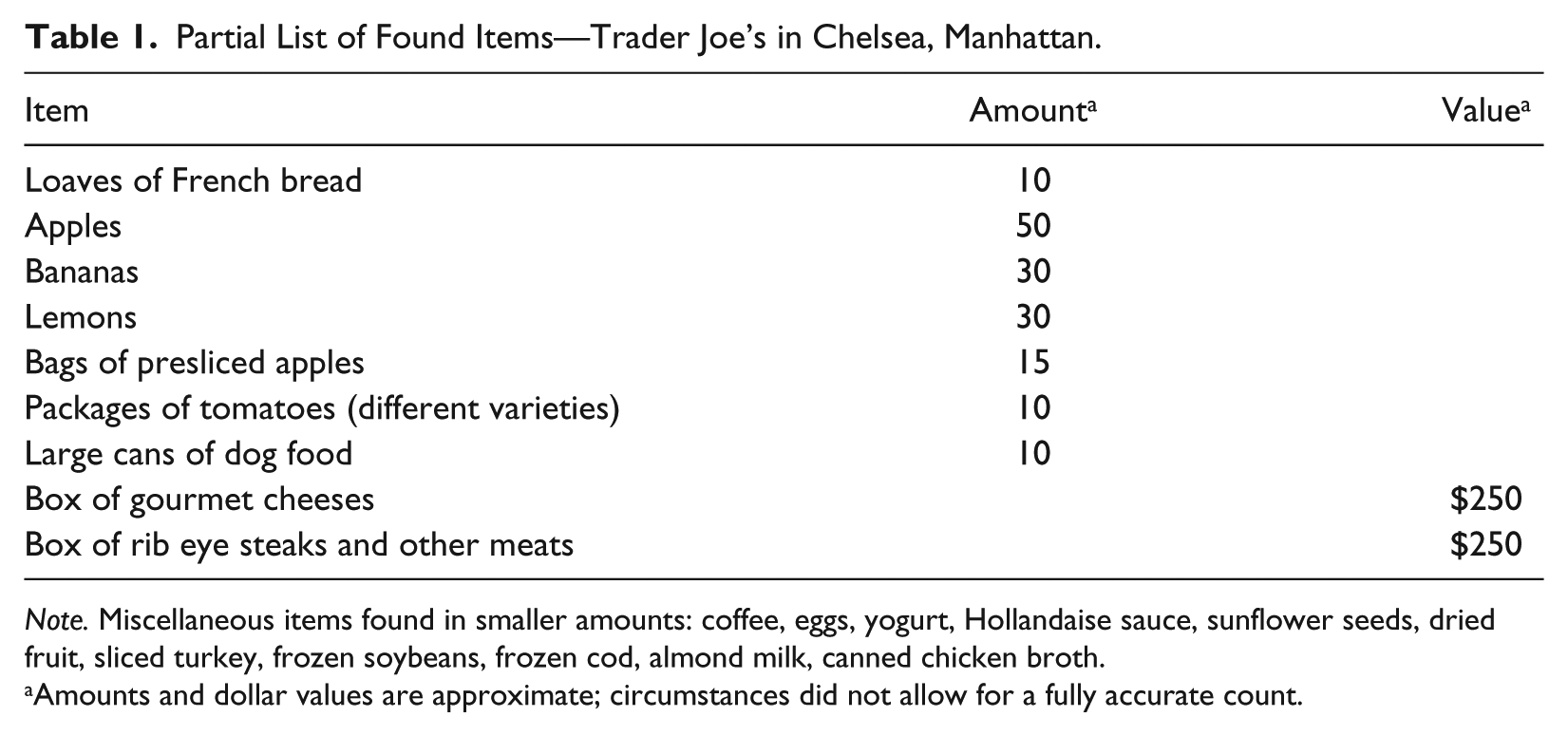
Note. Miscellaneous items found in smaller amounts: coffee, eggs, yogurt, Hollandaise sauce, sunflower seeds, dried fruit, sliced turkey, frozen soybeans, frozen cod, almond milk, canned chicken broth.
Amounts and dollar values are approximate; circumstances did not allow for a fully accurate count.
For many of the individuals at this particular location, who had otherwise limited means of income, dumpster diving provided a significant source of their livelihood. One person claimed he had been discriminated against and lost his job due to his sexual orientation. Regarding dumpster diving, he stated that “It was a huge help for me. I pretty much don’t spend any money on food now.” Another noted that “I don’t need to work as much because of this.” Many of the regulars were roughly between 40 and 60 years old, though it was not uncommon for some individuals in their 20s and 30s to also be present. Although many of the regulars were white, those who came more periodically reflected the overall racial diversity of New York City. Even though the group was disproportionately male (possibly due to the fact that the dumpsters were brought out late at night), some women nevertheless came regularly with male friends or partners. Apart from their gender and general reliance on dumpster diving as a source of food, then, the group was relatively diverse overall.
Although dumpster diving provided a substantial source of support for many at the site, it did not prevent them from voluntarily interacting and sharing useful knowledge with one another. In practice, socialization and sociability occurred together, as friendly interactions took place alongside the exchange of practical information and experience. The abundance of food at this particular location seemed to minimize competition, and indeed often encouraged sharing. As everyone sorted through the bags, it would not be uncommon to observe people offering to others some (or all, if they were not interested in the item) of what they had found: As one person put it on one particular occasion, “Anyone want coffee? If it ain’t organic I don’t want it.” Especially before the dumpsters had been brought out and after the bags were sorted through and meticulously placed back into the dumpsters, many would linger and chat with each other. Indeed, the prevalence of social interaction was such that, as one regular confided to me about another, “He doesn’t even care about getting food. He just comes to talk!”
Alongside the abundance of friendly interactions, the dumpster divers also exchanged practical information, happily sharing and discussing useful knowledge, techniques, and personal experiences. On any given night, people would update each other about other locations, share experiences akin to Fine’s (1998) “fish stories” (“Have you gotten any good finds recently?”), or talk about other relevant information. As one person shared with the group one night, I just bought a pair of Kevlar gloves—you know, the stuff they make bullet-proof vests from? They’re really good if you ever have to go through broken glass and stuff like that.
In other occasions, people consulted the “old heads” (Duneier 1999) or veterans: “Do you think tonight’s going to be a good night, Kenny?” He responded, “I don’t know. On Friday I saw the vans [that pick up food donated by the store] come by again.” Some even exchanged their cell phone numbers with each other, both as a sign of friendship and to keep each other informed, for example, about when the dumpsters were brought out or if other items were found at another nearby dumpster. In these ways, the exchange of knowledge, along with interaction for its own sake, provided the basis for affinity, and a context for developing shared views.
Sociability and socialization among the Trader Joe’s dumpster divers even encouraged the development of shared norms and perspectives. One norm commonly shared among dumpster divers is to leave the space as clean as it was found (which also involves opening bags at the knot rather than ripping them), as failure to follow it may lead storeowners to lock dumpsters or keep them in hard-to-access areas. Indeed, many of the Trader Joe’s dumpster divers made sure this norm was adhered to—to the point where in one instance, one of the regulars yelled at another dumpster diver for his carelessness. Such norms, shared and enforced at the micro-level, are reminiscent of the sidewalk book vendors described by Mitchell Duneier (1999), who in establishing a kind of social order among themselves, reflected a form of informal organization.
Ultimately, sociability and socialization engendered a context in which members of this group could develop shared views of the practice and the stigma associated with it. At the most basic level, everyone acknowledged the benefit of the free food obtained from dumpster diving and the difference that it made for them: as one person gleefully said to me, “I save so much money. I can put that shit into other things, man!” But everyone also expressed a clear awareness of the amount of “perfectly good stuff” that is regularly thrown away: As one person stated, “crazy how all this stuff gets thrown away, right?” Some even engaged in critiques of the amount of waste produced by society, while also acknowledging their dependence on it as a source of their livelihood: “they really throw out a lot of stuff—but you know, as long as they keep throwing it out, I’ll keep coming back!” In short, no one saw themselves as doing anything wrong. Most significantly, while many critiqued the stigma associated with dumpster diving, they also generally appeared to show resignation about their ability to change its status: As one person shared with me, “Most people just don’t understand . . . I don’t really care though.” Or as another dumpster diver put it, “Because it’s Chelsea, a lot of people are kinda jerks, because of all the clubs around here. But you know, whatever: what are you gonna do?” In this way, socialization and sociability enabled a situation in which no one expressed any guilt or shame about dumpster diving, even as many accepted the practice’s stigmatized status as unalterable.
Taken together, the presence of socialization, sociability, and shared norms among the Trader Joe’s dumpster divers represented a form of informal organization—which at the very least entailed regular patterns of interaction, and extended as far as group members exchanging cell phone numbers. Not unlike the way in which deviance is justified and sanctioned in the “subcultural” group (Cohen [1955] 1997), the interactions among the Trader Joe’s dumpster divers led them to hold similar views of the practice. By interacting and sharing their experiences with others, the dumpster divers could come to understand that there was nothing wrong in what they were doing. These in-group stigma management techniques dovetail with accounts of the verbal construction of identity among the homeless (Snow and Anderson 1987, 1993), along with the argument presented by Leon Anderson, David A. Snow, and Daniel Cress (1994:129) that in-group stigma management activities such as drinking, socializing, and “making bigger-than-life identity assertions” represented “functional and adaptive responses to demoralizing circumstances” and served to provide the homeless with “their own, admittedly fragile, community on the streets.” The findings discussed here add to these studies by representing these forms of interaction and community as a form of informal organization. In both of the study’s comparative groups, sociability and socialization provided the basis for an informal social organization in which no one in the group expressed any guilt or shame about the practice. Although the individuals in this group criticized the stigma associated with dumpster diving, they did not express a desire to collectively confront it. In contrast, even as some of the members of the freegan.info organization relied on dumpster diving as a primary means for their livelihood, their formal organization expressed and enabled their broader shared concern: to make a political statement and launch a collective out-group challenge to the stigma associated with the practice itself.
Formal Organization: Freeganism and Freegan.Info
The Freegan Frame
Unlike the Trader Joe’s dumpster divers, with whom I became familiar after being introduced to the location by a friend, I initially came across freegan.info through a simple Web search. The organization’s Web site, whose group has over 1,000 members on meetup.com, attracted viewers from across the world and served as a central source of freegan-related knowledge and information, even earning a description in the New York Times as “the closest thing their movement has to an official voice” (Kurutz 2007). Indeed, the freegan.info Web site played an important role in disseminating the concept of freeganism that, I argue below, effectively repositioned dumpster diving in broader, moral context. Even as the organization’s face-to-face events functioned to more directly and explicitly challenge the stigma associated with dumpster diving, its Web site also worked to inform the public about the organization and persuade individuals in the area to attend their events. As such, the Web site served as an organizational tool that worked to present the organization in a positive light and more broadly advance its objectives.
For the members of freegan.info, dumpster diving represented a single component within the broader frame of “freeganism.” The organization’s homepage explains freegans and freeganism in the following way: Freegans are people who employ alternative strategies for living based on limited participation in the conventional economy and minimal consumption of resources . . . Freeganism is a total boycott of an economic system where the profit motive has eclipsed ethical considerations and where massively complex systems of productions ensure that all the products we buy will have detrimental impacts most of which we may never even consider. Thus, instead of avoiding the purchase of products from one bad company only to support another, we avoid buying anything to the greatest degree we are able. (http://freegan.info)
As the homepage goes on to explain, this “total boycott” can manifest itself through several conscious lifestyle choices such as waste reclamation and minimization, eco-friendly transportation, rent-free housing, community gardening, wild foraging (or simply living in the wilderness), and working less. Within the context of freeganism, then, dumpster divers could view and represent their participation in the activity as a political act—for example, as part of a set of environmentally conscious choices or as part of a boycott of the capitalist system. By situating dumpster diving within a broader moral context, the concept of freeganism thus allowed self-identified freegans to not only reinterpret their own identity as dumpster divers, but also to represent dumpster diving as a noble activity.
In representing its activities, the freegan.info organization in different instances used the three types of framing identified by Snow and Benford (1988) that identify a problem, offer a solution, and provide a moral rationale for action. The following excerpt taken from the Web site, for example, provides a diagnostic frame that highlights the problem: Sweatshop labor, rainforest destruction, global warming, displacement of indigenous communities, air and water pollution, eradication of wildlife on farmland as “pests,” the violent overthrow of popularly elected governments to maintain puppet dictators compliant to big business interests, open-pit strip mining, oil drilling in environmentally sensitive areas, union busting, child slavery, and payoffs to repressive regimes are just some of the many impacts of the seemingly innocuous consumer products we consume every day. (http://freegan.info)
In enumerating and connecting these issues, the above excerpt suggests that their common source is consumer products themselves. The implicit solution, therefore, is a “total boycott,” or at least to the extent that it is possible. The Web site also presented motivational frames, or rationales for action, in statements such as the following: “We are dismayed by the social and ecological costs of an economic model where profit is valued over the environment and human and animal rights.” 3 In suggesting that the dominant values of the capitalist system are unjust, the excerpt implied that individuals have a moral obligation to resist those values by minimizing their consumption. These framing strategies resonated with broader cultural themes in the environmental movement encouraging individuals to alter their consumption patterns. In contrast to the Trader Joe’s dumpster divers, then, many individuals in the freegan.info organization viewed dumpster diving as an act that formed part of a broader political agenda.
The freegan.info Web site also carried out a parallel organizational objective of encouraging individuals to dumpster dive by providing them with concrete information. In addition to featuring a wealth of articles and advice on dumpster diving and freegan philosophy, the Web site featured a “dumpster directory” that provided a list of store locations, information about what time employees usually put out the store’s trash, what kinds of items can be found, and other advice specific to each location—thus providing a central source for the kind of information for which the Trader Joe’s dumpster divers relied on each other. In this way, the Web site not only raised awareness about freeganism but also worked to provide visitors with information that would encourage them to dumpster dive on their own.
In short, while the freegan frame worked to reposition dumpster diving within a broader moral context, the organization’s Web site more generally served as a useful organizational tool to disseminate this frame and advance the organization’s objectives. In practice, the organization’s Web site worked together with its face-to-face events, with the Web site providing a more formal explication of the organization’s frames and objectives, and the “trash tours” and other activities (discussed below) more broadly conveying these frames to newcomers and the media. The organization’s various events and gatherings also incorporated the group’s own variation of sociability, where participants had the opportunity to share and discuss their views of dumpster diving and freeganism.
Freegan Sociability
As freegan.info was a rather loosely structured formal organization with a strong Internet presence, the individuals who attended its events were rather diverse in terms of their age, race, gender, and class background. Even so, some of the more active members were more explicit in their political orientation, and many indeed sought to live by other freegan principles. One committed member, for example, shared how she had decided to quit her well-paying job at an IT company and sell her Manhattan apartment to buy a smaller one in Brooklyn. Another regular had been scavenging since her youth, but said she became more environmentally conscious after meeting the organization’s other members. In the context of freegan.info, dumpster diving was a more explicitly social activity (as I elaborate below), which may explain why the group’s members were more evenly balanced by gender than the dumpster divers at Trader Joe’s. In any case, whereas for the dumpster divers at Trader Joe’s, sociability and socialization developed at the site of the dumpsters themselves, the freegan.info organization provided the basis for its own version of sociability through its various meetings, events, and social gatherings.
As participation in freegan.info was voluntary, the organization had to provide incentives to encourage people to become involved. As Fine (1998:174, emphasis original) states in reference to leisure organizations, “Successful organizations provide staging arenas for friendship . . . Regular meetings are important for many groups in cementing members to the organization and to the activity.” Indeed, the freegan.info organization provided ample opportunities not only for socializing, but also for discussing freeganism and dumpster diving more generally. In addition to regularly held logistical meetings for active members, the organization helped host recurring events oriented around freeganism such as sewing circles, “free markets” (in which every item is free and no money is exchanged), and “freegan feasts”—meals prepared using exclusively “rescued” food. The group also held occasional “trail blazes”—outings whose purpose was to gather information about new locations and that closely resembled the “forays” discussed by Fine as “transform[ing] mushroom collecting from individual activity to group work” (Fine 1998:175). Indeed, the opportunities for socializing were such that members also arranged dumpster dives among themselves. Beyond individual members’ political agendas, these opportunities provided an additional incentive for their participation in the organization.
Although the abundant opportunities for socializing may have helped sustain members’ commitment, they more importantly provided an opportunity for participants, not unlike the Trader Joe’s dumpster divers, to cultivate shared views about dumpster diving and freeganism. During events, members would tell stories and share their experiences, whereas newcomers could ask questions. In one meeting oriented toward newcomers, for example, a first-timer expressed her doubt to the group: “I am totally supportive of doing this, but the thing is I just have like a huge complex with having people see me do it, and I don’t know how to deal with that.” A long-time veteran stepped in and sought to console her by responding, “That’s understandable. You just have to acknowledge that most people walking by are strangers; they won’t recognize you; you’ll never see them again.” These types of conversations, enabled within the space of the organization’s numerous events, thus provided an opportunity for participants to reinterpret their views and develop common understandings.
Although sociability was present among both the Trader Joe’s dumpster divers and the members of freegan.info, the groups differed according to the type of organization that served as the basis for sociability in each case. Whereas the Trader Joe’s dumpster divers came to interact with one another through their presence in one particular location, the majority of those involved in freegan.info became acquainted with each other through the organization’s formally arranged events; in other words, whereas the basis for interaction was more spontaneous among the Trader Joe’s dumpster divers, sociability was structured into the freegan.info organization in the form of preplanned, recurring events. In any case, sociability and socialization in both groups facilitated the development of common understandings about dumpster diving. The key difference between the two groups, as described in the next section, was that the members of freegan.info, acting in service of a more explicitly political agenda, utilized formal organization to additionally launch a collective challenge to the stigma associated with dumpster diving.
Confronting the Stigma: Organizational Work in Freegan.info
Although freegan.info hosted a series of diverse events related to freeganism, in reality most of the work carried out by this small, volunteer-run organization—and, indeed, almost all of the media attention it received—focused on dumpster diving. The statements of many members of the organization confirmed that encouraging more people to dumpster dive and reframing the practice were deliberate goals. “I would be very happy if more people were dumpster divers,” as one freegan expressed, “because I think more people would then realize how much food is actually wasted,” or as another member stated, “I hope that what we’re doing here will help educate people about the level of waste produced by our society.” The organization’s work thus consisted of not only of maintaining a Web site and holding social events; another perhaps even more critical component involved organizing public, media-oriented actions such as “trash tours,” which functioned to disseminate the organization’s framing strategies and reach an even wider public audience. Trash tours consisted of inviting members of the public on a walking tour of stores in a particular neighborhood that were known to throw out edible food. Taking place around 9:00 p.m. (after businesses put out their trash for collection), they gathered an average of about 20 people—a mixture of regulars, newcomers, and members of the media. The number of people who would gather at each location also drew the curiosity of passersby, to whom members would hand flyers with information about the organization.
The trash tours were fundamentally public events, not simply because they were open to the public and held in public space, but more importantly because they engaged the public in a politically theatrical way (Barnard 2011). The trash tours simultaneously accomplished a number of objectives. First, like their other events, they enabled sociability and socialization by providing a group context for discussion—so that, for example, newcomers could ask questions about dumpster diving and discuss the concept of freeganism with the organization’s members. Second, even if not all participants ultimately became regular dumpster divers or freegans, the trash tours helped raise awareness about the amount of waste produced: As a first-time trash tour participant expressed to me during one tour, “This [amount of food] is pretty crazy, but I don’t think I could do this on my own.” Although the tour did not convince this participant to become a committed dumpster diver, the tour nevertheless had an impact on her. Third and most important, the tours served as a public affirmation of dumpster diving—both to insiders and outsiders. In laying out all of the food on the sidewalk and making a speech to participants, for example, members of the organization were meticulously conscious of how they presented themselves to first-timers, passersby, and members of the media who regularly accompanied them on the tours. These speeches, which members nicknamed “waving the banana” (Barnard 2011), were staged moments in which members would critique the amount of food being wasted and its connection to capitalism. Many claims resonated with similar framing practices on the organization’s Web site. On one occasion, for example, the speaker stated in his speech, Look: you have all of this food being wasted. And all the stores that are throwing this stuff out, they just see this as part of doing business. All of this perfectly edible food . . . it just doesn’t make any sense.
In this instance, the speaker engaged in a series of framing strategies that both diagnosed the problem of food waste and provided a moral justification for dumpster diving.
Apart from these more staged moments, the trash tours also worked to demonstrate to newcomers and members of the media the viability and logistics of the practice. This included answering queries such as why so much edible food was being thrown away, and also the sharing of useful knowledge and skills, thus echoing the socialization that took place among the Trader Joe’s dumpster divers more informally. As the trash tours also served as occasions for first-timers to “get their hands dirty” in the company of more experienced dumpster divers, they also worked toward one of the organization’s goals of encouraging newcomers to become regular dumpster divers.
Even as they socialized newcomers and outsiders to the practice, members also engaged in framing efforts to challenge any negative views associated with dumpster diving. For instance, many developed responses to common doubts about the food’s cleanliness: As one person explained, “It’s about as sanitary as taking the food from the shelf, putting it into a plastic bag, and taking it outside. Most of the food was on the shelf that same day.” Other responses included pointing out that some of the reclaimed food was in better condition than what one might find in one’s refrigerator, and that “what’s disgusting is how much food is wasted” (even as members also encouraged using prudence and caution in coming across certain items; Samson 2011). In one sense, these comments worked against the broader association between garbage and uncleanliness. More generally—not unlike the disclaimers, techniques of neutralization (Sykes and Matza 1957), and “credentialing” discussed by Leon Anderson and Jimmy D. Taylor (2010)—they worked toward reframing dumpster diving as a legitimate and respectable practice.
Most importantly, the trash tours hosted by freegan.info most clearly exemplified how formal organization could be used as a collective resource and tool to raise awareness and challenge the stigma associated with dumpster diving. Many of the organization’s efforts toward capturing media attention were indeed rather successful, as the trash tours were featured in venues such as the Oprah Winfrey Show. Through the trash tours, the members of freegan.info turned their presence at the dumpsters into a spectacle intended for a public audience, including passersby and the media. This differed dramatically from the behavior of the Trader Joe’s dumpster divers who, even if they socialized among themselves, mostly sought to downplay their presence at the dumpsters, reflecting the “tension between attachment (trust) and competition (secrecy) [which] builds social order” (Fine 1998:187). In short, freegan.info not only provided ample opportunities for sociability within which views of dumpster diving could be shared and discussed, but, more importantly, also organized events that functioned to reframe the practice of dumpster diving and challenge negative views associated with it.
Insofar as sociability in freegan.info enabled the organization’s members to not feel ashamed about their participation in the practice, it served a similar function as sociability and socialization among the Trader Joe’s dumpster divers. However, the formal organization of freegan.info also allowed the group to advance its more political objectives through a group Web site and a number of face-to-face actions and events. Through these organizational resources, members were able to use a set of diagnostic, prognostic, and motivational frames (Snow and Benford 1988) that called attention to the problem of waste, proposed dumpster diving as a solution to this problem, and provided a moral rationale for engaging in the practice. Ultimately, public, media-oriented actions such as trash tours allowed the organization’s members to work toward explicitly challenging negative views of dumpster diving, and by implication, the basis of the stigma associated with it.
Discussion and Conclusion
This article has presented findings from a comparative study of two groups of dumpster divers in New York City. In assessing the resources at the disposal of the members of each group, it has highlighted organization as a key factor enabling their differing stigma management strategies. More specifically, socialization and sociability in both groups served as a form of informal organization, which allowed the members of each group to develop shared views and understandings about dumpster diving. In addition, the presence of formal organization in the second group enabled its members to not only cope with the stigma associated with dumpster diving, but launch a collective challenge to its very basis. The freegan.info organization carried out this challenge through the organizational channels of its Web site and public actions such as trash tours, whereas the concept of freeganism itself worked to reposition dumpster diving within a broader moral context. The comparative study discussed here therefore introduces organization as a useful analytical axis in assessing the resources at the disposal of stigmatized groups.
Although the findings discussed here demonstrate the benefits of informal and formal organization for stigmatized groups, a limitation of the study is that it does not examine the factors that facilitate the development of collective organization itself. Although the study’s two groups were not completely identical in their demographic characteristics, their relatively similar internal diversity suggests that factors such as class position and race did not in this case themselves explain the presence of organization in either group. Even so, because the two groups’ differing motivations suggest their organizational differences, future research is needed to more explicitly investigate the conditions under which stigmatized groups may develop informal and/or formal organization. Such work could usefully parallel scholarship on the development of collective action more generally.
The implications of this study’s findings should prove useful to scholars and stigmatized groups alike. For individuals who share a stigma, informal organization can on one hand be beneficial in developing shared perspectives regarding their stigma, which may mitigate its effects. Stigmatized groups that manage to develop formal organization, on the other hand, may additionally develop the ability to challenge the very basis of their shared stigma. More research—and, perhaps, experimentation—is needed to develop further insights into the conditions under which stigmatized groups will be more likely to develop each of these forms of organization.
Footnotes
Declaration of Conflicting Interests
The author(s) declared no potential conflicts of interest with respect to the research, authorship, and/or publication of this article.
Funding
The author(s) received no financial support for the research, authorship, and/or publication of this article.