



Abstract
In the United States, the dominant view of children is that they are passive receivers of parental resources—sites of investment that consume parental assets. However, this research largely ignores immigrant families, a fast-growing segment of the American population. This study uses data from the Early Childhood Longitudinal Study–Kindergarten Class of 1998–1999 (ECLS-K) to examine immigrant-native differences in who provides homework help to children in their households, a resource that most, if not all, children need and which parents are asked to provide. I find that, relative to white children in native-born households, both Asian and Latino children in immigrant households are more likely to rely on siblings for homework help (as opposed to parents). Unequal parental resources do not explain these immigrant-native differences. I show that far from being passive receivers of parental resources, children in immigrant families contribute much-needed resources—homework assistance, in this case—to their household members. This contribution, I suggest, is an expression of a larger immigrant adaptation strategy in the United States.
Introduction
American families spend, on average, about $300,000 on their children before their 18th birthday, excluding college tuition (Thomas 2014). This figure, which has been increasing over time, aligns with the dominant view of U.S. family dynamics, in which children are entities unto whom parents must unilaterally invest academic, emotional, and financial resources (Zelizer 1985). Under this view, children’s role in the family is limited to being passive sites of parental investment (Friedman 2013; Lareau 2011). This dynamic, scholars argue, is so firmly embedded in American family life that—in the last few decades—even grown children rely heavily on their parents for financial, emotional, and practical support during the newly extended transition to adulthood (Swartz et al. 2011). Despite this entrenched view of the role of children, it may not apply to a large and growing segment of the U.S. population: immigrant families, which are projected, by 2040, to raise about one-third of all American children (Child Trends 2014; Rong and Preissle 2009). Investigators who argue that children in contemporary U.S. families play passive roles, however, for the most part, omit immigrant households.
Although scholars have explored a number of dimensions of immigrant family life in the United States (Glick 2010), research on the contributions that children make to their households remains scant (e.g., Orellana, Dorner, and Pulido 2003). Because migration affects children as much as it does parents (Dreby 2010), one of its consequences may be that children must step into more contributive roles in their households (Dreby 2015; Lanuza and Bandelj 2015; Ponizovsky, Kurman, and Roer-Strier 2012). In this article, I argue that far from being passive receivers of household resources, children in immigrant households play supportive roles for their family members. Furthermore, I suggest that this supportive role is not only a result of immigrant-native differences in parental resources but also may be an adaptation strategy that immigrant families exhibit.
In this study, I use the case of homework assistance to show immigrant-native differences in the contributions that children make to their families. American educational institutions dictate what they expect parents to do to support the schooling efforts of their children (Souto-Manning and Swick 2006). Parental involvement in children’s schooling is widely regarded by educational institutions as necessary for children’s success (Green et al. 2007). Homework help is one dimension of parental involvement that schools expect parents to engage in (Epstein and Van Voorhis 2012). Although scholars debate whether homework help is beneficial for children’s achievement (Barnard 2004; Robinson and Harris 2014), it may nevertheless be consequential for the academic and emotional well-being of students (Englund et al. 2004). At the very least, parental involvement with homework meets school expectations, which has ramifications for the way that administrators, teachers, and staff treat students (DeCastro-Ambrosetti and Cho 2005).
Homework help, however, requires a number of parental resources, including money, time, and human capital, especially education, parental English language proficiency, and parental knowledge of school-related norms (Louie 2012). Thus, homework help is more resource intensive than first meets the eye, but schools often assume that parents have these resources, or, at the least, a bare minimum of them, to help their children (Hoover-Dempsey, Bassler, and Burow 1995). Furthermore, because parents are solely expected to provide homework help, along with other resources to their children, the supportive role of other family members is often minimized, if not totally ignored.
In this manuscript, I explore who provides homework help for children during fifth grade. Examining homework support during middle childhood is particularly useful because it is during this stage that children’s social world expands, thereby allowing children to seek help from a number of actors, both in and out of their households. Furthermore, at this age, children develop “social competence,” which allows them to gauge the constraints of their social world and find solutions accordingly (Collins, Madsen, and Susman-Stilman 2002). Although children’s social world expands, the family remains the primary source of support for children.
My study makes a number of contributions. Previous research examining immigrant family patterns of support are based on ethnographic accounts that rely on small, nonrepresentative samples (e.g., Azmitia, Cooper, and Brown 2008). This study uses nationally representative data to examine immigrant-native differences in family support at the population level. Previous research that explores children’s contributions to their households either only examines immigrant-specific resources (such as language brokerage) or lacks a native-born comparison group (Estrada 2012; Orellana et al. 2003; Park 2005; Song 1999; Valenzuela 1999). By using the case of homework assistance as the contribution that children provide to their households, I can make direct immigrant-native comparisons of the role of children in their respective homes. Finally, previous research that examines the role of children is limited to certain ethnic groups (for instance, Song 1999). By comparing Asian and Latino children in immigrant families, I examine whether this “expanded” role of children applies to most immigrant households. By using the case of both English language arts (ELA) and mathematics homework, I suggest that immigrant-native differences in children’s assistance contributions extend from disparate family dynamics and not from subject-specific concerns.
Theoretical Framework
The Role of Parental Resources in Immigrant-native Differences in Family Support
Homework help often requires a number of resources, including money, time, education, English language proficiency, and knowledge of school norms (Louie 2012). Social exchange theory posits that exchanges between actors in an interconnected network depend on who has available resources and who needs those resources (Cook et al. 2013; Molm 1990). Applying this theoretical model to the family—an interconnected social network—suggests that household exchanges, including patterns of providing support, are a consequence of the distribution of resources among household members. Because parents procure and provide resources for their households, and, therefore, have more resources than any other household member to help their children with homework assignments, social exchange theory predicts that parents would be the primary source of homework help for their children. This is particularly true during middle childhood because children are more or less constrained in who they have access to for homework help, relying heavily on their household members, especially their parents.
Compared with their native-born counterparts, immigrant parents are, on average, more disadvantaged. Relative to their native-born peers, immigrant parents have less money, lower levels of education, lower English language proficiency, work longer hours, and have less knowledge of school-related norms (Borjas 2011; Chiswick and DebBurman 2004; Suarez-Orozco 2005; Turney and Kao 2009). These difficulties negatively affect their children’s schooling. Vivian Louie (2012) finds, for example, that immigrant parents often lack the necessary resources – such as education, English proficiency, money, knowledge about school norms, and time – to help their children with homework, . She underscores that “lack of time, language barrier, and lack of comfort [hinders parents’ engagement] with their children’s school” (p. 81), and, subsequently, parents can only provide limited “guidance for their children’s academic development” (p. 76). These difficulties prevent parents from providing more homework help to their children.
Although I predict that immigrant parents are less likely to be the primary source of homework support to their children, relative to children with native-born parents, it is important to underscore that it is not because they lack interest or the desire to do so (Lopez 2001; Louie 2012). On the contrary, immigrant parents help their children as much as they can. For example, Louie (2012:76) finds that immigrant parents made sure children completed their homework, though they “did not necessarily actively check the quality of the homework” because they were unable to do so.
When Siblings Help Each Other
If parents have fewer resources to help children with homework, where do children go for help? Children may either go to another adult in household, should they live in extended families (e.g., uncle), or they can seek assistance from an adult outside of the home (e.g., school staff; see Cosden et al. 2001). Children might also rely on siblings for homework help or simply do the best they can on their own (Louie 2012).
Although other adults in the household seem like a viable alternative, most children, including children of immigrants, live with their parents only (Manning and Brown 2014; Ruggles 2011). Furthermore, even though previous research finds immigrants to be more likely than their native-born counterparts to live in extended households, these arrangements are usually transitory (Glick and Van Hook 2002, 2011; Kamo and Zhou 1994) Even when immigrant children live with extended family members, these adults may be working long hours and have limited availability. Extended family members, especially grandparents, may also lack the English language proficiency required to provide homework help (Treas and Mazumdar 2002). Siblings, on the contrary, may be more likely than other household members to have the English language proficiency, time, and knowledge of school norms necessary to provide help with homework (Portes and Rumbaut 2001).
Therefore,
This hypothesis is consistent with—and expands the application of—the segmented assimilation perspective. A key aspect of segmented assimilation suggests that children of immigrants “can become, in a very real sense, their parents’ parents” (Portes and Rumbaut 2001:53), which is referred to as “role reversal.” The parent-like responsibilities that children take on to support their parents may also be bestowed upon their siblings. Siblings, in other words, may provide one another with the kind of support that parents usually provide. In this project, I bridge segmented assimilation theory with the life course perspective to suggest that “role reversal” is a particular expression of a more general productive role of children in immigrant families, which they may exhibit before adolescence (and after it).
Hypothesis 2 above also aligns with the small but growing literature that finds that far from being “economically useless but emotionally priceless” to their households, children of immigrants play an “expanded” role in their homes. Among Latinos, a growing literature documents this “expanded” role. Abel Valenzuela (1999), for example, finds that siblings take on a “tutoring” role for children in poor Latino immigrant families. Similarly, Marjorie Orellana and her colleagues find that helping children with homework is part of the language brokering roles that siblings take on in their households, in addition to translating, interpreting, and advocating for their parents due to their parents’ lack of English language proficiency (Orellana 2001; Orellana et al. 2003). Siblings may also provide homework help to children of immigrants because, in general, they bridge home-school differences in learning (Volk 1999). Moreover, Gregory Jurkovic (1997) finds that children of immigrants take on parental responsibilities due to their parents’ lack of knowledge about school norms. More recently, scholars have documented child labor among children of low-income Latino immigrants—in meatpacking plants, street-vending, and as agricultural workers—to help support their families (Camayd-Freixas 2013; Estrada 2012; Romano 2011). Thus, providing homework help to a sibling may be another expression of the contributions that children of immigrants provide to their households.
Scholars find similar dynamics among Asian immigrants. Miri Song (1999) and Lisa Park (2005) document the extent to which Chinese and Korean parents rely on their children for the financial sustainability of their family-owned businesses in Britain and the United States. Although all of this work points to the expanded role of children in immigrant families, most, if not all, is based upon either ethnographic accounts of poor families and/or small nonrepresentative samples. Thus, it is unclear whether these findings apply more broadly. Notably lacking from this literature are direct immigrant-native comparisons in the resources that children provide to their families or the role that they take on in their households. For example, Orellana and colleagues argue that children in immigrant families engage in language brokerage, a much-needed resource that children provide to their households. Unfortunately, language brokerage cannot be compared across immigrant and native-born households because all native-born parents speak English, therefore native-born children do not engage in this practice.
If parental resources—or a lack thereof—alone dictate family patterns of support, including the primary homework assistance role that siblings take on in immigrant families, then accounting for these resources should explain the higher likelihood of children in immigrant families to rely on siblings, as opposed to parents, for homework help. In other words, according to social exchange theory,
Alternatively, research on immigrant families suggest that the contributions that children provide to their households also have an attitudinal component, generated as a consequence of migration-related difficulties and opportunities.
Attitudinal Explanation for Siblings’ Contributions to Their Families
Migration scholars document a number of dynamics in immigrant families that sets them apart from their native-born counterparts (Dreby 2015; Glick 2010; Kibria 1993; Zhou and Bankston 1998). One explanation for the “expanded” role of children in immigrant households is the “immigrant bargain” that these families engage in (Smith 2006). Due to the selective nature of migration (Feliciano 2006) and the context of reception (Portes and Rumbaut 2014), parents often experience steep downward mobility subsequent to migration (Hagan, Hernandez-Leon, and Demonsant 2015), experiencing unforeseen economic and emotional difficulties in the United States. These difficulties, parents believe, will be vindicated through their children’s socioeconomic mobility and opportunities in the United States, which are unavailable to their children in their countries of origin. In short, immigrant parents make a “bargain” with their children in the United States: Parents’ sacrifices and hardships associated with migration will be vindicated through their children’s socioeconomic mobility (Smith 2006).
To fulfill the immigrant bargain, children often engage in a number of practices and behaviors that, additively, vindicate their parents’ sacrifices in the United States, such as providing support to household members, performing well in school, and taking ownership of their own educational experience early on (Louie 2012). These practices can be understood as expressions of the obligations and responsibilities that children feel in their households as a consequence of the immigrant bargain. Previous research shows that both Latino and Asian children of immigrants are more likely to feel a sense of obligation to their families compared with white children in native-born families (Fuligni 2001; Fuligni and Pedersen 2002; Fuligni, Tseng, and Lam 1999; Hardway and Fuligni 2006). I suggest that siblings helping children with homework is another expression of the obligations and responsibilities they feel toward their families. Providing homework assistance to children is a contribution that siblings—other children in the home—provide to their households, yet another gesture that helps in fulfilling the immigrant bargain.
As a part of this bargain, children may also feel like they should not bother their parents with their needs, including homework help, because they don’t want to burden them with more responsibilities. Although siblings may be central figures in homework support,
In the case of homework help, children of immigrants may just bite the bullet and try to figure out their queries on their own. In short, felt obligations to their families include a sense of family responsibility for each other and for themselves. If these obligations are found in all immigrant households, children in both Latino and Asian immigrant families would be more likely to both rely on siblings and go without help (as opposed to receiving it from parents) compared with their peers with native-born parentage.
Furthermore, if the “immigrant bargain” is a viable explanation for immigrant family patterns of support,
In other words, reliance on siblings (children in the households), which extends from the immigrant bargain, is part of an immigrant adaptation strategy in the United States that applies to all immigrant families (Glick 2010).
Furthermore, if an immigrant bargain—or other migration-related adaptation strategy—is responsible for the reliance on siblings for homework assistance, I expect immigrant-native differences among Latinos.
In other words, accounting for any similarities that are shared by those who adopt this panethnic label (Latino), children in Latino families who are closer to the immigrant journey, namely, children of immigrants, take on more supportive roles in their homes than is the case among those Latinos with native-born parentage. This hypothesis is consistent with previous research, which finds that strong family ties shape the educational experiences of children of immigrants, including Latinos (Crosnoe and López Turley 2011; Halgunseth, Ispa, and Rudy 2006).
Finally, previous research suggests that Asian students have access to a vast network of supplementary education that supports their schooling endeavors (Lee and Zhou 2014; Zhou and Kim 2006). These services cut across class boundaries, bolstering the academic achievement of all Asian students. Thus,
This previous research suggests different family patterns of homework support between Latino and Asian students living in immigrant families, and between Asian students living in immigrant families relative to their white peers in native-born households.
Method
Data
To answer my research questions, I rely on the Early Childhood Longitudinal Study–Kindergarten Class of 1998–1999 (ECLS-K). ECLS-K contains information about a cohort of children who started kindergarten in the 1998–1999 academic year. Parents, school administrators, teachers, and the focal children were interviewed over seven waves. Interviews about the focal child and his or her home and school life were conducted during the fall and spring of kindergarten, fall and spring of first grade, and spring of third, fifth, and eighth grade. These data are particularly useful for my research questions because they contain a wealth of information about household dynamics, including family provision of homework help in fifth grade, when children were in middle childhood. Out of the original 21,409 observations in the base year, 8,370 have valid weights in the sixth wave of data collection, when children were in fifth grade. I limit my analyses to individuals with valid weights so as to make my estimates nationally representative. As an analytical strategy, I further limit my sample to those individuals, in the first wave of data collection, whose parents identified them as a white child living in a native-born family (I explain my definition of an “immigrant family” and a “native-born family” below), a Latino child living in native-born family, a Latino child living in an immigrant family, and an Asian child living in an immigrant family. I exclude native-born Asian children from the analysis due to small sample size. The analytic sample is limited to respondents with valid responses on both ELA and mathematics homework help measures. These exclusions reduce my analytical sample to 6,821 cases. 1
Because I am using longitudinal data across the first six waves of data collection, I use the sixth wave panel weights with parental interview data. Using weights, strata and primary stratification unit values, and the svy command in Stata, I account for unequal attrition and the data’s multistage sampling design. To maintain the small percentage of observations with missing values on independent variables (described below), I use a multiple imputation strategy. This strategy is preferable because it takes into account the error that may be involved with assigning a value to the missing information (Rubin 1987, 1996), and following previous research, I do not impute the dependent variable (Von Hipple 2007). I created 20 multiply imputed data sets to generate results. The tables present averaged coefficients over these data sets.
Measures
Who helps with homework?
During data collection interviews, parents were asked how often their child does homework. If the parent said “never”—1.2 percent of all participants 2 —the battery of homework questions was skipped. I also lost four more cases because parents refused to answer the question or did not know. For the rest of the participants, survey administrators asked parents if the child has “someone who can help him or her with homework in reading, language arts, or spelling?” The answer choices were either “yes” or “no.” The children for whom parents answered “no” are categorized as having “no one” to help them with homework. If the question was not ascertained or if they answered “no,” the rest of the questions were skipped. Then, survey administrators asked parents, “how often did someone help the child with his or her reading, language arts, or spelling homework.” For individuals who answered “never,” I categorize their children as having someone available to provide help yet do not receive any assistance. 3 These individuals were not asked the final question, which read, “who usually helps the child with his or her reading, language arts, or spelling homework?” The responses were mutually exclusive: mother, father, sister or brother, grandparent, another adult in the household, someone at an after-school program, or adults who don’t live in the household. From all of these questions, I create a single categorical measure of who helps the child with homework: parents, siblings, adults in the household, adults outside of the household, no one, or has someone available to provide help yet does not receive any assistance. Parents were asked the same questions about mathematics homework help. Note that I have two dependent variables, one for each subject matter. The proportion of missing values in my dependent variables is similar across my groups of interest. 4
Immigrant household
I theorize that immigrant households differ from native-born households because parents in immigrant households must contend with adaptation and settlement difficulties and opportunities, which native-born families do not. Therefore, I define an immigrant family as one where there is no native-born parental presence. In a family with one native-born and one immigrant parent, the native-born parent may have access to the resources that the immigrant parent (partner) cannot access for themselves and for their children. Therefore, families with two foreign-born parents or a single-parent family with a foreign-born parent are considered immigrant families, as well as those for which I only have information about one parent and that parent is foreign born. The rest of the families are considered native born. As a robustness measure, in the case of Latinos, I further disaggregate individuals with no immigrant parentage (third+ generation) from those with one immigrant and one native-born parent. This alternative specification further highlights immigrant-native differences.
With respect to nomenclature, “children of immigrant parents,” “immigrant households,” “immigrant families,” and “children with immigrant parentage” are used interchangeably. Similarly, “children of native-born parents,” “native-born households,” “native-born families,” and “children with native-born parentage” are used interchangeably. I then combine this immigrant household measure with a racial identification measure, as described earlier, to generate my key independent variable.
Parental Resources
Parental socioeconomic resources (income, education, and occupation)
To ascertain parental socioeconomic resources, I used a composite socioeconomic status measure provided by ECLS-K administrators when the child was in fifth grade. I used this measure because parental education, financial, and occupation-related resources are all highly correlated, though in supplementary analyses I used education and financial measures separately and I arrived at substantively similar results. Thus, I chose the most parsimonious model.
Parental time resources (work hours)
To account for the amount of time parents have available to provide homework help, I control for the number of hours parents work. Presumably, the longer parents work, the less time they have available to provide homework help to their children. ECLS-K administrators provided a categorical variable of mother and father employment status, which includes the following categories: “35 hours or more per week,” “less than 35 hours,” “looking for work,” “not in the labor force,” and “no [mother/father] in household.” I decided to use this variable instead of a continuous variable of work hours because in the continuous measure, all parents “looking for work” or “not in the labor force” would have zero hours of work, but if parents are looking for work, they might have less time to provide homework help than if they are simply not in the labor force. My categorical variable allows for this possibility and takes into account the absence of a parent from the household, if applicable.
Parental knowledge (English language proficiency)
ECLS-K administrators ascertained parental English language proficiency during the first (and last) wave of data collection. They asked parents “how well do you understand someone speaking English,” “how well do you read English,” “how well do you speak English,” and “how well do you write English.” For each one of these questions, I coded the responses as follows: 1 = not well at all, 2 = not very well, 3 = pretty well, and 4 = very well. As such, for each question, higher values indicate higher English language proficiency. I then created a summary measure, which takes the average score of all of the different measures (speak, read, write, and understand), with 1 suggesting low proficiency and 4 suggesting high proficiency.
Parental knowledge (familiarity with school norms and expectations)
To ascertain the level of familiarity with their child’s school, I utilize a battery of questions parents were asked with respect to their relationship with their child’s school in fifth grade. Parents either agreed or disagreed with possible scenarios about why their engagement with their children’s school is limited, including (1) school does not make me feel welcome, (2) family cannot understand school meetings, (3) parents don’t hear about school activities, and (4) notes from teacher are in a language parent cannot understand. I coded each parental reason for limited participation as 1 and 0 otherwise if they did not experience this difficulty. I then added the number of reasons parents provided for explaining why they had limited participation in their child’s school. Higher values denote more difficulties engaging with the school and less knowledge about its inner workings.
Covariates
Gender
To account for the child’s sex, I utilize a composite variable provided by ECLS-K administrators. The variable takes a value of 1 if the respondent is female, 0 otherwise. The information comes from the first wave of data collection.
Age
I calculated the respondents’ ages using the birthdate information that parents provided about their children in the first wave of data collection. I present their ages in kindergarten.
Birth order and number of siblings
To account for sibling configuration, I use the household roster to figure out how many siblings children have and the birth order among them. I created a categorical variable that distinguishes between first borns, middle borns, and last borns. Once I establish birth order in the first wave, I ascertain whether new babies arrived in the home, which might change the birth order of the last borns to middle borns. New arrivals would be inconsequential to getting homework help from a sibling because they would be younger than the focal child and thus would receive, not give, homework help from focal child. Nevertheless, more children might reduce the amount of time that parents can provide to the focal child.
Prior achievement
To control for the possibility that homework help provision is a response to children’s academic performance, I control for students’ prior achievement in mathematics and language arts in third grade (lagged one wave). I utilize item response theory (IRT) scores, which ECLS-K administrators provide. I also ran regressions that lagged other covariates, where applicable. The results are the same. In this article, I chose to keep the covariates and dependent variable that were ascertained at the same time (in same wave) because the theoretical framework suggests that the roles that family members play in their households may be most related to current household circumstances.
School type
To account for the possibility that homework help differentials are associated with the kind of school that children attend, I include a dummy variable for private versus public schooling.
Family structure
ECLS-K administrators asked parents if their household was composed of two parents plus siblings, two parents with no siblings, one parent plus siblings, one parent with no siblings, or other arrangements. I created three categories from this question: married (two parents), single parent (one parent), and other arrangement. Furthermore, using the household roster, I created dummy variables for the presence of other people in the household, including siblings, grandparents, aunts or uncles, cousins or other relatives, and nonrelatives.
Sample
Table 1 provides descriptive statistics for my sample. With respect to extended family in the household, most children in both immigrant and native-born households live with siblings (more than 85 percent in all groups), with Latino children in immigrant families being the most likely to have a sibling at home (95 % p < .001). With regard to parental socioeconomic resources, on average, Asian children live in families with the highest socioeconomic status, followed by white children in native-born families, Latino children in native-born families, and Latino children in immigrant families (p < .001). With respect to parental time resources, the highest percentage of mothers working full-time is found in Latino native-born families (56 percent) and in Asian immigrant families (56 percent), followed by mothers in white native-born families (49 percent) and mothers in Latino immigrant families (38 % p < .001). With respect to father’s employment, fathers in Asian immigrant households are the most likely to be employed full-time (81 percent), followed by fathers in white native-born households (76 percent), fathers in Latino immigrant households (70 percent), and, finally, fathers in Latino native-born households (68 % p < .01). Parents in immigrant households have lower English language proficiency scores compared with parents in native-born households, with Latino immigrant parents having the lowest score (p < .001), and finally, immigrant parents have the most difficulty interacting with schools and, presumably, the least knowledge about its norms and expectations compared with parents in native-born households (p < .001).
Weighted Percentages and Means of Variables in Analytic Sample (N = 6,821), by Immigrant Parentage and Race.

Note. All significant tests come from the first of the 20 multiply imputed data. For continuous variables, significance tests suggest that at least one category is significantly different from another at the shown level of significance. IRT = item response theory. *p < .05. **p < .01. ***p < .001.
Results
Who Provides Homework Help to Children? Are There Immigrant-native Differences?
Table 2 provides weighted descriptive statistics of the distribution of who helps with ELA and math homework. As expected, the distribution of who helps with homework differs for children in immigrant and native-born families (p < .001). Consistent with Hypothesis 1, relative to other members in the household, parents provide homework help to the largest share of children in both immigrant and native-born families; however, the extent of their involvement differs across each group. With respect to ELA, when someone is available to help, white and Latino children in native-born families are more likely to primarily rely on parents than Latino and Asian children of immigrants (88 and 78 percent vs. 46 and 67 percent, respectively). By contrast, Latino and Asian children in immigrant families are more likely to primarily rely on siblings for homework assistance compared with white and Latino children in native-born families (31 and 14 percent vs. 2 and 8 percent, respectively). Importantly, Asian children in immigrant families are not more likely to receive homework help from an adult outside of the household, as previous research suggests; there are no appreciable percentage point differences across the groups. Furthermore, Latino and Asian children in immigrant families are more likely to have no one available to help them with homework compared with white and Latino children in native-born families (10 and 8 percent vs. 1 and 2 percent). With regard to nonparental adults in and outside of the household, immigrant-native differences are not as stark, and perhaps most importantly, in terms of percentages, they do not play a large part in providing homework assistance for children in the United States. Although the percentages differ slightly, I find similar immigrant-native differences in who provides homework help to children in the case of mathematics (Table 2, Panel B).
Distribution of Who Helps Children with Homework in Fifth Grade (Weighted Percentages).
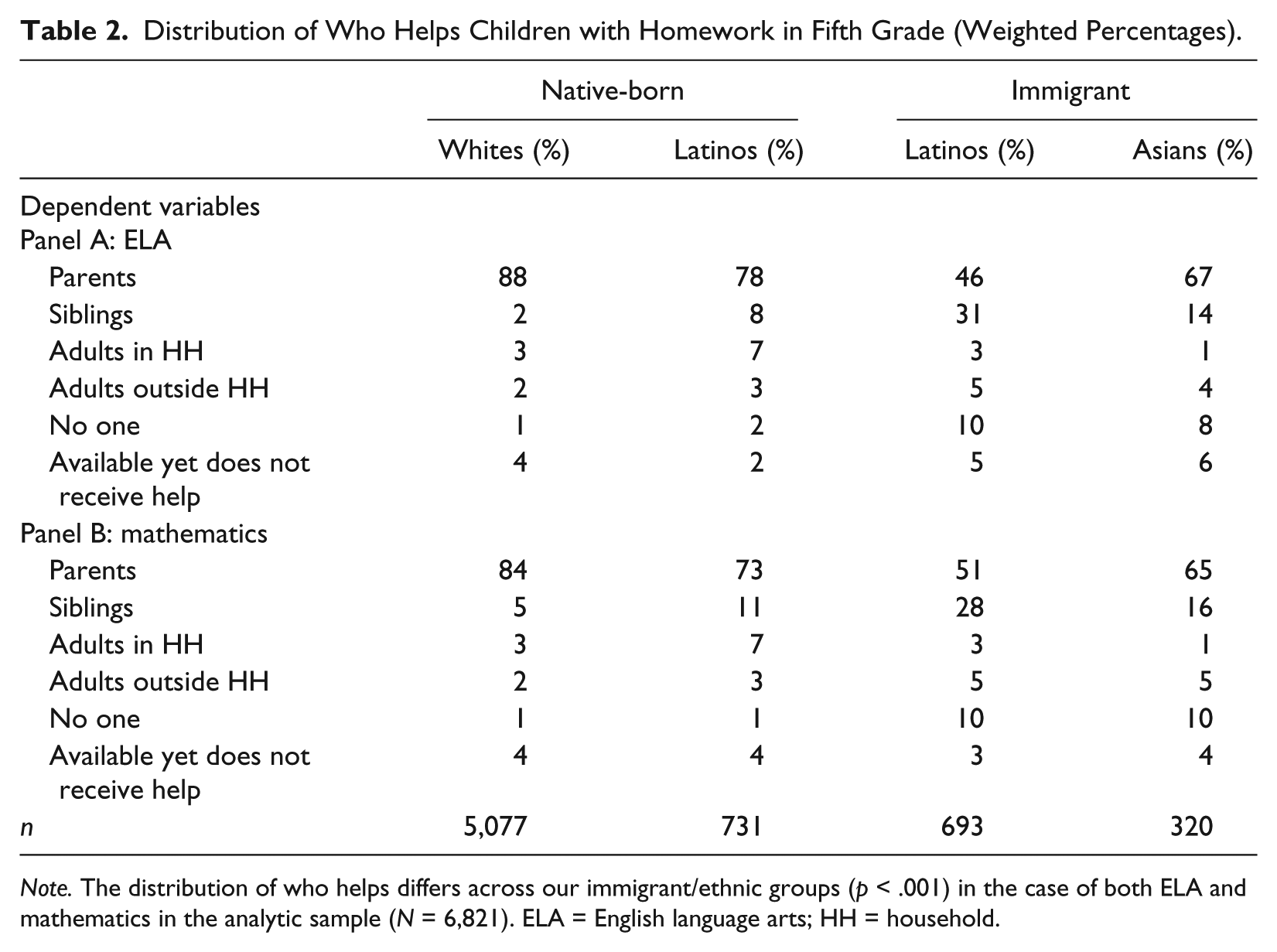
Note. The distribution of who helps differs across our immigrant/ethnic groups (p < .001) in the case of both ELA and mathematics in the analytic sample (N = 6,821). ELA = English language arts; HH = household.
In sum, Table 2 shows that compared with white and Latino children in native-born families, Asian and Latino children in immigrant households are less likely to receive homework help from a parent, more likely to receive homework help from a sibling, and more likely to have no one to help them with homework. The importance of siblings for homework assistance among children living in immigrant families cannot be overstated, especially among Latino families: About one-third of all children primarily rely on a sibling for ELA and math homework support. In supplemental analyses, I find that about 81 percent of these siblings are 17 years of age or younger during the focal child’s fifth-grade year (2004). In other words, we can surmise that about four out of five siblings who are providing homework help to children are also children themselves 5 (ages zero to 17).
Social exchange theory suggests that parental resources explain the distribution of homework help for children. Table 3 shows multinomial regressions of immigrant-native differences in who provides ELA and math homework help to children, using parents as the reference group. The models present relative risk ratios of Latino children in native-born families, Latino children in immigrant families, and Asian children in immigrant households, relative to white children in native-born households. With respect to ELA and math, Model 1 shows that, relative to white children in native-born families, Latino children in both immigrant and native-born families and Asian children in immigrant families are more likely to primarily rely on a sibling (as opposed to a parent) for homework help (Panel A). These results are consistent with Hypothesis 2, which states that siblings are more likely to provide homework help to children in immigrant families, relative to parents, compared with children in native-born families.
Multinomial Regressions Predicting Who Helps with Homework as a Function of Immigrant Status and Ethnic Group.
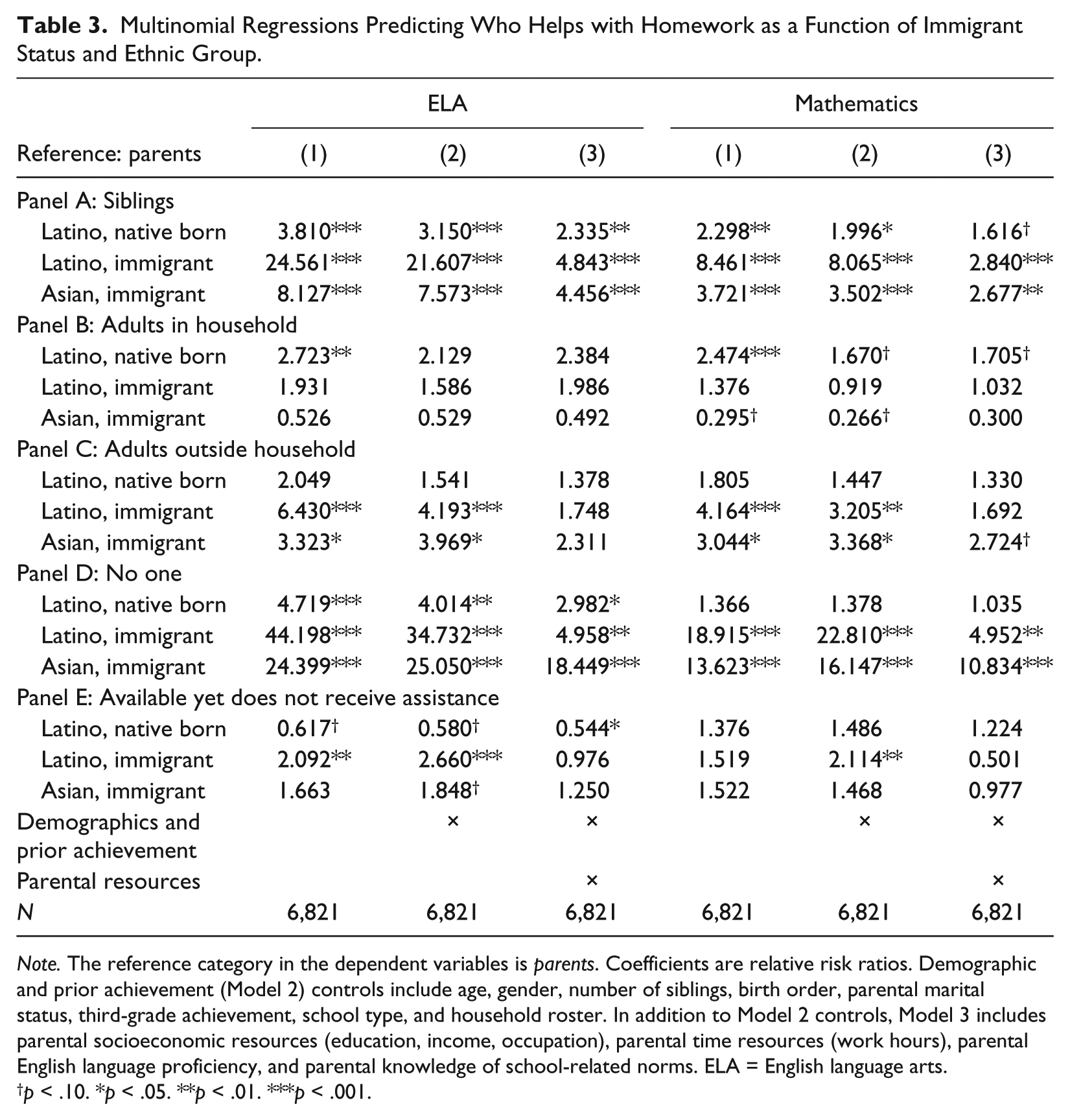
Note. The reference category in the dependent variables is parents. Coefficients are relative risk ratios. Demographic and prior achievement (Model 2) controls include age, gender, number of siblings, birth order, parental marital status, third-grade achievement, school type, and household roster. In addition to Model 2 controls, Model 3 includes parental socioeconomic resources (education, income, occupation), parental time resources (work hours), parental English language proficiency, and parental knowledge of school-related norms. ELA = English language arts.
p < .10. *p < .05. **p < .01. ***p < .001.
In addition, relative to white children in native-born families, Asian and Latino children in immigrant families are more likely to rely on adults outside of the household (Panel C) and more likely to have no one available to help them (Panel D). Finally, with respect to ELA only, relative to white children in native-born households, Latino children in immigrant families are more likely to have someone available to provide help yet not receive any assistance (as opposed to receiving help from parents). Model 2 introduces demographic characteristics, prior achievement, household composition, and school type. These controls do not explain Model 1 bivariate associations.
Do Parental Resources Explain the Immigrant-native Differential in Who Helps with Homework?
Model 3 of Table 3 introduces parental resources to evaluate social exchange theory’s prediction. Hypothesis 3 states that differences in parental resources explain the higher likelihood of children in immigrant families to receive homework help primarily from a sibling (as opposed to parent), compared with children in native-born households. Model 3 does not support this hypothesis. Net of parental socioeconomic resources, work hours, English language proficiency, and knowledge of school-related norms, I find that, relative to white native-born children, Latino and Asian children in immigrant households are more likely to rely on siblings for ELA and math homework help as opposed to a parent (p < .001; Panel A). Furthermore, although I do not present the results here, I find that this heavier reliance on siblings for homework help among children of immigrants, relative to children in native-born households, is exhibited across the socioeconomic distribution, except at the highest quintile, and is most prominent among the poorest households.
Note that Latino children in native-born families are more likely to rely on siblings (as opposed to parents) compared with white children in native-born families, net of parental resources (p < .01 for ELA, and p < .10 for math), but these differences are a consequence of the 2.5 immigrant generation children (children with one native-born and one immigrant parent) in the “native-born” Latino sample (results not shown but available upon request). When I separate 2.5 from third+ immigrant generation Latino children (both native-born parents) in the native-born family category, I find no statistically significant Latino-white differences in reliance on siblings (as opposed to parents) in native-born households for ELA or math homework assistance. Furthermore, I find that 2.5 generation Latinos are more likely to rely on siblings for homework help (as opposed to parents) compared with white children in native-born households (p < .05 for ELA, and p < .10 for math), as suggested by the immigrant bargain predictions.
Furthermore, relative to white children in native-born households, Latino and Asian children in immigrant households are more likely to not have anyone to help them with ELA and math homework help, as opposed to parents, net of parental resources (Panel D). Although these results can be interpreted as children in immigrant families being more likely to rely on themselves (as opposed to a parent) compared with children in native-born families (Hypothesis 4), further examination of the findings tempers this interpretation. If we compare children of immigrants and children of native-born parentage in “having someone available to provide help yet do not receive any assistance,” we observe that parental resources account for any immigrant-native difference (Panel E). The “having someone available to provide help yet do not receive any assistance” category can be interpreted as made up of children who do not need help, or as children who rely on themselves even if someone is available to help them so as to diminish the amount of obligations their family members, especially their parents, must meet in the household. If this category is, in fact, made up of individuals who rely on themselves to minimize parental burdens, then children in immigrant families are no more likely to rely on themselves to minimize parental burdens compared with their native-born white peers. Children of immigrants, in other words, do not contribute to their households by relying on themselves for homework help. They only rely on themselves if their parents do not have the resources to provide them with homework support.
Alternatively, it may be the case that, relative to children in native-born households, children in immigrant families are more likely to have no one (as opposed to a parent) available to provide homework help (Panel D) because parents expect them to be more self-reliant even if they have the resources available to provide help, as suggested by Model 3, which controls for parental resources. Thus, it may not be children’s attitudes about their role in the household that leaves them with no one available to provide help but their parents’, who may expect children to be more self-reliant.
Does Reliance on Siblings for Homework Help Apply to Most Immigrant Families?
To further examine whether reliance on siblings is a family strategy that most immigrant families engage in, I test Latino-Asian differences in children’s reliance on siblings for homework help (as opposed to parents) only among those living in immigrant families. If this is a strategy that most immigrants engage in, I should not observe differences between Asian and Latino children in immigrant families in the likelihood of receiving homework help from a sibling, as opposed to parent, net of parental resources (Hypothesis 5). Model 3 in Appendix Table A1 shows comparisons between Asian and Latino children in immigrant households. These results support Hypothesis 5. In other words, for both ELA and math, if parents in Asian and Latino immigrant households had the same amount of resources, reliance on siblings for homework assistance for children would not differ between these two groups (Panel A).
Examining the case of Latinos only provides further support that reliance on siblings is specific to immigrant families (Hypothesis 6). Model 3 in Appendix Table A1 shows that in the case of both ELA and mathematics, Latino children in immigrant families are more likely to rely on siblings (as opposed to parents) compared with Latino children in native-born families, even after accounting for parental resource differentials (Panel A; p < .05).
The Case of Asian Children of Immigrants and Homework Support
Keeping Min Zhou and colleagues’ research in mind, I hypothesized that Asian children in immigrant families are more likely to rely on adults outside of the household (such as an after-school program teacher), as opposed to a parent, net of parental resources (Hypothesis 7). My results do not provide support for this hypothesis. I find that Asian children are more likely to receive homework help from an adult outside of the household (as opposed to parent) compared with white children in native-born households, but these differences disappear once we account for differences in parental resources (see Table 3, Model 3, Panel C, for ELA and math). Furthermore, in our descriptive findings earlier in this article, I also show that a relatively small percentage of Asian children in immigrant households rely primarily on an adult outside of the household compared with their reliance on parents, siblings, or no one. Finally, Asian children are no more likely to rely on adults outside of the household (as opposed to parents) compared with Latino children in either immigrant or native-born households, net of parental resources (Appendix Table A1, Model 3, Panel C).
With respect to having no one available to help, I find no Asian-Latino differences for children living in immigrant families before accounting for parental resources (Models 1 and 2 in Appendix Table A1, Panel D). We do not observe Latino-Asian differences because Asian children’s parents in immigrant families have more resources than Latino children’s parents in immigrant families, on average. As parental resources increase, children are less likely to have “no one” available to help them with homework (results not shown). Thus, once we account for the fact that Asian children in immigrant families have more resources, we observe that they are actually more likely to have “no one” available to help them with homework (as opposed to parents) compared with Latino children in immigrant families with similar parental resources (Model 3 in Appendix Table A1, Panel D). One possible explanation, as suggested earlier, is that Asian immigrant parents expect self-reliance with respect to homework completion. These counterintuitive results point to the importance of parental resources in helping us understand the academic needs of Asian children.
Discussion and Conclusion
In the United States, the contributions that children make to their households are rarely highlighted (Zelizer 2002). Part of children’s invisibility can be traced to American conceptions of childhood, in which children are “economically useless but emotionally priceless” to the household (Zelizer 1985). Under this view, children are often thought as passive receivers of parental resources, solely active sites of parental investment for the future (Friedman 2013; Lareau 2011). Thus, any visibility that they garner highlights the consumptive roles that they play in their households (Chin 2001). This valuation of childhood delegates children to the periphery of their household’s productive roles, which renders any contribution largely invisible (Pugh 2014). This dominant view of children and their contributions to their households rarely takes into account immigrant families and the role that children play in their homes.
In contrast to this passive, consumptive view of children, I argue that, in immigrant families, children are important contributors to their households. In particular, relative to white children in native-born households, I find that children in immigrant families are more likely to receive homework help primarily from a sibling—another child in the household—as opposed to a parent. Children in immigrant families take on a “tutoring” role for their siblings (Valenzuela 1999). This role is an example of the contributions that children in immigrant families make to their households, a contribution that children in native-born families do not, by and large, provide. Importantly, this tutoring role applies to both Asian and Latino children in immigrant families.
Comparing the case of Latino and Asian children in immigrant families suggests that the contributions that children of immigrants provide to their households are directly tied to their experience as immigrants in the United States (Dreby 2015). In particular, I find that the reliance on siblings, as opposed to a parent, for homework help does not vary between Asian and Latino children with equally resourced parents. Comparing Latino children in immigrant and native-born families further bolsters my argument. Latino children in immigrant families are more likely to rely on a sibling, as opposed to a parent, for help compared with Latino children in native-born families. Both of these comparisons suggest that the immigrant experience is intimately implicated in the contributions that children make to their households.
Clear from my regression analyses is the fact that differences in resources between immigrant and native-born parents do not explain the expanded role of children of immigrants in their households. Although I do not test this explicitly, it may be that children of immigrants’ expanded role is a result of an immigrant bargain, which states that parents’ difficulties associated with migration will be vindicated through their children’s socioeconomic mobility in the United States (Smith 2006). Parents often remind their children of the sacrifice that they made by coming to this country and the obligations and responsibilities that children must endure to make this sacrifice worth the trouble. Children may, in turn, internalize these obligations and responsibilities, which spurs them into action in their homes, schools, and jobs. They keep their end of the “bargain” in a number of ways, including doing well in school, taking responsibility for their schooling, and supporting their households (Louie 2012). In this manner, children come to be central and contributive players in their household’s sources of support. These findings also suggest that the segmented assimilation’s concept of “role reversal” may be a specific instance of the larger role that children of immigrants play in their households along the life course.
Furthermore, the fact that we observe contributions among both Asian and Latino children in immigrant families suggests that it is not a result of a cultural feature specific to Latinos or Asians. Instead, these findings suggest that family dynamics change the farther they are from the immigrant journey. In other words, immigrant family processes are much more negotiated and interactive. Robert Smith (2006:126), for example, writes, “Cultures of the countries of origin and destination are themselves both evolving and internally inconsistent.” Immigrant family dynamics, in short, are constantly negotiated. This description fits the relational work perspective newly introduced in economic sociology (Bandelj 2012; Zelizer 2005, 2012). This perspective suggests that family members constantly negotiate the meaning of their relationships—and the appropriate corresponding behavior—through everyday interactions, responding to emerging and enduring household circumstances. Migration-related difficulties and opportunities, in other words, require that family members renegotiate their roles, positions, attitudes, and expectations in relation to one another in the family, and behave according to this shift in their relationships subsequent to migration.
The fact that children in immigrant households heavily rely on their siblings for homework help does not contradict the fact that parents are also involved in their children’s schooling. Consistent with social exchange theory, I find that a large proportion of children in the United States are receiving homework help primarily from their parents. However, reliance on parents for homework help differs by immigrant status. When parents do not provide this resource, other adults step in. Unequal parental resources explain the immigrant-native differences in the role of other adults—in and out of the household—in helping children with homework. In other words, these actors provide homework assistance when parents are unable to, which is not what I find for the reliance on siblings of the household. It is not just a matter of lack of parental resources that spurs children step into contributive roles. Future research should directly test whether attitudinal factors associated with the immigrant experience, including the immigrant bargain, further explain the immigrant-native differences in the role of children in their households.
This study makes a number of contributions. The few studies that have examined the contributions of children of immigrants to their households usually (1) explore resources that are specific to immigrant households (i.e., language brokerage); (2) are based on small samples, usually made up of poor families; (3) lack a direct comparison to native-born households; or (4) are based on ethnographic studies that cannot be generalized to the U.S. population. To advance the sociological literature on immigrant families, especially the contributions of children to their homes, I address each of these shortcomings in turn. The case of homework help is particularly instructive because it is a resource that all children need and may be able to provide to their siblings. Thus, homework help allows me to compare patterns of support in both immigrant and native-born households directly. ECLS-K provides a rare opportunity to examine immigrant-native differences in patterns of support. Building upon excellent ethnographic insights, this is the first nationally representative study of the immigrant-native differences in the contributions children make to their households.
Due to the growing presence of children of immigrants in the United States (Rong and Preissle 2009), it is imperative to bring immigrant families into larger studies of household dynamics (Glick 2010). For one, understanding immigrant family life may provide a glimpse into forthcoming changes in American family life. With respect to children, the growing presence of immigrant families may challenge the dominant view of children as only passive consumers of parental resources. We might see, for example, a growing acceptance of more consequential responsibilities for children in their homes. On the contrary, it might be that contributions that children make to their families may be yet another mechanism that exacerbates family inequalities. Responsibilities that children of immigrants endure in their households might hinder their own socioeconomic mobility (Agius Vallejo and Lee 2009; Flores and Hondagneu-Sotelo 2014). Helping siblings with homework, for example, may detract from their own academic needs. Furthermore, receiving help from a sibling may not be as useful as receiving help from a parent.
These findings suggest that children in immigrant families have responsibilities that their peers with native-born parentage do not. The consequences of these responsibilities are an empirical question. Policy makers should design programs that help parents support their children. For example, parental access to English language courses would diminish the need for siblings to provide English language expertise in the home. With respect to education, schools should develop inviting environments so that immigrant parents can feel welcomed and better advocate for their children. Specifically with respect to homework, schools can develop in-school homework completion after-school programs to support immigrant and poor students. Beyond programs that aim to provide resources to immigrant parents, it is most important that educational (and other) institutions develop culturally relevant responsive strategies that take into account the specific family dynamics of the child.
In sum, relative to children in native-born families, my findings support the “expanded” role of children of immigrants in their households, a proposition that a number of scholars suggest but do not directly test. Using the case of homework help, I find that the patterns of support differ in immigrant and native-born families. In particular, children in immigrant families, far from being passive receivers of parental resources only, are central contributors of needed resources to their households.
Footnotes
Appendix
Multinomial Regressions Predicting Who Helps with Homework as a Function of Immigrant Status and Ethnic Group.

| Reference: parents | ELA |
Mathematics |
||||
|---|---|---|---|---|---|---|
| (1) | (2) | (3) | (1) | (2) | (3) | |
| Panel A: siblings | ||||||
| Latino, native born vs. Asian, immigrant differences | LN- |
LN- |
LN- |
ns | ns | ns |
| Latino, native born vs. Latino, immigrant differences | LN- |
LN- |
LN- |
LN- |
LN- |
LN- |
| Latino, immigrant vs. Asian, immigrant differences | ns | ns | ||||
| Panel B: adults in household | ||||||
| Latino, native born vs. Asian, immigrant differences | ||||||
| Latino, native born vs. Latino, immigrant differences | ns | ns | ns | ns | ns | ns |
| Latino, immigrant vs. Asian, immigrant differences | ns | ns | ns | |||
| Panel C: adults outside household | ||||||
| Latino, native born vs. Asian, immigrant differences | ns | ns | ns | ns | ns | ns |
| Latino, native born vs. Latino, immigrant differences | LN- |
LN- |
ns | LN- |
LN- |
ns |
| Latino, immigrant vs. Asian, immigrant differences | ns | ns | ns | ns | ns | ns |
| Panel D: no one | ||||||
| Latino, native born vs. Asian, immigrant differences | LN- |
LN- |
LN- |
LN- |
LN- |
LN- |
| Latino, native born vs. Latino, immigrant differences | LN- |
LN- |
ns | LN- |
LN- |
LN- |
| Latino, immigrant vs. Asian, immigrant differences | ns | ns | LI- |
ns | ns | LI- |
| Panel E: available yet does not receive assistance | ||||||
| Latino, native born vs. Asian, immigrant differences | LN- |
LN- |
LN- |
ns | ns | ns |
| Latino, native born vs. Latino, immigrant differences | LN- |
LN- |
ns | ns | ns | ns |
| Latino, immigrant vs. Asian, immigrant differences | ns | ns | ns | ns | ns | ns |
| Demographics and prior achievement | × | × | × | × | ||
| Parental resources | × | × | ||||
| N | 6,821 | 6,821 | 6,821 | 6,821 | 6,821 | 6,821 |
Note. Bold letters indicate a higher likelihood to receive homework help from the household member indicated in the panel (as opposed to a parent) between the two groups. Models 1, 2, and 3 include the corresponding controls found in Table 3. ELA = English language arts; LN = Latino, native born; AI = Asian, immigrant; LI = Latino, immigrant.
p < .10. *p < .05. **p < .01. ***p < .001.
Acknowledgements
I thank Cynthia Feliciano, Edelina Burciaga, Mariam Ashtiani, Matthew Rafalow, Rubén Rumbaut, Judith Treas and Nina Bandelj and the anonymous reviewers for their helpful comments on earlier versions of this manuscript.
Declaration of Conflicting Interests
The author(s) declared no potential conflicts of interest with respect to the research, authorship, and/or publication of this article.
Funding
The author(s) received no financial support for the research, authorship, and/or publication of this article.