



Abstract
Using 77 status-imbalanced dyads, we experimentally test the effect of status on identity stability, setting the stage for research on identity change. From an identity theory perspective, we hypothesize that those with higher status will maintain greater identity stability over the course of a task-oriented interaction than their relatively lower status partners. We further test the role of identity-discrepant information. Results indicate that higher status actors are better able to maintain stable identity meanings than those with lower status. However, this relationship dissipates when situational meanings contrast with high-status actors’ self-views. More generally, this indicates that high status positively affects identity stability, yet high-status actors remain vulnerable to situational inputs.
Research shows that structural hierarchies manifest at the micro level through identity processes. In particular, those occupying higher positions of status and power are better able to define the situation and are better able to verify identity meanings in relation to their less powerful and lower status counterparts (Burke, Stets, and Cerven 2007; Cast 2003; Cast, Stets, and Burke 1999; Stets and Harrod 2004). From an identity theory perspective (Burke and Stets 2009), we begin to examine how social position affects identity change. We do so by testing the effect of status upon identity stability within a single interaction. Persistent identity instability is a key mechanism of identity change (Burke 2006). The results of our study therefore harbor implications for the effects of social structures on enduring identity processes and set the stage for longitudinal examinations of the topic. This is a topic of broad sociological relevance, pertaining to the myriad circumstances in which status differences inform interpersonal interaction such as the family, the workplace, educational settings, and everyday encounters between people of different races, genders, and social class positions.
We hypothesize that those with higher status will experience greater identity stability than their lower status counterparts. That is, higher status actors will maintain more consistent identity meanings through the course of interaction, thereby staving off identity change. Given this hypothesis, we are additionally interested in how to disrupt the status-identity stability relationship. We therefore test the effects of identity-discrepant information. We predict that introducing identity-discrepant information, or information that contrasts with a high-status actor’s identity meanings, will alleviate the status advantage.
Because of their highly controlled conditions, experimental methods are ideal for testing theoretical relationships (Webster and Sell 2014). Therefore, we test our hypotheses experimentally with status-imbalanced, task-oriented dyads (N = 77 groups/144 participants) in which participants enact “task-role” identities. Task-role identities refer to the meanings attached to the self as a member of a task group. We look specifically at the dimension of dominance, ranging in valence from dominant to submissive. We test our hypotheses for those with both highly dominant and highly submissive task-role identity meanings to account for the assumption within identity theory that identity processes are not directly affected by valence (Burke and Stets 2009).
Identity Theory
Structural symbolic interactionists understand the self as socially constructed within existing social structures (Stryker 1980). Identity theory makes sense of identity processes within this framework (Burke and Stets 2009). Research within identity theory contends that each situation invokes particular role identities, for which the actor holds an internalized set of meanings. The actor then works to verify identity meanings through the interaction (Stryker and Burke 2000).
Stryker and colleagues argue that the self is made up of several identities organized into a hierarchy of salience (Merolla et al. 2012; Stryker 1980; Stryker, Serpe, and Hunt 2005). Persons seek out situations in which they can enact their most salient identities (Stryker 1980). The hierarchical location of each identity is a function of one’s commitment to it, and commitment is a function of frequency of enactment as well as network ties associated with the identity (Stryker and Serpe 1994). Social actors call out identities based upon situational relevance. Once the actor calls out the identity, the identity verification process begins (Stryker and Burke 2000). Identity change, the construct of interest in the present work, is a key component of the verification process.
Upon entering a situation, social actors call forth particular relevant identities.
Each identity holds a set of meanings—referred to as an identity standard. The actor works to verify the identity standard through negotiated interaction (Burke and Stets 2009). The goal is to achieve identity verification, or congruence between identity meanings and situational meanings. Emotion is the motivating mechanism that drives identity verification efforts, as verification of identity elicits positive emotion (Burke 2004; Burke and Harrod 2005; Burke and Stets 1999; Robinson and Smith-Lovin 1992; Stets and Burke 2005b; Swann 1987), while lack of verification elicits negative emotion (Burke 1991, 2004; Burke and Harrod 2005; Stets and Burke 2005a).
Identity theory envisions the interaction process as a cybernetic feedback loop through which actors present themselves in accordance with an identity standard, receive feedback from their interaction partner(s), and adjust actions accordingly to achieve identity verification. It is through this process of negotiated interaction that social actors collaboratively construct selves within situations. More formally, identity verification processes are represented by four key components: identity standard, inputs, comparator, and outputs (Burke and Stets 2009).
The identity standard represents the meanings associated with a particular identity. These meanings may be positive or negative. Taking the example of task-role identity, one might see the self as highly dominant or alternatively, highly submissive (Swann and Hill 1982). In practice, identity meanings are located upon a continuum between poles of meaning. For instance, one may see the self as more dominant than submissive, more submissive than dominant, or equally dominant and submissive.
Inputs are the perceived situational meanings that actors utilize to determine the extent to which their identity standards are interactionally verified. These situational meanings may include environmental cues, one’s own behavior, and the behavior of others. For example, grades, participation patterns, and teacher responses are situational inputs for the student identity, while performance evaluations, contributions in meetings, and promotion decisions are situational inputs for the worker identity. Of particular relevance are reflected appraisals, or actors’ perceptions about how others see them.
Reflected appraisals and other inputs are placed into the comparator, the mechanism by which actors compare situational inputs to their identity standards. When actors perceive congruence between situational meanings and self-views, they achieve identity verification. When actors perceive incongruence between situational meanings and self-views, they experience nonverification.
As noted, identity verification elicits positive emotion, whereas nonverification elicits negative emotion. As such, when actors perceive discrepancies between situational meanings and their identity standard, they work to repair this schism through outputs. Outputs can be cognitive or behavioral, and take three forms: interpretive adjustments, behavioral adjustments, and identity adjustments (Burke and Stets 2009). For instance, a person can reinterpret situational inputs to better match identity meanings, or work harder to behaviorally display the meanings held in the identity standard. When identity nonverification persists, the person may change the meanings that make up the identity standard (Burke 2006). It is this last option—identity change—that we examine in relation to status.
Identity Change
Although identity theory presumes that identities are generally stable, there remains the capacity for dynamism, and even long-term identity change. One can change the meanings of an identity (i.e., the identity standard) or the salience of a given identity (Burke 2006; Burke and Cast 1997; Cast and Cantwell 2007; Serpe 1987). Existing research shows that changes in identity salience are affected by the “openness” of the social structure (Serpe 1987; Serpe and Stryker 1987, 1993). When people have the freedom to enact an array of identities, their salience hierarchy is more fluid. When people have less choice in the identities that they enact, the salience hierarchy is more stable. Like the research on identity salience, our study examines how structural conditions affect identity change. Our study, however, looks specifically at changes in the identity standard, and examines social structure from a status perspective.
Change to the identity standard is a slow process that generally takes place over a series of interactions through prolonged nonverification (Burke 2006). In our study, we treat situational identity instability as one instance on the route to identity change. Changes to the identity standard are most likely under two key conditions: large and/or persistent identity-discrepant situational inputs, and simultaneous enactment of multiple, contradictory roles (Burke 2006).
When situational inputs are too great to overcome and/or persist over time, social actors may change their identity standard to better fit with situational meanings. For example, major life events like having a child make it difficult to maintain existing role identity meanings and result in identity change (Burke and Cast 1997). Identity change is also a mechanism by which social actors manage the enactment of multiple roles (Smith-Lovin 2003). The self is made up of multiple role identities, many of which overlap, but do not perfectly coincide. For example, a woman may play both the role of worker and the role of mother, enacting different versions of womanhood in both instances. To reconcile these roles, she would change both her mother and worker identity standards, reaching a compromise identity for each (Burke 2006). Degree of change for each role, however, is not uniform, but depends on factors such as commitment (Burke and Reitzes 1991; Burke and Stets 1999; Stryker and Serpe 1982), degree of salience (Callero 1985; Stryker and Serpe 1982, 1994), and ties from one identity to other identities (Burke 2003; Smith-Lovin 2003; Thoits 1986). Specifically, those roles to which one is more committed, that hold greater salience, and are more tied in with other identities, tend to be more stable.
When identity change does occur, it can take two forms: strength and dimension (Burke 2006). Strength refers to the degree to which one identifies with a particular set of meanings. Dimension refers to the facet of a particular identity that is most relevant. For instance, the strength of a task-role identity refers to how strongly a person identifies as dominant or submissive, while dimension refers to the various relevant facets of a task-role identity (e.g., task orientation vs. dominance). In examining identity stability, we look specifically at changes in strength as they pertain to the dominance dimension.
Understanding the structural conditions that affect situational identity stability is an important first step in understanding the long-term effects of structure upon identity change. As such, we test the effects of status upon identity stability, and the conditions under which status effects can be disrupted. Following the work of Burke, Cast, Stets and others (e.g., Burke, Stets and Cerven 2007; Cast 2003), we predict that those occupying high-status positions will maintain greater identity stability than their lower status interaction partners. We further examine the conditions under which this relationship can be disrupted, with a focus on information.
Status and Identity
Status Characteristics and Expectation States Theory (SCES) contends that those with higher status receive higher performance expectations and in turn, greater deference than their lower status counterparts (Berger et al. 1977). Status is conveyed by one’s position within the social structure and pertains to the possession of valued characteristics such as race (white), class (high socioeconomic status [SES]), and gender (male), as well as rank within a task group, such as leader or boss. SCES’s burden of proof assumption states that status effects will form unless proven irrelevant to the task at hand (Berger et al. 1977).
Applying these principles, research within identity theory demonstrates that actors’ hierarchical positions affect the ease (or difficulty) with which they can achieve identity verification. Those with higher status and more power are more likely to verify their identity meanings than those with lower status and less power. The effects of status and power upon identity verification have been demonstrated experimentally (Burke et al. 2007) through survey research (Stets and Harrod 2004) and through a longitudinal study of newly married couples (Cast 2003; Cast et al. 1999). Together, these studies show that factors such as gender, race/ethnicity, SES, position of authority, and relative level of emotional dependence affect the likelihood of achieving identity verification.Such findings locate identity processes alongside robust research programs that have long documented the impact of structural hierarchies on interpersonal interaction (e.g., Berger et al. 1977; Gerber 2001; Johnson 1994; Love and Davis 2014; Ridgeway 1987). In this vein, we test the relationship between status and identity stability. Our first hypothesis predicts the following:
Although research within identity theory shows the transposition of structural inequality into interpersonal processes, it also identifies conditions under which this relationship can be disrupted. Stets and Harrod (2004) found that structural position affects instrumental identities but does not transfer to expressive identities such as “friend.” 1 Similarly, Burke et al. (2007) showed that the status effects of gender can be counteracted when women are placed into legitimate positions of authority. We examine how identity-discrepant information, as a situational input, disrupts the status advantage. This relies directly on SCES’s burden of proof assumption referenced above. Leadership position conveys status, activating performance expectations. We contend that disruptive situational inputs in the form of identity-discrepant information will work as evidence that high status should not be conferred. Therefore, our second hypothesis predicts the following:
Task-role identity is appropriate for these tests. In line with previous work in identity theory, task role is an instrumental identity and therefore affected by status processes. Similarly, as an instrumental identity, task role adheres to SCES’s traditional application within task-oriented interaction.
Method
Our experimental design first, tests the relationship between status and identity stability and second, examines one possible avenue through which status hierarchies can be disrupted at the interpersonal level. The study adheres to a 2 × 2 factorial design, with identity valance (dominant/submissive) blocked, and status position (high/low) and condition (intervention/baseline) randomized. In the intervention condition, we introduce information discrepant with the high-status actor’s identity standard. We introduce no new information in the baseline condition.
Experimental methods allow us to isolate our variables of interest and are therefore ideal for our task of theoretical hypothesis testing (Thye 2014; Zelditch 2014). Social life is highly complex and identity processes necessarily entangle with an array of circumstances in people’s everyday lives. The main strength of experiments is their artificiality (Webster and Sell 2014). By carefully controlling conditions, experimentalists can precisely identify the relationship between two or more variables. Therefore, instead of generalizing to an empirical population, experimental findings generalize back to theory. By generalizing to theory, social scientists can apply their findings anywhere the variables instantiate. Applying the theory under new conditions—both in the lab and in the field—lets researchers learn about the conditions under which the theory maintains predictive power and alternatively, the conditions under which the theory does not hold. When testing a new relationship, as we are with status and identity stability, experimental methods are therefore particularly useful (Webster and Sell 2014).
In this vein, the homogeneity of our sample and simplicity of design are intentional. Our study examines one-shot interactions between strangers of similar demographics who vary on only a single status characteristic. Certainly, this differs from the status-imbalanced interactions between spouses, bosses and employees, and students and teachers who often vary on multiple status characteristics and engage in prolonged interaction over time. However, laboratory controls allow us to isolate the variables of interest (status and identity stability). In doing so, our findings lay a foundation to better understand and possibly intervene, in microprocesses of status imbalance. This sets the stage for subsequent studies in which we, or other researchers, apply our findings under more complex conditions. If the findings persist through different conditions, we can establish strong support for the theory as is. However, if findings differ across conditions, we can identify and test the theoretical mechanisms that account for these differences and refine the theoretical formulation accordingly. Of note, we made design decisions in an effort to invoke a relevant identity and activate status processes. While we expect our theoretical findings to generalize to other status-imbalanced situations, procedures may be altered to fit the unique circumstances of participants who make up other samples.
Participants
We recruited participants from undergraduate classes at a large southwestern university (N = 144 participants/77 groups). Recruitment was done in person, and scheduling was done by phone. Controlling for external sources of status advantage required the selection of a homogeneous sample. We therefore selected only white undergraduate men between the ages of 18 and 23 and gave participants no information about one another’s year in school. As per the strengths of experimental design, our sampling decision reflects the practice of generalizing to theory rather than an empirical population.
We determined task-role identity meanings by distributing a task-role identity scale at the time of recruitment (adapted from Burke 2003; Burke et al. 2007; Riley and Burke 1995). The scale asks participants to think about how they behave when interacting in task groups. They are presented with a series of statements which include “I try to maintain my own opinion even though many other people may have a different point of view”; “When I work on committees, I like to take charge of things”; “I try to influence strongly other people’s actions”; “When I work with a group of people, I like to have things done my way”; and “I try to be the dominant person when I am with people.” Participants are asked to evaluate the accuracy with which each statement describes them on a scale from 1 (not at all accurate) to 7 (extremely accurate). Cronbach’s alpha for these items is .837, and final scores range from 7 to 35. High scores indicate dominant task-role identity meanings, and low scores indicate submissive task-role identity meanings. Based upon pretest data, we identified a range of scores that represent the top and bottom 25 percent. Those with scores that land in the upper quartile range (top 25 percent) are said to have dominant task-role identity meanings. Those with scores that land in the lower quartile range (bottom 25 percent) are said to have submissive task-role identity meanings. We selected only participants who fell within these ranges (excluding those with middle-ranging scores) so we could pair participants with partners who share similar identity meanings.
We scheduled participants in groups of two based upon high or low scores on the task-role identity scale. Those with dominant task-role identity meanings were paired with a partner who also holds dominant task-role identity meanings. Those with submissive task-role identity meanings were paired with a partner who also reported submissive task-role identity meanings. In this way, we were able to measure how status affects identity stability, when both partners start from the same base identity standard.
Procedures
All studies were conducted by a male research assistant. Once at the laboratory, participants completed the consent process and viewed a short instructional video. Through this instructional video and reiteration by the research assistant, participants were informed that they would work together to complete a complex task, and that payment was based on their collaborative performance.
After administering the instructions, the researcher assigned each participant to either the position of leader (high status), or that of assistant (low status). This designation was based upon a random number generator. The researcher informed participants that the designation was random and reminded them that they both reported similarly on the task-role scale, indicating that the participants maintained alternately dominant or submissive task-role identities. This was framed as “more comfortable in a dominant/supportive role.”
Although participants worked together on the task, the person assigned to the position of leader was given the final word on all decisions, reinforcing status differences. To ensure motivation, participants were told that payment depended upon how well they completed the collaborative task (minimum = US$10, maximum = US$20). In reality, all participants received the maximum payment of US$20. After finishing the primary task, all participants completed the task-role identity scale for a second time.
Following the study, the research assistant thanked, paid, and debriefed participants. He probed for suspicion and asked participants a series of questions to ensure that the status and information manipulations were effective. These included questions about their position (leader or assistant), what this position meant (who had the final say on all decisions), and when relevant, how they performed on the practice task. All participants understood their relative status positions and the meaning of their performance on the practice task, and no one reported suspicion.
Tasks
All groups completed a collaborative primary task. Participants first completed the primary task individually, and then together. This task, Shoot the Moon, presents participants with a hypothetical survival situation based on a spacecraft that crashes on the moon. Participants are asked to rank a list of items in order of usefulness. This task has objectively correct responses as judged by NASA. Participants were first given seven minutes to complete this task individually in order to “get a feel” for the task and develop some preliminary ideas. Once both participants finished the task, the researcher instructed them to begin working together to complete Shoot the Moon as a group. From the beginning, they were told that payment depended only upon the final answers produced collaboratively.
In the intervention condition, participants completed an individual practice task prior to attempting the primary task. In this practice exercise, participants were asked to make difficult decisions in light of several fictitious situations, such as a zombie apocalypse, trapped on an island, and so on. Participants were told that the practice task was similar in format to the primary task, and that it measured leadership performance as determined by experts at the Harvard Business School. We treat leadership performance as a situational input relevant to task-role identity. Strong leadership performance supports dominant task-role identity meanings, and poor leadership performance supports submissive task-role identity meanings. Therefore, practice-task performance scores offer an opportunity to confirm or disconfirm participants’ respective identity meanings.
The practice task has no objectively correct answers, and scores were uniform and predetermined as part of the procedural design. The researcher pretended to score these practice tasks and announced their results publicly. In addition, he wrote the scores visibly on index cards and showed them to participants. Group leaders received identity-discrepant scores, while assistants received identity-congruent scores. That is, if the group members both held dominant task-role identity meanings, the leader was said to have scored below average, and below the assistant, indicating a poor leadership performance, while the assistant received a score that was above average and higher than the leader’s. If the group members both held submissive task-role identity meanings, the researcher announced that the leader scored above average and above the assistant, indicating a strong leadership performance, while the assistant scored below average and below the leader. We use these manipulated appraisals to intentionally introduce situational inputs that contrast with the leader’s identity standard. This contrast is made especially sharp by coupling it with a reminder of original task scores and providing identity-confirming feedback for the assistant. Participants in the baseline condition did not complete the practice task and began immediately on the primary task.
Dependent Variable
The dependent variable is identity stability, conceptualized as the difference between the task-role identity standard at time of recruitment and the task-role identity standard following participation in the experiment. We construct the stability variable by comparing scores at the time of recruitment (Time 1 [T1]) with scores taken poststudy (Time 2 [T2]), obtaining the absolute difference. We then average these scores for all participants and compare each individual score to the sample mean. With this comparison, we operationalize the dependent variable as the likelihood of experiencing greater than average deviations from the identity standard. At or below average deviation indicates identity stability. Higher than average deviation indicates identity instability. Each group produces one stability score for the leader and one stability score for the assistant.
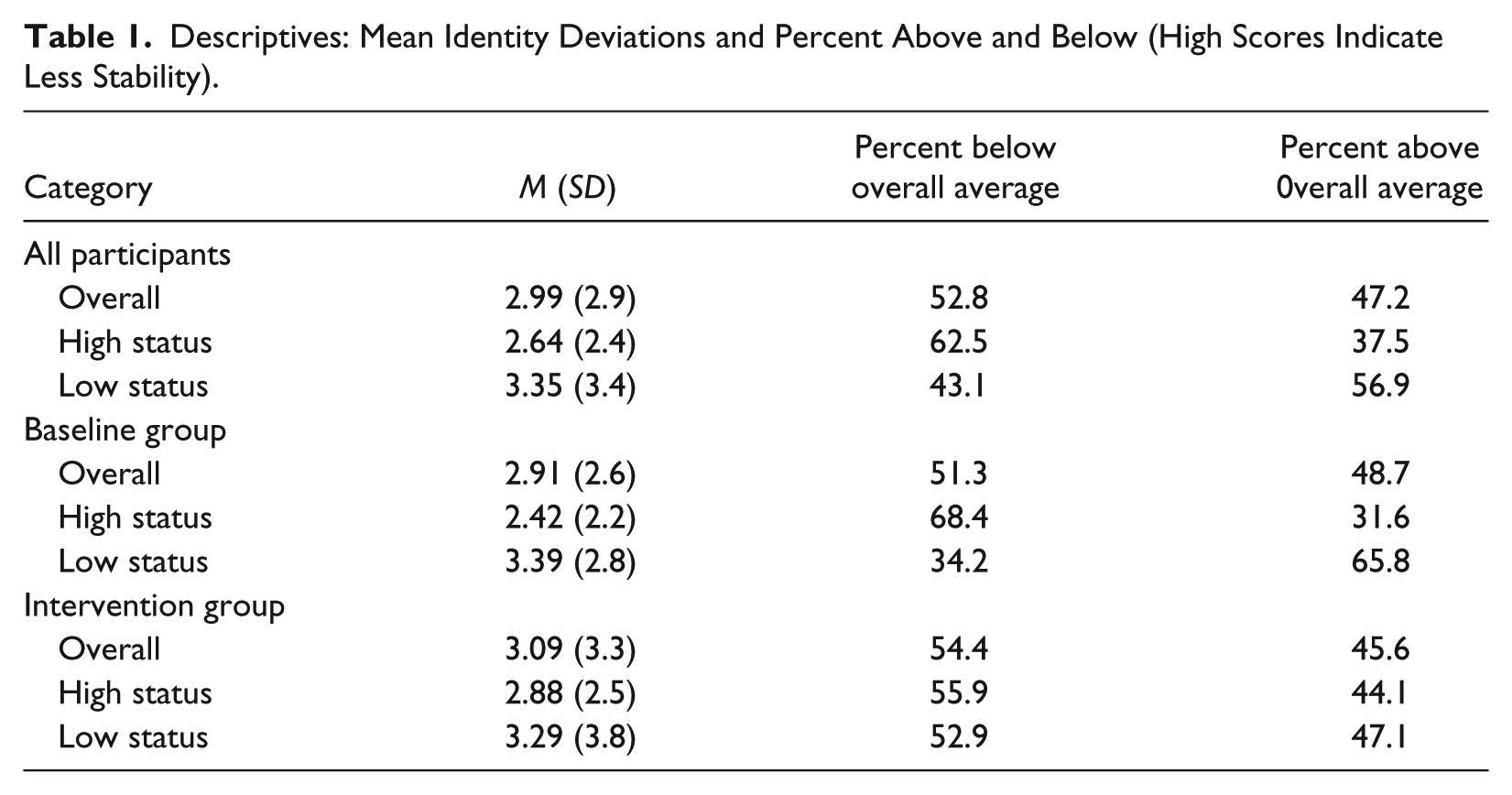
We construct our stability variable in this way because we know that even stable identities remain responsive to interaction (Burke 2006; Burke and Stets 2009). This is reinforced by the sample mean (a humble 2.9 points out of 16 possible, small but greater than 0—see Table 1). We assume that any interaction will provoke small deviations from the identity standard, if only temporarily. By using these deviations as a base, we treat them as “noise” and examine instead the conditions that provoke, or protect against, more substantial deviations. 2 Identity stability is a dichotomous variable in which greater than average deviation is assigned a score of 1, and at or below average deviation is assigned a score of 0.
Descriptives: Mean Identity Deviations and Percent Above and Below (High Scores Indicate Less Stability).
Independent Variables
The first independent variable is status. This varies between high status and low status. Each group consists of a randomly assigned leader and an assistant. We designate the person in the position of leader as high status, and the person in the position of assistant as low status. This is a dichotomous variable with leaders assigned a score of 1, and assistants assigned a score of 0. We assume that one can enact both the roles of “leader” and “assistant” in dominant or submissive ways. For instance, a leader may be strong and decisive or alternatively, a “pushover,” while an assistant may be loyal and subservient or alternatively, independent and defiant. Therefore, all participants have an opportunity to enact task-role identity meanings while occupying high or low positions within the status hierarchy.
The second independent variable is condition, or the presence/absence of identity-discrepant information. In the intervention condition, the researcher presents participants with information that is discrepant with the leader’s identity standard. The intervention is instantiated through the public announcement of practice-task scores. Again, the researcher does not actually score the practice tasks, but pretends to do so. In the baseline condition, participants do not engage in a practice task. This is a dichotomous variable, with the intervention condition assigned a score of 1, and the baseline condition assigned a score of 0.
Results
We put forth two hypotheses. H1 predicts that high status results in greater identity stability, as indicated by no-more-than-average identity deviations between T1 and T2. We therefore expect a direct effect in which leaders’ stability scores are significantly lower than assistants’ stability scores across groups. H2 predicts that identity-discrepant information will decrease status effects. We therefore expect an interaction between status and intervention, such that status no longer predicts the likelihood of experiencing identity stability. A significant interaction effect will indicate that the presence of identity-discrepant information does, indeed, affect the relationship between status and identity stability.
Identity theory assumes that identity processes are not directly affected by identity valence (i.e., direction of identity meanings; Burke and Stets 2009). To account for the range of identity valences, we test our hypotheses in groups that vary in identity meanings between dominant and submissive. 3 Table 1 shows the average identity deviations for each condition and also shows the percentage of each that fall above or below the average amount of deviation (2.9 points). Notice the large disparity in the baseline condition between high- and low-status participants. Also notice that this pattern does not hold true in the intervention condition in which an identity disruption is present.
Although our primary interest is degree of identity stability (i.e., amount of deviation), we also examine positive and negative directional changes in task-role identity scores. This is relevant only to the leaders in the intervention condition, as these were the participants who received identity-discrepant information. Research shows that when reflected appraisals differ from the identity standard, identity change occurs in the direction of the appraisals (Cast and Cantwell 2007). This pertains equally to reflected appraisals that are more positive and more negative than the identity standard. In line with this, we expect deviations in our sample to move in the direction of the feedback. That is, for the leaders with dominant task-role identities, we predict a decrease in task-role identity scores at T2, as indicated by a negative mean score. For leaders with submissive task-role identities, we predict an increase in task-role identity scores at T2, as indicated by a positive mean score. As expected, leaders in the intervention condition experience identity change in the direction of the manipulated feedback. For the leaders in intervention groups with dominant initial task-role identities, M = −1.00. The negative mean indicates an average decrease in task-role identity from T1 to T2. For the leaders in intervention groups with submissive initial task-role identities, M = 1.93. The positive mean indicates an average increase in task-role identity from T1 to T2. These findings support identity theory’s valence assumption.
Our hypotheses, however, do not predict direction, but degree of stability. Thus, we concern ourselves with absolute values rather than raw differences. Specifically, we are interested in predicting whether identity deviations are above average.
Because we are concerned with whether individuals experienced above-average change to the identity standard, we conducted a logistic regression with status and intervention condition as predictors of identity stability. These results can be interpreted as predicting the likelihood of experiencing above-average identity deviations, because the participants who exhibited above-average scores are coded as 1. As the experiment was conducted with dyads and not individuals, we allow the error terms to correlate within groups (see Table 2).
Logistic Regression for Likelihood of Above-average Identity Deviations (High Scores Indicate Less Stability).
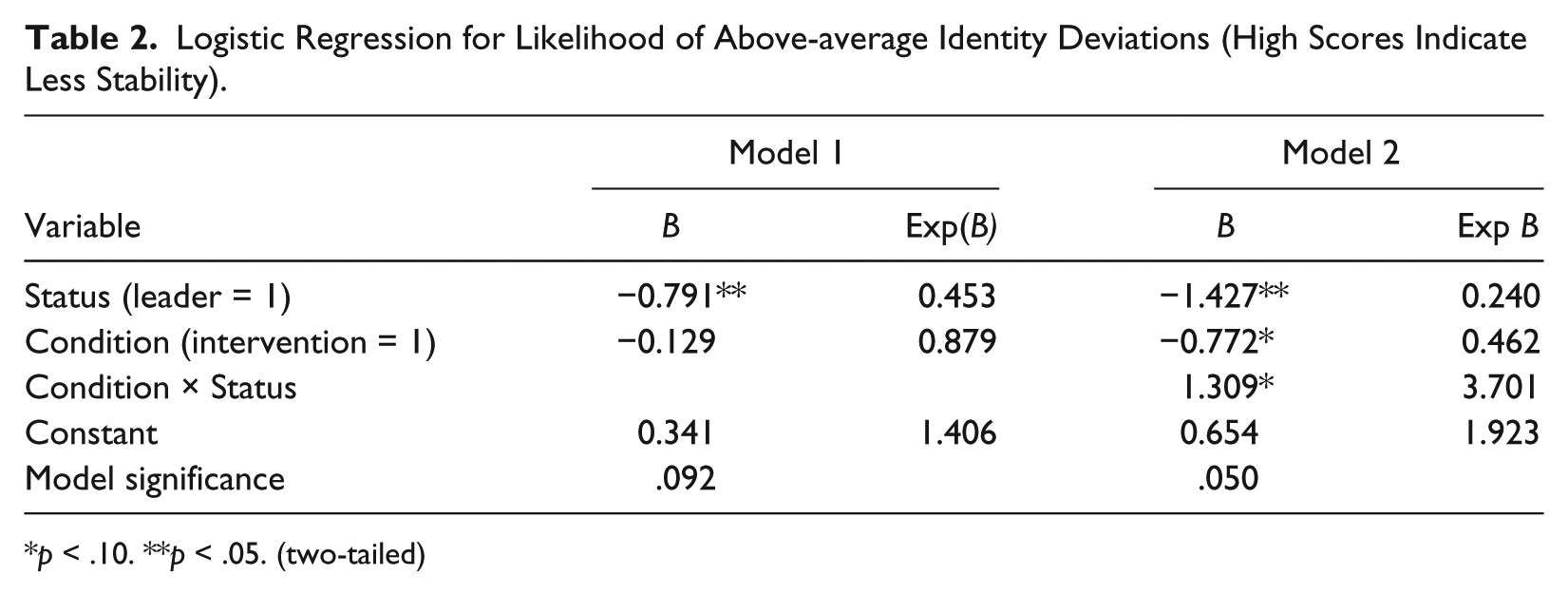
p < .10. **p < .05. (two-tailed)
First, we conducted the logistic regression with status position and intervention condition as the two predictors of identity stability (Model 1). The results show that, controlling for condition, status position is a statistically significant predictor of identity stability. High-status participants were less likely to experience larger than average identity deviations than were the participants assigned to the low-status position. This finding supports H1 that status confers the advantage of identity stability.
To test H2, we added the interaction term between status and intervention condition (Model 2). As you can see, the predicted log odds of exhibiting above-average deviation are lower for leaders (high status) and lower for those in the intervention group, and the coefficient associated with the interaction term is positive and statistically significant. In addition, the overall model significance indicates that the interactive model is preferable. The interaction term owns a relatively high value. It indicates that assistants in the baseline group are more likely to experience above-average identity change, while leaders are less likely. In the intervention condition, this trend does not persist. Under the intervention condition, neither the assistant nor the leader is appreciably more likely to experience identity deviation above what we would consider normal variation. H2 is supported.
Together, these findings indicate that those with higher status are better able to maintain situational identity meanings, reinforcing structural hierarchies at the micro level (H1). The effects of status, however, are not inexorable. In line with H2, the effects of status upon identity stability are disrupted through the introduction of identity relevant information that disaffirms the high-status actor’s identity standard. In line with identity theory, these patterns pertain to those with both dominant and submissive identity meanings, reinforcing the assumption that identity processes pertain across the range of identity valence.
Discussion and Conclusion
The identity control process has been widely studied, with an emphasis on the end goal of identity verification. However, when identity verification is not accomplished, social actors can change their identity meanings. It is this latter process, identity change, which we work toward in the present study.
Specifically, we tested the relationship between status and identity stability. Consistent with our predictions, results show that those with higher status enjoy greater identity stability than their lower status counterparts. That is, for those with low status, identity is less stable within interaction. However, the status-stability relationship is tempered by the introduction of identity-discrepant information about high-status participants.
These findings, in conjunction with existing research on the relationship between structural position and identity verification, show two key things. First, they strengthen the claim that structural hierarchies seep into microprocesses, affecting multiple nodes within the identity feedback loop. Second, they show that structural relations, though shaping, are not immutable within interpersonal interaction. Just as Stets and Harrod (2004) and Burke et al. (2007) identified conditions under which structural advantage does not positively affect identity verification—when enacting expressive identities and when legitimated into a position of authority, respectively—we showed that identity-discrepant situational inputs have a status disrupting effect.
Persistent situational instability is a mechanism of identity change. Our findings therefore suggest that persistent low status may increase the likelihood of experiencing identity change, while persistent high status may protect against it. However, situational inputs can disrupt status effects, subverting the identity change trajectory through interpersonal interaction. This work opens the door for broader and more nuanced research into identity change, as well as the relationship between status and identity processes more generally. Such work holds significance for the many settings in which status differences present, such as the family, the workplace, school, and community. Within these settings, our findings may help explain the mechanisms by which those with low status internalize negative personal or cultural sentiments, while those with higher status persist in the face of seeming identity threat. For example, a woman who experiences intimate partner violence may come to see herself as deserving punishment, while an abusive partner resists identity meanings of cruelty, selfishness, or insecurity. Similarly, a CEO may be in a better position to resist an “exploitative” identity, while a low-level worker may forego the identity of “creative” or “bright.”
Our experimental findings therefore provide theoretical tools with which researchers can approach more complex interaction situations. First, our findings set the stage for longitudinal studies that test the relationship between situational identity instability and long-term identity change, with a focus on systemic inequality. In addition, more preliminary work is needed on the dimension component of identity change and how structural hierarchies affect personal hierarchies of identity salience. Our measure of stability pertained specifically to the strength of a task-role identity along a single dimension (dominant/submissive). It is possible that one way of protecting against disruptive situational inputs is to focus on an alternative dimension of the relevant identity, or to move that identity down the salience hierarchy. For instance, if dominance comes under question, persons may shift emphasis to task orientation, fairness, or goal attainment to thwart the identity threat. Alternatively and/or in addition, persons may emphasize identities such as friend or parent while deemphasizing the task-role identity altogether. Similarly, researchers can examine different kinds of identities (i.e., instrumental vs. expressive) to test whether status effects persist within a single interaction and over time. Finally, our design focused on those with strong identity meanings (participants scoring in the top and bottom 25 percent). It is possible that participants’ polemic identity standards make them more susceptible to identity change or, alternatively, more resistant. This is an empirical question that we cannot answer with the present data. However, this is an important question for researchers to test as they examine how status and identity change operate under different conditions.
Although our findings certainly shed light on important status and identity processes, they should be interpreted in light of several considerations. First, our test of H1 is conservative, as our instantiation of status was random and short in duration. That is, the original effect of status would likely be stronger in the kinds of real world situations that afford prolonged hierarchical relationships, rooted in legitimate authority, and enacted repeatedly. With that said, the relatively mild status manipulation perhaps aided in our support for H2—which predicts that identity-discrepant information disrupts the status advantage. Future work, with a stronger status manipulation, would provide a more robust test of this hypothesis. Moreover, it would add theoretical nuance by testing the conditions under which status relations dissipate, and the threshold at which they hold. In addition, we acknowledge that status itself may protect against the introduction of disruptive inputs, as high-status actors already maintain disproportionate control over the situation. This is an important consideration for all studies that examine interpersonal means of status disruption. Finally, our current design gives feedback to both the leader and assistant simultaneously. We did this to drive home the identity-discrepant information for high-status participants. However, this prevents us from identifying the specific mechanism(s) by which the status-identity relationship breaks down. Therefore, an important next step is to test the relative effects of discrepant and confirming information on high- and low-status persons, respectively.
Overall, the findings show that status affects identity stability, but that this relationship is vulnerable to disruption as interaction partners learn more about each other. This is good news. It means that although status shapes identity processes, status equalizing interventions are possible. Designing interventions will be an important endeavor that can draw upon these initial findings.
Footnotes
Declaration of Conflicting Interests
The author(s) declared no potential conflicts of interest with respect to the research, authorship, and/or publication of this article.
Funding
The author(s) received no financial support for the research, authorship, and/or publication of this article.