




Abstract
This article addresses limitations of homonormativity in the pursuit of sexual and gender equality. Based on 20 interviews with cisgender, heterosexual Christian women, we demonstrate how even people who support same-sex marriage and some recognition of cisgender lesbian and gay people as potentially moral individuals may continue marginalization of transgender and bisexual people in their interpretations of gender, sexualities, and religion. We outline two generic processes in the reproduction of inequality which we name (1) deleting and (2) denigrating whereby people may socially construct transgender and bisexual existence as unnatural and unwelcome despite gains for cisgender lesbian and gay people. We argue that examining the social construction of bisexual and transgender people may provide insight into (1) limitations of homonormativity in the pursuit of sexual and/or gender liberation, (2) transgender and bisexual experience, and (3) the relative absence of bisexual and transgender focused analyses in sociology to date.
Over the past 75 years, bisexual, transgender, lesbian, and gay (BTLG) 1 movements have wrestled with Christian opposition in the pursuit of rights. Beginning in the 1940s, and responding to increasing challenges to sexual and gender norms at the time, for example, many Christian traditions including but not limited to Catholicism and Lutheranism began defining homosexuality as a sin contrary to God’s will and an illness destroying the moral and mental health of citizens (Wilcox 2001). In addition, following some victories for sexual and gender rights movements in the 1960s and 1970s, many 2 disparate Christian groups mobilized around opposition to homosexuality and gender equality on the grounds that such phenomena would destroy the world, the family, and the moral potential of children if left unchecked (see, for example, Barton 2012; Fetner 2008; Robinson and Spivey 2007). These Christian activists set the stage for the last 25 years of political debates concerning the rights of BTLG people.
In response to efforts by Christian movements opposed to homosexuality, many cisgender lesbian and gay movements adopted a politics of assimilation later termed “homonormativity” (Duggan 2004). 3 Rather than maintaining a politics of opposition to Christian standards of morality, family, and relationships, homonormativity involves a politics of similarity wherein (primarily cisgender) lesbian and gay people—regardless of religion or feelings about religion—adopt and conform to the same standards of white, middle-class, monogamous, patriarchal, and domestic “respectability” (see, for example, Bernstein 2002; Bryant 2008; Sumerau, Padavic, and Schrock 2015). Furthermore, such efforts rely upon the construction of homosexuality as the result of natural forces (i.e., God’s and/or biological creation) mirroring Christian conceptualizations of heterosexual and cisgender existence (Barton 2012). Homonormativity establishes some “respectable” lesbian and gay people at the expense of the ongoing marginalization of others (Ward 2008).
At present, the results of these interrelated events appear to be mixed. On one hand, some cisgender lesbian and gay people have achieved better treatment from, greater recognition within, and unprecedented integration into mainstream institutions including but not limited to Christianity and other religions, legal marriage, legal family forms, the military, residential neighborhoods, and educational settings. In fact, some scholars have interpreted these victories as evidence of a “postgay” era wherein lesbian and gay people experience greater freedom, rights, and autonomy regardless of sexuality (Ghaziani 2014). On the other hand, an emerging line of research reveals victories for cisgender lesbian and gay people do not yet translate into gains for transgender 4 and/or bisexual 5 people, and that many religious and political forces continue to demean bisexual and transgender existence (see, for example, Eisner 2013; Moss 2012; Westbrook and Schilt 2014). Furthermore, survey findings reveal that BT people are evaluated much more negatively than their LG counterparts (Cragun and Sumerau 2015, 2017; Worthen 2013).
The combination of these findings reveals emerging questions currently unexplored within sociologies of religion, sexualities, and gender. While scholars have noted the limits of homonormativity in relation to the pursuit of racial, classed, cisgender, and religious (McQueeney 2009) equality, we know far less about the ways such patterns may impact transgender and bisexual people. 6 How do bisexual and transgender people 7 experience a “postgay” society built upon homonormativity? How do people who have—to varying degrees—begun to at least tolerate (Sumerau, Grollman, and Cragun 2017) cisgender lesbian and gay people in more positive ways socially construct transgender and bisexual people? Do Christian interpretations of bisexual and transgender people mirror previous reactions to homosexuality (Wolkomir 2006) or will they mirror the emergence of more tolerant rhetoric about homosexuality (Thomas and Olson 2012a)?
In this article, we examine these questions through a study of cisgender, heterosexual, Christian women who all support the legalization of same-sex marriage whether or not they personally consider homosexuality good or bad in the eyes of God. 8 We analyze the ways they make sense of bisexual and transgender people by (1) deleting transgender and bisexual existence and (2) denigrating bisexual and transgender experience. Our analysis synthesizes existing scholarship on religion and sexuality, religion and gender, BTLG experience, and homonormativity by demonstrating some ways the emergence of a postgay era established through homonormative activism may signal the ongoing marginalization of bi+ and trans people. In conclusion, we discuss the limits of homonormativity revealed by integrating transgender and bisexual experience into sociologies of religion, gender, and sexualities (see also Sumerau et al. 2017).
Homonormativity and Christianity
Over the past decade, sociologists have demonstrated many ways contemporary lesbian and gay individuals and organizations adopt and perform homonormativity. These studies reveal how some cisgender, mostly white, and mostly middle- and upper-class lesbian and gay people conform to broader societal patterns of race, class, gender, religion, monogamy, and nationality to present themselves as in line with the lifestyles, morals, and expectations of the dominant, cisgender, heterosexual ideal (see, for example, Bernstein and Taylor 2013; Duggan 2004; Ward 2008). In addition, such studies reveal efforts by lesbian and gay people to redefine homosexuality in “heteronormative” (see Schrock, Sumerau, and Ueno 2014) terms (i.e., as biological and/or spiritually natural, domesticated and family focused, monogamous, and static across the life course, see also Adams 2011). Researchers have noted that much of the gains made by cisgender lesbian and gay movements have relied upon assimilation to dominant systems of societal inequality and the marginalization of abnormal others.
Much less attention has been paid to the ways homonormativity requires and promotes biphobia (Monro et al. 2017) and transphobia (Pfeffer 2014). The proposition that one must and will always be one or another sex and gender mirrors broader patterns of cisnormativity and transphobia (Sumerau, Cragun, and Mathers 2016), and has been documented in movements (Stone 2009), organizations (Sumerau 2012), and interpersonal interactions (Adams 2011) within mainstream LG communities (Serano 2016; Stryker 2008; Vidal-Ortiz 2009). Similarly, the proposition that one is and will always be only one sexuality mirrors broader societal patterns of monosexism and biphobia (Eisner 2013), and has been documented in movements (Nutter-Pridgen 2015), organizations (Simula 2012), and interpersonal interactions (Barringer et al. 2017) within mainstream LG communities (see also Sumerau et al. 2017; Barringer et al. 2017; Weiss 2003). Researchers have suggested that much of the advance toward equality by cisgender gay and lesbian movements has relied upon the continued operations of biphobia and transphobia.
Although rare in scholarship to date, some researchers have noted the similarities between Christian standards and homonormative politics. Exploring the shift from oppositional to assimilationist tactics by lesbian and gay movements, for example, Tina Fetner (2008) demonstrated how Christian demands that homosexuality was incongruent with morality, the family, marriage, and divinely inspired gender led activists to attempt to demonstrate their “similarity” to Christian norms in hopes of gaining acceptance (Moon 2004) and/or political sponsorship (McQueeney 2009). 9 As K. L. Broad (2011) notes, these efforts transformed gay and lesbian activism into an assimilationist movement focused on denying differences (see also Ghaziani 2011) and promoting the notion of “family values” that—intentionally or otherwise—mirrored the same notions promoted by Christian groups oppositional to LGBT rights (Broad, Crawley, and Foley 2004). As Jodi O’Brien (2004) notes, these efforts transformed homosexuality from an abomination into a “potentially Christian” occurrence (Wilcox 2009) or at least a social phenomenon tolerable to some Christians.
The pursuit of homonormativity mirroring Christian norms by lesbian and gay activists makes sense in relation to broader social patterns of Christian privilege embedded within American history and politics (Barton 2012). As Penny Edgell, Joseph Gerteis, and Douglas Hartmann (2006) note, religion may be one of the ultimate symbolic boundaries in America, and Christianity occupies the dominant position in the broader American religious hierarchy in terms of membership, influence, and political power (see also Heath 2012). Historically, this has meant that Christian norms have often been (1) the most accepted in society and (2) key to the efforts of minority groups seeking rights and recognition (Collins 2005). As Dawne Moon (2004) notes, Christian traditions have played powerful roles on both sides of every major political debate in America, and shifts in Christian attitudes about minorities have often been a fundamental influence upon the success or failure of civil rights campaigns. Like many other minority groups before them, cisgender lesbian and gay people sought entrance into mainstream society by—intentionally or otherwise—aligning with Christian norms (Barton 2012).
Both Christianity and homonormativity, for example, require people to adopt and perform romantic and sexual relationships (1) of only one type over the life course (i.e., monosexuality, see Barringer et al. 2017), (2) with only one person long term over the life course and concentrated in the institution of marriage (i.e., monogamy), and (3) focused on reproduction and nuclear families. At the same time, both Christianity and homonormativity often rely upon the reproduction (intentionally or otherwise) of existing societal patterns of patriarchal cisgender inequality (Burke 2016), inequitable racial relations (McQueeney 2009), “cisgendering reality” through the dismissal of transgender people (Sumerau et al. 2016), and the elevation of middle class respectability and individualist discourse (Heath 2012). Rather than a “postgay” era, scholars could easily refer to such patterns as an era of “tolerating” the sexual minorities who conform as much as possible to dominant Christian notions of morality and social order.
Considering the similarities between homonormativity and the dominant form of Christianity in America, it is not surprising that the rise of homonormativity has coincided with increasing Christian acceptance and sponsorship of lesbian and gay people (Thomas and Olson 2012a). Sociologists of religion, for example, have demonstrated some ways Christian groups have shifted their definitions of homosexuality in relation to shifting societal attitudes about lesbian and gay people (see, for example, Cragun, Sumerau, and Williams 2015; Olson and Cadge 2002; Thomas and Olson 2012b). At the same time, researchers have demonstrated the ways societal attitudes about lesbian and gay people have shifted in relation to changes in Christian identification (Sherkat et al. 2011), the acceptance of lesbian and gay people in some mainstream Christian traditions (Moon 2004), and the rise of explicitly lesbian and gay Christianity (Wilcox 2003). While there is no way to tease out which of these patterns ultimately leads to the other, and the data equally suggest both options, it has become increasingly clear that lesbian and gay rights may be tied to similarities between dominant Christian standards and homonormative representations of “respectable” and “potentially moral” gay and lesbian people.
The relationship between homonormativity and Christianity is also implicit in sociological studies of religion, gender, and sexualities. Despite a plethora of publications concerning Christian definitions of homosexuality and the experiences of lesbian and gay people in Christian settings in the past 25 years (Barton 2012), bisexuality remains almost entirely invisible within this literature (and underrepresented overall in social science, Monro et al. 2017). The past two decades have witnessed an explosion in analyses of cisgender women and men in Christian settings and the ways Christian traditions socially construct cisgender masculinities and femininities (see, for example, Avishai, Jafar, and Rinaldo 2015; Burke 2014; Bush 2010). Until recently (Sumerau et al. 2016), however, transgender people barely found their way into this literature. It is possible to hypothesize that—intentionally or otherwise—Christianity and homonormativity may have structured sociological analyses of gender, sexuality, and religion to date as well.
We arrive at a similar conclusion when we turn our attention to analyses of gender and sexualities in secular contexts. Emerging scholarship focused on bisexuality (see, for example, Compton 2015; Moss 2012; Scherrer, Kazyak, and Schmitz 2015) and transgender people (see, for example, Pfeffer 2014; Schilt and Westbrook 2009; Westbrook and Schilt 2014), for instance, has repeatedly noted that sociologies of gender and sexuality to date are predominantly focused on cisgender and gay/lesbian/straight experience. In addition, even in cases where researchers explore people who engage in both hetero and homo sexualities (see, for example, Burke 2016; Ward 2015), they rarely mention the marginalization of gender and sexual fluidity except in the process of discussing hetero/homo normativities (but see Pfeffer 2014). Similar to the ways sociology had to distance itself from heteronormativity not so long ago to understand lesbian and gay experience (Schrock et al. 2014), it would appear our field has reached a point where we need to come out of binary sexual and gender assumptions to understand bisexual (Moss 2012) and transgender (Sumerau et al. 2016) experiences as well as the issues such people face at present and may face in coming years (see also Barringer et al. 2017).
An important part of this process, as was the case with LG studies in the past (Warner 1999), will necessitate examining the social construction and deployment of trans- and biphobias (Eisner 2013). Although the body of sociological research on these topics is minimal (but slowly growing), scholars have already pointed to some interesting patterns of bi- and transphobia that warrant further exploration. Some research reveals the ways that bi- and transphobia are deployed by LG (Gamson 1995; Rust 1993) and heterosexual communities (Eliason 1997; Schilt and Westbrook 2009). More recently, scholars note that not only is it possible that patterns of bi- and transphobia among heterosexuals are overlapping, and have unique gendered connections with religion, but also that these patterns could be distinct from the ways heterosexual people engage in homophobia (Garelick et al. 2017). Despite such insights, much remains to interrogate about the connections between bi- and transphobia, homonormativity, and religion.
To this end, the present analysis explores Christian constructions of bisexual and transgender experience. Drawing on principles of analytic generalizability (Kleinman 2007; Schwalbe et al. 2000), we outline two generic processes—or common ways of accomplishing a shared goal likely to be found in multiple settings—whereby people—explicitly Christian or not—interpret bisexual and transgender people in biphobic and transphobic ways. Rather than making statements about a population, our analysis seeks to generalize actions to “sensitize” (Blumer 1969), or direct attention to, common ways people go about making sense of themselves and others. Our analysis begins the process of answering recent calls to (1) explore processes whereby people cisgender reality (Sumerau et al. 2016), (2) develop a “bisexual lens” in sociological research (Moss 2012), and (3) observe the ways sexual and gender fluidity complicate existing scholarship (Pfeffer 2014) by providing sociological consideration of the ways people may socially construct transgender and bisexual people in the context of increasing religious and societal tolerance of lesbian and gay people.
Methods and Analysis
Data for this study derive from in-depth, in-person interviews conducted with college students who identified themselves as cisgender, heterosexual Christian women. Respondents were sampled from a midsized university in the southeastern United States. Cisgender Christian women in college were selected because research shows that (1) cisgender women tend to participate in organized Christian traditions at higher rates than other populations (Bush 2010) and (2) because studies have shown both college attendance and identifying as a cisgender woman are highly correlated with more accepting attitudes toward minorities (Worthen 2013). We sought to find out what people most likely to be active Christians and more likely to be accepting of minorities thought about contemporary political debates and issues.
Respondents were recruited via word of mouth, posted flyers, and efforts of previous participants over 12 months. The sample consists of 20 cisgender, heterosexual Christian women active in a variety of Christian traditions (i.e., all respondents regularly engage in religious activities individually and in groups when able and consider Christianity to be a core part of their identities). Table 1 contains the demographic breakdown of the sample in terms of age, race, and religion. The sample was evenly split between respondents who believed the Bible was the literal word of God and those who believed it contained stories created by writers inspired by God.
Characteristics of the Sample.
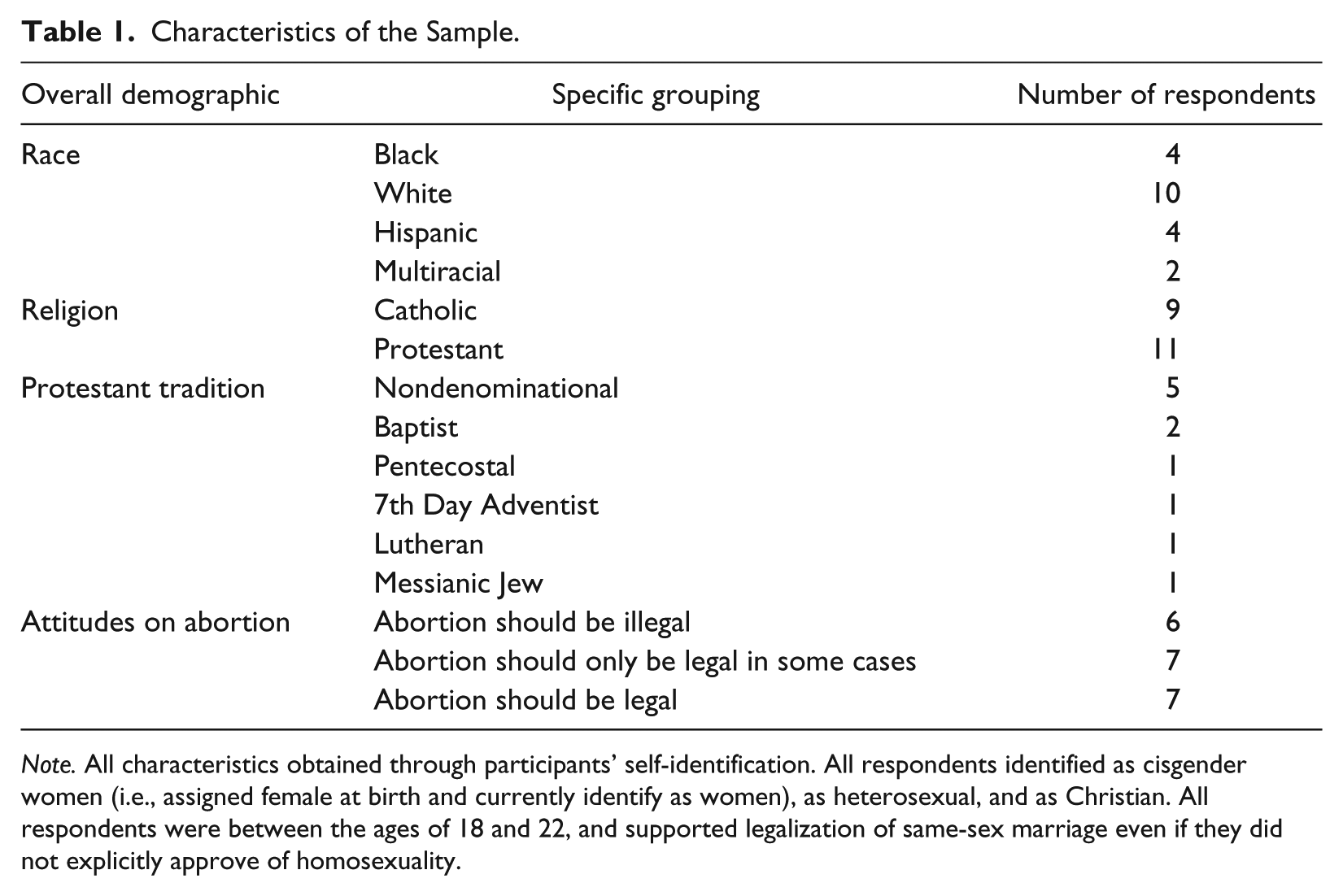
Note. All characteristics obtained through participants’ self-identification. All respondents identified as cisgender women (i.e., assigned female at birth and currently identify as women), as heterosexual, and as Christian. All respondents were between the ages of 18 and 22, and supported legalization of same-sex marriage even if they did not explicitly approve of homosexuality.
The interviews were conducted by the second author, and lasted between 1 and 2 hours each. The interviews took a conversational form wherein the second author simply mentioned a wide variety of topics of debate within contemporary society including but not limited to abortion, same-sex marriage, polyamory, homosexuality, bisexuality, transgender experience, heterosexuality, nonreligion, the Affordable Care Act, poverty, and the definition of marriage. The analysis below comes from responses to the following prompts: “What are your thoughts on transgender people” and “What do you think of bisexuality” followed by definitions of the terms. Respondents were granted complete latitude to talk as much or as little as they wished on each issue, and the second author asked follow-up questions to clarify or gain more detail on statements.
While we focus on respondents’ construction of bisexual and transgender people in the following analysis, it is important to note that their overall responses to BTLG people mirrored those found in recent surveys (Worthen 2013). They demonstrated much more negative attitudes and opinions toward TB people in comparison with tolerance toward cisgender lesbian and gay people (Cragun and Sumerau 2015). We outlined these findings and the broader ramifications related to BTLG people, Christianity, and tolerance elsewhere (Sumerau et al. 2017). While there were some examples of tolerance rhetoric for TB people as well as their GL counterparts, outright support was only ever mentioned for LG people and the vast majority of responses to BT people were negative.
We see this as an example homonormativity that reveals limitations of assimilation to social norms rooted in prevailing Christian understandings of social order. While there was no outright rejection of GL rights or people, each of these elements made up the bulk of reactions to BT people. However, a few respondents considered homosexuality sinful, though as 16 different respondents put it, “Not as bad as that other stuff.” Enough progress has been made by homonormative politics that every single respondent supported the legalization of same-sex marriage. Rather than explicitly anti-BTLG, our respondents were tolerant of LG people, tolerant of TB people in very rare cases, but explicitly opposed to BT people overall. As such, they mirror broader emerging tolerance of LG people alongside continued marginalization coupled with occasional tolerance of BT people (Eisner 2013). Homonormativity may, as others have suggested (Ghaziani 2014), have some effect on homophobia, but as we show below, it leaves biphobia and transphobia firmly in place.
Our analysis developed in an inductive fashion. Respondents’ statements about transgender, bisexual, heterosexual, and homosexual experience were separated out from the larger data set, and open-coded for recurring themes and patterns. Furthermore, we went back through the entirety of transcripts seeking demographic patterns and other contextual elements while refining and sorting our thematic categories to best capture the articulation offered by the total sample. In so doing, we began to see divergent patterns in the depiction of LG people and BT people. While we analyze the depictions of LG people—and a few examples related to BT people—as at least tolerable elsewhere (Sumerau et al. 2017), in this article we focus attention on our respondents’ overall and overt marginalization of BT people, which recalls past depictions of LG people but was not directed at them at all in this case.
After noticing the divergence, we began coding our respondents’ constructions of TB people, and noted recurring patterns through such efforts. We also noted that these endeavors were complementary to surveys revealing divisions in attitudes toward heterosexual and BTLG people, and focused on the ways our respondents socially constructed BT others. We went back through the data, categorizing the ways respondents (1) deleted bisexual and transgender people from God’s creation and (2) denigrated people who identified as transgender and/or bisexual.
Christian Constructions of Bisexual and Transgender People
What follows is an analysis of how the cisgender, heterosexual, Christian women we interviewed constructed bisexual and transgender people. First, we examine the ways they deleted bisexual and transgender people from God’s plan, world, and moral requirements. They argued that transgender and bisexual people might not actually exist, but rather represent examples of human disobedience to the demands of the supernatural. Second, we examine the ways they built on the above efforts by denigrating bisexual and transgender experience. They defined such experience as sinful, mentally ill, and dangerous. While we treat these two processes as analytically distinct, our respondents often mobilized both in connection with one another.
Deleting Bisexual and Transgender Existence
Sociologists have long recognized the ways members of dominant groups create worldviews and norms devoid of some aspects of empirical reality (Collins 2005). In fact, existing studies of sexual and gender fluidity already imply such processes occur in relation to bisexual and transgender people (Scherrer et al. 2015; Westbrook and Schilt 2014). Examining the experiences of transgender Mormons, for example, J. E. Sumerau and associates (2016) note the ways these people are erased from institutional and theological structures. Likewise, Alison R. Moss (2012) demonstrates the ways bisexual women are left out of contemporary understandings of family and romantic relationships. Furthermore, Carla A. Pfeffer (2014) notes the ways people assume one is either and only heterosexual/straight or gay/lesbian (i.e., monosexuality) based on the type of partner one accompanies in a given interaction, and one is either woman or man based on one’s appearance in a given interaction. Such findings imply that the deletion of bisexual and transgender people from normative social expectations represents a common aspect of contemporary social relations.
Such deletion is also a primary form of biphobia and transphobia (Eisner 2013). For example, scholarship in media studies demonstrates the ways bisexual television characters are often not named as such, despite participating in bisexual practices (such as having sexual and/or romantic partners of multiple genders), and that such erasure may contribute to negative outcomes for bisexuals (Corey 2017; Johnson 2016). Other scholars point to the ways that, despite increasing rates of acceptance for lesbian and gay people, young adults organize their sexual discourses in such a way that bisexual existence is rendered impossible (Alarie and Gaudet 2013). In addition, Greta R. Bauer and colleagues (2009) point to the ways that healthcare practitioners fail to acknowledge their transgender patients’ existence as transgender people, thus stigmatizing and burdening them. Furthermore, Lain A. B. Mathers (2017a) demonstrates the ways cisgender people explain away the possibility of transgender existence when taken for granted assumptions about gender are disrupted. These studies show how the deletion of bisexual and transgender people reinforces biphobia and transphobia in various social contexts. As we show below, the respondents in this study also reinforced transphobia and biphobia through their deletion of bisexual and transgender existence.
Respondents accomplished such deletion by defining transgender and bisexual existence as incongruent with their own assumed or imagined realities (see also Sumerau et al. 2016). Mirroring previous Ex-Gay (Robinson and Spivey 2007) and Ex-Lesbian (Ponticelli 1999) discourses, they suggested that bisexual and transgender people did not really exist in God’s creation. 10 Instead, they suggested that such people were actually unnatural occurrences that emerged from human disobedience and disregard for God’s requirements for human morality and salvation. In this section, we outline the ways our respondents engaged in trans- and bi-erasure to delete BT people from their worldviews.
“You don’t really think about the middle ground”
Much Christianity is predicated upon foundational stories (i.e., the Bible) that do not mention bisexuality explicitly, and thus create the symbolic impression that it does not exist in God’s world. Rather than the empirical world we inhabit, such stories erase sexual fluidity and breathe into life an imagined world wherein only monosexuality exists (Cragun and Sumerau 2015). Not surprisingly, respondents engaged in similar bi-erasure.
A white Protestant provides a typical illustration of this line of reasoning while also explicitly deleting even the possibility of bisexuality from the Bible:
I think it’s so interesting that in the Bible, some people perceive King David’s relationship with Jonathan as a bisexual relationship. I don’t agree with those statements. I just see that as cultural bias. My perception of David and Jonathan is that they were brothers, they were friends. They cared about each other, you could tell that. I don’t think that has to be seen as romantic. I know that some people perceive it that way, but to apply it to bisexuality. That’s an internal conflict. I think if a person decides to follow God, then over time that would diminish. Those desires would change to be more like the rest of us.
As this respondent illustrates, bisexuality was incongruent with her version of the world, and she relies on monosexist societal beliefs that bisexuality doesn’t truly exist, and is simply a transitory or infantile phase, to support her worldview. Moreover, bisexuality was incongruent with God’s design, which meant that if it existed her version of God was fallible or otherwise mistaken. Rather than confront that possibility, she erased bisexualities as even an option, and suggested no such feelings would last if one followed the instructions laid out by God.
Respondents also noted other ways bisexual potential is deleted from Christian contexts. A Hispanic Protestant noted, “I have never discussed bisexuality with anyone in my church before. I’ve never thought of that, but I would probably have to say it is not in line with God.” A black Protestant added,
Honestly, we don’t really think about that too much because in our society its very man/woman, heterosexual/homosexual. You don’t really think about the middle ground too much because everything is pretty much black and white—everything is just two-sided, that’s it.
A white Catholic also noted, “People don’t think that bisexuality is real. You can’t just like everything. You can’t have all the ice cream flavors. You have to choose one flavor.” The quotes from these respondents not only delete the potential for bisexual existence but also rely on assumptions that bisexuality is indulgent, excessive, or a fraught space between two categories (straight and gay), and that people will eventually settle into one of two binary, less excessive, and more respectable options.
Respondents also noted ways their religious experiences and interpretations of religious texts supported such deletion. They constructed a worldview devoid of potential bisexual morality by limiting people’s options to only one “flavor.” As a white Catholic put it, many Christians simply dismissed bisexuality out of hand in much the same way people once treated homosexuality:
Look, I even have gay friends who don’t believe in bisexuality. It is just not real—those people are just figuring out their stuff and they need to figure it out. Don’t get me wrong, I’m sure they believe it, but God doesn’t work like that. You like guys or you like girls, not both. God doesn’t work like that—those people are just confused is what I believe is going on.
While this respondent mentioning her “gay friend’s” stance on bisexuality is an example of monosexism and bisexual deletion within the gay community, it also reflects her efforts to tokenize her friend as ammunition for her own deletion of bisexual existence, a demonstration of the “relative” acceptance that results from homonormative political shifts (Eisner 2013). Rather than confront the possibility of sexual fluidity, respondents engaged in bi-erasure strategies such as this one by deleting any possibility of bisexualities from their worldview or version of God’s creation. Even if they had “gay friends,” possibilities beyond monosexuality were a bridge too far. As Ryan T. Cragun and J. E. Sumerau (2015) note, homonormative victories have expanded Christian morality to an ability to tolerate and even have LG friends, but at the same time, monosexism and biphobia remain firmly in place, and are utilized to delete nonmonosexual possibilities.
“There is no in between. There is no cross-sex. None of that—man penis, woman vagina”
As Sumerau and associates (2016) noted, the foundational religious texts of Christianity also leave no room for the existence of transgender people. While the experiences of transgender religious people demonstrate the results of their deletion from most of Christianity, Sumerau and associates (2016) noted the importance of also ascertaining the ways Christians accomplish such erasure. Our respondents did so by defining transgender existence as incongruent with God’s creation.
One of the primary ways our respondents deleted—or erased (Sumerau et al. 2016)—transgender people from their worldviews involved noting how churches, the Bible, and God left them out of their plans for the world. As a black Protestant noted,
When it comes to things like physicality, I feel like that there was not, throughout the entire Bible world as much as I’ve read, you never find those examples of . . . Moses was a guy, when Moses said, he wanted to be a woman. Moses did not say just select [to be] a woman and do womanly chores and stuff. I never find those examples in the Bible.
A white Catholic said, “The Church says that you are solely one gender for a reason. That is what God created and you can’t change that.” Another black Protestant put it more bluntly, “My church says NO! There is man and there is woman—there is no in between, there is no cross-sex. None of that—man penis, woman vagina. That is just what we believe.” Similar to the observations above in relation to bisexualities, these statements employ transphobic definitions of sex and gender (or cisnormativity, Serano 2007) to erase the existence of transgender and gender nonconforming people in the world. Respondents used their religious belief to reinforce the notion that sex is immutable and fundamentally connected to a stable gender identity. As noted above, rather than face the possibility that their versions of Christianity missed something or got something wrong, they instead delete the possibility outright.
Respondents also, as suggested by the experiences of transgender Mormons (Sumerau et al. 2016) and transgender women who left organized religion (Wilcox 2009), indicated one had to be (or become) cisgender to be close to God. As a white Protestant explained after noting someone being transgender could not come from God:
As a Christian, I’ll become more like Christ because of my relationship with God and more like what God ultimately created humans to be. Well, God created me to be female, and since He has my best interests at heart, He would not give me internal struggles over that because He would want me to be what he created so He can make me more like Him and that would apply to other people too.
A Hispanic Protestant noted, “The devil plays tricks and that could make transgender people feel that way the same way I feel peace following God’s plans. Someone who doesn’t have that peace there can fall victim to these types of things.” Note that we see deletion and denigration combined as the respondent implies transgender experience comes from the devil (denigration), and then uses this transphobic logic—that transgender people are inherently connected to evil and otherworldly forces—to argue transgender people do not exist (deletion). Rather than a natural occurrence or an aspect of God’s overall creation, transgender people—like their bisexual counterparts and like gay/lesbian people in previous decades (Cragun et al. 2015)—only emerged when people stepped beyond or lost sight of God’s plan. As a result, transgender and bisexual people are erased from respondents’ version of reality, and deleted from any option that could be of God. As we demonstrate in the next section, when respondents did acknowledge the existence of transgender and bisexual people, they did so in such a way that BT people were devalued, shunned, and framed as immoral and dangerous.
Denigrating Transgender and Bisexual People
Processes whereby members of dominant groups delete minority groups from normalized assumptions, expectations, and systems of meaning establish the ingredients for inequality, but the maintenance of inequality requires ongoing efforts to “mark” subordinates as deficient, abnormal, or otherwise “other” in comparison to dominant norms (see also Schwalbe et al. 2000). Gender and sexualities scholarship also suggests these processes are commonly occurring in relation to bisexual and transgender people. When people read romantic relationships that appear to contain different sexes or genders as automatically heterosexual (Pfeffer 2014), interests in same-sex activity as automatically gay/lesbian (Adams 2011), or transgender visibility as dangerous or threatening (Schilt and Westbrook 2009), for example, bisexual and transgender existence is continuously being defined or marked as “other than” moral, respectable, or legitimate (Eisner 2013). Such examples reveal the importance of ascertaining the ways transgender and bisexual people are socially constructed as “other” in society.
As noted above, such othering strategies represent forms of transphobia and biphobia. Respondents accomplished such biphobic and transphobic “othering” (Schwalbe et al. 2000) by denigrating transgender and bisexual experience. Similar to many Christian constructions of homosexuality over the past 75 years (Wolkomir 2006), respondents constructed BT others as deviants. They argued that since transgender and bisexual people were not supposed to exist in God’s world (i.e., forms of deletion noted in the previous section), their experiences were the result of moral corruption, mental illness, or other ungodly manifestations in society. In this section, we outline the ways respondents accomplished such forms of trans- and biphobia.
“Transgender, I feel it just shouldn’t happen”
Historically, the most common way Christian traditions have marked people and actions as morally deficient involves defining such phenomena, as noted in the last section, as against God’s intended design. Echoing statements about homosexuality since at least the 1940’s (Wilcox 2001) and concerns about Feminism in later decades (Robinson and Spivey 2007), respondents, as evidenced by the following quote from a white Protestant, took a similar path with transgender experience: “You’re playing God, you’re deciding what you’re going to look like now. He made you this way, but you act this way.” Unlike the previous section, the respondent confronts the existence of transgender people, but does so by denigrating it. A black Protestant agreed,
Transgender, I feel it just shouldn’t happen because the way you are born is because you’re supposed to be that way. You are born a male because God wanted you to be a male. It freaks me out and the church is all about hell and damnation and do not even try to come around because it’s a total abomination to everything God said. They always say when God created Adam, he created Adam as Adam and Eve as Eve. He didn’t create Eve but give her a penis and say, well some way down the line you want to be a guy.
As transgender people cannot exist based on respondents’ efforts to erase them, they argue that such people exist because of negative, ungodly forces and denigrate this existence when it confronts them. A Hispanic Protestant added,
I know the Bible doesn’t specifically mention that, but God created you in your mother’s womb. He obviously created you with one gender, and you choosing to go against that is wrong because you’re saying, I don’t like what God did. I don’t like the way he created me.
After deleting transgender people from their worldview, it becomes “obvious” people have only one gender so expressing otherwise is cause for transphobic denigration (i.e., “that is wrong” or “it’s a total abomination”). Instead of considering that God may have created a transgender person as such intentionally, these respondents denigrated the potential for transgender life by framing transgender people as an affront to God’s plan.
Whereas Christian opposition to LG people has often revolved around specific Bible verses (Moon 2004), respondents regularly noted the Bible had nothing to say about transgender people. Despite this Biblical—or Godly—silence, they, as illustrated by a Hispanic Catholic, found ways to define it as oppositional to God, immoral and unwelcome predicated upon their already established belief in its nonexistence in the world of their version of God:
God made you a man to be a man, God made you a woman to be a woman. It’s the devil—he has powers too and it can come down to that even before you’re born you’re corrupted. Some people feel like they’re born in the wrong body, which is basically saying that God made a mistake; you were supposed to be a woman but he put you in a man’s body, and that’s not how God works.
A white Catholic added, “I don’t like the situation. I’d rather you not be transgender because the devil can play tricks.” A multiracial Protestant added, “It can easily be a slippery slope and an example of how something that seems harmless can get real bad real fast.” As they already defined transgender people as nonexistent in their version of God’s plan, something else must be responsible, and as that something else is not their God, that something else must be negative (i.e., devil, corruption, etc.).
Similarities to previous articulations of homosexuality also emerged when respondents sought to link transgender experience to “sexual sin” (Wolkomir 2006). A white Protestant noted, “I think transgender is a sin. He made you to be a woman, or he made you to be a man. That’s who you are and a lot of times transgender is accompanied with sexual sins.” A white Catholic echoed this denigration of transgender people based on her existing belief that they did not exist:
When gender issues come up, it’s a lot of times because of their sexuality. For me, all those answers are in the Bible. You have to know the context of the Bible, but people just choose not to know that.
In both of these quotes, respondents relied on dominant ideologies that purport transgender people to be sexual deviants (see Schilt and Westbrook 2009).
At other times, however, respondents adopted recent rhetorical shifts in Christianity (Cragun et al. 2015) by defining transgender people as the result of mental illness in need of correction. A white Protestant offers an illustrative example:
It’s a psychological issue. It’s like a mental illness similar to depression, anxiety or any other, but not even as extreme as schizophrenia, but something like it where you’re just confused, unsure of reality. I’ve read where people overcame that confusion to identify with their biological sex and they learned that it matched up after a certain time.
A Hispanic Catholic added, “It’s a mental thing, and there is a fine line of people physically feeling that’s who they are and others doing it for attention.” A Black Protestant noted, “This is changing your personality. That is something that can’t be reversed. Let’s say people who actually do take the surgical step and all that stuff, you are literally changing yourself to fit your own pleasures.” A white Catholic added, “It’s just confusion. It’s just weird. You are who you are. God made you that way, embrace it.” Echoing decades of movement activity by Ex-Gay (Wolkomir 2006) and Ex-Lesbian (Ponticelli 1999) groups, respondents argued transgender people were not only morally but also potentially mentally deficient. As in other cases, this stemmed from the belief transgender people could not exist in their world, which necessitated explaining such existence in the empirical world.
At other times, respondents denigrated transgender people by defining them as dangerous. They echoed longstanding patterns whereby members of privileged groups construct marginalized groups as potentially harmful to their established way of life (Schwalbe et al. 2000). As a white Protestant noted and recent political debates illustrate, bathrooms have become one source of such tension: “I want to feel like there’s privacy in that bathroom. I wouldn’t feel as private, or as secure. Secure is a weird word when you’re talking about a bathroom, but I would feel like it was weird if there was a man in the stall next to me.” Although we did not explicitly ask about bathrooms, the theme emerged multiple times. In each case, respondents mirrored denigration patterns above while explaining them by suggesting transgender (and often bisexual people as well) entering their lives would make them feel, as a white Protestant implies, uncomfortable or unsafe:
What if they’re those creepy guys? Or those creepy girls that are bi or something, and there’s someone who’s extremely uncomfortable with it? I feel like if you have a certain organ, I feel so weird saying this, you go over there. I don’t know, I’d feel really weird if I was in a bathroom and there was a guy in the bathroom with me. I just think about little kids, that’s what popped into my head. When I was a little kid, it would have weirded me out if I saw a guy in the girls’ bathroom. I would have been, oh, why? This is very different.
A white Catholic summed up much of what respondents said in response to the potential of transgender people in their daily lives:
Bible belt people will say “burn them at the stake” and Catholics will be, “Okay you’re going to hell; don’t talk to me.” I would say I’m not exactly sure what you are so you stay in your corner until I know.
As transgender people did not exist in their worldview, any possibility of meeting such people became a source of discomfort (or phobia) respondents resolved by denigrating them.
“Bi and things like that are a spiritual influence that can get deeper like to steal, kill, and destroy”
We noted similar patterns of denigration when respondents discussed bisexuality. As the following excerpt from a multiracial Protestant reveals, respondents often denigrated bisexuality while drawing on their own suggestion that it did not exist in the first place in their version of the world:
Bi and things like that are a spiritual influence that can get deeper like to steal, kill, and destroy. It is the adversary’s tricks to really just take anything that could be good and lead to deeper things and more serious situations. I don’t think its natural. I guess the best way to explain it is to go back to Lucifer and all the bad things he does. He has really malicious ways of tricking people to break up God’s design and that’s what this is.
A white Protestant added,
If God made you a heterosexual and then you do some bi activity—I don’t know if that’s how you explain it—to me, that was a sin. They want to say this is who I am, but from a Christian perspective, it’s a sin.
After deleting bisexualities from God’s plan, a Hispanic Protestant argued they are incongruent with the way the world is supposed to be, and thus problematic:
I disagree with it. You’re doing either/or, whichever one you’re feeling. That’s not how it’s supposed to be. I feel that’s where I could say that its Biblical also because when it comes to bisex that’s not what God intended you to be. I would tell someone that is not okay. You’re finding a way to go against God, but you need to pray on it and figure out you should follow God. You might feel God is wrong, but for me, I’m not okay with it.
Interestingly, this respondent did not connect her assertion that bisexual people are “doing . . . whichever one you’re feeling” to God’s proclamation that humans have free will, instead she invoked the trope of bisexuality as excess. While some respondents also drew on this trope to delete bisexuality, as noted above, here, this respondent acknowledges the reality of bisexuality (“You’re doing either/or”) while admonishing such behavior because of its perceived sinful excess (“that’s not what God intended you to be”). A white Catholic added, “It gets addressed because in the Bible 2 Corinthians mentions a lot of weird sexual things that were going on in the societies and God told you not to.” Echoing responses to homosexuality in decades past (Wolkomir 2006) and gender variance at present (Sumerau et al. 2016), respondents denigrated bisexuality by defining it as, since they already believed it did not exist, oppositional to God and an immoral trick placed in the world to corrupt God’s people.
As the following quote from a white Catholic suggests, they also argued bisexual people were confused and needed to find the truth, which just happened to be the same truth they used to erase bisexualities from God’s plan:
Bisexuality, I really don’t understand because I believe you’re only attracted to either females or males. I think they’re just unsure and shouldn’t give themselves a label yet. They should just wait until they find who they are. I don’t understand how they wouldn’t. Maybe it comes from what their parents let them be and what they want to be or what their friends are doing, which could lead to being confused. They should just figure out who they are instead of telling people they’re confused or bisexual.
A black Protestant added, “Even people who are bisexual or questioning or whatever should remember do not be anxious about anything, but with prayer and thanksgiving present your request to God. At some point, they just got to let go and let God, and it will all make sense.” A Hispanic Catholic also noted,
My biggest thing is that I don’t understand the mentality of bisexuality. I mean, they must be confused or ill or something because I don’t understand how one day you can be attracted to males and then the next day go back to a female when you’re drunk at a bar. It doesn’t make sense to me.
As bisexualities did not exist in their versions of the world, this erasure created confusion for respondents when faced with the existence of bisexualities. Rather than try to understand it, they denigrated it by associating it with negative spiritual, cognitive, or other patterns in the world. They utilized biphobic denigration—as well as transphobic denigration noted above—to maintain their own version of a God and world that denies empirical realities.
Conclusion
In this article, we have drawn on the statements of cisgender, heterosexual, Christian women to reveal how the existence of bisexual and transgender people is socially constructed. We outlined two ways people may respond to the emergence of TB social movements and increased tolerance of LG people; specifically, we highlight the process of deleting bisexual and transgender people from their reality and denigrating transgender and bisexual people to explain how such people exist when one believes they are not supposed to. Although the intricacies of these processes may vary across settings, studies of gender, sex, and religion suggest they may be common elements of a postgay era established via homonormativity that has been left unexplored in existing scholarship. Our analysis provides a conceptual framework for exploring the ways people—religious or otherwise—may maintain the marginalization of transgender and bisexual people at the same time they offer more tolerance to lesbian and gay people as a result of homonormative movement activities and victories within and beyond Christian contexts.
These findings have implications for understanding the limitations of “homonormativity” (Duggan 2004) and the “postgay” era (Ghaziani 2014). First, bisexualities clearly disrupt “monosexist” assumptions (Moss 2012) embedded within both Christianity and homonormativity. Second, transgender experience equally calls into question the “cisnormativity” (Sumerau et al. 2016) necessary for Christian and homonormative interpretations of gender. Although our analysis of Christian people’s social constructions of transgender and bisexual people is unique at this point in sociological history, as “sensitizing concepts” (Blumer 1969), (1) deleting and (2) denigrating provide generic processes researchers can use to make sense of the boundaries of homonormative acceptance and Christian tolerance as well as the experiences of transgender and bisexual people in the postgay era.
These findings also have implications for the development of studies of bisexual religious experience. While sociologists have begun to explore the experiences of bisexual people in some secular settings (see, for example, McLean 2001; Moss 2012; Scherrer et al. 2015) and some ways monosexuals respond to bisexuality (Worthen 2013), religion has mostly been left out of the discussion (but see Cragun and Sumerau 2015). Considering the powerful role religion—and especially Christianity—played in debates concerning the rights of lesbian and gay people (Wilcox 2001), the absence of sociological studies focused on religion and bisexualities appears quite striking. We argue it is past time for sociologists to explore the ways bisexual people experience and are shaped by religious experiences, others, organizations, and traditions.
These findings also support emerging scholarship on transgender religious experience (Mathers 2017b; Sumerau et al. 2016; Wilcox 2009), and extend this scholarship by outlining processes whereby cisgender Christian people “cisgender reality.” When researchers note the ways in which transgender people feel erased or denigrated in many religious contexts, for example, they are demonstrating the results of people’s constructed definitions of transgender people as nonexistent and immoral. As scholars have noted in analyses of secular settings (Westbrook and Schilt 2014), our findings demonstrate the importance of analyzing how cisgender people accomplish such results. Researchers exploring cisnormativity may find much use in explicating the ways cisgender people—religious or otherwise—construct transgender people.
These insights also have implications for studies of BTLG experience, rights, and recognition. Whereas sociological analyses of lesbian and gay people have dramatically expanded in the past four decades (Schrock et al. 2014), such work has thus far mirrored Christian, homonormative, and broader public patterns by granting bisexuality and transgender issues much less attention (Monro et al. 2017). Even when sociologists have turned their attention to the limitations of homonormativity, we have generally focused on consequences such strategies have for existing racial, cisgender, familial, religious, marital, and economic patterns while leaving the consequences of homonormativity for transgender and bisexual communities mostly unexplored. Following recent critiques of such patterns (Sumerau et al. 2017; Pfeffer 2014), we suggest sociology may benefit greatly from beginning to systematically consider sexual and gender fluidity and the political and social limits of all forms of normativity.
Footnotes
Declaration of Conflicting Interests
The author(s) declared no potential conflicts of interest with respect to the research, authorship, and/or publication of this article.
Funding
The author(s) disclosed receipt of the following financial support for the research, authorship, and/or publication of this article: The authors received support from the University of Tampa David Delo Research Professor Grant.
Notes
Author Biographies
 .
.