



Abstract
The number of Americans and Canadians choosing to live outside of their home countries after retirement is increasing rapidly, with Mexico as the primary destination for emigration. The majority of these expatriates are white. This study explores how race affects the experiences of emigration and expatriation for these retirees. In-depth interviews with 30 white expatriate retirees living in Mazatlán, Mexico, reveal that white expatriates respond to a growing sense of racial victimization and nostalgia by framing their emigration as a chance to reclaim their superior and racialized social standing. Specifically, white expatriates use three strategies to explain how race affected their experiences in Mexico: escaping, wherein they come to Mexico to avoid the racial diversification of their home countries; evoking, in which they position Mexico as a place to recoup old-fashioned values; and reclaiming, wherein Mexico is perceived as a chance to regain their whiteness as standing.
With raids on undocumented citizens and suggestions to build a wall on the Mexican border, international migration, especially considering immigrants from Mexico, is a controversial issue in North America today. Indeed, a significant corpus of sociological research has documented the implications of Mexican immigration policy (Golash-Boza 2012; Massey, Durand, and Malone 2002), the experiences of immigrants themselves (Cantú 2009; Crosnoe and Lopez-Gonzalez 2005), and how immigrants are perceived by their receiving countries (Berg 2009; Wang 2012). Expatriates from Canada and the United States who immigrate to Mexico, however, are often considered distinct from other types of “immigrants,” both in the sociological literature and within the public imagination at large, instead being labeled as “expatriates” or “lifestyle migrants.” This linguistic differentiation highlights the racialization at play within the logic of immigration wherein white bodies are seen as socially and economically distinct from nonwhites, who are thus labeled as migrants or immigrants (Green 2009). Perhaps due to this perception, research has only just begun to investigate “the other side of the fence” (Croucher 2009b).
The number of Americans and Canadians choosing to live outside of their home countries after retirement is increasing, leading scholars to rethink notions of immigration to account for the experiences of these expatriates (Rojas, LeBlanc, and Sunil 2014). The number of Americans who are retiring outside of the United States grew 17 percent between 2010 and 2015 and 20 percent between 2015 and 2016, and as baby boomers retire, these numbers are expected to continue climbing (Talty 2017; Walker 2016; Zamudio 2016). Mexico is the primary destination for expatriation (Croucher 2009b, 2012; Lardies-Bosque, Guillen, and Montes-de-Oca 2016). Expatriates cite the proximity to their original countries, the decreased cost of living, an appreciation for the weather, the presence of already thriving expatriate communities, and an interest with the Mexican culture as reasons for choosing Mexico as their new homes (Croucher 2009b; Green 2009).
Expatriate engagement within the local economy in some Mexican communities serves a vital economic function, showing the constitutive relationship between expatriates and locals. Expatriates shop at stores, dine at restaurants, and hire locals to provide services for them, such as housekeeping or construction, meaning that the influx of these expatriates can have a significant impact on boosting the Mexican economy (Croucher 2009b). In addition, with fears over safety in Mexico due to drug cartels and the recession affecting Americans’ vacation plans in recent years, expatriate economic investment has been especially important in some Mexican tourist areas (Associated Press 2011; Lardies-Bosque, Guillen, and Montes-de-Oca 2016; O’Neil 2009). Thus, the economic resources that expatriates bring with them to Mexico are quite consequential.
Although most of the literature on expatriation acknowledges in passing the privileges that these migrants carry with them to their new homes, this privilege is not always centered within the analysis (Croucher 2015). When the analysis does examine expatriate power, it is often conceived of as resulting solely from their economic resources and/or their nations of origin. For example, Michaela Benson (2013:317) states that “[North American expatriates’] privilege is wrought by the migrants’ membership of powerful nation-states, rather than by their individual affluence and wealth, although this too may play a significant role.” However, this necessary exploration of the role of power in the expatriate experience commonly ignores that expatriates from Canada and the United States are also overwhelmingly white (Fechter 2005; Hayes 2015). That is, the literature seems to assume that individual and national economic resources trump other types of social identities, including whiteness.
As the world becomes increasingly globalized, it is essential to understand how racial privileges may translate across country borders. As with other types of cultural and economic transmission, globalization also allows racial meanings to transfer from country to country (Roth 2012). However, it still remains to be seen if and how racial hierarchies will be established within these new social relationships created by globalization. Scholarship has documented how whiteness is intentionally deployed within some of these globalized relationships, including within the process of white volunteer tourists in Honduras (Schneider 2018) and within advertising as a desirable tourist destination for whites in Costa Rica (Christian 2013). Thus, the theorization of the whiteness of expatriates within Mexican communities can also reveal larger negotiations of race in a globalized world. This project, therefore, starts with a wide-ranging question: How do white expatriate retirees understand race within their experiences of immigration? Based on qualitative interviews with white expatriate retirees living in Mazatlán, Mexico, this article reveals how whites respond to a growing sense of racial victimization and nostalgia by framing their expatriation as a chance to reclaim their superior and racialized social standing.
Background Information
Expatriation, Lifestyle Migration, and Race
There is great variation within the experiences of expatriates (Benson and O’Reilly 2009; Janoschka and Haas 2013; O’Reilly 2000). The term is most often associated with working professionals or retirees who are residing in a country other than that of their citizenship (Green 2009). Some have called expatriates who choose to relocate to poorer countries in search of a more comfortable or affordable living environment as “lifestyle migrants” (Croucher 2015). Mexico is a particular destination for lifestyle migrants, especially retirees, due to its relatively low cost of living (Truly 2002). However, expatriation also comes with its own set of challenges. Expatriate retirees in Mexico must adjust to circumstances that may be very different than their home countries. This includes new systems of governance and bureaucracy, unfamiliar cultural traditions, and navigating Spanish as the dominant language.
The amount of integration into Mexican society that an expatriate may experience varies widely. Some expatriates speak Spanish, form friendships with Mexican locals, and attempt to assimilate into the Mexican culture. Others seem to resist integrating into Mexican society, choosing instead to transplant aspects of their culture to their new homes, by remaining active in home country politics, maintaining their citizenship, refusing to learn or practice Spanish, and forming an “expatriate bubble” (Croucher 2009a, 2012; Rojas et al. 2014). Indeed, this approach seems to be common with expatriate retirees, who may be more likely than other type of expatriates to remain segregated from the local population (Lardies-Bosque et al. 2016). Within their daily life, however, expatriates still must interact with Mexicans regularly, as their cab drivers, restaurant servers, or housekeepers, and they utilize these connections to develop their racial understandings of their place as immigrants to Mexico. For example, expatriate retirees report that while they view the local population as warm, friendly, and helpful, they also characterize Mexicans as dishonest and deceptive, especially when it comes to economic ventures (Banks 2004).
Due to their desire to live in another country, some social theorists have suggested that expatriates may be uniquely primed to engage with divergent cultural experiences (Hannerz 1990). Within the Mexican context, some may assume that due to their choice to move to a Latino country, these white expatriates may be more racially aware or tolerant than their counterparts who do not immigrate. Moreover, the expatriate experience itself can allow for the development of an understanding of white privilege (Fechter 2005; Hayes 2015). However, research also highlights how expatriation can also support, or even strengthen, colorblind racial ideologies. For example, white expatriates in Ecuador engage in strategies meant to belittle the importance of their white identities, stressing their desire to integrate into the local community as authentic and belonging members (Hayes 2015). Thus, it cannot be assumed that white expatriates will come from a position of racial progressiveness, despite choosing to move to a country that they regard as nonwhite.
White Backlash, Diversification, and Racial Nostalgia
White identity has long functioned as a type of racialized status, or what Joel Olson (2008:704) calls “whiteness as standing,” a process that grants whites “a superior social status to all those who were not white.” This social status has taken different formulations across time, yet whites have historically been positioned to receive the spoils of white privilege, while denying similar benefits to people of color. However, since the incremental racial change introduced by the Civil Rights era, some whites have decried that their social standing has been under attack. With growing minority political power, the introduction of affirmative action and multicultural policies, and increasing cultural representation of people of color, whites have reported concerns that people of color’s gain will result in whites’ loss (Norton and Sommers 2011). Moreover, research indicates that whites are less aware of racial privilege than people of color (Hartmann, Gerteis, and Croll 2009; Pratto and Stewart 2012). That is, despite evidence that the benefits of white privilege persist, whites increasingly view their whiteness as a source of disadvantage.
In response, scholars have declared the racial politics of this current cultural moment as that of a “white backlash” (Hewitt 2005; Rhodes 2010). This backlash may have become heightened as whites seem on track to become numerical minorities in some Western countries, leading to wide-reaching implications about the seemingly inevitable shift toward a decrease in the political, social, and economic power of whites (Abrajano and Hajnal 2015; Lichter 2013). Indeed, whites report that the diversification of their communities is responsible for what they perceive of as a loss of privilege, resources, and recognition (Ferber 2000; Rhodes 2010).
White identities are often paradoxical (Doane 2014). Whereas some whites deny the racial salience of their identities in an effort to support the ideal of a “post-racial” society, others harness their whiteness to claim a loss of social, cultural, and economic resources (Kolber 2017). In this case, the victimization of whiteness works to bolster white identities. Matthew W. Hughey (2014:727) argues, “Claims to victimization cement an ideal white identity that is honoured and valuable.” Whites may use victimization to try to neutralize claims of white privilege, as haole (whites) in Hawai’i do to simultaneously navigate socioeconomic advantage and resentment from the locals (Rohrer 2010). That is, by proudly claiming whiteness, and the perceived disadvantages associated with it, whites work to assert an identity that is distinct from understandings of whiteness as being associated with white privilege.
Whites have aimed to remedy this sense of disenfranchisement and return to whiteness as standing (Olson 2008) through a variety of means. Anti-immigration and antiglobalist political parties have found popularity in recent years in part due to how they speak to ideas of victimization among voters and are thus able to mobilize white resentment to the ballot box (Abrajano and Hajnal 2015; Olson 2008; Rhodes 2010). Other whites aim to use the court system to correct what they perceive as an assault on whiteness, such as through recent cases against affirmative action policies (Hughey 2014). However, there are other ways that whites aim to regain their social standing outside of the political system. For example, whites may make choices about where they live or who they associate with to position themselves at the top of a racial hierarchy, such as in the case of white expatriates who are drawn to the positive treatment they receive in their new home countries as white individuals.
Connected with white victimization can be a sense of racial nostalgia. Indeed, nostalgia often develops after individuals who have been displaced work to reclaim a shared sense of identity (Milligan 2003). Thus, research has documented the ways that whites respond to feelings of victimization with narratives of racial nostalgia, such as how they rosily recall racially segregated neighborhoods (Maly and Dalmage 2015; Maly, Dalmage, and Michaels 2012) and mythologize the antebellum and Jim Crow South (Lavelle 2014, 2017; McPherson 2003). Importantly, the presence of white racial nostalgia does not depend on the accuracy of the memory of the past, but instead, nostalgia itself an act of creating narratives about what can be understood to be a desirable identity and experience.
I find that the experiences of these white expatriates reflect the larger trend toward white victimization, as a form of racialized nostalgia. I document how expatriates respond to the diversification of their home countries with feelings of racial resentment and fears of being marginalized for their whiteness. However, they choose to assuage these fears by immigrating to Mexico, despite knowing that they will be living among Latinos in a non-English-speaking society. To make sense of this seeming social paradox, they emphasize the ability to achieve a superior status as white expatriates in Mexico.
Data and Method
The data for this project comes from in-depth life-story interviews with 30 American and Canadian white expatriates living in Mazatlán, a city on the Western coast of Mexico. Mazatlán is a popular tourist destination in Mexico, with an established and diverse expatriate community. It is important to note that this article thus groups together the experiences of expatriates both from the United States and Canada as Mazatlán is a common destination for expatriate retirees from both countries. Although these two countries have their own unique histories with race, the commonalities found in the narratives of expatriates suggests some overlap in racial logics across the countries.
The sample for the study was split across gender, with 14 men and 16 women. The sample ranged in age from 55 to 81 with a mean and median age of 67.33 and 67, respectively. Due to the age within this sample, the findings may be attributed to generational differences. Specifically, previous research has documented that older individuals display more comparatively racist attitudes than their younger counterparts (Nteta and Greenlee 2013).
Respondents’ time in Mexico ranged from one year to 21 years with a mean of 8.4 years and a median of 7 years. Participants came from a variety of places across North America, including the West coast of the United States (12), the Midwestern United States (6), the Southern United States (5), the East coast of the United States (1), Central Canada (2), and Western Canada (4). Most participants described their socioeconomic background as middle-class (21), with a small number describing themselves as coming from a working-class or poor background (5) or an upper-class background (4). Prior to retirement, the expatriates were employed in a wide array of occupations, with most being classified as white-collar or professional jobs (22), but with some coming from blue-collar occupations (8). The majority of those interviewed indicated that they were liberal politically (23), whereas a smaller number identified as moderate (5) or conservative (2). Within Mazatlán, most of the participants (28) lived within an integrated neighborhood of the city, with two living in a tourist and majority white area of the city. As this sample is both small and nonrandom, it cannot be generalized to the experiences of other white expatriates, both within or outside of Mexico.
Interviews took place between 2015 and 2017. Participants were recruited through both purposive and respondent-driven selection. First, I used purposive selection, targeting individuals I believed would yield the most information (Suri 2011). As part of my selection, I connected with key contacts within the expatriate community via email and phone calls, including general information about the study and asked that they put me in contact with individuals who would be eligible to participate. These key contacts included individuals who worked or volunteered within organizations geared toward expatriates in the city, including charitable organizations and expatriate relocation organizations. In addition, I consulted online listings and rosters of organizations to identify potential participants. I then used respondent-driven selection by requesting that my initial participants recommend other participants that they thought may be interested in talking with me after each interview. Interviews lasted between 32 minutes and three hours, with a median of 67.3 minutes, and took place in participants’ homes, restaurants, and other popular expatriate meeting spaces. I informed respondents at the beginning of each interview of my own status as a white female who came to the study of expatriation by way of personal and intellectual interests related to being the child of white expatriates living in Mexico. This personal connection appeared to put them at ease as they began to read me as an “insider” with their experiences.
The interview included questions about motivations for expatriation, adjusting to another country, and reflections on being a white person in Mexico. I used a grounded theory approach to my data. The hallmark of grounded theory is that data production and analysis occur constitutively (Charmaz 2002). Analysis, therefore, is derived from multiple types and stages of data in an interactive process aimed at understanding similarities and differences across participants and their experiences (Creswell 2003). This grounded theory approach manifested itself in two stages. First, I examined the transcripts of the interviews line by line and used an open coding method in which I used broad concepts and comparison to link phrases and ideas with each other into larger themes (Glaser 1978). During this stage, I identified the theme of motivations for expatriation. Second, as this theme was discovered, I returned to the transcripts to group the initial codes into higher level categories and to uncover any additional data that may have been initially overlooked (Urquhart 2013).
Findings
Expatriates cite a variety of factors that have motivated their decision to relocate to Mexico. Previous research has highlighted how factors such as an affordable cost of living or warm weather might motivate expatriates to move to another country (Croucher 2009b; Green 2009). However, less research has highlighted the racial logics at play behind their move, as well as how expatriates come to understand their race within their new homes. Along with discussions of low costs of living and desirable weather, the individuals that I spoke with also described distinctly racialized motivations for moving to a space that resided across the color line and how their whiteness affected their experiences once they arrived in their new country. I explore three strategies that white expatriates used to explain how race affected their experiences in Mexico: escaping, wherein whites portray themselves as coming to Mexico to avoid the racial diversification of their home countries, even as they choose a country that they view as nonwhite as their new home; evoking, in which they position Mexico as a place to recoup old-fashioned values of personal responsibility and family togetherness; and reclaiming, wherein Mexico is perceived as a chance to regain their whiteness as standing by being appreciated for their whiteness and by providing essential economic resources to the local population. See Table 1 for information regarding the frequency and percentages of each code.
Coding Schema.
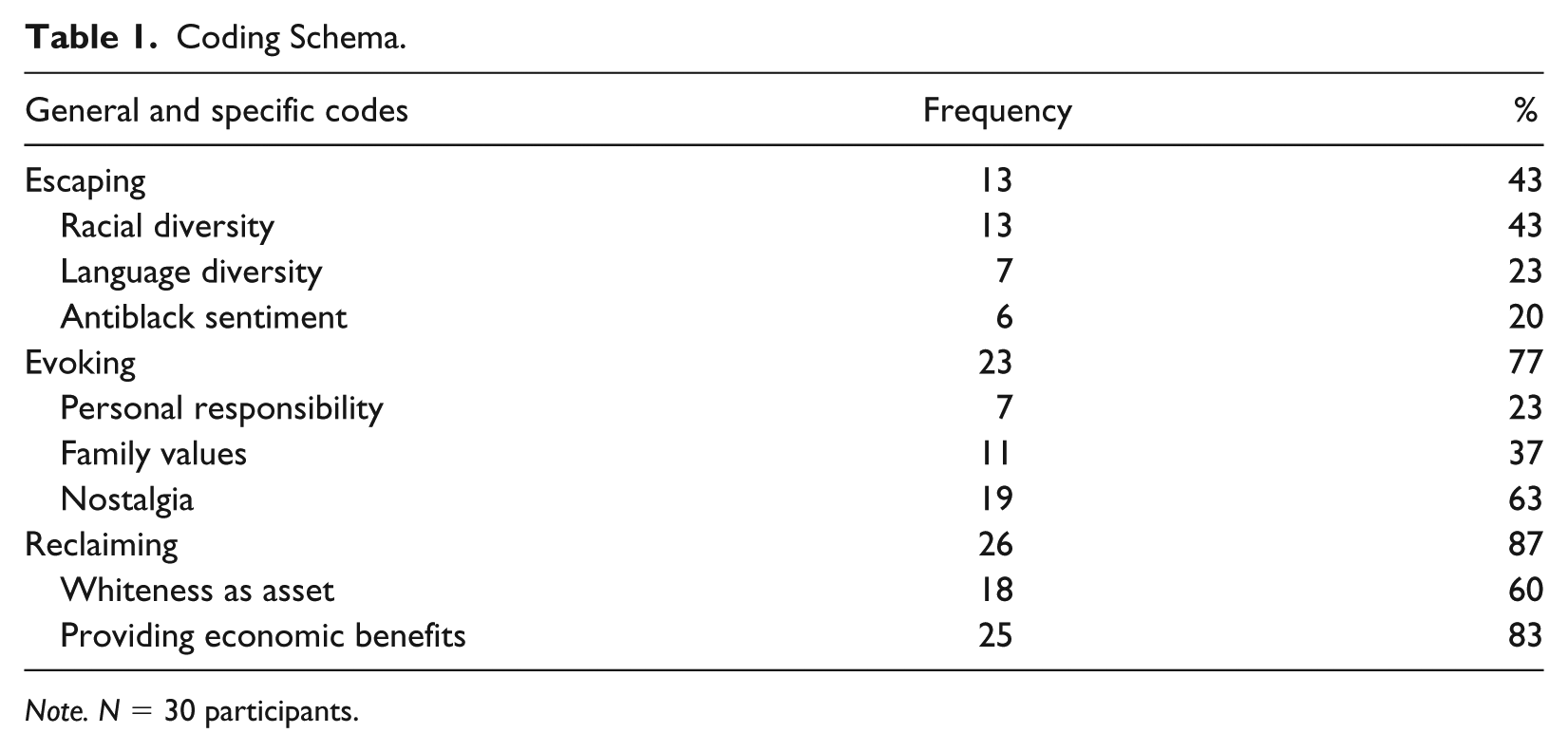
Note. N = 30 participants.
Escaping
Forty-three percent of the interviewees I spoke to stated that one of the motivating factors to retire outside of Canada and the United States was to escape the overall increase in racial diversity within their home communities. For these expatriates, the dwindling number of fellow white individuals in their local neighborhoods and communities had begun to make them feel uncomfortable. In addition, these expatriates believed that this increased racial diversity rendered differences between living at home or in a foreign country like Mexico meaningless. For example, Jane, an 80-year-old from the Western United States, quipped, Let’s face it. We [whites] are the minority in our own country. Here, I’ve never been treated ill in any way. I’ve never felt like I didn’t belong. I’ve felt in the States many times where I didn’t belong. And that’s truth! And that’s hard to swallow when you think about it! We are the minority in our own country. And a lot of people feel that.
In addition, Ronald, an 81-year-old from Central Canada, illuminated, “I find, one of the reasons that I moved, is that there was all of these various nationalities coming in all around me. You couldn’t find an English-speaking person at times! So being down here, it’s a breath of fresh air, actually.” Linguistic diversity thus becomes a racialized code within conversations about their feelings regarding the diversification of their home countries, and is marshalled for evidence of why escaping that environment was necessary.
Once in Mexico, the vast majority of expatriates (77 percent) that I spoke to did not speak Spanish, aside from some rudimentary phrases. For some of the expatriates, this contradiction was apparent to them, and had influenced how they viewed non-English-speaking immigrants within their home countries. Denise, a 65-year-old from the Southeastern United States, stated, I’m not at all prejudiced. Never have been. I knew a lot of prejudiced people who really hated the influx of all of the Mexicans when we lived in the States. And I understand that. But now I understand much more how they say, okay, you go to the country and learn the language. But here I am, I’ve been in this country seven years, and I still don’t speak the language.
Even though Denise “understand[s]” hating “the influx of all the Mexicans” in the United States, her Spanish-language deficiency, though she has resided in Mexico for seven years, has rendered her sympathetic to immigrants who may not speak English despite living in the United States. However, not all expatriates had this reaction to their own experience of being a non-native language speaker. Mary, a 65-year-old from the Western United States, clarified, “I realize that I have limitations in this country, but it’s because I don’t know the language. That’s my fault. It’s all my fault, not theirs. Just like it’s their fault if they are up there and can’t speak English. That’s on them.”
This distress that Jane, Ronald, and other expatriates experienced because of the presence of non-English-speaking individuals within their home countries initially seems particularly perplexing, given that they decided to immigrate to a country where English is not the national language, nor widely spoken. Despite the initial contradiction, it is clear from their experiences that these expatriates found the increase in non-native English speakers to be a hallmark of feeling outnumbered as whites in their home communities. Thus, their choice to immigrate to a non-English-speaking country showcases how they use an uptick in linguistic diversity in their home countries as a discursive strategy to justify their desire for a racial hierarchy that places themselves as whites on the top. That is, language diversity is only an excuse for them to reap the benefits of whiteness.
General racial diversification was not the only thing that expatriates aimed to escape. A number of expatriates described an antiblack sentiment behind their or other’s motivations to immigrate to Mexico, which illuminates why they were willing to move to a Latino country. Often, this sentiment was cloaked in comparisons between the dangers in Mexico and the risks to safety in the United States. Due to the violence in Mexico resulting from drug cartels, some Mexican communities have seen a decline in tourism due to safety concerns (Lindau 2011; O’Neil 2009). Mazatlán, residing in the state of Sinaloa, was particularly affected by drug cartels, with cruise ships even cancelling trips to the port city from 2011 until 2017 (Associated Press 2011). The expatriates I spoke to were concerned about this perception that Mexico in general, and Mazatlán specifically, was unsafe. Particularly, they felt that the lack of tourists would diminish the value of their properties and threaten the ability of the businesses that they enjoyed to stay open. To dispute this idea of Mazatlán being dangerous, they pointed to the incidence of gangs in urban American cities, using racialized language that conveyed an antiblack sentiment.
For some, this antiblack sentiment was more covert, shrouded by the coded language of gangs. For example, Darrel, an 81-year-old expatriate from the Southern United States, said, “People are afraid to come. Our sons, they won’t come. We always tell them it’s safer here than in New York City. We try to remind them. There aren’t gangs, you know, down here, like there are in the cities.” Imagery of gangs has been used in conversation to “conjure images of violently amoral black and minority ‘super-predators’” (Brown 2016:319). Therefore, by conjuring the idea of gang violence within New York City, Darrel effectively primes his sons about the inherent dangers he sees in being surrounded by black violence, hoping that Mexico and its lack of blackness will seem safer in comparison.
Others were even more overt about the association between blacks and danger. Herman, a 72-year-old from the Eastern United States, explained, “People say Mexico is dangerous. No. Chicago is dangerous. Did you see how many people were killed by blacks there last year? Not down here.” Similarly, Mary, the expatriate from the Western United States, told me, I used to work downtown [in a city on the West coast of the United States] and sometimes I’d go to the bar after work and I’d have to catch a bus home and there were stops that I wouldn’t use. I’d walk further because I wanted to catch a bus in a safe area. I’ve never felt like that here. It’s safer here. There’s not the gangs like there are up there. I’ve never felt it from the locals. But, I’m not sure if you are aware. There’s more Africans at immigration trying to get paperwork here, they are trying to get paperwork to cross into the U.S. illegally. That makes me nervous. But not Mexicans.
Mary juxtaposes what she perceives as the threatening nature of African immigration through Mexico to the United States to the safety of the Mexican locals. Although antiblack sentiment as a motivation usually came up when discussing safety concerns, others were clearer that they felt that this preference went beyond security. Fred, a 74-year-old from the Midwestern United States, quipped, “A lot of people like it down here because there’s not any black people.”
In their conversations, these participants drew a clear line between blacks and the local Mexican population. This antiblack sentiment coupled with positive connotations of Latinos showcases the differences in social distance that white individuals perceive between themselves and Latinos and blacks. Previous research has relayed that whites often view Latinos as more similar to them than blacks (Gallagher 2004). The association with Latinos over blacks for whites creates what can be thought of as a black/nonblack racial divide in the United States (Warren and Twine 1997; Yancey 2003). Thus, these expatriates chose to move to a country with Latinos as they felt a stronger sense of association with them than they did with blacks within their home communities.
For these expatriates, the ability to feel that they belonged within their home communities was interrupted by the influx of racial diversity within their previously white enclaves. This feeling may be influenced by their upbringings, as the formative years of this age cohort coincided with an immigration pause in the United States, as well as an especially low number of non-European immigrants (Martin 2014). Their experiences are similar to those of other white individuals who indicated racial change was a destructive force to their lifestyle (Maly et al. 2012). The expatriates’ perception that racial diversity causes harm has been reflected in other research, in which white individuals report feeling like outsiders within their diversifying communities (Abrajano and Hajnal 2015; Hewitt 2005). In contrast to other cases, however, these white expatriates choose to respond to these antidiversity ideals by escaping to what they see as a nonwhite country. Although this response initially seems paradoxical, the expatriates’ expressions of antiblack sentiment help to make sense of this decision. Therefore, white expatriates draw on feelings of social sameness with Latinos, as well as their appreciation for their ability to achieve a superior racial social standing within Mexico, to assuage any anxieties around immigrating to a country they view as nonwhite.
Evoking
Seventy-seven percent of the expatriates I spoke with described their draw to Mexico as being tied to what they perceived as old-fashioned values being present in the country. These expatriates argued that these ideals, such as family values and personal responsibility, were no longer revered within their home country. For these expatriates, then, moving to Mexico allowed them a chance to evoke the old-style values that they felt were missing within their home communities. For example, Chuck, a 63-year-old from the Midwestern United States, explained that he felt that principles of personal responsibility had been eschewed in the United States in favor of governmental programs, I sometimes see the waste that we have in our American government the more that we are here. What’s really interesting here is even the poorest of the poor that we see here, they seem happy and they will greet you. You know, the poor in the States, sometimes, it’s “What can you give me?” Handouts, welfare, and here, even the guy that doesn’t have a leg is out on the street, working to get some money. And it’s nice to give it to him because he is out there working for it. Not like the welfare queens up in the States.
Chuck used the antiblack image of a “welfare queen” to suggest that Americans are encouraging dependence for the poor (Hancock 2004). He contrasted this with antidotes that the disabled or impoverished in Mexico take responsibility for their situation by engaging in work. Moreover, he highlighted that they do so while showcasing a pleasant disposition. This idea that Mexicans are able to live in poverty while cheerful allows the expatriates to both cast any individuals who are unhappy about their impoverished life situation as morally repugnant as well as close off the chance to gain a deeper understanding about the difficulties of poverty that they might face while living in a less developed country (Crossley 2012).
For other expatriates, it was not a specific value, such as personal responsibility, that was found in Mexico. Multiple participants mentioned that they were motivated to move to Mexico because it reminded them of the 1950s. The tendency to view the 1950s with a sense of nostalgia is not unique to the individuals that I spoke with (Coontz 1993). John, a 67-year-old from the Southwest United States said, “Here in Mexico, it’s kind of like what I remember, hearing about the U.S., around the 1950s. It’s like going back in time.”
It is not a coincidence that these participants were harkening back to the 1950s, a time period before racial integration, the Civil Rights Movement, and the immigration boom at the turn of the century that is remembered through a particular lens of racial nostalgia (Bruyneel 2017; Dickinson 2006; Mann 2008). Indeed, evidence shows that white Americans are more likely than black or Latino Americans to agree that American culture and way of life has mostly changed for the worse since the 1950s (Cooper et al. 2015). It is unsurprising then that this notion of “going back in time” was often discussed in both gendered and racialized terms, highlighting differences in the way that Mexicans value family, the role of women, and racial relations. Harriet, a 66-year-old from the Western United States explained, [Mexicans] are more family-oriented. They are back like we were in the [19]50s, where they still enjoy their family. They don’t have a lot of money, but they just make do. They make fun with what they’ve got. They aren’t going around blaming things like racism for their own circumstances.
And Julie, a 77-year-old from the Southern United States, also stated, There is more respect for family here [in Mexico] than in the United States. Part of that in the United States is because people don’t live together anymore. One lives here, one lives somewhere else, so there is no family connection that you still see here in Mexico. That makes a big difference. It’s like 1950 here. Another reason is that people get along here. There’s not all this emphasis on quote-unquote diversity and ethnicity. Here they are just humans. It’s better.
Lamenting the decline of traditional values can also dovetail with concerns about the impact of growing racial diversity on the values at the core of American (Aguilar and Morgan 2014) and Canadian (Li 2001) communities, especially with stereotypes that people of color may lack traditional values (Sears and Henry 2003). For Harriet and Julie, immigrating to Mexico allows for the ability to be transformed to an era in which they felt more comfortable as whites—the 1950s. Even in a country that they code as nonwhite, the values that Mexicans expressed felt familiar to them. This represents a type of victimhood wherein whites position themselves as strangers within the land that they feel that they created (Mann 2008). Research has documented how they may try to rectify this isolation through political movements aimed at recreating white dominance and traditional values (Abrajano and Hajnal 2015; Parker and Barreto 2014). However, the experiences of the expatriates in this project is unique in that the way that these white individuals aim to regain their traditional values is through moving to a country that they see as nonwhite. The next strategy used helps to untangle this enigma.
Reclaiming
Eighty-seven percent of the expatriates I spoke with expressed that they felt that their whiteness was viewed as an asset within their new homeland. Relocating to Mexico allowed them a chance to reclaim the privileges associated with whiteness that they had indicated had been diminishing in their home communities (Olson 2008). Expatriates found that their whiteness drew locals to them. Because white people were few and far between in these contexts, Mexicans treated them with a sense of interest and curiosity. These positive interactions led them to perceive whiteness to be highly valued. Liz, a 55-year-old from the Western United States, explained, “Here, it’s almost, you are almost venerated as a white person. I’m like a big shot here. I’d not be a big shot [in the United States]. I would not be. I’d just be another retired person, living on top of the hill, probably lonely.” Liz appreciated that her whiteness provided her with a social standing in Mexico that she would not be able to achieve in her home country.
Other expatriates described that the admiration of whiteness in Mexico was due to the economic benefits that expatriates provide to the community. Ingrid, a 63-year-old from Western Canada, stated, “We are treated well here. People are glad we are here. They smile at us, they help us. Even more than they would if we were Mexican. It’s good for us here.” And Jane, the expatriate from the Western United States, explained, “The expats employ so many people here. So, people go out of their way to be friendly to us because they know we bring in, you know, the dinero, I guess.” The respect that the expatriates garnered based on their status as whites in Mexico allowed them to feel comfortable entering into a space associated with and inhabited by people of color, even if they were numerically outnumbered as white individuals. Indeed, sociologists have been careful to emphasize that racial domination is not exclusive to a numerical majority by theorizing racism as located in power, not proportionality (Bonilla-Silva 2001, 2010).
These expatriates conceptualized their roles as whites in Mexico as being tied to providing resources to the Mexican community. For some, these resources came from the money that expatriates were able to directly infuse into the local economy. Julie, a 77-year-old expatriate from the South, explained, The Mexicans want us here. They want the dinero. We try to be a little bit more generous with our tips and things. A lot of these people rely strictly on that for their livelihood and when there are not very many tourists here then it really has an economic impact on them.
Julie’s quote reflects the beliefs of many expatriates that their money is essential to aiding the Mexican economy. These individuals pointed to the economic ramifications of a decrease in tourists and cruise ships a short while ago because of the association of the country with drug-related violence. In response to this reduction in tourism, some expatriates formed local groups and organizations to persuade tourists to come to Mexico and to emphasize how safe they felt the city was for tourists. As Doug, a 68-year-old expatriate from the Western United States, clarified, It’s important we are here. That we keep coming. The people depend on us. When the cruise ships stopped coming, people suffered. So, it’s great and all that I like coming here, but it’s also bigger than just me. People depend on us for survival.
Doug stated that his role as living in another country is being “bigger than just me,” because “people depend on us for survival.” In so doing, he reframed his entrance into Mexico as a service to the people of color within the space, as opposed to something for his benefit.
For some expatriates this economic infusion came from gifts for local charities. The vast majority of white expatriates that I spoke with were involved in a charitable organization, many of which are founded and led by expatriates as a service to the local community. Lynn, a 55-year-old expatriate from the Midwestern United States, stated, “Here, charity feels like the only thing I can do to make a difference. So, we give money to organizations, and we bring food and presents to the kids.” For expatriates like Lynn, they saw charitable giving as one of the only ways that they can make a difference to the local community, given their status as outsiders. This emphasis on philanthropy for the local community may be an example of them using their relative privilege to subvert the negative postcolonial power relations between Mexico and their home countries (Benson 2013). On the contrary, it is also emblematic of a dynamic common within international charity in which whites are positioned as saviors to people of color, who are assumed as incapable of aiding in their own survival or uplift (Mostafanezhad 2013). Ultimately, it works in recreating a racial hierarchy that positions whites at the top as valuable and cherished and Latinos underneath as dependent and gracious.
To achieve their perceived “appropriate” racial standing as whites in Mexico, these expatriates frame their considerable economic and social resources as being essential to uplifting the local community, while also reveling in receiving respect for their whiteness by locals. Although their move to Mexico comes as a reaction to the increase of nonwhite individuals within their home communities, because their new location evokes the traditional values that heighten their racial nostalgia and allows them to reclaim their whiteness as social standing, these expatriates are able to justify their move to a country that they view as nonwhite.
The expatriates interviewed in this study demonstrate the conflicting ways in which white expatriates respond to a rapidly diversifying society. On one hand, these individuals feel uncomfortable in their home countries because of the proliferation of racial diversity, which leads them to feel isolated, forgotten, and even marginalized as white individuals. On the other hand, they choose to immigrate to Mexico to assuage these antimulticultural feelings, despite knowing that this will mean living among Latinos and navigating life in a non-English-speaking society. Expatriates make sense of this social paradox by emphasizing the superior status that they are able to achieve within Mexico as whites, and they highlight that the proclivity toward multiculturalism has made (re)achieving a similar superior status near impossible for whites within their home communities. Indeed, to these expatriates, the idea of moving to Mexico to escape racial diversification may not even be paradoxical, as they are able to not only reclaim their status as high-ranking white individuals but also do so in an environment with less racial diversity and with no expectation of racial or economic equality. Thus, in the perspective of these expatriate retirees, moving to Mexico is a logical step in escaping multiculturalism, given the values they understand the country to evoke and the chance to reclaim their position of racial dominance.
Conclusion
The expatriates that were interviewed for this study provide insight into the ways in which globalization had affected racial meanings. Their privileges, including their whiteness, economic status, and nationality, among other characteristics, have given them the flexibility to move across country borders. However, within their life in their new community in Mazatlán, these expatriates interpret their experiences through a particular racialized lens. Although white expatriates who move to Mexico may be initially assumed to be racially tolerant due to their decision to reside in a country populated by individuals that they see as racially different than them, I find that they remained tied to a racialized nostalgia that problematizes racial diversity and the loss of white dominance. As I have shown, white expatriates use three primary strategies to justify their immigration to Mexico: (1) whites portray themselves as escaping from racial diversity within their home countries, and especially the presence of blacks, even as they are moving to a country that they regard as nonwhite; (2) in doing so, they frame Mexico as evoking the spirit of traditional values, such as personal responsibility and family centeredness; and (3) they position their lives in Mexico as a chance to reclaim a superior social standing as white individuals.
In an era of increasing global connectedness, there is the possibility for more types of cross-racial contact than ever before. However, these new social relationships do not configure their interactions anew. Instead, racialized narratives and meanings are also apt to transfer across country boundaries (Roth 2012). Thus, when analyzing practices of those who cross racialized boundaries, scholars must not assume a reformulation or transformation in racialized logics but instead examine how dominant racial practices may become (re)incorporated, even by whites who may seem initially racially progressive, such as expatriates who choose to move to a racially diverse country. In addition, although the majority of these expatriates identified as politically liberal, scholarship has uncovered how racist ideology spans across the political spectrum (Burke 2017). The experiences of expatriates have parallels to the practices of other whites who choose to cross the color line but enact racialized logics and stereotypes within those institutions, such as in multiracial fraternities (Hunter and Hughey 2013), transracial families (Docan-Morgan 2011), and integrated neighborhoods (Burke 2012; Doering 2016; Mayorga-Gallo 2014).
Moreover, these findings help to tease out the commonalities and differences that exist between what has historically been seen as two types of migrants: white expatriates and nonwhite immigrants (Green 2009). As with immigrants fleeing violence in their own countries by coming to the United States (Carlson and Gallagher 2015; Parkins 2010; Rios 2014), the expatriates in this project also discussed their migration to Mexico as being motivated by perceived violence in their home countries. Similarly, both groups position their migration as a chance to gain a better quality of life for themselves (Sporlein 2015). However, the ways in which their race intersects with their perceived quality of life differs among these two groups. Whereas many nonwhite migrants experience racial discrimination and a loss of racial social standing on their immigration to the United States (Guenther, Pendaz, and Makene 2011; Haebecker 2011), these white expatriates discussed the ways in which their migration was a chance to reclaim a superior racial standing. These divergent impacts of immigration on racial hierarchy help to explain why Americans and Canadians who immigrate to Mexico are considered “expatriates,” rather than “immigrants”: It appears that “immigrants” are those who start at the bottom of the racial hierarchy in their new home countries. This calls into question how and if racial relations will be transformed even as racial identities cross geographic boundaries at a rapid rate in this globalized area.
These findings suggest directions for future research. To supplement this work, qualitative research should examine how Mexican locals interpret the white expatriates who join their communities. In addition, research would do well to compare these findings to white expatriates’ racialized logics in other countries, such as those within Asia, Africa, or the Middle East, as well as expatriates from other locations, social backgrounds, and age groups. Doing so would allow for a more complete understanding of how racial context influences immigration and expatriate communities.
Footnotes
Declaration of Conflicting Interests
The author(s) declared no potential conflicts of interest with respect to the research, authorship, and/or publication of this article.
Funding
The author(s) received no financial support for the research, authorship, and/or publication of this article.