




Abstract
Immigrants are known to have high expectations to matriculate into college and achieve a college degree. Yet the majority of the studies that examine the educational expectations of immigrant youth focus only on one country. Furthermore, researchers have not yet examined whether the high educational expectations of immigrants are promoted or hampered by the characteristics of educational systems in immigrants’ host countries. This paper examines the relationship between one such feature, tracking, and the educational expectations of immigrant youth in Europe. It shows that cross-nationally, immigrant students have higher educational expectations than nonimmigrant youth. However, for first-generation immigrants, this advantage is not as pronounced in tracked systems as compared with nontracked systems. This suggests that immigrants and nonimmigrants respond differently to the educational contexts that they encounter and that certain features of educational systems can stymie immigrant advancement.
Introduction
There are many factors that either exacerbate or alleviate inequality between immigrants and nonimmigrants. More specifically, in trying to explain the disparities between immigrant and nonimmigrant populations, researchers have analyzed how the welfare state (Filindra, Blanding, and Coll 2011; Fossati 2011; Morissens and Sainsbury 2005) and policies that intend to promote integration (Filindra et al. 2011; Fossati 2011; Manatschal and Stadelmann-Steffen 2013) influence immigrant advancement. They have also examined how the educational systems in immigrants’ host countries might shape their schooling outcomes (Alba and Silberman 2009; Borgna and Contini 2014; Crul and Vermeulen 2003; Dronkers, Levels, and de Heus 2014; Schneeweis 2011).
In fact, research on how the institutional features of educational systems influence immigrant student achievement and attainment is an established strand of the literature. This literature typically focuses on examining the effects of preschool and early compulsory schooling (Borgna and Contini 2014; Schneeweis 2011), as well as school programming specifically designed to help immigrants integrate (Crul and Vermeulen 2003; Gandara and Hopkins 2010). Another prominent factor in this literature is whether the host country features an educational system that separates students in different tracks during their progression through schooling (Alba and Silberman 2009; Borgna and Contini 2014; Dronkers et al. 2014). These studies typically examine the effect of tracking on either student achievement or the socioeconomic gradient in achievement and how these effects vary according to immigrant background. Much less attention has been paid to how the characteristics of educational systems might affect the educational plans of immigrant students and their expectations to achieve a college degree.
This line of inquiry, however, is very important. One reason why is because college graduates enjoy higher salaries than those who have not attained this credential (Goldin and Katz 2007; Haveman and Smeeding 2006). They also tend to have better health (Easterbrook, Kuppens, and Manstead 2016; Grossman 2006) and be more politically engaged (Easterbrook et al. 2016; Emler and Frazer 1999). Aspiring to and expecting to achieve a college degree is a necessary precursor to eventually attaining one. As the educational expectations of immigrants are linked to their educational attainment, this means that understanding the factors that influence the development of these expectations is extremely important.
This paper examines how one characteristic of educational systems—tracking—might affect the educational expectations of immigrant students. More specifically, it provides cross-national evidence that first- and second-generation immigrant students have higher educational expectations than nonimmigrant youth. This advantage, however, is reduced for first-generation immigrants in tracked systems. I argue that this reduction happens because immigrant families lack sufficient knowledge about how tracking works. By showing that tracking can be a vehicle for attenuating the educational expectations of first-generation immigrants, this paper provides additional evidence that educational institutions can have perverse effects on immigrant students.
Theory
Educational Expectations of Immigrant Youth
The expectations of immigrants to complete a college degree have been the focus of numerous studies. The most consistent finding in this literature is that immigrant youth generally have higher educational expectations than their nonimmigrant peers, holding their achievement and socioeconomic background constant (Brinbaum and Cebolla-Boado 2007; Feliciano and Lanuza 2016; Goyette and Xie 1999; Hao and Bonstead-Bruns 1998; Krahn and Taylor 2005; Portes and Rivas 2011). One possible reason for this gap is that immigrant students come from families that possess positive characteristics that nonimmigrant families do not. One such characteristic might be that immigrant parents have high levels of optimism for their children’s prospects in their new countries (Kao and Tienda 1995; Tjaden and Hunkler 2017). Other important factors might include immigrants’ higher motivation to better their fortunes—often referred to as “immigrant drive”—and their “grit” (Portes and Rumbaut 2001). Immigrant parents might be able to transmit these characteristics to their children, who as a result have an array of positive dispositions, including increased expectations to achieve a college degree (Kao and Tienda 1995).
The majority of studies that examine the educational expectations of immigrant youth focus on the United States (Feliciano and Lanuza 2016; Goyette and Xie 1999; Hao and Bonstead-Bruns 1998; Portes and Rivas 2011). Studies that examine educational expectations outside of the United States generally focus only on one country, such as Austria (Pásztor 2016), Canada (Krahn and Taylor 2005), France (Brinbaum and Cebolla-Boado 2007), the Netherlands (Pásztor 2009), or Spain (Portes et al. 2010). These studies typically find empirical support for the idea that immigrant students have higher educational expectations than nonimmigrant youth. One potential limitation with these findings, though, is that we do not know whether this relationship exists across a wider range of countries. This is important if we are interested in the generalizability of these findings.
Prior studies also largely disregard the observed tendency for immigrants to take on the values of natives as they assimilate (Waters and Pineau 2015). This means that the parents of second-generation youth are likely to be more similar to nonimmigrant parents than the parents of first-generation youth. If a first-generation and a second-generation student are of the same age, the parents of the latter have stayed in their host country longer. One empirical consequence of this is that the qualities that researchers expect to drive the increased educational expectations of immigrant youth should be more pronounced in the parents of first-generation immigrants than in the parents of second-generation immigrants. This line of argument leads me to expect that immigrant students will have higher educational expectations than nonimmigrant students, and that first-generation immigrants will experience a stronger positive inflation of educational expectations than second-generation immigrants. I outline this theoretical claim in the Immigrant Expectations Hypothesis.
Tracking and Educational Expectations of Native and Immigrant Youth
Educational systems vary in the academic pathways that they provide to students. One way in which educational systems differ is the degree to which they provide differentiated curriculum and instruction for different student groups. Differentiation, broadly defined, is a mechanism that distributes students with certain abilities or career preferences to courses or programs that are expected to fit their preferences and aptitudes (Ainsworth and Roscigno 2005; Sorensen 1970). G. K. LeTendre, B. K. Hofer, and H. Shimizu (2003) define five mechanisms for how this differentiation occurs: (1) by school type, (2) by course of study, (3) by stream, (4) by ability grouping, and (5) by geographic location. When educational systems use the first two mechanisms, students are assigned to either a distinct type of school (e.g., academically oriented vs. vocationally oriented) or a distinct type of program (e.g., technical course of study within one school), respectively. In both cases, some tracks are more competitive to get into than others and movement between tracks is extremely limited (Dupriez, Dumay, and Vause 2008). Differentiation by stream occurs when students are assigned to lower or higher level classes, such as college preparatory classes, on a course-by-course basis (Chmielewski 2014). Ability grouping occurs when students work within higher and lower ability groups within one classroom (LeTendre et al. 2003). Differentiation by geographic location occurs when there are differences in curricular offerings and opportunity to learn based on where the school is located (LeTendre et al. 2003). In this paper, I focus on differentiation by distinct school programs and school types. Although scholars oftentimes use the term “tracking” to refer to any of the five types of differentiation mentioned above, I use the term “tracking” to only refer to differentiation by distinct school programs and school types. In line with that, I also empirically examine only these two types of differentiation. This is because scholars have argued that the difficulty of moving between tracks, which is unique to the types of differentiation that I examine, is more detrimental to student outcomes than other types of differentiation, such as ability grouping within classrooms (Hallinan 1994; Stadelmann-Steffen 2012). The lack of possible movement across tracks can erode student self-efficacy and lead students to think that their postsecondary outcomes have been predetermined (Buchmann and Park 2009). My focus on this type of differentiation follows an established tradition in comparative education (Bodovski et al. 2017; McDaniel 2010; Pfeffer 2008; Schlicht, Stadelmann-Steffen, and Freitag 2010).
Although there is a large research program that shows how tracking can undermine student achievement and equality of educational opportunity (Bol et al. 2014; Burger 2016; Lavrijsen and Nicaise 2015; Schlicht et al. 2010; Stadelmann-Steffen 2012), only a handful of studies have examined how tracking might affect student expectations to matriculate into college and attain a college degree (Buchmann and Dalton 2002; Buchmann and Park 2009; Lee 2014; McDaniel 2010; Pásztor 2009, 2016). B. Lee (2014) shows that tracking has a negative effect on the educational expectations of all students and also finds that once students are placed on either the academic track or vocational track, their educational expectations do not differ along socioeconomic lines. C. Buchmann and H. Park (2009) show that socioeconomic status is a much stronger predictor of educational expectations in tracked systems than in comprehensive systems. A. McDaniel (2010) uses data from 29 Organisation for Economic Co-operation and Development (OECD) countries and finds that although tracking does not affect female students differently than male students, it has a generally negative effect on the educational expectations for all students.
This negative relationship, however, might be conditional on the immigrant status of the students. A. Pásztor (2009, 2016), in qualitative studies of students in the Netherlands and Austria, provides some initial evidence that this is the case. More specifically, the author discusses the interplay between choosing different tracks, student ethnicity, and the socioeconomic status of student families and examines how this interplay conditions immigrants’ thoughts about college matriculation (Pásztor 2009, 2016). In line with this, I theorize that the relationship between tracking and educational expectations will differ for immigrant and nonimmigrant students.
More specifically, tracking might be more detrimental to immigrant students as compared with native-born students. This occurs because immigrant students and their parents are less likely than native-born students and their parents to be familiar with the educational system of their new country, in general, and with tracking systems in particular (Alba, Sloan, and Sperling 2011; Barban and White 2011; Goldenberg et al. 2001; Rosenbaum and Rochford 2008). In fact, E. Rosenbaum and J. A. Rochford (2008) and C. Goldenberg et al. (2001) theorize that this lack of parental knowledge might inadvertently hamper the educational careers of immigrant students. There is some evidence that immigrant students whose parents are not knowledgeable in how the school system works might enroll in lower tracks or less academically oriented schools because they or their parents fear failure in academic schools, even if their school achievement indicates that they should succeed (Pásztor 2009; Sattin-Bajaj 2014; Yonezawa 1999). As such, prior studies have shown that a lack of knowledge about how educational systems work does not result in immigrants painting a rosy picture of their opportunities in school; instead, it results in immigrant parents and students overestimating how hard it would be to move through academic tracks of formal schooling. Furthermore, even if placed in higher tracks, immigrants often report being silenced in their classes, and feeling uncomfortable about speaking up (Gibson and Carrasco 2009).
Also, as I outline above, scholars have theorized that the higher educational expectations of recent immigrants can be partly explained by the more positive outlook and stronger work ethic of immigrant parents (Kao and Tienda 1995; Portes and Rumbaut 2001). C. Buchmann and B. Dalton (2002), however, show that while the attitudes of friends and family are highly important to the formation of educational expectations in more comprehensive educational systems with weak tracking, they are unimportant in educational systems with strong tracking. This happens because in more comprehensive systems, parents have a stronger ability to steer student aspirations as the educational system itself imposes few constraints on the postsecondary educational options of students. As “immigrant optimism” has been theorized to be an essential factor leading to higher educational expectations for immigrant students, immigrants’ educational expectations might be attenuated more by the presence of rigid tracking as compared with nonimmigrants, as immigrant parents might not be able to positively influence their children’s expectations as much.
Although a decrease in educational expectations is possible due to the factors outlined above, it is also possible that this attenuation will be stronger for first-generation immigrants than for second-generation immigrants. This is because as immigrant parents stay in their new countries for a longer period of time, they learn more about how tracking works. Furthermore, they likely face less of a language barrier that could hamper their ability to become engaged in schools and thus learn more about tracking (Terriquez 2012). They also might have stronger networks to count on if they need help navigating the school system. As such, I hypothesize that tracking will negatively influence immigrants’ educational expectations to a greater degree than it influences nonimmigrants’ educational expectations. This decrease in educational expectations should be greater for first-generation immigrants than for second-generation immigrants.
Data
To test my hypotheses, I use multiple sources of data. All individual-level variables come from the Program for International Student Assessment (PISA) 2003. 1 PISA is a survey of 15-year-old students in approximately 70 countries and economies conducted by the OECD. In my sample, I include students from 11 European immigration countries: Austria, Belgium, France, Germany, Ireland, Italy, the Netherlands, Norway, Spain, Sweden, and United Kingdom (Bauer, Lofstrom, and Zimmermann 2001; de la Rica, Glitz, and Ortega 2013; Holzmann and Munz 2004). I focus only on European immigration countries as these countries are more likely to have mechanisms and policies in place that regulate immigrant integration, thus making immigrant experiences within their host countries more homogeneous. Also, these countries have a sufficient stock of immigrants to allow for robust statistical analyses. Below, I outline how I construct my variables of interest, as well as their data sources.
Dependent Variable
The outcome variable is Educational Expectations for a college degree or more. It takes a value of 1 if students indicate that they expect to complete a four-year college degree or more and 0 otherwise.
Independent Variables
I have three primary independent variables: First-generation student, Second-generation student, and Tracking. First-generation immigrant status is coded 1 for students who were born outside of their host country and 0 if otherwise; Second-generation immigrant status is coded 1 for students who were born inside their host country but have at least one parent who was born outside of the host country and 0 if otherwise. As I include these variables in my empirical models, the reference category for my results is students who were born inside their respective analyzed country and whose parents were born there as well. I refer to these students as nonimmigrant students.
Tracking is coded 1 for a country where students are tracked into separate distinct educational programs or school types before the age of 16 years, and 0 for more comprehensive systems where students are not tracked into such programs or schools during their progression through compulsory schooling. In employing this approach to measuring tracking, I follow E. A. Hanushek and L. Woessmann (2006) and M. Jakubowski (2010). For example, I code Germany as 1 because after elementary school (or in some cases during lower secondary schooling), the most academically able students in Germany are tracked into Gymnasium; others are tracked into Realschule, which is less academic and more vocational; and yet others are tracked into Hauptschule, which is the most vocational and least academic track (Hillmert and Jacob 2010; Muhlenweg 2007). The curriculum that students are exposed to in each of these tracks varies widely, and while movement between tracks is possible, it is very hard due to the differences in curriculum that these students are taught (Hillmert and Jacob 2010; Muhlenweg 2007). Sweden, on the contrary, is coded as 0 because in this country, students progress through schooling without being tracked into distinct program types and schools (Hanushek and Woessmann 2006; Jakubowski 2010). Table 1 details whether each country features a tracked educational system.
Tracking in Educational Systems.
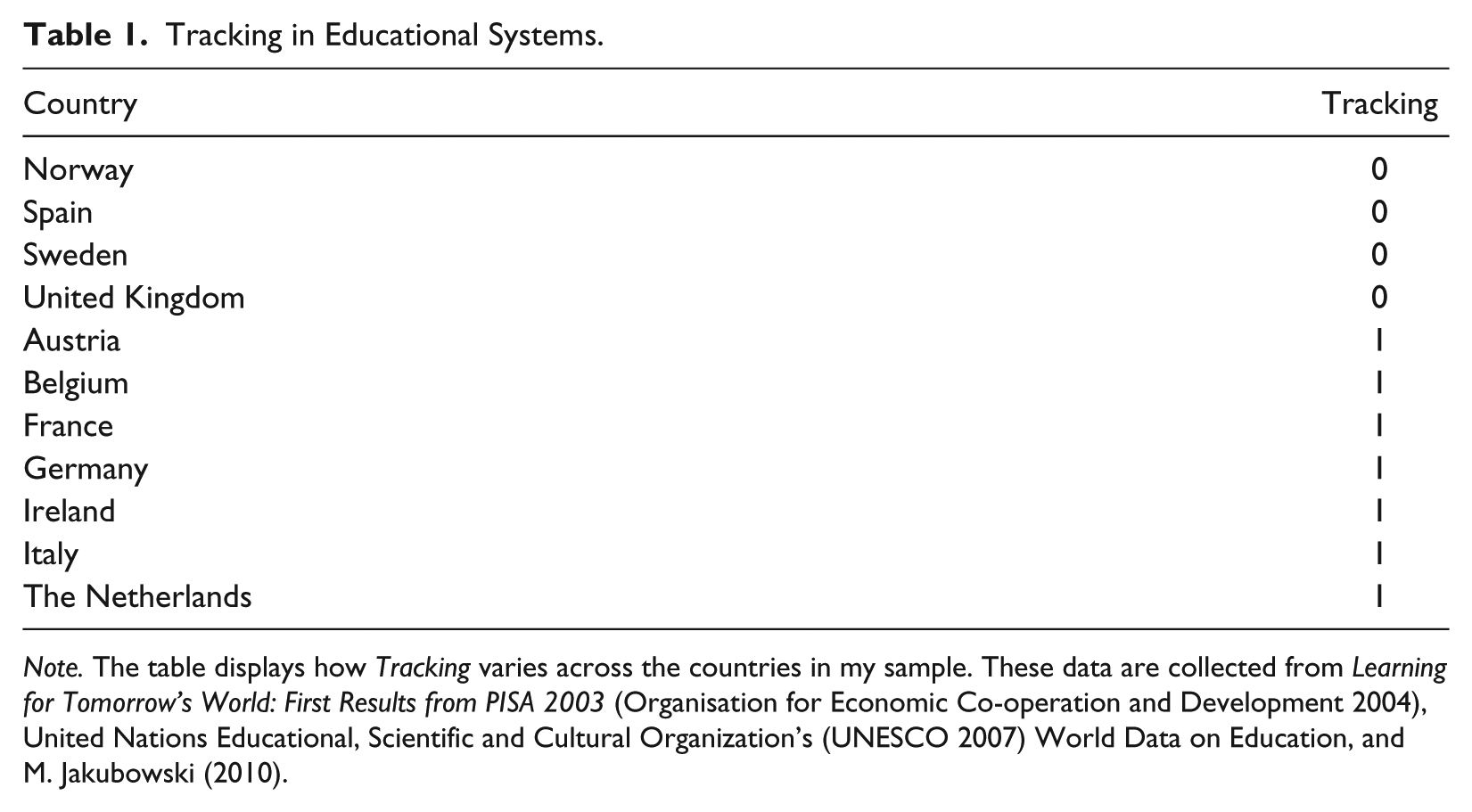
Note. The table displays how Tracking varies across the countries in my sample. These data are collected from Learning for Tomorrow’s World: First Results from PISA 2003 (Organisation for Economic Co-operation and Development 2004), United Nations Educational, Scientific and Cultural Organization’s (UNESCO 2007) World Data on Education, and M. Jakubowski (2010).
I collect information on the number of distinct programs and distinct school types available to students within each country and the age when tracking begins from Learning for Tomorrow’s World: First Results from PISA 2003 (OECD 2004). For France, I obtain additional information from UNESCO’s (2007) World Data on Education and from Jakubowski (2010).
Control Variables
Previous studies have pointed to numerous factors that affect the educational outcomes of immigrant students as well as the relationship between tracking and the educational outcomes of immigrants. In line with this research, I include controls for gender (Feliciano and Rumbaut 2005), prior achievement (Goyette and Xie 1999), parental education (Haller and Portes 1973; Lee and Zhou 2015), parental occupation (Haller and Portes 1973; Hao and Bonstead-Bruns 1998), and student family structure (Hampden-Thompson 2009; Hao and Bonstead-Bruns 1998). I also control for the type of school program that the student attends (Dronkers, Van der Velden, and Dunne 2012). At the country level, I control for gross domestic product (GDP) and the level of unemployment (Clark 2011), as well as the degree to which government policies are welcoming to immigrants (Manatschal and Stadelmann-Steffen 2013).
Regarding the measurement of control variables, Female is coded 1 for females and 0 for males. To measure Achievement, I combine each student’s math and reading scores across all five plausible values 2 for each subject. When constructing this measure, I follow Buchmann and Park (2009), M. Levels, J. Dronkers, and G. Kraaykamp (2008), and H. Park and S. Y. Byun (2015). Two-parent Family is coded 1 for students who live with a biological father and mother, and 0 for all other family arrangements. I measure Parental Education as the highest number of years of education completed by either parent. Parental Occupation is measured by the highest level of occupational status attained by a parent on the ISEI (International Socio-economic Index) scale (Ganzeboom, De Graaf, and Treiman 1992); as with parental education, if the occupational status is provided for both parents, the higher status is used. Program Designation denotes the type of study program that a student is currently enrolled in. It ranges from 1 to 3, where 1 indicates general programs that provide students with access to the next program level, 2 indicates programs that provide students with access to the next level of vocational studies, and 3 indicates programs that designate students to exit directly into the labor market upon completion. 3 Should the vast majority of immigrant students in my sample be tracked into lower program designations, it might mean that the effects that I observe between tracking and the immigrant status of students are driven by the possibility that most immigrant students in my sample are segregated in lower program designations. Table A1 in the appendix demonstrates that such segregation does not occur.
At the country level, I control for the national GDP, the national unemployment rate as a percent of total labor force, and a nation’s position on the Multiculturalism Policy Index (MPI) constructed by E. Tolley (2011). I collect measures of GDP per capita and Unemployment from the World Bank DataBank. I use the 2002 estimates for both variables to ensure that economic performance and unemployment are measured prior to educational expectations. MPI is a summative index of whether a country has multicultural policies in place. It is used to capture the policy environment wherein immigrants reside. The policies included in the index range from affirmative action for disadvantaged immigrant groups to state funding of bilingual education or mother-tongue instruction (Tolley 2011). I use estimates for 2000. The descriptive statistics for all variables are provided in Table 2.
Descriptive Statistics.
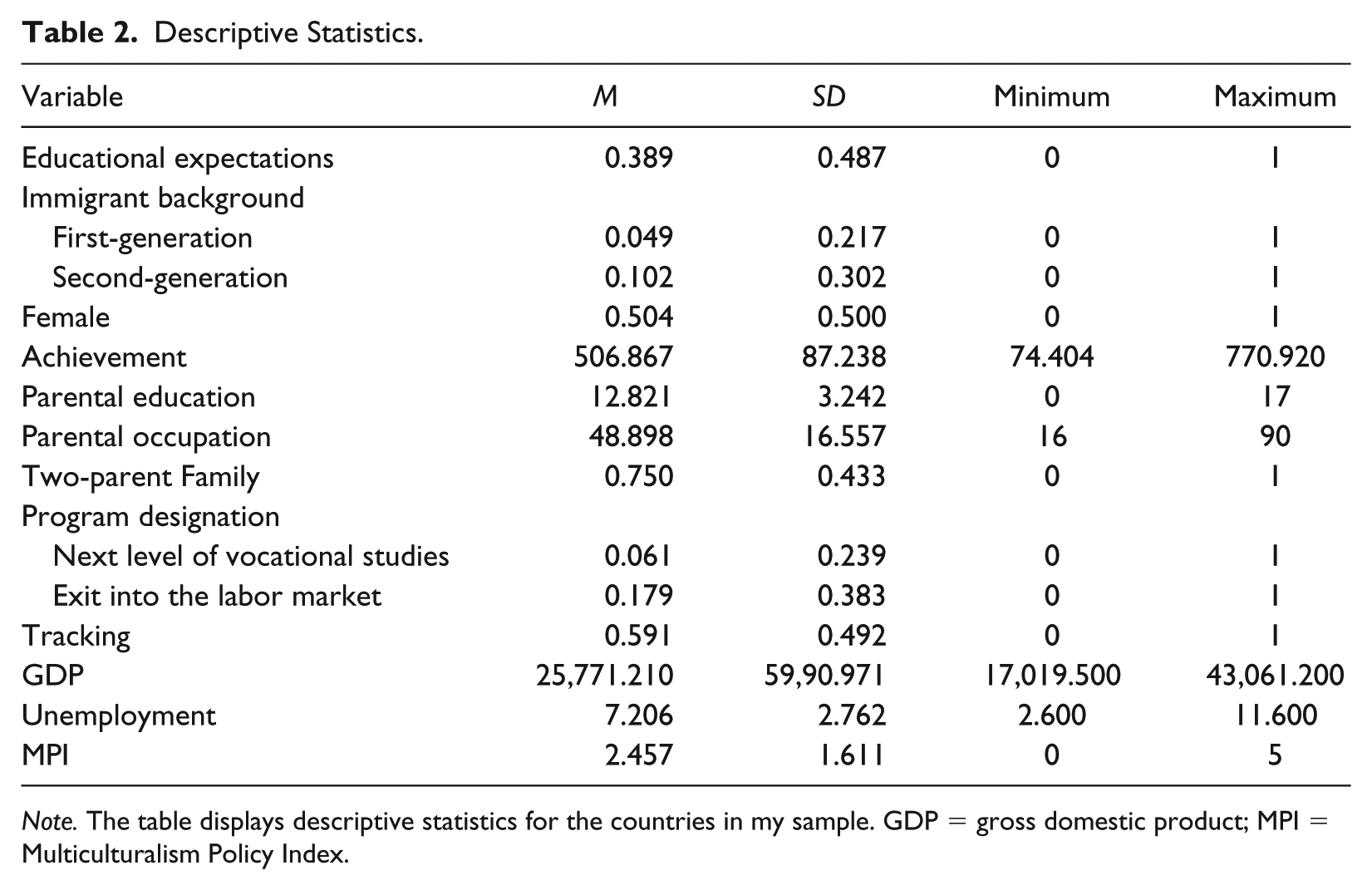
Note. The table displays descriptive statistics for the countries in my sample. GDP = gross domestic product; MPI = Multiculturalism Policy Index.
Analyses and Results
I test my hypotheses using multilevel modeling to take advantage of the nested structure of my data (i.e., students, the level-1 units, are nested within schools, the level-2 units, and within countries, the level-3 units). I include random intercepts at the school and at the country levels. This type of modeling has two primary advantages: (1) It allows me to account for dependence among error term components and (2) it allows me to control for unobserved heterogeneity (Gelman and Hill 2006; Raudenbush and Bryk 2002).
Given that my outcome measure is a binary variable and follows a Bernoulli distribution, I estimate a random effects logistic regression model (Wooldridge 2010). The probability model is Prob(Educational Expectations = 1|βj) = φ (Raudenbush and Bryk 2002). The logit model uses a logistic link function, g′(η) = log(φ / (1 − φ)), which transforms any outcome variable bounded on [0, 1] into an unbounded variable that ranges from [−∞, ∞] (Wooldridge 2010). The results of the analyses are presented in Table 3. Model 1 tests Immigrant Expectations Hypothesis and model 2 tests Conditional Tracking Hypothesis.
The Estimated Relationships between Tracking, First-generation and Second-generation Immigrant Status, and Educational Expectations.

Note. The table displays the results of two three-level models that estimate the relationship between Tracking, First-generation and Second-generation immigrant status, and Educational Expectations. Random intercepts are used at the school and country levels. Standard errors in parentheses. OR = odds ratio; GDP = gross domestic product; MPI = Multiculturalism Policy Index.
Only statistically significant odds ratios are reported.
Only statistically significant odds ratios are reported.
I conduct a Wald test to examine whether there is statistically significant difference between the First-generation and Second-generation coefficients in model 1. The coefficients are statistically different (χ2 = 40.28, p < .001).
I conduct a Wald test to examine whether there is statistically significant difference between the First-generation and Second-generation coefficients in model 2. The coefficients are statistically different (χ2 = 36.71, p < .001).
I conduct a Wald test to examine whether there is statistically significant difference between the First-generation × Tracking and Second-generation × Tracking coefficients in model 2. The coefficients are statistically different (χ2 = 6.95, p < .01). A. Gelman and H. Stern (2006) discuss why a formal test between a statistically significant coefficient and a nonstatistically significant coefficient still needs to be conducted to determine whether the two coefficients are statistically distinct.
p < .1. **p < .05. ***p < .01, two-tailed.
In model 1, the coefficients of interest are First-generation and Second-generation. These coefficients are positive and statistically significant. Holding other factors constant, being a first-generation immigrant is associated with a 132 percent increase in the likelihood that a student expects to achieve a college degree, and being a second-generation immigrant is associated with a 57 percent increase in such likelihood. This is in line with my Immigrant Expectations Hypothesis.
I also conduct a Wald test to examine whether the coefficients for First-generation and Second-generation in model 1 are different from each other. The Wald test shows that the difference is statistically significant (χ2 = 40.28, p < .001). This indicates that first-generation immigrants experience a higher gain in educational expectations than second-generation immigrants. This provides additional evidence for my Immigrant Expectations Hypothesis.
I test the Conditional Tracking Hypothesis in model 2. Here, I am interested in the coefficient for two cross-level interactions: First-generation × Tracking and Second-generation × Tracking. The first interaction term is statistically significant but the second one is not. Model 2 shows that a first-generation immigrant in an untracked system is 194 percent more likely to expect to attain a college degree than a nonimmigrant student. In a tracked system, however, the odds decrease to a 98 percent advantage. 4 However, the decrease that second-generation immigrants experience is not statistically significant. This relationship is depicted in Figure 1.

A marginal effects plot that shows how the association between tracking and educational expectations changes under different immigrant status conditions.
In sum, the positive association between immigrant background and educational expectations is attenuated for first-generation immigrants in tracked systems but not for second-generation immigrants. As such, I find partial support for my Conditional Tracking Hypothesis.
Furthermore, while my theory does not focus on the relationships between educational expectations and the control variables that I include in my models, it is worth noting that being a female, having higher achievement scores, having parents that are more educated and hold more prestigious jobs, as well as coming from a family where a student lives with two biological parents, are all associated with an increase in educational expectations. At the same time, attending school programs that lead to the next level of vocational studies or expect students to exit directly into the labor market are associated with a decrease in educational expectations. The results also indicate that GDP is negatively associated with educational expectations; this association, however, is substantively trivial. 5
Another interesting question is whether there is variation in how immigrant students react to tracking depending on their gender, the education of their parents, and the type of school program they attend. In analyses not presented here, 6 I subset my data only to immigrant students (both first- and second-generation students) and estimate additional models that include the following interaction terms: Female × Immigrant Background 7 × Tracking; Parental Education × Immigrant Background × Tracking; and Program Designation × Immigrant Background in tracked countries. 8 I find that none of these interactions are significant. In other words, the marginal effect of tracking on educational expectations of first- and second-generation students does not differ by student gender and parental education. Furthermore, the associations between first- and second-generation status and educational expectations do not vary depending on the program type that students attend.
Discussion
This paper examines the relationship between tracking and the educational expectations of immigrant and nonimmigrant students in Europe. It shows that both first- and second-generation students expect to achieve a college degree at a higher rate than nonimmigrant students. This finding is encouraging because expectations to achieve a college degree are generally regarded as a positive indicator for eventual degree attainment (Jacob and Wilder 2010). However, this paper also shows that first-generation immigrants tend to moderate their educational expectations in tracked educational systems, while second-generation and nonimmigrant students do not. I argue that the moderation of educational expectations results from it being harder for immigrant parents to navigate their child through tracked systems due to a lack of knowledge about how tracking works. The lack of a finding for second-generation students can then be attributed to the fact that this information asymmetry is likely more pronounced in the families of first-generation students than of second-generation students.
The findings of this paper also extend existing scholarship on how educational institutions serve to promote or hamper immigrants’ opportunities to realize their potential (Alba and Holdaway 2013; Crul et al. 2012; Dronkers et al. 2014). Although the finding that the educational expectations of immigrants are higher than those of nonimmigrants is reassuring, the fact that first-generation students have lower educational expectations in tracked systems speaks to the literature on how educational institutions might serve to marginalize minority youth (Delpit 2012; Faist 1993; Gonzales 2010; Noden, Shiner, and Modood 2014). This is especially problematic given the characteristics of immigrants currently arriving to Europe. As compared with immigrants who arrived in the previous decade, recent immigrants to Europe are less likely to be proficient in the language of their host country, possess an understanding of local customs and standards, and have educational qualifications that are recognized in their host country (OECD 2016). The net result of all these differences is that entry into the job market is more difficult for these immigrants (OECD 2016). In addition, many have also experienced emotional trauma from violence and deprivation in their homelands and on the way to Europe (Global Migration Data Analysis Center 2016). Due to these disadvantages, recent immigrant parents are perhaps worse suited to figure out the educational systems of their new host countries than those who arrived in the previous decade. This means that for current immigrants, the negative effects of tracking are likely to be stronger and harder to overcome.
This paper also provides the first cross-national test of how educational systems might influence the educational expectations of immigrant students. At a time when obtaining a college degree is associated with increased earnings, better health, and a stronger concept of self (Baker 2014), making sure that immigrants who achieve at the levels that enable them to matriculate into college do so is of utmost importance. Furthermore, anti-immigrant sentiment is often fueled by a perception that immigrants do not wish to assimilate into their host countries and that they overburden the welfare state (Feagin 1997; Schneider 2008). More educated immigrants are ostensibly at a lower likelihood of being perceived this way. By hampering first-generation immigrants’ educational expectations and thus their educational attainment, tracking might indirectly contribute to a strengthening of the anti-immigrant sentiment. In light of these potential negative outcomes, this paper adds an additional piece of evidence in favor of the OECD’s long-standing recommendation that countries should scale down tracking practices (OECD 2012).
Footnotes
Appendix
Declaration of Conflicting Interests
The author(s) declared no potential conflicts of interest with respect to the research, authorship, and/or publication of this article.
Funding
The author(s) received no financial support for the research, authorship, and/or publication of this article.
