



Abstract
Resentment, that is triggered by deprived entitlement, was suggested as particularly salient for energizing action and change in labor relations. However, its relationship with estrangement has not yet been examined as relevant to social change in times of contracting out services. I investigate this question in my research of public procurement as a mode of contract-based service delivery, examining two types of related jobs. The analysis of interviews with 30 employees and 12 administrators, all women, revealed the emergence of managed resentment and the conditions of its coexistence with estrangement. I demonstrate a learning process in which resentment energizes action but encounters lack of recognition. Managed resentment follows but remains protected from estrangement only by positive emotions created in care relations. I discuss possible meanings of these subjective developments for social change in the contexts of women’s encounter with lack of recognition of their skilled or professional contributions.
Keywords
Introduction
The fragmentation of working lives, created by public procurement among other forms of service delivery, provided Richard Sennett (1998) and other theorists (e.g. Elliott and Lemert 2006) with the opportunity to inquire about the association between emotion and social change. In these accounts, the process through which citizenship weakens its bond with participation, giving way to more privatized forms of citizenship (Elliott and Lemert 2006), has proved particularly intriguing. This transition may be succinctly explained as the replacement of social citizenship (Lister 2004; Marshall 1973)—based on social protection and rights—with market citizenship (Fudge 2005; Gazso 2012), based on the adult worker citizenship contract (Daly 2011; Lewis 2002) namely, the expectation that all citizens are financially independent and self-reliant in attaining all forms of services and support through the market. During times of social citizenship and standard employment, labor market participation embodied an inclusionary aspect of citizenship for women (Orloff 1993). It is unclear how changes occurred in this respect during times of nonstandard and poverty employment (Jacobs and Padavic 2015). Moreover, macro-level social change in citizenship and employees’ entitlements was surely associated with emotions. What are the emotional components of such social change? How do citizens learn of these privatized forms? I suggest that dealing with these questions provides an opportunity to engage in debate concerning emotion and social change.
The debate begins with Jack Barbalet’s (2001) accusation that Arlie R. Hochschild’s (1983) notions of emotional management and emotional work are conformist and miss the potential of resentment to energize resistance and social change. If this is indeed the case, if Barbalet’s conceptualization of resentment is more applicable to empirical findings, we may anticipate action and struggle—based on a sense of entitlement—against exclusionary aspects of the relevant jobs. If Hochschild’s emotional work offers a more accurate understanding of how emotions change, we may expect to see corrective emotional work, wherein negative emotionality is replaced along the lines of the workplace ideological environment. If resentment can be found to be managed, I suggest that it may shed light on the way Hochschild’s notion of emotional management is echoed in the current transformation of resentment and can help to understand barriers to employees’ action. However, I nuance this debate by introducing the concept of ‘managed resentment,’ that incorporates aspects of both theories to introduce an analytical processual view of emotion and social change that neither focuses necessarily on collective action nor does it portrays an employee totally attuned to workplace ideologies. My concentration on resentment distinguishes among three theoretical possibilities.
As a starting point, resentment is assumed to be associated with the realization that past entitlements, defined as a reward, advantage, or benefit granted in recognition of one’s status or contribution, were replaced. Past entitlements, either to remuneration or to forms of direct participation in the sense of having a say about work processes (Gallie 2013), are no longer publicly recognized. In the context of the current, polarized power relations (Vosko 2010) typical of workplaces, engendered by outsourcing and contracting-out procedures (Sack and Sarter, forthcoming), formal replacement of past entitlements could have had one of three implications for employees’ emotional response. First, entitlement could have disappeared: Estrangement, a form of alienation that hinders one’s ability to experience the full range of human feelings, leading to partial functioning (Weyher 2012), could have signaled a sharp turning point at which employees accept their new, deprived situation and their low levels of remuneration and participation. Second, entitlement could have been transformed: Resentment, an emotional response to deprived entitlement and lack of recognition of one’s value and the worth of one’s contribution, could indicate employees’ refusal to accept the situation created by their structural weakness. This refusal would mean that they do not succumb to their definition as not entitled to appropriate remuneration and participation. Rather, their resentment would indicate that they may still believe in their entitlement, but their survival needs require its transformation, exclusion from employment relations and privatization. Privatized entitlement in this context is the phenomenon by which people hold on to past entitlements but understand that others do not recognize it and that it may never be validated. Third, a similar process could take place to preserve entitlement in a privatized form, but workplace barriers to occupational routines would expose it to estrangement. Once estrangement develops, it may overlap resentment, creating an emotional state that hinders one’s ability to experience participation and belonging. It leads to partial functioning, wherein employees are unable to believe in their chances to make an impact. All three possibilities embed negative evaluative judgments of how employees are treated in terms of what they value and what they consider as affecting their wellbeing. Nevertheless, clarifying the dynamics of estrangement in the process may be crucial for understanding options for social change.
Moreover, clarifying empirically which of these three possibilities best describes how employees in contracted-out services and state administrators overseeing these services experience the association of estrangement and resentment allows for new insights into emotional management in times of polarized power relations in the workplace and transitions in citizenship contracts. Could resentment fulfill its potential as an engine of resisting action directed at social change (Barbalet 2001) in this context? Or would workplace power relations enforce emotional work (Hochschild 1983) and the management of resentment in ways consistent with Brian S. Turner’s (2014) suggestion that resentment is transformed and unable to herald political action and social change? To discuss employees’ emotions, I borrow Turner’s phrase ‘mute resentment’ and introduce a related concept, ‘managed resentment,’ that allows for more than one phase of resentment. In discussing women’s feelings, Turner’s phrase could imply an historical reverse, but this is not my argument at present. Nevertheless, I do use Turner’s suggestion that resentment is transformed, considering its potential for shedding light on social change. I offer a systematic examination of this potential by raising the research questions of what are the relations between estrangement and resentment and, what are the implications of these relations for social change particularly changing citizenship contracts. By the latter, I refer specifically to the transition introduced above between social citizenship that recognizes a range of rights and ensures participation and market citizenship that is based on assuming self-reliance and autonomy associated with isolation.
Employees in Israeli Contracted-out Services
Women’s employment in social services in Israel, as in other Organisation for Economic Co-operation and Development (OECD) countries, has not followed old discussions of wage work as estranged and focused instead on intrinsic rewards (Hebson, Rubery, and Grimshaw 2015). The emotional basis of caring relations and embedded involvement (e.g. Baines et al. 2014) were in fact suggested to be crucial to workers’ ability to perform their specific tasks well. Employees’ dedication at work has not alleviated their undervaluation nor affected budget administrators in their battle against the costs of professionalization and certification (Armstrong 2013). In Israel, one aspect of this confrontation has been the extensive use of public procurement in the social organization of state service provision. The transition from a mode of service delivery that relies on the state to a mixed economy of service delivery, organized by public procurement, namely, by outsourcing, requests for bids (RFBs) and contracting out, has been promoted incrementally since 1977. It was intensified since 1985 and reached a peak in 1996. Since then, many education, welfare and health care services have been based on contracts with service deliverers. This has diversified the hitherto unionized quality employment in these services that characterized local opportunity structures for Israeli women even though these reflected ethno-national discriminations (Ehrlich 1984).
Contracting out is a general category including public-private partnerships, as well as civil society organizations’ delivery and commissioning. All these types of service delivery are based on a contract—a practice that has been criticized extensively (e.g., Epstein 2013). Among other issues, contracting out has been associated with low-income employment in elderly care and childcare, as well as for nursing assistants and cleaning personnel, that engender a persistent level of poverty and/or dependency (Peña-Casas and Ghailani 2011; Rubery, Grimshaw, and Hebson 2013). Because the Israel Government procures welfare, education, and healthcare services, such outcomes are prevalent, affecting certified social workers, teachers, and nurses, along with uncertified service and care employees.
In Israel, contracting out as part of trade in services has exacerbated the fragmented character of the state (Mundlak 2007). Besides other trends, citizenship has been gradually transformed by the differences between unionized employees—whose entitlements are defined and protected by collective agreements—and marginalized employees in contracted-out services, whose entitlements tend to be blurred by disparities between law and practice. Such disparities are frequently reported for service deliverers who seek to extend their control when the state does not properly cover the expenses of the procured service (Nisim 2015).
As in the United Kingdom, Canada, and Australia, contracting out in Israel implies the absence of an employer in the traditional sense. Although the agency operating the service may be legally defined as an employer, the contract exempts it from responsibility over employment conditions. Instead, these are defined in the contract according to certification level and job duration (number of hours weekly) of the required labor force. In other words, it is the state that determines labor conditions for all intents and purposes. Yet in times of conflict, the state maintains its legal status as a service procurer with no responsibility for labor relations between the contracted agency and its labor force, while formal employers (contractors) argue that they have no influence on conditions and cannot afford to raise pay rates, as they depend on state funding of the project (Preminger 2018). A continuous public campaign engages with these issues protesting against the violations of workers’ rights in this context (Preminger 2018).
Alongside this category of employees, whose employment conditions are defined by a contract between a Government Ministry and a service deliverer, lies another category. It consists of professional women located higher up on occupational hierarchies of Government Ministries or municipalities who hold quality, unionized jobs. I refer to administrators involved in three stages of the contracting-out process: Contract design, contract negotiation with the selected bidder, and long-term contract management. Throughout these three stages, they oversee the occupational standards of the contracted-out service. In other words, they are required to contribute their professional knowledge and recommend labor force requirements, based on their understanding of the service and the needs of its users, grounded in their many years of experience in the field. The occupational standards they require, however, are negotiated with budgeting administrators seeking to lower the costs of service operation. They are under strong pressure to reduce these standards with regard to job extent of certified employees and to replace them with uncertified personnel. In other words, their routine involves a process in which they are asked to act as professionals in their respective fields, but their positions are recognized by budgeting officers only after they trim occupational standards.
Both categories of workers are exposed to encounters in which their subjectively held view of their entitlement—employees to remuneration and occupational standards administrators to professional participation—is not accorded recognition. The analysis presented below elucidates their responses to this lack of recognition, thereby conceptualizing the related transformation of entitlement and citizenship occurring in changing welfare regimes.
Emotion, Entitlement, Resentment
When critical theorists discuss emotion and social change, they emphasize employees’ agency—the power to resist estrangement, to “keep free of the emotional grip of the social structure” (Sennett and Cobb 1972:258; cf. Weyher 2012). In the context of polarized power relations within current labor fragmentation (Vosko 2010), the association between emotion and social change may need to be examined somewhat less optimistically. According to Barbalet, resentment—the emotionally charged perception of another’s advantage that did not appear to be deserved—bears potential for social change because of its deep connection to confident entitlement to that advantage. 1 Confidence in entitlement is embedded in social relations and depends on others’ recognition thereof (Honneth 1996). Entitlement is related to the feeling of what one deserves as a citizen, employee or esteemed administrator, whereas resentment emerges when one’s perceived entitlement is undermined. As an emotion, resentment becomes closer to anger and rage when confidence in entitlement is high, but not when entitlement is questioned. In transitional times such questioning becomes a frequent characteristic of interactions between citizens and state representatives, between employees and their superiors and so on. When such questioning is encountered repeatedly, entitlement is bound to weaken, with public discourses constantly blurring the boundaries between entitlement and the absence thereof. Barbalet’s (2001) interpretation of Thomas H. Marshall’s (1973) theory of citizenship suggests that once one is deprived of a right, the assumed entitlement cultivates resentment and action. Many collective struggles targeting class, race, and gender inequality may be described as illustrating Barbalet’s analysis of the role of emotions in social change. In today’s workplaces, employees’ sense of entitlement has to rely on past welfare regimes (Fraser 1998; Korteweg 2003) and comparisons with others who still benefit from past established entitlements. This creates a situation wherein one’s sense of entitlement is not necessarily validated at the workplace. Following the failure of attempts at engaging the organization’s negotiated order (Strauss 1978) in restoring entitlement it may be modified, subjecting resentment to new display rules.
In his criticism of Barbalet’s account of resentment, Turner (2014) argues that we no longer live in a time in which we may assume that resentment will become rage and then turn into rebellion. Instead, he suggests the emergence of mute resentment, claiming that The modern status system appears to be based on the “luck of the draw,” and there is as a result ample scope for disappointment, frustration, envy, and resentment. Such fragile and precarious reward systems create conditions for an inflationary growth of resentment within the modern occupational system and income ladder. Where success is broadcast through prizes, public awards and status-conferring ceremonies, the opportunities for resentment are further enhanced. Institutions where such ritualized rewards for celebrities are still emphasized—the academy and the film industry—will offer occasions for acute, if typical, mute resentment. (Turner 2014:186)
Hochschild’s notion of emotional management fits in well with Turner’s theory of mute resentment. Hochschild’s understanding that specific emotional norms are cultivated within specific ideological environments and that people work to correct their emotions would allow him to connect to the strength of the analytical distinction where deep acting and surface acting, or display rules, remain separate. Her notion of ideological environment suggests that employees who have to encounter daily a range of requirements with little recognition can be expected to act overtly on their resentment only on condition that a social force provides them with the recognition they long for, namely one that creates the ideological environment in which their deprived entitlement would be validated.
Connecting Hochschild’s insights with Turner’s (2014) conceptualization of resentment, that follows the general guideline of Elias’s civilization process, suggests relevance to the call to explore the relations of various emotions with Marx’s notion of estrangement (Weyher 2012). Estrangement is also highly relevant to the discussion of transitions in entitlements and may extend its meaning accordingly, indicating the possibility that it may result from managed responses and isolation. Estrangement, as a partial experience of being, occurs when some aspect of one’s knowledge or feeling cannot be manifested because of the imposed value criteria of a concrete social space. This partiality is closely related to the contemporary transformation of resentment. Consequently, one may debate its relations to estrangement: Is it tamed by the civilization process so that it changes its form? Is it managed as an adjustment to workplace power relations (Hochschild 1983)? Is it disappearing because of the emergence of estrangement resulting from the current requirement to maintain workplace rationality (Weyher 2012)? Despite the potential contribution of these issues to the analysis of emotion and social change, the question of the relationship between resentment and estrangement has not yet been examined. Assessing this relationship in light of “managed resentment,” I contribute to existing research by nuancing the debate about whether resentment catalyzes social action or dissipates when confronted by dialogue failure and estrangement. I address this relationship through employees and administrators facing situations in which they manage their resentment in heretofore unidentified ways. Figure 1 presents three theoretical possibilities of the examined relationship:
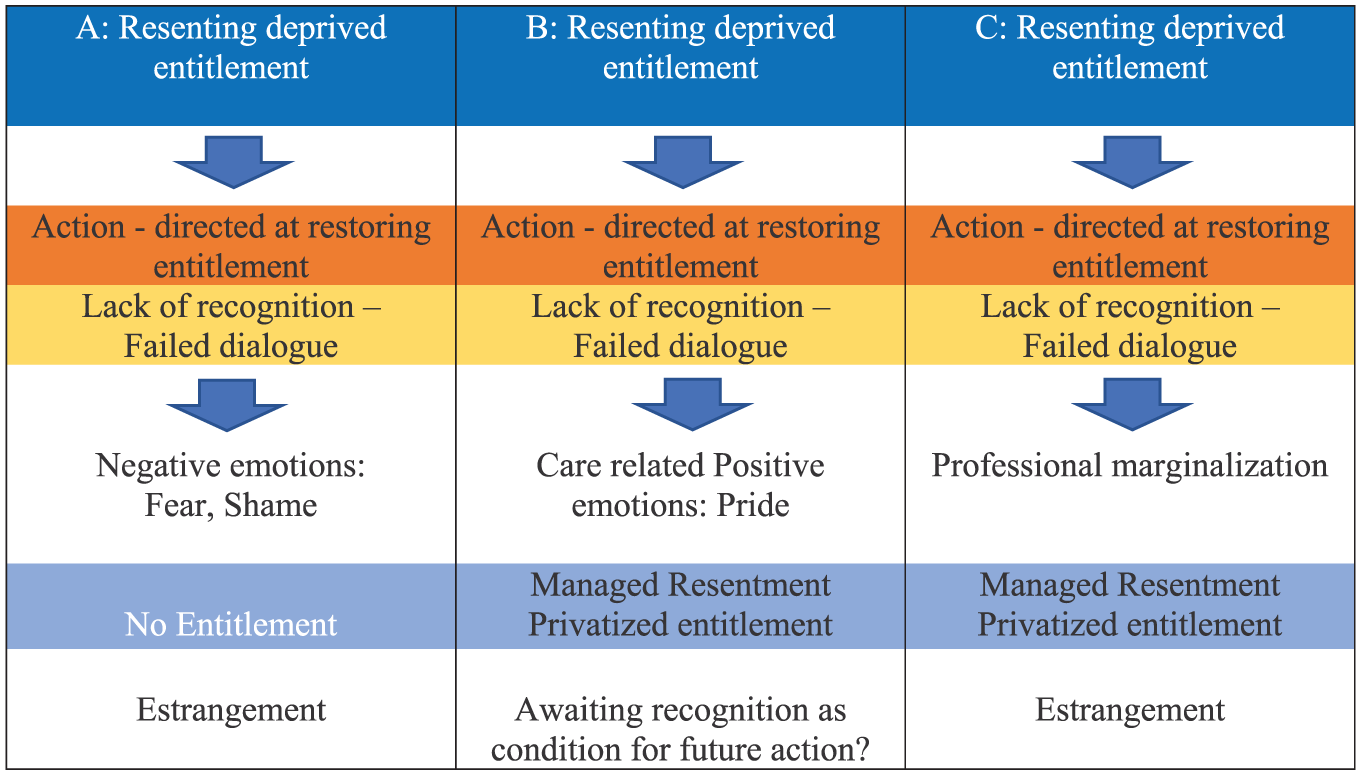
Possible role of Emotion in Social Change Processes.
The three processes presented in Figure 1 begin with the emotion of resenting deprived entitlement, resulting in the energizing of action directed at restoring entitlement from its presently unrecognized status. In Process A, consistent with Barbalet’s objection to Hochschild’s argument, respondents react by obeying the feeling structure that allocates fear and shame—emotions that diminish their resentment and forgo entitlement. Were this possibility to be supported empirically, estrangement could be said to override resentment and little future action could be expected. In Process B, consistent with Barbalet’s argument as nuanced by Hochschild’s understanding of managing emotions, respondents can refute the feeling structure by connecting to care-related, positive emotions such as pride. Their managed resentment would then converge with privatized entitlement that awaits recognition and could be translated into action and active citizenship, theoretically speaking, were such recognition to be granted. Here, the potential for social change is the strongest of the three. In Process C, defying Barbalet’s argument and supporting Hochschild’s perspective, respondents experience marginalization of their contribution, exposing them to estrangement irrespective of their privatized entitlement. Future recognition is unlikely to enable them to restore their professional position, rendering the potential of translation of their privatized entitlement into social change as only minimal.
Thus, I undertake to clarify how estrangement relates to managed resentment, using the three suggested processes as ways of understanding their association. Empirically clarifying which of the three is consistent with actual experiences would shed light on the specific conditions under which in times of changing labor relations and citizenship contracts, Barbalet’s suggestion that resentment leads to social change can actually materialize. In addition, studying this association would also indicate the importance of understanding Hochschild’s emotional management for in analyzing the likelihood of an action leading toward social change. I investigate these processes in the field of contracting out as a mode of service delivery and the two types of jobs it involves.
Methodology
The analysis presented here is part of a larger, multistage project in which I aim to study the social organization of contracted-out caring services by clarifying and analyzing the standpoints of the employees operating the services and the administrators involved in contract design. I approached these participants because employees of these services are the ones who know how it feels to be employed in a contracted-out service and whether estrangement can describe their experience. Furthermore, administrators in charge of occupational standards are aware of the feelings engendered by being part of the process of negotiating one’s professional knowledge with budgeting administrators aiming at lowering state costs. Both samples are thus particularly suitable for responding to the research question raised here.
At the first stage, thirty women employees in various care occupations in Israel were interviewed: Uncertified nurses who replaced traditional school nurses in the Vaccination Project, social workers employed in various welfare projects, teachers involved in a second chance project for dropouts, childcare aides, and care providers for elders. To recruit participants, I relied on the social networks of employees participating in unionized struggles, a method that may have yielded overrepresentation of employees who feel strongly about their deprived entitlements; I further relied on social networks of students from underprivileged social categories, primarily immigrants, implying that my participants do not work in the same workplace. Moreover, all interviews were conducted in Hebrew, the mother tongue of most participants but less comfortable to three of the caregivers for the elderly. The breakdown by occupation is as follows: five caregivers for the elderly, two nursing assistants, six youth social work (SW) assistants, one physical training teacher, three primary school (PS) teachers, three youth dropout teachers, two teaching assistants in PS, one welfare-to-work SW assistant, one special needs teaching assistant, one art teacher, two childcare assistants, one sex education teaching assistant, and two autistic spectrum SW assistants. Their ages ranged between 20 and 65; all were Jewish and except for the caregivers for the elderly, all were Israeli born (for more details, see Benjamin 2016).
Interviewers included four women students who were not acquainted with participants in advance and were not employed themselves in contracted-out services. Interviews focused on daily employment routines, the stories behind current employment conditions and relationships at work. Employees described negative feelings when asked “Could you tell me about your work conditions?” or “How is your relationship with your superiors”? Interviews lasted about an hour and a half and were conducted at each participant’s preferred location (often at home); all were recorded and transcribed verbatim.
At the second stage, a research assistant, who was familiar with some RFB (request for bid; also known as “tender”) processes because of his political activism against compulsory tendering of cleaning services but did not know any of the administrators in advance, interviewed 12 (10 women) occupational standards administrators working for the Health, Education and Social Service Ministries, as well as at local authorities. To recruit participants, the latter were asked about the people they worked with and subsequently provided the names of additional prospective candidates. Nevertheless, relatively few administrators were willing to be interviewed, possibly because of the subject’s sensitivity. The same sensitivity is responsible for the lack of information regarding their workplaces and areas of responsibility. Furthermore, administrators’ were reluctant to admit that they are part of the process and that they have relevant information, a tendency that can be explained by the timing of the interviews, that were conducted just as the public campaign against outsourcing of social services was gaining momentum (Preminger 2018) and the administrators did not want to be accused of taking part in the violations of workers’ rights that are attributed to this mode of service delivery. The same reluctance encouraged two administrators to request that they be interviewed together. Other than this case, all other interviews were conducted on a one-to-one basis.
Participants were generally asked about the procedures of preparing contracts and their role therein. Administrators’ feelings emerged when asked such questions as “Could you tell me about an RFB in which you were involved?”; “How is the labor force section of that RFB worded?”; “Do you get to deal with labor force issues after the contract is signed?” Interviews lasted approximately one hour in duration. As participants were highly insistent on anonymity, there was no tape recording. The interviewer took notes during the interviews and transcribed them immediately afterwards. All names are pseudonyms to protect the privacy of participants.
First, analysis of the two data sets was separated. Analysis of interviews with front-line employees was guided by grounded theory (Charmaz 2006). During this stage, certain emotional themes emerged, primarily pride and descriptions of being shamed by superiors and at times by care receivers’ relatives. Coding these themes, I noticed the concurrence of these emotions. Analysis of interviews with administrators followed Maarten Hajer’s (1995) discourse interaction approach, in which forms of speech are examined to determine the form perceived as most rational. The findings of this analysis are reported elsewhere. Throughout this earlier stage, however, I noticed the degree of pride associated with occupational identities and shaming experiences and realized the similarity between their experiences and those of the front-line workers. Consequently, I present hereunder the results of a second analysis that followed the participants’ accounts of resentment. I did not possess any systematic observations of emotional displays and instead followed Christine Coupland et al. (2008) in addressing people’s discussions of emotions.
Eliciting Resentment
Initially, I focused on shame as the organizing principle, but returning to Barbalet’s book, it became evident that lack of recognition played a part in the learning process. Informed by his account, I shifted emphasis from the shaming interaction itself to what I saw as the effect created by it, resentment. Later, further informed by Turner’s recent account, the notion of mute or managed resentment appeared even more applicable, reflecting the concurrence of pride and the sense of entitlement on one hand, along with the negative emotionality that remained after the encounter with lack of recognition on the other. As employees did not name any of these emotions, one cannot say with certainty whether what they described was anger, rage, frustration, or disappointment. Employees emphasized their devotion to and care of clients, explicitly manifesting their wish to protect care receivers from the problematic consequences of the current service organization. Such thoughts were expressed without reflexive negation of their position in the service and their speaking tones appeared highly passionate, suggesting that their feelings were not rumination alone. Seeking to identify the phenomenon of the emerging split between very positive and highly skilled experience at work with the negative emotion concerning inability to impact the service delivery organization, resentment fit the duality best among all options mentioned.
Findings
This Findings section unfolds a learning process for both categories of women: Those operating the services and those involved in designing the contract for their procurement. The process begins at a moment of trust when participants describe their attempt to engage in dialogue, expecting to restore their deprived entitlement. Acting on their resentment in this way, they assume the legitimacy of disclosing negative feelings (Hadley 2014). I use the context of their action to examine my research question concerning the relationship between resentment and estrangement.
Questioning Entitlement
The incremental promotion of different practices of outsourcing and contracting out of education services defined as peripheral to the core schooling excluded hundreds of teachers from the protection of their traditional union and the core labor conditions to which teachers at school have been entitled. They experience their exclusionary contracts in one of two different situations. The first entails complete spatial separation, in which contracted employees work in spaces that offer only contracted-out services, while in the second, workers employed by service deliverers share the same work space as persons employed by the state, who benefit from collective agreements. The latter situation creates an intensified social process in which the mechanism of relative deprivation dominates: Even if I feel so irritated about my retirement package and even if I realize that I’m going to be in the devastating position of having no pension, I already know that nothing can be done. I tried to go someplace, say something, do something . . . nothing . . . no one believes there’s anything . . . I envy the teachers I meet everywhere who have a retirement plan; they are secure and can do whatever they feel like . . . Well, one shouldn’t envy others, and indeed I’ve got my husband, who tells me I should be happy with what I have and my daughter-in-law says, “But we all envy you, see how you look at your age.” They all say I have nothing to complain about, but still I feel that, proud as I am about this beautiful family of mine, I deserve some financial security as well. Remember that I’ve been employed since the age of 18. Why should I retire with nothing, why? Why can’t they employ a person with due respect? Why employ me under such distorted conditions? (Rebecca).
Resentment is very clear in Rebecca’s experience of the deprivation of her entitlement to a pension after many years of stable labor market participation. Her resentment of the failed dialogue, however, is perceived by others as tempestuous envy, that they try to help her bring under control. Negating envy, she has to use her emotional powers to transform her feelings into managed resentment, but she is not alone in this endeavor. Family members provide support and her sense of entitlement remains very strong despite the fact it is only recognized in her own private world. Other than believing in it, she can do nothing about it. Privatized entitlement emerges in interviews with other teachers who compare their own conditions to those of their colleagues: I really love my work. These are unusual adolescents. It involves working in small learning groups and allows you to create deep relationships with them . . . but it’s frustrating: [the state-employed] get paid for 19 training courses, while we [contract workers] are only entitled to one. And the really shocking thing here is that everybody knows about it and would even agree that it’s unfair . . . but no one takes any action. There’s no one at the Ministry of Education who would tell you: “Yes, I know, let me take care of it . . .” That is really one place where the system shows its contempt for our work. (Gina) It’s so humiliating that a person like me, who has so much to give . . . This year, the school benefited from having me and everyone recognized the benefits . . . But this cannot work out without the project money [for her continued employment]. So, I’m in a terribly stressful position. (Zoë)
Gina is aware that had she been employed by the Ministry of Education, she would have been entitled to more training courses and the Ministry would perhaps show less contempt for her work. At the same time, she senses a complete lack of willingness to help from the people she speaks to. They apparently refuse to recognize her entitlement. For Zoë, the situation is translated into job insecurity and her resentment is accompanied by considerable stress. Though valuable in her own eyes and probably appreciated by others at her school, her position depends solely on external project funding, that is not considered part of the Ministry’s responsibility. Both teachers are left to protect their entitlements privately and move to other workplaces as their only option to escape lack of recognition. Managed resentment appears to develop together with their pride in their devoted work that seems to provide a shield against estrangement. In the accounts of participating caregivers, who described themselves as caregivers who are extremely loyal to their care receivers, estrangement is also confined. In describing encounters with their superiors, they describe the gap between nonrecognition of their skills and their devotion: We work so hard, we’re left without any energy for ourselves and our families. And we certainly believe that we deserve a higher salary. And . . . at the time, we had a more acute problem: We had a supervisor who was practically bullying us, humiliating us and making many leave the job. So, we managed to get organized and have the agency replace her. This was our only achievement. When we tried to say a word about our conditions, that is, our income, they were very clear: Whoever doesn’t fit in is free to leave . . . We’re all afraid of losing our jobs, so I’m sure we won’t do anything. (Asia)
The violation of entitlement triggered resentment regarding two issues: A bullying superior and bad working conditions. The caregivers received positive feedback for their organization and action: The bullying superior was replaced. A sense of victory arises with the impact of positive feedback on organizing as a path of action in restoring entitlement. When resentment concerning employment conditions activates a similar form of action, however, a response devoid of recognition dismisses the unique contribution and skills of the caregivers: Their entitlement is not recognized but Asia’s self-perception as entitled is maintained by her pride in what she perceives as her skilled work. She dismisses her boss’s gaze and holds on to her sense of entitlement, keeping it a secret. The crucial role of managed resentment consolidates the loss and isolation experienced after any attempt to restore one’s deprived entitlement to direct participation, to contributing her expertise: Once I dared tell [my patient’s son] that his mother needed help and that he should put her in a home where people could look after her. He answered emphatically: “It’s none of your business and don’t you dare interfere with my life! She’s my mother, and I’ll decide where she’ll be.” I was very hurt, because I gave this woman everything. I left her . . . (Alina)
Frustrated by the realization that her elderly patient needs care completely different from what she is capable of providing, Alina tried to speak to the woman’s son, but her attempt was rebuffed. Her ultimate privatized response to these negative feelings was to quit caring for her patient. In another case, one of a social work assistant employed in a youth service that offers temporary accommodations for emergency situations, the resentment of no recognition repeats itself in a slightly different way. Nora first describes her routine work at the hostel: . . . My job is to patrol their rooms to make sure that they take their showers and to talk with them during the night. Sometimes, a real relationship is formed during these talks, particularly with those who stay for longer periods. There are many brief conversations, so that the youngsters feel secure. We do make an effort to give them attention before bedtime, because that’s something very family-like, something that parents would do in a functioning household. (Nora)
In describing her work, Nora emphasizes her devotion to and concern for the youth under her care, her devotion is described it terms of her skilled ability to observe any specific needs and tend to them. When it comes to her remuneration, an overt disparity is evident: We get the minimum wage for nights, based on the assumption that we actually sleep during those hours, but that is virtually never the case. Often, we work even harder during the night and I don’t understand how they can ignore what we’re doing during our night shifts; even the minimum plus NIS 5 per hour is a very low rate in my mind . . . people around me keep leaving and I know I must leave sometime soon. The management just won’t listen when we tell them that our nights involve intense work. As far as they are concerned, you were asleep . . . (Nora)
Nora’s work is all about feeling close to the teenagers she cares for and figuring out how she can support them. She takes much pride in being there for them and, in this sense, estrangement does not seem to emerge even if frustration is mentioned. Nora describes her feeling of resentment about the lack of recognition for her nighttime work and the sense of failed dialogue over what exactly happens during the night. Like for the teachers and long-term caregivers mentioned above, her only option for solving the discrepancy between her devotion-based sense of entitlement and her superiors’ indifference to it is to resign.
For a social worker whose professional knowledge is part of a moral commitment and loyalty to immigrant care, the learning process takes a somewhat different path. Such was the case of Jasmine, a certified social worker who splits her hours among several service deliverers (whose contracts define mini-jobs as a way of cutting costs). She describes one of her employers—a nongovernmental organization (NGO) conducting a program for immigrant families in several localities around the country—as professionally uncommitted to the field and interested only in counting cases, that serve as the basis for funding: Both my supervisors know nothing about immigrants. They don’t really care and have no commitment to this population. In practice, there is no long-term thinking about the community and what should be done, as is their obligation. You don’t have an atmosphere of “Let’s see what their situation is like, how they are and try to understand where they are coming from.” Nothing, absolutely nothing of this nature. But they want me to get them numbers, so that they can show numbers . . . I arrived at the job totally innocent and when things didn’t seem right, I would meet with my team leader—sometimes during training sessions—and air my thoughts about how we could improve as a project. But she interpreted what I said as criticizing her personally . . . She began treating me very badly on a personal basis . . . It was a mistake to say what I thought . . . She used it against me. (Jasmine)
Jasmine resents the exploitative approach taken by the service provider and positions herself as morally and professionally superior. Before the learning process took place, she described herself as naïve in the sense of believing in her entitlement to comment professionally regarding the work process. Resentment about the service provider’s approach is manifested in an explicit action: She tries to have an impact on how the service should be delivered. Even though many other social workers share Jasmine’s resentment about their professional voices not being heard when it comes to quality of service (Paz-Fuchs and Schlossberg 2012), Jasmine acted on her own, confronting her supervisor with her professional criticism of the service. She paid for her action at the cost of her reputation, as she was de-professionalized and presented as someone who does not understand the professional code of behavior.
Jasmine’s attempts brought about the realization that her entitlement is not recognized; her entitlement to participate professionally is dismissed and she is mocked for attempting to contribute. Echoing other employees, she too is proud of her professional perspective and understanding of the situation. Like them, she realizes that the mocking and lack of impact reflect a failed dialogue for which she pays a professional price. Furthermore, to protect herself from incurring even more professional penalties, she has to manage her resentment. Her self-understanding as committed to her work with immigrants protects her entitlement that undergoes privatization: She is now studying for a master’s degree in social work, personally determined to escape contracted-out services.
One employee in this study had a different narrative concerning the failed dialogue. Because the city council defined her as an employee of a contracted-out service during her maternity leave, she learned that her position was taken away on her return. Only then she realized that she was defined as a temp whose salary is paid by a sub-contractor. She began negotiating her return to the status of city council employee. Her strong sense of entitlement, probably derived from the clear definition of maternal leave in Israel, meant that she could not accept the failed dialogue relating to her right to return to the same work conditions. Her privatized entitlement meant that she continued to struggle for her redefinition as a city council employee and never stopped engaging in repeated meetings with officials. Unlike other employees in this study whose privatized entitlement discouraged them from continuing to negotiate, the secret of her entitlement still enabled her to believe that a senior officer would recognize her case as exceptional and she was right. After a determined two-year struggle talking to various senior officials, she was indeed reenrolled in the city council staff, but only for half her original hours.
Modified Entitlement to Professional Participation
Occupational standards administrators are employed by Government Ministries and Municipalities to regulate and evaluate services provided to the public. In the context of contracting out such services, these administrators are charged with defining the operative model, including aspects of the service that the Ministry intends to fund. The administrators are enlisted to contribute their knowledge about positions to fill, workloads, required level of certification, training, and the like. Thus, they become the proponents of occupational conventions protecting the principles according to which quality services require certified employees. Often, they perceive care work as a skilled enterprise based on forming a caring relationship between caregiver and care receivers. Moreover, because they were involved in earlier forms of service delivery in their fields that are now contracted out, the administrators are able to evaluate the conditions of paid time and low turnover needed for a successful caring relationship, considered crucial to the caring service. Their knowledge—and more importantly, whether it is integrated into the funded model that is ultimately approved by the budgeting administrators—is essential in shaping jobs in contracted-out education, healthcare, and welfare services.
The learning process emerges for occupational standards administrators once they begin perceiving the budgeting administrators as operating against their knowledge and contribution over the years: To begin with, it felt as if they were listening to us and that we, the occupational standards people, managed to have a say. We were able to explicitly state how many children can enroll in each class, how many child minders and teachers are required, the type of equipment needed and so on and so forth. All this was clearly stated and accepted. Then, I got to know the realities of it all: The budgeting people, representing budgeting considerations . . . who set forth to dismantle everything we had built so carefully . . . What was so insulting is the way they dismissed the endless work we put in when we developed the training courses for child minders and preschool assistants . . . I wasn’t used to such things, you see . . . and this taught me that times have changed and that I’m lucky to be approaching my retirement . . . (Davina)
The meaning of failed dialogue for the occupational standards administrators appears to be completely different than its meaning for the employees above. Here, not managing to influence the budgeting administrators involves a different type of loss: Losing professional assets that once appeared to be a crucial contribution to the quality of the service they oversee. Resembling the analysis above, in this case as well, managed resentment follows failed dialogue. The transformation of entitlement to professionally participate into privatized entitlement cannot be protected, however, by continuing dedication to care relations or by the positive feeling such relations create. When the speaker says that “times have changed,” she is reflecting on the partial functioning with which she is left, having to succumb to a contract design that is not compatible with her professional credo. Here estrangement becomes part of her daily routines, underscoring the exclusionary essence of privatized entitlement.
For other administrators involved in contract design, the entry point to the learning process is the realization that the service deliverer’s professional voice is better heard than their own: . . . What happened then was that the service deliverer asked a lot of questions and got involved in the practical details of the procedure, forcing us to examine each point with a magnifying glass. This started a dispute with the budgeting people, who said: “We only have so much for our budget! You cannot ignore it!” and we would respond: “You must do this. It’s a sacred requirement!” Suddenly, the finance people started speaking a language we’d never heard before . . . Then, the very long list of requirements, each with its meticulously-calculated cost, became intimidating and the service deliverer said: “Look, I’m obligated to offer training, to provide the service, but nothing more than that.” Although we were aware of many more issues . . . we couldn’t . . . (Tatiana)
The resentment expressed in the administrator’s insistence that their requirements are sacred enlists religious language used with the hope to rehabilitate professional authority. But the action is left with no response. The administrators face a new language, one that is void of recognition adding a resentment triggered by the utter marginalization of their knowledge. Even if a firm belief in their entitlement to a say is maintained, they are left estranged, unable to raise the issues that are important to the quality of the service under design.
The managed resentment becomes particularly clear in the conflict between budgeting administrators and occupational standards administrators in contracts in which the Ministry is responsible for purchasing the services, but occupational administrators are employed by the local authorities. The latter are responsible for regulation, despite a lack of resource allocation. This was described in an interview with Linda and Lydia, both employed by a municipality: It’s our responsibility to send the Ministry all information concerning departures from the obligatory contracted guidelines on the part of the service deliverer . . . But it’s basically an absurdity. In the past, we believed that we had an advantage because we knew the field, but at the moment . . . (Linda) Recently, the Ministry people argued that we are the ones responsible for regulation. At the same time, we do not have the power to impose sanctions. No additional personnel were funded and no official positions were allocated. So we had to issue a harsh letter, explaining that unless we were granted funding for positions and the legal right to impose sanctions on the service deliverer, we were not going to initiate any further commissioning processes. (Lydia)
Linda’s and Lydia’s awareness of their institutional disempowerment is palpable and accompanied by their awareness that a social service is operating without regulation. Although they believe that the service should benefit from their occupational knowledge, they see how the current service delivery system ignores this aspect. What triggers resentment is the expectation that they take responsibility for regulation when no additional labor force is funded for this purpose, constituting a dual message of disentitlement: Not only does the Ministry ignore their professional position defining the need for a larger team, but it also puts the administrators in a position of responsibility for the absent regulation. Resentment motivates them to write an angry letter voicing their professional opinion, based on a sense of entitlement grounded in their past authority. Doing so exposes them to a turning point in the learning process: Receiving no response creates a ceremony of degradation clarifying the need to manage their resentment. By allowing no social recognition of their professional power position, the failed dialogue transforms their entitlement. They continue to believe in this entitlement, but their claim that “we do not have the power” suggests their inability to follow their ethical beliefs about their role. When lack of recognition privatizes their entitlement, it also initiates a stage of estrangement at which managed resentment is necessary for keeping up the appearance that work routines are maintained at the office.
At times, the emerging emotions of frustration and resentment are translated into a type of administrative action for social change. Marina is convinced that 500 additional positions for full-time certified employees are required to render the service she oversees effective. As an experienced negotiator in meetings with budgeting administrators who has accumulated much frustration over being ignored, she is willing to become the rational standards administrator they expect her to be, incorporating the language of the budgeting administrators at the Ministry of Finance to provide evidence-based substantiation of her demand for a larger labor force:
. . . They tell you, prove it! Prove you need more employees. They don’t want to trust your knowledge . . . so you aim to have a clear justified calculation of the tasks, the time each takes and so on:
How long did the calculation process you led take?
About five years.
And after presenting the calculations, were more [certified employees] funded for the service?
Not yet. It’s a struggle. You need to have a devoted Minister. The service is still neglected.
Elsewhere in the interview, Marina explained that she raised funds and engaged in an empirical systematic analysis of the work procedures in the service, based on a lengthy process of task assessment. In this way, she attempted to rehabilitate her professional authority as one who knows. The resentment that energized her into proving that she “knows,” led to the same failed dialogue. She awaits the Minister’s help bitterly, knowing that no Minister would undertake to confront the budgeting administrators and realizing that the service will operate in ways that contradict her professional understanding. Confident as she is in her entitlement to participate, emotional work to ensure that her resentment is managed is her only option.
Returning to Figure 1, we see that my analysis is not consistent with Process A but rather lends empirical support to process B in the case of employees in contracted out services who refute the feeling structure by connecting to care-related pride. Their managed resentment converged with privatized entitlement that awaits recognition and could be translated into action and active citizenship, theoretically speaking, were such recognition to be granted. Here, the potential for social change is maintained. In the case of the administrators, the analysis supported Process C for those who experience marginalization of their contribution, exposing them to estrangement irrespective of their privatized entitlement.
Following the failed dialogue, employees and administrators alike worked on their emotions, experienced managed resentment and refused to accept their deprived entitlement, maintaining it as privatized. The meaning of privatized entitlement differed between the categories, however. Because care relations provide positive emotions for the employees, as charted in Process B, their privatized entitlement, that is materially exclusionary, remains protected by the presence of positive emotions, so that their managed resentment does not take the form of estrangement. For the administrators, privatized entitlement means that their professional functioning is curtailed, and that they must live with the dissonance of being responsible for a service while unable to ensure its standards of operation. Thus, managed resentment, as detailed in Process C, does take the form of estrangement in their experience.
Discussion
The learning process I elicited from my analysis supports the possibility that managed resentment can be found in two types of jobs related to contracted-out services but estrangement can be found in only one of them. In my discussion, I follow sociologists’ contentions that emotion can help theorize the connection between the micro and macro levels of social reality (Weyher 2012). The shift to the macro level entails the understanding that once estrangement develops and overrides the form of managed resentment, a very partial functioning emerges with little energy to pursue actions related to social change. When this happens, the emotion of resentment and its relevant cognitive value judgment (Sayer 2005), lose their ability to serve as an energy that propels a social act within a structured relationship. Once an emotion is managed in ways that reduce chances for a social resisting act, it substantiates the idea that an emotion experienced on a micro level at work may become relevant on the macro level of citizenship. More clearly, a learning process that transforms an emotional response on a micro level may shed light on a transformation that occurs on a macro level. In Barbalet’s (2001) view micro-level emotions may consolidate social structures at some future time. As my findings show, these micro-level emotions include pride derived from caring work as much as they include estrangement and managed resentment.
The findings showed that both categories of workers realized that they must not allow resentment to impel them to action, especially when—in confirmation of Hochschild’s expectation—the ideological environment in which they operate does not recognize or legitimize resentment. Actions related to restoring their deprived entitlement are too dangerous, as their superiors do not share their understanding of their entitlement and of its deprivation. This realization did not eliminate their perception of themselves as entitled to remuneration and/or to professionally participate in the work process. By contrast, their entitlement continued to be cultivated in three ways: Knowledge of institutionalized forms of entitlement from the past; manifestations of entitlements in the presence of comparable others who are not excluded or marginalized by the contracts of public procurement and a third way, one that arose in my analysis, related to the valuing of their work by others who are not their superiors. Employees’ sense of entitlement is reinforced daily as they feel devoted to their work and see their success in their caring relations as evidence of recognition. Similarly, the administrators’ sense of entitlement is constantly strengthened by their profession itself. The present source of validation of entitlement was found to operate differently for employees and administrators. While it protects employees from estrangement, it provides no such protection for administrators, whose everyday functioning is accompanied by an estranged feeling, namely their inability to pursue their professional duties appropriately.
On the micro level, then, the question of the relationship between resentment and estrangement is answered by the emergence of managed resentment. Such resentment can override estrangement under conditions of positive emotionality derived from caring relationships. When enmeshed with estrangement in cases of hampered professional functioning, managed resentment was found to take a somewhat different form. But what happens on the macro level? What can be learned by following the relations between resentment and estrangement for the macro level? What can the emotion of managed resentment, found to be associated with a secret sense of entitlement that cannot be shared with others, tell us about the macro level? I deduced two interrelated answers: First, it contradicts Ann S. Orloff’s (1993) belief that labor market participation would consolidate women’s social citizenship by entitlement to a wide range of benefits. While Orloff’s expectations may be true elsewhere in the labor market, those parts that relate to public procurement of education, health, and welfare services, as addressed in my study, are not consistent with such expectations. On the contrary, I found both deprived entitlement and failed dialogue to be the result of any attempt to restore entitlement. Thus, labor market participation in services organized by public procurement, does not support women’s citizenship. Second, it reveals the transformative component that modifies social citizenship, based on a range of rights, into market citizenship, known as self-reliance that is not grounded in any expectation of state support. I believe the learning process that I have elicited facilitates the transformation between social and market citizenship through privatized entitlement, a dimension of excluded citizenship in which entitlement remains a subjective perception of individuals who have realized that others do not share and will not validate their entitlement. Once they have determined that this is indeed the case, they know they must keep it as a secret, to be taken care of in isolated ways. By taking care of their entitlements themselves, they fulfill the most important expectation of market citizenship: They ask for nothing. Managed resentment may be important in clarifying this dimension of citizenship. Indeed, Hochschild’s (2016) notion of “deep stories” allowed her to hear the managed resentment of her interviewees. Thus, based on the change in resentment, privatized entitlement is the facet of social structure that consolidates the social change signified by market citizenship.
My conclusions should be approached with caution, as the lack of a systematic comparison among specific services, countries or cultural settings limits the ability to generalize my findings. More specifically, with the surge of new unionism in the context of trade in services and contract-based service delivery (Preminger 2018), future research should explore the specific ways in which action, its defeats and its successes, feed entitlement in the context of union action.
Nevertheless, the persistence of entitlement raises questions for future empirical research to examine whether it suggests an optimistic future for political action and how social forces that promote recognition discourses for employees and occupational standards administrators would manage to apply the older form of resentment. More questions for future research could examine the relationship between emotional labor required by the workplace and that required by employees’ organized or unorganized interests in the context of the struggle against individualizing citizenship contracts. Such research will be able to shed light on the chances of future political action and its effective “caring with” (Tronto 2013) those in precarious employment whose ability to operate on their own is limited, as I demonstrated above. Research of this type will also have to focus on the contribution of stronger social categories to social change, primarily consumers of care services who depend on quality social services. While Turner (2014) is quick to conclude that contemporary resentment does not lend itself to collective action, he may minimize the importance of consumers’ resentment. It is my belief that current resentment, particularly in caring services, is becoming increasingly more important in people’s lives regardless of their position in the class structure.
Footnotes
Acknowledgements
I’m deeply indebted to the three anonymous reviewers assigned by Sociological Perspective for their generous feedback on an earlier draft allowing me to clarify and improve the paper. Additionally, my deep gratitude goes to Prof’ Larry Ray whose excellent comments assisted me in developing my argument. I also thank him for inviting me to present the paper at a seminar in Kent university, enabling me to benefit of participants’ insights. More gratitude goes to Prof’ Arlie Hochschild who kindly commented on an earlier version as well as to my friend Tova Bensky.
Declaration of Conflicting Interests
The author(s) declared no potential conflicts of interest with respect to the research, authorship, and/or publication of this article.
Funding
The author(s) received no financial support for the research, authorship, and/or publication of this article.
