



Abstract
Research suggests that religious participation is associated with feelings of social trust. A separate line of work shows that individuals who develop secure, intimate relationships with parents, caregivers, and others have higher levels of trust than those who do not. The current study integrates these two strands of theory and research by examining (1) whether attachment to God has a unique association with social trust, (2) whether different attachment “styles” (i.e., avoidant, anxious) produce variations in trust outcomes, and (3) whether the findings are significant net of controls for sociodemographic characteristics, religious service attendance, prayer, denominational affiliation, and images of God. Analyses are conducted using data from the 2010 Baylor Religion Survey (BRS), a nationwide sample of U.S. adults. Findings suggest that both avoidant and anxious attachment to God are inversely related to overall trust, generalized trust (unknown people and strangers), and particularized trust (neighbors and coworkers). These two measures also interact with education (but not marital status, race, or income) to predict trust in the following way: Both avoidant and anxious attachment to God have stronger inverse associations with trust among individuals with lower levels of education compared with their more highly educated counterparts. Overall, attachment to God may offer an explanation for trust not captured by more widely used indicators of religious life.
Introduction
Social trust, or the general assumption that others are honest and reliable, is central to the functioning of a democratic society. At the individual level, greater social trust is associated with greater volunteerism, increased charitable donations, and prosocial orientations, such as increased empathy toward others and a more positive view of government and civic institutions. Meanwhile, greater social trust at the population level is associated with greater economic growth and civic participation, as well as decreased crime and corruption (Rothstein and Uslaner 2005). Because of the important role social trust plays in democratic society, precisely identifying its correlates is an important goal for social scientific inquiry (Coleman 1994; Durkheim 1893; Marschall and Stolle 2004; Putnam 2000; Tocqueville 1840).
Researchers identifying the categorical effect of social distance distinguish between two types of social trust (Uslaner 2002b; Uslaner and Conley 2003). Particularized trust refers to the level of trust people place in known persons and members of their in-group, while generalized trust references trust in unknown persons and those outside the in-group. Although higher levels of particularized trust often correlate with greater suspicion of outsiders, and, therefore, lower generalized trust, the two types are not necessarily mutually contradictory (Scheitle and Adamczyk 2009; Uslaner 2002a). Thus, a clear picture of the relationships between trust and its correlates requires treating social trust as a complex and contingent phenomenon.
A growing literature suggests that various dimensions of religious experience shape a variety of prosocial activities and orientations, including levels of social trust (Daniels and von der Ruhr 2010; Lewis, MacGregor, and Putnam 2013; Musick, Wilson, and Bynum 2000; Park and Smith 2000; Putnam and Campbell 2010; Uslaner 2001; Welch et al. 2004; Wilson and Musick 1997; Wuthnow 1998). Participation in a religious community or congregation represents a powerful socialization mechanism, and much of this research has focused on the effects of religious friendship networks and attendance. Although focusing on the more public and relational aspects of religious practice has been empirically fruitful, the link between specific religious beliefs and trust is less established. Scholars also need to examine dimensions of religious and spiritual experience potentially more proximal to the development of trust, with particular attention to how people perceive the divine.
To this end, the current study marshals theory and research from the burgeoning field of attachment to God (Beck 2006; Cicirelli 2004; Davis, Hook, and Worthington 2008; Granqvist and Kirkpatrick 2013; Hall et al. 2009; McDonald et al. 2005). Intimate attachments to God (including avoidant and anxious “styles”) have already been linked to a variety of orientations and outcomes such as neuroticism, positive and negative affect, anxiety-related disorders, and agreeableness (Bradshaw, Ellison, and Marcum 2010; Ellison, Schieman, and Bradshaw 2014; Rowatt and Kirkpatrick 2002). Utilizing data from the 2010 Baylor Religion Survey (BRS), a large national survey of U.S. adults, we examine whether avoidant and anxious attachment to God are associated with three measures of social trust—overall, generalized, and particularized—net of God images, service attendance, prayer, and denominational affiliation. We also examine whether the associations between attachment to God and trust vary across important sociodemographic characteristics including marital status, race, and socioeconomic status (SES). The purpose of this study is, therefore, to examine the utility of differing styles of attachment to God as explanations for social trust.
Theoretical and Empirical Background
Current Literature on Religion and Trust
To date, the relationship between religion and trust has been pursued along two lines. The first has examined religious networks as a mechanism that generates trust via regular religious participation. Religious service attendance has been shown to provide a powerful social context where trust is created and maintained (Brown and Ferris 2007; Daniels and von der Ruhr 2010; Putnam and Campbell 2010; Schoenfeld 1978; Welch et al. 2004). Regular interactions with coreligionists often instill a sense of familiarity, goodness, and the trustworthiness of others (Uslaner 2002a; Wuthnow 1998, 2012). To some degree, religious participation can lead to particularized trust at the cost of generalized trust, whereby congregants feel greater solidarity with their religious in-group but are more suspicious of outsiders. However, there is also evidence that religious participation contributes to increased generalized trust and prosocial behavior in the form of increased volunteering in community organizations, both religious and secular (Putnam 2000; Welch et al. 2005; Wuthnow 1998, 1999, 2012; Wuthnow and Evans 2002).
The second line has examined the role of belief systems and their accompanying congregational characteristics. One segment of this literature suggests that embeddedness within different religious subcultures affects trust in different ways. On one hand, a strong focus on human sin and a wrathful God—characteristics of many conservative Protestant congregations—may predispose members toward lower levels of social trust compared with mainline Protestants and Catholics, as the latter groups tend to maintain weaker symbolic boundaries between themselves and society at large (Alwin 1986; D’Antonio et al. 2001; Diamond 1995; Keister 2007; Pearce and Thornton 2007; Putnam 1993; Smith 1998). On the other hand, most religious subcultures place considerable emphasis on human decency and dignity, and although separate studies have linked theological conservatism with decreased generalized trust and greater antipathy toward political out-group members (Hempel, Matthews, and Bartkowski 2012; Rhodes 2012), increased religious attendance among these groups is typically associated with greater trust (Henderson, Fitz, and Mencken 2017; Welch et al. 2004). Hence, even when subcultural norms are more amenable to particularized trust, findings suggest that increased embeddedness in religious communities may contribute to general trust extended to both in-group and out-group members, irrespective of religious affiliation.
More recent research has focused on the relationship between trust and beliefs about the nature, or “image,” of God (Henderson et al. 2017; Mencken, Bader, and Embry 2009). This work argues that God represents the central religious symbol in monotheistic traditions, and that perceptions of God (e.g., as loving, angry, or judgmental) correspond with beliefs about human beings (Froese and Bader 2007, 2010; Greeley 1995). Empirical work in this area finds that belief in a more loving God is associated with greater social trust, while belief in a more judging God is associated with lower levels of trust. However, a more judgmental view of God is associated with greater social trust, both generalized and particularized, for those deeply embedded in religious congregations.
Image of God studies imply that specific conceptions of God can affect how people engage with society, but religious beliefs are multidimensional: The current study complements image of God research by examining how styles of attachment to God are associated with social trust. Whereas image of God examines God as an “object” of worship or a “symbol” of meaning, expressed in propositional beliefs about the nature of God (Hall and Fujikawa 2013), attachment to God is implicit, concerned with personal experiences and feelings about God and more intimately related to the subconscious (Bradshaw et al. 2010; Hall and Fujikawa 2013).
Nonreligious Attachment and Trust
Before discussing attachment to God and trust, it is helpful to identify how nonreligious attachments have been applied in that context. Attachment theory is grounded in two premises: (1) infants and parents/caregivers form close, socioemotional bonds early in life that facilitate offspring development, well-being, and survival, and (2) early life attachments influence relationships over the life course (Bowlby 1969; Cassidy and Shaver 1999; Hazan and Shaver 1987; Pietromonaco, Uchino, and Schetter 2013; Schneider, Atkinson, and Tardif 2001; Thompson 2013). Many individuals develop supportive and reliable relationships, but others do not, and several different “styles” of attachment have been identified (Hazan and Shaver 1987; Kirkpatrick 2005; Rowatt and Kirkpatrick 2002). Secure attachment is characterized by feelings of love, closeness, and warmth toward attachment figures. In avoidant attachment, attachment figures are perceived as distant and cold. Anxious attachment is characterized by feelings of inconsistency and confusion (Ainsworth 1978; J. Holmes 2001; Hunter, Maunder, and Le 2016; Kirkpatrick 2005).
Adult attachments represent relational schemas of social interaction in interpersonal relationships (Mikulincer and Shaver 2006). Secure attachment is a defining marker that regulates expectations of others and is a predictor of trust-based social interaction (J. G. Holmes 2002; Wieselquist et al. 1999). Specifically, individuals with secure attachments form more trusting relationships with others (Collins and Read 1990), are more willing to open themselves up and disclose information to others (Mikulincer and Nachshon 1991), broadly demonstrate higher levels of trust (Mikulincer 1998), and are less suspicious and more willing to trust romantic partners (Ickes et al. 2003). Furthermore, Frederick G. Lopez and Kelly A. Brennan (2000) conclude that secure attachers are predisposed to trust because of their ability to recall more positive trust-based interactions from past experiences. To the contrary, those with avoidant and anxious attachments are less trusting of others, finding themselves driven by a fear that others will be absent in times of need (Collins and Read 1990).
Attachment to God and Trust
While attachment theory was originally applied to parent-child relationships, it has since been applied to other relationship domains, including attachment to God. Scholars suggest that perceived intimate relationships between humans and God meet the defining criteria of attachments—that is, proximity-seeking behavior, a haven of safety, and a secure base (Beck 2006; Cicirelli 2004; Granqvist and Kirkpatrick 2013; Kirkpatrick 2005; Rowatt and Kirkpatrick 2002). It is important that attachment to God not be conflated with attachment in other domains (i.e., romantic partners, work, etc.) as a recent comprehensive survey of the field makes clear that attachment to God is a discrete measure and not simply a proxy for adult attachment (Granqvist and Kirkpatrick 2013; see also Rowatt and Kirkpatrick 2002). Given that attachments to parents, friends, romantic partners, and supervisors are associated with a host of psychosocial outcomes, including interpersonal trust, it is reasonable to expect the same of attachment to God.
Conceptualizing God as an attachment figure is consistent with the beliefs of many religious traditions. For example, perceived availability and responsiveness of God is a fundamental dynamic underlying Christianity and other monotheistic religions. In these traditions, individuals proceed with the confidence that they can interact with God through prayer, and that God will protect and comfort them when danger threatens. The mere perception of God’s presence and accessibility may allow religious individuals to approach life’s challenges with confidence and security. In fact, an omnipotent, omniscient, omnipresent God may be an ideal “divine significant other” when compared with humans, who are fallible (Cicirelli 2004; Kirkpatrick 2005).
Empirical support for God as an attachment figure is scattered throughout the literature (Beck 2006; Davis et al. 2008; McDonald et al. 2005). For example, research has shown that individuals routinely turn to God for help during stressful times (Argyle and Beit-Hallahmi 1975; Pargament et al. 1988). If God functions as an attachment figure, this should pose implications for trust, which mirrors secular attachments—that is, being avoidantly or anxiously attached to God should inversely correlate with trust. No studies have been conducted on this topic, but work on other psychosocial outcomes provides insight. For example, secure attachment to God is associated with greater life satisfaction and optimism and lower levels of anxiety and depression (Bradshaw et al. 2010; Ellison et al. 2014; Kent, Bradshaw, and Uecker 2018). It is also inversely associated with loneliness, at least among women (Kirkpatrick, Shillito, and Kellas 1999). In the study that developed the measures used here, Wade Rowatt and Lee A. Kirkpatrick (2002) found that avoidant attachment to God was negatively associated with symbolic immortality and agreeableness, while anxious attachment was positively associated with neuroticism and negative affect.
Overall, these findings suggest that attachment to God is associated with multiple psychological characteristics and prosocial orientations. Trust is characteristic of secure attachments generally, and people often use God as a compensating attachment figure to help overcome attachment deficiencies in other relationships (Granqvist 2002; Kirkpatrick 2005). For this reason, we expect that attachment to God will correlate with social trust.
In addition to main effects, it is also possible that the association between attachment to God and trust varies across important sociodemographic characteristics including marital status, race, and SES. To begin with, we know that there are differences in trust among these subgroups in the population, with unmarried individuals, racial minorities, and low-SES individuals having lower levels of trust (Brehm and Rahn 1997; Knack and Keefer 1997; Lindström 2012; Marschall and Stolle 2004; Welch, Sikkink, and Loveland 2007). We also know that religious beliefs and practices function as resources for at least some individuals who are suffering from objective and subjective forms of hardship and deprivation (Bradshaw and Ellison 2010). Additional research also suggests that the associations between religion and many different aspects of psychological and social well-being are moderated by social roles and positions in systems of stratification, with several showing that religion is relatively more important among lower status individuals compared with their higher status counterparts (Ellison, Schieman, and Bradshaw 2014; Schieman, Nguyen, and Elliot 2003). It is, therefore, possible that attachment to God shapes trust in unique ways based on marital status, race, and SES. We will examine this possibility.
Hypotheses
Method
Data
To test hypotheses, we analyzed data from the 2010 BRS, the only national sample of U.S. adults that contains measures of attachment to God and social trust. In November of 2010, the Gallup Organization used random digit dialing (RDD) techniques to contact a sample of 7,000 adults. Approximately 2,500 of those individuals who were initially contacted agreed, and of those, 1,714 persons returned the survey (68.5 percent). The overall response rate for the study was 24.49 percent, which is similar to the response rates for previous waves of the BRS and other similar surveys. 1
To estimate potential response bias due to a relatively low response rate, the 2010 BRS was compared with the 2010 General Social Survey (GSS), a recognized gold standard in survey research with a response rate of more than 70 percent (Groves 2006). Comparisons on two dozen demographic and attitudinal items showed no appreciable difference between samples. 2 In fact, the BRS had more religious nonaffiliates and atheists than the GSS, suggesting the sample is not biased in favor of religious individuals. However, as this is a study of attachment to God, atheists were excluded from all analyses, as they were instructed to skip the attachment to God survey items. Case loss on other items was minor and was handled using multiple imputation techniques. The potential biases of missing data are well documented, and multiple imputation is an appropriate way to deal with this problem (Acock 2005). The results presented below are based on five imputed datasets and were comparable when listwise deletion was employed and when additional imputed datasets were analyzed. The final sample size was 1,430.
Outcome Variables
Social trust was measured in three different ways. Overall trust was measured with a four-item mean index (α = .794) composed of the following questions (Mencken et al. 2009; Welch et al. 2004): “How much would you say you trust the following groups (coded 1 = not at all to 4 = a lot): (a) people in general; (b) your neighbors; (c) your coworkers; and (d) strangers.” Generalized trust was measured by a mean index of the items concerning trust in people in general and strangers (α = .711), and particularized trust was measured with a mean index of the items concerning trust in neighbors and coworkers (α = .698).
Predictors
Attachment to God was measured with Rowatt and Kirkpatrick’s (2002) nine-item multidimensional index, validated in several previously published studies (Bradshaw et al. 2010; Ellison et al. 2014; Kent, Bradshaw, and Dougherty 2016). Avoidant attachment to God (α = .915) was tapped with the following six items, which range from 1 = not true to 4 = very true: (1) “I have a warm relationship with God (reverse coded)”; (2) “God knows when I need support (reverse coded)”; (3) “I feel that God is generally responsive to me (reverse coded)”; (4) “God seems impersonal to me”; (5) “God seems to have little or no interest in my personal problems”; (6) “God seems to have little or no interest in my personal affairs.” Anxious attachment (α = .783) was assessed from the following three items, which were also coded on a 1 to 4 scale: (1) “God sometimes seems responsive to my needs, but sometimes not”; (2) “God’s reactions to me seem to be inconsistent”; (3) “God sometimes seems warm and other times very cold to me.”
Covariates
Covariates included the following demographic characteristics: age (measured in years), gender (1 = female), race and ethnicity (1 = white), and marital status (1 = married). Urbanicity was measured with a set of dummy variables for urban, suburban, small town, and rural (reference category). Education was measured with a set of dummy variables for less than high school, high school (reference), some college, and college degree or more. Yearly household income is a dummy system with US$20,000 or less, US$20,001 to US$50,000, US$50,001 to US$150,000 (reference), and US$150,000 or more. Political orientations were measured with a 1 to 7 scale: 1 = extremely liberal, 2 = liberal, 3 = leaning liberal, 4 = moderate, 5 = leaning conservative, 6 = conservative, 7 = extremely conservative.
Four common indicators of religiosity were also included. Religious service attendance was measured with a dummy system of less than monthly (reference), monthly, weekly, and several times a week. Frequency of prayer was measured with a dummy system of less than once a week (reference), a few times a week, once a day, and several times a day. Denominational affiliation was measured using RELTRAD (Steensland et al. 2000), which includes categories for the following groups: evangelical Protestant, mainline Protestant, Black Protestant, Catholic, Jewish, other denomination, and no religious tradition. God images were measured with the following six questions, which were coded 1 = not at all to 4 = very well: “How well do you feel that each of the following words describe God in your opinion: (a) fatherly; (b) punishing; (c) just; (d) wrathful; (e) forgiving; and (f) severe.” Ancillary analyses suggested two independent factors: one for the items measuring fatherly, just, and forgiving (α = .913), and the second for those measuring punishing, wrathful, and severe (α = .867). A mean index of the two sets of items was included in analyses. The correlations between items in each measure were all .650 or larger, and the correlation between the two composite measures was .372.
Analytic Strategy
The hypotheses formulated above were tested in two main steps. First, descriptive statistics for all study variables were calculated. Second, a series of regression models were estimated. The outcome variables were treated as continuous and analyzed using ordinary least squares (OLS) regression. Regression analyses were weighted.
Results
Table 1 shows descriptive statistics for all measures. Overall trust has a mean of 2.896 on a scale of 1 to 4, indicating that the average respondent has roughly “some” trust in others (3 = some trust). General trust (i.e., in people in general and strangers) is a bit lower—it has a mean of 2.586 on a 1 to 4 scale. In contrast, particularized trust (in neighbors and coworkers) is higher, with a mean of 3.222. Avoidant attachment to God has a mean of 1.801 on a 1 to 4 scale, while anxious attachment to God has a mean of 2.001. The average age is about 56 years, 54.5 percent of the sample is female, 80.1 percent is white, and 64.5 percent is married. In the sample, 38.7 percent of respondents have a college degree or higher, 43.8 percent make between US$50,000 and US$150,000, 14.3 percent make less than US$20,000, and 12.4 percent make more than US$150,000. Political orientations are normally distributed in the sample. Nearly half of the sample (46.5 percent) attend religious services less than monthly, with 42.3 percent attending weekly or more than weekly. With respect to prayer, 31.3 percent of the sample pray less than once a week, while 31.5 percent pray more than once a day. Evangelical Protestants make up 31.3 percent of the sample, while mainline Protestants and Catholics represent 25.3 percent and 25.0 percent, respectively. The view that God is fatherly, just, and forgiving is quite high, with a mean of 3.454 on a 1 to 4 scale. Belief that God is punishing, wrathful, and severe is less common, with a mean of 2.189 on a scale of 1 to 4. Bivariate correlations of key variables are presented in Table 2.
Descriptive Statistics (n = 1,430).

Bivariate Correlations (n = 1,430).

Note. 1 = overall trust; 2 = general trust; 3 = particular trust; 4 = fatherly/just/forgiving God imagery; 5 = punishing/wrathful/severe God imagery; 6 = avoidant attachment to God; 7 = anxious attachment to God.
H1 predicted that avoidant attachment to God would be inversely associated with social trust net of controls for sociodemographic characteristics, religious service attendance, frequency of prayer, denominational affiliation, and images of God. Findings shown in Tables 3, 4, and 5 provide support. Model 2 in each table shows that there is a negative and statistically significant relationship between avoidant attachment to God and each of the three measures of trust: overall (b = −.077, p < .05), general (b = −.080, p < .05), and particularized (b = −.073, p < .05). H2 stated that an anxious attachment to God would be inversely associated with trust, and the findings shown in Tables 3, 4, and 5 provide support. The parameter estimates for anxious attachment in Model 3 in each table are robustly significant across all three measures of trust: overall (b = −.072, p < .001), general (b = −.073, p < .001), and particularized (b = −.071, p < .01).
OLS Parameter Estimates from the Regression of Overall Trust on Attachment to God and Covariates (n = 1,430).

Note. OLS = ordinary least squares.
White is reference category.
Rural is reference category.
High school education is reference category.
Income US$50,001–US$150,000 is reference category.
Less than monthly attendance is reference category.
Less than once a week is reference category.
Evangelical Protestant is reference category.
p < .10. *p < .05. **p < .01. ***p < .001 (two-tailed test).
OLS Parameter Estimates from the Regression of General Trust on Attachment to God and Covariates (n = 1,430).

Note. OLS = ordinary least squares.
White is reference category.
Rural is reference category.
High school education is reference category.
Income US$50,001–US$150,000 is reference category.
Less than monthly attendance is reference category.
Less than once a week is reference category.
Evangelical Protestant is reference category.
p < .10. *p < .05. **p < .01. ***p < .001 (two-tailed test).
OLS Parameter Estimates from the Regression of Particular Trust on Attachment to God and Covariates (n = 1,430).

Note. OLS = ordinary least squares.
White is reference category.
Rural is reference category.
High school education is reference category.
Income US$50,001–US$150,000 is reference category.
Less than monthly attendance is reference category.
Less than once a week is reference category.
Evangelical Protestant is reference category.
p < .10. *p < .05. **p < .01. ***p < .001 (two-tailed test).
When avoidant and anxious attachment to God are included in the models together (see Model 4 in Tables 3, 4, and 5), the relationships between avoidant attachment and all three measures of trust are not statistically significant. Anxious attachment to God remains a significant correlate of overall, general, and particular trust, however. These findings should be interpreted with some caution for the following reasons. First, some degree of multicollinearity is occurring here. The correlation between these two measures is .413, and when they are included in the models together, the variance inflation factor (VIF) statistics are more than 3.00. Second, the coefficients for each are not easy to interpret when they are analyzed together. More specifically, it is difficult to interpret the association between avoidant attachment to God and trust while controlling for anxious attachment (and vice versa). Third, a related issue concerns how these two variables are related. Ancillary analyses suggest that individuals who score high on the anxious attachment measure are more likely to be in the middle of the distribution on the avoidant measure (and not at either pole), so this association does not appear to be linear. This makes sense, because individuals who do not know whether they are avoidantly attached to God may, in fact, be anxiously attached. Therefore, even though we present findings with both in the models together (Model 4 in Tables 3, 4, and 5), it may be best to analyze them separately, and to focus on Models 2 and 3. The full models do, however, suggest that anxious attachment to God may be more likely to shape patterns of trust compared with avoidant attachment—when we include them in the models together, only anxious attachment to God remains significant.
This study also tested whether the associations between attachment to God and trust varied across marital status, race, and SES. While the findings for marital status, race, and income were not statistically significant, both measures of attachment to God interacted with education to predict all three measures of trust, and the findings were statistically significant. Examples of these findings are shown in Figure 1a and 1b. Based on these trends, even though avoidant and anxious attachment to God are associated with overall trust in the sample, as a whole, these associations are stronger for individuals with low levels of education. Among those with a high school education or less, there is a relatively steep inverse slope between avoidant and anxious attachment to God and trust; in contrast, for those with some college or more, these associations are weaker (p values are .001 for the interaction terms in regression models). The findings for the other two measures of trust (particular and generalized trust) are also statistically significant (p < .01 or less) and look very similar to these graphs. Detailed results are available upon request.
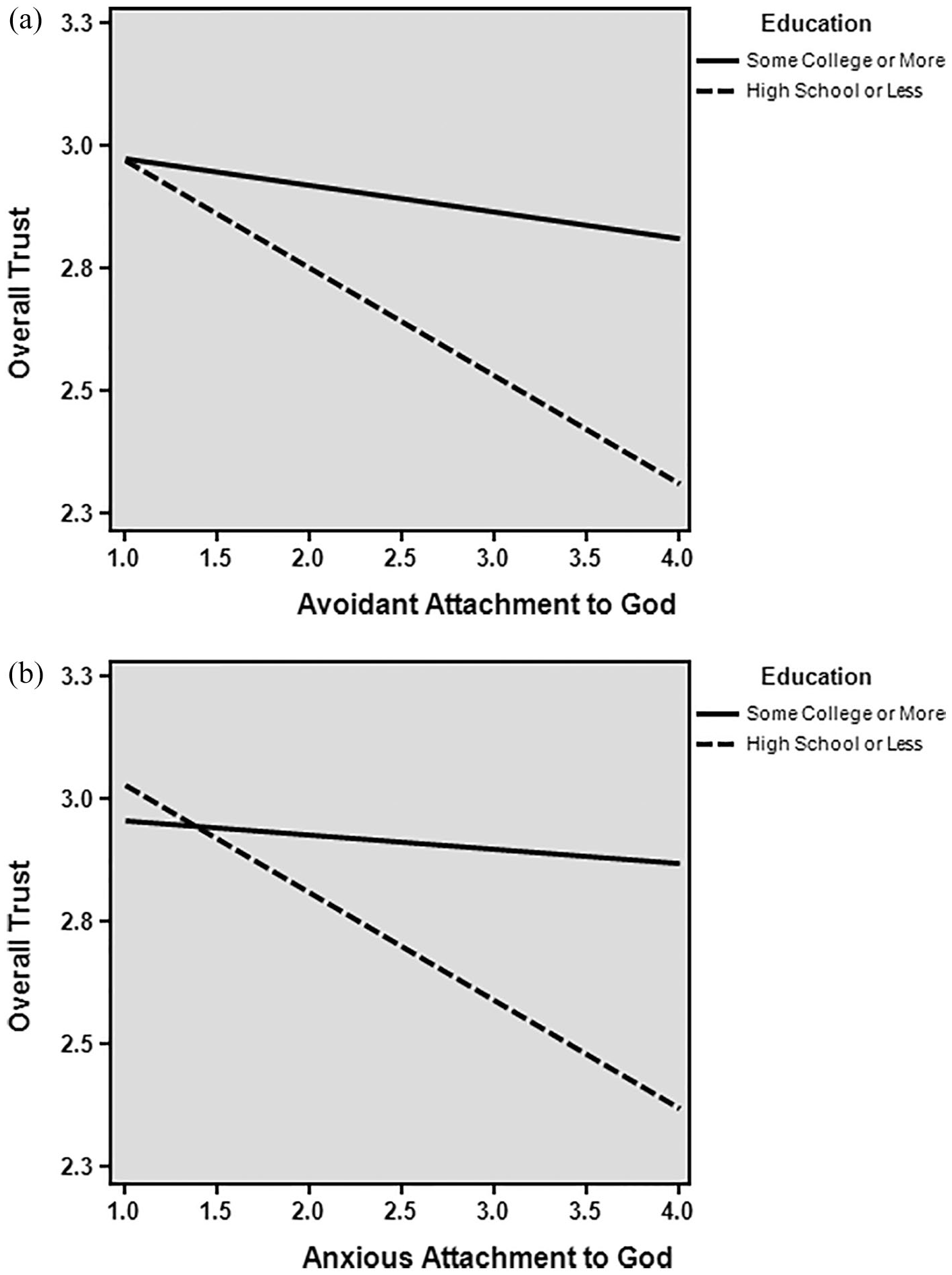
The interactive association between (a) avoidant attachment to God and education with overall trust and (b) anxious attachment to God and education with overall trust.
A brief note on the other religion measures is warranted. Fatherly/just/forgiving God imagery is associated with overall and particularized trust (but not general trust) in the base models (Model 1 in Tables 3 and 5), but once avoidant attachment is added, it is no longer significant. The standardized betas for fatherly/just/forgiving imagery are reduced by half, suggesting that avoidant attachment to God may be a more robust mechanism in explaining certain aspects of social trust, or that avoidant attachment may mediate the effects of these images of God on trust. Anxious attachment does not appear to have the same effect. The belief that God is punishing, wrathful, and severe seems to operate somewhat independently of attachment, however, and is inversely associated with all three types of trust (only weakly for general trust, however), a finding that is consistent with previous research (Mencken et al. 2009). Even though these variables are correlated, VIF estimates are 3.23 or less for all variables, which suggests that multicollinearity does not appear to be a major problem in these analyses (Hair, Black, and Babin 2009). Interactions between attachment and God images were also examined, but there were no significant findings. Also in line with previous research, frequent religious service attendance is positively associated with overall and particular trust when compared against those who attend services less than once a month. Prayer does not appear to be correlated with trust, and evangelical Protestants are no less trusting than members of other religious traditions in the sample.
Discussion
Drawing on insights from attachment theory and using data from a national sample of U.S. adults, this study expands our understanding of the relationship between religious belief and psychosocial outcomes by investigating the effects of attachment to God on social trust. Two findings are noteworthy: (1) styles of attachment to God are associated with overall trust, generalized trust (unknown people and strangers), and particularized trust (neighbors and coworkers), and (2) these findings are net of controls for sociodemographic characteristics, political orientations, religious service attendance, prayer, denominational affiliation, and images of God. The inverse associations between both avoidant and anxious attachment to God and trust are important for at least five reasons.
First, the results are consistent with previous findings that dispositions toward the divine largely correspond with dispositions toward others (Froese and Bader 2007, 2010; Greeley 1995; Henderson et al. 2017). Furthermore, the findings are generally consistent with Durkheim’s prediction that perceptions of the divine represent a symbolic expression of sociality, which influences how we perceive and respond to society. The independent associations for both generalized and particularized trust suggest this result holds for those we know and those we do not. Thus, any anxieties or insecurities people carry toward the divine are likely mirrored in interpersonal relationships and can impact engagement with both immediate and distal social groups. This assertion is buttressed by recent work demonstrating independent associations between secure attachment to God and congregational participation (Kent and Henderson 2017) and vocational commitment (Kent, Bradshaw, and Dougherty 2016).
Second, these results confirm that one’s perceived relationship with God is linked with social trust over and above the effects of conventional indicators of religious practice (i.e., service attendance, prayer, denomination), as well as images of God. This bears out the wisdom of attachment theory, and underscores the value of its core ideas for the psychology and sociology of religion, namely, that relational attachments (including attachments to God) are associated with a wide array of important psychosocial and life course outcomes (Beck 2006; Beck and McDonald 2004; Davis et al. 2008; Granqvist 1998; Granqvist and Hagekull 2003; Granqvist and Kirkpatrick 2013; Hall et al. 2009; McDonald et al. 2005; Sim and Loh 2003). Furthermore, these findings highlight the distinction between two particular aspects of the human-divine relationship: “styles” of attachment (i.e., avoidant, anxious) and the “object” of attachment (i.e., images of God). Previous research in this area has linked God imagery with social trust (Henderson et al. 2017; Mencken et al. 2009), but the current results reveal that attachment styles are consequential even when images of God are held constant.
Third, these findings highlight the importance of “spiritual struggles” for psychosocial outcomes. Attachment to God represents a disposition to the divine that is distinct from formal creed or expositional assertions. Therefore, an individual’s emotional disposition toward God, independent of their stated beliefs about the nature or character of the divine, may not only affect how they feel about themselves but also how they perceive and treat others. A balanced approach to the study of religion and psychosocial orientations must account for both the positive and negative effects of religious practice and experience. As interest in the phenomenon of spiritual struggles has expanded, a growing body of work has explored the implications of internal or intrapsychic struggles, such as religious doubting, for psychological characteristics (Ellison and Lee 2010; Ellison and Levin 1998; Pargament 2002; Pargament, Koenig, et al. 2001; Pargament, Tarakeshwar, et al. 2001). On average, religious individuals who experience avoidant or anxious attachments with God report lower levels of overall, general, and particular trust in others. The present study highlights this relationship, suggesting that decreased levels of social trust may be another possible consequence of spiritual struggles.
Fourth, these findings are relevant to the issue of general versus particularized trust. Previous research suggests that religious involvement may increase particular trust while decreasing generalized trust (Uslaner 2001). Robert Wuthnow (1998) noted that when trust is generated by individuals who have common goals and routinely interact, members may trust one another but have little reason to trust outsiders. This is still an open question, but the results presented here suggest that attachments to God shape both generalized and particularized trust. Similar findings were reported for God imagery by F. Carson Mencken and colleagues (2009), so perhaps intimate relations with God shape broad-based patterns of trust, while organizational involvement is more strongly associated with particular trust. Future research should devote more attention to this issue.
Fifth, this study provides evidence that both avoidant and anxious attachment to God interact with education to predict trust. Even though attachment to God is associated with all three types of trust in the sample as a whole, these associations are stronger for individuals with low levels of education (net of controls for religious service attendance, frequency of prayer, religious denomination, and demographic characteristics). These findings are consistent with research showing that religious practices and beliefs may serve a compensatory function for individuals and groups who lack alternative resources such as high levels of education (for a review, see Ellison, Schieman, and Bradshaw 2014). Highly educated individuals may not need, or draw on, religious resources like a perceived relationship with God, whereas those with less education may be more likely to utilize this potential psychosocial resource when interacting with others in contexts that involve trust. The associations between attachment to God and trust in these data do not appear to vary across other characteristics including marital status, race, or income, suggesting that attachment to God may work in similar ways for married versus unmarried individuals, different racial groups, and those with varying levels of income.
Like all studies, this investigation is characterized by several limitations, three of which are particularly significant. First, previous studies used different iterations of the BRS, and measures of God imagery vary slightly. However, the measures used here (punishing/wrathful/severe; fatherly/just/forgiving) include many of the same items and are conceptually similar. Second, the present study is based on cross-sectional data, which makes it impossible to establish a causal order among the key variables. For example, although the interpretation of the findings presented here is certainly plausible, it is also conceivable that trust in others shapes one’s view of God. Future research using longitudinal designs—ideally with three or more waves of data—will be required to address this limitation. Third, a reliance on self-report measures is another weakness of this study. The possibility of shared method variance, as well as the numerous potential biases inherent in such measures, including impression management, a lack of self-awareness, and so on, could potentially confound this study. Finally, the strength of the associations reported here are quite modest and should not be overstated. However, the standardized estimates for the two attachment to God measures shown in Tables 3 and 4 suggest that their effects on trust are comparable with (and, in several instances, larger than) other aspects of religious life, including service attendance and images of God.
The findings reported here also suggest a number of fruitful avenues for future inquiry. This study focused on broad trust in others, and it will be important to extend this research to cover trust in specific areas, such as parent-child relations, romantic partnerships, work groups, and voluntary associations. It is conceivable that the findings concerning the relative effects of avoidant and anxious styles of attachment to God may differ based on the context in which the trust is interpreted. Future studies should also explore the potential effects of relationships with God on other prosocial orientations, such as volunteering for charity, empathy, and altruism. In addition, future studies might profitably distinguish between attachments to God versus attachments to other humans (e.g., parents, romantic partners) to isolate the unique effects of the former on trust. This work could test the “amplification” and “compensation” hypotheses articulated in the literature (Kirkpatrick 2005; McDonald et al. 2005). These arguments suggest that attachments to God may (1) add to, or even multiply, the beneficial effects of nonreligious attachments, thereby providing the greatest benefits to persons who also enjoy beneficial and desirable social attachments; or (2) compensate for deficits in nonreligious attachments, thus affording greater advantages to people with avoidant or anxious attachments to other people. The current data do not contain measures of attachment to other humans, but future work should address these ideas.
In sum, this study has made a fresh contribution to the growing literature on religion and trust by examining the links between styles of attachment to God and overall trust, generalized trust, and particularized trust. Viewed broadly, the results underscore the value of attachment theory as it has been integrated into the study of religion, as well as recent refinements in the measurement of attachment to God. We hope that future research will replicate and extend these findings to cast new light on the complex psychosocial implications of individual relationships with God.
Footnotes
Acknowledgements
The authors thank Baylor University for providing access to the data, as well as financial support for statistical software, data analysis, presentation of the findings, and composition of the manuscript. The authors also thank Wade Rowatt and three anonymous reviewers for their helpful comments.
Authors’ Note
This research uses data from the 2010 Baylor Religion Survey. A previous version of this manuscript was presented at the 2016 Annual Meeting of the Association for the Sociology of Religion.
Declaration of Conflicting Interests
The author(s) declared no potential conflicts of interest with respect to the research, authorship, and/or publication of this article.
Funding
The author(s) received no financial support for the research, authorship, and/or publication of this article.