




Abstract
This study examines the 2013–2017 publishing productivity of sociology faculty at six types of colleges and universities (e.g., research universities, master’s institutions, and top liberal arts colleges) based on publication counts for articles, articles in high-impact journals, books, and books from high-impact publishers. We compare the productivity of groups based on institution type, gender, academic rank, years of experience, and reputation of PhD-granting institution. Our age-cohort data suggest that differentials in productivity among institution types have diminished in recent decades. The top universities are losing ground, in relative terms, while faculty at other types of institutions are more productive now than in the past. Our results for gender are unlike those reported in previous research, revealing (1) higher productivity for women than for men across most institution types and (2) the absence of any gender differential for all institution types combined. Our data also show that book and article counts are virtually unrelated, that faculty at the top liberal arts colleges have the highest average book counts, and that there is great variation in productivity within every institution type. In general, associate professors, faculty with fewer than 17 years of experience, and faculty with doctorates from top universities are especially productive.
Introduction
Unequal productivity is a fundamental characteristics of scholarly work. For example, the faculty of just 25 departments account for more than half the papers published in the top three general sociology journals (Weeber 2006). In the United States, differences in productivity are especially apparent among faculty at the different types of institutions: top universities, other research universities, other doctoral universities, master’s institutions, elite liberal arts colleges, and other bachelor’s institutions (Eckberg and Marx 2004).
Differences in productivity have led to the stratification of individuals and institutions. However, just one post-2000 study has systematically evaluated the relationships between institution type and scholarly productivity (Stack 2002). Our investigation updates previous research, examining the extent to which faculty at six types of American colleges and universities contributed to the sociological literature during the 2013–2017 period. Articles, articles in high-impact journals, books, and books from high-impact publishers are each counted separately. We compare the publishing productivity of various faculty groups based on institution type, academic rank, gender, years of experience, and reputation of PhD-granting institution. Specifically, the study addresses six research questions:
Our results for Research Questions 2 and 6 provide an indirect test of Jacques Berlinerblau’s (2017) assertion that productivity differences between faculty at higher- and lower-ranked institutions have diminished in recent decades. Likewise, Research Question 5 sheds light on an issue of longstanding interest, as previous studies have not examined gender differentials in publishing productivity among the various types of colleges and universities. This study is the first to compare sociologists’ publishing productivity by institution type for the full range of four-year colleges and universities, one of the few to discuss variations in productivity within each institution type, and the first to present separate findings for articles, books, high-impact journals, and books from high-impact publishers.
Previous Research
Publishing Productivity and Institution Type
Across the disciplines, publishing productivity is strongly related to institution type (e.g., research university or liberal arts college) (Collins, Cooper, and Knotts 2010; Joy 2006; Nakhaie 2002; Stack 2004). As John W. Creswell (1985) has pointed out, this can be attributed to differences in resources, expectations, incentives, and opportunities for collaboration. The relationship may also work in the other direction; research universities may be especially good at attracting the individuals who would be successful scholars regardless of their work environment.
A major distinction can be drawn between departments that grant doctorates and those that do not. Evaluating the annual productivity of 97 sociology faculty, John W. Holley (1977) found that those in undergraduate departments published only one third as many articles as those at doctoral institutions. More recently, Steven Stack (2002) evaluated the impact of institution type on article and book counts for the 1970–2000 period. He found that faculty in doctoral programs are substantially more productive than those in master’s programs, who, in turn, are more productive than those at undergraduate institutions. However, faculty who move from graduate to undergraduate institutions have publication rates similar to those of faculty continuously employed at undergraduate institutions, and those who move from undergraduate to graduate institutions have higher publication rates than any other group.
Previous research suggests that the reputation of the employing institution has a more limited effect. Although Holley (1977) reported that faculty at top 20 universities publish less than those at other doctoral institutions, recent studies have shown a modest effect in the opposite direction, for both lifetime article counts and papers in the top 3 sociology journals (Hermanowicz 2016; Keith et al. 2002).
Publishing Productivity and Gender
The higher average productivity of men, rather than women, is one of the more consistent findings reported in the literature (Creswell 1985). At least six studies have reported higher average annual productivity for men than for women in U.S. departments of sociology. Together, those studies suggest that men publish about 50 percent more articles and book chapters (Chubin 1974; Puuska 2010; Sax et al. 2002; Stack 2002) and at least 35 percent more papers in the foremost sociology journals (Keith et al. 2002; McNamee, Willis, and Rotchford 1990). Similar findings have been reported for other countries (Puuska 2010). The most recent data, for 2015–2017, reveal no obvious gender differentials among newly promoted associate professors at the top American sociology departments (Warren 2019). To our knowledge, however, no study has reported higher unadjusted counts for women than for men.
Another consistent finding, however, is that gender has no independent effect. As Creswell (1985) has noted, gender differences in productivity can be attributed to gender differences in the variables most closely associated with productivity. The analyses that support this conclusion have considered productivity in terms of articles, articles in top journals, books, chapters, and conference papers. They have accounted for a diverse range of covariates including age at PhD, years from bachelor’s degree to PhD, reputation of PhD department, age at first publication, current institution type, reputation of current department, academic rank, salary, years of experience, number of faculty positions held, external funding, marital status, parental status, orientation toward research, and desire for recognition (Clemente 1973; Keith et al. 2002; Leahey 2006; Monk-Turner and Fogerty 2010; Sax et al. 2002; Stack 2002, 2004). Most studies have included just a few covariates, but the variables included in each study have differed considerably. We found just one paper that identified gender as a significant, independent predictor of publishing productivity among U.S. sociologists (Light 2013), but only for those who earned their doctorates before 1989.
Daryl Chubin (1974) and Bruce Keith et al. (2002) provide the most coherent explanation for the persistence of gender differentials in the absence of an independent effect. First, women and men differ in the prestige of their initial academic positions. Although women and men graduate from equally renowned PhD institutions, men are more likely to start their careers at research universities, which provide more support and greater incentives for publication. Second—and perhaps because of the first factor—men have higher publication rates in the first 6 years after earning their doctorates. The effects of these advantages persist even in the absence of further gender-related disparities. Although “women and men with comparable career trajectories have similar publication histories” (Keith et al. 2002:1270), the initial advantages that foster high productivity are more common among men.
Another possible explanation is that gender influences publishing productivity through its interaction with marital or parental status. Two studies have investigated this possibility, but neither found substantial effects for gender, marital status, parental status, or the interactions among them (Sax et al. 2002; Stack 2004). Women with children under age 12 do have lower productivity than might be otherwise expected, but the impact of parental status is far weaker than the effects of variables such as institution type and external funding.
Other Correlates of Publishing Productivity
Just one study has explicitly evaluated academic rank or tenured status as a correlate of publishing productivity. Among faculty at U.S. doctoral institutions, achieving tenure is associated with a 39-percent decline in annual article counts and a 30-percent decline in annual book counts (Holley 1977).
Thomas J. Phelan (1995) is the only author to have systematically investigated the impact of cohort or experience on the publication patterns of American sociology faculty. Examining data for the authors who published most frequently in American Sociological Review (ASR), American Journal of Sociology (AJS), and Social Forces (SF), he found that the top article authors during the 1975–1984 period were also likely to be book authors. In contrast, the top article authors during the 1985–1994 period—a younger group, on average—were unlikely to have published books. Phelan concluded that sociologists tend to publish articles earlier in their careers and books later in their careers. The alternative explanation, of course, is that two distinct groups—article authors and book authors—have emerged over time.
Authors who collaborate often tend to have higher article counts than those who do not, but only when every coauthor is given full credit for each article. This effect disappears or even reverses when each coauthor is assigned fractional credit (1/n, where n is the number of authors) (Hollis 2001; Lee and Bozeman 2005; Light 2013).
Have Differences among Institution Types Declined over Time?
Berlinerblau (2017) has argued that the tight job market for academic job-seekers has led top candidates to a much broader range of institutions now than in the past. He asserts that because many excellent scholars have accepted positions at less prestigious colleges and universities, the differences in scholarly productivity among faculty at the various types of institutions have declined over time: “We live in an age . . . where countless deserving individuals find themselves trapped in dismal professional situations that are completely incommensurate with their achievements.”
Berlinerblau does not offer evidence to back up his claims, but other studies do provide empirical support. Publishing expectations have increased dramatically at all types of colleges and universities over the past few decades (Bauldry 2013; Lofthouse 1974; Warren 2019), and new sociology PhDs are increasingly likely to accept positions at institutions less prestigious than those from which they received their doctorates. Longitudinal data reveal that the extent of “downward mobility” increased from 50 percent in the 1964–1966 period to 65 percent in the 1985–1992 period (Baldi 1994). Likewise, graduates of the top 13 PhD programs have only a 4.5-percent chance of obtaining tenure-track positions in departments that are similar in prestige (Headworth and Freese 2016).
Val Burris (2004) has stressed the importance of academic pedigree in the hiring of faculty. Subsequent research supports this conclusion. The reputation of a candidate’s doctoral program is a good predictor of the reputation of his or her hiring department (Clauset, Arbesman, and Larremore 2015; Weakliem, Gauchat, and Wright 2012). Nonetheless, the independent effect of PhD reputation may be declining over time. Based on a multivariate analysis of data for more than 2,600 sociologists, Spencer Headworth and Jeremy Freese (2016) assert that the advantages enjoyed by top PhD graduates are due not to institutional pedigree, but to the selection effects, scholarly norms, socialization processes, and resources that enhance the capabilities of those who earn doctorates from the foremost universities.
Our study does not provide a direct test of Berlinerblau’s (2017) hypothesis; it deals solely with associate and full professors rather than new job-seekers. Moreover, our use of cross-sectional rather than longitudinal data does not allow us to directly evaluate changes over time. However, we can determine whether earlier PhD cohorts differ from later cohorts in the extent to which institution type influences publishing productivity. Our data also allow us to extend the analysis in ways not mentioned by Berlinerblau. We evaluate productivity differentials not just among doctoral universities, but among six distinct types of four-year colleges and universities. We present separate data for articles, articles in high-impact journals, books, and books from high-impact publishers, allowing for differences in output by publication type. Finally, we evaluate not just whether institution-type differentials in productivity have declined over time, but whether the same can be said of institution-type differentials in PhD reputation.
Data and Method
Six Institution Types
Our analysis centers on the differences among six types of U.S. colleges and universities:
TopR: The top 26 doctoral programs, based on ratings assigned by department chairs and graduate program directors (U.S. News and World Report 2017b). (Three programs were tied for 24th place.)
R1: All other institutions with a Carnegie classification of doctoral universities: highest research activity that offer doctorates in sociology (Carnegie Foundation for the Advancement of Teaching 2017).
OD (other doctoral): All institutions with a Carnegie classification of doctoral universities: higher research activity or doctoral universities: moderate research activity that offer doctorates in sociology.
M: All institutions in the Carnegie master’s categories that offer bachelor’s or master’s degrees in sociology.
TopLA: The top 50 national liberal arts colleges, based on alumni giving rate, class size, faculty salaries, financial resources, graduation rate, percentage of faculty with terminal degrees, retention rate, student selectivity, and undergraduate academic reputation (U.S. News and World Report 2017a). Limited to those that offer bachelor’s degrees in sociology.
B: All other institutions with a Carnegie classification of baccalaureate colleges: arts and sciences focus or baccalaureate colleges: diverse fields that offer bachelor’s degrees in sociology.
Four of the six institution types correspond to particular Carnegie classifications (Carnegie Foundation for the Advancement of Teaching 2018). However, the TopR and TopLA groups were split off from the R1 and bachelor’s categories due to the substantial differences among institutions in those categories. Notably, none of the six types are defined on the basis of research productivity, either for sociology or more generally.
The study population includes only public or nonprofit institutions with one or more full-time professors or associate professors of sociology. (In the tables and text, we refer to these faculty as tenured faculty even though tenure and academic rank do not always coincide.) By limiting the TopR, R1, and OD groups to universities that offer doctorates in sociology, we ensure that differences in institution type are not confounded by differences in the highest sociology degree granted. 1 For instance, R1 universities that offer doctorates in engineering but just master’s degrees in sociology are excluded from the study population.
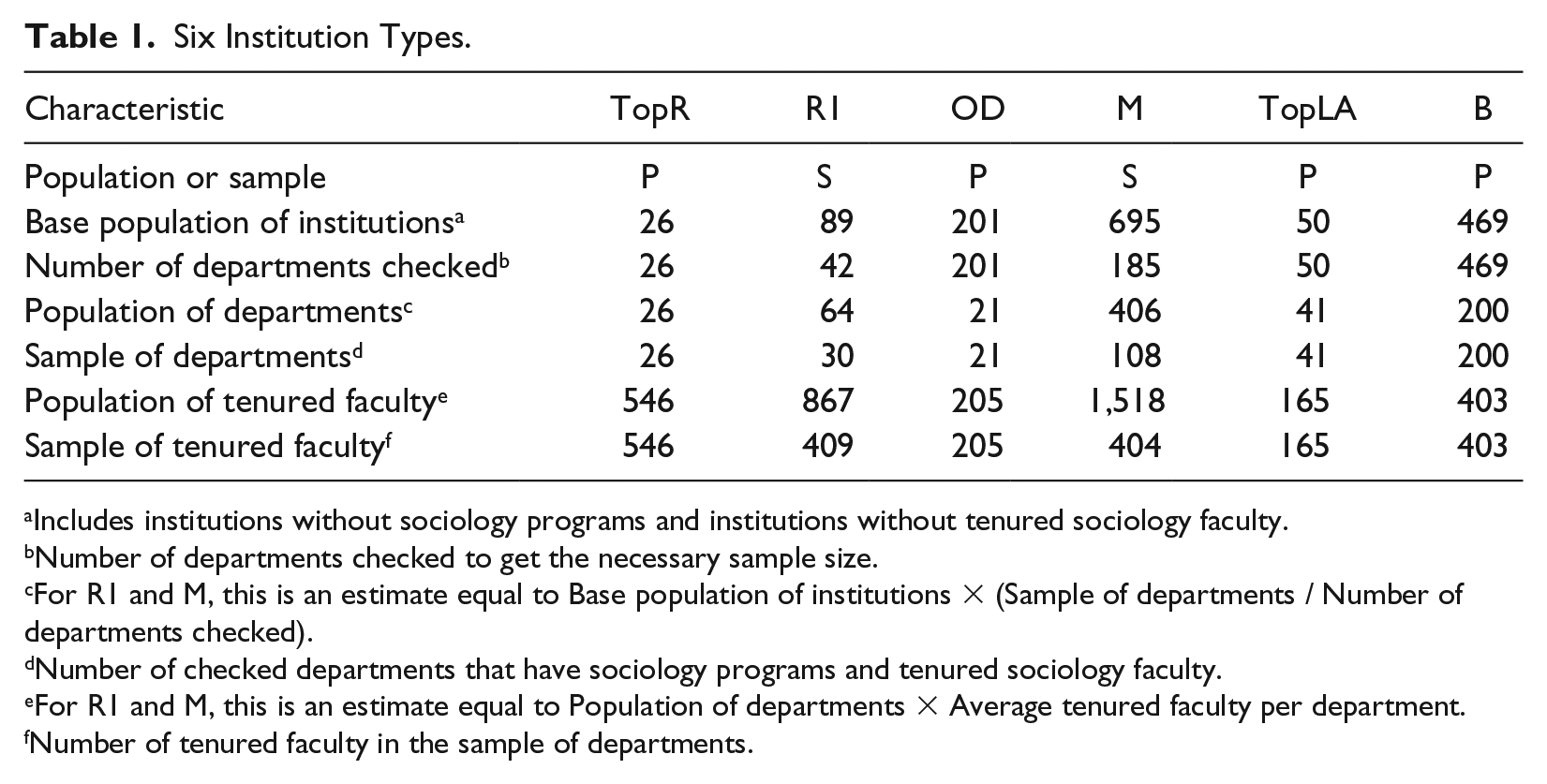
Our data for TopR, OD, TopLA, and B institutions include the entire populations of interest. In the TopLA category, for instance, the base population consists of the 50 top-ranked liberal arts colleges (see Table 1). Just 41 of those institutions offer bachelor’s degrees in sociology and have one or more tenured sociology faculty, however, so the final TopLA population includes 41 institutions with 165 tenured faculty.
Six Institution Types.
Includes institutions without sociology programs and institutions without tenured sociology faculty.
Number of departments checked to get the necessary sample size.
For R1 and M, this is an estimate equal to Base population of institutions × (Sample of departments / Number of departments checked).
Number of checked departments that have sociology programs and tenured sociology faculty.
For R1 and M, this is an estimate equal to Population of departments × Average tenured faculty per department.
Number of tenured faculty in the sample of departments.
Our data for R1 and M institutions are sample data that include roughly 47 and 27 percent of the corresponding populations. As Table 1 shows, there are 695 institutions in the three Carnegie master’s categories. We listed those institutions in random order, then went down the list and compiled data for the departments that met our criteria (bachelor’s degrees in sociology and one or more tenured sociology faculty) until our M sample included at least 400 faculty. We checked 185 departments before reaching our desired sample size. About 58 percent of those departments—108 departments with 404 faculty—met our criteria. Based on that proportion, we estimated a population size of 406 departments and 1,518 tenured faculty for the M group. These same procedures were used with R1 (see Table 1).
Basic institutional data were found online at the IPEDS Data Center (National Center for Education Statistics 2017). The department rosters, with name, academic rank, gender, years of experience, and PhD institution, were compiled in the first 3 months of 2018 from departmental web sites, university directories, academic catalogs/bulletins, personal web sites, LinkedIn, OCLC WorldCat, ProQuest Dissertation Express, and other sources. We found no cases in which our sources suggested a gender category other than female or male.
Measuring Publishing Productivity
Our measures of publishing productivity represent five-year productivity rather than lifetime productivity. This constraint limits our ability to directly examine long-term trends and to evaluate the influence of early productivity on initial job placement. However, it also helps us avoid two problems. First, by focusing on five-year productivity and excluding assistant professors, we ensure a five-year period of potential productivity for every individual in the population of interest. That is, we avoid the need to prorate scholarly productivity based on the number of research-active years. (Active engagement in research may or may not predate the PhD year, so the inclusion of assistant professors would have required us to determine a “first year of research” for every faculty member with less than five years of experience.) Second, the use of a five-year period minimizes the potential impact of name changes and avoids the need to rely on older bibliographic records that sometimes list just initials rather than first names. Our use of multiple information sources gave us confidence in matching authors to scholarly works over a five-year period. That task would have been more difficult and less reliable if we had tried to match authors and works over a period of several decades.
Four measures were used to represent publishing productivity during the 2013–2017 period:
Articles: Number of articles in journals indexed by SocINDEX. Our SocINDEX searches, conducted from March through June of 2018, were limited to peer-reviewed journals and to articles rather than items such as book reviews, editorials, and letters.
HI articles: Number of articles in the 44 high-impact journals indexed by SocINDEX. High-impact journals are those with a Scopus CiteScore of 2.35 or greater and a CiteScore rank of 95th percentile or better in any Scopus subject category. This standard ensures high impact in both absolute and relative terms. Twenty-five percent of the articles in our sample appeared in high-impact journals.
Books: Number of books listed in Amazon.com. Our Amazon searches, conducted from June through August of 2018, include only new books. We excluded chapters in edited volumes, editorships of edited volumes, new editions, translations, and re-publications such as paperback editions of titles originally issued in hardcover. We also excluded self-published books and works of fewer than 60 pages. We used university Web sites, personal Web sites, publisher’s Web sites, Google Scholar, and OCLC WorldCat to verify and clarify the information reported by Amazon.
HI books: Number of books from high-impact publishers. High-impact publishers—the top 25 in terms of average citations per book (Zuccala et al. 2015)—account for 45 percent of the books in our sample.
With all four measures, we used harmonic weighting to assign credit for coauthored works. Although methods such as whole counting and fractional credit are often used to assign authorship credit, each has its disadvantages. Whole counting—assigning full credit to every author—inflates the value of articles with more than one author and poses problems for comparisons over time, because the average number of authors has increased substantially in recent years (Cronin 2001; Endersby 1996; Hunter and Leahey 2008; Larsen 2008; Price 1981; Warren 2019). Fractional credit—assigning 1/x credit to each author, where x is the number of authors—avoids the inflationary effects of whole counting but disregards the fact that authors who appear earlier in the byline often contribute more than those listed later (Frandsen and Nicolaisen 2010; Põder 2010). In contrast, harmonic weighting accounts for the number of authors as well as each individual’s place in the author list. Specifically, the credit assigned to each author of a paper is 1/i divided by (1/1 + 1/2 + 1/3 + . . . + 1/N), where N is the number of authors and i is the author’s place (1 for first author, 2 for second author, etc.). For instance, the first author of a paper with three authors receives 0.545 credits; the second, 0.273 credits; and the third, 0.182 credits. As Nils T. Hagen (2010, 2013) has demonstrated, authorship credits calculated in this way correspond closely to the subjective weights assigned by scholars in the natural and social sciences. In particular, harmonic weights match scholars’ subjective assessments more closely than either whole counting or fractional counting. 2
Analytical Methods
We conducted separate analyses for each of the four productivity measures. Although previous studies have sometimes used point systems to combine book and article counts, there is no theoretically or empirically grounded method for assigning points (Clemente 1972; Nakhaie 2007; Tien 2007; Wilder and Walters 2019). Moreover, books and articles differ not just in value, but in character. The distinction between “book departments” and “article departments” cannot be examined if both books and articles are represented by a single index of publishing productivity.
We make use of summary statistics, comparisons, crosstabulations, and correlations. SPSS and MedCalc were used to test for significant differences between groups. Because we have population data for TopR, OD, TopLA, and B but random samples for R1 and M, we used one-sample tests (t for means, z for proportions) as well as two-sample tests (t for means, chi-square for proportions). All differences between population values were regarded as significant. For comparisons involving the set of all institutions—all institution types combined—we weighted the R1 cases (individuals) by 1.2201, the M cases by 2.1628, and all other cases by 0.5756 to construct a representative sample without inflating the sample size.
Results
Research Question 1: Distinctive Characteristics of Each Institution Type
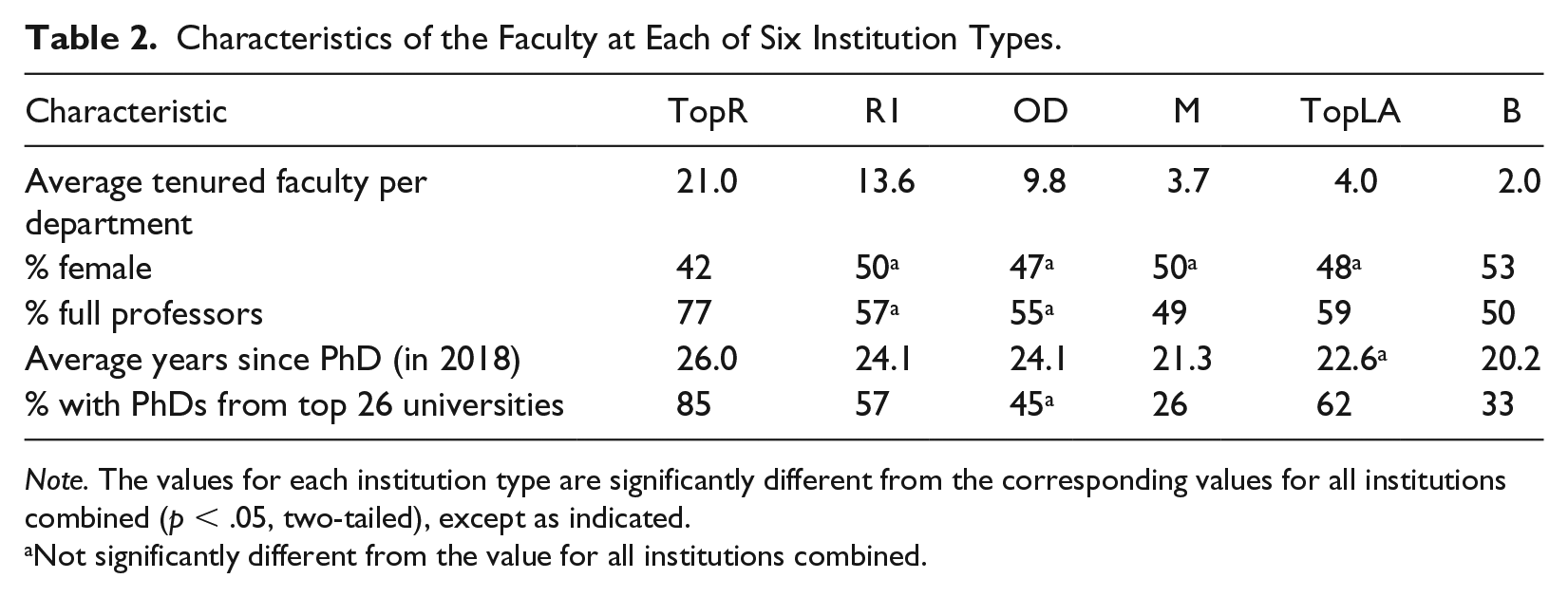
As Table 2 shows, the sociology departments of the top 26 research universities (TopR) are distinctive in several respects. For one thing, they are far larger than most. TopR faculty are also especially likely to be full professors and especially likely to have PhDs from top 26 universities. In fact, the link between PhD reputation and current TopR affiliation is perhaps the strongest relationship shown in Table 2. Much the same pattern can be seen for the R1 and TopLA institutions, but to a lesser extent.
Characteristics of the Faculty at Each of Six Institution Types.
Note. The values for each institution type are significantly different from the corresponding values for all institutions combined (p < .05, two-tailed), except as indicated.
Not significantly different from the value for all institutions combined.
The bachelor’s (B) institutions have relatively many female faculty while the TopR universities have relatively few. Although experience (average years since PhD) varies with institution type, only the TopR faculty are distinctive in that regard.
Research Question 2: Cohort-Related Differences in the Relationship between Institution Type and PhD Reputation
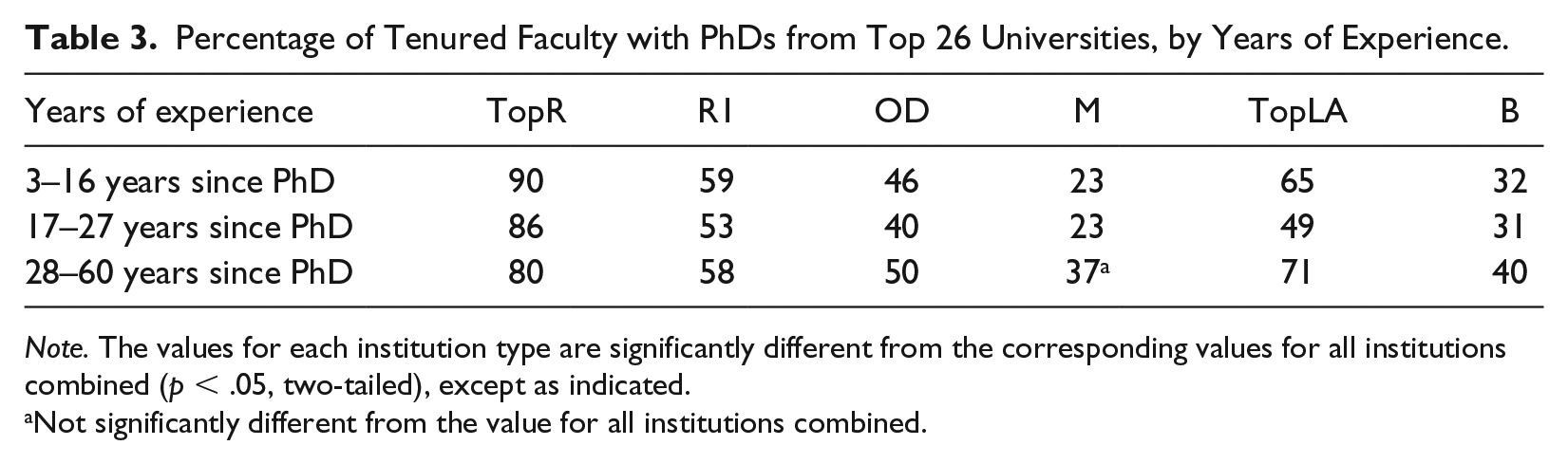
Table 3 presents additional information on the percentage of tenured faculty with doctorates from top 26 universities. As the table shows, the differences between institution types are most pronounced among faculty who began their careers more recently—those with 16 or fewer years of experience. 3 The same pattern can be seen even more clearly in Table 4, which shows the ratios between the Table 3 percentages for each of the 15 institution-type pairs. Nine of the 15 institution-type differentials are greatest among faculty with 3 to 16 years of experience. Five of the differentials are greatest among faculty with 17 to 27 years of experience, and just one (TopLA/R1) is greatest among those with 28 to 60 years of experience.
Percentage of Tenured Faculty with PhDs from Top 26 Universities, by Years of Experience.
Note. The values for each institution type are significantly different from the corresponding values for all institutions combined (p < .05, two-tailed), except as indicated.
Not significantly different from the value for all institutions combined.
Institution-Type Differentials in Percentage of Tenured Faculty with PhDs from Top 26 Universities, by Years of Experience.
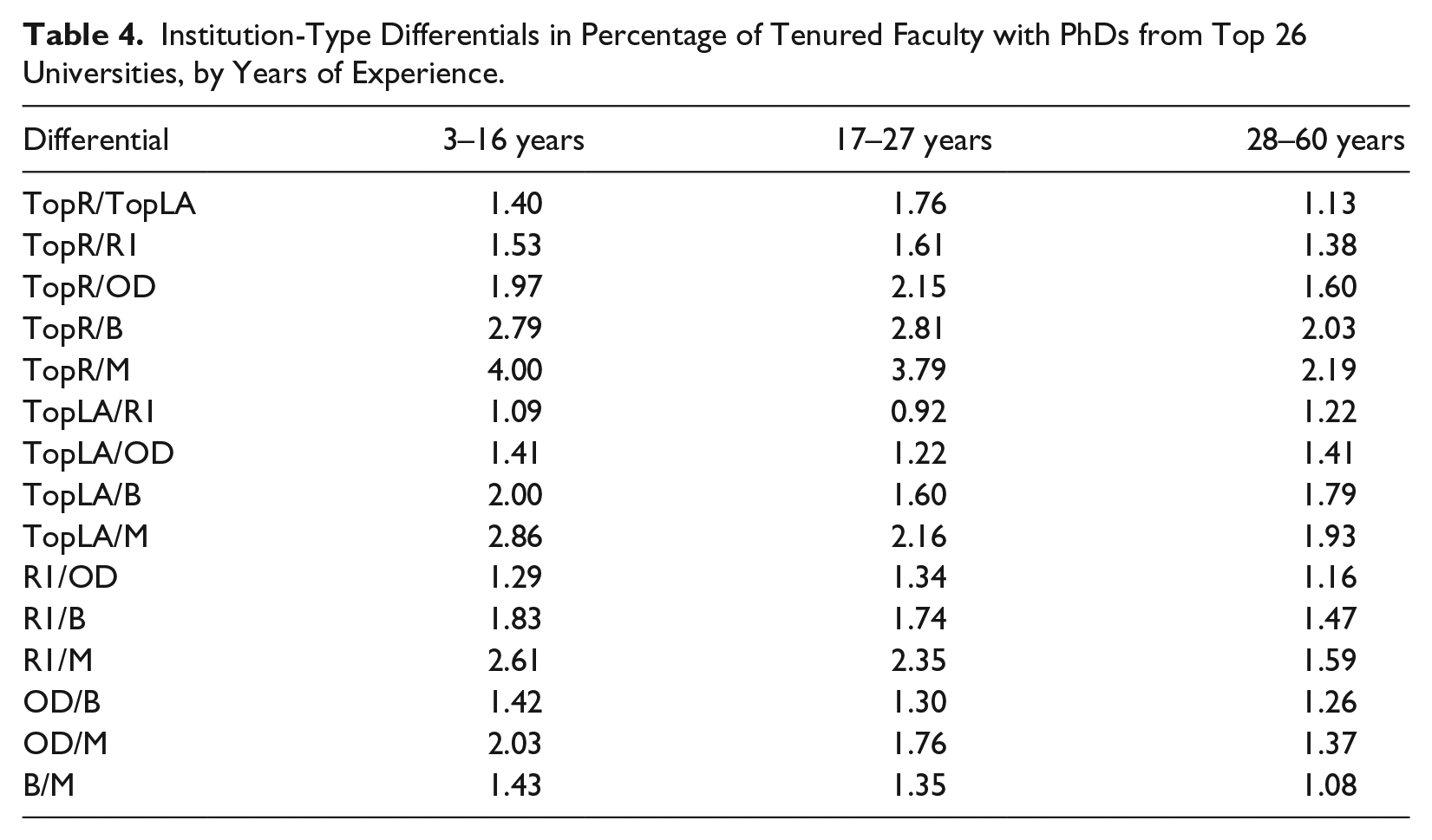
Because our data represent just a single point in time, these comparisons do not allow us to distinguish between cohort effects (i.e., graduates of the top doctoral programs behave differently now than in the past) and the effects of age or career stage (i.e., top graduates tend to start at the TopR universities, then move to a broader range of institutions later in their careers). To the extent that the patterns can be attributed to cohort effects, we can conclude that graduates of the most prestigious doctoral programs have become even more likely to work at the major research universities and the foremost liberal arts colleges over the past 15 or 20 years. This interpretation is contrary to the assertion put forth by Berlinerblau (2017), as it suggests that the institutions in the OD, M, and B categories have become less, rather than more, successful in attracting graduates of the top PhD programs.
Research Question 3: Differences in Publishing Productivity by Institution Type
Articles
In terms of journal articles, TopR faculty are far more productive than those in the other five groups. The article counts for R1 and OD faculty are also higher than the overall average (see Table 5). (Because harmonic weighting was used, each value is substantially lower than the total number of articles to which the “average” author contributed.) In contrast, faculty in the TopLA, M, and B groups lag behind, with average article counts no higher than 35 percent of the TopR average. Although TopLA faculty are especially likely to have graduated from the foremost doctoral programs, top PhD status is no guarantee of high article productivity.
Publishing Productivity, 2013–2017, by Institution Type.

Note. The average and percentage values for each institution type are significantly different from the corresponding values for all institutions combined (p < .05, two-tailed), except as indicated.
Not significantly different from the value for all institutions combined.
Faculty at the major research universities are also more consistently productive than the others. Most of the TopR, R1, and OD faculty published at least one article during the five-year period, and many published substantially more—up to 16. In contrast, most of the TopLA, M, and B faculty published no articles during the study period. Among TopR and R1 faculty, there is relatively little variation in productivity; both groups have SDs roughly equal to their average article counts. There is substantially greater variation among the faculty at the other types of institutions, however. Among the group B faculty, for instance, the coefficient of variation (the ratio of the SD to the mean) is 2.41.
Coauthorship rates vary dramatically by institution type (see Table 5). While our use of harmonic weighting ensures that differences in coauthorship rates do not bias the article counts, the substantial variation in coauthorship rates suggests that TopR, R1, and OD authors may differ from the others not just in the number of articles published, but in the nature of their contributions to those articles.
Articles in high-impact journals
The results for articles in high-impact journals are similar, but with an even greater distinction between the TopR universities and the others. In fact, the average number of HI articles written by TopR faculty is more than twice that of the next most productive group. Likewise, TopR is the only institution type for which more than half the faculty published in high-impact journals during the study period. For sociologists at master’s and undergraduate institutions, including the top liberal arts colleges, publication in a high-impact journal is an uncommon event.
As Table 5 shows, most articles in high-impact journals are coauthored, and there is little variation in coauthorship rates from one institution type to the next. Further analysis demonstrates that for faculty working at bachelor’s and master’s institutions, coauthorship in high-impact journals most often means collaboration with faculty at research universities; two thirds of their coauthors are at TopR, R1, or OD institutions.
Books
Although faculty at TopR universities are the most productive with regard to journal articles, those at the top liberal arts colleges are more prominent in the realm of book publishing. This is true in terms of both average productivity and the percentage of faculty who published one or more books during the study period (see Table 5). Overall, the differences among institution types are not as pronounced for books as for journal articles, however. Writing more than one book in five years is unusual for faculty at every type of institution.
The coauthorship rates for books are generally low, ranging from 23 to 35 percent for all institution types except TopR and R1. As with journal articles, the research universities have the highest coauthorship rates.
Books from high-impact publishers
Only 10 percent of the faculty in our sample published a book with a high-impact publisher during the five-year period, with rates ranging from 1 (M) to 18 (TopR) percent. Although TopLA faculty are the most productive book authors overall, TopR faculty are more likely to write HI books. There is only one clear break between groups: bachelor’s and master’s faculty (other than those at the TopLA schools) are far less productive than those at the other types of institutions.
The coauthorship rates for HI books range from 0 to 41 percent, and each rate is somewhat lower than the corresponding rate for all books. While articles in high-impact journals are especially likely to be coauthored (relative to other articles), HI books are especially unlikely to be coauthored (relative to other books).
Overall, these results demonstrate that is worthwhile to consider each of the four measures of publishing productivity separately rather than collapsing them into a single indicator. At the individual level (n = 2,132), the correlation between article count and HI article count is modest (r = .68), as is the correlation between book count and HI book count (r = .67). The two article measures and the two book measures are essentially unrelated, with an average correlation magnitude of .09 and values ranging from –.02 to .18.
Research Question 4: Distribution of Publishing Productivity within Each Institution Type
Frequency distributions
Figures 1 to 3 present frequency distributions of publishing productivity for the faculty in the various types of colleges and universities. As Figure 1 reveals, institution-type differences in article counts can be attributed largely to (1) differences in the proportion of faculty with no articles and (2) the relatively many TopR and R1 faculty with two or more articles. The spikes in the TopLA distribution at 1.0 and 2.0 can be traced to the number of faculty who published one or two articles, rather than none or many, as well as the relatively low coauthorship rate, which makes the counts cluster at the whole-number values.
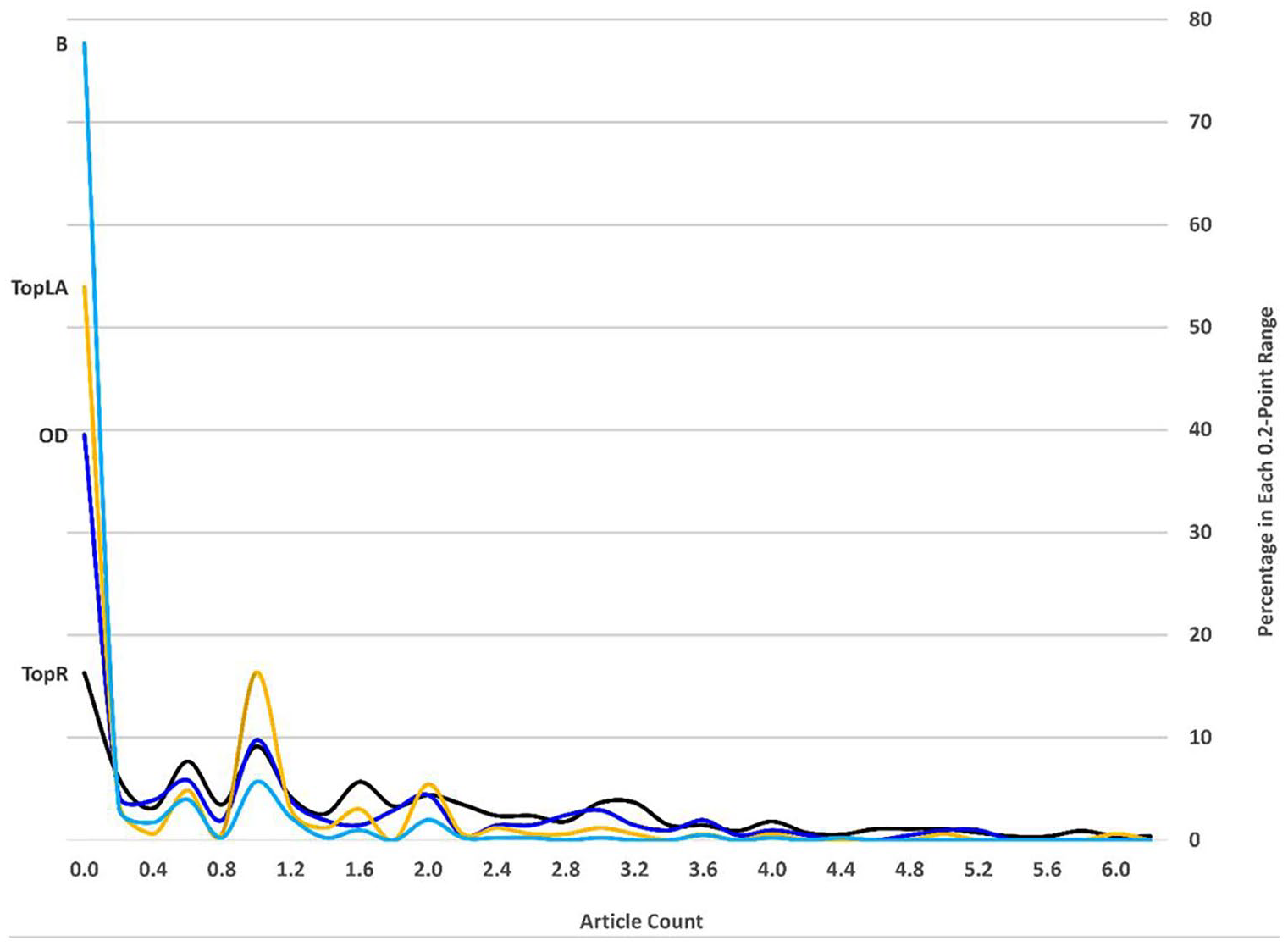
Article counts for faculty at institutions of each type.

HI article counts for faculty at institutions of each type.
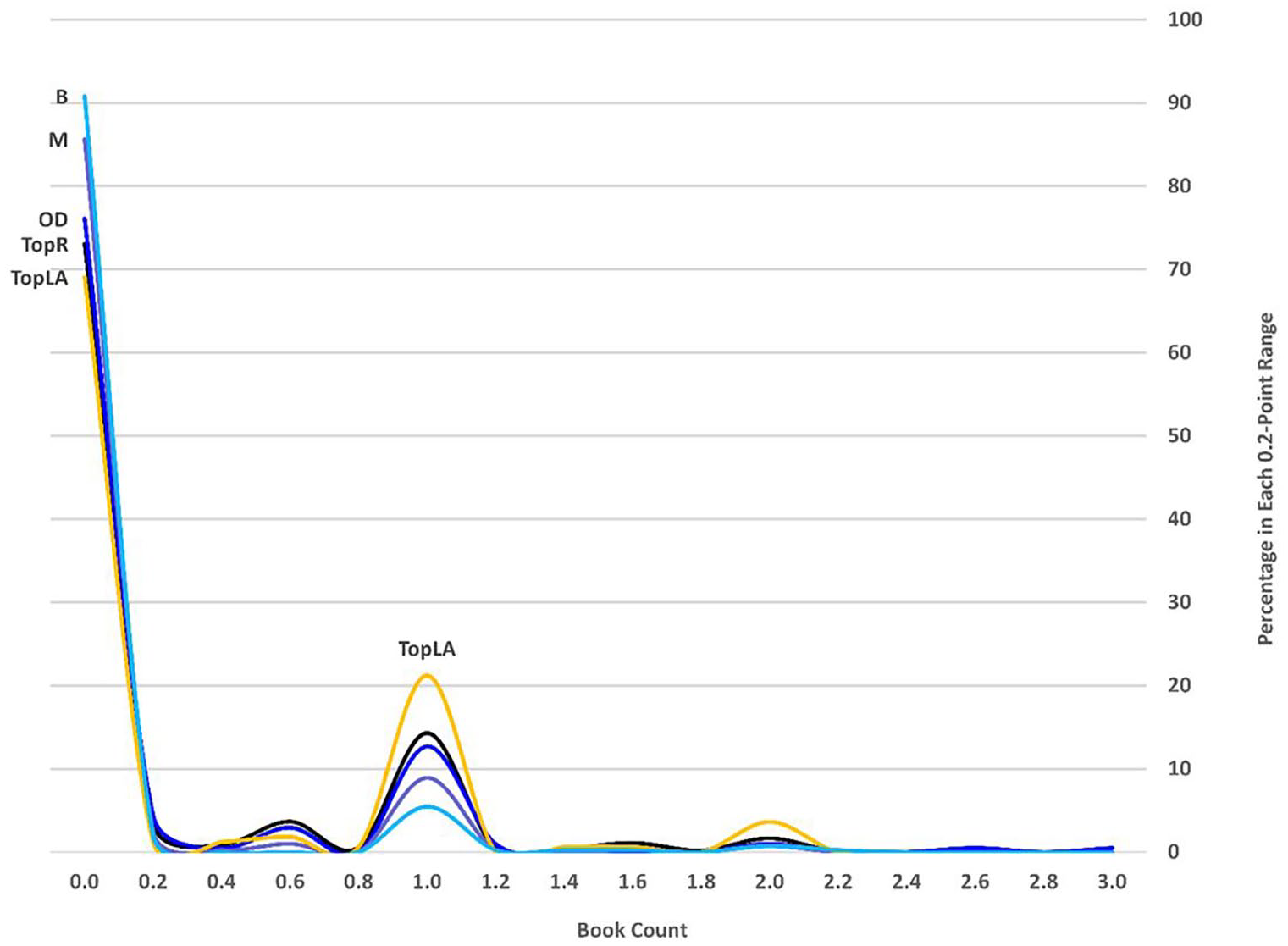
Book counts for faculty at institutions of each type.
The pattern for articles in high-impact journals (Figure 2) is much the same, but with a stronger distinction between TopR and the other institution types. TopR faculty are far more likely than the others to have published one or more HI articles, and they outperform all the other groups at the higher levels of accomplishment. Conversely, the M, TopLA, and B groups include no faculty with two or more articles in high-impact journals.
As noted earlier, TopLA faculty have the highest rates of book authorship. As Figure 3 shows, they are more productive than even the TopR faculty. Very few faculty at any type of institution wrote more than two books during the 2013–2017 period, so the distinctions among institution types can be attributed almost entirely to differences in the number who wrote zero, one, or two books. The frequency distribution for HI books (not shown) follows much the same pattern displayed in Figure 3.
Overlap among institution types
Table 6 shows the percentage of faculty at each type of institution whose publication counts meet or exceed the average value for each of the other institution types. These results should be interpreted with the strong positive skew of the distributions in mind. For example, just 39 percent of the faculty in the TopR group have article counts equal to or greater than the TopR average. Authors who meet that standard have therefore demonstrated a higher level of accomplishment than most TopR faculty.
Percentage of Individuals in the Row-Heading Group Whose Publication Counts Meet or Exceed the Average Value for the Column-Heading Group.
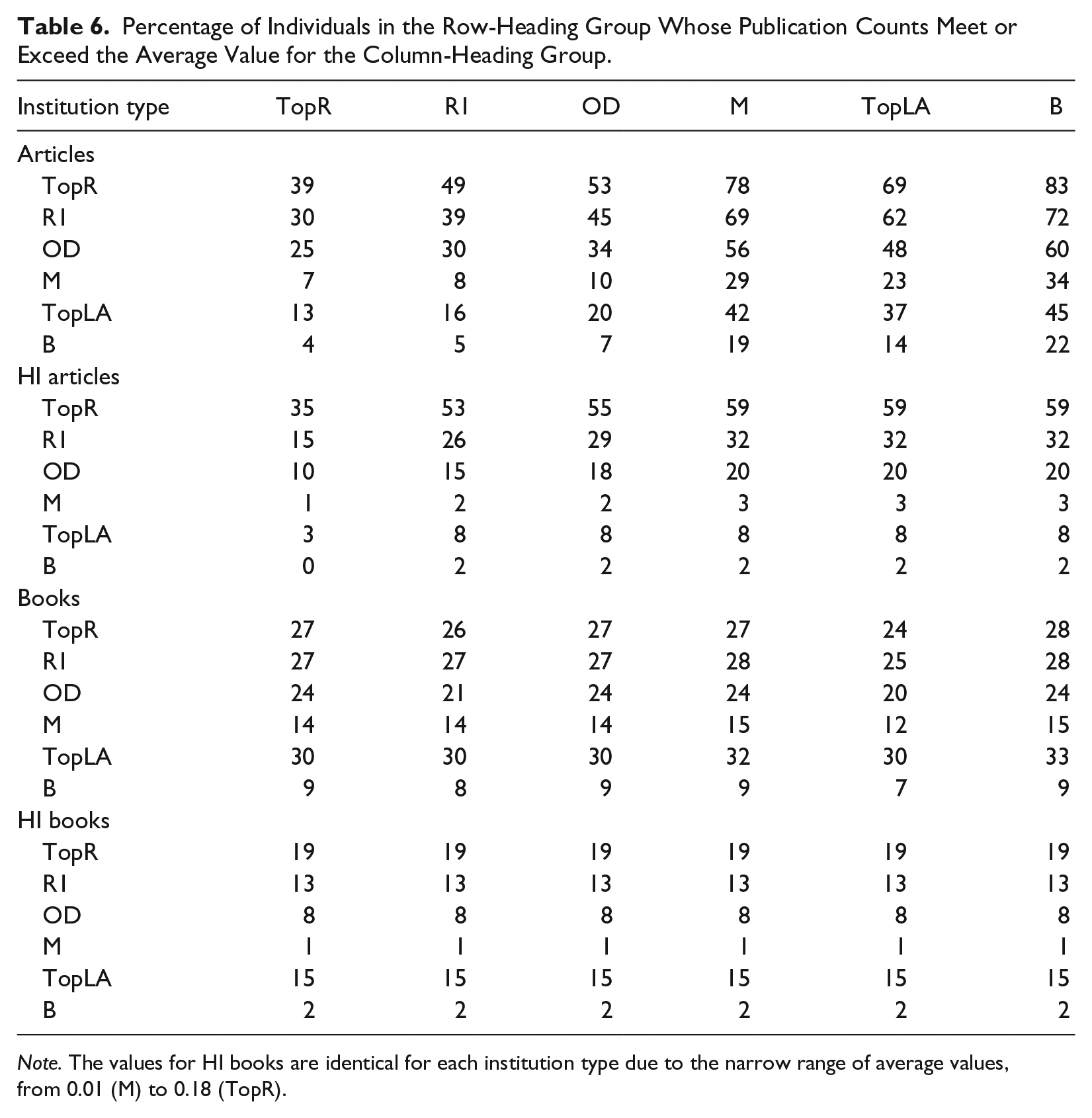
Note. The values for HI books are identical for each institution type due to the narrow range of average values, from 0.01 (M) to 0.18 (TopR).
The high variation in productivity within each group (Table 5) suggests that even some faculty at bachelor’s and master’s institutions will have met the “TopR average” standard. Table 6 supports this conclusion; 13 percent of the faculty at TopLA colleges and 7 percent of those at master’s institutions have article counts higher than the TopR average. Conversely, 22 percent of the faculty at TopR universities have article counts lower than the average for master’s institutions. Despite the sometimes dramatic institution-type differences in publishing productivity, there are both high- and low-performing individuals at all kinds of colleges and universities.
Research Question 5: Faculty Characteristics and Publishing Productivity
Overall, the average productivity values for the four publication measures and the six institution types (Table 7) suggest that associate professors are more productive than full professors, women are more productive than men, faculty with fewer than 17 years of experience are more productive than those with more experience, and faculty with doctorates from top 26 universities are more productive than those with doctorates from other institutions. There are substantial variations among the four measures and the six groups, however.
Average Number of Publications, 2013–2017, by Institution Type and Faculty Characteristics.
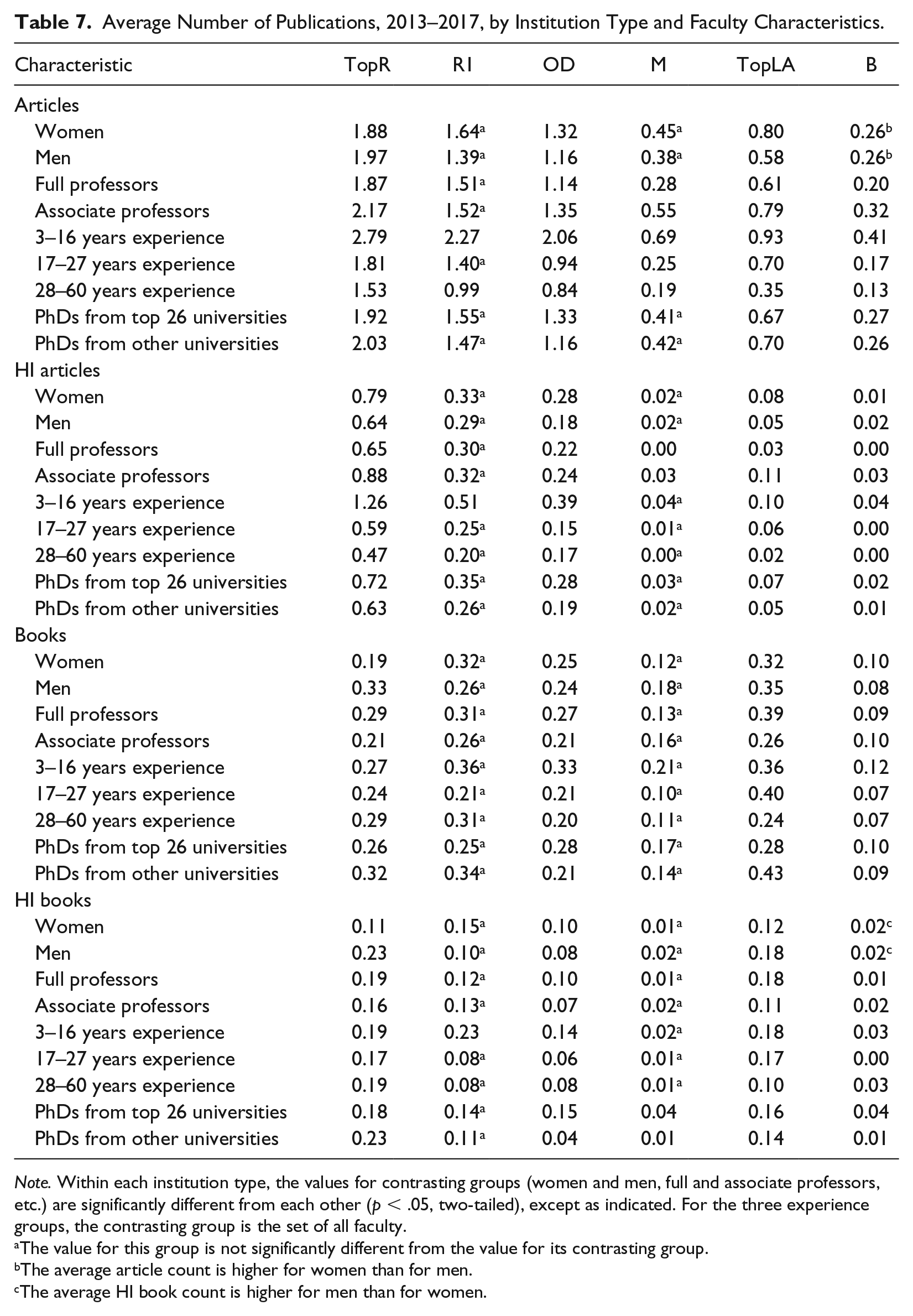
Note. Within each institution type, the values for contrasting groups (women and men, full and associate professors, etc.) are significantly different from each other (p < .05, two-tailed), except as indicated. For the three experience groups, the contrasting group is the set of all faculty.
The value for this group is not significantly different from the value for its contrasting group.
The average article count is higher for women than for men.
The average HI book count is higher for men than for women.
Gender
With regard to articles, both overall and in high-impact journals, the greater productivity of women can be seen for six of the eight statistically significant comparisons. The gender differences range from modest to moderate and persist across most institution types; only the TopR results are contrary to the overall pattern. For books and HI books, however, the results are mixed. Men outperform women in the TopR and TopLA categories while women outperform men in the OD category. It is possible that women feel a greater need to focus on research outputs that can be used to demonstrate immediate scholarly impact (i.e., articles rather than books). Alternatively, women may be more likely to work in subfields where journals rather than books are the main publication outlets. Both these interpretations are conjectural, however.
Academic rank
Considering just articles and articles in high-impact journals, associate professors have higher productivity than full professors at every institution type except R1. For books and HI books, the relationship is not as clear. Six of the eight significant comparisons indicate that full professors are more productive than associate professors, but the differences are generally modest. Moreover, the reverse relationship can be seen for institutions in the B category. Together, these findings support the idea that faculty are more likely to focus on articles—on shorter term projects that are perhaps more readily assessed—before achieving full professor rank, then subsequently more likely to focus on books. There are other plausible explanations, however. For instance, the difference in productivity may be a cohort effect (i.e., those who achieved professor rank in earlier years were more likely to write books and less likely to write articles than those who began their careers more recently).
Experience
The inverse relationship between experience and publishing productivity is readily apparent in Table 7. It can be seen for nearly every institution type, and for all four productivity measures. As with academic rank, however, our data do not allow us to distinguish between age and cohort effects.
Reputation of PhD program
Perhaps surprisingly, the overall article and book counts shown in Table 7 reveal no clear productivity advantage for faculty with doctorates from the top universities. Just four of the eight statistically significant comparisons show greater overall article or book productivity for those in the top PhD group. However, the advantage of a prestigious doctoral institution is evident when we consider HI articles and HI books. Eight of the nine significant comparisons for high-impact publications reveal greater productivity for faculty with doctorates from the top universities. This finding is consistent with that of Ryan Light (2013), who found that PhD institution is a significant predictor of publication in ASR and AJS.
Research Question 6: Cohort-Related Differences in the Relationship between Institution Type and Publishing Productivity
According to Berlinerblau (2017), intense competition for tenure-track positions has led many of the most active scholars to institutions other than the top universities where they might have taken up positions in earlier decades. That is, the differentials in publishing productivity between TopR universities and master’s institutions, for example, may have declined over time. Although our data do not allow us to address this question directly, they do show how institution-type differentials in productivity vary with years of experience. To the extent that these differences represent cohort effects, we can determine whether the link between institution type and publishing productivity is stronger or weaker for more recent cohorts.
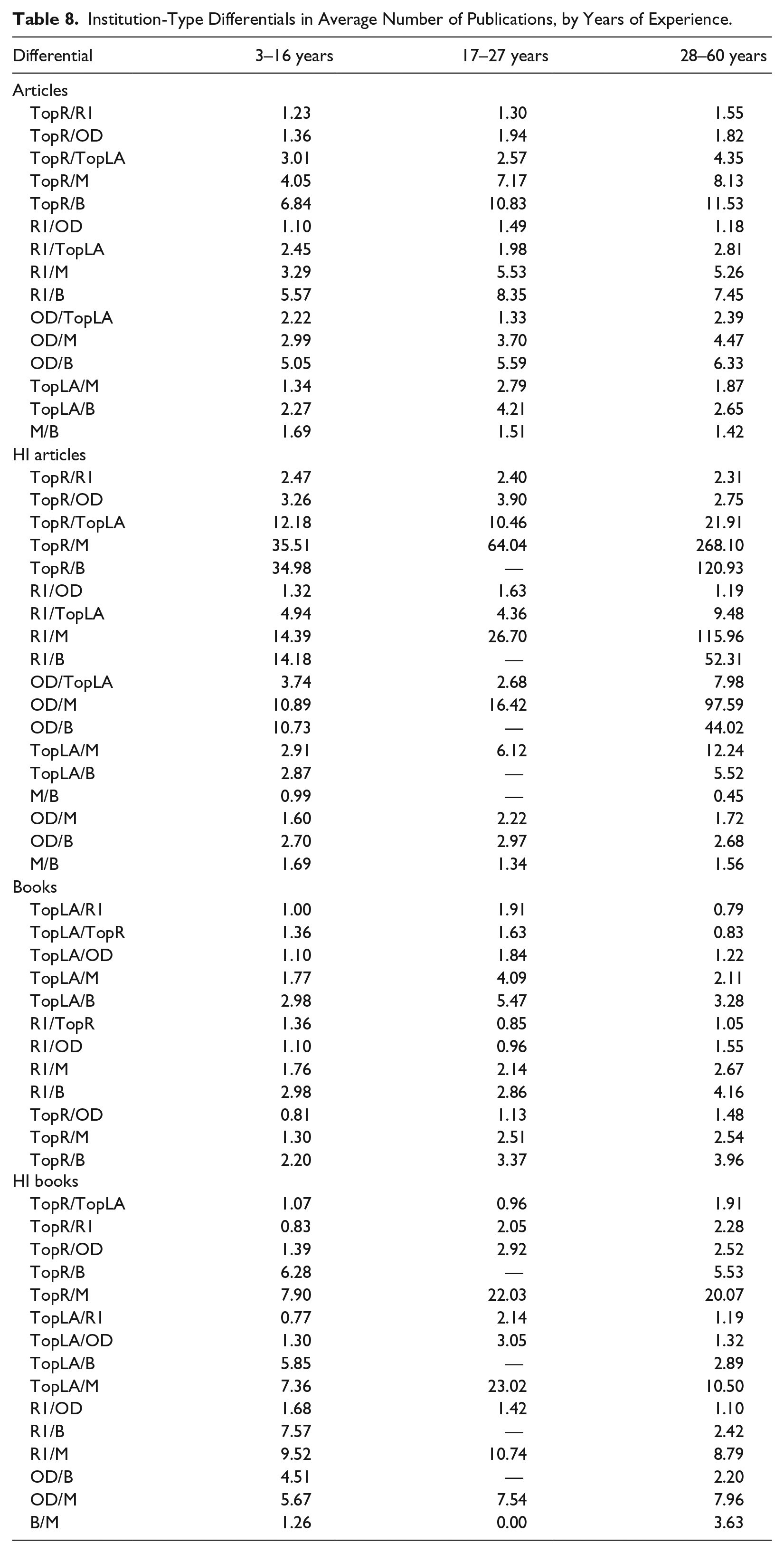
The publication counts for articles, articles in high-impact journals, books, and books from high-impact publishers show conclusively that institution-type differentials in productivity are lower for faculty with fewer than 17 years of experience than for those with more experience. This suggests that these differentials have declined over time, in keeping with Berlinerblau’s assertion.
Articles
Table 8 shows the institution-type differentials in average article count for each of the 15 institution-type pairs, by years of experience. In each case, the numerator is the category with the higher overall average value. The table shows, for example, that among individuals with 3 to 16 years of experience, the average article count for TopR faculty is 1.23 times that of R1 faculty. The ratio is higher (1.30) among faculty with 17 to 27 years of experience and even higher (1.55) among those with 28 to 60 years of experience. For articles, 8 of the 15 institution-type differentials are greatest among the most experienced faculty—those with 28 to 60 years of experience. Six differentials are greatest among faculty with 17 to 27 years of experience, and only one (M/B) is greatest among faculty with 3 to 16 years of experience. The consistency of these results suggests that institution-type differentials in article productivity have declined over the past two or three decades. The biggest decline appears to have occurred roughly 16 or 17 years ago, around 2001. The existence of an earlier decline, around 1990, is only weakly supported by the data.
Institution-Type Differentials in Average Number of Publications, by Years of Experience.
Articles in high-impact journals
The same general pattern can be seen in the results for articles in high-impact journals. Seven of the 15 institution-type differentials are greatest among the most experienced faculty. Seven are greatest among faculty with 17 to 27 years of experience, and just one (TopR/R1) is greatest among the faculty with the least experience.
Books
As Table 8 shows, the results for books are similar to those for journal articles. Six of the 15 institution-type differentials in book productivity are greatest among the most experienced faculty. Seven are greatest among faculty with 17 to 27 years of experience, and just two (R1/TopR and M/B) are greatest among the faculty with the least experience.
Books from high-impact publishers
For books from high-impact publishers, the equivalent counts are 4, 10, and 1. Only for HI books can we see a clear distinction between the 28–60 and 17–27 groups. These results tentatively suggest that institution-type differentials in the authorship of HI books may have increased in the decades before 1990, then declined again by 2001.
Conclusion
Have Differences among Institution Types Declined over Time?
The productivity gap between TopR faculty and other faculty remains substantial. Nonetheless, our data support Berlinerblau’s (2017) assertion that the gap has declined over time. More generally, the link between institution type and publishing productivity is weaker now than in the past, perhaps because many non-elite colleges and universities have begun to offer greater incentives for scholarly work (e.g., Hardré 2014). The biggest decline in productivity differentials appears to have occurred roughly 16 or 17 years ago, around 2001.
We might expect that such a change would be accompanied by declining differentials in the proportion of faculty with PhDs from the top 26 universities (Baldi 1994; Headworth and Freese 2016). However, differences in PhD reputation by institution type appear to have increased over the past few decades. That is, the major research universities attract a higher proportion of top 26 PhDs now than in the past. There are at least three possible explanations for this. First, the top research universities may have increased their efforts to attract the graduates of prestigious PhD programs in an effort to maintain their relative advantage in publishing productivity. Second, they may assume, rightly or wrongly, that top-university PhDs are more accomplished with regard to scholarly criteria other than book and article counts. Third, they may seek to maintain, build, or signal the quality of their faculty through mechanisms other than scholarly work.
These conclusions are based not on longitudinal analyses, but on the differences between more experienced and less experienced faculty. Our interpretations focus on cohort rather than age effects, on the assumption that the situation for current cohorts is different from that of past cohorts. The alternative explanation is that the differences between more experienced and less experienced faculty represent changes over the lifecourse. The most productive faculty may move from TopR universities to other institutions in mid-career, for instance.
Building on the work of Creswell (1985) and Headworth and Freese (2016), we can identify five major causes of variations in publishing productivity by institution type:
Differences in priorities and incentives, as expressed through teaching loads, tenure and promotion requirements, and other institutional policies.
Variations in research infrastructure (e.g., funding, staff, technology, and equipment).
Selection effects, whereby certain institutions are especially good at attracting the individuals who would be successful scholars regardless of their work environment.
Concentration effects that enhance productivity through the development of active, geographically localized research communities that facilitate knowledge transfer and specialization.
Bias, whereby faculty at prestigious universities gain an unfair advantage when submitting their work for review.
Differences in priorities/incentives and infrastructure are likely to persist. For instance, few master’s institutions can match the low teaching loads of the top universities. In fact, Items 1 and 2 can almost be regarded as defining characteristics of TopR and R1 institutions. A regional college that somehow matched the top research universities in priorities and infrastructure would probably be viewed not as an institution changing the rules, but as one moving upward in the institution-type hierarchy.
In contrast, colleges and universities of nearly every type are able to benefit from selection effects (Item 3) and concentration effects (Item 4). Selection effects may help explain the situation described by Berlinerblau (2017) and supported by our data, in which institutions other than the major research universities can now attract first-rate scholars on a regular basis. This situation may be expected to enhance systemwide productivity if it increases publishing activity at OD, M, TopLA, and B institutions more than it hinders publishing activity at TopR and R1 institutions. Likewise, concentration effects can help master’s and undergraduate institutions develop strong research communities without lessening the importance of scholarship at the major universities. For these reasons, declining differentials in publishing productivity may contribute to a systemwide increase in research output.
The implications of these changes for faculty at bachelor’s and master’s institutions will depend on the ways in which individual universities respond—through greater research expectations across the board, through stable research expectations that preserve the primacy of teaching even while individual faculty exceed those expectations, through alternate career tracks for more (or less) productive researchers, or through flexible options that allow individuals to alter their teaching and research loads over the course of their careers.
The possibility of bias (Item 5) has been raised by authors who stress the importance of reputational advantage and interpersonal relationships as factors in career success (Burris 2004; Weakliem, Gauchat, and Wright 2012). At worst, this might result in a permanent status hierarchy—the elevation of status over merit. However, our results suggest that while the link between PhD reputation and current institutional affiliation remains strong, the link between current affiliation and publishing productivity is not as strong as in the past. As suggested by Headworth and Freese (2016), the advantage of a top-university PhD may be declining, at least with regard to publishing productivity.
Gender and Publishing Productivity
Previous studies have reported that among sociology faculty, men have higher average publication rates than women (Chubin 1974; Creswell 1985; Keith et al. 2002; McNamee, Willis, and Rotchford 1990; Puuska 2010; Sax et al. 2002; Stack 2002; Warren 2019). Our results tell a different story. Considering all four productivity measures (Table 7), we can conclude that women are more productive than men at OD, TopLA, and B institutions while men are more productive than women at TopR institutions. (No significant gender differences were found at R1 and M institutions.) Pooling the data for all six institution types, we can detect no significant differences between men’s and women’s average article, HI article, book, and HI book counts (see Table 9). Women’s higher productivity at most types of colleges and universities offsets men’s higher productivity at the TopR institutions.
Average Number of Publications among Faculty at All Types of Institutions, 2013–2017, by Gender.

Note. The cases were weighted to arrive at a representative sample, as described in the “Analytical Methods” section. The sample includes 1,040 women and 1,092 men. The values for women and men are not significantly different for any of the four comparisons (p < .05, two-tailed).
There are at least three possible explanations for the discrepancy between our results and earlier findings. First, previous investigations may have provided only a partial view of the situation by focusing on just the major research universities. This explanation is not supported, however. Of the six large-scale studies that reported higher productivity for men, just one (Leahey 2006) was limited to research institutions. The others covered the full range of college and university types (Chubin 1974; Keith et al. 2002; McNamee, Willis, and Rotchford 1990; Sax et al. 2002; Stack 2002).
A second possibility, that women’s relative productivity has simply increased over time, seems intuitively reasonable. However, the presence or absence of a trend can be confirmed only with new data for the next 5 or 10 years. Although no clear temporal change can be seen in the findings of the six studies that reported higher productivity for men than for women, none of those studies used data for a period as recent as 2013–2017.
A third possibility is that structural factors have limited, and continue to limit, women’s opportunities to gain tenure-track positions at the foremost research universities. This explanation is consistent with previous research. As noted earlier, empirical studies suggest that gender differences are likely to arise due to men’s initial advantages in job placement. All else equal, men are more likely than women to begin their careers at the top universities, where they encounter lower teaching loads, better research support, and greater incentives for scholarly work (Chubin 1974; Keith et al. 2002; Monk-Turner and Fogerty 2010). Applied to our own results for gender (Table 7), this suggests that women who would otherwise be counted in the TopR category can instead be found among the most productive faculty at other types of institutions.
The glass ceiling that limits the upward mobility of women in the corporate world appears to have not just one but several analogs in the academic environment. Evidence from a range of disciplines—not just sociology—suggests that female professors have lower rates of tenure and promotion, and that women’s promotions occur later in their careers (Bain and Cummings 2000; Bonawitz and Andel 2009; McDowell, Singell, and Ziliak 1999). Women are disadvantaged by family considerations such as childbearing (Bingham and Nix 2010) and may face particular difficulties in male-dominated fields (Monroe and Chiu 2010; Sanders, Willemsen, and Millar 2009). Although we did not examine these issues directly, our data confirm that gender differentials in academic rank persist to the present day. Based solely on their relative numbers, female sociologists are overrepresented among associate professors and underrepresented among full professors. 4 This can be seen across nearly every institution type, but it is especially pronounced at the TopR, OD, and TopLA institutions (see Table 10). The implication, of course, is that women’s accomplishments may not be fully recognized when they apply for tenure and promotion.
Percentage Female, by Institution Type and Academic Rank.
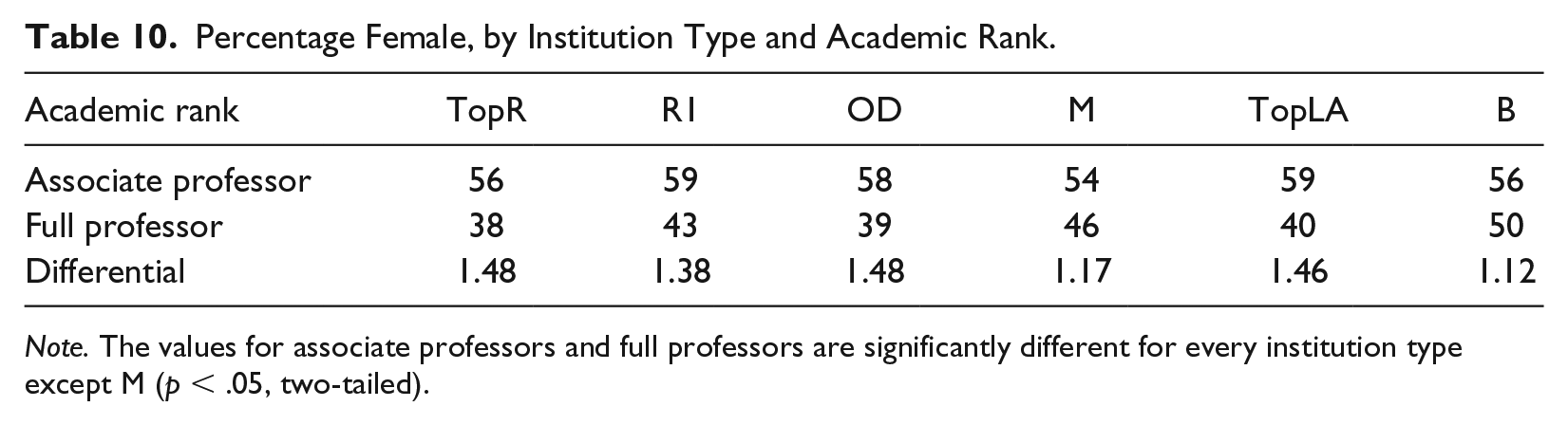
Note. The values for associate professors and full professors are significantly different for every institution type except M (p < .05, two-tailed).
Our primary finding with regard to gender, however, is that men are more productive than women at the TopR universities even though women are more productive at nearly every other type of institution. Within the framework established by Chubin (1974) and Keith et al. (2002), this suggests that women are less likely to attain tenure-track positions at the foremost universities. The main issue here is not the glass ceiling that limits tenure and promotion opportunities, but the possible exclusion of women from the ivory towers that are built on the highest ground. An analysis of entry-level, tenure-track placements might shed light on the situation.
Additional Findings
With regard to articles, TopR faculty are far more productive than the faculty in the other five groups. This finding is consistent with previous research (Creswell 1985; Hermanowicz 2016; Keith et al. 2002; Stack 2002) but contrary to Holley’s (1977) claim that TopR faculty publish fewer articles than those at R1 and OD institutions.
For books, TopLA faculty have the highest average productivity. Doctoral faculty are just slightly less productive, while faculty at M and B institutions are substantially less productive. To our knowledge, the prominence of TopLA faculty as book authors has not been reported in previous research. Our results are consistent with the findings of James E. Hartley and Michael D. Robinson (2001) but contrary to Douglas Eckberg and Jonathan Marx’s (2004) assertion that the top liberal arts colleges are not especially productive relative to other bachelor’s institutions. Despite the higher average book counts of TopLA faculty, TopR faculty are more likely to publish with the foremost university presses.
There is great variation in productivity within each of the six institution types, with high- and low-performing individuals at every type of college and university. Some faculty at bachelor’s institutions have article counts higher than the TopR average, for instance, while 22 percent of the faculty at TopR institutions have article counts lower than the average for master’s institutions.
In general, associate professors, faculty with fewer than 17 years of experience, and faculty with doctorates from top 26 universities have higher five-year publication rates than full professors, more experienced faculty, and faculty with doctorates from other institutions. There are exceptions to these patterns, however, and the differences among groups are more consistent for articles than for books. Our data support Thomas J. Phelan’s (1995) assertion that scholars in the later stages of their careers are especially likely to write books, although this is largely because the inverse relationship between experience and productivity is weaker for books than for articles.
Book and article counts are virtually uncorrelated. This finding is consistent with previous research (Clemens et al. 1995; Cronin, Snyder, and Atkins 1997; Moksony, Hegedűs, and Császár 2014; Wolfe 1990). Although it is possible to construct a single index of publishing productivity (Bott and Hargens 1991; Glenn and Villemez 1970; Keith and Babchuk 1998; Larson, Petrowsky and Vandiver, 1972; Stack 1994; Sturgis and Clemente 1973), our results demonstrate the advantages of evaluating books and articles separately.
Further Research
This study has several limitations that might be addressed through further research. Our publication data cover just a five-year period, with no longitudinal component. Journals not indexed by SocINDEX are excluded, as are potentially important scholarly outputs such as conference proceedings. Our data cannot be used to investigate initial job placement or early-career productivity, as assistant professors are excluded. Finally, our study does not account for the work of authors other than sociology faculty at U.S. colleges and universities. This last limitation is significant. In 2010, nearly 30 percent of the contributors to ASR were based in departments other than sociology (Kaba 2015), and a significant number of social science authors do not hold faculty appointments in academic departments (Collins, Cooper, and Knotts 2010).
As noted earlier, a key question suggested by this study is whether limited opportunities at the top research universities have led women to emerge as the most productive scholars at other institutions. Further research might also examine the influence of scholarly productivity and gender on measures such as initial faculty appointment (e.g., tenure-track, part-time, or full-time temporary), institutional reputation, initial salary, tenure success rate, time to tenure, time to each promotion, salary history, and the attainment of professional leadership positions and editorial board memberships. In each case, it is worthwhile to consider both (1) the extent to which these indicators are associated with scholarly productivity and (2) the extent to which they are associated with gender, either directly or through other covariates. We might ask, for instance, whether women and men with similar publication records are equally likely to attain distinguished professor positions or to serve on the editorial boards of major journals.
Two methodological points are also worthy of further investigation. First, it is possible that the act of contributing to a book or article may be qualitatively different for faculty at the various types of institutions. We might therefore examine whether the overall increase in sociologists’ coauthorship rates has altered individuals’ expectations of the research process; whether collaboration brings an increase in systemwide productivity through specialization and other mechanisms that promote efficiency in scholarly work; whether collaboration with graduate students brings authorship credit that is greater than, or less than, the faculty’s actual contributions to the coauthored work; and whether graduates of the top PhD programs who teach at undergraduate colleges continue to benefit from coauthorship arrangements with their former professors or grad-school colleagues at higher ranked universities. Notably, collaboration with graduate students may result in “extra credit” for faculty authors even when harmonic weighting is used.
Finally, further research might examine measures of scholarly accomplishment other than simple publication counts. Article citation rates can be used to represent scholarly impact, for instance, and article counts can be weighted to account for citations so that both productivity and impact are considered simultaneously (Walters 2017). Likewise, it may be useful to investigate the extent to which TopR and R1 faculty target the most prestigious journals and publishers. While TopR faculty are especially notable for their contributions to high-impact publications, we do not know whether they are especially likely to submit their papers to the top journals or whether their papers are simply more likely to be accepted.
Footnotes
Acknowledgements
We are grateful for the comments of three anonymous referees.
Declaration of Conflicting Interests
The author(s) declared no potential conflicts of interest with respect to the research, authorship, and/or publication of this article.
Funding
The author(s) received no financial support for the research, authorship, and/or publication of this article.