




Abstract
Scholarship indicates that there are many benefits of social support, yet theoretical questions remain as to whether the perceived efficacy of support depends upon its source. Drawing on in-depth interviews with a sample of collegiate athletes with access to a vast support network, this research examined the perceived utility of support received from significant others, similar others, and individuals who were both personally significant and experientially similar, albeit to varying degrees. Five categories of similar and/or significant other supporters emerged, each of which seemed to fulfill a different support function. Significant-only others provided support based in personal significance, whereas similar-only others supplied experience-based coping assistance. And a particularly valued resource, individuals who were both significant and similar were solicited based on the relative salience of their significant and similar other role identities and the uniquely specialized support they could provide to match the needs of both individuals and their stressful circumstances. In support of theory, findings highlight the potential for support interventions aimed at cultivating different types of similar and significant other relationships.
Scholarship on stress, health, and social support has long recognized the benefits of social relationships to overall health and well-being. There is a large body of research to suggest that social support, a coping resource conferred through these relationships, improves mental and physical health directly and indirectly by buffering against potentially negative impacts of stress (Cohen 2004; Cohen and Wills 1985; Thoits 1995; Umberson and Montez 2010). Still, there remains some uncertainty as to how exactly social support improves health and well-being, and scholars continue to explore the mechanisms behind the salutary effects of social relationships and social support (see, for example, Cohen 2004; McConnell 2017; Perry and Pescosolido 2015; Thoits 2011; Uchino, Cacioppo, and Kiecolt-Glaser 1996, and Umberson and Montez 2010). Nestled within these theoretical deliberations is the question of whether the perceived utility of and, consequently, individuals’ preference for certain types of support might depend upon their source. Specifically, scholars propose that significant others (i.e., family and friends with whom individuals have close, personal relationships) and experientially similar others (i.e., individuals, typically linked through more distal ties, who have experienced the same stressor(s)) should supply different kinds of support (see Thoits 2011). Nevertheless, few studies have actually compared individuals’ perceptions of support received from these two sources, or examined how supporters’ experiential similarity and/or personal significance might influence individuals’ evaluations of support received from different sources. Even fewer have examined perceptions of support provided by persons who are both experientially similar and personally significant, presumably because such individuals are rare.
To address these gaps in the literature, this study examines the support-seeking behaviors of a sample of collegiate athletes whose networks are made up of former and current athletes (i.e., experientially similar others) and whose structural location within collegiate athletic programs provides them unique access to a variety of supportive others. The purpose of this analysis is to better understand (1) how personal significance, experiential similarity, or both significance and similarity are perceived to influence the support received from various sources and (2) whether and how those perceptions might influence individuals’ support-seeking decisions. By identifying what individuals facing considerable strain perceive to be most important about the support provided within these supportive relationships, this study further illuminates the mechanisms through which social support may improve health and well-being.
Theory and Background
Among sociology’s greatest contributions to studies of health and well-being is the consistent and robust finding that social relationships positively impact health (Berkman et al. 2000; Umberson and Montez 2010). For instance, studies indicate that social relationships protect against psychological distress (Taylor 2007), improve physiological function (Uchino et al. 1996), and reduce risk of mortality (House, Landis, and Umberson 1988). Although debate continues as to the specific processes through which social relationships impact health, social support remains a promising explanatory mechanism (Cohen 2004; Thoits 2011; Uchino et al. 1996; Umberson and Montez 2010).
Social Support and Theories of Stress Buffering
Within stress research, social support is conceptualized as the functional properties of social relationships which individuals can mobilize in stressful circumstances to “buffer” against stressors or their consequences (Cohen 2004; House and Kahn 1985; Thoits 1995). Stress scholars generally classify social support according to whether it fulfills an instrumental, informational, or emotional purpose (e.g., House and Kahn 1985; Thoits 1995, 2011). Support that involves the provision of tangible resources (e.g., material, financial, or logistical) intended to mitigate stressful situations is classified as instrumental support (House and Kahn 1985; Thoits 1995, 2011). Advice or information that can help an individual reduce, reevaluate, or overcome a stressor is categorized as informational support (House and Kahn 1985; Thoits 1995, 2011). Finally, support that is directed at elevating an individual’s emotional state is defined as emotional support (House and Kahn 1985; Thoits 1995, 2011). This literature also distinguishes between perceived and received support (Thoits 2011), but generally finds that individuals’ belief that support is available carries greater benefit than the support received (Cohen and Wills 1985; Taylor 2007).
The social stress literature also suggests that social support comes from two key sources: (1) significant (intimate) others such as partners, family, or friends who, as part of one’s “primary network” (Thoits 2011), may have a role obligation to provide support, especially emotional support such as love, comfort, and esteem, and (2) similar others such as coworkers, neighbors, or acquaintances with whom individuals have less intimate relationships, but who may provide empathy and understanding based on social or experiential similarity (Cohen and McKay 1984; Taylor 2007; Thoits 1986, 1995, 2011). Although early research highlighted the important stress-buffering effects of having a close friend, partner, or confidant (i.e., a significant other) (e.g., Cohen and Wills 1985; Thoits 1995), and much research has been dedicated to understanding how significant other support improves health and well-being, theoretical and empirical work has since suggested a number of scenarios in which support from experientially similar others may be particularly effective at reducing stress and improving outcomes (Gage 2013; Gage-Bouchard et al. 2015; Grace 2018; McConnell 2017; Perry and Pescosolido 2015; Thoits 2011; Thoits et al. 2000). For example, studies of bereavement (Lehman, Ellard, and Wortman 1986), adult and childhood cancer (Dakof and Taylor 1990, and Gage 2013, respectively), heart surgery (Thoits et al. 2000), mental illness (McConnell 2017; Perry and Pescosolido 2015), status transitions (Suitor, Pillemer, and Keeton 1995) and, most recently, premedical education (Grace 2018) have all shown benefits of connecting with experientially similar others who can provide experience-based support. Still, because most of these studies examined support received from a single type of supporter, it remains unclear as to whether significant other or similar other support may be perceived as more or less desirable as few studies have actually compared individuals’ perceptions of support received from significant and similar others.
In their attempts to elucidate the mechanisms connecting social support to positive health outcomes, stress theorists have proposed various models of stress buffering which suggest that the efficacy of support should be based, in part, on the source of that support (see Cohen and McKay 1984; Thoits 1986, 2011). In an early model of stress buffering, Sheldon Cohen and Garth McKay (1984) suggested that, for support to effectively intervene in the stress process, there must be a match between the support available and the specific coping needs of a person’s stressful circumstances. Hypothesizing that a given situation could call for a specific type of support, Cohen and McKay (1984) theorized that experientially similar others could better address certain support needs than significant others. For instance, although significant others are aptly positioned to provide love and affection to strengthen a person’s sense of belonging should it be threatened, individuals who have experience with the stressor at hand are, based upon their own coping experiences, better prepared to help individuals appraise stressful circumstances (Cohen and McKay 1984).
Proponents of this matching hypothesis have argued that the benefits of similar other support may stem from processes of social comparison (Festinger 1954) through which individuals rely on similarly experienced others for behavioral, perceptual, and emotional guidance in uncertain circumstances (Cohen and McKay 1984; McConnell 2017; Thoits 2011). Accordingly, individuals experiencing stressful situations may look to others who are perceived to have effectively managed or overcome similar stressors for coping insights and validation of their stress responses (Cohen and McKay 1984; Thoits 1986). Thoits (1986, 2011) too argued that social comparison processes play a role in the effectiveness of similar other support; however, she moved beyond role modeling to theorize “empathic understanding” as the bedrock of successful support attempts (Thoits 1986:420). Redefining social support as “active coping assistance,” Thoits (1986:417) posited that social support processes reflect the same goals of problem-focused, meaning/perception-focused, and emotion-focused coping strategies by aiming to (1) address the stressor, (2) help an individual reevaluate the stressor, and/or (3) ease a person’s immediate emotional response to the stressor, respectively. Thus, according to Thoits (1986), active coping assistance involves providing support specifically attuned to the stressor at hand. Because experientially similar others can empathize and better understand a person’s stressful circumstances, Thoits (1986, 2011) argues that they should be most able to provide support tailored to those circumstances. Indeed, recent findings indicate that similar others supply great amounts of stressor-specific empathy, information, and instrumental aid (Gage 2013; Gage-Bouchard et al. 2015; Grace 2018).
Extending her work on coping assistance, Thoits (2011) has since identified “emotional sustenance” as another, more indirect pathway through which social support protects mental health. Rather than aiming at the immediate demands of a stressful situation, as is the goal of active coping assistance, this type of support involves standing by and tending to individuals’ emotional needs as they process and respond to a stressor (Thoits 2011). Thoits (2011) suggests that although significant others and similar others both supply these two forms of support, they do it differently based on their different positions. As committed, intimate others with clear role obligations, significant others provide emotional sustenance through sympathy, concern, and physical presence (Thoits 2011:153). And although they may not be prepared to advise on the particulars of a stressor, significant others can offer tangible, instrumental aid because their roles as significant others may oblige them to do so (Thoits 2011). In contrast, Thoits (2011) argues that similar others “sustain” individuals emotionally by empathizing with their circumstances and allowing them to vent their fears and frustrations, but they can also supply stressor-specific advice/encouragement (i.e., informational support) or assistance in stressor appraisal because they are appropriately positioned to do so based on experiential similarity. Thoits’ (2011) theorization, therefore, suggests that significant and similar others make important, but different contributions to individuals’ abilities to cope based upon their differential roles as either significant or similar others. Proposing a model in which the efficacy of each type of support is determined by its source, Thoits (2011:152) suggests that the most effective support should come from individuals who are both significant and experientially similar because they can provide the most comprehensive aid.
Significant Other Support versus Similar Other Support: Empirical Findings
Unfortunately, there are no studies of which the author is aware that examine support provided by persons who are both similar and significant, and there are only a few studies that have explicitly compared the perceived efficacy of similar and significant other support. Consistent with the theoretical patterns outlined above, these studies show that similar others are appreciated for their ability to provide empathy and understanding, role modeling, and firsthand, stressor-specific emotional or informational support (Dakof and Taylor 1990; Gage-Bouchard et al. 2015; Lehman et al. 1986), whereas significant others are most regarded for supplying emotional support such as being physically present and showing care and concern, and providing instrumental assistance (Dakof and Taylor 1990). Other research suggests that, in the case of health crises such as a child’s diagnosis of cancer, similar others provided situationally specific and experience-based information and emotional aid, whereas significant others including family and friends were appreciated for providing instrumental support such as childcare, meal prep, and financial aid which allowed parents to dedicate greater time and attention to their children’s health needs (Gage 2013; Gage-Bouchard et al. 2015).
This literature also suggests that supportive relationships with both similar and significant others can have negative consequences. For example, findings indicate that similarly experienced others can generate additional difficulty or distress when support exchanges expose individuals to evidence of particularly positive (i.e., successful) or negative outcomes (Gage 2013) or when supporters’ own stressful experiences spill over into their supportive exchanges (McConnell 2017). Significant others, on the other hand, have been shown to provide unhelpful forms of emotional support to individuals coping with stressors such as cancer or bereavement (Dakof and Taylor 1990; Lehman et al. 1986). For instance, Gayle A. Dakof and Shelley E. Taylor (1990) found that significant others were perceived to be overly judgmental of patients’ outlooks or behaviors, to discount the degree of threat patients were experiencing, to be inordinately concerned or cynical about patients’ prognoses, and to withdraw from interaction with the patient. In attempting to explain why well-meaning significant others may supply ineffective, and even hurtful forms of support, Darrin R. Lehman et al. (1986) suggested that significant others who feel compelled to assuage a loved one’s hurt or who may be struggling with their own feelings of distress surrounding the situation may try any number of supportive behaviors, even those that are considered unsupportive such as giving uninformed or unwanted advice (Lehman et al. 1986).
Peer support group and intervention research lends additional perspective as to the relative effectiveness and desirability of similar and significant other support behaviors. Vicki S. Helgeson and Sheldon Cohen (1996), for example, found that although cancer patients want and need emotional support, particularly the opportunity to express their anxieties, emotional support was ineffective at helping patients adjust to their illnesses when supplied by peer support group members, presumably because peer supporters lack the enduring, intimate ties believed to be necessary for effective emotional support. On the other hand, peer support groups were appreciated for providing informational support which they were well positioned to supply as similar others (Helgeson and Cohen 1996). Similarly, Davison, Pennebaker, and Dickerson (2000) found that, absent expert others, peer supporters are a desirable source of support because they have experience in managing a stressor (Davison et al. 2000). Relative to other sources, peer supporters can offer community, exchange of knowledge, and empowerment, all of which are areas in which individuals’ primary support networks of significant others may fall short (Ussher et al. 2006). By providing individuals with an outlet through which they can cope with a stressor and gain valuable insights as to how to do so, peer supporters (i.e., similar others) may also help ease tension within individuals’ intimate relationships, thus allowing significant others to provide the types of emotional support not necessarily available from similar others with whom individuals are less closely tied (Ussher et al. 2006).
Intervention research has also begun to identify specific conditions under which significant and similar other support might be most effective. For example, scholarship suggests that peer support may be most effective when it emerges from organically formed relationships with individuals concurrently experiencing a stressor, as opposed to strategically cultivated relationships with similar others who have previously experienced the stressor. In evaluating how similar other support influenced the health experiences of men undergoing heart surgery, Thoits et al. (2000) found that bringing in an experienced similar other to support patients carried no significant health benefits, but that informal interaction with other patients on the cardiac ward benefited patients both physically and psychologically. This further suggests that the process of developing ties with experientially similar others and/or the timing of supporters’ experience with stressors may condition the relative usefulness of similar other support (Thoits et al. 2000).
Taken together, these studies of support do not necessarily signify greater efficacy of one source over another. Rather, they suggest that similar and significant others may provide different and perhaps complementary benefits to individuals grappling with stressful circumstances and that, theoretically, there are several conditions under which each should be perceived as helpful/effective. To explore these possibilities, this study examines how experiential similarity and personal significance are perceived to shape or inform the types of support that various sources provide. In addition, this study explores the relative desirability of different support sources based on individuals’ perceptions of their significant and/or similar other statuses. By identifying how similarity and/or significance might influence individuals’ support-seeking decisions and behaviors, this study further contributes to theoretical understandings of how social support sustains health and well-being.
The Case: Collegiate Athletes
Although it could be argued that collegiate athletes represent a very select population operating within a unique institutional environment, they represent an ideal population in which to examine social support processes. In addition to facing a multitude of role-related strains that put them at a heightened risk of mental health concerns, athletes have been shown to have access to a wide network of supportive others, many of whom have experience with sport and its related strains (Freeman and Rees 2010; Rosenfeld, Richman, and Hardy 1989). In addition, athletes’ location within the institutional structure of big-time athletic programs provides them unique access to a comprehensive range of institutional support personnel with similar experience and professional expertise, including athletic trainers, sports psychologists, academic advisors, coaches, and other institutional staff (Carodine et al. 2001; Hatteberg 2020). These professional sources of support, coupled with more traditional sources of support such as family, friends, and romantic partners, as well as experientially similar others such as teammates and athletic peers who occupy the same social roles, form an exceptionally comprehensive support network from which athletes may draw, thus offering them many options in the help-seeking process.
Research further indicates that collegiate athletes experience a number of chronic institutional and role-related strains for which they need support, such as strains associated with the transition to college, overwhelming and often conflicting demands of their athletic and academic roles, athletic performance pressures, interpersonal conflict within their role relationships, exhaustion, burnout, and the ongoing risk of pain and injury (Adler and Adler 1991; Gould and Whitley 2009; Hatteberg 2015; Kimball and Freysinger 2003; Wilson and Pritchard 2005). Moreover, there is mounting evidence to suggest that athletes experience ambient strain associated with the all-encompassing total institutional structure of college athletic programs, as it subjects them to rigid scheduling, isolation from the outside world, pervasive surveillance, and control (Adler and Adler 1991; Hatteberg 2018; Southall and Weiler 2014). Thus, while operating within a unique social context, the case of collegiate athletes presents a rare opportunity to explore how personal significance and experiential similarity are perceived to impact the efficacy of support received for ongoing strains and to better understand how those perceptions might factor into individuals’ support-seeking decisions.
Data and Methods
Site Selection and Research Design
To address these gaps in the literature, I draw on semi-structured in-depth interviews conducted with college athletes at a large university in the Midwest as part of a larger, mixed-methods study on stress and coping within collegiate athletics. The athletic department at Large Midwestern University (LMU) was selected as the research site based on its status as a “big-time collegiate athletic program” (see Coakley 2009) in a highly competitive, Division I athletic conference. As a public research university, LMU had an enrollment of more than 30,000 undergraduate students (with athletes comprising just 2 percent) and a long tradition of athletic and academic excellence.
To better understand the social structure and context of Division I collegiate athletics, as well as the various institutional actors involved, the larger study from which these data are drawn began with participant observation conducted with three out of four different sports teams initially selected for inclusion in the study. These four teams were selected with the help of LMU athletic department personnel to represent different types of athletic environments (i.e., men’s and women’s, and revenue-generating and non-revenue-generating team environments); however, scheduling difficulties and other constraints prevented participant observation from being conducted with the men’s revenue-generating team selected. Participant observations were conducted for an entire academic year running from September 1, 2013 through May 2014, and provided the author with important contextual data which were used to develop and refine questions for the semi-structured interviews and short survey questionnaires that were conducted with a subsample of participants on each of the four sports teams initially selected. This second stage of research began at the end of December 2013 after the author had been in the field for four months and continued alongside participant observation through the end of the academic year (i.e., May 2014). 1
As a young white woman with a moderately athletic build who dressed in athletic attire or LMU polo shirts, I looked like many members of the LMU athletic department and came to be perceived as an insider by study participants who had become familiar with my presence in athletic facilities during the months leading up to interview recruitment. Having observed and sometimes assisted with minor tasks during practices, lifts, conditioning, treatment sessions, competitions, team meetings, study hall, team meals, and so on, for each of three teams, I was recognizable to most athletes and staff in LMU’s athletic department and, therefore, presumed to be knowledgeable about athletes’ experiences and role relationships. I believe that respondents’ familiarity with me contributed greatly to their candor throughout interviews.
About 11–16 athletes from each of the four selected teams agreed to participate in the semi-structured, in-depth interviews and short survey questionnaires for a total sample size of 56. Initial interview respondents signed up for interview slots and others were recruited via snowball sampling techniques with the help of athletes who had already completed the interview. Interviews covered topics related to respondents’ sources of stress, coping efforts, and support-seeking behaviors. Specifically, after describing the strains they experienced as college athletes, respondents detailed the types of support they sought and received from an exhaustive list of potential supporters about whom they were probed, including family members, friends, teammates, romantic partners, and institutional support personnel identified through participant observation. If not volunteered, respondents were also asked to explain what each mentioned supporter said or did to help them through their stressful circumstances. 2
Interviews were transcribed and deidentified. All names (participants’ and support providers’) were replaced with pseudonyms and identifying information regarding respondents’ team or sport type was replaced with more generic descriptors. Using ATLAS.ti, version 7, transcripts were initially coded using the line-by-line coding method advocated by Charmaz (2014), which prompted close study of the data and complete coding of each transcript. Next, following an epistemological approach, transcripts were coded using a subset of theoretical codes derived from Thoits’ (2011) theoretical propositions to identify how experiential similarity and personal significance were referenced within respondents’ discussions of supportive others and associated support experiences. Finally, following an inductive approach, interview transcripts were further analyzed and coded for themes that emerged regarding categories of significant and/or similar other supporters and the form and relative utility of support they supplied.
Sample Characteristics
Demographic and sport-related characteristics of interview respondents are presented in Table 1. As shown here, about half of the sample was female, the average age was 20.5, and two-thirds were white. Respondents were distributed across grade levels, a majority of them (33.93 percent) seniors, and the average grade point average (GPA) was 3.01 (a B average). Almost half of the respondents were profit athletes (i.e., those participating in a revenue-generating sport such as football, men’s or women’s basketball, or women’s volleyball).
Descriptive Statistics of Interview Respondents (N = 56).

Note. GPA = grade point average.
In line with previous sport-related research, respondents experienced many ongoing stressors including difficulty managing athletic and academic role obligations, athletic performance demands, conflict within their role relationships, sport-related pain and injury, and the restructuring or potential loss of their athletic roles (e.g., losing a starting position or contending with a career-altering injury). Respondents also complained of severe exhaustion, strict schedules, limited autonomy, and extensive institutional surveillance that limited their privacy. Respondents described dealing with these strains on an ongoing basis, with more than two-thirds of all respondents reporting experiencing two to three role-related strains.
Findings
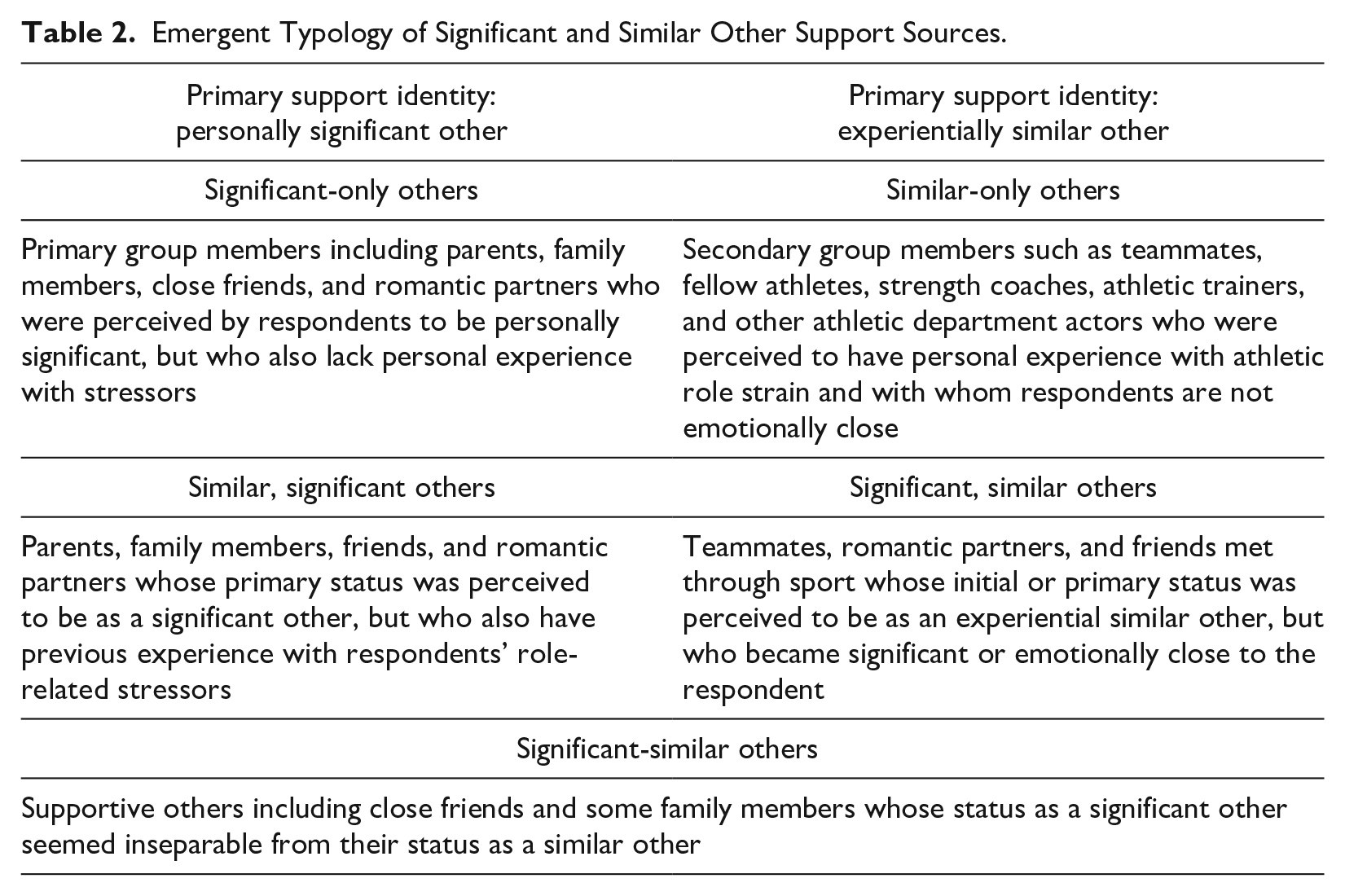
In attempting to cope with their role-related stressors, respondents reported receiving social support from a total of 34 different individuals or groups, including many who were perceived by respondents to be personally significant, experientially similar, or both. Out of the many sources described, five categories of significant and similar other supporters emerged. These categories are summarized in Table 2. In the discussion that follows, I explore themes that emerged with regard to the types and perceived helpfulness of support provided by each of these five categories of supporters, paying particular attention to how supporters’ relative significance and/or similarity to respondents was perceived to influence the support they provided.
Emergent Typology of Significant and Similar Other Support Sources.
The Benefits of Personal Significance
Consistent with previous literature, significant others were commonly described as a key source of support among respondents experiencing role strain. Made up primarily of family members (particularly parents and siblings), romantic partners, and close friends, significant others lacked experience with the specific role strains athletes faced, but were known for providing respondents with emotional sustenance (e.g., love, affection, care, and concern) and with coping assistance across stressors. For example, as theory would predict (Thoits 2011), significant others sustained respondents emotionally by listening, providing encouragement, and attempting to strengthen their self-confidence and esteem through expressions of love and reassurance. Respondents believed that, despite their lack of experience with athletes’ role-related strains, significant others attempted to be understanding of stressful circumstances by showing sympathy and concern. Beyond supplying these emotionally sustaining behaviors, significant others were appreciated for always being available and for providing respondents with steadfast, individualized support across stressful situations. They were also valued for intervening in stressful circumstances to protect respondents’ well-being.
Reliable and steadfast, individualized support
As respondents described their reasons for soliciting support from significant-only others, they emphasized emotional closeness and the reliable, unconditional nature of significant other relationships and the support provided within them. For example, in explaining that her mother is the first person she calls when she is struggling with role-related strains such as overwhelming pressure to continuously exhibit perfect athletic performance, Lauren said, Well, me and my mom have a really good relationship. I can basically tell my mom anything. So, I call my mom a lot . . . She just always reassures me that I’m tougher than I think . . . she’ll tweet pictures of me and, like, “Shout out to my favorite [sport] player,” like, “I know you can do this” and stuff like that.
As evidenced here, respondents valued the emotion-focused aid that significant others could supply across circumstances, and, in times of self-doubt, however, they seemed particularly comforted by the belief that significant other support would always be available. Indeed, respondents repeatedly referenced the sense that significant others could be depended on for support because their love was unconditional and their support unwavering. In addition, respondents felt comfortable disclosing their struggles to significant others and believed that these individuals were well equipped to communicate support effectively based on their status as significant others. For example, in describing why her partner (a nonathlete) was her go-to source of support for role-related strains such as the transition to collegiate athletics and managing conflicts between her academic and athletic obligations, Bailey explained, We’ve been dating for almost two years and we were friends before we dated, so we really have a really good relationship, communication-wise, and he always seems to know what to say. So, I think it’s more of a comfort thing. I know that I’m gonna be supported no matter what . . .
That they “knew just what to say” emerged as another major reason that significant others were solicited for support to help respondents manage role-related strains. Often, this special ability to communicate support in a productive manner was couched in significant others’ expert knowledge of the individual and their personal support needs to which similar experience was irrelevant. In explaining why he goes to nonathletic members of his family for strains associated with injury and role conflict, Dwight said, They know me almost better than me, so you know, they always say the right words, they give me refocus and stuff like that . . . You know, “You’ve been doing this your whole life, you always get through hard times,” and stuff like that . . . So, saying the right things I need to hear to keep pushing.
Again articulating how intimate and long-lasting ties with significant others equip them with expert knowledge of individuals’ support needs, allowing them to communicate support effectively, Dwight underscores the perception that significant other support is exceptionally reliable, steadfast, and tailored to individuals’ personal support needs.
Active problem-focused coping assistance and intervention
Significant others were also appreciated for supplying problem-focused support and for their willingness to intervene on a respondent’s behalf to protect their overall health and well-being. For example, they might advise or give perspective on a stressful situation (informational support), or provide instrumental or practical aid targeting a specific stressor. For example, significant others pushed respondents to ask for help from athletic department staff when they were struggling to meet their role obligations, they helped respondents get organized and develop strategies to manage their time better, and they provided financial support when respondents requested help with food or living expenses.
Sometimes, significant others intervened to reduce respondents’ stressful circumstances directly. For example, having been prematurely returned to play following a sport-related concussion that left Brandon second-guessing his own understanding of the situation, Brandon explained how his father intervened to provide advice and practical aid to eliminate the stressor: [He said] “The first priority is your health.” You know, [sport] is great, but at the same time I need to be able to function when I’m older, you know. I don’t want to develop [health problems] when I’m older because we kept going back in and kept getting [hurt] . . . I guess for me, my dad’s always willing to put in input with the coaches if he feels it’s not being handled right. I’m more passive, I don’t really care for confrontation too much and I’ll just go with it . . . With my concussion, he didn’t like the way I was being treated, so I think he let the coaches know.
Like Brandon, several respondents described appreciating significant others for their willingness to intervene on respondents’ behalf to address stressful situations, a practice that demonstrated significant others’ commitment to protecting respondents’ health and well-being.
Limits to significant other support
Although most significant other support was perceived as remarkably helpful, there were also several ways it was perceived to be limited, unhelpful, or ineffective. Most notably, significant others were often perceived as lacking the knowledge and empathic understanding necessary to support respondents through role-related strains because they lacked personal experience with the stressors respondents faced (i.e., they were not experientially similar). Accordingly, respondents explained that their nonathletic family members and partners were often limited to providing emotional support such as listening or consoling. Kenzie said that although she relies heavily on her mother for her unconditional assistance across situations, she sometimes prefers support from experientially similar others because of the difficulty involved in explaining her role-related concerns to her mother, a significant-only other: And with my mom, it’s not her fault, I just don’t like that I have to explain everything to her. And I have to explain things to her several times, because not only was she not an athlete herself, she didn’t raise [other athletes] . . . So this is literally an entirely new world to her.
Moving beyond these limitations of significant-only support, some respondents described avoiding significant others for support based on the perception that they would be dismissive of their concerns. As Cody explained, You can always talk to your parents, but that would never help because they’d just be like, “Oh, just suck it up, you’re only gonna deal with it for so much longer, you’ll be fine, you’re not going to die.”
Having similar concerns, Austin said that he kept his athletic role strains from his nonathletic friends because, I didn’t think they’d understand or maybe because I knew they wouldn’t understand (laughs). Or [I] didn’t think that they wanted to hear [that] I have to deal with the problem of, “oh my gosh, being on scholarship and a D1 athlete is so stinky.” They don’t want to hear that.
As a premed student with a rigorous course schedule, Austin’s most salient stressors involved balancing his academic and athletic role obligations and though he desperately wanted a network of friends who were as committed to their academics as he was, Austin also believed that his commitment to sport actually caused him to lose those friends. Nonetheless, his decision to avoid soliciting support from significant others out of concern that they would not understand or would give little weight to his stressors reflected a common sentiment about the limits of significant others’ support.
The Benefits of Experiential Similarity
As expected, experientially similar others emerged as a commonly solicited source of support and included individuals with current or previous experience with sport-related strains, but who were not perceived to be tied emotionally to respondents. Respondents reported seeking support from fellow athletes, teammates, and athletic department staff members such as coaches, strength and conditioning staff, and sports psychologists, whose previous or current experiences with athletic role strain qualified them as similar-only others. Unsurprisingly, shared stress and empathic understanding emerged as key reasons that similar-only others were solicited for support. Substantiating Thoits’ (2011) theorization, these aspects of experiential similarity qualified similar others to (1) validate respondents’ appraisals of stressful circumstances and provide them opportunities to vent (emotional sustenance), (2) offer experience-based advice, encouragement, or reassurance aimed at addressing a stressor or one’s response to it (active coping assistance), and (3) reduce respondents’ feelings of isolation by inspiring a sense of camaraderie (emotional sustenance and active coping assistance). However, interview responses also revealed that there are a few conditions under which similar other support may not be effective.
Validation and ventilation
One of the key reasons that respondents solicited support from similar others was their perceived ability to relate to and validate respondents’ perceptions of and reactions to stressors. Often, validation was delivered by teammates during venting sessions in which respondents voiced their role-related frustrations and their teammates agreed or otherwise validated those concerns. Asked what he did to manage his role-related stressors, Cody explained, If you’re asking who I would talk to, it would be other guys on the team, just so you talk to someone who knows what you’re going through at that moment. I wanted to talk to someone who was on the team or playing currently . . .
Reiterating the importance of shared experience, Cody described needing to talk to someone who was currently struggling with the same role-related strains he faced because, as he continued explaining, they were the only ones capable of acknowledging just how bad things were. Indeed, many respondents relied heavily on the emotional release they got from venting to similar others, particularly given their perceived lack of control over many of the stressors they faced. Thus, similar others were solicited for venting and validation purposes based primarily on their ability to empathize.
Experience-based guidance and role modeling
Similar others were also appreciated for providing active coping assistance through experience-based guidance and role modeling. This was particularly true for underclassmen who regularly solicited advice and information from their more experienced teammates in hopes of learning from their stress and coping experiences. For instance, in describing what she does to manage her stressors, notably her perceived struggles with time management, Riley (a first-year athlete) explained, Definitely talking to upperclassmen because they went through the stresses of being a freshman and just the stresses of college itself. I like talking to them about it, probably [because] they’ve gone through it too. And they’ll tell me what they did to relieve it or how it will get better, or how it’s going to change, or they’ll hang out with me or something. They’re always willing to help you out.
As a sophomore, Nick also described soliciting experience-based guidance from his more experienced teammates because they “usually do a good job of telling me what I’m doing wrong or what I can do to make the situation better. They know how it works, so they help a lot.” Nick, a premed student, went on to explain that he also solicited experience-based support from one of his premed teammates, saying, “I talk to him all the time about what classes are hard, or how to approach my schedule, stuff like that.” As indicated here, respondents specifically sought support from more seasoned, similar others based on the active, experience-based coping assistance they could supply and the perception that those individuals had successfully managed the same stressors (i.e., role modeling).
Togetherness and camaraderie
At times, the sheer presence of similar others in stressful circumstances inspired athletes to stay the course by reminding them they were not alone in their role-related struggles. Invoking the “misery loves company” sentiment, one respondent explained that she is particularly appreciative of her teammates because “it’s nice to have someone [who understands] to share in that.” As suggested here, shared experience of stressors inspired a sense of camaraderie. Sometimes, this camaraderie led athletes to band together to combat stressors. Gabrielle explained that she solicited support from her teammates with whom she shared classes and role-related concerns, because together they could tackle their stressors: [It] kind of helped because we can prepare for those classes together, and if we had a huge exam coming up, we could, together, go to the coaches and be like, “Oh, can we practice at a different time this week and get, like, time to study before this exam?” . . . it helps when you can kind of team up and take on those stressors together.
As evidenced here, respondents appreciated the emotional benefits they received from knowing that they were not alone in coping with role-related concerns and they used this knowledge to develop problem-focused coping strategies for managing stressors together.
Conditions under which similar other support was considered ineffective
Similar others were not perceived to help across all situations or stressors. Rather, there were a few conditions under which their support was thought to be ineffective or undesirable. First, respondents explained that the competitive nature of collegiate athletics could render some similar others untrustworthy and, thus, their support, undesirable. As Tristan clarified, it would be unwise to solicit support from similar others with whom an individual is in direct competition for playing time, starting positions, and so on, because they may have a vested interest in seeing their immediate competitors/teammates fail. In explaining the difficulty he experienced with the transition to college athletics, Tristan said, . . . you have some teammates who are genuinely nice, and you have some that just try to find dirt on you to deter you from focusing on what’s important. So you know, you guys are all playing the same positions, so you guys usually hang out together, but you can’t show a sign of weakness because they might try to be, “oh yeah, I understand,” but try to use it to their advantage later, you know?
Describing how similar others might express empathic understanding to model supportive behavior, but later use the information gained to get ahead, Tristan warned against relying too heavily on similar other support in the absence of close, trusting relationships.
The second condition under which similar other support was perceived to be potentially compromised was in the case of coaches and other athletic department personnel who, though experientially similar, may have competing interests or priorities based on their status as employees of the institution. For example, respondents appreciated the experience-based expertise that coaches provided for role-related stressors, particularly those linked to athletic performance, but they believed that these supporters could be overly critical of athletes’ struggles, that they could use knowledge of athletes’ concerns to make decisions about playing time and starting positions, or that they might prioritize institutional goals over athlete well-being. To this end, respondents appreciated support from coaches with recent athletic experience when such assistance was delivered in a “friendly” manner versus a “coach’s” manner. As if to imply that support from coaches was effective when it was couched in personal experience versus in institutional power or expertise, respondents believed that the competing role obligations of some similar others (e.g., as experts or as professional others) could complicate their ability to provide effective forms of social support. Future research is needed to further elucidate the complexities of such formal similar “expert other” support.
Significant and Similar Other Support
Another broad category of supporters that emerged were those who were both personally significant and had similar stress experiences. Within this broad category were three subcategories of supporters: (1) similar, significant others, (2) significant, similar others, and (3) significant-similar others. As will be discussed below, these sources of support are differentiated from one another based on the relative salience or timing of their similar and/or significant other role identities, and the differential forms of support that each group was appreciated for providing.
Similar, significant others
As outlined in Table 2, respondents solicited support from significant others who, based on their previous experience as college athletes, were also considered experientially similar and, to a certain extent, better able than significant-only others to empathize with respondents’ experiences of role strain. Reflecting the same-role relationships prevalent among significant-only others, this category of supporters was composed primarily of romantic partners, family members, and close friends with previous athletic experience (i.e., at collegiate and professional levels). These individuals offered the same benefits of significant other support, but with the added advantage of experience-based empathic understanding, which they drew upon to supply reassurance and active problem-, meaning-, or emotion-focused coping assistance that would protect respondents’ well-being, thus reflecting the salience of their significant other identities.
Respondents who described soliciting support from similar, significant others often identified them as their most frequently consulted source of support, presumably because of the variety of supportive functions they could fulfill. For example, Jason reported consulting his father, a former collegiate athlete and coach, most often because of his father’s unique ability to understand Jason’s strains and to help him reappraise and find meaning in sport-related stressors. According to Jason, his father would tell him, That, you know, you can do it, or it’s gonna be alright and no matter, you know, if it doesn’t work out . . . I mean my, my dad’s done a good job at making sure that [sport] is something that I want for myself, and it’s not his, so he’s just made sure that I was there for the right reasons and that, you know, you still have people on your side. You know, “hey, we believe in you,” and things like that.
Emphasizing how his father used his empathic understanding to boost his self-esteem and signal concern for Jason’s overall well-being, this excerpt reflects much of what respondents appreciated about similar, significant other support. Allie too explained how her father, a former collegiate athlete, helped support her: He helps a lot with calming me down. He’ll just be like, “Oh, yeah, you just had a tough week. Stay motivated, don’t let it bring you down. You’ll get out of this funk that you’re in, and it’ll turn around. You’re just tired.”
Helping her to reframe poor athletic performance as the result of fatigue rather than a lack of ability or effort, Allie trusted her father’s support for role-related strains more than she might from other significant others due to his experience and empathy.
Interestingly, respondents’ perceptions of similar, significant others’ experiential likeness were not necessarily limited to athletic role strain. As Connor explained, he consults his father more often than any other supporter because of his similar status: I mean, he was in the military, so he knows what it’s like when things get rough and I mean, he definitely gets on me too. He holds me accountable when my grades get down, but he also encourages me when I need it.
Clarifying that his father’s military experience qualified him as a similar other, Connor highlights how, as a significant other, his father encouraged, reassured, and held him accountable, while also providing him empathy and the opportunity to vent based on his shared experience with difficult, institution-based role strains.
Although many respondents described having access to a similarly experienced significant other, it did not necessarily lend itself to effective support. Often, similar, significant others were perceived to provide ineffective support because their experience with role-related strains was too far in the past to be helpful. As Caroline commented, although both her mother and romantic partner were former athletes, she found it difficult to accept the support they provided as similar, significant others because of their inability to acknowledge or validate the severity of her current role-related strains. Asked whether her mother’s or romantic partner’s previous athletic experiences helped them provide her with support, Caroline said, No. I feel like it would have if he had played it recently, but it’s been so long for him that I almost think that it’s worse. He’s really similar to my mom in the fact that he’s almost delusional, like, “I remember when I did it and I got through,” but he doesn’t have enough of a recent memory of it to realize how bad it was.
Highlighting the limitations of similar, significant others as a source of support, Caroline reiterates how the timing of similar others’ experience with role-related strains relative to respondents’ current experience of those strains can impact the perceived helpfulness and desirability of their support.
Significant, similar others
The second category of significant and similar other supporters that emerged included experientially similar others who became significant others through shared experience and bonding. As such, significant, similar others included all those individuals currently experiencing the same role-related strains respondents were facing and with whom respondents developed close, personal relationships. Composed primarily of teammates or fellow athletes who were described as close friends or romantic partners, similar, significant others were the most commonly solicited source of support within these data because they were emotionally and physically available and because they could provide the greatest range of assistance. Unsurprisingly, interviews revealed that one of the primary reasons these experientially similar others became personally significant was the bond arising from their role-based experiences of shared threat. Illustrating this process, Leonard described how his severe sports injury that was similarly timed with one of his teammate’s injuries brought them together. When asked what this teammate actually did to support him through role-related strains, Leonard further explained that he appreciated his friend’s ability to anticipate Leonard’s appraisals of and reactions to role-related stressors: Main thing, he’ll notice when I’m lifting, and like, I always have a smile on my face . . . But he’ll just notice me when I’m angry, [and say], “Get out of your head,” (laughs), or he’ll start messing with me, start hitting me and stuff, and we’ll just, whatever, then be back to normal, or we’ll just talk about something. He’ll give me an example of something that happened in his life. Like, he lost his aunt to cancer, so he was telling me about that when I was really struggling with [my grandmother’s cancer]. I mean, he can relate to literally everything that I’ve had going on with me, which, I don’t know, that’s why we’re so close, I think.
Again outlining how shared experience of stressors, particularly multiple stressors, engenders intimate relationships, Leonard appreciates that, as a significant, similar other, Cody had expert knowledge of Leonard and his role-related strains which uniquely positioned him to anticipate Leonard’s stress reactions and intervene to disrupt them.
Respondents also described how shared experience helped them cultivate romantic relationships with similar others. As Kenzie explained, I’m talking to a guy right now who’s also an athlete and in some ways it can take away some stress just because building a relationship with someone who understands your schedule and [understands] that it’s crazy is nice.
Similarly, many respondents described not being able to even imagine cultivating and maintaining a romantic relationship with a nonathlete because of their inability to understand athletes’ role-related stressors.
Still, most respondents seemed comforted by the fact that there was at least one significant, similar other to whom they could go for support in managing stressors, and they seemed to appreciate those individuals for providing the benefits of personal significance (e.g., watching out for respondents’ best interest) and the camaraderie and empathic understanding produced by experiential similarity. As Abigail explained, she often solicits support from her partner who was also an athlete at LMU because Basically, he (laughs)—if I get mad at a practice, he kind of gets mad with me, which is nice. He relates because he’s [an athlete], so he kind of knows . . . he’s just really supportive in that kind of way, so I don’t have to deal with everything on my own.
Although Kenzie was in the beginning stages of a relationship with a fellow athlete, she reported most commonly soliciting support from her teammate Natalie, who, as a close friend and more experienced college athlete, was perceived to have expert knowledge of Kenzie’s personal support needs and an in-depth understanding of the strains Kenzie was experiencing. This allowed her to provide the most effective social support. As Kenzie explained, I almost always call Natalie because she’s extremely positive, and she always tells me that I’m gonna be fine . . . I also trust her a lot because she’s been here for so long, and I’m slowly realizing that there are things that you freak out about in this program and there are things that you cannot freak out about in this program . . . she knows the program inside and out, so I really trust her and I have a lot of confidence in her opinion . . . she sees more of my tendencies now and understands me better. Just me, who I am, how I respond to adversity, how I handle problems.
Kenzie believed that Natalie’s experience with athletic strains coupled with her personal knowledge of Kenzie’s individual needs certified Natalie as an “expert” supporter who could tailor support to either the context, Kenzie, or both.
Unlike other categories of supporters, significant, similar others were rarely identified as being compromised or limited in their abilities to provide support. Even those significant, similar others with whom respondents believed themselves to be in direct competition (i.e., for playing time or starting positions) were described as providing empathic understanding and emotional sustenance. As Jason illustrates, You vent to your teammates and you guys talk about things that are really hard and they’re going through it with you, so those guys, they know . . . I think the sign of my best friends are the guys who, you know I [just competed against] all practice and then at the end of practice, we look at each other and we’re like, “Woo! That was terrible!” If I have somebody who can be my friend after that, that helps a lot.
Reiterating an appreciation for the bond that develops among experientially similar others, this quote highlights the durability of the mutually supportive and close relationships respondents had with similar, significant others.
Similar-significant others
A final category of similar and significant other supporters that emerged in the data involved individuals whose significant other role identity was inseparable or indistinguishable from their similar other role identity. Typically including childhood friends who had always been, simultaneously, both similar and significant, similar-significant others were actually quite rare. Nevertheless, this category of supporters was cherished for their ability to provide individualized and context-specific support in a confidential manner, often by way of being removed from the institutions of which respondents were a part. In explaining why she went to her best friend, a similar-significant other, for role-related support, Paige said, I do go to my best friend who’s an athlete too. She goes to [another Division I school] and plays [a different sport]. ’Cause she had the same stress as I would have, just like the demands. She would even have the same feelings of losing passion for the game. That’s a stressor too. I lost passion and the love for the game and the stressor was whether I keep playing or not. Like, keep putting time into something that I just didn’t know if I liked or not. So, I talked to her about every day. She was great. It was just nice ’cause she wasn’t on the team, so I wasn’t with her all the time, but she knew still what was going on with stressing stuff and so she helped a lot.
Unlike Paige’s friend, some similar-significant others posed problems for athletes because it was unclear which of their role identities (i.e., similar other or significant other) was most salient. This situation made it difficult to determine whether and how the similar-significant other was acting in an athlete’s best interest. For example, Pascale had a tumultuous relationship with her father who, in addition to competing in her sport at the college level, had competed nationally and internationally in their sport. Pascale expected her father, as a similarly experienced significant other, to have empathic understanding of her sport-related strains, but she also expected him to provide the type of unconditional support she expected from him as a significant other. Despite this, Pascale described having to avoid her father’s support based on his tendency to dismiss her injuries and other role-related concerns, saying, “I used to go to my dad a lot. Now I rarely ever talk to him about [sport] at all, because it just kind of ruins our relationship.” Depicting a supporter who was both experientially similar and personally significant, but whose support did not necessarily help, Pascale experienced her father’s support attempts painfully.
Discussion and Conclusion
Findings presented here suggest that, given access to an expansive network of potential supporters, individuals struggling with ongoing role-related strains, such as role conflict, pressure to perform, burnout and exhaustion, or institutional surveillance and control, reported receiving helpful forms of support from five main sources of significant and/or similar other supporters. Each of these sources seemed to fulfill a different or enhanced support function and the perceived helpfulness or desirability of support seemed to be based on its source. Significant others were appreciated for supplying reliable and unwavering aid and affection across stressful circumstances and for offering active coping assistance aimed at protecting respondents’ well-being, both of which they might be expected to do given their role obligations (Thoits 2011). Similar others were, based on empathic understanding and their current/recently shared experience, able to supply opportunities for venting and validation, experience-based guidance for managing stressors, and a sense of camaraderie that reduced individuals’ feelings of isolation.
Among supporters perceived to be both experientially similar and personally significant, three categories of supporters emerged based on the relative salience of their significant and similar other role identities: (1) similar, significant others, (2) significant, similar others, and (3) similar-significant others. Because similar, significant others’ primary role identity was as one of personal significance, this category of supporters did everything significant-only others did (i.e., provide unconditional love and reliable coping assistance tailored to individuals’ needs) but with the added advantage of supplying empathic understanding, which allowed them to provide trusted reassurance and active coping assistance tailored to both the stressor and respondents’ individual needs. Significant, similar others, on the other hand, were the category of supporters referenced most often and described with the greatest appreciation, particularly as respondents explained how shared threat was what brought them together. With a truly heightened sense of empathic understanding, physical and emotional availability, and specialized knowledge of individuals and their stressors, significant, similar others such as teammates and athletic friends with whom respondents had become close supplied the most extensive support. Although less common, significant-similar others emerged as a final category of supporters who had always been simultaneously similar and significant others and who tended to offer help with strains about which respondents seemed unwilling to consult their other supporters. Seeking their help was based on the knowledge that stressors would be kept confidential or because of their exceptional ability to empathize.
That all five of these categories of supporters supplied helpful forms of support to the majority of respondents suggests that they each made valuable contributions to individual coping efforts. However, the form and perceived utility of the support they each supplied was based on their differential role commitments and stressor-relevant experience. Nevertheless, there were a few limitations to support provided by different providers, suggesting that there are conditions under which support supplied by these sources might be ineffective or compromised. For example, consistent with previous research, significant others were criticized for not understanding and/or for dismissing respondents’ concerns. Similar-only others, on the other hand, were avoided by respondents who perceived them to be untrustworthy or in direct competition with respondents for playing time or starting positions. Furthermore, similar-only others who held additional statuses within the institution (e.g., expert or professional statuses) were also perceived, at times, to be limited in the support they could provide as similar others because of their conflicting statuses and institutional responsibilities. Finally, although similar, significant others were often appreciated for tailoring support based on empathic understanding, some were perceived as unhelpful because of the time that had lapsed since they personally had dealt with the same role-related strains; this led respondents to perceive them as out of touch with the severity of their current difficulties. This further suggests that the recency of similar other supporters’ experience might actually condition their ability to provide effective, experience-based support.
Implications
Generally, these findings lend support to existing theory and research. Consistent with Thoits’ (2011) theorization, the relative helpfulness and desirability of support depended on its source. Rather than citing a match of support to specific coping needs (Cohen and McKay 1984) which could be numerous and ever-changing, respondents described appreciating certain types of support from particular sources, based typically upon the source’s personal significance, their relative experience-based expertise, and/or their dependability. In addition, backing Thoits’ (2011) proposition that the most effective support should come from individuals who are both similar and significant, findings indicate that a majority of individuals saw particular advantages of soliciting support from similar, significant others (significant others with relevant experience with specific stressors) and from significant, similar others (current or former athletes who had become significant), above and beyond the benefits of significant-only or similar-only support. Building on Thoits’ (2011) theorization of similar and significant other support sources, I propose expanding the conceptualization of these sources to (1) account for the relative degree or salience of supporters’ personal significance and experiential similarity; (2) address the complexities that might arise when supporters who are significant, similar, or both significant and similar occupy other, conflicting social roles or statuses; and (3) further elucidate how perceptions of experiential similarity and, consequently, a supporter’s ability to provide experience-based help might actually hinge on the recency of their experiences with an individual’s current concerns.
Although additional research is necessary to verify these findings, this research signals that there may be advantages to fostering interventions to (1) help individuals cultivate close, supportive relationships with their similarly experienced peers and (2) help strengthen individuals’ relationships with significant others who may have had previous experience with role-related strains, particularly in high-stress institutional environments such as educational, military, or workplace settings wherein perceptions of competition may be prevalent and chronic role-related strain may be common. At the very least, individuals operating within such stressful, competitive, and rigidly structured environments should be educated on the benefits of nurturing and drawing upon close relationships with experientially similar others (past and present) for role-related strains, so they may better cope and avoid potentially harmful mental health consequences. As one of the first to ever examine perceptions of support received from individuals who are both similar and significant and to contrast them with perceptions of support from similar-only others and significant-only others, this study represents an important step in the continued theorization of the conditions under which social support is most effective.
Limitations
As with any research, this study has limitations. First, it relied on respondents’ general discussions of both stressors and support, rather than specific instances of support received when a given stressor occurred. Such general perceptions of support may not perfectly represent all support experiences as respondents likely emphasized positive aspects of support received and glossed over support attempts that were ineffective or inadequate, despite probes about such instances. Second, as a qualitative study of a unique sample and context, the results cannot be generalized in a statistical sense. In addition, it is important to note that, as a highly regulated total institution equipped with many support services, collegiate athletics represent a unique social context consisting of potentially unique exchanges of support. Thus, the support processes documented herein may be limited to similarly organized social settings such as the military, boarding schools, or hospital settings. Still, this research is an important step toward a closer theoretical understanding of how supporters’ varying similar and significant other statuses might impact the perceived efficacy of their help, as well as individuals’ support-seeking decisions and behaviors.
Overall, the specific types of social support that are solicited, received, and most valued appear to depend, at least in part, on the personal significance and experiential similarity of the person(s) providing them. Although significant, similar other support seemed to be perceived as the most helpful, given their extensive, intimate knowledge of individuals’ socioemotional needs and their detailed understanding of individuals’ current and ongoing strains and ways of coping with them, findings revealed that all categories of significant and similar other supporters were perceived to provide helpful forms of support, so long as that aid was significance or experience based. Nevertheless, these patterns need further validation, and the relative efficacy of each support source as a stress buffer will need assessment with established measures of physical and emotional well-being. Given further empirical confirmation, more tailored social support interventions could be designed for groups of individuals experiencing chronic difficulties.
Footnotes
Acknowledgements
The author thanks Peggy Thoits, the journal editors, and the three anonymous reviewers for their helpful comments and suggestions. The author also recognizes the NCAA Research Committee and Sports Science Institute for helping to fund the collection of the data upon which this research is based. Finally, the author thanks the study participants who made this research possible.
Declaration of Conflicting Interests
The author(s) declared no potential conflicts of interest with respect to the research, authorship, and/or publication of this article.
Funding
The author(s) disclosed receipt of the following financial support for research, authorship, and/or publication of this article: This research was funded in part by a research grant from the NCAA Research Committee and Sports Science Institute. Grant funding covered costs related to the collection and transcription of interview data including the purchase of recording devices and data analysis software, and the costs associated with interview transcription. The funding agency was not involved in the research design, data collection, data analysis, or the writing of this manuscript.