




Abstract
This article examines how ignorance can be produced by regulatory systems. Using the case of contamination from per- and polyfluoroalkyl substances (PFAS), we identify patterns of institutionalized ignorance in U.S. chemical regulation. Drawing on in-depth interviews and archival research, we develop a chemical regulatory pathway approach to study knowledge and ignorance production through the regulatory framework, the Toxic Substances Control Act (TSCA). Investigating TSCA’s operation, we consider why PFAS were relatively recently recognized as a significant public health threat, despite evidence of their risks in the 1960s. The historical context of TSCA’s enactment, including the mobilization of the chemical industry, contributed to the institutionalization of organizational practices promoting distinct types of ignorance based on stakeholder position: chemical manufacturers who have discretion over knowledge production and dissemination, regulators who operate under selective ignorance, and communities and consumers who experience nescience, or total surprise.
Introduction
In the United States, environmental regulation is often framed as science-driven. The dominant discourse around U.S. environmental health regulation and policy focuses on the “best available” science and “evidence-based” interventions (National Research Council 2000). Yet regulatory processes rely on knowledge and methods that may make regulation less likely, bolster the interests of private sector actors, and constrain public engagement. As an example of how regulatory frameworks produce ignorance, we examine the case of how per- and polyfluorinated alkyl substances (PFAS) have been produced, regulated, and contested in the United States. Today PFAS are some of the most widely studied chemicals and are subject to multiple state and federal level regulatory activities. Yet until recently, PFAS were an obscure class of chemicals, despite significant contamination episodes across the United States, Europe, and Australia, lawsuits against some of the world’s largest chemical corporations, and decades of research documenting pervasive global exposure in humans, wildlife, and drinking water. This class of chemicals has drawn significant advocacy, media, and state regulatory attention following a class-action lawsuit and accompanying epidemiologic study (C8 Science Panel 2019), the 2014 discovery of PFAS drinking water contamination in Hoosick Falls, New York (Rabinow 2019), nationwide testing of drinking water by the Environmental Protection Agency (EPA) from 2013 to 2015 (U.S. EPA 2017a), and recent discoveries of nationwide drinking water contamination from the use of AFFF (aqueous film forming foam) (Evans et al. 2020). However, internal industry documents reveal PFAS manufacturers’ knowledge of PFAS toxicity starting in the 1960s (Steiner 1980; see also Bilott 2019; Lyons 2007; Richter, Cordner, and Brown 2018).
This paper explores why knowledge of PFAS toxicity only recently gained attention, showing how the U.S. law regulating chemicals in commerce, the Toxic Substances Control Act (TSCA), limits EPA’s ability to produce and use science in chemical regulation, institutionalizes ignorance, and undermines society’s capacity to adequately respond to hazards. Using a case study of the PFAS chemical class, we trace the production of scientific knowledge and ignorance on PFAS across what we term the chemical regulatory pathway, an approach to evaluating the knowledge production practices that operate at different stages of a regulatory process that facilitates evaluation of the impact of those practices on chemical use, human health, and the environment. In contrast to a chemical “lifecycle” analysis that would study the movement of a PFAS compound from production to use to disposal, this approach follows PFAS through a federal regulatory framework, inspired by Monica Casper’s (2013) call to understand environmental health issues by “following the molecule.” We approach the chemical regulatory pathway as a method for tracing what a regulation does within or across the steps of its administration. We use a mixed-methods approach to examine what information is produced and what information is categorically omitted or undone in distinct stages of regulation, attentive to de jure and de facto operation of the law (Harris et al. 2012; Kiesler 1982). Through the chemical regulatory pathway, we follow PFAS through three of TSCA’s regulatory domains: the new chemical approval process, chemicals in use, and regulatory responses to contamination. Examining the historical context of regulatory commitments (Frickel and Vincent 2007) in each domain, we consider how and why TSCA favors particular types of knowledge and ignorance.
We begin by reviewing scholarship on scientific knowledge and ignorance production, isolating three discrete forms of ignorance at play in the PFAS case. Next, we briefly describe the emergence of PFAS as a class of chemicals worthy of examination. After describing our mixed methods, we examine historical data on the factors that shaped TSCA’s form and scope from 1971 until it passed into law in 1976. Our chemical regulatory pathway approach identifies dynamics that facilitate selective ignorance (Proctor 2008) and exacerbate “nescience” or a complete lack of knowledge (Gross 2007), demonstrating how certain forms of knowledge and ignorance can be linked. We examine the construction of a regulatory scaffolding that bolsters selective ignorance and cultures of forbidden knowledge, laying the groundwork for complete surprise. By identifying epistemic options in federal chemical policy, we gain opportunities to reorient regulatory pathways to focus on substantive evaluation and cessation of harm, reimagining oversight in favor of the protection of human health and the environment over rapid chemical production.
Theoretical Background
Sociologists of science and science and technology (STS) scholars use a range of approaches to characterize the nature of scientific knowledge and ignorance production in environmental issues (Hess 2009; Howard 2011), with growing attention to ignorance in recent decades (Croissant 2014; Frickel and Vincent 2007; Gross 2007; Gross and McGoey 2015; Hess 2019; Proctor 2008). We follow Frickel and Edwards (2014) in defining ignorance as “domain-based absence of knowledge” (p. 215). While ignorance is commonly understood as an objective absence of information or “naïve state,” social scientists and philosophers conceptualize a range of forms of ignorance (Gross and McGoey 2015; Mueller 2017; Sullivan and Tuana 2007). Some scholars have focused on the production of ignorance. Proctor (2008) distinguishes between ignorance as a selective choice and ignorance as intentional or strategic, for example, deciding not to gather data on a taboo subject versus intentionally withholding information from a second party. Selective ignorance can be significant, as “once things are made unknown—by suppression or apathy—they can often remain unknown without further effort” (Proctor 2008:8). Within the selective ignorance domain, we find that institutional rules or norms can create forms of knowledge about the unknown deemed “forbidden” (Kempler, Merz, and Bosk 2011). That forbidden knowledge produces a normative boundary around types of knowledge that should or should not be pursued (Kempler et al. 2011:478).
Other scholars have focused on whether ignorance is accompanied by awareness, distinguishing between known unknowns and unknown unknowns (Gross 2007; Kerwin 2003). Gross (2007) describes “nescience” as a complete lack of knowledge, a “prerequisite for a total surprise” (p. 751). Nescience or nichtwissen is associated with George Simmel’s (1906) work, and distinct from other forms of ignorance as “an observer can only ascribe nescience in retrospect” (Gross 2007:746). Thus, selective ignorance and nescience are two fundamentally distinct forms or experiences of ignorance, yet may be related if systems prevent the creation or dissemination of information. The related categories of undone science—research that is not conducted because it does not align with elite interests (Frickel et al. 2010; Hess 2009)—and unseen science—research that is conducted by not shared beyond institutional boundaries (Richter et al. 2018)—describe possible relationships between selective ignorance and nescience. We follow Gross’ (2007) call for research that builds on taxonomies of knowledge and ignorance to then theorize relationships between discrete forms. This paper links the “upstream” production of selective ignorance to the “downstream” production of both forbidden knowledge and nescience. We demonstrate how intentional ignorance and organization-level disincentives for knowledge production intersect, coexist, and evolve (Beamish 2002; Vaughan 1999; Wylie 2018).
The PFAS case reveals multiple categories of ignorance, demonstrating that an organization’s or actor’s social position can substantially shape how and what they can know. Some scholars caution against too great an emphasis on seemingly conspiratorial, intentional production of ignorance, viewing ignorance as an often inevitable feature of any knowledge production effort (Cordner 2015; Frickel and Edwards 2014; Gross and McGoey 2015) or resulting from the tendencies of distinct academic disciplines or institutional cultures (Hepler-Smith 2019; Kleinman and Suryanarayanan 2013). This is complicated in documented cases where inaccurate knowledge and selective ignorance are used to hinder regulation and litigation, as such behavior can be conspiratorial by legal definition (Markowitz and Rosner 2002) or characterized by the intentional “manufacture of doubt,” often by industry (Brandt 2007; Michaels 2008, 2020; Oreskes and Conway 2010; Proctor 1995).
While there are rich historical accounts of industry engagement in the manufacture of scientific doubt (often based on internal industry data made public by successful litigation, for example, Mondari and Glantz 1998; Michaels 2008, 2020), there is less scholarship tracing forms of scientific knowledge and ignorance production through discrete stages of a single regulatory framework (Frickel and Edwards 2014). In this paper, we argue for an approach that traces ignorance upstream, to understand the institutional contexts of scientific decision-making, with attention to the people and organizations active in the formation of TSCA in the 1970s. This effort aligns with work by Hepler-Smith’s (2019), who brings scrutiny to “molecular bureaucracy,” those conventions which inform how chemicals are categorized, ascertained, and ostensibly controlled. We agree with Hepler-Smith’s (2019) argument that dominant modes of chemical governance can undermine the potential for knowledge production on complex chemical substances like PFAS. This article pairs historical inquiry into the politics of TSCA’s formation, with an examination of how contemporary scientific knowledge and ignorance production unfold through EPA’s response to PFAS.
This chemical regulatory pathway and its relationship to forms of ignorance pertain to the long-studied phenomenon, “regulatory capture,” or how regulated industries work to exert control within the agencies designed to regulate them (Edelman and Suchman 1997; Etzioni 2009; Freudenburg and Gramling 1994; Michaels 2008, 2020). Often such analyses examine the revolving door by which regulatory agency personnel move to industry jobs, where they bring personal connections and knowledge of how to circumvent regulation (Walker and Rea 2014). The revolving door can also include hiring or appointing industry professionals to play technical, leadership, and advisory roles in a regulatory agency. Such practices are a long-standing feature of U.S. regulatory contexts (Wylie 2018), and have been identified as a particularly prominent feature of the Trump administration’s anti-regulatory EPA (Dillon et al. 2018). While regulatory capture effectively explains a number of limitations in EPA chemicals policy, this article describes how those weak laws then operate as pathways that structure the production of uncertainty and ignorance. 1 For example, in her analysis of agnotology and fracking, Wylie (2018) writes that legal loopholes such as exempting fracking sites from Clean Water Act regulations made it impossible for the EPA to track and monitor unconventional hydraulic fracturing, creating “a regime of imperceptibility in which the tools and infrastructures of environmental protection . . . function to make hazards less perceptible” (p. 286). This research raises significant questions about both moments of intentional design and systemic ignorance that construct Murphy’s (2006) regimes of imperceptibility. Our research shows that multiple forms of ignorance are at play, examining discretion in the PFAS case (in particular, the discretion to produce industrial chemicals, shape legal frameworks, and craft solutions), and how those legal and regulatory systems, once established, produce ignorance as routine practice.
Examining the types of scientific knowledge and ignorance produced in the U.S. chemical regulatory process, we bridge political-economic analyses of environmental science production and STS perspectives in the political sociology of science tradition. As Schnaiberg and Gould (1994) argue, in the context of the U.S. capitalist economic system, the intentions of parties engaged in scientific research matters. This perspective distinguishes between impact-oriented science which focuses on enhancing knowledge of the impacts of products or industries, and production-oriented science, which involves research activities conducted for the purpose of generating material deliverables or products to sell (Gould 2015). This distinction is helpful in the context of scientization, where science is increasingly mobilized in regulatory processes to settle political, legal, and social questions (Brickman, Jasanoff, and Ilgen 1985; Kinchy 2012; Morello-Frosch et al. 2006). For example, claims of objectivity or that “data speak for themselves” can be invoked by chemical industry stakeholders to foreclose engagement with non-scientific questions, such as conflict of interest in the production of data. The TSCA framework both allows and relies on corporations to conduct impact-oriented research on the risks of their own products, the health of employees, and emissions in local environmental media. This creates potential for (and documented) conflict of interest in the production and interpretation of environmental and toxicological data (Krimsky 2004; Wagner 2004). 2 We use the concept of impact-oriented science to evaluate if and how TSCA facilitates investigation of the human health and environmental consequences of PFAS. Analyzing the chemical regulatory framework demonstrates that EPA and non-industry affiliated researchers are hampered in their ability to develop timely impact-oriented science that could be used to promote public and environmental health regulation. Thus, this paper focuses on how the development and functioning of chemical policy produces linked forms of scientific ignorance.
While this article focuses on TSCA due to its central role shaping the EPA staff response to PFAS, we acknowledge a number of assumptions and limitations in our analysis. STS scholars urge caution regarding too great an emphasis on “neoliberal, technocratic modes of environmental politics that depend on the capture of social power” (Liboiron, Tironi, and Calvillo 2018:333). For decades, if not centuries, in what is now the United States, black, Indigenous, and people of color scholars and activists have criticized dominant myths about the sanctity of American law, science, and contemporary regulatory structures as means of universally “protecting” the lives of human beings or the environment (Bacon 2018; Bullard 2008; Finney 2014; LaDuke 2017; McGee and Greiner 2020). This literature demonstrates that these institutions, developed in and by actors in the Global North, are often the ones legitimating and accelerating permanent toxic pollution (Pellow 2007; Richter 2018a). As Boudia and Jas (2014) note, “science contributes to the development of regulatory systems producing and spreading ignorance and scientizing and legitimating public policies that naturalized the asymmetries between those affected by the contamination and those benefiting from them” (pp. 23–24). We write about TSCA not because it is the best manner through which to address industrial pollution, but due to its centrality to our conversations with stakeholders who articulated how TSCA constrained their potential oversight and response to PFAS. Our evidence speaks to what TSCA does in practice, often in contrast to how regulation is invoked in political and mainstream media discourse.
Background on PFAS
PFAS are a broad class of chemicals widely used in industrial and consumer applications. Among the approximately 5,000 PFAS compounds (Organisation for Economic Co-operation and Development [OECD] 2018), two compounds are most widely known: perfluorooctanic acid (PFOA, frequently referred to as C8 because of its chemical structure containing eight carbons, however see Hepler-Smith (2019) on complexity of accurate PFAS terminology] used in the manufacture of Teflon cookware coatings, and perfluorooctane sulfonate (PFOS), used in Scotchgard fabric protectors, firefighting foam, and semiconductor devices. 3 These chemicals have been in production for decades: Teflon was discovered in 1938 by DuPont chemists working with chlorofluorocarbons (CFCs), developed for use in World War II’s nuclear weapons production, and first used in commercial products in 1949 (Altman 2019; Hepler-Smith 2019; Lyons 2007). PFOA was studied by DuPont for toxicological and exposure concerns starting in the 1960s, and 3M detected organofluorines in the blood of production workers by 1976. 4 Yet broader awareness of these PFAS within the regulatory and academic science community did not occur until the late 1990s and early 2000s.
The broader public discovery of PFOA contamination followed a path described by (Brown and Mikkelsen 1997) as popular epidemiology in which lay people—often residents in contaminated communities—identify illness clusters and link them to a suspected pollution source (Richter et al. 2018). One family in particular, the Tennants, eventually sued DuPont in 1999 after losing their entire herd of cattle to a mysterious disease that emerged after DuPont began disposing chemical waste containing PFOA next to their farm (Bilott 2019; Lyons 2007; Richter et al. 2018). Prior to the Tennants’ litigation, little research on the health or environmental impacts of PFOA or other PFAS existed outside of that internally conducted by chemical industry (Richter et al. 2018). In 2001, after uncovering a substantial volume of data on PFOA toxicity through the legal discovery stage of personal injury litigation, the Tennants’ attorney, Robert Bilott, organized a class action lawsuit representing approximately 80,000 exposed residents of the Mid-Ohio Valley (Bilott 2013). DuPont settled, agreeing to pay up to $70 million for a health study of exposed residents with an additional $235 million in potential class compensation if the chemical was proven to cause health harm (Jack W. Leach, et al. v. E.I. du Pont de Nemours & Company 2001). Medical monitoring and epidemiological research mandated through this litigation linked PFOA exposure to high cholesterol, ulcerative colitis, thyroid disease, testicular and kidney cancers, and pregnancy-induced hypertension (C8 Science Panel 2019). The scientific corpus on PFAS has grown substantially in the past decade, and additional known health impacts of exposure to PFOA and other PFAS include immune system suppression, endocrine disruption, obesity, reproductive problems, birth defects, other types of cancer, stroke, and developmental problems in children (Agency for Toxic Substances and Disease Registry 2018; EFSA 2020; Lau 2015).
Academic, regulatory, and advocacy studies documenting widespread exposure have brought PFAS to the attention of a new, growing audience of environmental health scientists and involved laypeople, especially residents whose drinking water is contaminated with PFAS (Environmental Working Group [EWG] 2017; Richter et al. 2018; U.S. EPA 2017b). Public exposure to multiple PFAS compounds is ubiquitous: national testing by the Centers for Disease Control (CDC) found PFAS in the serum of over 98 percent the people tested (Calafat et al. 2007). These chemicals demonstrate the potential for low-dose toxicological and hormone disrupting effects, have an unusually long half-life in blood serum, and they do not naturally degrade in the environment (Post, Cohn, and Cooper 2012). While PFOA and PFOS are no longer manufactured in the United States, substantial production of these compounds has shifted to Asia (OECD 2015:13). In the United States, polyether PFAS and other replacement compounds commonly called “short-chain” PFAS are still widely used, despite growing concerns about exposures, persistence, and toxicity (Danish Ministry of the Environment 2015; Sun et al. 2016; U.S. EPA 2017b). Additional information on PFAS contamination, social discovery, and activism can be found elsewhere (Bilott 2019; Judge et al. 2016; Lyons 2007; Richter 2018b; Richter et al. 2018).
Methods
This paper is part of a larger research project that uses the PFAS class of chemicals to investigate scientific controversy and the production of scientific knowledge and ignorance {SSEHRI 2019 [pfasproject.com]). We use a mixed methodological approach including multi-sited participant observation, in-depth interviews, and archival research. Between July 2016 and February 2017, Richter completed seven months of participant observation to learn how scientists, industry, regulators, and contaminated communities are dealing with PFAS. Richter conducted research in two offices at the EPA (Office of Research and Development, and Office of Pollution Prevention and Toxics), and the state of Minnesota, a site of historic PFAS contamination and the location of a major PFAS manufacturer’s headquarters. We conducted archival research of digital EPA dockets on PFAS-related litigation and subsequent TSCA-related investigations, and reviewed corporate archival documents at the Minnesota Historical Society. 5 We additionally draw on material from the Science History Institute’s (previously Chemical Heritage Foundation) TSCA Oral History Project, which includes interview transcripts with key parties involved in the development and implementation of TSCA in the 1970s. Our research team collected observational data at public meetings regarding local PFAS contamination throughout New England between June 2015 and October 2017, and, continuing to the present, conducted 84 in-depth, semi-structured interviews with regulatory scientists, industry staff, academic researchers, affected community members, non-governmental organization (NGO) scientists, and journalists. All unattributed quotes in the text come from project interviews and observations. While this paper primarily refers to archival documents and a subset of in-depth interviews, the analysis is informed by our larger research project, including fieldwork that led us to identify distinct elements of the chemical regulatory pathway from the perspective of involved scientists, regulators, industry actors, and impacted publics.
During the course of Richter’s 2016 fieldwork at the EPA, Congress passed the Frank R. Lautenberg Chemical Safety for the 21st Century Act, the first reform to TSCA since the law’s passage in 1976. In 2016, EPA staff reviewing new chemical applications were in the process of interpreting reformed TSCA, and this process continues at present. TSCA reform could expand the capacity for EPA staff to evaluate the safety of existing chemicals, require increased justification for industry Confidential Business Information (CBI) claims, and remove the requirement that EPA analyze economic costs prior to the pursuit of any regulatory activity (Denison 2018; Krimsky 2017). While it is early to evaluate the efficacy of TSCA reform, EPA leadership since the 2016 election does not appear inclined to implement or advance changes to TSCA that would strengthen the capacity of this law (Denison 2018). Thus, while this paper focuses on how chemical regulation occurred under the pre-2016 version of TSCA, the challenges we reveal remain pertinent to U.S. chemical regulation.
Knowledge and Ignorance through TSCA
The multi-decade PFAS case provides a lens for examining scientific knowledge and ignorance production within U.S. chemical policy. We first briefly situate the formation of EPA and TSCA in the political and social movement context of the early 1970s. We then investigate how TSCA functions at the EPA as both a framework and a site of knowledge and ignorance production, following PFAS across three domains of the law’s regulatory pathway: (1) the new chemical application process, (2) the study of chemicals in-use, and (3) regulatory responses to chemical contamination and exposure. We combine archival research and oral histories of TSCA’s formation with contemporary interviews with state and federal regulators, scientists, industry staff, and advocates. This mixed methodology allows us to consider how environmental crises can, in part, be understood as the result of regulatory structures that facilitate the rapid release of chemicals onto the market.
Contextualizing TSCA’s Formation
Accounts from federal EPA and state regulators show that early environmental regulation following the EPA’s creation in 1970 was robust and aggressive, yet the EPA was a site of competing agendas from its inception (Davies 2009; Landy, Roberts, and Thomas 1994; Layzer 2012). By the early 1970s, progressive movements achieved significant moral authority, and government accountability dominated U.S. public discourse (Barley 2010). In response to this period of new regulatory oversight, private corporations organized themselves to better protect their collective interests and shape the emergent regulatory landscape (Layzer 2012).
The 1970s saw a rise in industry trade associations and organizations with the capacity to lobby, make political contributions, issue public comments, and serve on regulatory advisory boards. During this time, corporations mobilized into an “institutional field for shaping public policy” (Barley 2010:780), constructing networks to achieve particular shared interests through political engagement (Davies 2009; Layzer 2012; Powell 1971). Chemical trade associations started working with public relations firms, following the successful product defense strategies of the tobacco and petroleum industries (Brandt 2007; Michaels 2008). A central strategy in product defense is the production and translation of science demonstrating product safety or raising uncertainty regarding product harm (Cordner 2016; Michaels 2008; Proctor 1995; Vogel 2013). In the early 1970s, under substantial pressure from the public and environmental movements, U.S. policy makers engaged in drafting the first comprehensive chemical regulatory framework (Davies 2009; Hepler-Smith 2019). The development of TSCA was a site of significant chemical industry attention and activity.
Chemical Manufacturers and the TSCA
TSCA governs regulation of the manufacture and use of industrial chemicals. Between the establishment of EPA in 1970 and the passage of TSCA in 1976, years of negotiation shaped the ultimate components of this law (Davies 2009; Jellinek 2010). In the early 1970s, there was notable federal interest in creating a comprehensive chemical control framework to re-position government vis-à-vis environmental risk (White House, Council on Environmental Quality 1971). Despite strong public and federal interest in taking comprehensive action on chemical regulation, the Manufacturing Chemists Association (now the American Chemistry Council [ACC]) worked to initially block and then exert influence over this emergent chemical regulatory framework (Davies 2009; Kelly 2016). Congressional testimony and oral histories of the individuals who developed and oversaw TSCA in the 1970s, collected by the Science History Institute, depict a period of opposition followed by involvement by chemical companies facing new regulation (Science History Institute 2009).
Clarence Davies, one of TSCA’s original authors, explains that TSCA was initially proposed in 1971 and passed in 1976, a period where the Nixon and Ford administrations faced strong public pressure to intervene in environmental problems (Davies 2009). Those administrations were also criticized for maintaining close ties to the fossil fuel and chemical industries (House Committee on Interstate and Foreign Commerce 1976). Reflecting on Nixon, Davies said, “He hated environmentalists. He hated the environment” but felt he had to do something (Davies 2009). In practice, this meant that Republican leadership felt it necessary to appear to take meaningful action on chemicals, even as agencies such as the Department of Commerce worked to undermine the bill’s substantive capacity (Davies 2009). However, Davies explains that the Department of Commerce was not able to stop the bill: “there was so much pressure to do anything possible on the environment at that point, that, I think, they just didn’t have the political muscle” (Davies 2009:11).
TSCA underwent significant revisions between its proposal in 1971 and its passage in 1976, changes that some felt significantly weakened its ability protect public health. In congressional testimony prior to the final TSCA vote, Senator John Durkin (D-NH) stated, The bill is a watered-down version of what I would call meaningful control on the production of new chemicals. It does not require premarket testing of all new chemicals. It does not provide for simple administrative mechanisms which the Environmental Protection Agency will need to effectively keep potentially harmful chemicals off the market. And it fails to authorize sufficient funds to assure full implementation even of the bill as written, let alone more strenuous enforcement and testing . . . The bill which came out of the House-Senate conference contained everything that could be squeezed from the chemical companies and the Republican administration. (House Committee on Interstate and Foreign Commerce 1976:1103–104)
Durkin’s comments align with a number of concerns that scientists, communities, and scholars have raised about TSCA, both in the 1970s, over the last 40 years of its implementation, and by scores of scientists whose contemporary work is constrained by the law’s design. Davies (2009) describes the requirement that EPA demonstrate proof of harm prior to taking substantive action as the “single most egregious provision in the law.” He recounts being instructed by Nixon administration officials to revise drafts of TSCA with attorneys from the Department of Commerce, including an attorney who previously worked as an engineer for Dow Chemical (Davies 2009:9). In his role as a senior staff member of the Council on Environmental Quality in the Executive Office of the President, Davies (2009) recounts being closed in a room for two days with the Republican General Counsel of the Department of Commerce, Jim Lynn: A lot of perverse things that are in the law now got in there in that negotiation, because . . . Lynn started with the goal of trying to subvert the bill, in effect. The fact that he was a lawyer—and a pretty good lawyer—and that I was not gave him a distinct advantage. So, you know, a lot of the procedural, legal hurdles in TSCA really are due to that couple of days in negotiation.
Importantly, the final TSCA law exempted virtually all pre-1976 “existing chemicals” from regulation, grandfathering-in an estimated 60,000 chemicals as safe-by-default. This exemption for in-use compounds was not unprecedented, for example, between 1938 and 1962 the Food and Drug Administration had a similar policy for existing drugs (U.S. Food and Drug Administration 2008). Yet exempting existing chemicals from risk evaluation reduced EPA’s capacity to assess the potential toxicity of many thousands of widely used chemicals, thus inscribing many compounds into a permanent set of unknowns. In this way, TSCA codified Proctor’s (2008) “selective ignorance,” or the intentional construction of unknowns, demonstrating how once in place, an orientation toward undone science can carry on without active engagement.
After Davies and Lynn wrote the initial bill, the draft spent six years on Capitol Hill. Individual chemical companies and the Manufacturing Chemists Association played important roles in the negotiations leading up to TSCA’s passage. Steven Jellinek, the first EPA assistant administrator for toxic substances, recalled Congressman Eckhardt (D-Texas) walking out on one meeting with DuPont officials during long negotiations over TSCA’s ultimate content (Jellinek 2010). Notably, Jellinek (2010) described the final 1976 bill as one fundamentally compromised by industry: “I mean it was [called] the Heckert-Eckhardt bill . . . it was written by industry” (p. 5). Jellinek was referring to Richard Heckert, who at that time served as DuPont’s vice-president and chair of the Manufacturing Chemists Association.
While present-day regulatory and scientific ignorance of PFAS are frequently attributed to their “unregulated” status, examining the context of TSCA’s formation and the law’s weak design reveal historical, structural, political, and economic contributors to their relatively recent discovery as emerging chemicals of concern. Internal documents from both DuPont and 3M, made public through litigation, reveal histories of unseen science, research and data that were not disclosed outside of select industry circles, dating to before the passage of TSCA (Blake 2015; Richter et al. 2018; Lerner 2015; Sedlak 2016; Thacker 2006). PFAS compounds raised health and safety concerns as early as the 1960s, and by 1975, chemical industry executives were aware of research on finding fluorine in samples of human blood, suggesting that consumer products could be exposing the U.S. population to fluorine (Grandjean 2017; Guy, Taves, and Brey 1976; Taves 1968). Weaknesses in TSCA suggest that chemical companies were advocating for regulatory frameworks unable to apprehend or address classes of compounds that were known to pose human health and global environmental risk (Grandjean 2017, 2018; Lyons 2007; ToxicDocs 2018).
PFAS and the Chemical Regulatory Pathway
Having reviewed the historical and political context of U.S. chemical regulatory formation, we now consider how TSCA shaped the contemporary PFAS crisis. During Richter’s fieldwork, formal and informal conversations on PFAS with scientists and regulators frequently touched or centered on TSCA. The law mandated what they did, how long they spent on evaluations, what data they could or could not see, and whom they could speak with about chemicals protected by CBI rules. Using the PFAS example, we examine scientific knowledge production through a chemical regulatory pathway that traces a selection of key rules governing how chemical data are collected, disclosed, redacted, and otherwise handled under TSCA. Specifically, we focus on the following dynamics: voluntary data requirements for new chemical applications, chemical industry discretion in claiming trade secret protection for chemicals in use, and limited landscape of regulatory response to chemical contamination in human blood and drinking water.
The EPA has three major domains of responsibility under TSCA: (1) to collect information on new and existing chemicals produced domestically, (2) to gather and produce data for assessing chemical risk, and (3) to control chemicals determined to present “unreasonable risk of injury to health or the environment” through rulemaking which can include restrictions, labeling, and/or bans (U.S. Congress 1976). Table 1 identifies how distinct forms of ignorance are produced through the orientation of select components of TSCA. Theoretically, we categorize and juxtapose selective ignorance with forbidden knowledge and nescience as PFAS move through the chemical regulatory pathway. The table draws attention to how different forms of ignorance are experienced—as intentional, forbidden, or a surprise—depending on social location. We identify how particular stakeholders exert discretion over the states of ignorance they construct for both themselves and others, influencing regulatory systems that ultimately place lay people and fence line communities in states of nescience, or total surprise. The following three sections detail the dynamics summarized in Table 1.
Examples of TSCA Components That Codify Selective Ignorance and Compound Distinct Forms of Ignorance From Regulatory to Public Settings.
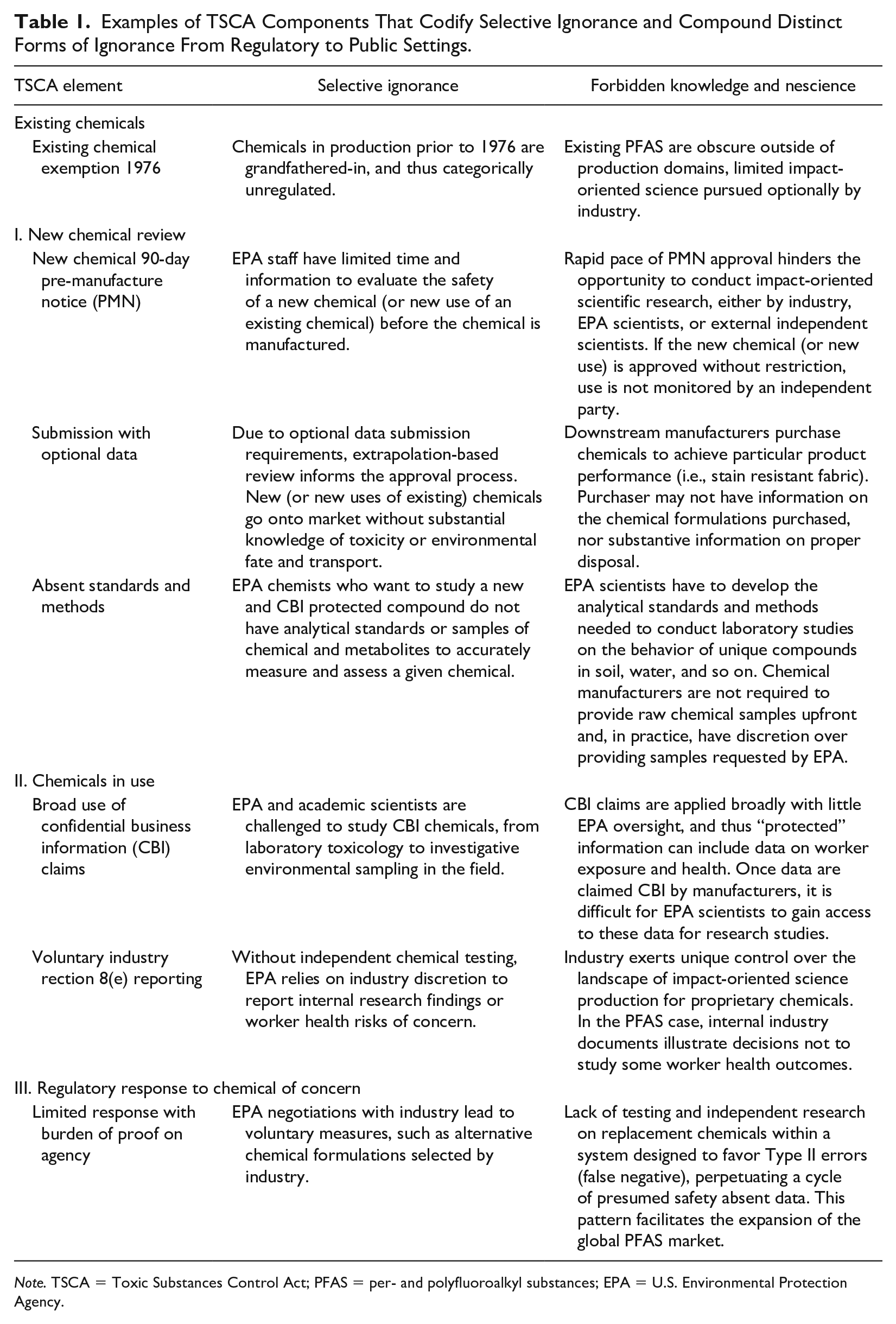
Note. TSCA = Toxic Substances Control Act; PFAS = per- and polyfluoroalkyl substances; EPA = U.S. Environmental Protection Agency.
New chemicals, absent data
As we noted above, some PFAS were in production long before TSCA was enacted, but others were first produced after 1976 and thus are considered “new chemicals” by EPA. Chemical manufacturers are required to submit Pre-Manufacture Notices (PMNs) to the EPA 90 days prior to production. For most PMN submissions, empirical data on chemical toxicity or exposure are not required. The PMN review process entails a multistage internal review of potential uses, exposure, toxicity, persistence, and bioaccumulation to determine whether the proposed chemical represents an unreasonable risk. An estimated 80 percent of PMNs are determined to pose no unreasonable risk (Cordner 2016; U.S. EPA 2012). As one EPA regulator explained in 2016: I get about a thousand applications for new chemicals every year, and again there’s no data required when a company submits it and EPA has exactly 90 days to say if they can make it, to do a risk assessment, if I have to say no, I have to show that there’s risk, otherwise they can just get approved.
While EPA can request more than 90 days to review a new chemical notice, ask for additional testing data, or impose use restrictions on new chemicals, this rarely happens (Cordner 2016; Geiser 2015). In conversations with EPA staff who evaluate new chemical submissions, one staff member observed that the new chemical risk assessment division of EPA is “fast-paced compared to other parts of the EPA they had worked,” and that EPA staff take seriously the 90-day review mandate (Richter field notes 2016). Such urgency is notable for this particular division of the agency, and stands in contrast to other domains of EPA responsibility, such as the enforcement of regulations or the processing of civil rights complaints, whose deadlines are routinely missed by years (Buford and Lombardi 2016; U.S. Government Accountability Office 2011).
Given the current normality of absent data on chemical toxicity and exposure, EPA staff devise a range of strategies for evaluating PMNs in a short time period. TSCA does not mandate that PMN submissions include toxicity or exposure testing data, nor descriptions of analytical standards or methods to measure and detect compounds. Of the estimated 36,000 new chemical PMNs submitted between 1979 and 2008, 67 percent contained no test data (U.S. EPA 2008). With such limited information, EPA scientists initially review an application by looking at chemical compound structure, using a “read-across” or analogue method that identifies existing compounds with similar structures. Based on this process, EPA risk assessors must quickly determine whether the new chemical raises concern or can move forward in the review process. Amid chronic staffing shortages and budget uncertainty, one scientist estimated that during a busy week they might have less than 30 minutes to review their portion of a PMN. In review of PMNs, this process institutionalizes the extrapolation of potential safety and risk based on modeled chemical behavior and analogue-based comparisons with existing chemicals. 6 This set of conditions favors rapid approvals over basic testing of new chemicals, for example, to characterize their toxicity, environmental fate, and transport, or even assessing capacity of municipal drinking water facilities to remove new chemical compounds once they are released. Furthermore, Wagner (2004) argues that TSCA disincentivizes companies from submitting voluntary data on their chemical products, as disclosing information on health or environmental risk could compromise their ability to produce and sell a product, especially when companies are unlikely to face substantial repercussions for failure to produce or disclose data. 7
A PMN process that does not require data or analytical standards on new chemical compounds prevents impact-oriented research on chemicals in this class by independent scientists at EPA or other research institutions. Analytical methods are the guidelines or instructions that allow chemists to produce research on compounds that is replicable and validated. Analytical standards contain known quantities and/or purities of compounds and allow scientists to develop quantitative methods for specific matrices (e.g., drinking water, blood serum, soil) that are precise and replicable. In the case of PFAS, one scientist explained that ideally PMN applications would require companies to provide raw chemical samples and analytical standards as part of the required information disclosed in a premanufacture application. However, most new chemicals are approved without such information and materials. This has important consequences on independent scientific knowledge production. For example, if a scientist sampled drinking water and was curious as to whether new PFAS were present, they would not have a sample of the compound and its transformation products to use as a standard to confirm the presence of absence of the new PFAS in various environmental media. That makes it time-consuming (and less definitive) for non-industry researchers, even those working at EPA, to characterize the specific chemical’s durability, toxicity, potential for bioaccumulation, or environmental disposition, since scientists who want to understand the presence of chemicals across environmental media have to develop the very laboratory methods for doing so without an analytical standard of the compound to confirm its identity. This requires a substantial use of public agency time and resources. Even when this information is provided by chemical manufacturers, it is generally sequestered inside the EPA Risk Assessment Division by CBI claims, rendering it invisible to EPA researchers working in other offices without CBI access (Wang et al. 2017).
Importantly, analytical standards, methods, and raw material samples are required to be provided by chemical pesticide manufacturers under the Federal Insecticide, Fungicide, and Rodenticide Act, and those methods are then validated by EPA scientists (U.S. EPA 2018a). Thus, there is federal regulatory precedent for such a requirement to be made of chemical manufacturers. In contrast, under TSCA it is methodologically prohibitive for regulatory scientists, academic scientists, or commercial laboratories to study thousands of PFAS without access to the needed identifying information or analytic standards. The result is a chemical approval process that, by design, both omits and substantively prohibits the downstream collection of data pertaining to environmental and human health effects by regulatory and academic scientists, let alone members of the public.
Thus, decisions made in TSCA’s early design, including grandfathering-in existing chemicals and a rapid, data-poor new chemical review process, institutionalize selective ignorance into the operation of chemical regulation. At this stage in the chemical regulatory pathway, regulators and scientists are aware that certain domains of information are systematically absent, and utilize strategies such as analogue chemical evaluation to compensate for known unknowns. The fragility of this work-around tactic is brought into sharp relief when dealing with a family of chemicals like PFAS that possess unique physicochemical properties. 8
Chemicals in use: Searching in the dark
Studying currently used industrial chemicals such as PFAS poses a range of challenges. There is little information on the use and location of chemicals throughout our economy, since there are no chemical reporting or tracking systems along national or international supply chains (Geiser 2015). TSCA’s sections 8, 12, and 13 require that manufacturers comply with record keeping and reporting requirements, including submitting basic information about chemical production and use through the Chemical Data Reporting rule, and inform the EPA of any chemical substances or mixtures that pose potential risk to human health or the environment. Beyond these requirements, manufacturers are able to claim submitted information as CBI. CBI information is available only to designated EPA offices and approved staff; it cannot be shared with other EPA offices, staff or government agencies without prior approval, and it cannot be released to the public. Employees who improperly handle or intentionally disclose CBI data can face criminal imprisonment and fines of up to $5,000 (U.S. Congress 1976; U.S. EPA 2003). For industry, however, there are no costs for claiming information as CBI and there is little de facto oversight of (or apparent repercussion for) the inappropriate use of CBI claims (Denison 2018).
CBI claims can include chemical formulas, manufacturing processes, and expected byproducts, the uses of the chemical, volume and location of production, and health and safety data, claims which are difficult for EPA to challenge without a lengthy legal entanglement (Geiser 2015). 9 Though companies ostensibly make CBI claims to protect industry trade secrets from peer industry competitors, CBI designations constrain internal EPA work. During Richter’s research at EPA, one scientist explained that CBI claims make it difficult to study the environmental fate and transport of short-chain replacement PFAS, because scientists do not know what to look for, let alone how to analyze unknown compounds in the lab absent basic chemical information or analytical standards. Non-industry stakeholders including advocates, academic scientists, and EPA researchers express frustration with the capacity for CBI claims to undermine evaluations of the presence and behavior of chemicals across environmental media, including human bodies (Denison 2018; Wang et al. 2017; Wylie 2018). 10
Current CBI policy logistically blocks and culturally deters regulatory scientists from producing impact-oriented science. The penalties for violating CBI policy transform basic types of scientific inquiry into potentially non-normative, criminal behavior (U.S. EPA 2003). Thus, CBI claims turn research on chemical impacts into “forbidden” knowledge, knowledge that is categorized as unnecessary or dangerous for certain stakeholders for social reasons (Kempler et al. 2011). CBI claims magnify the social production of ignorance by prohibiting independent monitoring and impact research on PFAS, despite the population’s ubiquitous exposure to these compounds since the 1960s. The types of selective ignorance examined thus far—from grandfathering-in existing chemicals in 1976 to cultures of forbidden knowledge surrounding CBI data—once institutionally put in place, can grow without effort or intention (Proctor 2008).
Weak regulatory response to PFAS
The regulatory response to PFAS in the United States has been characterized by voluntary phase-outs, circumscribed regulatory activities, non-binding advisories, and limited chemical class-based activity. Since the EPA’s 1991 legal failure to ban the use of asbestos, TSCA’s criteria for banning a chemical has been widely perceived as impossible to meet. 11 While the EPA had registration data on some PFAS through TSCA, and there was a small body of peer-reviewed literature on PFOA and PFOS, little attention paid to PFAS by federal regulators until the early 2000s (Hepler-Smith 2019). This changed following litigation in the Mid-Ohio Valley mandated internal industry disclosures on PFOA, medical monitoring, and epidemiological research (C8 Science Panel 2019), and the EPA and industry were pressured by advocacy organizations like the Environmental Working Group to act on PFAS (Richter et al. 2018). In 2006, EPA fined both DuPont and 3M for their failures to disclose data on PFOA and PFOS environmental and human health risks, including withholding internal data on pregnant female workers in the Teflon division and birth defects in 1981 (DuPont 1981). However, the fines were much lower than the penalty amounts stipulated in TSCA guidelines: DuPont was fined approximately $16 million but based on the duration of the TSCA violation they could have been fined $313 million (EWG 2007).
In 2000, shortly after 3M toxicologist-turned-whistleblower Rich Purdy resigned due to concerns over the firm’s refusal to release data on PFOS (Purdy 1999), the company announced a phase-out of PFOS-based chemical products (U.S. EPA 2000). Other PFAS manufacturers continued to produce PFOS in the United States until litigation and advocacy by Robert Bilott prompted some public interest. Research during this time led by EPA scientists identified developmental toxicity effects of long-chain PFAS, in mice and rats (Lau et al. 2003). Starting in 2006, the EPA and eight global PFAS producers negotiated the PFOA Stewardship Program, a voluntary agreement to phase-out certain PFAS by 2015 (U.S. EPA 2013). As part of this agreement, the EPA and chemical industry asserted that PFAS risk was influenced by the number of carbons in a chain, because chain length was believed to influence bioaccumulation potential (U.S. EPA 2018b). This allowed companies to comply with the phase-out agreements by producing short-chain and polyether PFAS, technical designations based on compound structure. Short-chain and polyether PFAS became the alternate or replacement for the legacy PFAS, such as PFOA and PFOS, that were phased out by United States chemical manufacturers. Due to the complexity of the PFAS class, some scientists feel that it is possible for companies to follow the letter but not the spirit of the PFOA Stewardship Program. For example, regulatory specifications such as contiguous perfluorinated carbons mean that breaking the contiguity of a carbon chain by placing a different type of atom within that chain could be permissible under the voluntary agreement. Given this complexity, chemical industry staff and paid representatives can position themselves as the only parties who understand their compounds.
PFAS manufacturing companies, along with their major trade association the ACC and affiliated groups such as FluoroCouncil, characterize this voluntary phase out of long-chain PFAS as one where the science has demonstrated a distinct scientific difference between long-chain and short-chain PFAS (FluoroCouncil 2020). They emphasize that regulation of long-chains should not impact the use of short-chains. In contrast to this understanding of the long-chain phase out, one regulatory agency staff member characterized the phase-out in this way: TSCA is a very, very weak chemical apparatus . . . We tend to regulate by agreement, to get the chemical companies to agree to shift when they see the writing is on the wall, when they understand that there is enough data and interest in particular compounds . . . So these big companies that were operating in the U.S. agree to phase out C8 [PFOA] and longer perfluorinated . . . EPA can be seen as effective, and doing something for public health and the environment. The industries can be seen as concerned about public health and innovation. . . by doing two things: they won’t make long-chains, but can do [short-chains].
There are a number of interpretations of the EPA’s PFOA Stewardship Agreement. Some academic scientists express concern over voluntary industry replacement logics, writing “due to current common industrial practices, structurally similar PFAS are developed to replace problematic PFAS . . . this may result in similar issues related to the existing PFAS (continuously) recurring in the future” (Wang et al. 2017:2513). The EPA staff member quoted above expanded on the replacement situation: They [industry] are making a whole range of compounds designed to give the same chemical performance, but they haven’t done an adequate job of characterizing their biological persistence, biomagnification and their toxicity . . . we’re exactly where we were in 2005, where we don’t have standards, we don’t really know what these compounds are. It’s as if we haven’t learned anything.
Growing research supports environmental and human health concerns regarding replacement PFAS (European Chemicals Agency 2019). Federal and international regulators explained in conversations that while short-chain PFAS may move through human bodies more quickly, they still do not break down in the environment, are highly mobile, and are now accumulating in bodies of water, which poses new concerns for local drinking water and wastewater treatment facilities around the world (Kwiatkowski et al. 2020).
Absent class-based regulatory approaches seen in the case of CFCs and the ozone hole (Gareau 2013), a dominant regulatory approach used by the EPA includes Significant New Use Rules (SNURs), Enforceable Consent Agreements (ECAs), and advisory drinking water levels. One former government regulator described SNURs as an attempt to “close the door” behind compounds that industry voluntarily phased out, requiring permission from EPA if a chemical company opts to produce a certain compound restricted from use by the SNUR. This interviewee described the logic of using SNURs shortly after 3M announced their phase-out of PFOS, “basically it was an attempt to say, okay 3M’s getting out of these chemistries, we’re gonna prevent others from getting into it. And that’s what the SNURs were for.” From 2000 to 2013, EPA issued at least four substantial SNURs on different sub-groups of PFAS: a 2002 SNUR that included 75 PFOS-related compounds voluntarily phased out by 3M between 2000 and 2002; a second 2000 SNUR for 13 PFOA-related compounds included in 3M’s phase-out; a 2007 SNUR on 83 sulfonate PFAS believed by EPA to no longer be manufactured or imported into the United States and a 2013 SNUR that prevents any new use of certain PFAS as part of carpets or carpet treatment products (Henry and Libelo 2015). ECAs have typically been used by the EPA to address localized contamination: for example, in the case of DuPont PFAS contamination in Parkersburg, West Virginia, EPA and DuPont entered into an ECA regarding the drinking water contamination levels above which DuPont would provide residents with an alternative drinking water source. Additionally, under the Safe Drinking Water Act (SDWA), the federal EPA has issued lifetime health advisories for two PFAS in drinking water: PFOA and PFOS at 70 part per trillion combined (U.S. EPA 2016). These are non-binding, non-enforceable health guidelines for states, local authorities, and water systems dealing with PFAS contamination, though some states have moved forward with guideline levels for various PFAS (Cordner et al. 2019), including enforceable maximum contaminant levels (MCLs) that are significantly lower than the EPA’s non-enforceable level (e.g., New Jersey Department of Environmental Protection 2020).
Our chemical regulatory lifecycle approach illustrates how chemical substitution (what critics view as “regrettable substitution”) is not only possible, but is framed as scientifically legitimate by both EPA and industry. Mapping discrete elements of TSCA’s structure (Table 1) while considering the historical context of the law’s formation, reveals how substantive scientific information emerges on chemical risk. Our analysis suggests that the context and form of ignorance matters. In particular, structural features of TSCA created selective ignorance which, in part, shaped the conditions of nescience among downstream impacted stakeholders who found themselves unable to either identity or evaluate PFAS risk (Richter et al. 2018).
Discussion and Conclusion
This article follows PFAS through the chemical regulatory pathway to explain how elements of TSCA, from its codification in the 1970s to its evaluation of new chemicals today, hinders the production of impact-oriented scientific knowledge. We argue that the design of the law and its de facto implementation do at least three things: produce selective ignorance, instill a culture of forbidden knowledge within EPA, and, absent substantive regulatory or litigation-related intervention, magnify nescience for downstream stakeholders. When considering elements of TSCA’s regulatory framework as a linked pathway, there are notably distinct orientations to scientific evidence at the initial stage of new chemical review, and later stages of potential regulation of a compound in use. In the data-poor, fast paced phase of new chemical review, TSCA can be used to claim that an absence of data is proof of safety (similar to a Type II error, a false negative). However, when evidence of potential risk raises interest in taking some sort of regulatory action, TSCA’s orientation to data becomes remarkably different. At this stage of the regulatory pathway, areas of ignorance provide justification for inaction. As we map in Figure 1, the design of TSCA codifies selective ignorance, deters impact-oriented science production within EPA, and transforms how scientific ignorance is experienced across time and space.

Production of discrete forms of ignorance.
The social and institutional production of ignorance is central to understanding TSCA’s failure to adequately identify or respond to the risks of PFAS. Specifically, we urge further inquiry into how moments of intentional production of ignorance—ostensibly the substantial chemical industry role in shaping TSCA—may have helped codify regulatory logics such that undone and unseen science become normal organizational practice. For regulatory and academic scientists, such barriers toward investigating existing chemicals transform the pursuit of impact-oriented knowledge into areas of nescience that are completely unknowable, or areas of forbidden knowledge, where certain scientific inquiries are deemed inappropriate, dangerous, even illegal due to proprietary claims. Thus, data on chemicals become categorically inaccessible for regulators, scientists, and broader publics.
In the case of TSCA in general and PFAS regulation in particular, selective ignorance begets further ignorance. As depicted in Figure 1, absent strong regulation, nescience is experienced by chemical industry factory workers, fenceline communities, academic scientists, product manufacturers purchasing patented non-stick coating mixtures, state public health and environmental regulators, and local waste water and drinking water treatment facility operators. Future research should examine whether these consequences of TSCA’s chemical regulatory pathway are shared with other chemical regulatory pathways in different locations and scales of governance.
Challenges to unseen and undone science periodically disturb the regime of imperception around PFAS, drawing attention to chemical nescience. This is demonstrated in the recent growth of contamination discoveries (e.g., CDC 2017; U.S. EPA 2017a; Washington et al. 2020) and evidence of broad national contamination through biomonitoring programs at the CDC, and the EPA’s periodic testing of unregulated contaminants in large public water supplies, both of which identified population-level exposure to PFAS (CDC 2017; U.S. EPA 2017a). The PFAS Contamination Database at Northeastern University was originally released in 2017 with approximately 50 sites; it currently contains over 340 specific sites and 390 contaminated water systems (PFAS Project 2020). Ignorance driven by unmatched industry discretion perpetuates cycles of nescience for downstream actors. Communities across the United States have recently discovered decades of contamination involving the need to warn water users, hire consultants to determine the extent of contamination, spend money on filters and/or alternative water supplies, negotiate with state and other entities, all while rapidly learning about sub-groups of the PFAS class, and often bearing the additional burden of educating medical providers about the risks and known health effects of PFAS exposure.
In practice, the magnitude and scope of ignorance compound across time and space. Ahistorical narratives depicting states of naïve ignorance erase the knowledge, intentions, and actions of uniquely positioned private actors and institutions that have consistently exerted influence over TSCA’s form and mundane function for decades. In the absence of regulatory capacity, researchers and government agencies can learn much though the discovery process in litigation, as in the landmark DuPont case and in a recent one involving 3M (Bilott 2019; State of Minnesota Office of Attorney General 2020). Researchers, advocates, and others can play an important role in obtaining more data through this approach. Knowledge of the adverse human health effects of PFAS arose from popular epidemiology (Brown and Mikkelsen 1990) in West Virginia, and through contentious litigation that both revealed internal industry research and mandated independent medical monitoring and population health studies (C8 Science Panel 2019; Judge et al. 2016).
The PFAS case raises questions regarding the capacity of private corporations like DuPont, 3M, and their trade industry associations, to shape public policy indirectly through influence over knowledge production and directly through regulatory capture. EPA’s predominantly voluntary response to PFAS contamination, coupled with industry’s discretion over, and use of, replacements, has resulted in selective ignorance facilitating not only continued global production, but potentially expanded production of the PFAS class (Gold and Wagner 2020; Wang et al. 2017). The contemporary, iterative discovery of numerous sites of PFAS contamination around the world is not a failure of scientific knowledge but a product of organized ignorance (Frickel and Edwards 2014). The chemical regulatory pathway offers a model for examining the de jure and de facto operation of public policy. This case demonstrates the need for precaution and public accountability in the governance of chemical production and use. Even in the 1970s at the height of the mainstream U.S. environmental movement, conception of the EPA, and drafting of TSCA, actors and organizations opposed to environmental protection secured a scaffolding that undermined the law’s capacity to address toxic substances.
After undergoing major legal reform in 2016, TSCA’s epistemic logics around evidence continue to prioritize protection of chemical use rather than public health (Gold and Wagner 2020). During a 2019 House Oversight Committee Hearing on PFAS, “The Devil They Knew,” Representative Harley Rouda (D-CA) asked Jane Luxton, a corporate attorney, if human beings should be treated as guinea pigs by letting them be exposed to untested chemicals. Luxton responded, No, of course that is not what I am suggesting. We don’t know what we don’t know about many things. But our laws don’t operate that way. Our laws require that there be some risk-based knowledge to justify regulating something, and for things where we don’t have any reason to believe they are toxic. We have no scientific evidence of that. We can’t ban them in advance. (Emphasis added)
Thus, the chemical regulatory pathway precludes adequate knowledge of chemical risk before production begins, and constrains the development of additional knowledge through mechanisms we have described in this paper. In the PFAS case, absent substantial change to the production of industrial chemicals, workers and fenceline communities will continue to bear the burden of both discovering and proving the adverse impacts of toxic chemicals. Beyond supporting regulatory legal frameworks that anticipate and resist capture (Barkow 2010), we are encouraged by social movements and scholarship that question the assumed necessity of toxic chemicals (Boudia and Jas 2014; Cousins et al. 2020; Liboiron et al. 2018; Murphy 2006; Shapiro, Zakariya, and Roberts 2017). Our findings support environmental justice and STS efforts to center values in collective decision making, situating science as one of many tools available to support governance and attempts to remediate what may be irreparable harms.
Footnotes
Acknowledgements
We thank members of the Social Science Environmental Health Research Institute at Northeastern University, Steven Vallas, Laura Senier, Jill Harrison, Kathryn Rogers, Tracy Perkins, Manuel Vallee, Jennifer Ohayon, Anna Robuck, Andy Lindstrom, Grace Poudrier, and all individuals who spoke with us for this research project. We also thank the editor and four anonymous reviewers for their helpful comments on this manuscript.
Declaration of Conflicting Interests
The author(s) declared no potential conflicts of interest with respect to the research, authorship, and/or publication of this article.
Funding
The author(s) disclosed receipt of the following financial support for the research, authorship and/or publication of this article: This research was supported by the National Science Foundation (SES 1456897; DDRI 1738687) and the Robert & Patricia Switzer Foundation.
Notes
Author Biographies
 ), and health social movements.