




Abstract
We draw on norms theory to develop hypotheses about norms regulating social distancing during the Covid-19 pandemic. We identify two theoretical approaches—the consequentialist and social cues approach—and argue that understanding norms will be enhanced by integrating these two approaches. We apply these general theoretical approaches to the Covid-19 pandemic to suggest concrete hypotheses regarding distancing norms. We test our hypotheses using two vignette experiments. We find that when the consequences of behavior are clear, both behavior consequences and social cues independently affect norms. But when the consequences of a behavior are ambiguous, behaviors and social cues interact to affect norms. Theoretically, our results provide the first empirical test of an integrated theory of norms, showing that in ambiguous situations an integrated approach produces more accurate predictions than either the behavior consequences or social cues approach alone. Substantively, our paper helps to explain Covid-19 distancing norms and variation in those norms across political orientation. Our findings have implications for understanding support for and compliance with public health directives.
In spring 2020, during the early days of the Covid-19 outbreak in the United States, compliance with distancing orders (staying six feet away from others, avoiding in-person nonessential work, etc.) was variable (unacast, n.d.). Given little capacity to identify infected individuals (Maxmen 2020; Stolberg, Stockman, and LaFraniere 2020), public health figures emphasized the importance of distancing in reducing infections (e.g., Centers for Disease Control and Prevention [CDC] 2020b). At the same time, information from political leaders and media figures about the seriousness of the illness, transmissibility, and safe behavior was inconsistent. As policy makers were grappling with how to manage the coronavirus pandemic and how to weigh concerns about public health and the economy (Fisher 2020), so too were average Americans struggling with what was right and what was wrong—producing new norms governing behavior and reactions to policy. The early days of the pandemic provided a unique opportunity to study norms as they occurred.
Norms theory identifies two approaches to explaining norm emergence—one relying on the consequences of a behavior for the group, the other on social cues and influence. Recent work suggests that these two approaches should not be seen as competing, but rather as complementary (Horne and Mollborn 2020). We integrate the two approaches by arguing that behavior consequences and social cues can interact to affect norms across groups. We test this argument in the context of the Covid-19 pandemic, examining the effects of (1) behaviors that have different collective and individual consequences, (2) social cues associated with political orientation, and (3) the interaction of these two factors on norms. To do so, we conduct two online vignette experiments that manipulate individual behavior and political group (Democrat or Republican) and measure participant political ideology and normative expectations. The results are generally consistent with our predictions. They show that behavior consequences, social cues, and their interactions predict norms regulating distancing behaviors.
Theoretically, our research provides empirical support for an integrated approach to understanding norm emergence, suggesting that in ambiguous settings in the field an integrated approach will produce more accurate predictions than the consequentialist or social cues approaches alone. Substantively, our findings show clear norms constraining behaviors that undermine public health, but also show differences across political orientation. Because addressing the virus involves changing health behaviors, and norms are widely recognized as tools in public health efforts (Cislaghi and Heise 2019; Reid, Cialdini, and Aiken 2011), our findings have implications for understanding support for and compliance with public health directives.
Theory and Predictions
Norms are collective evaluations of behavior (Horne and Mollborn 2020). They tell people whether a behavior is good or bad, appropriate or inappropriate, allowed or forbidden. Importantly, norms are not equivalent to the aggregation of individual attitudes. Instead, norms are collective; they are not so much about how an individual evaluates a behavior as they are about how the individual expects that others will react. When a norm is in place, people not only react negatively to violations, they also expect that others will react negatively (Bicchieri 2017). Accordingly, norms researchers often study norms by examining factors affecting either sanctioning (e.g., Horne 2001; Przepiorka and Diekmann 2018; Winter and Zhang 2018) or normative expectations about how others are likely to react to a behavior (e.g., Álvarez-Benjumea and Winter 2020; Horne, Dodoo, and Dodoo 2013; Stoebenau et al. 2019; see also Mollborn’s 2009 and 2010 use of embarrassment to capture such expectations). Here, we focus on normative expectations—how much people expect others will approve or disapprove of a behavior.
What factors affect normative expectations? The oldest and best-tested theory of norms is consequentialist. It holds that when an individual’s behavior affects others, those others have an interest in it. When the consequences of a behavior are harmful, people disapprove of the behavior and expect that others disapprove and will react negatively to it (Coleman 1990; Ullmann-Margalit 1977; see also Demsetz 1967; Heckathorn 1988, 1989). Norms will discourage noncooperative behavior. For example, norms against smoking emerged once people understood the dangers of second-hand smoke (Ellickson 2001). Consistent with this argument, in the lab, people regularly punish noncooperative and unfair behavior (e.g., Fehr and Gintis 2007). At the same time, evidence suggests that people also take into consideration the costs to individuals of complying with a norm (e.g., Horne, Dodoo, and Dodoo 2018). As those costs increase, disapproval for noncompliance will decline. That is, norms emerge in response to how people weigh both the consequences for the actor of engaging in or avoiding a particular behavior and the consequences for the collective of the actor’s decisions. The larger the harm a behavior produces for the collective, the stronger the norm against the behavior and the more people will expect that others disapprove of the behavior. The greater the cost to the individual of complying with the norm, the less people will expect others to disapprove of norm violations.
Although the consequentialist approach to norms has substantial support in the lab, it fares less well in the field (Elster 1989). Outside of the lab, one can identify norms that have harmful (rather than beneficial) consequences for the group (e.g., norms that mandate dueling for conflict resolution, entrench inequality, or require footbinding) and imagine potentially helpful norms that do not exist (e.g., norms limiting carbon-emitting behaviors; for example, Mackie 1996). In addition, the same harmful behaviors may be governed by different norms across time and place (e.g., anti-smoking norms vary across countries and subpopulations). Because of these inconsistencies, scholars have explored other factors—focusing in particular on the structure of social relationships and the influence exercised through those relationships (e.g., Horne 2001).
In this approach, the focus is not on behavior consequences, but rather on social approval—figuring out the behaviors that others are likely to approve or disapprove (e.g., Mackie 1996; see also Willer, Kuwabara, and Macy 2009). Social cues help individuals do this. Social cues provide information about how others might view a behavior. Such cues may include the number, status, or identity of individuals (or institutions) engaging in or advocating for a particular action. For example, when individuals observe high levels of segregation (most people interacting with others of their own race), they are likely to expect that people will react negatively to integration efforts (Horne, Tinkler, and Przepiorka 2018). And when people observe high-status or institutional actors take a position, they are likely to infer that others approve of that position (e.g., La Ferrara 2016; Paluck, Shepherd, and Aranow 2016; Robalino and Macy 2018). For example, a favorable ruling by the Supreme Court on marriage equality led people to expect that other Americans supported same-sex marriage (e.g., Tankard and Paluck 2017).
In homogeneous groups, social cues are consistent. Everyone produces and is exposed to similar cues. But many societies (such as the United States) are not homogeneous. In heterogeneous societies, particularly when there is intergroup conflict, different groups may produce different cues (e.g., Centola 2015). The actions and statements by actors associated with a particular group (public figures, media outlets, peers, etc.) provide information about that group’s norms. This means that people will hold different normative expectation about how members of different groups view the same behavior. In addition, people will pay particular attention to others they perceive as being like them or as sharing their interests or values (e.g., Drouvelis and Nosenzo 2013; Hogg 2010; Hogg and Reid 2006). Ingroup members will rely on similar social cues to develop normative expectations about what others in their own group approve and disapprove. They also rely on those ingroup cues, including ingroup reporting about the outgroup, to infer how outgroup members are likely to react to a behavior. The implication is that the normative expectations of ingroup members about outgroup members may differ from the normative expectations that outgroup members have about their own group.
Frequently, consequentialist and social cues predictions are tested in isolation. Researchers conduct studies in which the consequences of a behavior are clear (e.g., assessing sanctioning directed at noncooperative behavior; for example, Fehr and Gintis 2007) or in which people can observe social cues (e.g., DellaPosta, Shi, and Macy 2015; Tsvetkova and Macy 2015; Willer et al. 2009). Christine Horne and Stefanie Mollborn (2020) suggest that these two approaches could fruitfully be seen as complementing each other—arguing that consequentialist and social cues approaches together may produce more accurate predictions than either alone. Consistent with this view, some research on diffusion of beliefs and behaviors highlights conditions under which social influence leads to greater accuracy in beliefs about facts (e.g., Becker, Brackbill, and Centola 2017; Guilbeault and Centola 2020)—dynamics that have implications for understanding links between social cues and people’s understanding of behavior consequences.
Part of the reason for inconsistent support for the consequentialist approach in the lab and in the field is that, in the field, the costs and benefits of a behavior may be unclear. What is the harm to the collective of socializing without a mask or using one’s air conditioning? People may not feel that they know. In addition, there may be multiple consequences, and people may be unsure how to weigh their relative seriousness. Under such conditions of uncertainty, people are particularly likely to look to social cues—both to help them evaluate the likely consequences of a behavior and to gain information about whether others approve or disapprove of it (Álvarez-Benjumea and Winter 2020; Horne, Tinkler, and Przepiorka 2018; Willer, Kuwabara, and Macy 2009). In other words, people cannot simply consider the “objective” consequences of behavior because consequences are not self-evident and do not occur in a vacuum. And social cues are not completely disconnected from the reality of behavior consequences. Instead, we suggest that people understand consequences and social cues in light of each other (Horne and Mollborn 2020). The implication is that consequences and social cues intersect to affect normative expectations. As discussed above, groups structure social cues. Accordingly, we expect that behavior consequences and the cues associated with particular groups will interact to affect people’s normative expectations about how others in those groups will react to a behavior. Expectations of in- and outgroup members may differ:
Behaviors and group membership will interact to affect normative expectations about in- and outgroups.
Empirical Context: Covid-19 in Spring 2020
We test our integrated explanation of norms in the context of the Covid-19 pandemic in late April 2020 in the United States. The first U.S. case of Covid-19 was confirmed in January 2020 (CDC 2020a). That spring, health experts across the United States had come to understand the potential seriousness of the Covid-19 pandemic. Understanding of the virus was in its early stages, but highlighted transmission risks associated with face-to-face interactions and the need to keep cases down so that hospitals were not overwhelmed. Beginning the latter part of March, states began to “shut down” in various ways to limit the spread of the virus. So at the time we collected our data, many people had experienced a month or more (depending on the state) of some kind of distancing requirements. Constraints varied but most included some forms of distancing—staying home except for essential activities such as grocery shopping, staying six feet apart, encouraging wearing of masks, and so forth.
Methods
We tested our theoretical predictions in two online vignette experiments. Participants were recruited through Prolific, an online research site similar to Amazon’s Mechanical Turk, but designed for academic researchers (Peer et al. 2017). Prolific maintains panels of potential participants. We posted our studies on the Prolific site. Those who were interested clicked on a study link and were taken to the vignette experiment on a Qualtrics platform. Participants were randomly assigned to an experimental condition. They read the vignette and answered questions about it and about their sociodemographic characteristics. They then answered a manipulation check question. After completing the study, participants were automatically redirected to the Prolific site for payment. Data were collected on April 28 – a time when many states had had stay at home orders in place for multiple weeks, and some were beginning to ease up on their restrictions. Opposition to shutdown orders and support for reopening the economy were emerging. Our use of vignettes to test our abstract theoretical predictions required translating our theoretical concepts—behavior consequences and social cues—into the pandemic context, which we detail for each study below.
Study 1 Methods
Study 1 was designed to test the consequentialist and social cues approaches in a situation in which behavior consequences were clear. It had a 2 × 2 factorial design with one between-subjects manipulation (behavior consequences) and one within-subject manipulation (group social cues). We measured participant political orientation. And we measured participants’ normative expectations (our dependent variable).
Behavior consequences (between-subjects manipulation)
The Study 1 vignette described an order issued by a state governor as well as the consequences of an individual’s violation of that order. Each participant saw one version of the vignette. The vignette stated, Assume that the Governor of your state has issued a stay at home order and banned gatherings of more than 10 people. Certain businesses and services considered “essential” may remain open, but otherwise everyone has been ordered to stay at home unless grocery shopping or going to the doctor or pharmacy. An individual in your community is not complying with the governor’s order. Their behavior is [putting their own personal health at risk (though it is not affecting the health of others in the community)/putting the health of others in the community at risk (though not affecting their own personal health)].
In this vignette, an individual violates the governor’s order. The consequences of this violation are described as putting at risk either the health of the violator or the health of others in the community. In this manipulation, the consequences of the behavior for the individual and the collective are clear.
Group social cues
Political divides are highly salient in the United States (Baldassarri and Gelman 2008; McCarty, Poole, and Rosenthal 2007; Shi et al. 2017). During the pandemic, even in the early months, there were clear divisions between Democrats and Republicans, with Republican politicians downplaying the risks of the virus even as Democratic leaders emphasized its seriousness (e.g., Franck 2020; Peters 2020; Washington Post 2020). Because of the salience of political groups in the U.S. Covid-19 context, we use them as an indicator of group social cues. More specifically, we manipulated social cues by asking participants about their expectations regarding how much they expected most Democrats and most Republicans to disapprove or approve of the behavior in the vignette. Group social cues (Democratic or Republican) was a within-subjects manipulation—all participants answered a question soliciting their expectations about Democrats and a question focused on their expectations about Republicans. We coded political group as 0 for the question about Republicans and 1 for the question about Democrats.
Normative expectations
Participants’ responses to these questions on expected disapproval served as a measure of normative expectations (0 = strongly approve; 10 = strongly disapprove).
Group membership
To explore the implications of participants’ own political orientation (and as such, when their expectations about Democrats and Republicans were ingroup or outgroup), we measured their group membership. Again, given the general salience of political ideology and the tendency of liberals and conservatives to pay attention to different information sources and to use different sources when developing their own opinions (Bolsen, Druckman and Cook 2014; Jelen and Lockett 2014; Levendusky 2010; Mitchell et al. 2014; Peterson and Iyengar 2020), we used participant political orientation as an indicator. We did so by asking participants, “How they would describe their political views,” with response categories consistent with the American National Election Survey (1 = extremely liberal; 7 = extremely conservative). We recoded responses into two groups, with liberals (76.7 percent) defined as those responding 1 through 4 (including the midpoint) 1 and conservatives (23.3 percent) as those responding 5 through 7. For clarity, throughout the paper, when we talk about expectations about political party groups (our within-subjects manipulation), we identify those groups as Democratic or Republican. When we are talking about participants’ political orientation, we refer to liberals or conservatives.
Finally, we included some basic sociodemographic measures. As shown in Table 1, the average age of the sample was approximately 35 years, just under half of participants were female, and almost 70 percent were non-Hispanic white. The sample was relatively highly educated (measured as 1 = less than high school to 8 = Professional or Doctorate degree; a mean of 5 corresponds to having some college, but less than a bachelor’s degree). We also included a manipulation check that asked participants whether the person in the vignette was putting their own or community members’ health at risk. About 12.3 percent failed the manipulation check. 2 Analyses below (N = 700) report the results excluding these cases. Analyses of the full sample (N = 798) produced substantially similar results.
Sample Composition.

Note. Samples limited to those passing manipulation check for that study; N varies only due to missing data on these participant characteristics.
Study 1 Predictions
We apply the general theoretical argument described above to derive specific hypotheses for the Study 1 vignette. As applied to this context, the consequentialist approach predicts that participants will expect others to be more disapproving of the individual who puts others’ health at risk than who puts only their own health at risk. The social cues approach predicts that people will expect Democrats to react more negatively than Republicans to both violations of the governor’s order because Republicans tend to have more negative views of government constraints than Democrats (e.g., Gross, Medvetz, and Russell 2011). An integrated hypothesis would predict that behavior consequences and social cues will interact to affect normative expectations. In this vignette, however, behavior consequences are clear. Therefore, we do not expect to see an interaction effect of behavior consequences and social cues on normative expectations. Everyone will react to behavior consequences similarly because those consequences are clear; there is little need to look for additional sources of information.
Study 1 Results
Mean participant normative expectations across the experimental conditions (behavior consequences and group social cues) are shown in Figure 1. To test whether differences shown are statistically significant, we estimated repeated measures mixed regression models looking at the effects of the experimental conditions on participants’ expectations about disapproval. The results are shown in Table 2.
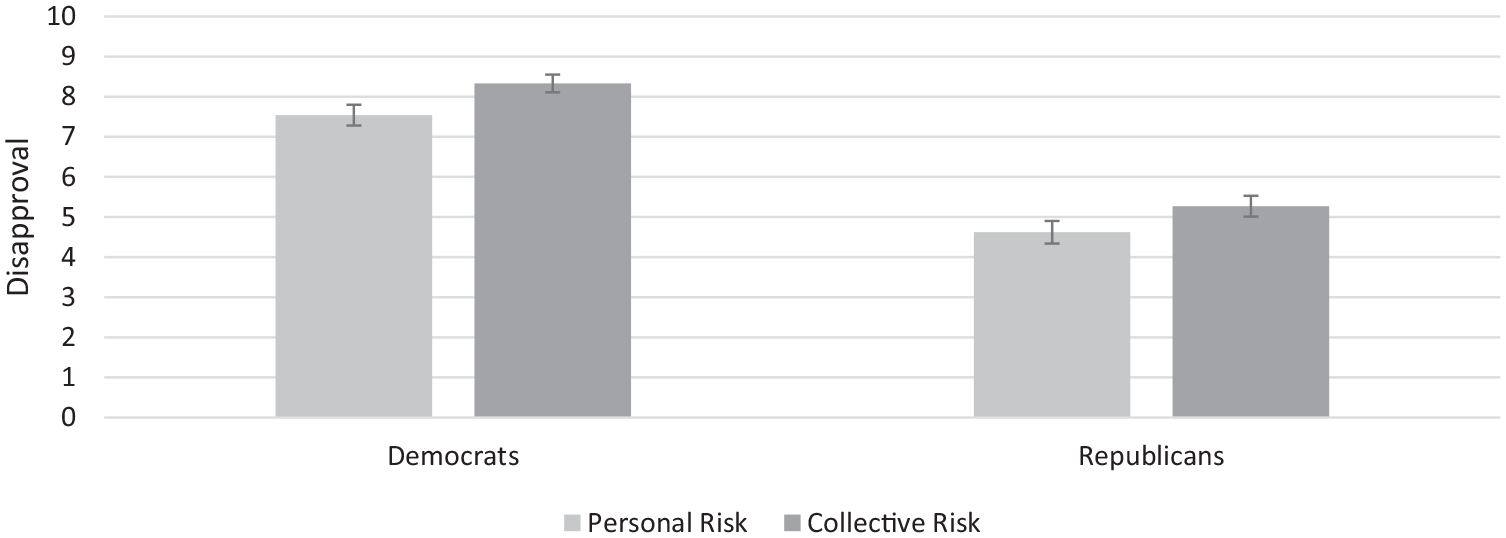
Mean normative expectation across the experimental conditions, Study 1.
Repeated Measures Mixed Model Explaining Normative Expectations, Study 1 (N = 700 participants; 1,394 observations).
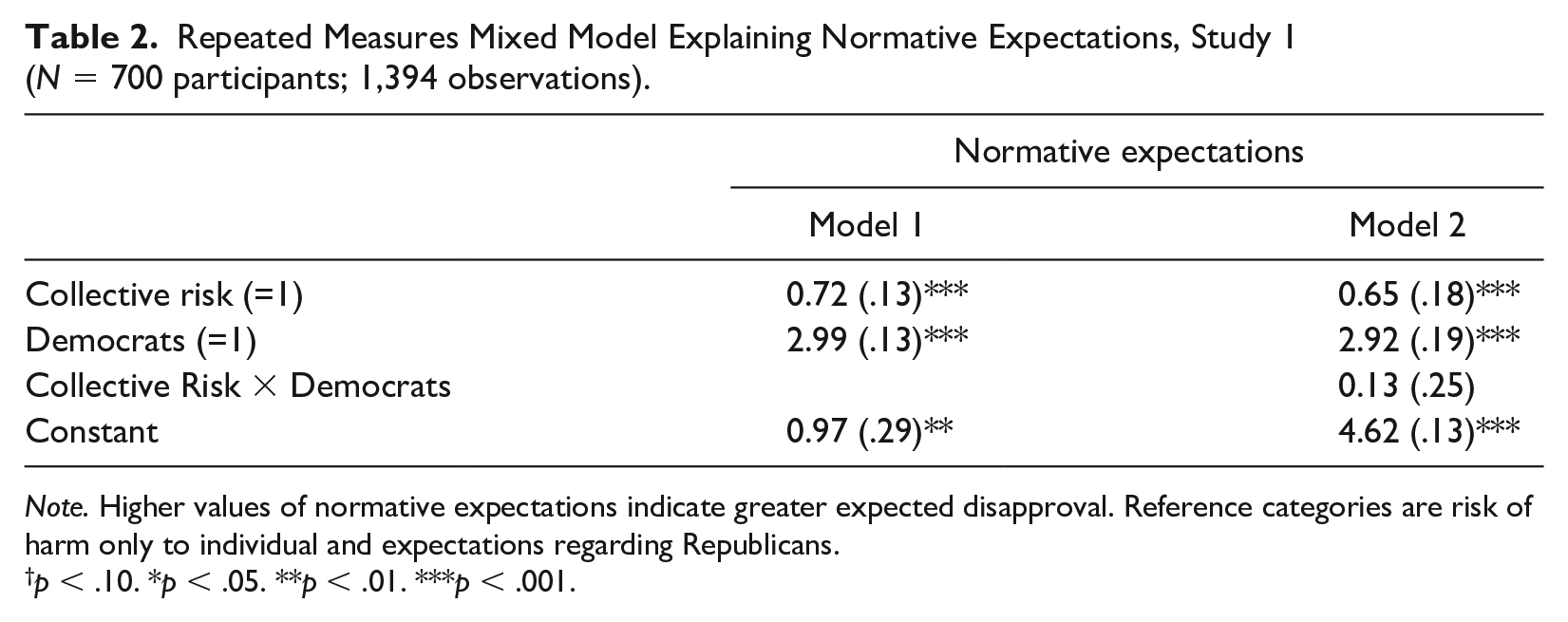
Note. Higher values of normative expectations indicate greater expected disapproval. Reference categories are risk of harm only to individual and expectations regarding Republicans.
p < .10. *p < .05. **p < .01. ***p < .001.
Consistent with the consequentialist argument, participants expected higher disapproval of the person whose behavior risked the health of the community compared with the person who risked only their own health (see the Collective Risk coefficient in Model 1). Consistent with the social cues argument, political group mattered, with participants expecting Democrats to be generally more disapproving than Republicans (see the Democrats coefficient in Model 1). Both of these findings are also easily seen in the pattern of means illustrated in Figure 1. Because behavior consequences were clear, we did not expect to see an interaction effect of behavior consequences and social cues on normative expectations. However, we checked for this possibility by including an interaction term in Model 2. It is not statistically significant (see the Collective Risk × Democrats coefficient). The effects of behavior consequences did not vary with social cues.
The social cues approach also suggests that ingroup and outgroup members may evaluate social cues differently. That is, liberal and conservative participants may have different expectations about the norms held by Democrats and Republicans. To assess this possibility, we first estimated mixed models that included behavior consequences, political group (Democrats vs. Republican), and participant political orientation (liberal or conservative) as independent variables. These models (not shown) indicated that participant political orientation had a significant interactive effect with political group (indicating that liberals/conservatives expected different levels of disapproval among Democrats/Republicans), but that there was no significant three-way interaction between it, political group, and behavior consequences. Both of these results were as expected. To show these effects more clearly, we present the results for Democrat and Republican groups separately—we estimated ordinary least squares (OLS) regression models that included behavior consequences and participant political ideology as independent variables and used normative expectations about Democrats (Models 1–2, Table 3) and normative expectations about Republicans (Models 3–4, Table 3) as separate dependent variables (instead of repeated as in the mixed models). This approach makes it easily apparent when the effects of participant political ideology groups represent ingroup and outgroup expectations. We first consider only main effects of behavior consequences and participant political orientation (Model 1 and 3), and then estimate models including their interaction (Model 2 and 4), which we do not expect to be significant.
Regression of Normative Expectations on Behavior Consequences (Personal vs. Community) and Participant Political Orientation (Liberal vs. Conservative), Study 1. Unstandardized Regression Coefficients (Standard Errors).

Note. Higher values of normative expectations indicate greater expected disapproval. Reference categories are risk of harm only to individual and conservative.
p < .10. *p < .05. **p < .01. ***p < .001.
Consistent with the consequentialist approach, and as similarly documented in Table 2, there is a statistically significant main effect of behavior consequences on expectations about both Democrats’ and Republicans’ disapproval (see the Collective Risk coefficient in Models 1 and 3). The social cues approach suggests that ingroup and outgroup members may view group norms differently. The results are consistent with this prediction. Liberal participants expected more disapproval among Democrats than conservatives did (see the marginally significant Liberal coefficient in Model 1). But liberals expected less disapproval among Republicans than conservatives did (see the statistically significant negative Liberal coefficient in Model 3). The difference in the coefficient for liberals in Model 1 compared with Model 3 is statistically significant. 3 Liberals and conservatives have quite similar expectations about how Democrats will react, but very different expectations about Republicans. These results support the consequentialist and social cues approaches.
Finally, because behavior consequences are clear, we expect no interaction effect of behavior consequences and participant group membership on normative expectations about Democrats and Republicans. Consistent with this, the interaction terms are not statistically significant (see the interaction terms in Models 2 and 4). (This result replicates our initial finding mentioned above showing no statistically significant three-way interaction term for Behavior Consequences × Social Cues × Participant Political Ideology on Normative Expectations in the mixed model.)
Study 2 Methods
To test our integrated approach, Study 2 created a situation in which behavior consequences are uncertain. Study 2 had a 3 × 2 factorial design with one between-subjects manipulation (behavior) and one within-subject manipulation (group social cues). Again, we measured participant political orientation and normative expectations. Importantly, Study 2 described the behavior of the individual in the vignette but did not specify the consequences.
Behavior consequences
Instead of directly describing the consequences of a behavior (as creating health risks for the individual or group like we did in Study 1), we described the behavior itself. In the pandemic setting, social interactions create the risk of spreading the coronavirus. Engaging in physical distancing limits the spread of the disease and affects the economy. Distancing by staying home has positive health consequences, but potential personal economic and social costs. Socializing has negative health consequences but potential psychological and social benefits. Going to work has negative health consequences for the collective, but positive financial consequences for the individual. Both compliance with the governor’s order (staying home) and violations of the order (socializing and going to work) have ambiguous consequences. Note that in Study 1, we compared only two violations with clear consequences (risks for the community or the individual) and did not include compliance. Here, we focus on behaviors with ambiguous consequences—which include both compliant and noncompliant behaviors.
In our vignette, we described an individual as complying with the governor’s order by staying home or violating the governor’s order by going to work or by socializing. To test the effects of going to work, we sought to make it clear that the vignette described a workplace that was clearly forbidden by state orders and that going to work was not being compelled by another person. To clarify that the individual did not work at an essential business, we identified a specific, nonessential business—a t-shirt shop. To be clear that the individual was not being forced to go to work by an employer, we described the individual as opening up their t-shirt shop each day. To test the effect of socializing, we focused on a particularly risky setting—large parties. The vignette stated, Assume that the Governor of your state has issued a stay at home order and banned gatherings of more than 10 people. Certain businesses and services considered “essential” may remain open, but otherwise everyone has been ordered to stay at home unless grocery shopping or going to the doctor or pharmacy. Someone in your community is [working from home and avoiding gatherings they would normally attend / going to work regularly to open up their t-shirt shop / attending large parties regularly].
We manipulated group social cues (Democratic vs. Republican) and measured normative expectations in the same way as Study 1. We also measured participant group membership (liberal [77.3 percent] vs. conservative [22.7 percent]) as in Study 1. We included sociodemographic items (see Table 1) and a manipulation check. The manipulation check asked what the person in the vignette was doing—staying home, going to work, or attending parties. About 2 percent of participants failed the manipulation check in each condition. We report the results excluding these cases (N = 584). Results for the full sample (N = 596) were substantially similar.
Study 2 Predictions
Again, we apply the general theoretical argument to produce hypotheses in the Covid-19 context. In Study 2, we described behaviors that have consequences, but did not specify what those consequences were. Because behavior consequences were unclear, we expected our integrated prediction to hold—behaviors and group social cues will interact to affect normative expectations.
Study 2 Results
Figure 2 shows mean normative expectations across the three behaviors and each political party (Democrat or Republican) participants were asked to think about. The pattern suggests that people expected Democrats to be highly approving of people staying home and highly disapproving of people going to work or socializing. In contrast, people expected Republicans to have somewhat approving views of both staying home and going to work, and moderately disapproving views of socializing. To assess whether these effects are statistically significant, we conducted repeated measures mixed regression analyses testing the effects of behavior (between subjects) and Democratic or Republican political groups (within subjects) on normative expectations. Model 1 in Table 4 reports only main effects. Model 2 tests our hypothesis for Study 2 by including the interaction of behavior and group social cues.
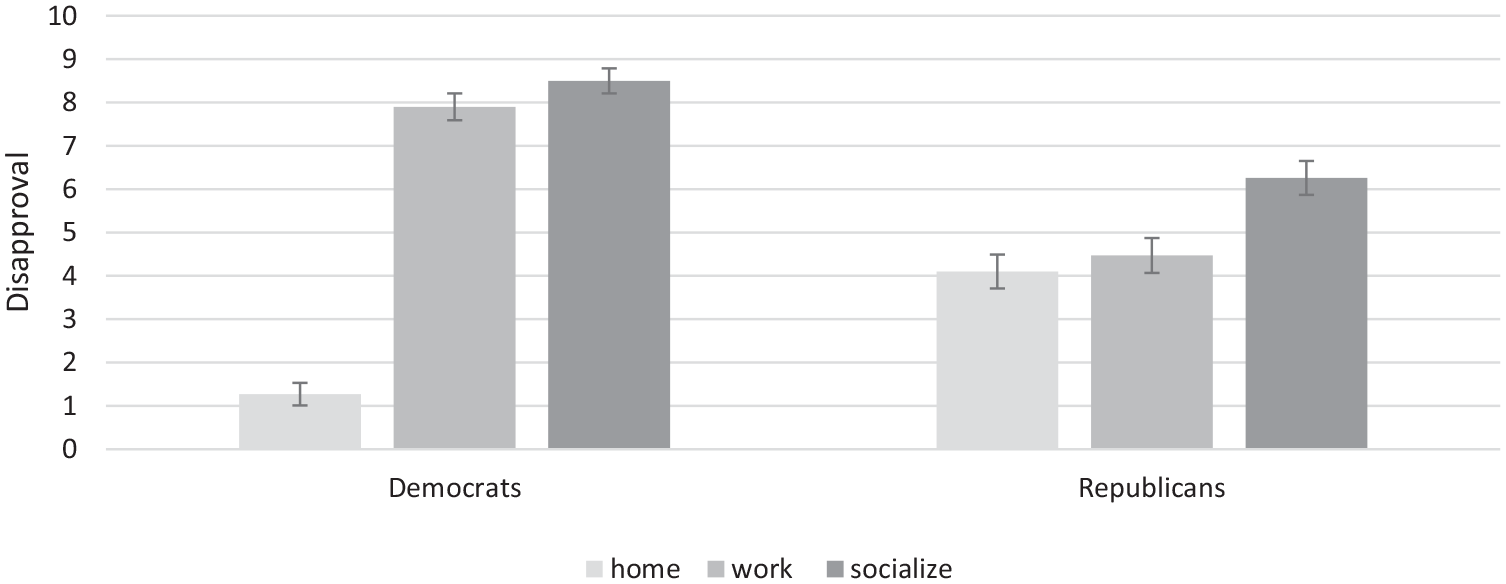
Mean normative expectation across the experimental conditions, Study 2.
Repeated Measures Mixed Model Explaining Normative Expectations, Study 2 (N = 584 participants; 1,158 observations).

Note. Higher values of normative expectations indicate greater expected disapproval. Reference categories are staying home and expectations regarding Republicans.
p < .10. *p < .05. **p < .01. ***p < .001.
Model 2 shows that participants expected Republican disapproval of going to work to be about the same as Republican disapproval of staying home (see the nonstatistically significant Work coefficient). They also expected that Republicans disapprove of socializing more than staying home (see the statistically significant Socialize coefficient). People expected Democrats to be less disapproving than Republicans of staying home (see the negative, statistically significant Democrats coefficient). And people expected Democrats to be more disapproving of both going to work and socializing than Republicans (see the statistically significant interaction terms). In other words, although people expected both Republicans and Democrats to be generally more disapproving of socializing than staying home, the size of this difference was larger when participants were asked about Democrats compared with Republicans (see also Figure 2). And people expected Democrats and Republicans to react very different to going to work, with people expecting Democrats to view going to work as comparable with socializing, and Republicans to view going to work as more comparable with staying home (see also Figure 2). These results are consistent with the integrated hypothesis that predicts interaction effects of the behavior manipulations and political party on normative expectations.
The integrated prediction also suggests that participant ingroup and outgroup membership (in this case liberal and conservative) will interact with behavior to affect normative expectations about ingroup and outgroup norms (in this case norms among Democrats and Republicans). To test this prediction, we first conducted repeated measures mixed model regressions in which behaviors, group social cues (Democrat vs. Republican), and group membership (liberal vs. conservative) were the independent variables and normative expectations was the dependent variable (not shown). We found multiple interaction effects, including the three-way interaction, that we predicted. For clarity, we present the results of OLS regression models that look separately at normative expectations about Democrats’ disapproval (Models 1 and 2) and about Republicans’ disapproval (Models 3 and 4) as a function of behavior and group membership/participants’ political orientation (Table 5). Again, we present a main effects model and then one that includes the interactions we expect for the Study 2 setting. Consistent with our expectations, there are significant interactions between the pandemic-related behavior and participant political orientation (Models 2 and 4 in Table 5). And they are different when participants were asked about Democrats and when they were asked about Republicans, reflecting ingroup versus outgroup assessments. The way these interactions play out is best understood by looking at the coefficients in Models 2 and 4 in combination with graphical representations of the patterns.
Regression of Normative Expectations on Behavior (Home vs. Work vs. Socialize) and Group Membership (Liberal vs. Conservative), Study 2. Unstandardized Regression Coefficients (Standard Errors).
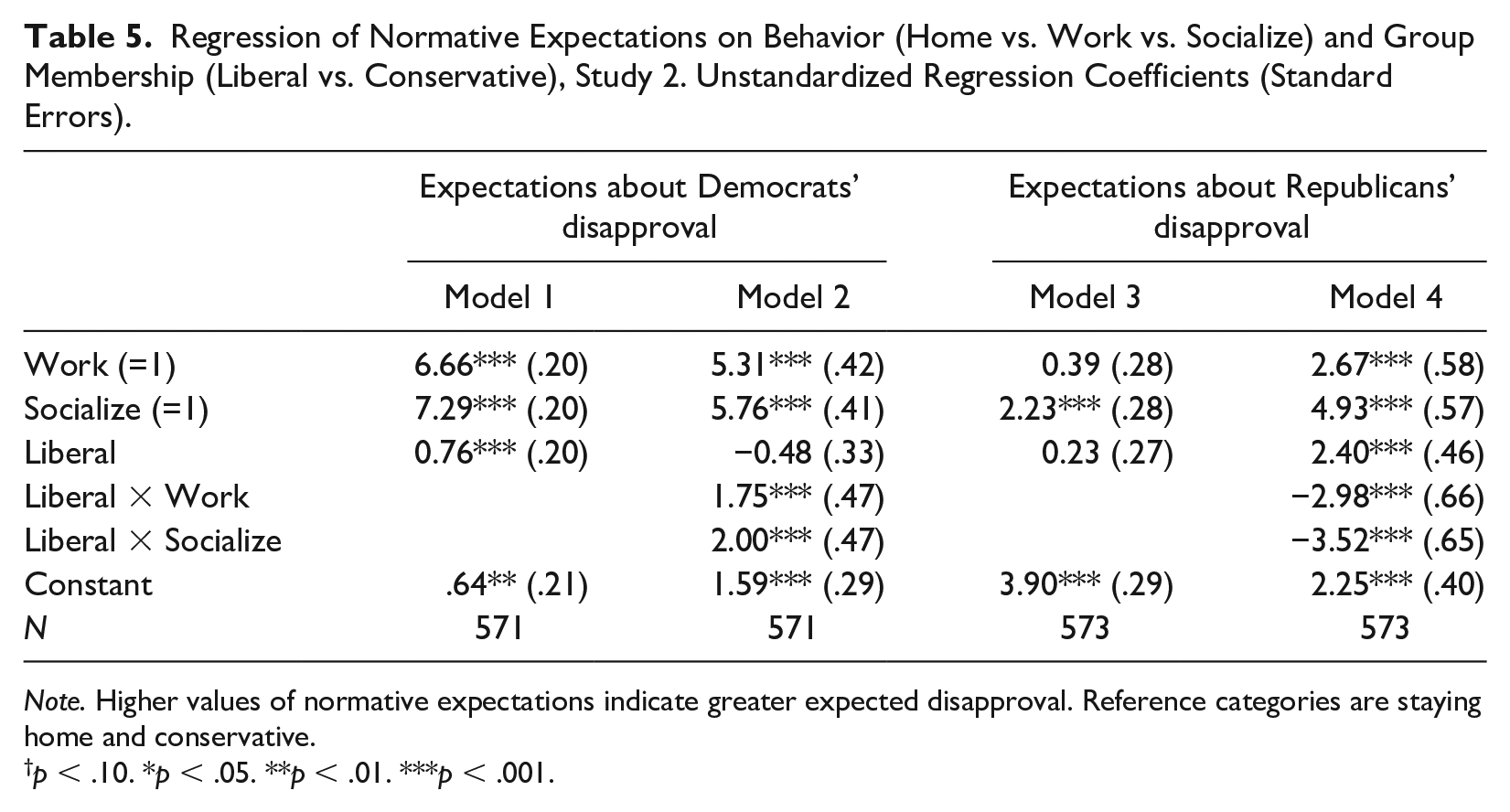
Note. Higher values of normative expectations indicate greater expected disapproval. Reference categories are staying home and conservative.
p < .10. *p < .05. **p < .01. ***p < .001.
Looking first at expectations about Democrats’ disapproval, the interaction terms indicate that liberal participants expected more disapproval than conservatives did of both violations (going to work and attending parties) compared with staying home (Model 2, Table 5). As shown in Figure 3, liberals expected more disapproval of those behaviors than conservatives did and expected a larger gap between expectations of disapproval for violations and staying home.

Expectations about Democrats’ disapproval, Study 2.
Turning to expectations about Republicans’ disapproval, we again see significant interaction effects (Model 4, Table 5). The effect of participant political orientation is significant and positive, indicating that liberal participants expected Republicans’ disapproval of staying home to be higher than conservatives expected it to be. The coefficients for the interactions of group membership with the noncompliant behaviors, going to work and attending parties, are negative and statistically significant. This shows that liberal participants expected Republicans to be less disapproving of violations than conservative participants did. We illustrate this interaction effect in Figure 4. Conservatives expected Republicans to be more disapproving of attending parties than going to work and expected more disapproval of both than of staying home. Liberals, however, expected Republican disapproval to be higher for staying home and lower for both attending parties and going to work.

Expectations about Republicans’ disapproval, Study 2.
Taken together, these patterns suggest that liberal and conservative participants had fairly similar expectations about Democrats’ disapproval, although conservative participants may have slightly underestimated Democrats’ disapproval of going to work or socializing. In contrast, liberal and conservative participants had quite different expectations about Republican’s disapproval.
Discussion
Our results provide the first empirical test of an integrated theory of norms that relies on both behavior consequences and social cues to predict norms across groups (Horne and Mollborn 2020). Study 1 examined a situation in which behavior consequences were clear. Here, behavior consequences and social cues each independently affected normative expectations. Furthermore, ingroup and outgroup members drew different inferences about group norms—in particular, liberals and conservatives differed in their normative expectations about Republicans. In this setting, both the behavior consequences and social cues approaches produced accurate results. Study 2 examined a situation in which behavior consequences were ambiguous. Here, behaviors and social cues interacted to affect normative expectations. Again, ingroup and outgroup members had different normative expectations. In this setting, normative expectations about the same (ambiguous) behaviors differed across social groups. These results highlight the importance of jointly considering behaviors and social cues for making accurate predictions about norms in the field.
Theoretically, our integrated approach helps to explain the inconsistent predictive power of behavior consequences (e.g., Elster 1989) across settings. Whereas in the lab behavior consequences are clear, in the field people may observe behaviors without being certain of the consequences. This lack of certainty leaves people’s normative expectations vulnerable to social cues as they interpret what the costs of a behavior are likely to be and infer how others will react to the behavior (Horne and Mollborn 2020). Furthermore, whereas much of the social cues literature examines nonconsequential behaviors (e.g., DellaPosta, Shi, and Macy 2015; Macy et al. 2019), our research shows that social cues can operate in conjunction with behaviors that have real costs for groups and individuals. In such situations, both behaviors and social cues matter. However, the greater the doubt about facts, the more people are likely to attend to social cues. In an era in which public figures and media highlight doubts (e.g., Davies 2019), the effects of social cues may be particularly strong. Future research should further examine the particularities of how behaviors and social cues intersect across situations to identify scope conditions for when these approaches have independent and joint effects and to specify the nature of those joint effects.
Substantively, the results show that there are political divides in normative expectations, as well as room for misperceptions. It is not simply that liberals and conservatives in the United States have different attitudes. Instead, they have different normative expectations, including different expectations about each other. To the extent that normative expectations are different from attitudes, an individual’s behavior (and speech) may not completely reflect their attitudes, but may be reinforced or discouraged by their group’s norms. One implication is that norms associated with political groups may exacerbate behavioral differences beyond those created by attitudinal divisions. Furthermore, the existence of pandemic-related norms means that efforts to engage individuals in fact-checking or to educate individuals about the virus may have little impact, both because individuals will interpret those efforts in light of the social cues that are salient to them and because changing individual beliefs does not address normative influences. Effective interventions may require addressing not just individual understandings, but also norms and associated social pressures (see, for example, Mackie 1996), for example, identifying strategies that might change the content of social cues or providing new cues to directly address normative expectations. Statements by leaders across group divides or statements issued by institutions with widespread legitimacy may help. To the extent that norms affect behavior (e.g., Cislaghi and Heise 2019; Reid et al. 2011), compliance with government public health mandates is likely to be inconsistent as long as prominent Democratic and Republican voices send conflicting messages. Furthermore, liberals and conservatives may have inaccurate views that may lead to vilification of each other, exacerbating existing political divides.
Our study was conducted with online convenience samples of U.S. residents. Our sample is therefore not representative of the U.S. population. For example, it is more highly educated. We expect that our sample is likely more homogeneous and that the differences between liberals and conservatives may not be as marked as in the general population. If so, then our study may underestimate political differences in norms.
In addition, our data were collected at one point in time relatively early in the pandemic (April 2020). Since then, the climate has shifted. There have been freedom and anti-mask rallies for example, and a Presidential election in which how to best respond to the pandemic was a key divisive issue. Our study does not speak to these changes. The pandemic provides a novel opportunity to examine norms as they occur, in particular, to assess norm conflict and change. Researchers should study norms at different points in the evolution of the pandemic.
We also test our theory with particular kinds of socializing (high risk with lots of people) and work (nonessential, worker not compelled by a boss). Different operationalizations may affect how people weigh the costs and benefits. For example, people might react differently to family members getting together for a holiday or socializing with small groups of friends than to people socializing in large groups. Similarly, people might react differently to work considered essential or if workers are threatened with being fired. This is because people are likely to have different views of the distribution of costs and benefits depending on the particularities of the situation. The integrated theory predicts that behavior consequences and social cues will interact to predict norms. Our operationalizations provide one test of this prediction. The theory can and should be tested with different behaviors and different kinds of social groups across multiple settings.
Our use of experimental methods is valuable for testing causal theories. But given the novel character of the pandemic, exploratory qualitative approaches would also be useful. Qualitative interviews to explore how people describe their moral reasoning could help to shed light on how people with different political orientations assess the consequences of different behaviors and the meaning of their actions. They could also illuminate the range of actors, individual and institutional, generating social cues.
We focused on political orientation as a source of social cues; sociodemographic differences would be another fruitful dimension to study. We might well expect norms to be different among groups that vary in socioeconomic status independently of political views. The implications of the pandemic for whether people have jobs, whether they can do those jobs remotely, and how people manage childcare and eldercare are different for people with different resources and structural locations within the economy. Different socioeconomic groups therefore may make different assessments of the costs and benefits of behavior. If so, then norms will differ accordingly.
Finally, we rely on vignette experiments that look at the effects of the causal factors on normative expectations. Normative expectations are a standard indicator of norms (e.g., Álvarez-Benjumea and Winter 2020; Horne, Dodoo, and Dodoo 2013; Stoebenau et al. 2019). Future research could test the integrated theory with alternative measures of norms—for example, participants’ anticipated embarrassment (Mollborn 2009, 2010) or sanctions (e.g., Horne 2001; Przepiorka and Diekmann 2018). Multiple studies set in different contexts and using different measures would increase confidence in the theory (Lucas 2003).
In sum, we find that people’s normative expectations vary in response to both behaviors and social cues. The results support the consequentialist and social cues approaches, but also suggest that, in the field, accurately predicting norms will require considering the joint effects of both behaviors and social cues. Our results also show that group members may perceive norms differently than outsiders. Our findings have implications for theoretical understanding of norms as well as substantive understanding of factors supporting or discouraging compliance during the Covid-19 pandemic.
Footnotes
Declaration of Conflicting Interests
The author(s) declared no potential conflicts of interest with respect to the research, authorship, and/or publication of this article.
Funding
The author(s) disclosed receipt of the following financial support for the research, authorship, and/or publication of this article: The authors received financial support from the Washington State University Department of Sociology.