




Abstract
Social mattering refers to an individual’s perceived sense of significance in the world and is a key aspect of overall mental health. Using data from a representative survey of adult Americans, we test the extent to which societal-level status, community engagement, group memberships, and interpersonal attachments affect men’s and women’s sense of mattering. We find that women gain social significance to the extent that they feel attached to others interpersonally, in terms of romantic relationships, parenthood, friendships, and closeness to family. Men’s sense of mattering is significantly influenced by broader social factors, like their strength of attachment to the Republican Party, their social media use, and their ability to donate money to the community. These differences suggests that gender norms lead men to also seek significance from the broader community and through group memberships while women rely mainly on their close social ties to feel like they matter.
Measures of social “mattering,” which attempt to capture a person’s sense of personal significance in society, are strongly related to mental and physical well-being (Taylor, McFarland, and Carr 2019). Feeling that others pay attention to you, others care about you, and others need you are the three core aspects of social mattering (see Rosenberg and McCullough 1981) and have been central to social theory from its origins. Beginning with Emile Durkheim’s (1951) study of suicide, social theorists have long argued that the creation and subsequent health of the “self” are intimately related to how a person perceives her social worth and attachment to others. Trisha L. Raque-Bogdan et al. (2011:272) more specifically hypothesized that perceptions of social mattering help explain the “strong link between adult attachment and mental and physical health.” In this article, we test the strength of various correlates with social mattering and whether they differ for women and men.
Using a national random sample of Americans, we analyze the influence of (1) societal-level status, (2) community involvement and group membership, and (3) interpersonal attachments on levels of social mattering. Because men and women have historically been taught to play different roles and serve different purposes in society, we isolate their effects (Schieman and Taylor 2001). As expected, we find different social sources of mattering for men and women along with several similarities. Specifically, we find that among women mattering is strongly tied to their parental role and feeling close to friends, while men’s mattering is also closely related to their donations to local organizations, social media usage, political party affiliation, and subjective social class. This suggests that women feel like they matter mainly based on the strength of their intimate personal attachments, while men appear to also matter in direct relation to their perceived status in the community and society overall. Still, for both men and women, strong interpersonal ties to significant others tend to be most beneficial to their sense of mattering.
The Importance of Mattering
Social scientists within the symbolic interactionist tradition have long asserted that feeling good about yourself is linked directly to the belief that you matter to others (Mead 1934). Humans are unique because their “self” becomes an object of their own evaluation; in becoming an object, the self begins to “self-assess” by attempting to understand how it is evaluated by others (Blumer 1969; Cooley 1909; Homans 1951; Simmel 1955). As George Herbert Mead (1934:163) pointed out, “what we mean by self-consciousness is an awakening in ourselves of the group of attitudes which we are arousing in others.” The perceived attitudes of others then become embedded in our own estimation of self—what Mead called “The Generalized Other.” This occurs in the process of child development but also throughout the life course as we rely on others to guide our sense of worth and our behavioral choices.
Symbolic interactionism describes this on-going process, which Herbert Blumer (1969:66) explains, involves interpretation, or ascertaining the meaning of the actions or remarks of the other person, and definition, or conveying indications to another person as to how he is to act. Human association consists of a process of such interpretation and definition.
Consequently, one’s sense of self is wholly interactive and adaptable, varying with our perception of how others view us. Put plainly, perceptions of social mattering connect our awareness of self to our awareness of others.
This back and forth between the social and the self occurs on multiple levels and results in providing a host of narratives, norms, and stigmas concerning one’s proper role(s) in society (Goffman 1959). Blumer (1969:107) notes that this dynamic is central to all human interaction, writing that “it would seem that whenever one human being enters into relationship with another he immediately falls into some sort of role, and that as long as he is in relationship will be in one role or another.” In turn, these roles provide guidelines for self-appraisal and evaluating one’s “success” in the world as it pertains to fulfilling one’s purpose (Fazio 2010). In addition, our personal connections to others communicate the extent to which others appear to need and rely on us (Rosenberg and McCullough 1981). Together, our identities (the roles we play) and our integration (the attachment we feel to others) provide the social criteria we use to determine our social significance.
Morris Rosenberg and B. Claire McCullough (1981) were the first to label a person’s inferred social significance as “mattering” and proposed a survey measure of it. They argued that mattering comprises three main dimensions: (1) the feeling that others pay attention to you (attention), (2) the belief that others care about you and what you do (importance), and (3) the perception that others need you (dependence) (Rosenberg and McCullough 1981). Their mattering measure offers a means to test the extent to which these perceptions of one’s social acceptance and value relate to one’s mental health and social functioning.
Since then, a number of studies have demonstrated mattering’s connection to overall well-being. Social mattering has been shown to be positively correlated with happiness (Demir et al. 2011) and is negatively related to social anxiety and loneliness (Flett et al. 2016), depression (Flett, Khan, and Su 2019), suicide ideation and suicide (Elliott, Colangelo, and Gelles 2005; Milner, Page, and LaMontagne 2016), and violent behavior (Elliott et al. 2011). More generally, it has also been theorized to act as a stress buffer and as a potential link between social support and mental and physical health (Thoits 2011). And although mattering is linked to concepts like perceived social support, self-esteem, and self-consciousness, it has been established as empirically distinct (Elliott 2009; Elliott, Kao, and Grant 2004; Fazio and Nguyen 2014) and can even be differentiated from the “need to belong” (Baumeister and Leary 1995; Elliott 2009). These recurring findings empirically establish what had long been theorized—that social mattering is a central aspect of overall well-being.
For many classical theorists, feeling socially significant was made more problematic in the modern era (Durkheim 1947); a decline in self-understanding and social awareness was hypothesized to emerge from increased bureaucratization (Weber 1978), increased pluralism (Berger 1967), increased social isolation (Durkheim 1951), or conflicting networks of affiliations (Simmel 1955). These modern social forces were thought to upend the ability of humans to construct a unified sense of self from clear, consistent, and insular human interactions. Current research confirms that conflicting social roles and unclear social expectations produce high levels of stress and confusion (Greenhaus and Parasuraman 1987; Pearlin 1983, 1989). As social life gets more complex, simple answers to one’s purpose in the world get more elusive. As Paul Froese (2016:34) argues, “the modern individual ponders the meaning of her life with different concerns and considerations. She sees that multiple paths are available. Among them is the threat that life will have no meaning.” Consequently, the modern individual must navigate a host of narratives, identities, and roles to hopefully discover a way to feel that they can still matter.
The totality of society’s ability to influence our individual sense of mattering is inestimable. To provide some structure to this dynamic, we focus on three interconnected sources of social mattering. First, society communicates general narratives and stereotypes concerning the importance and roles of basic groups. For instance, broad racial stereotypes affect how individuals understand their “self” regardless of other intervening factors, such that a black man can feel that he doesn’t matter in American society even if he is highly educated, gainfully employed, and closely connected to his community (Bonilla-Silva 2010). This level of social determination we call a person’s expected “societal-level status” based on the general demographic characteristics of the individual. Age, race, gender, and class are all central identifiers with corresponding cultural stereotypes about their social worth and moral goodness. Therefore, we expect that demographic characteristics that evoke popular negative stereotypes will be related to decreased senses of mattering.
Second, as we gain more knowledge of a person’s connection to her community and membership in various local groups, we can better understand the extent to which these more localized roles offset or enhance societal-level statuses. In particular, we note whether individuals attend religious services, participate in neighborhood activities, are active on social media, and feel strongly affiliated with a political party. These types of group connections may provide not only the social fabric which undergirds democratic institutions and reduces social conflict (Putnam 2000) but also personal feelings of social significance. They may even offset negative stereotypes at the societal level by establishing and communicating the worth of an individual to his community. Belonging to groups is also hypothesized to be a core human need that has been linked to health, coping, well-being, and happiness (Baumeister and Leary 1995). But like societal status, community involvement and group memberships are reliant on how the individual feels about their role and position within a larger group context. Consequently, we expect that being an “active” member of a church, a “strong” supporter of a political party, or a “contributor” to neighborhood projects will provide a sense of mattering to individuals. But we are also interested in how this may conflict with or accentuate societal-level status.
Finally, interpersonal attachments to intimate others are known to affect a person’s sense of mattering. Being in a romantic relationship, taking care of a loved one, having close friends, and parenting children can all enhance one’s sense of mattering because the individual is in daily purposive interaction with another (Demir et al. 2011; Rayle 2005; Schieman and Taylor 2001). Through intimate interactions, individuals come to see that they are needed and loved and also that they can rely on others for support. In turn, this communicates worth and significance regardless of societal statuses or community and group involvement. We are especially interested in the possibility that interpersonal relationships will overwhelm all other social sources in predicting mattering.
Societal-level status, community involvement and group memberships, and interpersonal connections combine to produce a person’s sense of social significance or mattering. And mattering is central to one’s mental health and flourishing. Our analyses seek to establish the independent effects of these various determinants to find which matter most. We expect that these different factors will affect individuals differently based on the narratives, roles, and identities available to them. In particular, we note that men and women receive different messages about their “proper” identities, roles, and purposes in the world. Therefore, we also outline how men and women differ in their sources of mattering.
The Significance of Gender
Gender can act as a schema and background identity that influences all interactions depending on its salience to the particular situation (Ridgeway 2011). Moreover, gender can also be framed as a performance, in that “doing gender” means enacting and negotiating gendered norms in our daily interactions (West and Zimmerman 1987). Above all, gender may also be understood as a social structure that acts on multiple dimensions (Risman 2004). According to Barbara J. Risman (2004), the gender structure permeates the individual, interactional, and macro levels of social life. Gender then influences bodily habits, identity formation, beliefs, and norms, as well as the distribution of material resources (Risman 2004).
In total, these influences and daily reminders of what one’s gender means will have an influence on individuals’ sense of self, their roles, and how they evaluate themselves in comparison with others. The literature on gender and mental health shows that men and women express mental illness in different ways, which may be due to their differential socialization in terms of what counts as gender-appropriate emotional expression (Simon 2014). In addition, some scholars argue that women simply experience distress more frequently than men (Mirowsky and Ross 1995), implying that women may be more exposed to distressing circumstances due to gender inequality. This latter view illustrates the differential exposure theory, which has been exemplified, among other things, by men’s and women’s often unequal share in household labor (Bird 1999) or the greater exposure to stress of single mothers (Avison, Ali, and Walters 2007).
Overall, men’s and women’s gendered roles have been linked to their emotional well-being (Leupp 2017; Simon 1995). Chloe E. Bird and Patricia P. Rieker (1999:748) explain that Gender differences in opportunities shape men’s and women’s choices and expectations regarding social roles and role-related activities, which in turn affect their exposures to various risks (including stress, role overload, [and] occupational health problems [ . . .]) and their access to protective resources (including income, wealth, health and disability insurance and social support).
In combination, both the sociology of gender and literature on gender and mental health support a theoretical framework wherein a sense of mattering may be constructed differently for men and women.
In terms of who shows a stronger sense of mattering, Andrea L. Dixon, Corey Scheidegger, and J. Jeifries McWhirter (2009) report no differences in average mattering scores between female and male adolescents. In contrast, Sheila K. Marshall et al. (2010) note that women show higher mattering to their parents and friends in their sample of university students. Other studies report similarly that female high school students (Rayle 2005) and female college students (Rayle and Chung 2007) tend to score higher on perceived mattering to specific others. Among adults, too, the sense of mattering appears to be higher for women (Schieman and Taylor 2001). Our data also confirm this pattern.
Another line of research shows in more detail that wives feeling like they matter to their husbands leads to changes in the evaluation of fairness of household labor distribution (Kawamura and Brown 2010; Lachance-Grzela 2012). Finally, Scott Schieman and John Taylor (2001) show that the effect of education on mattering is stronger for women, but that for men this education effect seems to be working indirectly through job qualities to affect mattering. The same authors also find that men’s sense of mattering is more strongly influenced by being in a relationship and having children compared with women, whereas work/family conflict shows a negative effect on perceived mattering only among women. Importantly, the authors note that being married shows a positive effect on mattering only when marital conflict is controlled for (Schieman and Taylor 2001).
Like Schieman and Taylor (2001), we argue that the traditional gender socialization practices of decades past emphasized women’s roles in the family realm and with care work, while men’s roles centered more on career and work achievements, which may lead to mattering being influenced by different family and occupational roles for men and women.
Sources of Mattering for Women and Men
Societal-level Status
We propose to test the effects of societal-level status using basic demographic measures. Societal-level status refers to the ascribed status of various demographic groups, accounting for popular negative stereotypes concerning racial minorities, the economically disadvantaged, and the elderly. Previous research indicates that as people age they tend to feel that they matter less (Fazio 2010; Schieman and Taylor 2001). In particular, the stigma of aging has been shown to be especially damaging to the mattering of gay men (Wight et al. 2015) and may also impact individuals who feel their health compromised because of the COVID-19 pandemic (Flett and Heisel 2020). Similarly, individuals with low socioeconomic status (SES) (Schieman, Ellison, and Bierman 2010) and those who have lower levels of education (Schieman and Taylor 2001) tend to feel that they matter less.
All of these studies suggest that groups of individuals who have experienced negative stereotyping and individuals who are disadvantaged in terms of income, employment, and education will feel that they matter less to others. In this way, we see societal-level status play a significant role in how individuals perceive their worth to society. Our analysis will test the extent to which age, race and ethnicity, and subjective social class affect mattering in gendered ways and predict that nonwhites, older Americans, and those who self-describe as low and working class will report a lower sense of mattering. We assume that age may correlate with a decreased sense of mattering for both men and women since society tends to devalue those of old age as well as due to retirement and a decreasing need to act in the parent role. However, since it is commonly believed that women tend to maintain stronger and more dense social networks, even in old age, we expect this trend to be less pronounced among women.
Based on our assumptions that stratification will impact individuals’ sense of mattering, we predict negative relationships between being nonwhite and mattering and a positive relationship between social class and mattering. However, we expect that the influence of class on mattering will be stronger for men due to common cultural beliefs that assume men as the primary breadwinners in families. Failure to provide a high standard of living may be more detrimental to men’s sense of mattering.
Community Involvement and Group Membership
R. F. Baumeister and M. R. Leary (1995) hypothesize that group belonging is a core human need and that individuals will always seek out social attachments and work hard to avoid breaking these attachments. Their “belonging hypothesis” suggests that community involvements and group memberships are always central to human well-being and, as such, they should be strongly related to social mattering. In support, Scott Schieman et al. (2010) find that church membership and attendance improves a person’s sense of mattering (also see Lewis and Taylor 2009). These studies affirm that belonging to an association provides members with a feeling that they matter, which occurs because the organization tends to want you as a member and also provides a network of individuals with whom to interact on a regular basis. Together, belonging and interaction within an organization appear to enhance social significance.
Carissa J. Schmidt et al. (2020) found that children’s sense of mattering increases to the extent that they participate in school. Again, interaction within the boundaries of an organization or institution appears to provide individuals with a role and purpose, which adds significance to their presence. In this way, organizations and groups naturally communicate mattering because they tend to value membership and participation. In addition to schools and churches, we posit that neighborhood involvement in projects and goals, along with connections to others through social media and membership in political groups will similarly enhance a person’s sense of mattering. All of these instances illustrate connections to others through community-level structures.
More specifically, we seek to test whether a sense of belonging within a neighborhood or subgroup counterbalances the negative effects of low societal-level status. We expect that, overall, increased involvement in the community is associated with an enhanced sense of mattering for both men and women. However, we also hypothesize that gendered patterns may be evident depending on the type of involvement in one’s neighborhood. Due to the common cultural beliefs of women as caring and nurturing and of men as workers and economic providers, we suggest that roles that associate with power and money will be more salient for men and roles associated with care will be more salient for women.
Interpersonal Attachments
Finally, and most importantly, interpersonal attachments are known to be crucial to a person’s sense of mattering. Social mattering is higher for people who have close friends (Demir et al. 2011; Marshall et al. 2010), who are married or have significant others (Rosenberg and McCullough 1981; Schieman and Taylor 2001), who have children (Marshall et al. 2010; Schieman and Taylor 2001), and who are close to family members (Rayle 2005). Intimacy clearly communicates that one is loved, needed, and supported—central aspects of feeling like one matters. For this reason, we expect that interpersonal attachments will be the strongest predictors of social mattering and might easily offset a lack of societal status or community/group involvement. Due to traditional notions of women as caregivers, the motherhood role along with their closeness to their family and friends may be more important to women’s sense of mattering.
Methods
Data
We use data from the 2017 “Values and Beliefs of the American Public” survey, administered by Gallup. The sample for this survey was selected based on an Address Based Sample (ABS) method founded on a simple stratified sample design. Surveys were mailed to adult respondents nationwide. Of the 11,000 addresses sampled, 1,501 surveys were returned, resulting in a response rate of 13.6 percent. Despite the low response rate, the survey compares favorably with the 2016 General Social Survey on several key demographic factors. 1 This particular survey was selected since it offers several questions about mattering which were used to create an index for this project. Moreover, the survey features several measures of relational closeness and local embeddedness, which constitute key variables when it comes to mattering. Sampling weights were applied to regression analyses.
Measures
Mattering
Social mattering is measured with five questions, all of which have response categories coded as “not at all” (1), “a little” (2), “somewhat” (3), and “a lot” (4). Respondents were prompted with the following statements: “How much do you feel other people pay attention to you?”, “How much do you feel others would miss you if you went away?”, “How interested are people generally in what you say?”, “How much do other people depend on you?”, and “How important do you feel you are to other people?”. These items mirror the ones examined by Morris Rosenberg and B. Claire McCullough (1981) and have been used successfully as a scale in other studies (Flett et al. 2016; Schieman and Taylor 2001; Taylor et al. 2019; Wight et al. 2015). After summing the items, the resulting scale ranges from 5 to 20, with an unweighted mean of 16.56 among women and 16.28 among men. The resulting alphas for both the female and male samples are above .80 and show eigenvalues >2 during factor analyses for both samples, suggesting high correlations between items and that this sum scale measures a single concept.
Independent Variables
Interpersonal-level measures
We include measures of closeness to one’s family, friends, and neighbors. Respondents were asked, “How close do you feel to:” with “your family,” “your friends,” and “your neighbors” as specific prompts. Answer categories included “not at all close” (1), “not very close” (2), “somewhat close” (3), and “very close” (4). In addition, we add a variable testing for being in a romantic relationship (1) compared to being single (0). Another binary measure for being a parent was also constructed (having at least one child = 1). 2
Community embeddedness and involvement
Two binary variables test for whether a person attended a neighborhood event or donated to a local organization (for both yes = 1). Time spent on social media is measured by asking respondents “On average, how many hours per day do you spend: Using the Internet to access or use social media?” Response categories ranged from (0) zero/none to (6) more than 12 hours. The variable is treated as a set of dummy variables in our analyses. For this purpose, we coded the variable to hold the following values: (1) zero hours on social media (the reference group), (2) one hour or less on social media, (3) between one and three hours on social media, and (4) more than three hours on social media per day. Political party affiliation is measured in seven categories ranging from strong Republican (1) to strong Democrat (7), with Independent constituting the reference category. Worship attendance is measured on a scale ranging from (0) never to (7) several times a week.
Societal-level measures
We test for the influence of age (in years) and for racial or ethnic minority status (Hispanic, black, other race, and being not non-Hispanic white as the reference category). A variable measuring the respondents’ self-identified social class is also added, which was changed from its five original categories (lower class, working class, middle class, upper middle class, and upper class) to be measured in three categories: lower and working class, middle class, and upper middle and upper class. The group identifying as lower or working class will constitute the reference category for this study. Employment status is included as a binary variable (1 = currently employed).
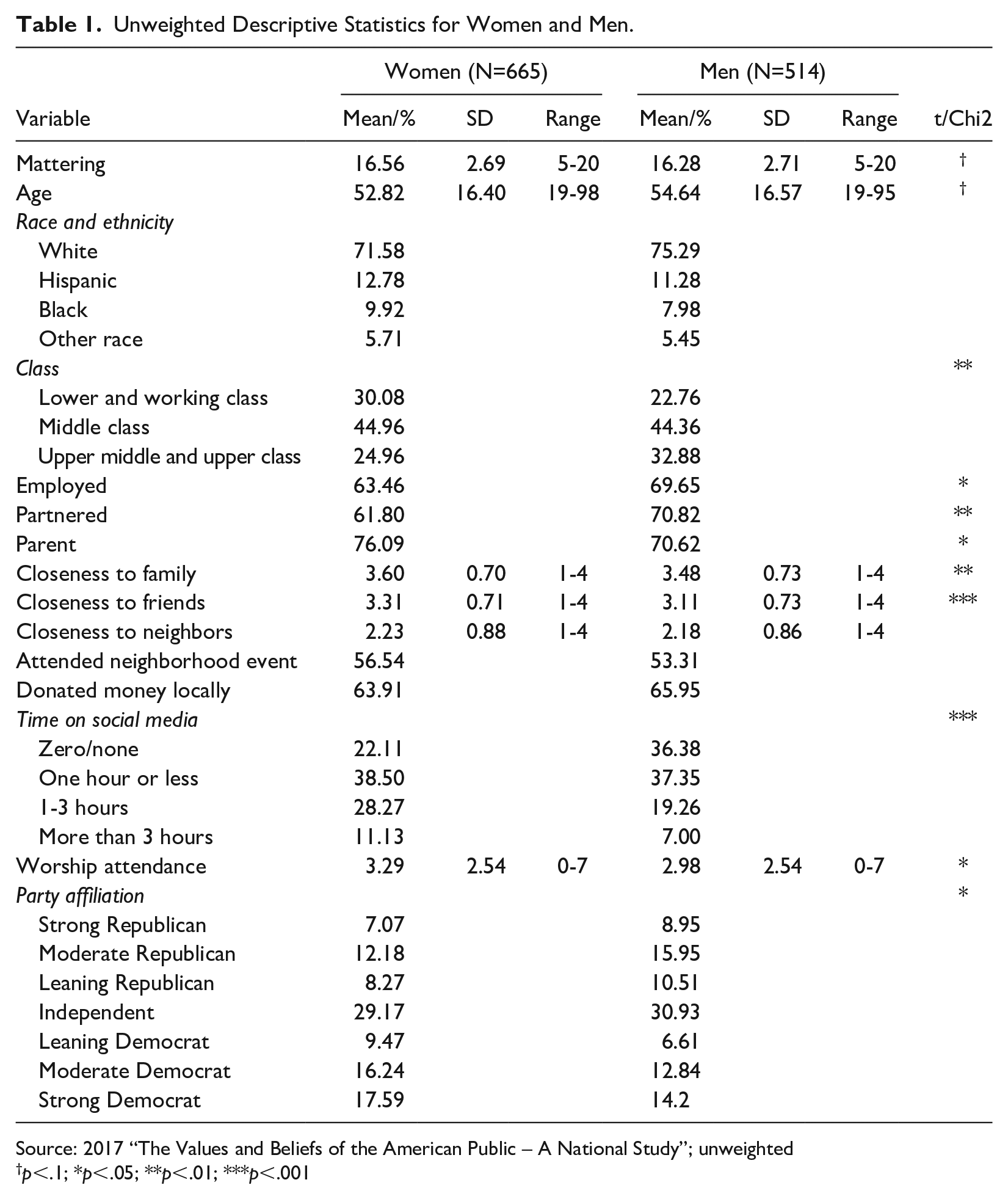
Descriptive statistics for both the male and the female sample are shown in Table 1. Due to listwise deletion, the final sample sizes are 665 for the female sample and 514 for the male sample. 3
Unweighted Descriptive Statistics for Women and Men.
Source: 2017 “The Values and Beliefs of the American Public – A National Study”; unweighted
p<.1; *p<.05; **p<.01; ***p<.001
Analytical Strategy
First, we present unweighted descriptive statistics for both men and women in Table 1 in addition to difference tests. Next, we show results from ordinary least squares (OLS) regression analyses on separate male and female samples. We use stratified samples because they emphasize the different lived experiences of men and women. For both men and women, we separate analyses into four models. Model 1 includes measures of societal status, namely, age, race/ethnicity, employment status, and subjective social class. Model 2 adds measures for community involvement and group membership while still controlling for general societal status variables. Model 3 excludes the community involvement measures and tests instead for the effect of interpersonal attachments on mattering while controlling for societal status measures. Finally, Model 4 constitutes our full model and includes all proposed measures. Weighted OLS regression results are presented in Table 2 for the female sample and in Table 3 for the male sample. Both standardized and unstandardized coefficients are reported in addition to HC3 robust standard errors (Long and Ervin 2000). All analyses were conducted with Stata version 15. 4
OLS Regression Results for Women (N=665).

Source: 2017 “The Values and Beliefs of the American Public – A National Study”; weighted data
p<.1; *p<.05; **p<.01; ***p<.001
non-Hispanic, white as reference category
Lower and working class serves as reference category
Never uses social media as reference category
Independent serves as reference category
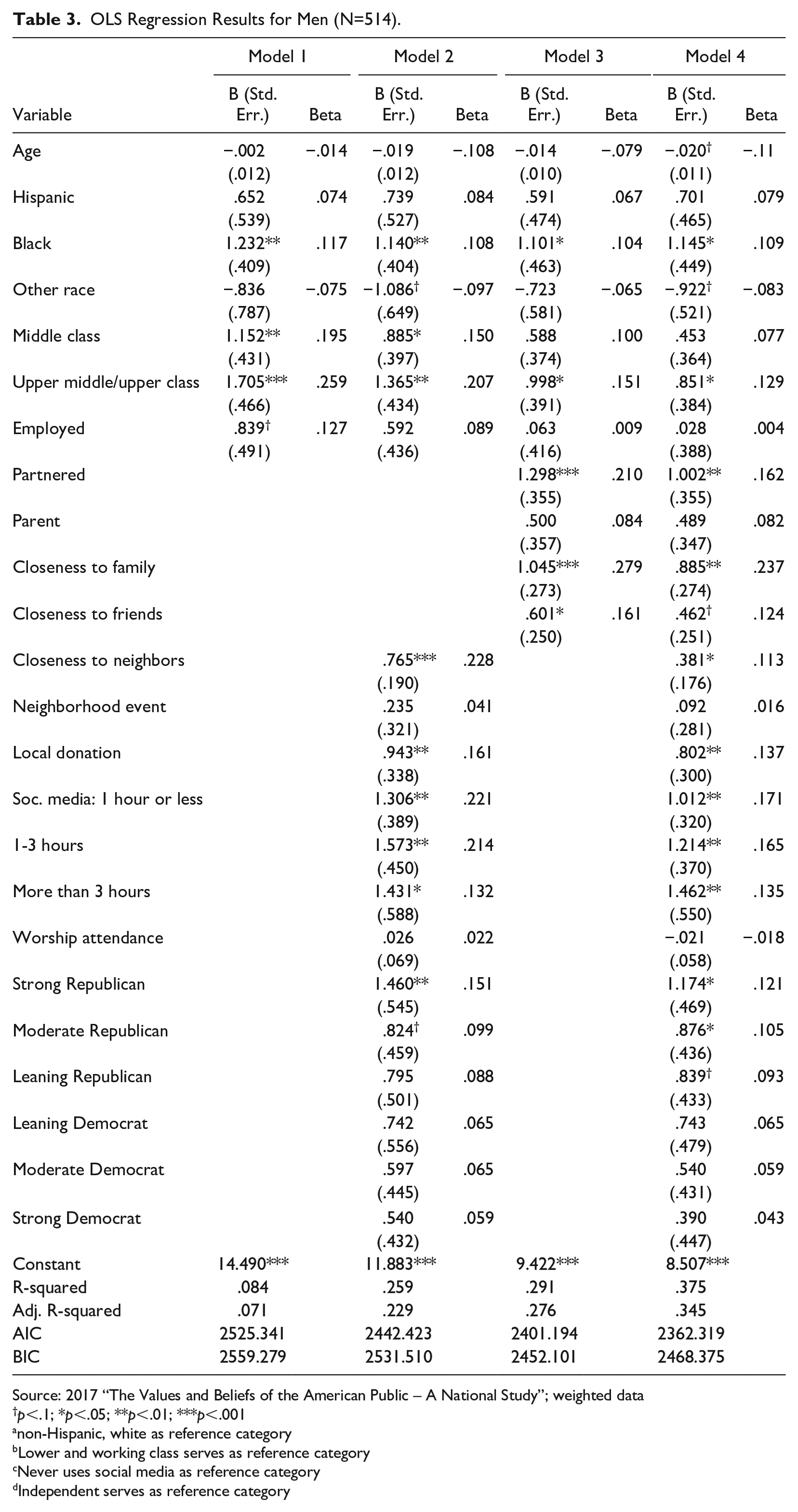
OLS Regression Results for Men (N=514).
Source: 2017 “The Values and Beliefs of the American Public – A National Study”; weighted data
p<.1; *p<.05; **p<.01; ***p<.001
non-Hispanic, white as reference category
Lower and working class serves as reference category
Never uses social media as reference category
Independent serves as reference category
Results
To begin, we report descriptive statistics for both the female and male samples in Table 1. Women show a slightly higher average mattering score compared to men, but the difference between the two samples is only marginally significant (p < .1) and rather small: the average mattering score for women is 16.56, while it is 16.28 for men. More pronounced are the gender differences when it comes to subjective social class, employment, being a parent, worship attendance, and political party affiliation. More women than men would rank themselves as lower or working class, while more men in our sample report upper middle or upper class status. More men than women in our samples are employed, yet more women indicate that they are a parent. Furthermore, women report higher levels of worship attendance and social media use than men and are more left-leaning politically. Small, albeit statistically significant, differences are evident in closeness to family and closeness to friends. For both measures, women show slightly higher averages than men.
Tables 2 and 3 illustrate the results from multiple regression models for women (Table 2) and men (Table 3). Among women, Model 1 demonstrates the influence of social class on mattering when only societal-level measures are included. Compared to women who see themselves in the lower or working class, women who perceive themselves as middle class report slightly higher scores on the mattering index (b = 0.608, beta = 0.109, p < .1). The contrast is sharper for women in the upper middle and upper class, who are expected to score, on average, 1.141 units higher on the mattering index compared to lower and working class women (beta = 0.164, p < .01). Model 1 shows a very small adjusted R2 for women of .022, which increases markedly in Model 2 and especially in Model 3. This indicates that group and interpersonal connectedness explain more of the variance in women’s senses of mattering, while societal-level status, as we conceptualize it here, has very little explanatory power.
Adding community-level measures in Model 2 for the women sample shows that closeness to neighbors, attending a neighborhood event, and leaning Republican (compared to being politically independent) show positive associations with mattering to various degrees. Among these variables, closeness to neighbors shows the highest statistical significance and the largest standardized coefficient (b = 0.567, beta = 0.184, p < .001). A woman who attended a neighborhood event in the past year is expected to show a 0.727-unit higher score on the mattering index compared to a woman who has not done so (beta = 0.131, p < .05). We also observe a marginally significant link between mattering and leaning Republican, but the association pales in terms of effect size in comparison with the other measures. Controlling for these community-level measures decreased the influence of subjective social class for women. Although still statistically significant, the unstandardized coefficient for women in the upper middle and upper class decreases to 0.689 in Model 2 (beta = 0.099, p < .05). As Model 3 and Model 4 show, subjective social class is no longer significantly associated with mattering for women in our sample once we control for interpersonal relationships.
Model 3 adds measures for interpersonal connections but leaves out the community-level measures. This constellation of variables reveals the importance of closeness to friends for women (b = 1.172, beta = 0.332, p < .001). Also important are the measures of closeness to family (b = 0.649, beta = 0.174, p < .01) and being a parent (b = 0.900, beta = 0.144, p < .01). Being in a romantic relationship is significant for women, yet shows smaller coefficients compared to these measures (b = 0.688, beta = 0.117, p < .05). The adjusted R2 for Model 3 among women reveals that about 22.2 percent of the variance within mattering can be explained by the measures included in this model. As the R2 for Model 4 shows, inclusion of the community-level measures barely increases the R2 measures, which could indicate just how crucial our level of connectedness to close others is when it comes to mattering.
The full model for women (Model 4 in Table 2) shows the slightly decreased but relatively stable influence of being a parent, being partnered, closeness to family, and closeness to friends for mattering among women. Closeness to friends remains the measure with the largest standardized coefficient in this full model of our women sample. We would expect that for each standard deviation increase in closeness to friends, a woman would gain, on average, 0.298 standard deviations in terms of mattering. Using the unstandardized coefficient, we would expect about a 1-unit increase on the mattering index for every 1-unit increase on the closeness to friends measure for women (p < .001), holding all other measures constant. A woman who is also a parent would be expected to score 0.808 units higher on the mattering index (beta = 0.129, p < .05) than a woman who is not a parent. Holding everything else constant, closeness to family still shows a significant positive relationship to mattering for women (b = 0.583, beta = 0.156, p < 0.01). In sum, the results for our women sample suggest that interpersonal measures show the strongest influence on mattering, with closeness to friends standing out as the strongest correlate. The influence of social class evident in the first two models disappears once we account for intimate connections to others.
Turning to the results for men summarized in Table 3, we observe both similarities and differences compared to the results for women. We observe that black men show an average of 1.232 units higher mattering scores than white men (p < .01), holding other measures constant. This effect weakens somewhat as more variables are added. A class effect is also evident for men, but appears more pronounced in Model 1 and appears more stable when considering the contrast between the self-identified upper middle/upper class status and the lower/working class status. Compared to a man identifying himself to be in the lower or working class, a man in the middle class would be expected to score 1.152 units higher on the mattering index (beta = 0.195, p < .01). In addition, a man of the upper middle or upper class would be expected to score more than 1.7 units higher on the mattering index (beta = 0.259, p < .001).
Model 2 shows that the influence of subjective social class decreases slightly once community-level measures are added, but remains statistically significant. In Model 2, closeness to neighbors shows a positive relationship with mattering (b = 0.765, beta = 0.228, p < .001). We also find positive associations for having made a donation to a local organization (b = 0.943, beta = 0.161, p < .01) and for time spent on social media. Compared to men who never use social media, all three contrast groups (using social media one hour or less, one to three hours, or more than three hours) show statistically significant positive associations with mattering. Even the use of social media among the group of men who use social media an hour or less was linked to a more than 1-unit increase on the mattering index compared to never-users (b = 1.306, beta = 0.221, p < .01). Notable is also the influence of strong Republican identification and, to a lesser degree, the identification as a moderate Republican compared to identifying as politically independent. Compared to a man who is politically independent, a man who identifies as a strong Republican would be expected to score 1.460 units higher on the mattering index (beta = 0.151, p < .01). The influence of being politically right-leaning not only remains in our full model, but the coefficients for moderate Republican and leaning Republican both increase slightly once all variables are controlled for. Interestingly, we do not observe a similar pattern for being left-leaning among our male sample.
Mirroring the model constellation for women, Model 3 includes both societal-level and interpersonal-level measures. A slight improvement in the R2 from the previous model indicates that these measures are, indeed, important predictors of mattering for men. A man who is partnered is expected to rank 1.298 scores higher on the mattering index compared to a man who is single (beta = 0.210, p < .001). Similar to our results for women, closeness to friends is a significant predictor of mattering for men (b = 0.601, beta = 0.161, p < .05). In contrast to women, closeness to family appears to be more important than closeness to friends when considering our male sample, though. Each unit increase on our closeness to family measure is associated with a 1.045-unit increase on the mattering index (beta = 0.279, p < .001). In addition, and similar to the results for women, the influence of subjective social class decreases once interpersonal measures are controlled for.
The final model for men includes a negative relationship between age and mattering that shows up to be only marginally significant (p = .087). With each additional year in age we would expect a man in our sample to show a drop in mattering of about 0.020 units (beta = −0.112, p < .1). Alternatively, we could express this trend as a 0.20-unit decrease in mattering with each additional decade gained in age for men. This age trend is accompanied by positive coefficients for being partnered and for closeness to family, as well as for having made a local donation and for time spent on social media. Political party affiliation shows to be significant for men, but the contrast to being politically independent is only evident on the right of the political spectrum. Once all measures are controlled for, the influence of closeness to neighbors and of closeness to friends wanes somewhat and the latter measure is now only marginally significant. The improvement in R2 from Model 3 to Model 4 is notable. In general, Model 1 with only societal-level measures included shows a modest adjusted R2 of .071 for men, indicating that only about 7.1 percent of the variation in mattering can be explained by the demographic measures. The improvement in adjusted R2 from Model 1 to Model 2 is particularly notable (from .071 to .229), and the final model indicates that with the included measures, over a third of the variance in mattering can be explained (adjusted R2 of .345).
Although we do not aim to compare coefficients between samples, the abovementioned trends indicate that men and women share crucial similarities in what makes them feel like they matter. Unsurprisingly, a strong sense of connectedness to close others bolsters mattering regardless of the gender. We consciously treat men and women as separate groups here who may share different perspectives in what social roles are especially salient for their sense of mattering. Only among men do we observe a connection between time spent on social media, political party affiliation, making a local donation, and a sense of mattering. Only among women do we find a statistically significant coefficient for being a parent and for attending a neighborhood event. Supplemental analyses show that an interaction term between gender and age is marginally statistically significant (p = .059) when entered into the full model of combined samples. Similarly, we observe statistically significant interaction terms between time spent on social media and gender and between some of the party affiliation measures and gender, when we enter these interaction terms separately. We encourage further research building on this exploratory study and want to point out these effects.
Discussion
Overall, only some of our initial hypotheses were supported, as illustrated in Table 4. Only among men do we observe associations between making a local donation and time spent on social media with mattering along with a less significant negative association between age and mattering. Furthermore, although being a parent is associated with an increased sense of mattering among women, it fails to be statistically significant for men, although it comes close in some model constellations. A strong affiliation with the Republican Party correlates with an increased sense of mattering for men—a trend that is not mirrored among women. For both men and women, closeness to family plays an important role for their sense of mattering. Men in particular appear to gain from being in a romantic relationship, and for women feeling close to their friends is very important to their sense of mattering. While attending a neighborhood event was statistically significant for women, making a monetary contribution to a local organization is a stable predictor of increased mattering among men. Thus, we find a general pattern that indicates the benefits of social integration for both men and women. The specific means of social integration, however, appear to have somewhat gendered effects on mattering.
Summary of Results.

Women and men share many sources of mattering, especially in terms of the importance of interpersonal attachments, but they also differ in stark and revealing ways. Compared to women, men’s mattering is more closely related to their community status, their ties to political groups, and connections on social media. Men may also feel a greater loss of mattering with age. In sum, our overarching expectation that women will draw heavily from interpersonal relationships to feel like they matter is supported, but the details of our findings highlight some interesting trends.
First, societal-level status, as measured by age, race, class, and employment, tends be less important once we control for other sources of mattering. For instance, one’s social class matters to both men and women but loses significance when we take into account personal and community connections. The fact that age becomes significant for men in the final model but not for women indicates that men may feel the pain of losing status and attention as they get older more than women, supporting previous research (Fazio 2010). Perhaps this is also tied to men’s lower life expectancy and a swifter decline in health as they age. In future explorations of the negative effects of age on men’s sense of mattering, researchers should look at health problems as a potential mitigating factor and the influence of retirement as a potentially significant life event when it comes to men’s sense of mattering.
Second, our findings concerning the effects of community involvement and group membership support our initial expectations but with some intriguing specifics. Men who are strongly Republican and use social media have enhanced feelings of mattering. It appears that men feel that they matter to the extent that they are devoutly Republican and active on the Internet. If these two factors provide a sense of mattering to men in general, it comes as no surprise that conservative social media is so popular and polarizing. The causal direction of these findings is unclear and we ponder the extent to which men, who have lost a sense of mattering, turn toward partisanship and the caustic climate of social media to feel that they matter again. If so, these trends are troubling and need to be explored in more detail. On a more positive note, social media use could be especially pertinent to men since it provides them another avenue of feeling connected to others, a sense of connectedness that women may already gain from other sources.
Surprisingly, religious service attendance, a historically important aspect of local community, has no effect on mattering when controlling for our other variables. It could be that the sense of mattering a person gains from worship attendance is already accounted for by their closeness to friends and neighbors, some of whom may also attend the same congregation. Among our sample of men, having made a donation to a local organization increases mattering, while having attended a neighborhood event increases the sense of mattering among women. This trend may suggest that men are more driven by external markers of status and significance than women.
Finally, interpersonal attachments are extremely important to both men and women. The big difference is that women find meaning in all their close attachments—romantic partnerships, parenting, friends, and family—while men seem to place especially great importance on their romantic partnerships and closeness to family. Moreover, the strength of women’s attachment to close friends and family overwhelms the effects of both societal-level statuses and community connections. As we expected, women find they matter when performing traditionally feminine roles, such as mothering and being a good friend. In contrast, we speculate that men might compensate for a lack of intimate ties with partisanship and social media engagement, but women might not find these options as enriching.
This study aims to expand on the existing knowledge on gender and mattering, yet, like all studies, it comes with certain limitations. First, the cross-sectional nature of the data does not permit us to draw conclusions regarding causality. Second, this study should be replicated with samples that have larger numbers of nonwhite individuals. Third, this study was conducted with a sample of U.S. adults—our findings may not apply to cultures outside of the United States, and we encourage researchers to consider studying mattering in diverse contexts and to replicate this study with other data sources. Furthermore, we acknowledge that we did not control for an increase in study-wise error rate. We consider this research preliminary and wish to encourage replication with other data and analytical approaches. Despite these limitations, this study has significantly advanced our knowledge about how a variety of social influences may shape mattering. In addition, this study suggests that the different socialization of men and women may shape feelings of mattering at least to some degree. Future studies should expand on how mattering may be gendered, but should also focus on other social categories. In particular, we encourage qualitative work and mixed-methods approaches to the study of mattering, as well as quantitative work that considers mattering from an intersectional perspective.
Conclusion
Social mattering is an important aspect of how the “self” is constructed and has crucial implication for mental health. It indicates that a person feels like others respect and need them, and consider them as an important addition to their social circle. Classical theorists have long argued that one’s sense of self is intimately tied to how others see them, and contemporary measures of social mattering attempt to quantify a person’s self-evaluation of their social worth. Consistent with past theory, we posited three different aspects of social life that might influence an individual’s sense of mattering to others; they are societal-level status, community engagement along with group memberships, and interpersonal attachments. Unsurprisingly, we find that interpersonal attachments are strongly predictive of social mattering for both men and women.
Still, larger social factors beyond having intimate connections can play a role in an individual’s sense of mattering. The fact that women and men differ somewhat in their sources of social mattering suggest that traditional gender norms and roles influence how a person feels about their significance to others at least to some degree. Traditional women’s roles stress the importance of family life, mothering, and friendship, and all of these attachments prove extremely important to women’s sense of mattering. Men draw their significance from a wider range of sources. In particular, men’s mattering is related to their status and recognition from a larger community, including their roles as patrons of a community, their attachment to conservative politics, and their online engagement. Traditional male roles emphasize being more than just a family man or loving parent: men are also expected to be active in the world and successful in their career pursuits. Consequently, we find that men need more than intimate relationships to feel that they matter.
Research on mattering helps to further unravel the complex connections between social integration and mental health. Societal-level expectations along with community engagement and group membership can all communicate a sense of worth and purpose to individuals. But our findings indicate that the importance of these factors differ at least somewhat for men and women, which suggests that sources of mattering are gendered. In turn, this implies that different social groupings, by race, age, and class, may cultivate meaning and mattering in somewhat different ways, depending on the expectations and stereotypes placed upon them and the status opportunities available to them.
Footnotes
Declaration of Conflicting Interests
The author(s) declared no potential conflicts of interest with respect to the research, authorship, and/or publication of this article.
Funding
The author(s) received no financial support for the research, authorship, and/or publication of this article.