



Abstract
Although many recognize that families shape the likelihood of getting into college, few examine variation in families’ involvement during college or its implications for sustaining inequalities. Using interviews with 51 Black and 61 Asian American college students, our analysis reveals that class and race jointly shape students’ perceptions of the financial assistance that they receive from and give to family—whether in the short term (during college) or their plans for the long term (post-college). Advantaged students across race receive more and provide less assistance than disadvantaged students. Both disadvantaged Black and Asian American students share future intentions of support, but only disadvantaged Black students give their families money during college. Race and class affect students’ framing of family and designation of the particular family members (whether parents, siblings, extended kin, or fictive kin) included in these exchanges. Lastly, we analyze the ways these different forms of assistance shape students’ college struggles; Black students experience the most strain due to their working and giving back during college. Drawing on and developing theories addressing the models and practices of familial diversity, this paper shows how class and race intersect to shape family assistance and its consequences for the persistence of inequality.
Money matters for educational attainment. Although the myth of meritocracy persists, substantial scholarship demonstrates that individuals from more affluent families experience educational advantages compared to those from less affluent families. Often employing theoretical formulations about the value of familial capital for educational attainment (Bourdieu and Passeron 1977; Lareau 2011), this literature reveals how affluent families invest considerable amounts of money, knowledge, and energy to help their children access college as a strategy to reproduce their class background (Perna and Titus 2005). Far less research examines variation in families’ continued involvement during the college years or its implications for sustaining inequalities. Although scholars are beginning to examine class differences in this process (Armstrong and Hamilton 2013; Nichols and Islas 2015), they tend to employ a narrow definition of family that focuses only on parents (Hamilton, Roksa, and Nielsen 2018; Palbusa and Gauvain 2017) and describe the provision of support in unidirectional terms—from parents to students (Westbrook and Scott 2012). Additionally, most ignore how racial variation intersects with these processes of class reproduction.
This paper compares Black and Asian American college students—a rare, but we argue, a particularly fruitful comparison. Current racial analyses which include these groups tend to examine family involvement for a single racial group: Black undergraduates (Wiggins 2020; Winkle-Wagner 2009) or Asian American undergraduates (Harrington 2022; Trieu 2016). Moreover, when families’ involvement with Black and Asian American students is addressed, the commentary often relies on stereotypical images. Media portrayals of Black students emphasize their lack of academic success and—at least in the past—have used denigrating arguments which blame in large part Black family dynamics for harming students’ performance (e.g., Moynihan Report; Wilson 2009). Conversely, portrayals of Asian American students emphasize their academic success (Chow 2017) and often credit Asian American families for inspiring such achievement, if only through overly strict Tiger Mother parenting strategies (Chua 2011) and “hyper education” (Dhingra 2020) during the pre-college years. This stark contrast, we argue, provides a useful site for comparison as these monolithic views ignore the diversity within each group, including the intersection of race and class, and they overlook the social factors—structural and cultural—that affect these two groups.
Comparing intensive interviews with 112 Black and Asian American students at a public university, this paper examines what college students say about: (1) their receipt of financial support from their families; (2) their provision of financial support to their families—both in the short-term and expectations for the long-term; (3) who is involved in these exchanges; and (4) the subjective consequences of these processes. Within each racial group, we compare economically advantaged and disadvantaged students. Overall, this allows us to address the broad issues of intersection and diversity within and between these two racial groups, the factors that students’ narratives indicate shape that diversity, and the ways that the give and take of familial financial assistance sustain inequality around the intersections of race and class.
Literature Review
Financial Support from Family to Students: Unequal Provision of Family Capital
The dominant theoretical model concerning support for education has been that families—primarily parents—provide students with material, social, and cultural resources, which strongly influence students’ development and likelihood of success (Friedman 2013; Lareau 2011). Little research, however, focuses on familial financial involvement during the college years and the conceptual model that scholars use is mixed, even somewhat contradictory: Although some research suggests that college students or those now labeled “emerging adults” (Arnett 2014) rely heavily on their parents for all manner of support (Settersten and Ray 2010; Waters, Carr, and Kefalas 2011), many still argue that independence remains key to the way these parents and young adults define, or think they should define, emerging adulthood.
Teresa Toguchi Swartz (2008) studied young adults, though not specifically college students, and proposed a conceptual rubric—“family capital”—to cover the range of support families provide for them and the reproduction of class inequalities this produces. A key form of family capital is financial support. Economically advantaged parents provide more financial support to their adult children than disadvantaged families (Fingerman et al. 2015; Swartz et al. 2011), including more funding for college-related costs (e.g., tuition and housing) and daily expenses (Padilla-Walker et al. 2012). Affluent students’ receipt of this funding sustains their class advantage (Armstrong and Hamilton 2013). Students from disadvantaged families receive significant non-financial assistance from parents—whether emotional and practical support (Sanchez, Reyes, and Singh 2005) or aspirational, linguistic, and resistant capital (Yosso 2005)—but they assume responsibility for their own expenses at a much earlier age (Schoeni and Ross 2005).
Less research examines the connection of race to such financial provision, and almost none of this research compares Black and Asian American students. Scholarship on Black students suggests that they rely heavily on college loans—even when holding class constant (Jackson and Reynolds 2013)—and that disadvantaged Black students assume much of the cost of college themselves rather than rely on their families (McCabe and Jackson 2016). Whereas scholarship on Asian American students is divided. Jennifer Lee and Min Zhou (2015) advance that family involvement allows for financially disadvantaged Asian American students to override their class disadvantage. Vivian Louie (2008) argues the opposite: Asian American students experience the processes of class reproduction, that is, families who have more resources give more. This paper is the first to qualitatively compare these groups’ receipt of financial support.
Financial Support from Students to Family Members: Reciprocity
Most research addresses familial financial assistance as a one-way process—from parents to students. The scant literature which considers reciprocity in financial support suggests that young adult children do provide support for their families, and here race is key. This scholarship focuses largely on racial frames (Feagin 2013) of communities of color where collectivism and interdependence of family members is a longstanding tradition (Goldrick-Rab 2016).
Again, though often studied separately, there is indication that both Black (Agius Vallejo 2012; Patillo-and McCoy 1999) and Asian American (Chao and Tseng 2002; Fuligni, Tseng, and Lam 1999) children want to, even feel compelled to, “give back” to their families. Linda Burton (2007) found that many Black “grown kids” continue to assume financial responsibilities for their families as they transition into adulthood. For Asian American families, children’s provision of financial support is often tied to immigration. Ruben G. Rumbaut and Golnaz Komaie (2010) suggest that “the pattern of support in immigrant families more often flows reciprocally or even in the opposite direction than indicated by data on preponderantly native-parentage families” (p. 56). Immigrant children may help their parents with jobs (Portes and Rumbaut 2001) or supply direct monetary support (Lanuza 2020). Scholars (Tseng 2004) explain providing financial support to older family members as an Asian cultural expectation (i.e., a facet of filial piety). Andrew Fuligni and Sara Pedersen (2002) and Melissa R. Witkow, Virginia Huynh, and Andrew J. Fuligni (2015) argue this expectation is more pronounced for Asian American children than those from other racial groups, but neither analyzes Black students.
Some research advances that race combines with class to shape young adults’ experiences of giving. It is especially in economically disadvantaged families of color that young adult children maintain close ties to family, and they value that attachment, obligation, respect and reciprocity as a way for the family as a whole to survive financially (Desmond and Turley 2009; Newman 2012). These patterns were noted in the classic work by Carol Stack (1974), who documented a “what goes around comes around” norm of reciprocity within a disadvantaged Black community whereby community members were expected to help others facing difficulty, even to their own financial detriment, and could expect similar assistance in return. More recent studies of disadvantaged families, especially of color, have revealed similar interdependent strategies of financial assistance (Covarrubias, Jones, and Johnson 2018; Edin and Lein 1997). Some studies emphasize that it is financial need more than a belief in filial piety that motivates Asian American young adults to assist their families (Harrington 2022; Trieu 2016). This points to the need to explore further the experiences of college students and the sources and diversity of bidirectional family financial exchanges across both race and class.
Broader Models of Family
In discussions of family contributions to education, researchers focus almost exclusively on the nuclear family, especially parent-child relations; this reflects and reproduces the ideology of the nuclear family and obfuscates ties not only to other kin but also to siblings. Prior research shows that the nuclear family takes on the most prominence among white advantaged families while broader kin ties are more salient for families of color and those less privileged (Gerstel 2011; Mwangi 2015). Developing a more inclusive theoretical model of family, Tara J. Yosso (2005) argues that family needs to be defined beyond racialized and classed, and heterosexualized notions of family to include immediate family (e.g., parents, siblings), extended family (e.g., aunts, uncles, grandparents), and fictive kin (e.g., social ties not formed by blood or marriage).
Even the limited literature that theorizes and focuses on familial diversity in support looks at college access and choice (Perna and Titus 2005) rather than experiences during college. Moreover, the few studies of family involvement in higher education that include kin other than parents find that class matters: Mads Meier Jaeger (2012), for example, shows that economically disadvantaged students rely on extended kin who compensate for the lack of resources in nuclear families and that this reliance matters for educational success. Some literature suggests that siblings (typically ignored in both family and education research) are also important for understanding familial support: Josipa Roksa (2019) argues that additional siblings create “resource dilution” for parents, which she suggests is a key explanation for the negative association between the number of siblings and educational outcomes. However, other literature indicates that older siblings who have recently attended college sometimes provide advice and support to younger siblings (Conger and Little 2010) and that Asian American undergraduates benefit particularly from this support (Harrington et al. 2015). By exploring students’ connections to parents, siblings, extended, and fictive kin, we seek to overcome the narrow view of families.
Other class-based differences in family structure may also play an important role in the level of financial support that disadvantaged families can provide their children. Disadvantaged families are far more likely to be headed by single parent (usually a mother), who are likely to have fewer resources which in turn constrains resources available to the children (McLanahan 2004). Multigenerational households are also more common among the disadvantaged (Carlson and Furstenberg 2006). Overall, strategies used by parents vary according to the level of financial resources at their disposal which is likely shaped by the structure of the family.
Subjective Consequences of Financial Assistance
The final question this paper addresses is: What are the subjective consequences of this exchange of money? Little research looks at the subjective outcomes of financial assistance, or the ways in which the exchange of money shapes students’ sense of strain and struggle in college.
There is reason, however, to expect that not receiving and giving money are associated with a heightened sense of struggle for Black and Asian American college students. Once enrolled, disadvantaged students are more likely to work longer hours than their advantaged counterparts (Aries 2008), which likely increases the stress they feel. Examining Asian American and Latinx disadvantaged undergraduates, Rebecca Covarrubias et al. (2021) found both groups experience distress not only because they did not receive financial support but because they wanted to give back; this contributed to their feeling “family achievement guilt.” College students who spend many hours working to provide money for their families may find less time to study, further producing stress. The final part of the paper examines the ways struggle and strain associated with these financial processes are organized around race and class.
Data and Methods
This research is a part of an ongoing project that examines family involvement in the college experience. For this paper, we analyzed semi-structured, in-depth, face-to-face interviews with Black (n = 51) and Asian American (n = 61) college students attending a large public research institution (hereafter Flagship University) located in the northeastern region of the United States. Many studies of class reproduction at college and college success have focused on elite, private colleges (Aries 2008; Stevens 2007). Yet, the majority of young people attend public universities. Because of this, Flagship University is a site that allows us to investigate college experiences that are more representative of the college population, and provides more class heterogeneity. Flagship University has 33 percent students of color, similar to the national average for public institutions, which is 34 percent.
We obtained a list of all students in their sophomore year and above from Flagship’s Undergraduate Registrar Office. It included each undergraduate’s name, email address, self-reported race and gender, and financial aid data (i.e., if they were a Pell Grant recipient). Fitting with the larger project’s selection criteria, respondents from this list were selected if they were as follows: (1) non-international students, (2) under the age of 25, (3) fulltime students, (4) in their sophomore year or above, and (5) not living with their parents during the school year.
Each member of the research team was equally involved in the study. The one-time in-depth interviews took place between 2013 and 2015 in private university offices. Each ranged from forty-five minutes to three hours, with most interviews lasting approximately one hour. Interviews of all respondents included questions and probes about students’ receipt of financial support (i.e., how they were paying for college and their additional educational and personal expenses), students’ provision of financial support (i.e., the financial support they gave their families while in college and their expectations for providing such support once they graduated), the family members involved in these processes (i.e., whom students received support from and to whom they provided support for), and how students assessed the ways that the receipt and provision of support affected them during college (i.e., their struggle and strain related to money).
Our research design employed race matching between researcher and participant: The researcher who interviewed the Black respondents identified as Black, and the researcher who interviewed the Asian American respondents identified as Asian American. Fontana and Frey (1994) argue that race matching is especially helpful when interviews explicitly address racial themes. Our in-depth approach sought to “elicit stories and case-oriented narratives” (Miller and Crabtree 1999: 189), probing when students raised race in their narrative.
Interviews were audio recorded and transcribed verbatim. During data collection, analytic memos were written about each participant. Each week, these memos and significant preliminary emerging findings were discussed by the research team. The entire team jointly coded in three stages. First, broad codes were created based on topics of interest, past literature, and our interview guide. Second, after collecting and transcribing some interviews, searching for patterns, commonalities, and distinctions and discussing them, we created a new coding scheme reflecting these initial insights. Third, all team members used qualitative software, NVivo11, to create a final set of refined and specific codes. We conducted an intercoder reliability test, using percent agreement among interviewers, and found high consensus: Over multiple tests, coding matched an average of 97 percent of the time. Each interviewee was given a pseudonym.
Characteristics of Respondents
Because our research addresses class differences in students’ receipt and provision of financial support, we divided the respondents into two groups: the financially advantaged and financially disadvantaged. The (U.S. Department of Education, n.d.) Department of Education (2022) identifies Federal Pell Grant recipients as “undergraduate students who display exceptional financial need.” Using this designation of class position, we categorized non-Pell Grant recipients as more financially advantaged (hereafter we refer to as advantaged”) and Pell Grant recipients as more financially disadvantaged (hereafter we refer to as “disadvantaged”).
During their interviews, we asked students to report their parents’ income, but a majority of students from each racial group were unaware of it or said they had little confidence in any figure they could present (see Anderson and Holt 2017 who surveyed almost 70,000 high school students and found similar results). Given these limitations, we did not think it valid to use student assessments. Moreover, although students sometimes relied on those other than parents, we do not have—and think it would be even more difficult to obtain—a measure of other family members’ income. In other investigations (author citation) our collaborative project relies on additional class indicators (e.g., parents’ education level and occupation). We did not find that these indicators affected students’ receipt or provision of financial support from family.
Racial groups were ethnically diverse, and approximately half of each group were men and half women. As Figure 1 shows, Black and Asian American respondents were also similar in terms of class status, residency status, year in school and loan debt. A majority of respondents in each racial group had college loans, which goes against some literature which suggests Asian Americans are more loan averse (Cunningham and Santiago 2008). Since, our research intentionally recruited Black and Asian American respondents who were similar in terms of class composition, our sampling strategy may explain this difference. Moreover, our respondents resemble national distributions, showing 66v of students who graduated public, four-year institutions in 2016 had federal loans (NCES 2020). Our research does not have information on the amount or type of students’ loan debt (e.g., public versus private loans) because—similar to parents’ income—most students did not know this information.
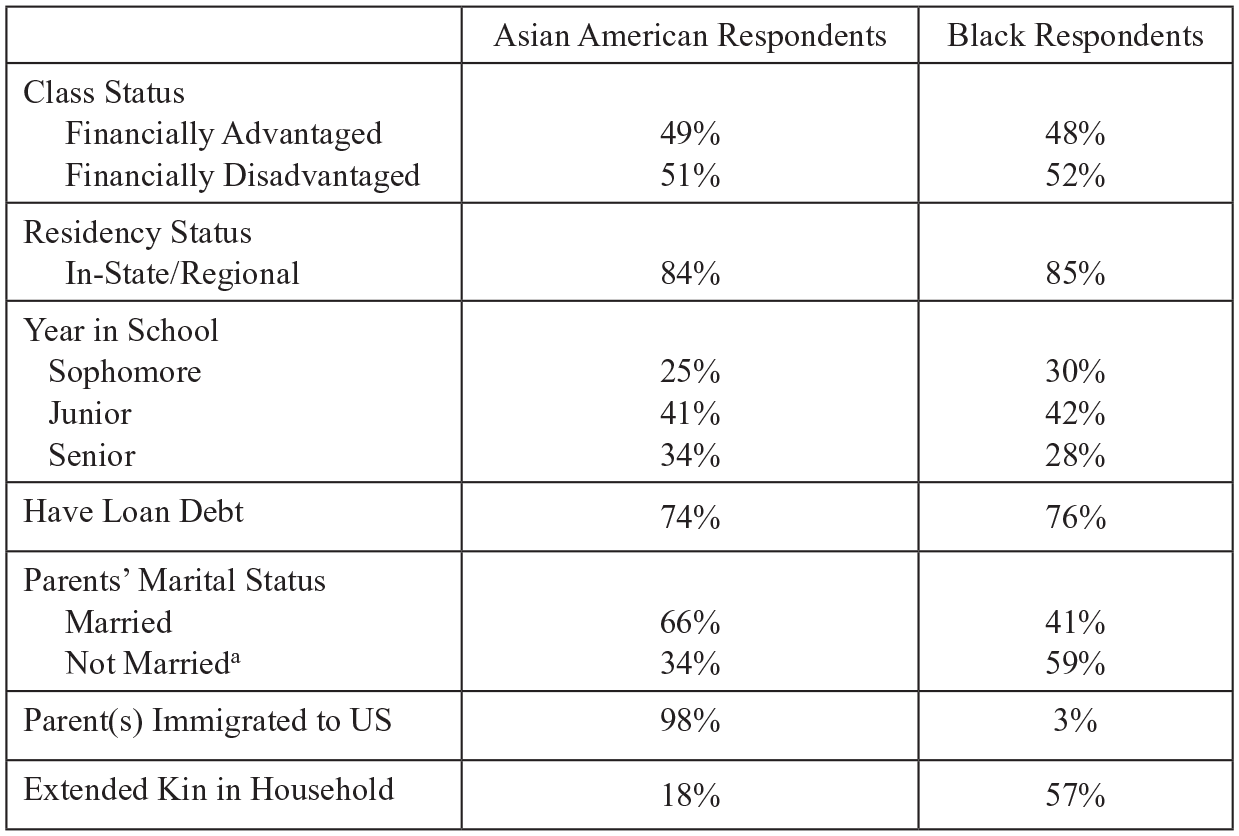
Sample characteristics by race.
Figure 1 also shows pronounced differences between the racial groups. Asian American respondents were more likely than Black respondents to come from households with married parents and less likely than Black respondents to come from households with extended kin. Almost all of the Asian American students had at least one parent who was an immigrant to the United States while almost none of the Black students did.
Racial differences existed in GPA (data from university registrar): Advantaged and disadvantaged Asian American students had similar GPAs with a median GPA of 3.29 and 3.36, respectively. Black students’ GPA varied by class status: Advantaged Black students had a median GPA of 3.0 while disadvantaged Black students had a median GPA of 2.21.
Results
Race and class jointly shape Asian American and Black students’ perceptions of the financial assistance that they receive from as well as that they give to family—whether in their experience of the short term (during college) or their plans for the long term (after college). First, we address variation in students’ receipt of financial assistance from family—suggesting that class affects this financial transfer. Second, we show how race and class intersect to affect which family members—whether parents, siblings, extended kin—college students can and do rely on for material support. Third, we show that students—especially disadvantaged Black students—are not just the recipients of financial assistance; these students are especially likely to give back in college. Fourth, we discuss how class and race also affect which family members students provide support. Finally, we discuss how these financial exchanges shape students’ subjective experience of struggle and strain.
Class Differences in the Receipt of Financial Assistance
Unsurprisingly, advantaged students receive far more monetary support from their parents than disadvantaged students. However, challenging racial stereotypes, we find few racial differences. Some advantaged Black and Asian American students indicated that their parents covered the majority, if not all of, their educational expenses, including their tuition and fees, housing, and school supplies. And they often seemed to take for granted this support. An advantaged Black woman, Nia, stated, “My parents pay for my college. They give me money for books and other expenses—100 percent of it.” When asked how he was paying for college, Huy, an advantaged Asian American man conveyed, “[My mom] just pays the [bill] herself, because she doesn’t want me to go to college with loans.” It was common for advantaged students to report having at least some money in loans. But even those who indicated having loans often said that their parents were currently helping pay them off or would be once they graduated.
A portion of the advantaged students suggested that their parents only paid for their educational expenses, but just as many said that they also received extra spending money from their parents. Some of these latter students discussed a set amount of spending money or allowance that their parents sent at routine intervals (sometimes monthly, sometimes by the semester). Others stated that they were given money whenever they asked for it. An advantaged Black woman, Melanie, discussed the substantial funding her parents provided: I’m taken care of by my family while I’m away at school. I have an emergency credit card for just in case and I also get enough money from my mom and dad whenever for whatever. They want to make me feel comfortable.
Sometimes parents expected their children maintain a certain GPA in order to receive these funds, but students typically explained that these stipulations were quite lenient and easy to meet.
Disadvantaged students—both Black and Asian American students—spoke very differently about their parents’ provision of financial support. Most disadvantaged Asian American and Black students explained that they relied heavily, if not exclusively on loans, scholarships, and grants to fund their college educations. When asked how she was paying for college, a disadvantaged Asian American woman, Aimee, responded, “The majority is financial aid, and then whatever financial aid doesn’t cover, I take out a private loan.” Adding to this, another disadvantaged Asian American woman, Trina, commented, “My loans are a lot more than what [my parents] are paying.”
Disadvantaged students also understood that their experience was not universal. Many commented on their financial disadvantage. Trina went on to explain why she had taken out loans. She said, “Our income in general is not high. My mom just got laid off.” When discussing how they were funding their college education, all disadvantaged Black students, to varying degrees, drew comparisons between themselves and their seemingly more advantaged peers. Marvina, a disadvantaged Black woman explained, I pay for college mostly through loans. Like, I’m maxed out with the amount of loans I receive. What isn’t paid for by loans, I pay out of my own pocket by working. I know my experience is different from the kids in my classes that get money shoved down their throats by their parents. I have to scramble for money all by myself.
Another disadvantaged Black student, Devon, makes evident his awareness of inequality: It just seems like most students here don’t have a care in the world, especially not about money. I go into the financial aid office so much to talk about my financial situation that they know me by name. I rely on loans and my Pell Grant. It’s not like that for a lot of other students here. Many of them don’t worry about staying in school or not from one semester to the next.
At the same time, knowing that their family members struggled financially, many disadvantaged Black and Asian American men and women resisted attempting to turn to their parents for financial help. Instead, they employed strategies to avoid financially burdening them. A typical refrain for these students was: “I never ask [my parents] for money.” Arianna, a Black woman remarked, “Everyone in my family is struggling, so I don’t ask them for money.” Or as a disadvantaged Asian American woman, Savita, commented, “My way of taking care of my dad is not expensing him more than he needs to be expensed.” Disadvantaged students often expressed wishing that their parents could provide more. Yet no student reported feeling hostility toward their parents due to their lack of funding, often making it a point to note that financial disadvantage rather than desire limited it.
The Meaning of Family: Racial Differences in Who Gives
Although we have seen that Asian American and Black students are quite similar when they talked about receiving financial assistance, there were racial differences. These racial differences appeared in the ways advantaged and disadvantaged students spoke of the meaning, organization, and role of family.
Though parents were the predominant providers of financial support for advantaged students, some advantaged Black students said that extended kin also provide funding toward their education. Describing how he was paying for college, an advantaged Black man, Vincent, indicated: “My mom and dad and my grandfather all pay. I think the loans are in my grandfather’s name.” Tamia, an advantaged Black woman explained how extended kin gave her money for other expenses: “My grandmother usually pays for my books. Every now and then my older cousin does.” In contrast, none of the advantaged Asian American students spoke of such reliance on extended kin. When they spoke of these relatives, they tended to say that the only money they received from members of their family beyond the nuclear family came in the form of gifts during holidays or other special occasions.
Compared to advantaged Black students, disadvantaged Black students reported that their parents, extended kin, as well as fictive kin pooled their monetary resources to support the college-going student. Jessica, a disadvantaged Black woman, described her family members’ financial contributions as mini donations: They kind of all just supported me when I was first going off to college. They knew that every dollar counted, so my mom, my mom’s boyfriend, my oldest sister, my cousins, and aunts they would sometimes only have $5, $10, to spare. It all added up.
Leon, a disadvantaged Black man, compared this compiling of resources to a collection plate: College time comes and it’s basically like a collection plate. My aunts and uncles, family friends all help. The church we go to takes up “college fund” donation for me. They do what they can so that I have a little bit of cash when I go back to campus.
Disadvantaged Black students talk of this broad collective support as a natural, normal way of doing family. In this way not only are they—and some advantaged Black students—different from what other research suggests about white students; they are also different from the Asian American students we interviewed. And these Black college students (whose college enrollment indicates their relative success) simultaneously call into question the view of Black families as somehow broken or pathological. Instead, they talk of their families as different but functioning and valued. Their way of “doing family” entailed an emphasis on collectivism that included receiving financial assistance from extended and sometimes fictive kin.
Disadvantaged Asian American students, on the other hand, tended to talk less about either extended or fictive kin. For these students, when they spoke of those other than parents giving money, they often talked of siblings pooling their resources to pay for college. Most disadvantaged Asian American students—whose sibling(s) had already graduated college and worked fulltime—indicated that their sibling put at least some money toward their tuition costs or other education related expenses. Rahit, an Asian American man, said his older sister contributed between $100 and $200 each month. Jillian, a disadvantaged Asian American woman said, “[My brother’s] making [a lot of money], so he doesn’t mind paying for some of my student loans. [My parents] are both on welfare and receiving Medicaid, so they can’t really afford to pay for my education.” A few suggested a sibling paid for most, if not all, of their tuition. These disadvantaged students, however, made it clear that their siblings financial contributions went exclusively toward their education; thus, their receipt of support, still did not measure up to that of advantaged Asian American and Black students who often received spending money as well.
Interestingly, disadvantaged Black students rarely referenced siblings as being among those who pooled resources, possibly because most were the first in their family to attend college—suggesting that their older siblings likely had fewer financial means to help. While we found these differences in receiving support by race among the disadvantaged students, we found no gender difference in any of the groups.
Giving Assistance: Differences in Students’ Provision of Financial Assistance
Far less research looks at the other side: undergraduates’ giving support to their families. But this was a key part of the story that disadvantaged students—both Black and Asian American—told us. These students talked of such financial support in two different ways—giving while in college and expectations for giving after college. This varied by race and it again intersected with class; that is, racial differences appeared only among the disadvantaged.
Advantaged Black and Asian American students are again not very different: Seldom did these students report ever having to or feeling obligated to assist any of their family members financially—either while in college or after. Some explained that they would be happy to financially assist their family members but that their family members did not need—and would likely reject—such assistance. Kevin, an advantaged Black man demonstrated his family’s lack of financial need, when asked if he had ever given them money: No, because there really hasn’t been a reason to. My grandfather has most of the money in the family so if anyone fell on hard times, he’d be the one that people would go to.
Raisa, an advantaged Asian American woman, seemed shocked when asked if she planned to provide future financial support to her family: They never ask me for anything financial. I would even be the one telling my mom I will be in charge of my younger brother when he is going to college. And she is like, “No, why would you do that? You have your own life.”
These advantaged students’ remarks suggest that in some ways they share a similar view of family as disadvantaged students of their respective race: The advantaged Black student spoke about a broad range of family members while the advantaged Asian American student spoke primarily about parents and sometimes siblings. Still, their class advantage removed their actual intentions of supplying monetary support.
Among the disadvantaged though, there were significant differences by race. Far more than the disadvantaged Asian American students, most disadvantaged Black students reported that they felt an obligation to provide financial support to their families during college. This is the only area where gender proved salient for Black students: Both disadvantaged Black women and men talked about giving money during college as essential for their family to thrive and, in some cases, survive. We find, however, that these Black men and women each framed support through a gendered lens.
Disadvantaged Black men tended to perceive their financial contributions to the family as their “duty” as “the man.” Often raised by single mothers, many saw themselves as their families’ primary breadwinner. Giving assistance while at college was a way to ensure that their families stay afloat. The oldest of eight, a Black disadvantaged student, Martrez, who calls himself “the man of the house” states how his mother and younger siblings rely on him financially for basic needs: My mom has a disability, so she can’t work at all. But she and my little sisters and brothers still have to eat. Some might think, like, hey, he’s still in school, he shouldn’t be doing this, but I have to do this. I wouldn’t be able to sleep at night. I’m still the man of the house even though I go to school. I work at least 20 hours a week, sometimes more, just so I can send money home so my mom can pay bills. They’re counting on me.
While not all Black men spoke in such stark ways as Martrez and few mentioned siblings in particular, many spoke of the need to make and send money home. Another Black disadvantaged young man, Kahlil, talks about how providing money for his family comes before his academics: Hands down, if it ever comes to it, if I had to choose, my family comes first. If I need to work longer hours to make more money and if working more hours means that I have to miss a final or write a paper because they need me at home, I’ll do it.
In contrast, many disadvantaged Black women gave, but they tended to talk of giving monetarily to a range of family members—not just parents—as a way to pool resources and be a “good daughter.” Minnie relayed, “I’ve been working ever since I’ve been in college. I always send money home every pay period. I don’t think twice about it. It’s what a good daughter does.”
These women also reported giving money largely due to self-imposed expectations and feelings that they “left the family” by going away to college. Kasia talks about assisting her family and her attempts to remain a “good daughter” even from a distance: Leaving and going away to college was probably the hardest thing that I’ve ever done. I felt like I was leaving the family even though I’m only a few hours away. I felt like I was a bad daughter for saying, okay, I’m going to live this other life at this other place and go to school. I get a refund check every semester and I always give my family half of that.
As these comments illustrate, both disadvantaged Black women and men talk about giving, but they engage in gendered assessments—for these men giving is a continuation of an “adultified” position as a son (Burton 2007), sustaining their sense of duty. For women giving is a way to continue as a daughter, in something of a subordinate role—that of a good child who feels obligated to care for kin. In part, this gendered lens used by the disadvantaged Black students may be tied to their household composition and parents’ marital status: Because so many of these women and men grew up with single mothers, Black men could view themselves as the head or “the man” of the household while Black women did not see themselves assuming the adultified position in the household.
Disadvantaged Asian American students—men and women—were different; in fact, most did not provide money to family during college. A few reported helping to pay for their family’s groceries or other smaller expenses. A disadvantaged Asian American woman, Angela, explained: “Like phone bills or if I come home sometimes, and I know that they don’t have the finances to pay for certain things then like whatever extra I have then I just pay that off.” A disadvantaged Asian American man, Frank, said: “For like small things like food and groceries and stuff. They’re like, ‘can you buy these groceries for me?’ And I’m just like, ‘okay.’ I’m not going to be a stickler if you’re like, ‘oh give me $40 for groceries.’ But it was rare for these students to discuss—as the Black students did—giving significant financial support to their families. In fact, most disadvantaged Asian American young men and women said that their families discouraged them from doing so, insisting that this would detract from their children’s studies and (as we will see) their future financial obligations to family. When asked if she currently contributes to her family financially, Grace, a disadvantaged Asian American woman replied, ‘No . . . They don’t even want me to work. They just like want me to focus on my grades.’ A number explained this expectation in cultural terms. Their parents were raised in Asia where education is prioritized. Thus, they believed that the only way to assimilate and advance was to graduate from college which meant not financially supporting their parents during college but, instead, waiting until after college. Communicating her awareness of this expectation, Charuka, a disadvantaged Asian American woman, explained: ‘After grad school when I get a job, that’s when I know the expectation is going to lie on my shoulder.’
Giving Assistance in the Future: A Sense of Reciprocity
Although there were clear racial differences in disadvantaged students’ giving money while still in college, they shared a similar view of life after college. As described, advantaged students, across race, did not talk about giving after college. In contrast, most disadvantaged Black as well as Asian American students talked about planning to provide for their families after graduation. To them, college success was a family affair. Most of these men as well as women said that as soon as they finished their education—and found work—they would begin giving their parents money in regular intervals. Discussing her future plans to provide monetary aid, a disadvantaged Asian American woman, Jenny, said, “Once I’m stable then I would give [my parents] money every month from my paycheck.” Tymeisha, a disadvantaged Black woman, expressed, “My biggest priority is getting out of here [Flagship], getting a good paying job right off the bat, so I can start working and take care of my family.” Many disadvantaged students described large financial contributions they intended to make (e.g., they expected to pay for the entirety of their families’ home mortgage payments and other bills).
Though we did not observe gender differences in disadvantaged students’ discussion of providing future monetary assistance, some disadvantaged Asian American students perceived this behavior was gendered. That is, several disadvantaged Asian American women conveyed that Asian American men—more so than Asian American women—had a greater responsibility for the future financial care of their parents. Charuka commented, “In my culture, it’s so much like the first male—the first son—they’re expected to take care of the family until they get married.” Another, Feng Mian, expressed: “If I were a male. . . [my parents] would probably have high expectations of me. And probably they would expect me to. . .[financially] support them for the future.” A third student, Bian—who did not have a brother—felt that she had taken on the expectations typically held for Asian American men. She said, “I feel like I’ve been doing a boy’s job in my family. I’ve been like the independent one. I have to take care of my parents. I have to take care of myself. I have to take care of everyone.” Thus, these disadvantaged Asian American women seemed to believe gender mattered in their provision of support, but the interview data revealed otherwise. According to students’ own accounts, men and women were equally likely to discuss providing future financial care of their parents. It may be that these students are buying into cultural stereotypes of Asian Americans—which associate men with the breadwinner ideal (Ide et al. 2018)—rather than speaking to gender differences that exist in their actual experiences.
The Meaning of Family: Racial Differences in Whom Students Provide for
As with the receipt of money, there were racial differences in the models of family life that our respondents believed in and practiced when they spoke of giving money. Disadvantaged Black students again discussed a broad model of family. In college, they described giving money to their single mothers, but many also said that they financially supported other family members as well. Recall Martrez who spoke of supporting his younger siblings. Nikki, a disadvantaged Black woman commented, “I give a portion of what I make to my mom and grandma.” Still another disadvantaged Black man, Joe, described, “My aunt lives with us and so I help her too. I try to send money to both my mom and her every month.” Disadvantaged Black students also used this broad model of family when describing their plans to support their families in the future. Discussing this, Jay, a disadvantaged Black man said: “I’m expected to help out financially . . . help pay bills that my mom, my aunts, and grandpa have.” Providing financial support to parents—especially mothers—was important for disadvantaged Black students, but the notion of giving money clearly went beyond parents.
In contrast, most disadvantaged Asian American students spoke of providing monetary assistance only to parents. Describing his goals for after graduation, Bruce, a disadvantaged Asian American man said, “Get a good paying job so I can support my family: my mom and dad.” This finding reflects an adherence to filial piety. It may also be a result of our sample. While many disadvantaged Asian American students had older college-educated siblings helping pay for their education, only a select few had younger siblings who would be in college once they entered the workforce and thereby could benefit from this assistance. Drew, who had younger siblings, explained that he intended to help pay for his two younger sisters’ college costs, as his older sister was currently helping pay for his tuition. He stated, “The younger two sisters who also have to go to college, I’m definitely going to have to help pay for that.” Thus, monetary exchanges for these students, both received and provided, were largely confined to the nuclear family and focused on higher education. Seldom did Asian American students mention giving to grandparents or other kin, perhaps because they were likely to have immigrant parents and so many of their relatives still lived abroad; even fewer students mentioned future remittances to them (because we focused on students, we do not know if their parents provided such remittances; other research suggests that many immigrant parents do, Yang 2011).
The Subjective Consequences of Receiving and Providing Financial Assistance
Our final question is: What are the consequences of these different patterns of financial support? How and why does students’ receipt and provision of financial assistance matter for their subjective experience of college? Overall, we found an inverse relationship between financial assistance and a sense of strain and struggle among these students. This was largely because of struggles around time.
Because they often felt they had enough money and got much support from their parents, advantaged students talked little—if at all— about how money created struggles in college for them. Part of this was because they had more time to focus on academic work, social life and resume-building. Substantiating what other scholarship has found, these advantaged students were less likely to work during the school year than the disadvantaged students. Francis, an advantaged Asian American man explained that he did not work during the school year because, “I prefer to use that time for school and friends.” Isaiah, an advantaged Black man put it differently, “My main job here is to keep my grades up. All I really have to do is worry about my classes and stuff like that.” A number of these students said that their parents dissuaded them from working during the school year. An advantaged Asian American woman, Anna, described what her parents had told her when she asked them if she should find a job, “No, you don’t have to work. You’re doing okay. Just hold your money. Just take our money.” To be sure, some advantaged students did work, but they often explained that they opted to do so for professional development purposes—to enhance their résumés—rather than for the money they received (i.e., they expected that this work would benefit their future success). It was also common for advantaged students to be involved in multiple unpaid extracurricular and volunteer activities.
In contrast, disadvantaged students—Black and Asian American—who did not receive much financial support from their families but tended to give back to them often spoke of struggling with budgeting money and their schedules. Frank, a disadvantaged Asian American man said his financial strategy was simple, “Don’t spend money.” Another disadvantaged Asian American man, Ryan, explained, “I haven’t been buying books ever [laughing].” When asked, “Is that because of the money or . . . ?” He answered, “Yes . . . I make friends who have books, and we work together.”
Many of these economically disadvantaged students said that this strict budgeting was sometimes stressful, especially when they saw what they thought of as free spending habits of some of their advantaged peers. Precious, a disadvantaged Black woman explained, I really don’t have any friends here because I don’t want people to judge me. Honestly, I’m probably one of the poorest people here at this school. Like, I’m never able to go out like all the rest of the kids on my floor do because I don’t have any money. I can’t ever eat outside of the dining commons or chip in for pizza on Friday nights like a lot of the kids on my floor do on Friday nights, because I don’t have any money. And sometimes I’m like, maybe I shouldn’t torture myself and be this committed to staying in college like what’s the point, you know?
Precious questioned whether she should leave the university due to her financial struggles.
Jamie, a disadvantaged Asian American man, did temporarily leave school instead of trying to combine college attendance with working for pay, saying “I took a half semester off and worked at an accounting firm. And I was working like 60, 70 hours a week.” But Jamie also explained this was intentional: He and his mom did not want his work to interfere with his academics.
It was disadvantaged Black students who most often indicated that they worked long hours in college—in positions they did not view as resume-boosters—to pay their expenses. Ariana, a disadvantaged Black woman described her multiple positions, saying “I pay for everything myself, everything. I have a work-study job that I go to in between my classes and I’m trying to work at McDonald’s too.” A few disadvantaged Asian American students also noted their long work hours. A disadvantaged Asian American woman Nadia, remarked, “Between working and schoolwork and wanting to sleep, there’s not much time.” However, most—like Jamie who opted to forgo a semester of school to work but reduced his work hours upon returning to college—had far fewer job obligations in college.
Many disadvantaged Black students felt that working long hours negatively impacted their grades in ways that created more stress for them. Stacey, a disadvantaged Black woman with a 2.0 GPA, explained her low GPA by saying: “I just feel stretched in so many directions. I spend way too many hours putting in job applications and searching for jobs that it takes my focus off of studying.” Carlton, a disadvantaged Black male, used this same reasoning to explain his low GPA of 1.91. He said, “All I do is work, go to class, and sleep. I work nights, so a lot of times when I get off, the last thing that I want to do is study.” Disadvantaged Asian American students did not talk of this struggle and the reduced grades it caused, perhaps because they were much less likely to work long hours to support themselves and their families. This likely helps explain why, on average, their GPAs were similar to advantaged Black and Asian American students.
Providing for their families, however, had some positive effects on students. A disadvantaged Asian American man, Ryan, indicated that needing to provide financial support motivated his decision to attend college: I was kind of on the fence about like going to college or not, and my parents were just like, “You have to go to college.” And I told them like I really didn’t have an idea of what I wanted to study. But they said, “We just want you to have a college education, just because it’s important, and you need to support us in the future.” So, I couldn’t say no.
Many others explained that it motivated to complete college and find high-paying work.
Thus, intending to financially support one’s family could inspire students to achieve academic and economic success at the same time as this process created substantial stress for them. Tien, a disadvantaged Asian American woman, had initially felt motivated by her intentions, but no longer felt this way: At first it was really motivating, but now it’s kind of really stressful . . . And it really goes down to me and my sister if we can be successful enough to be able to take care of [my parents]. They never want to put that burden on us, but I can see they’re getting old.
Keisha, a disadvantaged Black woman described how she felt immense pressure to provide financially—in her case to grandparents—in the long-term: I have to be able to take care of myself and my grandparents in the future . . . So, I work hard each day because I know they’re waiting on me to get this degree so they can retire and I can take care of them. If I can’t do that, I’ll feel about this low, like a failure.
Natalie, a disadvantaged Black woman, also expresses the feeling of stress associated with the thought of giving back financially to family in the future: It’s a ton of weight on my shoulders that I feel all the time. There’s a lot of pressure placed on me to work hard, not only for myself, but for my family too, so that I can help out, help pay for it all. I feel so stressed about it.
Disadvantaged students indicated they faced not only objective but also subjective inequalities because of their intentions to provide future support and these were shared across race by the disadvantaged students.
Disadvantaged Asian American students though felt less of a sense of struggle than disadvantaged Black students for another reason; for these students, siblings again were key. Disadvantaged Asian American students who had siblings providing parental support suggested that this reduced their own intentions of future assistance. Aarav, an Asian American student remarked, “When I’m done with college, my oldest brother will probably be doing a lot of the [financial] taking care of [my parents]. Just because he’s like seven years older, and he’s more settled.” Conversely, respondents who did not have siblings providing financial assistance often said the opposite. Because their siblings did not provide this help, it made students feel they needed to give or would be giving greater amounts of assistance in the future. An Asian American woman, Jenny relayed that it had become her duty to help her parents, because her sisters were not financially supporting them: My oldest [sister] is still in school. She’s in grad school, so she doesn’t have a job . . . My second sister . . . She goes out every week. So even if she wanted to pay my parents, she doesn’t have the money for it because she has to pay all these debts back. And my third sister she is still looking for a job, because she just graduated . . . I feel that it puts a lot of pressure on me because . . . personally I feel that once I graduate college, I need to find a job and I need to help [my parents] pay for everything. Because no offense, but I don’t really rely on my other sisters.
Ryan, the disadvantaged Asian American man who said he had no choice but to financially support his family in the future, explained that he had not always felt this way. He initially believed one of his older siblings would take on this responsibility: I wasn’t the one expecting to contribute to the family. It went down the list. It was ultimately my sister because my sister like helped out the family so much. And the fact that they kicked her out, they have like put this burden on me. Because, by the time [they kicked her out], my brother was in the National Guard. And eventually he left, so they couldn’t rely on him. Um, and then, [my other brother], who I love to death, but he won’t be able to support the family. He can barely support himself [because of his disability]. And so, it all came down on me in like a split second. And I was not expecting this.
Overall, disadvantaged Black and Asian American students spoke of greater struggle and strain than advantaged students. Yet some racial differences emerged among the disadvantaged students. Disadvantaged Black students faced a greater sense of struggle because of their greater job obligations. Also, for the disadvantaged Asian American students, siblings’ provision of support—in both the short and long term—seemed to reduce their sense of struggle in college.
Conclusion and Discussion
Challenging the image of the autonomous college student, this paper argues that familial financial assistance shapes students’ experiences in multiple ways as they move through the college years. This involvement, however, is not uniform. Building upon an emerging literature, which suggests class affects parents’ provision of support to college students (Armstrong and Hamilton 2013; Hamilton, Roksa, and Nielsen 2018), we argue that analyzing race as well as class and their intersection (e.g., see Crenshaw 1989; Valdes, Culp, and Harris 2002) are key for understanding differences in support and the experience of inequalities in higher education. Additionally, particularly for those economically disadvantaged, we find that financial support—across race—is reciprocal and extensive rather than confined to the nuclear family.
We show that class—more than race—shapes the extent to which students receive and give financial help. Advantaged Black and Asian American students are primarily recipients of support, while disadvantaged students—across race—not only receive less financial support than the advantaged but also give more financial support and have greater expectations for giving in the future. Although class variation is key, we also find racial differences within each class grouping—especially among the disadvantaged.
These differences are rooted in racial frames propelled by structural factors. As Joe Feagin (2013) writes, racial frames provide the language and values that help people interpret, normalize and engage in their worlds. Both disadvantaged Black and Asian American students believed in a frame of collectivism which emphasizes interdependence and joint goals with family members rather than an individualistic frame focusing primarily on the separate needs of individual members. The collectivist versus individualist frames are deeply rooted in class (Billings and Young 2022). We found that these frames are tied to both class and race and their form varies by race. Affirming prior literature (Lamont 2000; Sarkisian and Gerstel 2004), this paper shows that disadvantaged Black students emphasize an intergenerational or vertical model of family—one that entails commitment to exchange financial assistance not only with parents and occasionally siblings but also grandparents, extended kin, and fictive kin, even when doing so increased struggles for them as individuals. While some advantaged Black students also received financial support from extended kin, we found it is the disadvantaged Black students who told us most often that they valued reciprocal financial exchanges during college with a broad range of family members.
In contrast, the disadvantaged Asian American students said they valued “filial piety” toward their parents. Adding complexity, however, to traditional notions of filial piety (Tseng 2004), assistance was often a joint effort among siblings which, in turn, helped parents. Older siblings who had already graduated from college helped pay for younger siblings’ educational costs. Moreover, although many students said they intended to give their parents money after they completed their education, some Asian Americans noted older siblings would join or replace them in providing assistance in these later years and this reduced the pressure to provide. These disadvantaged Asian American students said they understood such sharing not only helped them and their siblings but also helped their parents who faced fewer demands when siblings collectively engaged in support of the family. These students recognized that their parents encounter less “resource dilution” (Roksa 2019) when siblings help one another. Overall, then, we find that although both Blacks and Asian American college students held to a view and narrative of family collectivism, the particular form it took was organized by race.
These racial differences in the value of collectivism are likely at least partially propelled by several structural differences between Blacks and Asian Americans—including macro-economic, immigration, as well as marital/household patterns. First, although our data on differences in students’ family income or wealth are limited, we assume that larger patterns of racism and the associated economic inequality shape students’ expectations. Given broader social inequalities, the disadvantaged Black students likely face greater cumulative intergenerational poverty and have less family wealth than the disadvantaged Asian Americans students (e.g. see Oliver and Shapiro 2019). Compared to Blacks, Asian Americans have higher rates of college attendance (NCES 2020) and have higher median incomes (U.S. Department of Labor 2022), even though as we have argued many are economically disadvantaged. Other research confirms that it is young adults with low SES, who are especially likely to be Black, who are likely to give money to their parents (Lanuza 2020) and more likely to value financial help to extended kin (Gerstel 2011), both of which may deplete their own resources.
Second, variations in frames may be tied to distinctive immigration patterns. Compared to the Black students, Asian American students (nearly all of whom had at least one immigrant parent) spoke of fewer available vertical kin ties at least in this country—for example, to grandparents, aunts or uncles—on whom they relied or to whom they intended to supply future remittances. But siblings are different. As Carol Hafford (2010) finds, close sibling relationships are particularly valued among immigrants, but sibling relationships were important only for disadvantaged Asian American students. Disadvantaged Asian American students had older siblings, who graduated college and secured employment; they often indicated that these brothers and sisters supplied much-needed—and sometimes substantial—funding of college expenses. This helped their parents, too. Disadvantaged Black students, who were often the first or only one in their family to attend college, did not have this luxury. At the same time, few Blacks had immigrant parents; consequently, they could and did rely on a range of extended kin living in the United States.
A third structural difference that may well have shaped the racialized frames and patterns of assistance were students’ living arrangements and parents marital status. Disadvantaged Black students were far more likely to come from households with single mothers and extended kin than disadvantaged Asian American students who tended to come from households with married parents and siblings (again, in part due to immigration patterns). These distinct family structures shaped both the receipt and provision of financial support for disadvantaged students. The difference in family models and structures we find among these two groups of students supports a theoretical literature suggesting that research all too often uses a narrow nuclear model that is biased toward understanding white family patterns but overlooks the families of people of color (Cross 2018; Yosso 2005).
We not only looked at the variation in patterns of support but their subjective consequences and found disadvantaged Black and Asian American students experienced guilt and strain as a result of these financial exchanges. Prior qualitative work documents “family achievement guilt” among Asian American students (Covarrubias et al. 2021), but this research does not include Black students. The disadvantaged Black students in our study endured substantially more struggle and strain than the disadvantaged Asian American students. Many took jobs, often with extensive hours, so they could both support themselves as well as give money to family, including not only mothers but other kin as well. Disadvantaged Asian American students tended to worked fewer hours for pay; while they spoke frequently about reciprocation, they emphasized that this would occur only after college. In addition, fewer had extended kin whom they felt a need to support and more had siblings on whom they could rely; these likely further reduced their sense of struggle. Perhaps this helps explains the lower GPAs of Black students compared to Asian Americans. Josipa Roksa and Peter Kinsley (2018) find that family’s emotional support is beneficial for college students’ academic outcomes; financial support, however, was not significantly related to the objective measures of GPA. Yet, that is not what the students in our study indicate. Although jobs made it possible to support the families they valued, disadvantaged Black students said their jobs made it harder for them to find the time and energy to focus on college classes.
Our data do not indicate that disadvantaged Asian American place greater emphasis on education and earning a college degree than Blacks. Families of disadvantaged Blacks and Asian Americans see college as key for children’s success (See also Kim 1993). We did, however, find racial differences in the ways in which students said their families conceptualized what it takes to persist in college. For example, financially disadvantaged Black families and students believed that working during college, even in a service sector job, would better prepare them for the world of work following graduation. As one disadvantaged Black student, Rebecca said of her service job at Wendy’s: “I work to support myself and my family but I’m also doing it so that I’m ready for life after [Flagship].” Disadvantaged Asian American families did not think participation in the labor market would serve their college students well; instead, these students said their parents believed this work would detract from their educational achievement (see also, Gibbs et al. 2017; Tang, Kim, and Haviland 2013).
There are clear limits to what we present here. This study did not capture other important variations such as students’ year in school (i.e., the ways in which familial financial exchanges and the college experience of sophomores, juniors, and seniors are different). We focused on students who do not live with family members during the academic school year. This truncates the students’ family engagement and is in a way tied to class: Disadvantaged students more often live with family members. Consequently, we have likely understated the involvement with family of economically disadvantaged students—both in terms of what they provide and what they receive. Moreover, we focused on the struggle of students who are in college—presumably some drop out because these become too great to continue in school.
At its core, though, this paper provides a rationale for more higher education policies and practices that address inequalities and increase opportunities for students of color from diverse family backgrounds. Higher education can cost a significant amount of money; students talked of not only having to cover tuition but also about paying for accommodations like room and board, learning resources such as textbooks, and other general living costs. For those students who come from disadvantaged backgrounds and feel the need to assist their families economically, having to cover these costs can be stressful and negatively affect their academic performance.
Many have proposed that access to postsecondary education should be a national priority. This paper points to the pervasive equity gaps that exist within our higher education system. There is still much debate needed on causes and effect, but the trends are clear—social mobility in the U.S. is slowing down and too many students from financially disadvantaged backgrounds are unable to move up through education. State governments continue to reduce aid for public higher education, making it increasingly out of reach for the neediest students. In the meantime, as costs escalate, grant dollars pay for less. Federal educational policy should target funds to those who need them most, yet some policies provide help mainly to financially advantaged students and their families. We need to reset our educational policy priorities to recognize and overcome the ongoing inequalities rooted in the amount and type of ongoing family assistance. A growing number of colleges and universities are establishing offices to interact with “families” (Savage and Petree 2015). But such offices—like the one we examined at Flagship—tend to develop policies to involve parents but rarely other family members; they send newsletters to parents, have web sites for parents, and set up “parent orientation programs” (Wiggins 2020). They rarely recognize the range of kin involved with students. Our paper provides a compelling case that colleges should recognize the ways in which their policy and outreach intensifies inequalities by race and class during and likely following the college years.
While loans, grants, and scholarships are sometimes available, our students’ comments suggest other ways an institution can make a student’s college experience more affordable and less stressful. The disadvantaged talked of sharing books or skipping meals that their peers could afford. Some activists have begun to insist that providing low-cost food on campus can help reduce such inequality. Some universities have student-run food pantries, but many still do not. Colleges and universities can partner with bookstores in the community and sell secondhand books and provide student discounts when they hand in used textbooks. Further, instructors can opt to use open access readings in order to reduce financial costs. Overall, our analyses indicate the university should play a greater role—in small and large ways—to reduce the class and race-based inequalities that result from college students’ diverse involvement with families.
Footnotes
Declaration of Conflicting Interests
The author(s) declared no potential conflicts of interest with respect to the research, authorship, and/or publication of this article.
Funding
The author(s) received no financial support for the research, authorship, and/or publication of this article.